WASHINGTON, D.C. — Weighing in on a case that will significantly impact expression on Facebook, Twitter and other social networks, The Rutherford Institute has asked the U.S. Supreme Court to reverse the conviction of a Pennsylvania man who was charged with making unlawful threats (it was never proven that he intended to threaten anyone) and sentenced to 44 months in jail after he posted allusions to popular song lyrics and comedy routines on his Facebook page.
The Rutherford Institute’s amicus brief in Anthony D. Elonis v. United States of America argues that the First Amendment protects even inflammatory statements that may give offense or cause concern to others unless the statements were a credible threat to engage in violence against another and made by the defendant with the intent to cause fear in the alleged victim. The case arises out of Facebook postings made by Anthony Elonis expressing his anger about events in his life, and which were based upon rap lyrics of artists such as Eminem and a comedy sketch of the group The Whitest Kids U’ Know.
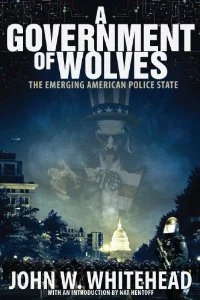
“Whether it’s a Marine arrested for criticizing the government on Facebook or an ex-husband jailed for expressing his frustrations through rap lyrics on Facebook, the end result is the same—the criminalization of free speech,” said John W. Whitehead, president of The Rutherford Institute and author of A Government of Wolves: The Emerging American Police State. “While social media and the Internet have become critical forums for individuals to freely share information and express their ideas, they have unfortunately also become tools for the government to monitor, control and punish the populace for behavior and speech that may be controversial but are far from criminal.”
Anthony Elonis was an active poster on Facebook who often used references to popular culture to express his views, feelings and frustration about events in his life. In May 2010, after Elonis’ wife left him and took his two children, he began listening to rap music and alluding to the sometimes violent lyrics of rap songs on his Facebook page. Elonis would couple these postings with statements acknowledging that the lyrics were fictitious and that he was simply exercising his First Amendment right of expression. After his estranged wife obtained a protection order against him, Elonis posted a reference to a comedy sketch of The Whitest Kids U’ Know about threatening language that Elonis changed to include a reference about harming his wife. In another post, Elonis used the lyrics of Eminem in which the rap artist included fantasized thoughts about shooting up a school. After federal agents were alerted to some of his postings, an investigator was sent to speak with Elonis. In response, Elonis posted rap lyrics he wrote containing fantasized language about having a bomb strapped to his body and doing violence to the agent.
In response to these postings, the federal government charged Elonis under a statute making it a crime to transmit in interstate commerce any communication containing a threat to injure another. Elonis was convicted on four counts of violating this statute but appealed his conviction, arguing that the government should have been required to prove that he intended to threaten the alleged victims, not simply that the victims could reasonably have believed the words were “true threats.” In weighing in on the case before the U.S. Supreme Court, Rutherford Institute attorneys argue that “in order to protect the First Amendment rights of speakers, courts must ensure that they are criminalizing more than just the unrealized and unrealizable fears of particularly sensitive listeners.”
In a related case, The Rutherford Institute is also representing Marine veteran Brandon Raub, who was arrested, detained in a psychiatric ward, and forced to undergo psychological evaluations based solely on the controversial nature of lines from song lyrics, political messages and virtual card games which he posted to his private Facebook page.
“If you don’t want to get shot, tased, pepper-sprayed, struck with a baton or thrown to the ground, just do what I tell you. Don’t argue with me, don’t call me names, don’t tell me that I can’t stop you, don’t say I’m a racist pig, don’t threaten that you’ll sue me and take away my badge. Don’t scream at me that you pay my salary, and don’t even think of aggressively walking towards me. Most field stops are complete in minutes. How difficult is it to cooperate for that long?”—Sunil Dutta, an officer with the Los Angeles Police Department for 17 years
For those who resist, who dare to act independently, think for themselves, march to the beat of a different drummer, the consequences are invariably a one-way trip to the local jail or death.
What Americans must understand, what we have chosen to ignore, what we have fearfully turned a blind eye to lest the reality prove too jarring is the fact that we no longer live in the “city on the hill,” a beacon of freedom for all the world.
Far from being a shining example of democracy at work, we have become a lesson for the world in how quickly freedom turns to tyranny, how slippery the slope by which a once-freedom-loving people can be branded, shackled and fooled into believing that their prisons walls are, in fact, for their own protection.
In a war zone, you have no rights. When you are staring down the end of a police rifle, there can be no free speech. When you’re being held at bay by a militarized, weaponized mine-resistant tank, there can be no freedom of assembly. When you’re being surveilled with thermal imaging devices, facial recognition software and full-body scanners and the like, there can be no privacy. When you’re charged with disorderly conduct simply for daring to question or photograph or document the injustices you see, with the blessing of the courts no less, there can be no freedom to petition the government for a redress of grievances.
And when you’re a prisoner in your own town, unable to move freely, kept off the streets, issued a curfew at night, there can be no mistaking the prison walls closing in.
This is not just happening in Ferguson, Missouri. As I show in my book A Government of Wolves: The Emerging American Police State, it’s happening and will happen anywhere and everywhere else in this country where law enforcement officials are given carte blanche to do what they like, when they like, how they like, with immunity from their superiors, the legislatures, and the courts.
You see, what Americans have failed to comprehend, living as they do in a TV-induced, drug-like haze of fabricated realities, narcissistic denial, and partisan politics, is that we’ve not only brought the military equipment used in Iraq and Afghanistan home to be used against the American people. We’ve also brought the very spirit of the war home.
This is what it feels like to be a conquered people. This is what it feels like to be an occupied nation. This is what it feels like to live in fear of armed men crashing through your door in the middle of the night, or to be accused of doing something you never even knew was a crime, or to be watched all the time, your movements tracked, your motives questioned.
This is what it’s like to be a citizen of the American police state. This is what it’s like to be an enemy combatant in your own country.
So if you don’t want to get shot, tased, pepper-sprayed, struck with a baton or thrown to the ground, by all means, stand down. Cower in the face of the police, turn your eyes away from injustice, find any excuse to suggest that the so-called victims of the police state deserved what they got.
But remember, when that rifle finally gets pointed in your direction—and it will—when there’s no one left to stand up for you or speak up for you, remember that you were warned.
It works the same in every age. Martin Niemoller understood this. A German pastor who openly opposed Hitler and spent the last seven years of Nazi rule in a concentration camp, Niemoller warned:
First they came for the Socialists, and I did not speak out—Because I was not a Socialist. Then they came for the Trade Unionists, and I did not speak out—Because I was not a Trade Unionist. Then they came for the Jews, and I did not speak out—Because I was not a Jew. Then they came for me—and there was no one left to speak for me.
“Is life so dear, or peace so sweet, as to be purchased at the price of chains and slavery? I know not what course others may take; but as for me, give me liberty or give me death!”–Patrick Henry
Imagine living in a country where armed soldiers crash through doors to arrest and imprison citizens merely for criticizing government officials. Imagine that in this very same country, you’re watched all the time, and if you look even a little bit suspicious, the police stop and frisk you or pull you over to search you on the off chance you’re doing something illegal. Keep in mind that if you have a firearm of any kind while in this country, it may get you arrested and, in some circumstances, shot by police.
If you’re thinking this sounds like America today, you wouldn’t be far wrong. However, the scenario described above took place more than 200 years ago, when American colonists suffered under Great Britain’s version of an early police state. It was only when the colonists finally got fed up with being silenced, censored, searched, frisked, threatened, and arrested that they finally revolted against the tyrant’s fetters.
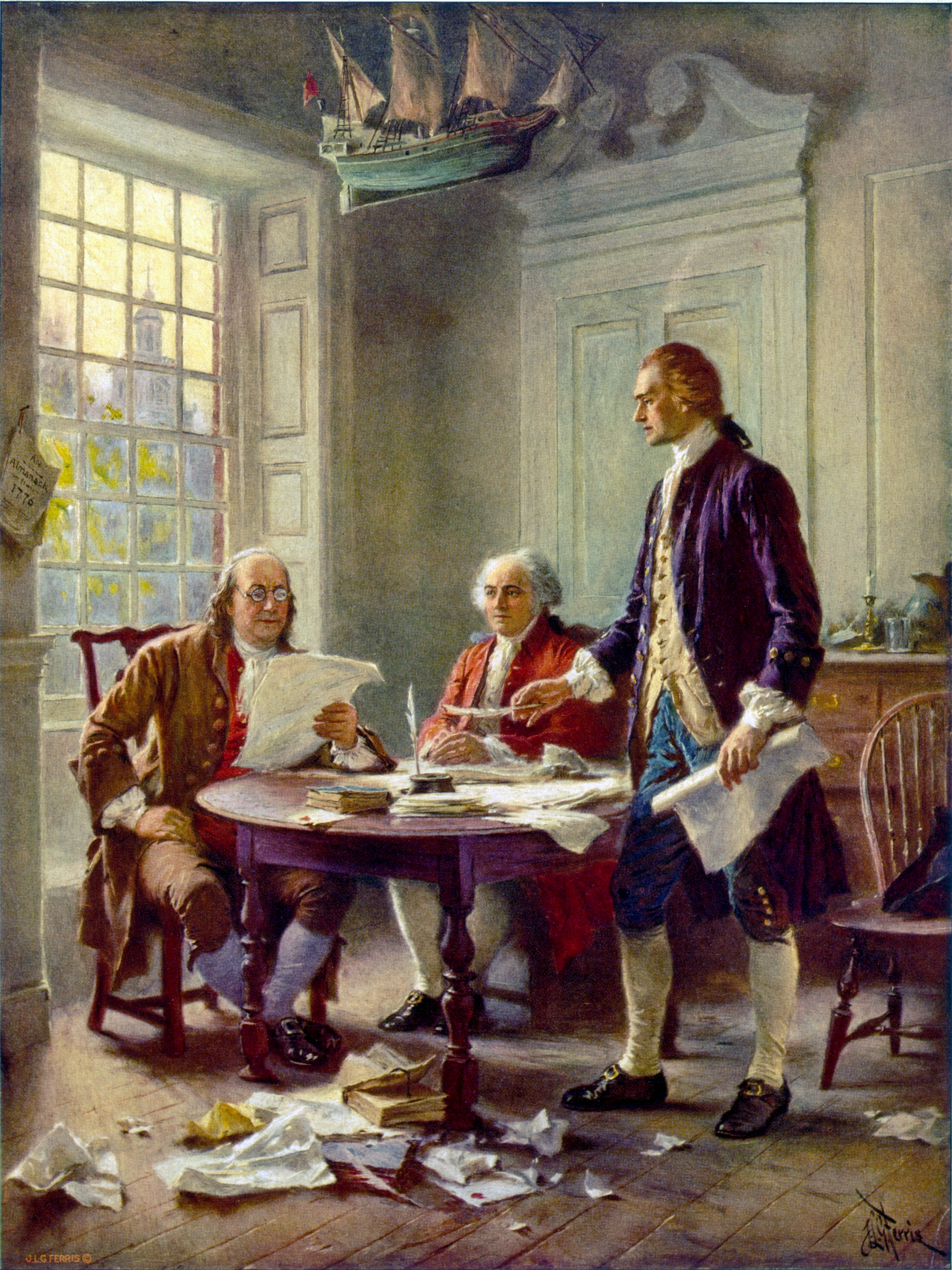
No document better states their grievances than the Declaration of Independence. A document seething with outrage over a government which had betrayed its citizens, the Declaration of Independence was signed on July 4, 1776, by 56 men who laid everything on the line, pledged it all–“our Lives, our Fortunes, and our sacred Honor”–because they believed in a radical idea: that all people are created to be free.
Labeled traitors, these men were charged with treason, a crime punishable by death. For some, their acts of rebellion would cost them their homes and their fortunes. For others, it would be the ultimate price–their lives. Yet even knowing the heavy price they might have to pay, these men dared to speak up when silence could not be tolerated. Even after they had won their independence from Great Britain, these new Americans worked to ensure that the rights they had risked their lives to secure would remain secure for future generations. The result: our Bill of Rights, the first ten amendments to the Constitution.
Imagine the shock and outrage these 56 men would feel were they to discover that 238 years later, the government they had risked their lives to create has been transformed into a militaristic police state in which exercising one’s freedoms is often viewed as a flagrant act of defiance. Indeed, had the Declaration of Independence been written today, it would have rendered its signers terrorists, resulting in them being placed on a government watch list, targeted for surveillance of their activities and correspondence, and potentially arrested, held indefinitely, stripped of their rights and labeled enemy combatants.
The Second Amendment was intended to guarantee “the right of the people to keep and bear arms.” Yet while gun ownership has been recognized as an individual citizen right, Americans continue to face an uphill battle in the courts when it comes to defending themselves against militarized, weaponized government agents armed to the hilt. In fact, court rulings in recent years have affirmed that citizens don’t have the right to resist police officers who enter their homes illegally, mistakenly or otherwise.
The Third Amendment reinforces the principle that civilian-elected officials are superior to the military by prohibiting the military from entering any citizen’s home without “the consent of the owner.” Unfortunately, the wall of separation between civilian and military policing has been torn down in recent years, as militarized SWAT teams are now allowed to burst into homes unannounced in order to investigate minor crimes such as marijuana possession and credit card fraud. With domestic police increasingly posing as military forces–complete with weapons, uniforms, assault vehicles, etc.–a good case could be made for the fact that SWAT team raids constitute the forced quartering of soldiers within the private home, which the Third Amendment was written to prevent.
The Fourth Amendment prohibits government agents from touching you or placing you under surveillance or entering your property without probable cause and even then, only with a court-sanctioned warrant. Unfortunately, the Fourth Amendment has been all but eviscerated in recent years by court rulings and government programs that sanction all manner of intrusions, including giving police carte blanche authority to break into homes or apartments without a warrant, conduct roadside strip searches, and generally manhandle any person in manner they see fit. Moreover, in the so-called name of national security, intelligence agencies like the National Security Agency now have the ability to conduct mass unwarranted electronic intrusions into the personal and private transactions of all Americans, including phone, mail, computer and medical records. All of this data is available to other government agencies, including local police.
The Fifth Amendment is supposed to ensure that you are innocent until proven guilty, and government authorities cannot deprive you of your life, your liberty or your property without following strict legal guidelines. Unfortunately, those protections have been largely extinguished in recent years, especially in the wake of Congress’ passage of the National Defense Authorization Act (NDAA), which allows the president and the military to arrest and detain Americans indefinitely without due process.
The Sixth Amendment was intended to not only ensure a “speedy and public trial,” but it was supposed to prevent the government from keeping someone in jail for unspecified offenses. That too has been a casualty of the so-called war on terror. Between the NDAA’s indefinite detention clause and the Authorization to Use Military Force (AUMF) legislation, which has been used as justification for using drones to kill American citizens in the absence of a court trial, the Sixth Amendment’s guarantees become meaningless.
The Seventh Amendment guarantees citizens the right to a jury trial. However, when the populace has no idea of what’s in the Constitution–civic education has virtually disappeared from most school curriculums–that inevitably translates to an ignorant jury incapable of distinguishing justice and the law from their own preconceived notions and fears.
The Eighth Amendment is similar to the Sixth in that it is supposed to protect the rights of the accused and forbid the use of cruel and unusual punishment. However, the Supreme Court’s determination that what constitutes “cruel and unusual” should be dependent on the “evolving standards of decency that mark the progress of a maturing society” leaves us with little protection in the face of a society lacking in morals altogether. America’s continued reliance on the death penalty, which has been shown to be flawed in its application and execution, is a perfect example of this.
The Ninth Amendment provides that other rights not enumerated in the Constitution are nonetheless retained by the people. Popular sovereignty–the belief that the power to govern flows upward from the people rather than downward from the rulers–is clearly evident in this amendment. However, it has since been turned on its head by a centralized federal government that sees itself as supreme and which continues to pass more and more laws that restrict our freedoms under the pretext that it has an “important government interest” in doing so. Thus, once the government began violating the non-enumerated rights granted in the Ninth Amendment, it was only a matter of time before it began to trample the enumerated rights of the people, as explicitly spelled out in the rest of the Bill of Rights.
As for the Tenth Amendment‘s reminder that the people and the states retain every authority that is not otherwise mentioned in the Constitution, that assurance of a system of government in which power is divided among local, state and national entities has long since been rendered moot by the centralized Washington, DC power elite–the president, Congress and the courts. Indeed, the federal governmental bureaucracy has grown so large that it has made local and state legislatures relatively irrelevant. Through its many agencies, the federal government has stripped states of the right to regulate countless issues that were originally governed at the local level.
Thus, even on those rare occasions when the courts provide us with a slight glimmer of hope that all may not be lost, those brief reprieves of judicial sensibility are quickly overwhelmed by a bureaucratic machine that continues to march relentlessly in lockstep with the police state.
This brings me back to those 56 men who risked everything–their fortunes and their lives–to speak truth to power in that sweltering Philadelphia heat 238 summers ago. Of those 56 signers, 9 died during the Revolution, 5 were captured by British soldiers, 18 had their homes looted and burned by the Red Coats, 2 were wounded in battle and 2 lost their sons during the war. Remarkably, these men–who were community leaders, business owners, judges, lawyers and inventors–sacrificed their lives, their fortunes and their sacred honor so that you and I could live freely in a nation where we have the right to stand up and speak out against tyrannical government. In the face of torture and even death, they did not waver.
The choice before us is clear. In the words of Patrick Henry, will we choose dangerous freedom or peaceful slavery?
“[I]f the individual is no longer to be sovereign, if the police can pick him up whenever they do not like the cut of his jib, if they can ‘seize’ and ‘search’ him in their discretion, we enter a new regime. The decision to enter it should be made only after a full debate by the people of this country.”—U.S. Supreme Court Justice William O. Douglas
The U.S. Supreme Court was intended to be an institution established to intervene and protect the people against the government and its agents when they overstep their bounds. Yet as I point out in my book A Government of Wolves: The Emerging American Police State, Americans can no longer rely on the courts to mete out justice. In the police state being erected around us, the police and other government agents can probe, poke, pinch, taser, search, seize, strip and generally manhandle anyone they see fit in almost any circumstance, all with the general blessing of the courts.
These are the hallmarks of the emerging American police state: where police officers, no longer mere servants of the people entrusted with keeping the peace, are part of an elite ruling class dependent on keeping the masses corralled, under control, and treated like suspects and enemies rather than citizens.
A review of the Supreme Court’s rulings over the past 10 years, including some critical ones this term, reveals a startling and steady trend towards pro-police state rulings by an institution concerned more with establishing order and protecting government agents than with upholding the rights enshrined in the Constitution.
Police officers can use lethal force in car chases without fear of lawsuits. In Plumhoff v. Rickard (2014), the Court declared that police officers who used deadly force to terminate a car chase were immune from a lawsuit. The officers were accused of needlessly resorting to deadly force by shooting multiple times at a man and his passenger in a stopped car, killing both individuals.
Police officers can stop cars based only on “anonymous” tips. In a 5-4 ruling in Navarette v. California (2014), the Court declared that police officers can, under the guise of “reasonable suspicion,” stop cars and question drivers based solely on anonymous tips, no matter how dubious, and whether or not they themselves witnessed any troubling behavior. This ruling came on the heels of a ruling by the Tenth Circuit Court of Appeals in U.S. v. Westhoven that driving too carefully, with a rigid posture, taking a scenic route, and having acne are sufficient reasons for a police officer to suspect you of doing something illegal, detain you, search your car, and arrest you—even if you’ve done nothing illegal to warrant the stop in the first place.
Secret Service agents are not accountable for their actions, as long as they’re done in the name of security. In Wood v. Moss (2014), the Court granted “qualified immunity” to Secret Service officials who relocated anti-Bush protesters, despite concerns raised that the protesters’ First Amendment right to freely speak, assemble, and petition their government leaders had been violated. These decisions, part of a recent trend toward granting government officials “qualified immunity”—they are not accountable for their actions—in lawsuits over alleged constitutional violations, merely incentivize government officials to violate constitutional rights without fear of repercussion.
Citizens only have a right to remain silent if they assert it. The Supreme Court ruled in Salinas v. Texas (2013) that persons who are not under arrest must specifically invoke their Fifth Amendment privilege against self-incrimination in order to avoid having their refusal to answer police questions used against them in a subsequent criminal trial. What this ruling says, essentially, is that citizens had better know what their rights are and understand when those rights are being violated, because the government is no longer going to be held responsible for informing you of those rights before violating them.
Police have free reign to use drug-sniffing dogs as “search warrants on leashes,” justifying any and all police searches of vehicles stopped on the roadside. In Florida v. Harris (2013), a unanimous Court determined that police officers may use highly unreliable drug-sniffing dogs to conduct warrantless searches of cars during routine traffic stops. In doing so, the justices sided with police by claiming that all that the police need to do to prove probable cause for a search is simply assert that a drug detection dog has received proper training. The ruling turns man’s best friend into an extension of the police state.
Police can forcibly take your DNA, whether or not you’ve been convicted of a crime. In Maryland v. King (2013), a divided Court determined that a person arrested for a crime who is supposed to be presumed innocent until proven guilty must submit to forcible extraction of their DNA. Once again the Court sided with the guardians of the police state over the defenders of individual liberty in determining that DNA samples may be extracted from people arrested for “serious offenses.” While the Court claims to have made its decision based upon concerns of properly identifying criminal suspects upon arrest, what they actually did is open the door for a nationwide dragnet of suspects targeted via DNA sampling.
Police can stop, search, question and profile citizens and non-citizens alike. The Supreme Court declared in Arizona v. United States (2012) that Arizona police officers have broad authority to stop, search and question individuals—citizen and non-citizen alike. While the law prohibits officers from considering race, color, or national origin, it amounts to little more than a perfunctory nod to discrimination laws on the books, while paving the way for outright racial profiling and destroying the Fourth Amendment.
Police can subject Americans to virtual strip searches, no matter the “offense.” A divided Supreme Court actually prioritized making life easier for overworked jail officials over the basic right of Americans to be free from debasing strip searches. In its 5-4 ruling in Florence v. Burlington (2012), the Court declared that any person who is arrested and processed at a jail house, regardless of the severity of his or her offense (i.e., they can be guilty of nothing more than a minor traffic offense), can be subjected to a virtual strip search by police or jail officials, which involves exposing the genitals and the buttocks. This “license to probe” is now being extended to roadside stops, as police officers throughout the country have begun performing roadside strip searches—some involving anal and vaginal probes—without any evidence of wrongdoing and without a warrant.
Immunity protections for Secret Service agents trump the free speech rights of Americans. The court issued a unanimous decision in Reichle v. Howards (2012), siding with two Secret Service agents who arrested a Colorado man simply for daring to voice critical remarks to Vice President Cheney. However, contrast the Court’s affirmation of the “free speech” rights of corporations and wealthy donors in McCutcheon v. FEC (2014), which does away with established limits on the number of candidates an entity can support with campaign contributions, and Citizens United v. FEC (2010) with its tendency to deny those same rights to average Americans when government interests abound, and you’ll find a noticeable disparity.
Police can break into homes without a warrant, even if it’s the wrong home. In an 8-1 ruling in Kentucky v. King (2011), the Supreme Court placed their trust in the discretion of police officers, rather than in the dictates of the Constitution, when they gave police greater leeway to break into homes or apartments without a warrant. Despite the fact that the police in question ended up pursuing the wrong suspect, invaded the wrong apartment and violated just about every tenet that stands between us and a police state, the Court sanctioned the warrantless raid, leaving Americans with little real protection in the face of all manner of abuses by police.
Police can interrogate minors without their parents present. In a devastating ruling that could very well do away with what little Fourth Amendment protections remain to public school students and their families—the Court threw out a lower court ruling in Camreta v. Greene (2011), which required government authorities to secure a warrant, a court order or parental consent before interrogating students at school. The ramifications are far-reaching, rendering public school students as wards of the state. Once again, the courts sided with law enforcement against the rights of the people.
It’s a crime to not identify yourself when a policeman asks your name. In Hiibel v. Sixth Judicial District Court of the State of Nevada (2004), a majority of the high court agreed that refusing to answer when a policeman asks “What’s your name?” can rightfully be considered a crime under Nevada’s “stop and identify” statute. No longer will Americans, even those not suspected of or charged with any crime, have the right to remain silent when stopped and questioned by a police officer.
The cases the Supreme Court refuses to hear, allowing lower court judgments to stand, are almost as critical as the ones they rule on. Some of these cases, turned away in recent years alone, have delivered devastating blows to the rights enshrined in the Constitution.
Legally owning a firearm is enough to justify a no-knock raid by police. Justices refused to hear Quinn v. Texas (2014) the case of a Texas man who was shot by police through his closed bedroom door and whose home was subject to a no-knock, SWAT-team style forceful entry and raid based solely on the suspicion that there were legally-owned firearms in his household.
The military can arrest and detain American citizens. In refusing to hear Hedges v. Obama (2014), a legal challenge to the indefinite detention provision of the National Defense Authorization Act of 2012 (NDAA), the Supreme Court affirmed that the President and the U.S. military can arrest and indefinitely detain individuals, including American citizens. In so doing, the high court also passed up an opportunity to overturn its 1944 Korematsu v. United States ruling allowing for the internment of Japanese-Americans in concentration camps.
Students can be subjected to random lockdowns and mass searches at school. The Court refused to hear Burlison v. Springfield Public Schools (2013), a case involving students at a Missouri public school who were subjected to random lockdowns, mass searches and drug-sniffing dogs by police. In so doing, the Court let stand an appeals court ruling that the searches and lockdowns were reasonable in order to maintain the safety and security of students at the school.
Police officers who don’t know their actions violate the law aren’t guilty of breaking the law. The Supreme Court let stand a Ninth Circuit Court of Appeals decision in Brooks v. City of Seattle (2012) in which police officers who clearly used excessive force when they repeatedly tasered a pregnant woman during a routine traffic stop were granted immunity from prosecution. The Ninth Circuit actually rationalized its ruling by claiming that the officers couldn’t have known beyond a reasonable doubt that their actions—tasering a pregnant woman who was not a threat in any way until she was unconscious—violated the Fourth Amendment.
When all is said and done, what these assorted court rulings add up to is a disconcerting government mindset that interprets the Constitution one way for the elite—government entities, the police, corporations and the wealthy—and uses a second measure altogether for the underclasses—that is, you and me.
Keep in mind that in former regimes such as Nazi Germany and the Soviet Union, the complicity of the courts was the final piece to fall into place before the totalitarian beast stepped out of the shadows and into the light. If history is a guide, then the future that awaits us is truly frightening.
WASHINGTON, DC — Ruling in two separate cases in Plumhoff v. Rickard and Wood v. Moss, the U.S. Supreme Court has once again refused to hold law enforcement officials accountable for allegedly violating citizens’ constitutional rights. In the first case, the Court dismissed complaints against police officers who were involved in a fatal shooting, despite Fourth Amendment concerns that the officers needlessly resorted to a deadly use of force, and in the second, the Court granted “qualified immunity” to Secret Service officials who relocated anti-Bush protesters, despite concerns raised that the protesters’ First Amendment right to freely speak, assemble, and petition their government leaders had been violated. Noting that these decisions are part of a recent trend toward granting government officials “qualified immunity” in lawsuits over alleged constitutional violations, John W. Whitehead, president of The Rutherford Institute, warned that such rulings incentivize government officials to violate constitutional rights without fear of repercussion.
“Not a day goes by without reports of police officers overstepping the bounds of the Constitution and brutalizing, terrorizing and killing the citizenry. Indeed, the list of incidents in which unaccountable police abuse their power, betray their oath of office and leave taxpayers bruised, broken and/or killed grows longer and more tragic by the day to such an extent that Americans are now eight times more likely to die in a police confrontation than they are to be killed by a terrorist,” said constitutional attorney John W. Whitehead, author of A Government of Wolves: The Emerging American Police State. “This lawlessness on the part of government officials, an unmistakable characteristic of a police state, is made possible in large part by the courts, which increasingly defer to law enforcement and prioritize security over civil liberties. In so doing, the government gives itself free rein to abuse the law, immune from reproach, and we are all the worse off for it.”
In Wood v. Moss, the Ninth Circuit Court of Appeals found that Secret Service agents who removed only anti-Bush protesters (while allowing pro-Bush supporters standing on an adjacent street to remain) were not immune from lawsuit on First Amendment grounds, and had to make a showing that their actions were not unlawfully motivated by the viewpoint of the protesters. In reversing the Ninth Circuit, the U.S. Supreme Court held that the protesters’ rights to “equal access to the President” were not clearly established under the law, and that the agents’ actions were not motivated by the viewpoint of the protesters.
In Plumhoff v. Rickard, the Sixth Circuit Court of Appeals ruled that police officers who used lethal force against a man fleeing police in a high speed car chase were not immune from a wrongful death suit, and that the case should continue to trial. In Plumhoff, the deceased plaintiff led police officers on a high-speed car chase, which came to a halt after his car was spun out in a parking lot. Officers proceeded to fire three shots at the stopped vehicle, then fired an additional 12 shots as the vehicle backed away, eventually killing both the driver and passenger of the vehicle. The Sixth Circuit held that it could not conclude that the officers’ conduct was reasonable as a matter of law, and instead should proceed to a fact finder. In reversing the Sixth Circuit’s decision, the Supreme Court held that the officers’ use of deadly force to terminate the car chase did not violate the Fourth Amendment and the officers were immune from suit.
How do you persuade a nation of relatively freedom-loving individuals to march in lock step with a police state? You start by convincing them that they’re in danger, and only the government can protect them. Keep them keyed up with constant danger alerts, and the occasional terrorist incident, whether real or staged. Distract them with wall-to-wall news coverage about sinking ships, disappearing planes and pseudo-celebrities spouting racist diatribes. Use blockbuster movies, reality shows and violent video games to hype them up on military tactics, and then while they’re distracted and numb to all that is taking place around them, indoctrinate their young people to your way of thinking, relying primarily on the public schools and popular culture.
After all, public education the world over has always been the vehicle for statist propaganda of one sort or another, whether it’s religion, militarism, democracy or totalitarianism, and America is no exception. In fact, today’s public schools, far from being bastions of free speech, are merely microcosms of the world beyond the schoolhouse gates, and increasingly, it’s a world hostile to freedom.
As I show in my book A Government of Wolves: The Emerging American Police State, within America’s public schools can be found almost every aspect of the American police state that plagues those of us on the “outside”: metal detectors, surveillance cameras, militarized police, drug-sniffing dogs, tasers, cyber-surveillance, random searches, the list goes on. Whether it takes the form of draconian zero tolerance policies, overreaching anti-bullying statutes, police officers charged with tasering and arresting so-called unruly children, standardized testing with its emphasis on rote answers, political correctness, or the extensive surveillance systems cropping up in schools all over the country, young people in America are first in line to be indoctrinated into compliant citizens of the new American police state.
Zero tolerance policies, which punish all offenses severely, no matter how minor, condition young people to steer clear of doing anything that might be considered out of line, whether it’s pointing their fingers like a gun, drawing on their desks, or chewing their gum too loudly. Although the Obama administration recently called on schools to rethink how they discipline and punish students who misbehave, their guidelines to help schools re-evaluate their disciplinary policies fail to address the source of the problem: the quasi-prison atmosphere of public schools.
Surveillance technologies, used by school officials, police, NSA agents, and corporate entities to track the everyday activities of students, accustom young people to life in an electronic concentration camp, with all of their movements monitored, their interactions assessed, and their activities recorded and archived. For example, the Department of Education (DOE) has created a system to track, archive and disseminate data on every single part of a child’s educational career with colleges and state agencies such as the Department of Labor and the offices of Technology and Children and Family Services. The system relies on a database called inBloom, which is funded by corporate magnates such as the Bill and Melinda Gates Foundation and Rupert Murdoch’s News Corp. DOE has also received $40 million from various state and federal agencies to help fund the program.
Standardized testing and Common Core programs, which discourage students from thinking for themselves while rewarding them for regurgitating whatever the government, through its so-called educational standards, dictates they should be taught, will create a generation of test-takers capable of little else, molded and shaped by the federal government and its corporate allies into what it considers to be ideal citizens. Incredibly, despite the fact that the U.S. invests more money in public education (roughly $8,000 per child per year) than many other developed countries, we rank 27th in the world for school educational achievement.
What’s really unnerving, however, are the similarities between our own system of youth indoctrination and that of Nazi Germany, with its Hitler Youth programs and overt campaign of educational indoctrination. Now before I’m drowned out by howls of outrage, note that while I am not suggesting the United States is deliberately attempting to raise up a generation of Hitler Youth, our schools and society at large are teaching young people to march in lockstep with the all-powerful government—which may be just as dangerous in the end.
We’re certainly not doing ourselves or our young people any favors by allowing them to be indoctrinated into a police state mindset from early on, with no knowledge that they have any their rights or any sense that they are the descendants of revolutionaries who stood up to tyrannical regimes.
If there is one glimmer of hope for this younger generation, it may be found in the unlikeliest of places: young adult literature, specifically dystopian literature, which is all the rage among young people today. Serial books such as Harry Potter, The Hunger Games, The Bone Season and The Giver all speak to a growing awareness among young people that the future awaiting them is far from secure, and that freedom ultimately rests in their ability to take on the powers-that-be.
“Those who make peaceful revolution impossible will make violent revolution inevitable.”—John F. Kennedy
Those tempted to write off the standoff at the Bundy Ranch as little more than a show of force by militia-minded citizens would do well to reconsider their easy dismissal of this brewing rebellion. This goes far beyond concerns about grazing rights or the tension between the state and the federal government.
What we’re really faced with, and what we’ll see more of before long, is a growing dissatisfaction with the government and its heavy-handed tactics by people who are tired of being used and abused and are ready to say “enough is enough.” And it won’t matter what the issue is—whether it’s a rancher standing his ground over grazing rights, a minister jailed for holding a Bible study in his own home, or a community outraged over police shootings of unarmed citizens—these are the building blocks of a political powder keg. Now all that remains is a spark, and it need not be a very big one, to set the whole powder keg aflame.
As I show in my book A Government of Wolves: The Emerging American Police State, there’s a subtext to this incident that must not be ignored, and it is simply this: America is a pressure cooker with no steam valve, and things are about to blow. This is what happens when a parasitical government muzzles the citizenry, fences them in, herds them, brands them, whips them into submission, forces them to ante up the sweat of their brows while giving them little in return, and then provides them with little to no outlet for voicing their discontent.
The government has been anticipating and preparing for such an uprising for years. For example, in 2008, a U.S. Army War College report warned that the military must be prepared for a “violent, strategic dislocation inside the United States,” which could be provoked by “unforeseen economic collapse,” “purposeful domestic resistance,” “pervasive public health emergencies” or “loss of functioning political and legal order”—all related to dissent and protests over America’s economic and political disarray. Consequently, predicted the report, the “widespread civil violence would force the defense establishment to reorient priorities in extremis to defend basic domestic order and human security.”
Despite “no specific information that domestic rightwing terrorists are currently planning acts of violence,” the DHS listed a number of scenarios that could arise as a result of so-called rightwing extremists playing on the public’s fears and discontent over various issues, including the economic downturn, real estate foreclosures and unemployment.
Equally disconcerting, the reports use the words “terrorist” and “extremist” interchangeably. In other words, voicing what the government would consider to be extremist viewpoints is tantamount to being a terrorist. Under such a definition, I could very well be considered a terrorist. So too could John Lennon, Martin Luther King Jr., Roger Baldwin (founder of the ACLU), Patrick Henry, Thomas Jefferson and Samuel Adams—all of these men protested and passionately spoke out against government practices with which they disagreed and would be prime targets under this document.
The document also took pains to describe the political views of those who would qualify as being a rightwing extremist. For example, you are labeled a rightwing extremist if you voice concerns about a myriad of issues including: policy changes under President Obama; the economic downturn and home foreclosures; the loss of U.S. jobs in manufacturing and construction sectors; and social issues such as abortion, interracial crimes and immigration. DHS also issued a red-flag warning against anyone who promotes “conspiracy theories involving declarations of martial law, impending civil strife or racial conflict, suspension of the U.S. Constitution, and the creation of citizen detention camps.”
Fast forward five years, with all that has transpired, from the Occupy Protests and the targeting of military veterans to domestic surveillance, especially of activist-oriented groups and now, most recently, the Bundy Ranch showdown, and it would seem clear that the government has not veered one iota from its original playbook. Indeed, the government’s full-blown campaign of surveillance of Americans’ internet activity, phone calls, etc., makes complete sense in hindsight.
It’s not just the Cliven Bundys of the world who are being dealt with in this manner. Don Miller, a 91-year-old antiques collector, recently had his Indiana home raided by the FBI, ostensibly because it might be in the nation’s best interest if the rare and valuable antiques and artifacts Miller had collected over the course of 80 years were cared for by the government. Such tactics carried out by anyone other than the government would be considered grand larceny, and yet the government gets a free pass.
When law enforcement officials—not just the police, but every agent of the government entrusted with enforcing laws, from the president on down—are allowed to discard the law when convenient, and the only ones having to obey the law are the citizenry and not the enforcers, then the law becomes only a tool to punish us, rather than binding and controlling the government, as it was intended.
This phenomenon is what philosopher Abraham Kaplan referred to as the law of the instrument, which essentially says that to a hammer, everything looks like a nail. In the scenario that has been playing out in recent years, we the citizenry have become the nails to be hammered by the government’s henchmen, a.k.a. its guns for hire, a.k.a. its standing army, a.k.a. the nation’s law enforcement agencies.
That is exactly what we are witnessing today: a war against the American citizenry. Is it any wonder then that Americans are starting to resist?
More and more, Americans are tired, frustrated, anxious, and worried about the state of their country. They are afraid of an increasingly violent and oppressive federal government, and they are worried about the economic insecurity which still grips the nation. And they’re growing increasingly sick of being treated like suspects and criminals. As former law professor John Baker, who has studied the growing problem of overcriminalization, noted, “There is no one in the United States over the age of 18 who cannot be indicted for some federal crime. That is not an exaggeration.”
So if average Americans, having largely lost all of the conventional markers of influencing government, whether through elections, petition, or protest, have no way to impact their government, no way to be heard, no assurance that their concerns are truly being represented and their government is one “by the people, of the people, and for the people,” as opposed to being engineered expressly for the benefit of the wealthy elite, then where does that leave them?
Unfortunately, the intrepid, revolutionary American spirit that stood up to the British, blazed paths to the western territories, and prevailed despite a civil war, multiple world wars, and various economic depressions has taken quite a beating in recent years. Nevertheless, the time is coming when each American will have to decide: will you be a slave, rebel or revolutionary?
Outrageous examples of wasteful government spending from Sen. Coburn’s 2013 ‘Wastebook’
“To force a man to pay for the violation of his own liberty is indeed an addition of insult to injury.”—Benjamin Tucker, 19th century advocate of American individualist anarchism
I promise this is no belated April Fools’ joke. These are actual line items paid for by American taxpayers, whose tax dollars continue to be wasted on extravagant, unnecessary items that serve no greater purpose than to fatten the wallets of corporations and feed political graft (such as the $1 million bus stop, complete with heated benches and sidewalks which can only shelter 15 people and provides little protection from rain, snow, or the sun).
In doing so, the justices expanded on the Court’s landmark 2010 ruling in Citizens United v. FEC, which not only gave unfettered free speech rights to corporations but paved the way for corporations to spend unlimited amounts of money promoting candidates, especially presidential candidates. What this does, of course, is turn the ballot box into an auction block, wherein those who are “elected” to public office are bought and paid for by those who can afford to support their campaigns—namely, lobbyists, corporations and high-dollar donors. (Then again, perhaps it will remain status quo. According to a 2013 study by Trinity University, U.S. Senators do not take into account the opinions and wishes of their lower class constituents. Rather, their voting was aligned with their upper class constituents. This dismissal of lower class opinion held true for both Republican and Democratic Senators, themselves made up of millionaires.)
When all is said and done, what we are witnessing is the emergence of a disconcerting government mindset that interprets the Constitution one way for corporations, government entities and the wealthy, and uses a second measure altogether for average Americans. For example, contrast the Supreme Court’s affirmation of the “free speech” rights of corporations and wealthy donors in McCutcheon and Citizens United with its tendency to deny those same rights to average Americans when government interests abound, such as in its 2012 decision in Reichle v. Howards, where a unanimous Supreme Court allowed immunity protections for Secret Service agents to trump the free speech rights of Americans, and you’ll find a noticeable disparity.
This is a far cry from how a representative government is supposed to operate. Indeed, it has been a long time since we could claim to be the masters of our own lives. Rather, we are now the subjects of a militarized, corporate empire in which the vast majority of the citizenry work their hands to the bone for the benefit of a privileged few.
Adding injury to the ongoing insult of having our tax dollars misused and our so-called representatives bought and paid for by the moneyed elite, the government then turns around and uses the money we earn with our blood, sweat and tears to target, imprison and entrap us, in the form of militarized police, surveillance cameras, private prisons, license plate readers, drones, and cell phone tracking technology.
All of those nefarious deeds that you read about in the paper every day: those are your tax dollars at work. It’s your money that allows for government agents to spy on your emails, your phone calls, your text messages, and your movements. It’s your money that allows out-of-control police officers to burst into innocent people’s homes, or probe and strip search motorists on the side of the road. And it’s your money that leads to innocent Americans across the country being prosecuted for innocuous activities such as raising chickens at home, growing vegetable gardens, and trying to live off the grid.
There was a time in our history when our forebears said “enough is enough” and stopped paying their taxes to what they considered an illegitimate government. They stood their ground and refused to support a system that was slowly choking out any attempts at self-governance, and which refused to be held accountable for its crimes against the people. Their resistance sowed the seeds for the revolution that would follow.
Unfortunately, in the 200-plus years since we established our own government, we’ve let bankers, turncoats and number-crunching bureaucrats muddy the waters and pilfer the accounts to such an extent that we’re back where we started. Once again, we’ve got a despotic regime with an imperial ruler doing as they please. Once again, we’ve got a judicial system insisting we have no rights under a government which demands that the people march in lockstep with its dictates. And once again, we’ve got to decide whether we’ll keep marching or break stride and make a turn toward freedom.
But what if we didn’t just pull out our pocketbooks and pony up to the federal government’s outrageous demands for more money? What if we didn’t just dutifully line up to drop our hard-earned dollars into the collection bucket, no questions asked about how it will be spent? What if, instead of quietly sending in our checks, hoping vainly for some meager return, we did a little calculating of our own and started deducting from our taxes those programs that we refuse to support?
If we don’t have the right to decide what happens to our hard-earned cash, then we don’t have very many rights at all. If they can just take from you what they want, when they want, and then use it however they want, you can’t claim to be anything more than a serf in a land they think of as theirs. This was the case in the colonial era, and it’s the case once again.
This latter point should really stick in your craw. Consider the irony: the government insists it can carry out all manner of surveillance on us—listen in on our phone calls, read our emails and text messages, track our movements, photograph our license plates, even enter our biometric information into DNA databases—but if we dare to return the favor, even a little, we get roughed up by the police, arrested, charged with violating various and sundry crimes (often trumped up), and forced to make restitution.
Leon Rosby was filming a police standoff in June 2013, his cellphone in one hand and his dog’s leash in the other, when three officers approached him. Anticipating a problem, Rosby placed his 2-year-old Rottweiler, Max, in his car. The LA Times reports: “As officers cuffed Rosby, the dog escaped through an open window and began to bark and lunge at officers. One officer tried to grab the dog’s leash, then drew his gun and fired four shots, killing Max. Video of the incident went viral on YouTube, prompting a public outcry and drawing protesters to the Police Department headquarters.” Rosby has now filed a civil rights lawsuit against the city and the three police officers.
“I’m allowed to do this,” the man told the officer.
“Get it out of my face,” the officer replied.
“I have my rights,” the man said.
“You have no rights,” the officer said.
But the man didn’t stop rolling and was once again aggressively approached.
“Do you see the police presence here? Do you see us all? We’re not [expletive] around. Do you understand? Do not disrespect us and do not not listen to us,” the officer said. “Now walk away and shut your [expletive] mouth or you’re going to jail, do you understand?”
After backing away, the officer came at the man a third time, appearing to grab him.
“I thought I had freedom of speech here,” the man said.
“You don’t. You just lost it,” the officer replied.
And that, in a nutshell, is what happens when law enforcement officials—not just the police, but every agent of the government entrusted with enforcing laws, from the president on down—are allowed to discard the law when convenient. At the point where there’s a double standard at play, where the only ones having to obey the law are the citizenry and not the enforcers, then that vital “social contract” that John Locke envisioned as the basis for society breaks down. The more we allow government officials to operate outside the law, the more we ensure that the law becomes only a tool to punish us, rather than binding and controlling the government, as it was intended.
This brings me back to the problem of Americans getting arrested for filming the police. Until recently, this has primarily been a problem experienced by journalists and photographers attempting to document political protests and other disturbances involving the police. However, with the preponderance of smart phones capable of recording audio and video, individuals who dare to record police engaged in questionable or abusive activities in public are increasingly finding themselves on the receiving end of the harsh treatment they intended to document. These videos, if widely distributed, can be a powerful method of subjecting police to closer scrutiny and holding them accountable to respecting the rights of those they are supposed to serve.
Naturally, police agencies and unions have sought out legal prohibitions on such videos from being created. Massachusetts police, for instance, have invoked a state surveillance law to charge citizen video-makers criminally for their actions. Because the state surveillance law requires “two-party” consent, most kinds of public filming can be construed as illegal. Similar laws exist in California, Florida, Illinois, Michigan, and Pennsylvania. The law was enacted to protect private citizens from invasive surveillance, but the police have exploited it to curtail free speech that tarnishes their public image. Police claim that this regulation gives them legal justification to prohibit filming by citizens such as Jeffrey Manzelli, a journalist who recorded the police intimidating protesters at a rally and was arrested and charged under the law.
As part of a $200,000 legal settlement, Indianapolis police will soon be required to remind its officers that citizens have a legal right to videotape on-duty police officers. The case arose after a 66-year-old Indianapolis resident was tackled to the ground, arrested and charged with resisting arrest, disorderly conduct and public intoxication (he was found not guilty of the charges) after he used his cellphone to record police arresting a young man in his neighbor’s driveway. There is also a movement afoot to equip police with on-officer cameras that would provide footage of what an officer sees.
The Garcia case involves a journalist who was arrested and charged with disorderly conduct for filming police as they detained two men. According to the lawsuit, police “dragged Garcia to the police car, put him in handcuffs, threw him to the ground by kicking his feet out from under him, taunted him, threatened to arrest his wife if she came too close and took his camera, and seized the memory card, which was never returned.”
The difficulty we face is that police officers are becoming increasingly thin skinned, less restrained in dealing with the public, and more inclined to conceive every word, gesture, or motion as a threat. In an ideal world, police would recognize that, as public servants, they are rightfully subject to recording and surveillance when carrying out their public duties. Unfortunately, this is far from an ideal world.
So what are we to do?
We must continue to stand up for our rights, record police when the opportunity presents itself, and politely remind any offended officers that they are, in fact, our public servants and, as such, their behavior is subject to public scrutiny. If they disagree and attempt to stop us from recording, we can refer them to the U.S. Constitution, which they have sworn to uphold, which protects our right to record matters of public interest. And if they continue to insist on hauling people to jail because they don’t like the idea of transparency and accountability, they can take it up with the courts. The goal is to eventually arrive at a point where we can keep a watchful eye on our government officials, instead of the other way around. As Justice Louis D. Brandeis once observed, “Sunlight is said to be the best of disinfectants; electric light the most efficient policeman.” — John W. Whitehead
“The First Amendment was intended to secure something more than an exercise in futility.”—Justice John Paul Stevens, dissenting in Minnesota Board for Community Colleges v. Knight (1984)
Living in a representative republic means that each person has the right to take a stand for what they think is right, whether that means marching outside the halls of government, wearing clothing with provocative statements, or simply holding up a sign. That’s what the First Amendment is supposed to be about.
Unfortunately, as I show in my book A Government of Wolves: The Emerging American Police State, through a series of carefully crafted legislative steps and politically expedient court rulings, government officials have managed to disembowel this fundamental freedom, rendering it with little more meaning than the right to file a lawsuit against government officials. In fact, if the court rulings handed down in the last week of February 2014 are anything to go by, the First Amendment has, for all intents and purposes, become an exercise in futility.
On February 26, the U.S. Supreme Court in a 9-0 ruling, held that anti-nuclear activist John Denis Apel could be prosecuted for staging a protest on a public road at an Air Force base, free speech claims notwithstanding, because the public road is technically government property.
Insisting that it’s not safe to display an American flag in an American public school, on February 27, the Ninth Circuit Court of Appeals ruled that school officials were justified when they ordered three students at a California public high school to cover up their patriotic apparel emblazoned with American flags or be sent home on the Mexican holiday Cinco de Mayo, allegedly out of a concern that it might offend Hispanic students.
On February 28, a federal court dismissed Marine veteran Brandon Raub’s case. Despite the fact that Raub was interrogated by Secret Service agents, handcuffed, arrested, subjected to a kangaroo court, and locked up in a mental facility for posting song lyrics and statements on Facebook critical of the government—a clear violation of his free speech rights—the court ruled that Raub’s concerns about the government were far-fetched and merited such treatment.
There you have it: three rulings in three days, from three different levels of the American judicial system, and all of them aimed at suppressing free speech. Yet what most people fail to understand is that these cases are not merely about the citizenry’s right to freely express themselves. Rather, these cases speak to the citizenry’s right to express their concerns about their government to their government, in a time, place and manner best suited to ensuring that those concerns are heard.
The First Amendment gives every American the right to “petition his government for a redress of grievances.” This amounts to so much more than filing a lawsuit against the government. It works hand in hand with free speech to ensure, as Adam Newton and Ronald K.L. Collins report for the Five Freedoms Project, “that our leaders hear, even if they don’t listen to, the electorate. Though public officials may be indifferent, contrary, or silent participants in democratic discourse, at least the First Amendment commands their audience.”
The challenge we face today, however, is that government officials have succeeded in insulating themselves from their constituents, making it increasingly difficult for average Americans to make themselves seen or heard by those who most need to hear what “we the people” have to say. Indeed, while lobbyists mill in and out of the White House and the homes and offices of Congressmen, the American people are kept at a distance through free speech zones, electronic town hall meetings, and security barriers. And those who dare to breach the gap—even through silent forms of protest—are arrested for making their voices heard.
This right to speak freely, assemble, protest and petition one’s government officials for a redress of grievances is front and center right now, with the U.S. Supreme Court set to decide five free speech cases this term, the first of which, U.S. v. Apel, was just handed down. The case was based upon claims brought by John Denis Apel, an anti-war activist who holds monthly protests at Vandenburg Air Force Base near Lompoc, California. While the Court did not uphold his conviction for trespassing on military property, they doubled down on the notion that the public is subject to the whims of military commanders in matters relating to use military property, even when it intersects with public property. The Court refused to rule on Apel’s First Amendment claims.
The Supreme Court is also set to decide McCullen v. Coakley, which will determine whether or not a Massachusetts law which restricts protests on public sidewalks near the entrances, exits, and driveways of abortion clinics in the state is constitutional. The facts of the case indicate that the law does not abide by a reasonable time, place, and manner restriction, and places an undue burden on protestors. However, it’s unclear which way the Court will rule, especially with their refusal to clarify matters in Apel.
Free speech can certainly not be considered “free” when expressive activities across the nation are being increasingly limited, restricted to so-called free speech zones, or altogether blocked, including in front of the Supreme Court’s own plaza. If citizens cannot stand out in the open on a public road and voice their disapproval of their government, its representatives and its policies, without fearing prosecution, then the First Amendment with all its robust protections for free speech, assembly and the right to petition one’s government for a redress of grievances is little more than window-dressing on a store window—pretty to look at but serving little real purpose.
The case of Harold Hodge is a particularly telling illustration of the way in which the political elite in America have sheltered themselves from all correspondence and criticism.
On a snowy morning in January 2011, Harold Hodge quietly and peacefully stood in the plaza area near the steps leading to the United States Supreme Court Building, wearing a 3’ X 2’ sign around his neck that proclaimed: “The U.S. Gov. Allows Police To Illegally Murder And Brutalize African Americans And Hispanic People.” There weren’t many passersby, and he wasn’t blocking anyone’s way. However, after a few minutes, a police officer informed Hodge that he was violating a federal law that makes it unlawful to display any flag, banner or device designed to bring into public notice a party, organization, or movement while on the grounds of the U.S. Supreme Court and issued him three warnings to leave the plaza. Hodge refused, was handcuffed, placed under arrest, moved to a holding cell, and then was transported to U.S. Capitol Police Headquarters where he was booked and given a citation.
According to the federal law Hodge is accused of violating, “It is unlawful to parade, stand, or move in processions or assemblages in the Supreme Court Building or grounds, or to display in the Building and grounds a flag, banner, or device designed or adapted to bring into public notice a party, organization, or movement.” The penalty for violating this law is a fine of up to $5,000 and/or up to 60 days in jail.
With the help of The Rutherford Institute, in January 2012, Hodge challenged the constitutionality of the statute barring silent expressive activity in front of the Supreme Court. A year later, in a strongly worded opinion, District Court Judge Beryl L. Howell struck down the federal law, declaring that the “the absolute prohibition on expressive activity [on the Supreme Court plaza] in the statute is unreasonable, substantially overbroad, and irreconcilable with the First Amendment.”
Incredibly, one day later, the marshal for the Supreme Court—with the approval of Chief Justice John Roberts—issued even more strident regulations outlawing expressive activity on the grounds of the high court, including the plaza. Hodge’s case, along with a companion case challenging the new regulations on behalf of a broad coalition of protesters, is now making its way through the appeals process. Ironically, it will be the justices of the U.S. Supreme Court who will eventually be asked to decide the constitutionality of their own statute, yet they have already made their views on the subject quite clear.
This desire to insulate government officials from those exercising their First Amendment rights stems from an elitist mindset which views “we the people” as different, set apart somehow, from the citizens they have been appointed to serve and represent. It is nothing new. In fact, the law under which Harold Hodge was prosecuted was enacted by Congress in 1949. In the decades since, interactions with politicians have become increasingly manufactured and distant. Press conferences, ticketed luncheons, televised speeches and one-sided town hall meetings held over the phone now largely take the place of face-to-face interaction with constituents.
Additionally, there has been an increased use of so-called “free speech zones,” designated areas for expressive activity used to corral and block protestors at political events from interacting with public officials. Both the Democratic and Republican parties have used these “free speech zones,” some located within chain-link cages, at various conventions to mute any and all criticism of their policies.
Clearly, the government has no interest in hearing what “we the people” have to say. Yet if Americans are not able to peacefully assemble for expressive activity outside of the halls of government or on public roads on which government officials must pass, the First Amendment has lost all meaning. If we cannot stand silently outside of the Supreme Court or the Capitol or the White House, our ability to hold the government accountable for its actions is threatened, and so are the rights and liberties that we cherish as Americans. And if we cannot proclaim our feelings about the government, no matter how controversial, on our clothing, or to passersby, or to the users of the world wide web, then the First Amendment really has become an exercise in futility.
George Orwell, always relevant to our present age, warned against this intolerance for free speech in 1945. As he noted:
The point is that the relative freedom which we enjoy depends of public opinion. The law is no protection. Governments make laws, but whether they are carried out, and how the police behave, depends on the general temper in the country. If large numbers of people are interested in freedom of speech, there will be freedom of speech, even if the law forbids it; if public opinion is sluggish, inconvenient minorities will be persecuted, even if laws exist to protect them… The notion that certain opinions cannot safely be allowed a hearing is growing. It is given currency by intellectuals who confuse the issue by not distinguishing between democratic opposition and open rebellion, and it is reflected in our growing indifference to tyranny and injustice abroad. And even those who declare themselves to be in favour of freedom of opinion generally drop their claim when it is their own adversaries who are being prosecuted.