


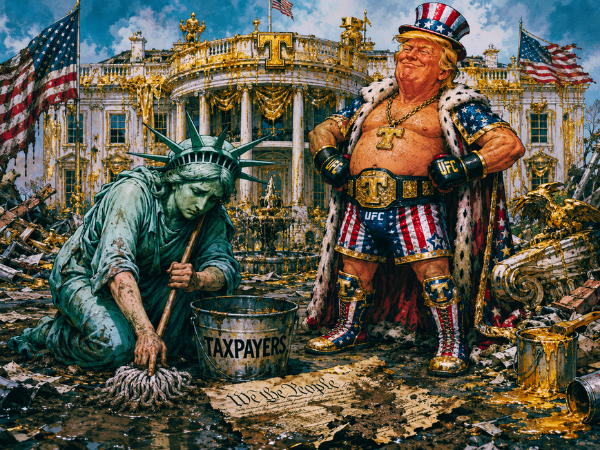
The American taxpayer has become the cleanup crew for the American Police State.
We pay for the constitutional violations.
We pay for the wars.
We pay for the lawsuits, the settlements, the cover-ups, the damage control, the reconstruction, the overreach, the incompetence and the corruption.
And when government officials are finally called to account for their misconduct, we pay for that, too.
That is the dirty little secret of government accountability in America: even when the government loses, the government does not really pay. “We the people” do.
This is not a problem invented by Donald Trump.
For decades, politicians, police officers, prosecutors, prison officials, federal agents and bureaucrats of both parties have violated rights, exceeded their authority, misused public power and left taxpayers to pick up the tab.
The wrongdoers rarely pay personally. They get to keep their pensions, promotions, pardons, security details and speaking fees. The government agencies involved in misconduct rarely suffer lasting consequences. The victims get a check drawn on taxpayer funds.
And the tax-paying populace gets to pay for the settlements, the legal fees, the court costs, the reconstruction costs and the long-term damage to trust in government.
The message is coming across loud and clear: the government can violate our rights in every way possible—using resources that we are forced to provide—and then it can turn right around and make us pay to clean up its many messes and right its many wrongs.
This is the Art of the Steal.
Trump, having taken to government corruption like a duck to water, has made ripping off the taxpayers the cornerstone of his governing philosophy.
For a man who has spent a lifetime grifting, it is the ultimate grift.
During his second term in office, Trump has established a track record of forcing the public to subsidize the consequences of his own recklessness: rewarding allies, funding unconstitutional crackdowns, rebuilding what he tears down, bankrolling vanity projects, and attempting to buy his way out of crises he helped create.
Start with Iran.
Trump’s war with Iran is a case study in the Art of the Doublecross.
Candidate Trump sold himself as the antidote to endless war. He promised strength without entanglement, peace through power, no new wars, no more nation-building, no more wasting American lives and treasure on conflicts that do not serve the American people.
Then came the Epstein Files.
Suddenly, the man who promised no new wars needed a War of Distraction.
Now, after dragging the country into a preemptive, unprovoked war with Iran that Congress never authorized—a war that has rattled global markets, driven up energy prices, depleted military resources, risked regional escalation, and inflicted real economic pain on Americans already struggling to afford groceries, gas, insurance and debt payments—Trump needs help fixing the crisis he helped create.
Whatever the final terms of any so-called peace arrangement—assuming such a thing is actually forthcoming—taxpayers will bear the cost. Trump has announced, teased and promised breakthroughs before, only for the details to shift, the terms to unravel, or the supposed deal to become another bargaining chip in an endless cycle of threats, deadlines and reversals.
Rest assured, the price of Trump’s war will not be limited to missiles fired and ships deployed. It will include lives lost, military resources depleted, global markets rattled, energy prices spiked, alliances strained, enemies emboldened, and diplomatic concessions made to end a conflict that diplomacy might have prevented in the first place.
Even if U.S. taxpayers do not directly write the check for a reported $300 billion reconstruction framework, the absurdity remains: Trump starts the war, others negotiate the cleanup, and the American people are left paying the political, economic and constitutional costs.
They are also paying through the dangerous precedent that empowers an imperial president to start a war based on instinct, impulse or political convenience, without constitutional accountability.
That is no small thing.
The Constitution gives Congress, not the president, the power to declare war. That safeguard was not a procedural technicality. It was meant to prevent exactly this kind of unilateral adventurism: one man gambling with the lives, liberties and livelihoods of millions, then sending the invoice to the people.
The public pays while the politicians posture.
That is how government turns recklessness into public debt: first by provoking the crisis, then by charging the people for the cleanup, then by pretending the cleanup is a triumph.
Yet not every government bill arrives in the mail.
Some arrive at the gas pump, the grocery store, the insurance premium, the interest rate, the shrinking paycheck, the empty Treasury, and the next generation’s debt.
Others arrive later, in the form of lawsuits, settlements, damages, broken families, shattered communities and rights that must be clawed back in and out of court after the damage has already been done.
Iran is only the most explosive example.
We are seeing this destruction play out on almost every front: wars, raids, tariffs, deportations, political payouts, lawsuits, pardons, institutional wreckage and vanity projects.
Every unconstitutional executive order, retaliatory investigation, purge, firing, freeze, funding cutoff, loyalty test and administrative abuse produces another round of emergency litigation, government lawyers, court costs, injunctions, appeals and attorney fees.
Trump governs by breaking things. Taxpayers pay for the repair.
But some things cannot be repaired with money alone.
Who will pay to rebuild what Trump and the architects of the police state have destroyed of our constitutional republic?
As always, that burden will fall on the American people.
Trust, once shattered, is not so easily restored.
Institutions, once vandalized, do not repair themselves.
Constitutional limits, once treated as optional, become harder to restore with every violation.
And then there are the vanity projects, where the symbolism becomes almost too obvious to miss.
Trump’s so-called “beautification” projects—gaudy, expensive and self-serving—speak volumes about his disastrous approach to governing.
The Lincoln Memorial Reflecting Pool, a public landmark that has served as the backdrop for historic moments from Marian Anderson’s 1939 concert to Martin Luther King Jr.’s “I Have a Dream” speech, has become a veritable swamp of slime after Trump, without meaningful oversight and at a grossly marked-up expense, decided by fiat to “fix” it and use it and the Lincoln Memorial as the backdrop for a UFC fight weigh-in.
The Reflecting Pool fiasco is the Trump presidency in miniature: gaudy, expensive, performative and already covered in algae.
The demolished East Wing is now the architectural scar behind a ballooning White House ballroom project whose costs keep shifting upward, now estimated at $600 million with more than half of it paid for by taxpayers—despite Trump’s insistence it would all be privately funded.
Then came June 14, when the White House—transformed from the people’s house into a gilded stage set for one man’s ego—had its South Lawn turned into a literal arena for a UFC spectacle.
“Take care of this house,” the song from the Leonard Bernstein/Alan Jay Lerner musical 1600 Pennsylvania Avenue warns.
“Take care of this house
Keep it from harm
If bandits break in
Sound the alarm…
Be careful at night
Check all the doors
If someone makes off with a dream
The dream will be yours.”
That warning was not about wallpaper, furniture or ceremonial rooms.
It was about stewardship. It was about vigilance. It was about recognizing that the house belongs not to the occupant, but to the people whose dreams, sacrifices and constitutional inheritance it is supposed to shelter.
Trump’s transformation of the White House is a visual reminder of what he has done to the presidency itself: taken what belongs to the people, stripped it for parts, gilded what remained, and presented the wreckage as grandeur.
It is embarrassing. It is grotesque. It is a national humiliation.
This is what the American experiment in self-government has been reduced to: a constitutional republic dressed up like a casino, a people’s house converted into a stage set, a presidency refashioned as a brand extension, and taxpayers forced to underwrite the spectacle.
The founders never assumed the experiment would survive on autopilot.
They knew self-government was fragile. They knew republics decay when citizens become spectators, when public servants become rulers, when law becomes optional for the powerful, and when the people are made to finance their own subjugation.
That is why the spectacle matters.
The gilding of the people’s house is not just a question of bad taste or bloated expense. It is constitutional graffiti: a ruler’s signature scrawled across the people’s house.
It is a warning sign: a government that has forgotten the difference between public trust and private entitlement, between stewardship and ownership, between serving the people and ruling over them.
There is something obscene about gilding the people’s house while the people are being asked to pay for wars they did not approve, tariffs they were told foreigners would pay, raids carried out in their name, deportation schemes that endanger human lives, unconstitutional orders struck down by the courts, and settlements for abuses committed by government agents.
That is the real cost of cleaning up Trump’s messes.
It is not merely the $1.776 billion slush fund, the tariff refunds, the deportation flights, the ICE raids, the Reflecting Pool, the East Wing, the Iran war, the courtroom defenses, the settlements or the gilded pageantry.
It is the conversion of citizenship into servitude.
It is the expectation that the people will pay for their own surveillance, their own intimidation, their own impoverishment, their own silencing, their own manipulation, and their own loss of power.
It is taxation for domination.
It is government by mess, followed by government by invoice.
It is the rewriting of the American Dream from a dream of opportunity for all to a dream of entitlement for a select, privileged few.
The American Revolution was fought, in part, against a government that forced people to finance their own subjugation.
That warning still applies.
When Americans are made to pay for undeclared wars, unlawful tariffs, militarized raids, political payouts, constitutional violations, palace renovations and the settlements that follow government abuse, they are not merely being overcharged.
They are being ruled.
And ruled people always pay.
A free people do not pay tribute to rulers.
They bind them down. They hold them accountable.
And, as I make clear in my book Battlefield America: The War on the American People and in its fictional counterpart The Erik Blair Diaries, they refuse to be made accomplices in their own subjugation.
It is time to clean house.
Source: https://tinyurl.com/33m6ssa6
ABOUT JOHN W. WHITEHEAD
Constitutional attorney and author John W. Whitehead is founder and president of The Rutherford Institute. His most recent books are the best-selling Battlefield America: The War on the American People, the award-winning A Government of Wolves: The Emerging American Police State, and a debut dystopian fiction novel, The Erik Blair Diaries. Whitehead can be contacted at staff@rutherford.org. Nisha Whitehead is the Executive Director of The Rutherford Institute. Information about The Rutherford Institute is available at www.rutherford.org.
Publication Guidelines / Reprint Permission
John W. Whitehead’s weekly commentaries are available for publication to newspapers and web publications at no charge.

