Posts Tagged ‘news’

I don’t think about Americans’ financial situation. I don’t think about anybody.”—Donald Trump

One way or another, the American taxpayers always get screwed by politicians eager to spend our hard-earned dollars on programs and projects that do little to improve our lives, safeguard our freedoms, or secure our future.

Donald Trump—the billionaire trust-fund baby/reality TV showman who transformed himself into a populist champion of working-class Americans—has proven to be no different, and in many ways worse, than the politicians who came before him.

Trump has given new meaning to government corruption, graft, grift, profiteering, self-dealing and pay-to-play politics.

From the proposed White House ballroom and its taxpayer-backed security upgrades, to the high-dollar UFC spectacle planned for the White House lawn, to pardons that function less like mercy than loyalty rewards, to government access increasingly conditioned on political obedience, Trump has turned the presidency into a private rewards program for himself, his donors, his allies and his enforcers.

Every new abuse is wrapped in the language of patriotism, security or justice. Every bill lands, sooner or later, on the backs of the American people.

Thus, rather than draining the swamp, Trump has shown himself to be the veritable swamp monster, mired in the muck and determined to keep it that way.

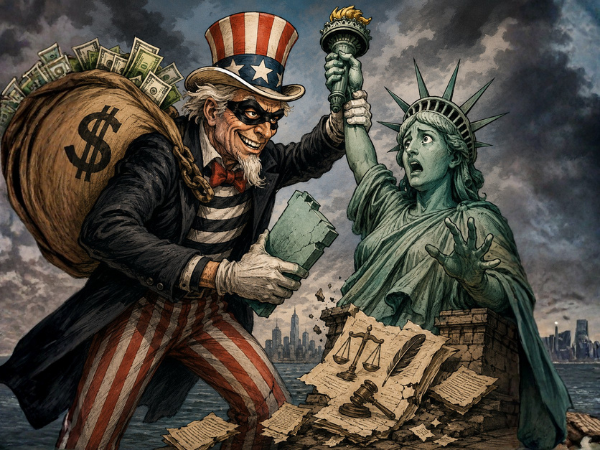
Trump’s latest grift? A taxpayer-funded slush fund, dressed up as justice, purportedly to compensate those who claim they were targeted by the “weaponization” of the Biden Justice Department and Democrats.

As part of the same settlement, the government also reportedly agreed to bar the IRS from auditing Trump, his family, the Trump Organization and related entities over tax filings and claims predating the agreement—a breathtaking act of self-protection disguised as legal closure that helps shield the president and his empire from the very kind of government scrutiny ordinary Americans are expected to endure without complaint.

Taken together, the payout fund and the audit shield expose the real purpose of this so-called anti-weaponization crusade: not to end weaponized government, but to decide who gets protected by it, who gets paid by it, and who gets crushed by it

Read between the lines of the deliberately vague information provided about this “Anti-Weaponization Fund,” which will be seeded with $1.776 billion in taxpayer funds, and it starts to look suspiciously like a fund to reimburse those convicted, investigated or politically inconvenienced for crossing legal lines in service to Trump’s agenda.

If it looks like corruption—and it smells like corruption—there’s a good chance it’s corruption.

Donald K. Sherman, president of Citizens for Responsibility and Ethics in Washington, wasn’t mincing words when he described it as “one of the single most corrupt acts in American history.”

At best, this is an outrageous misuse of taxpayer money. At worst, it is yet another perverted form of Trump’s presidential pardons, which have overwhelmingly benefited political loyalists, donors, grifters, extremists, and individuals either convicted of crimes in pursuit of Trump’s ambitions or useful to advancing those ambitions in the future—or both.

The message is unmistakable: commit crimes that benefit those in power, and those in power will absolve you, reimburse you, excuse you, or reward you.

These are not miscarriages of justice being corrected. They are protection payments, signals to future operatives: do what we need you to do, and we will take care of you.

But who will compensate “we the people” for the damage done when the government weaponizes its powers against us?

Who will compensate the people surveilled without warrants, raided without cause, censored for their views, bankrupted by fines and fees, brutalized by militarized police, jailed without due process, dragged through the courts, disappeared into detention centers, or treated as enemies of the state for exercising their constitutional rights?

Who will compensate the victims of a police state that has been weaponized by Republicans and Democrats alike?

That is the real question.

The Trump administration claims this fund is about redressing government weaponization.

Yet at the very same time, it is weaponizing the government against the citizenry: against protesters, immigrants, law firms, judges, journalists, universities, critics, whistleblowers, and anyone else who stands in the way of executive power.

This is what it means to weaponize the government.

When the government turns its power against its own people—through surveillance, retaliation, censorship, and intimidation—it ceases to serve the public and instead becomes a weapon of oppression.

According to the Political Dictionary, “The term ‘weaponize’ refers to the strategic manipulation or transformation of information, institutions, or social issues into tools for gaining political advantage.” That can mean exploiting existing laws, turning neutral institutions into partisan weapons, using the bureaucracy to delegitimize opponents, or rallying a base by convincing them that oppression is justice.

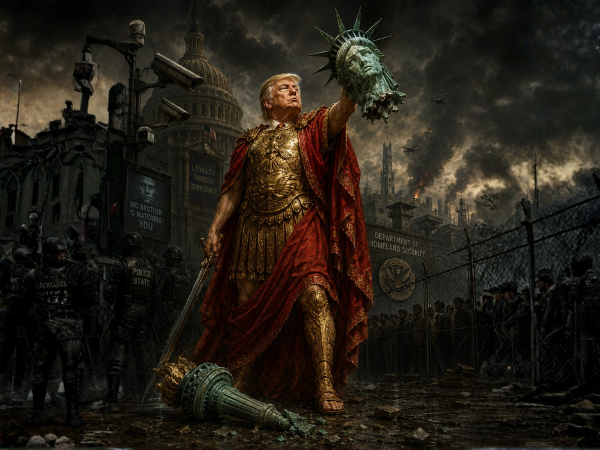
Time and again, presidents and power-hungry politicians have stretched—or outright shattered—the limits of their authority, weaponizing government power through unjust laws, surveillance, censorship, detention, intimidation and suppression.

Each power grab is another way of turning government into a weapon.

John Adams used the Alien and Sedition Acts to prosecute journalists and political opponents.

Abraham Lincoln suspended habeas corpus, allowing the military to detain individuals without trial and suppressing Confederate sympathizers and political dissenters.

Under Woodrow Wilson, the Espionage and Sedition Acts were used to crack down on anti-war activists, socialists, and labor organizers, including Eugene V. Debs, who spoke out against World War I.

Franklin D. Roosevelt issued an executive order that led to the internment of over 120,000 Japanese Americans during World War II, based on suspicions of disloyalty, despite little to no evidence.

Richard Nixon harnessed the power of the FBI, CIA, and IRS, to harass, spy on and sabotage his political opponents and perceived enemies.

Spanning numerous presidential administrations, from FDR to Nixon, the FBI’s covert intelligence program COINTELPRO was used to infiltrate, discredit and disrupt civil rights leaders, anti-war activists, and other political dissidents.

In a bid to fight so-called disinformation, Biden pressured social media companies to censor and suppress individuals expressing views perceived as conspiratorial or extremist, especially as they related to COVID-19.

And then there’s Donald Trump, who is setting new records for how far he’s willing to go to retaliate against his perceived enemies and sidestep the rule of law.

Indeed, Ken Hughes, an investigative journalist who spent two decades listening to Richard Nixon’s Secret White House Tapes, has concluded that Nixon’s abuses of presidential power—which included weaponizing the government to sabotage Vietnam peace talks, manipulate the timing of withdrawal from Vietnam, and spring former Teamsters president Jimmy Hoffa from prison in return for political support—pale beside Trump’s abuses.

Trump, who once vowed to end government overreach and the weaponization of the federal government, now openly uses its full force against his critics, dismantling democratic norms, consolidating power in ways that defy the Constitution, and directing an all-out weaponization of the federal government against his perceived enemies.

Those “enemies” now include anyone who dares to oppose him.

If Trump were merely a blowhard, that would be one thing.

Unfortunately, having populated his administration with individuals more loyal to him than to the Constitution, Trump has gotten drunk on power.

The danger is not Trump alone. The danger is Trump backed by enablers-to-abuse: the many minions within his administration and beyond who are eager to carry out unlawful orders, defy the courts, ignore Congress, trample rights, and butcher the Constitution in the name of putting America first.

If this keeps up, America—once held up as a bastion of freedom and economic opportunity—will be the last place anyone thinks of when they hear the words freedom, justice and equality.

Every action taken by the Trump administration in defiance of the rule of law—whether or not that action is dressed up as national security, law and order, border control, anti-corruption, or anti-weaponization—pushes us that much closer to the complete dismantling of our constitutional republic.

Don’t be so carried away by fear-inducing tales of rapists, foreign invaders, corruption, crime waves and political persecution that you let the government get away with murder: the painful execution of our rights.

That way lies tyranny.

You can see the pattern forming already.

When protesters are snatched up, arrested, prosecuted or surveilled for challenging government policy, that is government weaponized against dissent.

When immigrants are rounded up, chained, deported or detained without meaningful due process—without being properly identified, charged, heard, or allowed to challenge the government’s claims—that is government weaponized against due process.

When law firms are punished for the clients they represent, barred from federal buildings, stripped of security clearances, threatened with the loss of contracts, or pressured into providing hundreds of millions of dollars in legal services aligned with the administration’s priorities, that is government weaponized against the right to counsel.

When judges are derided, defied or threatened for ruling against the president’s agenda, that is government weaponized against the separation of powers.

When universities are threatened with funding cuts, investigations and ideological purges for failing to toe the government’s line, that is government weaponized against academic freedom and independent thought.

When journalists and critics are branded enemies, liars, radicals, criminals or traitors for questioning official narratives, that is government weaponized against the First Amendment.

When government websites, archives, agencies and public records are rewritten, scrubbed or politicized in order to reshape history, control memory, and enforce ideological obedience, that is government weaponized against truth.

When the president threatens other nations militarily, talks openly about seizing foreign lands, stirs up international tensions, rattles the war drums, and then claims wartime powers at home, that is government weaponized against peace, liberty and constitutional restraint.

Trump, adept at twisting facts and spinning lies, insists these end-runs around the rule of law are for our safety.

Don’t believe him. Words are cheap.

More importantly, don’t trust him. Bind him down with the chains of the Constitution.

The only real protection we have against tyranny is the rule of law, provided that the people and the system of government still hold the rule of law as inviolable.

That is our real power: the extent to which we hold fast to the Constitution and demand that the government and its agents do so, as well.

The moment that we relent in that commitment—the moment that we look the other way and let first a few encroachments slide, then ever more and more—is the moment the Constitution loses its power to protect us against tyranny.

That is what is unfolding right now.

This is the devil’s bargain that we are being asked to enter into with Trump: empty promises and a one-way street to a dictatorship in exchange for our freedoms.

Watch out.

When any politician claims to be saving you money by imposing tariffs that ramp up inflation and cutting government programs aimed at educating the massesfeeding the hungry, and helping the poor, disabled and elderly, all the while spending taxpayer money on his own lavish lifestyle and self-serving political programs, you’d better beware. Your hard-earned dollars will be next in line to be seized, spent and squandered.

When any politician suggests that you relinquish your freedoms—of speech, assembly, due process, association, etc.—in exchange for promises of greater security, you’d better beware. Your freedoms will be next on the chopping block.

When any politician persuades you to look the other way while innocent individuals are rounded up alongside suspected criminals just because they look a certain way, talk a certain way, worship a certain way, protest a certain way, or belong to a particular demographic, you’d better beware. Your right to due process will be next.

When any politician comes up with a vast array of reasons why he doesn’t need to obey court rulings—because they were issued verbally, because his power trumps that of the courts, because the courts are biased, because national security demands obedience, because the law ends at the border—you’d better beware. This shifty reasoning for breaking the law could be used against you next.

There can be no doubt about the nature of what is taking place right now.

This is government weaponized into war.

President Trump’s justification for defying the courts and doing whatever he wants in pursuit of his political agenda (arresting protesters, carrying out mass arrests and deportations, muzzling critics, seizing funds, dismantling agencies, usurping congressional powers) is that “this is war.”

Here’s the thing, though: Trump may be using the language of war to bypass the Constitution at every turn, but the only war being waged is a war against the Constitution, the rule of law and the American people.

Congress, which has the sole power to declare war under Article I, Section 8, Clause 11, has not declared war on the American people. And still Trump is using the emergency powers and wartime rhetoric of the presidency to sidestep accountability and due process.

In ruling after ruling, the courts, which have the judicial power to rein in overreach and misconduct, have pushed back against the Trump administration’s steady dismantling of constitutional limits. And still Trump is unilaterally hacking away at the very foundations of our system of government.

If the president refuses to be held accountable, insists his power is supreme, abuses the power of his office to wreak havoc and revenge, reduces our republic to rubble, tramples the Constitution, and disregards the rule of law, he is aligning himself with every despot, dictator and tyrant to have walked the earth.

We’ve been here before. We know how this story ends.

It takes time and effort and a willingness on the part of “we the people” to look beyond our differences and stand united in opposition to oppression, but when we do that, freedom prevails in the end.

This year will mark the 250th anniversary of the birth of this country, when America’s founders declared their independence from King George’s tyranny.

What’s just as important, however, is what came before that: the small steps of rebellion, resistance and outrage that said, “enough is enough.”

What we are now experiencing is not simply a partisan power struggle. It is the weaponization of the machinery of government for compliance and control.

The objective: obedience.

The strategy: destabilize the economy, polarize the populace, escalate racial and political tensions, intensify the use of violence, and then, when all hell breaks loose, clamp down on the nation for the good of the people and the security of the nation.

The outcome for this particular conflict is already foregone if we refuse to resist: the Deep State wins.

The Deep State wins by ensuring that we are censored, silenced, muzzled, gagged, zoned out, caged in and shut down.

It wins by monitoring our speech and activities for any sign of “extremist” activity.

It wins by ensuring that we are estranged from each other and kept at a distance from those who are supposed to represent us.

It wins by saddling us with taxation without representation and a government without the consent of the governed.

It wins by terminating the Constitution—or rewriting it until it no longer restrains those in power.

So where does that leave us?

“We” may have contributed to our downfall through our inaction and gullibility, but we are also the only hope for a free future.

After all, the Constitution begins with those three beautiful words, “We the people.”

Those three words were intended as a reminder to future generations that there is no government without us: our sheer numbers, our muscle, our economy, our physical presence in this land.

When we forget that—when we allow the “me” of a self-absorbed, narcissistic, politically polarizing culture to override our civic duties as citizens to collectively stand up to tyranny and make the government play by the rules of the Constitution—that is when tyranny rises and freedom falls.

Remember, there is power in numbers.

Not the kinds of numbers that Trump likes to spout about landslide victories and electoral mandates, but the most powerful numbers of all: the sheer, overwhelming mass of humanity that is “we the people” of these United States of America.

If there is any means left to us for thwarting the government in its relentless march towards outright dictatorship, it rests with us.

Ultimately, that’s what the Tenth Amendment to the Constitution is all about: it affirms that “we the people” have all the power, and what powers we do not explicitly give to the federal government or the states, we retain.

We may appoint government representatives to act in our stead, but we never relinquish that power altogether.

That’s where Trump and his Deep State handlers get it wrong. Speaking through him and his administration, they claim that this dismantling of the federal government is a bid to return power to local communities and state governments, but it’s not their government to dismantle, nor is it their power to return.

We are the government.

We are the power.

And it’s time “we the people” reminded the government and its henchmen of that important fact.

The power still lies with us.

We must resist every attempt to erode our freedoms, demand accountability, and uphold the Constitution before it’s too late.

It’s time to invalidate governmental laws, tactics and policies that are illegitimate, egregious or blatantly unconstitutional.

Nullify everything the government does that flies in the face of the Constitution.

Flood your representatives’ phone lines, inboxes and townhall meetings with your discontent.

Protest everything that tramples on the Constitution.

Stand up for your own rights, of course, but more importantly, stand up for the rights of those with whom you might disagree.

Defend freedom at all costs. Defend justice at all costs. Make no exceptions based on race, religion, creed, politics, immigration status, sexual orientation, etc.

Don’t play semantics. Don’t justify. Don’t politicize it.

If it carries even a whiff of tyranny, oppose it.

Demand that your representatives in government cut you a better deal, one that abides by the Constitution and doesn’t just attempt to sidestep it. That’s their job: make them do it.

And don’t let them distract you with slush funds, payouts, pardons and political theater disguised as justice.

If the government is going to compensate anyone for being victimized by weaponized power, then start with “we the people.”

Start with the Americans whose rights have been trampled by SWAT teams, surveillance dragnets, censorship regimes, secret watchlists, police brutality, asset forfeiture schemes, no-knock raids, indefinite detentions, politically motivated prosecutions, and every other tactic by which the police state has turned the Constitution into collateral damage.

Start with the people forced to pay for their own oppression.

Until then, this so-called Anti-Weaponization Fund is not justice.

It is hush money for the powerful, paid for by the powerless.

It is the weaponized government rewarding its own while leaving the rest of us to foot the bill.

As I make clear in my book Battlefield America: The War on the American People and in its fictional counterpart The Erik Blair Diaries, all freedoms hang together.

They fall together, as well.

Source: https://tinyurl.com/mdz5p9rw

ABOUT JOHN W. WHITEHEAD

Constitutional attorney and author John W. Whitehead is founder and president of The Rutherford Institute. His most recent books are the best-selling Battlefield America: The War on the American People, the award-winning A Government of Wolves: The Emerging American Police State, and a debut dystopian fiction novel, The Erik Blair Diaries. Whitehead can be contacted at staff@rutherford.org. Nisha Whitehead is the Executive Director of The Rutherford Institute. Information about The Rutherford Institute is available at www.rutherford.org.

Publication Guidelines / Reprint Permission

John W. Whitehead’s weekly commentaries are available for publication to newspapers and web publications at no charge. 
Disinformation does not mean false information. It means misleading information—misplaced, irrelevant, fragmented or superficial information—information that creates the illusion of knowing something, but which in fact leads one away from knowing.”—Neil Postman, Amusing Ourselves to Death

Call it what it is: a heist.

The corruption, cronyism, and self-dealing that now define the American government—under Donald Trump in particular—amount to a slow-motion stick-up carried out in broad daylight.

But here’s the trick: it’s a heist hidden behind spectacle. The Trump administration is flooding the stage with noise so “we the people” don’t notice what’s happening behind the curtain.

We’re being manipulated into watching the wrong thing.

The distractions are part of the plan to rob us blind.

You don’t have to look far to see how the con works. Nowhere is the hustle more obvious than in how the presidency itself is being used.

For the Trump family, the presidency isn’t public service. It’s an all-access pass to wealth, power, and privilege—an ongoing exercise in how to squeeze maximum personal gain out of public office.

Taxpayers foot the bill for this massive grift: security for President Trump’s extended family, luxury travel, private business ventures, weekends at Trump-owned golf resorts, and vanity projects with a hidden price tag for the privilege of bearing Trump’s name.

We pay for it. They profit from it.

Even Congress is in on the game.

In a blatant act of political pandering, Senate Republicans are trying to slip a provision into an ICE funding bill that would direct $1 billion in taxpayer money toward Trump’s long-desired White House ballroom—bypassing debate and oversight.

A billion dollars.

Not to lower your grocery bill. Not to fix your healthcare. Not for infrastructure that serves the public.

For a ballroom.

A taxpayer-funded space where donors, insiders, and elites can gather and trade access—while the average American is left outside looking in.

The grift has become so obvious, Americans are finally taking notice.

Poll after poll shows the same thing: people are fed up.

Not just with the economy but with a president who seems more focused on himself, his image, and his vanity projects than on the people he’s supposed to serve.

Washington Post poll puts it clearly: disapproval with Trump’s job performance is rising, with 62% unhappy about his job as president, 76% dissatisfied with how he’s dealing with the cost of living, 72% unhappy about his handling of inflation, 65% against his handling of the economy, and 66% opposed to the war with Iran.

They’re right to be unhappy.

While Americans struggle to make rent, pay for groceries, and stay afloat, the government is bankrolling ballrooms.

But here’s what most Americans are missing: the ballroom isn’t just a vanity project. It’s a distraction.

So are his plans to redo the East Potomac Golf Course.

So is his repainting of the Reflecting Pool.

So is the spectacle of him staging a UFC fight on the White House lawn.

So are his endless, bombastic, outrage-driven, manic, headline-making Truth Social posts.

Trump is good at pushing people’s buttons. He knows exactly what will outrage, distract, and drag people into one more pointless argument.

The bigger and louder, the better. That’s the show.

And while we’re watching Trump’s bread-and-circus antics, something else is happening.

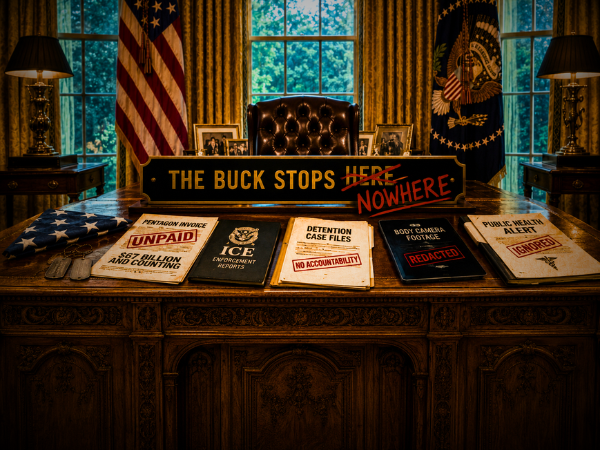
The real damage to our republic is being buried—delayed, redacted, denied.

This shell game keeps our attention fixed on Trump’s costly antics while his partners-in-crime use the diversion to lock down the country and strip us of what’s rightfully ours.

It’s not just one elaborate ruse, either, but a series of cover-ups and obfuscations meant to keep us from looking too closely or asking too many questions about what’s really going on.

What began as a scramble to redirect public attention—from questions about Epstein to war, White House spectacles, immigration crackdowns, and culture-war theater—has become an ever-widening web of manufactured distractions and diversions.

Consider what’s happening behind the scenes.

Investigative reports reveal that the Trump administration has refused to fully disclose the extent of the damage inflicted by Iran on U.S. military installations.

Satellite imagery has been restricted. Access has been limited. Reporters are forced to rely on foreign aerial images and secondhand accounts just to piece together what’s happening.

And the lack of transparency doesn’t stop there.

Reports suggest the Pentagon has downplayed casualty figures of U.S. troops killed or wounded during the Iran war.

Oversight of DHS, ICE, and private contractors is being curtailed.

Human rights abuses are mounting, while accountability disappears behind a wall of secrecy.

They don’t want us looking too closely—because the less we see, the easier it is to take from us.

We’re meant to watch the show—not the government ledger.

When we can’t see the damage—at home or abroad—we can’t measure the cost. But we’re being asked to pay, and the price is mounting daily.

The same man who bankrupted his own businesses is now running the same play on the U.S. government.

Consider the Trump economy by the numbers. They tell the real story.

The government is spending more than it takes in. By a lot.

The national debt is now bigger than the entire U.S. economy. For the first time since World War II, the debt has surpassed 100 percent of the gross domestic product (GDP).

This is no small thing.

The federal government is now spending $1.33 for every dollar it collects.

And interest payments on that $31 trillion national debt are consuming one out of every seven dollars spent by the government. As Robert Reich, a former Secretary of Labor, warns, “That’s money we don’t spend on education, healthcare, roads and bridges, social safety nets, or (if we actually needed more spending on it) national defense.”

We don’t need an economist to spell it out for us, but there are ample warnings about the toll Trump’s costly policies are taking on the economy.

As Douglas Elmendorf, former director of the Congressional Budget Office, explains, rising debt fuels higher interest rates and inflation, driving up the cost of mortgages, car loans, and everyday life for ordinary Americans.

This is not sustainable.

While both political parties share responsibility for decades of fiscal mismanagement, the Trump administration has accelerated the crisis through a toxic combination of reckless spending, tax giveaways, and costly, unauthorized wars.

Promises to “drain the swamp,” balance the budget, and restore fiscal discipline have given way to ballooning deficits and trillion-dollar spending packages dressed up as economic revival.

Even the administration’s so-called cost-cutting measures fail to hold up under closer scrutiny.

Despite the propaganda pushed by DOGE and its supporters, nothing about the Trump administration has added up to savings for the American people.

Instead, Americans are seeing cuts to healthcare, education, housing assistance, and programs that provide economic stability.

At the very moment Americans are struggling to make ends meet, the Trump administration is spending big—at taxpayer expense—on projects that appeal to Trump’s ego, stoke his vanity, consolidate his power, reward his allies, or entrench the police state’s machinery of control.

Nero fiddled while Rome burned.

Trump is playing golf while America burns—and he keeps striking the match.

While “we the people” are paying more for everything, Trump is getting richer off the presidency—at taxpayer expense.

Much richer.

Billions added to his fortune—while in office. His family’s wealth has exploded.

Trump’s net worth has surged to an estimated $6.5 billion. According to Forbes, Trump added $1.4 billion in a single year by leveraging the presidency for profit—fueled by cryptocurrency ventures, revived licensing deals, favorable legal outcomes, and a rush of foreign business interests seeking proximity to power.

Trump’s family is also cashing in, doubling their net worth since the 2024 election to an estimated $10 billion.

While the Trumps aren’t the first family to leverage the presidency for profit, as Forbes points out, “no first family has used the office to make as much money as Donald Trump’s.”

You know who’s not profiting?

We the people. Especially those of us that do not belong to the political and corporate elite.

For most Americans, life is getting harder.

Gas prices are up. Groceries are up. Healthcare costs are up.

Paychecks? Not keeping up.

And what is the government doing? Not easing the burden. Not restoring balance.

And Trump?

He jets off to Mar-a-Lago at taxpayer expense. He golfs while dragging a full security detail along. He’s turning the White House—and by extension, much of the nation’s capital—into his personal domain, redecorating according to his personal tastes, with little concern for the wishes of the American people.

He lives like a king, while we pay for his excesses, one way or another.

He’s slashing government spending for programs that educate, protect, and support Americans, while building a $1.5 trillion war machine and boosting all aspects of the police state that treats us like suspects—locking us down and locking us up.

He’s building monuments to his own ego: a $400 million ballroom—now potentially a $1 billion taxpayer-funded monument to access and influence if Senate Republicans get their way; professional, taxpayer-funded golf courses that take the place of public parks; a new Trump-class “Golden Fleet” of battleships, costing $13 billion each.

He’s pushing for airports and train stations and other infrastructure to bear his name, then tacking on dubious licensing agreements for the so-called privilege.

At the same time, medical research is gutted. Job training gets cut. Environmental protections get axed. Disaster relief gets hollowed out. Welfare for the most vulnerable gets short-changed.

This isn’t just mismanagement. This isn’t just bad policy.

This is a system that takes from us and gives to the corporate and political oligarchic elite.

We pay more. “They” gain more.

Wars only make it worse.

Every missile. Every deployment. Every “operation.”

Paid for by “we the people.” Not just in taxes—but in higher prices, higher debt, and fewer services.

Pete Hegseth has been boasting that thanks to Trump’s $1.5 trillion defense budget, the Department of War is running war like a business.

The truth is, they’re turning war into big business and cashing in.

In one of the most glaring examples of this, the Associated Press reports that Trump’s sons have, in his second term, expanded their business interests beyond hotels and golf courses to a broad range of investments that include cryptocurrency ventures, prediction markets, federal contractors making rocket parts, and rare earth magnets.

Conveniently timed to coincide with Trump’s war on Iran, his sons have also gotten into the drone manufacturing business, selling to countries in the Middle East eager to curry favor with the Trump administration.

As Richard Painter, a former chief White House ethics lawyer under President George W. Bush, observed, “These countries are under enormous pressure to buy from the sons of the president so he will do what they want. This is going to be the first family of a president to make a lot of money off war—a war he didn’t get the consent of Congress for.”

This is how you turn government into a profit machine.

Once again, we find ourselves confronted by the age-old debate over our national priorities and the choice between investing heavily in guns or butter—military might or domestic needs.

Once again, we find ourselves watching from the sidelines as big-talking politicians justify stealing from “we the people” in order to pad the pockets of the military industrial complex.

As The Guardian notes, to help pay for his expanded military budget, “Trump is seeking a 10% cut in discretionary domestic spending, chopping such popular programs as medical research, job training, home heating assistance, environmental protection and disaster relief after hurricanes.”

This is exactly the moral theft President Dwight D. Eisenhower warned about: stealing from social and domestic needs in order to build up the military-industrial complex.

In Trump’s case, he wants guns and caviar: military might for the empire, wealth for himself, and less for America’s most vulnerable.

“We’re fighting wars,” Trump announced at an Easter luncheon. “It’s not possible for us to take care of daycare, Medicaid, Medicare … They can do it on a state basis. You can’t do it on a federal. We have to take care of one thing: military protection.”

Unfortunately, Trump’s version of military protection is a costly display of macho posturing.

Rebranding the Defense Department as the Department of War will cost taxpayers upwards of $125 million in new signs and stationery.

As Steven Greenhouse concludes for The Guardian, “In seeking a mammoth increase in military spending while cutting social programs, Trump is again showing how hollow his promises were about making life better for typical Americans.”

Marjorie Taylor Greene was right to course-correct. “I don’t have Trump Derangement Syndrome,” she said. “I have Trump Disappointment Syndrome.”

Trump Disappointment Syndrome is spreading.

This is, unfortunately, how the game works: less for us, more for them—paid for by “we the people.”

Yet just as important as the math involved in bleeding us dry is the conspiracy of distraction that keeps us in the dark about the theft in our midst.

That’s where the distractions come in: the ballroom, the golf course, the spectacles on the White House lawn.

Give the public something to watch. Something to argue about. Something impossible to ignore.

They want our outrage, not our scrutiny.

Keep the spotlight bright, so no one notices what’s happening in the shadows.

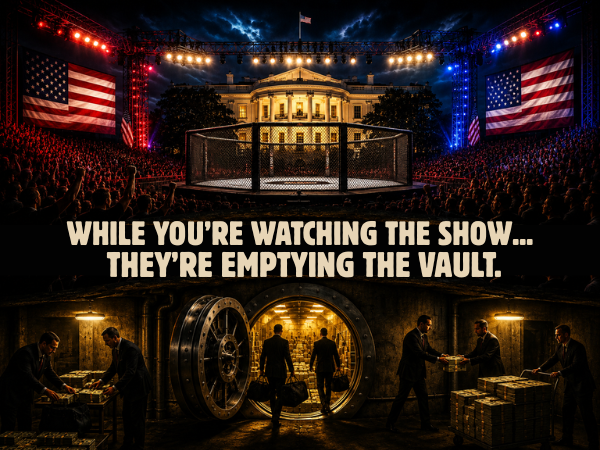
While the public watches the spectacle, the money is moving.

The spectacle is the decoy. The theft is the point.

The damage is being hidden—but the bill is still coming due.

We’re told this is policy. This is leadership. This is necessary for national security and the good of the country.

But what we’re really being given is a show, with Trump playing the part of the greatest showman.

The show has to be loud enough to keep the public’s attention. It has to be constant enough to keep us from asking the real question: where is the money going?

Because while we’re watching the show, the hold-up is taking place. The tellers are filling the bags with stolen loot. And they’re using the government as the get-away car.

That is how the con works.

As we warned in Battlefield America: The War on the American People and its fictional counterpart The Erik Blair Diaries, this is how the machinery of the police state expands: not just through endless war, unchecked power, and a government that no longer answers to the people—but through insider profiteering, cronyism and corruption disguised as reform, efficiency and nationalism.

That’s the Trump hustle: while we’re being distracted by the spectacle, they’re emptying the vault.

Source: https://tinyurl.com/4una32zs

ABOUT JOHN W. WHITEHEAD

Constitutional attorney and author John W. Whitehead is founder and president of The Rutherford Institute. His most recent books are the best-selling Battlefield America: The War on the American People, the award-winning A Government of Wolves: The Emerging American Police State, and a debut dystopian fiction novel, The Erik Blair Diaries. Whitehead can be contacted at staff@rutherford.org. Nisha Whitehead is the Executive Director of The Rutherford Institute. Information about The Rutherford Institute is available at www.rutherford.org.

Publication Guidelines / Reprint Permission

John W. Whitehead’s weekly commentaries are available for publication to newspapers and web publications at no charge. 
“The cost of war is too damn high
Not another nickel
Not another dime
We won’t pay for Trump’s war crimes.”
—Chanted by anti-war military veteran protesters in DC

Reports of food shortages on naval ships deployed to the Middle East.

Video footage of disabled military veterans—some in wheelchairs, others leaning on canes—being zip-tied and dragged out of the Capitol Rotunda for staging a peaceful, anti-war protest. Sixty-six veterans were arrested while conducting a flag-folding ceremony in recognition of the 13 military servicemembers who have died so far in Trump’s war with Iran.

A growing number of active-duty military service members asking how to end their service, become conscientious objectors, and refuse unlawful orders.

And a president openly threatening to commit war crimes by targeting civilian infrastructure in Iran—and floating preemptive strikes against Cuba.

This is where we are now.

Almost two months into Donald Trump’s disastrous, unauthorized war with Iran, the United States is in freefall.

The economy is struggling. Inflation and fuel prices are rising. America’s standing in the world is eroding by the day.

The war itself is spiraling—threats one day, concessions the next—as the Trump administration scrambles to reopen the Strait of Hormuz, a vital waterway that had remained stable until Trump recklessly pushed us into this disastrous war.

Meanwhile, the so-called “peace deal” being floated appears worse—for the U.S. and the world—than the nuclear agreement Trump tore up during his first term in a fit of ego and arrogance.

At home, the government is unraveling. Corruption is flourishing.

The constitutional guardrails are gone.

Leadership inside the White House is in disarray.

And Congress—rather than acting as a constitutional check—has chosen blind devotion, competing to outdo itself in displays of loyalty: proposing to carve Trump’s face into Mt. Rushmore, rename airports in his honor, create a “Trump Peace Prize,” declare his birthday a federal holiday, mint a $250 bill bearing his likeness, and even fund research into “Trump Derangement Syndrome.”

This is not governance.

This is fealty.

And at the center of it all is a man who avoided military service during Vietnam through a series of deferments—four as a student, one for a conveniently diagnosed bone spur—now posturing as a wartime commander, strategist and dealmaker.

The reality tells a far different story about the man steering the nation into war.

Trump—fixated on securing his legacy with a ballroom and a triumphal arch—appears increasingly erratic, unfocused, and unfit for the job assigned to him.

As journalists Josh Dawsey and Annie Linskey report, “The president sometimes loses focus, spending time on the details of his plans for the White House ballroom… Advisers said he has multiple meetings a week on the topic and views himself as the general contractor.”

This is a man woefully unprepared to deal with the many catastrophes he brings about.

Reporting from the Wall Street Journal indicates that Trump, after learning that two American airmen were missing in Iran, “screamed at aides for hours,” obsessing over how it would impact his image, legacy and the midterm elections, “veering between belligerent and conciliatory approaches and grappling behind the scenes with just how badly things could go wrong.”

It only went downhill from there.

Concerned that Trump’s impatience would make things worse, aides kept the nation’s Commander-in-Chief out of the Situation Room, delivering updates at key moments.

Concerns about Trump’s ability to carry out his duties have grown so voluble that there are now competing efforts to either invoke the 25th amendment or compel him to resign in a last-ditch effort to contain the damage.

As William Becker observes:

“The Trump decade should be remembered as a period when a president commandeered every news cycle by creating fresh controversies. As his power crumbled, he escalated his outrages so that each one distracted national attention from the last. Many theorize that he even launched a war to divert persistent attention from the most sordid scandal in American history: the Epstein affair. His badly conceived attack has so far cost the lives of 15 U.S. soldiers, wounded 400, and killed or injured nearly 30,000 Iranians while pushing the world economy to the brink of recession and imposing economic costs on people around the world.”

Against this messy backdrop of ineptitude, arrogance, greed, corruption and a Constitution in crisis, consider this: the government is making it easier to send our nation’s young people to war—and harder for the citizenry to have a say in it.

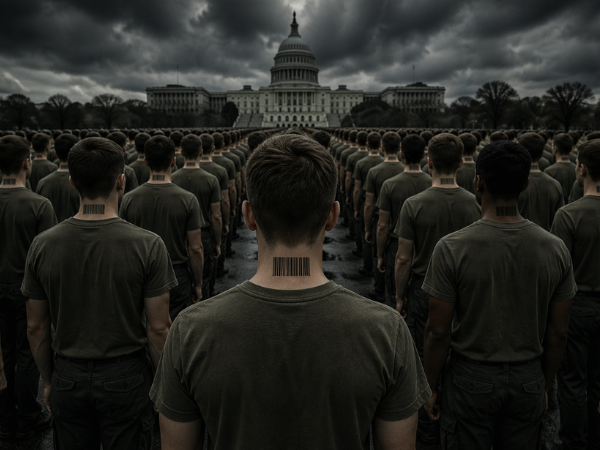
At the same time that the Trump administration is expanding its war machine abroad, it is moving to automate military draft registration at home—making it easier than ever to conscript young men to fight and die in wars they did not choose.

Under a provision tucked into the 2026 National Defense Authorization Act, all men between the ages of 18 and 25 will be automatically registered for the draft within 30 days of turning 18.

There was never anything voluntary about the draft.

Established in 1917 during World War I, suspended in 1975, and reinstated in 1980, the draft requires men—citizens and immigrants alike—to register under penalty of $250,000 and jail time of up to five years.

Register—or face the consequences.

Now even the illusion of choice is being stripped away—and the system itself is about to become far more powerful.

Although 46 states and territories already implement some form of automatic registration, how the federal government plans to automate the process is unclear. But it will almost certainly rely on the integration and cross-referencing of vast amounts of personal data across government agencies.

In other words, a database.

A potentially powerful one.

And in the wrong hands, a weaponized one.

Beware anytime the government insists it’s making things more “convenient” or “efficient.”

More often than not, “efficiency” is a Trojan Horse used to mask the government’s ongoing power grabs and assaults on our freedoms as something benevolent and in our best interests.

The government has never had our best interests at heart.

Nor has it ever been in the business of making life easier for its citizens.

It is in the business of control.

In the modern surveillance state, that control starts with data.

Once control is built on data, it doesn’t stay in government hands alone.

Enter Palantir Technologies—one of the government’s largest defense contractors, with billions in military contracts and a long track record of data-driven surveillance.

Already linked to AI-assisted military targeting systems and the “kill lists” used by the Israeli military in Gaza, Palantir has been a driving force behind the push to automate the draft.

This is the future of modern warfare they are building.

Not just smarter wars but more efficient ones.

More expansive. More detached. More deadly.

And built with an army of people the government views as fully expendable.

Consider the hypocrisy at work.

The Trump administration has spent months demonizing immigrants—detaining them, deporting them, tearing apart families, and casting them as threats to national security.

And yet, when it comes time to fill the ranks of its endless wars, those same individuals—green card holders, refugees, asylum seekers, even undocumented men—suddenly become expendable assets.

Too dangerous to belong. Not too dangerous to die.

Increasingly, the same could be said of all of us.

We are all being viewed as potential threats by the government.

A government that views its people as expendable will always find ways to use them—whether as labor, as data points, or as cannon fodder.

And it will just as quickly look for ways to silence them.

While the government is making it easier for Americans to be conscripted and killed in war, it is simultaneously working to make it harder for us to have any say in the decisions that send our young men and women to war in the first place.

Rather than ensuring all American citizens access to the ballot box, the Trump administration has moved to restrict it—pushing measures that would tighten voter eligibility, limit mail-in voting, and centralize control over election systems.

Why not automate voter registration?

If efficiency were truly the goal, that would be the logical place to start.

As the Brennan Center for Justice explains, automatic voter registration flips the system from “opt-in” to “opt-out,” allowing eligible citizens who interact with government agencies to be registered automatically, with their information transmitted electronically to election officials. The result is higher participation, more accurate voter rolls, and a more efficient system overall.

In other words, the same kind of streamlined, data-driven infrastructure being used to prepare Americans for war could just as easily be used to strengthen democracy.

Which is precisely why it isn’t being prioritized.

Because this is not about efficiency.

It is about power.

The Constitution is clear on this point: authority over elections rests primarily with the states and Congress—not the president.

That is not a technicality.

It is a safeguard.

A deliberate check against the very kind of centralized control this administration is now attempting to assert.

This is not a new playbook.

It is an old one—one the Founders knew well, and warned against.

As the nation approaches the 250th anniversary of its founding, the parallels to the grievances listed in the Declaration of Independence are becoming impossible to ignore.

A government that wages war without meaningful consent of the governed.

A government that maintains standing armies and engages in foreign conflicts without accountability.

A government that obstructs the will of the people and undermines their ability to participate in the political process.

A government that treats its citizens not as participants in a republic, but as resources to be managed, tracked, and deployed.

This is not the system the Founders envisioned.

It is the system they rebelled against.

The American police state is making it easier to send you to war.

They’re making it harder for you to vote.

They are automating what kills us but complicating what empowers us: building databases to track us, systems to conscript us, and laws to silence us.

This is not about efficiency. This is not about national security.

We are living the reality I warned of in Battlefield America: The War on the American People and its fictional counterpart The Erik Blair Diaries: a nation where the citizenry is the enemy and the state is the predator.

This is about control.

Source: https://tinyurl.com/2d256yac

ABOUT JOHN W. WHITEHEAD

Constitutional attorney and author John W. Whitehead is founder and president of The Rutherford Institute. His most recent books are the best-selling Battlefield America: The War on the American People, the award-winning A Government of Wolves: The Emerging American Police State, and a debut dystopian fiction novel, The Erik Blair Diaries. Whitehead can be contacted at staff@rutherford.org. Nisha Whitehead is the Executive Director of The Rutherford Institute. Information about The Rutherford Institute is available at www.rutherford.org.

Publication Guidelines / Reprint Permission

John W. Whitehead’s weekly commentaries are available for publication to newspapers and web publications at no charge. 
“From the least to the greatest, all are greedy for gain; prophets and priests alike, all practice deceit. They dress the wound of my people as though it were not serious. ‘Peace, peace,’ they say, when there is no peace.”—Jeremiah 6:13–14

“This is insane. Regime change will result in a bloody civil war… Resist this!”—Charlie Kirk (2025)

The military-industrial complex and the American police state have joined forces.

War abroad and war at home are no longer separate enterprises. They have fused.

This did not happen overnight.

Every modern president has stretched the limits of war-making power. Some have shredded those limits altogether.

Each time that boundary is breached, the Constitution recedes a little further.

This is one of those moments.

In a complete about-face from his claims to being a peace president, Donald Trump has authorized yet another preemptive strike—this time against Iran—without a declaration of war from Congress, without meaningful public debate, and without constitutional clarity.

The gravity of that decision cannot be overstated.

While American troops were being ordered into harm’s way, Trump was hosting a $1 million-a-ticket fundraiser for himself at Mar-a-Lago, trotting out his signature dance moves between curtained war briefings.

That spectacle tells you everything you need to know.

That is how we arrived at Operation Epic Fury.

With its Orwellian proclamations of “peace through strength,” Operation Epic Fury is less strategy than spectacle—an egotistical, muscle-flexing distraction by the Trump administration and an overarching attempt to normalize the use of unilateral force by the executive branch without congressional input or authorization.

This was never about peace. It was always about power.

And the Constitution is clear about how this is supposed to work, even if the White House is not.

Article I, Section 8 grants Congress—not the president—the power to declare war. The president under Article II, Section 2 is designated as commander-in-chief with the power to command the military. He is not commander-of-everything.

Yet here we are.

The Trump administration is advancing a global policing doctrine that mirrors the domestic police state: strike first, ask questions later.

Since January 2025, Trump has carried out more than 600 military strikes on foreign targets that include Iran, Yemen, Nigeria and Venezuela, while threatening forceful military takeovers of Greenland, Colombia and Mexico.

Preemptive force has become policy.

Call it what it is: war.

Despite the word games over its war games—the administration insists its actions in Iran do not constitute a war—members of Trump’s Cabinet use the word “war” freely until congressional authorization is mentioned.

And when the administration is asked to explain themselves, the answer is not constitutional deference but open defiance.

Clearly, they have lost sight of who they answer to—and who funds their war chests: we the taxpayers.

Pete Hegseth—the self-righteous blowhard who brags about lethal weapons and has rebranded the Defense Department as the Department of War—dismissed public accountability outright, expressing in no uncertain terms that it’s none of our business: “Why in the world would we tell you, you, the enemy, anybody what we will or will not do in pursuit of an objective. We fight to win. We fight to achieve the objectives the President of the United States has laid out and we will do so unapologetically.”

The Constitution is the “why.”

The American people have a right to debate war before it begins. We have a right to know how our tax dollars are spent. We have a right to insist our representatives authorize the use of force. We have a right to know why our sons and daughters are sent into harm’s way. We have a right to refuse to have our tax dollars used to kill other people’s daughters and sons.

As Rick Steves, the globetrotting travel writer, put it:

“As an American taxpayer, I believe that every US bomb that falls and every bullet that flies has my name on it. In the last year, our president (who won votes by promising to keep America out of wars and is now famously agitating for a Nobel Peace Prize) has dropped bombs on seven foreign countries—and each of those bombs has your name on it, too…including the one that just recklessly decapitated a nation of 90 million people in a war-torn corner of our world.”

He is right. War is not abstract—it is done with our money, and too often without our consent.

As Cato Institute’s Katherine Thompson explains, “War…costs American blood and treasure. The Founders placed the power to initiate it in Congress precisely to ensure those costs are confronted and debated before the country walks into battle.”

That safeguard is being ignored.

And the damage does not stop at constitutional injury, because war is not only a constitutional problem. It is an economic one.

War fuels defense contracts, reconstruction deals and intelligence budgets. It sustains a vast military-industrial apparatus whose profits depend on instability.

Nothing about Operation Epic Fury puts America first. It pushes us toward a fiscal cliff.

Within days, the costs were staggering: $300 million for three F-15E jets downed by “friendly” fire. $630 million to transport troops, ships and aircraft to the region in advance of the attacks. More than 50,000 troops deployed to the region. $13 million a day just for two aircraft carriers stationed nearby. $43.8 million for 1,250 Kamikaze drones. $2 million each for Tomahawk missiles. $12.8 million each for anti-ballistic missile interceptors.

Forbes estimates that Trump’s military strikes in Iran have already cost American taxpayers over $1 billion, “with a price tag that could approach $100 billion, depending on how long it can stretch on.” The total economic cost of the conflict “could trigger an economic loss for the U.S. of between $50 billion and $210 billion.”

And that is before accounting for the human cost.

Innocent civilians—over a hundred young girls between the ages of 7 and 12—have died because the U.S. and Israel reportedly launched a deadly strike on a girls’ elementary school in Iran using outdated maps.

American servicepeople are dying because of one man’s unilateral decision to play at war.

So much for “America First.”

Permanent war places empire first.

And as usual, “we the people” will be forced pay for another unpopular forever war—financially, constitutionally, and domestically—and for the presidential hubris and the greed of the military-industrial complex and Deep State undergirding it all.

Congress anticipated this danger.

The War Powers Act was meant to rein in presidents who bypass Congress. But laws are only as strong as the institutions willing to enforce them.

Without congressional authorization, without meaningful debate, without constitutional clarity, the executive branch claims the unilateral authority to wage war.

This is how dictatorships arise and republics erode.

It happens when a president is allowed to treat constitutional limits as inconveniences rather than restraints.

Trump routinely dismisses unfavorable polls, ignores the courts, sidesteps Congress, shows contempt for the will of the American people, and ignorance about the fact that he works for “we the people.” He behaves not as a public servant but as a potentate.

As John Jay warned in The Federalist No. 4:

Absolute monarchs will often make war when their nations are to get nothing by it, but for the purposes and objects merely personal, such as thirst for military glory, revenge for personal affronts, ambition, or private compacts to aggrandize or support their particular families or partisans. These and a variety of other motives, which affect only the mind of the sovereign, often lead him to engage in wars not sanctified by justice or the voice and interests of his people.”

If this were merely a constitutional dispute, it would be grave enough.

But it is not merely constitutional.

The consequences are immediate, political, and profoundly destabilizing.

Trump has a tendency to bulldoze through constitutional and legal restraints, creating a spectacle or a crisis, and then leaving others to clean up the fallout—whether it is a gutted ballroom, an eviscerated federal agency, a chaotic immigration crackdown, or now a widening war in the Middle East.

Long after the headlines move on, the wreckage remains.

And when the crisis involves war, the consequences are not merely bureaucratic or political — they are measured in lives and liberties.

War, in particular, has always been the most convenient tool of presidents facing troubles at home. When approval ratings slide, when economic policy falters, when scandal threatens to consume the headlines, foreign conflict has a way of shifting the narrative.

Trump’s Iran escalation—a deadly, costly, immoral, unpopular distraction from missteps of Trump’s own making—comes amid dismal polling, a faltering economy, escalating immigration crackdowns, eroding constitutional protections, and renewed scrutiny tied to the Epstein files.

Six out of ten Americans disapprove of Trump’s military action against Iran.

And while there is little to defend about Iran—it is a brutal regime—no nation has the right to declare itself judge, jury and executioner of another without lawful authority. To suggest otherwise is the language of strongmen.

Moreover, what happens abroad does not stay abroad.

The same government that claims unilateral authority to bomb foreign nations claims expanded authority to surveil, detain and silence domestically.

The military-industrial complex and the police state operate in tandem.

At home, we are being subjected to many of the same tactics and technologies deployed overseas. This is how America becomes a battlefield.

The pattern is not new. George W. Bush expanded warrantless surveillance. Obama normalized drone warfare. Presidents of both parties have stretched executive power.

Trump inherited the imperial presidency—and leaned into it. He boasts of his authority, derides the courts, dismisses Congress, and treats constitutional limits as inconveniences rather than guardrails.

He governs as though Article II were a royal charter.

Defense contractors may prosper in such a climate. The Constitution does not.

History teaches that war abroad produces blowback at home. Twenty-five years ago, 9/11 was itself blowback—the consequence of decades of military intervention and occupation in the Middle East.

Blowback justifies emergency powers. Emergency powers justify a police state. A police state justifies a permanent national security state.

The “war on terror” did not end terrorism. It institutionalized emergency. And permanent emergency makes constitutional government fragile.

James Madison warned that “the means of defense against foreign danger have been always the instruments of tyranny at home.”

We have seen it unfold over the past quarter century: the militarization of police, battlefield tactics in American neighborhoods, expansive surveillance justified by counterterrorism. The same tactics and rationale deployed abroad eventually get used against the American people here at home.

War abroad justifies control at home. That is the pattern.

As legal scholar Aziz Huq, professor of law at the University of Chicago, warns, the same national-security powers used to justify bombing foreign nations can be turned inward—against domestic opponents and even against the electoral process itself.

That is the long game being played right now.

This unprovoked attack on Iran is turning the Middle East into a war zone, in turn laying the groundwork for Trump to act on the fantasies he has long entertained about cancelling the mid-term elections.

It is not far-fetched to imagine he might attempt it. He has repeatedly hinted about it and has already demonstrated how far he is willing to go to overturn an election.

On the very day bombs began falling on Tehran, Huq notes that the White House was reportedly considering a unilateral executive order asserting the power to control how and when Americans vote in the upcoming midterm elections—citing “national security” and alleged foreign meddling as justification.

As Huq explains, the presidency is especially weakly bound by law when “national security” is invoked. The absence of legal authority did not prevent the strikes on Iran—strikes that are unlawful under the Constitution, which assigns Congress alone the power to initiate war.

If national security can be invoked to bypass Congress abroad, it can be invoked to bypass constitutional limits at home.

In other words, if a president can launch a war without congressional authorization, he can claim similar emergency authority to restrict voting, suppress dissent, or silence opposition.

This is not republican governance. It is rule by force.

Even some of Trump’s former allies sense the instability. As Marjorie Taylor Greene bluntly put it, “I think it’s time for America to rip the Band-Aid off and we need to have a serious conversation about what the f— is happening in this country and who in the hell are these decisions being made for and who is making these decisions.”

America’s founders understood this danger. They structured the Constitution to prevent any one man from dragging the nation into war.

In making the case that decisions about war should never be left to one man, legal scholar David French quotes then-Congressman Abraham Lincoln at the close of the Mexican-American War in 1948: “Kings had always been involving and impoverishing their people in wars, pretending generally, if not always, that the good of the people was the object. This, our convention understood to be the most oppressive of all kingly oppressions and they resolved to so frame the Constitution that no one man should hold the power of bringing this oppression upon us.”

Concludes French: “Those words were true then, and they’re true now. No matter what he thinks, Trump is not a king. But by taking America to war all on his own, he is acting like one.”

If we are to preserve any semblance of constitutional government, Congress must reclaim its war powers. The War Powers Resolution must be enforced. Emergency powers must be narrowed, sunsetted and restrained. Surveillance must be reined in. Domestic military deployment must be limited to the most narrow, exceptional circumstances.

But structural reform alone will not save a republic that has grown comfortable with permanent war. Because once war abroad and war at home fully merge, the Constitution becomes little more than words on paper.

War is not peace. Preemptive war is not strength. And an imperial presidency—no matter how loudly it wraps itself in flags—is not constitutional government.

The Founders understood that the gravest threat to liberty would not come from foreign enemies alone, but from the concentration of power in the hands of one man who believed himself indispensable.

A president who can send bombs abroad without consent can silence opposition at home without hesitation.

A government that governs by the rule of emergency eventually ceases to govern by the rule of law.

And a nation that trades liberty for spectacle will wake up to find that it has neither.

History is a relentless teacher: military empires may rise on the back of war, but they fall just as quickly from being spread too thin. Already, days after the start of this debacle of a war on Iran, U.S. forces are being used to combat drug trafficking in Ecuador.

As I make clear in my book Battlefield America: The War on the American People and in its fictional counterpart The Erik Blair Diaries, the question is no longer whether America can police the globe. The question is whether our Republic can survive the weight of the Empire it has become.

We are at the point where we must choose: the spectacle of permanent war, or the survival of the American experiment in freedom.

We cannot have both.

Source: https://tinyurl.com/u65m2syb

ABOUT JOHN W. WHITEHEAD

Constitutional attorney and author John W. Whitehead is founder and president of The Rutherford Institute. His most recent books are the best-selling Battlefield America: The War on the American People, the award-winning A Government of Wolves: The Emerging American Police State, and a debut dystopian fiction novel, The Erik Blair Diaries. Whitehead can be contacted at staff@rutherford.org. Nisha Whitehead is the Executive Director of The Rutherford Institute. Information about The Rutherford Institute is available at www.rutherford.org.

Publication Guidelines / Reprint Permission

John W. Whitehead’s weekly commentaries are available for publication to newspapers and web publications at no charge. 

Donald Trump took an oath to serve the American people. Instead, he has focused on using the presidency to enrich himself… President Trump has never been a man to ask what he can do for his country. In his second term, as in his first, he is instead testing the limits of what his country can do for him.”—New York Times Editorial Board

In his State of the Union address, President Trump declared that America is entering a “Golden Age.” Golden for whom?

For a president who lives lavishly in a taxpayer-funded mansion, jets around to weekend golf getaways at taxpayer expense, and dismisses concerns about “affordability” as fake news, life might indeed be gilded.

For the rest of the country, it is fool’s gold.

Nearly six-in-ten Americans say the country is worse off now than it was a year ago. Groceries cost more. Utilities cost more. Housing costs more.

For millions of families, this is not a golden age.

It is a painful lesson in imperial economics: the billionaire class lives large while “we the people” are told to live small.

Trump is not working to make America great again. He is working to expand his wealth, protect his investments, and rule in gilded comfort at taxpayer expense.

As a candidate, Trump promised to “drain the swamp.”

Instead, the swamp has been privatized.

When it comes to the true state of our nation, Americans would do well to examine not just what the Trump administration has accomplished—or failed to accomplish—but who has profited.

The highest public office in the land has become a personal revenue stream for Donald Trump & Co.—a vehicle for private enrichment that monetizes access, influence and public assets while the public pays the tab.

To monetize the presidency is to treat public power as property—something to be leased, leveraged and exploited for private gain.

This is how you bilk a nation.

The man who once lent his name to the ghostwritten The Art of the Deal is now authoring a far more instructive manual: The Art of the Steal—a step-by-step guide to how to convert a constitutional republic into a personal brand.

Power attracts conmen and swindlers. It always has. But never has the grift been so openly institutionalized.

One year after the Trump administration’s failed DOGE venture—the Elon Musk-led “Department of Government Efficiency” promised to eliminate waste, but the federal government ended up spending significantly more than the meager amount DOGE claimed to save—“we the people” are left to tally the real cost.

While Americans struggle with soaring food prices, rising utility costs, and economic instability, the White House has perfected one area of growth: personal enrichment and private accumulation.

According to the New York Times Editorial Board, “Trump has used the office of the presidency to make at least $1.4 billion. We know this number to be an underestimate because some of his profits remain hidden from public view. And they continue to grow.”

This is not savvy business. This is graft.

“Throughout the nation’s history, presidents of both parties have taken care to avoid even the appearance of profiting from public service. This president gleefully squeezes American corporations, flaunts gifts from foreign governments and celebrates the rapid growth of his own fortune,” concludes the New York Times. “All told, Mr. Trump has profited from his return to the presidency by an amount of money equal to 16,822 times the median U.S. household income.”

Just consider the entries in this administration’s ledger.

Personal indulgence and vanity projects:

$400 million and counting for a White House ballroom underwritten by corporate giants whose regulatory futures sit squarely in presidential hands.

$70 million for a luxury jet with a private bedroom so DHS secretary Kristi Noem can fly around in comfort with her rumored partner.

$28 million for an Amazon documentary on Melania Trump.

Tens of millions for Trump’s weekend golf trips to Mar-a-Lago, including what he charges the American taxpayer for the Secret Service to be housed at the resort.

Policy decisions that generate revenue or leverage:

Billions in stealth taxes disguised as “emergency” tariff revenues paid for by the American people. According to NPR, the federal government is now collecting roughly $30 billion per month in tariff revenue—far more than it collected from import taxes before Trump returned to office—largely paid for by American consumers. So when Trump tries to sell Americans on the idea that tariffs could eventually replace income taxes—a clear bid to overturn the Supreme Court’s ruling against his tariff policy—don’t believe it. That’s just another money grab.

A $10 billion taxpayer buy-in to a privatized Board of Peace created and controlled by Trump in perpetuity with no real oversight or accountability.

$230 million in damages Trump claims he is owed over investigations into his own past misconduct.

Another $10 billion in damages which Trump claims he is owed after an IRS contractor was convicted of leaking his tax information.

Millions in trademark rights and licensing fees tied to Trump’s name on public infrastructure. As trademark attorney Josh Gerben notes, “The move raises unusual questions about the intersection of public infrastructure and private brand ownership. While presidents and public officials have had landmarks named in their honor, a sitting president’s private company has never in the history of the United States sought trademark rights in advance of such naming.”

At least $23 million from licensing Trump’s name overseas since his re-election.

$4 billion flowing into Trump family coffers in the first year of his second term, including $867 million through cryptocurrency ventures.

Public money redirected toward private allies and enforcement expansion:

$128 million for an ICE warehouse purchased three years earlier for $29 million—a $100 million markup benefiting a Russian-backed company.

$15 million earmarked to feed starving children internationally, which was instead impounded for OMB director Russell Vought’s security detail.

$51 billion in taxes not paid by Amazon, Alphabet,  Meta, and Tesla in 2025 after receiving a 4.9% tax rate.

$10 billion government contract between the Army and Palantir, founded by Trump supporter Peter Thiel.

Foreign entanglements and gifts:

A $400 million luxury plane from the Qatari government, which will be retrofitted at taxpayer expense for Trump’s official use as Air Force One and which he plans to take with him when he leaves office.

Hundreds of millions more from foreign government-linked investors gaining access through the purchase of the Trump family’s cryptocurrency ventures.

These are not isolated expenditures. They reveal a pattern.

They speak to the blueprint Trump has used to monetize his stint in the White House.

The Founders anticipated precisely this danger: a president tempted to convert public trust into private profit. The Constitution’s Foreign and Domestic Emoluments Clauses were intended to prevent a president from profiting from office.

The Framers were explicit about this. The Foreign Emoluments Clauses bar any federal officeholder from accepting any present, Emolument, Office, or Title from a foreign state without congressional consent.

An emolument is not merely a bribe. It is any profit, gain, or advantage derived from office.

The prohibition exists for one reason: to prevent foreign powers from purchasing influence over American decision-making.

With Congress unwilling to enforce the Constitution and the courts slow to intervene, these guardrails have weakened.

“Never in our history had a president come to office presenting the same threat of harming America’s national interest in favor of their personal financial interests,” concluded Citizens for Responsibility and Ethics in Washington. “In spite of Trump’s efforts to avoid transparency, publicly available records reveal a mountain of violations of the Emoluments Clauses during his administration, resulting in a level of corruption that has no analogue in American history.”

By continuing to operate private ventures while in office, including his crypto companies, hosting foreign dignitaries at Trump-branded properties, pursuing crypto enterprises, and reportedly entertaining extravagant gifts from foreign governments, Trump has raised urgent ethical and legal concerns about self-dealing, corruption and backdoor arrangements by which foreign and domestic governments can funnel money into Trump’s personal coffers.

As the Brennan Center concludes, “Not even the most notorious public corruption scandals from American history can match the scale of Trump’s profiteering in terms of total dollar amount.”

It is difficult to determine which is worse: a kleptocracy—government by thieves—or a kakistocracy—government by the worst.

Increasingly, we appear to have both.

And this is where the danger becomes clear.

When a president turns public office into a source of personal revenue, corruption does not stop at enrichment. It spreads.

It spreads into the Justice Department.

It spreads into the courts.

It spreads into law enforcement.

It spreads into the very machinery that is supposed to hold power accountable.

Rather than being restrained by the rule of law, this administration increasingly behaves as though the law exists to serve it.

One system of justice for allies and investors. Another for everyone else.

For instance, President Trump wants his own Justice Department to put American taxpayers on the line to pay him $230 million in damages over FBI investigations into his alleged past misconduct.

When the president seeks to use the Justice Department to pursue his own financial grievances, the line between public duty and private interest disappears.

Journalist David D. Kirkpatrick calculates that Donald Trump and his immediate family have made more than $3.4 billion from his time in the White House, including more than $2.3 billion from various cryptocurrency ventures alone.

In May 2025, Trump was accused of selling access to accumulate personal wealth when he hosted a private event for 220 crypto investors who had bought into his meme coin. News reports estimate that buyers spent about $148 million in total on the coin and associated perks, with some spending $1.8 million to attend.

This is how access to power is sold to the highest bidders.

The average American waits. The wealthy pay.

The emerging revelations from the Epstein files only underscore how deeply the monetization of access has infected the culture of power. For years, wealthy and politically connected figures moved through a shadow network in which proximity to influence appeared to buy protection, silence, or both.

That culture does not disappear when one scandal fades. It seeps into institutions. It normalizes the idea that influence can be purchased and consequences can be avoided.

Measured against this reality, Thomas Jefferson’s warning to bind government down “by the chains of the Constitution” sounds almost quaint.

What good is a Constitution if those sworn to uphold it treat it as optional?

It has become increasingly difficult to pretend that we are still dealing with a functioning republic.

What we have instead is a government that rewards loyalty, punishes dissent, and treats public power as private property.

The American system of government was designed as a constitutional covenant: power delegated, limited, and bound by law.

What we are witnessing is transactional governance: access traded, favors exchanged, loyalty rewarded, and policy negotiated like a business deal.

This pay-to-play culture now permeates the highest levels of power.

The Foreign Gifts and Decoration Act bars the president and federal officials from accepting gifts worth more than $480 from foreign governments (unless they’re accepted on behalf of the United States—meaning they would then belong to the American people—or purchased by the official). Yet congressional investigators have already documented more than a hundred foreign gifts to Trump and his family that went unreported for months in violation of disclosure rules.

The publicly-reported gifts being showered upon President Trump by foreign governments and politically connected foreign corporations include: a gold crown, a Rolex desk clock and a one-kilogram personalized gold bar worth $130,000, and a $400 million luxury Boeing 747.

These are not tokens of diplomacy; they are investments in influence.

As Richard Painter, a former chief White House ethics lawyer for President George W. Bush, explains, “It’s unconstitutional in the United States for the president or anyone else in a position of power to receive anything of value from a foreign government. That is unconstitutional. But if the gift is from a foreign corporation or a private interest, it’s not technically prohibited under the emoluments clause of the Constitution. But it’s still a very, very dangerous precedent to set that foreign interests can give gifts to the president and then get a concession on tariffs or anything else.”

In many cases, these gifts went unreported to the State Department, only coming to light through House investigations and watchdog reports—concealed from the public and from Congress until after the fact.

That secrecy was not accidental. It was strategic.

Federal contracts, regulatory decisions, and diplomatic overtures increasingly appear correlated with the interests of those giving the gifts. A growing number of domestic and foreign business interests appear to be receiving preferential treatment from agencies whose regulatory decisions align suspiciously with Trump’s personal business deals advancing behind the scenes.

This quid pro quo governance—private profit in exchange for public policy—does not resemble republican self-government. It resembles a protection racket, where the powerful exchange favors not for the public good but for personal gain—and access and immunity are available for purchase by those willing to pay.

Unfortunately, the rot doesn’t stop there.

The presidential pardon—meant as a safeguard against injustice—has become a reward system.

During his first term, Trump issued 238 pardons and commutations. A year into his second term, he has issued nearly 2,000 pardons.

Who benefits? Political loyalists. Donors. Operatives. Financial criminals. Those who proved useful.

A congressional report found that Trump’s pardons have allowed convicted fraudsters and white-collar criminals to avoid more than $1.3 billion in restitution and penalties—money owed to victims and taxpayers.

In other words, the pardon power has been used to return stolen wealth to the people who stole it.

This is not mercy. It is a protection racket.

These are not miscarriages of justice being corrected; they are protection payments, signals to future operatives: do what we need you to do, and we will take care of you.

The resemblance to a cartel grows harder to ignore.

The U.S. government is fast becoming a self-serving, money-laundering enterprise masquerading as legitimate authority.

As the Editorial Board of the New York Times concluded:

“[A] government whose leaders worked to enrich themselves might still call itself a republic, and might still go through the motions, but when the aim of government shifts from public good to private gain, its constitution becomes an empty shell. The government is no longer for the people. The demands of avarice gradually corrupt the work of government as officials facilitate the accumulation of personal wealth. Worse, such a government corrupts the people who live under its rule… The United States risks falling into this cynical spiral as Mr. Trump hollows out the institutions of government for personal gain.”

The choice before us is not partisan. It is constitutional.

A republic cannot survive when public office becomes private property.

A Constitution cannot restrain power when those sworn to uphold it treat it as optional.

When loyalty is rewarded, dissent punished, and wealth transferred upward through the machinery of government, we are no longer witnessing politics as usual.

We are witnessing the hollowing out of a constitutional republic.

As I make clear in my book Battlefield America: The War on the American People and in its fictional counterpart The Erik Blair Diaries, this is how republics fall.

Not in a single dramatic collapse, but in the steady conversion of public trust into private gain.

If we allow the presidency to become a profit center, the Constitution becomes window dressing. And “we the people” become subjects.

It is time to reclaim our role as the ultimate check on government power.

It is time to drain the swamp.

Source: https://tinyurl.com/265c2yfs

ABOUT JOHN W. WHITEHEAD

Constitutional attorney and author John W. Whitehead is founder and president of The Rutherford Institute. His most recent books are the best-selling Battlefield America: The War on the American People, the award-winning A Government of Wolves: The Emerging American Police State, and a debut dystopian fiction novel, The Erik Blair Diaries. Whitehead can be contacted at staff@rutherford.org. Nisha Whitehead is the Executive Director of The Rutherford Institute. Information about The Rutherford Institute is available at www.rutherford.org.

Publication Guidelines / Reprint Permission

John W. Whitehead’s weekly commentaries are available for publication to newspapers and web publications at no charge. 

When did pedophilia become a partisan issue? The American people deserve to know the whole truth about Jeffrey Epstein and every single powerful person who enabled him. Every name, every flight log, every cover up, all of it … If there’s one thing we should all be able to agree on Democrats and Republicans, conservatives and progressives—it’s that no one, including the President of the United States, should be able to cover up crimes against children.”—James Talarico (Texas politician, Presbyterian seminarian, and former public school teacher)

Nearly 30 years after the first complaints were filed, the Epstein files remain a masterclass in how the ruling class shields its own.

This is no longer just about one man’s crimes—it is about the machinery of silence that keeps the global elite untouchable.

We are long past the point for partisan excuses and institutional gaslighting.

The question is no longer whether Jeffrey Epstein—the hedge fund billionaire/convicted serial pedophile and sex trafficker—committed monstrous crimes against young girls, many of them children.

We know he did.

What remains unresolved is something far more troubling.

We know that Epstein did not act alone.

A decision by the Second Circuit Court of Appeals allowing thousands of pages of Epstein-related documents to be unsealed referenced allegations involving “numerous prominent American politicians, powerful business executives, foreign presidents, a well-known Prime Minister, and other world leaders.”

That alone should have been enough to trigger full transparency.

Instead, nearly 30 years after the first complaints against Epstein were filed, the full truth remains obscured.

Why are documents still partially sealed? Why do redactions remain? Why are investigations declared “closed” while unanswered questions linger?

Epstein may have conveniently died in a jail cell six weeks after his arrest on federal sex trafficking charges, but the machinery that empowered and protected him is still very much intact and it continues to work overtime to shield the global power elite, silence victims, and erase accountability.

And that is the real scandal.

Because this was never simply about Epstein. It was about the system that made Epstein possible.

The Epstein files should have been a moral bright line—an issue so morally reprehensible and widely condemned as to cut through partisan politics.

Instead, it has become part of the three-ring circus that is governance in America today.

The political noise. The wag-the-dog distractions. The slow-walking of the files’ release. The what-aboutisms.

This was never about one president.

It was never about one political party.

And yet, at this present moment, it is one president and one party that appear to be resisting full transparency.

Donald Trump was at one time socially connected to Epstein. Bill Clinton was, too. Both men were shielded, in different ways and at different times, by a partisan system willing to look the other way when politically convenient.

The same voices who denounced Clinton for sexual impropriety often fell silent in the face of Trump’s own history. Likewise, some who defended Clinton had no hesitation in condemning Trump.

The principle was never the point. Power was.

And that is why this cannot be dismissed as partisan score-settling.

This is not a minor incident involving minor players, nor can it be confined to one political party or one political era.

This is about the darkness at the heart of the American police state: a system built to shield the powerful from justice.

Epstein did not sidestep accountability because he was clever. He sidestepped accountability because he was protected.

Power protects power.

Epstein was aided, abetted and protected by a cross-section of political, corporate and societal classes here in the United States and abroad. He cultivated relationships across politics, finance, academia, entertainment, and global power circles. His social network spanned parties, ideologies, and continents.

Trump’s name alone reportedly appears more than 38,000 times. Numerous top officials connected to the Trump administration have also appeared in the Epstein files, including Elon Musk, Steve Bannon, and Commerce Secretary Howard Lutnick.

While mere association is not tantamount to guilt, these associations speak volumes about how power operates according to its own rules.

As Rep. Thomas Massie warned Attorney General Pam Bondi, who has been at the forefront of the Trump administration’s effort to slow-walk the release of the Epstein files: “This is bigger than Watergate. This goes over four administrations. You don’t have to go back to Biden. Let’s go back to Obama. Let’s go back to George Bush. This cover-up spans decades, and you are responsible for this portion of it.”

If it looks like a cover-up, smells like a cover-up, and appears to benefit the same entrenched interests, we have every right—indeed, a civic and moral duty—to demand greater transparency.

Nothing illustrates how the power elite protects its own more clearly than Epstein’s 2008 plea agreement.

Almost two decades ago, when Epstein was first charged with molesting, raping and trafficking underage girls, he was gifted a secret plea deal.

According to the Palm Beach Post, that sweetheart deal, arranged by then-U.S. Attorney Alexander Acosta, led to 15 more years of abuse by Epstein.

The Justice Department estimates that Epstein victimized at least 1,000 women and children. Over 100 survivors of Epstein’s sexual abuse have come forward so far.

Yet the plea deal allowed Epstein to evade federal charges and serve what amounted to a privileged sentence. For the first 13 months, he was allowed to “work” at home six days a week before returning to a private wing of the Palm Beach County jail to sleep. Later, under house arrest, he was allowed to travel extensively, including to his private island.

Acosta, the U.S. attorney who enabled that arrangement—which, in turn, shielded Epstein’s associates from federal exposure—was later nominated by Trump and served as his Labor Secretary.

This is how corruption by the power elite flourishes: not through secrecy alone but through get-out-of-jail cards that tacitly sanction immoral, illegal and corrupt bad behavior by the ruling classes.

As the Associated Press pointed out, “The arrest of the billionaire financier on child sex trafficking charges is raising questions about how much his high-powered associates knew about the hedge fund manager’s interactions with underage girls, and whether they turned a blind eye to potentially illegal conduct.”

The rot goes deep, and the Epstein case is only the most visible symptom of a much larger disease.

For years, the Epstein case has stood as a grotesque emblem of the depravity within the global power elite: a sex trafficking ring operated not only for Epstein’s personal pleasure but also for that of his friends and business associates—billionaires, politicians, and celebrities.

According to The Washington Post, “several of the young women…say they were offered to the rich and famous as sex partners at Epstein’s parties.”

Once again, fact and fiction mirror each other.

Popular culture has long hinted at what polite society refuses to confront.

Almost 30 years ago—three years after the first complaint against Epstein was filed—Stanley Kubrick’s final film Eyes Wide Shut provided viewing audiences with a sordid glimpse of an elite sexual underworld insulated from consequence: a secret sex society that indulged the basest urges of its affluent members while preying on vulnerable young women.

Kubrick suggested these secret societies flourish because the public chooses not to see what’s right in front of them, content to navigate life in denial about the ugly, obvious truths in our midst.

The Epstein case suggests he was not wrong.

Sex slaves. Sex trafficking. Secret societies. Powerful elites. Government corruption. Judicial cover-ups.

It is not so different from the real world, where powerful men, insulated from accountability, indulge their base urges.

As The Guardian reports, “By the mid-2000s, Jeffrey Epstein’s sexual abuse of teen girls was routine. From 2002 to 2005 alone, the late financier victimized ‘dozens’ of underage teens by luring them into sex acts for payment under the auspices of massage work, some as young as 14.”

If Epstein exposed the rot at the top, the broader landscape of child sex trafficking reveals how deep and systemic that rot truly runs.

The numbers alone are staggering.

Child sex trafficking—the buying and selling of women, young girls and boys for sex, some as young as 9 years old—has become big business in America. It is one of the fastest growing criminal operations and the second most-lucrative commodity traded illegally after drugs and guns.

Adults purchase children for sex at least 2.5 million times a year in the United States.

It’s not just young girls who are vulnerable to these predators, either. Boys account for over a third of victims in the U.S. sex industry.

Who buys a child for sex?

Otherwise ordinary men from all walks of life. “They could be your co-worker, doctor, pastor or spouse,” writes journalist Tim Swarens, who spent more than a year investigating the sex trade in America.

Ordinary men, yes. But then there are the so-called extraordinary men—like Epstein and his associates—with wealth, connections, and protection who are allowed to operate according to their own rules.

Power does not create perversion, but it does insulate the powerful.

These men skate free of accountability because the criminal justice system panders to the powerful, the wealthy and the elite.

For years, investigative journalists and survivors have documented how blackmail, intelligence agency ties, and financial leverage helped shield elite sexual predators—not just from prosecution, but from public scrutiny.

For every Epstein who is—finally—called to account for his illegal sexual exploits after years of being given a free pass by those in power, there are hundreds (perhaps thousands) more in the halls of power and wealth whose predation continues unabated.

While Epstein’s alleged crimes are heinous enough on their own, he is part of a larger narrative of how a culture of entitlement becomes a cesspool and a breeding ground for despots and predators.

Nor is this culture of impunity confined to billionaires and political elites.

Across the country, law enforcement officers have been caught running sex trafficking rings, abusing women and girls in their custody, or exploiting their badge to coerce sex.

From Louisiana to Ohio to New York, officers have been arrested for trafficking underage girls, assaulting vulnerable women, and raping detainees—often shielded by unions, prosecutors, or a blue wall of silence.

This isn’t a few bad apples. It is a culture of impunity baked into the system.

This is how the system works, protecting the untouchables—not because they’re innocent, but because the system has made them immune.

And this is why this case was never just about one man.

As Piotr Smolar writes for Le Monde, “Epstein was the most striking face of a two-tier system of justice, one that provided a privileged path for the powerful.”

We see this pattern everywhere.

A cop shoots an unarmed citizen and walks free. A president sidesteps constitutional limits. An agency spies on its citizens. A financier negotiates immunity.

Abuse of power—and the ambition-fueled hypocrisy and deliberate disregard for misconduct that make those abuses possible—works the same whether you’re talking about sex crimes, government corruption, or the rule of law.

Sexual predators aren’t the only threat.

For every prominent name who eventually gets called out for his sexual misbehavior, there are hundreds—thousands—of others in the American police state who are getting away with murder—in many cases, literally—simply because they can.

And as history repeatedly demonstrates, power corrupts.

Worse, as 19th-century historian Lord Acton concluded, absolute power corrupts absolutely.

Give any one person—or government agency—too much power and allow them to believe that they are entitled, untouchable and will not be held accountable for their actions, and those powers will be abused.

History proves it. The present moment confirms it.

We can agree to disagree about many things, but the sex trafficking and abuse of children is one issue where there should be absolutely no dissembling, no wiggle room, and no immunity.

America should have zero tolerance for child sex trafficking.

So when President Trump insists that there’s nothing more to discuss or investigate so we should just move on, our collective, unequivocal answer should be an absolute refusal to move on, be distracted or engage in what-aboutisms.

At some point, moral outrage must give way to moral clarity.

The Trump administration’s cover-up is unacceptable. The selective redactions of non-victims’ names and faces are unacceptable. The removal of files by biased administration operatives is unacceptable.

As I make clear in my book Battlefield America: The War on the American People and in its fictional counterpart The Erik Blair Diaries, a constitutional republic cannot survive a protected class.

If the Epstein files force us to think and act differently about anything, let it be this: the rule of law cannot be a one-sided weapon used against the powerless. It must require that the powerful be held just as accountable for their abuses as anyone else.

Source: https://tinyurl.com/3cec2zrj

ABOUT JOHN W. WHITEHEAD

Constitutional attorney and author John W. Whitehead is founder and president of The Rutherford Institute. His most recent books are the best-selling Battlefield America: The War on the American People, the award-winning A Government of Wolves: The Emerging American Police State, and a debut dystopian fiction novel, The Erik Blair Diaries. Whitehead can be contacted at staff@rutherford.org. Nisha Whitehead is the Executive Director of The Rutherford Institute. Information about The Rutherford Institute is available at www.rutherford.org.

Publication Guidelines / Reprint Permission

John W. Whitehead’s weekly commentaries are available for publication to newspapers and web publications at no charge. 
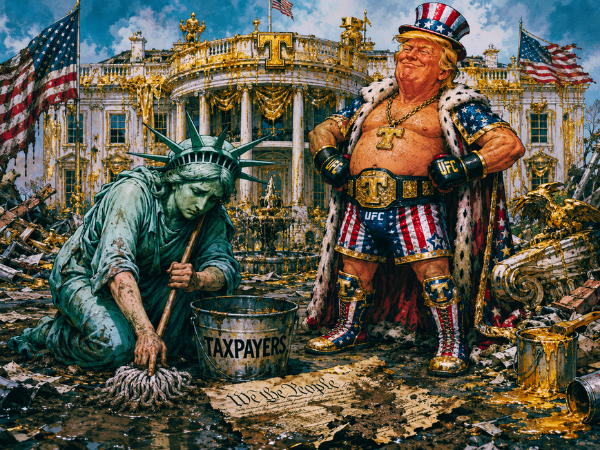
WASHINGTON, DC — If you carried a cell phone past the wrong street corner at the wrong moment, police could already have your movements, your digital trail, and your identity—without ever suspecting you of a crime. That is the reality of geofence warrants, a powerful surveillance tool whose use by police is now being challenged before the U.S. Supreme Court.

Warning that geofence warrants constitute digital fishing expeditions that force millions of innocent Americans to prove they’re not suspects, The Rutherford Institute is urging the Supreme Court to hold that geofence warrants are unconstitutional general warrants—an abuse of power the Founders sought to prohibit through the Fourth Amendment. Historically, general warrants gave government agents sweeping authority to search wherever they pleased, without probable cause or particularized suspicion limited to particular individuals, locations, or materials. As Institute attorneys warn in an amicus brief in Wells v. Texas, geofence warrants revive that same abuse in digital form, allowing the government to rummage through the location histories of untold numbers of innocent people in the hope that someone, somewhere, might be connected to a crime.

“Geofence warrants turn the Fourth Amendment on its head. If the government can track where we go, who we associate with, and when we were present—without probable cause—then no one’s movements are truly private,” said constitutional attorney John W. Whitehead, president of The Rutherford Institute and author of Battlefield America: The War on the American People. “This case is about whether the Constitution still places meaningful limits on government surveillance in the digital age.”

When police have no suspect but assume—correctly—that nearly everyone carries a cell phone, geofence warrants allow them to compel technology companies to turn over location data for every device within a defined area and time period, regardless of suspicion. Police can then narrow that data through successive requests—tracking movements, reviewing account information, and ultimately identifying individuals—until a suspect emerges. Geofence warrants have been used by law enforcement since at least 2016.

In Wells v. Texas, Texas police obtained a geofence warrant directing Google to identify devices located near the scene of a crime during a specific time window. Through successive data requests, police ultimately identified a cell phone associated with the defendant as being in the area, leading to a conviction. In a divided decision, the Texas Court of Criminal Appeals upheld the geofence warrant as constitutional. Two judges went further, asserting that no warrant was required at all because cell phone users lack a reasonable expectation of privacy in information they “voluntarily” share with third parties such as Google. That reasoning directly conflicts with a ruling in another case from the Fifth Circuit Court of Appeals, which held that geofence warrants are general warrants categorically prohibited by the Fourth Amendment.

In asking the U.S. Supreme Court to review the case, The Rutherford Institute warns that geofence warrants pose a grave and growing threat to the privacy of all Americans. By normalizing suspicionless surveillance, these warrants establish a dangerous precedent in which vast numbers of innocent people must surrender their privacy simply for existing in public space with a smartphone in their pocket.

Ethan H. Townsend and Maura R. Cremin of McDermott Will & Schulte LLP advanced the arguments in the amicus brief.

The Rutherford Institute, a nonprofit civil liberties organization, defends individuals whose constitutional rights have been threatened or violated and educates the public on a wide spectrum of issues affecting their freedoms.

Source: https://tinyurl.com/8hhk7yvp

WASHINGTON, D.C. — In a decision that makes it easier for political candidates to challenge election-related harms while leaving ordinary Americans without similar recourse, the U.S. Supreme Court ruled that candidates may challenge state laws governing the counting of votes in their own races but declined to base that on broader standing principles applicable for all citizens harmed by unlawful government action.

The Court’s ruling in Bost v. Illinois State Board of Elections revives a lawsuit brought by U.S. Rep. Michael Bost against Illinois election officials. The Rutherford Institute joined the American Civil Liberties Union, the League of Women Voters, and their Illinois affiliates in an amicus brief urging the Court to adopt a broader rule: that any individual—not just political candidates—has standing when forced to incur costs to counter or mitigate allegedly unlawful government action. While the majority of the Court declined to go that far, Justice Amy Coney Barrett, joined by Justice Elena Kagan, cited the coalition’s amicus brief as support in a concurring opinion. The concurrence reasoned that financial harm caused by government action can establish standing for a wide range of plaintiffs beyond political candidates, depending on the context.

“A Constitution that cannot be enforced in court is little more than a suggestion,” said constitutional attorney John W. Whitehead, president of The Rutherford Institute and author of Battlefield America: The War on the American People. “This case underscores a growing problem in constitutional law: the fight for freedom doesn’t end at the courthouse steps—but too often today, that’s exactly where it’s being stopped.”

Under Illinois law, election officials may receive and count mail-in ballots for up to two weeks after Election Day, so long as the ballots are postmarked or certified by Election Day. Federal law, however, establishes a single “day of the election” for choosing members of Congress and appointing presidential electors: the Tuesday following the first Monday in November. Rep. Michael Bost sued the Illinois State Board of Elections, arguing that the extended state mail-in ballot receipt deadline unlawfully prolongs Election Day. Bost alleged that the extended process forces his campaign to remain operational—and incur additional expenses—after Election Day to monitor the counting of ballots.

Lower federal courts dismissed the lawsuit, concluding that Bost had raised only a generalized grievance about the government’s failure to follow the law. The Supreme Court reversed, explaining that vote-counting rules which undermine the integrity of the electoral process cause a loss of legitimacy that constitutes a concrete harm to a representative, and candidates have an interest in a fair pro­cess whether they win or lose. Thus, the majority expressly limited its ruling to political candidates challenging vote-counting rules, and declined to adopt a broader standing doctrine that would apply to any citizen harmed by unlawful government action.

The Court has dismissed significant cases for lack of standing, such as Murthy v. Missouri, in which plaintiffs challenged government-pressured censorship. Justice Samuel Alito has expressed concern that courts are using the doctrine of Article III standing as a means to avoid deciding “particularly contentious constitutional questions.” The Rutherford Institute called on the Supreme Court to use this case to prevent standing requirements from becoming a procedural shield that insulates government misconduct from meaningful review.

Ari Savitzky, Cecillia D. Wang, Evelyn Danforth-Scott, and others at the ACLU advanced the arguments in the Bost v. Illinois State Board of Elections amicus brief.

The Rutherford Institute, a nonprofit civil liberties organization, defends individuals whose constitutional rights have been threatened or violated and educates the public on a wide spectrum of issues affecting their freedoms.

Source: https://tinyurl.com/58z4e7xd

WASHINGTON, D.C. — One year after the U.S. Supreme Court declined to protect homeowners from warrantless searches by police based merely on a suspicion that a person on probation or parole resides on the premises, agents with Immigration and Customs Enforcement are now forcibly entering private homes without a judge’s warrant.

According to reporting by the Associated Press, ICE officers are being instructed that they may use force to enter a residence based solely on an administrative arrest warrant tied to a final order of removal—despite prior guidelines and legal precedent holding that such warrants do not authorize entry into a private home absent consent or exigent circumstances.

“This is not law enforcement. It’s a home-invasion policy,” said constitutional attorney John W. Whitehead, president of The Rutherford Institute and author of Battlefield America: The War on the American People. “The Fourth Amendment does not disappear at the doorstep simply because the government labels a piece of paper an ‘administrative warrant.’ Judicial oversight is not optional. It is the Constitution’s first line of defense against tyranny.”

The Rutherford Institute warned one year ago that the Supreme Court’s refusal to intervene in Bailey v. Arkansas set the nation on a slippery slope toward a society in which police may invade homes based on nothing more than a hunch. That warning now carries graver weight in light of ICE’s newly revealed internal memo authorizing officers to forcibly enter private residences without judicial approval—a sweeping assertion of power that directly collides with the Fourth Amendment’s core protections against unreasonable searches and seizures. Disturbingly, these warrantless raids are not confined to non-citizens. In a widely reported incident, ICE agents forced open the door to the Minnesota home of ChongLy Thao, a U.S. citizen, dragged him outside in his underwear, and detained him without a judicial warrant—despite his repeated assertions of citizenship. The incident underscores the real-world consequences of treating administrative authority as a substitute for constitutional safeguards. Unlike judicial warrants issued by neutral judges upon a showing of probable cause, ICE administrative warrants are signed internally by immigration officials—allowing the same agency to act as lawmaker, judge, and enforcer. Civil liberties advocates warn that this concentration of power invites precisely the kind of warrantless, militarized home raids the Fourth Amendment was written to prevent.

For years, The Rutherford Institute has documented the steady erosion of Fourth Amendment protections through no-knock raidsmilitarized policing, and “Constitution-free” enforcement tactics—often targeting the most vulnerable communities first. ICE’s new guidance represents a dangerous escalation of that trend. “This memo doesn’t just threaten immigrants. It normalizes the idea that armed government agents may force their way into a home without judicial approval. Once that line is crossed, no one’s privacy is secure—not even citizens,” Whitehead said. “The government is once again testing how much lawlessness the public will tolerate. History shows that when agencies are allowed to ignore the Fourth Amendment in the name of expediency, abuse follows—and freedom is the casualty.”

The Rutherford Institute, a nonprofit civil liberties organization, defends individuals whose constitutional rights have been threatened or violated and educates the public on a wide spectrum of issues affecting their freedoms.

Source: https://tinyurl.com/mryprccm

“The people have the power… We are the government.”—John Lennon

We are living through a period of open lawlessness at the highest levels of government.

Executive orders are issued to sidestep Congress. Federal law enforcement is deployed as a tool of retaliationProtest is criminalizedSurveillance expands. Due process becomes optional. Courts are packed, ignored, or bypassed. Entire communities are terrorized under the guise of “law and order.”

None of this is accidental. And none of it is temporary.

At a time when executive orders are used to punish dissent, federal agencies are weaponized against political opponents, protesters are met with militarized force, immigration enforcement is used as terror theater, and constitutional limits are treated as inconveniences rather than restraints, one fact has become impossible to ignore: politics won’t fix a system that is broken beyond repair.

Elections have failed to check the police state.

Courts increasingly defer to it.

And a year into Trump’s second term, what began as campaign rhetoric has hardened into administrative policy; what was once framed as a national emergency has become routine authoritarianism.

Executive power has expanded, accountability has contracted, and constitutional limits have been tested—and ignored—by the Trump administration with increasing confidence.

This is no longer a warning about what might happen. It is a record of what has already occurred.

This same authoritarian mindset has not remained confined to domestic policy. It has predictably expanded outward, revealing itself just as clearly in foreign affairs.

Trump’s renewed saber-rattling over Greenland—treating another nation’s territory as if it were a corporate asset to be acquired or controlled—reveals how deeply this distortion of power has taken hold.

It is the language of ownership, not governance; of command, not consent.

A president is not a monarch, a CEO, or a landlord over the republic. He is an employee—hired by “we the people,” bound by a written contract called the Constitution, and subject to limits he did not write and cannot rewrite.

When that employee ignores his limits, only one check remains: the people themselves.

John Lennon’s reminder that “the people have the power” has never been more relevant—or more dangerous to those in power.

That power has a name: nullification.

It is the authority of ordinary citizens and local communities to refuse cooperation with unjust laws, illegitimate prosecutions, and unconstitutional government action.

In an era of open executive defiance and punitive governance, nullification is no longer optional—it is a civic necessity.

How else do you balance the scales of justice at a time when Americans are being tasered, tear-gassed, pepper-sprayed, hit with batons, shot with rubber bullets and real bullets, blasted with sound cannons, detained in cages and kennels, and arrested and jailed for challenging the government’s excesses, abuses and power-grabs?

No matter who sits in the White House, a shadow government continues to call the shots behind the scenes.

Relying on the courts to restore justice has exposed a growing fracture within the judiciary itself.

On one side are lower courts, which have often served as a first line of defense against the Trump administration’s constitutional overreaches and abuses of power. On the other is the U.S. Supreme Court, which appears increasingly preoccupied with preserving order and insulating government agents from accountability rather than upholding the rights enshrined in the Constitution.

With each ruling handed down by the Supreme Court, it becomes harder to deny that we are living in an age of hollow justice—one in which the government is routinely granted a free pass to sidestep the rule of law, shielding the powerful from accountability rather than restraining them.

Even so, justice matters.

It matters whether you’re a rancher protesting a federal land grab by the Bureau of Land Management, a Native American defending sacred land and water from oil pipelines, a college student demonstrating against U.S. complicity in foreign wars, a trucker protesting government mandates, a Black American marching against the routine killing of unarmed citizens by police, or a protester standing witness in the face of ICE raids that terrorize communities.

They may be different causes, but it’s the same police state response over and over again: militarized force, mass arrests, surveillance, and prosecution.

Unfortunately, protests and populist movements haven’t done much to push back against an authoritarian regime that is deaf to our cries, dumb to our troubles, blind to our needs, and accountable to no one.

Regardless of ideology or grievance, the government’s modus operandi remains the same: shut down protests using all means available, prosecute First Amendment activities to the fullest extent of the law, criminalize dissent, label dissidents as extremists or terrorists, and surveil the population in order to crush resistance before it can take root.

If protests are met with force, elections are rendered performative, courts defer to power, and legislatures refuse to act, then any remaining means of thwarting the government’s relentless march toward outright dictatorship cannot lie within the system itself.

It must lie with the people—specifically, with the power of juries and local communities to refuse cooperation with illegitimate laws, abusive prosecutions, and unconstitutional government actions.

Nullification works.

Just as a President may veto an act of Congress, the American juror possesses the “People’s Veto”—the power to refuse enforcement of a law or prosecution that offends the conscience of the Constitution.

When a former Department of Justice employee threw a sandwich at an ICE agent, the Trump administration sent 20 officers in riot gear to his home to arrest him, then attempted to have a grand jury send him to jail for eight years on charges of a felony assault on a federal agent. The grand jury refused.

That refusal was not lawlessness. It was conscience.

As law professor Ilya Somin explains, jury nullification is the practice by which a jury refuses to convict someone accused of a crime if they believe the “law in question is unjust or the punishment is excessive.” According to former federal prosecutor Paul Butler, the doctrine of jury nullification is “premised on the idea that ordinary citizens, not government officials, should have the final say as to whether a person should be punished.”

In a world of “rampant overcriminalization,” where the average American unknowingly breaks multiple laws every day, jury nullification serves as “a check on runaway authoritarian criminalization and the increasing network of confusing laws that are passed with neither the approval nor oftentimes even the knowledge of the citizenry.”

Indeed, Butler believes so strongly in the power of nullification to balance the scales between the power of the prosecutor and the power of the people that he advises: “If you are ever on a jury in a marijuana case, I recommend that you vote ‘not guilty’—even if you think the defendant actually smoked pot, or sold it to another consenting adult. As a juror, you have this power under the Bill of Rights; if you exercise it, you become part of a proud tradition of American jurors who helped make our laws fairer.”

In other words, it is “we the people”—not politicians, not prosecutors, not judges, not corporate interests—who can and should be determining what laws are just, what activities are criminal and who can be jailed for what crimes.

This is why nullification matters now more than ever—not just because injustice is being imposed from below, but because accountability is being erased from above.

Trump’s willingness to use the presidential pardon power not as a safeguard against injustice but as a tool to erase it reveals a dangerous inversion of constitutional authority.

Pardons issued to political allies and ideological foot soldiers function as a form of nullification from above—executive erasure of legal consequence.

Jury nullification, by contrast, operates from below, as the people’s last remaining check on government abuse.

Writing for New York magazine, Elie Honig, a former federal and state prosecutor, rightly points out:

“Trump presently faces little meaningful opposition to his agenda, and to his excesses. The Executive Branch has largely been purged of objectors (or even some who faithfully do their jobs). The Republican-controlled House and Senate provide no friction, while Democrats flail helplessly. And the Supreme Court generally (though not always) has gone Trump’s way on executive power. One of the few remaining checks comes from the most humble of sources – the everyday civilians who get that dreaded notice in the mail and wind up serving on grand juries and trial juries. Other than voting, it’s the most basic, populist exercise of American democracy.

The punishment should fit the crime, but the law itself should also reflect the will and conscience of the people—not the profit-driven priorities of a corporate-government elite that sees nothing wrong with locking someone away for life over a nonviolent offense.

Unsurprisingly, the powers-that-be do not want the public to know it has this power.

The government prefers a citizenry ignorant of its rights.

Indeed, the Supreme Court ruled as far back as 1895 that jurors need not be informed of their right to nullify—a telling admission of how threatening this power truly is.

Those who attempt to educate jurors about nullification have faced intimidation’ and prosecution. Yet courts have also recognized that discussing jury nullification in the abstract is protected speech under the First Amendment, reinforcing the idea that public debate about the justice system is not only lawful, but essential.

Jury nullification has deep roots in American history. It was championed by figures such as John Adams and John Hancock and used repeatedly to resist laws that were unjust, immoral, or out of step with fundamental liberties—from colonial resistance to British rule to modern opposition to draconian drug laws.

At a time when government officials accused of wrongdoing are routinely granted leniency, while ordinary citizens are prosecuted to the fullest extent of the law, jury nullification stands as a powerful reminder that “we the people” are the government.

For too long, we have allowed our so-called representatives to call the shots. It is time to restore the citizenry to its rightful place in the republic.

To reclaim our power, we must change the rules and restore “we the people” as the masters, not the servants, in the power dynamic.

The government has perfected a divide-and-conquer strategy that exploits political, racial, economic, and cultural divisions. Surveillance, extremism reports, militarized policing, fusion centers, domestic intelligence databases, and the transformation of local police into extensions of the military have created an atmosphere of fear, suspicion, and distrust.

What too many Americans fail to realize is that, in the eyes of an unaccountable state, distinctions between left and right, protester and bystander, loyalist and dissenter eventually collapse.

When the crackdown comes—and it is coming—it will not matter who you voted for, which protest you supported, or whether you spoke out or stayed silent. When the machinery of repression turns inward, everyone becomes a potential target.

The government is not afraid of civil unrest. It anticipates it. It prepares for it.

The protests in FergusonBaltimoreBaton Rouge, and Standing Rock—where militarized police turned American towns into war zones and caged demonstrators like animals—were dress rehearsals.

They were training exercises for a future in which widespread dissent is met with overwhelming force.

Case in point: what’s unfolding in Minneapolis right now—a pattern that has repeated itself across the country whenever dissent threatens power.

The objective is compliance. The strategy is destabilization followed by control.

Knowing this, the question is no longer whether the police state can be reasoned with, voted out, or restrained from within.

The question is how ordinary people reclaim power in a system designed to deny it.

You change the rules.

You engage in disciplined, nonviolent resistance that disrupts unjust systems without surrendering moral authority. You practice civil disobedience and militant nonviolence, as Martin Luther King Jr. did through sit-ins, boycotts, and mass protest. You build grassroots power locally—thinking nationally, but acting locally.

And above all, you refuse to comply with laws, prosecutions, and policies that are illegitimate, egregious, or unconstitutional.

Nullify injustice.

Nullify unjust court cases. Nullify unjust laws. Nullify executive overreach.

Justice in America is too often reserved for those who can afford to buy it. For everyone else, the system is riddled with failures: police misconduct, prosecutorial abuse, judicial bias, inadequate defense, and a legal code so vast and convoluted that innocence becomes almost irrelevant.

In a courtroom, the conscience of a jury manifesting as nullification may be the one advantage left to us in the face of government corruption.

Nullification is not lawlessness. It is lawful resistance and it may be our last remaining safeguard against tyranny.

It is ordinary people refusing to rubber-stamp injustice. It is the citizenry exercising the authority the Constitution entrusts to them when every other safeguard has failed.

What nullification represents is the power of the people to reject potentates and tyrants.

It is a reminder that no president owns this country—just as no president gets to purchase, annex, or command the world as if it were his personal domain.

For too long, we have been conditioned to believe that power flows downward—from politicians, courts, and enforcers to the people. The truth is the opposite. Power flows upward, but only when citizens are willing to claim it.

As I make clear in Battlefield America: The War on the American People and in its fictional counterpart The Erik Blair Diaries, “We the people” are the government.

And if those in power don’t like being reminded of that fact, they’re free to get another job.

Source: https://tinyurl.com/5bms434y

ABOUT JOHN W. WHITEHEAD

Constitutional attorney and author John W. Whitehead is founder and president of The Rutherford Institute. His most recent books are the best-selling Battlefield America: The War on the American People, the award-winning A Government of Wolves: The Emerging American Police State, and a debut dystopian fiction novel, The Erik Blair Diaries. Whitehead can be contacted at staff@rutherford.org. Nisha Whitehead is the Executive Director of The Rutherford Institute. Information about The Rutherford Institute is available at www.rutherford.org.

Publication Guidelines / Reprint Permission

John W. Whitehead’s weekly commentaries are available for publication to newspapers and web publications at no charge.