Posts Tagged ‘Iran’

“In individuals, insanity is rare; but in groups, parties, nations and epochs, it is the rule.”— Friedrich Nietzsche

One week after posting a profanity-laced Easter message threatening to wipe out the entire civilization of Iran, Donald J. Trump, the 47th president of the United States, spent the night of April 12 and into the early morning hours unleashing a barrage of AI-generated images, threats and insults.

One post depicted Trump as Jesus, imbued with divine power, healing the sick.

Another imagined a Trump-branded hotel on the Moon.

Yet another lashed out at Pope Leo XIV as weak on crime, suggesting he owed his papacy to Trump and “should get his act together as Pope, use Common Sense, stop catering to the Radical Left, and focus on being a Great Pope, not a Politician.”

After significant outcry—including from his own evangelical and MAGA supporters—Trump deleted the post but refused to apologize for it.

Blasphemous. Profane. Threatening. Self-aggrandizing.

These posts are not anomalies.

They are part of a pattern—one that appears to be escalating.

What was once dismissed as erratic now feels increasingly unhinged. What was once provocative now borders on delusional. What was once ego now approaches outright megalomania.

Consider the trajectory.

In May 2025, after returning from the funeral of Pope Francis, Trump posted an AI generated image of himself as pope.

In December 2025, he posted more than 160 times over a five-hour period.

In January 2026, another late-night posting binge featured what the Poynter Institute described as “false economic claims, election conspiracies and political attacks.”

In February 2026, Trump shared a racist video depicting Barack and Michelle Obama as apes—while casting himself as the king of the jungle.

This is not normal.

Nor is it merely rhetorical excess.

It is behavior that mirrors the governing style: impulsive, self-serving, detached from reality, and increasingly dangerous.

The same egomania driving Trump’s online persona is shaping his presidency.

He has alienated allies, threatened the sovereignty of other nations—including Canada, Greenland and Cuba—and pushed the country toward ill-advised wars with devastating human and financial costs.

Having inherited one of the strongest economies in the world, he has overseen policies that have left average Americans struggling to stay afloat, even as his allies and corporate partners grow richer.

Whether driven by ego or manipulation—by flattery, spectacle or greed—the result is the same: America is being hollowed out while the president redecorates it in gold.

Literally.

Operating on the philosophy that it’s easier to ask forgiveness than permission, Trump bulldozed the East Wing to construct a lavish ballroom. He has proposed monuments in his own honor, covered the White House in gold embellishments, affixed his name to national institutions, and floated renaming major landmarks after himself.

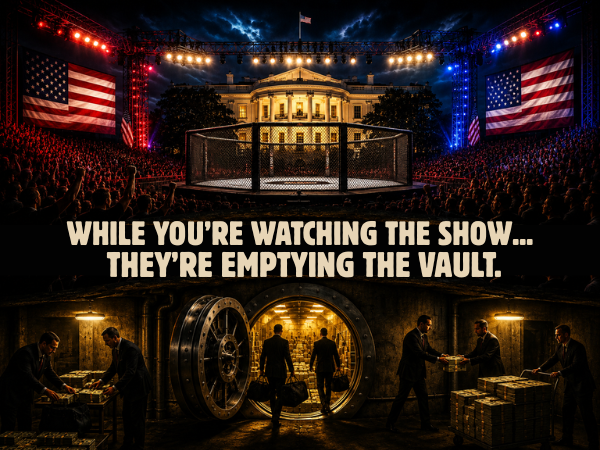
He is even staging a UFC fight on the White House lawn on his 80th birthday as part of the nation’s 250th anniversary celebrations.

All of this while Americans struggle with rising grocery costs, unaffordable healthcare, and economic instability driven by his reckless policy decisions.

This is not serious governance. This is spectacle.

This is not rational.

This is not presidential.

And yet, despite widespread fatigue, desensitization, and normalization of this behavior, there must come a point when we acknowledge what is plainly visible: something is deeply wrong with the president.

This is no longer a matter of partisan disagreement or political style.

To any objective viewer, Donald Trump’s behavior—which has always been erratic at best—has become increasingly unstable.

As the New York Times reports:

“Trump seems even less restrained and more incoherent at times. He uses more profanity, speaks longer and regularly makes comments rooted in fantasy rather than fact. He keeps saying that his father was born in Germany when in fact he was born in the Bronx. He repeats an invented story about his uncle, an M.I.T. professor, telling him about teaching the terrorist known as the Unabomber. He wanders off into odd tangents — an eight-minute ramble at a Christmas reception about poisonous snakes in Peru, a long digression during a cabinet meeting about Sharpie pens, an interruption of an Iran war update to praise the White House drapes. He has confused Greenland with Iceland and more than once boasted of ending a fictional war between Cambodia and Azerbaijan, two countries separated by nearly 4,000 miles.”

As the oldest person elected to the White House, Trump—who turns 80 this year—oscillates between vicious politicking, relentless self-idolatry, and serving as the sleight-of-hand prop for what increasingly resembles an organized crime operation—one that operates behind the floodlights to consolidate power and wealth while robbing the American electorate blind.

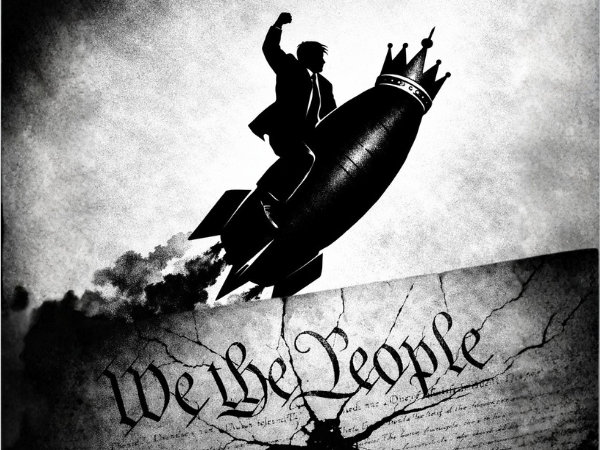
Trump’s self-mythologizing is unprecedented in modern American politics.

As journalist Peter Baker notes, Trump “regularly depicts himself in a heroic, almost godly fashion, as a monarch, as a Superman, as a Jedi knight, as a military hero, even as a pope in a white cassock.”

“His picture has been splashed all over the White House, on multistory banners on the side of federal buildings, on annual passes to national parks and maybe even soon on a one-dollar coin. His name has been etched on the John F. Kennedy Center for the Performing Arts, on the U.S. Institute of Peace, on federal investment accountsspecial visas and a discount drug program and, if he has his way, on Washington Dulles International Airport, Penn Station in New York and the future stadium of the Washington Commanders.”

Baker’s catalogue of Trump’s efforts to brand himself as the face of a new America is expansive, ranging from a 15-foot-tall gold-covered “Don Colossus” statue to a new class of battleships and adding his face to Mt. Rushmore. Trump even toyed with the idea of renaming the Gulf of Mexico to the Gulf of Trump.

This is not branding.

It is the architecture of a cult of personality.

This is a man drunk on power with an already enormous ego,” said Sarah Matthews, deputy White House press secretary during the first Trump administration. “It reinforces the perception that this presidency is more about elevating one man than serving the country.”

As always, history points the way.

Cults of personality are hallmarks of authoritarian regimes—not constitutional republics. They are associated with figures like Stalin, Mao, Mussolini and, more recently, Vladimir Putin.

The parallels are difficult to ignore.

So, too, are Trump’s similarities to the megalomania of Saparmurat Niyazov, the former dictator of Turkmenistan, whose own cult of personality gave rise to policies based on his changeable whims, pet peeves and ego.

As Slate reports, Niyazov not only outlawed beards, lip syncing, and gold teeth but also installed a 350 foot, rocket-shaped monument­—the Arch of Neutrality—topped with a golden statue of Niyazov that rotated so it constantly faced the sun.

But such power does not exist in a vacuum.

It is enabled.

While Niyazov was, indeed, a megalomaniac, it was his cult of personality—the hard-core followers who formed his base—that empowered him to act as a dictator.

Likewise, Trump’s personality cult has, as the New York Times Editorial Board noted, “transformed the Republican Party from a political organization into a cult of personality”—one that reinforces and amplifies his excesses.

We are, as Pope Leo XIV warned, mired in a “delusion of omnipotence” that “is becoming increasingly unpredictable and aggressive.”

Which brings us to the unavoidable question: what happens when the president appears unable to discharge the duties of his office in a rational, coherent, and responsible manner?

In other words, what can we do when the president appears to be losing his mind?

This is a constitutional crisis.

And the Constitution provides a remedy.

The 25th Amendment to the U.S. Constitution, ratified in 1967 in the wake of John F. Kennedy’s assassination, provides a process by which the government continues to function should the president be unable to carry out his duties.

There are four clauses to the amendment, which outlines the procedure for “replacing the president or vice president in the event of death, removal, resignation, or incapacitation.”

Section 4 is explicit:

“Whenever the Vice President and a majority of either the principal officers of the executive departments or of such other body as Congress may by law provide, transmit to the President pro tempore of the Senate and the Speaker of the House of Representatives their written declaration that the President is unable to discharge the powers and duties of his office, the Vice President shall immediately assume the powers and duties of the office as Acting President.”

A growing chorus of individuals—a lineup of the usual Trump critics, as well as some of his onetime defenders—have loudly called to invoke the 25th Amendment, insisting that the president is not fit for office.

Yet as Gaby Hinsliff concludes in The Guardian:

“In practice, constitutional safeguards are only as strong as the resolve of a leader’s inner circle—people often devoted to keeping them in power at all costs—to expose the boss publicly at his or her most vulnerable… But it’s precisely to override such emotional dilemmas that, in the case of political leaders, constitutional safeguards exist. For without them, we’re all potentially just passengers in some superpower’s speeding truck: watching helplessly from the back seat as the driver weaves all over the road, and wondering just how close we have to get to crashing before someone speaks up.”

Notably silent among those calling to invoke the 25th Amendment: anyone in Trump’s cabinet or among those who would benefit most from keeping Trump as a figurehead, including the Republicans in Congress (minus Thomas Massie).

History suggests this is not unusual.

There has long been a tendency to shield those in power from scrutiny, to conceal frailty in the name of stability, and to protect the office even at the expense of the public.

That instinct—to cover up rather than confront—can be as dangerous as the instability itself.

This was never supposed to be about politics.

It was never supposed to be about ideology.

It is about constitutional capability.

Yet the same voices that once called for invoking the 25th Amendment against Joe Biden have fallen silent—or worse, attempted to dismiss Trump’s instability as authentic and refreshingly unfiltered.

But there is no filter for this level of dysfunction.

Somewhere between Trump’s attempts to overthrow the 2020 election and his threats of war crimes against civilians, we crossed a line—from controversial leadership into dangerous incapacity.

“What’s alarming is how the rate of Trump’s bizarre speech and political decisions have been increasing,” said Harry Segal, a senior lecturer in the Psychology Department at Cornell University and in the Psychiatry Department at Weill Cornell Medicine. “Trump has shown evidence of dementia … as indicated by his strange gait, phonemic paraphasia—when he begins a word and can’t finish it—and decline in the complexity of his words and concepts… he is avoiding events where he has to respond coherently and spontaneously … he has become more impulsive, another sign of incipient dementia.”

Even those within Trump’s orbit have acknowledged the risk.

As former White House Communications Director Anthony Scaramucci observed, “It was at this point that our Founders thought the best thing to do would be to remove a mad man who has the executive office. It became more formalized with the 25th amendment, but more people now should be calling for this man’s removal.”

Yet again, the troubling parallels to America’s nascent beginnings are hard to ignore.

King George III—believed to have suffered from severe mental instability, including manic episodes and delusions—lost the American colonies in part because of his inability to govern rationally.

Two hundred fifty years later, America once again finds itself charting dangerous territory.

Yet even so, this moment is about so much more than one man and his cult of personality.

Because while the president may be unraveling in plain sight, the machinery of the American Police State continues to expand—quietly, relentlessly, and with bipartisan support.

Surveillance is expanding.

Policing is becoming more militarized.

Power is becoming more centralized and less accountable.

And unlike the presidency, there is no 25th Amendment for the police state.

No mechanism to declare it unfit.

No procedure to remove it.

Or is there?

After all, isn’t that what the Declaration of Independence was—a formal recognition that a ruler was no longer fit to govern, followed by a blueprint for replacing that power with something accountable to the people?

The American Revolution was, at its core, a judgment: that unchecked power must be resisted.

That principle still stands.

As I make clear in Battlefield America: The War on the American People and in its fictional counterpart The Erik Blair Diaries, the answer is not violence, but vigilance.

Not chaos, but constitutional resistance.

If the government has become unfit—whether through madness, corruption or unchecked power—then it is up to “we the people” to hold it accountable.

Because if we fail to act, we may soon find that the problem is no longer one unstable leader—but a system that no longer answers to the people at all.

Source: https://tinyurl.com/3msmnbt9

ABOUT JOHN W. WHITEHEAD

Constitutional attorney and author John W. Whitehead is founder and president of The Rutherford Institute. His most recent books are the best-selling Battlefield America: The War on the American People, the award-winning A Government of Wolves: The Emerging American Police State, and a debut dystopian fiction novel, The Erik Blair Diaries. Whitehead can be contacted at staff@rutherford.org. Nisha Whitehead is the Executive Director of The Rutherford Institute. Information about The Rutherford Institute is available at www.rutherford.org.

Publication Guidelines / Reprint Permission

John W. Whitehead’s weekly commentaries are available for publication to newspapers and web publications at no charge.
“We’re fighting wars, we can’t take care of … daycare, Medicaid, Medicare, all these individual things… We have to take care of one thing: military protection.”—President Donald J. Trump

“Every gun that is made, every warship launched, every rocket fired signifies, in the final sense, a theft from those who hunger and are not fed, those who are cold and are not clothed.”— President Dwight D. Eisenhower

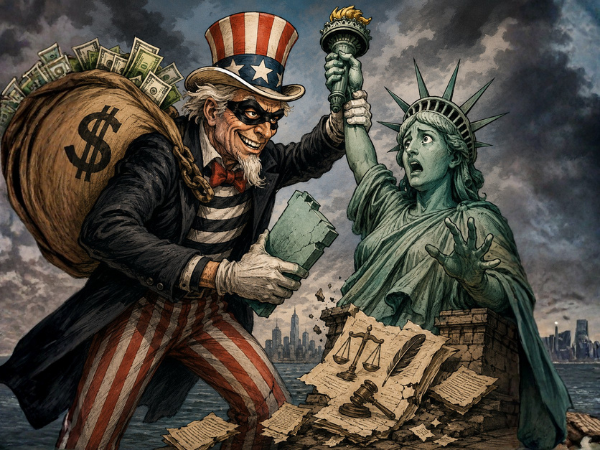
Every bomb dropped abroad is a bill sent home.

Every war waged in the name of “security” is paid for by Americans who go without—without affordable healthcare, without stable housing, without a government that prioritizes their well-being.

As the U.S. pours trillions into endless wars and military expansion, Americans are left paying the price—not just in dollars, but in lost freedoms and eroded constitutional protections.

This is not national defense.

This is organized theft.

While Americans struggle with rising gas prices, soaring grocery bills, and mounting debt—fueled in part by reckless tariffs and preemptive wars—the federal government is spending money it doesn’t have on military expansion, foreign conflicts, and presidential excess.

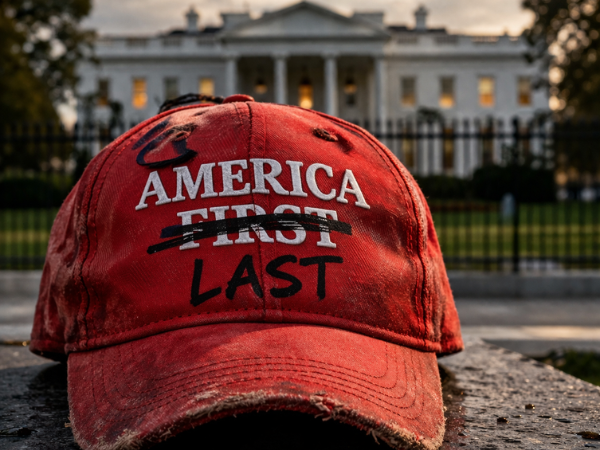
This is not America First.

If anything, it is becoming painfully clear that Donald Trump’s “America First” approach to governing puts America last every time.

Trump has not made it a priority to rebuild America’s crumbling infrastructure. He has not made it a priority to invest in innovation or ensure that the nation remains competitive in a rapidly advancing technological world. Nor has he shown much concern for caring for veterans, the elderly, or the young.

Instead, the government is cutting back on programs that make Americans healthier, smarter, and more secure—while the president builds monuments to himself and indulges in a taxpayer-funded lifestyle of staggering excess.

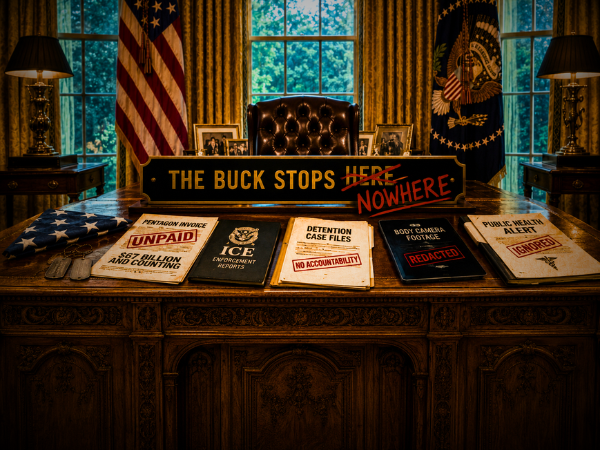
Despite once claiming he would be too busy to play golf, Trump is on track to leave taxpayers with a bill exceeding $300 million in travel and security expenses—much of it tied to frequent trips to his Florida properties. Each visit to Mar-a-Lago costs an estimated $3.4 million.

Meanwhile, taxpayers are shelling out $273,063 per hour to keep Air Force One in the air.

And while millions of Americans struggle to afford basic necessities, Trump is demanding $377 million—an 866 percent increase—to renovate the White House residence.

But these excesses, outrageous as they are, pale in comparison to the true cost of this administration’s priorities: war.

The Trump administration has requested $1.5 trillion for its FY 2027 military budget—separate from an additional $200 billion in emergency funding for the war in Iran.

The sitting president of the United States is spending money that is not his to spend in order to fight endless wars unauthorized by Congress that do nothing to protect the American people or our interests, while insisting that the federal government’s only priority should be the military industrial complex.

The president’s fiscal priorities include:

In addition to increasing the budget for the military, prisons, nuclear weapons, and a weaponized Justice Department, the Trump administration has also proposed budget cuts of $73 billion to non-military programs—slashing funding for medical research, public schools, and low-income heating assistance, as well as cuts to affordable housing, job training, small-business lending, anti-poverty programs, agriculture, NASA, research in social sciences and economics, humanitarian assistance and global health programs, among others.

As Dominik Lett writes for Cato, “Shifting dollars from domestic programs to the Pentagon is shuffling deck chairs on the Titanic given our mounting fiscal crisis.”

This is how empires fall.

The Constitution does not permit a president to wage war on a whim.

The founders were clear: the power to declare war rests with Congress, not the executive. The president, as Commander in Chief, was meant to oversee the military—not unleash it unchecked.

And yet, once again, we find ourselves embroiled in an unauthorized war—funded by taxpayers, justified with shifting narratives, and carried out without meaningful oversight.

With Congress unwilling to act as a check on executive overreach, and the courts increasingly sidelined, the constitutional safeguards meant to prevent this very scenario have all but collapsed.

War is no longer a last resort.

It has become a business model.

The man who campaigned on a pledge of “no new wars” has instead propelled the nation into endless military conflicts that promise to become endless wars that enrich defense contractors, reward political allies, and deepen the financial burden on the American people.

Reports of insider profiteering tied to shifting policy decisions only reinforce what many Americans already suspect: that war, in the Trump era, is as much about profit as it is about power.

Historian Timothy Snyder, who has written extensively on authoritarian regimes, sees the administration’s expanded war budget through a darker and more troubling lens—by which military spending functions as a way to bribe the military into supporting a Trump-led government takeover.

Translation: the Trump administration could be laying the groundwork for a false flag terrorist attack that would allow Trump to declare martial law, cancel or nullify the midterm elections and shift the nation further towards a dictatorship.

There is precedent for it, not only with Trump’s own actions in January 2020, but also by the man he most admires—Vladimir Putin, who masterminded his own false flag terrorist attacks in Russia in 1999 as a means of entrenching his own power.

In that light, the obscene escalation of military funding raises the specter of a government preparing not just for foreign conflict—but for domestic control.

This tracks closely with the Pentagon’s chilling Megacities training video, which predicts that by 2030, armed forces would be used against civilian populations to solve domestic political and social problems.

The danger is not theoretical.

History has shown, time and again, that leaders who accumulate unchecked power, surround themselves with loyalists, and normalize perpetual war often turn those powers inward.

But what happens when that unchecked power is placed in the hands of someone who appears increasingly erratic and unmoored from reality?

In recent weeks, Trump has issued profanity-laced threats on social media targeting civilian infrastructure in Iran—actions that would constitute war crimes under international law.

On Easter Sunday, when Christians the world over were celebrating the hope and resurrection of Jesus Christ, Trump shared a profanity-laden post to his Truth Social account, threatening to target civilian infrastructure in Iran—war crimes under the Geneva Convention. “Tuesday will be Power Plant Day, and Bridge Day, all wrapped up in one, in Iran. There will be nothing like it!!! Open the Fuckin’ Strait, you crazy bastards, or you’ll be living in Hell – JUST WATCH! Praise be to Allah. President DONALD J. TRUMP.”

He has used public appearances to rant about political enemies, threaten foreign nations, and boast about military actions with little regard for accuracy or consequence.

In front of an audience of children gathered for the White House’s annual Easter Egg Roll, Trump ranted about Biden’s autopen, expounded on the war in Iran, referred to Kamala Harris as a “low IQ person,” described the Biden administration as not knowing “what the hell they were doing,” and once again threatened to obliterate Iran’s power plants and bridges, which constitute a war crime.

He has suggested he could start charging “tolls” on global shipping through the Strait of Hormuz, claimed victory in the war with Iran even while American forces and Middle Eastern allies continue to come under fire, and floated fantastical political ambitions untethered from constitutional limits, including the idea that he could quickly learn Spanish in order to run for president of Venezuela and win.

This pattern of behavior—reckless, inflammatory, and detached from reality—has prompted a growing number of voices, across the political spectrum, to question whether the president should be removed from office under the 25th Amendment.

Not surprisingly, the very same individuals who loudly called to invoke the 25th Amendment against Joe Biden have fallen silent in the face of Trump’s increasingly erratic behavior.

The standard, it seems, is not constitutional—it is political.

Which brings us back to the war in Iran—a costly, dangerous, and deeply suspect conflict that raises more questions than answers and provides a conveniently timed distraction from Trump’s presence within the Epstein files.

Despite President Trump and Pete Hegseath’s incessant claims of lethality and success, victory is not a foregone conclusion.

And the price we are paying is high indeed, in treasure and life.

Credible concerns point to the fact that key details about the true cost of this war—which “we the people” are entitled to know—are being withheld from the public.

An investigative report by The Intercept suggests that “U.S. Central Command, or CENTCOM, which oversees military operations in the Middle East, appears to be engaged in what a defense official called a ‘casualty cover-up,’ offering The Intercept low-ball and outdated figures and failing to provide clarifications on military deaths and injuries.”

Far from providing a true accounting of the human and financial burden to be borne by the American people, the Trump administration has apparently continued to stonewall and slow-walk information about the numbers of troops injured and killed, and the number of U.S. bases attacked. Indeed, U.S. troops throughout the Middle East have reportedly been forced to abandon their bases and retreat to hotels and office buildings, which are ill-equipped to provide defensive cover.

Even the administration’s account of a dramatic rescue mission of a downed weapons system officer—one involving massive resources and the destruction of U.S. aircraft—is coming under scrutiny, with some suggesting it may have been something far more ambitious and far less successful than advertised.

Although Trump has insisted that he directed the military to send in more than 150 aircraft—including 64 fighter jets, four bombers, 48 refuelers, 13 rescue aircraft and 26 intelligence and jamming aircraft, hundreds of troops, munitions, and multiple aircraft (two of which were reportedly destroyed by U.S. forces to avoid them falling into enemy hands) to rescue this one airman, there is a growing groundswell of voices suggesting that the administration’s rescue mission was, in fact, a failed ground invasion to seize Iran’s enriched uranium—a prospect Trump has teased for weeks.

As Financial Review concluded, “Trump’s daring special ops rescue comes at a hefty price. Some 100 special operations forces were involved in the high-stakes mission while several multimillion-dollar US aircraft were destroyed to secure the airman.”

Which begs the question: can we trust the U.S. government to tell us the truth?

Can we trust a government that has historically engaged in cover-ups—medical, military, political, and environmental?

Can we trust a government that treats its citizens as data points to be tracked, monitored, and manipulated?

Can we trust a government that wages wars for profit, jails its own people for profit, and shields those in power from accountability?

This is a government that lies, cheats, steals, spies, kills, and overreaches its authority at almost every turn.

It treats human beings as expendable—resources to be used, controlled, and discarded.

It is not guided by morality, restraint, or constitutional principle.

It is power unbound—corrupt, unaccountable, and increasingly indifferent to the freedoms it was meant to protect.

This is a government that wages wars for profit and turns a blind eye while its agents abuse their power.

And increasingly, the wars being waged are not just overseas.

Those wars are also here at home.

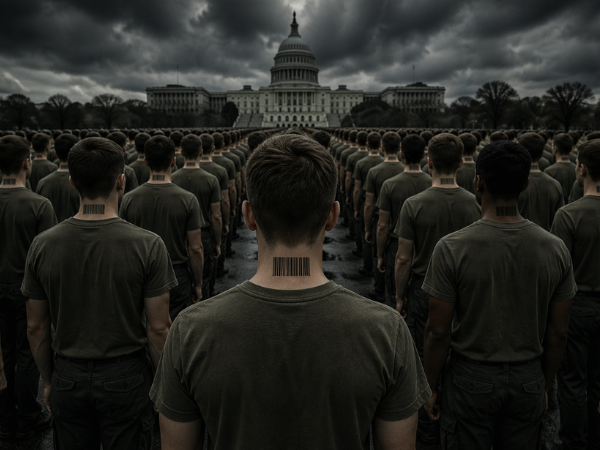
Through mass surveillance programs that track every movement and communication. Through militarized policing and the deployment of National Guard units against civilian populations. Through federal agencies empowered to detain, deport, and disappear individuals with little regard for due process. Through policies that attempt to redefine who is entitled to the protections of citizenship—and who can be stripped of them.

This is what it looks like when the machinery of war—built for foreign battlefields—is turned inward.

This is what it looks like when “we the people” become the enemy.

And in this moment, we find ourselves brought full circle.

Nearly 250 years after the American colonists rose up against a distant ruler for waging war against his own people—through standing armies, arbitrary rule, and the stripping away of rights—we are once again confronting a government that views its citizens not as sovereign individuals, but as subjects to be controlled.

As I make clear in Battlefield America: The War on the American People and in its fictional counterpart The Erik Blair Diaries, the government was never meant to be trusted. It was meant to be restrained by the chains of the Constitution.

The greatest threat to freedom is not a foreign enemy.

The greatest threat to freedom is a government that no longer fears, values or serves its people.

Don’t fall for the lie.

Source: https://tinyurl.com/4z57c7nw

ABOUT JOHN W. WHITEHEAD

Constitutional attorney and author John W. Whitehead is founder and president of The Rutherford Institute. His most recent books are the best-selling Battlefield America: The War on the American People, the award-winning A Government of Wolves: The Emerging American Police State, and a debut dystopian fiction novel, The Erik Blair Diaries. Whitehead can be contacted at staff@rutherford.org. Nisha Whitehead is the Executive Director of The Rutherford Institute. Information about The Rutherford Institute is available at www.rutherford.org.

Publication Guidelines / Reprint Permission

John W. Whitehead’s weekly commentaries are available for publication to newspapers and web publications at no charge. 
“From the least to the greatest, all are greedy for gain; prophets and priests alike, all practice deceit. They dress the wound of my people as though it were not serious. ‘Peace, peace,’ they say, when there is no peace.”—Jeremiah 6:13–14

“This is insane. Regime change will result in a bloody civil war… Resist this!”—Charlie Kirk (2025)

The military-industrial complex and the American police state have joined forces.

War abroad and war at home are no longer separate enterprises. They have fused.

This did not happen overnight.

Every modern president has stretched the limits of war-making power. Some have shredded those limits altogether.

Each time that boundary is breached, the Constitution recedes a little further.

This is one of those moments.

In a complete about-face from his claims to being a peace president, Donald Trump has authorized yet another preemptive strike—this time against Iran—without a declaration of war from Congress, without meaningful public debate, and without constitutional clarity.

The gravity of that decision cannot be overstated.

While American troops were being ordered into harm’s way, Trump was hosting a $1 million-a-ticket fundraiser for himself at Mar-a-Lago, trotting out his signature dance moves between curtained war briefings.

That spectacle tells you everything you need to know.

That is how we arrived at Operation Epic Fury.

With its Orwellian proclamations of “peace through strength,” Operation Epic Fury is less strategy than spectacle—an egotistical, muscle-flexing distraction by the Trump administration and an overarching attempt to normalize the use of unilateral force by the executive branch without congressional input or authorization.

This was never about peace. It was always about power.

And the Constitution is clear about how this is supposed to work, even if the White House is not.

Article I, Section 8 grants Congress—not the president—the power to declare war. The president under Article II, Section 2 is designated as commander-in-chief with the power to command the military. He is not commander-of-everything.

Yet here we are.

The Trump administration is advancing a global policing doctrine that mirrors the domestic police state: strike first, ask questions later.

Since January 2025, Trump has carried out more than 600 military strikes on foreign targets that include Iran, Yemen, Nigeria and Venezuela, while threatening forceful military takeovers of Greenland, Colombia and Mexico.

Preemptive force has become policy.

Call it what it is: war.

Despite the word games over its war games—the administration insists its actions in Iran do not constitute a war—members of Trump’s Cabinet use the word “war” freely until congressional authorization is mentioned.

And when the administration is asked to explain themselves, the answer is not constitutional deference but open defiance.

Clearly, they have lost sight of who they answer to—and who funds their war chests: we the taxpayers.

Pete Hegseth—the self-righteous blowhard who brags about lethal weapons and has rebranded the Defense Department as the Department of War—dismissed public accountability outright, expressing in no uncertain terms that it’s none of our business: “Why in the world would we tell you, you, the enemy, anybody what we will or will not do in pursuit of an objective. We fight to win. We fight to achieve the objectives the President of the United States has laid out and we will do so unapologetically.”

The Constitution is the “why.”

The American people have a right to debate war before it begins. We have a right to know how our tax dollars are spent. We have a right to insist our representatives authorize the use of force. We have a right to know why our sons and daughters are sent into harm’s way. We have a right to refuse to have our tax dollars used to kill other people’s daughters and sons.

As Rick Steves, the globetrotting travel writer, put it:

“As an American taxpayer, I believe that every US bomb that falls and every bullet that flies has my name on it. In the last year, our president (who won votes by promising to keep America out of wars and is now famously agitating for a Nobel Peace Prize) has dropped bombs on seven foreign countries—and each of those bombs has your name on it, too…including the one that just recklessly decapitated a nation of 90 million people in a war-torn corner of our world.”

He is right. War is not abstract—it is done with our money, and too often without our consent.

As Cato Institute’s Katherine Thompson explains, “War…costs American blood and treasure. The Founders placed the power to initiate it in Congress precisely to ensure those costs are confronted and debated before the country walks into battle.”

That safeguard is being ignored.

And the damage does not stop at constitutional injury, because war is not only a constitutional problem. It is an economic one.

War fuels defense contracts, reconstruction deals and intelligence budgets. It sustains a vast military-industrial apparatus whose profits depend on instability.

Nothing about Operation Epic Fury puts America first. It pushes us toward a fiscal cliff.

Within days, the costs were staggering: $300 million for three F-15E jets downed by “friendly” fire. $630 million to transport troops, ships and aircraft to the region in advance of the attacks. More than 50,000 troops deployed to the region. $13 million a day just for two aircraft carriers stationed nearby. $43.8 million for 1,250 Kamikaze drones. $2 million each for Tomahawk missiles. $12.8 million each for anti-ballistic missile interceptors.

Forbes estimates that Trump’s military strikes in Iran have already cost American taxpayers over $1 billion, “with a price tag that could approach $100 billion, depending on how long it can stretch on.” The total economic cost of the conflict “could trigger an economic loss for the U.S. of between $50 billion and $210 billion.”

And that is before accounting for the human cost.

Innocent civilians—over a hundred young girls between the ages of 7 and 12—have died because the U.S. and Israel reportedly launched a deadly strike on a girls’ elementary school in Iran using outdated maps.

American servicepeople are dying because of one man’s unilateral decision to play at war.

So much for “America First.”

Permanent war places empire first.

And as usual, “we the people” will be forced pay for another unpopular forever war—financially, constitutionally, and domestically—and for the presidential hubris and the greed of the military-industrial complex and Deep State undergirding it all.

Congress anticipated this danger.

The War Powers Act was meant to rein in presidents who bypass Congress. But laws are only as strong as the institutions willing to enforce them.

Without congressional authorization, without meaningful debate, without constitutional clarity, the executive branch claims the unilateral authority to wage war.

This is how dictatorships arise and republics erode.

It happens when a president is allowed to treat constitutional limits as inconveniences rather than restraints.

Trump routinely dismisses unfavorable polls, ignores the courts, sidesteps Congress, shows contempt for the will of the American people, and ignorance about the fact that he works for “we the people.” He behaves not as a public servant but as a potentate.

As John Jay warned in The Federalist No. 4:

Absolute monarchs will often make war when their nations are to get nothing by it, but for the purposes and objects merely personal, such as thirst for military glory, revenge for personal affronts, ambition, or private compacts to aggrandize or support their particular families or partisans. These and a variety of other motives, which affect only the mind of the sovereign, often lead him to engage in wars not sanctified by justice or the voice and interests of his people.”

If this were merely a constitutional dispute, it would be grave enough.

But it is not merely constitutional.

The consequences are immediate, political, and profoundly destabilizing.

Trump has a tendency to bulldoze through constitutional and legal restraints, creating a spectacle or a crisis, and then leaving others to clean up the fallout—whether it is a gutted ballroom, an eviscerated federal agency, a chaotic immigration crackdown, or now a widening war in the Middle East.

Long after the headlines move on, the wreckage remains.

And when the crisis involves war, the consequences are not merely bureaucratic or political — they are measured in lives and liberties.

War, in particular, has always been the most convenient tool of presidents facing troubles at home. When approval ratings slide, when economic policy falters, when scandal threatens to consume the headlines, foreign conflict has a way of shifting the narrative.

Trump’s Iran escalation—a deadly, costly, immoral, unpopular distraction from missteps of Trump’s own making—comes amid dismal polling, a faltering economy, escalating immigration crackdowns, eroding constitutional protections, and renewed scrutiny tied to the Epstein files.

Six out of ten Americans disapprove of Trump’s military action against Iran.

And while there is little to defend about Iran—it is a brutal regime—no nation has the right to declare itself judge, jury and executioner of another without lawful authority. To suggest otherwise is the language of strongmen.

Moreover, what happens abroad does not stay abroad.

The same government that claims unilateral authority to bomb foreign nations claims expanded authority to surveil, detain and silence domestically.

The military-industrial complex and the police state operate in tandem.

At home, we are being subjected to many of the same tactics and technologies deployed overseas. This is how America becomes a battlefield.

The pattern is not new. George W. Bush expanded warrantless surveillance. Obama normalized drone warfare. Presidents of both parties have stretched executive power.

Trump inherited the imperial presidency—and leaned into it. He boasts of his authority, derides the courts, dismisses Congress, and treats constitutional limits as inconveniences rather than guardrails.

He governs as though Article II were a royal charter.

Defense contractors may prosper in such a climate. The Constitution does not.

History teaches that war abroad produces blowback at home. Twenty-five years ago, 9/11 was itself blowback—the consequence of decades of military intervention and occupation in the Middle East.

Blowback justifies emergency powers. Emergency powers justify a police state. A police state justifies a permanent national security state.

The “war on terror” did not end terrorism. It institutionalized emergency. And permanent emergency makes constitutional government fragile.

James Madison warned that “the means of defense against foreign danger have been always the instruments of tyranny at home.”

We have seen it unfold over the past quarter century: the militarization of police, battlefield tactics in American neighborhoods, expansive surveillance justified by counterterrorism. The same tactics and rationale deployed abroad eventually get used against the American people here at home.

War abroad justifies control at home. That is the pattern.

As legal scholar Aziz Huq, professor of law at the University of Chicago, warns, the same national-security powers used to justify bombing foreign nations can be turned inward—against domestic opponents and even against the electoral process itself.

That is the long game being played right now.

This unprovoked attack on Iran is turning the Middle East into a war zone, in turn laying the groundwork for Trump to act on the fantasies he has long entertained about cancelling the mid-term elections.

It is not far-fetched to imagine he might attempt it. He has repeatedly hinted about it and has already demonstrated how far he is willing to go to overturn an election.

On the very day bombs began falling on Tehran, Huq notes that the White House was reportedly considering a unilateral executive order asserting the power to control how and when Americans vote in the upcoming midterm elections—citing “national security” and alleged foreign meddling as justification.

As Huq explains, the presidency is especially weakly bound by law when “national security” is invoked. The absence of legal authority did not prevent the strikes on Iran—strikes that are unlawful under the Constitution, which assigns Congress alone the power to initiate war.

If national security can be invoked to bypass Congress abroad, it can be invoked to bypass constitutional limits at home.

In other words, if a president can launch a war without congressional authorization, he can claim similar emergency authority to restrict voting, suppress dissent, or silence opposition.

This is not republican governance. It is rule by force.

Even some of Trump’s former allies sense the instability. As Marjorie Taylor Greene bluntly put it, “I think it’s time for America to rip the Band-Aid off and we need to have a serious conversation about what the f— is happening in this country and who in the hell are these decisions being made for and who is making these decisions.”

America’s founders understood this danger. They structured the Constitution to prevent any one man from dragging the nation into war.

In making the case that decisions about war should never be left to one man, legal scholar David French quotes then-Congressman Abraham Lincoln at the close of the Mexican-American War in 1948: “Kings had always been involving and impoverishing their people in wars, pretending generally, if not always, that the good of the people was the object. This, our convention understood to be the most oppressive of all kingly oppressions and they resolved to so frame the Constitution that no one man should hold the power of bringing this oppression upon us.”

Concludes French: “Those words were true then, and they’re true now. No matter what he thinks, Trump is not a king. But by taking America to war all on his own, he is acting like one.”

If we are to preserve any semblance of constitutional government, Congress must reclaim its war powers. The War Powers Resolution must be enforced. Emergency powers must be narrowed, sunsetted and restrained. Surveillance must be reined in. Domestic military deployment must be limited to the most narrow, exceptional circumstances.

But structural reform alone will not save a republic that has grown comfortable with permanent war. Because once war abroad and war at home fully merge, the Constitution becomes little more than words on paper.

War is not peace. Preemptive war is not strength. And an imperial presidency—no matter how loudly it wraps itself in flags—is not constitutional government.

The Founders understood that the gravest threat to liberty would not come from foreign enemies alone, but from the concentration of power in the hands of one man who believed himself indispensable.

A president who can send bombs abroad without consent can silence opposition at home without hesitation.

A government that governs by the rule of emergency eventually ceases to govern by the rule of law.

And a nation that trades liberty for spectacle will wake up to find that it has neither.

History is a relentless teacher: military empires may rise on the back of war, but they fall just as quickly from being spread too thin. Already, days after the start of this debacle of a war on Iran, U.S. forces are being used to combat drug trafficking in Ecuador.

As I make clear in my book Battlefield America: The War on the American People and in its fictional counterpart The Erik Blair Diaries, the question is no longer whether America can police the globe. The question is whether our Republic can survive the weight of the Empire it has become.

We are at the point where we must choose: the spectacle of permanent war, or the survival of the American experiment in freedom.

We cannot have both.

Source: https://tinyurl.com/u65m2syb

ABOUT JOHN W. WHITEHEAD

Constitutional attorney and author John W. Whitehead is founder and president of The Rutherford Institute. His most recent books are the best-selling Battlefield America: The War on the American People, the award-winning A Government of Wolves: The Emerging American Police State, and a debut dystopian fiction novel, The Erik Blair Diaries. Whitehead can be contacted at staff@rutherford.org. Nisha Whitehead is the Executive Director of The Rutherford Institute. Information about The Rutherford Institute is available at www.rutherford.org.

Publication Guidelines / Reprint Permission

John W. Whitehead’s weekly commentaries are available for publication to newspapers and web publications at no charge. 

“Let us resolve that never again will we send the precious young blood of this country to die trying to prop up a corrupt military dictatorship abroad. This is also the time to turn away from excessive preoccupation overseas to the rebuilding of our own nation. America must be restored to a proper role in the world. But we can do that only through the recovery of confidence in ourselves…. together we will call America home to the ideals that nourished us from the beginning. From secrecy and deception in high places; come home, America. From military spending so wasteful that it weakens our nation; come home, America.”—George S. McGovern, former Senator and presidential candidate

I agree wholeheartedly with George S. McGovern, a former Senator and presidential candidate who served in the Vietnam War, about one thing: I’m sick of old men dreaming up wars for young men to die in.

It’s time to bring our troops home.

Bring them home from Somalia, Afghanistan, Iraq and Syria. Bring them home from Germany, South Korea and Japan. Bring them home from Saudi Arabia, Jordan and Oman. Bring them home from Niger, Chad and Mali. Bring them home from Turkey, the Philippines, and northern Australia.

That’s not what’s going to happen, of course.

The U.S. military reportedly has more than 1.3 million men and women on active duty, with more than 450,000 of them stationed overseas in nearly every country in the world. As investigative journalist David Vine explains, “Although few Americans realize it, the United States likely has more bases in foreign lands than any other people, nation, or empire in history.”

Don’t fall for the propaganda, though: America’s military forces aren’t being deployed abroad to protect our freedoms here at home. Rather, they’re being used to guard oil fields, build foreign infrastructure and protect the financial interests of the corporate elite. In fact, the United States military spends about $81 billion a year just to protect oil supplies around the world.

The reach of America’s military empire includes close to 800 bases in as many as 160 countries, operated at a cost of more than $156 billion annually. As Vine reports, “Even US military resorts and recreation areas in places like the Bavarian Alps and Seoul, South Korea, are bases of a kind. Worldwide, the military runs more than 170 golf courses.”

This is how a military empire occupies the globe.

Already, American military servicepeople are being deployed to far-flung places in the Middle East and elsewhere in anticipation of the war drums being sounded over Iran.

This Iran crisis, salivated over by the neocons since prior to the Iraq War and manufactured by war hawks who want to jumpstart the next world war, has been a long time coming.

Donald Trump, Barack Obama, George W. Bush, Bill Clinton: they all have done their part to ensure that the military industrial complex can continue to get rich at taxpayer expense.

Take President Trump, for instance.

Despite numerous campaign promises to stop America’s “endless wars,” once elected, Trump has done a complete about-face, deploying greater numbers of troops to the Middle East, ramping up the war rhetoric, and padding the pockets of defense contractors. Indeed, Trump is even refusing to withdraw U.S. troops from Iraq in the face of a request from the Iraqi government for us to leave.

Obama was no different: he also pledged—if elected—to bring the troops home from Iraq and Afghanistan and reduce America’s oversized, and overly costly, military footprint in the world. Of course, that didn’t happen.

Yet while the rationale may keep changing for why American military forces are policing the globe, these wars abroad (in Iraq, Afghanistan, Pakistan, Syria, Yemen and now Iran) aren’t making America—or the rest of the world—any safer, are certainly not making America great again, and are undeniably digging the U.S. deeper into debt.

War spending is bankrupting America.

Although the U.S. constitutes only 5% of the world’s population, America boasts almost 50% of the world’s total military expenditure, spending more on the military than the next 19 biggest spending nations combined.

In fact, the Pentagon spends more on war than all 50 states combined spend on health, education, welfare, and safety.

The American military-industrial complex has erected an empire unsurpassed in history in its breadth and scope, one dedicated to conducting perpetual warfare throughout the earth.

Since 2001, the U.S. government has spent more than $4.7 trillion waging its endless wars.

Having been co-opted by greedy defense contractors, corrupt politicians and incompetent government officials, America’s expanding military empire is bleeding the country dry at a rate of more than $32 million per hour.

In fact, the U.S. government has spent more money every five seconds in Iraq than the average American earns in a year.

Future wars and military exercises waged around the globe are expected to push the total bill upwards of $12 trillion by 2053.

Talk about fiscally irresponsible: the U.S. government is spending money it doesn’t have on a military empire it can’t afford.

As investigative journalist Uri Friedman puts it, for more than 15 years now, the United States has been fighting terrorism with a credit card, “essentially bankrolling the wars with debt, in the form of purchases of U.S. Treasury bonds by U.S.-based entities like pension funds and state and local governments, and by countries like China and Japan.”

War is not cheap, but it becomes outrageously costly when you factor in government incompetence, fraud, and greedy contractors. Indeed, a leading accounting firm concluded that one of the Pentagon’s largest agencies “can’t account for hundreds of millions of dollars’ worth of spending.”

Unfortunately, the outlook isn’t much better for the spending that can be tracked.

A government audit found that defense contractor Boeing has been massively overcharging taxpayers for mundane parts, resulting in tens of millions of dollars in overspending. As the report noted, the American taxpayer paid:

$71 for a metal pin that should cost just 4 cents; $644.75 for a small gear smaller than a dime that sells for $12.51: more than a 5,100 percent increase in price. $1,678.61 for another tiny part, also smaller than a dime, that could have been bought within DoD for $7.71: a 21,000 percent increase. $71.01 for a straight, thin metal pin that DoD had on hand, unused by the tens of thousands, for 4 cents: an increase of over 177,000 percent.

That price gouging has become an accepted form of corruption within the American military empire is a sad statement on how little control “we the people” have over our runaway government.

Mind you, this isn’t just corrupt behavior. It’s deadly, downright immoral behavior.

Americans have thus far allowed themselves to be spoon-fed a steady diet of pro-war propaganda that keeps them content to wave flags with patriotic fervor and less inclined to look too closely at the mounting body counts, the ruined lives, the ravaged countries, the blowback arising from ill-advised targeted-drone killings and bombing campaigns in foreign lands, or the transformation of our own homeland into a warzone.

That needs to change.

The U.S. government is not making the world any safer. It’s making the world more dangerous. It is estimated that the U.S. military drops a bomb somewhere in the world every 12 minutes. Since 9/11, the United States government has directly contributed to the deaths of around 500,000 human beings. Every one of those deaths was paid for with taxpayer funds.

The U.S. government is not making America any safer. It’s exposing American citizens to alarming levels of blowback, a CIA term referring to the unintended consequences of the U.S. government’s international activities. Chalmers Johnson, a former CIA consultant, repeatedly warned that America’s use of its military to gain power over the global economy would result in devastating blowback.

The 9/11 attacks were blowback. The Boston Marathon Bombing was blowback. The attempted Times Square bomber was blowback. The Fort Hood shooter, a major in the U.S. Army, was blowback.

The assassination of Iranian General Qasem Soleimani by a U.S. military drone strike will, I fear, spur yet more blowback against the American people.

The war hawks’ militarization of America—bringing home the spoils of war (the military tanks, grenade launchers, Kevlar helmets, assault rifles, gas masks, ammunition, battering rams, night vision binoculars, etc.) and handing them over to local police, thereby turning America into a battlefield—is also blowback.

James Madison was right: “No nation could preserve its freedom in the midst of continual warfare.” As Madison explained, “Of all the enemies to public liberty war is, perhaps, the most to be dreaded because it comprises and develops the germ of every other. War is the parent of armies; from these proceed debts and taxes… known instruments for bringing the many under the domination of the few.”

We are seeing this play out before our eyes.

The government is destabilizing the economy, destroying the national infrastructure through neglect and a lack of resources, and turning taxpayer dollars into blood money with its endless wars, drone strikes and mounting death tolls.

Clearly, our national priorities are in desperate need of an overhauling.

At the height of its power, even the mighty Roman Empire could not stare down a collapsing economy and a burgeoning military. Prolonged periods of war and false economic prosperity largely led to its demise. As historian Chalmers Johnson predicts:

The fate of previous democratic empires suggests that such a conflict is unsustainable and will be resolved in one of two ways. Rome attempted to keep its empire and lost its democracy. Britain chose to remain democratic and in the process let go its empire. Intentionally or not, the people of the United States already are well embarked upon the course of non-democratic empire.

This is the “unwarranted influence, whether sought or unsought, by the military-industrial complex” that President Dwight Eisenhower warned us more than 50 years ago not to let endanger our liberties or democratic processes.

Eisenhower, who served as Supreme Commander of the Allied forces in Europe during World War II, was alarmed by the rise of the profit-driven war machine that emerged following the war—one that, in order to perpetuate itself, would have to keep waging war.

We failed to heed his warning.

As I make clear in my book Battlefield America: The War on the American People, there’s not much time left before we reach the zero hour.

It’s time to stop policing the globe, end these wars-without-end, and bring the troops home before it’s too late.

Source: https://www.rutherford.org/publications_resources/john_whiteheads_commentary/come_home_america_stop_policing_the_globe_and_put_an_end_to_wars_without_end

ABOUT JOHN W. WHITEHEAD

Constitutional attorney and author John W. Whitehead is founder and president of The Rutherford Institute. His new book Battlefield America: The War on the American People  is available at www.amazon.com. Whitehead can be contacted at johnw@rutherford.org.

Publication Guidelines / Reprint Permission

John W. Whitehead’s weekly commentaries are available for publication to newspapers and web publications at no charge. Please contact staff@rutherford.org to obtain reprint permission.