Posts Tagged ‘israel’

“We’re fighting wars, we can’t take care of … daycare, Medicaid, Medicare, all these individual things… We have to take care of one thing: military protection.”—President Donald J. Trump

“Every gun that is made, every warship launched, every rocket fired signifies, in the final sense, a theft from those who hunger and are not fed, those who are cold and are not clothed.”— President Dwight D. Eisenhower

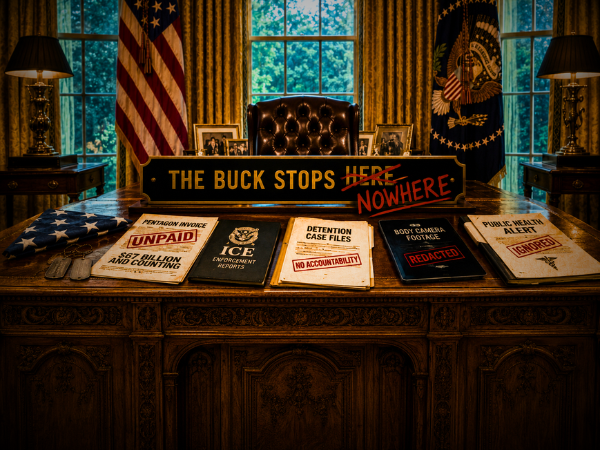
Every bomb dropped abroad is a bill sent home.

Every war waged in the name of “security” is paid for by Americans who go without—without affordable healthcare, without stable housing, without a government that prioritizes their well-being.

As the U.S. pours trillions into endless wars and military expansion, Americans are left paying the price—not just in dollars, but in lost freedoms and eroded constitutional protections.

This is not national defense.

This is organized theft.

While Americans struggle with rising gas prices, soaring grocery bills, and mounting debt—fueled in part by reckless tariffs and preemptive wars—the federal government is spending money it doesn’t have on military expansion, foreign conflicts, and presidential excess.

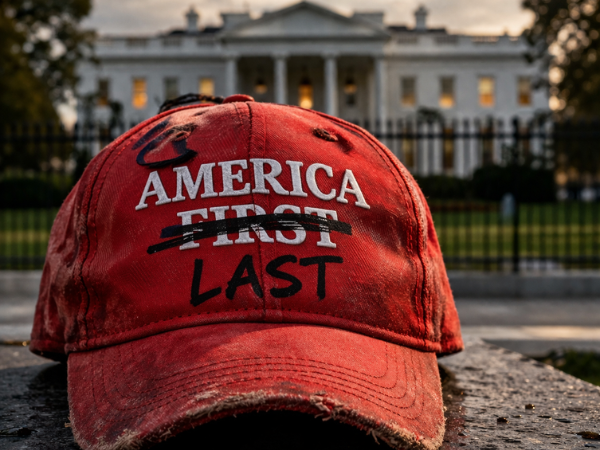
This is not America First.

If anything, it is becoming painfully clear that Donald Trump’s “America First” approach to governing puts America last every time.

Trump has not made it a priority to rebuild America’s crumbling infrastructure. He has not made it a priority to invest in innovation or ensure that the nation remains competitive in a rapidly advancing technological world. Nor has he shown much concern for caring for veterans, the elderly, or the young.

Instead, the government is cutting back on programs that make Americans healthier, smarter, and more secure—while the president builds monuments to himself and indulges in a taxpayer-funded lifestyle of staggering excess.

Despite once claiming he would be too busy to play golf, Trump is on track to leave taxpayers with a bill exceeding $300 million in travel and security expenses—much of it tied to frequent trips to his Florida properties. Each visit to Mar-a-Lago costs an estimated $3.4 million.

Meanwhile, taxpayers are shelling out $273,063 per hour to keep Air Force One in the air.

And while millions of Americans struggle to afford basic necessities, Trump is demanding $377 million—an 866 percent increase—to renovate the White House residence.

But these excesses, outrageous as they are, pale in comparison to the true cost of this administration’s priorities: war.

The Trump administration has requested $1.5 trillion for its FY 2027 military budget—separate from an additional $200 billion in emergency funding for the war in Iran.

The sitting president of the United States is spending money that is not his to spend in order to fight endless wars unauthorized by Congress that do nothing to protect the American people or our interests, while insisting that the federal government’s only priority should be the military industrial complex.

The president’s fiscal priorities include:

In addition to increasing the budget for the military, prisons, nuclear weapons, and a weaponized Justice Department, the Trump administration has also proposed budget cuts of $73 billion to non-military programs—slashing funding for medical research, public schools, and low-income heating assistance, as well as cuts to affordable housing, job training, small-business lending, anti-poverty programs, agriculture, NASA, research in social sciences and economics, humanitarian assistance and global health programs, among others.

As Dominik Lett writes for Cato, “Shifting dollars from domestic programs to the Pentagon is shuffling deck chairs on the Titanic given our mounting fiscal crisis.”

This is how empires fall.

The Constitution does not permit a president to wage war on a whim.

The founders were clear: the power to declare war rests with Congress, not the executive. The president, as Commander in Chief, was meant to oversee the military—not unleash it unchecked.

And yet, once again, we find ourselves embroiled in an unauthorized war—funded by taxpayers, justified with shifting narratives, and carried out without meaningful oversight.

With Congress unwilling to act as a check on executive overreach, and the courts increasingly sidelined, the constitutional safeguards meant to prevent this very scenario have all but collapsed.

War is no longer a last resort.

It has become a business model.

The man who campaigned on a pledge of “no new wars” has instead propelled the nation into endless military conflicts that promise to become endless wars that enrich defense contractors, reward political allies, and deepen the financial burden on the American people.

Reports of insider profiteering tied to shifting policy decisions only reinforce what many Americans already suspect: that war, in the Trump era, is as much about profit as it is about power.

Historian Timothy Snyder, who has written extensively on authoritarian regimes, sees the administration’s expanded war budget through a darker and more troubling lens—by which military spending functions as a way to bribe the military into supporting a Trump-led government takeover.

Translation: the Trump administration could be laying the groundwork for a false flag terrorist attack that would allow Trump to declare martial law, cancel or nullify the midterm elections and shift the nation further towards a dictatorship.

There is precedent for it, not only with Trump’s own actions in January 2020, but also by the man he most admires—Vladimir Putin, who masterminded his own false flag terrorist attacks in Russia in 1999 as a means of entrenching his own power.

In that light, the obscene escalation of military funding raises the specter of a government preparing not just for foreign conflict—but for domestic control.

This tracks closely with the Pentagon’s chilling Megacities training video, which predicts that by 2030, armed forces would be used against civilian populations to solve domestic political and social problems.

The danger is not theoretical.

History has shown, time and again, that leaders who accumulate unchecked power, surround themselves with loyalists, and normalize perpetual war often turn those powers inward.

But what happens when that unchecked power is placed in the hands of someone who appears increasingly erratic and unmoored from reality?

In recent weeks, Trump has issued profanity-laced threats on social media targeting civilian infrastructure in Iran—actions that would constitute war crimes under international law.

On Easter Sunday, when Christians the world over were celebrating the hope and resurrection of Jesus Christ, Trump shared a profanity-laden post to his Truth Social account, threatening to target civilian infrastructure in Iran—war crimes under the Geneva Convention. “Tuesday will be Power Plant Day, and Bridge Day, all wrapped up in one, in Iran. There will be nothing like it!!! Open the Fuckin’ Strait, you crazy bastards, or you’ll be living in Hell – JUST WATCH! Praise be to Allah. President DONALD J. TRUMP.”

He has used public appearances to rant about political enemies, threaten foreign nations, and boast about military actions with little regard for accuracy or consequence.

In front of an audience of children gathered for the White House’s annual Easter Egg Roll, Trump ranted about Biden’s autopen, expounded on the war in Iran, referred to Kamala Harris as a “low IQ person,” described the Biden administration as not knowing “what the hell they were doing,” and once again threatened to obliterate Iran’s power plants and bridges, which constitute a war crime.

He has suggested he could start charging “tolls” on global shipping through the Strait of Hormuz, claimed victory in the war with Iran even while American forces and Middle Eastern allies continue to come under fire, and floated fantastical political ambitions untethered from constitutional limits, including the idea that he could quickly learn Spanish in order to run for president of Venezuela and win.

This pattern of behavior—reckless, inflammatory, and detached from reality—has prompted a growing number of voices, across the political spectrum, to question whether the president should be removed from office under the 25th Amendment.

Not surprisingly, the very same individuals who loudly called to invoke the 25th Amendment against Joe Biden have fallen silent in the face of Trump’s increasingly erratic behavior.

The standard, it seems, is not constitutional—it is political.

Which brings us back to the war in Iran—a costly, dangerous, and deeply suspect conflict that raises more questions than answers and provides a conveniently timed distraction from Trump’s presence within the Epstein files.

Despite President Trump and Pete Hegseath’s incessant claims of lethality and success, victory is not a foregone conclusion.

And the price we are paying is high indeed, in treasure and life.

Credible concerns point to the fact that key details about the true cost of this war—which “we the people” are entitled to know—are being withheld from the public.

An investigative report by The Intercept suggests that “U.S. Central Command, or CENTCOM, which oversees military operations in the Middle East, appears to be engaged in what a defense official called a ‘casualty cover-up,’ offering The Intercept low-ball and outdated figures and failing to provide clarifications on military deaths and injuries.”

Far from providing a true accounting of the human and financial burden to be borne by the American people, the Trump administration has apparently continued to stonewall and slow-walk information about the numbers of troops injured and killed, and the number of U.S. bases attacked. Indeed, U.S. troops throughout the Middle East have reportedly been forced to abandon their bases and retreat to hotels and office buildings, which are ill-equipped to provide defensive cover.

Even the administration’s account of a dramatic rescue mission of a downed weapons system officer—one involving massive resources and the destruction of U.S. aircraft—is coming under scrutiny, with some suggesting it may have been something far more ambitious and far less successful than advertised.

Although Trump has insisted that he directed the military to send in more than 150 aircraft—including 64 fighter jets, four bombers, 48 refuelers, 13 rescue aircraft and 26 intelligence and jamming aircraft, hundreds of troops, munitions, and multiple aircraft (two of which were reportedly destroyed by U.S. forces to avoid them falling into enemy hands) to rescue this one airman, there is a growing groundswell of voices suggesting that the administration’s rescue mission was, in fact, a failed ground invasion to seize Iran’s enriched uranium—a prospect Trump has teased for weeks.

As Financial Review concluded, “Trump’s daring special ops rescue comes at a hefty price. Some 100 special operations forces were involved in the high-stakes mission while several multimillion-dollar US aircraft were destroyed to secure the airman.”

Which begs the question: can we trust the U.S. government to tell us the truth?

Can we trust a government that has historically engaged in cover-ups—medical, military, political, and environmental?

Can we trust a government that treats its citizens as data points to be tracked, monitored, and manipulated?

Can we trust a government that wages wars for profit, jails its own people for profit, and shields those in power from accountability?

This is a government that lies, cheats, steals, spies, kills, and overreaches its authority at almost every turn.

It treats human beings as expendable—resources to be used, controlled, and discarded.

It is not guided by morality, restraint, or constitutional principle.

It is power unbound—corrupt, unaccountable, and increasingly indifferent to the freedoms it was meant to protect.

This is a government that wages wars for profit and turns a blind eye while its agents abuse their power.

And increasingly, the wars being waged are not just overseas.

Those wars are also here at home.

Through mass surveillance programs that track every movement and communication. Through militarized policing and the deployment of National Guard units against civilian populations. Through federal agencies empowered to detain, deport, and disappear individuals with little regard for due process. Through policies that attempt to redefine who is entitled to the protections of citizenship—and who can be stripped of them.

This is what it looks like when the machinery of war—built for foreign battlefields—is turned inward.

This is what it looks like when “we the people” become the enemy.

And in this moment, we find ourselves brought full circle.

Nearly 250 years after the American colonists rose up against a distant ruler for waging war against his own people—through standing armies, arbitrary rule, and the stripping away of rights—we are once again confronting a government that views its citizens not as sovereign individuals, but as subjects to be controlled.

As I make clear in Battlefield America: The War on the American People and in its fictional counterpart The Erik Blair Diaries, the government was never meant to be trusted. It was meant to be restrained by the chains of the Constitution.

The greatest threat to freedom is not a foreign enemy.

The greatest threat to freedom is a government that no longer fears, values or serves its people.

Don’t fall for the lie.

Source: https://tinyurl.com/4z57c7nw

ABOUT JOHN W. WHITEHEAD

Constitutional attorney and author John W. Whitehead is founder and president of The Rutherford Institute. His most recent books are the best-selling Battlefield America: The War on the American People, the award-winning A Government of Wolves: The Emerging American Police State, and a debut dystopian fiction novel, The Erik Blair Diaries. Whitehead can be contacted at staff@rutherford.org. Nisha Whitehead is the Executive Director of The Rutherford Institute. Information about The Rutherford Institute is available at www.rutherford.org.

Publication Guidelines / Reprint Permission

John W. Whitehead’s weekly commentaries are available for publication to newspapers and web publications at no charge. 
“Once the principle is established that the government can arrest and jail protesters… officials will use it to silence opposition broadly.”—Heather Cox Richardson, historian

You can’t have it both ways.

You can’t live in a constitutional republic if you allow the government to act like a police state.

You can’t claim to value freedom if you allow the government to operate like a dictatorship.

You can’t expect to have your rights respected if you allow the government to treat whomever it pleases with disrespect and an utter disregard for the rule of law.

There’s always a boomerang effect.

Whatever dangerous practices you allow the government to carry out now—whether it’s in the name of national security or protecting America’s borders or making America great again—rest assured, these same practices can and will be used against you when the government decides to set its sights on you.

Arresting political activists engaged in lawful, nonviolent protest activities is merely the shot across the bow.

The chilling of political speech and suppression of dissident voices are usually among the first signs that you’re in the midst of a hostile takeover by forces that are not friendly to freedom.

This is how it begins.

Consider that Khalil Mahmoud, an anti-war protester and recent graduate of Columbia University, was arrested on a Saturday night by ICE agents who appeared ignorant of his status as a legal U.S. resident and his rights thereof. That these very same ICE agents also threatened to arrest Mahmoud’s eight-months-pregnant wife, an American citizen, is also telling.

This does not seem to be a regime that respects the rights of the people.

Indeed, these ICE agents, who were “just following orders” from on high, showed no concern that the orders they had been given were trumped up, politically motivated and unconstitutional.

If this is indeed the first of many arrests to come, what’s next? Or more to the point, who’s next?

We are all at risk.

History shows that when governments claim the power to silence dissent—whether in the name of national security, border protection, or law and order—that power rarely remains limited. What starts as a crackdown on so-called “threats” quickly expands to include anyone who challenges those in power.

President Trump has made it clear that Mahmoud’s arrest is just “the first arrest of many to come.” He has openly stated his intent to target noncitizens who engage in activities he deems contrary to U.S. interests—an alarmingly vague standard that seems to change at his whim, the First Amendment be damned.

If history is any guide, the next targets will not just be immigrants or foreign-born activists. They will be American citizens who dare to speak out.

If you need further proof of Trump’s disregard for constitutional rights, look no further than his recent declaration that boycotting Tesla is illegal—a chilling statement that reveals his fundamental misunderstanding of both free speech and the rule of law.

For the record, there is nothing illegal about exercising one’s First Amendment right of speech, assembly, and protest in a nonviolent way to bring about social change by boycotting private businesses. In fact, the U.S. Supreme Court ruled 8-0 in NAACP v. Claiborne Hardware Co. (1982) that nonviolent boycotts are a form of political speech which are entitled to First Amendment protection.

The problem, unfortunately, when you’re dealing with a president who believes that he can do whatever he wants because he is the law is that anyone and anything can become a target.

Mahmoud is the test case.

As journalists Gabe Kaminsky, Madeleine Rowley, and Maya Sulkin point out, Mahmoud’s arrest for being a “threat to the foreign policy and national security interests of the United States” (note: he is not actually accused of breaking any laws) is being used as a blueprint for other arrests to come.

What this means is that anyone who dares to disagree with the government and its foreign policy and express that disagreement could be considered a threat to the country’s “national security interests.”

Yet the right to speak out against government wrongdoing is the quintessential freedom.

Indeed, the First Amendment does more than give us a right to criticize our country: it makes it a civic duty. Certainly, if there is one freedom among the many spelled out in the Bill of Rights that is especially patriotic, it is the right to criticize the government.

Unfortunately, the Deep State doesn’t take kindly to individuals who speak truth to power.

This is nothing new, nor is it unique to any particular presidential administration.

Throughout history, U.S. presidents have used their power to suppress dissent. The Biden administration equated the spread of “misinformation” with terrorism. Trump called the press “the enemy of the people” and suggested protesting should be illegal. Obama expanded anti-protest laws and cracked down on whistleblowers. Bush’s Patriot Act made it a crime to support organizations the government deemed terrorist, even in lawful ways. This pattern stretches back centuries—FDR censored news after Pearl Harbor, Woodrow Wilson outlawed criticism of war efforts, and John Adams criminalized speaking against the government.

Regardless of party, those in power have repeatedly sought to limit free speech. What’s new is the growing willingness to criminalize political dissent under the guise of national security.

Clearly, the government has been undermining our free speech rights for quite a while now, but Trump’s antagonism towards free speech is taking this hostility to new heights.

The government has a history of using crises—real or manufactured—to expand its power.

Once dissent is labeled a threat, it’s only a matter of time before laws meant for so-called extremists are used against ordinary citizens. Criticizing policy, protesting, or even refusing to conform could be enough to put someone on a watchlist.

We’ve seen this before.

The government has a long list of “suspicious” ideologies and behaviors it uses to justify surveillance and suppression. Today’s justification may be immigration; tomorrow, it could be any form of opposition.

This is what we know: the government has the means, the muscle and the motivation to detain individuals who resist its orders and do not comply with its mandates in a vast array of prisons, detention centers, and concentration camps paid for with taxpayer dollars.

It’s just a matter of time.

It no longer matters what the hot-button issue might be (vaccine mandates, immigration, gun rights, abortion, same-sex marriage, healthcare, criticizing the government, protesting election results, etc.) or which party is wielding its power like a hammer.

The groundwork has already been laid.

Under the indefinite detention provision of the National Defense Authorization Act (NDAA), the President and the military can detain and imprison American citizens with no access to friends, family or the courts if the government believes them to be a terrorist.

So it should come as no surprise that merely criticizing the government could get you labeled as a terrorist.

After all, it doesn’t take much to be considered a terrorist anymore, especially given that the government likes to use the words “anti-government,” “extremist” and “terrorist” interchangeably.

This is what happens when you not only put the power to determine who is a potential danger in the hands of government agencies, the courts and the police but also give those agencies liberal authority to lock individuals up for perceived wrongs.

It’s a system just begging to be abused by power-hungry bureaucrats desperate to retain their power at all costs.

Having allowed the government to expand and exceed our reach, we find ourselves on the losing end of a tug-of-war over control of our country and our lives. And for as long as we let them, government officials will continue to trample on our rights, always justifying their actions as being for the good of the people.

Yet the government can only go as far as “we the people” allow. Therein lies the problem.

This is not just about one administration or one set of policies. This is a broader pattern of governmental overreach that has been allowed to unfold, unchecked and unchallenged. And at the heart of this loss of freedom is a fundamental misunderstanding—or even a deliberate abandonment—of what sovereignty really means in America.

Sovereignty is a dusty, antiquated term that harkens back to an age when kings and emperors ruled with absolute power over a populace that had no rights. Americans turned the idea of sovereignty on its head when they declared their independence from Great Britain and rejected the absolute authority of King George III. In doing so, Americans claimed for themselves the right to self-government and established themselves as the ultimate authority and power.

In other words, as the preamble to the Constitution states, in America, “we the people”—sovereign citizens—call the shots.

So, when the government acts, it is supposed to do so at our bidding and on our behalf, because we are the rulers.

That’s not exactly how it turned out, though, is it?

In the 200-plus years since we boldly embarked on this experiment in self-government, we have been steadily losing ground to the government’s brazen power grabs, foisted upon us in the so-called name of national security.

The government has knocked us off our rightful throne. It has usurped our rightful authority. It has staged the ultimate coup. Its agents no longer even pretend that they answer to “we the people.”

This is how far our republic has fallen and how desensitized “we the people” have become to this constant undermining of our freedoms.

If we are to put an end to this steady slide into totalitarianism, that goose-stepping form of tyranny in which the government has all of the power and “we the people” have none, we must begin by refusing to allow the politics of fear to shackle us to a dictatorship.

President Trump wants us to believe that the menace we face (imaginary or not) is so sinister, so overwhelming, so fearsome that the only way to surmount the danger is by empowering the government to take all necessary steps to quash it, even if that means allowing government jackboots to trample all over the Constitution.

Don’t believe it. That argument has been tried before.

The government’s overblown, extended wars on terrorism, drugs, violence and illegal immigration have all been convenient ruses used to terrorize the populace into relinquishing more of their freedoms in exchange for elusive promises of security.

We are walking a dangerous path right now.

Political arrests. Harassment. Suppression of dissident voices. Retaliation. Detention centers for political prisoners.

These are a harbinger of what’s to come if the Trump administration carries through on its threats to crack down on any and all who exercise their First Amendment rights to free speech and protest.

We are being acclimated to bolder power grabs, acts of lawlessness, and a pattern of intimidation, harassment, and human rights violations by government officials. And yet, in the midst of this relentless erosion of our freedoms, the very concept of sovereignty—the foundational idea that the people, not the government, hold ultimate power—has been all but forgotten.

“Sovereignty” used to mean something fundamental in America: the idea that the government serves at the will of the people, that “we the people” are the rightful rulers of this land, and that no one, not even the president, is above the law. But today, that notion is scarcely discussed, as the government continues its unchecked expansion.

We have lost sight of the fact that our power is meant to restrain the government, not the other way around.

Don’t allow yourselves to be distracted, derailed or desensitized.

As I make clear in my book Battlefield America: The War on the American People and in its fictional counterpart The Erik Blair Diaries, the moment these acts of aggression becomes the new normal, authoritarianism won’t be a distant threat; it will be reality.

Source: https://tinyurl.com/2rt4sxhr

ABOUT JOHN W. WHITEHEAD

Constitutional attorney and author John W. Whitehead is founder and president of The Rutherford Institute. His most recent books are the best-selling Battlefield America: The War on the American People, the award-winning A Government of Wolves: The Emerging American Police State, and a debut dystopian fiction novel, The Erik Blair Diaries. Whitehead can be contacted at staff@rutherford.org. Nisha Whitehead is the Executive Director of The Rutherford Institute. Information about The Rutherford Institute is available at www.rutherford.org.

Publication Guidelines / Reprint Permission

John W. Whitehead’s weekly commentaries are available for publication to newspapers and web publications at no charge. 

“I did not know Israel was capturing or recording my face. [But Israel has] been watching us for years from the sky with their drones. They have been watching us gardening and going to schools and kissing our wives. I feel like I have been watched for so long.”—Mosab Abu Toha, Palestinian poet

If you want a glimpse of the next stage of America’s transformation into a police state, look no further than how Israel—a long-time recipient of hundreds of billions of dollars in foreign aid from the U.S.—uses its high-tech military tactics, surveillance and weaponry to advance its authoritarian agenda.

Military checkpoints. Wall-to-wall mass surveillance. Predictive policing. Aerial surveillance that tracks your movements wherever you go and whatever you do. AI-powered facial recognition and biometric programs carried out with the knowledge or consent of those targeted by it. Cyber-intelligence. Detention centers. Brutal interrogation tactics. Weaponized drones. Combat robots.

We’ve already seen many of these military tactics and technologies deployed on American soil and used against the populace, especially along the border regions, a testament to the heavy influence Israel’s military-industrial complex has had on U.S. policing.

Indeed, Israel has become one of the largest developers and exporters of military weapons and technologies of oppression worldwide.

Journalist Antony Loewenstein has warned that Pegasus, one of Israel’s most invasive pieces of spyware, which allows any government or military intelligence or police department to spy on someone’s phone and get all the information from that phone, has become a favorite tool of oppressive regimes around the world. The FBI and NYPD have also been recipients of the surveillance technology which promises to turn any “target’s smartphone into an intelligence gold mine.”

Yet it’s not just military weapons that Israel is exporting. They’re also helping to transform local police agencies into extensions of the military.

According to The Intercept, thousands of American law enforcement officers frequently travel for training to Israel, “one of the few countries where policing and militarism are even more deeply intertwined than they are here,” as part of an ongoing exchange program that largely flies under the radar of public scrutiny.

A 2018 investigative report concluded that imported military techniques by way of these exchange programs that allow police to study in Israel have changed American policing for the worse. “Upon their return, U.S. law enforcement delegates implement practices learned from Israel’s use of invasive surveillance, blatant racial profiling, and repressive force against dissent,” the report states. “Rather than promoting security for all, these programs facilitate an exchange of methods in state violence and control that endanger us all.”

“At the very least,” notes journalist Matthew Petti, “visits to Israel have helped American police justify more snooping on citizens and stricter secrecy. Critics also assert that Israeli training encourages excessive force.”

Petti documents how the NYPD set up a permanent liaison office in Israel in the wake of 9/11, eventually implementing “one of the first post-9/11 counterterrorism programs that explicitly followed the Israeli model. In 2002, the NYPD tasked a secret ‘Demographics Unit’ with spying on Muslim-American communities. Dedicated ‘mosque crawlers’ infiltrated local Muslim congregations and attempted to bait worshippers with talk of violent revolution.”

That was merely the start of American police forces being trained in martial law by foreign nations under the guise of national security theater. It has all been downhill from there.

As Alex Vitale, a sociology professor who has studied the rise of global policing, explains, “The focus of this training is on riot suppression, counterinsurgency, and counterterrorism—all of which are essentially irrelevant or should be irrelevant to the vast majority of police departments. They shouldn’t be suppressing protest, they shouldn’t be engaging in counterinsurgency, and almost none of them face any real threat from terrorism.”

This ongoing transformation of the American homeland into a techno-battlefield tracks unnervingly with the dystopian cinematic visions of Steven Spielberg’s Minority Report and Neill Blomkamp’s Elysium, both of which are set 30 years from now, in the year 2054.

In Minority Reportpolice agencies harvest intelligence from widespread surveillance, behavior prediction technologies, data mining, precognitive technology, and neighborhood and family snitch programs in order to capture would-be criminals before they can do any damage.

While Blomkamp’s Elysium acts as a vehicle to raise concerns about immigration, access to healthcare, worker’s rights, and socioeconomic stratification, what was most striking was its eerie depiction of how the government will employ technologies such as drones, tasers and biometric scanners to track, target and control the populace, especially dissidents.

With Israel in the driver’s seat and Minority Report and Elysium on the horizon, it’s not so far-fetched to imagine how the American police state will use these emerging technologies to lock down the populace, root out dissidents, and ostensibly establish an “open-air prison” with disconcerting similarities to Israel’s technological occupation of present-day Palestine.

For those who insist that such things are celluloid fantasies with no connection to the present, we offer the following as a warning of the totalitarian future at our doorsteps.

Facial Recognition

Fiction: One of the most jarring scenes in Elysium occurs towards the beginning of the film, when the protagonist Max Da Costa waits to board a bus on his way to work. While standing in line, Max is approached by two large robotic police officers, who quickly scan Max’s biometrics, cross-check his data against government files, and identify him as a former convict in need of close inspection. They demand to search his bag, a request which Max resists, insisting that there is nothing for them to see. The robotic cops respond by manhandling Max, throwing him to the ground, and breaking his arm with a police baton. After determining that Max poses no threat, they leave him on the ground and continue their patrol. Likewise, in Minority Report, police use holographic data screens, city-wide surveillance cameras, dimensional maps and database feeds to monitor the movements of its citizens and preemptively target suspects for interrogation and containment.

Fact: We now find ourselves in the unenviable position of being monitored, managed, corralled and controlled by technologies that answer to government and corporate rulers. This is exactly how Palestinian poet and New Yorker contributor Mosab Abu Toha found himself, within minutes of passing through an Israeli military checkpoint in Gaza with his wife and children in tow, asked to step out line, only to be blindfolded, handcuffed, interrogated, then imprisoned in an Israeli detention center for two days, beaten and further interrogated. Toha was finally released in what Israeli soldiers chalked up to a “mistake,” yet there was no mistaking the AI-powered facial recognition technology that was used to pull him out of line, identify him, and label him (erroneously) as a person of interest.

Drones

Fiction: In another Elysium scene, Max is hunted by four drones while attempting to elude the authorities. The drones, equipped with x-ray cameras, biometric readers, scanners and weapons, are able to scan whole neighborhoods, identify individuals from a distance—even through buildings, report their findings back to police handlers, pursue a suspect, and target them with tasers and an array of lethal weapons.

Fact: Drones, some deceptively small and yet powerful enough to capture the facial expressions of people hundreds of feet below them, have ushered in a new age of surveillance. Not even those indoors, in the privacy of their homes, will be safe from these aerial spies, which can be equipped with technology capable of peering through walls. In addition to their surveillance capabilities, drones can also be equipped with automatic weapons, grenade launchers, tear gas, and tasers.

Biometric scanners and national IDs

Fiction: Throughout Elysium, citizens are identified, sorted and dealt with by way of various scanning devices that read their biometrics—irises, DNA, etc.—as well as their national ID numbers, imprinted by a laser into their skin. In this way, citizens are tracked, counted, and classified. Likewise, in Minority Report, tiny sensory-guided spider robots converge on a suspected would-be criminal, scan his biometric data and feed it into a central government database. The end result is that there is nowhere to run and nowhere to hide to escape the government’s all-seeing eyes.

Fact: Given the vast troves of data that various world governments, including Israel and the U.S., is collecting on its citizens and non-citizens alike, we are not far from a future where there is nowhere to run and nowhere to hide. In fact, between the facial recognition technology being handed out to law enforcement, license plate readers being installed on police cruisers, local police creating DNA databases by extracting DNA from non-criminals, including the victims of crimes, and police collecting more and more biometric data such as iris scans, we are approaching the end of anonymity. It won’t be long before police officers will be able to pull up a full biography on any given person instantaneously, including their family and medical history, bank accounts, and personal peccadilloes. It’s already moving in that direction in more authoritarian regimes.

Predictive Policing

Fiction: In Minority Report, John Anderton, Chief of the Department of Pre-Crime, finds himself identified as the next would-be criminal and targeted for preemptive measures by the very technology that he relies on for his predictive policing. Consequently, Anderton finds himself not only attempting to prove his innocence but forced to take drastic measures in order to avoid capture in a surveillance state that uses biometric data and sophisticated computer networks to track its citizens.

Fact: Precrime, which aims to prevent crimes before they happen, has justified the use of widespread surveillance, behavior prediction technologies, data mining, precognitive technology, and snitch programs. As political science professor Anwar Mhajne documents, Israel has used all of these tools in its military engagements with Palestine: deploying AI surveillance and predictive policing systems in Palestinian territories; utilizing facial recognition technology to monitor and regulate the movement of Palestinians; subjecting Palestinians to facial recognition scans at checkpoints, with a color-coded mechanism to dictate who should be allowed to proceed, subjected to further questioning, or detained.

Making the Leap from Fiction to Reality

When Aldous Huxley wrote Brave New World in 1931, he was convinced that there was “still plenty of time” before his dystopian vision became a nightmare reality. It wasn’t long, however, before he realized that his prophecies were coming true far sooner than he had imagined.

Israel’s military influence on the United States, its advances in technological weaponry, and its rigid demand for compliance are pushing us towards a world in chains.

Through its oppressive use of surveillance technology, Israel has erected the world’s first open-air prison, and in the process, has made itself a model for the United States.

What we cannot afford to overlook, however, is the extent to which the American Police State is taking its cues from Israel.

As I make clear in my book Battlefield America: The War on the American People and in its fictional counterpart The Erik Blair Diaries, we may not be an occupied territory, but that does not make the electronic concentration camp being erected around us any less of a prison.

Source: https://tinyurl.com/5n73uf7e

ABOUT JOHN W. WHITEHEAD

Constitutional attorney and author John W. Whitehead is founder and president of The Rutherford Institute. His most recent books are the best-selling Battlefield America: The War on the American People, the award-winning A Government of Wolves: The Emerging American Police State, and a debut dystopian fiction novel, The Erik Blair Diaries. Whitehead can be contacted at staff@rutherford.org. Nisha Whitehead is the Executive Director of The Rutherford Institute. Information about The Rutherford Institute is available at www.rutherford.org.

Publication Guidelines / Reprint Permission

John W. Whitehead’s weekly commentaries are available for publication to newspapers and web publications at no charge.