WASHINGTON, D.C. — Weighing in on a case that will significantly impact expression on Facebook, Twitter and other social networks, The Rutherford Institute has asked the U.S. Supreme Court to reverse the conviction of a Pennsylvania man who was charged with making unlawful threats (it was never proven that he intended to threaten anyone) and sentenced to 44 months in jail after he posted allusions to popular song lyrics and comedy routines on his Facebook page.
The Rutherford Institute’s amicus brief in Anthony D. Elonis v. United States of America argues that the First Amendment protects even inflammatory statements that may give offense or cause concern to others unless the statements were a credible threat to engage in violence against another and made by the defendant with the intent to cause fear in the alleged victim. The case arises out of Facebook postings made by Anthony Elonis expressing his anger about events in his life, and which were based upon rap lyrics of artists such as Eminem and a comedy sketch of the group The Whitest Kids U’ Know.
“Whether it’s a Marine arrested for criticizing the government on Facebook or an ex-husband jailed for expressing his frustrations through rap lyrics on Facebook, the end result is the same—the criminalization of free speech,” said John W. Whitehead, president of The Rutherford Institute and author of A Government of Wolves: The Emerging American Police State. “While social media and the Internet have become critical forums for individuals to freely share information and express their ideas, they have unfortunately also become tools for the government to monitor, control and punish the populace for behavior and speech that may be controversial but are far from criminal.”
Anthony Elonis was an active poster on Facebook who often used references to popular culture to express his views, feelings and frustration about events in his life. In May 2010, after Elonis’ wife left him and took his two children, he began listening to rap music and alluding to the sometimes violent lyrics of rap songs on his Facebook page. Elonis would couple these postings with statements acknowledging that the lyrics were fictitious and that he was simply exercising his First Amendment right of expression. After his estranged wife obtained a protection order against him, Elonis posted a reference to a comedy sketch of The Whitest Kids U’ Know about threatening language that Elonis changed to include a reference about harming his wife. In another post, Elonis used the lyrics of Eminem in which the rap artist included fantasized thoughts about shooting up a school. After federal agents were alerted to some of his postings, an investigator was sent to speak with Elonis. In response, Elonis posted rap lyrics he wrote containing fantasized language about having a bomb strapped to his body and doing violence to the agent.
In response to these postings, the federal government charged Elonis under a statute making it a crime to transmit in interstate commerce any communication containing a threat to injure another. Elonis was convicted on four counts of violating this statute but appealed his conviction, arguing that the government should have been required to prove that he intended to threaten the alleged victims, not simply that the victims could reasonably have believed the words were “true threats.” In weighing in on the case before the U.S. Supreme Court, Rutherford Institute attorneys argue that “in order to protect the First Amendment rights of speakers, courts must ensure that they are criminalizing more than just the unrealized and unrealizable fears of particularly sensitive listeners.”
In a related case, The Rutherford Institute is also representing Marine veteran Brandon Raub, who was arrested, detained in a psychiatric ward, and forced to undergo psychological evaluations based solely on the controversial nature of lines from song lyrics, political messages and virtual card games which he posted to his private Facebook page.
“If you don’t want to get shot, tased, pepper-sprayed, struck with a baton or thrown to the ground, just do what I tell you. Don’t argue with me, don’t call me names, don’t tell me that I can’t stop you, don’t say I’m a racist pig, don’t threaten that you’ll sue me and take away my badge. Don’t scream at me that you pay my salary, and don’t even think of aggressively walking towards me. Most field stops are complete in minutes. How difficult is it to cooperate for that long?”—Sunil Dutta, an officer with the Los Angeles Police Department for 17 years
For those who resist, who dare to act independently, think for themselves, march to the beat of a different drummer, the consequences are invariably a one-way trip to the local jail or death.
What Americans must understand, what we have chosen to ignore, what we have fearfully turned a blind eye to lest the reality prove too jarring is the fact that we no longer live in the “city on the hill,” a beacon of freedom for all the world.
Far from being a shining example of democracy at work, we have become a lesson for the world in how quickly freedom turns to tyranny, how slippery the slope by which a once-freedom-loving people can be branded, shackled and fooled into believing that their prisons walls are, in fact, for their own protection.
In a war zone, you have no rights. When you are staring down the end of a police rifle, there can be no free speech. When you’re being held at bay by a militarized, weaponized mine-resistant tank, there can be no freedom of assembly. When you’re being surveilled with thermal imaging devices, facial recognition software and full-body scanners and the like, there can be no privacy. When you’re charged with disorderly conduct simply for daring to question or photograph or document the injustices you see, with the blessing of the courts no less, there can be no freedom to petition the government for a redress of grievances.
And when you’re a prisoner in your own town, unable to move freely, kept off the streets, issued a curfew at night, there can be no mistaking the prison walls closing in.
This is not just happening in Ferguson, Missouri. As I show in my book A Government of Wolves: The Emerging American Police State, it’s happening and will happen anywhere and everywhere else in this country where law enforcement officials are given carte blanche to do what they like, when they like, how they like, with immunity from their superiors, the legislatures, and the courts.
You see, what Americans have failed to comprehend, living as they do in a TV-induced, drug-like haze of fabricated realities, narcissistic denial, and partisan politics, is that we’ve not only brought the military equipment used in Iraq and Afghanistan home to be used against the American people. We’ve also brought the very spirit of the war home.
This is what it feels like to be a conquered people. This is what it feels like to be an occupied nation. This is what it feels like to live in fear of armed men crashing through your door in the middle of the night, or to be accused of doing something you never even knew was a crime, or to be watched all the time, your movements tracked, your motives questioned.
This is what it’s like to be a citizen of the American police state. This is what it’s like to be an enemy combatant in your own country.
So if you don’t want to get shot, tased, pepper-sprayed, struck with a baton or thrown to the ground, by all means, stand down. Cower in the face of the police, turn your eyes away from injustice, find any excuse to suggest that the so-called victims of the police state deserved what they got.
But remember, when that rifle finally gets pointed in your direction—and it will—when there’s no one left to stand up for you or speak up for you, remember that you were warned.
It works the same in every age. Martin Niemoller understood this. A German pastor who openly opposed Hitler and spent the last seven years of Nazi rule in a concentration camp, Niemoller warned:
First they came for the Socialists, and I did not speak out—Because I was not a Socialist. Then they came for the Trade Unionists, and I did not speak out—Because I was not a Trade Unionist. Then they came for the Jews, and I did not speak out—Because I was not a Jew. Then they came for me—and there was no one left to speak for me.
“A patriot must always be ready to defend his country against his government.”―Edward Abbey, American author
There’s a lot to love about America and its people: their pioneering spirit, their entrepreneurship, their ability to think outside the box, their passion for the arts, etc. Increasingly, however, as time goes by, I find the things I don’t like about living in a nation that has long since ceased to be a sanctuary for freedom are beginning to outnumber the things I love.
Here’s what I don’t like about living in the American police state: I don’t like being treated as if my only value to the government is as a source of labor and funds. I don’t like being viewed as a consumer and bits of data. I don’t like being spied on and treated as if I have no right to privacy, especially in my own home.
I don’t like government officials who lobby for my vote only to ignore me once elected. I don’t like having representatives incapable of and unwilling to represent me. I don’t like taxation without representation.
I don’t like being bullied by government bureaucrats, vigilantes masquerading as cops, or faceless technicians. I don’t like being railroaded into financing government programs whose only purpose is to increase the power and wealth of the corporate elite. I don’t like being forced to pay for wars abroad that serve no other purpose except to expand the reach of the military industrial complex.
I don’t like being subjected to scans, searches, pat downs and other indignities by the TSA. I don’t like VIPR raids on so-called “soft” targets like shopping malls and bus depots by black-clad, Darth Vader look-alikes. I don’t like fusion centers, which represent the combined surveillance efforts of federal, state and local law enforcement.
I don’t like being treated like an underling by government agents who are supposed to be working for me. I don’t like being threatened, intimidated, bribed, beaten and robbed by individuals entrusted with safeguarding my rights. I don’t like being silenced, censored and marginalized. I don’t like my movements being tracked, my conversations being recorded, and my transactions being catalogued.
I don’t like how the presidency has developed into a neo-monarchy replete with all the luxury and lasciviousness of the feudal lords of old.
I don’t like politicians who spend most of their time running for office, fundraising and enjoying being feted by lobbyists and corporations alike. I don’t like being kept at a distance from my elected representatives, including the president (a.k.a. the Emperor). I don’t like free speech zones, roving bubble zones and trespass laws that restrict Americans’ First Amendment rights.
I don’t like laws that criminalize Americans for otherwise lawful activities such as holding religious studies at home, growing vegetables in their yard, and collecting rainwater. I don’t like the NDAA, which allows the president and the military to arrest and detain American citizens indefinitely. I don’t like the Patriot Act, which opened the door to all manner of government abuses and intrusions on our privacy.
I don’t like the Department of Homeland Security (DHS), which has become America’s standing army in direct opposition to the dire warnings of those who founded our country. I don’t like military weapons such as armored vehicles, sound cannons and the like being used against the American citizens. I don’t like government agencies such as the DHS, Post Office, Social Security Administration and Wildlife stocking up on hollow-point bullets. And I definitely don’t like the implications of detention centers being built that could house American citizens.
I don’t like the fact that since President Obama took office, police departments across the country “have received tens of thousands of machine guns; nearly 200,000 ammunition magazines; thousands of pieces of camouflage and night-vision equipment; and hundreds of silencers, armored cars and aircraft.”
I don’t like having my hard-earned taxpayer dollars used against me.
I don’t like the partisan nature of politics today, which has so polarized Americans that they are incapable of standing in unity against the government’s abuses. I don’t like the entertainment drivel that passes for news coverage today.
I don’t like the fact that those within a 25-mile range of the border are getting a front row seat to the American police state, as Border Patrol agents are now allowed to search people’s homes, intimately probe their bodies, and rifle through their belongings, all without a warrant.
I don’t like public schools that treat students as if they were prison inmates. I don’t like zero tolerance laws that criminalize childish behavior. I don’t like a public educational system that emphasizes rote memorization and test-taking over learning, synthesizing and critical thinking.
I don’t like police precincts whose primary purpose—whether through the use of asset forfeiture laws, speed traps, or red light cameras—is making a profit at the expense of those they have sworn to protect. I don’t like militarized police and their onerous SWAT team raids.
I don’t like Department of Defense and DHS programs that transfer surplus military hardware to local and state police. I don’t like government programs that reward cops for raiding homes and terrorizing homeowners. I don’t like local police dressing and acting as if they were the military while viewing me as an enemy combatant.
I don’t like being treated as if I have no rights.
I don’t like feeling as if we’ve come full circle back to a pre-Revolutionary era.
I don’t like answering to an imperial president, who operates above the law. I don’t like the injustice that passes for justice in the courts. I don’t like prosecutors so hell bent on winning that they allow innocent people to suffer for crimes they didn’t commit.
I don’t like the double standards that allow government officials to break laws with immunity, while average Americans get the book thrown at them. I don’t like cops who shoot first and ask questions later. I don’t like police dogs being treated with more respect and afforded more rights than American citizens.
I don’t like living in a suspect society. I don’t like Americans being assumed guilty until they prove their innocence. I don’t like the fact that 38 states require that a property owner prove his innocence when police have laid claim to it in a civil forfeiture proceeding, whether or not that individual has done anything wrong.
I don’t like technology being used as a double-edged sword against us. I don’t like agencies like DARPA developing weapons for the battlefield that get used against Americans back at home. I don’t like the fact that drones will be deployed domestically in 2015, yet the government has yet to establish any civil liberties protocols to prevent them from being used against the citizenry.
Most of all, I don’t like feeling as if there’s no hope for turning things around.
Now there are those who would suggest that if I don’t like things about this country, I should leave and go elsewhere. And there are certainly those among my fellow citizens who are leaving for friendlier shores. However, I happen to come from a long line of people who believe in the virtue of hard work and perseverance and in the principle that nothing worthwhile comes without effort.
So I’m not giving up, at least not anytime soon. But I’m also not waiting around for the government to clean up its act. I’m not making any deals with politicians who care nothing about me and mine. To quote Number Six, the character in the British television series The Prisoner: “I will not be pushed, filed, stamped, indexed, briefed, debriefed, or numbered! My life is my own!”
I plan to keep fighting, writing, speaking up, speaking out, shouting if necessary, filing lawsuits, challenging the status quo, writing letters to the editor, holding my representatives accountable, thinking nationally but acting locally, and generally raising a ruckus anytime the government attempts to undermine the Constitution and ride roughshod over the rights of the citizenry.
As I make clear in my book A Government of Wolves: The Emerging American Police State, we’re at a crisis point in American history. If we don’t get up off our duffs and get involved in the fight for freedom, then up ahead the graveyard beckons. As Martin Luther King Jr. warned, “The hottest places in hell are reserved for those who in a period of moral crisis maintain their neutrality.”
WASHINGTON, DC — Ruling in two separate cases in Plumhoff v. Rickard and Wood v. Moss, the U.S. Supreme Court has once again refused to hold law enforcement officials accountable for allegedly violating citizens’ constitutional rights. In the first case, the Court dismissed complaints against police officers who were involved in a fatal shooting, despite Fourth Amendment concerns that the officers needlessly resorted to a deadly use of force, and in the second, the Court granted “qualified immunity” to Secret Service officials who relocated anti-Bush protesters, despite concerns raised that the protesters’ First Amendment right to freely speak, assemble, and petition their government leaders had been violated. Noting that these decisions are part of a recent trend toward granting government officials “qualified immunity” in lawsuits over alleged constitutional violations, John W. Whitehead, president of The Rutherford Institute, warned that such rulings incentivize government officials to violate constitutional rights without fear of repercussion.
“Not a day goes by without reports of police officers overstepping the bounds of the Constitution and brutalizing, terrorizing and killing the citizenry. Indeed, the list of incidents in which unaccountable police abuse their power, betray their oath of office and leave taxpayers bruised, broken and/or killed grows longer and more tragic by the day to such an extent that Americans are now eight times more likely to die in a police confrontation than they are to be killed by a terrorist,” said constitutional attorney John W. Whitehead, author of A Government of Wolves: The Emerging American Police State. “This lawlessness on the part of government officials, an unmistakable characteristic of a police state, is made possible in large part by the courts, which increasingly defer to law enforcement and prioritize security over civil liberties. In so doing, the government gives itself free rein to abuse the law, immune from reproach, and we are all the worse off for it.”
In Wood v. Moss, the Ninth Circuit Court of Appeals found that Secret Service agents who removed only anti-Bush protesters (while allowing pro-Bush supporters standing on an adjacent street to remain) were not immune from lawsuit on First Amendment grounds, and had to make a showing that their actions were not unlawfully motivated by the viewpoint of the protesters. In reversing the Ninth Circuit, the U.S. Supreme Court held that the protesters’ rights to “equal access to the President” were not clearly established under the law, and that the agents’ actions were not motivated by the viewpoint of the protesters.
In Plumhoff v. Rickard, the Sixth Circuit Court of Appeals ruled that police officers who used lethal force against a man fleeing police in a high speed car chase were not immune from a wrongful death suit, and that the case should continue to trial. In Plumhoff, the deceased plaintiff led police officers on a high-speed car chase, which came to a halt after his car was spun out in a parking lot. Officers proceeded to fire three shots at the stopped vehicle, then fired an additional 12 shots as the vehicle backed away, eventually killing both the driver and passenger of the vehicle. The Sixth Circuit held that it could not conclude that the officers’ conduct was reasonable as a matter of law, and instead should proceed to a fact finder. In reversing the Sixth Circuit’s decision, the Supreme Court held that the officers’ use of deadly force to terminate the car chase did not violate the Fourth Amendment and the officers were immune from suit.
How do you persuade a nation of relatively freedom-loving individuals to march in lock step with a police state? You start by convincing them that they’re in danger, and only the government can protect them. Keep them keyed up with constant danger alerts, and the occasional terrorist incident, whether real or staged. Distract them with wall-to-wall news coverage about sinking ships, disappearing planes and pseudo-celebrities spouting racist diatribes. Use blockbuster movies, reality shows and violent video games to hype them up on military tactics, and then while they’re distracted and numb to all that is taking place around them, indoctrinate their young people to your way of thinking, relying primarily on the public schools and popular culture.
After all, public education the world over has always been the vehicle for statist propaganda of one sort or another, whether it’s religion, militarism, democracy or totalitarianism, and America is no exception. In fact, today’s public schools, far from being bastions of free speech, are merely microcosms of the world beyond the schoolhouse gates, and increasingly, it’s a world hostile to freedom.
As I show in my book A Government of Wolves: The Emerging American Police State, within America’s public schools can be found almost every aspect of the American police state that plagues those of us on the “outside”: metal detectors, surveillance cameras, militarized police, drug-sniffing dogs, tasers, cyber-surveillance, random searches, the list goes on. Whether it takes the form of draconian zero tolerance policies, overreaching anti-bullying statutes, police officers charged with tasering and arresting so-called unruly children, standardized testing with its emphasis on rote answers, political correctness, or the extensive surveillance systems cropping up in schools all over the country, young people in America are first in line to be indoctrinated into compliant citizens of the new American police state.
Zero tolerance policies, which punish all offenses severely, no matter how minor, condition young people to steer clear of doing anything that might be considered out of line, whether it’s pointing their fingers like a gun, drawing on their desks, or chewing their gum too loudly. Although the Obama administration recently called on schools to rethink how they discipline and punish students who misbehave, their guidelines to help schools re-evaluate their disciplinary policies fail to address the source of the problem: the quasi-prison atmosphere of public schools.
Surveillance technologies, used by school officials, police, NSA agents, and corporate entities to track the everyday activities of students, accustom young people to life in an electronic concentration camp, with all of their movements monitored, their interactions assessed, and their activities recorded and archived. For example, the Department of Education (DOE) has created a system to track, archive and disseminate data on every single part of a child’s educational career with colleges and state agencies such as the Department of Labor and the offices of Technology and Children and Family Services. The system relies on a database called inBloom, which is funded by corporate magnates such as the Bill and Melinda Gates Foundation and Rupert Murdoch’s News Corp. DOE has also received $40 million from various state and federal agencies to help fund the program.
Standardized testing and Common Core programs, which discourage students from thinking for themselves while rewarding them for regurgitating whatever the government, through its so-called educational standards, dictates they should be taught, will create a generation of test-takers capable of little else, molded and shaped by the federal government and its corporate allies into what it considers to be ideal citizens. Incredibly, despite the fact that the U.S. invests more money in public education (roughly $8,000 per child per year) than many other developed countries, we rank 27th in the world for school educational achievement.
What’s really unnerving, however, are the similarities between our own system of youth indoctrination and that of Nazi Germany, with its Hitler Youth programs and overt campaign of educational indoctrination. Now before I’m drowned out by howls of outrage, note that while I am not suggesting the United States is deliberately attempting to raise up a generation of Hitler Youth, our schools and society at large are teaching young people to march in lockstep with the all-powerful government—which may be just as dangerous in the end.
We’re certainly not doing ourselves or our young people any favors by allowing them to be indoctrinated into a police state mindset from early on, with no knowledge that they have any their rights or any sense that they are the descendants of revolutionaries who stood up to tyrannical regimes.
If there is one glimmer of hope for this younger generation, it may be found in the unlikeliest of places: young adult literature, specifically dystopian literature, which is all the rage among young people today. Serial books such as Harry Potter, The Hunger Games, The Bone Season and The Giver all speak to a growing awareness among young people that the future awaiting them is far from secure, and that freedom ultimately rests in their ability to take on the powers-that-be.
Outrageous examples of wasteful government spending from Sen. Coburn’s 2013 ‘Wastebook’
“To force a man to pay for the violation of his own liberty is indeed an addition of insult to injury.”—Benjamin Tucker, 19th century advocate of American individualist anarchism
I promise this is no belated April Fools’ joke. These are actual line items paid for by American taxpayers, whose tax dollars continue to be wasted on extravagant, unnecessary items that serve no greater purpose than to fatten the wallets of corporations and feed political graft (such as the $1 million bus stop, complete with heated benches and sidewalks which can only shelter 15 people and provides little protection from rain, snow, or the sun).
In doing so, the justices expanded on the Court’s landmark 2010 ruling in Citizens United v. FEC, which not only gave unfettered free speech rights to corporations but paved the way for corporations to spend unlimited amounts of money promoting candidates, especially presidential candidates. What this does, of course, is turn the ballot box into an auction block, wherein those who are “elected” to public office are bought and paid for by those who can afford to support their campaigns—namely, lobbyists, corporations and high-dollar donors. (Then again, perhaps it will remain status quo. According to a 2013 study by Trinity University, U.S. Senators do not take into account the opinions and wishes of their lower class constituents. Rather, their voting was aligned with their upper class constituents. This dismissal of lower class opinion held true for both Republican and Democratic Senators, themselves made up of millionaires.)
When all is said and done, what we are witnessing is the emergence of a disconcerting government mindset that interprets the Constitution one way for corporations, government entities and the wealthy, and uses a second measure altogether for average Americans. For example, contrast the Supreme Court’s affirmation of the “free speech” rights of corporations and wealthy donors in McCutcheon and Citizens United with its tendency to deny those same rights to average Americans when government interests abound, such as in its 2012 decision in Reichle v. Howards, where a unanimous Supreme Court allowed immunity protections for Secret Service agents to trump the free speech rights of Americans, and you’ll find a noticeable disparity.
This is a far cry from how a representative government is supposed to operate. Indeed, it has been a long time since we could claim to be the masters of our own lives. Rather, we are now the subjects of a militarized, corporate empire in which the vast majority of the citizenry work their hands to the bone for the benefit of a privileged few.
Adding injury to the ongoing insult of having our tax dollars misused and our so-called representatives bought and paid for by the moneyed elite, the government then turns around and uses the money we earn with our blood, sweat and tears to target, imprison and entrap us, in the form of militarized police, surveillance cameras, private prisons, license plate readers, drones, and cell phone tracking technology.
All of those nefarious deeds that you read about in the paper every day: those are your tax dollars at work. It’s your money that allows for government agents to spy on your emails, your phone calls, your text messages, and your movements. It’s your money that allows out-of-control police officers to burst into innocent people’s homes, or probe and strip search motorists on the side of the road. And it’s your money that leads to innocent Americans across the country being prosecuted for innocuous activities such as raising chickens at home, growing vegetable gardens, and trying to live off the grid.
There was a time in our history when our forebears said “enough is enough” and stopped paying their taxes to what they considered an illegitimate government. They stood their ground and refused to support a system that was slowly choking out any attempts at self-governance, and which refused to be held accountable for its crimes against the people. Their resistance sowed the seeds for the revolution that would follow.
Unfortunately, in the 200-plus years since we established our own government, we’ve let bankers, turncoats and number-crunching bureaucrats muddy the waters and pilfer the accounts to such an extent that we’re back where we started. Once again, we’ve got a despotic regime with an imperial ruler doing as they please. Once again, we’ve got a judicial system insisting we have no rights under a government which demands that the people march in lockstep with its dictates. And once again, we’ve got to decide whether we’ll keep marching or break stride and make a turn toward freedom.
But what if we didn’t just pull out our pocketbooks and pony up to the federal government’s outrageous demands for more money? What if we didn’t just dutifully line up to drop our hard-earned dollars into the collection bucket, no questions asked about how it will be spent? What if, instead of quietly sending in our checks, hoping vainly for some meager return, we did a little calculating of our own and started deducting from our taxes those programs that we refuse to support?
If we don’t have the right to decide what happens to our hard-earned cash, then we don’t have very many rights at all. If they can just take from you what they want, when they want, and then use it however they want, you can’t claim to be anything more than a serf in a land they think of as theirs. This was the case in the colonial era, and it’s the case once again.
This latter point should really stick in your craw. Consider the irony: the government insists it can carry out all manner of surveillance on us—listen in on our phone calls, read our emails and text messages, track our movements, photograph our license plates, even enter our biometric information into DNA databases—but if we dare to return the favor, even a little, we get roughed up by the police, arrested, charged with violating various and sundry crimes (often trumped up), and forced to make restitution.
Leon Rosby was filming a police standoff in June 2013, his cellphone in one hand and his dog’s leash in the other, when three officers approached him. Anticipating a problem, Rosby placed his 2-year-old Rottweiler, Max, in his car. The LA Times reports: “As officers cuffed Rosby, the dog escaped through an open window and began to bark and lunge at officers. One officer tried to grab the dog’s leash, then drew his gun and fired four shots, killing Max. Video of the incident went viral on YouTube, prompting a public outcry and drawing protesters to the Police Department headquarters.” Rosby has now filed a civil rights lawsuit against the city and the three police officers.
“I’m allowed to do this,” the man told the officer.
“Get it out of my face,” the officer replied.
“I have my rights,” the man said.
“You have no rights,” the officer said.
But the man didn’t stop rolling and was once again aggressively approached.
“Do you see the police presence here? Do you see us all? We’re not [expletive] around. Do you understand? Do not disrespect us and do not not listen to us,” the officer said. “Now walk away and shut your [expletive] mouth or you’re going to jail, do you understand?”
After backing away, the officer came at the man a third time, appearing to grab him.
“I thought I had freedom of speech here,” the man said.
“You don’t. You just lost it,” the officer replied.
And that, in a nutshell, is what happens when law enforcement officials—not just the police, but every agent of the government entrusted with enforcing laws, from the president on down—are allowed to discard the law when convenient. At the point where there’s a double standard at play, where the only ones having to obey the law are the citizenry and not the enforcers, then that vital “social contract” that John Locke envisioned as the basis for society breaks down. The more we allow government officials to operate outside the law, the more we ensure that the law becomes only a tool to punish us, rather than binding and controlling the government, as it was intended.
This brings me back to the problem of Americans getting arrested for filming the police. Until recently, this has primarily been a problem experienced by journalists and photographers attempting to document political protests and other disturbances involving the police. However, with the preponderance of smart phones capable of recording audio and video, individuals who dare to record police engaged in questionable or abusive activities in public are increasingly finding themselves on the receiving end of the harsh treatment they intended to document. These videos, if widely distributed, can be a powerful method of subjecting police to closer scrutiny and holding them accountable to respecting the rights of those they are supposed to serve.
Naturally, police agencies and unions have sought out legal prohibitions on such videos from being created. Massachusetts police, for instance, have invoked a state surveillance law to charge citizen video-makers criminally for their actions. Because the state surveillance law requires “two-party” consent, most kinds of public filming can be construed as illegal. Similar laws exist in California, Florida, Illinois, Michigan, and Pennsylvania. The law was enacted to protect private citizens from invasive surveillance, but the police have exploited it to curtail free speech that tarnishes their public image. Police claim that this regulation gives them legal justification to prohibit filming by citizens such as Jeffrey Manzelli, a journalist who recorded the police intimidating protesters at a rally and was arrested and charged under the law.
As part of a $200,000 legal settlement, Indianapolis police will soon be required to remind its officers that citizens have a legal right to videotape on-duty police officers. The case arose after a 66-year-old Indianapolis resident was tackled to the ground, arrested and charged with resisting arrest, disorderly conduct and public intoxication (he was found not guilty of the charges) after he used his cellphone to record police arresting a young man in his neighbor’s driveway. There is also a movement afoot to equip police with on-officer cameras that would provide footage of what an officer sees.
The Garcia case involves a journalist who was arrested and charged with disorderly conduct for filming police as they detained two men. According to the lawsuit, police “dragged Garcia to the police car, put him in handcuffs, threw him to the ground by kicking his feet out from under him, taunted him, threatened to arrest his wife if she came too close and took his camera, and seized the memory card, which was never returned.”
The difficulty we face is that police officers are becoming increasingly thin skinned, less restrained in dealing with the public, and more inclined to conceive every word, gesture, or motion as a threat. In an ideal world, police would recognize that, as public servants, they are rightfully subject to recording and surveillance when carrying out their public duties. Unfortunately, this is far from an ideal world.
So what are we to do?
We must continue to stand up for our rights, record police when the opportunity presents itself, and politely remind any offended officers that they are, in fact, our public servants and, as such, their behavior is subject to public scrutiny. If they disagree and attempt to stop us from recording, we can refer them to the U.S. Constitution, which they have sworn to uphold, which protects our right to record matters of public interest. And if they continue to insist on hauling people to jail because they don’t like the idea of transparency and accountability, they can take it up with the courts. The goal is to eventually arrive at a point where we can keep a watchful eye on our government officials, instead of the other way around. As Justice Louis D. Brandeis once observed, “Sunlight is said to be the best of disinfectants; electric light the most efficient policeman.” — John W. Whitehead
“The First Amendment was intended to secure something more than an exercise in futility.”—Justice John Paul Stevens, dissenting in Minnesota Board for Community Colleges v. Knight (1984)
Living in a representative republic means that each person has the right to take a stand for what they think is right, whether that means marching outside the halls of government, wearing clothing with provocative statements, or simply holding up a sign. That’s what the First Amendment is supposed to be about.
Unfortunately, as I show in my book A Government of Wolves: The Emerging American Police State, through a series of carefully crafted legislative steps and politically expedient court rulings, government officials have managed to disembowel this fundamental freedom, rendering it with little more meaning than the right to file a lawsuit against government officials. In fact, if the court rulings handed down in the last week of February 2014 are anything to go by, the First Amendment has, for all intents and purposes, become an exercise in futility.
On February 26, the U.S. Supreme Court in a 9-0 ruling, held that anti-nuclear activist John Denis Apel could be prosecuted for staging a protest on a public road at an Air Force base, free speech claims notwithstanding, because the public road is technically government property.
Insisting that it’s not safe to display an American flag in an American public school, on February 27, the Ninth Circuit Court of Appeals ruled that school officials were justified when they ordered three students at a California public high school to cover up their patriotic apparel emblazoned with American flags or be sent home on the Mexican holiday Cinco de Mayo, allegedly out of a concern that it might offend Hispanic students.
On February 28, a federal court dismissed Marine veteran Brandon Raub’s case. Despite the fact that Raub was interrogated by Secret Service agents, handcuffed, arrested, subjected to a kangaroo court, and locked up in a mental facility for posting song lyrics and statements on Facebook critical of the government—a clear violation of his free speech rights—the court ruled that Raub’s concerns about the government were far-fetched and merited such treatment.
There you have it: three rulings in three days, from three different levels of the American judicial system, and all of them aimed at suppressing free speech. Yet what most people fail to understand is that these cases are not merely about the citizenry’s right to freely express themselves. Rather, these cases speak to the citizenry’s right to express their concerns about their government to their government, in a time, place and manner best suited to ensuring that those concerns are heard.
The First Amendment gives every American the right to “petition his government for a redress of grievances.” This amounts to so much more than filing a lawsuit against the government. It works hand in hand with free speech to ensure, as Adam Newton and Ronald K.L. Collins report for the Five Freedoms Project, “that our leaders hear, even if they don’t listen to, the electorate. Though public officials may be indifferent, contrary, or silent participants in democratic discourse, at least the First Amendment commands their audience.”
The challenge we face today, however, is that government officials have succeeded in insulating themselves from their constituents, making it increasingly difficult for average Americans to make themselves seen or heard by those who most need to hear what “we the people” have to say. Indeed, while lobbyists mill in and out of the White House and the homes and offices of Congressmen, the American people are kept at a distance through free speech zones, electronic town hall meetings, and security barriers. And those who dare to breach the gap—even through silent forms of protest—are arrested for making their voices heard.
This right to speak freely, assemble, protest and petition one’s government officials for a redress of grievances is front and center right now, with the U.S. Supreme Court set to decide five free speech cases this term, the first of which, U.S. v. Apel, was just handed down. The case was based upon claims brought by John Denis Apel, an anti-war activist who holds monthly protests at Vandenburg Air Force Base near Lompoc, California. While the Court did not uphold his conviction for trespassing on military property, they doubled down on the notion that the public is subject to the whims of military commanders in matters relating to use military property, even when it intersects with public property. The Court refused to rule on Apel’s First Amendment claims.
The Supreme Court is also set to decide McCullen v. Coakley, which will determine whether or not a Massachusetts law which restricts protests on public sidewalks near the entrances, exits, and driveways of abortion clinics in the state is constitutional. The facts of the case indicate that the law does not abide by a reasonable time, place, and manner restriction, and places an undue burden on protestors. However, it’s unclear which way the Court will rule, especially with their refusal to clarify matters in Apel.
Free speech can certainly not be considered “free” when expressive activities across the nation are being increasingly limited, restricted to so-called free speech zones, or altogether blocked, including in front of the Supreme Court’s own plaza. If citizens cannot stand out in the open on a public road and voice their disapproval of their government, its representatives and its policies, without fearing prosecution, then the First Amendment with all its robust protections for free speech, assembly and the right to petition one’s government for a redress of grievances is little more than window-dressing on a store window—pretty to look at but serving little real purpose.
The case of Harold Hodge is a particularly telling illustration of the way in which the political elite in America have sheltered themselves from all correspondence and criticism.
On a snowy morning in January 2011, Harold Hodge quietly and peacefully stood in the plaza area near the steps leading to the United States Supreme Court Building, wearing a 3’ X 2’ sign around his neck that proclaimed: “The U.S. Gov. Allows Police To Illegally Murder And Brutalize African Americans And Hispanic People.” There weren’t many passersby, and he wasn’t blocking anyone’s way. However, after a few minutes, a police officer informed Hodge that he was violating a federal law that makes it unlawful to display any flag, banner or device designed to bring into public notice a party, organization, or movement while on the grounds of the U.S. Supreme Court and issued him three warnings to leave the plaza. Hodge refused, was handcuffed, placed under arrest, moved to a holding cell, and then was transported to U.S. Capitol Police Headquarters where he was booked and given a citation.
According to the federal law Hodge is accused of violating, “It is unlawful to parade, stand, or move in processions or assemblages in the Supreme Court Building or grounds, or to display in the Building and grounds a flag, banner, or device designed or adapted to bring into public notice a party, organization, or movement.” The penalty for violating this law is a fine of up to $5,000 and/or up to 60 days in jail.
With the help of The Rutherford Institute, in January 2012, Hodge challenged the constitutionality of the statute barring silent expressive activity in front of the Supreme Court. A year later, in a strongly worded opinion, District Court Judge Beryl L. Howell struck down the federal law, declaring that the “the absolute prohibition on expressive activity [on the Supreme Court plaza] in the statute is unreasonable, substantially overbroad, and irreconcilable with the First Amendment.”
Incredibly, one day later, the marshal for the Supreme Court—with the approval of Chief Justice John Roberts—issued even more strident regulations outlawing expressive activity on the grounds of the high court, including the plaza. Hodge’s case, along with a companion case challenging the new regulations on behalf of a broad coalition of protesters, is now making its way through the appeals process. Ironically, it will be the justices of the U.S. Supreme Court who will eventually be asked to decide the constitutionality of their own statute, yet they have already made their views on the subject quite clear.
This desire to insulate government officials from those exercising their First Amendment rights stems from an elitist mindset which views “we the people” as different, set apart somehow, from the citizens they have been appointed to serve and represent. It is nothing new. In fact, the law under which Harold Hodge was prosecuted was enacted by Congress in 1949. In the decades since, interactions with politicians have become increasingly manufactured and distant. Press conferences, ticketed luncheons, televised speeches and one-sided town hall meetings held over the phone now largely take the place of face-to-face interaction with constituents.
Additionally, there has been an increased use of so-called “free speech zones,” designated areas for expressive activity used to corral and block protestors at political events from interacting with public officials. Both the Democratic and Republican parties have used these “free speech zones,” some located within chain-link cages, at various conventions to mute any and all criticism of their policies.
Clearly, the government has no interest in hearing what “we the people” have to say. Yet if Americans are not able to peacefully assemble for expressive activity outside of the halls of government or on public roads on which government officials must pass, the First Amendment has lost all meaning. If we cannot stand silently outside of the Supreme Court or the Capitol or the White House, our ability to hold the government accountable for its actions is threatened, and so are the rights and liberties that we cherish as Americans. And if we cannot proclaim our feelings about the government, no matter how controversial, on our clothing, or to passersby, or to the users of the world wide web, then the First Amendment really has become an exercise in futility.
George Orwell, always relevant to our present age, warned against this intolerance for free speech in 1945. As he noted:
The point is that the relative freedom which we enjoy depends of public opinion. The law is no protection. Governments make laws, but whether they are carried out, and how the police behave, depends on the general temper in the country. If large numbers of people are interested in freedom of speech, there will be freedom of speech, even if the law forbids it; if public opinion is sluggish, inconvenient minorities will be persecuted, even if laws exist to protect them… The notion that certain opinions cannot safely be allowed a hearing is growing. It is given currency by intellectuals who confuse the issue by not distinguishing between democratic opposition and open rebellion, and it is reflected in our growing indifference to tyranny and injustice abroad. And even those who declare themselves to be in favour of freedom of opinion generally drop their claim when it is their own adversaries who are being prosecuted.
“Twelve voices were shouting in anger, and they were all alike. No question, now, what had happened to the faces of the pigs. The creatures outside looked from pig to man, and from man to pig, and from pig to man again; but already it was impossible to say which was which.” ― George Orwell, Animal Farm
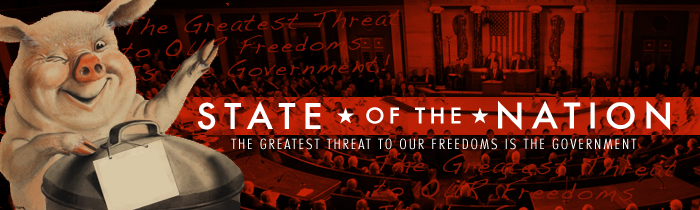
What was striking about this year’s State of the Union address was not the sheer arrogance of the president’s remarks, the staged nature of the proceedings and interactions, or the predictable posturing of the rebuttals, but the extent to which the members of the various branches of government—President Obama, Congress, the Supreme Court, and the assorted government agencies—are just one big, brawling, noisy, semi-incestuous clan.
Watching these bureaucrats, both elected and appointed, interact in the unguarded moments before the event, with their hugging and kissing and nudging and joking and hobnobbing and general high spirits, I was reminded anew that these people—Republicans and Democrats alike—are united in a common goal, and it is not to protect and defend the Constitution. No, as Orwell recognized in Animal Farm, their common goal is to maintain the status quo, a goal that is helped along by an unquestioning, easily mollified, corporate media. In this way, the carefully crafted spectacle that is the State of the Union address is just that: an exaggerated farce of political theater intended to dazzle, distract and divide us, all the while the police state marches steadily forward.
No matter what the president and his cohorts say or how convincingly they say it, the reality Americans must contend with is that the world is no better the day after President Obama’s State of the Union address than it was the day before. Indeed, if the following rundown on the actual state of our freedoms is anything to go by, the world is a far more dangerous place.
Americans have no protection against police abuse. It is no longer unusual to hear about incidents in which police shoot unarmed individuals first and ask questions later, such as the 16-year-old teenager who skipped school only to be shot by police after they mistook him for a fleeing burglar. Then there was the unarmed black man in Texas “who was pursued and shot in the back of the neck by Austin Police… after failing to properly identify himself and leaving the scene of an unrelated incident.” And who could forget the 19-year-old Seattle woman who was accidentally shot in the leg by police after she refused to show her hands? What is increasingly common, however, is the news that the officers involved in these incidents get off with little more than a slap on the hands.
Americans are little more than pocketbooks to fund the police state. If there is any absolute maxim by which the federal government seems to operate, it is that the American taxpayer always gets ripped off. This is true, whether you’re talking about taxpayers being forced to fund high-priced weaponry that will be used against us, endless wars that do little for our safety or our freedoms, or bloated government agencies such as the National Security Agency with its secret budgets, covert agendas and clandestine activities. Rubbing salt in the wound, even monetary awards in lawsuits against government officials who are found guilty of wrongdoing are paid by the taxpayer.
Americans are no longer innocent until proven guilty. We once operated under the assumption that you were innocent until proven guilty. Due in large part to rapid advances in technology and a heightened surveillance culture, the burden of proof has been shifted so that the right to be considered innocent until proven guilty has been usurped by a new norm in which all citizens are suspects. This is exemplified by police practices of stopping and frisking people who are merely walking down the street and where there is no evidence of wrongdoing. Likewise, by subjecting Americans to full-body scans and license-plate readers without their knowledge or compliance and then storing the scans for later use, the government—in cahoots with the corporate state—has erected the ultimate suspect society. In such an environment, we are all potentially guilty of some wrongdoing or other.
Americans no longer have a right to self-defense. In the wake of various shootings in recent years, “gun control” has become a resounding theme for government officials, with President Obama even going so far as to pledge to reduce gun violence “with or without Congress.” Those advocating gun reform see the Second Amendment’s right to bear arms as applying only to government officials. As a result, even Americans who legally own firearms are being treated with suspicion and, in some cases, undue violence. In one case, a Texas man had his home subjected to a no-knock raid and was shot in his bed after police, attempting to deliver a routine search warrant, learned that he was in legal possession of a firearm. In another incident, a Florida man who was licensed to carry a concealed firearm found himself detained for two hours during a routine traffic stop in Maryland while the arresting officer searched his vehicle in vain for the man’s gun, which he had left at home.
Americans no longer have a right to private property. If government agents can invade your home, break down your doors, kill your dog, damage your furnishings and terrorize your family, your property is no longer private and secure—it belongs to the government. Likewise, if government officials can fine and arrest you for growing vegetables in your front yard, praying with friends in your living room, installing solar panels on your roof, and raising chickens in your backyard, you’re no longer the owner of your property.
Americans no longer have a say about what their children are exposed to in school. Incredibly, the government continues to insist that parents essentially forfeit their rights when they send their children to a public school. This growing tension over whether young people, especially those in the public schools, are essentially wards of the state, to do with as government officials deem appropriate, in defiance of the children’s constitutional rights and those of their parents, is reflected in the debate over sex education programs that expose young people to all manner of sexual practices and terminology, zero tolerance policies that strip students of any due process rights, let alone parental involvement in school discipline, and Common Core programs that teach students to be test-takers rather than critical thinkers.
Americans are powerless in the face of militarized police. In early America, citizens were considered equals with law enforcement officials. Authorities were rarely permitted to enter one’s home without permission or in a deceitful manner. And it was not uncommon for police officers to be held personally liable for trespass when they wrongfully invaded a citizen’s home. Unlike today, early Americans could resist arrest when a police officer tried to restrain them without proper justification or a warrant—which the police had to allow citizens to read before arresting them. (Daring to dispute a warrant with a police official today who is armed with high-tech military weapons and tasers would be nothing short of suicidal.) As police forces across the country continue to be transformed into outposts of the military, with police agencies acquiring military-grade hardware in droves, Americans are finding their once-peaceful communities transformed into military outposts, complete with tanks, weaponry, and other equipment designed for the battlefield.
Americans no longer have a right to bodily integrity. Court rulings undermining the Fourth Amendment and justifying invasive strip searches have left us powerless against police empowered to forcefully draw our blood, strip search us, and probe us intimately. Accounts are on the rise of individuals—men and women—being subjected to what is essentially government-sanctioned rape by police in the course of “routine” traffic stops. Most recently, a New Mexico man was subjected to a 12-hour ordeal of anal probes, X-rays, enemas, and finally a colonoscopy because he allegedly rolled through a stop sign.
Americans no longer have a right to the expectation of privacy. Despite the staggering number of revelations about government spying on Americans’ phone calls, Facebook posts, Twitter tweets, Google searches, emails, bookstore and grocery purchases, bank statements, commuter toll records, etc., Congress, the president and the courts have done little to nothing to counteract these abuses. Instead, they seem determined to accustom us to life in this electronic concentration camp.
Americans no longer have a representative government. We have moved beyond the era of representative government and entered a new age, let’s call it the age of authoritarianism. History may show that from this point forward, we will have left behind any semblance of constitutional government and entered into a militaristic state where all citizens are suspects and security trumps freedom. Even with its constantly shifting terrain, this topsy-turvy travesty of law and government has become America’s new normal. It is not overstating matters to say that Congress, which has done its best to keep their unhappy constituents at a distance, may well be the most self-serving, semi-corrupt institution in America.
Americans can no longer rely on the courts to mete out justice. The U.S. Supreme Court was intended to be an institution established to intervene and protect the people against the government and its agents when they overstep their bounds. Yet through their deference to police power, preference for security over freedom, and evisceration of our most basic rights for the sake of order and expediency, the justices of the Supreme Court have become the architects of the American police state in which we now live, while the lower courts have appointed themselves courts of order, concerned primarily with advancing the government’s agenda, no matter how unjust or illegal.
Yes, the world is a far more dangerous place than it was a year ago. What the president failed to mention in his State of the Union address, however (and what I document in my book A Government of Wolves: The Emerging American Police State), is the fact that it’s the government that poses the gravest threat to our freedoms and way of life, and no amount of politicking, parsing or pandering will change that. — John W. Whitehead
“To the degree that we take away play, we deprive children of the ability to practise adulthood, and we create people who will go through life with a sense of dependence and victimisation, a sense that there is some authority out there who is supposed to tell them what to do and solve their problems. That is not a healthy way to live.” – psychologist Peter Gray
These days, it is far too easy to rattle off the outrageous examples of zero tolerance policy run amok in our nation’s schools. A 14-year-old student arrested for texting in class. Three middle school aged boys in Florida thrown to the ground by police officers wielding rifles, who then arrested them for goofing off on the roof of the school. A 9-year-old boy suspended for allegedly pointing a toy at a classmate and saying “bang, bang.” Two 6-year-old students in Maryland suspended for using their fingers as imaginary guns in a schoolyard game of cops and robbers. A 12-year-old New York student hauled out of school in handcuffs for doodling on her desk with an erasable marker. An 8-year-old boy suspended for making his hand into the shape of a gun, in violation of the school district’s policy prohibiting “playing with invisible guns.” A 17-year-old charged with a felony for keeping his tackle box in his car parked on school property, potentially derailing his chances of entering the Air Force. Two seventh graders in Virginia suspended for the rest of the school year for playing with airsoft guns in their own yard before school.
Thus, it’s tempting, when hearing about the 7-year-old suspended for chewing his Pop-Tart into the shape of a gun to chalk it up to an isolated example of school officials lacking in common sense. However, as I point out in my book A Government of Wolves: The Emerging American Police State, these incidents are far from isolated, occurring as they have for the better part of the past 30 years under the guise of maintaining safety and security in the schools. They are part of a concerted, top-down approach to creating a generation of obedient worker-bees content to be directed, distracted and kept in line.
Despite a general consensus that zero tolerance policies have failed to have any appreciable impact on student safety, schools have doubled down on these policies to the detriment of children all across the nation. Indeed, the zero tolerance mindset is so entrenched among school administrators all over America that we are now seeing school officials reaching into the personal lives of students to police their behavior at all times. For example, 13,000 students in the Glendale Unified School District in California are now being subjected to constant social media monitoring by school officials. Superintendent Richard Sheehan has hired private firm Geo Listening to analyze the public social media posts of students both off and on campus. Whether on Twitter, Facebook, YouTube, or any other social media platform, students will have their posts and comments analyzed for evidence of “bullying, cyber-bullying, hate and shaming activities, depression, harm and self harm, self hate and suicide, crime, vandalism, substance abuse and truancy.”
Unfortunately, the Glendale program is simply one component of a larger framework in which all student activity is treated as an open book by school administrators. What we are witnessing is a paradigm shift in American society, in which no personal activity is safe from the prying eyes of government agents and their corporate allies. Every decision and action, no matter how innocent, is scrutinized, analyzed, filed, stored, and eventually held against you when those in power feel like it.
When one pulls back the veil of zero tolerance, one can see the real culprit is the corporate-state, which has been meticulously applying the zero tolerance mindset to not just public schools in America, but our workplaces, our political forums, our social interactions and even our own homes. The end result is a society which is completely pacified and willing to march in lockstep with the corporate-state.
Government officials have worked hard to indoctrinate Americans into the belief that everything you do is suspect, and anything you do can be held against you at a later date. This mindset is clear in all aspects of society, from zero tolerance policies in our nation’s schools, to SWAT team raids in our neighborhoods, from the NSA’s surveillance of all Americans’ communications, to the corporate-state’s insistence that people aren’t capable of managing their own affairs. More and more people are becoming suspicious of others, quick to judge, and more than willing to follow the government’s dictates, however irrational and immoral they may be.
This manner of thinking has been slowly adopted by many Americans, but more worrisome is the manner in which it’s being foisted upon our nation’s youth. We are now living in an era in which childhood as it was once understood, a time to learn, to make mistakes, to try and fail, to try again and succeed, has been replaced by the worst elements of corporate and government culture. Children are treated as workers and prisoners, collected, corralled and controlled by teachers who increasingly act as bureaucrats, forced to fit every child into the exact same mold, regardless of their personal abilities and talents. This mindset is apparent among the proponents of the Common Core Testing Standards which threaten to unleash a new system of standardized testing on a new generation of kids.
As communications consultant Luba Vangelova has noted, the key attributes of a productive member of society are “a zest for life, creativity, perseverance, empathy, effective communication and the ability to cooperate with others. These are things that can’t be measured well – if at all – by tests.” Our obsession with testing leaves children without basic reasoning and analysis skills. They are taught to parrot information, rather than produce arguments. Their value is tied to letter grades and numbers.
Psychologist Peter Gray takes this criticism further, noting that children today are rarely allowed the opportunity to engage in undirected creative activity, also known as playing. Gray notes that since the 1960s, time for play has taken a backseat in the lives of children in favor of rigid curriculums revolving around high-stakes testing. Even sports, which were once simply games played on the fly by a mixed group of neighborhood kids, have taken on the rigidity of life in a factory or cubicle. The obsession with quantifying childhood progress has gone so far that charter schools in DC are beginning to conduct high stakes testing for three and four year old children.
Over the same time period, incidences of childhood mental illness have steadily increased. The number of children and young adults suffering from major depression and generalized anxiety disorder have increased between five and eightfold since the 1950s. The suicide rate for 15 – 24 year olds has doubled, while the suicide rate for those under the age of 15 has quadrupled.
The rise in these mental illnesses is coupled with a decrease in empathy and an increase in narcissism in young people, indicating that their ability to work with others — as is necessary in a society — has been muted. We’re raising a generation of anxious individuals who expect their life’s direction to come to them from orders from above. In short, we’re creating a generation ingrained with an authoritarian mindset.
This authoritarian mindset is an unavoidable consequence of the American education system. Indeed, while so-called education reformers insist on more tests, pushing schools to emulate the Chinese, Japanese, and South Korean educational systems, they miss a big piece of the puzzle: educators in those countries consider their systems a failure. Despite performing better than American children on certain international standardized tests, Chinese educators have noted that Chinese students have also demonstrated a “lack of social and practical skills, absence of self-discipline and imagination, loss of curiosity and passion for learning.”
Despite this fact, states are pushing ahead with programs like Common Core, which not only threatens our children’s quality of education, but their privacy as well. A great deal of data will be collected under new guidelines proposed by the program. While the purposes of the data collection appear legitimate on their face, mainly focused on keeping track of student progress, we must keep in mind that we are living in the era of Big Data, in which information becomes currency between the government and their corporate benefactors. The data collected on students goes beyond test scores and includes “social security numbers, attendance records, records of interaction with school counselors, identification of learning disabilities, and even disciplinary records.” Of course, having all of this information about every misstep or mistake one has made through his whole life does not bode well in a society in which government and corporate authorities are happy to punish any minor mishap.
We are living in an era where every personal decision, such as where to work, where to shop, where to play, who to love, who to befriend, who to worship, what to believe, and what to say, is open to scrutiny by government officials and corporate managers. It’s a poisonous mentality for those hoping to preserve democracy, and it’s being foisted upon our children, whether in the form of bureaucrats fashioning one-size-fits-all educational standards, or police officers investigating innocent activities such as children playing in the street as possible crimes.
This situation will only get worse as our children are taught to accept the police state as normal. Between the regimes of zero tolerance, the surveillance of students both in school and in their homes, and the value placed in standardized testing over teaching analytical thinking skills, we are raising a generation which is being encouraged to adopt the authoritarian mindset which pollutes the minds of our government and corporate leaders. By allowing our children to be subject to the forces of the market and the dictates of the state, we are ensuring tyranny within a generation or two, if not sooner. — John W. Whitehead


 “Whether it’s a Marine arrested for criticizing the government on Facebook or an ex-husband jailed for expressing his frustrations through rap lyrics on Facebook, the end result is the same—the criminalization of free speech,” said John W. Whitehead, president of The Rutherford Institute and author of A Government of Wolves: The Emerging American Police State. “While social media and the Internet have become critical forums for individuals to freely share information and express their ideas, they have unfortunately also become tools for the government to monitor, control and punish the populace for behavior and speech that may be controversial but are far from criminal.”




 If there is one glimmer of hope for this younger generation, it may be found in the unlikeliest of places: young adult literature, specifically dystopian literature, which is all the rage among young people today. Serial books such as Harry Potter, The Hunger Games, The Bone Season and The Giver all speak to a growing awareness among young people that the future awaiting them is far from secure, and that freedom ultimately rests in their ability to take on the powers-that-be.

 For example,

 John W. Whitehead, Constitutional Attorney