


“The evil was not in bread and circuses, per se, but in the willingness of the people to sell their rights as free men for full bellies and the excitement of the games which would serve to distract them from the other human hungers which bread and circuses can never appease.” — Admiral Ben Moreell (1892 – 1978), chief of the U.S. Navy’s Bureau of Yards and Docks and of the Civil Engineer Corps
As the grandfather of three young ones, ages 5 to 9, I get to see my fair share of kid movies: plenty of hijinks, lots of bathroom humor, and an endless stream of slapstick gags. Yet even among the worst of the lot, there’s something to be learned, some message being conveyed, or some aspect of our reality being reflected in celluloid.
So it was that I found myself sitting through The Angry Birds Movie on a recent Sunday afternoon, doling out popcorn, candy and drinks and trying to make sense of a 90-minute movie based on a cell phone video game that has beendownloaded more than 3 billion times.
The storyline is simple enough: an island nation of well-meaning, feel-good, flightless birds gets seduced by a charismatic green pig and his cohort who comes bearing food, wine and entertainment spectacles (the Roman equivalent of bread circuses). Ignoring the warnings of one solitary, suspicious “angry” bird that the pigs are up to no good, the clueless birds eventually discover that the pigs have stolen their most precious possessions: their eggs, the future of their entire society. It takes the “angry bird” to motivate the normally unflappable Bird Nation to get outraged enough to do something about the violation of their trust by the pigs and the theft of their personal property.
While one would be hard-pressed to call The Angry Birds Movie overly insightful, it is, as The Atlantic concludes, a “feather-light metaphor for our times… The film functions, effectively, as a fairy tale: It uses its status as fantasy to impart lessons about reality.”
 It turns out that we’re no different from the wine-guzzling, food-noshing, party-loving Bird Nation. We too are easily fooled by charismatic politicians bearing gifts. And we too are easily distracted as those same politicians and their cohorts rob us blind.
Case in point: while Barack Obama winds down his presidency with a flurry of celebrity-studded events that is causing the media to hail him as the “coolest” president, and the presidential candidates continue to distract us with spectacular feats of chest-thumping, browbeating and demagoguery, the police state continues its steady march onward.
All of the revelations of government wrongdoing, spying and corruption disclosed by NSA whistleblower Edward Snowdenseem to have fallen on deaf ears.
Nothing has improved or changed for the better.
There has been no real reform, no significant attempts at greater transparency, no accountability, no scaling back of the government’s warrantless, illegal domestic surveillance programs, and no recognition by Congress or the courts that the Fourth Amendment provides citizens with any protection against unreasonable searches and seizures by government agents.
In fact, as I point out in my book Battlefield America: The War on the American People, we’ve been subject to even more obfuscation, even more lies, even more sleight-of-hand maneuvers by government agencies determined to keep doing what they’re doing without any restrictions on their nefarious activities, and even more attempts by government agencies to listen in our phone calls, read our emails and text messages, monitor our movements, and generally imprison us within an electronic concentration camp.
Writing for the New Yorker, investigative reporter Maria Bustillos concludes, “the machinery of our government seems to have taken on an irrational life of its own. We live in a surreal world in which a ‘transparent’ government insists on the need for secret courts; our President prosecutes whistle-blowers and maintains a secret ‘kill list’; and private information is collected in secret and stored indefinitely by intelligence agencies.”
It’s no coincidence that almost exactly three years after Snowden began his steady campaign to leak documents about the government’s illegal surveillance program, Congress is preparing to adopt legislation containing a secret provision that would expand the FBI’s powers to secretly read Americans’ emails without a court order.
 Yes, you read that correctly.
The government is planning to push through secret legislation that would magnify its ability to secretly spy on us without a warrant.
After three years of lying to us about the real nature of the government’s spying program, feigning ignorance, dissembling, and playing at enacting real reforms, it turns out that what the government really wants is more power, more control and more surveillance.
A secret provision tacked onto the 2017 Intelligence Authorization Act will actually make it easier for the government to spy on Americans’ emails as well as their phone calls.
If enacted, this law would build upon the Patriot Act’s authorization of National Security Letters (NSL) which allows the FBI to secretly demand—without prior approval from a judge and under a gag order that carries the penalty of a prison sentence—that banks, phone companies, and other businesses provide them with customer information and not disclose the demands to the person being investigated or even indicate that they have been subjected to an NSL.
As Reuters reports, federal agencies do not need a warrant to access emails or other digital communications more than 180 days old due to a provision in a 1986 law that considers them abandoned by the owner. However, legislative efforts to require government authorities to obtain a search warrant before accessing old emails have been turned on their head by the insertion of this secret provision giving the FBI carte blanche access to Americans’ emails.
As if the FBI didn’t have enough corrupt tools in its bag of tricks already.
NSLs—in existence since the 1970s—empower FBI operatives to delve into Americans’ most personal affairs based only on the say-so of an agency that has come to be known as America’s Gestapo, or secret police. Incredibly, all the FBI needs to assert in order to justify such a search is that the information sought is relevant to a national-security investigation.
Nicholas Merrill can tell you all about NSLs. The head of a web-hosting company, he challenged the FBI’s unwarranted request for information on one of his customers and its companion gag order. Only after the FBI withdrew its request and a subsequent court-ordered lifting of the gag order was Merrill able to share his experiences. As Merrill recounts:
It was not a warrant. It was not stamped or signed by a court or a judge. It was this letter demanding this information from me. And it also told me that I could never tell anyone that I had gotten the letter. It said that I could tell ‘no person.’ The amount of information that the government can get with one of these letters can paint an incredibly vivid picture of all aspects of a person’s life — from the professional, to the personal, to the political, to their religious beliefs, to invading the privacy of their marriage, to being able to figure out what their sexual preference is. The amount of information that comes out of a national security letter is just so invasive. The fact that the government has been treating it so casually, and essentially going out on mass fishing expeditions and gathering the data of potentially millions of Americans without any suspicion of wrongdoing is very upsetting to me as someone who was raised on ideas about American exceptionalism and the belief that our system of government — with its built-in checks and balances and safeguards against abuse — were what made our country different from other countries.
Clandestine requests. Broad powers. Minimal insight. Intimidation tactics.
 That’s how the FBI’s use of NSLs are described, but it can easily be applied to the government-at-large and its voracious quest for ever-greater powers without any real accountability to the citizenry or any adherence to the rule of law.
It’s estimated that the FBI issues approximately 40,000 to 60,000 such NSLs per year and that number is growing.
In 2008, the Justice Department’s inspector general revealed that the FBI had been abusing its NSL authority by making improper requests, collecting more data than they were allowed to, not having proper authorization to proceed with a case, and attempting to sidestep the Foreign Intelligence Surveillance Court, the secret court charged with overseeing the government’s secret surveillance program. In one case, after having its search request denied by the FISA Court on the basis that “the ‘facts’ were too thin” and the “request implicated the target’s First Amendment rights,” the FBI used its NSL power to carry out its surveillance.
Even after being called on the carpet for abusing its information-gathering powers, the FBI continued to flout the very laws put in place to keep government abuses in check.
Incredibly, Barack Obama criticized President Bush for his administration’s mass government surveillance programsonly to fully embrace them once he himself had attained the White House. Indeed, the Obama administration has been lobbying for years to expand the FBI’s use of NSLs to include emails.
Now, here we are, eight years later, and we’re still being treated like the gullible birds in The Angry Birds Movie, easily pacified with bread, easily distracted by circuses, and easily robbed of our most precious possessions—our freedoms, our privacy and our right to have a government that abides by the rule of law and answers to us.
There are many ways of reacting to this latest news about the government’s treachery.
You can subscribe to the simplistic, head-in-the-sand routine and do as one of my so-called Facebook “friends” suggests and just obey the law, hoping that it will keep you out of the government’s clutches, but that’s no guarantee of safe passage. Of course, that will mean knowing the law—federal, state and local—in all of its convoluted, massive, growing permutations, understanding that overcriminalization has resulted in the average person unknowingly committing three crimes a day. As author Harvey Silvergate points out, even the most honest and informed citizen “cannot predict with any reasonable assurance whether a wide range of seemingly ordinary activities might be regarded by federal prosecutors as felonies.” For instance, you could be charged criminally for receiving an odd package, taking a fake sick day, reporting on government wrongdoing based on an anonymous source, or creating a website for a religious charity.
 You can insist that such concessions to security are making us safer, even though facts suggest otherwise.Barring a few notable exceptions, the politicians are singing the same tune: security at any cost. The NSL provision sailed past the 15-member Senate Intelligence Committee with only Sen. Ron Wyden (D-Ore.) dissenting. In a joint statement that underscores the ease with which the Republicans and Democrats work together in order to sell us out, Chairman Richard Burr (R-NC) and Vice Chairman Dianne Feinstein (D-Calif.) declared the expanded powers necessary to “keep America safe” and “vital” in order to “provide intelligence agencies with all the resources they need to prevent attacks both at home and abroad.”
This whole line of reasoning, as Nicholas Merrill explains, is hogwash. As he points out, the terrorist attacks in Paris were carried out by individuals “communicating without the use of any type of security or encryption. They were speaking in Facebook groups and using regular text messaging on their phones, without taking any steps to cover their tracks or make it harder to listen in on what they were doing. To me this proves that the whole dragnet surveillance system that we’ve built is actually useless, because it didn’t help us at all to prevent that type of attack.”
In other words, government spying isn’t making us safer, but it is making us less free. “In the end we’ve lost part of our freedom that maybe we’ll never get back. We’ve lost some part of what makes our system great, but in the end we’ve not really gained the security we thought we would get in the tradeoff for the freedom that we’ve given up.”
You can cast your ballot for one of the many slogan-spouting politicians who are long on lies and short on loyalty to their constituents. At the end of the day, these people work for the government and their primary purpose is to remain in office, living the kind of rarefied, pampered, privileged life that the average American only gets to dream about. Every one of the members of the Senate Intelligence Committee who voted for this legislation is a traitor to their oath of office and should be booted off that committee. What’s more, any member of Congress who votes for this legislation should be sent packing back to where they came from. As Brewster Kahle, another recipient of an NSL who successfully challenged the government’s gag order, reminds us, “The government is not one monolithic thing. It’s a bunch of people, thinking they’re doing their jobs.” It’s our job to make them toe the line when their thinking goes awry.
Or you can stop drinking the happy juice, stop believing the politicians’ lies, stop being so gallingly gullible and out to lunch, and start getting angry. In our politically correct, feel-good, play nice culture, anger has gotten a bad rap, but there’s something to be said for righteous anger acted upon in a nonviolent, effective fashion. It’s what Martin Luther King Jr. referred to as “military nonviolent resistance.” It means caring enough to get off your caboose, get on your feet and get actively involved in holding government officials accountable to the simple fact that they work for “we the people.”
It’s not an easy undertaking.
The government has been playing fast and loose with the rules for too long now, and its greed for power and riches is boundless.
 Still we are not powerless, although the government’s powers grow daily. We have not yet been altogether muzzled, although the acts of censorship increase daily. And we have not yet lost all hope for restoring our republic, although the outlook appears bleaker by the day.
For the moment, we still have some small allotment of freedoms by which we can express our displeasure, push back against injustice and corruption, and resist tyranny. One Texas man, outraged at being fined $212 for driving 39 in a 30 mph zone, chose to pay his fine with 22,000 pennies. It was a small act of disdain in the face of a government machine that tolerates little resistance, but it was acts such as these that sowed the early seeds of resistance that birthed this nation.
As revolutionary patriot Samuel Adams observed, “It does not take a majority to prevail… but rather an irate, tireless minority, keen on setting brushfires of freedom in the minds of men.”

Support the work of The Rutherford Institute with a tax-deductible donation today.


 The Judicial Branch: The Supreme Court was intended to be an institution established to intervene and protect the people against the government and its agents when they overstep their bounds. Yet through their deference to police power, preference for security over freedom, and evisceration of our most basic rights for the sake of order and expediency, the justices of the United States Supreme Court have become the
  A Suspect Surveillance Society: Every dystopian sci-fi film we’ve ever seen is suddenly converging into this present moment in a dangerous trifecta between science, technology and a government that wants to be all-seeing, all-knowing and all-powerful. By tapping into your phone lines and cell phone communications, the
  I haven’t even touched on the corporate state, the military industrial complex, SWAT team raids, invasive surveillance technology, zero tolerance policies in the schools, overcriminalization, or privatized prisons, to name just a few, but what I have touched on should be enough to show that the landscape of our freedoms has already changed dramatically from what it once was and will no doubt continue to deteriorate unless Americans can find a way to wrest back control of their government and reclaim their freedoms.
 It is easy to be diverted, distracted and amused by the antics of the presidential candidates, the pomp and circumstance of awards shows, athletic events, and entertainment news, and the feel-good evangelism that passes for religion today. What is far more difficult to face up to is the reality of life in America, where unemployment, poverty, inequality, injustice and violence by government agents are increasingly norms.
 Endless wars have resulted in a battlefield mindset that is infecting the nation. The Departments of Justice, Homeland Security (DHS) and Defense have passed off
  The schools, modeled after quasi-prisons, are churning out future compliant citizens. Within America’s public schools can be found almost every aspect of the American police state that plagues those of us on the “outside”: metal detectors, surveillance cameras, militarized police, drug-sniffing dogs, tasers, cyber-surveillance, random searches, senseless arrests, jail time, the list goes on. Whether it takes the form of draconian zero tolerance policies, overreaching anti-bullying statutes, police officers charged with tasering and arresting so-called unruly children, standardized testing with its emphasis on rote answers, political correctness, or the extensive surveillance systems cropping up in schools all over the country, young people in America are first in line to be indoctrinated into compliant citizens of the new American police state.

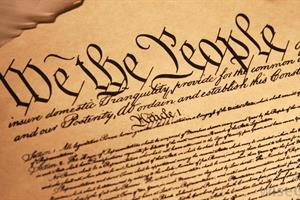 Ironically, the 14th anniversary of the 9/11 attacks occurs just days before the
 Yet despite the clear protections found in the First Amendment, the freedoms described therein are under constant assault. Increasingly, Americans are being arrested and charged with bogus “
 The Second Amendment was intended to guarantee “the right of the people to keep and bear arms.” Yet while gun ownership has been recognized by the U.S. Supreme Court as an individual citizen right, Americans remain
  The Fourth Amendment prohibits the government from conducting surveillance on you or touching you or invading you, unless they have some evidence that you’re up to something criminal. In other words, the Fourth Amendment ensures privacy and bodily integrity. Unfortunately, the Fourth Amendment has suffered the greatest damage in recent years and been all but eviscerated by an unwarranted expansion of police powers that include strip searches and even anal and vaginal searches of citizens, surveillance and intrusions justified in the name of fighting terrorism, as well as the outsourcing of otherwise illegal activities to
  The technological future appears to pose even greater threats to what’s left of our Fourth Amendment rights, with advances in biometric identification and microchip implants on the horizon making it that much easier for the government to track not only our movements and cyber activities but our very cellular beings. Barclays has already begun using a
  The Eighth Amendment is similar to the Sixth in that it is supposed to protect the rights of the accused and forbid the use of cruel and unusual punishment. However, the Supreme Court’s determination that what constitutes “cruel and unusual” should be dependent on the “evolving standards of decency that mark the progress of a maturing society” leaves us with little protection in the face of a society lacking in morals altogether. For example, a California appeals court is being asked to consider “whether
  The film V for Vendetta is a powerful commentary on how totalitarian governments such as our own exploit fear and use mass surveillance, censorship, terrorism, and militarized tactics to control, oppress and enslave.

 In other words, it’s a sophisticated ruse aimed at keeping us divided and fighting over
  Trump’s various donations to the Clintons (
 Congress. Perhaps the most notorious offenders and most obvious culprits in the creation of the corporate-state, Congress has proven itself to be both inept and avaricious, oblivious champions of an authoritarian system that is systematically dismantling their constituents’ fundamental rights. Long before they’re elected, Congressmen are trained to dance to the tune of their wealthy benefactors, so much so that they spend
  tallied, the work of buying and selling access to the White House is far from over. President Obama spends significant amounts of time hosting and attending fundraisers, having



 The case arose after Anthony Elonis, an aspiring rap artist, used personal material from his life as source material and inspiration for rap lyrics which he then shared on Facebook. For instance, shortly after Elonis’ wife left him and he was fired from his job, his lyrics included references to killing his ex-wife, shooting a classroom of kindergarten children, and blowing up an FBI agent who had opened an investigation into his postings.
 The internet and social media have taken the place of the historic public square, which has slowly been crowded out by shopping malls and parking lots. As such, these cyber “public squares” may be the only forum left for citizens to freely speak their minds and exercise their First Amendment rights, especially in the wake of legislation that limits access to our elected representatives. Unfortunately, the internet has become a tool for the government to monitor, control and punish the populace for behavior and speech that may be controversial but are far from criminal.


