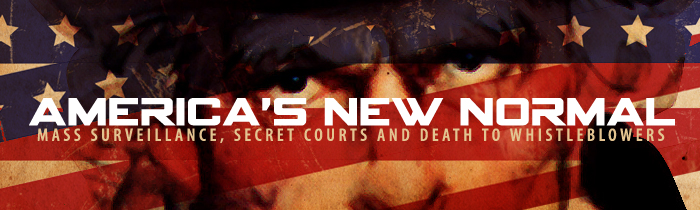
In this next installment in the Pressure Points series which explores threatens to the Bill of Rights and our essential freedoms, I examine the language of fear and government paranoia.
View it here.
In this next installment in the Pressure Points series which explores threatens to the Bill of Rights and our essential freedoms, I examine the language of fear and government paranoia.
View it here.

“I love America more than any other country in this world, and, exactly for this reason, I insist on the right to criticize her perpetually.”—James A. Baldwin
Just in time for Memorial Day, we’re being treated to a generous serving of praise and grandstanding by politicians, corporations and others with similarly self-serving motives eager to go on record as being pro-military. Patriotic platitudes aside, however, America has done a deplorable job of caring for her veterans. We erect monuments for those who die while serving in the military, yet for those who return home, there’s little honor to be found.
Despite the fact that the U.S. boasts more than 23 million veterans who have served in World War II through Korea, Vietnam, the Gulf War, Iraq and Afghanistan, the plight of veterans today, while often overlooked, is common knowledge: impoverished, unemployed, lacking any decent health benefits, homeless, traumatized mentally and physically, struggling with depression, thoughts of suicide, marital stress.
Making matters worse, thanks to Operation Vigilant Eagle, a program launched by the Department of Homeland Security in 2009, military veterans returning from Iraq and Afghanistan are also being characterized as extremists and potential domestic terrorist threats because they may be “disgruntled, disillusioned or suffering from the psychological effects of war.” As a result, these servicemen and women—many of whom are decorated—are finding themselves under surveillance, threatened with incarceration or involuntary commitment, or arrested, all for daring to voice their concerns about the alarming state of our union and the erosion of our freedoms.
An important point to consider, however, is that the government is not merely targeting individuals who are voicing their discontent so much as it is locking up individuals trained in military warfare who are voicing feelings of discontent. Under the guise of mental health treatment and with the complicity of government psychiatrists and law enforcement officials, these veterans are increasingly being portrayed as ticking time bombs in need of intervention. In 2012, for instance, the Justice Department launched a pilot program aimed at training SWAT teams to deal with confrontations involving highly trained and often heavily armed combat veterans.
In the four years since the start of Operation Vigilant Eagle, the government has steadily ramped up its campaign to “silence” dissidents, especially those with military backgrounds. Coupled with the DHS’ dual reports on Rightwing and Leftwing “Extremism,” which broadly define extremists as individuals and groups “that are mainly antigovernment, rejecting federal authority in favor of state or local authority, or rejecting government authority entirely,” these tactics have boded ill for anyone seen as opposing the government.
One particularly troubling mental health label being applied to veterans and others who challenge the status quo is “oppositional defiance disorder” (ODD). As journalist Anthony Martin explains, an ODD diagnosis
“denotes that the person exhibits ‘symptoms’ such as the questioning of authority, the refusal to follow directions, stubbornness, the unwillingness to go along with the crowd, and the practice of disobeying or ignoring orders. Persons may also receive such a label if they are considered free thinkers, nonconformists, or individuals who are suspicious of large, centralized government… At one time the accepted protocol among mental health professionals was to reserve the diagnosis of oppositional defiance disorder for children or adolescents who exhibited uncontrollable defiance toward their parents and teachers.”
The case of 26-year-old decorated Marine Brandon Raub—who was targeted because of his Facebook posts, interrogated by government agents about his views on government corruption, arrested with no warning, labeled mentally ill for subscribing to so-called “conspiratorial” views about the government, detained against his will in a psych ward for standing by his views, and isolated from his family, friends and attorneys—is a prime example of the government’s war on veterans.
Raub’s case exposes the seedy underbelly of a governmental system that is targeting Americans—especially military veterans—for expressing their discontent over America’s rapid transition to a police state.
On Thursday, August 16, 2012, a swarm of local police, Secret Service and FBI agents arrived at Raub’s home, asking to speak with him about posts he had made on his Facebook page made up of song lyrics, political opinions and dialogue used in a political thriller virtual card game. Among the posts cited as troublesome were lyrics to a song by the rap group Swollen Members and Raub’s views, shared increasingly by a number of Americans, that the 9/11 terrorist attacks were an inside job.
After a brief conversation and without providing any explanation, levying any charges against Raub or reading him his rights, law enforcement officials then handcuffed Raub and transported him first to the police headquarters, then to a medical center, where he was held against his will due to alleged concerns that his Facebook posts were “terrorist in nature.” Outraged onlookers filmed the arrest and posted the footage to YouTube, where it quickly went viral. Meanwhile, The Rutherford Institute came to Raub’s assistance, which combined with heightened media attention, may have helped prevent Raub from being successfully “disappeared” by the government.
In a hearing on August 20, government officials pointed to Raub’s Facebook posts as the sole reason for their concern and for his continued incarceration. Ignoring Raub’s explanations about the fact that the Facebook posts were being read out of context, Raub was sentenced to up to 30 days’ further confinement in a psychiatric ward. While in the psych ward, Raub reported being interrogated by medical staff about his views about the government and threatened by a doctor with brainwashing. Raub’s legal team, provided by The Rutherford Institute, immediately began petitioning the courts for his release.
On August 23, Circuit Court Judge Allan Sharrett declared the government’s case to be lacking in factual allegations and ordered Raub immediately released. However, for the tens of thousands of individuals detained—wrongfully or otherwise—under civil commitment laws every year, regaining their freedom is nearly impossible, predicated as it is on a bureaucratic legal and judicial system.
Within days of Raub being seized at his Virginia home on August 16, 2012, and forcibly held in a VA psych ward, news reports started surfacing of other veterans having similar experiences.
That the government is using the charge of mental illness as the means by which to immobilize (and disarm) these veterans is diabolically brilliant. With one stroke of a magistrate’s pen, these service men are being declared mentally ill, locked away against their will, and stripped of their constitutional rights. Make no mistake, these returning veterans are being positioned as enemy number one.
Given the government’s increasing view of veterans as potential domestic terrorists, it makes one think twice about a new Michigan law that adds a veterans designation on Michigan driver’s licenses and state IDs. Hailed by politicians as a way to “make it easier for military veterans to access discounts from retailers, restaurants, hotels and vendors across the state,” it will also make it that much easier for the government to identify and target veterans who dare to challenge the status quo.
Particularly telling is a training exercise for the Explorers program, which trains young people for careers in law enforcement, in which teenaged boys and girls dressed like quasi-SWAT teams and armed with pellet guns attempt to take down “a disgruntled Iraq war veteran [who] has already taken out two people, one slumped in his desk, the other covered in blood on the floor.” As a side note: this Explorers program, an extension of the Boy Scouts, is unnervingly similar to the Hitler Youth program used by the Nazis to indoctrinate young people into a police state mindset, chillingly documented by H.W. Koch in The Hitler Youth: Origins and Development 1922-1945.
This brings me back to present-day America, with its penchant for endless wars that empty our national coffers while fattening those of the military industrial complex. Does anyone else find it heartbreaking and ironic that we raise our young people on a steady diet of violence and military action, sell them on the idea that defending freedom abroad by serving in the military is their patriotic duty, then when they return home, bruised and battle-scarred and suddenly serious about defending their freedoms at home, we treat them like criminal suspects?
Brandon Raub understands this all too well. While still serving with the Marines in Afghanistan in November 2011, Raub put pen to paper in order to flesh out some of his concerns about the dismantling of freedom in America. His concerns echo those of countless Americans like myself dismayed at the nation’s descent into authoritarianism:
America has lost itself. We have lost who we truly are… They are controlling your media. They have dumbed you down through your school systems. They have systematically dismantled the constitution. It is in rags. The bill of rights is being systematically dismantled. Men have spilled their blood for those rights. Your sons and daughters, your brothers and sisters, and America’s best young men and women are losing their limbs. They are losing their lives. They are losing the hearts. They do not know why they are fighting. They are killing. And they do not know why. They have done some extraordinary acts. Their deeds go before them. But these wars are lies. They are lies. They deceived our entire nation with terrorism. They have gotten us to hand them our rights… We gave them the keys to our country. We were not vigilant with our republic. There is hope. BUT WE MUST TAKE OUR REPUBLIC BACK.
Second in the Pressure Points series: The Overcriminalization of America
In conjunction with the upcoming release of my new book, A Government of Wolves: The Emerging American Police State, I wanted to discuss several “pressure points” that are threatening the Bill of Rights and undermining our essential freedoms. In part two of this special series, I examine the overcriminalization of America. — John W. Whitehead
In conjunction with the upcoming release of my new book, A Government of Wolves: The Emerging American Police State, I set some time aside to sit down and discuss several “pressure points” that are threatening the Bill of Rights and undermining our essential freedoms. In part one of this special series, I examine the increased presence of militarized police.
Watch it here.

“I am in Birmingham because injustice is here.”—Martin Luther King Jr., “Letter from Birmingham Jail”
Bookended by the Newtown school shootings late last year to the most recent Boston explosions, city-wide imposition of martial law and man hunt, we’ve gone from a winter of discontent, turmoil and strife to a spring of more discontent, turmoil and strife.
No one is happy—not the politicians, who want more power, more control and less oversight; not the citizenry, who want fewer taxes, fewer regulations and greater freedom; and not small business owners, who are being strangled to death by the glut of bureaucratic red-tape being directed their way. Indeed, the only two sectors that might be reasonably content with the status quo, profiting as they do from our misery, are the corporations (especially the security and military industrial complexes) and, by extension, the corporate media.
The times are definitely calling for a change, and a significant change at that, not the cosmetic pandering that passes for political and social rhetoric today. What we are grappling with is how that change will be brought about. Clearly, the political process hasn’t worked, as evidenced by the failure in recent years by both political parties and independent movements to achieve any meaningful change. Clearly, violence is also not the answer, neither on the government’s part nor on the part of disgruntled citizens. Violence only leads to more violence.
So where does this leave us?
It was exactly fifty years ago this year that Martin Luther King Jr. found himself faced with a similar dilemma. His answer to a white populace largely satisfied with the status quo and critical of his call to activism and a black citizenry hungry for equality and immediate change was what he would later refer to as “military nonviolent resistance.”
The seething stew that was racial conflict finally boiled over in 1963, with King at the helm, leading demonstrations and marches in one segregated city after another. Jailed for participating in civil rights demonstrations in Birmingham, Alabama—one of the most racially segregated cities in the country at the time, King found himself on the defensive after eight prominent “liberal” Alabama clergypersons, all white, published an open letter castigating King for inciting civil disturbances through nonviolent resistance and calling on him to let the local and federal courts deal with the question of integration.
Although King rarely bothered to defend himself against his critics, he used his time behind bars to put pen to paper and refute those who not only opted to stand silently on the sidelines and do nothing in the face of injustice and oppression but found fault with any who took a more activist stance in the face of an urgent need. The result was King’s stirring “Letter from Birmingham City Jail,” written on April 16, 1963.
King understood that if justice and freedom were to prevail, African-Americans could not afford to be long-suffering. Quoting U.S. Supreme Court Justice Thurgood Marshall, King wrote, “Justice too long delayed is justice denied.”
Action was needed immediately. In his letter, King declared:
We are caught in an inescapable network of mutuality, tied in a single garment of destiny. Whatever affects one directly affects all indirectly. Never again can we afford to live with the narrow, provincial “outside agitator” idea. Anyone who lives in the United States can never be considered an outsider anywhere in this country…. Nonviolent direct action seeks to create such a crisis and establish such creative tension that a community that has constantly refused to negotiate is forced to confront the issue. It seeks so to dramatize the issue that it can no longer be ignored…. We know through painful experience that freedom is never voluntarily given by the oppressor; it must be demanded by the oppressed…. You express a great deal of anxiety over our willingness to break laws. This is certainly a legitimate concern…. One may well ask, “How can you advocate breaking some laws and obeying others?” The answer is found in the fact that there are two types of laws: there are just and there are unjust laws. I would agree with Saint Augustine that “An unjust law is no law at all.”… Any law that uplifts human personality is just. Any law that degrades human personality is unjust…. I submit that an individual who breaks a law that conscience tells him is unjust, and willingly accepts the penalty by staying in jail to arouse the conscience of the community over its injustice, is in reality expressing the very highest respect for law…. We can never forget that everything Hitler did in Germany was “legal” and everything the Hungarian freedom fighters did in Hungary was “illegal.” It was “illegal” to aid and comfort a Jew in Hitler’s Germany. But I am sure that if I had lived in Germany during that time I would have aided and comforted my Jewish brothers even though it was illegal…. It is the strangely irrational notion that there is something in the very flow of time that will inevitably cure all ills. Actually time is neutral. It can be used either destructively or constructively. I am coming to feel that the people of ill will have used time much more effectively than the people of good will…. But as I continued to think about the matter I gradually gained a bit of satisfaction from being considered an extremist. Was not Jesus an extremist in love—“Love your enemies, bless them that curse you, pray for them that despitefully use you.”… Was not Abraham Lincoln an extremist—“This nation cannot survive half slave and half free.” Was not Thomas Jefferson an extremist—“We hold these truths to be self-evident, that all men are created equal.” So the question is not whether we will be extremist but what kind of extremist will we be. Will we be extremists for hate or will we be extremists for love?
The word “extremist” has taken on negative connotations over the years, but it is appropriate here. When talking about the urgent need for transformative change, there can be no room for timidity or lukewarm emotions. What we need is passion and dedication and courage.
Fifty years after Martin Luther King Jr. urged Americans to stop standing on the sidelines and become extremists for love and gadflies for change, relying on militant nonviolent resistance as the means for that change, we’re in dire need of that pep talk once again, because injustice is still here. — John W. Whitehead


“The First Amendment was intended to secure something more than an exercise in futility.”—Justice John Paul Stevens, dissenting in Minnesota Board for Community Colleges v. Knight (1984)
Living in a representative democracy such as ours means that each person has the right to stand outside the halls of government and express his or her opinion on matters of state without fear of arrest. That’s what the First Amendment is all about.
It gives every American the right to “petition the government for a redress of grievances.” It ensures, as Adam Newton and Ronald K.L. Collins report for the Five Freedoms Project, “that our leaders hear, even if they don’t listen to, the electorate. Though public officials may be indifferent, contrary, or silent participants in democratic discourse, at least the First Amendment commands their audience.”
As Newton and Collins elaborate:
“Petitioning” has come to signify any nonviolent, legal means of encouraging or disapproving government action, whether directed to the judicial, executive or legislative branch. Lobbying, letter-writing, e-mail campaigns, testifying before tribunals, filing lawsuits, supporting referenda, collecting signatures for ballot initiatives, peaceful protests and picketing: all public articulation of issues, complaints and interests designed to spur government action qualifies under the petition clause, even if the activities partake of other First Amendment freedoms.
Unfortunately, through a series of carefully crafted legislative steps, our government officials—both elected and appointed—have managed to disembowel this fundamental freedom, rendering it with little more meaning than the right to file a lawsuit against government officials. In the process, government officials have succeeded in insulating themselves from their constituents, making it increasingly difficult for average Americans to make themselves seen or heard by those who most need to hear what “we the people” have to say.
Indeed, while lobbyists mill in and out of the homes and offices of Congressmen, the American people are kept at a distance through free speech zones, electronic town hall meetings, and security barriers. And those who dare to breach the gap—even through silent forms of protest—are arrested for making their voices heard. The case of Harold Hodge is a particularly telling illustration of the way in which the political elite in America have sheltered themselves from all correspondence and criticism.
On a snowy morning on January 24, 2011, Harold Hodge walked to the plaza in front of the U.S. Supreme Court building with a sign around his neck. The 3’ x 2’ placard read: “The U.S. Gov. allows police to illegally murder and brutalize African Americans and Hispanic people.” Hodge, a 45-year-old African-American, stood silently at attention in front of the building displaying his message. There weren’t many passersby, and he wasn’t blocking anyone’s way. However, after a few minutes, Hodge was approached by a police officer for the Supreme Court. The officer informed Hodge that he was violating a law prohibiting expressive activity in and around the Supreme Court building and asked him to leave.
According to federal law (U.S. Code 40 U.S.C. § 6135), “It is unlawful to parade, stand, or move in processions or assemblages in the Supreme Court Building or grounds, or to display in the Building and grounds a flag, banner, or device designed or adapted to bring into public notice a party, organization, or movement.” The penalty for violating this law is a fine of up to $5,000 and/or up to 60 days in jail.
Hodge, steadfast in his commitment to peaceably exercise his right to assemble and petition his government, politely refused. Over the course of some 35 minutes, several more police officers gathered and began to slowly circle Hodge. After ordering Hodge two more times to disperse, the officers placed Hodge under arrest, handcuffing his hands behind his back and leading him to a holding cell within the Supreme Court building.
Hodge is not the only person to be arrested for demonstrating in front of the Supreme Court building. Not long ago, 14 anti-death penalty demonstrators were arrested for unfurling a banner on the Supreme Court steps. In October 2011, Dr. Cornel West, the Princeton University philosopher and activist, was arrested on the steps of the Supreme Court while protesting the influence of corporate money on the political process. In January 2008, 34 demonstrators protesting the indefinite detention of inmates at Guantanamo Bay were arrested for demonstrating outside the Supreme Court. D.C. Superior Court Judge Wendell P. Gardner Jr. stated that most of those demonstrators would be sentenced to probation, but that he would perhaps jail those who had prior convictions for civil disobedience so that they would stop doing “the same thing over and over.”
This desire to insulate government officials from those exercising their First Amendment rights stems from an elitist mindset which views them as different, set apart somehow, from the people they have been appointed to serve and represent. It is nothing new.
The law under which Harold Hodge was prosecuted was enacted by Congress in 1949. Since then, interactions with politicians have become increasingly manufactured and distant. Press conferences and televised speeches now largely take the place of face-to-face interaction with constituents. For example, in 2011, 60 percent of Congressmen did not schedule a town hall meeting with their constituents during their summer recess. Other Congressmen, such as Rep. Paul Ryan (R – WI), held luncheons instead, charging $10 to $35 per admission ticket. Meanwhile, politicians in Virginia have considered changing the meeting rules for their public officials, making it possible for officials to “meet” electronically or by phone, thus eliminating the two-way dialogues and face-to-face interactions that are inherent to a physical meeting.
Additionally, there has been an increased use of so-called “free speech zones,” designated areas for expressive activity used to corral and block protestors at political events from interacting with public officials. George W. Bush used “free speech zones” excessively during his first term as president and both the Democratic and Republican parties have used them at various conventions to mute any and all criticism of their policies.
Perhaps the most egregious instance of imposing a free speech zone upon protesters came in 2004 at the Democratic National Convention. It was there that Boston Police constructed a cage of jersey walls and chain link fences out of sight of the convention center into which protesters were huddled. After seeing the designated area, Judge Douglas Woodlock stated, “One cannot conceive of other elements put in place to make a space more of an affront to the idea of free expression than the designated demonstration zone.” Such an area is obviously not designed to respect the American people’s right to free speech and to peaceably assemble and petition their government officials.
Clearly, the government has no interest in hearing what “we the people” have to say. Indeed, what we’re dealing with is a government that wants its citizenry to remain deaf, mute and blind—ignorant about the violations of their rights taking place daily and incapable of voicing their discontent. Thankfully, we still have the First Amendment, which ensures that Americans can speak freely, assemble and petition their government for a redress of grievances. However, these freedoms are only relevant as long as people like Harold Hodge continue to exercise their rights and hold the government accountable when it attempts to undermine or do away with those rights.
In other words, if Americans are not able to peacefully assemble outside of the halls of government for expressive activity, the First Amendment has lost all meaning. If we cannot stand silently outside of the Supreme Court or the Capitol or the White House, our ability to hold the government accountable for its actions is threatened, and so are the rights and liberties which we cherish as Americans.
That’s where Harold Hodge comes in. With the help of The Rutherford Institute, Hodge is now challenging the constitutionality of the statute barring silent expressive activity in front of the Supreme Court. It will be an uphill battle, given that it challenges the domain of the elite, but it’s a battle that must be fought. The government has already filed motions asking that the case be dismissed.
The Supreme Court has already dismissed one challenge to the law. In United States v. Grace (1983), a case challenging the ban on expressive activity in front of the Supreme Court, the justices ruled that “[t]he Court grounds are not transformed into ‘public forum’ property merely because the public is permitted to freely enter and leave the grounds at practically all times and is admitted to the building during specified hours.”
Hopefully, freedom will win out in the end. As Justice John Paul Stevens noted in his dissent in Minnesota Board for Community Colleges v. Knight (1984):
We need not consider whether executives or legislators have any constitutional obligation to listen to unsolicited advice to decide this case. It is inherent in the republican form of government that high officials may choose—in their own wisdom and at their own peril—to listen to some of their constituents and not to others. But the First Amendment does guarantee an open marketplace for ideas—where divergent points of view can freely compete for the attention of those in power and of those to whom the powerful must account…
There can be no question but that the First Amendment secures the right of individuals to communicate with their government. And the First Amendment was intended to secure something more than an exercise in futility—it guarantees a meaningful opportunity to express one’s views. For example, [the Supreme] Court has recognized that the right to forward views might become a practical nullity if government prohibited persons from banding together to make their voices heard. Thus, the First Amendment protects freedom of association because it makes the right to express one’s views meaningful. — John W. Whitehead
Delivering a blow to the sustainable living and local food movement, the Virginia Supreme Court has refused to hear the case of a Virginia Beach resident who was prohibited from keeping chickens as pets and as a source of organic eggs. In denying the appeal filed by The Rutherford Institute, the Virginia Supreme Court let stand a judgment against Tracy Gugal-Okroy, who has also been subjected to criminal charges for keeping chickens on her property in violation of a local zoning ordinance.
Rutherford Institute attorneys took issue with a Virginia Beach inspector’s assessment that Okroy violated a zoning ordinance that prohibits raising “poultry” for “agricultural and horticultural uses” within residential districts. The Rutherford Institute has been particularly vocal in recent months regarding the need for less onerous regulations that render otherwise law-abiding individuals as criminals simply for attempting to grow or raise their own food in a sustainable manner.
Despite the Virginia Supreme Court’s refusal to hear the Okroy case, this is not an issue that is going to go away. Weekly, we’re getting calls from individuals and families across the country who are being cited and fined for simply growing or raising their own food in a sustainable manner. One way or another, something has to give. Either the laws have to change, or the courts do. Certainly, at a time when food production is increasingly being corporatized, outsourced, and corrupted, resulting in all manner of diseases, we should not be criminalizing people who want to keep things local and sustainable.
The case started in 2011, when Tracy Gugal-Okroy purchased a dozen chicks from a Virginia farm and began keeping them in the backyard of her suburban residence within the City of Virginia Beach. Before doing so, she constructed an elevated coop and fenced in an area of her yard to keep the chickens from ranging and to protect them from predators. Gugal-Okroy consulted with her neighbors who all gave their permission for her to keep the chickens. The chickens, which have been given names by the family, provide companionship and entertainment for the family and neighbors. They are quiet, and provide the additional benefit of eating mosquitoes and other pests. They also provide Gugal-Okroy with a supply of compost, manure and fertilizer for vegetable and flower gardens she keeps on her property.
However, on January 10, 2012, Gugal-Okroy received a notice from the City inspector that she was in violation of a Virginia Beach zoning ordinance that allows “agricultural and horticultural uses” within residential districts, except the keeping of “poultry.” Gugal-Okroy appealed this decision to the City’s Zoning Board of Appeals and in support of her appeal presented no less than five letters of support from neighbors. Despite the support of neighbors, the Board of Appeals upheld the decision that the chickens were not allowed in the City. Gugal-Okroy then appealed to the circuit court, during which time she received a summons charging her with being in violation of the City’s ordinance, with a possible fine of up to $1,000. On October 31, 2012, the Circuit Court ruled that the Zoning Board of Appeals’ decision “was not erroneous” and decreed that the chickens were being kept in violation of the City’s zoning ordinance.
In asking the Virginia Supreme Court to hear Okroy’s case, Rutherford Institute attorneys asserted that the lower court’s ruling misconstrued the City’s ordinances, pointing out that persons are allowed to keep fowl within the City and that the restriction on keeping “poultry” relates to agricultural uses, not keeping chickens as companions and pets. — John W. Whitehead

“Of all the tyrannies a tyranny sincerely exercised for the good of its victims may be the most oppressive.”—C.S. Lewis
Caught up in the televised drama of a military-style manhunt for the suspects in the Boston Marathon explosion, most Americans fail to realize that the world around them has been suddenly and jarringly shifted off its axis, that axis being the U.S. Constitution.
For those like myself who have studied emerging police states, the sight of a city placed under martial law—its citizens under house arrest (officials used the Orwellian phrase “shelter in place” to describe the mandatory lockdown), military-style helicopters equipped with thermal imaging devices buzzing the skies, tanks and armored vehicles on the streets, and snipers perched on rooftops, while thousands of black-garbed police swarmed the streets and SWAT teams carried out house-to-house searches in search of two young and seemingly unlikely bombing suspects—leaves us in a growing state of unease.
Mind you, these are no longer warning signs of a steadily encroaching police state. The police state has arrived.
Equally unnerving is the ease with which Americans welcomed the city-wide lockdown, the routine invasion of their privacy, and the dismantling of every constitutional right intended to serve as a bulwark against government abuses. Watching it unfold, I couldn’t help but think of Nazi Field Marshal Hermann Goering’s remarks during the Nuremberg trials. As Goering noted:
It is always a simple matter to drag people along whether it is a democracy, or a fascist dictatorship, or a parliament, or a communist dictatorship. Voice or no voice, the people can always be brought to the bidding of the leaders. This is easy. All you have to do is tell them they are being attacked, and denounce the pacifists for lack of patriotism and exposing the country to danger. It works the same in every country.
As the events in Boston have made clear, it does indeed work the same in every country. The same propaganda and police state tactics that worked for Adolf Hitler 80 years ago continue to be employed with great success in a post-9/11 America.
Whatever the threat to so-called security—whether it’s rumored weapons of mass destruction, school shootings, or alleged acts of terrorism—it doesn’t take much for the American people to march in lockstep with the government’s dictates, even if it means submitting to martial law, having their homes searched, and being stripped of one’s constitutional rights at a moment’s notice.
As journalist Andrew O’Hehir observes in Salon:
In America after 9/11, we made a deal with the devil, or with Dick Cheney, which is much the same thing. We agreed to give up most of our enumerated rights and civil liberties (except for the sacrosanct Second Amendment, of course) in exchange for a lot of hyper-patriotic tough talk, the promise of “security” and the freedom to go on sitting on our asses and consuming whatever the hell we wanted to. Don’t look the other way and tell me that you signed a petition or voted for John Kerry or whatever. The fact is that whatever dignified private opinions you and I may hold, we did not do enough to stop it, and our constitutional rights are now deemed to be partial or provisional rather than absolute, do not necessarily apply to everyone, and can be revoked by the government at any time.
Particularly disheartening is the fact that Americans, consumed with the need for vengeance, seem even less concerned about protecting the rights of others, especially if those “others” happen to be of a different skin color or nationality. The public response to the manhunt, capture and subsequent treatment of brothers Tamerlan and Dzhokhar Tsarnaev is merely the latest example of America’s xenophobic mindset, which was also a driving force behind the roundup and detention of hundreds of Arab, South Asian and Muslim men following 9/11, internment camps that housed more than 18,000 people of Japanese ancestry during World War II, and the arrest and deportation of thousands of “radical” noncitizens during America’s first Red Scare.

Boston Marathon bomber suspect Dzhokhar Tsarnaev
Moreover, there has been little outcry over the Obama administration’s decision to deny 19-year-old U.S. citizen Dzhokhar Tsarnaev his due process rights and treat him as an enemy combatant, first off by interrogating him without reading him his Miranda rights (“You have the right to remain silent. Anything you say can and will be used against you in a court of law…”).
Presently, under the public safety exception to the Miranda rule, if law enforcement agents believe a suspect has information that might reduce a substantial threat, they can wait to give the Miranda warning. For years now, however, the Obama administration has been lobbying to see this exception extended to all cases involving so-called terror suspects, including American citizens. Tsarnaev’s case may prove to be the game-changer. Yet as journalist Emily Bazelon points out for Slate: “Why should I care that no one’s reading Dzhokhar Tsarnaev his Miranda rights? When the law gets bent out of shape for him, it’s easier to bend out of shape for the rest of us.”
The U.S. Supreme Court rightly recognized in its 1966 ruling in Miranda v. Arizona that police officers must advise a suspect of his/her civil rights once the suspect has been taken into custody, because the police can and often do take advantage of the fact that most Americans don’t know their rights. There have been few exceptions to the Miranda rule over the last 40 years or so, and with good reason. However, if the Obama administration is allowed to scale back the Miranda rule, especially as it applies to U.S. citizens, it would be yet another dangerous expansion of government power at the expense of citizens’ civil rights.
This continual undermining of the rules that protect civil liberties, not to mention the incessant rush to judgment by politicians, members of the media and the public, will inevitably have far-reaching consequences on a populace that not only remains ignorant about their rights but is inclined to sacrifice their liberties for phantom promises of safety.
Moments after taking Tsarnaev into custody, the Boston Police Dept. tweeted “CAPTURED!!! The hunt is over. The search is done. The terror is over. And justice has won.” Yet with Tsarnaev and his brother having been charged, tried and convicted by the government, the media and the police—all without ever having stepped foot inside a courtroom—it remains to be seen whether justice has indeed won.
The lesson for the rest of us is this: once a free people allows the government to make inroads into their freedoms or uses those same freedoms as bargaining chips for security, it quickly becomes a slippery slope to outright tyranny. And it doesn’t really matter whether it’s a Democrat or a Republican at the helm, because the bureaucratic mindset on both sides of the aisle now seems to embody the same philosophy of authoritarian government. Increasingly, those on the left who once hailed Barack Obama as the antidote for restoring the numerous civil liberties that were lost or undermined as a result of Bush-era policies are finding themselves forced to acknowledge that threats to civil liberties are worse under Obama.
Clearly, the outlook for civil liberties under Obama grows bleaker by the day, from his embrace of indefinite detention for U.S. citizens and drone kill lists to warrantless surveillance of phone, email and internet communications, and prosecutions of government whistleblowers. Most recently, capitalizing on the nation’s heightened emotions, confusion and fear, government officials used the Boston Marathon tragedy as a means of extending the reach of the police state, starting with the House of Representatives’ overwhelming passage of the controversial Cyber Intelligence Sharing and Protection Act (CISPA), which opens the door to greater internet surveillance by the government.
These troubling developments are the outward manifestations of an inner, philosophical shift underway in how the government views not only the Constitution and the Bill of Rights, but “we the people,” as well. What this reflects is a move away from a government bound by the rule of law to one that seeks total control through the imposition of its own self-serving laws on the populace.
All the while, the American people remain largely oblivious to the looming threats to their freedoms, eager to be persuaded that the government can solve the problems that plague us—whether it be terrorism, an economic depression, an environmental disaster or even a flu epidemic. Yet having bought into the false notion that the government can ensure not only our safety but our happiness and will take care of us from cradle to grave—that is, from daycare centers to nursing homes, we have in actuality allowed ourselves to be bridled and turned into slaves at the bidding of a government that cares little for our freedoms or our happiness. — John W. Whitehead