Posts Tagged ‘overcriminalization’

Back in the heyday of the old Soviet Union, a phrase evolved to describe gullible western intellectuals who came to visit Russia and failed to notice the human and other costs of building a communist utopia. The phrase was “useful idiots” and it applied to a good many people who should have known better. I now propose a new, analogous term more appropriate for the age in which we live: useful hypocrites. That’s you and me, folks, and it’s how the masters of the digital universe see us. And they have pretty good reasons for seeing us that way. They hear us whingeing about privacy, security, surveillance, etc., but notice that despite our complaints and suspicions, we appear to do nothing about it. In other words, we say one thing and do another, which is as good a working definition of hypocrisy as one could hope for.—John Naughton, The Guardian

“Who needs direct repression,” asked philosopher Slavoj Zizek, “when one can convince the chicken to walk freely into the slaughterhouse?”

In an Orwellian age where war equals peace, surveillance equals safety, and tolerance equals intolerance of uncomfortable truths and politically incorrect ideas, “we the people” have gotten very good at walking freely into the slaughterhouse, all the while convincing ourselves that the prison walls enclosing us within the American police state are there for our protection.

Call it doublespeak, call it hypocrisy, call it delusion, call it whatever you like, but the fact remains that while we claim to value freedom, privacy, individuality, equality, diversity, accountability, and government transparency, our actions and those of our government overseers contradict these much-vaunted principles at every turn.

For instance, we disdain the jaded mindset of the Washington elite, and yet we continue to re-elect politicians who lie, cheat and steal. We disapprove of the endless wars that drain our resources and spread thin our military, and yet we repeatedly buy into the idea that patriotism equals supporting the military. We chafe at taxpayer-funded pork barrel legislation for roads to nowhere, documentaries on food fights, and studies of mountain lions running on treadmills, and yet we pay our taxes meekly and without raising a fuss of any kind. We object to the militarization of our local police forces and their increasingly battlefield mindset, and yet we do little more than shrug our shoulders over SWAT team raids and police shootings of unarmed citizens.

And then there’s our love-hate affair with technology, which sees us bristling at the government’s efforts to monitor our internet activities, listen in on our phone calls, read our emails, track our every movement, and punish us for what we say on social media, and yet we keep using these very same technologies all the while doing nothing about the government’s encroachments on our rights. This contradiction is backed up by a recent Pew Research Center study, which finds that “Americans say they are deeply concerned about privacy on the web and their cellphones. They say they do not trust Internet companies or the government to protect it. Yet they keep using the services and handing over their personal information.”

Let me get this straight: the government continues to betray our trust, invade our privacy, and abuse our rights, and we keep going back for more?
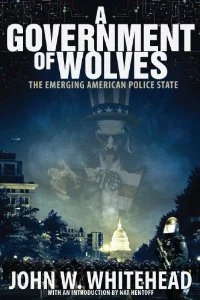
A Government of Wolves book coverSure we do. After all, the alternative—taking a stand, raising a ruckus, demanding change, refusing to cooperate, engaging in civil disobedience—is a lot of work. What we fail to realize, however, is that by tacitly allowing these violations to continue, we not only empower the tyrant but we feed the monster. In this way, as I point out in my book A Government of Wolves: The Emerging American Police State, what starts off as small, occasional encroachments on our rights, justified in the name of greater safety, becomes routine, wide-ranging abuses so entrenched as to make reform all but impossible.

We saw this happen with the police and their build-up of military arsenal, ostensibly to fight the war on drugs. The result: a transformation of America’s law enforcement agencies into extensions of the military, populated with battle-hardened soldiers who view “we the people” as enemy combatants.

The same thing happened with the government’s so-called efforts to get tough on crime by passing endless laws outlawing all manner of activities. The result: an explosion of laws criminalizing everything from parenting decisions and fishing to gardening and living off the grid.

And then there were the private prisons, marketed as a way to lower the government’s cost of locking up criminals. Only it turns out that private prisons actually cost the taxpayer more money and place profit incentives on jailing more Americans.

Are you starting to notice a pattern yet? The government lures us in with a scheme to make our lives better, our families safer, and our communities more secure, and then once we buy into it, they slam the trap closed. Doesn’t matter whether you’re talking about red light cameras, DNA databases, surveillance cameras, or zero tolerance policies—they all result in “we the people” being turned into enemy #1.

In this way, the government campaign to spy on our phone calls, letters and emails was sold to the American people as a necessary tool in the war on terror. Instead of targeting terrorists, however, the government has turned us into potential terrorists, so that if we dare say the wrong thing in a phone call, letter, email or on the internet, especially social media, we end up investigated, charged and possibly jailed.

This criminalization of free speech, which is exactly what the government’s prosecution of those who say the “wrong” thing using an electronic medium amounts to, is at the heart of Elonis v. The United States, a case before the U.S. Supreme Court this term.

If you happen to be one of the 1.31 billion individuals who use Facebook or one of the 255 million who tweet their personal and political views on Twitter, you might want to pay close attention, because the case has broad First Amendment implications for where the government can draw the line when it comes to expressive speech that is protected and permissible versus speech that could be interpreted as connoting a criminal intent.

The case arose after Anthony Elonis, an aspiring rap artist, used personal material from his life as source material and inspiration for rap lyrics which he then shared on Facebook. For instance, shortly after Elonis’ wife left him and he was fired from his job, his lyrics included references to killing his ex-wife, shooting a classroom of kindergarten children, and blowing up an FBI agent who had opened an investigation into his postings.

Despite the fact that Elonis routinely accompanied his Facebook posts with disclaimers that his lyrics were fictitious, and that he was using such writings as an outlet for his frustrations, he was charged with making unlawful threats (although it was never proven that he intended to threaten anyone) and sentenced to 44 months in jail.

Elonis is not the only Facebook user to be targeted for the content of his posts. In a similar case making its way through the courts, Marine veteran Brandon Raub was arrested by a swarm of FBI, Secret Service agents and local police and forcibly detained in a psychiatric ward because of controversial song lyrics and political views posted on his Facebook page. He was eventually released after a circuit court judge dismissed the charges against him as unfounded.

Earlier this year, rapper Jamal Knox and Rashee Beasley were sentenced to jail terms of up to six years for a YouTube video calling on listeners to “kill these cops ‘cause they don’t do us no good.” Although the rapper contended that he had no intention of bringing harm to the police, he was convicted of making terroristic threats and intimidation of witnesses.

And then there was Franklin Delano Jeffries II, an Iraq war veteran, who, in the midst of a contentious custody battle for his daughter, shared a music video on YouTube and Facebook in which he sings about the judge in his case, “Take my child and I’ll take your life.” Despite his insistence that the lyrics were just a way for him to vent his frustrations with the legal battle, Jeffries was convicted of communicating threats and sentenced to 18 months in jail.

The common thread running through all of these cases is the use of social media to voice frustration, grievances, and anger, sometimes using language that is overtly violent. The question the U.S. Supreme Court must now decide in Elonis is whether this activity, in the absence of any overt intention of committing a crime, rises to the level of a “true threat” or whether it is, as I would contend, protected First Amendment activity. (The Supreme Court has defined a “true threat” as “statements where the speaker means to communicate a serious expression of an intent to commit an act of unlawful violence to a particular individual or group of individuals.”)

The internet and social media have taken the place of the historic public square, which has slowly been crowded out by shopping malls and parking lots. As such, these cyber “public squares” may be the only forum left for citizens to freely speak their minds and exercise their First Amendment rights, especially in the wake of legislation that limits access to our elected representatives. Unfortunately, the internet has become a tool for the government to monitor, control and punish the populace for behavior and speech that may be controversial but are far from criminal.

Indeed, the government, a master in the art of violence, intrusion, surveillance and criminalizing harmless activities, has repeatedly attempted to clamp down on First Amendment activity on the web and in social media under the various guises of fighting terrorism, discouraging cyberbullying, and combatting violence. Police and prosecutors have also targeted “anonymous” postings and messages on forums and websites, arguing that such anonymity encourages everything from cyber-bullying to terrorism, and have attempted to prosecute those who use anonymity for commercial or personal purposes.

We would do well to tread cautiously in how much authority we give the government to criminalize free speech activities and chill what has become a vital free speech forum. Not only are social media and the Internet critical forums for individuals to freely share information and express their ideas, but they also serve as release valves to those who may be angry, seething, alienated or otherwise discontented. Without an outlet for their pent-up anger and frustration, these thoughts and emotions fester in secret, which is where most violent acts are born.

In the same way, free speech in the public square—whether it’s the internet, the plaza in front of the U.S. Supreme Court or a college campus—brings people together to express their grievances and challenge oppressive government regimes. Without it, democracy becomes stagnant and atrophied. Likewise, if free speech is not vigilantly protected, democracy is more likely to drift toward fear, repression, and violence. In such a scenario, we will find ourselves threatened with an even more pernicious injury than violence itself: the loss of liberty. In confronting these evils, more speech, not less, is the remedy.


Whether the mask is labeled fascism, democracy, or dictatorship of the proletariat, our great adversary remains the apparatus—the bureaucracy, the police, the military. Not the one facing us across the frontier of the battle lines, which is not so much our enemy as our brothers’ enemy, but the one that calls itself our protector and makes us its slaves. No matter what the circumstances, the worst betrayal will always be to subordinate ourselves to this apparatus and to trample underfoot, in its service, all human values in ourselves and in others.—Simone Weil, French philosopher and political activist

It’s no coincidence that during the same week in which the U.S. Supreme Court heard arguments in Yates v. United States, a case in which a Florida fisherman is being threatened with 20 years’ jail time for throwing fish that were too small back into the water, Florida police arrested a 90-year-old man twice for violating an ordinance that prohibits feeding the homeless in public.

A Government of Wolves book coverBoth cases fall under the umbrella of overcriminalization, that phenomenon in which everything is rendered illegal and everyone becomes a lawbreaker. As I make clear in my book A Government of Wolves: The Emerging American Police State, this is what happens when bureaucrats run the show, and the rule of law becomes little more than a cattle prod for forcing the citizenry to march in lockstep with the government.

John Yates, a commercial fisherman, was written up in 2007 by a state fish and wildlife officer who noticed that among Yates’ haul of red grouper, 72 were apparently under the 20-inch minimum legal minimum. Yates, ordered to bring the fish to shore as evidence of his violation of the federal statute on undersized catches, returned to shore with only 69 grouper in the crate designated for evidence. A crew member later confessed that, on orders from Yates, the crew had thrown the undersized grouper overboard and replaced them with larger fish. Unfortunately, they were three fish short. Sensing a bait-and-switch, prosecutors refused to let Yates off the hook quite so easily. Unfortunately, in prosecuting him for the undersized fish under a law aimed at financial crimes, government officials opened up a can of worms.

Arnold Abbott, 90 years old and the founder of a nonprofit that feeds the homeless, is facing a fine of $1000 and up to four months in jail for violating a city ordinance that makes it a crime to feed the homeless in public. Under the city’s ordinance, clearly aimed at discouraging the feeding of the homeless in public, organizations seeking to do so must provide portable toilets, be 500 feet away from each other, 500 feet from residential properties, and are limited to having only one group carry out such a function per city block. Abbott has been feeding the homeless on a public beach in Ft. Lauderdale every Wednesday evening for the past 23 years. On November 2, 2014, moments after handing out his third meal of the day, police reportedly approached the nonagenarian and ordered him to “‘drop that plate right now,’ as if I were carrying a weapon,” recalls Abbott. Abbott was arrested and fined. Three days later, Abbott was at it again, and arrested again.

That both of these incidents occurred in Florida is no coincidence. Remember, this is the state that arrested Nicole Gainey for letting her 7-year-old son walk to the park alone, even though it was just a few blocks from their house. If convicted, Gainey could have been made to serve up to five years in jail.

This is also the state that a few years back authorized police raids on barber shops in minority communities, resulting in barbers being handcuffed in front of customers, and their shops searched without warrants. All of this was purportedly done in an effort to make sure that the barbers’ licensing paperwork was up to snuff.

As if criminalizing fishing, charity, parenting decisions, and haircuts wasn’t bad enough, you could also find yourself passing time in a Florida slammer for such inane activities as singing in a public place while wearing a swimsuit, breaking more than three dishes per day, farting in a public place after 6 pm on a Thursday, and skateboarding without a license.

Despite its pristine beaches and balmy temperatures, Florida is no less immune to the problems plaguing the rest of the nation in terms of overcriminalization, incarceration rates, bureaucracy, corruption, and police misconduct. In fact, the Sunshine State has become a poster child for how a seemingly idyllic place can be transformed into a police state with very little effort. As such, it is representative of what is happening in every state across the nation, where a steady diet of bread and circuses has given rise to an oblivious, inactive citizenry content to be ruled over by an inflexible and highly bureaucratic regime.

This transformation of the United States from being a beacon of freedom to a locked down nation illustrates perfectly what songwriter Joni Mitchell was referring to when she wrote:

Don’t it always seem to go

That you don’t know what you’ve got ‘til it’s gone.

They paved paradise and put up a parking lot.

Only in our case, sold on the idea that safety, security and material comforts are preferable to freedom, we’ve allowed the government to pave over the Constitution in order to erect a concentration camp. The problem with these devil’s bargains, however, is that there is always a catch, always a price to pay for whatever it is we valued so highly as to barter away our most precious possessions.

We’ve bartered away our right to self-governance, self-defense, privacy, autonomy and that most important right of all—the right to tell the government to “leave me the hell alone.” In exchange for the promise of safe streets, safe schools, blight-free neighborhoods, lower taxes, lower crime rates, and readily accessible technology, health care, water, food and power, we’ve opened the door to militarized police, government surveillance, asset forfeiture, school zero tolerance policies, license plate readers, red light cameras, SWAT team raids, health care mandates, overcriminalization and government corruption.

In the end, such bargains always turn sour.

We asked our lawmakers to be tough on crime, and we’ve been saddled with an abundance of laws that criminalize almost every aspect of our lives. So far, we’re up to 4500 criminal laws and 300,000 criminal regulations that result in average Americans unknowingly engaging in criminal acts at least three times a day. For instance, the family of an 11-year-old girl was issued a $535 fine for violating the Federal Migratory Bird Act after the young girl rescued a baby woodpecker from predatory cats.

We wanted criminals taken off the streets, and we didn’t want to have to pay for their incarceration. What we’ve gotten is a nation that boasts the highest incarceration rate in the world, with more than 2.3 million people locked up, many of them doing time for relatively minor, nonviolent crimes, and a private prison industry fueling the drive for more inmates, who are forced to provide corporations with cheap labor. A special report by CNBC breaks down the national numbers:

One out of 100 American adults is behind bars — while a stunning one out of 32 is on probation, parole or in prison. This reliance on mass incarceration has created a thriving prison economy. The states and the federal government spend about $74 billion a year on corrections, and nearly 800,000 people work in the industry.

We wanted law enforcement agencies to have the necessary resources to fight the nation’s wars on terror, crime and drugs. What we got instead were militarized police decked out with M-16 rifles, grenade launchers, silencers, battle tanks and hollow point bullets—gear designed for the battlefield, more than 80,000 SWAT team raids carried out every year (many for routine police tasks, resulting in losses of life and property), and profit-driven schemes that add to the government’s largesse such as asset forfeiture, where police seize property from “suspected criminals.”

Justice Department figures indicate that as much as $4.3 billion was seized in asset forfeiture cases in 2012, with the profits split between federal agencies and local police. According to the Washington Post, these funds have been used to buy guns, armored cars, electronic surveillance gear, “luxury vehicles, travel and a clown named Sparkles.” Police seminars advise officers to use their “department wish list when deciding which assets to seize” and, in particular, go after flat screen TVs, cash and nice cars. In Florida, where police are no strangers to asset forfeiture, Florida police have been carrying out “reverse” sting operations, where they pose as drug dealers to lure buyers with promises of cheap cocaine, then bust them, and seize their cash and cars. Over the course of a year, police in one small Florida town seized close to $6 million using these entrapment schemes.

We fell for the government’s promise of safer roads, only to find ourselves caught in a tangle of profit-driven red light cameras, which ticket unsuspecting drivers in the so-called name of road safety while ostensibly fattening the coffers of local and state governments. Despite widespread public opposition, corruption and systemic malfunctions, these cameras—used in 24 states and Washington, DC—are particularly popular with municipalities, which look to them as an easy means of extra cash. One small Florida town, population 8,000, generates a million dollars a year in fines from these cameras. Building on the profit-incentive schemes, the cameras’ manufacturers are also pushing speed cameras and school bus cameras, both of which result in heft fines for violators who speed or try to go around school buses.

This is just a small sampling of the many ways in which the American people continue to get duped, deceived, double-crossed, cheated, lied to, swindled and conned into believing that the government and its army of bureaucrats—the people we appointed to safeguard our freedoms—actually have our best interests at heart.

Yet when all is said and done, who is really to blame when the wool gets pulled over your eyes: you, for believing the con man, or the con man for being true to his nature?

It’s time for a bracing dose of reality, America. Wake up and take a good, hard look around you, and ask yourself if the gussied-up version of America being sold to you—crime free, worry free and devoid of responsibility—is really worth the ticket price: nothing less than your freedoms.


“Police are specialists in violence. They are armed, trained, and authorized to use force. With varying degrees of subtlety, this colors their every action. Like the possibility of arrest, the threat of violence is implicit in every police encounter. Violence, as well as the law, is what they represent.”—Kristian Williams, activist and author

If you don’t want to get probed, poked, pinched, tasered, tackled, searched, seized, stripped, manhandled, arrested, shot, or killed, don’t say, do or even suggest anything that even hints of noncompliance. This is the new “thin blue line” over which you must not cross in interactions with police if you want to walk away with your life and freedoms intact.

"Stand on Guard" - via Jason Hargrove / Flickr

“Stand on Guard” – via Jason Hargrove / Flickr

The following incidents and many more like them serve as chilling reminders that in the American police state, “we the people” are at the mercy of law enforcement officers who have almost absolute discretion to decide who is a threat, what constitutes resistance, and how harshly they can deal with the citizens they were appointed to “serve and protect.”

For example, police arrested Chaumtoli Huq because she failed to promptly comply when ordered to “move along” while waiting outside a Ruby Tuesday’s restaurant for her children, who were inside with their father, using the bathroom. NYPD officers grabbed Huq, a lawyer with the New York City Public Advocate’s office, flipped her around, pressed her against a wall, handcuffed her, searched her purse, arrested her, and told her to “shut up” when she cried out for help, before detaining her for nine hours. Huq was charged with obstructing governmental administration, resisting arrest and disorderly conduct.

Oregon resident Fred Marlow was jailed and charged with interfering and resisting arrest after he filmed a SWAT team raid that took place across the street from his apartment and uploaded the footage to the internet. The footage shows police officers threatening Marlow, who was awoken by the sounds of “multiple bombs blasting and glass breaking” and ran outside to investigate only to be threatened with arrest if he didn’t follow orders and return inside.

Eric Garner, 43 years old, asthmatic and unarmed, died after being put in a chokehold by NYPD police, allegedly for resisting arrest over his selling untaxed, loose cigarettes, although video footage of the incident shows little resistance on Garner’s part. Indeed, the man was screaming, begging and insisting he couldn’t breathe. And what was New York Mayor Bill De Blasio’s advice to citizens in order to avoid a similar fate? Don’t resist arrest. (Mind you, the NYPD arrests more than 13,000 people every year on charges of resisting arrest, although only a small fraction of those charged ever get prosecuted.)

Then there was Marine Brandon Raub, who was questioned at his home by a swarm of DHS, FBI, Secret Service agents and local police, tackled to the ground, handcuffed, and forcibly transported to a police station. Raub was then detained against his will in a psychiatric ward, without being provided any explanation, having any charges levied against him or being read his rights—all allegedly because of controversial song lyrics and political views posted on his Facebook page.

Incredibly, police insisted that Raub was not in fact under arrest. Of course, Raub was under arrest. When your hands are handcuffed behind you, when armed policemen are tackling you to the ground and transporting you across town in the back of a police car, and then forcibly detaining you against your will, you’re not free to walk away.

If you do attempt to walk away, be warned that the consequences will likely be even worse, as Tremaine McMillian learned the hard way. Miami-Dade police slammed the 14-year-old boy to the ground, putting him in a chokehold and handcuffing him after he allegedly gave them “dehumanizing stares” and walked away from them, which the officers found unacceptable. According to Miami-Dade Police Detective Alvaro Zabaleta, “His body language was that he was stiffening up and pulling away… When you have somebody resistant to them and pulling away and somebody clenching their fists and flailing their arms, that’s a threat. Of course we have to neutralize the threat.”

A Government of Wolves book coverAs I point out in my book A Government of Wolves: The Emerging American Police State, this mindset that any challenge to police authority is a threat that needs to be “neutralized” is a dangerous one that is part of a greater nationwide trend that sets the police beyond the reach of the Fourth Amendment. Moreover, when police officers are allowed to operate under the assumption that their word is law and that there is no room for any form of disagreement or even question, that serves to chill the First Amendment’s assurances of free speech, free assembly and the right to petition the government for a redress of grievances.

Frankly, it doesn’t matter whether it’s a casual “show your ID” request on a boardwalk, a stop-and-frisk search on a city street, or a traffic stop for speeding or just to check your insurance: if you feel like you can’t walk away from a police encounter of your own volition—and more often than not you can’t, especially when you’re being confronted by someone armed to the hilt with all manner of militarized weaponry and gear—then for all intents and purposes, you’re under arrest from the moment a cop stops you.

That raises the question, what exactly constitutes resisting an arrest? What about those other trumped up “contempt of cop” charges such as interference, disorderly conduct, obstruction, and failure to obey a police order that get trotted out anytime a citizen engages in behavior the police perceive as disrespectful or “insufficiently deferential to their authority”? Do Americans really have any recourse at all when it comes to obeying an order from a police officer, even if it’s just to ask a question or assert one’s rights, or should we just “surrender quietly”?

The short answer is that anything short of compliance will get you arrested and jailed. The long answer is a little more complicated, convoluted and full of legal jargon and dissonance among the courts, but the conclusion is still the same: anything short of compliance is being perceived as “threatening” behavior or resistance to be met by police with extreme force resulting in injury, arrest or death for the resistor.

The key word, of course, is comply meaning to obey, submit or conform. This is what author Kristian Williams describes as the dual myths of heroism and danger: “The overblown image of police heroism, and the ‘obsession’ with officer safety, do not only serve to justify police violence after the fact; by providing such justification, they legitimize violence, and thus make it more likely.”

How else can we explain why police shot a schizophrenic 30-year-old man holding a pellet gun over 80 times before his corpse was handcuffed? Mind you, witnesses reportedly informed the police that it was not a real gun, but the officers nonetheless opened fire about five minutes after arriving on the scene.

John Crawford was shot by police in an Ohio Wal-Mart for holding an air rifle sold in the store that he may have intended to buy. Oscar Grant, age 23, unarmed and lying face-down on the ground, was shot in the back by a transit officer in Oakland, Calif., who mistakenly used a gun instead of a taser to further restrain him. Ordered to show his hands after “anti-crime” police officers noticed him adjusting “his waistband in a manner the officers deemed suspicious,” 16-year old Kimani Grey was fired at 11 times, and shot seven times, including three times in the back. Reportedly, the teenager was unarmed and unthreatening.

Even dogs aren’t spared if they are perceived as “threatening.” Family dogs are routinely shot and killed during SWAT team raids, even if the SWAT team is at the wrong address or the dog is in the next yard over. One six-year-old girl witnessed her dog Apollo shot dead by an Illinois police officer.

Clearly, when police officers cease to look and act like civil servants or peace officers but instead look and act like soldiers occupying a hostile territory, it alters their perception of “we the people.” Those who founded this country believed that we were the masters and that those whose salaries we pay with our hard-earned tax dollars are our servants.

If daring to question, challenge or even hesitate when a cop issues an order can get you charged with resisting arrest or disorderly conduct, you’re not the master in a master-servant relationship. In fact, you’re not even the servant—you’re the slave.

This is not freedom. This is not even a life.

This is a battlefield, a war zone—if you will—governed by martial law and disguised as a democracy. No matter how many ways you fancy it up with shopping malls, populist elections, and Monday night football, the fact remains that “we the people” are little more than prisoners in the American police state, and the police are our jailers and wardens.

“If you don’t want to get shot, tased, pepper-sprayed, struck with a baton or thrown to the ground, just do what I tell you. Don’t argue with me, don’t call me names, don’t tell me that I can’t stop you, don’t say I’m a racist pig, don’t threaten that you’ll sue me and take away my badge. Don’t scream at me that you pay my salary, and don’t even think of aggressively walking towards me. Most field stops are complete in minutes. How difficult is it to cooperate for that long?”—Sunil Dutta, an officer with the Los Angeles Police Department for 17 years

Life in the American police state is an endless series of don’ts delivered at the end of a loaded gun: don’t talk back to police officers, don’t even think about defending yourself against a SWAT team raid (of which there are 80,000 every year), don’t run when a cop is nearby lest you be mistaken for a fleeing criminal, don’t carry a cane lest it be mistaken for a gun, don’t expect privacy in public, don’t let your kids walk to the playground alone, don’t engage in nonviolent protest near where a government official might pass, don’t try to grow vegetables in your front yard, don’t play music for tips in a metro station, don’t feed whales, and on and on.

For those who resist, who dare to act independently, think for themselves, march to the beat of a different drummer, the consequences are invariably a one-way trip to the local jail or death.

What Americans must understand, what we have chosen to ignore, what we have fearfully turned a blind eye to lest the reality prove too jarring is the fact that we no longer live in the “city on the hill,” a beacon of freedom for all the world.

Far from being a shining example of democracy at work, we have become a lesson for the world in how quickly freedom turns to tyranny, how slippery the slope by which a once-freedom-loving people can be branded, shackled and fooled into believing that their prisons walls are, in fact, for their own protection.

Having spent more than half a century exporting war to foreign lands, profiting from war, and creating a national economy seemingly dependent on the spoils of war, we failed to protest when the war hawks turned their profit-driven appetites on us, bringing home the spoils of war—the military tanks, grenade launchers, Kevlar helmets, assault rifles, gas masks, ammunition, battering rams, night vision binoculars, etc.—to be distributed for free to local police agencies and used to secure the homeland against “we the people.”

It’s not just the Defense Department that is passing out free military equipment to local police. Since the early 1990s, the Justice Department has worked with the Pentagon to fund military technology for police departments. And then there are the billions of dollars’ worth of federal grants distributed by the Department of Homeland Security, enabling police departments to go on a veritable buying spree for highly questionable military-grade supplies better suited to the battlefield.

Is it any wonder that we now find ourselves in the midst of a war zone?

We live in a state of undeclared martial law. We have become the enemy.

In a war zone, there are no police—only soldiers. Thus, there is no more Posse Comitatus prohibiting the government from using the military in a law enforcement capacity. Not when the local police have, for all intents and purposes, already become the military.

In a war zone, the soldiers shoot to kill, as American police have now been trained to do. Whether the perceived “threat” is armed or unarmed no longer matters when police are authorized to shoot first and ask questions later.

In a war zone, even the youngest members of the community learn at an early age to accept and fear the soldier in their midst. Thanks to funding from the Obama administration, more schools are hiring armed police officers—some equipped with semi-automatic AR-15 rifles—to “secure” their campuses.

In a war zone, you have no rights. When you are staring down the end of a police rifle, there can be no free speech. When you’re being held at bay by a militarized, weaponized mine-resistant tank, there can be no freedom of assembly. When you’re being surveilled with thermal imaging devices, facial recognition software and full-body scanners and the like, there can be no privacy. When you’re charged with disorderly conduct simply for daring to question or photograph or document the injustices you see, with the blessing of the courts no less, there can be no freedom to petition the government for a redress of grievances.

And when you’re a prisoner in your own town, unable to move freely, kept off the streets, issued a curfew at night, there can be no mistaking the prison walls closing in.

A Government of Wolves book coverThis is not just happening in Ferguson, Missouri. As I show in my book A Government of Wolves: The Emerging American Police State, it’s happening and will happen anywhere and everywhere else in this country where law enforcement officials are given carte blanche to do what they like, when they like, how they like, with immunity from their superiors, the legislatures, and the courts.

You see, what Americans have failed to comprehend, living as they do in a TV-induced, drug-like haze of fabricated realities, narcissistic denial, and partisan politics, is that we’ve not only brought the military equipment used in Iraq and Afghanistan home to be used against the American people. We’ve also brought the very spirit of the war home.

This is what it feels like to be a conquered people. This is what it feels like to be an occupied nation. This is what it feels like to live in fear of armed men crashing through your door in the middle of the night, or to be accused of doing something you never even knew was a crime, or to be watched all the time, your movements tracked, your motives questioned.

This is what it’s like to be a citizen of the American police state. This is what it’s like to be an enemy combatant in your own country.

So if you don’t want to get shot, tased, pepper-sprayed, struck with a baton or thrown to the ground, by all means, stand down. Cower in the face of the police, turn your eyes away from injustice, find any excuse to suggest that the so-called victims of the police state deserved what they got.

But remember, when that rifle finally gets pointed in your direction—and it will—when there’s no one left to stand up for you or speak up for you, remember that you were warned.

It works the same in every age. Martin Niemoller understood this. A German pastor who openly opposed Hitler and spent the last seven years of Nazi rule in a concentration camp, Niemoller warned:

First they came for the Socialists, and I did not speak out—Because I was not a Socialist. Then they came for the Trade Unionists, and I did not speak out—Because I was not a Trade Unionist. Then they came for the Jews, and I did not speak out—Because I was not a Jew. Then they came for me—and there was no one left to speak for me.

“Of all tyrannies, a tyranny sincerely exercised for the good of its victim may be the most oppressive. It may be better to live under robber barons than under omnipotent moral busybodies. The robber baron’s cruelty may sometimes sleep, his cupidity may at some point be satiated, but those who torment us for our own good will torment us without end for they do so with the approval of their own conscience.”—C.S. Lewis

Surveillance cameras, government agents listening in on your phone calls, reading your emails and text messages and monitoring your spending, mandatory health care, sugary soda bans, anti-bullying laws, zero tolerance policies, political correctness: these are all outward signs of a government—i.e., a societal elite—that believes it knows what is best for you and can do a better job of managing your life than you can.

This is tyranny disguised as “the better good.” Indeed, as I document in my book A Government of Wolves: The Emerging American Police State, this is the tyranny of the Nanny State: marketed as benevolence, enforced with armed police, and inflicted on all those who do not belong to the elite ruling class that gets to call the shots. Thus, this explains the recent rash of parents getting charged with negligence and arrested for leaving their kids alone for any amount of time, whether at a park, in a store, in a car, or in their front yard—another sign of what C.S. Lewis referred to as tyranny exercised by “omnipotent moral busybodies.”

For example, working mom Debra Harrell was arrested, spent 17 days in jail, lost custody of her daughter, and if convicted, could spend up to 10 years in jail all because she let her 9-year-old daughter play alone at a nearby park.  Single mother Shanesha Taylor, unemployed and essentially homeless, was arrested for leaving her kids in her car during a 40-minute job interview.

For the so-called “crime” of allowing her 7-year-old son to visit a neighborhood playground located a half mile from their house, Nicole Gainey was interrogated, arrested and handcuffed in front of her son, and transported to the local jail where she was physically searched, fingerprinted, photographed and held for seven hours and then forced to pay almost $4000 in bond in order to return to her family. Gainey now faces a third-degree criminal felony charge that carries with it a fine of up to $5,000 and 5 years in jail.

A Connecticut mother was arrested after her 7-year-old, who wasn’t wearing a helmet, fell off his scooter and allegedly injured himself. Patricia Juarez was arrested after letting her 7-year-old son play at a Legoland store in the mall while she did her shopping. Tammy Cooper was arrested, jailed overnight and charged with child endangerment for letting her kids ride their scooters alone in the cul-de-sac outside her suburban home.

Jeffrey Williamson was arrested after his 8-year-old son skipped church to play with neighborhood children. The experience has left scars on the household. “Every time that we leave in our car or drive down the street or something like that, every time they see a cop in Blanchester, they freak out and say, ‘Daddy, Daddy, Daddy, are they going to arrest you?’” Williamson said.

Crystal Byers was arrested after refusing to allow a social worker to take her children away, despite the fact that the state services worker was unable to provide any paperwork supporting the removal. Then there was the father arrested, charged with child cruelty, and banished from his family home after he spanked his 3-year-old daughter once for talking back to her mother, pushing the screen out of her window, refusing to pick up her toys and throwing a belt at him. The father was also ordered to undergo 52 weeks of parenting classes and two monitored visits with his daughter each week.

These manifestations of the criminalization of parenthood are worsened by what journalist Josh Harkinson more broadly refers to as the “criminalization of the working poor,” oftentimes targeting parents “struggling to make ends meet with no better child care options.” As Harkinson points out: “Is the seven-year-old son of the janitor in Jacksonville better off now that his dad is in jail? How about the baby left in a car at 8 a.m., shielded from the sun, with the windows cracked and sunroof open, while her mom took a final exam for cosmetology school? Or the mother who left her two kids in the car while she donated blood plasma to get gas money?

Indeed, in the rush to cast judgment on these “negligent” parents, arresting them, jailing them, and sentencing them to outrageous prison terms, there is little concern shown for the hapless kids who in one way or another contribute to their parents’ arrests and are then left to grapple with feelings of guilt, abandonment, etc., not to mention the trauma of foster care. It’s estimated that 2.7 million children in the U.S. have at least one parent in prison, whether it be a local jail or a state or federal penitentiary, due to a wide range of factors ranging from overcriminalization and surprise raids at family homes to roadside traffic stops.

Despite the arrest-driven uproar over what constitutes negligent parenting and the government’s attitude that it—in concert with Social Services—knows what is best for your kids, it turns out that kids aren’t really in any greater danger today than they were 40 years ago, at least not from abductions by strangers. “What has changed over the last 40 years,” note journalists Jessica Grose and Hanna Rosin for Slate, “is our sense of community. Mothers work, neighbors talk less, and the divorce rate began to creep upward in the 1970s and has remained at around 45 percent…. Over the years, parental fears have also translated into the view that children are fragile, too tender to handle tricky emotional or physically risky activities.”

Having allowed our fears to be codified and our actions criminalized, we now find ourselves in a strange new world where just about everything we do is criminalized, not just our parenting decisions. Even so, how did we go from enacting laws to make our worlds safer to being saddled with a government that polices our social decisions?

As with most of the problems plaguing us in the American police state, we are the source of our greatest problems. As journalist Gracy Olmstead recognizes, the problem arose when we looked “first to the State to care for the situation, rather than exercising any sort of personal involvement… These actions reveal a more passive, isolated attitude. But here, again, we see the result of breakdown in modern American community—without a sense of communal closeness or responsibility, we act as bystanders rather than as stewards.”

Olmstead continues:

[Communitarian libertarian Robert] Nisbet predicted that, in a society without strong private associations, the State would take their place — assuming the role of the church, the schoolroom, and the family, asserting a “primacy of claim” upon our children. “It is hard to overlook the fact,” he wrote, “that the State and politics have become suffused by qualities formerly inherent only in the family or the church.” In this world, the term “nanny state” takes on a very literal meaning.

Unfortunately, even in the face of outright corruption and incompetency on the part of our elected officials, Americans in general remain relatively gullible, eager to be persuaded that the government can solve the problems that plague us—whether it be terrorism, an economic depression, an environmental disaster, how or what we eat or even keeping our children safe.

We have relinquished control over the most intimate aspects of our lives to government officials who, while they may occupy seats of authority, are neither wiser, smarter, more in tune with our needs, more knowledgeable about our problems, nor more aware of what is really in our best interests. Yet having bought into the false notion that the government does indeed know what’s best for us and can ensure not only our safety but our happiness and will take care of us from cradle to grave—that is, from daycare centers to nursing homes—we have in actuality allowed ourselves to be bridled and turned into slaves at the bidding of a government that cares little for our freedoms or our happiness.

A Government of Wolves book coverThe lesson is this: once a free people allows the government inroads into their freedoms or uses those same freedoms as bargaining chips for security, it quickly becomes a slippery slope to outright tyranny. Nor does it seem to matter whether it’s a Democrat or a Republican at the helm anymore, because the bureaucratic mindset on both sides of the aisle now seems to embody the same philosophy of authoritarian government, whose priorities are to remain in control and in power.

Modern government in general—ranging from the militarized police in SWAT team gear crashing through our doors to the rash of innocent citizens being gunned down by police to the invasive spying on everything we do—is acting illogically, even psychopathically. (The characteristics of a psychopath include a “lack of remorse and empathy, a sense of grandiosity, superficial charm, conning and manipulative behavior, and refusal to take responsibility for one’s actions, among others.” )

When our own government no longer sees us as human beings with dignity and worth but as things to be manipulated, maneuvered, mined for data, manhandled by police, conned into believing it has our best interests at heart, mistreated, and then jails us if we dare step out of line, punishes us unjustly without remorse, and refuses to own up to its failings, we are no longer operating under a constitutional republic. Instead, what we are experiencing is a pathocracy: tyranny at the hands of a psychopathic government, which “operates against the interests of its own people except for favoring certain groups.”

So where does that leave us?

Having allowed the government to expand and exceed our reach, we find ourselves on the losing end of a tug-of-war over control of our country and our lives. And for as long as we let them, government officials will continue to trample on our rights, always justifying their actions as being for the good of the people.

Yet the government can only go as far as “we the people” allow. Therein lies the problem.

The problem is that we have suspended our moral consciences in favor of the police state. As Chris Hedges rightly told me years ago, “Not having to make moral choice frees you from a great deal of anxiety. It frees you from responsibility. And it assures that you will always be wrapped in the embrace of the powerful as long as, of course, you will do or dance to the tune the powers play… when you do what is right, you often have to understand that you are not going to be lauded and praised for it. Making a moral decision always entails risks, certainly to one’s career and to one’s standing in the community.”

The choice before us is clear, and it is a moral choice. It is the choice between tyranny and freedom, dictatorship and autonomy, peaceful slavery and dangerous freedom, and manufactured pipedreams of what America used to be versus the gritty reality of what she is today.

Most of all, perhaps, the choice before us is that of being a child or a parent, of obeying blindly, never questioning, and marching in lockstep with the police state or growing up, challenging injustice, standing up to tyranny, and owning up to our responsibilities as citizens, no matter how painful, risky or uncomfortable.

As author Erich Fromm warned in his book Civil Disobedience, “At this point in history, the capacity to doubt, to criticize and to disobey may be all that stands between a future for mankind and the end of civilization.”

Never in the civilised world have so many been locked up for so little.”—“Rough Justice in America,” The Economist

Why are we seeing such an uptick in Americans being arrested for such absurd “violations” as letting their kids play at a park unsupervised, collecting rainwater and snow runoff on their own property, growing vegetables in their yard, and holding Bible studies in their living room?

Mind you, we’re not talking tickets or fines or even warnings being issued to these so-called “lawbreakers.” We’re talking felony charges, handcuffs, police cars, mug shots, pat downs, jail cells and criminal records.

Consider what happened to Nicole Gainey, the Florida mom who was arrested and charged with child neglect for allowing her 7-year-old son to visit a neighborhood playground located a half mile from their house.

For the so-called “crime” of allowing her son to play at the park unsupervised, Gainey was interrogated, arrested and handcuffed in front of her son, and transported to the local jail where she was physically searched, fingerprinted, photographed and held for seven hours and then forced to pay almost $4000 in bond in order to return to her family. Gainey’s family and friends were subsequently questioned by the Dept. of Child Services. Gainey now faces a third-degree criminal felony charge that carries with it a fine of up to $5,000 and 5 years in jail.

For Denise Stewart, just being in the wrong place at the wrong time, whether or not she had done anything wrong, was sufficient to get her arrested.

The 48-year-old New York grandmother was dragged half-naked out of her apartment and handcuffed after police mistakenly raided her home when responding to a domestic disturbance call. Although it turns out the 911 call came from a different apartment on a different floor, Stewart is still facing charges of assaulting a police officer and resisting arrest.

And then there are those equally unfortunate individuals who unknowingly break laws they never even knew existed. John Yates is such a person. A commercial fisherman, Yates was sentenced to 30 days in prison and three years of supervised release for throwing back into the water some small fish which did not meet the Florida Fish and Wildlife Commission’s size restrictions. Incredibly, Yates was charged with violating a document shredding provision of the Sarbanes-Oxley Act, which was intended to prevent another Enron scandal.

The list of individuals who have suffered similar injustices at the hands of a runaway legal system is growing, ranging from the orchid grower jailed for improper paperwork and the lobstermen charged with importing lobster tails in plastic bags rather than cardboard boxes to the former science teacher labeled a federal criminal for digging for arrowheads in his favorite campsite.

As awful as these incidents are, however, it’s not enough to simply write them off as part of the national trend towards overcriminalization—although it is certainly that. Thanks to an overabundance of 4500-plus federal crimes and 400,000 plus rules and regulations, it’s estimated that the average American actually commits three felonies a day without knowing it.

Nor can we just chalk them up as yet another symptom of an overzealous police state in which militarized police attack first and ask questions later—although it is that, too.

Nor is the problem that we’re a crime-ridden society. In fact, it’s just the opposite. The number of violent crimes in the country is down substantially, the lowest rate in 40 years, while the number of Americans being jailed for nonviolent crimes, such as driving with a suspended license, is skyrocketing.

So what’s really behind this drive to label Americans as criminals?

A Government of Wolves book coverAs with most things, if you want to know the real motives behind any government program, follow the money trail. When you dig down far enough, as I document in my book A Government of Wolves: The Emerging American Police State, you quickly find that those who profit from Americans being arrested are none other than the police who arrest them, the courts which try them, the prisons which incarcerate them, and the corporations, which manufacture the weapons and equipment used by police, build and run the prisons, and profit from the cheap prison labor.

Talk about a financial incentive.

First, there’s the whole make-work scheme. In the absence of crime, in order to keep the police and their related agencies employed, occupied, and utilizing the many militarized “toys” passed along by the Department of Homeland Security, one must invent new crimes—overcriminalization—and new criminals to be spied on, targeted, tracked, raided, arrested, prosecuted and jailed. Enter the police state.

Second, there’s the profit-incentive for states to lock up large numbers of Americans in private prisons. Just as police departments have quotas for how many tickets are issued and arrests made per month—a number tied directly to revenue—states now have quotas to meet for how many Americans go to jail. Having outsourced their inmate population to private prisons run by corporations such as Corrections Corp of America and the GEO Group, ostensibly as a way to save money, increasing numbers of states have contracted to keep their prisons at 90% to 100% capacity. This profit-driven form of mass punishment has, in turn, given rise to a $70 billion private prison industry that relies on the complicity of state governments to keep the money flowing and their privately run prisons full. No wonder the United States has the largest prison population in the world.

But what do you do when you’ve contracted to keep your prisons full but crime rates are falling? Easy. You create new categories of crime and render otherwise law-abiding Americans criminals. Notice how we keep coming full circle back to the point where it’s average Americans like you and me being targeted and turned into enemies of the state?

That brings me to the third factor contributing to Americans being arrested, charged with outrageous “crimes,” and jailed: the Corporate State’s need for profit and cheap labor. Not content to just lock up millions of people, corporations have also turned prisoners into forced laborers.

According to professors Steve Fraser and Joshua B. Freeman, “All told, nearly a million prisoners are now making office furniture, working in call centers, fabricating body armor, taking hotel reservations, working in slaughterhouses, or manufacturing textiles, shoes, and clothing, while getting paid somewhere between 93 cents and $4.73 per day.” Tens of thousands of inmates in U.S. prisons are making all sorts of products, from processing agricultural products like milk and beef, to packaging Starbucks coffee, to shrink-wrapping software for companies like Microsoft, to sewing lingerie for Victoria’s Secret.

What some Americans may not have realized, however, is that America’s economy has come to depend in large part on prison labor. “Prison labor reportedly produces 100 percent of military helmets, shirts, pants, tents, bags, canteens, and a variety of other equipment. Prison labor makes circuit boards for IBM, Texas Instruments, and Dell. Many McDonald’s uniforms are sewn by inmates. Other corporations—Microsoft, Victoria’s Secret, Boeing, Motorola, Compaq, Revlon, and Kmart—also benefit from prison labor.” The resulting prison labor industries, which rely on cheap, almost free labor, are doing as much to put the average American out of work as the outsourcing of jobs to China and India.

No wonder America is criminalizing mundane activities, arresting Americans for minor violations, and locking them up for long stretches of time. There’s a significant amount of money being made by the police, the courts, the prisons, and the corporations.

What we’re witnessing is the expansion of corrupt government power in the form of corporate partnerships which both increase the reach of the state into our private lives while also adding a profit motive into the mix, with potentially deadly consequences.

This perverse mixture of government authoritarianism and corporate profits is now the prevailing form of organization in American society today. We are not a nation dominated by corporations, nor are we a nation dominated by government. We are a nation dominated by corporations and government together, in
partnership, against the interests of individuals, society and ultimately our freedoms.

If it sounds at all conspiratorial, the idea that a government would jail its citizens so corporations can make a profit, then you don’t know your history very well. It has been well documented that Nazi Germany forced inmates into concentration camps such as Auschwitz to provide cheap labor to BASF, Bayer, Hoechst, and other major German chemical and pharmaceutical companies, much of it to produce products for European countries.

Makes you wonder, doesn’t it, whether what we are experiencing right now is fascism, American style, or Auschwitz revisited?

“The greatest evil is not now done in those sordid ‘dens of crime’ that Dickens loved to paint. It is not done even in concentration camps and labour camps. In those we see its final result. But it is conceived and ordered (moved, seconded, carried, and minuted) in clean, carpeted, warmed and well-lighted offices, by quiet men with white collars and cut fingernails and smooth-shaven cheeks who do not need to raise their voices. Hence, naturally enough, my symbol for Hell is something like the bureaucracy of a police state or the office of a thoroughly nasty business concern.”—C.S. Lewis, The Screwtape Letters

Whether it’s the working mother arrested for letting her 9-year-old play unsupervised at a playground, the teenager forced to have his genitals photographed by police, the underage burglar sentenced to 23 years for shooting a retired police dog, or the 43-year-old man who died of a heart attack after being put in a chokehold by NYPD officers allegedly over the sale of untaxed cigarettes, the theater of the absurd that passes for life in the American police state grows more tragic and incomprehensible by the day.

Debra Harrell, a 46-year-old South Carolina working mother, was arrested, charged with abandonment and had her child placed in state custody after allowing the 9-year-old to spend unsupervised time at a neighborhood playground while the mom worked a shift at McDonald’s. Mind you, the child asked to play outside, was given a cell phone in case she needed to reach someone, and the park—a stone’s throw from the mom’s place of work—was overrun with kids enjoying its swings, splash pad, and shade.

A Connecticut mother was charged with leaving her 11-year-old daughter in the car unsupervised while she ran inside a store—despite the fact that the child asked to stay in the car and was not overheated or in distress. A few states away, a New Jersey man was arrested and charged with endangering the welfare of his children after leaving them in a car parked in a police station parking lot, windows rolled down, while he ran inside to pay a ticket.

A Virginia teenager was charged with violating the state’s sexting law after exchanging sexually provocative videos with his girlfriend. Instead of insisting that the matter be dealt with as a matter of parental concern, police charged the boy with manufacturing and distributing child pornography and issued a search warrant to “medically induce an erection” in the 17-year-old boy in order to photograph his erect penis and compare it to the images sent in the sexting exchange.  The police had already taken an initial photograph of the boy’s penis against his will, upon his arrest.

In Georgia, a toddler had his face severely burned when a flash bang grenade, launched by a SWAT team during the course of a no-knock warrant, landed in his portable crib, detonating on his pillow. Also in Georgia, a police officer shot and killed a 17-year-old boy who answered the door, reportedly with a Nintendo Wii controller in his hands. The cop claimed the teenager pointed a gun at her, thereby justifying the use of deadly force. Then there was the incident wherein a police officer, responding to a complaint that some children were “chopping off tree limbs” creating “tripping hazards,” pulled a gun on a group of 11-year-old boys who were playing in a wooded area, attempting to build a tree fort.

While the growing phenomenon of cops shooting family pets only adds to the insanity (it is estimated that a family pet is killed by law enforcement every 98 minutes in America), it’s worse for those who dare to shoot a police dog. Ivins Rosier was 16 when he broke into the home of a Florida highway patrol officer and shot (although he didn’t kill) the man’s retired police dog. For his crime, the teenager was sentenced to 23 years in prison, all the while police officers who shoot family pets are rarely reprimanded.

Meanwhile if you’re one of those hoping to live off the grid, independent of city resources, you might want to think again. Florida resident Robin Speronis was threatened with eviction for living without utilities. Speronis was accused of violating the International Property Maintenance Code by relying on rain water instead of the city water system and solar panels instead of the electric grid.

Now we can shrug these incidents off as isolated injustices happening to “other” people. We can rationalize them away by suggesting that these people “must” have done something to warrant such treatment. Or we can acknowledge that this slide into totalitarianism—helped along by overcriminalization, government surveillance, militarized police, neighbors turning in neighbors, privatized prisons, and forced labor camps, to name just a few similarities—is tracking very closely with what we saw happening in Germany in the years leading up to Hitler’s rise to power.

When all is said and done, what these incidents reflect is a society that has become so bureaucratic, so legalistic, so politically correct, so militaristic, so locked down, so self righteous, and so willing to march in lockstep with the corporate-minded police state that any deviations from the norm—especially those that offend the sensibilities of the “government-knows-best” nanny state or challenge the powers that be—become grist for prosecution, persecution and endless tribulations for the poor souls who are caught in the crosshairs.

Then there are the incidents, less colorful perhaps but no less offensive to the sensibilities of any freedom-loving individual, which should arouse outrage among the populace but often slip under the radar of a sleeping nation.

For instance, not only is the NSA spying on and collecting the content of your communications, but it’s also going to extreme lengths to label as “extremists” anyone who attempts to protect their emails from the government’s prying eyes. Adding insult to injury, those same government employees and contractors spying on Americans’ private electronic communications are also ogling their private photos. Recent revelations indicate that NSA employees routinely pass around intercepted nude photos, considered a “fringe benefit” of surveillance positions.

A trove of leaked documents reveals the government’s unmitigated gall in labeling Americans as terrorists for little more than being suspected of committing “any act that is ‘dangerous’ to property and intended to influence government policy through intimidation.” As The Intercept reports: “This combination—a broad definition of what constitutes terrorism and a low threshold for designating someone a terrorist—opens the way to ensnaring innocent people in secret government dragnets.” All the while, the TSA, despite the billions of dollars we spend on the agency annually and the liberties to which its agents subject travelers, has yet to catch a single terrorist.

No less disconcerting are the rash of incidents in which undercover government agents encourage individuals to commit crimes they might not have engaged in otherwise. This “make work” entrapment scheme runs the gamut from terrorism to drugs. In fact, a recent report released by Human Rights Watch reveals that “nearly all of the highest-profile domestic terrorism plots in the United States since 9/11 featured the ‘direct involvement’ of government agents or informants.”

Most outrageous of all are the asset forfeiture laws that empower law enforcement to rake in huge sums of money by confiscating cash, cars, and even homes based on little more than a suspicion of wrongdoing. In this way, Americans who haven’t been charged with a crime, let alone convicted of wrongdoing, are literally being subjected to highway robbery by government agents offering profit-driven, cash-for-freedom deals.

So who or what is to blame for this bureaucratic nightmare delivered by way of the police state? Is it the White House? Is it Congress? Is it the Department of Homeland Security, with its mobster mindset? Is it some shadowy, power-hungry entity operating off a nefarious plan?

Or is it, as Holocaust survivor Hannah Arendt suggests, the sheepish masses who mindlessly march in lockstep with the government’s dictates—expressing no outrage, demanding no reform, and issuing no challenge to the status quo—who are to blame for the prison walls being erected around us? The author of The Origins of Totalitarianism, Arendt warned that “the greatest evil perpetrated is the evil committed by nobodies, that is, by human beings who refuse to be persons.”

This is where democracy falls to ruin, and bureaucracy and tyranny prevail.


A Government of Wolves book coverAs I make clear in my book A Government of Wolves: The Emerging American Police State, we have only ourselves to blame for this bureaucratic hell that has grown up around us. Too many of us willingly, knowingly and deliberately comprise what Arendt refers to as “cogs in the mass-murder machine.”

These cogs are none other than those of us who have turned a blind eye to the government corruption, or shrugged dismissively at the ongoing injustices, or tuned out the mayhem in favor of entertainment distractions. Just as guilty are those who have traded in their freedoms for a phantom promise of security, not to mention those who feed the machine unquestioningly with their tax dollars and partisan politics.

And then there are those who work for the government, federal, state, local or contractor. These government employees—the soldiers, the cops, the technicians, the social workers, etc.—are neither evil nor sadistic. They’re simply minions being paid to do a job, whether that job is to arrest you, spy on you, investigate you, crash through your door, etc. However, we would do well to remember that those who worked at the concentration camps and ferried the victims to the gas chambers were also just “doing their jobs.”

Then again, if we must blame anyone, blame the faceless, nameless, bureaucratic government machine—which having been erected and set into motion is nearly impossible to shut down—for the relentless erosion of our freedoms through a million laws, statutes, and prohibitions.

If there is any glimmer of hope to be found, it will be at the local level, but we cannot wait for things to get completely out of control. If you wait to act until the SWAT team is crashing through your door, until your name is placed on a terror watch list, until you are reported for such outlawed activities as collecting rainwater or letting your children play outside unsupervised, then it will be too late.

Obedience is the precondition to totalitarianism, and the precondition to obedience is fear. Regimes of the past and present understand this. “The very first essential for success,” Hitler wrote in Mein Kampf, “is a perpetually constant and regular employment of violence.” Is this not what we are seeing now with the SWAT teams and the security checkpoints and the endless wars?

This much I know: we are not faceless numbers. We are not cogs in the machine. We are not slaves. We are people, and free people at that. As the Founders understood, our freedoms do not flow from the government. They were not given to us, to be taken away at the will of the State; they are inherently ours. In the same way, the government’s appointed purpose is not to threaten or undermine our freedoms, but to safeguard them.

Until we can get back to this way of thinking, until we can remind Americans what it really means to be a free American, and learn to stand our ground in the face of threats to those freedoms, and encourage our fellow citizens to stop being cogs in the machine, we will continue as slaves in thrall to the bureaucratic police state.

What the government is good at is collecting taxes, taking away your freedoms and killing people. It’s not good at much else.” —Author Tom Clancy

Call it what you will—taxes, penalties, fees, fines, regulations, tariffs, tickets, permits, surcharges, tolls, asset forfeitures, foreclosures, etc.—but the only word that truly describes the constant bilking of the American taxpayer by the government and its corporate partners is theft.

We’re operating in a topsy-turvy Sherwood Forest where instead of Robin Hood and his merry band of thieves stealing from the rich to feed the poor, you’ve got the government and its merry band of corporate thieves stealing from the poor to fatten the wallets of the rich. In this way, the poor get poorer and the rich get richer. All the while, the American Dream of peace, prosperity, and liberty has turned into a nightmare of endless wars, debilitating debt, and outright tyranny.

What Americans don’t seem to comprehend is that if the government can arbitrarily take away your property, without your having much say about it, you have no true rights. You’re nothing more than a serf or a slave.

In this way, the police state with all of its trappings—from surveillance cameras, militarized police, SWAT team raids, truancy and zero tolerance policies, asset forfeiture laws, privatized prisons and red light cameras to Sting Ray guns, fusion centers, drones, black boxes, hollow-point bullets, detention centers, speed traps and abundance of laws criminalizing otherwise legitimate conduct—is little more than a front for a high-dollar covert operation aimed at laundering as much money as possible through government agencies and into the bank accounts of corporations.

The rationalizations for the American police state are many. There’s the so-called threat of terrorism, the ongoing Drug War, the influx of illegal immigrants, the threat of civil unrest in the face of economic collapse, etc. However, these rationalizations are merely excuses for the growth of a government behemoth, one which works hand in hand with corporations to profit from a society kept under lockdown and in fear at all times.

Indeed, as I point out in my book A Government of Wolves: The Emerging American Police State, the real motivating factor behind erecting a police state is not to protect the people, but to further enrich the powerful. Consider the following costly line items, all part of the government’s so-called quest to keep us safe and fight terrorism while entrenching the police state, enriching the elite, and further shredding our constitutional rights:

$4.2 billion for militarized police. Almost 13,000 agencies in all 50 states and four U.S. territories participate in a military “recycling” program which allows the Defense Department to transfer surplus military hardware to local and state police. In 2012 alone, $546 million worth of military equipment was distributed to law enforcement agencies throughout the country.

$34 billion for police departments to add to their arsenals of weapons and equipment. Since President Obama took office, police departments across the country “have received tens of thousands of machine guns; nearly 200,000 ammunition magazines; thousands of pieces of camouflage and night-vision equipment; and hundreds of silencers, armored cars and aircraft.”While police departments like to frame the acquisition of military surplus as a money-saving method, in a twisted sort of double jeopardy, the taxpayer ends up footing a bigger bill. First, taxpayers are forced to pay millions of dollars for equipment which the Defense Department purchases from megacorporations only to abandon after a few years. Then taxpayers find themselves footing the bill to maintain the costly equipment once it has been acquired by the local police.

$6 billion in assets seized by the federal government in one year alone. Relying on the topsy-turvy legal theory that one’s property can not only be guilty of a crime but is also guilty until proven innocent, government agencies have eagerly cashed in on the civil asset forfeiture revenue scheme, which allows police to seize private property they “suspect” may be connected to criminal activity. Then whether or not any crime is actually proven to have taken place, the cops keeps the citizen’s property. Eighty percent of these asset forfeiture cases result in no charge against the property owner. Some states are actually considering expanding the use of asset forfeiture laws to include petty misdemeanors. This would mean that property could be seized in cases of minor crimes such as harassment, possession of small amounts of marijuana, and trespassing in a public park after dark.

$11,000 per hour for a SWAT team raid on a government dissident. The raid was carried out against Terry Porter, a Maryland resident who runs a welding business, is married with three kids, is outspoken about his views of the government, and has been labeled a prepper because he has an underground bunker and food supplies in case things turn apocalyptic. The raiding team included “150 Maryland State Police, FBI, State Fire Marshal’s bomb squad and County SWAT teams, complete with two police helicopters, two Bearcat ‘special response’ vehicles, mobile command posts, snipers, police dogs, bomb disposal truck, bomb sniffing robots and a huge excavator. They even brought in food trucks.”

$3.8 billion requested by the Obama administration to send more immigration judges to the southern border, build additional detention camps and add border patrol agents. Border Patrol agents are already allowed to search people’s homes, intimately probe their bodies, and rifle through their belongings, all without a warrant. As one journalist put it, “The surveillance apparatus is in your face. The high-powered cameras are pointed at you; the drones are above you; you’re stopped regularly at checkpoints and interrogated.” For example, an American citizen entering the U.S. from Mexico was subjected to a full-body cavity search in which she was subjected to a variety of invasive procedures, including an observed bowel movement and a CT scan, all because a drug dog jumped on her when she was going through border security. Physicians found no drugs hidden in her body.

$61 billion for the Department of Homeland Security, one of the most notoriously bloated government agencies ever created. The third largest federal agency behind the Departments of Veterans Affairs and Defense, the DHS—with its 240,000 full-time workers and sub-agencies—has been aptly dubbed a “runaway train.”

$80 billion spent on incarceration by the states and the federal government in 2010. While providing security, housing, food, medical care, etc., for six million Americans is a hardship for cash-strapped states, it’s a gold mine to profit-hungry corporations such as Corrections Corp of America and GEO Group, the leaders in the partnership corrections industry. Thus, with an eye toward increasing its bottom line, CCA has floated a proposal to prison officials in 48 states offering to buy and manage public prisons at a substantial cost savings to the states. In exchange, the prisons would have to contain at least 1,000 beds and states would have to maintain a 90% occupancy rate for at least 20 years. This has led to the phenomenon of overcriminalization of everyday activities, in which mundane activities such as growing vegetables in your yard or collecting rainwater on your property are criminalized, resulting in jail sentences for individuals who might otherwise have never seen the inside of a jail cell.

$6.4 billion a year for the Bureau of Prisons and $30,000 a year to house an inmate. There are over 3,000 people in America serving life sentences for non-violent crimes. These include theft of a jacket, siphoning gasoline from a truck, stealing tools, and attempting to cash a stolen check. Most of the non-violent offenses which triggered life sentences were drug crimes involving trace amounts of heroin and cocaine. One person imprisoned for life was merely a go-between for an undercover officer buying ten dollars’ worth of marijuana. California has more money devoted to its prison system than its system of education. State spending on incarceration is the fastest growing budget item besides Medicaid.

93 cents an hour for forced, prison labor in service to for-profit corporations such as Starbucks, Microsoft, Walmart, and Victoria’s Secret. What this forced labor scheme has created, indirectly or not, is a financial incentive for both the corporations and government agencies to keep the prisons full to capacity. A good portion of the 2 million prisoners in public facilities are forced to work for corporations, making products on the cheap, undermining free laborers, and increasing the bottom line for many of America’s most popular brands. “Prison labor reportedly produces 100 percent of military helmets, shirts, pants, tents, bags, canteens, and a variety of other equipment. Prison labor makes circuit boards for IBM, Texas Instruments, and Dell. Many McDonald’s uniforms are sewn by inmates. Other corporations—Microsoft, Victoria’s Secret, Boeing, Motorola, Compaq, Revlon, and Kmart—also benefit from prison labor.”

$2.6 million pocketed by Pennsylvania judges who were paid to jail youths and send them to private prison facilities. The judges, paid off by the Mid Atlantic Youth Service Corporation, which specializes in private prisons for juvenile offenders, had more than 5,000 kids come through their courtrooms and sent many of them to prison for petty crimes such as stealing DVDs from Wal-Mart and trespassing in vacant buildings.

$1.4 billion per year reportedly lost to truancy by California school districts, which receive government funding based on student attendance. The so-called “solution” to student absences from school, has proven to be a financial windfall for cash-strapped schools, enabling them to rake in millions, fine parents up to $500 for each unexcused absence, with the potential for jail time, and has given rise to a whole new track in the criminal justice system devoted to creating new revenue streams for communities. For example, Eileen DiNino, a woman serving a two-day jail sentence for her children’s truancy violations, died while in custody. She is one of hundreds of people jailed in Pennsylvania over their inability to pay fines related to truancy, which include a variety of arbitrary fees meant to rack up money for the courts. For example, “[DiNino’s] bill included a laundry list of routine fees: $8 for a “judicial computer project”; $60 for Berks constables; $40 for “summary costs” for several court offices; and $10 for postage.” So even if one is charged with a $20 fine, they may end up finding themselves on the hook for $150 in court fees.

$84.9 million collected in one year by the District of Columbia as a result of tickets issued by speeding and traffic light cameras stationed around the city. Multiply that income hundreds of times over to account for the growing number of localities latching onto these revenue-generating, photo-enforced camera schemes, and you’ll understand why community governments and police agencies are lining up in droves to install them, despite reports of wide scale corruption by the companies operating the cameras. Although nine states have banned the cameras, they’re in 24 states already and rising.

$1.4 billion for fusion centers. These fusion centers, which represent the combined surveillance and intelligence efforts of federal, state and local law enforcement, have proven to be exercises in incompetence, often producing irrelevant, useless or inappropriate intelligence, while spending millions of dollars on “flat-screen televisions, sport utility vehicles, hidden cameras and other gadgets.”

In sum, the American police state is a multi-billion dollar boondoggle, meant to keep the property and the resources of the American people flowing into corrupt government agencies and their corporate partners. For those with any accounting ability, it’s clear that the total sum of the expenses being charged to the American taxpayer’s account by the government add up to only one thing: the loss of our freedoms. It’s time to seriously consider a plan to begin de-funding this beast and keeping our resources where they belong: in our communities, working for us.

WASHINGTON, DC — Ruling in two separate cases in Plumhoff v. Rickard and Wood v. Moss, the U.S. Supreme Court has once again refused to hold law enforcement officials accountable for allegedly violating citizens’ constitutional rights. In the first case, the Court dismissed complaints against police officers who were involved in a fatal shooting, despite Fourth Amendment concerns that the officers needlessly resorted to a deadly use of force, and in the second, the Court granted “qualified immunity” to Secret Service officials who relocated anti-Bush protesters, despite concerns raised that the protesters’ First Amendment right to freely speak, assemble, and petition their government leaders had been violated. Noting that these decisions are part of a recent trend toward granting government officials “qualified immunity” in lawsuits over alleged constitutional violations, John W. Whitehead, president of The Rutherford Institute, warned that such rulings incentivize government officials to violate constitutional rights without fear of repercussion.

“Not a day goes by without reports of police officers overstepping the bounds of the Constitution and brutalizing, terrorizing and killing the citizenry. Indeed, the list of incidents in which unaccountable police abuse their power, betray their oath of office and leave taxpayers bruised, broken and/or killed grows longer and more tragic by the day to such an extent that Americans are now eight times more likely to die in a police confrontation than they are to be killed by a terrorist,” said constitutional attorney John W. Whitehead, author of A Government of Wolves: The Emerging American Police State. “This lawlessness on the part of government officials, an unmistakable characteristic of a police state, is made possible in large part by the courts, which increasingly defer to law enforcement and prioritize security over civil liberties. In so doing, the government gives itself free rein to abuse the law, immune from reproach, and we are all the worse off for it.”

In Wood v. Moss, the Ninth Circuit Court of Appeals found that Secret Service agents who removed only anti-Bush protesters (while allowing pro-Bush supporters standing on an adjacent street to remain) were not immune from lawsuit on First Amendment grounds, and had to make a showing that their actions were not unlawfully motivated by the viewpoint of the protesters. In reversing the Ninth Circuit, the U.S. Supreme Court held that the protesters’ rights to “equal access to the President” were not clearly established under the law, and that the agents’ actions were not motivated by the viewpoint of the protesters.

In Plumhoff v. Rickard, the Sixth Circuit Court of Appeals ruled that police officers who used lethal force against a man fleeing police in a high speed car chase were not immune from a wrongful death suit, and that the case should continue to trial. In Plumhoff, the deceased plaintiff led police officers on a high-speed car chase, which came to a halt after his car was spun out in a parking lot.  Officers proceeded to fire three shots at the stopped vehicle, then fired an additional 12 shots as the vehicle backed away, eventually killing both the driver and passenger of the vehicle.  The Sixth Circuit held that it could not conclude that the officers’ conduct was reasonable as a matter of law, and instead should proceed to a fact finder. In reversing the Sixth Circuit’s decision, the Supreme Court held that the officers’ use of deadly force to terminate the car chase did not violate the Fourth Amendment and the officers were immune from suit.

“Those who make peaceful revolution impossible will make violent revolution inevitable.”—John F. Kennedy

Those tempted to write off the standoff at the Bundy Ranch as little more than a show of force by militia-minded citizens would do well to reconsider their easy dismissal of this brewing rebellion. This goes far beyond concerns about grazing rights or the tension between the state and the federal government.

Few conflicts are ever black and white, and the Bundy situation, with its abundance of gray areas, is no exception. Yet the question is not whether Cliven Bundy and his supporters are domestic terrorists, as Harry Reid claims, or patriots, or something in between. Nor is it a question of whether the Nevada rancher is illegally grazing his cattle on federal land or whether that land should rightfully belong to the government. Nor is it even a question of who’s winning the showdown— the government with its arsenal of SWAT teams, firepower and assault vehicles, or Bundy’s militia supporters with their assortment of weapons—because if such altercations end in bloodshed, everyone loses.

What we’re really faced with, and what we’ll see more of before long, is a growing dissatisfaction with the government and its heavy-handed tactics by people who are tired of being used and abused and are ready to say “enough is enough.” And it won’t matter what the issue is—whether it’s a rancher standing his ground over grazing rights, a minister jailed for holding a Bible study in his own home, or a community outraged over police shootings of unarmed citizens—these are the building blocks of a political powder keg. Now all that remains is a spark, and it need not be a very big one, to set the whole powder keg aflame.

As I show in my book A Government of Wolves: The Emerging American Police State, there’s a subtext to this incident that must not be ignored, and it is simply this: America is a pressure cooker with no steam valve, and things are about to blow. This is what happens when a parasitical government muzzles the citizenry, fences them in, herds them, brands them, whips them into submission, forces them to ante up the sweat of their brows while giving them little in return, and then provides them with little to no outlet for voicing their discontent.

The government has been anticipating and preparing for such an uprising for years. For example, in 2008, a U.S. Army War College report warned that the military must be prepared for a “violent, strategic dislocation inside the United States,” which could be provoked by “unforeseen economic collapse,” “purposeful domestic resistance,” “pervasive public health emergencies” or “loss of functioning political and legal order”—all related to dissent and protests over America’s economic and political disarray. Consequently, predicted the report, the “widespread civil violence would force the defense establishment to reorient priorities in extremis to defend basic domestic order and human security.”

One year later, in 2009, the Department of Homeland Security under President Obama issued its infamous reports on Rightwing and Leftwing “Extremism.” According to these reports, an extremist is defined as anyone who subscribes to a particular political viewpoint. Rightwing extremists, for example, are broadly defined in the report as individuals and groups “that are mainly antigovernment, rejecting federal authority in favor of state or local authority, or rejecting government authority entirely.”

Despite “no specific information that domestic rightwing terrorists are currently planning acts of violence,” the DHS listed a number of scenarios that could arise as a result of so-called rightwing extremists playing on the public’s fears and discontent over various issues, including the economic downturn, real estate foreclosures and unemployment.

Equally disconcerting, the reports use the words “terrorist” and “extremist” interchangeably. In other words, voicing what the government would consider to be extremist viewpoints is tantamount to being a terrorist. Under such a definition, I could very well be considered a terrorist. So too could John Lennon, Martin Luther King Jr., Roger Baldwin (founder of the ACLU), Patrick Henry, Thomas Jefferson and Samuel Adams—all of these men protested and passionately spoke out against government practices with which they disagreed and would be prime targets under this document.

The document also took pains to describe the political views of those who would qualify as being a rightwing extremist. For example, you are labeled a rightwing extremist if you voice concerns about a myriad of issues including: policy changes under President Obama; the economic downturn and home foreclosures; the loss of U.S. jobs in manufacturing and construction sectors; and social issues such as abortion, interracial crimes and immigration. DHS also issued a red-flag warning against anyone who promotes “conspiracy theories involving declarations of martial law, impending civil strife or racial conflict, suspension of the U.S. Constitution, and the creation of citizen detention camps.”

Fast forward five years, with all that has transpired, from the Occupy Protests and the targeting of military veterans to domestic surveillance, especially of activist-oriented groups and now, most recently, the Bundy Ranch showdown, and it would seem clear that the government has not veered one iota from its original playbook. Indeed, the government’s full-blown campaign of surveillance of Americans’ internet activity, phone calls, etc., makes complete sense in hindsight.

All that we have been subjected to in recent years—living under the shadow of NSA spying; motorists strip searched and anally probed on the side of the road; innocent Americans spied upon while going about their daily business in schools and stores; homeowners having their doors kicked in by militarized SWAT teams serving routine warrants—illustrates how the government deals with people it views as potential “extremists”: with heavy-handed tactics designed to intimidate the populace into submission and discourage anyone from stepping out of line or challenging the status quo.

It’s not just the Cliven Bundys of the world who are being dealt with in this manner. Don Miller, a 91-year-old antiques collector, recently had his Indiana home raided by the FBI, ostensibly because it might be in the nation’s best interest if the rare and valuable antiques and artifacts Miller had collected over the course of 80 years were cared for by the government. Such tactics carried out by anyone other than the government would be considered grand larceny, and yet the government gets a free pass.

In the same way, the government insists it can carry out all manner of surveillance on us—listen in on our phone calls, read our emails and text messages, track our movements, photograph our license plates, even enter our biometric information into DNA databases—but those who dare to return the favor, even a little, by filming potential police misconduct, get roughed up by the police, arrested, charged with violating various and sundry crimes.

When law enforcement officials—not just the police, but every agent of the government entrusted with enforcing laws, from the president on down—are allowed to discard the law when convenient, and the only ones having to obey the law are the citizenry and not the enforcers, then the law becomes only a tool to punish us, rather than binding and controlling the government, as it was intended.

This phenomenon is what philosopher Abraham Kaplan referred to as the law of the instrument, which essentially says that to a hammer, everything looks like a nail. In the scenario that has been playing out in recent years, we the citizenry have become the nails to be hammered by the government’s henchmen, a.k.a. its guns for hire, a.k.a. its standing army, a.k.a. the nation’s law enforcement agencies.

Indeed, there can no longer be any doubt that militarized police officers, the end product of the government—federal, local and state—and law enforcement agencies having merged, have become a “standing” or permanent army, composed of full-time professional soldiers who do not disband. Yet these permanent armies are exactly what those who drafted the U.S. Constitution feared as tools used by despotic governments to wage war against its citizens.

That is exactly what we are witnessing today: a war against the American citizenry. Is it any wonder then that Americans are starting to resist?

More and more, Americans are tired, frustrated, anxious, and worried about the state of their country. They are afraid of an increasingly violent and oppressive federal government, and they are worried about the economic insecurity which still grips the nation. And they’re growing increasingly sick of being treated like suspects and criminals. As former law professor John Baker, who has studied the growing problem of overcriminalization, noted, “There is no one in the United States over the age of 18 who cannot be indicted for some federal crime. That is not an exaggeration.”

To make matters worse, a recent scientific study by Princeton researchers confirms that the United States of America is not the democracy that is purports to be, but rather an oligarchy, in which “economic elites and organized groups representing business interests have substantial independent impacts on U.S. government policy.” As PolicyMic explains, “An oligarchy is a system where power is effectively wielded by a small number of individuals defined by their status called oligarchs. Members of the oligarchy are the rich, the well connected and the politically powerful, as well as particularly well placed individuals in institutions like banking and finance or the military… In other words, their statistics say your opinion literally does not matter.

So if average Americans, having largely lost all of the conventional markers of influencing government, whether through elections, petition, or protest, have no way to impact their government, no way to be heard, no assurance that their concerns are truly being represented and their government is one “by the people, of the people, and for the people,” as opposed to being engineered expressly for the benefit of the wealthy elite, then where does that leave them?

To some, the choice is clear. As psychologist Erich Fromm recognized in his insightful book, On Disobedience: “If a man can only obey and not disobey, he is a slave; if he can only disobey and not obey, he is a rebel (not a revolutionary). He acts out of anger, disappointment, resentment, yet not in the name of a conviction or a principle.”

Unfortunately, the intrepid, revolutionary American spirit that stood up to the British, blazed paths to the western territories, and prevailed despite a civil war, multiple world wars, and various economic depressions has taken quite a beating in recent years. Nevertheless, the time is coming when each American will have to decide: will you be a slave, rebel or revolutionary?