Posts Tagged ‘fourth amendment’

“Everybody’s a target; everybody with communication is a target.”—A senior intelligence official previously involved with the Utah Data Center

The recent revelation that the National Security Agency (NSA) is collecting the telephone records of millions of Verizon customers, with the complete blessing of the Obama administration, should come as no surprise to anyone who has been paying attention over the past decade.

As I document in my new book A Government of Wolves: The Emerging American Police State (available now at Amazon.com), what we are witnessing, in the so-called name of security and efficiency, is the creation of a new class system comprised of the watched (average Americans such as you and me) and the watchers (government bureaucrats, technicians and private corporations). What too many fail to realize, consumed as they are with partisan politics and blinded by their own political loyalties, is that the massive bureaucracies—now computerized—that administer governmental policy transcend which party occupies the White House.

This explains why the civil liberties abuses carried out by the Bush Administration have not been corrected by the Obama Administration. Rather, they have been expanded upon. Take, for instance, the warrantless wiretapping program conducted during the Bush years, which resulted in the NSA monitoring the private communications of millions of Americans—a program that continues unabated today, with help from private telecommunications companies such as AT&T. The program recorded 320 million phone calls a day when it first started. It is estimated that the NSA has intercepted 15 to 20 trillion communications of American citizens since 9/11.

To our misfortune, the Obama White House has proven to be even worse than the Bush White House when it comes to invading the privacy rights of Americans. As Yale law professor Jack Balkin notes, “We are witnessing the bipartisan normalization and legitimization of a national-surveillance state. [Obama has] systematically adopted policies consistent with the second term of the Bush Administration.” Unfortunately, whereas those on the Left raised a hew and cry over the Bush administration’s constant encroachments on Americans’ privacy rights, it appears that the political leanings of those on the Left have held greater sway than their principles. Consequently, the Obama administration has faced much less criticism for its blatant efforts to reinforce the surveillance state.

Insisting that terrorists “will come after us if they can and the only thing that we have to deter this is good intelligence to understand that a plot has been hatched and to get there before they get to us,” Senator Dianne Feinstein (D-Calif.), who chairs the Senate intelligence committee, is defending the NSA’s actions, as well as the secret court order requiring Verizon to turn over its phone records to government agents. It’s a tired, overused line that preys on Americans’ fear of another terrorist attack and offers phantom promises of security while ensuring neither safety nor greater freedom. Even the vague and unsupported claim put forth by House Intelligence Committee Chairman Mike Rogers (R-Mich.) that the NSA surveillance program “helped thwart ‘a significant case’ of terrorism in the United States ‘within the last few years’” fails to justify a program of this magnitude, which makes everyone a target and turns us all into a nation of suspects.

Clearly, the age of privacy in America is coming to a close. We have moved into a new paradigm in which surveillance technology which renders everyone a suspect is driving the bureaucratic ship that once was our democratic republic. It will not be long before no phone call, no email, no Tweet, no web search is safe from the prying eyes and ears of the government. People going about their daily business will no longer be assured that they are not being spied upon by federal agents and other government bureaucrats.

Thus, the question looms before us.  Can freedom in the United States continue to flourish and grow in an age when the physical movements, individual purchases, conversations, and meetings of every citizen are constantly under surveillance by private companies and government agencies?

Whether or not the surveillance is undertaken for so-called “worthy” (read: politically expedient) reasons such as preventing another terrorist attack, does not surveillance of all citizens gradually poison the soul of a nation and render us all data collected in government files? Does not such surveillance completely eviscerate our right to be free from unreasonable searches and seizures as guaranteed by our Constitution?

For  more on this and other pressing issues relating to the emerging police state in America, read my new book  A Government of Wolves: The Emerging American Police State, available now at Amazon.com.– John W. Whitehead

In a devastating ruling handed down in Maryland v. King, a divided U.S. Supreme Court has approved the practice by police of forcefully obtaining DNA samples from individuals arrested for serious crimes, even though they are presumed innocent, without first obtaining a search warrant.

Any American who thinks they’re safe from the threat of DNA sampling, blood draws, and roadside strip and/or rectal or vaginal searches simply because they’ve ‘done nothing wrong,’ needs to wake up to the new reality in which we’re now living. As the Supreme Court’s ruling in Maryland v. King shows, the mindset of those in the highest seats of power—serving on the courts, in the White House, in Congress—is a utilitarian one that has little regard for the Constitution, let alone the Fourth Amendment. Like Justice Scalia, all I can hope is that “today’s incursion upon the Fourth Amendment” will someday be repudiated.

As Justice Antonin Scalia, writing for the dissent, points out, the Court’s ruling succeeds only in burdening “the sole group for whom the Fourth Amendment’s protections ought to be most jealously guarded: people who are innocent of the State’s accusations.” Moreover, if such a dubious practice were to prevail simply for the sake of “solving more crimes,” as Scalia suggests, it would not take much to justify the “taking of DNA samples from anyone who flies on an airplane (surely the Transportation Security Administration needs to know the “identity” of the flying public), applies for a driver’s license, or attends a public school.”

In 2009, Maryland police arrested Alonzo Jay King Jr. on charges of assault. Relying on a state law which authorizes DNA collection from people arrested but not yet convicted of a crime, police carried out a cheek swab on King to obtain his DNA profile without first procuring a warrant. The DNA sample was then matched up against a database which identified him as having allegedly been involved in a 2003 rape. King was then convicted of the 2003 crime. On appeal, the Maryland Court of Appeals ruled in April 2012 that the state law violated the Fourth Amendment. In an unusual move, in July 2012, Supreme Court Chief Justice John Roberts issued a stay of the lower court’s ruling, prior to the Court’s even agreeing to hear the case, using the rationale that collecting DNA from people accused of serious crimes is “an important feature of day-to-day law enforcement practice in approximately half the states and the federal government.”

In agreeing to hear the case, the Supreme Court was asked to determine whether the Fourth Amendment allowed law enforcement officials to collect DNA from people who have merely been arrested and so are presumed innocent. Yet  the Court’s subsequent 5-4 ruling which equates forcefully obtaining a DNA sample to “fingerprinting and photographing, a legitimate police booking procedure that is reasonable under the Fourth Amendment,” further guts an already severely disemboweled Fourth Amendment. Justices Anthony Kennedy, John Roberts, Clarence Thomas, Stephen Breyer and Samuel Alito affirmed the practice of warrantless DNA grabs by the police. Issuing a strongly worded dissent were Justices Antonin Scalia, Ruth Bader Ginsburg, Sonia Sotomayor and Elena Kagan.

The Supreme Court’s ruling in Maryland v. King is available at http://www.supremecourt.gov/opinions/12pdf/12-207_d18e.pdf.

For more on these issues, read my new book A Government of Wolves: The Emerging American Police State which paints a chilling portrait of a nation in the final stages of transformation into a police state, complete with surveillance cameras, drug-sniffing dogs, SWAT team raids, roadside strip searches, blood draws at DUI checkpoints, mosquito drones, tasers, privatized prisons, GPS tracking devices, zero tolerance policies, overcriminalization, and free speech zones.

Marine veteran Brandon Raub is not the first veteran to be targeted for speaking out against the government. However, his case exposed the seedy underbelly of a governmental system that is targeting military veterans for expressing their discontent over America’s rapid transition to a police state. Hopefully, by holding officials accountable, we can ensure that Brandon is the last to suffer in this way.

That’s why attorneys for The Rutherford Institute have just filed a civil rights lawsuit against law enforcement and other government officials on behalf of   Raub. Last August, Raub was arrested by a swarm of FBI, Secret Service agents and local police and forcibly detained in a psychiatric ward for a week because of controversial song lyrics and political views posted on his Facebook page. The complaint, filed in federal court in Richmond, alleges that Raub’s seizure and detention were the result of a federal government program code-named “Operation Vigilant Eagle” that involves the systematic surveillance of military veterans who express views critical of the government. Institute attorneys allege that the attempt to label Raub as “mentally ill” and his involuntary commitment was a pretext designed to silence Raub’s speech critical of the government and that the defendants violated Raub’s rights under the First and Fourth Amendments.

Since coming to Raub’s defense, The Rutherford Institute has been contacted by military veterans across the country recounting similar incidents. In filing a civil suit against government officials, Rutherford Institute attorneys plan to take issue with the manner in which Virginia’s civil commitment statutes are being used to silence individuals engaged in lawfully exercising their free speech rights.

On Aug.16, 2012, Chesterfield police, Secret Service and FBI agents arrived at Brandon Raub’s home, asking to speak with him about his Facebook posts. Like many Facebook users, Raub, a Marine who has served tours in Iraq and Afghanistan, uses his Facebook page to post song lyrics and air his political opinions. Without providing any explanation, levying any charges against Raub or reading him his rights, law enforcement officials handcuffed Raub and transported him to police headquarters, then to John Randolph Medical Center, where he was held against his will. In a hearing on Aug. 20, government officials pointed to Raub’s Facebook posts as the reason for his incarceration. While Raub stated that the Facebook posts were being read out of context, a Special Justice ordered Raub be held up to 30 more days for psychological evaluation and treatment.

In coming to Raub’s aid, Institute attorneys challenged the government’s actions as procedurally improper, legally unjustified, and in violation of Raub’s First Amendment rights. On Aug. 23, Circuit Court Judge Allan Sharrett ordered Raub’s immediate release, stating that the government’s case was “so devoid of any factual allegations that it could not be reasonably expected to give rise to a case or controversy.” In asking the United States District Court for the Eastern District of Virginia to acknowledge the harm done to Raub and to rectify the violation of his First, Fourth, Fifth, and Fourteenth Amendment rights, Institute attorneys are requesting that Raub be awarded damages for the harm caused by the deprivation of his constitutional rights.

To support the Institute’s efforts on this and other cases, donate online at https://www.rutherford.org/donate/.

Yet another sign of the insanity in our public schools today: a second-grade teacher was suspended and charged with possessing, carrying, storing or using a weapon after he displayed garden-variety tools such as wrenches, pliers and screwdrivers in his classroom as part of his second grade teaching curriculum that required a “tool discussion.”

Incredibly, despite the fact that all potentially hazardous items were kept out of the students’ reach, school officials at Washington Irving Elementary School informed Doug Bartlett, a 17-year veteran in the classroom, that his use of the tools as visual aids endangered his students. Bartlett was subsequently penalized with a four-day suspension without pay.

In an age where public schools face an unprecedented number of real challenges in maintaining student discipline, and addressing threats of real violence, surely no one benefits from trumped up charges where no actual ‘weapons’ violation has occurred and there is no threat whatsoever posed to any member of the school community.

This school district’s gross overreaction to a simple teaching demonstration on basic tools such as wrenches and pliers underscores exactly what is wrong with our nation’s schools. Education truly suffers when school administrators exhibit such poor judgment and common sense, especially when it comes to their zealous misapplication of misguided zero tolerance policies. However, what makes this case stand out from the rest is that this latest victim of zero tolerance policies run amok happens to be a veteran school teacher.

Doug Bartlett teaches second graders at Washington Irving Elementary School in Chicago, Illinois. On August 8, 2011, Bartlett displayed several garden-variety tools he used around the classroom, including wrenches, screwdrivers, a box cutter, a 2.25” pocketknife, and pliers, as visual aids for a “tool discussion” which is required by the teaching curriculum. It is common for teachers to use such visual aids to help students retain their lessons. As he displayed the box cutter and pocketknife in particular, Bartlett specifically described the proper uses of these tools. None of the tools were made accessible to the students. When not in use, the tools were secured in a toolbox on a high shelf out of reach of the students.

On August 19, 2011, Bartlett received notice that he was under investigation for, among other things, “possessing, carrying, storing, or using a weapon,” and for negligently supervising children.  Bartlett subsequently received a four-day suspension without pay.

In coming to Bartlett’s defense, Rutherford Institute attorneys filed a civil rights lawsuit, challenging the constitutionality of such disciplinary action against Bartlett as a direct violation of Bartlett’s Fourteenth Amendment right to due process. Institute attorneys also point out that Bartlett had no intent to use the tools as weapons, nor did he ever receive notice that using such tools in an educational manner could even be construed as using a weapon.

“Of all the tyrannies a tyranny sincerely exercised for the good of its victims may be the most oppressive.”—C.S. Lewis

Caught up in the televised drama of a military-style manhunt for the suspects in the Boston Marathon explosion, most Americans fail to realize that the world around them has been suddenly and jarringly shifted off its axis, that axis being the U.S. Constitution.

For those like myself who have studied emerging police states, the sight of a city placed under martial law—its citizens under house arrest (officials used the Orwellian phrase “shelter in place” to describe the mandatory lockdown), military-style helicopters equipped with thermal imaging devices buzzing the skies, tanks and armored vehicles on the streets, and snipers perched on rooftops, while thousands of black-garbed police swarmed the streets and SWAT teams carried out house-to-house searches in search of two young and seemingly unlikely bombing suspects—leaves us in a growing state of unease.

Mind you, these are no longer warning signs of a steadily encroaching police state. The police state has arrived.

Equally unnerving is the ease with which Americans welcomed the city-wide lockdown, the routine invasion of their privacy, and the dismantling of every constitutional right intended to serve as a bulwark against government abuses. Watching it unfold, I couldn’t help but think of Nazi Field Marshal Hermann Goering’s remarks during the Nuremberg trials. As Goering noted:

It is always a simple matter to drag people along whether it is a democracy, or a fascist dictatorship, or a parliament, or a communist dictatorship. Voice or no voice, the people can always be brought to the bidding of the leaders. This is easy. All you have to do is tell them they are being attacked, and denounce the pacifists for lack of patriotism and exposing the country to danger. It works the same in every country.

As the events in Boston have made clear, it does indeed work the same in every country. The same propaganda and police state tactics that worked for Adolf Hitler 80 years ago continue to be employed with great success in a post-9/11 America.

Whatever the threat to so-called security—whether it’s rumored weapons of mass destruction, school shootings, or alleged acts of terrorism—it doesn’t take much for the American people to march in lockstep with the government’s dictates, even if it means submitting to martial law, having their homes searched, and being stripped of one’s constitutional rights at a moment’s notice.

As journalist Andrew O’Hehir observes in Salon:

In America after 9/11, we made a deal with the devil, or with Dick Cheney, which is much the same thing. We agreed to give up most of our enumerated rights and civil liberties (except for the sacrosanct Second Amendment, of course) in exchange for a lot of hyper-patriotic tough talk, the promise of “security” and the freedom to go on sitting on our asses and consuming whatever the hell we wanted to. Don’t look the other way and tell me that you signed a petition or voted for John Kerry or whatever. The fact is that whatever dignified private opinions you and I may hold, we did not do enough to stop it, and our constitutional rights are now deemed to be partial or provisional rather than absolute, do not necessarily apply to everyone, and can be revoked by the government at any time.

Particularly disheartening is the fact that Americans, consumed with the need for vengeance, seem even less concerned about protecting the rights of others, especially if those “others” happen to be of a different skin color or nationality. The public response to the manhunt, capture and subsequent treatment of brothers Tamerlan and Dzhokhar Tsarnaev is merely the latest example of America’s xenophobic mindset, which was also a driving force behind the roundup and detention of hundreds of Arab, South Asian and Muslim men following 9/11, internment camps that housed more than 18,000 people of Japanese ancestry during World War II, and the arrest and deportation of thousands of “radical” noncitizens during America’s first Red Scare.

Boston Marathon bomber suspect Dzhokhar Tsarnaev

Moreover, there has been little outcry over the Obama administration’s decision to deny 19-year-old U.S. citizen Dzhokhar Tsarnaev his due process rights and treat him as an enemy combatant, first off by interrogating him without reading him his Miranda rights (“You have the right to remain silent. Anything you say can and will be used against you in a court of law…”).

Presently, under the public safety exception to the Miranda rule, if law enforcement agents believe a suspect has information that might reduce a substantial threat, they can wait to give the Miranda warning. For years now, however, the Obama administration has been lobbying to see this exception extended to all cases involving so-called terror suspects, including American citizens. Tsarnaev’s case may prove to be the game-changer. Yet as journalist Emily Bazelon points out for Slate: “Why should I care that no one’s reading Dzhokhar Tsarnaev his Miranda rights? When the law gets bent out of shape for him, it’s easier to bend out of shape for the rest of us.”

The U.S. Supreme Court rightly recognized in its 1966 ruling in Miranda v. Arizona that police officers must advise a suspect of his/her civil rights once the suspect has been taken into custody, because the police can and often do take advantage of the fact that most Americans don’t know their rights. There have been few exceptions to the Miranda rule over the last 40 years or so, and with good reason. However, if the Obama administration is allowed to scale back the Miranda rule, especially as it applies to U.S. citizens, it would be yet another dangerous expansion of government power at the expense of citizens’ civil rights.

This continual undermining of the rules that protect civil liberties, not to mention the incessant rush to judgment by politicians, members of the media and the public, will inevitably have far-reaching consequences on a populace that not only remains ignorant about their rights but is inclined to sacrifice their liberties for phantom promises of safety.

Moments after taking Tsarnaev into custody, the Boston Police Dept. tweeted “CAPTURED!!! The hunt is over. The search is done. The terror is over. And justice has won.” Yet with Tsarnaev and his brother having been charged, tried and convicted by the government, the media and the police—all without ever having stepped foot inside a courtroom—it remains to be seen whether justice has indeed won.

The lesson for the rest of us is this: once a free people allows the government to make inroads into their freedoms or uses those same freedoms as bargaining chips for security, it quickly becomes a slippery slope to outright tyranny. And it doesn’t really matter whether it’s a Democrat or a Republican at the helm, because the bureaucratic mindset on both sides of the aisle now seems to embody the same philosophy of authoritarian government. Increasingly, those on the left who once hailed Barack Obama as the antidote for restoring the numerous civil liberties that were lost or undermined as a result of Bush-era policies are finding themselves forced to acknowledge that threats to civil liberties are worse under Obama.

Clearly, the outlook for civil liberties under Obama grows bleaker by the day, from his embrace of indefinite detention for U.S. citizens and drone kill lists to warrantless surveillance of phone, email and internet communications, and prosecutions of government whistleblowers. Most recently, capitalizing on the nation’s heightened emotions, confusion and fear, government officials used the Boston Marathon tragedy as a means of extending the reach of the police state, starting with the House of Representatives’ overwhelming passage of the controversial Cyber Intelligence Sharing and Protection Act (CISPA), which opens the door to greater internet surveillance by the government. 

House of Representatives passes CISPA in the wake of Boston Marathon explosions.

These troubling developments are the outward manifestations of an inner, philosophical shift underway in how the government views not only the Constitution and the Bill of Rights, but “we the people,” as well. What this reflects is a move away from a government bound by the rule of law to one that seeks total control through the imposition of its own self-serving laws on the populace.

All the while, the American people remain largely oblivious to the looming threats to their freedoms, eager to be persuaded that the government can solve the problems that plague us—whether it be terrorism, an economic depression, an environmental disaster or even a flu epidemic. Yet having bought into the false notion that the government can ensure not only our safety but our happiness and will take care of us from cradle to grave—that is, from daycare centers to nursing homes, we have in actuality allowed ourselves to be bridled and turned into slaves at the bidding of a government that cares little for our freedoms or our happiness. — John W. Whitehead

In yet another victory for the Fourth Amendment, the U.S. Supreme Court has ruled in Missouri v. McNeely that police may not forcibly take blood from a drunk driving suspect without a warrant. Insisting that the Fourth Amendment requires judicial authorization for such drastic action except in emergency situations, the Court rejected arguments by state officials asking it to establish a per se rule that all cases of drunk driving present “exigent circumstances” allowing police to extract blood from a suspect without a warrant.

The Rutherford Institute filed an amicus curiae brief in the case on behalf of Tyler McNeely, who was forced to give a blood sample after being arrested on suspicion of driving while intoxicated. Although McNeely refused to submit to a blood test, the arresting officer ordered hospital personnel to extract his blood anyway and test it for alcohol levels. In weighing in on the case, Rutherford Institute attorneys argued that the state’s interests in ensuring public safety and discouraging drunk driving could have been realized in a manner that secured the desired blood alcohol evidence while at the same time protecting McNeely’s constitutional rights in keeping with the Fourth Amendment’s warrant requirement and prohibition on unreasonable searches and seizures.

In accord with the Institute’s brief, the Supreme Court’s majority opinion held that forced extraction of a person’s blood is “an invasion of bodily integrity [that] implicates an individual’s most personal and deep-rooted expectations of privacy” and, absent some emergency, should not be allowed unless a judge has found probable cause to justify the intrusion.

While public safety is of great concern, especially when it comes to serious offenses such as driving under the influence of alcohol, Americans’ constitutional rights cannot be wholly discounted and conveniently discarded. This case has far-reaching implications that go beyond one man’s run-in with the police. The Supreme Court is to be commended for recognizing that if we allow government agents broad powers to invade our bodies without consent or court order, the bodily integrity of all persons in the United States will be in serious jeopardy.

The case arose out of an incident that took place in in October 2010 when Tyler McNeely was stopped by a Missouri state highway patrolman. Based upon his behavior, the patrolman suspected that McNeely was intoxicated. The patrolman led McNeely through a series of field sobriety tests and based upon the results, arrested him for drunk driving. After McNeely refused to submit to a breathalyzer test, the patrolman took him to a nearby hospital in order to secure a sample of his blood and test it for alcohol levels. Although McNeely refused to consent to a blood test, the patrolman ordered a hospital lab technician to take a blood sample from McNeely. At no point did the officer attempt to obtain a warrant authorizing the extraction.

In weighing in on the case before the U.S. Supreme Court, Rutherford Institute attorneys stressed that forcible bodily intrusions of the kind inflicted on McNeely are among the most serious abuses of government authority which the Fourth Amendment was meant to forbid, and that such intrusions should be allowed only in extremely urgent circumstances. Institute attorneys also noted that enforcement of drunk driving laws does not suffer when warrants for blood extraction are required, many of which can be obtained within a relatively short time, often within 30 minutes of an arrest. — John W. Whitehead

“There was of course no way of knowing whether you were being watched at any given moment. How often, or on what system, the Thought Police plugged in on any individual wire was guesswork. It was even conceivable that they watched everybody all the time. But at any rate they could plug in your wire whenever they wanted to. You had to live—did live, from habit that became instinct—in the assumption that every sound you made was overheard, and, except in darkness, every movement scrutinized.”—George Orwell,1984

Advanced technology now provides government agents and police officers with the ability to track our every move. The surveillance state is our new society. It is here, and it is spying on you, your family and your friends every day. Worse yet, those in control are using life’s little conveniences, namely cell phones, to do much of the spying. And worst of all, the corporations who produce these little conveniences are happy to hand your personal information over to the police so long as their profit margins increase. To put it simply, the corporate-surveillance state is in full effect, and there is nowhere to hide.

Using the data transferred from, received by, and stored in your cell phone, police are now able to track your every move. Your texts, web browsing, and geographic location are all up for grabs. Using “stingray” devices, often housed in mobile surveillance vans, federal agents track the cell phones of unsuspecting people. By triangulating the source of a cell phone signal, agents are able to track down the whereabouts of the person holding it. Just recently, the Washington Post reported that federal investigators in Northern California routinely used StingRays “to scoop up data from cellphones and other wireless devices in an effort to track criminal suspects — but failed to detail the practice to judges authorizing the probes.”

The issues, judges and activists say, are twofold: whether federal agents are informing courts when seeking permission to monitor suspects, and whether they are providing enough evidence to justify the use of a tool that sweeps up data not only from a suspect’s wireless device but also from those of bystanders in the vicinity…

The Justice Department has generally maintained that a warrant based on probable cause is not needed to use a “cell-site simulator” because the government is not employing them to intercept conversations, former officials said. But some judges around the country have disagreed and have insisted investigators first obtain a warrant…

Chris Soghoian, the ACLU’s principal technologist, said cell-site simulators are being used by local, state and federal authorities. “No matter how the StingRay is used — to identify, locate or intercept — they always send signals through the walls of homes,” which should trigger a warrant requirement, Soghoian said. “The signals always penetrate a space protected by the Fourth Amendment.”

These surveillance sweeps target all cell phone signals, not just those of criminal suspects. Examples of extralegal police surveillance in the years since 9/11 are numerous, from the NSA’s warrantless wiretapping program to the NYPD’s spy network that targeted Muslims in the New York area.

Unfortunately, the now widespread tactic of spying on people via their cell phones resides in a legal grey area, which has allowed police agencies to take drastic steps to record the daily activity of all Americans. Whereas cell phone tracking once fell only in the purview of federal agents, local police departments, big and small, are beginning to engage in cell phone tracking with little to no oversight. Small police agencies are shelling out upwards of $244,000 to get the technology necessary to track cell phones. And as you might expect, most police departments have attempted to keep knowledge of their cell phone tracking programs secret, fearing (as they should) a public backlash.

Federal courts are divided on the issue, some saying that a warrant is necessary before executing a cell phone search. However, the United States Court of Appeals for the Sixth Circuit recently ruled that tracking the location of a cell phone without a warrant is legal and, thus, not a violation of the Fourth Amendment. This lack of concern for the Fourth Amendment—which requires reasonable suspicion that you’re up to something illegal before the police conduct surveillance on you—is widely shared among the federal and state courts. In fact, courts issue tens of thousands of cell tracking orders a year, allowing police agencies to accurately pinpoint people’s locations within meters. Unless they’re charged with a crime, most people remain unaware that their cell data has been tracked.

Although government agencies are increasingly acquiring the technology to track cell phones themselves, most rely on cell phone companies to provide them with the user data. In July 2012, it was revealed that cell phone carriers had responded to an astonishing 1.3 million requests from police agencies for personal information taken from people’s cell phones. One of the larger carriers, AT&T, responds to roughly 700 requests a day, 230 of which are so-called “emergencies,” exempting them from standard court orders. This number has tripled since 2007. A relatively small carrier, C Spire Wireless, said that it received 12,500 requests in 2011. Sprint received the most requests, averaging 1,500 per day. The number of requests is almost certainly higher than 1.3 million, and the number of people affected much higher, because a single request often involves targeting multiple people.

The problem is exacerbated by the fact that the telecommunications companies which produce cell phone technology are more than happy to comply with government requests for personal information. They even make a handsome profit from selling the details of your private life to the government. Indeed, cell phone carriers are making a killing charging police agencies “surveillance fees”—from a few hundred to a few thousands dollars per request—to share information on a person’s location and activities. AT&T collected $8.3 million in 2011 for their surveillance activities, up from $2.8 million in 2007.

Telecommunications providers have also come up with price lists for easy reference for police agencies. For example, “Sprint charged $120 per target number for ‘Pictures and Video,’ $60 for ‘E-Mail,’ $60 for ‘Voicemail,’ and $30 for ‘SMS Content.’” Sprint actually has 110 employees who work solely on responding to information requests from the government. And government agents need not worry about maximizing resources by seeking only high priority targets. One agent can track 200 or 300 people at a time.

On the rare occasion that a telecom corporation resists a police effort to spy on a particular cell phone customer, there are methods by which companies are coerced to comply with the data requests. Telecoms are frequently harassed by the FBI with National Security Letters (NSL), which are demands for user information without warrant or judicial oversight. These include a gag order, which prevents the recipient from discussing the demand with others, including the media. Roughly 300,000 of these NSLs have been sent out since 2000, implying a massive spying effort on the part of the federal government. One telecom is currently in a battle with the federal government over an NSL demanding user data. The telecom refused to abide by the NSL, and in response the federal government has sued the telecom, insisting that their refusal jeopardizes national security. The end logic of this is that our private data is actually not private. The federal government claims that knowing our personal information is critical to preserving national security, and thus neither telecoms nor users may resist the sharing of that information.

Of course, corporations are just as interested in tracking people’s daily activities as the government. Cell phone companies and the software companies that create applications for their devices track your personal information so that they can market their services to you. Unfortunately, this leads to mass aggregation of user data which is then used by government agents to spy on and track all cell phone users. For example, Carrier IQ, a software company, and cell phone manufacturers HTC and Samsung are currently in the midst of a class-action lawsuit brought by Android phone users whose phone activities are recorded by a “rootkit,” a piece of software surreptitiously installed on cell phones that records the keystrokes of phone users. The FBI denied a December 2011 FOIA request to determine how the government was utilizing Carrier IQ’s software, as it could have an adverse impact on ongoing investigations. The agency’s refusal suggests that not only is Carrier IQ spying on cell phone users for their corporate purposes, but that federal agents are utilizing the software to conduct their own spying campaigns.

Unfortunately, with intelligence gathering and surveillance doing booming business, and corporations rolling out technologies capable of filtering through vast reams of data, tapping into underseas communication cables, and blocking websites for entire countries, life as we know it will only get worse. As journalist Pratap Chatterjee has noted, “[T]hese tools have the potential to make computer cables as dangerous as police batons.” Telecoms hold on to user data, including text messages and Internet browsing history, for months to years at a time. This, of course, has some ominous implications. For example, British researchers have created an algorithm that accurately predicts someone’s future whereabouts at a certain time based upon where she and her friends have been in the past.

So where does this leave us? As George Orwell warned, you have to live with the assumption that everything you do, say and see is being tracked by those who run the corporate surveillance state.

Walking a narrow line, the U.S. Supreme Court has ruled 5-4 in Florida v. Jardines that the use of drug-sniffing dogs by police to carry out warrantless searches of homes is unconstitutional.

In keeping with the Court’s recent decision in Florida v. Harris, in which the justices ruled unanimously that police may use drug dogs to conduct warrantless searches during traffic stops, the Court did not address the question of whether a drug dog’s sniff constitutes a violation of one’s reasonable expectation of privacy. Instead, the Court ruled that an officer bringing a drug-sniffing dog to the front of a home without a warrant constitutes an unconstitutional invasion of private property.

In an age in which the police can probe, poke, pinch, taser, search, seize, strip and generally manhandle anyone they see fit in almost any circumstance, all with the general blessing of the courts, it’s difficult to really celebrate this ruling given that it basically just gives a head nod to the Fourth Amendment. What we are experiencing today is a slow death by a thousand cuts, only it’s the Fourth Amendment being inexorably bled to death. It remains to be seen whether today’s ruling by the Supreme Court proves to be little more than a band-aid fix to a rapidly worsening condition.

Florida v. Jardines arose out of an incident that took place in November 2006, when Miami police responded to an “anonymous” tip that marijuana was being grown at the residence of Joelis Jardines. After police surveillance of the Jardines home failed to reveal any incriminating evidence, the police brought in a drug-sniffing dog and handler to inspect the property at 7:30 a.m. The police handler walked the dog up to the front door on a leash and the dog allegedly “alerted” to the scent of contraband, which was reported to the investigating police who also approached the door and allegedly smelled marijuana. Using this information, the police obtained a warrant to search the Jardines residence, resulting in the seizure of marijuana plants.

In court, Jardines’ lawyer moved to suppress the evidence obtained under the warrant, insisting that the warrant itself was invalid because of its reliance on the alert by the drug-sniffing dog. On appeal, the Florida Supreme Court ruled that the use of detection dogs at private residences raises significant privacy concerns. The U.S. Supreme Court, having ruled in previous cases that dog sniffs do not constitute “searches” for purposes of the Fourth Amendment, agreed to review the state court decision.

In weighing in on the matter, The Rutherford Institute had asked the Supreme Court to declare the warrantless use of drug-sniffing dogs in both scenarios, searches of homes and vehicles, to be unconstitutional in violation of the Fourth Amendment’s prohibition on unreasonable searches and seizures. In an amicus curiae brief filed with the U.S. Supreme Court in Florida v. Jardines, Institute attorneys cited mounting empirical evidence that narcotics detection dogs are unreliable and inaccurate, pointing out that both anecdotal evidence and research show that dogs frequently signal false alerts and show sensitivity to handler bias. Institute attorneys also pointed out that the amount of time it takes for the dogs to carry out a detection sniff on the perimeter of a private residence constitutes a trespass under Fourth Amendment jurisprudence.

The Court ruled unanimously in a similar case, Florida v. Harris, that police officers may use drug-sniffing dogs to conduct warrantless searches of cars during routine traffic stops. — John W. Whitehead

“I never thought I would see the day when a Justice Department would claim that only the most extreme infliction of pain and physical abuse constitutes torture and that acts that are merely cruel, inhuman and degrading are consistent with United States law and policy, that the Supreme Court would have to order the president of the United States to treat detainees in accordance with the Geneva Convention, never thought that I would see that a president would act in direct defiance of federal law by authorizing warrantless NSA surveillance of American citizens. This disrespect for the rule of law is not only wrong, it is destructive.”—Eric Holder, June 2008 speech to the American Constitution Society

Since the early days of our republic, the Attorney General (AG) of the United States has served as the chief lawyer for the government, entrusted with ensuring that the nation’s laws are faithfully carried out and holding government officials accountable to abiding by their oaths of office to “uphold and defend the Constitution.”

Unfortunately, far from holding government officials accountable to abiding by the rule of law, the attorneys general of each successive administration have increasingly aided and abetted the Executive Branch in skirting and, more often than not, flouting the law altogether, justifying all manner of civil liberties and human rights violations and trampling the Constitution in the process, particularly the Fourth Amendment.

No better example is there of the perversion of the office of the AG than its current occupant Eric Holder, who was appointed by President Obama in 2009. Hailed by civil liberties and watchdog groups alike for his pledge to “reverse the disastrous course that we have been on over the past few years” and usher in a new era of civil liberties under Obama, Holder has instead carried on the sorry tradition of his predecessors, going to great lengths to “justify” egregious government actions that can only be described as immoral, unjust and illegal.

Indeed, Holder has managed to eclipse both John Ashcroft and Alberto Gonzalez, whose tenures under George W. Bush earned them constant reproach by Democrats and other left-leaning groups for justifying acts of torture, surveillance of American citizens and clandestine behavior by the government. Holder, however, has largely been given a free pass by these very same groups in much the same way that Obama has. The reason, according to former Senate investigator Paul D. Thacker, is that “Obama is a Democrat. And because he is a Democrat, he’s gotten a pass from many of the civil liberty and good-government groups who spent years watching President Bush’s every move like a hawk.”

Despite getting a “pass” from those who would normally have been crying foul, during his time as attorney general, Holder has “made the Constitution scream”—that according to one of his detractors. The colorful description is apt. Some of the Justice Department’s (DOJ) “greatest hits” under Holder begin and end with his stalwart defense of the Obama administration’s growing powers, coming as they do at the expense of the Constitution.

Moreover, as head of the DOJ, Holder’s domain is vast, spanning several law enforcement agencies, including the United States Marshals Service; FBI; Federal Bureau of Prisons; National Institute of Corrections; Bureau of Alcohol, Tobacco, Firearms and Explosives; Drug Enforcement Administration; and Office of the Inspector General (OIG), as well as the U.S. National Central Bureau for INTERPOL. To say that the agencies under Holder have struggled to abide by the rule of law is an understatement.

The following are just some of the highlights of the dangerous philosophies embraced and advanced by Holder and his Justice Department.

The military can detain anyone, including American citizens, it deems a threat to the country. Not only has the DOJ persisted in defending a provision of the National Defense Authorization Act that sanctions indefinite detentions of Americans, but it has also blasted the federal judge who ruled the NDAA to be vague and chilling as overstepping the court’s authority and infringing on Obama’s power to act as Commander in Chief.

Presidential kill lists and drone killings are fine as long as the president thinks someone might have terrorist connections. Holder has gone to great lengths to defend Obama’s use of drones to target and kill American citizens, even on U.S. soil, as legally justifiable. In fact, a leaked DOJ memo suggests that the President has the power to murder any American citizen the world over, so long as he has a feeling that they might, at some point in the future, pose a threat to the United States.

The federal government has the right to seize the private property—cash, real estate, cars and other assets—of those suspected of being “connected” to criminal activity, whether or not the suspect is actually guilty. The government actually collects billions of dollars every year through this asset-forfeiture system, which it frequently divvies up with local law enforcement officials, a practice fully supported by the DOJ and a clear incentive for the government to carry out more of these “takings.”

Warrantless electronic surveillance of Americans’ telephone, email and Facebook accounts is not only permissible but legal. According to court documents, more Americans have had their electronic communications spied on as a result of DOJ orders for phone, email and Internet information—40,000 people alone in 2011—and that doesn’t even begin to take into account agencies outside Holder’s purview, terrorism investigations or requests by state and local law enforcement officials.

Judicial review is far from necessary. Moreover, while it is legal for the government to use National Security Letters (NSL) to get detailed information on Americans’ finances and communications without oversight from a judge, it is illegal to challenge the authority of the Justice Department. Administrative subpoenas or NSLs—convenient substitutes for court-sanctioned warrants that require only a government official’s signature in order to force virtually all businesses to hand over sensitive customer information—have become a popular method of bypassing the Fourth Amendment and a vital tool for the DOJ’s various agencies. Incredibly, the DOJ actually sued a telecommunications company for daring to challenge the FBI’s secret order, lacking in judicial oversight, that it relinquish information about its customers. The FBI alone has issued more than 300,000 NSLs since 2000.

Due process and judicial process are not the same. In one of his earliest attempts to justify targeted assassinations of American citizens by the president, Holder declared in a March 5, 2012 speech at the Northwestern University School of Law that “The Constitution guarantees due process, not judicial process.” What Holder was attempting to suggest is that the Fifth Amendment’s assurance that “No person shall be deprived of life, liberty, or property without due process of law” does not necessarily involve having one’s day in court and all that that entails—it simply means that someone, the president for example, should review and be satisfied by the facts before ordering someone’s death. As one history professor warned, “Insert even a sliver of difference between due process and judicial process, and you convert liberty into tyranny. Holder, sworn to uphold the laws of the United States, is the mouthpiece of that tyranny, and Obama is its self-appointed judge, jury and executioner.”

Government whistleblowers will be bankrupted, blacklisted, blackballed and in some cases banished. As AG, Holder has reportedly prosecuted more government officials for alleged leaks than all his predecessors combined. Relying on the World War I-era Espionage Act, the DOJ has launched an all-out campaign to roust out, prosecute, and imprison government whistleblowers for exposing government corruption, incompetence, and greed. Intelligence analyst Bradley Manning is merely one in a long line of so-called “enemies of the state” to feel the Obama administration’s wrath for daring to publicly criticize its policies by leaking information to the media.

Government transparency is important unless government officials are busy, can stonewall, redact, obfuscate or lie about the details, are able to make the case that they are exempt from disclosure or that it interferes with national security. AsSlate reports, “President Obama promised transparency and open government. He failed miserably.” Not only has Holder proven to be far less transparent than any of his predecessors, however, but his DOJ has done everything in its power to block access to information, even in matters where that information was already known. For example, when asked to explain the “Fast and Furious” debacle in which government operatives trafficked guns to Mexican drug lords, DOJ officials—unaware that much of the facts had already been revealed—“responded with false and misleading information that violated federal law.” When pressed for further information, the Justice Department retracted its initial response and refused to say anything more.

When it comes to Wall Street, justice is not blind. As revealed in a PBS Frontline report, the Obama administration has driven federal prosecutions of financial crimes down to a two-decade low, buoyed in its blindness to corporate corruption by campaign donations from Wall Street banks (whom Holder has determined are too big to prosecute anyhow) and staffers whose lucrative financial portfolios came about as a result of chummy relationships with financiers. As David Sirota points outs:

After watching the [PBS] piece, you will understand that the word “justice” belongs in quotes thanks to an Obama administration that has made a mockery of the name of a once hallowed executive department… Rooted in historical comparison, it contrasts how the Reagan administration prosecuted thousands of bankers after the now-quaint-looking S&L scandal with how the Obama administration betrayed the president’s explicit promise to “hold Wall Street accountable” and refused to prosecute a single banker connected to 2008′s apocalyptic financial meltdown.

Not all suspects should have the right to remain silent. In 2010, Holder began floating the idea that Miranda rights—which require that a suspect be informed of his right to remain silent—should be modified depending on the circumstances. Curiously, the Supreme Court is presently reviewing a case addressing a similar question, namely whether a suspect’s silence equates to an admission of guilt.

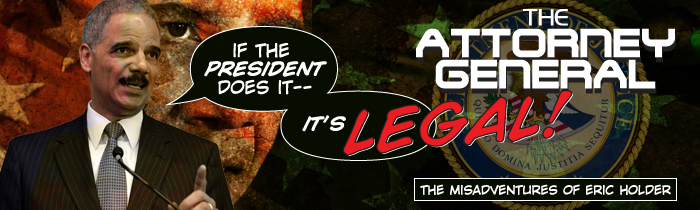
Clearly, it’s not the Constitution that Eric Holder is safeguarding but the power of the presidency. Without a doubt, Holder has taken as his mantra Nixon’s mantra that “When the President does it, that means it is not illegal.” It may be that the time has come to create a “non-political” and “independent” Attorney General, one who would serve the interests of the public by upholding the rule of law rather than justifying the whims of the President. — John W. Whitehead

Warning that a texting law approved by the Virginia General Assembly is vague and overly broad and has been drafted in such a way as to give police officers leeway to carry out fishing expeditions on drivers’ cell phones, thereby opening the floodgates to a broad range of civil liberties violations, The Rutherford Institute is asking Governor McDonnell not to sign the legislation. House Bill 1907 allows police officers to pull over anyone suspected of texting or reading emails or text messages while driving. However, as I pointed out in a letter to McDonnell, any marginal safety benefits gained by passage of this law will be wholly eclipsed by the threats it poses to critical Fourth Amendment rights.

If the General Assembly wishes to discourage dangerous driving habits, they must do so in a manner that does not run afoul of the Constitution. In an age in which police officers have shown themselves to be increasingly aggressive and willing to discard Fourth Amendment prohibitions on unreasonable searches and seizures, even going so far as to perform invasive roadside cavity searches on female travelers without any probable cause of wrongdoing, this legislation renders the Fourth Amendment null and void and leaves Virginia drivers with virtually no civil liberties protection.

House Bill 1907, passed by both houses of the General Assembly and now before Governor McDonnell for his signature, allows police officers to stop and arrest drivers whom they suspect are engaging in texting or reading emails and/or text messages while driving. The law also makes texting while driving a primary offense and levies a $250 fine for the first offense and $500 fines for any offenses thereafter. Under current law, although texting while driving is illegal, it is a secondary offense, meaning police cannot pull you over simply for texting. Cautioning the governor against signing the bill into law, Rutherford Institute attorneys warn that the broad language of the law places far-reaching powers in the hands of law enforcement agents, and any marginal safety benefits gained by passage of the law will be wholly eclipsed by the threats it poses to critical Fourth Amendment rights. Paramount among the Institute’s concerns are that it expands police powers to search individuals’ private property without a warrant, does away with the need for probable cause, and fails to provide police with adequate standards for determining whether there is sufficient cause to believe a driver is texting as opposed to numerous other activities that are not a basis for a stop of the vehicle, among other things.

Specifically, I pointed out that HB 1907 contains insufficient enforcement standards to ensure that officers are not empowered to stop drivers who are not, in fact, using handheld devices while driving.  Additionally, the legislation will presumably justify an officer’s intrusive search of a citizen’s private cell phone if the officer alleges that he or she witnessed the citizen texting while driving. And finally, the bill contains an unjustifiable, blanket exemption for law enforcement officers, which undermines the legislation’s putative purpose of protecting the public. Institute attorneys advise that until the General Assembly is able to identify and articulate clear standards to guide police in enforcing a no-texting-while-driving law, McDonnell should refuse to sanction an approach that places fundamental civil rights at the mercy of government officials. — John W. Whitehead

Click here to read The Rutherford Institute’s letter to Virginia Governor Bob McDonnell.