“The shaping of the will of Congress and the choosing of the American president has become a privilege reserved to the country’s equestrian classes, a.k.a. the 20% of the population that holds 93% of the wealth, the happy few who run the corporations and the banks, own and operate the news and entertainment media, compose the laws and govern the universities, control the philanthropic foundations, the policy institutes, the casinos, and the sports arenas.” – Journalist Lewis Lapham
The pomp and circumstance of the presidential inauguration has died down. Members of Congress have taken their seats on Capitol Hill, and Barack Obama has reclaimed his seat in the White House. The circus of the presidential election has become a faint memory. The long months of debates, rallies, and political advertisements have slipped from our consciousness. Now we are left with the feeling that nothing has really changed, nor will it.
This is not by accident. The media circus leading up to the elections, the name calling in the halls of Congress, the vitriol and barbs traded back and forth among people who are supposed to be working together to improve the country, are all components of the game set up by those who run the show. The movers and shakers behind these engaging, but ultimately trite, political exercises are the elite, the so-called upper class, who benefit from the status quo. This status quo is marked by an economic crisis with no end in sight, by the slow but steady growth of a police state aimed at the lowest rungs of society, and a political circus which keeps us enraptured long enough that we don’t question what’s really going on.
Meanwhile, this elite, composed of corporations profiting off of our ignorance, avoid being brought to task for their destruction of democratic governance and the economy. These are the corporations who sent our economy into a tail spin and were then rewarded with taxpayer money. These are the corporations who write laws which eliminate real competition in the market in order to secure their profits through lucrative government contracts. These are the corporations who avoid criminal prosecution, and are instead slapped with meager fines which do nothing to halt their felonious activities.
We now live in a two-tiered system of justice and governance. There are two sets of laws: one set for the government and the corporations, and another set for you and me.
The laws which apply to the majority of the population allow the government to do things like rectally probe you during a roadside stop, or listen in on your phone calls and read all of your email messages, or indefinitely detain you in a military holding cell. These are the laws which are executed every single day against a population which has up until now been blissfully ignorant of the radical shift taking place in American government.
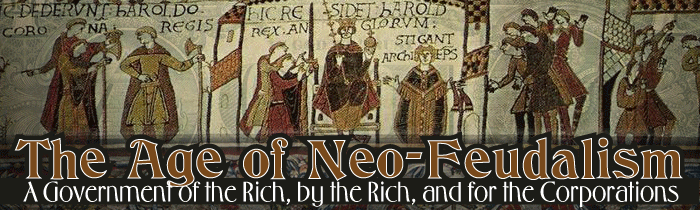
Then there are the laws constructed for the elite, which allow bankers who crash the economy to walk free. They’re the laws which allow police officers to avoid prosecution when they strip search non-violent criminals, or taser pregnant women on the side of the road, or pepper spray peaceful protestors. These are the laws of the new age we are entering, an age of neo-feudalism, in which corporate-state rulers dominate the rest of us, where the elite create the laws which can result in a person being jailed for possessing marijuana while bankers that launder money for drug cartels walk free.
Unfortunately, this two-tiered system of justice has been a long time coming. The march toward an imperial presidency, to congressional intransigence and impotence, to a corporate takeover of the mechanisms of government, and the division of America into haves and have nots has been building for years.
Journalist Chris Hedges, one of the few voices to speak against the corporate-state, who has put himself on the line by making a legal challenge to the President’s authority to indefinitely detain American citizens, summarizes the situation at hand:
“Our passivity has resulted… in much more than imperial adventurism and a permanent underclass. A slow-motion coup by a corporate state has cemented into place a neofeudalism in which there are only masters and serfs. And the process is one that cannot be reversed through the traditional mechanisms of electoral politics.”
Indeed, electoral politics are off the table as a means of reforming the system. They are so thoroughly corrupted by corporate money that there is no chance, even for a well-meaning person, to affect any real change through Congress.
Just consider the last election cycle. Both parties spent $1 billion each attempting to get their candidate elected to the presidency. This money came from rich donors and corporate sponsors, intent on getting their candidate in office. This massive spending was mirrored at the congressional level, where business lobbying soared in the last three months of the year. The U.S. Chamber of Commerce alone spent over $125 million attempting to influence members of Congress, an 88 percent increase from 2011.
Indeed, lobbyists are the source of much corruption and exchanging of money in Washington, and their attempts to woo Congressmen only exacerbate the problems inherent to the institution. Jack Abramoff should know. Jailed for bribing public officials, the former lobbyist insists that the system is every bit as corrupt now as it was when he was convicted. From job offers for staffers and Congressmen after they leave Capitol Hill, to taking representatives to sporting events and fancy restaurants, there is no shortage of methods of influencing public officials to enact the policies of special interests. According to Abramoff, these tactics are still in use today, and “the system hasn’t been cleaned up at all.”
Once their foot is in the door, these lobbyists then offer up language for legislation that is “so obscure, so confusing, so uninformative, but so precise” as to make passage as easy as possible. This legislation cements the privilege of the corporations to do as they please, making all of their dubious activities “legal.”
This lobbying is buoyed by a congressional lifestyle which demands that our representatives spend the majority of their time fund raising for campaigns, rather than responding to the needs of their constituents. In November 2012, the Democratic House leadership offered a model daily schedule to newly elected Democrats which suggests a ten-hour day, five hours of which are dominated by “call time” and “strategic outreach,” including fund raisers and correspondence with potential donors. Three or four hours are for actually doing the job they were elected to do, such as attending committee meetings, voting on legislation, and interacting with constituents.
When half of one’s time is devoted to asking for money from rich individuals and special interests, there is no way that he can respond to the problems which pervade the country. And yet, even Congressmen in safe seats are expected to fundraise constantly so as to support their colleagues in competitive districts. As Rep. John Larson (D-Conn.) put it, “…this is the mother’s milk of what [Congressmen] need to do to try to sustain their campaigns, and it’s the only system they have to work with.”
Thus, even well-meaning Congressmen face a Catch-22 where they are pushed to fundraise to secure their seats, but then once in office, it is basically impossible for them to do their jobs. The full ramifications of this are laid out by Rep. Brad Miller (D-NC):
“Any member who follows that schedule will be completely controlled by their staff, handed statements that their staff prepared, speaking from talking points they get emailed from leadership… It really does affect how members of Congress behave if the most important thing they think about is fundraising. You end up being nice to people that probably somebody needs to be questioning skeptically… You won’t ask tough questions in hearings that might displease potential contributors, won’t support amendments that might anger them, will tend to vote the way contributors want you to vote.”
The influence of corporate money on Congress is exacerbated by how out of touch Congressmen are with the daily struggles of most Americans. In February 2012, the median net worth of Congressmen was $913,000 as compared to $100,000 for the rest of the population. Aside from being immediately wealthy, Congressmen also weathered the tribulations of the financial crisis much better than the average American. An analysis of Congressional finances by theWashington Post in October 2012 revealed that the wealthiest one-third of Congress was largely shielded from the effects of the Great Recession. While the median household net worth of the average American dropped by 39 percent between 2007 and 2010, the median wealth of Congressmen rose 5 percent. It rose 14 percent for the wealthiest one-third.
At a time when most people in the country are suffering, Congressmen are profiting. This alone should demonstrate how out of touch our elected leaders have become. Members of Congress, entrusted to represent the best interests of the average American, instead play out a stilted, ineffective soap opera on our TV screens, complete with phony discussions of fiscal cliffs and debt ceilings which take the place of real proposals for meaningful change in the country.
There is no voice for the working American in the halls of Congress, the American who was promised a life beyond taxes, debt, and unemployment. There is no voice for the peace loving American, the American who understands that America’s military might is meant for defense of the homeland, not looking for trouble in faraway lands. There is no voice for the American who expects his representatives to abide by the Constitution, who laments the way Congress, the President, and the Supreme Court work together to take away our rights piece by piece. — John W. Whitehead


