“I never thought I would see the day when a Justice Department would claim that only the most extreme infliction of pain and physical abuse constitutes torture and that acts that are merely cruel, inhuman and degrading are consistent with United States law and policy, that the Supreme Court would have to order the president of the United States to treat detainees in accordance with the Geneva Convention, never thought that I would see that a president would act in direct defiance of federal law by authorizing warrantless NSA surveillance of American citizens. This disrespect for the rule of law is not only wrong, it is destructive.”—Eric Holder, June 2008 speech to the American Constitution Society
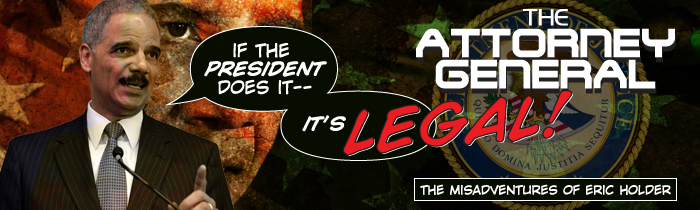
Since the early days of our republic, the Attorney General (AG) of the United States has served as the chief lawyer for the government, entrusted with ensuring that the nation’s laws are faithfully carried out and holding government officials accountable to abiding by their oaths of office to “uphold and defend the Constitution.”

Unfortunately, far from holding government officials accountable to abiding by the rule of law, the attorneys general of each successive administration have increasingly aided and abetted the Executive Branch in skirting and, more often than not, flouting the law altogether, justifying all manner of civil liberties and human rights violations and trampling the Constitution in the process, particularly the Fourth Amendment.

No better example is there of the perversion of the office of the AG than its current occupant Eric Holder, who was appointed by President Obama in 2009. Hailed by civil liberties and watchdog groups alike for his pledge to “reverse the disastrous course that we have been on over the past few years” and usher in a new era of civil liberties under Obama, Holder has instead carried on the sorry tradition of his predecessors, going to great lengths to “justify” egregious government actions that can only be described as immoral, unjust and illegal.

Indeed, Holder has managed to eclipse both John Ashcroft and Alberto Gonzalez, whose tenures under George W. Bush earned them constant reproach by Democrats and other left-leaning groups for justifying acts of torture, surveillance of American citizens and clandestine behavior by the government. Holder, however, has largely been given a free pass by these very same groups in much the same way that Obama has. The reason, according to former Senate investigator Paul D. Thacker, is that “Obama is a Democrat. And because he is a Democrat, he’s gotten a pass from many of the civil liberty and good-government groups who spent years watching President Bush’s every move like a hawk.”

Despite getting a “pass” from those who would normally have been crying foul, during his time as attorney general, Holder has “made the Constitution scream”—that according to one of his detractors. The colorful description is apt. Some of the Justice Department’s (DOJ) “greatest hits” under Holder begin and end with his stalwart defense of the Obama administration’s growing powers, coming as they do at the expense of the Constitution.

Moreover, as head of the DOJ, Holder’s domain is vast, spanning several law enforcement agencies, including the United States Marshals Service; FBI; Federal Bureau of Prisons; National Institute of Corrections; Bureau of Alcohol, Tobacco, Firearms and Explosives; Drug Enforcement Administration; and Office of the Inspector General (OIG), as well as the U.S. National Central Bureau for INTERPOL. To say that the agencies under Holder have struggled to abide by the rule of law is an understatement.

The following are just some of the highlights of the dangerous philosophies embraced and advanced by Holder and his Justice Department.

The military can detain anyone, including American citizens, it deems a threat to the country. Not only has the DOJ persisted in defending a provision of the National Defense Authorization Act that sanctions indefinite detentions of Americans, but it has also blasted the federal judge who ruled the NDAA to be vague and chilling as overstepping the court’s authority and infringing on Obama’s power to act as Commander in Chief.

Presidential kill lists and drone killings are fine as long as the president thinks someone might have terrorist connections. Holder has gone to great lengths to defend Obama’s use of drones to target and kill American citizens, even on U.S. soil, as legally justifiable. In fact, a leaked DOJ memo suggests that the President has the power to murder any American citizen the world over, so long as he has a feeling that they might, at some point in the future, pose a threat to the United States.

The federal government has the right to seize the private property—cash, real estate, cars and other assets—of those suspected of being “connected” to criminal activity, whether or not the suspect is actually guilty. The government actually collects billions of dollars every year through this asset-forfeiture system, which it frequently divvies up with local law enforcement officials, a practice fully supported by the DOJ and a clear incentive for the government to carry out more of these “takings.”

Warrantless electronic surveillance of Americans’ telephone, email and Facebook accounts is not only permissible but legal. According to court documents, more Americans have had their electronic communications spied on as a result of DOJ orders for phone, email and Internet information—40,000 people alone in 2011—and that doesn’t even begin to take into account agencies outside Holder’s purview, terrorism investigations or requests by state and local law enforcement officials.

Judicial review is far from necessary. Moreover, while it is legal for the government to use National Security Letters (NSL) to get detailed information on Americans’ finances and communications without oversight from a judge, it is illegal to challenge the authority of the Justice Department. Administrative subpoenas or NSLs—convenient substitutes for court-sanctioned warrants that require only a government official’s signature in order to force virtually all businesses to hand over sensitive customer information—have become a popular method of bypassing the Fourth Amendment and a vital tool for the DOJ’s various agencies. Incredibly, the DOJ actually sued a telecommunications company for daring to challenge the FBI’s secret order, lacking in judicial oversight, that it relinquish information about its customers. The FBI alone has issued more than 300,000 NSLs since 2000.

Due process and judicial process are not the same. In one of his earliest attempts to justify targeted assassinations of American citizens by the president, Holder declared in a March 5, 2012 speech at the Northwestern University School of Law that “The Constitution guarantees due process, not judicial process.” What Holder was attempting to suggest is that the Fifth Amendment’s assurance that “No person shall be deprived of life, liberty, or property without due process of law” does not necessarily involve having one’s day in court and all that that entails—it simply means that someone, the president for example, should review and be satisfied by the facts before ordering someone’s death. As one history professor warned, “Insert even a sliver of difference between due process and judicial process, and you convert liberty into tyranny. Holder, sworn to uphold the laws of the United States, is the mouthpiece of that tyranny, and Obama is its self-appointed judge, jury and executioner.”

Government whistleblowers will be bankrupted, blacklisted, blackballed and in some cases banished. As AG, Holder has reportedly prosecuted more government officials for alleged leaks than all his predecessors combined. Relying on the World War I-era Espionage Act, the DOJ has launched an all-out campaign to roust out, prosecute, and imprison government whistleblowers for exposing government corruption, incompetence, and greed. Intelligence analyst Bradley Manning is merely one in a long line of so-called “enemies of the state” to feel the Obama administration’s wrath for daring to publicly criticize its policies by leaking information to the media.

Government transparency is important unless government officials are busy, can stonewall, redact, obfuscate or lie about the details, are able to make the case that they are exempt from disclosure or that it interferes with national security. AsSlate reports, “President Obama promised transparency and open government. He failed miserably.” Not only has Holder proven to be far less transparent than any of his predecessors, however, but his DOJ has done everything in its power to block access to information, even in matters where that information was already known. For example, when asked to explain the “Fast and Furious” debacle in which government operatives trafficked guns to Mexican drug lords, DOJ officials—unaware that much of the facts had already been revealed—“responded with false and misleading information that violated federal law.” When pressed for further information, the Justice Department retracted its initial response and refused to say anything more.

When it comes to Wall Street, justice is not blind. As revealed in a PBS Frontline report, the Obama administration has driven federal prosecutions of financial crimes down to a two-decade low, buoyed in its blindness to corporate corruption by campaign donations from Wall Street banks (whom Holder has determined are too big to prosecute anyhow) and staffers whose lucrative financial portfolios came about as a result of chummy relationships with financiers. As David Sirota points outs:

After watching the [PBS] piece, you will understand that the word “justice” belongs in quotes thanks to an Obama administration that has made a mockery of the name of a once hallowed executive department… Rooted in historical comparison, it contrasts how the Reagan administration prosecuted thousands of bankers after the now-quaint-looking S&L scandal with how the Obama administration betrayed the president’s explicit promise to “hold Wall Street accountable” and refused to prosecute a single banker connected to 2008′s apocalyptic financial meltdown.

Not all suspects should have the right to remain silent. In 2010, Holder began floating the idea that Miranda rights—which require that a suspect be informed of his right to remain silent—should be modified depending on the circumstances. Curiously, the Supreme Court is presently reviewing a case addressing a similar question, namely whether a suspect’s silence equates to an admission of guilt.

Clearly, it’s not the Constitution that Eric Holder is safeguarding but the power of the presidency. Without a doubt, Holder has taken as his mantra Nixon’s mantra that “When the President does it, that means it is not illegal.” It may be that the time has come to create a “non-political” and “independent” Attorney General, one who would serve the interests of the public by upholding the rule of law rather than justifying the whims of the President. — John W. Whitehead

My new vodcast on the government’s war  against Bradley Manning and all those who speak out against injustice, corruption and war. — John W. Whitehead

The right to remain silent when being questioned by the police is an essential element of liberty. If government agents are allowed to use silence in the face of accusatory questions as a sign of guilt, then the burden of proof will have been shifted to the suspect to prove his innocence, hearkening back to the days of the Salem Witch Trials and McCarthyism.

This essential right to not incriminate oneself is at the heart of Salinas v. Texas, a case before the U.S. Supreme Court. The Rutherford Institute has asked the Court to affirm the right of criminal suspects to remain silent during interactions with police by prohibiting prosecutors from using a suspect’s pre-arrest silence as proof of his guilt during a criminal trial.

The facts of the case are as follows:

In 1992, Juan and Hector Garza were found murdered in their apartment. Genovevo Salinas, an acquaintance of the men who had been at a party with them the evening before they were found dead, was suspected by police as being responsible for the murders. The police approached Salinas at his home and asked him to accompany them to the police station so they could question him and clear his name. Salinas was never handcuffed and was not given Miranda warnings. At the police station, Salinas was taken to an interview room where, during the course of the interview, police questioning became more accusatory, and Salinas was asked whether his father’s shotgun “would match the shells recovered at the scene of the murder.” Salinas remained silent and did not answer the question. The interview proceeded.  At the conclusion of the interview, police arrested Salinas for outstanding traffic fines.  The district attorney later charged Salinas with the murders, but police were unable to arrest Salinas on the murder charge until 2007. After the first trial resulted in a hung jury, Salinas was re-tried. During the second trial, the prosecutor suggested that Salinas’ silence during the police interview prior to his arrest was a “very important piece of evidence” and that only a guilty person would have remained silent when questioned about his connection to a crime. The jury found Salinas guilty of murder and sentenced him to twenty years in prison.

In appealing the verdict to the Texas Court of Appeals, Salinas argued that the prosecution’s emphasis on his pre-arrest silence as evidence of his guilt was a violation of the Fifth Amendment’s guarantee against self-incrimination. Two Texas appeals courts upheld the verdict, ruling that Salinas was not under government compulsion during the time of the police interview, thus he had no Fifth Amendment right to remain silent.

In asking the U.S. Supreme Court to overturn the lower court’s ruling, The Rutherford Institute is asking the Court to affirm that under the Fifth Amendment, a person cannot be compelled to be a witness against himself, whether by being forced to testify, or by using his silence as evidence of his guilt. In keeping with the Fifth Amendment’s guarantee that “[n]o person… shall be compelled in any criminal case to be a witness against himself,” Institute attorneys are urging the Court to reverse the conviction of Genovevo Salinas, who was found guilty of homicide after prosecutors argued that Salinas’ silence during a police interview prior to his arrest was a “very important piece of evidence” and that only a guilty person would have remained silent when questioned about his connection to a crime. A jury found Salinas guilty of murder and he was sentenced to twenty years in prison.

In their “friend of the court” brief, Institute attorneys argue that a person’s refusal to answer police questions, even before arrest and before Miranda warnings are given, does not indicate guilt in light of the well-known “right to remain silent.” — John W. Whitehead

Click here to read The Rutherford Institute’s amicus brief in Salinas v. Texas

“The war against Bradley Manning is a war against us all.”—Chris Hedges, author and journalist

“I wanted the American public to know that not everyone in Iraq and Afghanistan are targets that needed to be neutralized, but rather people who were struggling to live in the pressure cooker environment of what we call asymmetric warfare.”—Bradley Manning

Time and again, throughout America’s history, individuals with a passion for truth and a commitment to justice have opted to defy the unjust laws and practices of the American government in order to speak up against slavery, segregation, discrimination, and war. Even when their personal safety and freedom were on the line, these individuals spoke up, knowing they would be chastised, ridiculed, arrested, branded traitors and even killed.

Indeed, while brave men and women such as Martin Luther King, Jr., Henry David Thoreau, Susan B. Anthony and Harriet Tubman are lauded as American heroes today, they were once considered enemies of the state.

Thanks to the U.S. government’s growing intolerance for dissidents who insist on transparency and accountability, oppose its endless wars and targeted killings of innocent civilians and terrorists alike, and demand that government officials abide by the rule of law, that list of so-called “enemies of the state” is growing.

One such “enemy of the state” is Bradley Manning, an intelligence analyst who has been targeted by the Obama administration for holding up a mirror to the bloated face of American empire. Manning is being prosecuted for leaking classified government documents which, like the Pentagon Papers a generation ago, expose systemic corruption within America’s military and diplomatic apparatus. The embarrassment caused by showing that the emperor has no clothes, as it were, has made Bradley Manning public enemy number one in the eyes of the federal government. 

As Chris Hedges explains:

“Manning provided to the public the most important window into the inner workings of imperial power since the release of the Pentagon Papers. The routine use of torture, the detention of Iraqis who were innocent, the inhuman conditions within our secret detention facilities, the use of State Department officials as spies in the United Nations, the collusion with corporations to keep wages low in developing countries such as Haiti, and specific war crimes such as the missile strike on a house that killed seven children in Afghanistan would have remained hidden without Manning.”

Despite not being convicted of any crime, Manning has been put through a horror trip since the first day of his incarceration in the military brig at Quantico. He has spent 1,000 days in jail without trial, a large portion of which was passed in solitary confinement, imprisoned in a windowless 6 x 12 foot cell containing a bed, a drinking fountain and a toilet. Manning was kept under Suicide and/or Prevention of Injury (POI) watch during his incarceration, largely against the advice of two forensic psychiatrists. Under suicide watch, Manning was confined to his tiny cell for 24 hours a day and stripped of all clothing with the exception of his underwear. His prescription eyeglasses were taken away, leaving him in essential blindness except for those limited times when he was permitted to read or watch television. In a thinly veiled attempt to harass him, guards would check on Manning every five minutes, asking if he was ok.

Once he was finally brought before a military court, Manning pled guilty to ten of the twenty-two charges brought against him, admitting that he leaked the documents because he believed that the public has a right to know about the government’s misdeeds. Manning’s admission guarantees that he will be put into prison for up to twenty years. However, instead of proceeding to sentencing, government prosecutors are insisting on pressing the most serious charges against him, including “aiding the enemy,” in an attempt to imprison him for life.

The government’s aim is clear: to make an example of Manning (what Yale professor Eugene Fidell describes as an attempt to “scare the daylights out of other people”), thereby discouraging anyone else from defying the regime or daring to lay bare the inner workings of a corrupt government.

Indeed, despite promising unprecedented levels of transparency when he ascended to the presidency in 2009, Obama has invoked the WWI-era Espionage Act more times than all his predecessors combined as a means of silencing all internal dissent and criticism. Obama’s administration has also launched an all-out campaign to roust out, prosecute, and imprison government whistleblowers for exposing government corruption, incompetence, and greed. Obama’s other targets include John Kiriakou, a CIA agent who was prosecuted and imprisoned for blowing the whistle on government-sponsored torture, and Peter Van Buren, who exposed the government’s incompetence and failures during the occupation of Iraq.

Thus, Bradley Manning is merely the latest whistleblower to be singled out for punishment. So determined is the government to crucify Manning that government prosecutors plan to make the case that Manning essentially aided and abetted Osama bin Laden. Manning’s trial, which promises to be a government spectacle of manufactured “shock and awe,” will feature testimony from an anonymous Navy Seal who took part in the raid on Osama bin Laden’s Abbottabad compound. This Seal will reportedly testify that he recovered computer discs in Osama bin Laden’s personal effects containing government material that originated from Manning’s leak.

What the government is attempting to suggest is that if an individual or news organization publishes information that is accessed by terrorists over the internet, for example, then those individuals or news organizations are essentially guilty of collusion.

Stacking the odds in their favor, government prosecutors have refused to allow Manning’s defense team to interview government witnesses or to introduce evidence showing that Manning’s leak of government information did little, if any, harm to U.S. interests other than showing that the Obama administration is no different from its predecessors. In fact, Defense Secretary Robert Gates said that the publication of the Iraq War Logs and the Afghan War Diary had “not revealed any sensitive intelligence sources or methods.” As for the leak of some 250,000 State Department documents, a report by Reuters indicates that the damage caused was “limited,” and was for the most part simply an embarrassment to the Obama administration.

Manning reacted as one would hope any honorable American would react when they witness their government acting in a manner that is corrupt, incompetent, inhumane, immoral and, it must be said, downright evil. Manning was particularly affected by the so-called “Collateral Murder” video in which American Apache helicopter pilots can be see firing on civilians in Iraq, including children and a Reuters journalist. “The people in the van were not a threat but merely ‘good Samaritans,’” observed Manning. “The most alarming aspect of the video to me, however, was the seemly delightful bloodlust [the American troops] appeared to have.”

To his credit, Manning refused to remain silent. He spoke out, first to his superiors, who turned a deaf ear to his concerns, then to the New York Times and Washington Post. When he still could find no one willing to alert the American people to what their government was really doing in Iraq, Afghanistan, and elsewhere, he turned to Wikileaks.

The rest, as they say, is history. — John W. Whitehead

Warning that a texting law approved by the Virginia General Assembly is vague and overly broad and has been drafted in such a way as to give police officers leeway to carry out fishing expeditions on drivers’ cell phones, thereby opening the floodgates to a broad range of civil liberties violations, The Rutherford Institute is asking Governor McDonnell not to sign the legislation. House Bill 1907 allows police officers to pull over anyone suspected of texting or reading emails or text messages while driving. However, as I pointed out in a letter to McDonnell, any marginal safety benefits gained by passage of this law will be wholly eclipsed by the threats it poses to critical Fourth Amendment rights.

If the General Assembly wishes to discourage dangerous driving habits, they must do so in a manner that does not run afoul of the Constitution. In an age in which police officers have shown themselves to be increasingly aggressive and willing to discard Fourth Amendment prohibitions on unreasonable searches and seizures, even going so far as to perform invasive roadside cavity searches on female travelers without any probable cause of wrongdoing, this legislation renders the Fourth Amendment null and void and leaves Virginia drivers with virtually no civil liberties protection.

House Bill 1907, passed by both houses of the General Assembly and now before Governor McDonnell for his signature, allows police officers to stop and arrest drivers whom they suspect are engaging in texting or reading emails and/or text messages while driving. The law also makes texting while driving a primary offense and levies a $250 fine for the first offense and $500 fines for any offenses thereafter. Under current law, although texting while driving is illegal, it is a secondary offense, meaning police cannot pull you over simply for texting. Cautioning the governor against signing the bill into law, Rutherford Institute attorneys warn that the broad language of the law places far-reaching powers in the hands of law enforcement agents, and any marginal safety benefits gained by passage of the law will be wholly eclipsed by the threats it poses to critical Fourth Amendment rights. Paramount among the Institute’s concerns are that it expands police powers to search individuals’ private property without a warrant, does away with the need for probable cause, and fails to provide police with adequate standards for determining whether there is sufficient cause to believe a driver is texting as opposed to numerous other activities that are not a basis for a stop of the vehicle, among other things.

Specifically, I pointed out that HB 1907 contains insufficient enforcement standards to ensure that officers are not empowered to stop drivers who are not, in fact, using handheld devices while driving.  Additionally, the legislation will presumably justify an officer’s intrusive search of a citizen’s private cell phone if the officer alleges that he or she witnessed the citizen texting while driving. And finally, the bill contains an unjustifiable, blanket exemption for law enforcement officers, which undermines the legislation’s putative purpose of protecting the public. Institute attorneys advise that until the General Assembly is able to identify and articulate clear standards to guide police in enforcing a no-texting-while-driving law, McDonnell should refuse to sanction an approach that places fundamental civil rights at the mercy of government officials. — John W. Whitehead

Click here to read The Rutherford Institute’s letter to Virginia Governor Bob McDonnell.

Random, suspicionless lockdown raids against children teach our children a horrific lesson—one that goes against every fundamental principle this country was founded upon—that we have no rights at all against the police state. Americans should be outraged over the fact that school officials are not only defending such clearly unconstitutional practices but are actually going so far as to insist that these raids are a “standard drill” that will continue. Making matters worse, the courts are actually affirming this dangerous mindset.

For example, in a ruling issued by the U.S. Court of Appeals for the Eighth Circuit in Burlison vSpringfield Public Schools, the court deemed a Missouri school district’s policy of imposing a “lockdown” of the school for the purpose of allowing the local sheriff’s department, aided by drug-sniffing dogs, to perform mass inspections of students’ belongings to be a “reasonable procedure to maintain the safety and security of students at the school,” and not a violation of the Fourth Amendment rights of students.

Attorneys for The Rutherford Institute had challenged the school district’s practice of conducting random lockdowns and mass searches of students. Institute attorneys had asked the appeals court to reverse a federal district court’s January 2012 ruling that Springfield Public Schools and the Greene County Sheriff’s Office did not violate the Fourth Amendment rights of students when they executed the April 2010 lockdown at Central High School.

On April 22, 2010, the principal of Central High School announced over the public address system that the school was going into “lockdown” and that students were prohibited from leaving their classrooms. School officials and agents of the Greene County Sheriff’s Department thereafter ordered students to leave all personal belongings behind and exit the classrooms. Dogs were also brought in to assist in the raid. Upon re-entering the classrooms, students allegedly discovered that their belongings had been rummaged through. Mellony and Doug Burlison, who had two children attending Central High School, complained to school officials that the lockdown and search were a violation of their children’s rights. School officials allegedly responded by insisting that the search was a “standard drill” and policy of the school district which would continue.

Attorneys for The Rutherford Institute sued the school district in September 2010 on behalf of the Burlisons and their two children, asking the U.S. District Court for the Western District of Missouri to declare that the practice of effecting a lockdown of the school and conducting random, suspicionless seizures and searches violates the Fourth Amendment to the U.S. Constitution and the similar provision of the Missouri Constitution. In its January 2012 decision, the district court declared that the random lockdown and mass searches did not violate students’ rights. In its ruling issued March 4, 2013, the Court of Appeals affirmed the judgment, holding that the school’s interest in combatting drug use outweighed the privacy rights of students.

More info on Burlison vSpringfield Public Schools at The Rutherford Institute’s website.

We are now five years out from the worst financial crisis in modern history, and still the yoke around the neck of the average American seems to tighten with every new tax, fine, fee and law adopted by our so-called representatives. Meanwhile, the three branches of government (Executive, Legislative and Judicial) and the agencies under their command—Defense, Commerce, Education, Homeland Security, Justice, Treasury, etc.—have switched their allegiance to the Corporate State with its unassailable pursuit of profit at all costs and by any means possible.

As a result, we are now ruled by a government consumed with squeezing every last penny out of the population and seemingly unconcerned if essential freedoms are trampled in the process. This profits-over-people mindset has taken various forms in recent years, ranging from the rise of privatized, for-profit prisons which require the states to keep their jails full to capacity to the overcriminalization phenomenon which has subjected Americans to a slew of inane laws that outlaw such innocuous activities as making and selling unpasteurized goat cheese, cultivating certain types of orchids, and feeding a whale. Included in the mix are the preponderance of red light cameras, sold to communities as a means of minimizing traffic accidents at intersections but in fact are just a vehicle for levying nuisance fines against drivers often guilty of little more than making a right-hand turn on a red light.

The most recent ploy to separate taxpayers from their hard-earned dollars and render them criminals comes in the form of school truancy laws. Disguised as well-meaning attempts to resolve attendance issues in the schools, these truancy laws are nothing less than stealth maneuvers aimed at enriching school districts and court systems alike through excessive fines and jail sentences, while the ones being singled out for punishment—more often than not from middle- to low-income families—are the very ones who can least afford it.

Instead of giving students detention or some other in-school punishment for “unauthorized” absences, schools are now opting to fine parents and force them or their kids to serve jail time.

Under this increasingly popular system of truancy enforcement, instead of giving students detention or some other in-school punishment for “unauthorized” absences, schools are now opting to fine parents and force them or their kids to serve jail time. (“Unauthorized” is the key word here, of course, since schools retain the right to determine whether an absence sanctioned by a parent or even a doctor is acceptable.)

For example, California students are ticketed for missing or being late to school. One ticket for tardiness can cost a family $250. Tardiness is a particular problem in Los Angeles, where the city’s poor transit infrastructure and overcrowded buses often leave student passengers stranded at the bus stops. According to the Los Angeles Bus Riders Union, 12,000 students received tickets for truancy in Los Angeles in 2008. Of those students, about 80% received tickets simply for being late to school. In order to avoid a $250 ticket, some parents from low-income households go so far as to keep their children home from school if there is any chance they will be late. As Barbara Ehrenreich, writing for the New York Times, points out, “it’s an ingenious anti-truancy policy that discourages parents from sending their youngsters to school.”

In 2011, more than 400 parents in Baltimore City were brought up on truancy charges because their children had missed more than 15 days of school, while a dozen parents were sentenced to jail. One mother of four school-aged children, Barbara Gaskins, was jailed for 10 days (served on five consecutive weekends) after her son allegedly missed 103 out of 130 days of school. Her son insists he was in school but wasn’t marked present.

Parents in Florida can be charged with a second-degree misdemeanor and face up to two months in jail if their kids have 15 or more unexcused absences from school over the course of three months. Truancy laws in Alabama, Texas, and North Carolina, among other states, have also resulted in parents doing jail time for their kids’ absenteeism.

As problematic as it may be for states to levy excessive fines and jail time on families that, in many cases, are already struggling to make ends meet and stay together, it’s the motives behind these programs that are particularly troubling. Much like the profit incentives behind privatized prisons and red light traffic cameras, there are also profit motives driving most of the states that are pushing for stricter truancy laws and establishing truancy courts for those parents and students unlucky enough to run afoul of them. Those profit motives range from state funding in exchange for proof of higher school attendance (a clear factor behind the rapid adoption of RFID tracking badges in certain Houston schools), to increased revenue from fines and more bodies in the jails.

Consider, for example, the case of Diane Tran, a 17-year-old honor student. She was sent to jail for 24 hours and forced to pay a $100 fine for breaking Texas’ truancy laws, which define truancy as “missing three full or partial days in a four-week period, or 10 days in six months.” Tran, who had been helping support her family by working two jobs on top of her strenuous schoolwork, was shown no mercy by the court. Unfortunately, Tran’s case is standard operating procedure throughout the United States as more and more states and localities make truancy enforcement a high priority.

In Texas, where schools have taken truancy enforcement to extreme lengths in an effort to qualify for state funds based upon having the highest attendance rates possible, truancy cases ballooned from 85,000 incidents to 120,000 between 2005 and 2009. More truancy cases mean increased profits for truancy courts, which function much like traffic court, and hefty profits for the state. Dallas courts, for example, pull in roughly $2 million from prosecuting 35,000 truancy cases per year. As Deborah Fowler, deputy director of the legal advocacy group Texas Appleseed, has noted, “They’ve developed a whole system in Dallas that has to feed itself to justify its existence.” The targets, of course, are school children and their families.

Unfortunately, these money rackets posing as courts of law are not unique to any one state. In Lebanon, Pennsylvania, the school district filed 8,000 truancy violations between 2005 and 2010, collecting $1.3 million in fines. The district is currently facing a class-action lawsuit from parents subjected to fines far in excess of the $300 limit set out by state law. One plaintiff, single parent Omary Rodriguez-Fuentes, received 29 truancy tickets over three years, totaling almost $7,000. Incredibly, in an attempt to pay off the fines, Rodriguez-Fuentes had to resort to using revenue from his monthly disability checks.

As illustrated by Rodriguez-Fuentes’ case, truancy laws tend to be applied most vigorously against the most defenseless members of society, punishing those who need the most help in continuing their education with little regard for the root causes of absenteeism, which tend to be family problems, financial issues, mental illness, and simply being sick. For example, a judge in Rhode Island threatened a 13-year-old student suffering from sickle-cell anemia and his mother with arrest and jail time. The student had been missing school due to extreme bouts of pain. In fact, he was ordered to attend school on a particular day in February 2010. Once there, however, the school had to call an ambulance because of his critical condition.

Truancy laws have gotten so absurd that adults are even being put in detention facilities for skipping school when they were children. For example, Francisco de Luna, an 18-year-old who racked up $11,000 in truancy fines over the course of five years, was sentenced to 132 days in jail. De Luna’s truancy was related to the death of his father at age 13, at which point his family’s finances and his own mental health faced a steep decline and he ended up dropping out of school.

Elizabeth Diaz, also 18 years old, received 18 days in jail for failure to pay $1,600 in fines imposed on her when she was 14 years old. Diaz’s past truancy was related to health problems—bipolar disorder and fibromyalgia. Diaz was set to graduate on time until she was jailed, at which point the school withdrew her enrollment, causing her to miss exams she was required to take before graduation.

Despite outcry from parents and activist groups alike, strident truancy laws are still being proposed and strengthened in cities across the country. Officials in Washington, DC, are currently debating proposals that would allow Child and Family Services Agency officials to investigate cases of truancy for minors up to the age of 17, a significant expansion of the city’s already extant authority to punish parents and children with fines and jail time.

Living under the threat of zero tolerance policies, tagged and tracked with surveillance devices, and facing exorbitant fines and jail time in cases of truancy, America’s youth are now finding themselves in a protracted battle brought about by those whom they are supposed to trust: teachers, police officers, and courts of law. Tasked with protecting young people, these once-trusted figures and institutions are instead serving the interests of the state, which is less concerned about educating the next generation, and more concerned with encouraging obedience and extracting wealth.

All the while, America continues to find itself ranking the lowest among developed nations in terms of quality of public education. Despite an array of standardized tests meant to boost student performance, young people are not taught higher-level thinking skills, putting them at a distinct disadvantage upon entering college or the workforce. It’s a dire situation made worse by the profit-over-people, total-security mindset that has overtaken our governing institutions and undermined our freedoms. — John W. Whitehead

“The unspoken power dynamics in a police/civilian encounter will generally favor the police, unless the civilian is a local sports hero, the mayor, or a giant who is impervious to bullets.”—Journalist Justin Peters

From time to time throughout history, individuals have been subjected to charges (and eventual punishment) by accusers whose testimony was treated as infallible and inerrant. Once again, we find ourselves repeating history, only this time, it’s the police whose testimony is too often considered beyond reproach and whose accusations have the power to render one’s life over.

In the police state being erected around us, the police can probe, poke, pinch, taser, search, seize, strip and generally manhandle anyone they see fit in almost any circumstance, all with the general blessing of the courts. Making matters worse, however, police dogs—cute, furry, tail-wagging mascots with a badge—have now been elevated to the ranks of inerrant, infallible sanctimonious accusers with the power of the state behind them. This is largely due to the U.S. Supreme Court’s recent ruling in Florida v. Harris, in which a unanimous Court declared roadside stops to be Constitution-free zones where police may search our vehicles based upon a hunch and the presence of a frisky canine.

This is what one would call a slow death by a thousand cuts, only it’s the Fourth Amendment being inexorably bled to death. This latest wound, in which a unanimous Supreme Court determined that police officers may use drug-sniffing dogs to conduct warrantless searches of cars during routine traffic stops, comes on the heels of recent decisions by the Court that give police the green light to taser defenseless motorists, strip search non-violent suspects arrested for minor incidents, and break down people’s front doors without evidence that they have done anything wrong.

These are the hallmarks of the emerging American police state, where police officers, no longer mere servants of the people entrusted with keeping the peace, are part of an elite ruling class dependent on keeping the masses corralled, under control, and treated like suspects and enemies rather than citizens. Whether it’s police officers breaking through people’s front doors and shooting them dead in their homes or strip searching innocent motorists on the side of the road, in a police state such as ours, these instances of abuse are not condemned by the government. Rather, they are continually validated by a judicial system that kowtows to every police demand, no matter how unjust, no matter how in opposition to the Constitution.

The justices of the United States Supreme Court through their deference to police power, preference for security over freedom, and evisceration of our most basic rights for the sake of order and expediency have become the architects of the American police state.

The justices of the United States Supreme Court through their deference to police power, preference for security over freedom, and evisceration of our most basic rights for the sake of order and expediency have become the architects of the American police state.

In Florida v. Harris, for example, the Court was presented with the case of Clayton Harris who, in 2006, was pulled over by Officer William Wheetley for having an expired license tag. During the stop, Wheetley decided that Harris was acting suspicious and requested to search his vehicle. Harris refused, so Wheetley brought out his drug-sniffing dog, Aldo, to walk around Harris’ car. Aldo allegedly alerted to the door handle of Harris’ car, leading Wheetley to search the vehicle.

Although the search of Harris’ car did not turn up any of the drugs which Aldo was actually trained to detect, such as marijuana, Wheetley found pseudophedrine, a common ingredient in cold medicine, and other materials allegedly used in the manufacture of methamphetamine. Harris was arrested and released on bail, during which time he was again stopped by Officer Wheetley and again subjected to a warrantless search of his vehicle based upon Aldo’s alert, but this time Wheetley found nothing.

Harris challenged the search, arguing that the police had not provided sufficient evidence that Aldo was a reliable drug-sniffing dog, thus his supposed alert on Harris’ door did not give the officer probable cause to search the vehicle. The Florida Supreme Court agreed, ruling that police should be able to prove that the dog actually has a track record of finding drugs while in the field before it is used as an excuse for a warrantless search.

Unfortunately, the U.S. Supreme Court did not see it that way. In reversing the Florida Supreme Court’s ruling, the U.S. Supreme Court sided with police by claiming that all that the police need to do to prove probable cause for a search is simply assert that a drug detection dog has received proper training. As such, the Court has now given the police free reign to use dogs as “search warrants on leashes,” justifying any and all police searches of vehicles stopped on the roadside. The ruling turns man’s best friend into an extension of the police state.

The Supreme Court’s decision is particularly alarming when one considers that drug sniffing dogs, even expertly trained dogs with reliable handlers, are rarely accurate. One study demonstrated that dogs were incorrect in drug identification up to 60% of the time. A 2011 study published in Animal Cognition involved a series of tests, some designed to fool the dog and some designed to fool the handler. The dogs in these tests falsely alerted 123 out of a total of 144 times. When a test was designed to fool the handler rather than the dog, the dog was twice as likely to falsely alert.

As the Animal Cognition study shows, dogs are heavily influenced by the behavior and biases of their handlers. If an officer thinks he is likely to find something, whether due to personal bias or because he finds the suspect suspicious, he often cues his dog—consciously or unconsciously—to alert on the area to be searched.

The Supreme Court has now given the police free reign to use dogs as “search warrants on leashes,” justifying any and all police searches of vehicles stopped on the roadside. The Court’s ruling in Florida v. Harris turns man’s best friend into an extension of the police state.

Despite being presented with numerous reports documenting flaws in the use of drug-detection dogs, the U.S. Supreme Court opted to ignore plentiful evidence that drug dog alerts are specious at best. Moreover, the justices also chose to interpret Aldo’s failure to detect any of the drugs he was trained to find during the two sniff searches around Harris’ car as proof of Aldo’s superior sniffing skills rather than glaring proof that drug-sniffing dogs do make mistakes. Incredibly, the Court suggested that the dog alert was due to Aldo having smelled an odor that was transferred to the car door after the defendant used methamphetamine—a supposition that is nearly impossible to prove.

Law enforcement officials have come up with a slew of clever excuses to “explain” the not uncommon phenomenon of dogs that alert but fail to uncover drugs. For example, in 2008, U.S. border patrol agent Christopher Jbara claimed that a dog alerted to a car containing no drugs because the car’s window “had been washed by a window washer on the street… and the water used to clean it could have been contaminated with bong water.” The real reason may be that the odors which dogs are trained to detect are simply chemical compositions found in a number of common products. For example, to a dog, perfume may smell like cocaine, glue may smell like heroin, and mosquito repellant may smell like the drug ecstasy.

Unfortunately, the Supreme Court’s decision is merely the latest in a long line of abuses justified by an institution concerned more with establishing order and protecting government agents than with upholding the rights enshrined in the Constitution. For example, in 2011, the U.S. Supreme Court ruled 8-1 in Kentucky v. King that police may smash down doors of homes or apartments without a warrant when in search of illegal drugs which they suspect might be destroyed.  Despite the fact that police busted in on the wrong suspect in the wrong apartment, the Court sanctioned the warrantless raid, saying that police had acted lawfully and that was all that mattered.

In April 2012, a divided Supreme Court ruled in Florence v. Burlington that any person who is arrested and processed at a jail house, regardless of the severity of his or her offense (i.e., they can be guilty of nothing more than a minor traffic offense), can be subjected to a strip search by police or jail officials, which involves exposing the genitals and the buttocks.

This “license to probe” is being extended to roadside stops, as police officers throughout the country have begun performing roadside strip searches without any evidence of wrongdoing and without a warrant. For example, Angel Dobbs and her niece, who were pulled over by a Texas state trooper on July 13, 2012, allegedly for flicking cigarette butts out of the car window, were subjected to roadside cavity searches of their anus and vagina. The officer claimed to be searching for marijuana. No marijuana was found.

With case after case stacking up in which the courts empower the police to run roughshod over citizens’ rights, the Constitution be damned, the outlook is decidedly grim. In fact, the U.S. Supreme Court still has to rule on another drug-sniffing, dog-related case, Florida v. Jardines, which challenges warrantless searches of individuals’ homes based on questionable dog alerts. For those hoping that our rights will be restored or at least protected, you could have a long wait.

Indeed, the next decision from the Supreme Court might just take the Fourth Amendment down for the count. — John W. Whitehead

From today’s New York Times, “A Company That Runs Prisons Will Have Its Name on a Stadium”:

Florida Atlantic University, in Boca Raton, firmed a deal to rename its football buildingGEO Group Stadium. Perhaps that pushed stadium naming to its zenith, if only because the GEO Group is a private prison corporation.

For this partnership, there is no obvious precedent.

The university’s president described the deal as “wonderful” and the company as “well run” and by a notable alumnus. But it also left some unsettled, including those who study the business of sports and track the privatization of the prison industry. To those critics, this was a jarring case of the lengths colleges and teams will go to produce revenue, of the way that everything seems to be for sale now in sports — and to anyone with enough cash…

Critics say the cost may be too high. One is Bob Libal, the executive director of Grassroots Leadership, a social justice group that opposes private prison systems.

“It’s startling to see a stadium will be named after them,” Libal said. “It’s like calling something Blackwater Stadium. This is a company whose record is marred by human rights abuses, by lawsuits, by unnecessary deaths of people in their custody and a whole series of incidents that really draw into question their ability to successfully manage a prison facility.”

GEO Group reported revenues in excess of $1.6 billion in 2011, income generated mostly from state and federal prisons and detention centers for illegal immigrants. The company owns or runs more than 100 properties that operate more than 73,000 beds in sites across the world. It holds nearly $3 billion in assets.

The company has been opposed by civil liberty and human rights groups and immigrant rights organizations. It has been cited by state and federal regulators and lost a series of high-profile lawsuits.

In an age when freedom is fast becoming the exception rather than the rule, imprisoning Americans in private prisons run by mega-corporations has turned into a cash cow for big business. At one time, the American penal system operated under the idea that dangerous criminals needed to be put under lock and key in order to protect society. Today, as states attempt to save money by outsourcing prisons to private corporations, the flawed yet retributive American “system of justice” is being replaced by an even more flawed and insidious form of mass punishment based upon profit and expediency.

As author Adam Gopnik reports for the New Yorker:

[A] growing number of American prisons are now contracted out as for-profit businesses to for-profit companies. The companies are paid by the state, and their profit depends on spending as little as possible on the prisoners and the prisons. It’s hard to imagine any greater disconnect between public good and private profit: the interest of private prisons lies not in the obvious social good of having the minimum necessary number of inmates but in having as many as possible, housed as cheaply as possible.

Consider this: despite the fact that violent crime in America has been on the decline, the nation’s incarceration rate has tripled since 1980. Approximately 13 million people are introduced to American jails in any given year. Incredibly, more than six million people are under “correctional supervision” in America, meaning that one in fifty Americans are working their way through the prison system, either as inmates, or while on parole or probation. According to the Federal Bureau of Prisons, the majority of those being held in federal prisons are convicted of drug offenses—namely, marijuana. Presently, one out of every 100 Americans is serving time behind bars.

Little wonder, then, that public prisons are overcrowded. Yet while providing security, housing, food, medical care, etc., for six million Americans is a hardship for cash-strapped states, to profit-hungry corporations such as Corrections Corp of America (CCA) and GEO Group, the leaders in the partnership corrections industry, it’s a $70 billion gold mine. Thus, with an eye toward increasing its bottom line, CCA has floated a proposal to prison officials in 48 states offering to buy and manage public prisons at a substantial cost savings to the states. In exchange, and here’s the kicker, the prisons would have to contain at least 1,000 beds and states would have agree to maintain a 90% occupancy rate in the privately run prisons for at least 20 years.

The problem with this scenario, as Roger Werholtz, former Kansas secretary of corrections, recognizes is that while states may be tempted by the quick infusion of cash, they “would be obligated to maintain these (occupancy) rates and subtle pressure would be applied to make sentencing laws more severe with a clear intent to drive up the population.” Unfortunately, that’s exactly what has happened. Among the laws aimed at increasing the prison population and growing the profit margins of special interest corporations like CCA are three-strike laws (mandating sentences of 25 years to life for multiple felony convictions) and “truth-in-sentencing” legislation (mandating that those sentenced to prison serve most or all of their time).

And yes, in case you were wondering, part of the investment pitch for CCA and its cohort GEO Group include the profits to be made in building “kindler, gentler” minimum-security facilities designed for detaining illegal immigrants, especially low-risk detainees like women and children. All of this, of course, comes at taxpayer expense.

“And this is where it gets creepy,” observes reporter Joe Weisenthal for Business Insider, “because as an investor you’re pulling for scenarios where more people are put in jail.” In making its pitch to potential investors, CCA points out that private prisons comprise a unique, recession-resistant investment opportunity, with more than 90% of the market up for grabs, little competition, high recidivism among prisoners, and the potential for “accelerated growth in inmate populations following the recession.” In other words, caging humans for profit is a sure bet, because the U.S. population is growing dramatically and the prison population will grow proportionally as well, and more prisoners equal more profits.

In this way, minor criminals, from drug users to petty thieves, are being handed over to corporations for lengthy prison sentences which do nothing to protect society or prevent recidivism. This is the culmination of an inverted justice system which has come to characterize the United States, a justice system based upon increasing the power and wealth of the corporate-state. — John W. Whitehead