“Dissent is the greatest form of patriotism.”–Thomas Jefferson

Let me tell you  about 56 men who risked everything–their fortunes and their lives–to take a stand for truth.

These men laid everything on the line, pledged it all–“our Lives, our Fortunes, and our sacred Honor”–because they believed in a radical idea: that all people are created to be free. They believed that the rights we possess are, in their words, given to us by the Creator. At the heart of these rights is freedom. The freedom to speak, to think and to stand up for ideas–even when it’s not popular to do so, even when it’s dangerous to do so.

Labeled traitors, these men were charged with treason, a crime punishable by death. For some, their acts of rebellion would cost them their homes and their fortunes. For others, it would be the ultimate price–their lives. Yet even knowing the heavy price they might have to pay, these men dared to speak up when silence could not be tolerated.

Their signatures, famously scribbled on a piece of parchment, expressed their unfettered willingness to speak out against the most powerful empire in the world. These 56 men were the signers of the Declaration of Independence.

Some we remember for their later accomplishments–such as Thomas Jefferson and John Adams, both of whom went on to serve as American presidents. But there were others–such as Lewis Morris, Carter Braxton, Thomas Nelson and Richard Stockton–who do not often get mentioned, who sought not glory but rather a cause. They knew that sacrifice was necessary to secure freedom, and they were willing to make the sacrifice.

Lewis Morris lost his entire estate. The British ravaged and destroyed it, sending his family fleeing in desperation with nowhere to go.

Carter Braxton’s entire career and way of life were decimated. Losing his ships to the British Navy, his shipping company was forever lost and he was never able to revive it.

Thomas Nelson’s price for liberty was to the tune of $2 million–and that was in 1776. He ran up the $2 million credit debt for the “Patriots’ Cause.” In the end, repaying the debt cost him his entire estate. He died bankrupt and was buried in an unmarked grave.

Richard Stockton paid dearly also. Once a prominent judge, he gave up his cherished seat on the bench to fight for liberty. For his decision, he was dragged from his bed and tortured by British soldiers.

All in all, of those 56 signers, 9 died during the Revolution, 5 were captured by British soldiers, 18 had their homes looted and burned by the Red Coats, 2 were wounded in battle and 2 lost their sons during the war. Remarkably, these men–who were community leaders, business owners, judges, lawyers and inventors–sacrificed their lives, their fortunes and their sacred honor so that you and I could live freely in a nation where we have the right to stand up and speak out.

There are many more stories of heroic patriots throughout American history who have risked it all to preserve the freedoms we possess. Most of them have come from radically different walks of life–different upbringings, different educations, different ideas. But the one thing that unites them is their love of and commitment to freedom and their willingness to stand up and speak out, no matter the cost. Although many of them lost everything, they were willing to make the sacrifice to raise their voices in truth. They put freedom before their own interests. Because of their bravery in speaking truth to power and their commitment to unwavering principles, history has judged them to be extraordinary.

Thus, it is only right that we should still honor them today. Yet how do we do so? We go through the motions every Fourth of July, spouting patriotic sentiments and putting on displays of national pomp and circumstance that at the end of the day mean nothing. Sadly, as a nation, we have become jaded and apathetic, content to celebrate our independence with cookouts and fireworks but little else.

What we need is a fresh outlook and a renewed commitment to not let the American dream of freedom die. And we need to remember that “citizenship,” as actor Sam Waterston reminded a group of newly minted citizens a few years on the Fourth of July, “isn’t just a great privilege and opportunity, though it is all that, it’s also a job.”

Gathered at Monticello, the home of Thomas Jefferson, those new citizens, having migrated to the U.S. from all over the world, took an oath of allegiance to the United States, solemnly swearing to “support and defend the Constitution and laws of the United States of America against all enemies, foreign and domestic.”

I’ve always thought it a shame that Americans born in this country aren’t asked to make a similar pledge of allegiance to our Constitution. Still, pledge or not, we owe it to those who have put their lives on the line for our freedoms to make our citizenship count for something. We need to get educated about our rights. We need to take responsibility for what’s going on around us. And we need to stand up and support those who refuse to remain silent when they see an injustice and who, like those 56 brave men, dare to put it all on the line in order to speak truth to power.

As Waterston pointed out, “We all need to exercise our lungs in the discussion. This is not a job just for the talking heads on TV and the politicians. Nor for moneyed interests, nor for single-issue movements. As the WWI recruiting poster said, ‘Uncle Sam needs you’, needs us.”

Whatever the issue might be, whether it’s mass surveillance, no-knock raids, or the right to freely express one’s views about the government, we’ve moved into a new age in which the rights of the citizenry are being treated as a secondary concern by the White House, Congress, the courts, and their vast holding of employees, including law enforcement officials. The disconnect, of course, is that the Constitution establishes a far different scenario in which government officials, including the police, are accountable to ‘we the people.’ For it to be otherwise, for government concerns to trump individual freedoms, with government officials routinely sidestepping the Constitution and reinterpreting the law to their own purposes, makes a mockery of everything this nation is supposed to stand for—self-government, justice, and the rule of law.

For example,  in a case that tests the limits of Second and Fourth Amendment protections for law-abiding gun owners, The Rutherford Institute has asked a Texas appeals court to ensure that individuals are not subjected to unannounced “no-knock” entries by police based solely on their lawful possession of a firearm. In a petition filed with the Texas Court of Criminal Appeals in Quinn v. State of Texas, Rutherford Institute attorneys have asked the court to establish that an individual’s exercise of his Second Amendment right to possess a firearm in his residence does not deprive the individual of his Fourth Amendment protection against “no-knock” executions of search warrants by police.

The case involves a Texas resident, John Quinn, whose home was stormed by a SWAT team that failed to knock and announce its entry in keeping with police protocol for non-violent situations. Although the SWAT team had been granted a search warrant on the basis of leads provided by informants that Quinn’s son may have been involved in drug activity, the warrant did not authorize police to enter the residence without knocking and announcing their entry. Nevertheless, based solely on the suspicion that there were firearms in the Quinn household, the SWAT team forcibly broke into Quinn’s home after he had gone to bed and proceeded to carry out a search of the premises. The raid resulted in police finding less than one gram of cocaine, which Quinn was charged with possessing. Lower courts rejected Quinn’s objection to the “no-knock” entry on the grounds that because police had information that guns were present at the residence, they were justified in making a forced and unannounced invasion into Quinn’s home.

Although established Fourth Amendment jurisprudence dictates that police officers entering a dwelling must knock on the door and announce their identity and purpose before attempting a forcible entry, police may disregard the knock and announce rule under circumstances presenting a threat of physical violence or a danger that evidence will be destroyed. In their petition to the Court of Criminal Appeals, Rutherford Institute attorneys argue that in the absence of any evidence of actual danger to police, the legal possession of a firearm, as guaranteed by the Second Amendment, is not sufficient to justify allowing police to override the Fourth Amendment’s protection against unannounced “no-knock” home invasions when executing warrants.

Affiliate attorney James A. Pikl of Scheef & Stone, LLP, in Frisco, Texas, is assisting the Institute in defending the rights of Quinn.

“How far does a man have to go to be thought so dangerous that he needs to be locked away, physically separated from the rest of the world, behind stone walls and iron bars? Clearly, it is a last resort.”—Joe, Land of the Blind

In the Wachowskis’ iconic 1999 film, The Matrix, the protagonist Neo is wakened from a lifelong slumber by Morpheus, a freedom fighter seeking to liberate humans from virtual slavery—a lifelong hibernation state—imposed by hyper-advanced artificial intelligence machines. With their minds plugged into a perfectly crafted virtual reality, few humans ever realize they are living in a dream world to such an extent that most are willing to give their lives in order to preserve the system that enslaves them.

Sound familiar? It should, because as I make clear in my new book, A Government of Wolves: The Emerging American Police State (available on Amazon.com and in stores), we too are living in a fantasy world carefully crafted to resemble a representative democracy, while in reality we are little more than slaves in thrall to an authoritarian regime, with its constant surveillance, manufactured media spectacles, secret courts, inverted justice, and violent repression of dissent. And for the few who dare to challenge the status quo such as Edward Snowden, they are assured of being branded either as conspiratorialists, alarmists, lunatics or outright traitors.

A Government of Wolves: The Emerging American Police State by John W. Whitehead

Consider how quickly the government’s attack dogs went from defending the NSA’s warrantless mass surveillance of Americans’ phone calls to targeting and punishing any and all parties involved in the “leak” of sensitive information, including labeling Snowden a traitor, charging him with espionage and warning foreign governments against giving him refuge. Adding to the surreal drama, President Obama has begun preaching about the need for Americans to “trust” their government, insisting that the NSA’s surveillance is perfectly legal with no acknowledgment of the fact that the information leaked by Snowden shed much-needed light on government corruption, illicit programs and treachery on the part of our so-called representatives.

So well-oiled and interconnected are the cogs, wheels and gear shifts in our government machinery that it can be near to impossible to decipher where the fault lies when something goes awry. What some are slowly coming to realize, however, is that the mechanism itself has changed. Its purpose is no longer to keep our republic running smoothly. To the contrary, this particular contraption’s purpose is to keep the corporate police state in power. Thus, when hiccups, belches, whinges and jams arise, they are not being caused by the mechanism itself becoming faulty—its various parts are already a corrupt part of the whole. Rather, that’s the sound of someone jamming the mechanism and interrupting the smooth flow of the corporate state.

Just consider how insidious and incestuous the various “parts” of the mechanism have become.

Congress. Perhaps the most notorious offenders and most obvious culprits in the creation of the corporate-state, Congress has proven itself to be both inept and avaricious, oblivious champions of an authoritarian system that is systematically dismantling their constituents’ fundamental rights. Congress’ most grievous behavior, however, is its failure to bring the president to task, who for all intents and purposes now operates above the law. The precedent set during the Bush administration of Congressmen going along with senseless and illegal White House policies has turned the office of the president into an untouchable, unstoppable force.

The President. Despite having ridden into office on a wave of optimism and the promise of a new America free of civil liberties abuses, President Obama has proven to be a more effective manipulator of the American people than his predecessors. His presidency has been defined by “kill lists,” the murder of civilians in secret drone strikes, the assassination of American citizens, the continued operation of Guantanamo Bay, the championing of warrantless surveillance of American citizens, and most recently, the funneling of arms to al-Qaeda backed rebels in Syria.

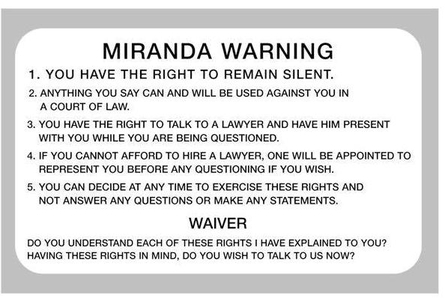
The Supreme Court. The U.S. Supreme Court—once the last refuge of justice, the one governmental body really capable of rolling back the slowly emerging tyranny enveloping America—has instead become the champion of the American police state, absolving government and corporate officials of their crimes while relentlessly punishing the average American for exercising his or her rights. Consider that in the past month alone, the justices have determined that criminal suspects, who are supposed to be treated as innocent until proven guilty, may have their DNA forcibly extracted from them by police. They have decided that staying silent while the police question you may be considered evidence of guilt, despite the Fifth Amendment’s protection against self-incrimination and the well-established “right to remain silent.” Finally, the Court has decided that it operates in a zone in which First Amendment protections cease to exist, as they have unilaterally barred protests outside the Supreme Court building, countering a federal court decision that determined that activities on the Supreme Court grounds are protected by the First Amendment. These are just three examples of a Court that, like the rest of the government, places profit, security, and convenience above our basic rights.

The Media. Of course, this triumvirate of total control would be completely ineffective without a propaganda machine provided by the world’s largest corporations. Besides shoving drivel down our throats at every possible moment, the so-called news agencies which are supposed to act as bulwarks against government propaganda have instead become the mouthpieces of the state. One need only look at the media’s behavior post-9/11 to understand what I mean. From championing the invasion of Iraq based upon absolute fabrications, to the fanatic support of all surveillance state policies and the demonization of whistle blowers like Edward Snowden and Bradley Manning, the pundits which pollute our airwaves are at best court jesters and at worst propagandists for the false reality created by the American government.

The American People. Of course, the most superior engine in the world still requires some form of energy to bring it to life and maintain it, and in this particular mechanism, “we the people” serve that vital function. We are the petrol that powers the motor, for good or bad. We now belong to a permanent underclass in America. It doesn’t matter what you call us—chattel, slaves, worker bees, drones, it’s all the same—what matters is that we are expected to march in lockstep with and submit to the will of the state in all matters, public and private.

Through our complicity in matters large and small, we have allowed an out-of-control corporate-state apparatus to take over every element of American society. Our failure to remain informed about what is taking place in our government, to know and exercise our rights, to vocally protest, to demand accountability on the part of our government representatives, and at a minimum to care about the plight of our fellow Americans has been our downfall. Having allowed ourselves to descend into darkness, refusing to see what is really happening, happily trading the truth for false promises of security and freedom, we have allowed the police state to emerge and to flourish.

Having started with The Matrix, allow me to conclude with a woefully overlooked film, Land of the Blind (2006), a dark political satire in which tyrannical rulers are overthrown by new leaders who prove to be just as bad, if not worse. In the film, citizens perceived as questioning the state are sent to “re-education camps” where the state’s concept of reality is drummed into their heads. Joe, a prison guard, is so impressed with a political prisoner Thorne that he eventually joins a coup to unseat the present dictator and replace him with Thorne. Before long, however, Joe becomes the target of the new government and comes to realize that the old boss is the same as the new boss.

In an age of governmental doublespeak, media obfuscation, and insidious subterfuge on all sides, it can at times be hard to know who is working for whom, and which side the “good guys,” if there are any, are really on. When in doubt, just remember what Orwell had to say about the matter in Animal Farm: “Four legs good, two legs bad.”

What the Supreme Court’s ruling in Salinas v. Texas says, essentially, is that citizens had better know what their rights are and understand when those rights are being violated, because the government is no longer going to be held responsible for informing you of those rights before violating them. Mind you, this is the same court that agreed that cops who tasered a pregnant woman couldn’t be held accountable because they were not aware that repeated electro-shocks qualified as constitutionally excessive and unreasonable force.

Dealing a blow to the fundamental right of citizens to remain silent, a 5-4 United States Supreme Court  has ruled that persons who are not under arrest must specifically invoke their Fifth Amendment privilege against self-incrimination in order to avoid having their refusal to answer police questions used against them in a subsequent criminal trial.

In handing down their decision in Salinas v. Texas, the Court upheld the conviction of Genovevo Salinas, who was found guilty of homicide after prosecutors argued that Salinas’ silence during a police interview prior to his arrest was a “very important piece of evidence” and that only a guilty person would have remained silent when questioned about his connection to a crime. Justice Samuel Alito wrote in the majority opinion that Salinas “was required to assert the privilege in order to benefit from it,” even though a person questioned while under arrest could not have his silence used against him.

The case began in 1992, Juan and Hector Garza were found murdered in their apartment. Genovevo Salinas, an acquaintance of the men, was suspected by police as being responsible for the murders. The police approached Salinas at his home and asked him to accompany them to the police station so they could question him and clear his name. Salinas was never handcuffed and was not given Miranda warnings.

At the police station, Salinas was taken to an interview room where, during the course of the interview, police questioning became more accusatory, and Salinas was asked whether his father’s shotgun “would match the shells recovered at the scene of the murder.” Salinas remained silent and did not answer the question. The interview proceeded. At the conclusion of the interview, police arrested Salinas for outstanding traffic fines.

The district attorney charged Salinas with the murders, but Salinas wasn’t arrested on the murder charge until 2007. During the trial, the prosecutor suggested that Salinas’ silence during the police interview prior to his arrest was a “very important piece of evidence” and that only a guilty person would have remained silent when questioned about his connection to a crime. The jury found Salinas guilty of murder and sentenced him to twenty years in prison.

On appeal, Salinas argued that the prosecution’s emphasis on his pre-arrest silence as evidence of his guilt was a violation of the Fifth Amendment’s guarantee against self-incrimination. Two Texas appeals courts ruled that Salinas was not under government compulsion during the time of the police interview, thus he had no Fifth Amendment right to remain silent.

In upholding the lower courts’ rulings, the Supreme Court majority asserted that a person claiming the benefit of the Fifth Amendment’s privilege “must claim it” and a person does not normally claim the privilege by remaining silent. In Justice Stephen Breyer’s dissenting opinion, he argued that the fact that Salinas was a suspect in a criminal investigation gave rise to a reasonable conclusion that his silence derived from an exercise of his Fifth Amendment privilege.

The Rutherford Institute filed an amicus curiae brief in the case, arguing that a person’s refusal to answer police questions, even before arrest and before Miranda warnings are given, does not indicate guilt in light of the well-known “right to remain silent,” and exclusion of evidence of silence is in keeping with the Fifth Amendment’s guarantee that “[n]o person… shall be compelled in any criminal case to be a witness against himself.”

For more on this and other pressing issues relating to the emerging police state in America, read my new book A Government of Wolves: The Emerging American Police State, available now at Amazon.com.


“You had to live—did live, from habit that became instinct—in the assumption that every sound you made was overheard, and, except in darkness, every movement scrutinized.”—George Orwell, 1984

There’s a reason George Orwell’s 1984 is a predominant theme in my new book A Government of Wolves: The Emerging American Police State (available now on Amazon.com and in stores on June 25). It’s the same reason Orwell’s dystopian thriller about a futuristic surveillance society has skyrocketed to the top of book charts in the wake of recent revelations by former CIA employee and National Security Agency (NSA) contractor Edward Snowden that the nefarious spy agency is collecting the telephone records of millions of Verizon customers, with the complete blessing of the Obama administration.

“To the future or to the past, to a time when thought is free, when men are different from one another and do not live alone— to a time when truth exists and what is done cannot be undone: From the age of uniformity, from the age of solitude, from the age of Big Brother, from the age of doublethink — greetings! ” ― George Orwell

Orwell understood what many Americans, caught up in their partisan flag-waving, are still struggling to come to terms with: that there is no such thing as a government organized for the good of the people—even the best intentions among those in government inevitably give way to the desire to maintain power and control at all costs. As Orwell explains:

The Party seeks power entirely for its own sake. We are not interested in the good of others; we are interested solely in power, pure power. What pure power means you will understand presently. We are different from the oligarchies of the past in that we know what we are doing. All the others, even those who resembled ourselves, were cowards and hypocrites. The German Nazis and the Russian Communists came very close to us in their methods, but they never had the courage to recognize their own motives. They pretended, perhaps they even believed, that they had seized power unwillingly and for a limited time, and that just around the corner there lay a paradise where human beings would be free and equal. We are not like that. We know that no one ever seizes power with the intention of relinquishing it. Power is not a means; it is an end. One does not establish a dictatorship in order to safeguard a revolution; one makes the revolution in order to establish the dictatorship. The object of persecution is persecution. The object of torture is torture. The object of power is power. Now you begin to understand me.

The fact that the U.S. government now has at its disposal a technological arsenal so sophisticated and invasive as to render any constitutional protections null and void, and these technologies are being used by the government to invade the privacy of the American people should not come as a surprise to anyone who has been paying attention over the past decade.

Spearheaded by the NSA, which has shown itself to care little for constitutional limits or privacy, the “security/industrial complex”—a marriage of government, military and corporate interests aimed at keeping Americans under constant surveillance—has come to dominate our government and our lives. At three times the size of the CIA, constituting one third of the intelligence budget and with its own global spy network to boot, the NSA has a long history of spying on Americans, whether or not it has always had the authorization to do so.

“The creatures outside looked from pig to man, and from man to pig, and from pig to man again; but already it was impossible to say which was which.”―George Orwell, Animal Farm

What many fail to realize, however, is that the government is not operating alone. It cannot. It requires an accomplice. Thus, the increasingly complex security needs of our massive federal government, especially in the areas of defense, surveillance and data management, have been met within the corporate sector, which has shown itself to be a powerful ally that both depends on and feeds the growth of governmental bureaucracy. For example, USA Today reports that five years after the 9/11 terrorist attacks, the homeland security business was booming to such an extent that it eclipsed mature enterprises like movie-making and the music industry in annual revenue. This security spending by the government to private corporations is forecast to exceed $1 trillion in the near future.

Money, power, control. There is no shortage of motives fueling the convergence of mega-corporations and government. But who is paying the price? The American people, of course, and you can be sure that it will take a toll on more than our pocketbooks. “You have government on a holy mission to ramp up information gathering and you have an information technology industry desperate for new markets,” says Peter Swire, the nation’s first privacy counselor in the Clinton Administration. “Once this is done, you will have unprecedented snooping abilities. What will happen to our private lives if we’re under constant surveillance?” We’re at that point now.

“Until they became conscious they will never rebel, and until after they have rebelled they cannot become conscious.”—George Orwell

Americans have been conditioned to accept routine incursions on their privacy rights. However, at one time, the idea of a total surveillance state tracking one’s every move would have been abhorrent to most Americans. That all changed with the 9/11 attacks. As professor Jeffrey Rosen observes, “Before Sept. 11, the idea that Americans would voluntarily agree to live their lives under the gaze of a network of biometric surveillance cameras, peering at them in government buildings, shopping malls, subways and stadiums, would have seemed unthinkable, a dystopian fantasy of a society that had surrendered privacy and anonymity.”

We have, so to speak, gone from being a nation where privacy is king to one where nothing is safe from the prying eyes of government. In search of terrorists hiding amongst us–the proverbial “needle in a haystack,” as one official termed it–the government has taken to monitoring all aspects of our lives, from cell phone calls and emails to Internet activity and credit card transactions. Much of this data is being fed through fusion centers across the country. These are state and regional intelligence centers that collect data on you.

“If liberty means anything at all, it means the right to tell people what they do not want to hear.”―George Orwell

Wherever you go and whatever you do, you are now being watched–especially if you leave behind an electronic footprint. When you use your cell phone, you leave a record of when the call was placed, who you called, how long it lasted and even where you were at the time. When you use your ATM card, you leave a record of where and when you used the card. There is even a video camera at most locations. When you drive a car enabled with GPS, you can be tracked by satellite. And all of this once-private information about your consumer habits, your whereabouts and your activities is now being fed to the U.S. government.

As I document in A Government of Wolves: The Emerging American Police State, the government has nearly inexhaustible resources when it comes to tracking our movements, from electronic wiretapping devices, traffic cameras and biometrics to radio-frequency identification cards, satellites and Internet surveillance.

“Big Brother is Watching You.”―George Orwell

Speech recognition technology now makes it possible for the government to carry out massive eavesdropping by way of sophisticated computer systems. Phone calls can be monitored, the audio converted to text files and stored in computer databases indefinitely. And if any “threatening” words are detected–no matter how inane or silly–the record can be flagged and assigned to a government agent for further investigation. And in recent years, federal and state governments, as well as private corporations, have been amassing tools aimed at allowing them to monitor Internet content. Users are profiled and tracked in order to identify, target and even prosecute them.


“Nothing was your own except the few cubic centimetres inside your skull. ” ― George Orwell
In such a climate, everyone is a suspect. And you’re guilty until you can prove yourself innocent. To underscore this shift in how the government now views its citizens, just before leaving office, President Bush granted the FBI wide-ranging authority to investigate individuals or groups, regardless of whether they are suspected of criminal activity.

Here’s what a lot of people fail to understand, however: it’s not just what you say or do that is being monitored, but how you think that is being tracked and targeted. We’ve already seen this play out on the state and federal level with hate crime legislation that cracks down on so-called “hateful” thoughts and expression, encourages self-censoring and reduces free debate on various subject matter.

Total Internet surveillance is merely the next logical step in the government’s attempts to predict and, more importantly, control the populace–and it’s not as far-fetched as you might think. For example, the NSA is now designing an artificial intelligence system that is designed to anticipate your every move. In a nutshell, the NSA will feed vast amounts of the information it collects to a computer system known as Aquaint (the acronym stands for Advanced QUestion Answering for INTelligence), which the computer can then use to detect patterns and predict behavior.

Thus, what we are witnessing, in the so-called name of security and efficiency, is the creation of a new class system comprised of the watched (average Americans such as you and me) and the watchers (government bureaucrats, technicians and private corporations).No information is sacred or spared. Everything from cell phone recordings and logs, to emails, to text messages, to personal information posted on social networking sites, to credit card statements, to library circulation records, to credit card histories, etc., is collected by the NSA. One NSA researcher actually quit the Aquaint program, “citing concerns over the dangers in placing such a powerful weapon in the hands of a top-secret agency with little accountability.”

Clearly, the age of privacy in America is coming to a close. If Orwell’s predictions prove true, what follows will be even worse. “If you want a picture of the future,” he forewarned, “imagine a boot stamping on a human face—for ever.”

For more on this and other pressing issues relating to the emerging police state in America, read my new book A Government of Wolves: The Emerging American Police State, available now at Amazon.com.


It’s bad enough that the government thinks it can violate our rights whenever it chooses and the populace accepts all manner of violations as long as they’re told it’s for their own good. However, once you start treating young people as if they have no rights by subjecting them to random lockdowns, mass searches, and drug-sniffing dogs, you’re not just violating their rights, you’re teaching them a horrific lesson—one that goes against every fundamental principle this country was founded upon—that we have no rights at all against the police state.

This is the principle at the heart of Burlison v. Springfield Public Schools, a case The Rutherford Institute has just appealed to the U.S. Supreme Court. Warning against the long-term ramifications of treating young people as if they have no rights, The Rutherford Institute has asked the U.S. Supreme Court to declare the use of random lockdowns, mass searches and drug-sniffing dogs in the public schools to be unconstitutional in violation of the Fourth Amendment’s prohibition on unreasonable seizures.

In appealing Burlison v. Springfield Public Schools to the high court, Rutherford Institute attorneys are challenging a Missouri school district’s policy of imposing a “lockdown” of the school for the purpose of allowing the local sheriff’s department, aided by drug-sniffing dogs, to perform mass inspections of students’ belongings. The U.S. Court of Appeals for the Eighth Circuit found the lockdown policy was a reasonable procedure to maintain the safety and security of students at the school. However, Rutherford Institute attorneys disagree, insisting that government officials should be required to show particularized suspicion for instituting such aggressive searches and should still be required to operate within the parameters of the Fourth Amendment.

The case started on April 22, 2010, when the principal of Central High School announced over the public address system that the school was going into “lockdown” and that students were prohibited from leaving their classrooms.  School officials and agents of the Greene County Sheriff’s Department thereafter ordered students to leave all personal belongings behind and exit the classrooms. Dogs were also brought in to assist in the raid. Upon re-entering the classrooms, students allegedly discovered that their belongings had been rummaged through. Mellony and Doug Burlison, who had two children attending Central High School, complained to school officials that the lockdown and search were a violation of their children’s rights. School officials allegedly responded by insisting that the search was a “standard drill” and policy of the school district which would continue.

The Rutherford Institute sued the school district in September 2010 on behalf of the Burlisons and their two children, asking a federal district court to declare that the practice of effecting a lockdown of the school and conducting random, suspicionless seizures and searches violates the Fourth Amendment to the U.S. Constitution and the similar provision of the Missouri Constitution. In its January 2012 decision, the district court declared that the random lockdown and mass searches did not violate students’ rights. In March 2013, the Court of Appeals affirmed the judgment, holding that the school’s interest in combatting drug use outweighed the privacy rights of students.

For  more on this and other pressing issues relating to the emerging police state in America, read my new book  A Government of Wolves: The Emerging American Police State, available now at Amazon.com.

Declaring a federal ban on expressive activity on the U.S. Supreme Court plaza to be “repugnant” to the Constitution, a District of Columbia federal court has struck down a 60-year-old statute which broadly prohibits speech and expression in front of the United States Supreme Court.

The court’s ruling comes in response to a lawsuit filed by The Rutherford Institute on behalf of Harold Hodge, a 46-year-old African-American man who was arrested in January 2011 while standing silently in front of the U.S. Supreme Court building wearing a sign voicing his concerns about the government’s disparate treatment of African-Americans and Hispanics. In a ruling issued in Hodge v. Talkin, et al., District Court Judge Beryl L. Howell struck down a federal law that makes it unlawful to display any flag, banner or device designed to bring into public notice a party, organization, or movement while on the grounds of the U.S. Supreme Court, declaring that the “the absolute prohibition on expressive activity [on the Supreme Court plaza] in the statute is unreasonable, substantially overbroad, and irreconcilable with the First Amendment.”

Judge Howell’s frank, no-holds-barred ruling affirming the Supreme Court plaza as a free speech zone throws a lifeline to the First Amendment at a time when government officials are doing their best to censor, silence and restrict free speech activities. There are a good many things that are repugnant to the Constitution right now—mass surveillance of Americans, roadside strip searches, forcible DNA extractions, SWAT team raids, civil commitments for criticizing the government, etc.—but this ruling at least sends a message that all is not lost as long as we still have some members of the judiciary who understand and abide by both the letter and the spirit of the rule of law, our U.S. Constitution.

The case began on January 28, 2011, Harold Hodge quietly and peacefully stood in the plaza area near the steps leading to the United States Supreme Court Building, wearing a 3’ X 2’ sign around his neck that proclaimed: “The U.S. Gov. Allows Police To Illegally Murder And Brutalize African Americans And Hispanic People.” The plaza is a place where the public is allowed to gather and converse and is in all relevant respects like a public square or park where citizens have traditionally met to express their views on matters of public interest. However, Hodge was approached by a police officer who informed him that he was violating the law and issued him three warnings to leave the plaza. Hodge refused, was handcuffed, placed under arrest for violating 40 U.S.C. § 6135, moved to a holding cell, and then was transported to U.S. Capitol Police Headquarters where he was booked and given a citation. The charge was dismissed in September 2011 after Hodge complied with an agreement to stay away from the Supreme Court building and grounds for six months.

In asking the U.S. District Court to declare 40 U.S.C. § 6135 unconstitutionally vague and overbroad in violation of the First Amendment, Rutherford Institute attorneys argued that absolute prohibition on speech and expression on the Supreme Court plaza is unreasonable and unnecessary to protect any legitimate governmental interest with respect to the Court or its proceedings. Affiliate attorney Jeffrey Light assisted The Rutherford Institute in securing the victory for Hodge.

“We have been silent witnesses of evil deeds: we have been drenched by many storms; we have learnt the arts of equivocation and pretence; experience has made us suspicious of others and kept us from being truthful and open; intolerable conflicts have worn us down and even made us cynical. Are we still of any use? What we shall need is not geniuses, or cynics, or misanthropes, or clever tacticians, but plain, honest, straightforward men. Will our inward power of resistance be strong enough, and our honesty with ourselves remoreseless enough, for us to find our way back to simplicity and straightforwardness?” – Dietrich Bonhoeffer, 1943

In the wake of recent revelations about the National Security Agency’s (NSA) program of mass surveillance directed at all American citizens, Edward Snowden, the alleged leaker of the documents proving the government’s misdeeds, is being hailed as a hero by some, a traitor and criminal by others, while some simply don’t know what to think.

Here’s what I think: Snowden and the countless others like him who are daring to stand up to the government machine are acting as the moral conscience for a nation that has lost its way.

In our current governmental climate, where laws that run counter to the dictates of the Constitution are made in secret, passed without debate, and upheld by secret courts that operate behind closed doors, obeying one’s conscience can well render you a criminal. Or as George Orwell put it, “In a time of universal deceit, telling the truth is a revolutionary act.”

As I discuss in my new book, A Government of Wolves: The Emerging American Police State (available now on Amazon.com), some of history’s most pivotal events came about because someone or some group chose to speak out against wrongdoing at great personal cost, even if it meant “breaking” the law. Dietrich Bonhoeffer, a young German theologian with a brilliant future before him and a refuge in the United States, opted instead to take part in a plot to overthrow Hitler and his despotic regime, believing that “Silence in the face of evil is itself evil. God will not hold us guiltless. Not to speak is to speak. Not to act is to act.” For his “crime” against the Fuhrer, Bonhoeffer was put to death at Flossenburg Concentration Camp.

Examples of “lawbreakers” who follow their conscience in order to stand against tyranny abound in our own history, starting with the colonists who rose up in opposition to the British crown criminals. The engineers of the Underground Railroad and the leaders of the Civil Rights Movement were also considered criminals of their day. Remember, Martin Luther King Jr. was arrested upwards of twenty times, most often for violating Jim Crow laws which mandated racial segregation in public facilities.

While technically violating the laws of their time, these individuals chose to speak and act against injustice, whether in the form of tyranny, slavery, or segregation. Instead of keeping their heads down and going with the flow, they raised their voices and sacrificed their security, comfort, and even their lives.

This brings me back to Edward Snowden, who not only has provided a window into the inner workings of American government but is holding up a mirror to American society and reflecting back our inaction, our acceptance of corruption in high places, and our indifference about the steady erosions of our freedoms.

While Snowden’s revelations about the NSA were dismaying, they were not surprising. Indeed, what I have found more disconcerting is the Left-Right response to Snowden’s revelations, namely, the willingness by those on both sides to join forces in maintaining the governmental status quo, at all costs.

When politicians with such disparate views as Senators Diane Feinstein (D-Calif.) and Lindsey Graham (R-NC) both give a full-throated defense of the Obama administration’s undeniably egregious and invasive surveillance activities, it’s obvious that we are no longer dealing with questions of freedom, or surveillance, or terrorism, but rather the defense of government power at all costs.

Talk about showing one’s true colors. When politicians with such disparate views as Senators Diane Feinstein (D-Calif.) and Lindsey Graham (R-NC) both give a full-throated defense of the Obama administration’s undeniably egregious and invasive surveillance activities, it’s obvious that we are no longer dealing with questions of freedom, or surveillance, or terrorism, but rather the defense of government power at all costs.

What this collusion reveals is that we currently live under a regime which has fully embraced the Nixonian mantra of “If the president does it, it’s not illegal.” The system of checks and balances which is supposed to protect Americans from government overreach like the NSA spying program is obviously not working.

Even President Obama, the former constitutional law professor, understands this, albeit in a perverse, backwards sort of way. In a recent speech in San Jose, Obama declared: “If people can’t trust not only the executive branch but also don’t trust Congress, and don’t trust federal judges, to make sure that we’re abiding by the Constitution with due process and rule of law, then we’re going to have some problems here.” However, when all branches of government are condoning clearly unconstitutional activities by the government against the citizenry, that’s a problem.

Now available for advance purchase at Amazon.com and in stores on June 25.


Moreover, there is no room for trust in the relationship between the government and its citizens. Remember it was James Madison who warned that “All men having power ought to be distrusted to a certain degree.” Thomas Jefferson’s solution was simple: “bind them down from mischief with the chains of the Constitution.”

As for the claim that the government is protecting us from further acts of terrorism by systematically violating our civil liberties, Conor Friedersdorf of The Atlantic effectively exorcised that particular demon when he pointed out that the likelihood of dying in a terrorist attack is astronomically low, lower than the chances of dying in a car wreck or being hit by lightning.

Thus, the question we should be asking is not whether Edward Snowden is a criminal but why the rest of us aren’t criminals as well? What are you doing to push back against the excesses of government, to reclaim our freedoms, and to live up to the ideals embodied in the Declaration of Independence and the US Constitution? What are you doing to stop the emerging American police state?

“The administration has now lost all credibility. Mr. Obama is proving the truism that the executive branch will use any power it is given and very likely abuse it.” ­­– New York Times editorial board

“Everyone everywhere now understands how bad things have gotten – and they’re talking about it. They have the power to decide for themselves whether they are willing to sacrifice their privacy to the surveillance state.” – Edward Snowden, alleged source of NSA leaks

There is a deep and abiding sense of unease permeating American society. From the IRS targeting politically conservative groups to the Department of Justice targeting journalists for surveillance, from the revelation that the National Security Agency (NSA) is tracking the telephone calls of most Americans to the public spectacle of whistleblower Bradley Manning’s trial, in recent weeks there has been no shortage of evidence that the new “normal” in the United States is not friendly to freedom.

The America we learned about in school, the one celebrated in songs and poems, the one to which our ancestors flocked in hopes of starting a new life based upon promises of wealth and liberty, is getting harder to find with every passing day. As I document in my new book, A Government of Wolves: The Emerging American Police State (available at Amazon.com), the American ideal of freedom and civic involvement is being replaced by a technocratic nightmare in which government bureaucrats and their allies in the corporate sector rig the rules of society in order to protect the power and privilege of a select few politicians and businessmen. All the while, the majority of the American people are kept in check via debt, imprisonment, and a vast surveillance network which keeps us monitored, controlled and marching in lock step with the government’s dictates.

If any of this sounds fantastical, it’s only because people haven’t been paying close enough attention. Why, in the past week alone, the government has doubled down on its attacks on individual liberty, government transparency, the rule of law, and basic human decency.

On Wednesday, June 5, it was revealed that the NSA has been systematically collecting information on all telephone calls placed in the United States via the Verizon network. Based upon a top-secret order handed down by the Foreign Intelligence Surveillance Court (FISA) in April 2013, Verizon has been forced to hand over its records to the NSA on an “ongoing, daily basis.” While the government insists that the content of telephone conversations are not recorded, they acknowledge that telephone numbers, location data, call duration, and other unique identifiers are sent to the NSA for analysis. The NSA collects information on about 3 billion phone calls per day.

Immediately following the revelation of the secret court order allowing the NSA to record the telephone activities of Verizon customers, The Washington Post released a top-secret document outlining a project code-named PRISM, which involves the NSA and FBI “tapping directly into the central servers of nine leading U.S. Internet companies, extracting audio and video chats, photographs, e-mails, documents, and connection logs that enable analysts to track foreign targets.” These companies include Microsoft, Yahoo, Google, Facebook, PalTalk, AOL, Skype, YouTube, and Apple.

PRISM was born at the tail end of President Bush’s disastrous program of warrantless surveillance. It depends in part on legislation passed by Congress in 2007 and 2008, the Protect America Act and FISA Amendments Act, which provide immunity to private companies that voluntarily cooperate with government efforts to collect private data on users. Government officials are increasingly relying upon PRISM for data collection as the program has become the “most prolific contributor to the President’s Daily Brief” and nearly one in seven intelligence reports rely primarily on information extracted via the program.

While shocking to some, these revelations are par for the course for our out-of-control government. Relying on secret orders handed down from government officials and the courts and emboldened by members of Congress with little concern for protecting the rights of the citizenry, government agents are now able to flout all safeguards to privacy while still claiming that they are technically acting within the bounds of the law.

This is no trifling matter. Senators Ron Wyden (D-OR) and Mark Udall (D-CO) have warned that Americans are the subject of a surveillance program that knows no bounds. As Udall has warned, “there is nothing to prohibit the intelligence community from searching through a pile of communications, which may have been incidentally or accidentally collected without a warrant, to deliberately search for the phone calls or e-mails of specific Americans.” For his part, Wyden has asked NSA staff to disclose the number of Americans whose communications have been collected, but NSA officials continue to stonewall, even going so far as to suggest that estimating the number of Americans whose communications have been collected would violate their privacy rights.

In full damage control mode, the government wants us to believe that the surveillance is primarily directed at communications coming from foreign sources and that “reasonable procedures [are] in place to minimize collection of ‘U.S. persons’ data without a warrant.” However, as we are learning, the government rarely tells the truth.

In typical fashion, intelligence officials spent the week attacking journalists for reporting on the NSA’s secret surveillance programs, with Director of National Intelligence James Clapper calling the leaks “reprehensible” and vowing to prosecute whomever chose to leak the information. On Sunday, former CIA employee and NSA contractor Edward Snowden came forward as the source of the NSA leaks. Speaking from Hong Kong, Snowden insisted that the information needed to be seen by the American public, in part to “send a message to government that people will not be intimidated.”

Snowden’s actions speak to the need for greater citizen action and transparency in government, two qualities sorely lacking in America today. Typical of Beltway politics, however, rather than holding the government accountable for its systematic and illegal surveillance of American citizens, they’re looking to shoot the messenger. Indeed, the heads of both the House and Senate Intelligence committees, Rep. Mike Rogers (R-MI) and Senator Diane Feinstein (D-CA) have already come out in favor of Snowden’s prosecution.

This is par for the course for the Obama administration, which has relentlessly pursued whistleblowers intent on exposing government crimes. Just ask Bradley Manning, whose court martial is underway. The government plans to call over 140 witnesses to the stand in an attempt to prove that Manning knowingly “aided the enemy” when he released hundreds of thousands of diplomatic cables outlining various government and military abuses to Wikileaks.

If the government’s case succeeds, not only will Manning face life imprisonment, but whistleblowers and journalists alike who dare to hold a mirror to the bloated face of American government will find themselves targeted for censure and prosecution by government agents. Yet as veteran journalist Walter Lippmann once declared, “There can be no higher law in journalism than to tell the truth and to shame the devil.”

Frankly, we should all be doing our part to shame this particular devil.

“Everybody’s a target; everybody with communication is a target.”—A senior intelligence official previously involved with the Utah Data Center

The recent revelation that the National Security Agency (NSA) is collecting the telephone records of millions of Verizon customers, with the complete blessing of the Obama administration, should come as no surprise to anyone who has been paying attention over the past decade.

As I document in my new book A Government of Wolves: The Emerging American Police State (available now at Amazon.com), what we are witnessing, in the so-called name of security and efficiency, is the creation of a new class system comprised of the watched (average Americans such as you and me) and the watchers (government bureaucrats, technicians and private corporations). What too many fail to realize, consumed as they are with partisan politics and blinded by their own political loyalties, is that the massive bureaucracies—now computerized—that administer governmental policy transcend which party occupies the White House.

This explains why the civil liberties abuses carried out by the Bush Administration have not been corrected by the Obama Administration. Rather, they have been expanded upon. Take, for instance, the warrantless wiretapping program conducted during the Bush years, which resulted in the NSA monitoring the private communications of millions of Americans—a program that continues unabated today, with help from private telecommunications companies such as AT&T. The program recorded 320 million phone calls a day when it first started. It is estimated that the NSA has intercepted 15 to 20 trillion communications of American citizens since 9/11.

To our misfortune, the Obama White House has proven to be even worse than the Bush White House when it comes to invading the privacy rights of Americans. As Yale law professor Jack Balkin notes, “We are witnessing the bipartisan normalization and legitimization of a national-surveillance state. [Obama has] systematically adopted policies consistent with the second term of the Bush Administration.” Unfortunately, whereas those on the Left raised a hew and cry over the Bush administration’s constant encroachments on Americans’ privacy rights, it appears that the political leanings of those on the Left have held greater sway than their principles. Consequently, the Obama administration has faced much less criticism for its blatant efforts to reinforce the surveillance state.

Insisting that terrorists “will come after us if they can and the only thing that we have to deter this is good intelligence to understand that a plot has been hatched and to get there before they get to us,” Senator Dianne Feinstein (D-Calif.), who chairs the Senate intelligence committee, is defending the NSA’s actions, as well as the secret court order requiring Verizon to turn over its phone records to government agents. It’s a tired, overused line that preys on Americans’ fear of another terrorist attack and offers phantom promises of security while ensuring neither safety nor greater freedom. Even the vague and unsupported claim put forth by House Intelligence Committee Chairman Mike Rogers (R-Mich.) that the NSA surveillance program “helped thwart ‘a significant case’ of terrorism in the United States ‘within the last few years’” fails to justify a program of this magnitude, which makes everyone a target and turns us all into a nation of suspects.

Clearly, the age of privacy in America is coming to a close. We have moved into a new paradigm in which surveillance technology which renders everyone a suspect is driving the bureaucratic ship that once was our democratic republic. It will not be long before no phone call, no email, no Tweet, no web search is safe from the prying eyes and ears of the government. People going about their daily business will no longer be assured that they are not being spied upon by federal agents and other government bureaucrats.

Thus, the question looms before us.  Can freedom in the United States continue to flourish and grow in an age when the physical movements, individual purchases, conversations, and meetings of every citizen are constantly under surveillance by private companies and government agencies?

Whether or not the surveillance is undertaken for so-called “worthy” (read: politically expedient) reasons such as preventing another terrorist attack, does not surveillance of all citizens gradually poison the soul of a nation and render us all data collected in government files? Does not such surveillance completely eviscerate our right to be free from unreasonable searches and seizures as guaranteed by our Constitution?

For  more on this and other pressing issues relating to the emerging police state in America, read my new book  A Government of Wolves: The Emerging American Police State, available now at Amazon.com.– John W. Whitehead