Archive for the ‘Uncategorized’ Category


“As we express our gratitude, we must never forget that the highest appreciation is not to utter words, but to live by them.”—John F. Kennedy

Just in time for Memorial Day, we’re once again being treated to a generous serving of praise and grandstanding by politicians and corporations eager to go on record as being supportive of our veterans. Patriotic platitudes aside, however, America has done a deplorable job of caring for her veterans. We erect monuments for those who die while serving in the military, yet for those who return home, there’s little honor to be found.

Despite the fact that the U.S. boasts more than 23 million veterans who have served in World War II through Korea, Vietnam, the Gulf War, Iraq and Afghanistan, the plight of veterans today is deplorable, with large numbers of them impoverished, unemployed, traumatized mentally and physically, struggling with depression, thoughts of suicide, and marital stress, homeless (a third of all homeless Americans are veterans), subjected to sub-par treatment at clinics and hospitals, and left to molder while their paperwork piles up within Veterans Administration (VA) offices.

According to the National Veterans Foundation, the VA has had a backlog of as many as 1.2 million unprocessed claims in recent years, in addition to the fraud and mismanagement within the VA and its network of offices across the country, and secret lists containing thousands of names of veterans who were forced to wait months just to see a doctor.

While President Obama has now declared that he “will not stand” for the mistreatment of veterans under his watch, the time for words is long past. As Slate political correspondent John Dickerson observed, these inexcusable delays represent “a failure of one of the most basic transactions government is supposed to perform: keeping a promise to those who were asked to protect our very form of government.”

Then again, as I detail in my book A Government of Wolves: The Emerging American Police State, the government has been breaking its promises to the American people for a long time now, starting with its most sacred covenant to uphold and defend the Constitution. Yet if the government won’t abide by its commitment to respect our constitutional rights to be free from government surveillance and censorship, if it completely tramples on our right to due process and fair hearings, and routinely denies us protection from roadside strip searches and militarized police, why should anyone expect the government to treat our nation’s veterans with respect and dignity?

Indeed, in recent years, military servicemen and women—many of whom are decorated—have found themselves increasingly targeted for surveillance, censorship, threatened with incarceration or involuntary commitment, labeled as extremists and/or mentally ill, and stripped of their Second Amendment rights, all for daring to voice their concerns about the alarming state of our union and the erosion of our freedoms.

For example, a Department of Homeland Security (DHS) program dubbed Operation Vigilant Eagle tracks military veterans returning from Iraq and Afghanistan, and characterizes them as extremists and potential domestic terrorist threats because they may be “disgruntled, disillusioned or suffering from the psychological effects of war.” Since launching Operation Vigilant Eagle, the government has steadily ramped up its campaign to “silence” dissidents, especially those with military backgrounds. Coupled with the DHS’ dual reports on Rightwing and Leftwing “Extremism,” which broadly define extremists as individuals, military veterans and groups “that are mainly antigovernment, rejecting federal authority in favor of state or local authority, or rejecting government authority entirely,” these tactics have boded ill for anyone seen as opposing the government.

An important point to consider, however, is that the government is not merely targeting individuals who are voicing their discontent so much as it is locking up individuals trained in military warfare who are voicing feelings of discontent. Under the guise of mental health treatment and with the complicity of government psychiatrists and law enforcement officials, these veterans are increasingly being portrayed as ticking time bombs in need of intervention. In 2012, for instance, the Justice Department launched a pilot program aimed at training SWAT teams to deal with confrontations involving highly trained and often heavily armed combat veterans.

Unfortunately, as we’ve seen in recent years, the problem with depicting veterans as potential enemy combatants is that any encounter with a military veteran can escalate very quickly into an explosive and deadly situation—at least, on the part of law enforcement.

For example, Jose Guerena, a Marine who served in two tours in Iraq, was killed in 2011 after an Arizona SWAT team kicked open the door of his home during a mistaken drug raid and opened fire. Thinking his home was being invaded by criminals, Guerena told his wife and child to hide in a closet, grabbed a gun and waited in the hallway to confront the intruders. He never fired his weapon. In fact, the safety was still on his gun when he was killed. The SWAT officers, however, not as restrained, fired 70 rounds of ammunition at Guerena—23 of those bullets made contact. Apart from his military background, Guerena had had no prior criminal record, and the police found nothing illegal in his home.

John Edward Chesney, a 62-year-old Vietnam veteran, was killed earlier this year by a SWAT team allegedly responding to a call that the Army veteran was standing in his San Diego apartment window waving what looked like a semi-automatic rifle. SWAT officers locked down Chesney’s street, took up positions around his home, and fired 12 rounds into Chesney’s apartment window. It turned out that the gun Chesney reportedly pointed at police from three stories up was a “realistic-looking mock assault rifle.”

Thankfully, Ramon Hooks’ encounter with a Houston SWAT team did not end as tragically, but it very easily could have. Hooks, a 25-year-old Iraq war veteran, was using an air rifle gun for target practice outside when a Homeland Security Agent, allegedly house shopping in the area, reported him as an active shooter. It wasn’t long before the quiet neighborhood was transformed into a war zone, with dozens of cop cars, an armored vehicle and heavily armed police. Hooks was arrested, his air rifle pellets and toy gun confiscated, and charges filed against him for “criminal mischief.”

Although no toy guns were involved in Brandon Raub’s case, his fact scenario is even more chilling, given that he was targeted for exercising his First Amendment rights on Facebook. The 26-year-old decorated Marine actually found himself interrogated by government agents about his views on government corruption, arrested with no warning, labeled mentally ill for subscribing to so-called “conspiratorial” views about the government, detained against his will in a psych ward for standing by his views, and isolated from his family, friends and attorneys.

On August 16, 2012, a swarm of local police, Secret Service and FBI agents arrived at Raub’s Virginia home, asking to speak with him about posts he had made on his Facebook page made up of song lyrics, political opinions and dialogue used in a political thriller virtual card game. Among the posts cited as troublesome were lyrics to a song by a rap group and Raub’s views, shared increasingly by a number of Americans, that the 9/11 terrorist attacks were an inside job.

After a brief conversation and without providing any explanation, levying any charges against Raub or reading him his rights, Raub was then handcuffed and transported to police headquarters, then to a medical center, where he was held against his will due to alleged concerns that his Facebook posts were “terrorist in nature.” Outraged onlookers filmed the arrest and posted the footage to YouTube, where it quickly went viral. Meanwhile, in a kangaroo court hearing that turned a deaf ear to Raub’s explanations about the fact that his Facebook posts were being read out of context, Raub was sentenced to up to 30 days’ further confinement in a psychiatric ward.

Thankfully, The Rutherford Institute came to Raub’s assistance, which combined with heightened media attention, brought about his release and may have helped prevent Raub from being successfully “disappeared” by the government. Even so, within days of Raub being seized and forcibly held in a VA psych ward, news reports started surfacing of other veterans having similar experiences.

That the government is using the charge of mental illness as the means by which to immobilize (and disarm) these veterans is diabolically brilliant. With one stroke of a magistrate’s pen, these service men are being declared mentally ill, locked away against their will, and stripped of their constitutional rights. Make no mistake, these returning veterans are being positioned as enemy number one.

Indeed, Raub’s case, a prime example of the government’s war on veterans, exposes the seedy underbelly of a governmental system that is targeting Americans—especially military veterans—for expressing their discontent over America’s rapid transition to a police state.

A federal judge actually dismissed Raub’s lawsuit challenging the government’s “Operation Vigilant Eagle” campaign and its increasing view of veterans as potential domestic terrorists as “far-fetched.” Yet what may sound far-fetched to the courts is a grim reality to Americans who are daily being targeted for daring to exercise their constitutional rights to speak their minds, criticize the government, and defend themselves and their families against over-reaching government surveillance and heavy-handed police tactics.

It’s ironic, isn’t it, that we raise our young people to believe that it is their patriotic duty to defend freedom abroad by serving in the military, then when they return home, bruised and battle-scarred and suddenly serious about defending their freedoms at home, we treat them like terrorists. Then again, perhaps it’s not so much ironic as it is tragic and pathetic—a sad tribute, indeed, to those willing to put their lives on the line.

OWS-Police-Brutality

“Police are specialists in violence. They are armed, trained, and authorized to use force. With varying degrees of subtlety, this colors their every action. Like the possibility of arrest, the threat of violence is implicit in every police encounter. Violence, as well as the law, is what they represent.”–Kristian Williams, activist and author

Living in a free society means not having to look over your shoulder to see whether the government is watching or fearing that a government agent might perpetuate violence upon you.

Unfortunately, as I detail in my book A Government of Wolves: The Emerging American Police State, subjected as we are to government surveillance, body scanners, militarized police, roadside strip searches, SWAT team raids, drones, and other trappings of a police state, “we the people” do not live in a free society any longer.

Not only are we no longer a free people but we have become a fearful people, as well, helped along in large part by politicians eager to capitalize on our fears. As Julie Hanus writes for Utne: “Since the 1980s, society at large has bolted frantically from one panic to the next. Fear of crime reduced us to wrecks, but before long we were also howling about deadly diseases, drug abusers, online pedophiles, avian flu, teens gone wild, mad cows, anthrax, immigrants, environmental collapse, and–let us not forget–terrorists.”

Now thanks to an increasingly militarized police force and police officers who shoot first and ask questions later, we’ve got one more fear to add to that growing list, and with good reason: fear of the police–local, state and federal agents.

Who wouldn’t be afraid of police officers who go around shooting unarmed citizens, tasering women–young and old alike, and forcing law-abiding Americans to the ground at gunpoint?

Such was the case when a Missouri police officer shot and wounded an unarmed panhandler. Texas police, during a raid on a home where music was reportedly being played too loudly, repeatedly tasered a 54-year-old grandmother, kicking and punching other members of the household. A 20-year-old Florida woman who was tasered by a police officer while she was handcuffed ended up in a permanent vegetative state and eventually died. And then there was the homeless man who was shot and killed by Albuquerque police for squatting on public land.

If it were just a few “bad” cops terrorizing the citizenry, that would be one thing. But what we’re dealing with is a nationwide epidemic of court-sanctioned police violence carried out against individuals posing little or no threat of violence, who are nevertheless subjected to such excessive police force as to end up maimed or killed.

For example, Ron Hillstrom was pacing in the parking lot of his apartment complex asking for help when four officers approached him, unleashed their tasers, and subdued him with electric shocks. When Hillstrom fell to the ground, another officer hit him with a flashlight. Hillstrom died soon thereafter.

Danny Cantu was recently awarded $105,000 after Dallas police rushed into his backyard, threw a flash bang grenade into his window, and broke into his home without warning. Cantu was thrown to the ground and beaten with his hands tied behind his back.

Denise Green is suing San Francisco police after a license plate reader misread her license plate, causing her to be pulled over by five police officers who pointed guns at her under the false belief that she was driving a stolen car. After being held at gunpoint on the ground, Green was handcuffed and her car searched before she was finally released.

The toll such incidents take on adults can be life-altering, but when such police brutality is perpetrated on young people, the end result is nothing less than complete indoctrination into becoming compliant citizens of a totalitarian state. The message is clear and chilling: any deviation from what is “allowed” will be punished severely.

Thus, when a 9-year-old Portland girl got into a fight at a youth club, instead of the incident being resolved by staff members and reported to her family, police showed up at her home, arrested the young girl, took her down to the station, fingerprinted her, and had her mug shot taken.

Similarly, when 13-year-old Kevens Jean Baptiste failed to follow a school bus driver’s direction to keep the bus windows closed (Kevens, who suffers from asthma, opened the window after a fellow student sprayed perfume, causing him to cough and wheeze), he was handcuffed by police, removed from the bus, and while still handcuffed, had his legs swept out from under him by an officer, causing him to crash to the ground.

In Missouri, a 7-year-old child was handcuffed because he was allegedly upset about being teased by his classmates. The inconsolable child, who was screaming in class because of the taunting, was taken by the school’s security officer to the principal’s office and handcuffed until his father arrived at the school.

There might be some hope of reform if only this problem of police brutality were not so widespread and endemic, if the citizenry actually had some sway with their representatives, if communities actually had some say over how law enforcement agencies “police” their communities, if police unions did not have such a stranglehold over the oversight process, if the courts were more impartial and less inclined to blindly sanction the actions of the police, and if the federal government itself had not already coopted state and local police agencies in order to transform them into extensions of the military.

In the absence of any credible scenarios that would hold the police accountable to abiding by the rule of law–our U.S. Constitution–and respecting the citizenry’s right to be treated with respect and dignity, the police have become a law unto themselves.

Clearly, the master-servant relationship upon which American government was based has now been reversed. Government agents in general, and the police in particular, now seem to believe they are the masters and we are the servants. It’s definitely time to reestablish us, the American citizenry, as the masters of our government–even if it means showing the oppressors that we will no longer wear their chains.

Some Americans have already begun pushing back. In Albuquerque, New Mexico, for example, where police have been involved in 39 shootings since 2010–with the most recent being a police shooting of an unarmed homeless man camped out in a public park–residents have begun engaging in nonviolent acts of civil disobedience to disrupt the normal functioning of the city government until the police department is brought under control. Community activists actually went so far as to storm a city council meeting and announce that they would be performing a citizens’ arrest of the police chief, charging him with “harboring fugitives from justice at the Albuquerque police department” and “crimes against humanity.”

This growing tension, seen in Albuquerque and felt throughout the country, is a tension between those who wield power on behalf of the government–the president, Congress, the courts, the military, the militarized police, the technocrats, the faceless unelected bureaucrats who blindly obey and carry out government directives, no matter how immoral or unjust, and the corporations–and those among the populace who are finally waking up to the mounting injustices, seething corruption and endless tyrannies that are transforming our country into a police state.

Where we go wrong is in painting our oppressors–whether it be the police, the courts, Congress, or the president–as absolutely evil and ourselves as powerless to resist.

Hannah Arendt, a Holocaust survivor who reported on the war crimes trial of Nazi Adolf Eichmann, a senior officer who organized Hitler’s death camps, denounced Eichmann not because he was evil per se but because he was a bureaucrat who unquestioningly carried out orders that were immoral, inhumane and evil. This, Arendt concluded, was the banality of evil, the ability to engage in wrongdoing or turn a blind eye to it, without taking any responsibility for your actions or inactions.

Coincidentally, the same year that Arendt’s book Eichmann in Jerusalem: A Report on the Banality of Evil was published, Martin Luther King Jr. penned his “Letter from a Birmingham Jail,” in which he concludes that “the Negro’s great stumbling block in his stride toward freedom is not the White Citizen’s Counciler or the Ku Klux Klanner, but the white moderate, who is more devoted to ‘order’ than to justice.” As King points out, “We should never forget that everything Adolf Hitler did in Germany was ‘legal’ and everything the Hungarian freedom fighters did in Hungary was ‘illegal.’ It was ‘illegal’ to aid and comfort a Jew in Hitler’s Germany.”

In other words, there comes a time when law and order are in direct opposition to justice.

This tension is at the heart of the issue over police brutality, carried out by individuals who may not themselves be evil but are merely following orders, marching in lockstep with a government machine that views us as less than human. So how does one achieve justice without resorting to violence, given that violence only leads to more violence? The only recourse left to us, as both King and Arendt recognize, is mass civil disobedience of the nonviolent sort. As King notes:

[T]here is nothing new about this kind of civil disobedience. It was evidenced sublimely in the refusal of Shadrach, Meshach and Abednego to obey the laws of Nebuchadnezzar, on the ground that a higher moral law was at stake. It was practiced superbly by the early Christians, who were willing to face hungry lions and the excruciating pain of chopping blocks rather than submit to certain unjust laws of the Roman Empire. To a degree, academic freedom is a reality today because Socrates practiced civil disobedience. In our own nation, the Boston Tea Party represented a massive act of civil disobedience.

After all, as King declared, “Freedom is never voluntarily given up by the oppressor; it must be demanded.”

google-surveillance

“The Google services and apps that we interact with on a daily basis aren’t the company’s main product: They are the harvesting machines that dig up and process the stuff that Google really sells: for-profit intelligence.”—Journalist Yasha Levine

“We know where you are. We know where you’ve been. We can more or less know what you’re thinking about.”—former Google CEO Eric Schmidt

What would happen if the most powerful technology company in the world and the largest clandestine spying agency in the world joined forces?

No need to wonder. Just look around you. It’s happened already. Thanks to an insidious partnership between Google and the National Security Agency (NSA) that grows more invasive and more subtle with every passing day, “we the people” have become little more than data consumer commodities to be bought, sold and paid for over and over again.

With every smartphone we buy, every GPS device we install, every Twitter, Facebook, and Google account we open, every frequent buyer card we use for purchases—whether at the grocer’s, the yogurt shop, the airlines or the department store, and every credit and debit card we use to pay for our transactions, we’re helping Corporate America build a dossier for its government counterparts on who we know, what we think, how we spend our money, and how we spend our time.

What’s worse, this for-profit surveillance scheme, far larger than anything the NSA could capture just by tapping into our phone calls, is made possible by our consumer dollars and our cooperation. All those disclaimers you scroll though without reading them, the ones written in minute font, only to quickly click on the “Agree” button at the end so you can get to the next step—downloading software, opening up a social media account, adding a new app to your phone or computer: those signify your written consent to having your activities monitored, recorded and shared.

It’s not just the surveillance you consent to that’s being shared with the government, however. It’s the very technology you happily and unquestioningly use which is being hardwired to give the government easy access to your activities.

In this way, Congress can pass all the legislation it wants—it will have no real effect on the NSA’s activities—because the NSA no longer needs to dirty its hands by spying on Americans’ phone, email and internet activities, and the government can absolve itself of any direct wrongdoing. They can go straight to the source, as evidenced by a Freedom of Information Act request detailing the close relationship between Google higher-ups Eric Schmidt and Sergey Brin and NSA Director Gen. Keith Alexander. With Google in its hip pocket, the NSA can just bypass any legislative restrictions dreamed up to appease the electorate and buy their way into a surveillance state.

The government’s motives aren’t too difficult to understand—money, power, control—but what do corporate giants like Google stand to gain from colluding with Big Brother? Money, power, control. As privacy and security expert Bruce Schneier observed, “The main focus of massive Internet companies and government agencies both still largely align: to keep us all under constant surveillance. When they bicker, it’s mostly role-playing designed to keep us blasé about what’s really going on.”

While one billion people use Google every day, none of them pay to utilize Google’s services. However, there’s a good reason that Google doesn’t charge for its services, and it has nothing to do with magnanimity, generosity, altruism, or munificence. If as the old adage warns, there’s no such thing as a free lunch, then what does Google get out of the relationship? Simple: Google gets us.

It turns out that we are Soylent Green. The 1973 film of the same name, starring Charlton Heston and Edward G. Robinson, is set in 2022 in an overpopulated, polluted, starving New York City whose inhabitants depend on synthetic foods manufactured by the Soylent Corporation for survival. Heston plays a policeman investigating a murder, who then discovers the grisly truth about what the wafer, soylent green—the principal source of nourishment for a starved population—is really made of. “It’s people. Soylent Green is made out of people,” declares Heston’s character. “They’re making our food out of people. Next thing they’ll be breeding us like cattle for food.”

Oh, how right he was. Soylent Green is indeed people, or in our case, Soylent Green is our own personal data, repossessed, repackaged and used by corporations and the government to entrap us. In this way, we’re being bred like cattle but not for food—rather, we’re being bred for our data. That’s the secret to Corporate America’s success.

Google, for example, has long enjoyed a relationship with clandestine agencies such as the CIA and NSA, which use Google’s search-technology for scanning and sharing various intelligence. The technology leviathan turns a profit by processing, trading, and marketing products based upon our personal information, including our relationships, daily activities, personal beliefs, and personalities. Thus, behind the pleasant glow of the computer screen lies a leviathan menace, an intricate system of data collection which transforms all Americans into a string of data, to be added, manipulated, or deleted based upon the whims of those in control.

Take, for example, Google’s Street View program, which gives a fully immersive street level view of towns across the world. The program was constructed by Google Street View cars outfitted with 360 degree cameras, which seemed a neat idea to many people, most of whom didn’t realize that the cars were not only taking pictures of all residential and commercial districts which they drove through, but were also “siphoning loads of personally identifiable data from people’s Wi-Fi connections all across the world,” including emails, medical records, and any other electronic documents that were not encrypted.

Even the most seemingly benign Google program, Gmail, has been one of the most astoundingly successful surveillance programs ever concocted by a state or corporate entity. Journalist Yasha Levine explains:

“All communication was subject to deep linguistic analysis; conversations were parsed for keywords, meaning, and even tone; individuals were matched to real identities using contact information stored in a user’s Gmail address book; attached documents were scraped for intel — that info was then cross-referenced with previous email interactions and combined with stuff gleaned from other Google services, as well as third-party sources…”

Google then creates profiles on Gmail users, based upon “concepts and topics discussed in email, as well as email attachments [including] the content of websites that users have visited; demographic information — including income, sex, race, marital status; geographic information; psychographic information — personality type, values, attitudes, interests, and lifestyle interests; previous searches users have made; information about documents a user viewed and or edited by the users; browsing activity; previous purchases.”

Even if one isn’t using Gmail themselves, but merely contacting a Gmail user, that person is subject to this mass collection and analysis of personal data. Google has gone so far as to disingenuously argue that “people who used Internet services for communication had ‘no legitimate expectation of privacy’ — and thus anyone who emailed with Gmail users had given ‘implied consent’ for Google to intercept and analyze their email exchange.”

What Google’s vast acquisition and analysis of information indicates is that we are entering what some have called an age of infopolitics, in which the human person is broken down into data sets to be collated and analyzed, and used for a variety of purposes, including marketing, propaganda, and the squelching of dissent. As philosopher Colin Koopman notes, we may soon find ourselves in a more efficient version of the McCarthy era, in which one’s personal beliefs or associations become fodder for the rising corporate surveillance state.

Email, social media, and GPS are just the tip of the iceberg, however. Google has added to its payroll the best and brightest minds in the fields of military defense, robotics (including humanoid robotics), defense, surveillance, machine learning, artificial intelligence, web-controlled household appliances (such as Nest thermostats), and self-driving cars. As journalist Carole Cadwalladr’s predicts, “The future, in ways we can’t even begin to imagine, will be Google’s.”

Toward this end, Google has been working towards what one investor called “a Manhattan project of AI [artificial intelligence].” For those who remember their history, the Manhattan Project was a top-secret, multi-agency, multi-billion-dollar, military-driven government project aimed at building the first atom bombs. This project not only spawned the nuclear bombs used at Hiroshima and Nagasaki, but it also ushered in a nuclear arms race that, to this day, puts humanity on the brink of annihilation.

No less powerful and potentially destructive to the human race are modern-day surveillance and robotic technologies, manufactured by corporations working in tandem with government agencies. These are the building blocks of the global electronic concentration camp encircling us all, and Google, in conjunction with the NSA, has set itself up as a formidable warden.

The question, when all is said and done, is where will all this technology take us? It’s a conundrum I explore at length in my book A Government of Wolves: The Emerging American Police State, which looks to film, fiction and art as indicators of the police state that now surrounds us, brought about with the help of the government and its corporate partners.

It won’t be long before we find ourselves, much like Edward G. Robinson’s character in Soylent Green, looking back on the past with longing, back to an age where we could speak to whom we wanted, buy what we wanted, think what we wanted without those thoughts, words and activities being tracked, processed and stored by corporate giants such as Google, sold to government agencies such as the NSA and CIA, and used against us by militarized police with their army of futuristic technologies.

Then again, George Orwell’s description of the world of 1984 is as apt a description of today’s world as I’ve ever seen: “You had to live—did live, from habit that became instinct—in the assumption that every sound you made was overheard, and, except in darkness, every movement scrutinized.”

holocaust

“First they came for the Socialists, and I did not speak out—Because I was not a Socialist. Then they came for the Trade Unionists, and I did not speak out—Because I was not a Trade Unionist. Then they came for the Jews, and I did not speak out—Because I was not a Jew. Then they came for me—and there was no one left to speak for me.”—Martin Niemoller

Despite what some may think, the Constitution is no magical incantation against government wrongdoing. Indeed, it’s only as effective as those who abide by it. However, without courts willing to uphold the Constitution’s provisions when government officials disregard it and a citizenry knowledgeable enough to be outraged when those provisions are undermined, it provides little to no protection against SWAT team raids, domestic surveillance, police shootings of unarmed citizens, indefinite detentions, and the like.

Unfortunately, the courts and the police have meshed in their thinking to such an extent that anything goes when it’s done in the name of national security, crime fighting and terrorism. Consequently, America no longer operates under a system of justice characterized by due process, an assumption of innocence, probable cause and clear prohibitions on government overreach and police abuse. Instead, our courts of justice have been transformed into courts of order, advocating for the government’s interests, rather than championing the rights of the citizenry, as enshrined in the Constitution.

Just recently, for example, the Tenth Circuit Court of Appeals ruled in U.S. v. Westhoven that driving too carefully, with a rigid posture, taking a scenic route, and having acne are sufficient reasons for a police officer to suspect you of doing something illegal, detain you, search your car, and arrest you—even if you’ve done nothing illegal to warrant the stop in the first place.

In that same vein, the U.S. Supreme Court declared in a 5-4 ruling in Navarette v. California that police officers can, under the guise of “reasonable suspicion,” stop cars and question drivers based solely on anonymous tips, no matter how dubious, and whether or not they themselves witnessed any troubling behavior.

And then you have the Supreme Court’s refusal to hear Hedges v. Obama, a legal challenge to the indefinite detention provision of the National Defense Authorization Act of 2012 (NDAA), thereby affirming that the President and the U.S. military can arrest and indefinitely detain individuals, including American citizens, based on a suspicion that they might be associated with or aiding terrorist organizations.

All three cases reflect a mindset in which the rule of law, the U.S. Constitution, once the map by which we navigated sometimes hostile terrain, has been unceremoniously booted out of the runaway car that is our government, driven over and left for road kill on the side of the road. All that can be seen in the rear view mirror are the tire marks on its ragged frame.

What we are dealing with, as I document in my book A Government of Wolves: The Emerging American Police State, is a run-away government hyped up on its own power, whose policies are dictated more by paranoia than need. Making matters worse, “we the people” have become so gullible, so easily distracted, and so out-of-touch that we are ignoring the warning signs all around us and failing to demand that government officials of all stripes—the White House, Congress, the courts, the military, law enforcement, the endless parade of bureaucrats, etc.—respect our rights and abide by the rule of law.

The Supreme Court’s refusal to hear the NDAA indefinite detention case—which challenged whether the government can lawfully lock up American citizens who might be deemed extremists or terrorists (the government likes to use these words interchangeably) for criticizing the government—is one such warning sign that we would do well to heed.

The building blocks are already in place for such an eventuality: the surveillance networks, fusion centers and government contractors already monitor what is being said by whom; government databases track who poses a potential threat to the government’s power; the militarized police, working in conjunction with federal agencies, coordinate with the federal government when it’s time to round up the troublemakers; the courts sanction the government’s methods, no matter how unlawful; and the detention facilities, whether private prisons or FEMA internment camps, to lock up the troublemakers.

For those who can read the writing on the wall, it’s all starting to make sense: the military drills carried out in major American cities, the VIPR inspections at train depots and bus stations, the SWAT team raids on unsuspecting homeowners, the Black Hawk helicopters patrolling American skies, the massive ammunition purchases by various federal agencies such as the Department of Homeland Security, the Department of Education, the IRS and the Social Security Administration.

Viewed in conjunction with the government’s increasing use of involuntary commitment laws to declare individuals mentally ill and lock them up in psychiatric wards for extended periods of time, the NDAA’s provision allowing the military to arrest and indefinitely detain anyone, including American citizens, only codifies this unraveling of our constitutional framework.

Throw in the profit-driven corporate incentive to jail Americans in private prisons, as well as the criminalizing of such relatively innocent activities as holding Bible studies in one’s home or sharing unpasteurized goat cheese with members of one’s community, and it becomes clear that “we the people” have become enemies of the state. Thus, it’s no longer a question of whether the government will lock up Americans for First Amendment activity but when. (It’s particularly telling that the government’s lawyers, when pressed for an assurance that those exercising their First Amendment rights in order to criticize the government would not be targeted under the NDAA, refused to provide one.)

History shows that the U.S. government is not averse to locking up its own citizens for its own purposes. One need only go back to the 1940s, when the federal government proclaimed that Japanese-Americans, labeled potential dissidents, could be put in concentration (a.k.a. internment) camps based only upon their ethnic origin, to see the lengths the federal government will go to in order to maintain “order” in the homeland. The U.S. Supreme Court validated the detention program in Korematsu v. US (1944), concluding that the government’s need to ensure the safety of the country trumped personal liberties. That decision has never been overturned.

In fact, the creation of detention camps domestically has long been part of the government’s budget and operations, falling under the jurisdiction of FEMA, the Federal Emergency Management Agency. FEMA’s murky history dates back to the 1970s, when President Carter created it by way of an executive order merging many of the government’s disaster relief agencies into one large agency. During the 1980s, however, reports began to surface of secret military-type training exercises carried out by FEMA and the Department of Defense. Code named Rex-84, 34 federal agencies, including the CIA and the Secret Service, were trained on how to deal with domestic civil unrest.

FEMA’s role in creating top-secret American internment camps is well-documented. But be careful who you share this information with: it turns out that voicing concerns about the existence of FEMA detention camps is among the growing list of opinions and activities which may make a federal agent or government official think you’re an extremist (a.k.a. terrorist), or sympathetic to terrorist activities, and thus qualify you for indefinite detention under the NDAA. Also included in that list of “dangerous” viewpoints are advocating states’ rights, believing the state to be unnecessary or undesirable, “conspiracy theorizing,” concern about alleged FEMA camps, opposition to war, organizing for “economic justice,” frustration with “mainstream ideologies,” opposition to abortion, opposition to globalization, and ammunition stockpiling.

Now if you’re going to have internment camps on American soil, someone has to build them. Thus, in 2006, it was announced that Kellogg Brown and Root, a subsidiary of Halliburton, had been awarded a $385 million contract to build American detention facilities. Although the government and Halliburton were not forthcoming about where or when these domestic detention centers would be built, they rationalized the need for them in case of “an emergency influx of immigrants, or to support the rapid development of new programs” in the event of other emergencies such as “natural disasters.”

Of course, these detention camps will have to be used for anyone viewed as a threat to the government, and that includes political dissidents. So it’s no coincidence that the U.S. government has, since the 1980s, acquired and maintained, without warrant or court order, a database of names and information on Americans considered to be threats to the nation. As Salon reports, this database, reportedly dubbed “Main Core,” is to be used by the Army and FEMA in times of national emergency or under martial law to locate and round up Americans seen as threats to national security. As of 2008, there were some 8 million Americans in the Main Core database.

Fast forward to 2009, when the Department of Homeland Security (DHS) released two reports, one on “Rightwing Extremism,” which broadly defines rightwing extremists as individuals and groups “that are mainly antigovernment, rejecting federal authority in favor of state or local authority, or rejecting government authority entirely,” and one on “Leftwing Extremism,” which labeled environmental and animal rights activist groups as extremists. Both reports use the words terrorist and extremist interchangeably. That same year, the DHS launched Operation Vigilant Eagle, which calls for surveillance of military veterans returning from Iraq and Afghanistan, characterizing them as extremists and potential domestic terrorist threats because they may be “disgruntled, disillusioned or suffering from the psychological effects of war.”

These reports indicate that for the government, so-called extremism is not a partisan matter. Anyone seen as opposing the government—whether they’re Left, Right or somewhere in between—is a target, which brings us back, full circle, to where we started, with the NDAA’s indefinite detention provision, whose language is so broad and vague as to implicate anyone critical of the government.

Unfortunately, we seem to be coming full circle on many fronts. Consider that a decade ago we were debating whether non-citizens—for example, so-called enemy combatants being held at Guantanamo Bay and Muslim-Americans rounded up in the wake of 9/11—were entitled to protections under the Constitution, specifically as they relate to indefinite detention. Americans weren’t overly concerned about the rights of non-citizens then, and now we’re the ones in the unenviable position of being targeted for indefinite detention by our own government.

Similarly, most Americans weren’t unduly concerned when the U.S. Supreme Court gave Arizona police officers the green light to stop, search and question anyone—ostensibly those fitting a particular racial profile—they suspect might be an illegal immigrant. Two years later, the cops have carte blanche authority to stop any individual, citizen and non-citizen alike, they suspect might be doing something illegal (mind you, in this age of overcriminalization, that could be anything from feeding the birds to growing exotic orchids).

Likewise, you still have a sizeable portion of the population today unconcerned about the government’s practice of spying on Americans, having been brainwashed into believing that if you’re not doing anything wrong, you have nothing to worry about. It will only be a matter of time before they learn the hard way that in a police state, it doesn’t matter who you are or how righteous you claim to be—eventually, you will be lumped in with everyone else and everything you do will be “wrong” and suspect.

Martin Niemoller learned that particular lesson the hard way. A German military officer turned theologian, Niemoller was an early supporter of Hitler’s rise to power. It was only when Hitler threatened to attack the churches that Niemoller openly opposed the regime. For his efforts, Neimoller was arrested, charged with activities against the government, fined, detained, and eventually interned in the Sachsenhausen and Dachau concentration camps from 1938 to 1945.

As Niemoller reportedly replied when asked by his cellmate why he ever supported the Nazi party:

I find myself wondering about that too. I wonder about it as much as I regret it. Still, it is true that Hitler betrayed me… Hitler promised me on his word of honor, to protect the Church, and not to issue any anti-Church laws. He also agreed not to allow pogroms against the Jews… Hitler’s assurance satisfied me at the time…I am paying for that mistake now; and not me alone, but thousands of other persons like me.

WASHINGTON, D.C. — In refusing to hear a legal challenge to the indefinite detention provision of the National Defense Authorization Act of 2012 (NDAA), the United States Supreme Court has affirmed that the President and the U.S. military can arrest and indefinitely detain individuals, including American citizens.

By denying without comment a petition for review in Hedges v. Obama, the high court not only passed up an opportunity to overturn its 1944 Korematsu v. United States ruling allowing for the internment of Japanese-Americans in concentration camps, but also let stand a lower court ruling empowering the President to use “all necessary and appropriate force” to indefinitely detain persons associated with or “suspected” of aiding terrorist organizations. In weighing in on the case before the lower court, attorneys for The Rutherford Institute challenged the Obama administration’s claim that the NDAA does not apply to American citizens, arguing that the NDAA’s language is so unconstitutionally broad and vague as to open the door to arrests and indefinite detentions for speech and political activity that might be critical of the government.

“Once again, the U.S. Supreme Court has shown itself to be an advocate for the government, no matter how illegal its action, rather than a champion of the Constitution and, by extension, the American people,” said John W. Whitehead, president of The Rutherford Institute and author of A Government of Wolves: The Emerging American Police State. “No matter what the Obama administration may say to the contrary, actions speak louder than words, and history shows that the U.S. government is not averse to locking up its own citizens for its own purposes. What the NDAA does is open the door for the government to detain as a threat to national security anyone viewed as a troublemaker. According to government guidelines for identifying domestic extremists—a word used interchangeably with terrorists, that technically applies to anyone exercising their First Amendment rights in order to criticize the government.”

The NDAA 2012, the mammoth defense bill passed by Congress in 2011 and signed into law by President Obama, contains a provision allowing for the indefinite detention of those who “associate” or “substantially support” enemies of the U.S. such as terrorist groups. These terms, however, are not defined in the statute, and the government itself is unable to say who exactly is subject to indefinite detention based upon these terms, leaving them open to wide ranging interpretations which threaten those engaging in legitimate First Amendment activities.

Soon after the NDAA was enacted, a lawsuit was filed by citizens and non-citizen activists and journalists alleging that it violated their constitutional rights by threatening them with indefinite detention for engaging in protected speech, such as protesting American foreign policy or interviewing suspected terrorists for journalistic purposes. On September 12, 2012, U.S. District Judge Katherine Forrest of the Southern District Court of New York ruled in favor of the plaintiffs and placed a permanent injunction on the indefinite detention provision. However, President Obama appealed the decision to the Second Circuit Court of Appeals, which ruled in July 2013 that the journalists and activists did not have standing to challenge the detention provisions. In rationalizing its decision, the court stressed that there had been no history of enforcement against persons such as these plaintiffs (activists and journalists, but non-combatants), the statute is not aimed at persons like them, and there has been no specific threat by the government to apply the statute to them.

Critics of the NDAA had hoped that the U.S. Supreme Court would agree to hear the case and, in so doing, reverse its 1944 ruling in Korematsu v. United States, which concluded that the government’s need to ensure the safety of the country trumped personal liberties and allowed for the internment of Japanese-Americans during World War II.

LEGAL ACTION

Click Here to read The Rutherford Institute’s amicus brief in Hedges v. Obama

[The aim of public education is not] to fill the young of the species with knowledge and awaken their intelligence. . . . Nothing could be further from the truth. The aim . . . is simply to reduce as many individuals as possible to the same safe level, to breed and train a standardized citizenry, to put down dissent and originality. That is its aim in the United States…”—Henry Mencken, American Journalist (April 1924)

How do you persuade a nation of relatively freedom-loving individuals to march in lock step with a police state? You start by convincing them that they’re in danger, and only the government can protect them. Keep them keyed up with constant danger alerts, and the occasional terrorist incident, whether real or staged. Distract them with wall-to-wall news coverage about sinking ships, disappearing planes and pseudo-celebrities spouting racist diatribes. Use blockbuster movies, reality shows and violent video games to hype them up on military tactics, and then while they’re distracted and numb to all that is taking place around them, indoctrinate their young people to your way of thinking, relying primarily on the public schools and popular culture.

After all, public education the world over has always been the vehicle for statist propaganda of one sort or another, whether it’s religion, militarism, democracy or totalitarianism, and America is no exception. In fact, today’s public schools, far from being bastions of free speech, are merely microcosms of the world beyond the schoolhouse gates, and increasingly, it’s a world hostile to freedom.

As I show in my book A Government of Wolves: The Emerging American Police State, within America’s public schools can be found almost every aspect of the American police state that plagues those of us on the “outside”: metal detectors, surveillance cameras, militarized police, drug-sniffing dogs, tasers, cyber-surveillance, random searches, the list goes on. Whether it takes the form of draconian zero tolerance policies, overreaching anti-bullying statutes, police officers charged with tasering and arresting so-called unruly children, standardized testing with its emphasis on rote answers, political correctness, or the extensive surveillance systems cropping up in schools all over the country, young people in America are first in line to be indoctrinated into compliant citizens of the new American police state.

Zero tolerance policies, which punish all offenses severely, no matter how minor, condition young people to steer clear of doing anything that might be considered out of line, whether it’s pointing their fingers like a gun, drawing on their desks, or chewing their gum too loudly. Although the Obama administration recently called on schools to rethink how they discipline and punish students who misbehave, their guidelines to help schools re-evaluate their disciplinary policies fail to address the source of the problem: the quasi-prison atmosphere of public schools.

Surveillance technologies, used by school officials, police, NSA agents, and corporate entities to track the everyday activities of students, accustom young people to life in an electronic concentration camp, with all of their movements monitored, their interactions assessed, and their activities recorded and archived. For example, the Department of Education (DOE) has created a system to track, archive and disseminate data on every single part of a child’s educational career with colleges and state agencies such as the Department of Labor and the offices of Technology and Children and Family Services. The system relies on a database called inBloom, which is funded by corporate magnates such as the Bill and Melinda Gates Foundation and Rupert Murdoch’s News Corp. DOE has also received $40 million from various state and federal agencies to help fund the program.

Metal detectors at school entrances and police patrolling school hallways acclimatize young people to being viewed as suspects. Funded in part by federal grants, school districts across the country have “paid local police agencies to provide armed ‘school resource officers’ for high schools, middle schools and sometimes even elementary schools.” As the New York Times reports, “Hundreds of additional districts, including those in Houston, Los Angeles and Philadelphia, have created police forces of their own, employing thousands of sworn officers.” The problem, of course, is that the very presence of these police officers in the schools results in greater numbers of students being arrested or charged with crimes for nonviolent, childish behavior. In Texas, for example, school police officers write more than 100,000 misdemeanor tickets a year, each ticket amounting to hundreds of dollars in court fines—a convenient financial windfall for the states. All too often, these incidents remain on students’ permanent records, impacting college and job applications.

Weapons of compliance, such as tasers which deliver electrical shocks lethal enough to kill, not only teach young people to fear the police, the face of our militarized government, but teach them that torture is an accepted means of controlling the population. It’s a problem that has grown exponentially as the schools have increasingly clamored for—and hired on—their own police forces. One high school student in Texas suffered severe brain damage and nearly died after being tasered. A 15-year-old disabled North Carolina student was tasered three times, resulting in punctured lungs. A New York student was similarly tasered for lying on the floor and crying.

Standardized testing and Common Core programs, which discourage students from thinking for themselves while rewarding them for regurgitating whatever the government, through its so-called educational standards, dictates they should be taught, will create a generation of test-takers capable of little else, molded and shaped by the federal government and its corporate allies into what it considers to be ideal citizens. Incredibly, despite the fact that the U.S. invests more money in public education (roughly $8,000 per child per year) than many other developed countries, we rank 27th in the world for school educational achievement.

Overt censorship, monitoring and political correctness, which manifest themselves in a variety of ways, from Internet filters on school computers to sexual harassment policies, habituate young people to a world in which nonconformist, divergent, politically incorrect ideas and speech are treated as unacceptable or dangerous. In such an environment, a science teacher criticizing evolution can get fired for insubordination, a 9-year-old boy remarking that his teacher is “cute” can be suspended for sexual harassment, students detected using their smart phones during class time can be reported for not paying attention in class, and those accused of engaging in “bullying, cyber-bullying, hate and shaming activities, depression, harm and self harm, self hate and suicide, crime, vandalism, substance abuse and truancy” on social media such as Twitter or Facebook, will have their posts and comments analyzed by an outside government contractor.

So far I’ve only mentioned what’s happening within the public schools. It doesn’t even begin to touch on extracurricular activities such as the Explorers program, which trains young people—“ages 14 to 21 who have a C average”—to be future agents of the police state. Explorers meet weekly, train for competitions and spend their weekends working on service projects. In one Border Patrol training exercise, teenagers as young as 14, suited up in military gear with lethal-looking airsoft guns, were “instructed on how to quiet an obstreperous lookout,” reports the New York Times. “Put him on his face and put a knee in his back,” a Border Patrol agent explained. “I guarantee that he’ll shut up.”

Then there’s the military’s use of video games and blockbuster movies to propagandize war and recruit young people. Thanks to a collaboration between the Department of Defense and the entertainment industry, the American taxpayer is paying for what amounts to a propaganda campaign aimed at entrenching the power of the military in American society. As author Nick Turse points out, “Today, almost everywhere you look, whether at the latest blockbuster on the big screen or what’s on much smaller screens in your own home – likely made by a defense contractor like Sony, Samsung, Panasonic or Toshiba – you’ll find the Pentagon or its corporate partners.”

What’s really unnerving, however, are the similarities between our own system of youth indoctrination and that of Nazi Germany, with its Hitler Youth programs and overt campaign of educational indoctrination. Now before I’m drowned out by howls of outrage, note that while I am not suggesting the United States is deliberately attempting to raise up a generation of Hitler Youth, our schools and society at large are teaching young people to march in lockstep with the all-powerful government—which may be just as dangerous in the end.

You don’t have to take my word for it. The United States Holocaust Memorial Museum provides some valuable insight into education in the Nazi state, which was responsible for winning “millions of German young people … over to Nazism in the classroom and through extracurricular activities.” The similarities are startling, ranging from the dismissal of teachers deemed to be “politically unreliable” to the introduction of classroom textbooks that taught students obedience to state authority and militarism. “Board games and toys for children served as another way to spread racial and political propaganda to German youth. Toys were also used as propaganda vehicles to indoctrinate children into militarism.” And then there was the Hitler Youth, a paramilitary youth group intended to train young people for future service in the armed forces and government.

Hitler himself recognized the value of indoctrinating young people. As he noted, “When an opponent declares, ‘I will not come over to your side, and you will not get me on your side,’ I calmly say, ‘Your child belongs to me already. A people lives forever. What are you? You will pass on. Your descendants however now stand in the new camp. In a short time they will know nothing else but this new community.’”

We’re certainly not doing ourselves or our young people any favors by allowing them to be indoctrinated into a police state mindset from early on, with no knowledge that they have any their rights or any sense that they are the descendants of revolutionaries who stood up to tyrannical regimes.

If there is one glimmer of hope for this younger generation, it may be found in the unlikeliest of places: young adult literature, specifically dystopian literature, which is all the rage among young people today. Serial books such as Harry Potter, The Hunger Games, The Bone Season and The Giver all speak to a growing awareness among young people that the future awaiting them is far from secure, and that freedom ultimately rests in their ability to take on the powers-that-be.

Warning against any effort to deprive parents of their fundamental right to be actively involved in their child’s educational experience, including access to school grounds, The Rutherford Institute has come to the defense of a Texas mother who has been banned from her children’s elementary school campus and threatened with arrest, allegedly because she was overheard using “inappropriate language” in a conversation with another parent. The mother denies using any inappropriate language. Pointing out that the trespass warning against Yvonne Garcia, whose two children, ages 7 and 11, attend Forbes Elementary School in San Antonio, Texas, is overreaching, egregious and unlawful, Rutherford Institute attorneys are demanding that school officials immediately reinstate Ms. Garcia’s right of access to the school grounds. Institute attorneys also point out that the school’s decision to deprive Ms. Garcia of access to her children while at school, even to drop off or pick up her children, without explanation or an opportunity to defend herself, flies in the face of longstanding recognition by the courts that parents have a liberty interest in the “care, custody, and control of their children.”

“Hate crime laws, anti-bullying statutes, zero tolerance policies, trespassing warnings—these policies may have started out with the best of intentions to make students and schools safer, but what they have accomplished is transforming the schools into quasi-prisons, microcosms of the emerging American police state,” said John W. Whitehead, president of The Rutherford Institute and author of A Government of Wolves: The Emerging American Police State. “This is the danger of allowing government officials to prioritize so-called security needs over Americans’ constitutional rights: rather than pursuing rational policies that foster safer environments, they demand total compliance and advocate a totalitarian mindset which punishes any deviation whatsoever, no matter how insignificant.”

On Monday, December 9, 2013, when Yvonne Garcia arrived at Forbes Elementary School to pick up her children, she was confronted by police officers who were awaiting her arrival. The officers informed her that she was barred from entering the school because she had allegedly used “inappropriate language” while on campus the previous Friday. Ms. Garcia was also given a letter informing her that she is banned from being present on school grounds, even to drop off and pick up her children, or meet with school personnel about her children’s health and educational progress. The following day, Ms. Garcia was granted “limited permission” to access school grounds when “dropping off [her] children,” which requires her to drop off her children in an inaccessible and inconvenient area behind the school gym. In order to pick up her children, Ms. Garcia has to park her vehicle across the street from the school grounds and wait while her children are escorted to her vehicle by a school official. This arrangement requires that the Garcia children leave class 15 minutes early each day and wait for their escort in the principal’s office, publicly embarrassing and stigmatizing them to the other schoolchildren. The trespass order also prevents Ms. Garcia from being present at her son’s upcoming graduation ceremony.

Noting that the situation has become untenable and is causing the Garcia children great anxiety, to such an extent that one of the children has suffered increasing bouts of anxiety attacks, Rutherford Institute attorneys have requested a response from school officials by Monday, April 28, 2014.

“Those who make peaceful revolution impossible will make violent revolution inevitable.”—John F. Kennedy

Those tempted to write off the standoff at the Bundy Ranch as little more than a show of force by militia-minded citizens would do well to reconsider their easy dismissal of this brewing rebellion. This goes far beyond concerns about grazing rights or the tension between the state and the federal government.

Few conflicts are ever black and white, and the Bundy situation, with its abundance of gray areas, is no exception. Yet the question is not whether Cliven Bundy and his supporters are domestic terrorists, as Harry Reid claims, or patriots, or something in between. Nor is it a question of whether the Nevada rancher is illegally grazing his cattle on federal land or whether that land should rightfully belong to the government. Nor is it even a question of who’s winning the showdown— the government with its arsenal of SWAT teams, firepower and assault vehicles, or Bundy’s militia supporters with their assortment of weapons—because if such altercations end in bloodshed, everyone loses.

What we’re really faced with, and what we’ll see more of before long, is a growing dissatisfaction with the government and its heavy-handed tactics by people who are tired of being used and abused and are ready to say “enough is enough.” And it won’t matter what the issue is—whether it’s a rancher standing his ground over grazing rights, a minister jailed for holding a Bible study in his own home, or a community outraged over police shootings of unarmed citizens—these are the building blocks of a political powder keg. Now all that remains is a spark, and it need not be a very big one, to set the whole powder keg aflame.

As I show in my book A Government of Wolves: The Emerging American Police State, there’s a subtext to this incident that must not be ignored, and it is simply this: America is a pressure cooker with no steam valve, and things are about to blow. This is what happens when a parasitical government muzzles the citizenry, fences them in, herds them, brands them, whips them into submission, forces them to ante up the sweat of their brows while giving them little in return, and then provides them with little to no outlet for voicing their discontent.

The government has been anticipating and preparing for such an uprising for years. For example, in 2008, a U.S. Army War College report warned that the military must be prepared for a “violent, strategic dislocation inside the United States,” which could be provoked by “unforeseen economic collapse,” “purposeful domestic resistance,” “pervasive public health emergencies” or “loss of functioning political and legal order”—all related to dissent and protests over America’s economic and political disarray. Consequently, predicted the report, the “widespread civil violence would force the defense establishment to reorient priorities in extremis to defend basic domestic order and human security.”

One year later, in 2009, the Department of Homeland Security under President Obama issued its infamous reports on Rightwing and Leftwing “Extremism.” According to these reports, an extremist is defined as anyone who subscribes to a particular political viewpoint. Rightwing extremists, for example, are broadly defined in the report as individuals and groups “that are mainly antigovernment, rejecting federal authority in favor of state or local authority, or rejecting government authority entirely.”

Despite “no specific information that domestic rightwing terrorists are currently planning acts of violence,” the DHS listed a number of scenarios that could arise as a result of so-called rightwing extremists playing on the public’s fears and discontent over various issues, including the economic downturn, real estate foreclosures and unemployment.

Equally disconcerting, the reports use the words “terrorist” and “extremist” interchangeably. In other words, voicing what the government would consider to be extremist viewpoints is tantamount to being a terrorist. Under such a definition, I could very well be considered a terrorist. So too could John Lennon, Martin Luther King Jr., Roger Baldwin (founder of the ACLU), Patrick Henry, Thomas Jefferson and Samuel Adams—all of these men protested and passionately spoke out against government practices with which they disagreed and would be prime targets under this document.

The document also took pains to describe the political views of those who would qualify as being a rightwing extremist. For example, you are labeled a rightwing extremist if you voice concerns about a myriad of issues including: policy changes under President Obama; the economic downturn and home foreclosures; the loss of U.S. jobs in manufacturing and construction sectors; and social issues such as abortion, interracial crimes and immigration. DHS also issued a red-flag warning against anyone who promotes “conspiracy theories involving declarations of martial law, impending civil strife or racial conflict, suspension of the U.S. Constitution, and the creation of citizen detention camps.”

Fast forward five years, with all that has transpired, from the Occupy Protests and the targeting of military veterans to domestic surveillance, especially of activist-oriented groups and now, most recently, the Bundy Ranch showdown, and it would seem clear that the government has not veered one iota from its original playbook. Indeed, the government’s full-blown campaign of surveillance of Americans’ internet activity, phone calls, etc., makes complete sense in hindsight.

All that we have been subjected to in recent years—living under the shadow of NSA spying; motorists strip searched and anally probed on the side of the road; innocent Americans spied upon while going about their daily business in schools and stores; homeowners having their doors kicked in by militarized SWAT teams serving routine warrants—illustrates how the government deals with people it views as potential “extremists”: with heavy-handed tactics designed to intimidate the populace into submission and discourage anyone from stepping out of line or challenging the status quo.

It’s not just the Cliven Bundys of the world who are being dealt with in this manner. Don Miller, a 91-year-old antiques collector, recently had his Indiana home raided by the FBI, ostensibly because it might be in the nation’s best interest if the rare and valuable antiques and artifacts Miller had collected over the course of 80 years were cared for by the government. Such tactics carried out by anyone other than the government would be considered grand larceny, and yet the government gets a free pass.

In the same way, the government insists it can carry out all manner of surveillance on us—listen in on our phone calls, read our emails and text messages, track our movements, photograph our license plates, even enter our biometric information into DNA databases—but those who dare to return the favor, even a little, by filming potential police misconduct, get roughed up by the police, arrested, charged with violating various and sundry crimes.

When law enforcement officials—not just the police, but every agent of the government entrusted with enforcing laws, from the president on down—are allowed to discard the law when convenient, and the only ones having to obey the law are the citizenry and not the enforcers, then the law becomes only a tool to punish us, rather than binding and controlling the government, as it was intended.

This phenomenon is what philosopher Abraham Kaplan referred to as the law of the instrument, which essentially says that to a hammer, everything looks like a nail. In the scenario that has been playing out in recent years, we the citizenry have become the nails to be hammered by the government’s henchmen, a.k.a. its guns for hire, a.k.a. its standing army, a.k.a. the nation’s law enforcement agencies.

Indeed, there can no longer be any doubt that militarized police officers, the end product of the government—federal, local and state—and law enforcement agencies having merged, have become a “standing” or permanent army, composed of full-time professional soldiers who do not disband. Yet these permanent armies are exactly what those who drafted the U.S. Constitution feared as tools used by despotic governments to wage war against its citizens.

That is exactly what we are witnessing today: a war against the American citizenry. Is it any wonder then that Americans are starting to resist?

More and more, Americans are tired, frustrated, anxious, and worried about the state of their country. They are afraid of an increasingly violent and oppressive federal government, and they are worried about the economic insecurity which still grips the nation. And they’re growing increasingly sick of being treated like suspects and criminals. As former law professor John Baker, who has studied the growing problem of overcriminalization, noted, “There is no one in the United States over the age of 18 who cannot be indicted for some federal crime. That is not an exaggeration.”

To make matters worse, a recent scientific study by Princeton researchers confirms that the United States of America is not the democracy that is purports to be, but rather an oligarchy, in which “economic elites and organized groups representing business interests have substantial independent impacts on U.S. government policy.” As PolicyMic explains, “An oligarchy is a system where power is effectively wielded by a small number of individuals defined by their status called oligarchs. Members of the oligarchy are the rich, the well connected and the politically powerful, as well as particularly well placed individuals in institutions like banking and finance or the military… In other words, their statistics say your opinion literally does not matter.

So if average Americans, having largely lost all of the conventional markers of influencing government, whether through elections, petition, or protest, have no way to impact their government, no way to be heard, no assurance that their concerns are truly being represented and their government is one “by the people, of the people, and for the people,” as opposed to being engineered expressly for the benefit of the wealthy elite, then where does that leave them?

To some, the choice is clear. As psychologist Erich Fromm recognized in his insightful book, On Disobedience: “If a man can only obey and not disobey, he is a slave; if he can only disobey and not obey, he is a rebel (not a revolutionary). He acts out of anger, disappointment, resentment, yet not in the name of a conviction or a principle.”

Unfortunately, the intrepid, revolutionary American spirit that stood up to the British, blazed paths to the western territories, and prevailed despite a civil war, multiple world wars, and various economic depressions has taken quite a beating in recent years. Nevertheless, the time is coming when each American will have to decide: will you be a slave, rebel or revolutionary?

An Illinois federal court has ruled that Chicago school officials did not violate the rights of a second-grade teacher who was charged with possessing weapons on school grounds after he displayed garden-variety tools such as wrenches, pliers and screwdrivers in his classroom as part of his second grade teaching curriculum that required a “tool discussion.” In granting a motion to dismiss the complaint in Douglas Bartlett v. City of Chicago School District #299, U.S. District Court Judge Robert Dow, Jr., held that school officials at Washington Irving Elementary School acted properly when they applied a definition of “weapons” contained in a student handbook to the actions of teacher Douglas Bartlett.
Attorneys for The Rutherford Institute filed the civil rights lawsuit in April 2013 on behalf of Bartlett, a 17-year veteran in the classroom, who was suspended without pay for four days on the grounds that his use of the tools as visual aids endangered his students, despite the fact that all potentially hazardous items were kept out of the students’ reach.

“In an age where public schools face an unprecedented number of real challenges in maintaining student discipline, and addressing threats of real violence, surely no one benefits from trumped up charges where no actual ‘weapons’ violation has occurred and no threat is posed to any member of the school community,” said John W. Whitehead, president of The Rutherford Institute and author of A Government of Wolves: The Emerging American Police State. “This school district’s gross overreaction to a simple teaching demonstration on basic tools such as wrenches and pliers underscores exactly what is wrong with our nation’s schools. Education truly suffers when school administrators exhibit such poor judgment and common sense, especially when it comes to their zealous misapplication of misguided zero tolerance policies. However, what makes this case stand out from the rest is that this victim of zero tolerance policies run amok happens to be a veteran school teacher.”

Doug Bartlett teaches second graders at Washington Irving Elementary School in Chicago, Illinois. On August 8, 2011, Bartlett displayed several garden-variety tools he used around the classroom, including wrenches, screwdrivers, a box cutter, a 2.25” pocketknife, and pliers, as visual aids for a “tool discussion” which is required by the teaching curriculum. It is common for teachers to use such visual aids to help students retain their lessons. As he displayed the box cutter and pocketknife in particular, Bartlett specifically described the proper uses of these tools. None of the tools were made accessible to the students. When not in use, the tools were secured in a toolbox on a high shelf out of reach of the students.

On August 19, 2011, Bartlett received notice that he was under investigation for, among other things, “possessing, carrying, storing, or using a weapon,” and for negligently supervising children.  Bartlett subsequently received a four-day suspension without pay. In coming to Bartlett’s defense, Rutherford Institute attorneys filed a civil rights lawsuit, challenging the constitutionality of such disciplinary action against Bartlett as a direct violation of Bartlett’s Fourteenth Amendment right to due process. Institute attorneys also pointed out that Bartlett had no intent to use the tools as weapons, nor did he ever receive notice that using such tools in an educational manner could even be construed as using a weapon.

Affiliate attorney Dmitry N. Feofanov is assisting The Rutherford Institute with Bartlett’s case.

Click here to read the Illinois federal court ruling in Bartlett v. Chicago Sch. Distr

Click here to read The Rutherford Institute’s complaint in Bartlett v. Chicago Sch. Distr

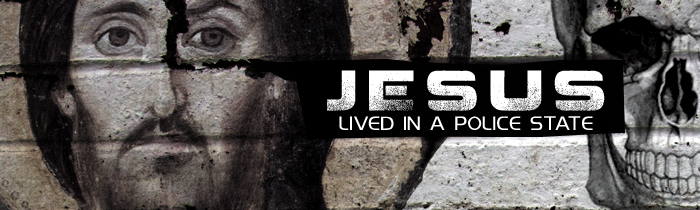
“There is no evidence that Jesus himself openly advocated violent actions. But he was certainly no pacifist. “Do not think that I have come to bring peace on earth. I have not come to bring peace, but the sword” (Matthew 10:34 | Luke 12:51).” ― Reza Aslan, Zealot: The Life and Times of Jesus of Nazareth

Those living through this present age of SWAT team raids, police shootings of unarmed citizens, roadside strip searches, and invasive surveillance might feel as if these events are unprecedented. Yet while we in the United States may be experiencing a steady slide into a police state, we are neither the first nor the last nation to do so.

Although technology, politics and superpowers have changed over time, the characteristics of a police state and its reasons for being have remained the same: control, power and money. Indeed, as I point out in my book A Government of Wolves: The Emerging American Police State, a police state extends far beyond the actions of law enforcement.  In fact, a police state “is characterized by bureaucracy, secrecy, perpetual wars, a nation of suspects, militarization, surveillance, widespread police presence, and a citizenry with little recourse against police actions.”

Just as police states have arisen throughout history, there have also been individuals or groups of individuals who have risen up to challenge the injustices of their age. Nazi Germany had its Dietrich Bonhoeffer. The gulags of the Soviet Union were challenged by Aleksandr Solzhenitsyn. America had its color-coded system of racial segregation and warmongering called out for what it was, blatant discrimination and profiteering, by Martin Luther King Jr.

And then there was Jesus Christ, an itinerant preacher and revolutionary activist, who not only died challenging the police state of his day—namely, the Roman Empire—but provided a blueprint for civil disobedience that would be followed by those, religious and otherwise, who came after him. Yet for all the accolades poured out upon Jesus, little is said about the harsh realities of the police state in which he lived and its similarities to modern-day America, and yet they are striking.

Secrecy, surveillance and rule by the elite. As the chasm between the wealthy and poor grew wider in the Roman Empire, the ruling class and the wealthy class became synonymous, while the lower classes, increasingly deprived of their political freedoms, grew disinterested in the government and easily distracted by “bread and circuses.” Much like America today, with its lack of government transparency, overt domestic surveillance, and rule by the rich, the inner workings of the Roman Empire were shrouded in secrecy, while its leaders were constantly on the watch for any potential threats to its power. The resulting state-wide surveillance was primarily carried out by the military, which acted as investigators, enforcers, torturers, policemen, executioners and jailers. Today that role is fulfilled by increasingly militarized police forces across the country.

Widespread police presence. The Roman Empire used its military forces to maintain the “peace,” thereby establishing a police state that reached into all aspects of a citizen’s life. In this way, these military officers, used to address a broad range of routine problems and conflicts, enforced the will of the state. Today SWAT teams, comprised of local police and federal agents, are employed to carry out routine search warrants for minor crimes such as marijuana possession and credit card fraud.

Citizenry with little recourse against the police state. As the Roman Empire expanded, personal freedom and independence nearly vanished, as did any real sense of local governance and national consciousness. Similarly, in America today, citizens largely feel powerless, voiceless and unrepresented in the face of a power-hungry federal government. As states and localities are brought under direct control by federal agencies and regulations, a sense of learned helplessness grips the nation.

Perpetual wars and a military empire. Much like America today with its practice of policing the world, war and an over-arching militarist ethos provided the framework for the Roman Empire, which extended from the Italian peninsula to all over Southern, Western, and Eastern Europe, extending into North Africa and Western Asia as well. In addition to significant foreign threats, wars were waged against inchoate, unstructured and socially inferior foes.

Martial law. Eventually, Rome established a permanent military dictatorship that left the citizens at the mercy of an unreachable and oppressive totalitarian regime. In the absence of resources to establish civic police forces, the Romans relied increasingly on the military to intervene in all matters of conflict or upheaval in provinces, from small-scale scuffles to large-scale revolts. Not unlike police forces today, with their militarized weapons and “shoot first, ask questions later” mindset, the Roman soldier had “the exercise of lethal force at his fingertips” with the potential of wreaking havoc on normal citizens’ lives.

A nation of suspects. Just as the American Empire looks upon its citizens as suspects to be tracked, surveilled and controlled, the Roman Empire looked upon all potential insubordinates, from the common thief to a full-fledged insurrectionist, as threats to its power. The insurrectionist was seen as directly challenging the Emperor.  A “bandit,” or revolutionist, was seen as capable of overturning the empire, was always considered guilty and deserving of the most savage penalties, including capital punishment. Bandits were usually punished publicly and cruelly as a means of deterring others from challenging the power of the state.  Jesus’ execution was one such public punishment.

Acts of civil disobedience by insurrectionists. Starting with his act of civil disobedience at the Jewish temple, the site of the administrative headquarters of the Sanhedrin, the supreme Jewish council, Jesus branded himself a political revolutionary. When Jesus “with the help of his disciples, blocks the entrance to the courtyard” and forbids “anyone carrying goods for sale or trade from entering the Temple,” he committed a blatantly criminal and seditious act, an act “that undoubtedly precipitated his arrest and execution.” Because the commercial events were sponsored by the religious hierarchy, which in turn was operated by consent of the Roman government, Jesus’ attack on the money chargers and traders can be seen as an attack on Rome itself, an unmistakable declaration of political and social independence from the Roman oppression.

Detail from Hans Holbein the Younger, The Passion of Christ (1524-25, Kunstmuseum, Basel)

Military-style arrests in the dead of night. Jesus’ arrest account testifies to the fact that the Romans perceived Him as a revolutionary. Eerily similar to today’s SWAT team raids, Jesus was arrested in the middle of the night, in secret, by a large, heavily armed fleet of soldiers.  Rather than merely asking for Jesus when they came to arrest him, his pursuers collaborated beforehand with Judas. Acting as a government informant, Judas concocted a kiss as a secret identification marker, hinting that a level of deception and trickery must be used to obtain this seemingly “dangerous revolutionist’s” cooperation.

Torture and capital punishment. In Jesus’ day, religious preachers, self-proclaimed prophets and nonviolent protesters were not summarily arrested and executed. Indeed, the high priests and Roman governors normally allowed a protest, particularly a small-scale one, to run its course. However, government authorities were quick to dispose of leaders and movements that appeared to threaten the Roman Empire. The charges leveled against Jesus—that he was a threat to the stability of the nation, opposed paying Roman taxes and claimed to be the rightful King—were purely political, not religious. To the Romans, any one of these charges was enough to merit death by crucifixion, which was usually reserved for slaves, non-Romans, radicals, revolutionaries and the worst criminals.

Jesus was presented to Pontius Pilate “as a disturber of the political peace,” a leader of a rebellion, a political threat, and most gravely—a claimant to kingship, a “king of the revolutionary type.” After Jesus is formally condemned by Pilate, he is sentenced to death by crucifixion, “the Roman means of executing criminals convicted of high treason.”  The purpose of crucifixion was not so much to kill the criminal, as it was an immensely public statement intended to visually warn all those who would challenge the power of the Roman Empire. Hence, it was reserved solely for the most extreme political crimes: treason, rebellion, sedition, and banditry. After being ruthlessly whipped and mocked, Jesus was nailed to a cross.

As Professor Mark Lewis Taylor observed:

The cross within Roman politics and culture was a marker of shame, of being a criminal. If you were put to the cross, you were marked as shameful, as criminal, but especially as subversive. And there were thousands of people put to the cross. The cross was actually positioned at many crossroads, and, as New Testament scholar Paula Fredricksen has reminded us, it served as kind of a public service announcement that said, “Act like this person did, and this is how you will end up.”

Jan Provoost, Crucifixion, 1500.

Jesus—the revolutionary, the political dissident, and the nonviolent activist—lived and died in a police state.Any reflection on Jesus’ life and death within a police state must take into account several factors: Jesus spoke out strongly against such things as empires, controlling people, state violence and power politics. Jesus challenged the political and religious belief systems of his day. And worldly powers feared Jesus, not because he challenged them for control of thrones or government but because he undercut their claims of supremacy, and he dared to speak truth to power in a time when doing so could—and often did—cost a person his life.

Unfortunately, the radical Jesus, the political dissident who took aim at injustice and oppression, has been largely forgotten today, replaced by a congenial, smiling Jesus trotted out for religious holidays but otherwise rendered mute when it comes to matters of war, power and politics. Yet for those who truly study the life and teachings of Jesus, the resounding theme is one of outright resistance to war, materialism and empire.

As Professor Taylor notes, “The power of Jesus is one that enables us to critique the nation and the empire. Unfortunately, that gospel is being sacrificed and squandered by Christians who have cozied up to power and wealth.” Ultimately, this is the contradiction that must be resolved if the radical Jesus—the one who stood up to the Roman Empire and was crucified as a warning to others not to challenge the powers-that-be—is to be an example for our modern age. — John W. Whitehead