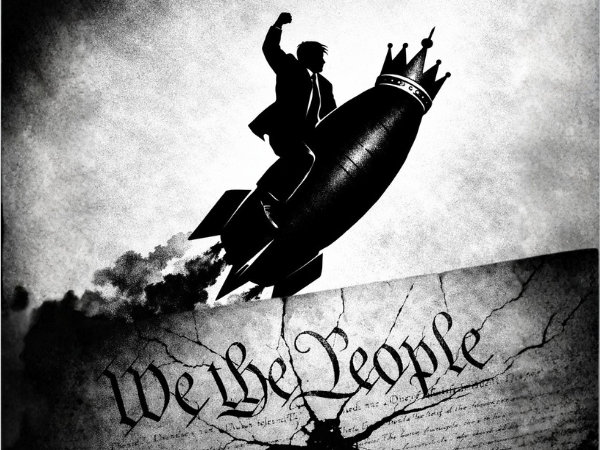
Posts Tagged ‘surveillance’

“He sees you when you’re sleeping.
He knows when you’re awake.
He knows if you’ve been bad or good,
So be good for goodness’ sake.”
   — “Santa Claus Is Coming to Town

For generations, “Santa Claus Is Coming to Town” has been treated as a playful reminder to children to be good because someone, somewhere, is watching.

Today, it reads less like a joke and more like a warning.

The Surveillance State is making a naughty list, and we’re all on it.

Long before Santa’s elves start loading his sleigh with toys for good girls and boys, the government’s surveillance apparatus is already at work—logging your movements, monitoring your messages, tracking your purchases, scanning your face, recording your license plate, and feeding it all into algorithmic systems designed to determine whether you belong on a government watchlist.

Unlike Santa’s naughty list, however, the consequences of landing on the government’s “naughty list” are far more severe than a stocking full of coal. They can include heightened surveillance, loss of privacy, travel restrictions, financial scrutiny, police encounters, or being flagged as a potential threat—often without notice, explanation, or recourse.

This is not fiction. This is not paranoia.

This is the modern surveillance state operating exactly as designed.

Santa Claus has long been the benign symbol of omniscient surveillance, a figure who watches, judges, and rewards. His oversight is fleeting, imaginary, and ultimately harmless.

The government’s surveillance is none of those things—and never was.

What was once dismissed as a joke—“Santa is watching”—has morphed into a chilling reality. Instead of elves, the watchers are data brokers, intelligence agencies, predictive algorithms, and fusion centers. Instead of a naughty-or-nice list, Americans are sorted into databases, risk profiles, and threat assessments—lists that never disappear.

The shift is subtle but profound.

Innocence is no longer presumed.

Everyone is watched. Everyone is scored. Everyone is a potential suspect.

This is the surveillance state in action.

Today’s surveillance state doesn’t require suspicion, a warrant, or probable cause. It is omnipresent, omniscient, and inescapable.

Your smartphone tracks your location. Your car records your movements. License plate readers log when and where you drive. Retail purchases create detailed consumer profiles. Smart speakers listen to everything you say. Home security cameras observe not just your property, but your neighbors, delivery drivers, and anyone who passes by.

The government’s appetite for data is insatiable.

In a dramatic expansion of surveillance reach, the Transportation Security Administration now shares airline passenger lists with Immigration and Customs Enforcement, enabling ICE to identify and arrest travelers at airports based on immigration status.

In one incident, ICE arrested and immediately deported a college student with no criminal record who was flying home to spend Thanksgiving with her family.

What was once routine aviation security data has been transformed into an enforcement tool—merging civilian travel records with the machinery of deportation and demonstrating how ordinary movements can be weaponized by the state.

Even the most personal acts—like Christmas shopping—are now tracked in real time. Every item you buy, where you buy it, how you pay, and who you buy it for becomes part of a permanent digital record. That data does not stay confined to retailers. It is shared, sold, aggregated, and folded into sprawling surveillance ecosystems that blur the line between corporate data collection and government intelligence.

Companies like Palantir specialize in fusing these data streams into comprehensive behavioral profiles, linking financial activity, social media behavior, geolocation data, and government records into a single, searchable identity map.

The result is not merely a government that watches what you’ve done but one that claims the power to predict what you will do next.

It is a short step from surveillance to pre-crime.

While predictive policing and AI-driven risk assessments are marketed as tools of efficiency and public safety, in reality, they represent a dangerous shift from punishing criminal acts to policing potential behavior.

Algorithms—trained on historical data already shaped by over-policing, bias, and inequality—are now used to predict who might commit a crime, who might protest, or who might pose a “risk.” Even the way you drive—where you came from, where you were going and which route you took—is being analyzed by predictive intelligence programs for suspicious patterns that could get you flagged and pulled over.

Once flagged by an algorithm, individuals often have no meaningful way to challenge the designation. The criteria are secret. The data sources opaque. The decisions automated.

Accountability disappears.

This isn’t law enforcement as envisioned by the Founders. This is pre-crime enforcement—punishing people not for what they’ve done, but for what an AI machine predicts they might do.

At the same time, President Trump has openly threatened states that attempt to regulate artificial intelligence in order to protect citizens from its discriminatory and intrusive uses—seeking to clear the way for unchecked, nationwide deployment of these systems.

No government initiative has done more to normalize, expand, and entrench mass surveillance than the Trump administration’s war on immigration.

The Trump administration’s war on immigration has become the laboratory for the modern surveillance state.

Under the guise of border security, vast stretches of the country have been transformed into Constitution-free zones—places where the Fourth Amendment is treated as optional and entire communities are subjected to constant monitoring.

The federal government has transformed immigration policy into a proving ground for authoritarian surveillance tactics—testing tools, technologies, and legal shortcuts could be deployed with minimal public resistance and quietly repurposed for use against the broader population. As journalist Todd Miller warned, these areas have been transformed into “a ripe place to experiment with tearing apart the Constitution, a place where not just undocumented border-crossers, but millions of borderland residents have become the targets of continual surveillance.”

Through ICE and DHS, the government fused immigration enforcement with corporate surveillance technologies—facial recognition, license-plate readers, cellphone tracking, and massive data-sharing agreements—creating a sprawling digital dragnet that now extends far beyond immigrants.

What began as a policy aimed at undocumented immigrants has now become a model for nationwide surveillance policing.

“What’s new,” reports the Brennan Center for Justice, “is that the federal government now openly says it will use its supercharged spy capabilities to target people who oppose ICE’s actions. Labeled as ‘domestic terrorists’ by the administration, these targets include anti-ICE protesters and anyone who allegedly funds them—all of them part of a supposed left-wing conspiracy to violently oppose the president’s agenda.”

The critical point is this: the surveillance infrastructure developed to track immigrants is now used to monitor everyone. Immigration enforcement served as the justification, the infrastructure, and the legal gray zone needed to create a permanent surveillance apparatus that treats all Americans as potential suspects.

All of this adds up to an algorithmic naughty list.

Government watchlists have exploded in size and scope.

Terrorist watchlists, no-fly lists, gang databases, protester tracking systems, and “suspicious activity” registries operate with little oversight and even less transparency.

People can be added to these lists without notification and can remain there indefinitely. Errors are common. Corrections are rare.

Social media posts are mined. Associations are mapped. Speech is scrutinized. Peaceful dissent is increasingly treated as a precursor to extremism.

The government’s watchlists aren’t just opaque databases hidden from public view. They are becoming public-facing instruments of political classification. Internal Justice Department memoranda now direct the FBI to compile lists of groups and networks it categorizes as possible domestic extremists, broadening counter-terror tools to sweep in ideological opponents and organizations without clear statutory definitions.

At the same time, the White House has launched an official “Offender Hall of Shame”—a public naughty list of journalists and media outlets it accuses of bias—even briefly circulating a video styled like Santa putting together a naughty list of offenders before deleting it amid backlash.

In this system, being “good” no longer means obeying the law. It means staying under the radar, avoiding attention, and never questioning authority.

The chilling effect is the point.

Once upon a time, privacy was recognized as a fundamental liberty—an essential buffer between the individual and the state. Today, it’s a conditional privilege, granted temporarily and revoked when it suits the police state’s purposes.

Under the banner of national security, public health, and law and order, surveillance powers continue to expand. Biometric identification—facial recognition, gait analysis, voice prints—are normalized.

What was once unthinkable has become routine.

Americans are being conditioned to accept constant monitoring as the price of safety. That resistance is suspicious. That anonymity is dangerous.

Yet history teaches us the opposite: societies that normalize surveillance do not become safer—they become more authoritarian.

A government that sees everything, everywhere, all the time, will eventually control everything.

The Founders understood this. That is why they enshrined protections against unreasonable searches and unchecked power. They knew liberty couldn’t survive under constant surveillance.

When the government knows where you go, what you buy, what you say, who you associate with, and what you believe, freedom becomes conditional.

This Christmas, we might joke about Santa watching from the North Pole, but we should be far more concerned about the watchers much closer to home.

The surveillance state doesn’t take a holiday. It doesn’t sleep. It doesn’t forget. And it doesn’t forgive easily.

So you see, the question is not whether we are being watched. We are.

The question, as I make clear in my book Battlefield America: The War on the American People and in its fictional counterpart The Erik Blair Diaries, is whether we will continue to accept a system that treats every citizen as a suspect—and whether we will reclaim the constitutional limits that once stood between liberty and the all-seeing state.

Source: https://tinyurl.com/yc6cmv9m

ABOUT JOHN W. WHITEHEAD

Constitutional attorney and author John W. Whitehead is founder and president of The Rutherford Institute. His most recent books are the best-selling Battlefield America: The War on the American People, the award-winning A Government of Wolves: The Emerging American Police State, and a debut dystopian fiction novel, The Erik Blair Diaries. Whitehead can be contacted at staff@rutherford.org. Nisha Whitehead is the Executive Director of The Rutherford Institute. Information about The Rutherford Institute is available at www.rutherford.org.

Publication Guidelines / Reprint Permission

John W. Whitehead’s weekly commentaries are available for publication to newspapers and web publications at no charge. 

“We the people are the rightful masters of both Congress and the courts, not to overthrow the Constitution but to overthrow the men who pervert the Constitution.”—Abraham Lincoln

We now live in a nation where constitutional rights exist in theory, not in practice.

Yet what good are rights on paper when every branch of government is allowed to ignore, circumvent, chip away at or hollow them out in practice?

Two hundred and thirty-four years after the ratification of the Bill of Rights on December 15, 1791, the safeguards meant to shield “We the people” from government abuse are barely recognizable.

In ways the Founders could scarcely have imagined—and would never have tolerated—the safeguards meant to restrain government overreach have become little more than empty platitudes.

America’s founders understood that power corrupts and absolute power—especially when it comes to power-hungry governments fixated on amassing institutional power at the expense of individual freedoms—corrupts absolutely. That’s why they insisted on binding down the government “with the chains of the Constitution.”

In 2025, those chains have been cut link by link.

These links were not severed in secret. They snapped under the weight of executive orders issued without congressional authority, judicial doctrines that shield misconduct from accountability, and a Congress that no longer defends its own constitutional prerogatives.

If Americans are finally learning the true significance of constitutional limits, it is because the government keeps violating them—and daring anyone to stop it. Time and again, the message is being drummed into our heads that constitutional limits no longer apply when they inconvenience those in power.

Any government that treats rights as privileges—contingent on economic status, citizenship, race, orientation, religious beliefs, or political alignment—has already abandoned the Bill of Rights.

And a government that does so with the courts’ blessing is not a constitutional republic.

When rights become privileges, what we are left with is a two-tier system of freedom: those afforded the privilege of enjoying their constitutional rights vs. those targeted for exercising those same rights.

The Bill of Rights was intended as a bulwark. Each amendment was drafted as a barrier against a specific form of tyranny.

In 2025, every one of those barriers buckled under the weight of government corruption, political expediency, partisan politics, and institutional neglect.

The following is what it looked like to live without the protections of the Bill of Rights in the American police state.

First Amendment—Speech Without Protection: In 2025, the right to speak freely was not guaranteed—it was conditional. Political activism—especially around immigration, foreign policy, or policing—was treated as a national security concern. Students questioning government actions found themselves on watchlists. ICE agents used ideology as cause for detention. Peaceful protest was conflated with domestic extremism.

This year also saw revelations—via leaked FBI planning documents—that the government is preparing an expanded “extremist” classification system that goes far beyond violence or criminal activity. The categories include broad ideological markers that include anyone expressing “opposition to law and immigration enforcement; extreme views in favor of mass migration and open borders; adherence to radical gender ideology,” as well as labels such as “anti-Americanism,” “anti-capitalism,” and “anti-Christianity.” In other words, Americans are being profiled not for what they have done, but for what the government predicts they might think, believe, or someday express. It is the architecture of a pre-crime state.

Second Amendment—The Right to Self-Defense in a Militarized Nation. While the political class fixated on culture-war debates over gun ownership, the government quietly expanded the militarization of policing, federalized National Guard units, and broadened executive authority to deploy armed agents domestically. During several high-profile ICE operations, heavily armed federal teams equipped with military-grade gear conducted raids in residential neighborhoods, making it clear that this administration intends to rule by martial law.

Third Amendment—Quartering Without Quarters: The Rise of Domestic Militarization. The Third Amendment is often dismissed as obsolete. Nothing could be further from the truth. Although Americans no longer face the literal quartering of soldiers in their homes, the spirit of the Third Amendment—prohibiting the use of the military against the civilian population—has been trampled. Its purpose was to prevent exactly what we are seeing now: a permanent, militarized presence in civilian life, illustrated vividly when armored vehicles and tactical teams patrol residential neighborhoods during ICE operations.

Fourth Amendment—Privacy Without Boundaries. The Framers wrote the Fourth Amendment in response to “general warrants”: broad, suspicionless searches by the British Crown. In 2025, the digital equivalents of general warrants have become routine, executed at the speed of an algorithm and justified by the flimsiest of standards. Americans now live under surveillance so pervasive that privacy survives mostly in legal theory. In several cities, entire apartment complexes were subjected to geofence dragnets after minor incidents, sweeping innocent residents into criminal databases simply because their phones were nearby. Geofence warrants became routine, sweeping up location data from entire neighborhoods. Predictive policing tools—fueled by Palantir-style data fusion—were treated as legitimate substitutes for suspicion or probable cause. And the Supreme Court keeps lowering the threshold for intrusion.

Fifth & Sixth Amendments—Due Process Without Process. What we have seen emerge this year is a justice system where the government is accountable only to itself. Immigration courts—already overcrowded and under-resourced—operated as Constitution-lite tribunals where counsel was scarce, evidence was opaque, and the presumption of innocence evaporated. Executive detention powers continued to expand under the radar, with little oversight. Due process now bends to government expediency. For example, asylum seekers placed into “expedited removal” proceedings were denied meaningful hearings, legal counsel, or the ability to present evidence—procedures that would never withstand constitutional scrutiny in any ordinary court of law. In some instances, hearings lasted less than ten minutes. In others, decisions were issued without the accused ever speaking to a lawyer. This is not due process. It is bureaucracy masquerading as justice.

Seventh Amendment—Civil Justice Denied by Design. The right to a civil jury trial—already inaccessible for many—continued to erode in 2025, keeping ordinary Americans from ever getting their day in court, while corporations and government agencies enjoy legal shields that no ordinary citizen can penetrate. A right that exists only in theory—and which you cannot afford to exercise—is a right that has already been lost.

Eighth Amendment—Justice Without Humanity. Cruelty, once hidden, has now been codified as policy. The federal government allocated $170 billion to expand incarceration, including the construction of Alligator Alcatraz, the first of several planned megaprison complexes. The Kilmar Garcia case exposed the brutality of a system where preventable death, medical neglect, and inhumane conditions are treated as regrettable but acceptable collateral. In one widely reported incident, a detainee held on a nonviolent immigration violation died after being denied medical care for hours—a tragedy officials dismissed as “procedurally compliant,” revealing just how low the bar has fallen. These incidents are not anomalies. They are symptoms of a system designed for maximum control and minimum accountability, a system where cruelty is not an accident but an administrative outcome.

Ninth Amendment—Unenumerated Rights Crushed by Government Power. The Ninth Amendment affirms that the people retain rights beyond those listed in the Constitution. In 2025, those inherent liberties—bodily autonomy, privacy, freedom of movement, freedom from government coercion—were repeatedly undermined. Biometric surveillance was expanded. Predictive analytics categorized individuals as pre-criminal. Mandatory data-sharing regimes blurred the boundary between state and citizen. Bodily autonomy came under attack through proposed health-tracking mandates.

The Ninth Amendment’s warning has never been more relevant: the rights of the people do not end where the government’s imagination begins.

Tenth Amendment—Powers Reserved to the People Swept Aside. Federal overreach dominated 2025. Executive orders, emergency declarations, and federalized law enforcement displaced state and local authority. The Tenth Amendment’s guarantee that powers not delegated to the federal government are reserved to the states—or to the people—has become meaningless under a system in which the executive branch claims inherent authority to:

  • deploy troops domestically,
  • commandeer local police,
  • surveil the populace, and
  • dictate immigration enforcement priorities.

When states attempted to challenge the federal deployment of troops or resist federalized policing mandates, the courts largely sided with the executive, leaving states with little more than symbolic sovereignty.

A government that disregards the Bill of Rights rarely stops there.

The collapse of the Bill of Rights would be alarming enough on its own, but it is only part of the story. Beyond these first ten amendments, the structural safeguards designed to limit government power—the separation of powers, checks and balances, transparency, and federalism—were also weakened dramatically.

Without an independent judiciary willing to restrain power, the founders recognized that the entire constitutional framework would collapse.

What we continue to witness is the U.S. Supreme Court’s abdication of its constitutional duties in favor of partisan politics. By refusing to review cases that cut to the heart of constitutional protections, the Court has effectively signaled to the executive branch that there is no constitutional line it cannot cross.

While the Supreme Court is not the only institution responsible for upholding the Constitution, when the Court refuses to act as a check on government power, every American suffers.

A constitutional crisis does not always erupt in dramatic fashion.

Sometimes it arrives quietly, in the form of a Court that declines to hear the very cases that would determine whether the Constitution still has meaning.

Here is what it means to live under the Constitution today.

For generations, Americans were taught that living under the Constitution meant:

  • The government cannot enter your home without a warrant.
  • The government cannot silence you for criticizing its actions.
  • The government cannot surveil you without probable cause.
  • The government cannot imprison you without due process.
  • The government cannot treat you as guilty until proven innocent.
  • The government cannot deploy troops against the public unless the Constitution expressly allows it.
  • The government cannot classify you as a threat solely for your beliefs.

Now consider what it means to live under the American Police State of 2025:

  • Your digital life is a government search zone.
  • Your speech can place you on a watchlist.
  • Your movements are tracked without a warrant.
  • Your property can be seized without meaningful judicial review.
  • Your community can be subjected to predictive policing algorithms with no oversight.
  • Your rights depend on which legal category you fall into.
  • And the courts increasingly refuse to intervene.

The gap between the promise of a constitutional republic and the practice of the American Police State has grown so vast that the rights Americans take for granted no longer resemble the realities they face in their daily lives.

America’s founders assumed the people—not the president, not the politicians, not the courts—would be the ones to keep the government in check.

What the police state wants is for us to meekly accept its constitutional violations as normal, inevitable, or justified. That complacency fuels and sustains tyranny.

We cannot afford to be complacent.

If Americans want a government bound by law, we must insist on it—daily, loudly, relentlessly and without apology or fear.

As I make clear in my book Battlefield America: The War on the American People and in its fictional counterpart The Erik Blair Diaries, the Constitution will not collapse all at once. It will erode one unchallenged abuse at a time—until future generations wonder how the people who inherited a framework for liberty allowed it to slip through their fingers.

If 2025 was the year the Constitution became optional, 2026 will determine whether it becomes obsolete.

Source: https://tinyurl.com/mvses7du

ABOUT JOHN W. WHITEHEAD

Constitutional attorney and author John W. Whitehead is founder and president of The Rutherford Institute. His most recent books are the best-selling Battlefield America: The War on the American People, the award-winning A Government of Wolves: The Emerging American Police State, and a debut dystopian fiction novel, The Erik Blair Diaries. Whitehead can be contacted at staff@rutherford.org. Nisha Whitehead is the Executive Director of The Rutherford Institute. Information about The Rutherford Institute is available at www.rutherford.org.

Publication Guidelines / Reprint Permission

John W. Whitehead’s weekly commentaries are available for publication to newspapers and web publications at no charge. 

“Hold on, my friends, to the Constitution and to the Republic for which it stands. Miracles do not cluster, and what has happened once in 6000 years, may not happen again. Hold on to the Constitution, for if the American Constitution should fail, there will be anarchy throughout the world.”—Daniel Webster

We find ourselves approaching that time of year when, as George Washington and Abraham Lincoln proclaimed, we’re supposed to give thanks as a nation and as individuals for our safety and our freedoms.

It’s not an easy undertaking.

The contrast between George Washington’s first Thanksgiving proclamation and the state of the nation today reveals how far we have drifted—and how low we have fallen—since Washington called upon early Americans (a nation of immigrants) to give thanks for a government that protected their safety and happiness, and for a Constitution designed to safeguard civil and religious liberty.

But how do you give thanks for freedoms that are constantly being eroded?

How do you express gratitude for one’s safety when the perils posed by the American police state grow more treacherous by the day?

How do you come together as a nation in thanksgiving when the powers-that-be continue to polarize and divide us into warring factions?

To our collective misfortune, we have been saddled with a government that is a far cry from Washington’s vision: governed by wise, just, constitutional laws; faithfully executed by principled public servants; promoting peace, virtue, and liberty; and fostering the prosperity of the nation.

Instead, the U.S. government has become a warring empire: lawless in its ambitions, militarized in its posture, abusive in its policing, and increasingly hostile to conscience, truth, and constitutional limits.

Washington never intended Thanksgiving to be a day of glib platitudes—a moment to be grateful for whatever crumbs the government chooses to bestow upon us. He intended it to be a day of reflection, honesty, and moral accounting, a day when the nation examines its failures, acknowledges its wrongs, and commits to restoring liberty in the year ahead.

If Thanksgiving is to mean anything in times such as these, it must also compel us to speak plainly about the forces that threaten our freedom. Giving thanks for our blessings requires the courage to say “no thanks” to the very forces working to strip away the blessings we claim to celebrate.

In that true spirit of Thanksgiving, here is a sobering list of things for which we should not give thanks in this age of the American police state.

Say “no thanks” to oligarchy and self-serving, pay-to-play politics. A pay-to-play culture now permeates the highest levels of government, dominated by a mindset that money—not law—defines the boundaries of power. America is being bought and sold by corporate elites and political cronies. “We the People” have been pushed into a permanent underclass, ruled by a political machine that monetizes every aspect of governance—surveillance, policing, incarceration, immigration enforcement, even war itself. Our elected officials increasingly represent the interests of the wealthy and well-connected rather than the rights and needs of the citizenry. This is oligarchy masquerading as representative government.

Say “no thanks” to an imperial presidency that rules by fiat. Executive power has metastasized into something the Framers would not recognize. In 2025 alone, we have seen:

• sweeping executive orders redefining law without Congress’ oversight or approval,
• federal agencies weaponized against political enemies,
• unilateral decisions to deploy federal troops domestically,
• and attempts to redefine constitutional rights by proclamation.

Whether the occupant of the Oval Office is a Republican or Democrat, the result is the same: presidents now behave as lawmakers, judges, and enforcers combined — a constitutional impossibility and a recipe for dictatorship. The Founders warned us plainly: when one person claims the authority to rule by decree, liberty is already in mortal danger.

Say “no thanks” to martial law and standing armies used against the American people. What once would have been unthinkable is now routine. National Guard units have been federalized to police protests. Tactical teams roam American streets outfitted like combat forces. A generation of Americans is growing up under the shadow of armored vehicles and militarized responses to ordinary civil unrest. This year’s federal deployments in California and elsewhere following ICE raids—justified by vague claims of “restoring order”—are only the latest sign. A government comfortable using soldiers against its own citizens is a government that has abandoned the constitutional line between civilian authority and military force.

Say “no thanks” to the government’s fear tactics. Fear is the oldest tool of tyranny. We have seen fear weaponized to justify:

• speech crackdowns,
• “domestic threat” watchlists,
• expanded surveillance authorities,
• “emergency powers” without end,
• and the rounding up of vulnerable populations under the guise of safety.

From mental-health “round-ups” to demands that soldiers obey unlawful commands without question, fear has become the operating currency of government power. When the people are afraid, they can be controlled. When one’s right to conscience is criminalized, that conscience can be silenced.

Say “no thanks” to endless wars. For more than two decades, the U.S. has been mired in endless wars without clear objectives, limits, or endpoints. The war footing has become perpetual—an unbroken justification for secrecy, surveillance, militarization, and unchecked executive power. Wars abroad have consequences at home: they brutalize our politics, exhaust our populace, expand federal power, and normalize the idea that violence—rather than diplomacy, law, or liberty—is the default solution for national problems.

Say “no thanks” to everywhere wars. When government can label anyone, anywhere, an “enemy” in order to wage war, we are all in danger. That danger is no longer theoretical. In the same breath that the administration touts lethal military strikes against Venezuelan boats in Caribbean waters, federal agents are conducting coordinated militarized raids on communities across the country. The lesson to be learned: a nation permanently on war footing eventually turns its war machinery inward.

Say “no thanks” to the transformation of domestic police into extensions of the military.  For decades, billions in Pentagon gear—tanks, drones, armored carriers, battlefield weapons — have been funneled to local police under the 1033 military surplus program. Training once reserved for war zones has become standard for domestic policing. The results are unmistakable:

• SWAT raids for routine warrants,
• trigger-happy policing,
• a “kill or be killed” mentality,
• and communities patrolled like occupied territories.

The police are no longer peace officers. They are an occupying force.

Say “no thanks” to ICE raids that trample constitutional rights and terrorize communities. What began as an agency tasked with immigration enforcement has mutated into something far darker: a roaming domestic strike force. ICE’s quota-driven model incentivizes arrests at all costs, creating a bounty-hunter culture in which constitutional rights are obstacles, not guarantees. From coast to coast, ICE goon squads—incognito, thuggish, fueled by profit-driven incentives and outlandish quotas, and empowered by the Trump administration to act as if they are untouchable—are prowling neighborhoods, churches, courthouses, hospitals, bus stops, and worksites, anywhere “suspected” migrants might be present, snatching people first and asking questions later. No one is off limits—not even American citizens.

Say “no thanks” to a government mindset that seeks to transform the nation into a prison state. From the creation of Alligator Alcatraz to the administration’s $170 billion plan for megaprisons, the U.S. incarceration system is being expanded at breakneck speed. Combined with predictive enforcement, surveillance dragnets, and limits on due process, the United States is rapidly becoming a prison state — one that cages not only bodies, but autonomy, dissent, and opportunity.

Say “no thanks” to a surveillance state that has become a fourth branch of government.  We now live in a world in which everything—your words, your purchases, your location, your associations—is recorded, stored, and weaponized by the government and its corporate partners in crime. The surveillance state watches, catalogs, and predicts everything we do. This year alone has seen the normalization of:

• Palantir-powered national tracking systems,
• AI threat-scoring of ordinary Americans,
• geofence warrants turning whole neighborhoods into suspects,
• biometric mandates proposed as “public health tools,”
• and the creation of federal databases of “pre-crime indicators.”

Say “no thanks” to a government that punishes the poor. 2025 has brought a brutal resurgence of debtors’ courts, cash-bail coercion, poverty penalties, and retaliatory prosecutions. The criminal legal system has become a two-tiered caste structure—harsh for the poor, lenient for the powerful.

Say “no thanks” to policies that muzzle dissent. Whistleblowers, journalists, activists, and critics continue to find themselves targeted for speaking truth to power. In a climate where thought crimes and “dangerous ideas” are policed, those who criticize the government are increasingly being portrayed as traitors and subjected to investigation and prosecution.

Say “no thanks” to courts that rubber-stamp government power. Time and again, the courts have chosen order over justice, secrecy over transparency, and government power over constitutional rights—refusing to rein in geofence warrants, no-knock raids, military deployments, or the ever-expanding surveillance state.

Say “no thanks” to a government that criminalizes the rights enshrined in the Constitution. Perhaps the most alarming development of all is the growing chorus of political voices calling for the arrest—even the execution—of those who urge members of the military to follow their conscience and refuse unlawfulunconstitutional orders. Let us be clear: the American military’s oath is to the Constitution—not to any president, political agenda, or unlawful order. Anyone who suggests otherwise should be court-martialed.

Say “no thanks” to government theft disguised as fines, fees, taxes, and forfeitures. When the government can seize your home, your car, your money, or your property without due process, you are no longer a free citizen—you are a subject. Asset forfeiture, civil penalties, red-light cameras, code-enforcement schemes, and debt-trap fines have turned the government at all levels into a predatory revenue machine. The line between public property and private property has vanished. This is legalized theft.

At some point, we’ve got to face up to the uncomfortable truth that freedom is slipping through our fingers, and that the government now poses a greater threat to our safety than any outside force ever could.

We cannot keep pretending that “it can’t happen here” while it is happening all around us.

There comes a point at which no people—not even a patient, hopeful, long-suffering people—can continue pretending that the crumbs of liberty left to them constitute freedom.

Thanksgiving is supposed to remind us of our blessings. But it is also meant to remind us of our responsibilities.

A free people must do more than count their blessings.

We must guard them. We must assert them. We must defend them—even when doing so is dangerous, costly, or unpopular.

There is still time to turn back from the brink, but the hour is late.

If we want future generations to enjoy even a measure of the freedom we inherited, then “We the People” must refuse to go quietly into the machinery of the police state.

We must refuse to be governed by fear.

We must refuse to surrender our rights for the illusion of safety.

And we must refuse to bow to those who insist that conscience is treason and obedience is the highest virtue.

The Founders gave us a constitutional republic on the condition that we fight to keep it. That responsibility cannot be outsourced to politicians, courts, or parties. It rests squarely with the people themselves, with those who refuse to surrender conscience, rights, or truth to the demands of tyrants.

As I make clear in my book Battlefield America: The War on the American People and in its fictional counterpart The Erik Blair Diaries, the only force strong enough to restrain government overreach is an informed, engaged, and courageous citizenry that will not trade its birthright for the hollow comforts of authoritarianism.

The future of freedom depends not on presidents or parties but on “We the People”—ordinary individuals who refuse to be silent, refuse to be intimidated, and refuse to give up on the promise of America.

So this Thanksgiving, let us give thanks. But let us also say—with clarity and conviction—no thanks to tyranny, in whatever form it takes.

Source: https://tinyurl.com/3z6wd9wz

ABOUT JOHN W. WHITEHEAD

Constitutional attorney and author John W. Whitehead is founder and president of The Rutherford Institute. His most recent books are the best-selling Battlefield America: The War on the American People, the award-winning A Government of Wolves: The Emerging American Police State, and a debut dystopian fiction novel, The Erik Blair Diaries. Whitehead can be contacted at staff@rutherford.org. Nisha Whitehead is the Executive Director of The Rutherford Institute. Information about The Rutherford Institute is available at www.rutherford.org.

Publication Guidelines / Reprint Permission

John W. Whitehead’s weekly commentaries are available for publication to newspapers and web publications at no charge. 

“When they came in the middle of the night, they terrorized the families that were living there. There were children who were without clothing, they were zip tied, taken outside at 3 o’clock in the morning. A senior resident, an American citizen with no warrants, was taken outside and handcuffed for three hours. Doors were blown off their hinges, walls were broken through, immigration agents coming from Black Hawk helicopters … This is America.”—Chicago Mayor Brandon Johnson

When the government can label anyone or anything an enemy in order to wage war, we are all in danger.

That danger is no longer theoretical.

In the same breath that the administration touts lethal military strikes against Venezuelan boats in Caribbean waters, federal agents are conducting coordinated militarized raids on homes in Chicago, rappelling down on apartment buildings from Black Hawk helicopters, dragging families out of their homes, separating children from their parents, and using zip ties to immobilize them—even citizens.

The message—spoken and unspoken—is that the government is on a war footing everywhere: abroad, at sea, and now at our front doors.

This “everywhere war” depends on a simple redefinition: call it a war, and the target becomes a combatant. Call the city a battlespace, and its residents become suspects.

What the White House is doing overseas to vessels it deems part of a terrorist network (without any credible proof or due process), it is now mimicking at home with door-kicking raids, mass surveillance, and ideological watchlists.

With the stroke of a pen, President Trump continues to set aside the constitutional safeguards meant to restrain exactly this kind of mission creep, handing himself and his agencies sweeping authority to disregard the very principles on which this nation was founded—principles intended to serve as constitutional safeguards against tyranny, corruption, abuse and overreach put in place by America’s founding fathers.

Take National Security Presidential Memorandum 7 (NSPM-7), for example.

NSPM-7 directs a government-wide campaign to “investigate,” “disrupt,” and “dismantle” so-called domestic threats, ordering agencies to pool their data, resources, and operations in service of this agenda.

What makes NSPM-7 so dangerous is not only its declared purpose but its breadth and secrecy. There are no clearly defined standards, no meaningful transparency, and no external oversight. The public is told only that the government will protect them—by watching them.

Yet the danger is not only in what the government hides, but in what it chooses to see.

Even more troubling is the way “threats” are defined.

What is being sold as a campaign to disrupt left-wing conspiracies has expanded to include ideology, rhetoric, and belief.

Clearly, this is not just another surveillance program.

NSPM-7 is a framework for rebranding dissent as a danger to be quashed.

The government has a long history of using vague definitions of “extremism” to justify ever-expanding control. Once dissent is rebranded as danger, every act of resistance can be swept into the government’s dragnet.

Whether through counterinsurgency tactics abroad or domestic militarization at home, the pattern is the same: dissent is rebranded as danger, and those who resist government narratives become subjects of investigation.

NSPM-7 merely formalizes this cycle of suspicion.

It also resurrects an old playbook with new machinery—COINTELPRO, digitized and centralized. The tools may be different, but the logic—neutralize dissent—is the same, now scaled up with modern surveillance and stitched together under executive direction. From there, the apparatus needs only a pretext—a checklist of behaviors, viewpoints, associations and beliefs—to justify recasting citizens as suspects.

For years now, the government has flagged certain viewpoints and phrases as potential markers of extremism.

To that list, you can now add “anti-Christian,” “anti-capitalist,” and “anti-American,” among others.

What this means, in practice, is that sermons, protests, blog posts, or donor lists could all be flagged as precursors to terrorism.

Under this policy, America’s founders would be terrorists. Jesus himself would be blacklisted as “anti-Christian” and “anti-capitalist.”

Anything can be declared a war, and anyone can be redefined as an enemy combatant.

The definition shifts with political convenience, but the result is always the same: unchecked executive power.

The president has already labeled drug cartels “unlawful combatants” and insists the United States is in a “non-international armed conflict.”

The raids in Chicago and the White House’s evolving attitude towards surveillance confirm what follows from that logic: this war footing is not confined to foreign shores. It is being turned inward—toward journalists, political opponents, and ordinary citizens whose beliefs or associations are deemed “anti-American.”

By anti-American, this administration really means anti-government, especially when Trump is calling the shots.

According to local news reports, agents arrived in Black Hawk helicopters, trucks and military-style vans, using power tools to breach perimeter fencing, destroying property to gain entry, and zip-tying family members—including children—as they were separated and escorted from the building.

The imagery is unmistakably martial: a domestic operation staged and executed with battlefield methods.

This “everywhere war” lands on a country already saturated with domestic watchlists and dragnet filters.

Federal agencies have leaned on banks and data brokers to run broad, warrantless screens of ordinary Americans’ purchases and movements for so-called “extremism” indicators—everything from buying religious materials to shopping at outdoor stores or booking travel—none of which are crimes.

The point isn’t probable cause; it’s preemptive suspicion.

At the same time, geofence warrants and other bulk location grabs have exposed who went where and with whom—scooping up churchgoers, hotel guests, and passersby across entire city blocks—while a sprawling web of fusion and “real-time crime” centers ingests camera feeds, social posts, license-plate scans, facial recognition, and predictive-policing scores to flag “persons of interest” who have done nothing wrong.

This is how dissent gets relabeled as danger: by surrounding every American with the presumption of guilt first, and constitutional safeguards—if any—much later.

When merely looking a certain way or talking a certain way or voting a certain way is enough to get you singled out and subjected to dehumanizing, cruel treatment by government agents, we are all in danger.

When the president of the United States and his agents threaten to “intimidate, demoralize, hunt and kill the enemies of our country”—i.e., those who don’t comply with the government’s demands, we are all in danger.

When the police state has a growing list of innocuous terms and behaviors that are suspicious enough to classify someone a terrorist, we are all in danger.

Today it is drug cartels. Yesterday it was immigrants. Tomorrow it could be journalists, political opponents, or ordinary citizens who express views deemed “anti-American.”

With NSPM-7, the Trump White House is not merely amplifying surveillance power—it is institutionalizing a regime in which thought, dissent, and ideological posture become the raw material for domestic investigations and suppression.

Make no mistake: this is an unprecedented escalation in the government’s war on privacy, dissent, and constitutional limits.

Consider the secret phone-records dragnet operated for more than a decade across multiple administrations—formerly “Hemisphere,” now “Data Analytical Services.”

By paying AT&T and exploiting privacy loopholes, the government has gained warrantless access to more than a trillion domestic call records a year, sweeping in not only suspects but their spouses, parents, children, friends—anyone they might have called. Training on the program has reportedly reached beyond drug agents to postal inspectors, prison officials, highway patrol, border units, and even the National Guard.

This is how a surveillance apparatus becomes a governing philosophy.

A presidency armed with NSPM-7 can fuse that kind of dragnet data with interagency “threat” frameworks and ideological watchlists, collapsing the wall between intelligence gathering and political control.

This is how tyrants justify tyranny in order to stay in power.

This is McCarthyism in a digital uniform.

Joseph McCarthy branded critics as Communist infiltrators. Donald Trump brands enemies as “combatants.”

The mechanism is the same: redefine dissent as treachery, then prosecute it under extraordinary powers.

For those old enough to have lived through the McCarthy era, there is a whiff of something in the air that reeks of the heightened paranoia, finger-pointing, fear-mongering, totalitarian tactics that were hallmarks of the 1950s.

Back then, it was the government—spearheaded by Senator McCarthy and the House Un-American Activities Committee—working in tandem with private corporations and individuals to blacklist Americans suspected of being communist sympathizers.

By the time the witch hunts drew to a close, thousands of individuals (the vast majority innocent of any crime) had been accused of communist ties, investigated, subpoenaed, and blacklisted. Careers were ruined, suicides followed, immigration tightened, and free expression chilled.

Seventy-five years later, the same vitriol, fear-mongering, and knee-jerk intolerance are once again being deployed against anyone who dares to think for themselves.

All the while, the American police state continues to march inexorably forward.

This is how fascism, which silences all dissenting views, prevails.

The silence is becoming deafening.

What is unfolding is the logical culmination of years of bipartisan betrayals of the Bill of Rights, from the Cold War to the digital panopticon

What once operated in the shadows of intelligence agencies is now openly coordinated from the Oval Office.

For decades, presidents of both parties have waged a steady assault on the Constitution. Each crisis—Cold War, 9/11, pandemic—became an excuse to concentrate more power in the executive branch.

The Patriot Act normalized warrantless surveillance. The FISA courts gave secret cover for dragnet spying. The NSA’s metadata sweeps exposed millions of Americans’ phone records. Predictive policing and geofencing warrants turned smartphones into government informants.

Each measure, we were told, was temporary, limited, and necessary. None were rolled back. Each became the foundation for the next expansion.

Against this backdrop, NSPM-7 emerges as the next, more dangerous iteration.

What distinguishes it is not merely scale but centralization: the government has moved from piecemeal encroachments to a bold, centralized framework in which the White House claims the prerogative to oversee surveillance across agencies with virtually no external checks.

Oversight by Congress and the courts is reduced to a fig leaf.

This is how liberties die: not with a sudden coup, but with the gradual normalization of extraordinary powers until they are no longer extraordinary at all.

It is the embodiment of James Madison’s nightmare: the accumulation of all powers, legislative, executive, and judicial, in the same hands.

From red-flag seizures and “disinformation” hunts to mail imaging, biometric databases, license-plate grids, and a border-zone where two-thirds of Americans now live under looser search rules, the default has flipped: everyone is collectible, everyone is rankable, and everyone is interruptible.

That is how a free people become reduced to databits first and citizens as an afterthought.

The constitutional stakes couldn’t be higher.

The Fourth Amendment promises that people shall be secure against unreasonable searches and seizures. That promise is empty if the President can authorize the government to sweep up data, monitor communications, and track movements without individualized warrants or probable cause.

The First Amendment protects freedom of speech, association, and press. Those protections mean little if journalists fear their calls are tapped, if activists believe their networks are infiltrated, or if citizens censor themselves out of fear.

Separation of powers itself is on the line. By directing surveillance policy across government without legislative debate or judicial review, the White House is usurping authority never meant to rest in a single set of hands.

The risks are not hypothetical.

COINTELPRO targeted civil rights leaders and dissidents. The NSA’s bulk collection swept up millions of innocents. Fusion centers today track and analyze daily life.

What was once shocking—the idea that the government might listen in on every phone call or sift through every email—is now treated as the price of living in modern America.

If those older, less centralized programs were abused, why would NSPM-7—with broader reach and weaker oversight—be any different?

This is not speculation. We have seen this progression before.

In 2009, the Department of Homeland Security issued reports on so-called “rightwing extremism” that swept broadly across the ideological spectrum. Economic anxiety, anti-immigration views, gun rights advocacy, even the military service of returning veterans were flagged as potential red flags for extremism.

The backlash was immediate, and DHS was forced to walk back the report, but the damage was done: dissenting views had been equated with dangerous plots.

That same playbook now risks becoming institutionalized under NSPM-7, which consolidates ideological profiling into a White House-directed mandate.

Imagine a journalist investigating corruption within the administration. Under NSPM-7, their sources and communications could be quietly monitored.

Imagine a nonprofit advocating for immigration reform. Its donors and staff could be swept into a database of “domestic threats.”

Imagine an attorney representing a controversial client. Even attorney-client privilege, once considered sacrosanct, could be eroded under a regime that treats dissent as subversion.

These scenarios are not alarmist—they are logical extensions of a system that places no real limits on executive discretion.

With NSPM-7, the line between foreign and domestic surveillance blurs entirely, and every citizen becomes a potential target of investigation.

Unless “we the people” demand accountability, NSPM-7 will become the new normal, entrenched in the machinery of government long after this administration has passed.

We must insist that surveillance be subject to the same constitutional limits that govern every other exercise of state power. We must demand transparency. We must pressure Congress to reclaim its role and courts to enforce constitutional duty. Most of all, we must cultivate a culture of resistance.

The Bill of Rights is not self-executing; it depends on the vigilance of the citizenry.

Civil liberties groups have already sounded the alarm, warning that NSPM-7 authorizes government-wide investigations into nonprofits, activists, and donors. Law scholars call it a dangerous overreach, a program as vague as it is menacing. Even law firms, normally cautious about critiquing executive power, are voicing concern about the risks it poses to attorney-client privilege.

When so many diverse voices converge in warning, we should pay attention.

And yet warnings alone will not stop this juggernaut, because NSPM-7 is not simply about technology or data collection. It is about power—and how fear is weaponized to consolidate that power.

If we are silent now, if we allow NSPM-7 to pass unchallenged, we will have no excuse when the surveillance state tightens its grip further.

When ideas themselves become a trigger for surveillance, the First Amendment loses.

America has entered dangerous territory.

A government that answers only to itself is not a constitutional republic—it is a rogue state. And NSPM-7, far from securing our freedoms, threatens to extinguish them.

Unchecked power is unconstitutional power.

As U.S. District Judge Sparkle L. Sooknanan cautioned in a recent ruling: “The government’s arguments paint with a broad brush and threaten to upend fundamental protections in our Constitution. But ours is not an autocracy; it is a system of checks and balances.”

Those checks only function if we insist on them.

With congressional Republicans having traded their constitutional autonomy for a place in Trump’s authoritarian regime, the courts—and the power of the people themselves—remain the last hope for reining in this runaway police state.

Cognizant that a unified populace poses the greatest threat to its power grabs, the Deep State—having co-opted Trump and the MAGA movement—is doing everything it can to keep the public polarized and fearful.

This has been a long game.

The contagion of fear that McCarthy once spread with the help of government agencies, corporations, and the power elite never truly died; it merely evolved.

NSPM-7 is its modern form, and Trump a modern-day McCarthy.

That anyone would support a politician whose every move has become antithetical to freedom is mind-boggling, but that is the power of politics as a drug for the masses.

That anyone who claims to want to “Make America Great Again” would sell out the country—and the Constitution—to do so says a lot.

That judges, journalists and activists are being threatened for daring to hold the line against the government’s overreaches and abuses speaks volumes.

One of Trump’s supporters sent an anonymous postcard to Judge William G. Young, a Reagan appointee assigned to a case challenging the Trump administration’s effort to deny full First Amendment protection to non-citizens lawfully present in the United States. The postcard taunted: “Trump has pardons and tanks… What do you have?

Judge Young opened his opinion with a direct reply: “Dear Mr. or Ms. Anonymous, Alone, I have nothing but my sense of duty. Together, We the People—you and me—have our magnificent Constitution. Here’s how that works in a specific case.”

The judge then proceeded to issue a blistering 161-page opinion that hinges on the language of the First Amendment: “Congress shall make no law respecting an establishment of religion, or prohibiting the free exercise thereof; or abridging the freedom of speech, or of the press; or the right of the people peaceably to assemble, and to petition the Government for a redress of grievances.”

“No law” means “no law,” concluded Judge Young,

In other words, the First Amendment is not negotiable.

Non-citizens lawfully present in the United States “have the same free speech rights as the rest of us.”

This is the constitutional answer to NSPM-7’s everywhere-war logic.

When a president declares anything a battlefield and anyone a combatant, the First Amendment answers back: No law means no law.

It is not a permission slip the government can offer only to favored citizens or compliant viewpoints. It is a boundary the government may not cross.

So the question returns to us, the ones Judge Young addressed: “What do we have, and will we keep it?”

We have a constitutional republic, and we keep it by holding fast to the Constitution.

We keep it by refusing the normalization of the Executive Branch’s extraordinary overreaches and power grabs.

We keep it by insisting that dissent is not danger, speech is not suspicion, and watchlists are not warrants.

We keep it by demanding congressional oversight with teeth, courts that enforce first principles, and communities that resist fear when fear is used to rule.

In closing, Judge Young quoted Ronald Reagan’s warning, issued in 1967: “Freedom is a fragile thing and it’s never more than one generation  away from extinction. It is not ours by way of inheritance; it must be fought for and defended constantly by each generation, for it comes only once to a people.”

Reagan’s words would be flagged under NSPM-7, but it doesn’t change the challenge.

As I make clear in my book Battlefield America: The War on the American People and in its fictional counterpart The Erik Blair Diaries, the hard work of defending freedom rests as always with “we the people.”

Let’s get to it.

Source: https://tinyurl.com/yc6c7af3

ABOUT JOHN W. WHITEHEAD

Constitutional attorney and author John W. Whitehead is founder and president of The Rutherford Institute. His most recent books are the best-selling Battlefield America: The War on the American People, the award-winning A Government of Wolves: The Emerging American Police State, and a debut dystopian fiction novel, The Erik Blair Diaries. Whitehead can be contacted at staff@rutherford.org. Nisha Whitehead is the Executive Director of The Rutherford Institute. Information about The Rutherford Institute is available at www.rutherford.org.

Publication Guidelines / Reprint Permission

John W. Whitehead’s weekly commentaries are available for publication to newspapers and web publications at no charge.
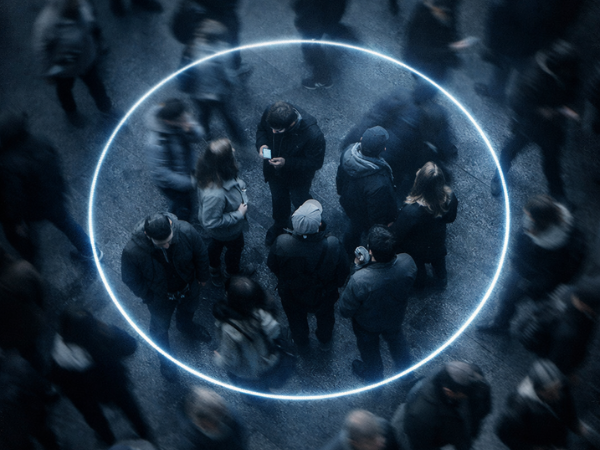
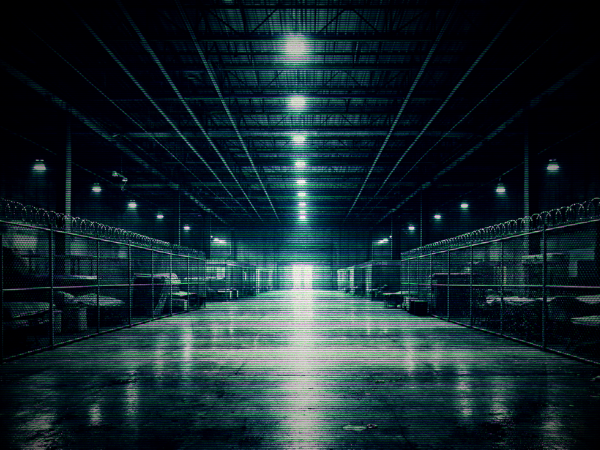
“That was when they suspended the Constitution… There wasn’t even an enemy you could put your finger on.”—Margaret Atwood, The Handmaid’s Tale

What we are witnessing is not a government of the people, by the people, and for the people; it is a government over the people.

Call it what it is: political gaslighting—the regime says one thing while doing the opposite, and insists on the citizenry’s trust while dismantling the very checks and balances that make trust possible.

So when the powers-that-be claim to be protecting the Constitution, they’re dismantling it at every turn. In this way, the mechanisms of constitutional government—separation of powers, federalism, due process, and the Bill of Rights—are being hollowed out in plain sight.

Although this dismantling did not start with President Trump, it has accelerated beyond imagining.

What was once a slow bleed is now a hemorrhage—and it is not random. The damage is unfolding on two parallel tracks: a steady, methodical, bureaucratic erosion (rule changes, executive orders, new databases) paired with shock-and-awe surges (National Guard deployments, mass round-ups, headline-grabbing prosecutions).

The words may say “freedom” and “order,” but the deeds smack of tyranny.

Attorney General Pam Bondi vows to punish “hateful” speech even as the administration normalizes hateful rhetoric and violent imagery. Vice President JD Vance promises to “go after” those with a “leftist” ideology while preaching free-speech absolutism for allies.

The Trump administration denounces “hate speech” even as it excuses and downplays the Jan. 6 riots; pledges fiscal restraint while shoveling billions into surveillance, prisons, and domestic deployments; wraps itself in law-and-order while tolerating lawlessness by cronies; sermonizes about faith and morality while normalizing cruelty as governance; and peddles outrage over waste while spending lavishly on the trappings of office.

Rights are framed as absolute for friends and privileges for critics. That is the opposite of constitutional government, which holds everyone—especially those in power—to the same rule of law, applied evenly.

If the government can police ideas, deploy troops at home, run dragnets by algorithm, disappear people into distant prisons, build spectacle cages, and amass power in one office, then no American is safe—including those who cheer these efforts today.

If you believe in limited government, equal justice, and due process—whatever your party—these double standards should alarm you most, because the precedents being cheered today will be wielded against you tomorrow.

What follows is a running ledger of the gaslighting playbook and its constitutional costs.

The Gaslight: “We’re Restoring the Constitution.”
Reality: The “temporary” powers created after 9/11 have hardened into a permanent police-state architecture—Patriot Act surveillance, secret FISA processes and National Security Letters, DHS fusion centers, a diluted Fourth Amendment “border zone,” civil-asset forfeiture, Pentagon 1033 militarization, Real ID, facial-recognition and geofence warrants—now run at full throttle across administrations.
The Cost: A police state.

The Gaslight: “We Value Law and Order.”
Reality: The administration deployed Marines and the National Guard into American streets to police protests protected by the First Amendment. On September 2, 2025, a federal judge ruled that the administration’s deployment of thousands of Guard troops and U.S. Marines to Los Angeles—ostensibly for immigration protests—violated the Posse Comitatus Act, describing a “top-down, systemic effort” to militarize civil law enforcement. The Constitution’s framers feared standing armies and military occupations of American communities.
The Cost: The death of Posse Comitatus.

The Gaslight: “We Defend Free Speech.”
Reality: Dissent is criminalized, expressive conduct is relitigated, and disfavored groups face terror labels and IRS pressure. Protest is a right, not a privilege, yet the government increasingly recasts organized dissent as conspiracy. After the Charlie Kirk shooting, the White House floated designating “antifa” and other liberal groups as domestic terrorists, bringing racketeering cases against funders, and targeting nonprofits critical of the administration—all while downplaying right-wing violence. Fold in Bondi’s vow to target “hateful” speech and Vance’s pledge to eradicate “leftist ideology,” and power slides from punishing unlawful acts to policing ideas.
The Cost: A weaponized First Amendment.

The Gaslight: “We’re Protecting You from Extremists.”  
Reality: Watchlists without due process, elastic “material support” theories, politicized “extremism” labels, and donor targeting that treat journalists, whistleblowers, activists—even parents at school boards—as suspects first and citizens second. Speaking truth to power is reframed as a security risk. In free societies, the state fears the citizen; in unfree ones, the citizen fears the state.
The Cost: Dissent rebranded as extremism.

The Gaslight: “We’re Ending Federal Censorship.”
Reality: On Day One, the President signed an order to “end federal censorship.” Read closely, it asserts sweeping control over how agencies interact with media platforms and broadcasters, rebranding ordinary outreach and fact-checking as First Amendment violations, while positioning the Executive as referee of the private square. By centralizing power over the flow of information in the Executive Branch, it threatens the independence of the very private forums where Americans speak. The test of free speech is whether the government stays out of the marketplace of ideas—not whether it curates it to the President’s liking.
The Cost: The state as speech referee.

The Gaslight: “We Use Smart Tech, Not Dragnet Surveillance.”
Reality: The administration is fusing government databases and outsourcing “intelligence” to private vendors in such a way that data becomes the warrant. ICE’s new $30 million deal with Palantir to build “ImmigrationOS” promises to identify, track, and deport people using AI-driven analytics and cross-agency data sharing. Add in geofence warrants, face-scan dragnets, and fusion-center “suspicious activity” pipelines, and you get a domestic intelligence system that presumes guilt by data trail.
The Cost: Probable cause replaced by algorithms.

The Gaslight: “We’re Tough on Crime.”
Reality: This year, U.S. agencies financed the transfer of migrants to El Salvador’s mega-prison (CECOT), where families and lawyers lost contact with detainees for months. Florida’s “Alligator Alcatraz” detention site whetted the government’s appetite for scaled-up incarceration, converting state prisons into immigration jails nationwide. These attempts by the Trump administration constitute an end run around longstanding constitutional protections for anyone accused of a crime. The common denominator is spectacle over justice, expansion over restraint.  
The Cost: The death of due process.

The Gaslight: “We’re Compassionate, Not Cruel.”  
Reality: The push to clear homeless encampments combines criminalization with expanded involuntary commitments. A July 24, 2025 executive order encourages states to funnel people into institutions and mental-health courts, tying funding to “maximum” use of commitments—an end-run around the presumption of liberty that undergirds due process.
The Cost: Bureaucratic coercion over compassion.

The Gaslight: “We’re Streamlining Government.”
Reality: The separation of powers was intended to serve as a check against any one government agency becoming too powerful. Yet the administration has pressed an aggressive unitary-executive theory to encroach on independent agencies, such as the Federal Reserve. Scholars warn this could erase the independence of agencies designed to check the White House.
The Cost: Checks and balances gutted.

The Gaslight: “We’re Keeping America Safe Overseas.”
Reality: Killing by assassination, not authorization. Twice in recent months, U.S. forces have launched unannounced attacks on Venezuelan boats, killing crews without warning or due process, on the mere assertion that they were drug traffickers.
The Cost: War powers and judicial oversight bypassed.

The Gaslight: “We’re Fixing Wasteful Spending.”
Reality: Having poured billions into surveillance, prisons, and domestic deployments, the “police-state budget” unravels the economy while eroding liberty.
The Cost: A debt-funded police state.

Many who cherish ordered liberty, limited government, fiscal restraint, and constitutional morality would normally recoil at these tactics under any other administration, so why not now?

Principles should not change because the party in power has changed, and yet that’s exactly what continues to drive the double standard.

If there’s a constitutional scorecard, “we the people” are on the losing team right now.

The First Amendment is buckling as protest is chilled, expressive conduct is targeted, opponents are threatened with terror labels, and the Executive Branch expands control over the speech ecosystem.

The Fourth and Fifth Amendments have been weakened by AI surveillance and cross-agency fusion that normalize suspicionless tracking, while offshore detention and coerced commitments compromise due process.

The Eighth Amendment is mocked by harsh, theatrical detention regimes.

Federalism and the Tenth Amendment give way when federal troops step into local policing.

Separation of powers erodes as an inflated unitary-executive theory encroaches on independent agencies.

War powers are skirted by extrajudicial killings abroad. And fiscal responsibility is inverted as surveillance and prison appropriations swell while liberty contracts.

What must happen now?

Congress must codify guardrails against domestic military use—tighten Posse Comitatus, narrow Insurrection Act exceptions, and mandate transparency for any domestic mission. Courts and prosecutors should reaffirm expressive rights, rejecting end-runs around Texas v. Johnson and refusing cases that criminalize symbolism.

Lawmakers must impose bright-line limits on data fusion, bar cross-agency pooling for generalized surveillance, and require algorithmic transparency and adversarial testing before any tool touches liberty. The U.S. must prohibit outsourcing detention to abusive regimes, close loopholes, and apply human-rights scrutiny to every foreign arrangement.

The independence of watchdogs and the Fed needs protection through clear “for cause” standards. States and cities should decriminalize homelessness and fund housing-first approaches instead of coercive commitments.

Congress must reassert war powers, requiring explicit authorization before any attack abroad. And fiscal sanity must be restored: sunset emergency outlays for surveillance and prison build-outs, mandate GAO audits of domestic deployments and fusion contracts, and attach civil-liberties impact statements to major security spending.

Our job as citizens is not to trust the government but to bind it down with the Constitution. “In questions of power,” Thomas Jefferson warned, we must “bind [government] down from mischief by the chains of the Constitution.”

Whatever you do, don’t trust the government with your privacy. Don’t trust it with your property: no-knock raids and forfeiture turn “private” property into whatever authorities permit you to keep.

Don’t trust it with your finances: Washington spends money it doesn’t have on programs it can’t afford. Don’t trust it with your life: force without accountability is not protection.

Above all, don’t trust it with your freedoms: on paper, rights endure; in practice, they are rationed by policy memos, watchlists, and shifting lines in the sand.

This should never be a right-vs-left debate; it’s the State vs. your liberty.

If you wouldn’t trust your worst political enemy with these weaponized tools, you shouldn’t trust your favorite politician with them either.

So think nationally, act locally.

Rebuild the habits of self-government where you live: know your neighbors and officials; know your rights and your city charter; ask who runs the jail and demand transparency; vet the people you entrust with power; and hold officials to account—show up, file requests, appeal, document, organize.

This is the work in front of us—not knee-jerk outrage, but persistent, consistent work to fortify the “chains of the Constitution.”

As I make clear in my book Battlefield America: The War on the American People and in its fictional counterpart The Erik Blair Diaries, if we let emergency rule become ordinary rule—military troops as beat cops, protest as crime, data as warrant, assassination as policy, money as politics—there won’t be a Constitution left to defend.

Source: https://tinyurl.com/ydxdjx5b

ABOUT JOHN W. WHITEHEAD

Constitutional attorney and author John W. Whitehead is founder and president of The Rutherford Institute. His most recent books are the best-selling Battlefield America: The War on the American People, the award-winning A Government of Wolves: The Emerging American Police State, and a debut dystopian fiction novel, The Erik Blair Diaries. Whitehead can be contacted at staff@rutherford.org. Nisha Whitehead is the Executive Director of The Rutherford Institute. Information about The Rutherford Institute is available at www.rutherford.org.

Publication Guidelines / Reprint Permission

John W. Whitehead’s weekly commentaries are available for publication to newspapers and web publications at no charge. 
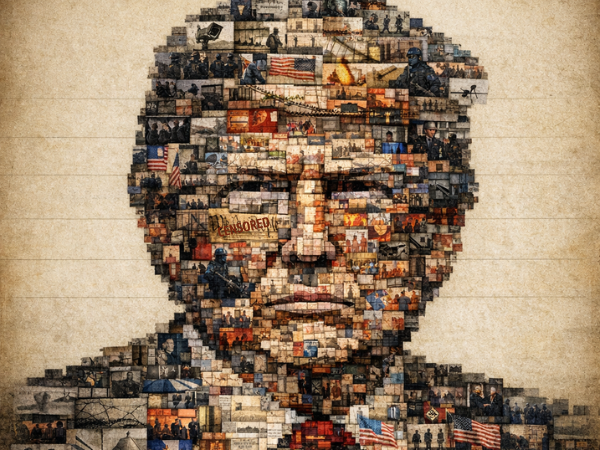
“The greatest tyrannies are always perpetuated in the name of the noblest causes.”—Thomas Paine

They said it was for safety.
They said it was for order.
They said it was for the good of the nation.

They always say it’s for something good… until it isn’t.

Nearly a quarter-century after 9/11, we are still living with the consequences of fear-driven government power grabs. What began as “temporary” measures for our security have hardened into a permanent architecture of control.

The bipartisan police-state architecture that began with 9/11 has been passed from president to president and party to party, each recycling the same justifications—safety, security, patriotism—to expand its powers at the expense of the citizenry.

So they locked down the country “for our safety.”
They expanded surveillance “for our security.”
They rounded up anyone who challenged the narrative “for the common good.”
They erased names, ideas, and histories “to prevent offense.”
They forced schools to teach only what was politically correct “for the children.”
They censored speech “for our protection.”
They targeted dissenters “to preserve peace.”
They militarized the streets and called it “law and order.”

These very abuses—once denounced when carried out by the Left—are now cheered, defended, and excused when carried out by the Right.

People who once spoke passionately about truth, freedom, and faith have now fallen silent in the face of injustice, or worse, convinced themselves that nothing is wrong. The very voices that should be warning against tyranny are instead excusing it or looking away.

This is the danger of double standards in politics: every tyranny is rationalized in the moment by its chorus of defenders.

But history teaches that what goes around comes around. If you justify it now, you’ll have no defense when the tables turn.

And yet, time and again, the lies we tell ourselves make it possible. The cult of personality. The blind loyalty to party. The belief that “our side” can’t be the villain.

It never ceases to amaze how far people will go to excuse the actions of their favorite tyrant, even when those actions are the very things they once swore to oppose.

The pattern of justifying tyranny is as old as power itself. Every abuse comes wrapped in the same excuse: we had to do it.

After 9/11, Americans were told the Patriot Act and mass surveillance were “necessary to prevent terrorism.” The result was a sprawling security state that tracks every phone call, every online search, every purchase. The justification was security. The cost was freedom.

Under Obama, drone warfare and the prosecution of whistleblowers were defended as “keeping America safe.” The president even claimed the power to assassinate U.S. citizens abroad without trial. The result was an unaccountable government acting as judge, jury and executioner. The justification was safety. The cost was due process.

During the COVID-19 pandemic, lockdowns and mandates were imposed in the name of “public health,” laying the groundwork for a Nanny State empowered to micromanage every aspect of our lives—where we go, what we buy, who we see. The result was government claiming control over every aspect of daily life. The justification was saving lives. The cost was the right to govern our bodies.

Under Trump, the script is familiar.

National Guard deployments in American cities are justified as “restoring order.” Sweeping surveillance is framed as “protecting communities.” Crackdowns on dissent are defended as “stopping criminals.” Mental health round-ups of the homeless are justified as “helping the vulnerable.” Militarized patrols on city streets are justified as “cleaning up the streets.” Turning ICE into a roving army of lawless thugs is justified as “protecting citizenship.” Censorship and efforts to sanitize American history are now being lauded by the same voices that railed against “cancel culture.”

That same logic has taken a deadly turn abroad. At Trump’s direction, the U.S. carried out a series of preemptive military strikes this year—against Iran’s nuclear sites, against the Houthis in Yemen, and most recently against what the administration claimed was a drug-trafficking boat off the coast of Venezuela. The White House has justified these deadly attacks—carried out without congressional approval or constitutional authorization—as part of the president’s unilateral war-making authority.

This, too, is part of the bipartisan police-state architecture built after 9/11, when presidents claimed open-ended authority to wage preemptive war without meaningful congressional oversight.

What began with Afghanistan and Iraq has metastasized into a global battlefield where any president can launch attacks—on Iran, on Yemen, on Venezuela—without accountability.

As always, the justification is order, safety, and patriotism. The cost is truth, justice and freedom.

Every time Trump expands his powers, the chorus is the same: It wouldn’t be necessary if Democrats had done their job. If you don’t break the law, you have nothing to fear. If you’re not doing anything wrong, why worry?

These are the oldest excuses for tyranny—and they never change. Only the partisanship does.

What makes Trump and those who came before him especially dangerous is not merely their willingness to wield power but the eagerness of their enablers to excuse and defend it at every turn.

History shows that bullies and strongmen can only rise when mobs rally to their side. A tyrant’s greatest weapon is not his fist, but the crowd that cheers him on, intimidates his critics, and convinces itself that might makes right.

The machinery of authoritarianism always needs a chorus of defenders, and today that chorus is louder, more organized, and more dismissive of constitutional limits than ever before.

We have been building to this moment for a long time. Even so, why do people accept tyranny so easily?

First, the cult of personality. When people invest blind faith in a leader, they will excuse anything he does. If he says surveillance is necessary, they believe it. If he says dissenters are enemies, they cheer their punishment. It is the psychology of the mob, cloaked in the loyalty of the true believer.

Second, fear as a political weapon. Every despot knows that frightened people will tolerate almost anything. Fear of terrorism. Fear of crime. Fear of disease. Fear of immigrants. Fear of collapse. Fear makes people beg for the chains that bind them.

Third, the “our side” fallacy. People imagine tyranny is only tyranny when the other side does it. When their side does it, they call it leadership. They call it patriotism. They call it protection. But the abuse doesn’t change when the party label does. Wrong is wrong.

Every new regime that seizes power promises it will use extraordinary authority only for good. And every regime—without exception—uses it to entrench itself at the expense of liberty.

Every generation tells itself the same lies to excuse the same abuses.

Consider the whiplash of partisan double standards:

  • Conservatives who blasted the Obama administration for NSA spying now cheer Trump’s Palantir partnership and AI-driven surveillance that tracks Americans’ digital footprints.
  • Democrats who embraced Biden’s use of emergency orders to advance their agenda have been quick to denounce Trump for ruling by executive order.
  • Those who bristled at COVID mandates under Democrats now applaud Trump’s use of government force to impose his own version of “public safety.”
  • Both sides flip-flop on free speech. Conservatives denounced censorship on college campuses but defend banning “dangerous” books and surveilling dissidents, while liberals oppose Trump’s attempt to whitewash history yet defend platforms censoring speech they deem “harmful” or “hateful.”

The double standard is breathtaking.

Tyranny doesn’t change depending on who carries it out. Yet partisans convince themselves it does. They say: It’s different this time. It’s necessary. It’s for us.

In truth, the only difference is who holds the whip.

The Constitution was designed to restrain exactly this impulse. It does not say: “These rights apply only when the other party is in power.” It does not say: “The executive may rule by decree if he is popular.”

James Madison warned that “if men were angels, no government would be necessary.” But men are not angels. That is why the Constitution separates powers, guarantees due process, and protects speech and assembly—especially in times of crisis.

Every time one party tramples these limits, the other eventually inherits those same powers and uses them in turn. The Patriot Act, passed under Bush, was wielded aggressively under Obama, Trump, and Biden. The executive orders one president signs become the precedents for the next.

“What you excuse today,” history warns us, “will be used against you tomorrow.”

The descent into tyranny always begins with justifications.

The Roman Republic collapsed into empire because senators claimed Caesar needed extraordinary powers to restore order. The republic never recovered.

In 1930s Germany, emergency decrees were defended as temporary measures to stabilize society. They became the permanent architecture of dictatorship.

In post-9/11 America, warrantless surveillance and secret courts were sold as temporary protections. Nearly a quarter-century later, they remain fixtures of government power.

Tyranny is never announced as tyranny. It is always justified as safety, morality, and order. It is always explained away as temporary. And it is always defended by people who believe they are on the winning side.

And so here we are.

A president issues executive orders that erode the Bill of Rights. His supporters applaud. Another president expands surveillance or censorship. His supporters applaud.

Both sides denounce the abuses of their opponents yet sanction the same abuses when carried out by their own.

This is how liberty dies—not with a sudden coup, but with partisan politics valued more than principled freedom.

The police state thrives on this selective outrage. It does not matter which party is in power. The machinery of control grows. The Constitution withers. And the people are left squabbling over whose tyrant is better.

There is only one antidote: principle.

You cannot defend freedom by defending tyranny when your side is in power. You cannot preserve liberty by cheering for its destruction. You cannot expect constitutional limits to shield you tomorrow if you discard them today.

The warnings span centuries. The Founders foresaw the danger: James Madison cautioned against the “gradual and silent encroachments” of government. Thomas Jefferson warned that the natural tendency of power is to grow.

Justice Louis Brandeis later confirmed it from the vantage point of the modern state: “the greatest dangers to liberty lurk in insidious encroachments by men of zeal, well-meaning but without understanding.”

Those warnings went unheeded after 9/11, and we have been paying the price ever since. The bipartisan police-state architecture built in those years has only grown stronger, repurposed by each new administration.

Unless we find the courage to dismantle it, today’s justifications will become tomorrow’s permanent chains.

The lesson is clear: if you want liberty, you must defend it consistently—even when it restrains your own party, your own leader, your own side. Especially then.

What you excuse today will be used against you tomorrow.

As I make clear in my book Battlefield America: The War on the American People and in its fictional counterpart The Erik Blair Diaries, it does not matter whether the abuse comes draped in red or blue. It does not matter whether it is cheered by the Right or justified by the Left.

Tyranny, once excused, becomes entrenched.

Source: https://tinyurl.com/3htehha7

ABOUT JOHN W. WHITEHEAD

Constitutional attorney and author John W. Whitehead is founder and president of The Rutherford Institute. His most recent books are the best-selling Battlefield America: The War on the American People, the award-winning A Government of Wolves: The Emerging American Police State, and a debut dystopian fiction novel, The Erik Blair Diaries. Whitehead can be contacted at staff@rutherford.org. Nisha Whitehead is the Executive Director of The Rutherford Institute. Information about The Rutherford Institute is available at www.rutherford.org.

Publication Guidelines / Reprint Permission

John W. Whitehead’s weekly commentaries are available for publication to newspapers and web publications at no charge.

Have you ever wondered who’s pulling the strings? … Anything we touch is a weapon. We can deceive, persuade, change, influence, inspire. We come in many forms. We are everywhere.”— U.S. Army Psychological Operations recruitment video

From viral memes to military-grade influence operations, the government is waging a full-spectrum psychological war—not against foreign enemies but against its own citizens.

The goal? Compliance. Control. Conformity.

The battlefield is no longer physical—it is psychological—and the American people are the targets.

From AI-manipulated narratives and National Guard psyops to loyalty scorecards for businesses, the Deep State’s war on truth and independent thought is no longer covert. It is coordinated, calculated, and by design.

Yet while both major parties—long in service to the Deep State—have weaponized mass communication to shape public opinion, the Trump administration is elevating it into a new art form that combines meme warfare, influencer psyops, and viral digital content to control narratives and manufacture consensus.

In doing so, President Trump and his influencers are capitalizing on a propaganda system long cultivated by the security-industrial complex.

What we’re witnessing is not just propaganda. It is psychological warfare.

Psychological warfare, as defined by the Rand Corporation, “involves the planned use of propaganda and other psychological operations to influence the opinions, emotions, attitudes, and behavior of opposition groups.”

Today, those “opposition groups” include the American public.

For years, the government has been bombarding the citizenry with propaganda and psychological operations aimed at conditioning us to be compliant, easily manipulated and supportive of the police state’s growing domestic and global power.

The government is so confident in its Orwellian powers of manipulation that it’s taken to bragging about them. For example, the U.S. Army’s 4th Psychological Operations Group, the branch of the military responsible for psychological warfare, released a recruiting video that touts its efforts to pull the strings, turn everything they touch into a weapon, be everywhere, deceive, persuade, change, influence, and inspire.

This is the danger that lurks in plain sight: a government so immersed in the art of mind manipulation that it no longer sees its citizens as individuals, but as targets.

Of all the weapons in the government’s vast arsenal, psychological warfare may be the most insidious.

As the military journal Task and Purpose explains, “Psychological warfare is all about influencing governments, people of power, and everyday citizens.” PSYOP soldiers aim to influence “emotions, notices, reasoning, and behavior of foreign governments and citizens,” and “deliberately deceive” enemy forces.

Yet increasingly, these operations are being used not just abroad—but at home.

The government has made clear in word and deed that “we the people” are domestic enemies to be targeted, tracked, manipulated, micromanaged, surveilled, viewed as suspects, and treated as if our fundamental rights are mere privileges that can be easily discarded.

Aided by technological advances and behavioral science, the U.S. government has become a master manipulator of minds, perception, and belief—an agitator of the masses.

As J. Edgar Hoover once observed: “It is the function of mass agitation to exploit all the grievances, hopes, aspirations, prejudices, fears, and ideals of all the special groups that make up our society, social, religious, economic, racial, political. Stir them up. Set one against the other. Divide and conquer. That’s the way to soften up a democracy.”

Here are just a few ways psychological warfare is being waged against the American people:

Weaponizing violence. Recurring mass shootings, domestic unrest, and acts of terrorism traumatize the public, destabilize communities, and give the government greater pretext to crack down, lock down, and clamp down—all in the name of national security.

Weaponizing surveillance and pre-crime. Digital surveillance, AI threat detection, and predictive policing have created a society in which everyone is watched, profiled, and potentially punished before any crime occurs. The government’s war on crime has also veered into the realm of social media and technological entrapment, with government agents adopting fake social media identities and AI-created profile pictures in order to surveil, target and capture potential suspects. It has all the markings of a digital panopticon optimized for psychological control.

Weaponizing digital tools and censorship. Digital censorship is just the beginning. Tech giants, working with the government, now determine who can speak, bank, travel, or participate in society. Digital currencies (which can be used as “a tool for government surveillance of citizens and control over their financial transactions”), combined with social credit systems and surveillance capitalism create a litmus test to determine who is worthy enough to be part of society and punish individuals for moral lapses and social transgressions (and reward them for adhering to government-sanctioned behavior).

For example, the Trump White House recently rolled out a pilot program using a loyalty scorecard to evaluate businesses, echoing China’s social credit system. Businesses deemed “non-compliant” with patriotic messaging or flagged for “ideological extremism” based on their social media posts, public statements, or advertising content are at risk of being barred from federal contracts.

Weaponizing compliance. From the war on terror to COVID mandates, nearly every government “crisis response” has been weaponized to normalize surveillance and control, and demand obedience in exchange for perceived safety.

Weaponizing entertainment. Hollywood and the Pentagon have a long, symbiotic relationship. The military provides equipment, personnel, and funding in exchange for favorable portrayals of war, surveillance, and state power. As Elmer Davis, a CBS broadcaster who was appointed the head of the Office of War Information, observed, “The easiest way to inject a propaganda idea into most people’s minds is to let it go through the medium of an entertainment picture when they do not realize that they are being propagandized.”

Weaponizing behavioral science and nudging. The government’s “nudge units” use psychology and data science to steer public behavior. It may begin with paperwork, but it ends with worldview manipulation—conditioning the population to think and act as the state prefers, all while maintaining the illusion of free will.

Weaponizing desensitization. Lockdowns, SWAT raids, and threat alerts desensitize us to authoritarianism. What once shocked is now routine. That’s by design. The more accustomed we become to surveillance, policing, and crisis, the more willingly we embrace it.

Weaponizing fear. Fear is the preferred tool of totalitarians. It divides the public into factions—persuading them to see each other as the enemy, empowers the government, and numbs rational thinking. The more frightened the population, the easier it is to control. This Machiavellian scheme has so ensnared the nation that few Americans even realize they are being manipulated into adopting an “us” against “them” mindset.

Weaponizing genetics. Fear doesn’t just condition us—it can alter us. Trauma and fear responses can be encoded in DNA and passed on to future generations, as studies in epigenetic inheritance have shown.

Weaponizing the future. The Pentagon’s chilling Megacities training video predicts that by 2030, armed forces would be used against civilian populations to solve domestic political and social problems. Under Trump’s expanded domestic security powers, the National Guard has been increasingly deployed in civil contexts—most recently to address squalor and crime in Washington DC and other parts of the country.

None of this is speculative. It’s well-documented.

In 2022, the Pentagon was forced to investigate reports that the military was creating fake social media profiles with AI-generated photos and fictitious news sites to manipulate users.

These are the modern tools of psychological warfare. But the blueprint goes back decades.

The end goal of these mind control campaigns—packaged in the guise of the greater good—is to see how far the American people will allow the government to go in re-shaping the country in the image of a totalitarian police state.

In the 1950s, the CIA’s MKUltra program tested LSD, electroshock, hypnosis, and other behavior modification techniques on civilians and soldiers—American citizens—often without their knowledge or consent. CIA agents hired prostitutes to lure men into bugged rooms, then dosed them with drugs and observed their behavior. Some detainees were interrogated to death in efforts to erase memories or induce compliance.

It wasn’t until the 1970s that a portion of the CIA’s criminal activities under MKUltra came to light. Congress’s Church Committee investigations revealed that the CIA had spent over $20 million attempting to control human thought and behavior, reportedly as a means of programming people to carry out assassinations (i.e., national defense).

Similarly, the top-secret Montauk Project allegedly was working to develop mind-control techniques that could trigger crime waves.

These were not fringe experiments—they were official policy.

As journalist Lorraine Boissoneault noted, “The same methods that had once been used to train American soldiers ended up being used to extract information from terrorists in Abu Ghraib, Iraq and Guantanamo Bay.”

Fast forward to the present day, and it’s clear the government’s psyops warfare has not ended—it has simply gone digital.

Today’s psyops rely on mass media, AI, algorithmic censorship, and behavioral economics—not LSD. But the goal remains the same: shape thought, induce obedience, silence dissent.

In 2014, for example, a Fusion Center in Washington State mistakenly released records detailing government interest in “psycho-electronic” weapons—remote mind control tactics allegedly capable of controlling people or subjecting them to varying degrees of pain from a distance.

More recently, COVID-19 gave the government a global platform to deploy fear-based compliance strategies. Science writer David Robson explains: “Fears of contagion lead us to become more conformist and tribalistic… [we] value conformity and obedience over eccentricity or rebellion.”

That is precisely the point.

By constantly invoking crisis, the government keeps us reactive, not rational. Fear shuts down the brain’s prefrontal cortex—our center for reasoning and critical thought. A population that stops thinking for itself is one easily led.

This is how the government persuades people to surveil themselves, police their neighbors, and conform to shifting norms: through fear, repetition, and psychological fatigue.

It’s classic Orwell: through censorship, disinformation crackdowns, and hate crime laws, speech becomes thoughtcrime and conformity becomes patriotism.

Edward Bernays, the father of modern propaganda, warned of this nearly a century ago: “We are governed, our minds are molded, our tastes formed, our ideas suggested, largely by men we have never heard of.”  They are, he concluded, “the true ruling power of our country.”

This “invisible government”—the Deep State—has perfected the art of psychological control.

With the approach of the 2026 midterm elections, this psychological warfare will only escalate: more fear-based narratives, more digital manipulation, more pressure to conform.

But the battlefield is not lost—not yet.

As I stress in my book Battlefield America: The War on the American People and in its fictional counterpart The Erik Blair Diaries, the first step in resisting tyranny is recognizing its tools: fear, deception, division, and control.

We must reject the Deep State’s mind games in order to reclaim sovereignty over our mental space and remind the government that “we the people” are not puppets to be manipulated or threats to be neutralized.

We are the rightful rulers of a free republic, and that starts with the right to think for ourselves.

Source: https://tinyurl.com/2c5byxmz

ABOUT JOHN W. WHITEHEAD

Constitutional attorney and author John W. Whitehead is founder and president of The Rutherford Institute. His most recent books are the best-selling Battlefield America: The War on the American People, the award-winning A Government of Wolves: The Emerging American Police State, and a debut dystopian fiction novel, The Erik Blair Diaries. Whitehead can be contacted at staff@rutherford.org. Nisha Whitehead is the Executive Director of The Rutherford Institute. Information about The Rutherford Institute is available at www.rutherford.org.

Publication Guidelines / Reprint Permission

John W. Whitehead’s weekly commentaries are available for publication to newspapers and web publications at no charge. 

When the states legalize the deliberate ending of certain lives… it will eventually broaden the categories of those who can be put to death with impunity.”—Nat Hentoff, The Washington Post, 1992

Bodily autonomy—the right to privacy and integrity over our own bodies—is rapidly vanishing.

The debate now extends beyond forced vaccinations or invasive searches to include biometric surveillance, wearable tracking, and predictive health profiling.

We are entering a new age of algorithmic, authoritarian control, where our thoughts, moods, and biology are monitored and judged by the state.

This is the dark promise behind the newest campaign by Robert F. Kennedy Jr., President Trump’s Secretary of Health and Human Services, to push for a future in which all Americans wear biometric health-tracking devices.

Under the guise of public health and personal empowerment, this initiative is nothing less than the normalization of 24/7 bodily surveillance—ushering in a world where every step, heartbeat, and biological fluctuation is monitored not only by private companies but also by the government.

In this emerging surveillance-industrial complex, health data becomes currency. Tech firms profit from hardware and app subscriptions, insurers profit from risk scoring, and government agencies profit from increased compliance and behavioral insight.

This convergence of health, technology, and surveillance is not a new strategy—it’s just the next step in a long, familiar pattern of control.

Surveillance has always arrived dressed as progress.

Every new wave of surveillance technology—GPS trackers, red light cameras, facial recognition, Ring doorbells, Alexa smart speakers—has been sold to us as a tool of convenience, safety, or connection. But in time, each became a mechanism for tracking, monitoring, or controlling the public.

What began as voluntary has become inescapable and mandatory.

The moment we accepted the premise that privacy must be traded for convenience, we laid the groundwork for a society in which nowhere is beyond the government’s reach—not our homes, not our cars, not even our bodies.

RFK Jr.’s wearable plan is just the latest iteration of this bait-and-switch: marketed as freedom, built as a cage.

According to Kennedy’s plan, which has been promoted as part of a national campaign to “Make America Healthy Again,” wearable devices would track glucose levels, heart rate, activity, sleep, and more for every American.

Participation may not be officially mandatory at the outset, but the implications are clear: get on board, or risk becoming a second-class citizen in a society driven by data compliance.

What began as optional self-monitoring tools marketed by Big Tech is poised to become the newest tool in the surveillance arsenal of the police state.

Devices like Fitbits, Apple Watches, glucose trackers, and smart rings collect astonishing amounts of intimate data—from stress and depression to heart irregularities and early signs of illness. When this data is shared across government databases, insurers, and health platforms, it becomes a potent tool not only for health analysis—but for control.

Once symbols of personal wellness, these wearables are becoming digital cattle tags—badges of compliance tracked in real time and regulated by algorithm.

And it won’t stop there.

The body is fast becoming a battleground in the government’s expanding war on the inner realms.

The infrastructure is already in place to profile and detain individuals based on perceived psychological “risks.” Now imagine a future in which your wearable data triggers a mental health flag. Elevated stress levels. Erratic sleep. A skipped appointment. A sudden drop in heart rate variability.

In the eyes of the surveillance state, these could be red flags—justification for intervention, inquiry, or worse.

RFK Jr.’s embrace of wearable tech is not a neutral innovation. It is an invitation to expand the government’s war on thought crimes, health noncompliance, and individual deviation.

It shifts the presumption of innocence to a presumption of diagnosis. You are not well until the algorithm says you are.

The government has already weaponized surveillance tools to silence dissent, flag political critics, and track behavior in real time. Now, with wearables, they gain a new weapon: access to the human body as a site of suspicion, deviance, and control.

While government agencies pave the way for biometric control, it will be corporations—insurance companies, tech giants, employers—who act as enforcers for the surveillance state.

Wearables don’t just collect data. They sort it, interpret it, and feed it into systems that make high-stakes decisions about your life: whether you get insurance coverage, whether your rates go up, whether you qualify for employment or financial aid.

As reported by ABC News, a JAMA article warns that wearables could easily be used by insurers to deny coverage or hike premiums based on personal health metrics like calorie intake, weight fluctuations, and blood pressure.

It’s not a stretch to imagine this bleeding into workplace assessments, credit scores, or even social media rankings.

Employers already offer discounts for “voluntary” wellness tracking—and penalize nonparticipants. Insurers give incentives for healthy behavior—until they decide unhealthy behavior warrants punishment. Apps track not just steps, but mood, substance use, fertility, and sexual activity—feeding the ever-hungry data economy.

This dystopian trajectory has been long foreseen and forewarned.

In Brave New World by Aldous Huxley (1932), compliance is maintained not through violence but by way of pleasure, stimulation, and chemical sedation. The populace is conditioned to accept surveillance in exchange for ease, comfort, and distraction.

In THX 1138 (1971), George Lucas envisions a corporate-state regime where biometric monitoring, mood-regulating drugs, and psychological manipulation reduce people to emotionless, compliant biological units.

Gattaca (1997) imagines a world in which genetic and biometric profiling predetermines one’s fate, eliminating privacy and free will in the name of public health and societal efficiency.

In The Matrix (1999), written and directed by the Wachowskis, human beings are harvested as energy sources while trapped inside a simulated reality—an unsettling parallel to our increasing entrapment in systems that monitor, monetize, and manipulate our physical selves.

Minority Report (2002), directed by Steven Spielberg, depicts a pre-crime surveillance regime driven by biometric data. Citizens are tracked via retinal scans in public spaces and targeted with personalized ads—turning the body itself into a surveillance passport.

The anthology series Black Mirror, inspired by The Twilight Zone, brings these warnings into the digital age, dramatizing how constant monitoring of behavior, emotion, and identity breeds conformity, judgment, and fear.

Taken collectively, these cultural touchstones deliver a stark message: dystopia doesn’t arrive overnight.

As Margaret Atwood warned in The Handmaid’s Tale,  “Nothing changes instantaneously: in a gradually heating bathtub, you’d be boiled to death before you knew it.” Though Atwood’s novel focuses on reproductive control, its larger warning is deeply relevant: when the state presumes authority over the body—whether through pregnancy registries or biometric monitors—bodily autonomy becomes conditional, fragile, and easily revoked.

The tools may differ, but the logic of domination is the same.

What Atwood portrayed as reproductive control, we now face in a broader, digitized form: the quiet erosion of autonomy through the normalization of constant monitoring.

When both government and corporations gain access to our inner lives, what’s left of the individual?

We must ask: when surveillance becomes a condition of participation in modern life—employment, education, health care—are we still free? Or have we become, as in every great dystopian warning, conditioned not to resist, but to comply?

That’s the hidden cost of these technological conveniences: today’s wellness tracker is tomorrow’s corporate leash.

In a society where bodily data is harvested and analyzed, the body itself becomes government and corporate property. Your body becomes a form of testimony, and your biometric outputs are treated as evidence. The list of bodily intrusions we’ve documented—forced colonoscopies, blood draws, DNA swabs, cavity searches, breathalyzer tests—is growing.

To this list we now add a subtler, but more insidious, form of intrusion: forced biometric consent.

Once health tracking becomes a de facto requirement for employment, insurance, or social participation, it will be impossible to “opt out” without penalty. Those who resist may be painted as irresponsible, unhealthy, or even dangerous.

We’ve already seen chilling previews of where this could lead. In states with abortion restrictions, digital surveillance has been weaponized to track and prosecute individuals for seeking abortions—using period-tracking appssearch histories, and geolocation data.

When bodily autonomy becomes criminalized, the data trails we leave behind become evidence in a case the state has already decided to make.

This is not merely the expansion of health care. It is the transformation of health into a mechanism of control—a Trojan horse for the surveillance state to claim ownership over the last private frontier: the human body.

Because ultimately, this isn’t just about surveillance—it’s about who gets to live.

Too often, these debates are falsely framed as having only two possible outcomes: safety vs. freedom, health vs. privacy, compliance vs. chaos. But these are illusions. A truly free and just society can protect public health without sacrificing bodily autonomy or human dignity.

We must resist the narrative that demands our total surrender in exchange for security.

Once biometric data becomes currency in a health-driven surveillance economy, it’s only a matter of time before that data is used to determine whose lives are worth investing in—and whose are not.

We’ve seen this dystopia before.

In the 1973 film Soylent Green, the elderly become expendable when resources grow scarce. My good friend Nat Hentoff—an early and principled voice warning against the devaluation of human life—sounded this alarm decades ago. Once pro-choice, Hentoff came to believe that the erosion of medical ethics—particularly the growing acceptance of abortion, euthanasia, and selective care—was laying the groundwork for institutionalized dehumanization.

As Hentoff warned, once the government sanctions the deliberate ending of certain lives, it can become a slippery slope: broader swaths of the population would eventually be deemed expendable.

Hentoff referred to this as “naked utilitarianism—the greatest good for the greatest number. And individuals who are in the way—in this case, the elderly poor—have to be gotten out of the way. Not murdered, heaven forbid. Just made comfortable until they die with all deliberate speed.”

That concern is no longer theoretical.

In 1996, writing about the Supreme Court’s consideration of physician-assisted suicide, Hentoff warned that once a state decides who shall die “for their own good,” there are “no absolute limits.” He cited medical leaders and disability advocates who feared that the poor, elderly, disabled, and chronically ill would become targets of a system that valued efficiency over longevity.

Today, data collected through wearables—heart rate, mood, mobility, compliance—can shape decisions about insurance, treatment, and life expectancy. How long before an algorithm quietly decided whose suffering is too expensive, whose needs are too inconvenient, or whose body no longer qualifies as worth saving?

This isn’t a left or right issue.

Dehumanization—the process of stripping individuals or groups of their dignity, autonomy, or moral worth—cuts across the political spectrum.

Today, dehumanizing language and policies aren’t confined to one ideology—they’re weaponized across the political divide. Prominent figures have begun referring to political opponents, immigrants, and other marginalized groups as “unhuman”—a disturbing echo of the labels that have justified atrocities throughout history.

As reported by Mother Jones, J.D. Vance endorsed a book by influencer Jack Posobiec and Joshua Lisec that advocates crushing “unhumans” like vermin.

This kind of rhetoric isn’t abstract—it matters.

How can any party credibly claim to be “pro‑life” when it devalues the humanity of entire groups, stripping them of the moral worth that should be fundamental to civil society?

When the state and its corporate allies treat people as data, as compliance issues, or as “unworthy,” they dismantle the very notion of equal human dignity.

In such a world, rights—including the right to bodily autonomy, health care, or even life itself—become privileges doled out only to the “worthy.”

This is why our struggle must be both political and moral. We can’t defend bodily sovereignty without defending every human being’s equal humanity.

The dehumanization of the vulnerable crosses political lines. It manifests differently—through budget cuts here, through mandates and metrics there—but the outcome is the same: a society that no longer sees human beings, only data points.

The conquest of physical space—our homes, cars, public squares—is nearly complete.

What remains is the conquest of inner space: our biology, our genetics, our psychology, our emotions. As predictive algorithms grow more sophisticated, the government and its corporate partners will use them to assess risk, flag threats, and enforce compliance in real time.

The goal is no longer simply to monitor behavior but to reshape it—to preempt dissent, deviance, or disease before it arises. This is the same logic that drives Minority Report-style policing, pre-crime mental health interventions, and AI-based threat assessments.

If this is the future of “health freedom,” then freedom has already been redefined as obedience to the algorithm.

We must resist the surveillance of our inner and outer selves.

We must reject the idea that safety requires total transparency, or that health requires constant monitoring. We must reclaim the sanctity of the human body as a space of freedom—not as a data point.

The push for mass adoption of wearables is not about health. It is about habituation.

The goal is to train us—subtly, systematically—to accept government and corporate ownership of our bodies.

We must not forget that our nation was founded on the radical idea that all human beings are created equal, “endowed by their Creator with certain unalienable Rights,” among them life, liberty, and the pursuit of happiness.

These rights are not granted by the government, the algorithm, or the market. They are inherent. They are indivisible. And they apply to all of us—or they will soon apply to none of us.

The Founders got this part right: their affirmation of our shared humanity is more vital than ever before.

As I make clear in my book Battlefield America: The War on the American People and in its fictional counterpart The Erik Blair Diaries, the task before us is whether we will defend that humanity—or surrender it, one wearable at a time. Now is the time to draw the line—before the body becomes just another piece of state property.

Source: https://tinyurl.com/mr24w458

ABOUT JOHN W. WHITEHEAD

Constitutional attorney and author John W. Whitehead is founder and president of The Rutherford Institute. His most recent books are the best-selling Battlefield America: The War on the American People, the award-winning A Government of Wolves: The Emerging American Police State, and a debut dystopian fiction novel, The Erik Blair Diaries. Whitehead can be contacted at staff@rutherford.org. Nisha Whitehead is the Executive Director of The Rutherford Institute. Information about The Rutherford Institute is available at www.rutherford.org.

Publication Guidelines / Reprint Permission

John W. Whitehead’s weekly commentaries are available for publication to newspapers and web publications at no charge. 

“Experience should teach us to be most on our guard to protect liberty when the government’s purposes are beneficent. Men born to freedom are naturally alert to repel invasion of their liberty by evil-minded rulers. The greatest dangers to liberty lurk in insidious encroachment by men of zeal, well-meaning but without understanding.”—Justice Louis D. Brandeis

While the U.S. wages war abroad—bombing Iran, escalating conflict, and staging a spectacle of power for political gain—a different kind of war is being waged here at home.

This war at home is quieter but no less destructive. The casualties are not in distant deserts or foreign cities. They are our freedoms, our communities, and the Constitution itself.

And the agents of this domestic war? Masked thugs. Unmarked vans. Raids. Roundups.

Detentions without due process. Retaliation against those who dare to question or challenge government authority. People made to disappear into bureaucratic black holes. Fear campaigns targeting immigrant communities and political dissenters alike. Surveillance weaponized to monitor and suppress lawful activity.

Packaged under the guise of national security—as all power grabs tend to be—this government-sanctioned thuggery masquerading as law-and-order is the face of the Trump Administration’s so-called war on illegal immigration.

Don’t fall for the propaganda that claims we’re being overrun by criminals or driven into the poorhouse by undocumented immigrants living off welfare.

The real threat to our way of life comes not from outside invaders, but from within: an unelected, unaccountable enforcement agency operating above the law.

President Trump insists that ICE (Immigration and Customs Enforcement) is focused on violent criminals, but the facts tell a different story (non-criminal ICE arrests have surged 800% in six months)—and that myth is precisely what enables the erosion of rights for everyone.

By painting enforcement as narrowly targeted, the administration obscures a far broader dragnet that sweeps up legal residents, naturalized citizens, and native-born Americans alike.

What begins with immigrants rarely ends there.

According to the Cato Institute, 65 percent of people taken by ICE had no convictions, and 93 percent had no violent convictions at all.

This isn’t targeted enforcement—it’s indiscriminate purging.

What ICE—an agency that increasingly resembles a modern-day Gestapo—is doing to immigrants today, it can and will do to citizens tomorrow: these are the early warning signs of a system already in motion.

The machinery is in place. The abuses are ongoing. And the constitutional safeguards we rely on are being ignored, dismantled, or bypassed entirely.

When legal residents, naturalized citizens, and native-born Americans are swept up in ICE’s raids, detained without cause, and subjected to treatment that defies every constitutional protection against government overreach, this isn’t about immigration.

It’s not about danger. It’s about power—unchecked and absolute.

This is authoritarianism by design.

Here are just a few examples of how ICE’s reach now extends far beyond a criminal class of undocumented immigrants:

This pattern of abuse is not accidental.

It reflects a deliberate strategy of fear and domination by ICE agents acting like an occupying army, intent on intimidating the population into submission while the Trump Administration redraws the boundaries of the Constitution for all within America’s borders, citizen and immigrant alike.

This is how you dismantle a constitutional republic: not in one dramatic moment, but through the steady erosion of rights, accountability, and rule of law—first for the marginalized, then for everyone.

When constitutional guarantees become conditional and oversight is systematically evaded, all Americans—regardless of status—stand vulnerable to a regime that governs by fear rather than freedom.

We’ve seen this playbook before.

It’s the same strategy used by fascist regimes to consolidate power—using fear, force, and propaganda to turn public institutions into instruments of oppression.

ICE raids often occur without warrants. Agents frequently detain individuals not charged with any crime. Homes, schools, hospitals, workplaces, and courthouses have all become targets. Agents in plain clothes swarm unsuspecting individuals, arrest them without explanation, and separate families under the pretense of national security. In many cases, masked agents refuse to identify themselves at all—creating a climate of terror where the public cannot distinguish lawful enforcement from lawless abduction.

This is not justice. It is intimidation. And it has become business as usual.

ICE has even begun deputizing local police departments to carry out these raids.

Through an expanded network of partnerships, ICE has turned routine traffic stops into pipelines for deportation. According to The Washington Post, immigrants stopped on the way to volleyball practice, picking up baby formula, or heading to job sites have been detained and, in some cases, sent to a notorious mega-prison in El Salvador.

This is what politicizing and weaponizing local police looks like.

Even members of Congress attempting to exercise constitutional oversight have been turned away from ICE facilities. As The New York Times reported, ICE now claims the authority to “deny a request or otherwise cancel” congressional visits based on vague “operational concerns”—effectively placing its operations beyond democratic scrutiny.

Beyond the high-profile arrests, the abuse runs deeper.

Julio Noriega, a 54-year-old American citizen, was snatched up off the street and detained in Chicago for 10 hours without explanation. Leonardo Garcia Venegas, a U.S.-born citizen, was detained because ICE dismissed his REAL ID as fake. Cary López Alvarado, a pregnant U.S. citizen, was handcuffed and arrested for challenging ICE agents who had followed her fiancé to work. Children, veterans, and immunocompromised individuals have all suffered under ICE’s dragnet.

These are not outliers. They are the product of a system that operates without meaningful checks.

ICE agents are rarely held accountable. Internal investigations are ineffective. Congress has abdicated oversight. Directives from the Trump administration—including those authored by Stephen Miller—have turbocharged deportations and loosened any remaining restraints.

From boots on the ground to bytes in the cloud, ICE’s unchecked power reflects a broader shift toward authoritarianism, fueled by high-tech surveillance, public indifference and minimal judicial oversight. The agency operates a sprawling digital dragnet: facial recognition, license plate readers, cellphone tracking, and partnerships with tech giants like Amazon and Palantir feed massive databases—often without warrants or oversight.

These same tools—hallmarks of a growing surveillance state—are now being quietly repurposed across other federal agencies, setting the stage for an integrated surveillance-policing regime that threatens the constitutional rights of every American.

This isn’t about safety. It’s about control.

These tools aren’t just targeting undocumented immigrants—they’re laying the digital scaffolding for a future in which everyone is watched, scored, and subject to state suspicion.

Quotas over justice. Algorithms over rights.

ICE’s operations have little to do with individualized threat assessments. What drives these raids is not public safety but bureaucratic performance. Field offices are under pressure to meet arrest quotas, creating a system that incentivizes indiscriminate sweeps over focused investigations.

As Jennie Taer writes for the NY Post:

“The Trump administration’s mandate to arrest 3,000 illegal migrants per day is forcing ICE agents to deprioritize going after dangerous criminals and targets with deportation orders, insiders warn. Instead, federal immigration officers are spending more time rounding up people off the streets… Agents are desperate to meet the White House’s high expectations, leading them to leave some dangerous criminal illegal migrants on the streets, and instead look for anyone they can get their hands on at the local Home Depot or bus stop.”

Predictive algorithms and flawed databases replace constitutional suspicion with digital hunches, turning enforcement into a numbers game and transforming communities into statistical targets.

Constitutional safeguards are being replaced by digital suspicion.

We now live in a nation where lawful dissent—especially from immigrants or those perceived as outsiders—can place someone under state suspicion. The line between investigation and persecution has been erased.

Fear needs fuel.

And ICE finds it in propaganda: just as the Gestapo used propaganda to justify its cruelty, ICE relies on the language of fear and division. When the government labels people “invaders,” “animals,” or “thugs,” it strips them of humanity—and strips us of our conscience.

This rhetoric serves to distract and divide. It normalizes abuse. And it ensures that, once targeted, no one is safe.

The construction of a new ICE mega-prison in Florida—nicknamed “Alligator Alcatraz” for its proposed moat and remote location—serves as a grotesque symbol of the Trump Administration’s mass deportation agenda: out of sight, beyond accountability, and surrounded by literal and bureaucratic barriers to due process.

And Trump’s shifting stance on industries that rely on migrant labor—one moment threatening crackdowns, the next signaling exemptions for hotels, farms, and construction—reveals what this campaign is really about: not security, but political theater.

It’s not about danger; it’s about dominance.

But the crisis isn’t just rhetorical. It’s systemic. Agents are trained to obey, not to question. Immunity shields misconduct. Whistleblowers are punished. Watchdogs are ignored. Courts too often defer to executive power.

This is not law enforcement—it is authoritarian enforcement.

And it’s not limited to immigrants. It’s creeping into every corner of American life.

When a government can detain its own citizens without due process, punish political dissent, and target individuals for what they believe or how they look, it is no longer governed by law. It is governed by fear.

The Constitution was designed to prevent this. But rights are meaningless when no one is held accountable for violating them.

That is why the solution must go beyond the ballot box.

We must dismantle the machinery of oppression that enables ICE to act as judge, jury, and jailer.

Congress must ban warrantless raids, end predictive profiling, and prohibit mass surveillance. It must enforce real oversight and revoke the legal shields that insulate abusive agents from consequences.

We must reassert the rule of law, not just through legislation, but through a cultural recommitment to constitutional values. That includes transparency, demilitarization, and equal protection for all—citizens and non-citizens alike.

This is not just a fight over immigration policy. It’s a battle for the soul of our nation.

ICE is not the exception. It is the prototype.

As I make clear in my books Battlefield America: The War on the American People and A Government of Wolves: The Emerging American Police State, the same blueprint is being applied across the federal landscape: to protest monitoring, dissent suppression, and data-mined predictive policing.

If we fail to dismantle the ICE model, we normalize it—and risk reproducing it everywhere else.

ICE has become the beta test—perfecting the merger of technology, policing, and executive power that could soon define American governance as a whole.

Make no mistake: when fear becomes law, freedom is the casualty.

If we don’t act soon, we may find that the Constitution is the next to be detained.

James Madison warned that “the accumulation of all powers, legislative, executive, and judiciary, in the same hands… may justly be pronounced the very definition of tyranny.”

When ICE acts as enforcer, jailer, and judge for the president, those fears are no longer theoretical—they are the daily reality for countless people within U.S. borders.

Source: https://tinyurl.com/fc2ffn45

ABOUT JOHN W. WHITEHEAD

Constitutional attorney and author John W. Whitehead is founder and president of The Rutherford Institute. His most recent books are the best-selling Battlefield America: The War on the American People, the award-winning A Government of Wolves: The Emerging American Police State, and a debut dystopian fiction novel, The Erik Blair Diaries. Whitehead can be contacted at staff@rutherford.org. Nisha Whitehead is the Executive Director of The Rutherford Institute. Information about The Rutherford Institute is available at www.rutherford.org.

Publication Guidelines / Reprint Permission

John W. Whitehead’s weekly commentaries are available for publication to newspapers and web publications at no charge.

We are fast approaching the stage of the ultimate inversion: the stage where the government is free to do anything it pleases, while the citizens may act only by permission.” — Ayn Rand

Call it what it is: a panopticon presidency.

President Trump’s plan to fuse government power with private surveillance tech to build a centralized, national citizen database is the final step in transforming America from a constitutional republic into a digital dictatorship armed with algorithms and powered by unaccountable, all-seeing artificial intelligence.

This isn’t about national security. It’s about control.

According to news reports, the Trump administration is quietly collaborating with Palantir Technologies—the data-mining behemoth co-founded by billionaire Peter Thiel—to construct a centralized, government-wide surveillance system that would consolidate biometric, behavioral, and geolocation data into a single, weaponized database of Americans’ private information.

This isn’t about protecting freedom. It’s about rendering freedom obsolete.

What we’re witnessing is the transformation of America into a digital prison—one where the inmates are told we’re free while every move, every word, every thought is monitored, recorded, and used to assign a “threat score” that determines our place in the new hierarchy of obedience.

This puts us one more step down the road to China’s dystopian system of social credit scores and Big Brother surveillance.

The tools enabling this all-seeing surveillance regime are not new, but under Trump’s direction, they are being fused together in unprecedented ways—with Palantir at the center of this digital dragnet.

Palantir, long criticized for its role in powering ICE (Immigration and Customs Enforcement) raids and predictive policing, is now poised to become the brain of Trump’s surveillance regime.

Under the guise of “data integration” and “public safety,” this public-private partnership would deploy AI-enhanced systems to comb through everything from facial recognition feeds and license plate readers to social media posts and cellphone metadata—cross-referencing it all to assess a person’s risk to the state.

Palantir’s software has already been used to assist ICE in locating, arresting, and deporting undocumented immigrants, often relying on vast surveillance data sets aggregated from multiple sources. In New Orleans, the company secretly partnered with local police to run a predictive policing program without public knowledge or oversight, targeting individuals flagged as likely to commit crimes based on social networks and past behaviors—not actual wrongdoing.

This isn’t speculative. It’s already happening.

Palantir’s Gotham platform, used by law enforcement and military agencies, has long been the backbone of real-time tracking and predictive analysis. Now, with Trump’s backing, it threatens to become the central nervous system of a digitally enforced authoritarianism.

As Palantir itself admits, its mission is to “augment human decision-making.” In practice, that means replacing probable cause with probability scores, courtrooms with code, and due process with data pipelines.

In this new regime, your innocence will be irrelevant. The algorithm will decide who you are.

To understand the full danger of this moment, we must trace the long arc of government surveillance—from secret intelligence programs like COINTELPRO to today’s AI-driven digital dragnet embodied by data fusion centers.

The threat posed by today’s surveillance state did not emerge overnight. The groundwork was laid decades ago through covert government programs such as COINTELPRO (Counter Intelligence Program), launched by the FBI in the 1950s and continuing through the 1970s. Its explicit mission was to “disrupt, misdirect, discredit, or otherwise neutralize” political dissidents, including civil rights leaders, Vietnam War protesters, and Black liberation groups.

Under COINTELPRO, federal agents infiltrated lawful organizations, spread misinformation, blackmailed targets, and conducted warrantless surveillance.

Though exposed and publicly condemned by Congress, the spirit of COINTELPRO never died—it merely went underground and digital.

Post-9/11 legislation like the USA PATRIOT Act provided legal cover for mass surveillance, allowing intelligence agencies to collect phone records, monitor internet activity, and build profiles on American citizens without meaningful oversight. Fusion centers, initially conceived to coordinate counterterrorism efforts, became clearinghouses for domestic spying, facilitating data-sharing between federal agencies and local police.

Today, this infrastructure has merged with the tools of Big Tech.

With Palantir and similar firms at the helm, the government can now watch more people, more closely, for more arbitrary reasons than ever before. Dissent is once again being criminalized. Free expression is being categorized as extremism. And citizens—without ever committing a crime—can be flagged, tracked, and punished by an invisible digital bureaucracy that operates with impunity.

Building on this foundation of historical abuse, the government has evolved its tactics, replacing human informants with algorithms and wiretaps with metadata, ushering in an age where pre-crime prediction is treated as prosecution.

In the age of AI, your digital footprint is enough to convict you—not in a court of law, but in the court of preemptive suspicion.

Every smartphone ping, GPS coordinate, facial scan, online purchase, and social media like becomes part of your “digital exhaust”—a breadcrumb trail of metadata that the government now uses to build behavioral profiles. The FBI calls it “open-source intelligence.” But make no mistake: this is dragnet surveillance, and it is fundamentally unconstitutional.

Already, government agencies are mining this data to generate “pattern of life” analyses, flag “radicalized” individuals, and preemptively investigate those who merely share anti-government views. Whistleblowers have revealed that the FBI has flagged individuals as potential threats based on their internet search history, social media posts, religious beliefs, or associations with activist groups.

In a growing number of cases, individuals have found themselves visited by agents simply for attending a protest, making a political post, or appearing on the “wrong” side of a digital algorithm.

This is not law enforcement. This is thought-policing by machine.

The FBI has developed detailed dossiers on individuals based not on criminal activity, but on constitutionally protected expression—flagging citizens for visiting alternative media websites, criticizing government policies, or supporting causes deemed “extreme.”

According to leaked memos and internal documents, terms like “liberty,” “sovereignty,” and even the Gadsden flag have been cited as potential indicators of domestic extremism. In one case, a peaceful protester was interrogated for merely using encrypted messaging apps. In another, churchgoers were surveilled because their religious leader spoke critically of the government.

These are the logical outcome of a system that criminalizes dissent and deputizes algorithms to do the targeting.

Nor is this entirely new.

For decades, the federal government has reportedly maintained a highly classified database known as Main Core, designed to collect and store information on Americans deemed potential threats to national security.

Investigative journalists have revealed that Main Core may contain data on millions of individuals—compiled without warrants or due process—for potential use during a national emergency. As Tim Shorrock reported for Salon, “One former intelligence official described Main Core as ‘an emergency internal security database system’ designed for use by the military in the event of a national catastrophe, a suspension of the Constitution or the imposition of martial law.”

Trump’s embrace of Palantir, and its unparalleled ability to fuse surveillance feeds, social media metadata, public records, and AI-driven predictions, marks a dangerous evolution: a modern-day resurrection of Main Core, digitized, centralized, and fully automated.

What was once covert contingency planning is now becoming active policy.

What has emerged is a surveillance model more vast than anything dreamed up by past regimes—a digital panopticon in which every citizen becomes both observed and self-regulating.

Imagine a society in which every citizen is watched constantly, and every move is logged in a government database.

Imagine a state where facial recognition cameras scan your face at protests and concerts, where your car’s location is tracked by automatic license plate readers, where your biometric data is captured by drones, and where AI programs assign you a “threat assessment” score based on your behavior, opinions, associations, and even your purchases.

This is not science fiction. This is America—now.

This is the panopticon brought to life: a circular prison designed so that inmates never know when they are being watched, and thus must behave as if they always are. Jeremy Bentham’s original vision has become the model of modern-day governance: total visibility, zero accountability.

Our every move is being monitored, our every word recorded, our every action judged and categorized—not by humans, but by machines without conscience, without compassion, and without constitutional limits.

And in this surveillance state, the people have become inventory. Lives reduced to data points. Choices reduced to algorithms. Freedom reduced to a permission slip. You are no longer the customer. You are the product.

In this new reality, we are not only watched—we are measured, categorized, and sold back to the very systems that enslave us.

We are no longer free citizens.

We are data points in a digital control grid—commodified, categorized, and exploited.

In this new digital economy, our lives have become profit centers for corporations that track, trade, and monetize our every move.

The surveillance state is powered not only by authoritarian government impulses but by a corporate ecosystem that sees no distinction between the marketplace and the public square.

We are being bought and sold, not as citizens with rights, but as consumers to be studied and shaped.

Our autonomy is being eroded by design, not by accident.

This modern surveillance state knows everything about you—where you go, what you buy, what you read, who you associate with—and it uses that information to predict your behavior, shape your preferences, and ultimately control your actions.

Your phone is tracking you.

Your car is tracking you.

Your smart TV, internet searches, and digital assistant—all of it is being harvested to feed a growing network of AI-powered surveillance.

Even your refrigerator and your doorbell are reporting on you.

Every electronic device you use, every online transaction you make, every move you make through a smart city grid, adds another data point to your profile.

This is the machinery of oppression, and it is being refined daily.

The difference between past regimes and the one being constructed now is its subtlety. Today’s totalitarianism doesn’t come with jackboots and secret police. It comes with convenience. With apps. With “national security” justifications. With the illusion of safety.

As in the dystopian world of Soylent Green, where the individual is reduced to a consumable product of the system, today’s surveillance state treats Americans not as citizens but as data points to be harvested, scored, and fed back into the machine of control.

We are no longer governed—we are managed.

It is no less dangerous—just more efficient.

The tragedy, however, is that most Americans don’t see the bars being built around them, because the architecture of tyranny is disguised as convenience and cloaked in comfort.

Most Americans are still asleep to the danger. They live in a prison masquerading as paradise, where surveillance is sold as safety, compliance is branded as patriotism, and convenience has become the currency of captivity.

We have been conditioned to love our servitude, to decorate our cells with apps and smart devices, and to mistake technological dependency for freedom.

The prison walls are invisible, the bars digital, the guards automated.

We are inmates in a high-tech prison, lulled by convenience and pacified by illusion. We carry our tracking devices in our pockets. We whisper our secrets into microphones embedded in our own devices. We voluntarily surrender our privacy to digital overlords.

Meanwhile, those who dare question this system—journalists, whistleblowers, dissidents—are silenced, surveilled, and punished. All under color of law.

Consider:

This is predictive policing turned preemptive prosecution. It is the very definition of a surveillance state.

As this technological tyranny expands, the foundational safeguards of the Constitution—those supposed bulwarks against arbitrary power—are quietly being nullified and its protections rendered meaningless.

What does the Fourth Amendment mean in a world where your entire life can be searched, sorted, and scored without a warrant? What does the First Amendment mean when expressing dissent gets you flagged as an extremist? What does the presumption of innocence mean when algorithms determine guilt?

The Constitution was written for humans—not for machine rule. It cannot compete with predictive analytics trained to bypass rights, sidestep accountability, and automate tyranny.

And that is the endgame: the automation of authoritarianism. An unblinking, AI-powered surveillance regime that renders due process obsolete and dissent fatal.

Still, it is not too late to resist—but doing so requires awareness, courage, and a willingness to confront the machinery of our own captivity.

Make no mistake: the government is not your friend in this. Neither are the corporations building this digital prison. They thrive on your data, your fear, and your silence.

To resist, we must first understand the weaponized AI tools being used against us.

We must demand transparency, enforce limits on data collection, ban predictive profiling, and dismantle the fusion centers feeding this machine.

We must treat AI surveillance with the same suspicion we once reserved for secret police. Because that is what AI-powered governance has become—secret police—only smarter, faster, and less accountable.

We must stop cooperating with our captors. Stop consenting to our own control. Stop feeding the surveillance machine with our data, our time, and our trust.

We don’t have much time.

Trump’s alliance with Palantir is a warning sign—not just of where we are, but of where we’re headed. A place where freedom is conditional, rights are revocable, and justice is decided by code.

The question is no longer whether we’re being watched—that is now a given—but whether we will meekly accept it. Will we dismantle this electronic concentration camp, or will we continue building the infrastructure of our own enslavement?

As I point out in my book Battlefield America: The War on the American People and in its fictional counterpart The Erik Blair Diaries, if we trade liberty for convenience and privacy for security, we will find ourselves locked in a prison we helped build, and the bars won’t be made of steel. They will be made of data.

Source: https://tinyurl.com/4mxvwpz3

ABOUT JOHN W. WHITEHEAD

Constitutional attorney and author John W. Whitehead is founder and president of The Rutherford Institute. His most recent books are the best-selling Battlefield America: The War on the American People, the award-winning A Government of Wolves: The Emerging American Police State, and a debut dystopian fiction novel, The Erik Blair Diaries. Whitehead can be contacted at staff@rutherford.org. Nisha Whitehead is the Executive Director of The Rutherford Institute. Information about The Rutherford Institute is available at www.rutherford.org.

Publication Guidelines / Reprint Permission

John W. Whitehead’s weekly commentaries are available for publication to newspapers and web publications at no charge.