Posts Tagged ‘police state’

“Who needs direct repression when one can convince the chicken to walk freely into the slaughterhouse?”—Philosopher Slavoj Žižek

Despite the best efforts of some to sound the alarm, the nation is being locked down into a militarized, mechanized, hypersensitive, legalistic, self-righteous, goose-stepping antithesis of every principle upon which this nation was founded.

All the while, the nation’s citizens seem content to buy into a carefully constructed, benevolent vision of life in America that bears little resemblance to the gritty, pain-etched reality that plagues those unfortunate enough to not belong to the rarefied elite.

For those whose minds have been short-circuited into believing the candy-coated propaganda peddled by the politicians, here is an A-to-Z, back-to-the-basics primer of what life in the United States of America is really all about.

A is for the AMERICAN POLICE STATE. As I point out in my book Battlefield America: The War on the American People, a police state “is characterized by bureaucracy, secrecy, perpetual wars, a nation of suspects, militarization, surveillance, widespread police presence, and a citizenry with little recourse against police actions.”

B is for our battered BILL OF RIGHTS. In the cop culture that is America today, where you can be kicked, punched, tasered, shot, intimidated, harassed, stripped, searched, brutalized, terrorized, wrongfully arrested, and even killed by a police officer, and that officer is rarely held accountable for violating your rights, the Bill of Rights doesn’t amount to much.

C is for CIVIL ASSET FORFEITURE. The latest governmental scheme to deprive Americans of their liberties—namely, the right to property—is being carried out under the guise of civil asset forfeiture, a government practice wherein government agents (usually the police) seize private property they “suspect” may be connected to criminal activity. Then, whether or not any crime is actually proven to have taken place, the government keeps the citizen’s property.

D is for DRONES. It is estimated that at least 30,000 drones will be airborne in American airspace by 2020, part of an $80 billion industry. Although some drones will be used for benevolent purposes, many will also be equipped with lasers, tasers and scanning devices, among other weapons.

E is for ELECTRONIC CONCENTRATION CAMP. In the electronic concentration camp, as I have dubbed the surveillance state, all aspects of a person’s life are policed by government agents and all citizens are suspects, their activities monitored and regulated, their movements tracked, their communications spied upon, and their lives, liberties and pursuit of happiness dependent on the government’s say-so.

F is for FUSION CENTERS. Fusion centers, data collecting agencies spread throughout the country and aided by the National Security Agency, serve as a clearinghouse for information shared between state, local and federal agencies. These fusion centers constantly monitor our communications, everything from our internet activity and web searches to text messages, phone calls and emails. This data is then fed to government agencies, which are now interconnected: the CIA to the FBI, the FBI to local police.

G is for GRENADE LAUNCHERS. The federal government has distributed more than $18 billion worth of battlefield-appropriate military weapons, vehicles and equipment such as drones, tanks, and grenade launchers to domestic police departments across the country. As a result, most small-town police forces now have enough firepower to render any citizen resistance futile.

H is for HOLLOW-POINT BULLETS. The government’s efforts to militarize and weaponize its agencies and employees is reaching epic proportions, with federal agencies as varied as the Department of Homeland Security and the Social Security Administration stockpiling millions of lethal hollow-point bullets, which violate international law. Ironically, while the government continues to push for stricter gun laws for the general populace, the U.S. military’s arsenal of weapons makes the average American’s handgun look like a Tinker Toy.

I is for the INTERNET OF THINGS, in which internet-connected “things” will monitor your home, your health and your habits in order to keep your pantry stocked, your utilities regulated and your life under control and relatively worry-free. The key word here, however, is control. This “connected” industry propels us closer to a future where police agencies apprehend virtually anyone if the government “thinks” they may commit a crime, driverless cars populate the highways, and a person’s biometrics are constantly scanned and used to track their movements, target them for advertising, and keep them under perpetual surveillance.

J is for JAILING FOR PROFIT. Having outsourced their inmate population to private prisons run by private corporations, this profit-driven form of mass punishment has given rise to a $70 billion private prison industry that relies on the complicity of state governments to keep their privately run prisons full by jailing large numbers of Americans for inane crimes.

K is for KENTUCKY V. KING. In an 8-1 ruling, the Supreme Court ruled that police officers can break into homes, without a warrant, even if it’s the wrong home as long as they think they have a reason to do so. Despite the fact that the police in question ended up pursuing the wrong suspect, invaded the wrong apartment and violated just about every tenet that stands between us and a police state, the Court sanctioned the warrantless raid, leaving Americans with little real protection in the face of all manner of abuses by law enforcement officials.

L is for LICENSE PLATE READERS, which enable law enforcement and private agencies to track the whereabouts of vehicles, and their occupants, all across the country. This data collected on tens of thousands of innocent people is also being shared between police agencies, as well as with fusion centers and private companies.

M is for MAIN CORE. Since the 1980s, the U.S. government has acquired and maintained, without warrant or court order, a database of names and information on Americans considered to be threats to the nation. As Salon reports, this database, reportedly dubbed “Main Core,” is to be used by the Army and FEMA in times of national emergency or under martial law to locate and round up Americans seen as threats to national security. As of 2008, there were some 8 million Americans in the Main Core database.

N is for NO-KNOCK RAIDS. Owing to the militarization of the nation’s police forces, SWAT teams are now increasingly being deployed for routine police matters. In fact, more than 80,000 of these paramilitary raids are carried out every year. That translates to more than 200 SWAT team raids every day in which police crash through doors, damage private property, terrorize adults and children alike, kill family pets, assault or shoot anyone that is perceived as threatening—and all in the pursuit of someone merely suspected of a crime, usually some small amount of drugs.

O is for OVERCRIMINALIZATION. Thanks to an overabundance of 4500-plus federal crimes and 400,000 plus rules and regulations, it’s estimated that the average American actually commits three felonies a day without knowing it. As a result of this overcriminalization, we’re seeing an uptick in Americans being arrested and jailed for such absurd “violations” as letting their kids play at a park unsupervised, collecting rainwater and snow runoff on their own property, growing vegetables in their yard, and holding Bible studies in their living room.

P is for PATHOCRACY. When our own government treats us as things to be manipulated, maneuvered, mined for data, manhandled by police, mistreated, and then jailed in profit-driven private prisons if we dare step out of line, we are no longer operating under a constitutional republic. Instead, what we are experiencing is a pathocracy: tyranny at the hands of a psychopathic government, which “operates against the interests of its own people except for favoring certain groups.”

Q is for QUALIFIED IMMUNITY. Qualified immunity allows officers to walk away without paying a dime for their wrongdoing. Conveniently, those deciding whether a police officer should be immune from having to personally pay for misbehavior on the job all belong to the same system, all cronies with a vested interest in protecting the police and their infamous code of silence: city and county attorneys, police commissioners, city councils and judges.

R is for ROADSIDE STRIP SEARCHES and BLOOD DRAWS. The courts have increasingly erred on the side of giving government officials—especially the police—vast discretion in carrying out strip searches, blood draws and even anal probes for a broad range of violations, no matter how minor the offense. In the past, strip searches were resorted to only in exceptional circumstances where police were confident that a serious crime was in progress. In recent years, however, strip searches have become routine operating procedures in which everyone is rendered a suspect and, as such, is subjected to treatment once reserved for only the most serious of criminals.

S is for the SURVEILLANCE STATE. On any given day, the average American going about his daily business will be monitored, surveilled, spied on and tracked in more than 20 different ways, by both government and corporate eyes and ears. A byproduct of this new age in which we live, whether you’re walking through a store, driving your car, checking email, or talking to friends and family on the phone, you can be sure that some government agency, whether the NSA or some other entity, is listening in and tracking your behavior. This doesn’t even begin to touch on the corporate trackers that monitor your purchases, web browsing, Facebook posts and other activities taking place in the cyber sphere.

T is for TASERS. Nonlethal weapons such as tasers, stun guns, rubber pellets and the like, have resulted in police using them as weapons of compliance more often and with less restraint—even against women and children—and in some instances, even causing death. These “nonlethal” weapons also enable police to aggress with the push of a button, making the potential for overblown confrontations over minor incidents that much more likely. A Taser Shockwave, for instance, can electrocute a crowd of people at the touch of a button.

U is for UNARMED CITIZENS SHOT BY POLICE. No longer is it unusual to hear about incidents in which police shoot unarmed individuals first and ask questions later, often attributed to a fear for their safety. Yet the fatality rate of on-duty patrol officers is reportedly far lower than many other professions, including construction, logging, fishing, truck driving, and even trash collection.

V is for VIPR SQUADS. So-called “soft target” security inspections, carried out by roving VIPR task forces, comprised of federal air marshals, surface transportation security inspectors, transportation security officers, behavior detection officers and explosive detection canine teams, are taking place whenever and wherever the government deems appropriate, at random times and places, and without needing the justification of a particular threat.

W is for WHOLE-BODY SCANNERS. Using either x-ray radiation or radio waves, scanning devices are being used not only to “see” through your clothes but government mobile units can drive by your home and spy on you within the privacy of your home. While these mobile scanners are being sold to the American public as necessary security and safety measures, we can ill afford to forget that such systems are rife with the potential for abuse, not only by government bureaucrats but by the technicians employed to operate them.

X is for X-KEYSCORE. One of the many spying programs carried out by the National Security Agency (NSA) that targets every person in the United States who uses a computer or phone. This top-secret program “allows analysts to search with no prior authorization through vast databases containing emails, online chats and the browsing histories of millions of individuals.”

Y is for YOU-NESS. Using your face, mannerisms, social media and “you-ness” against you, you can now be tracked based on what you buy, where you go, what you do in public, and how you do what you do. Facial recognition software promises to create a society in which every individual who steps out into public is tracked and recorded as they go about their daily business. The goal is for government agents to be able to scan a crowd of people and instantaneously identify all of the individuals present. Facial recognition programs are being rolled out in states all across the country.

Z is for ZERO TOLERANCE. We have moved into a new paradigm in which young people are increasingly viewed as suspects and treated as criminals by school officials and law enforcement alike, often for engaging in little more than childish behavior. In some jurisdictions, students have also been penalized under school zero tolerance policies for such inane “crimes” as carrying cough drops, wearing black lipstick, bringing nail clippers to school, using Listerine or Scope, and carrying fold-out combs that resemble switchblades.

As you can see, the warning signs are all around us. The question is whether you will organize, take a stand and fight for freedom, or will you, like so many clueless Americans, freely walk into the slaughterhouse?

“Strange how paranoia can link up with reality now and then.” ― Philip K. Dick, A Scanner Darkly

Once upon a time, there was a nation of people who believed everything they were told by their government.

When terrorists attacked the country, and government officials claimed to have been caught by surprise, the people believed them. And when the government passed massive laws aimed at locking down the nation and opening the door to total government surveillance, the people believed it was done merely to keep them safe. The few who disagreed were labeled traitors.

When the government waged costly preemptive wars on foreign countries, insisting it was necessary to protect the nation, the citizens believed it. And when the government brought the weapons and tactics of war home to use against the populace, claiming it was just a way to recycle old equipment, the people believed that too. The few who disagreed were labeled unpatriotic.

When the government spied on its own citizens, claiming they were looking for terrorists hiding among them, the people believed it. And when the government began tracking the citizenry’s movements, monitoring their spending, snooping on their social media, and surveying their habits—supposedly in an effort to make their lives more efficient—the people believed that, too. The few who disagreed were labeled paranoid.

When the government let private companies take over the prison industry and agreed to keep the jails full, justifying it as a cost-saving measure, the people believed them. And when the government started arresting and jailing people for minor infractions, claiming the only way to keep communities safe was to be tough on crime, the people believed that too. The few who disagreed were labeled soft on crime.

When the government hired crisis actors to take part in disaster drills, never alerting the public to which “disasters” were staged, the people genuinely believed they were under attack. And when the government insisted it needed greater powers to prevent such attacks from happening again, the people believed that too. The few who disagreed were told to shut up or leave the country.

Finally, the government started carrying out covert military drills around the country, insisting they were necessary to train the troops for foreign combat, and most of the people believed them. The few who disagreed, warning that perhaps all was not what it seemed, were dismissed as conspiracy theorists and quacks.

By the time the government locked down the nation, using local police and the military to impose martial law, there was no one left in doubt of the government’s true motives—total control and domination—but there was also no one left to fight back.

Now every fable has a moral, and the moral of this story is to beware of anyone who urges you to ignore your better instincts and trust the government.

In other words, if it looks like trouble and it smells like trouble, you can bet there’s trouble afoot.

For instance, while there is certainly no shortage of foul-smelling government activities taking place right now, the one giving off the greatest stench is Jade Helm 15. This covert, multi-agency, multi-state, eight-week military training exercise is set to take place from July 15 through Sept. 15 in states across the American Southwest.

According to official government sources, “Jade Helm: Mastering the Human Domain” is a planned military exercise that will test and practice unconventional warfare including, but not limited to, guerrilla warfare, subversion, sabotage, intelligence activities, and unconventional assisted recovery. The training exercise will take place in seven different southwestern states: California, New Mexico, Colorado, Arizona, Texas, Utah and Nevada.

U.S. Army Special Operations Command will primarily lead this interagency training program but the Navy Seals, Air Force Special Operations, Marine Special Operations Command, Marine Expeditionary Units, 82nd Airborne Division, and other interagency partners will also be involved. Approximately 1,200 troops are expected to participate in these exercises.

The training is known as Realistic Military Training because it will be conducted outside of federal property. The exercises are going to be carried out on both public and private land, with the military reportedly asking permission of local authorities and landowners prior to land usage. The military map listing the locations that will host the exercise shows Texas, Utah, and the southern part of California as “hostile territory.” According to U.S. officials, these three areas are marked as hostile to simulate environments where American troops are viewed as the enemy. The other areas on the map are marked as permissive, uncertain (leaning friendly), or uncertain (leaning hostile).

Military officials claim that the southwestern states were chosen because this exercise requires large areas of undeveloped land as well as access to towns and population hubs. These states purportedly also provide a climate and terrain that is similar to that of potential areas of combat for the United States, particularly Iraq, Iran and Syria.

Now the mainstream media has happily regurgitated the government’s official explanation about Jade Helm. However, there is a growing concern among those who are not overly worried about being labeled conspiratorialists or paranoid that the government is using Jade Helm as a cover to institute martial law, bring about total population control, or carry out greater surveillance on the citizenry.

In the first camp are those who fear that Jade Helm will usher in martial law. These individuals believe that by designating the two traditionally conservative and Republican-dominated states, Utah and Texas, as hostile territory, while more Democratic states like Colorado and California are marked as friendly, the military plans to infiltrate the states with large numbers of gun owners and attempt to disarm them.

Adding fuel to the fire is the mysterious and sudden temporary closures of five Walmart stores in Texas, California, Oklahoma and Florida, two of which are located near Jade Helm training sites. Those in this camp contend that the military is planning to use the Walmart stores as processing facilities for Americans once martial law is enacted.

Pointing to the mission’s official title, “Jade Helm: Mastering the Human Domain,” there is a second camp that fears that the military exercises are merely a means to an end—namely total population control—by allowing the military to discern between friendly civilians and hostiles. This concern is reinforced by military documents stating that a major portion of Jade Helm training will be about blending in with civilians, understanding how to work with civilians, using these civilians to find enemy combatants, and then neutralizing the target.

In this way, the United States military is effectively using psychological warfare to learn how people function and how to control them.

As a study written by military personnel states, mastering the human domain, also known as identity processes, means “use of enhanced capabilities to identify and classify the human domain; to determine whether they are adversarial, friendly, neutral, or unknown.” The study later states that identity processes can be used to “manage local populations during major combat, stability, and humanitarian assistance and/or disaster relief operations.”

While the military has promised that the work they are doing is aimed for use overseas, we have seen first-hand how quickly the military’s weapons and tactics used overseas are brought home to be used against the populace. In fact, some of the nation’s evolutionary psychologists, demographers, sociologists, historians and anthropologists have been working with the Department of Defense’s Minerva Initiative to master the human domain. This security research includes “Understanding the Origin, Characteristics, and Implications of Mass Political Movements” at the University of Washington and “Who Does Not Become a Terrorist and Why?” at the Naval Academy Post Graduate School. Both studies focus on Americans and the different movements and patterns that the government can track to ensure “safety and security.”

The Department of Homeland Security (DHS) is also working to infiltrate churches across the country to establish a Christian Emergency Network, carry out emergency training exercises to prevent and prepare for disasters (active shooter drills and natural disaster preparedness), and foster two-way information sharing, while at the same time instituting a media blackout of their activities. As the DHS continues to establish itself within churches, a growing number of churches are adopting facial recognition systems to survey their congregations, identify and track who attends their events, and target individuals for financial contributions or further monitoring. As the partnership between churches and the DHS grows, their facial recognition databases may be shared with the federal government, if that is not already happening.

Finally, there is the third camp which fears that Jade Helm is merely the first of many exercises to be incorporated into regular American life so that the government can watch, study, and better understand how to control the masses. Certainly, psychological control techniques could be used in the future to halt protests and ensure that the nation runs “smoothly.”

It remains to be seen whether Jade Helm 15 proves to be a thinly veiled military plot to take over the country (one lifted straight out of director John Frankenheimer’s 1964 political thriller Seven Days in May), turn the population into automatons and psychological experiments, or is merely a “routine” exercise for troops, albeit a blatantly intimidating flexing of the military’s muscles.

However, as I point out in my book Battlefield America: The War on the American People, the problem arises when you add Jade Helm to the list of other troubling developments that have taken place over the past 30 years or more: the expansion of the military industrial complex and its influence in Washington DC, the rampant surveillance, the corporate-funded elections and revolving door between lobbyists and elected officials, the militarized police, the loss of our freedoms, the injustice of the courts, the privatized prisons, the school lockdowns, the roadside strip searches, the military drills on domestic soil, the fusion centers and the simultaneous fusing of every branch of law enforcement (federal, state and local), the stockpiling of ammunition by various government agencies, the active shooter drills that are indistinguishable from actual crises, the economy flirting with near collapse, the growing social unrest, the socio-psychological experiments being carried out by government agencies, etc.

Suddenly, the overall picture seems that much more sinister. Clearly, there’s a larger agenda at work here, and it’s one the American people had better clue into before it’s too late to do anything about it.

Call me paranoid, but I think we’d better take James Madison’s advice and “take alarm at the first experiment on our liberties.”


“No man in the wrong can stand up against a fellow that’s in the right and keeps on a-comin’.”—Texas Rangers

In one swoop, on June 22, 2015, a divided U.S. Supreme Court handed down three consecutive rulings affirming the right of raisin farmers, hotel owners and prison inmates. However, this push back against government abuse, government snooping and government theft only came about because some determined citizens stood up and took a stand against tyranny.

The three cases respectively deal with the government’s confiscation of agricultural crops without any guarantee or promise of payment (Horne v. U.S. Department of Agriculture); the practice of police gaining unfettered access to motel and hotel guest registries (City of Los Angeles v. Patel); and the use of tasers and excessive force by prison officials (Kingsley v. Hendrickson).

Whether these three rulings will amount to much in the long run remains to be seen. In the meantime, they sound a cautiously optimistic note at a time when police state forces continue to use advancing technologies, surveillance and militarization to weaken, sidestep and flout the Constitution at almost every turn.

In the first case, Horne v. U.S. Department of Agriculture, a 5-4 Supreme Court declared that raisin farmer Marvin Horne deserves to be compensated for the official seizure of one-third of his personal property by the government.

The case arose after independent raisin farmers in California were fined almost $700,000 for refusing to surrender about 40% of the raisins they produced to the government as part of a program purportedly aimed at maintaining a stable market for commodities.

Marvin and Laura Horne are independent farmers in California and have been growing raisins for almost half a century. During that time, the Hornes were subject to a Depression-era law promulgated by the U.S. Department of Agriculture that aims to create “orderly” market conditions for raisins by regulating their supply. Supply is regulated by requiring that raisin producers surrender a certain percentage of their raisins (a so-called “reserve tonnage”) each year to an administrative committee.

In 2002-2003, the reserve tonnage was set at 47% of the crop. The reserve tonnage may be sold by the government with the government paying itself first for administrative costs, and then providing pro rata payments to participating farmers. However, in 2002-2003, raisin farmers received payments that did not cover the expenses of production and in 2003-2004, no payments whatsoever were made for reserve tonnage raisins.

Although the Hornes attempted to arrange their operation to avoid having to give up part of their crop, the USDA assessed a monetary penalty of $695,226 against the Hornes for having failed to surrender raisins they produced between 2002 and 2004. The Hornes appealed this order, arguing that the requirement that they surrender, on pain of monetary penalty, a percentage of their property without any guarantee of compensation violated the command of the Fifth Amendment to the U.S. Constitution that private property shall not be taken for public use without just compensation. However, the U.S. Court of Appeals for the Ninth Circuit determined that the Fifth Amendment affords less protection to personal property than real property (land), and upheld the penalties. The Hornes subsequently appealed that ruling to the U.S. Supreme Court, arguing that the Fifth Amendment’s prohibition on government confiscation of property applies not only to the appropriation of land but with full and equal force to personal property such as agricultural crops.

Battlefield_Cover_300The bigger picture: Whether you’re talking about raisins confiscated by the USDA, homes expropriated by government agencies under the rubric of eminent domain, or cars and cash seized by asset forfeiture-driven highway police, these various takings all add up to the same thing: government theft sanctioned by an endless assortment of arcane laws. Unfortunately, as I point out in my book Battlefield America: The War on the American People, the lines between private and public property have been so blurred that private property is reduced to little more than something the government can use to control, manipulate and harass the citizenry to suit its own purposes, while ‘we the people’ have been reduced to little more than tenants or serfs in bondage to an overbearing landlord. This is feudalism revisited.

In the second case handed down on June 22 (City of Los Angeles v. Patel), a 5-4 Supreme Court struck down a Los Angeles ordinance that permits the police to check guest registries at motels and hotels at any hour of the day or night without a warrant or other judicial review.

Section 41.49 of the City of Los Angeles Municipal Code requires all hotel owners to maintain a registry that collects information about persons staying at the hotel, including their names, addresses, vehicle information, arrival and departure dates, room prices, and payment methods.

Under this law, it is a crime for a guest to provide false or misleading information in registering at the hotel. The law also requires that hotels make these records available to any officer of the Los Angeles Police Department for inspection on demand, thereby allowing law enforcement officers to inspect this information at any time regardless of whether there is consent to the inspection or a warrant allowing it. Additionally, police need not have any measure of suspicion in order to review hotel registries under the ordinance and there need not be any history of criminal activity at the hotel. A hotel operator is guilty of a crime if he or she refuses to allow inspection.

In 2005, the Los Angeles Lodging Association and various owners and operators of hotels and motels in the city filed a lawsuit challenging the requirement of the ordinance that they grant unfettered access to their guest registries, arguing that the ordinance is a patent violation of the Fourth Amendment’s protection of persons’ houses, papers and effects against “unreasonable searches and seizures.”

In December 2013, the U.S. Court of Appeals for the Ninth Circuit upheld the hotel owners’ claims, ruling that the inspection of hotel registries by police is clearly a search for purposes of the Fourth Amendment. The Ninth Circuit also rejected the claim that hotels are a “closely regulated” industry that should expect government inspections, thereby holding that police are not excused from the general search warrant requirement.

Citing a fundamental right to privacy, travel and association, civil liberties advocates argued that the ordinance, which is similar to laws on the books in cities across the nation, flies in the face of historical protections affording hotel guests privacy in regards to their identities and comings-and-goings and burdens the fundamental rights of travel and association. Moreover, police should not be given carte blanche to rummage through records containing highly personal information because this could chill the exercise of other constitutional rights, such as the right to travel and the right of association.

The bigger picture: The practice of giving police officers unfettered, warrantless access to Americans’ hotel records is no different from the government’s use of National Security Letters to force banks, phone companies, casinos and other businesses to secretly provide the FBI with customer information such as telephone records, subscriber information, credit reports, employment information, and email records and not disclose the demands. Both ploys are merely different facets of the government’s campaign to circumvent, by hook or by crook, the clear procedural safeguards of the Fourth Amendment and force business owners to act as extensions of the police state.

In the last case, a 5-4 U.S. Supreme Court ruled in Kingsley v. Hendrickson that a lower court used an improper test to determine whether guards used excessive force against a pretrial detainee.

The case involves a Wisconsin man who alleged that he was subjected to unreasonable and excessive force in reckless disregard for his safety when prison guards forcibly removed him from his jail cell and subdued him with a stun gun.

In 2010, Michael Kingsley was arrested and booked into the jail in Sparta, Wisconsin, and detained there pending his court appearances on the charges against him. About a month into his detention, guards noticed that a sheet of yellow paper was covering the light above Kingsley’s bed, which was a common practice among detainees in order to dim the brightness of the facilities lights. The guards ordered Kingsley to remove the paper, but he refused, pointing out that he had not put the paper over the light.

The next morning, Kingsley was again ordered to remove the paper and again he refused. The jail administrator was then called, who told Kingsley he would be transferred to another cell. Five officers then came to the cell and ordered Kingsley to stand up. Kingsley protested that he had done nothing wrong, but was told to follow the order or he would be tasered.

Kingsley continued to lie face down on his bunk but put his hands behind his back and was handcuffed. The officers pulled Kingsley off the bunk, which allegedly caused injuries to his knees and feet and inflicted pain so severe Kingsley could not stand or walk. The officers then carried him to a receiving cell, placed him face down on a bunk and attempted to remove the handcuffs.

Although Kingsley denied that he resisted, the officers allegedly smashed his head into the concrete bunk and placed a knee into his back. When Kingsley told the officer to get off him, one of the officers tasered Kingsley for five seconds. As a result of this incident, Kingsley sued several officers involved, alleging that they used excessive force against him and that this violated his constitutional right to due process. A jury ruled against Kingsley, who subsequently lost his appeal to the U.S. Court of Appeals for the Seventh Circuit. Weighing in on the case, civil liberties advocates asked the Supreme Court to remove restrictions some courts have imposed on civil rights lawsuits for excessive force by inmates against jail personnel, thereby discouraging the use of excessive force by prison officials.

The bigger picture: In a police state, there is no need for judges, juries or courts of law, because the police act as judge, jury and law, and their version of justice is one-sided, delivered at the end of a gun, taser or riot stick. Unless the courts and legislatures act soon to change this climate of government-sanctioned police brutality, we may find that there is no real difference between those who are innocent, those accused of committing crimes and those found guilty, because we will all suffer the same at the hands of government agents.

Taken individually, these three cases may appear to be little more than small, procedural slaps on the wrist to government agencies that are so bloated, out-of-control and unaccountable as to scarcely register the slaps. However, taken together they serve as a potent reminder of what happens when a determined citizenry takes a collective stand against government abuse. That said, if “we the people” don’t keep pushing back, standing up, and holding government officials accountable to the rule of law, these victories will do little to keep government bureaucrats off the backs of the American citizenry.

 

“It is perfectly possible for a man to be out of prison and yet not free—to be under no physical constraint and yet be a psychological captive, compelled to think, feel and act as the representatives of the national state, or of some private interest within the nation wants him to think, feel and act. . . . To him the walls of his prison are invisible and he believes himself to be free.”—Aldous Huxley, A Brave New World Revisited

Free worlders” is prison slang for those who are not incarcerated behind prison walls.  Supposedly, those fortunate souls live in the “free world.” However, appearances can be deceiving.

“As I got closer to retiring from the Federal Bureau of Prisons,” writes former prison employee Marlon Brock, “it began to dawn on me that the security practices we used in the prison system were being implemented outside those walls.” In fact, if Brock is right, then we “free worlders” do live in a prison—albeit, one without visible walls.

In federal prisons, cameras are everywhere in order to maintain “security” and keep track of the prisoners. Likewise, the “free world” is populated with video surveillance and tracking devices. From surveillance cameras in stores and street corners to license plate readers (with the ability to log some 1,800 license plates per hour) on police cars, our movements are being tracked virtually everywhere. With this increasing use of iris scanners and facial recognition software—which drones are equipped with—there would seem to be nowhere to hide.

Detection and confiscation of weapons (or whatever the warden deems “dangerous”) in prison is routine. The inmates must be disarmed. Pat downs, checkpoints, and random searches are second nature in ferreting out contraband.

Sound familiar?

Metal detectors are now in virtually all government buildings. There are the TSA scanning devices and metal detectors we all have to go through in airports. Police road blocks and checkpoints are used to perform warrantless searches for contraband. Those searched at road blocks can be searched for contraband regardless of their objections—just like in prison. And there are federal road blocks on American roads in the southwestern United States. Many of them are permanent and located up to 100 miles from the border.

Stop and frisk searches are taking place daily across the country. Some of them even involve anal and/or vaginal searches. In fact, the U.S. Supreme Court has approved strip searches even if you are arrested for a misdemeanor—such as a traffic stop. Just like a prison inmate.

Prison officials open, search and read every piece of mail sent to inmates. This is true of those who reside outside prison walls, as well. In fact, “the United States Postal Service uses a ‘Mail Isolation Control and Tracking Program’ to create a permanent record of who is corresponding with each other via snail mail.” Believe it or not, each piece of physical mail received by the Postal Service is photographed and stored in a database. Approximately 160 billion pieces of mail sent out by average Americans are recorded each year and the police and other government agents have access to this information.

Prison officials also monitor outgoing phone calls made by inmates. This is similar to what the NSA, the telecommunication corporation, and various government agencies do continually to American citizens. The NSA also downloads our text messages, emails, Facebook posts, and so on while watching everything we do.

Then there are the crowd control tactics: helmets, face shields, batons, knee guards, tear gas, wedge formations, half steps, full steps, pinning tactics, armored vehicles, and assault weapons. Most of these phrases are associated with prison crowd control because they were perfected by prisons.

Finally, when a prison has its daily operations disturbed, often times it results in a lockdown. What we saw with the “free world” lockdowns following the 2013 Boston Marathon bombing and the melees in Ferguson, Missouri and Baltimore, Maryland, mirror a federal prison lockdown.

These are just some of the similarities between the worlds inhabited by locked-up inmates and those of us who roam about in the so-called “free world.”

Is there any real difference?

To those of us who see the prison that’s being erected around us, it’s a bit easier to realize what’s coming up ahead, and it’s not pretty. However, and this must be emphasized, what most Americans perceive as life in the United States of America is a far cry from reality. Real agendas and real power are always hidden.

As Author Frantz Fanon notes, “Sometimes people hold a core belief that is very strong. When they are presented with evidence that works against that belief, the new evidence cannot be accepted. It would create a feeling that is extremely uncomfortable, called cognitive dissonance. And because it is so important to protect the core belief, they will rationalize, ignore and even deny anything that doesn’t fit in with the core belief.”

This state of denial and rejection of reality is the essential plot of John Carpenter’s 1988 film They Live, where a group of down-and-out homeless men discover that people have been, in effect, so hypnotized by media distractions that they do not see their prison environment and the real nature of those who control them—that is, an oligarchic elite.

Caught up in subliminal messages such as “obey” and “conform,” among others, beamed out of television and various electronic devices, billboards, and the like, people are unaware of the elite controlling their lives. As such, they exist, as media analyst Marshall McLuhan once wrote, in “prisons without walls.” And of course, any resistance is met with police aggression.

A key moment in the film occurs when John Nada, a homeless drifter, notices something strange about people hanging about a church near the homeless settlement where he lives. Nada decides to investigate. Entering the church, he sees graffiti on a door: They live, We sleep. Nada overhears two men, obviously resisters, talking about “robbing banks” and “manufacturing Hoffman lenses until we’re blue in the face.” Moments later, one of the resisters catches Nada fumbling in the church and tells him “it’s the revolution.” When Nada nervously backs off, the resister assures him, “You’ll be back.”

Rummaging through a box, Nada discovers a handful of cheap-looking sunglasses, referred to earlier as Hoffman lenses. Grabbing a pair and exiting the church, he starts walking down a busy urban street.

Sliding the sunglasses on his face, Nada is shocked to see a society bombarded and controlled on every side by subliminal messages beamed at them from every direction. Billboards are transformed into authoritative messages: a bikini-clad woman in one ad is replaced with the words “MARRY AND REPRODUCE.” Magazine racks scream “CONSUME” and “OBEY.” A wad of dollar bills in a vendor’s hand proclaims, “THIS IS YOUR GOD.”

What’s even more disturbing than the hidden messages, however, are the ghoulish-looking creatures—the elite—who appear human until viewed them through the lens of truth.

This is the subtle message of They Live, an apt analogy of our own distorted vision of life in the American police state. These things are in plain sight, but from the time we are born until the time we die, we are indoctrinated into believing that those who rule us do it for our good. The truth, far different, is that those who rule us don’t really see us as human beings with dignity and worth. They see us as if “we’re livestock.”

It’s only once Nada’s eyes have been opened that he is able to see the truth: “Maybe they’ve always been with us,” he says. “Maybe they love it—seeing us hate each other, watching us kill each other, feeding on our own cold f**in’ hearts.” Nada, disillusioned and fed up with the lies and distortions, is finally ready to fight back. “I got news for them. Gonna be hell to pay. Cause I ain’t daddy’s little boy no more.”

What about you?

Battlefield_Cover_300As I point out in my book Battlefield America: The War on the American People, the warning signs have been cautioning us for decades. Oblivious to what lies ahead, most have ignored the obvious. We’ve been manipulated into believing that if we continue to consume, obey, and have faith, things will work out. But that’s never been true of emerging regimes. And by the time we feel the hammer coming down upon us, it will be too late.

As Rod Serling warned:

All the Dachaus must remain standing. The Dachaus, the Belsens, the Buchenwalds, the Auschwitzes—all of them. They must remain standing because they are a monument to a moment in time when some men decided to turn the earth into a graveyard, into it they shoveled all of their reason, their logic, their knowledge, but worst of all their conscience. And the moment we forget this, the moment we cease to be haunted by its remembrance. Then we become the grave diggers.

The message: stay alert.

Take the warning signs seriously. And take action because the paths to destruction are well disguised by those in control.

This is the lesson of history.

“The ultimate goal of the NSA is total population control.”—William Binney, NSA whistleblower

We now have a fourth branch of government.

As I document in my new book Battlefield America: The War on the American People, this fourth branch came into being without any electoral mandate or constitutional referendum, and yet it possesses superpowers, above and beyond those of any other government agency save the military. It is all-knowing, all-seeing and all-powerful. It operates beyond the reach of the president, Congress and the courts, and it marches in lockstep with the corporate elite who really call the shots in Washington, DC.

You might know this branch of government as Surveillance, but I prefer “technotyranny,” a term coined by investigative journalist James Bamford to refer to an age of technological tyranny made possible by government secrets, government lies, government spies and their corporate ties.

Beware of what you say, what you read, what you write, where you go, and with whom you communicate, because it will all be recorded, stored and used against you eventually, at a time and place of the government’s choosing. Privacy, as we have known it, is dead.

The police state is about to pass off the baton to the surveillance state.

Having already transformed local police into extensions of the military, the Department of Homeland Security, the Justice Department and the FBI are preparing to turn the nation’s soldier cops into techno-warriors, complete with iris scanners, body scanners, thermal imaging Doppler radar devices, facial recognition programs, license plate readers, cell phone Stingray devices and so much more.

This is about to be the new face of policing in America.

The National Security Agency (NSA) has been a perfect red herring, distracting us from the government’s broader, technology-driven campaign to render us helpless in the face of its prying eyes. In fact, long before the NSA became the agency we loved to hate, the Justice Department, the FBI, and the Drug Enforcement Administration were carrying out their own secret mass surveillance on an unsuspecting populace.

Just about every branch of the government—from the Postal Service to the Treasury Department and every agency in between—now has its own surveillance sector, authorized to spy on the American people. Then there are the fusion and counterterrorism centers that gather all of the data from the smaller government spies—the police, public health officials, transportation, etc.—and make it accessible for all those in power. And of course that doesn’t even begin to touch on the complicity of the corporate sector, which buys and sells us from cradle to grave, until we have no more data left to mine.

The raging debate over the fate of the NSA’s blatantly unconstitutional, illegal and ongoing domestic surveillance programs is just so much noise, what Shakespeare referred to as “sound and fury, signifying nothing.”

It means nothing: the legislation, the revelations, the task forces, and the filibusters.

The government is not giving up, nor is it giving in. It has stopped listening to us. It has long since ceased to take orders from “we the people.”

If you haven’t figured it out yet, none of it—the military drills, the surveillance, the militarized police, the strip searches, the random pat downs, the stop-and-frisks, even the police-worn body cameras—is about fighting terrorism. It’s about controlling the populace.

Despite the fact that its data snooping has been shown to be ineffective at detecting, let alone stopping, any actual terror attacks, the NSA continues to operate largely in secret, carrying out warrantless mass surveillance on hundreds of millions of Americans’ phone calls, emails, text messages and the like, beyond the scrutiny of most of Congress and the taxpayers who are forced to fund its multi-billion dollar secret black ops budget.

Legislation such as the USA Patriot Act serves only to legitimize the actions of a secret agency run by a shadow government. Even the proposed and ultimately defeated USA Freedom Act, which purported to restrict the reach of the NSA’s phone surveillance program—at least on paper—by requiring the agency to secure a warrant before surveillance could be carried out on American citizens and prohibiting the agency from storing any data collected on Americans, amounted to little more than a paper tiger: threatening in appearance, but lacking any real bite.

The question of how to deal with the NSA—an agency that operates outside of the system of checks and balances established by the Constitution—is a divisive issue that polarizes even those who have opposed the NSA’s warrantless surveillance from the get-go, forcing all of us—cynics, idealists, politicians and realists alike—to grapple with a deeply unsatisfactory and dubious political “solution” to a problem that operates beyond the reach of voters and politicians: how do you trust a government that lies, cheats, steals, sidesteps the law, and then absolves itself of wrongdoing to actually obey the law?

Since its official start in 1952, when President Harry S. Truman issued a secret executive order establishing the NSA as the hub of the government’s foreign intelligence activities, the agency—nicknamed “No Such Agency”—has operated covertly, unaccountable to Congress all the while using taxpayer dollars to fund its secret operations. It was only when the agency ballooned to 90,000 employees in 1969, making it the largest intelligence agency in the world with a significant footprint outside Washington, DC, that it became more difficult to deny its existence.

In the aftermath of Watergate in 1975, the Senate held meetings under the Church Committee in order to determine exactly what sorts of illicit activities the American intelligence apparatus was engaged in under the direction of President Nixon, and how future violations of the law could be stopped. It was the first time the NSA was exposed to public scrutiny since its creation.

The investigation revealed a sophisticated operation whose surveillance programs paid little heed to such things as the Constitution. For instance, under Project SHAMROCK, the NSA spied on telegrams to and from the U.S., as well as the correspondence of American citizens. Moreover, as the Saturday Evening Post reports, “Under Project MINARET, the NSA monitored the communications of civil rights leaders and opponents of the Vietnam War, including targets such as Martin Luther King, Jr., Mohammed Ali, Jane Fonda, and two active U.S. Senators. The NSA had launched this program in 1967 to monitor suspected terrorists and drug traffickers, but successive presidents used it to track all manner of political dissidents.”

Senator Frank Church (D-Ida.), who served as the chairman of the Select Committee on Intelligence that investigated the NSA, understood only too well the dangers inherent in allowing the government to overstep its authority in the name of national security. Church recognized that such surveillance powers “at any time could be turned around on the American people, and no American would have any privacy left, such is the capability to monitor everything: telephone conversations, telegrams, it doesn’t matter. There would be no place to hide.”

Noting that the NSA could enable a dictator “to impose total tyranny” upon an utterly defenseless American public, Church declared that he did not “want to see this country ever go across the bridge” of constitutional protection, congressional oversight and popular demand for privacy. He avowed that “we,” implicating both Congress and its constituency in this duty, “must see to it that this agency and all agencies that possess this technology operate within the law and under proper supervision, so that we never cross over that abyss. That is the abyss from which there is no return.”

The result was the passage of the Foreign Intelligence Surveillance Act (FISA), and the creation of the FISA Court, which was supposed to oversee and correct how intelligence information is collected and collated. The law requires that the NSA get clearance from the FISA Court, a secret surveillance court, before it can carry out surveillance on American citizens. Fast forward to the present day, and the so-called solution to the problem of government entities engaging in unjustified and illegal surveillance—the FISA Court—has unwittingly become the enabler of such activities, rubberstamping almost every warrant request submitted to it.

The 9/11 attacks served as a watershed moment in our nation’s history, ushering in an era in which immoral and/or illegal government activities such as surveillance, torture, strip searches, SWAT team raids are sanctioned as part of the quest to keep us “safe.”
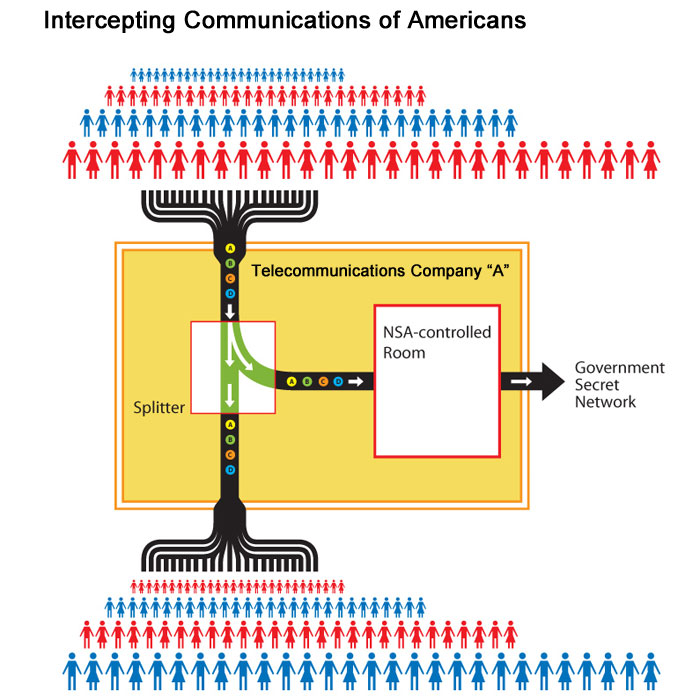
In the wake of the 9/11 attacks, George W. Bush secretly authorized the NSA to conduct warrantless surveillance on Americans’ phone calls and emails. That wireless wiretap program was reportedly ended in 2007 after the New York Times reported on it, to mass indignation.

Nothing changed under Barack Obama. In fact, the violations worsened, with the NSA authorized to secretly collect internet and telephone data on millions of Americans, as well as on foreign governments.

It was only after whistleblower Edward Snowden’s revelations in 2013 that the American people fully understood the extent to which they had been betrayed once again.

What this brief history of the NSA makes clear is that you cannot reform the NSA.

As long as the government is allowed to make a mockery of the law—be it the Constitution, the FISA Act or any other law intended to limit its reach and curtail its activities—and is permitted to operate behind closed doors, relaying on secret courts, secret budgets and secret interpretations of the laws of the land, there will be no reform.

Presidents, politicians, and court rulings have come and gone over the course of the NSA’s 60-year history, but none of them have done much to put an end to the NSA’s “technotyranny.”

The beast has outgrown its chains. It will not be restrained.

The growing tension seen and felt throughout the country is a tension between those who wield power on behalf of the government—the president, Congress, the courts, the military, the militarized police, the technocrats, the faceless unelected bureaucrats who blindly obey and carry out government directives, no matter how immoral or unjust, and the corporations—and those among the populace who are finally waking up to the mounting injustices, seething corruption and endless tyrannies that are transforming our country into a technocrized police state.

At every turn, we have been handicapped in our quest for transparency, accountability and a representative democracy by an establishment culture of secrecy: secret agencies, secret experiments, secret military bases, secret surveillance, secret budgets, and secret court rulings, all of which exist beyond our reach, operate outside our knowledge, and do not answer to “we the people.”

What we have failed to truly comprehend is that the NSA is merely one small part of a shadowy permanent government comprised of unelected bureaucrats who march in lockstep with profit-driven corporations that actually runs Washington, DC, and works to keep us under surveillance and, thus, under control. For example, Google openly works with the NSA, Amazon has built a massive $600 million intelligence database for the CIA, and the telecommunications industry is making a fat profit by spying on us for the government.

In other words, Corporate America is making a hefty profit by aiding and abetting the government in its domestic surveillance efforts. Conveniently, as the Intercept recently revealed, many of the NSA’s loudest defenders have financial ties to NSA contractors.

Thus, if this secret regime not only exists but thrives, it is because we have allowed it through our ignorance, apathy and naïve trust in politicians who take their orders from Corporate America rather than the Constitution.

If this shadow government persists, it is because we have yet to get outraged enough to push back against its power grabs and put an end to its high-handed tactics.

And if this unelected bureaucracy succeeds in trampling underfoot our last vestiges of privacy and freedom, it will be because we let ourselves be fooled into believing that politics matters, that voting makes a difference, that politicians actually represent the citizenry, that the courts care about justice, and that everything that is being done is in our best interests.

Indeed, as political scientist Michael J. Glennon warns, you can vote all you want, but the people you elect aren’t actually the ones calling the shots. “The American people are deluded … that the institutions that provide the public face actually set American national security policy,” stated Glennon. “They believe that when they vote for a president or member of Congress or succeed in bringing a case before the courts, that policy is going to change. But … policy by and large in the national security realm is made by the concealed institutions.”

In other words, it doesn’t matter who occupies the White House: the secret government with its secret agencies, secret budgets and secret programs won’t change. It will simply continue to operate in secret until some whistleblower comes along to momentarily pull back the curtain and we dutifully—and fleetingly—play the part of the outraged public, demanding accountability and rattling our cages, all the while bringing about little real reform.

Thus, the lesson of the NSA and its vast network of domestic spy partners is simply this: once you allow the government to start breaking the law, no matter how seemingly justifiable the reason, you relinquish the contract between you and the government which establishes that the government works for and obeys you, the citizen—the employer—the master.

Once the government starts operating outside the law, answerable to no one but itself, there’s no way to rein it back in, short of revolution. And by revolution, I mean doing away with the entire structure, because the corruption and lawlessness have become that pervasive.

“If we’re training cops as soldiers, giving them equipment like soldiers, dressing them up as soldiers, when are they going to pick up the mentality of soldiers? If you look at the police department, their creed is to protect and to serve. A soldier’s mission is to engage his enemy in close combat and kill him. Do we want police officers to have that mentality? Of course not.”— Arthur Rizer, former civilian police officer and member of the military

Talk about poor timing. Then again, perhaps it’s brilliant timing.

Only now—after the Departments of Justice, Homeland Security (DHS) and Defense have passed off billions of dollars worth of military equipment to local police forces, after police agencies have been trained in the fine art of war, after SWAT team raids have swelled in number to more than 80,000 a year, after it has become second nature for local police to look and act like soldiers, after communities have become acclimated to the presence of militarized police patrolling their streets, after Americans have been taught compliance at the end of a police gun or taser, after lower income neighborhoods have been transformed into war zones, after hundreds if not thousands of unarmed Americans have lost their lives at the hands of police who shoot first and ask questions later, after a whole generation of young Americans has learned to march in lockstep with the government’s dictates—only now does President Obama lift a hand to limit the number of military weapons being passed along to local police departments.

Not all, mind you, just some.

Talk about too little, too late.

Months after the White House defended a federal program that distributed $18 billion worth of military equipment to local police, Obama has announced that he will ban the federal government from providing local police departments with tracked armored vehicles, weaponized aircraft and vehicles, bayonets, grenade launchers, camouflage uniforms and large-caliber firearms.

Obama also indicated that less heavy-duty equipment (armored vehicles, tactical vehicles, riot gear and specialized firearms and ammunition) will reportedly be subject to more regulations such as local government approval, and police being required to undergo more training and collect data on the equipment’s use. Perhaps hoping to sweeten the deal, the Obama administration is also offering $163 million in taxpayer-funded grants to “incentivize police departments to adopt the report’s recommendations.”

While this is a grossly overdue first step of sorts, it is nevertheless a first step from an administration that has been utterly complicit in accelerating the transformation of America’s police forces into extensions of the military. Indeed, as investigative journalist Radley Balko points out, while the Obama administration has said all the right things about the need to scale back on a battlefield mindset, it has done all the wrong things to perpetuate the problem:

  • distributed equipment designed for use on the battlefield to local police departments,
  • provided private grants to communities to incentivize SWAT team raids,
  • redefined “community policing” to reflect aggressive police tactics and funding a nationwide COPS (Community Oriented Policing Services) program that has contributed to dramatic rise in SWAT teams,
  • encouraged the distribution of DHS anti-terror grants and the growth of “contractors that now cater to police agencies looking to cash DHS checks in exchange for battle-grade gear,”
  • ramped up the use of military-style raids to crack down on immigration laws and target “medical marijuana growers, shops, and dispensaries in states that have legalized the drug,”
  • defended as “reasonable” aggressive, militaristic police tactics in cases where police raided a guitar shop in defense of an obscure environmental law, raided a home looking for a woman who had defaulted on her student loans, and terrorized young children during a raid on the wrong house based on a mistaken license plate,
  • and ushered in an era of outright highway robbery in which asset forfeiture laws have been used to swindle Americans out of cash, cars, houses, or other property that government agents can “accuse” of being connected to a crime.

It remains to be seen whether this overture on Obama’s part, coming in the midst of heightened tensions between the nation’s police forces and the populace they’re supposed to protect, opens the door to actual reform or is merely a political gambit to appease the masses all the while further acclimating the populace to life in a police state.

Certainly, on its face, it does nothing to ease the misery of the police state that has been foisted upon us. In fact, Obama’s belated gesture of concern does little to roll back the deadly menace of overzealous police agencies corrupted by money, power and institutional immunity. And it certainly fails to recognize the terrible toll that has been inflicted on our communities, our fragile ecosystem of a democracy, and our freedoms as a result of the government’s determination to bring the war home.

Will the young black man guilty of nothing more than running away from brutish police officers be any safer in the wake of Obama’s edict? It’s unlikely.

Will the old man reaching for his cane have a lesser chance of being shot? It’s doubtful.

Will the little girl asleep under her princess blanket live to see adulthood when a SWAT team crashes through her door? I wouldn’t count on it.

It’s a safe bet that our little worlds will be no safer following Obama’s pronouncement and the release of his “Task Force on 21st Century Policing” report. In fact, there is a very good chance that life in the American police state will become even more perilous.

Among the report’s 50-page list of recommendations is a call for more police officer boots on the ground, training for police “on the importance of de-escalation of force,” and “positive non-enforcement activities” in high-crime communities to promote trust in the police such as sending an ice cream truck across the city.

Curiously, nowhere in the entire 120-page report is there a mention of the Fourth Amendment, which demands that the government respect citizen privacy and bodily integrity. The Constitution is referenced once, in the Appendix, in relation to Obama’s authority as president. And while the word “constitutional” is used 15 times within the body of the report, its use provides little assurance that the Obama administration actually understands the clear prohibitions against government overreach as enshrined in the U.S. Constitution.

For instance, in the section of the report on the use of technology and social media, the report notes: “Though all constitutional guidelines must be maintained in the performance of law enforcement duties, the legal framework (warrants, etc.) should continue to protect law enforcement access to data obtained from cell phones, social media, GPS, and other sources, allowing officers to detect, prevent, or respond to crime.”

Battlefield_Cover_300Translation: as I document in my book Battlefield America: The War on the American People, the new face of policing in America is about to shift from waging its war on the American people using primarily the weapons of the battlefield to the evermore-sophisticated technology of the battlefield where government surveillance of our everyday activities will be even more invasive.

This emphasis on technology, surveillance and social media is nothing new. In much the same way the federal government used taxpayer-funded grants to “gift” local police agencies with military weapons and equipment, it is also funding the distribution of technology aimed at making it easier for police to monitor, track and spy on Americans. For instance, license plate readers, stingray devices and fusion centers are all funded by grants from the DHS. Funding for drones at the state and local levels also comes from the federal government, which in turn accesses the data acquired by the drones for its own uses.

If you’re noticing a pattern here, it is one in which the federal government is not merely transforming local police agencies into extensions of itself but is in fact federalizing them, turning them into a national police force that answers not to “we the people” but to the Commander in Chief. Yet the American police force is not supposed to be a branch of the military, nor is it a private security force for the reigning political faction. It is supposed to be an aggregation of the countless local civilian units that exist for a sole purpose: to serve and protect the citizens of each and every American community.

So where does that leave us?

There’s certainly no harm in embarking on a national dialogue on the dangers of militarized police, but if that’s all it amounts to—words that sound good on paper and in the press but do little to actually respect our rights and restore our freedoms—then we’re just playing at politics with no intention of actually bringing about reform.

Despite the Obama Administration’s lofty claims of wanting to “ensure that public safety becomes more than the absence of crime, that it must also include the presence of justice,” this is the reality we must contend with right now:

Americans still have no real protection against police abuse. Americans still have no right to self-defense in the face of SWAT teams mistakenly crashing through our doors, or police officers who shoot faster than they can reason. Americans are still no longer innocent until proven guilty. Americans still don’t have a right to private property. Americans are still powerless in the face of militarized police. Americans still don’t have a right to bodily integrity. Americans still don’t have a right to the expectation of privacy. Americans are still being acclimated to a police state through the steady use and sight of military drills domestically, a heavy militarized police presence in public places and in the schools, and a taxpayer-funded propaganda campaign aimed at reassuring the public that the police are our “friends.” And to top it all off, Americans still can’t rely on the courts, Congress or the White House to mete out justice when our rights are violated by police.

To sum it all up: the problems we’re grappling with have been building for more than 40 years. They’re not going to go away overnight, and they certainly will not be resolved by a report that instructs the police to simply adopt different tactics to accomplish the same results—i.e., maintain the government’s power, control and wealth at all costs.

This is the sad reality of life in the American police state.


“The government is merely a servant―merely a temporary servant; it cannot be its prerogative to determine what is right and what is wrong, and decide who is a patriot and who isn’t. Its function is to obey orders, not originate them.” ― Mark Twain

How many Americans have actually bothered to read the Constitution, let alone the first ten amendments to the Constitution, the Bill of Rights (a quick read at 462 words)?

Take a few minutes and read those words for yourself—rather than having some court or politician translate them for you—and you will be under no illusion about where to draw the line when it comes to speaking your mind, criticizing your government, defending what is yours, doing whatever you want on your own property, and keeping the government’s nose out of your private affairs.

In an age of overcriminalization, where the average citizen unknowingly commits three crimes a day, and even the most mundane activities such as fishing and gardening are regulated, government officials are constantly telling Americans what not to do. Yet it was not always this way. It used to be “we the people” telling the government what it could and could not do. Indeed, the three words used most frequently throughout the Bill of Rights in regards to the government are “no,” “not” and “nor.”

Compare the following list of “don’ts” the government is prohibited from doing with the growing list of abuses to which “we the people” are subjected on a daily basis, and you will find that we have reached a state of crisis wherein the government is routinely breaking the law and violating its contractual obligations.

For instance, the government is NOT allowed to restrict free speech, press, assembly or the citizenry’s ability to protest and correct government wrongdoing. Nevertheless, the government continues to prosecute whistleblowers, persecute journalists, cage protesters, criminalize expressive activities, crack down on large gatherings of citizens mobilizing to voice their discontent with government policies, and insulate itself and its agents from any charges of wrongdoing (or what the courts refer to as “qualified immunity”).

The government may NOT infringe on a citizen’s right to defend himself. Nevertheless, in many states, it’s against the law to carry a concealed weapon (gun, knife or even pepper spray), and the average citizen is permitted little self-defense against militarized police officers who shoot first and ask questions later.

The government may NOT enter or occupy a citizen’s house without his consent (the quartering of soldiers). Nevertheless, government soldiers (i.e., militarized police) carry out more than 80,000 no-knock raids on private homes every year, while maiming children, killing dogs and shooting citizens.

The government may NOT carry out unreasonable searches and seizures on the citizenry or their possessions. NOR can government officials issue warrants without some evidence of wrongdoing (probable cause). Unfortunately, what is unreasonable to the average American is completely reasonable to a government agent, for whom the ends justify the means. In such a climate, we have no protection against roadside strip searches, blood draws, DNA collection, SWAT team raids, surveillance or any other privacy-stripping indignity to which the government chooses to subject us.

The government is NOT to deprive anyone of life, liberty or property without due process. Nevertheless, the government continues to incarcerate tens of thousands of Americans whose greatest crime is being poor and brown-skinned. The same goes for those who are put to death, some erroneously, by a system weighted in favor of class and wealth.

The government may NOT take private property for public use without just compensation. Nevertheless, under the guise of the “greater public interest,” the government often hides behind eminent domain laws in order to allow megacorporations to tear down homes occupied by less prosperous citizens in order to build high-priced resorts and shopping malls.

Government agents may NOT force a citizen to testify against himself. Yet what is the government’s extensive surveillance network that spies on all of our communications but a thinly veiled attempt at using our own words against us?

The government is NOT allowed to impose excessive fines on the citizenry or inflict cruel and unusual punishments upon them. Nevertheless Americans are subjected to egregious fines and outrageous punishments for minor traffic violations, student tardiness and absence from school, and generally having the misfortune of being warm bodies capable of filling privatized, profit-driven jails.

The government is NOT permitted to claim any powers that are not expressly granted to them by the Constitution. This prohibition has become downright laughable as the government continues to claim for itself every authority that serves to swell its coffers, cement its dominion, and expand its reach.

Despite what some special interest groups have suggested to the contrary, the problems we’re experiencing today did not arise because the Constitution has outlived its usefulness or become irrelevant, nor will they be solved by a convention of states or a ratification of the Constitution.

Battlefield_Cover_300No, as I document in my new book Battlefield America: The War on the American People, the problem goes far deeper. It can be traced back to the point at which “we the people” were overthrown as the center of the government. As a result, our supremacy has been undone, our authority undermined, and our experiment in democratic self-governance left in ruins. No longer are we the rulers of this land. We have long since been deposed and dethroned, replaced by corporate figureheads with no regard for our sovereignty, no thought for our happiness, and no respect for our rights.

In other words, without our say-so and lacking any mandate, the point of view of the Constitution has been shifted from “we the people” to “we the government.” Our taxpayer-funded employees—our appointed servants—have stopped looking upon us as their superiors and started viewing as their inferiors. Unfortunately, we’ve gotten so used to being dictated to by government agents, bureaucrats and militarized police alike that we’ve forgotten that WE are supposed to be the ones calling the shots and determining what is just, reasonable and necessary.

Then again, we’re not the only ones guilty of forgetting that the government was established to serve us as well as obey us. Every branch of government, from the Executive to the Judicial and Legislative, seems to be suffering this same form of amnesia. Certainly, when government programs are interpreted from the government’s point of view (i.e., the courts and legislatures), there is little the government CANNOT do in its quest for power and control.

We’ve been so brainwashed and indoctrinated into believing that the government is actually looking out for our best interests, when in fact the only compelling interesting driving government programs is maintain power and control by taking away our money and control. This vital truth, that the government exists for our benefit and operates at our behest, seems to have been lost in translation over two centuries dominated by government expansion, endless wars and centralized federal power.

Have you ever wondered why the Constitution begins with those three words “we the people”? It was intended to be a powerful reminder that everything flows from the citizenry. We the people are the center of the government and the source of its power. That “we” is crucial because it reminds us that there is power and safety in numbers, provided we stand united. We can accomplish nothing alone.

This is the underlying lesson of the Constitution, which outlines the duties and responsibilities of government. It was a mutual agreement formed by early Americans in order to ensure that when problems arose, they could address them together.

It’s like the wagon trains of the Old West, comprised of individual groups of pioneers. They rarely ventured out alone but instead traveled as convoys. And when faced with a threat, these early Americans formed their wagons into a tight circle in order to defend against invaders. In doing so, they presented a unified front and provided protection against an outside attack. In much the same way, the Constitution was intended to work as an institutionalized version of the wagon circle, serving as a communal shield against those who would harm us.

Unfortunately, we have been ousted from that protected circle, left to fend for ourselves in the wilderness that is the American frontier today. Those who did the ousting—the courts, the politicians, and the corporations—have since replaced us with yes-men, shills who dance to the tune of an elite ruling class. In doing so, they have set themselves as the central source of power and the arbiters of what is just and reasonable.

Once again we’re forced to navigate hostile terrain, unsure of how to protect ourselves and our loved ones from militarized police, weaponized drones, fusion centers, Stingray devices, SWAT team raids, the ongoing military drills on American soil, the government stockpiling of ammunition, the erection of mass detention centers across the country, and all other manner of abuses.
Read the smoke signals, and the warning is clear: It’s time to circle the wagons, folks. The government is on the warpath, and if we are to have any hope of surviving whatever is coming at us, we’ll need to keep our wits about us and present a unified front. Most of all, we need to restore “we the people” to our rightful place at the center of government. How we do that depends largely on each community’s willingness to get past their partisan politics and blind allegiance to uniformed government officials and find common ground.

To put it a little more bluntly, stop thinking like mindless government robots and start acting like a powerhouse of citizens vested with the power to say “enough is enough.” We have the numbers to stand our ground. Now we just need the will.

WASHINGTON, D.C. —Rejecting the idea that some violations of the Constitution are insignificant, the U.S. Supreme Court ruled today that police may not extend the time needed to conduct an ordinary traffic stop in order to subject the vehicle and its occupants to an examination by a drug-detecting dog unless they have specific reasons to suspect the car is carrying contraband. In its 6-3 ruling in Rodriguez v. United States, the Court held that a police officer violated the Fourth Amendment rights of motorist Dennys Rodriguez and his passenger when, after giving Rodriguez a written warning for a minor driving infraction, he continued to make them wait while a drug-sniffing dog patrolled the exterior of the vehicle.

“While this ruling is certainly a step in the right direction, as long as the courts continue to bend the Constitution to favor the police, there is little to celebrate. After all, the police are still empowered to stop cars based on anonymous tips, carry out warrantless searches of cars using drug-sniffing dogs, and subject Americans to virtual strip searches, no matter the offense,” said constitutional attorney John W. Whitehead, president of The Rutherford Institute and author ofBattlefield America: The War on the American People. “Whether it’s police officers breaking through people’s front doors and shooting them dead in their homes or strip searching innocent motorists on the side of the road, these instances of abuse are continually validated by a judicial system that kowtows to virtually every police demand, no matter how unjust, no matter how in opposition to the Constitution.”

Battlefield_Cover_300In March 2012, police officer Morgan Struble was on early-morning patrol in Nebraska when he observed a vehicle momentarily veer onto the shoulder of the highway. Struble, who is a K-9 officer and had his dog with him at the time, pulled the vehicle over and upon approaching it determined that the driver was Dennys Rodriguez and that there was a passenger in the front seat. After Rodriguez explained that he had swerved in order to avoid a pothole, Struble obtained Rodriguez’s license, registration and proof of insurance and ran a check to determine if all the paperwork was valid and whether there were any outstanding arrest warrants for Rodriguez. After the officer determined that everything was in order and that neither Rodriguez nor the passenger were wanted, he wrote up a warning ticket for Rodriguez for violating a state law prohibiting driving on highway shoulders. Upon returning to the vehicle and giving Rodriguez back the papers, Struble asked Rodriguez for permission to allow his dog to walk around the vehicle. Rodriguez refused to give permission. Struble then ordered Rodriguez to turn the car off and exit the vehicle. Rodriguez complied and Struble led the dog around the vehicle. Although the dog did nothing during the first pass, on the second pass the dog alerted. Based on this alert, Struble and another officer searched the vehicle and found methamphetamine. This evidence was the basis for a federal indictment against Rodriguez.

Before his trial, Rodriguez moved to suppress evidence of the methamphetamine, arguing that the officer violated the Fourth Amendment’s prohibition on unreasonable searches and seizures by holding him after all matters related to the driving infraction had been completed. However, Rodriguez’s argument was rejected by the trial court, which ruled that the additional seizure of Rodriguez for the seven to eight minutes the dog sniff took was a “de minimis intrusion on Rodriguez’s Fourth Amendment rights” and was not a sufficient basis to order suppression. The court of appeals affirmed the ruling on Rodriguez’s appeal, but the U.S. Supreme Court agreed to review the case. In reversing the lower courts’ decisions, the Supreme Court adhered to prior cases holding that a traffic stop can become unlawful in prolonged beyond the time required to meet the mission of issuing a ticket.

If Jesus had been killed twenty years ago, Catholic school children would be wearing little electric chairs around their necks instead of crosses.”―Lenny Bruce

If you buy into the version of Christianity Lite peddled by evangelical leaders such as Franklin Graham, who recently advised Americans to do as the Bible says and “submit to your leaders and those in authority,” then staying alive in the American police state depends largely on your ability to comply, submit, obey orders, respect authority and generally do whatever a cop tells you to do.

If, however, you’re one of those who prefers to model yourself after Jesus Christ himself—a radical nonconformist who challenged authority at every turn—rather than subscribe to the watered-down, corporatized, simplified, gentrified, sissified vision of a meek creature holding a lamb that most modern churches peddle, then you will understand better than most how relevant Jesus’ life and death are to those attempting to navigate the American police state.

Indeed, it is fitting, at a time when the nation is grappling with moral questions about how best to execute death row prisoners (by electric chair, lethal injection or shooting squad), whether police should be held responsible for shooting unarmed citizens (who posed no threat and complied with every order), and to what extent we allow the government to dictate, monitor and control every aspect of our lives (using Stingray devices, license plate readers, and all manner of surveillance technology), that we remember that Jesus Christ—the religious figure worshipped by Christians for his death on the cross and subsequent resurrection—died at the hands of a police state.

Those living through this present age of militarized police, SWAT team raids, police shootings of unarmed citizens, roadside strip searches, and invasive surveillance might feel as if these events are unprecedented. Yet while we in the United States may be experiencing a steady slide into a police state, we are neither the first nor the last nation to do so.

Although technology, politics and superpowers have changed over time, the characteristics of a police state and its reasons for being have remained the same: control, power and money. Indeed, as I point out in my book Battlefield America: The War on the American People, a police state extends far beyond the actions of law enforcement. In fact, a police state “is characterized by bureaucracy, secrecy, perpetual wars, a nation of suspects, militarization, surveillance, widespread police presence, and a citizenry with little recourse against police actions.”

Just as police states have arisen throughout history, there have also been individuals or groups of individuals who have risen up to challenge the injustices of their age. Nazi Germany had its Dietrich Bonhoeffer. The gulags of the Soviet Union were challenged by Aleksandr Solzhenitsyn. America had its color-coded system of racial segregation and warmongering called out for what it was, blatant discrimination and profiteering, by Martin Luther King Jr.

And then there was Jesus Christ, an itinerant preacher and revolutionary activist, who not only died challenging the police state of his day—namely, the Roman Empire—but provided a blueprint for civil disobedience that would be followed by those, religious and otherwise, who came after him. Yet for all the accolades poured out upon Jesus, little is said about the harsh realities of the police state in which he lived and its similarities to modern-day America, and yet they are striking.

Secrecy, surveillance and rule by the elite. As the chasm between the wealthy and poor grew wider in the Roman Empire, the ruling class and the wealthy class became synonymous, while the lower classes, increasingly deprived of their political freedoms, grew disinterested in the government and easily distracted by “bread and circuses.” Much like America today, with its lack of government transparency, overt domestic surveillance, and rule by the rich, the inner workings of the Roman Empire were shrouded in secrecy, while its leaders were constantly on the watch for any potential threats to its power. The resulting state-wide surveillance was primarily carried out by the military, which acted as investigators, enforcers, torturers, policemen, executioners and jailers. Today that role is fulfilled by increasingly militarized police forces across the country.

Widespread police presence. The Roman Empire used its military forces to maintain the “peace,” thereby establishing a police state that reached into all aspects of a citizen’s life. In this way, these military officers, used to address a broad range of routine problems and conflicts, enforced the will of the state. Today SWAT teams, comprised of local police and federal agents, are employed to carry out routine search warrants for minor crimes such as marijuana possession and credit card fraud.

Citizenry with little recourse against the police state. As the Roman Empire expanded, personal freedom and independence nearly vanished, as did any real sense of local governance and national consciousness. Similarly, in America today, citizens largely feel powerless, voiceless and unrepresented in the face of a power-hungry federal government. As states and localities are brought under direct control by federal agencies and regulations, a sense of learned helplessness grips the nation.

Perpetual wars and a military empire. Much like America today with its practice of policing the world, war and an over-arching militarist ethos provided the framework for the Roman Empire, which extended from the Italian peninsula to all over Southern, Western, and Eastern Europe, extending into North Africa and Western Asia as well. In addition to significant foreign threats, wars were waged against inchoate, unstructured and socially inferior foes.

Martial law. Eventually, Rome established a permanent military dictatorship that left the citizens at the mercy of an unreachable and oppressive totalitarian regime. In the absence of resources to establish civic police forces, the Romans relied increasingly on the military to intervene in all matters of conflict or upheaval in provinces, from small-scale scuffles to large-scale revolts. Not unlike police forces today, with their martial law training drills on American soil, militarized weapons and “shoot first, ask questions later” mindset, the Roman soldier had “the exercise of lethal force at his fingertips” with the potential of wreaking havoc on normal citizens’ lives.

A nation of suspects. Just as the American Empire looks upon its citizens as suspects to be tracked, surveilled and controlled, the Roman Empire looked upon all potential insubordinates, from the common thief to a full-fledged insurrectionist, as threats to its power. The insurrectionist was seen as directly challenging the Emperor. A “bandit,” or revolutionist, was seen as capable of overturning the empire, was always considered guilty and deserving of the most savage penalties, including capital punishment. Bandits were usually punished publicly and cruelly as a means of deterring others from challenging the power of the state. Jesus’ execution was one such public punishment.

Acts of civil disobedience by insurrectionists. Starting with his act of civil disobedience at the Jewish temple, the site of the administrative headquarters of the Sanhedrin, the supreme Jewish council, Jesus branded himself a political revolutionary. When Jesus “with the help of his disciples, blocks the entrance to the courtyard” and forbids “anyone carrying goods for sale or trade from entering the Temple,” he committed a blatantly criminal and seditious act, an act “that undoubtedly precipitated his arrest and execution.” Because the commercial events were sponsored by the religious hierarchy, which in turn was operated by consent of the Roman government, Jesus’ attack on the money chargers and traders can be seen as an attack on Rome itself, an unmistakable declaration of political and social independence from the Roman oppression.

Military-style arrests in the dead of night. Jesus’ arrest account testifies to the fact that the Romans perceived Him as a revolutionary. Eerily similar to today’s SWAT team raids, Jesus was arrested in the middle of the night, in secret, by a large, heavily armed fleet of soldiers. Rather than merely asking for Jesus when they came to arrest him, his pursuers collaborated beforehand with Judas. Acting as a government informant, Judas concocted a kiss as a secret identification marker, hinting that a level of deception and trickery must be used to obtain this seemingly “dangerous revolutionist’s” cooperation.


Torture and capital punishment. In Jesus’ day, religious preachers, self-proclaimed prophets and nonviolent protesters were not summarily arrested and executed. Indeed, the high priests and Roman governors normally allowed a protest, particularly a small-scale one, to run its course. However, government authorities were quick to dispose of leaders and movements that appeared to threaten the Roman Empire. The charges leveled against Jesus—that he was a threat to the stability of the nation, opposed paying Roman taxes and claimed to be the rightful King—were purely political, not religious. To the Romans, any one of these charges was enough to merit death by crucifixion, which was usually reserved for slaves, non-Romans, radicals, revolutionaries and the worst criminals.

Jesus was presented to Pontius Pilate “as a disturber of the political peace,” a leader of a rebellion, a political threat, and most gravely—a claimant to kingship, a “king of the revolutionary type.” After Jesus is formally condemned by Pilate, he is sentenced to death by crucifixion, “the Roman means of executing criminals convicted of high treason.” The purpose of crucifixion was not so much to kill the criminal, as it was an immensely public statement intended to visually warn all those who would challenge the power of the Roman Empire. Hence, it was reserved solely for the most extreme political crimes: treason, rebellion, sedition, and banditry. After being ruthlessly whipped and mocked, Jesus was nailed to a cross.


As Professor Mark Lewis Taylor observed:


The cross within Roman politics and culture was a marker of shame, of being a criminal. If you were put to the cross, you were marked as shameful, as criminal, but especially as subversive. And there were thousands of people put to the cross. The cross was actually positioned at many crossroads, and, as New Testament scholar Paula Fredricksen has reminded us, it served as kind of a public service announcement that said, “Act like this person did, and this is how you will end up.”


Jesus—the revolutionary, the political dissident, and the nonviolent activist—lived and died in a police state. Any reflection on Jesus’ life and death within a police state must take into account several factors: Jesus spoke out strongly against such things as empires, controlling people, state violence and power politics. Jesus challenged the political and religious belief systems of his day. And worldly powers feared Jesus, not because he challenged them for control of thrones or government but because he undercut their claims of supremacy, and he dared to speak truth to power in a time when doing so could—and often did—cost a person his life.

Unfortunately, the radical Jesus, the political dissident who took aim at injustice and oppression, has been largely forgotten today, replaced by a congenial, smiling Jesus trotted out for religious holidays but otherwise rendered mute when it comes to matters of war, power and politics. Yet for those who truly study the life and teachings of Jesus, the resounding theme is one of outright resistance to war, materialism and empire.


As Professor Taylor notes, “The power of Jesus is one that enables us to critique the nation and the empire. Unfortunately, that gospel is being sacrificed and squandered by Christians who have cozied up to power and wealth.” Ultimately, this is the contradiction that must be resolved if the radical Jesus—the one who stood up to the Roman Empire and was crucified as a warning to others not to challenge the powers-that-be—is to be an example for our modern age.


“Do exactly what I say, and we’ll get along fine. Do not question me or talk back in any way. You do not have the right to object to anything I may say or ask you to do, or ask for clarification if my demands are unclear or contradictory. You must obey me under all circumstances without hesitation, no matter how arbitrary, unreasonable, discriminatory, or blatantly racist my commands may be. Anything other than immediate perfect servile compliance will be labeled as resisting arrest, and expose you to the possibility of a violent reaction from me. That reaction could cause you severe injury or even death. And I will suffer no consequences. It’s your choice: Comply, or die.”— “‘Comply or Die’ policing must stop,” Daily KOS

Americans as young as 4 years old are being leg shackled, handcuffed, tasered and held at gun point for not being quiet, not being orderly and just being childlike—i.e., not being compliant enough.

Americans as old as 95 are being beaten, shot and killed for questioning an order, hesitating in the face of a directive, and mistaking a policeman crashing through their door for a criminal breaking into their home—i.e., not being submissive enough.

And Americans of every age and skin color are being taught the painful lesson that the only truly compliant, submissive and obedient citizen in a police state is a dead one.

It doesn’t matter where you live—big city or small town—it’s the same scenario being played out over and over again in which government agents, hyped up on their own authority and the power of their uniform, ride roughshod over the rights of the citizenry. In turn, Americans are being brainwashed into believing that anyone who wears a government uniform—soldier, police officer, prison guard—must be obeyed without question.

Franklin Graham, the heir to Billy Graham’s evangelical empire, offered up this “simple” piece of advice for “Blacks, Whites, Latinos, and everybody else” hoping to survive an encounter with the police:

Most police shootings can be avoided. It comes down to respect for authority and obedience. If a police officer tells you to stop, you stop. If a police officer tells you to put your hands in the air, you put your hands in the air. If a police officer tells you to lay down face first with your hands behind your back, you lay down face first with your hands behind your back. It’s as simple as that. Even if you think the police officer is wrong—YOU OBEY.

Clearly, Graham’s message resonated with a core group of Americans: almost 200,000 individuals “liked” the message on Facebook, with an astounding 83,000 fans sharing his words of advice with their own friends, none of whom seem to recall that Jesus Christ, whom they claim to follow and model their lives after, not only stood up to the police state of his day but was put to death for it.

It’s not just mainstream evangelicals who have been brainwashed into believing that a good citizen is a compliant citizen and that obedience will save us from the police state. In the wake of a grand jury’s decision not to indict the police officer responsible for the choking death of Eric Garner, Patrick Lynch, president of the Patrolmen’s Benevolent Association, declared:

“We have to teach our children, our sons and our daughters, no matter what they look like, to respect New York City police officers, teach them to comply with New York City police officers even if they think it’s unjust.”

Similarly, Officer Sunil Dutta of the Los Angeles Police Department advises:

If you don’t want to get shot, tased, pepper-sprayed, struck with a baton or thrown to the ground, just do what I tell you. Don’t argue with me, don’t call me names, don’t tell me that I can’t stop you, don’t say I’m a racist pig, don’t threaten that you’ll sue me and take away my badge. Don’t scream at me that you pay my salary, and don’t even think of aggressively walking towards me.”

In other words, it doesn’t matter if you’re in the right, it doesn’t matter if a cop is in the wrong, it doesn’t matter if you’re being treated with less than the respect you deserve. If you want to emerge from a police encounter with your life and body intact, then you’d better comply, submit, obey orders, respect authority and generally do whatever a cop tells you to do.

Battlefield_Cover_300In this way, the old police motto to “protect and serve” has become “comply or die.” As I point out in my book A Government of Wolves: The Emerging American Police State and in my forthcoming book Battlefield America: The War on the American People, this is the unfortunate, misguided, perverse message being beaten, shot, tasered and slammed into our collective consciousness, and it is regrettably starting to take root.

Despite the growing number of criminal charges (ranging from resisting arrest and interference to disorderly conduct, obstruction, and failure to obey a police order) that get trotted out anytime a citizen voices discontent with the government or challenges or even questions the authority of the powers that be, the problems we’re experiencing in terms of police shootings have little to do with rebellion or belligerence or resistance.

Rather, the problem arises when compliance doesn’t happen fast enough to suit the police.

For instance, 15-year-old Jamar Nicholson was shot in the back by police after they spotted him standing next to a friend holding a toy gun. “Officers ordered the boy to drop the weapon multiple times,” reports the Los Angeles Times. “When he didn’t comply, one of the officers opened fire.”

Martese Johnson, a 20-year-old college student, unarmed and in the process of walking away from a bar where he’d just been denied entry for being underage, was tackled by police and had his head slammed to the ground and bloodied, allegedly for being intoxicated, belligerent and using a fake ID. Johnson, who it turns out was polite, had a legal ID and was not drunk, survived the encounter after 10 stitches to his head.

And then there was Christopher Lollie, who was tasered, arrested and charged with trespassing, disorderly conduct and obstruction of the legal process for refusing to identify himself to police while waiting to pick his children up from their daycare. Footage of the encounter shows Lollie asking, “Why do I have to let you know who I am? I don’t have to let you know who I am if I haven’t broken any laws.” The charges against Lollie were eventually dropped.

Nicholson, Johnson and Lollie aren’t the only Americans being taught a hard lesson about compliance at the end of a government-issued gun.

World War II veteran John Wrana, 95 years old, dependent on a walker to get around, and a resident of an assisted living center, was rushed by five police officers—one with a Taser and riot shield, others with handguns and a 12-gauge Mossberg pump shotgun—after refusing treatment for a urinary tract infection and brandishing a shoehorn. One of the officers, allegedly fearing for his safety, fired multiple beanbag rounds at Wrana at close range, who bled to death from internal injuries.

Martese Johnson, slammed and bloodied by ABC police.

James Howard Allen, 74 years old and recovering at home from a surgery, was shot and killed by police who were asked by family members to do a welfare check on him. When police crashed through the man’s back door, they found Allen, perhaps having just awoken and fearing a burglary, armed with a gun.

These shootings and deaths, and many more like them, constitute a drop in the proverbial bucket when it comes to police killing unarmed American citizens, and yet you’d be hard-pressed to find exact numbers for how many unarmed citizens are killed by police every year. Indeed, while police go to great lengths to document how many police are killed in the line of duty, police agencies aren’t actually required to report the number of times police officers engage in homicide. Suffice it to say, however, that the numbers are significantly underreported.

One website estimates that police kill on average three citizens a day in the United States. In 2014, 1100 individuals were killed by police in the U.S. That’s 70 times more than other first-world nations, and almost 20 times more than the number of U.S. troops killed in the same year in Afghanistan and Iraq.

Rarely are these officers given more than a slap on the wrist. More often than not, they operate with impunity, are shielded from justice by the governmental bureaucracy, and are granted qualified immunity by the courts.

A recent report by the Justice Department on police shootings in Philadelphia, which boasts the fourth largest police department in the country, found that half of the unarmed people shot by police over a seven-year span were “shot because the officer saw something (like a cellphone) or some action (like a person pulling at the waist of their pants) and misidentified it as a threat.”

Now it’s one thing for those who back the police—no matter what the circumstance—to insist that if you just obey a police officer, you’ll be safe. But what happens when compliance isn’t enough?

What happens if you play it safe, comply and do whatever a police officer tells you to do, don’t talk back, don’t threaten, and don’t walk away—in other words, don’t do anything that even hints at resistance—and still, you find yourself staring down the wrong end of a government agent’s gun? After all, the news is riddled with reports of individuals who didn’t resist when confronted by police and still got tasered, tackled or shot simply because they looked at police in a threatening manner or moved in a way that made an officer “fear” for his safety.

For instance, Levar Jones, pulled over for not wearing a seatbelt, was shot after complying with a police officer’s order to retrieve his license. The trooper justified his shooting of the unarmed man by insisting that Jones reached for his license “aggressively.”

What more could Jones or anyone have done to protect himself in that situation? How does a citizen protect himself against a police officer’s tendency to shoot first and ask questions later, oftentimes based only on their highly subjective “feeling” of being threatened?

The short answer is you can’t.

The assurance of safety in exchange for compliance is a false, misguided doctrine that has us headed towards a totalitarian regime the likes of which the world has seen before.

Rest assured, if we just cower before government agents and meekly obey, we’ll find ourselves repeating history. However, history also shows us a different path, one that involves standing up and speaking truth to power. Jesus Christ walked that road. So did Mahatma Gandhi, Martin Luther King Jr., and countless other freedom fighters whose actions changed the course of history.

Indeed, had Christ merely complied with the Roman police state, there would have been no crucifixion and no Christian religion. Had Gandhi meekly fallen in line with the British Empire’s dictates, the Indian people would never have won their independence. Had Martin Luther King Jr. obeyed the laws of his day, there would have been no civil rights movement. And if the founding fathers had marched in lockstep with royal decrees, there would have been no American Revolution.

The long answer, therefore, is that we must adopt a different mindset and follow a different path if we are to alter the outcome of these interactions with police.

No matter what path you follow, it will be fraught with peril. America is in the midst of a nervous breakdown, brought about by prolonged exposure to the American police state, and there are few places that are safe anymore.

A good test is this: if you live in a community that has welcomed the trappings of the police state with open arms (surveillance cameras, forced DNA extractions, Stingray devices, red light cameras, private prisons, etc.), all the while allowing its police forces to militarize, weaponize and operate beyond the reach of the Constitution, then you don’t live in a democratic republic—you live in a microcosm of the American police state.

If you have no real say in how your local law enforcement operates, if the only oversight of police actions is carried out by fellow officers, if any attempt to criticize the police is edited out or not covered by your local newspaper or TV station, drowned out by your fellow citizens, or intimidated into silence by your local police, then you have no recourse when it comes to police abuses.

Finally, if, despite having done nothing wrong, you feel nervous during a police encounter, you fear doing or saying the wrong thing in front of an officer will get you shot, and your local police dress and act like extensions of the military and treat you like a suspect, then it’s safe to say that you are not the one holding the upper hand in the master-servant relationship anymore.

This is the death rattle of the American dream, which was built on the idea that no one is above the law, that our rights are inalienable and cannot be taken away, and that our government and its appointed agents exist to serve us.