Posts Tagged ‘police state’

What happens to a dream deferred?
Does it dry up
like a raisin in the sun?
Or fester like a sore—
And then run?
Does it stink like rotten meat?
Or crust and sugar over—
like a syrupy sweet?
Maybe it just sags
like a heavy load.
Or does it explode?—Langston Hughes, “Harlem”

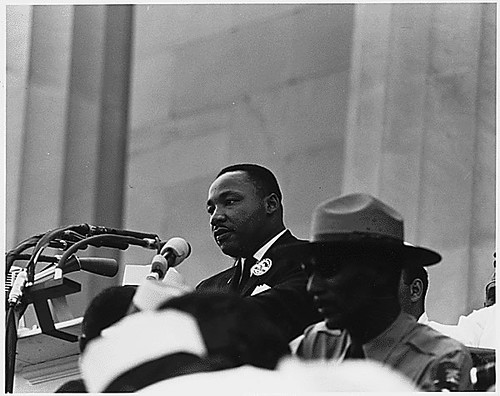
Martin Luther King Jr. could tell you what happens to dreams deferred. They explode.

As I point out in my book Battlefield America: The War on the American People, more than 50 years after King was assassinated, his dream of a world without racism, militarism and materialism remains a distant dream.

Indeed, the reality we must contend with is far different from King’s dream for the future: America has become a ticking time bomb of racial unrest and injustice, police militarization, surveillance, government corruption and ineptitude, the blowblack from a battlefield mindset and endless wars abroad, and a growing economic inequality between the haves and have nots.

King’s own legacy has suffered in the process.

The image of the hard-talking, charismatic leader, voice of authority, and militant, nonviolent activist minister/peace warrior who staged sit-ins, boycotts and marches and lived through police attack dogs, water cannons and jail cells has been so watered down that younger generations recognize his face but know very little about his message.

Rubbing salt in the wound, while those claiming to honor King’s legacy pay lip service to his life and the causes for which he died, they have done little to combat the evils about which King spoke and opposed so passionately: injustice, war, racism and economic inequality.

For instance, President Obama speaks frequently of King, but what has he done to bring about peace or combat the racial injustices that continue to be meted out to young black Americans by the police state?

Republican presidential candidate Donald Trump plans to “honor” Martin Luther King Jr.’s legacy by speaking at a convocation at Liberty University, but what has he done to combat economic injustice?

Democratic presidential contender Hillary Clinton will pay tribute to King’s legacy by taking part in Columbia, South Carolina’s King Day at the Dome event, but has she done anything to dispel her track record’s impression that “machines and computers, profit motives and property rights are still considered more important than people”?

Unlike the politicians of our present day, King was a clear moral voice that cut through the fog of distortion. He spoke like a prophet and commanded that you listen. King dared to speak truth to the establishment and called for an end to oppression and racism. He raised his voice against the Vietnam War and challenged the military-industrial complex. And King didn’t just threaten boycotts and sit-ins for the sake of photo ops and media headlines. Rather, he carefully planned and staged them to great effect.

The following key principles formed the backbone of Rev. King’s life and work. King spoke of them incessantly, in every sermon he preached, every speech he delivered and every article he wrote. They are the lessons we failed to learn and, in failing to do so, we have set ourselves up for a future in which a militarized surveillance state is poised to eradicate freedom.

Practice militant non-violence, resist militarism and put an end to war.

“I could never again raise my voice against the violence of the oppressed in the ghettos without having first spoken clearly to the greatest purveyor of violence in the world today—my own government.”—Martin Luther King Jr., Sermon at New York’s Riverside Church (April 4, 1967)

On April 4, 1967, exactly one year before his murder, King used the power of his pulpit to condemn the U.S. for “using massive doses of violence to solve its problems, to bring about the changes it wanted.” King called on the U.S. to end all bombing in Vietnam, declare a unilateral cease-fire, curtail its military buildup, and set a date for troop withdrawals. In that same sermon, King warned that “a nation that continues year after year to spend more money on military defense than on programs of social uplift is approaching spiritual death.”

Fifty-some years later, America’s military empire has been expanded at great cost to the nation, with the White House leading the charge. Indeed, in his recent State of the Union address, President Obama bragged that the U.S. spends more on its military than the next eight nations combined. Mind you, the money spent on wars abroad, weapons and military personnel is money that is not being spent on education, poverty and disease.

Stand against injustice.

“Injustice anywhere is a threat to justice everywhere… there are two types of laws: just and unjust. I would be the first to advocate obeying just laws. One has not only a legal but a moral responsibility to obey just laws. Conversely, one has a moral responsibility to disobey unjust laws.”― Martin Luther King Jr., “Letter from a Birmingham Jail” (April 16, 1963)

Arrested and jailed for taking part in a nonviolent protest against racial segregation in Birmingham, Ala., King used his time behind bars to respond to Alabama clergymen who criticized his methods of civil disobedience and suggested that the courts were the only legitimate means for enacting change. His “Letter from a Birmingham Jail,” makes the case for disobeying unjust laws when they are “out of harmony with the moral law.”

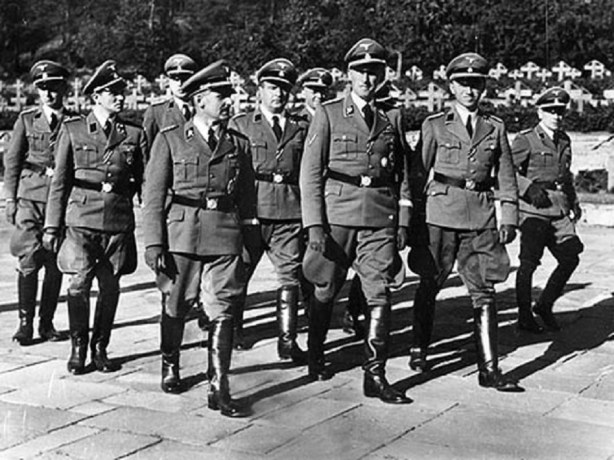
Fifty-some years later, we are being bombarded with unjust laws at both the national and state levels, from laws authorizing the military to indefinitely detain American citizens and allowing the NSA to spy on American citizens to laws making it illegal to protest near an elected official or in front of the U.S. Supreme Court. As King warned, “Never forget that everything Hitler did in Germany was legal.”

Work to end poverty. Prioritize people over corporations.

“When machines and computers, profit motives and property rights, are considered more important than people, the giant triplets of racism, extreme materialism, and militarism are incapable of being conquered.” —Martin Luther King Jr., Sermon at New York’s Riverside Church (April 4, 1967)

Especially in the latter part of his life, King was unflinching in his determination to hold Americans accountable to alleviating the suffering of the poor, going so far as to call for a march on Washington, DC, to pressure Congress to pass an Economic Bill of Rights.

Fifty-some years later, a monied, oligarchic elite calls the shots in Washington, while militarized police and the surveillance sector keep the masses under control. With roughly 23 lobbyists per Congressman, corporate greed largely dictates what happens in the nation’s capital, enabling our so-called elected representatives to grow richer and the people poorer. One can only imagine what King would have said about a nation whose political processes, everything from elections to legislation, are driven by war chests and corporate benefactors rather than the needs and desires of the citizenry.

Stand up for what is right, rather than what is politically expedient.

“On some positions, cowardice asks the question, is it expedient? And then expedience comes along and asks the question, is it politic? Vanity asks the question, is it popular? Conscience asks the question, is it right? There comes a time when one must take the position that is neither safe nor politic nor popular, but he must do it because conscience tells him it is right.”—Martin Luther King Jr., Sermon at National Cathedral (March 31, 1968)

Five days before his assassination, King delivered a sermon at National Cathedral in Washington, DC, in which he noted that “one of the great liabilities of life is that all too many people find themselves living amid a great period of social change, and yet they fail to develop the new attitudes, the new mental responses, that the new situation demands. They end up sleeping through a revolution.”

Freedom, human dignity, brotherhood, spirituality, peace, justice, equality, putting an end to war and poverty: these are just a few of the big themes that shaped King’s life and his activism. As King recognized, there is much to be done if we are to make this world a better place, and we cannot afford to play politics when so much hangs in the balance.

It’s time to wake up, America.

To quote my hero: “[O]ur very survival depends on our ability to stay awake, to adjust to new ideas, to remain vigilant and to face the challenge of change. The large house in which we live demands that we transform this world-wide neighborhood into a world-wide brotherhood. Together we must learn to live as brothers or together we will be forced to perish as fools.”

Original post can be found at http://rutherford.org/publications_resources/john_whiteheads_commentary/what_happens_to_a_dream_deferred_ask_martin_luther_king_jr


“There will be, in the next generation or so, a pharmacological method of making people love their servitude, and producing dictatorship without tears, so to speak, producing a kind of painless concentration camp for entire societies, so that people will in fact have their liberties taken away from them, but will rather enjoy it, because they will be distracted from any desire to rebel by propaganda or brainwashing, or brainwashing enhanced by pharmacological methods. And this seems to be the final revolution.”—Aldous Huxley

There’s a man who contacts me several times a week to disagree with my assessments of the American police state. According to this self-avowed Pollyanna who is tired of hearing “bad news,” the country is doing just fine, the government’s intentions are honorable, anyone in authority should be blindly obeyed, those individuals who are being arrested, shot and imprisoned must have done something to deserve such treatment, and if you have nothing to hide, you shouldn’t care whether the government is spying on you.

In other words, this man trusts the government with his life, his loved ones and his property, and anyone who doesn’t feel the same should move elsewhere.

It’s tempting to write this man off as dangerously deluded, treacherously naïve, and clueless to the point of civic incompetence. However, he is not alone in his goose-stepping, comfort-loving, TV-watching, insulated-from-reality devotion to the alternate universe constructed for us by the Corporate State with its government propaganda, pseudo-patriotism and contrived political divisions.

While only 1 in 5 Americans claim to trust the government to do what is right, the majority of the people are not quite ready to ditch the American experiment in liberty. Or at least they’re not quite ready to ditch the government with which they have been saddled.

As The Washington Post concludes, “Americans hate government, but they like what it does.” Indeed, kvetching aside, Americans want the government to keep providing institutionalized comforts such as Social Security, public schools, and unemployment benefits, fighting alleged terrorists and illegal immigrants, defending the nation from domestic and foreign threats, and maintaining the national infrastructure. And it doesn’t matter that the government has shown itself to be corrupt, abusive, hostile to citizens who disagree, wasteful and unconcerned about the plight of the average American.

For the moment, Americans are continuing to play by the government’s rules. Indeed, Americans may not approve the jobs being done by their elected leaders, and they may have little to no access to those same representatives, but they remain committed to the political process, so much so that they are working themselves into a frenzy over the upcoming presidential election, with contributions to the various candidates nearing $500 million.

Yet as Barack Obama’s tenure in the White House shows, no matter how much hope and change were promised, what we’ve ended up with is not only more of the same, but something worse: an invasive, authoritarian surveillance state armed and ready to eliminate any opposition.

The state of our nation under Obama has become more bureaucratic, more debt-ridden, more violent, more militarized, more fascist, more lawless, more invasive, more corrupt, more untrustworthy, more mired in war, and more unresponsive to the wishes and needs of the electorate. Most of all, the government, already diabolical and manipulative to the nth degree, has mastered the art of “do what I say and not what I do” hypocrisy.

For example, the government’s arsenal is growing. While the Obama administration is working to limit the public’s access to guns by pushing for greater gun control, it’s doing little to scale back on the federal government’s growing arsenal of firepower and militarized equipment.

In fact, it’s not just the Department of Defense that’s in the business of waging war. Government agencies focused largely on domestic matters continue to spend tens of millions of taxpayer dollars to purchase SWAT and military-style equipment such as body armor, riot helmets and shields, cannon launchers and police firearms and ammunition. The Department of Veterans Affairs spent nearly $2 million on riot helmets, defender shields, body armor, a “milo return fire cannon system,” armored mobile shields, Kevlar blankets, tactical gear and equipment for crowd control. The Food and Drug Administration purchased “ballistic vests and carriers.” The Environmental Protection Agency shelled out $200,000 for body armor. And the Smithsonian Institution procured $28,000 worth of body armor for its “zoo police and security officers.”

The national debt is growing. In fact, it’s almost doubled during Obama’s time in office to nearly $20 trillion. Much of this debt is owed to foreign countries such as China, which have come to exert an undue degree of influence on various aspects of the American economy.

Meanwhile, almost half of Americans are struggling to save for emergencies and retirement, 43% can’t afford to go more than one month without a paycheck, and 24% have less than $250 in their bank accounts preceding payday.

On any given night, over half a million people in the U.S. are homeless, and half of them are elderly. In fact, studies indicate that the homeless are aging faster than the general population in the U.S.

While the U.S. spends more on education than almost any other country, American schools rank 28th in the world, below much poorer countries such as the Czech Republic and Vietnam.

The American police state’s payroll is expanding. Despite the fact that violent crime is at a 40-year-low, there are more than 1.1 million persons employed on a full-time basis by state and local law enforcement in this country. That doesn’t include the more than 120,000 full-time officers on the federal payroll.

While crime is falling, the number of laws creating new crimes is growing at an alarming rate. Congress creates, on average, more than 50 new criminal laws each year. This adds up to more than 4,500 federal criminal laws and an even greater number of state laws.

The prison population is growing at an alarming rate. Owing largely to overcriminalization, the nation’s prison population has quadrupled since 1980 to 2.4 million, which breaks down to more than one out of every 100 American adults behind bars. According to The Washington Post, it costs $21,000 a year to keep someone in a minimum-security federal prison and $33,000 a year for a maximum-security federal prison. Those costs are expected to increase 30 percent by 2020. Translation: while the American taxpayer will be forced to shell out more money for its growing prison population, the private prison industry will be making a hefty profit.

The nation’s infrastructure—railroads, water pipelines, ports, dams, bridges, airports and roads—is rapidly deteriorating. An estimated $1.7 trillion will be needed by 2020 to improve surface transportation, but with vital funds being siphoned off by the military industrial complex, there’s little relief in sight.

The expense of those endless wars in Afghanistan and Iraq will cost taxpayers $4 trillion to $6 trillion. That does not include the cost of military occupations and exercises elsewhere around the globe. Unfortunately, that’s money that is not being invested in America, nor is it being used to improve the lives of Americans.

Government incompetence, corruption and lack of accountability continue to result in the loss of vast amounts of money and weapons. A Reuters investigation revealed $8.5 trillion in “taxpayer money doled out by Congress to the Pentagon since 1996 that has never been accounted for.” Then there was the $500 million in Pentagon weapons, aircraft and equipment (small arms, ammunition, night-vision goggles, patrol boats, vehicles and other supplies) that the U.S. military somehow lost track of.

Rounding out the bad news, many Americans know little to nothing about their rights and the government. Only 31% can name all three branches of the U.S. government, while one in three says that the Bill of Rights guarantees the right to own your own home, while one in four thinks that it guarantees “equal pay for equal work.” One in 10 Americans (12%) says the Bill of Rights includes the right to own a pet.

If this brief catalogue of our national woes proves anything at all, it is that the American experiment in liberty has failed, and as political economist Lawrence Hunter warns, it is only a matter of time before people realize it. Writing for Forbes, Hunter notes:

The greatest fear of America’s Founding Fathers has been realized: The U.S. Constitution has been unable to thwart the corrosive dynamics of majority-rule democracy, which in turn has mangled the Constitution beyond recognition. The real conclusion of the American Experiment is that democracy ultimately undermines liberty and leads to tyranny and oppression by elected leaders and judges, their cronies and unelected bureaucrats.  All of this is done in the name of “the people” and the “general welfare,” of course.  But in fact, democracy oppresses the very demos in whose name it operates, benefiting string-pullers within the Establishment and rewarding the political constituencies they manage by paying off special interests with everyone else’s money forcibly extracted through taxation. The Founding Fathers (especially Washington, Jefferson, Franklin, Adams, Madison, and James Monroe), as well as outside observers of the American Experiment such as Alexis de Tocqueville all feared democracy and dreaded this outcome.  But, they let hope and faith in their ingenious constitutional engineering overcome their fear of the democratic state, only to discover they had replaced one tyranny with another.

So are there any real, workable solutions to the emerging American police state?

A second American Revolution will not work. In the first revolution, the colonists were able to dispatch the military occupation and take over the running of the country. However, the Orwellian state is here and it is so pervasive that government agents are watching, curtailing and putting down any resistance before it can get started.

A violent overthrow of the government will not work. Government agents are armed to the teeth and will easily blow away any insurgency when and if necessary.

Politics will not help things along. As history has made clear, the new boss is invariably the same as or worse than the old boss—all controlled by a monied, oligarchic elite.

Battlefield_Cover_300As I make clear in my book Battlefield America: The War on the American People, there is only one feasible solution left to us short of fleeing the country for parts unknown: grassroots activism that strives to reform the government locally and trickles up.

Unfortunately, such a solution requires activism, engagement, vigilance, sacrifice, individualism, community-building, nullification and a communal willingness to reject the federal government’s handouts and, when needed, respond with what Martin Luther King Jr. referred to as “militant nonviolent resistance.”

That means forgoing Monday night football in order to actively voice your concerns at city council meetings, turning off the television and spending an hour reading your local newspaper (if you still have one that reports local news) from front to back, showing your displeasure by picketing in front of government offices, risking your reputation by speaking up and disagreeing with the majority when necessary, refusing to meekly accept whatever the government dictates, reminding government officials—including law enforcement—that they work for you, and working together with your neighbors to present a united front against an overreaching government.

Unfortunately, we now live in a ubiquitous Orwellian society with all the trappings of Huxley’s A Brave New World. We have become a society of watchers rather than activists who are distracted by even the clumsiest government attempts at sleight-of-hand.

There are too many Americans who are reasonably content with the status quo and too few Americans willing to tolerate the discomfort of a smaller, more manageable government and a way of life that is less convenient, less entertaining, and less comfortable.

It well may be that Huxley was right, and that the final revolution is behind us. Certainly, most Americans seem to have learned to love their prison walls and take comfort in a dictatorship without tears.

“When it gets down to having to use violence, then you are playing the system’s game. The establishment will irritate you – pull your beard, flick your face – to make you fight. Because once they’ve got you violent, then they know how to handle you. The only thing they don’t know how to handle is non-violence and humor.”—John Lennon

Yes, the government is corrupt.

Yes, the system is broken. By broken, I mean it’s “dysfunctional, gridlocked, and, in general, incapable of doing what needs to be done.”

Yes, the government is out of control and overreaching on almost every front.

Yes, the government’s excesses—pork barrel spending, endless wars, etc.—are pushing the nation to a breaking point.

Yes, many Americans are afraid. Who wouldn’t be afraid of an increasingly violent and oppressive federal government?

Yes, the citizenry has little protection against standing armies (domestic and military), invasive surveillance, marauding SWAT teams, an overwhelming government arsenal of assault vehicles and firepower, and a barrage of laws that criminalize everything from vegetable gardens to lemonade stands.

Yes, in the eyes of the American surveillance state, “we the people” are little more than suspects and criminals to be monitored, policed, prosecuted and imprisoned. As former law professor John Baker, who has studied the growing problem of overcriminalization, noted, “There is no one in the United States over the age of 18 who cannot be indicted for some federal crime.”

Yes, the United States of America is not the democracy that is purports to be, but rather an oligarchy ruled by a wealthy corporate elite.

Yes, politics is a sham. Average Americans have largely lost all of the conventional markers of influencing government, whether through elections, petition, or protest, have no way to impact their government, no way to be heard, and no assurance that their concerns are truly being represented.

Yes, the Obama administration’s efforts to identify, target and punish “domestic extremists” through the use of surveillance, corporate spies, global police and the Strong Cities network sends a troubling message to all Americans that any opposition to the government—no matter how benign—will be viewed with suspicion and will likely be treated with hostility.

Yes, we have reached a tipping point. The freedoms we once enjoyed are increasingly being eroded: speech, assembly, association, privacy, etc.

Yes, something needs to be done about the government’s long train of abuses, power grabs, erosion of private property, and overt acts of tyranny.

Yes, many Americans, increasingly dissatisfied with the government and its heavy-handed tactics, are tired of being used and abused and are ready to say “enough is enough.”

No, violence is not the answer.

A handful of armed protesters are not going to fix what’s broken in the government by forcing a showdown with government agents. In fact, this kind of scenario plays right into the government’s hands by provoking a violent confrontation that allows government officials to sanctimoniously justify their use of surveillance, military weaponry and tactics, and laws criminalizing guns and hate speech in order to target anyone who even vaguely resembles an “anti-government extremist.”

Take the latest spectacle in Oregon, for example.

Armed activists led by brothers Ryan and Ammon Bundy have occupied a federal wildlife refuge. The Bundys (infamous for their 2014 standoff with the Bureau of Land Management over grazing rights on federal land in Nevada) are protesting the government’s prosecution of two ranchers, Dwight and Steven Hammond, who have been sentenced to five years in prison for allegedly setting back fires on government-owned land in Oregon. (Mind you, the government owns more than half the land in Oregon.)

Few conflicts are ever black and white, and this situation involving the Bundys, the Hammonds and the BLM is no exception. Yet the issue is not whether the Hammonds are arsonists as the government claims, or whether the Bundys are anti-government extremists as the government claims, or even whether ranchers should have their access to government-owned lands regulated as the BLM claims.

Battlefield_Cover_300No, as I point out in my book Battlefield America: The War on the American People, the larger question at play here is who owns—or controls—the government: is it “we the people” or private corporations?

Are American citizens shareholders of the government’s vast repositories, or are we merely serfs and tenant farmers in bondage to corporate overlords? Do we have a say in how the government is run, or are we merely on the receiving end of the government’s dictates? What recourse do we have if we don’t approve of the government’s actions?

Almost every struggle between the citizenry and the government is, at its core, about whether we are masters or slaves in this constantly evolving relationship with the government.

  • Do parents have a right to allow their children to play outside alone, or must they abide by the government’s dictates about how to raise their families?
  • Do activists have a right to freely associate with one another, assemble in public, and voice their opinions publicly or privately, or must they be constrained by what the government and its corporate partners deem to be appropriate?
  • Do residents of a community have to obey whatever a police officer says, lawful or not, or do Americans have a right to resist an unlawful order without getting shot or arrested?

It doesn’t matter what the issue is—whether it’s a rancher standing his ground over grazing rights, a minister jailed for holding a Bible study in his own home, or a community outraged over police shootings of unarmed citizens—these are the building blocks of a political powder keg.

Much like the heated protests that arose after the police shootings in Ferguson and Baltimore, there’s a subtext to the Oregon incident that must not be ignored, and it is simply this: America is a pressure cooker with no steam valve, and things are about to blow.

This is what happens when a parasitical government muzzles the citizenry, fences them in, herds them, brands them, whips them into submission, forces them to ante up the sweat of their brows while giving them little in return, and then provides them with little to no outlet for voicing their discontent.

As psychologist Erich Fromm recognized in his insightful book, On Civil Disobedience: “If a man can only obey and not disobey, he is a slave; if he can only disobey and not obey, he is a rebel (not a revolutionary). He acts out of anger, disappointment, resentment, yet not in the name of a conviction or a principle.”

Let me say it again: an armed occupation of a government property only plays right into the government’s hands and increases its power over the citizenry. Yet it speaks to a growing tension over how to bring about meaningful change when dealing with a government that refuses to listen to its citizens.

This is what happens when people get desperate, when citizens lose hope, and when lawful, nonviolent alternatives appear pointless.

Whether the parties involved are blameless or not, whether they’re using the wrong tactics or not, whether their agendas are selfless or not, this is the face of a nation undergoing a nervous breakdown on all fronts.

Now all that remains is a spark, and it need not be a very big one, to set the whole powder keg aflame.

The government has been anticipating and preparing for such an explosion for years. For example, in 2008, a U.S. Army War College report warned that the military must be prepared for a “violent, strategic dislocation inside the United States,” which could be provoked by “unforeseen economic collapse,” “purposeful domestic resistance,” “pervasive public health emergencies” or “loss of functioning political and legal order”—all related to dissent and protests over America’s economic and political disarray. Consequently, predicted the report, the “widespread civil violence would force the defense establishment to reorient priorities in extremis to defend basic domestic order and human security.”

In 2009, the Department of Homeland Security (DHS) released two reports, one on “Rightwing Extremism,” which broadly defines rightwing extremists as individuals and groups “that are mainly antigovernment, rejecting federal authority in favor of state or local authority, or rejecting government authority entirely,” and one on “Leftwing Extremism,” which labeled environmental and animal rights activist groups as extremists.

Incredibly, both reports use the words terrorist and extremist interchangeably.

That same year, the DHS launched Operation Vigilant Eagle, which calls for surveillance of military veterans returning from Iraq and Afghanistan, characterizing them as extremists and potential domestic terrorist threats because they may be “disgruntled, disillusioned or suffering from the psychological effects of war.” These reports indicate that for the government, anyone seen as opposing the government—whether they’re Left, Right or somewhere in between—can be labeled an extremist. Under such a definition, John Lennon, Martin Luther King Jr., Patrick Henry, Thomas Jefferson and Samuel Adams—all of whom protested and passionately spoke out against government practices with which they disagreed—would be prime targets.

Fast forward a few years, and you have the National Defense Authorization Act (NDAA), which President Obama has continually re-upped, that allows the military to take you out of your home, lock you up with no access to friends, family or the courts if you’re seen as an extremist. Now connect the dots, from the 2009 Extremism reports to the NDAA and the UN’s Strong Cities Network with its globalized police forces, the National Security Agency’s far-reaching surveillance networks, and fusion centers that collect and share surveillance data between local, state and federal police agencies.

Add in tens of thousands of armed, surveillance drones that will soon blanket American skies, facial recognition technology that will identify and track you wherever you go and whatever you do. And then to complete the circle, toss in the real-time crime centers being deployed in cities across the country, which will be attempting to “predict” crimes and identify criminals before they happen based on widespread surveillance, complex mathematical algorithms and prognostication programs.

Hopefully you’re getting the picture, which is how easy it is for the government to identify, label and target individuals as “extremist.”

All that we have been subjected to in recent years—living under the shadow of NSA spying; motorists strip searched and anally probed on the side of the road; innocent Americans spied upon while going about their daily business in schools and stores; homeowners having their doors kicked in by militarized SWAT teams serving routine warrants—illustrates how the government deals with people it views as potential “extremists”: with heavy-handed tactics designed to intimidate the populace into submission and discourage anyone from stepping out of line or challenging the status quo.

What we’re grappling with is a double standard in what the government metes out to the citizenry, and how the citizenry is supposed to treat the government.

SWAT teams can crash through our doors without impunity, but if we dare to defend ourselves against unknown government assailants, we’ll be shot or jailed.

Government agents can confiscate our homes, impound our cars and seize our bank accounts on the slightest suspicion of wrongdoing, but we’ll face jail time and fines for refusing to pay taxes in support of government programs with which we might disagree.

Government spies can listen in on our phone calls, read our emails and text messages, track our movements, photograph our license plates, and even enter our biometric information into DNA databases, but those who dare to film potential police misconduct will likely get roughed up by the police, arrested, and charged with violating various and sundry crimes.

This phenomenon is what philosopher Abraham Kaplan referred to as the law of the instrument, which essentially says that to a hammer, everything looks like a nail. In the scenario that has been playing out in recent years, we the citizenry have become the nails to be hammered by the government’s battalion of laws and law enforcers: its police officers, technicians, bureaucrats, spies, snitches, inspectors, accountants, etc.

This is exactly what those who drafted the U.S. Constitution feared: that laws and law enforcers would be used as tools by a despotic government to wage war against the citizenry.

That is exactly what we are witnessing today: a war against the American citizenry.

Is it any wonder then that Americans are starting to resist?

*This article can also be found at The Rutherford Institute.

“Those who cannot remember the past are condemned to repeat it.”—George Santayana, The Life of Reason, Vol. 1

In Harold Ramis’ classic 1993 comedy Groundhog Day, TV weatherman Phil Connors (played by Bill Murray) is forced to live the same day over and over again until he not only gains some insight into his life but changes his priorities.

Battlefield_Cover_300Similarly, as I illustrate in my book Battlefield America: The War on the American People, we in the emerging American police state find ourselves reliving the same set of circumstances over and over again—egregious surveillance, strip searches, police shootings of unarmed citizens, government spying, the criminalization of lawful activities, war-mongering, etc.—although with far fewer moments of comic hilarity.

What remains to be seen is whether 2016 will bring more of the same or whether “we the people” will wake up from our somnambulant states. Indeed, when it comes to civil liberties and freedom, 2015 was far from a banner year.

The following is just a sampling of what we can look forward to repeating if we don’t find some way to push back against the menace of an overreaching, aggressive, invasive, militarized surveillance state.

More surveillance. The surveillance state is alive and well and kicking privacy to shreds in America. Whether you’re walking through a store, driving your car, checking email, or talking to friends and family on the phone, you can be sure that some government agency, whether the NSA or some other entity, will still be listening in and tracking your behavior. This doesn’t even begin to touch on the corporate trackers that monitor your purchases, web browsing, Facebook posts and other activities taking place in the cyber sphere. We are now in a state of transition with the police state shifting into high-gear under the auspices of the surveillance state. In such an environment, we are all suspects to be spied on, searched, scanned, frisked, monitored, tracked and treated as if we’re potentially guilty of some wrongdoing or other. Even our homes provide little protection against government intrusions. Police agencies, already empowered to crash through your door if they suspect you’re up to no good, now have radars that allow them to “see” through the walls of your home.

More militarized police. Americans will continue to be rendered powerless in the face of militarized police. In early America, government agents were not permitted to enter one’s home without permission or in a deceitful manner. And citizens could resist arrest when a police officer tried to restrain them without proper justification or a warrant. Daring to dispute a warrant with a police official today who is armed with high-tech military weapons would be nothing short of suicidal. Moreover, as police forces across the country continue to be transformed into extensions of the military, Americans are finding their once-peaceful communities transformed into military outposts, complete with tanks, weaponry, and other equipment designed for the battlefield. Having already transformed local police into extensions of the military, now the Department of Homeland Security, the Justice Department and the FBI are preparing to turn the nation’s police officers into techno-warriors, complete with iris scanners, body scanners, thermal imaging Doppler radar devices, facial recognition programs, license plate readers, cell phone Stingray devices and so much more.

More police shootings of unarmed citizens. Owing in large part to the militarization of local law enforcement agencies, not a week goes by without more reports of hair-raising incidents by police imbued with a take-no-prisoners attitude and a battlefield approach to the communities in which they serve.

More so-called “terrorist” attacks. Despite the government’s endless propaganda about the threat of terrorism and even in the wake of the shootings in San Bernardino and Paris, statistics show that you are 17,600 times more likely to die from heart disease than from a terrorist attack. You are 11,000 times more likely to die from an airplane accident than from a terrorist plot involving an airplane. You are 1,048 times more likely to die from a car accident than a terrorist attack. You are 404 times more likely to die in a fall than from a terrorist attack. And you are 8 times more likely to be killed by a police officer than by a terrorist.

More costly wars. The military industrial complex that has advocated that the U.S. remain at war, year after year, is the very entity that will continue to profit the most from America’s expanding military empire. The U.S. Department of Defense is the world’s largest employer, with more than 3.2 million employees. Thus far, the U.S. taxpayer has been made to shell out more than $1.6 trillion to wage wars in Afghanistan and Iraq. When you add in our military efforts in Pakistan, as well as the lifetime price of health care for disabled veterans and interest on the national debt, that cost rises to $4.4 trillion.

More attempts by the government to identify, target and punish so-called domestic “extremists.” In much the same way that the USA Patriot Act was used as a front to advance the surveillance state, the government’s anti-extremism program will, in many cases, be utilized to render otherwise lawful, nonviolent activities as potentially extremist. To this end, police will identify, monitor and deter individuals who exhibit, express or engage in anything that could be construed as extremist before they can become actual threats. This is pre-crime on an ideological scale and it’s been a long time coming. Moreover, under the guise of fighting violent extremism “in all of its forms and manifestations” in cities and communities across the world, the Obama administration has agreed to partner with the United Nations to take part in its Strong Cities Network program and hire a domestic extremism czar.

More SWAT team raids. More than 80% of American communities have their own SWAT teams, with more than 80,000 of these paramilitary raids are carried out every year. That translates to more than 200 SWAT team raids every day in which police crash through doors, damage private property, kill citizens, terrorize adults and children alike, kill family pets, assault or shoot anyone that is perceived as threatening—and all in the pursuit of someone merely suspected of a crime, usually some small amount of drugs.

More erosions of private property. Private property means little at a time when SWAT teams and other government agents can invade your home, break down your doors, kill your dog, wound or kill you, damage your furnishings and terrorize your family. Likewise, if government officials can fine and arrest you for growing vegetables in your front yard, praying with friends in your living room, installing solar panels on your roof, and raising chickens in your backyard, you’re no longer the owner of your property.

More debt. Currently, the national debt is somewhere in the vicinity of a whopping $18.1 trillion and rising that our government owes to foreign countries, private corporations and its retirement programs. Not only is the U.S. the largest debtor nation in the world, but according to Forbes, “the amount of interest on the national debt is estimated to be accumulating at a rate of over one million dollars per minute.”

More government contractors. Despite all the talk about big and small government, what we have been saddled with is a government that is outsourcing much of its work to high-paid contractors at great expense to the taxpayer and with no competition, little transparency and dubious savings. According to the Washington Post, “By some estimates, there aretwice as many people doing government work under contract than there are government workers.” These open-ended contracts, worth hundreds of millions of dollars, “now account for anywhere between one quarter and one half of all federal service contracting.”

More overcriminalization. The government’s tendency towards militarization and overcriminalization, in which routine, everyday behaviors become targets of regulation and prohibition, have resulted in Americans getting arrested for making and selling unpasteurized goat cheese, cultivating certain types of orchids, feeding a whale, holding Bible studies in their homes, and picking their kids up from school.

More strip searches and the denigration of bodily integrity. The Fourth Amendment to the U.S. Constitution was intended to protect the citizenry from being subjected to “unreasonable searches and seizures” by government agents. While the literal purpose of the amendment is to protect our property and our bodies from unwarranted government intrusion, the moral intention behind it is to protect our human dignity. Unfortunately, court rulings undermining the Fourth Amendment and justifying invasive strip searches have left us powerless against police empowered to forcefully draw our blood, forcibly take our DNA, strip search us, and probe us intimately. Accounts are on the rise of individuals—men and women alike—being subjected to what is essentially government-sanctioned rape by police in the course of “routine” traffic stops.

More injustice. Americans can no longer rely on the courts to mete out justice. The courts were established to intervene and protect the people against the government and its agents when they overstep their bounds. Yet the courts increasingly march in lockstep with the police state, while concerned themselves primarily with advancing the government’s agenda, no matter how unjust or illegal. As a result, Americans have no protection against police abuse. It is no longer unusual to hear about incidents in which police shoot unarmed individuals first and ask questions later. What is increasingly common, however, is the news that the officers involved in these incidents get off with little more than a slap on the hands.

More political spectacles. Americans continue to naively buy into the idea that politics matter, as if there really were a difference between the Republicans and Democrats (there’s not). As if Barack Obama proved to be any different from George W. Bush (he has not). As if Hillary Clinton’s values are any different from Donald Trump’s (with both of them, money talks). As if when we elect a president, we’re getting someone who truly represents “we the people” rather than the corporate state (in fact, in the oligarchy that is the American police state, an elite group of wealthy donors is calling the shots). Politics in America is a game, a joke, a hustle, a con, a distraction, a spectacle, a sport, and for many devout Americans, a religion. In other words, it’s a sophisticated ruse aimed at keeping us divided and fighting over two parties whose priorities are exactly the same.

More drones. As corporations and government agencies alike prepare for their part in the coming drone invasion—it is expected that at least 30,000 drones will occupy U.S. airspace by 2020, ushering in a $30 billion per year industry—it won’t be long before American citizens who will be the target of these devices discover first-hand that drones—unmanned aerial vehicles—come in all shapes and sizes, from nano-sized drones as small as a grain of sand that can do everything from conducting surveillance to detonating explosive charges, to middle-sized copter drones that can deliver pizzas to massive “hunter/killer” Predator warships that unleash firepower from on high.

More dumbed down, locked down public schools. Our schools have become training grounds for compliant citizens. Despite the fact that we spend more than most of the world on education ($115,000 per student), we rank 36th in the world when it comes to math, reading and science, far below most of our Asian counterparts. Even so, we continue to insist on standardized programs such as Common Core, which teach students to be test-takers rather than thinkers. Making matters worse is the heavy police presence in schools, which have become little more than quasi-prisons in which classrooms are locked down and kids as young as age 4 are being handcuffed for “acting up,” subjected to body searches, and suspended for childish behavior.

More ignorance about our rights. Americans know little to nothing about their rights or how the government is supposed to operate. This includes educators and politicians. For example, 27 percent of elected officials cannot name even one right or freedom guaranteed by the First Amendment, while 54 percent do not know the Constitution gives Congress the power to declare war.

More prisons. Our prisons, housing the largest number of inmates in the world and still growing, have become money-making enterprises for private corporations that manage the prisons in exchange for the states agreeing to maintain a 90% occupancy rate for at least 20 years. And how do you keep the prisons full? By passing laws aimed at increasing the prison population, including the imposition of life sentences on people who commit minor or nonviolent crimes such as siphoning gasoline. Little surprise, then, that the United States has 5% of the world’s population, but 25% of the world’s prisoners.

More corruption. If there is any absolute maxim by which the federal government seems to operate, it is that the American taxpayer always gets ripped off. This is true, whether you’re talking about taxpayers being forced to fund high-priced weaponry that will be used against us, endless wars that do little for our safety or our freedoms, or bloated government agencies such as the National Security Agency with its secret budgets, covert agendas and clandestine activities. Rubbing salt in the wound, even monetary awards in lawsuits against government officials who are found guilty of wrongdoing are paid by the taxpayer.

More censorship. First Amendment activities are being pummeled, punched, kicked, choked, chained and generally gagged all across the country. The reasons for such censorship vary widely from political correctness, safety concerns and bullying to national security and hate crimes but the end result remains the same: the complete eradication of what Benjamin Franklin referred to as the “principal pillar of a free government.” Free speech zones, bubble zones, trespass zones, anti-bullying legislation, zero tolerance policies, hate crime laws and a host of other legalistic maladies dreamed up by politicians and prosecutors have conspired to corrode our core freedoms. As a result, we are no longer a nation of constitutional purists for whom the Bill of Rights serves as the ultimate authority. We have litigated and legislated our way into a new governmental framework where the dictates of petty bureaucrats carry greater weight than the inalienable rights of the citizenry.

More fascism. As a Princeton University survey indicates, our elected officials, especially those in the nation’s capital, represent the interests of the rich and powerful rather than the average citizen. We are no longer a representative republic. With Big Business and Big Government having fused into a corporate state, the president and his state counterparts—the governors, have become little more than CEOs of the Corporate State, which day by day is assuming more government control over our lives. Never before have average Americans had so little say in the workings of their government and even less access to their so-called representatives.

More fear. We’re being fed a constant diet of fear, which has resulted in Americans adopting an “us” against “them” mindset that keeps us divided into factions, unable to reach consensus about anything and too distracted to notice the police state closing in on us.

James Madison, the father of the Constitution, put it best: “Take alarm,” he warned, “at the first experiment with liberties.” Anyone with even a casual knowledge about current events knows that the first experiment on our freedoms happened long ago. Worse, we have not heeded the warnings of Madison and those like him who understood that if you give the government an inch, they will take a mile. Unfortunately, the government has not only taken a mile, they have taken mile after mile after mile after mile with seemingly no end in sight for their power grabs.

If you’re in the business of making New Year’s resolutions, why not resolve that 2016 will be the year we break the cycle of tyranny and get back on the road to freedom? No matter what the politicians say about the dire state of our nation, you can rest assured that none of the problems that continue to plague our lives and undermine our freedoms will be resolved by our so-called elected representatives in any credible, helpful way in the new year.

“We the people”—the citizenry, not the politicians—are the only ones who have ever been able to enact effective change, and there is a lot that needs to change.

All of the signs point to something nasty up ahead.

“Two thousand years later … the memory of the revolutionary zealot who walked across Galilee gathering an army of disciples with the goal of establishing the Kingdom of God on earth, the magnetic preacher who defied the authority of the Temple priesthood in Jerusalem, the radical Jewish nationalist who challenged the Roman occupation and lost, has been almost completely lost to history.” ― Reza Aslan, religious scholar

The Christmas narrative of a baby born in a manger is a familiar one.

The Roman Empire, a police state in its own right, had ordered that a census be conducted. Joseph and his pregnant wife Mary traveled to the little town of Bethlehem so that they could be counted. There being no room for the couple at any of the inns, they stayed in a stable, where Mary gave birth to a baby boy. That boy, Jesus, would grow up to undermine the political and religious establishment of his day and was eventually crucified as a warning to others not to challenge the powers-that-be.

But what if Jesus, the revered preacher, teacher, radical and prophet, had been born 2,000 years later? How would Jesus’ life have been different had he be born and raised in the American police state?

Consider the following if you will.

Had Jesus been born in the year 2015…

Rather than traveling to Bethlehem for a census, Jesus’ parents would have been mailed a 28-page American Community Survey, a mandatory government questionnaire documenting their habits, household inhabitants, work schedule, and even how many toilets were in their home, etc. The penalty for not responding to this invasive survey would have resulted in a fine of $5,000.

Instead of being born in a manger, Jesus might have been born at home. Rather than wise men and shepherds bringing gifts, however, the baby’s parents might have been forced to ward off visits from state social workers intent on prosecuting them for the home birth. One couple in Washington had all three of their children removed after social services objected to the two youngest being birthed in an unassisted home delivery.

Had Jesus been born in a hospital, his blood and DNA would have been taken and entered into a government biobank without his parents’ knowledge or consent. While most states require newborn screening, a growing number are indefinitely holding onto that genetic material long-term for research, analysis and purposes yet to be disclosed.

Then again, had his parents been undocumented immigrants, they and the newborn baby might have been shuffled to aprofit-driven, private detention center for illegals. There’s quite a lot of money to be made from imprisoning immigrants, especially when taxpayers are footing the bill.

Once in school, Jesus would have been drilled in lessons of compliance and obedience to government authorities, all the while learning little about his own rights. And if he dared to challenge school officials, he might have found himself suspended under a school zero tolerance policy that punishes minor infractions (such as doodling or talking in class) as harshly as more serious offenses (such as bringing a weapon to class).

According to scripture, Jesus, at the age of twelve, wandered the temple courts in Jerusalem alone and unsupervised. Today, had Jesus disappeared for a few hours let alone days, his parents would have been handcuffed, arrested and jailed for parental negligence. Parents across the country have been arrested for far less “offenses” such as allowing their children to walk to the park unaccompanied and play in their front yard alone.

Rather than disappearing from the history books from his early teenaged years to adulthood, Jesus’ movements and personal data—including his biometrics—would have been documented, tracked, monitored and filed by governmental agencies and corporations such as Google and Microsoft. Incredibly, 95 percent of school districts share their student records with outside companies contracted to manage the data.

If Jesus were to ever make contact with the likes of John the Baptist, he would have been flagged for surveillance because of his association with a prominent activist, peaceful or otherwise. Since 9/11, the FBI has actively carried out surveillance and intelligence-gathering operations on a broad range of activist groups, from animal rights groups to poverty relief and anti-war organizations.

Rather than being permitted to live as an itinerant preacher, Jesus might have found himself threatened with arrest for daring to live off the grid or sleeping outside. In fact, the number of cities that have resorted to criminalizing homelessness by enacting bans on camping, sleeping in vehicles, loitering and begging in public has doubled in recent years.

Had his travels taken him from community to community, Jesus might have been reported to government officials as “suspicious” under the Department of Homeland Security’s “See Something, Say Something” programs. Many states, including New York, are providing individuals with phone apps that allow them to take photos of suspicious activity and report them to their state Intelligence Center, where they are reviewed and forwarded to law-enforcement agencies.

Perceived as a dissident and a potential threat to the government’s power, Jesus might have had government spies planted among his followers in order to monitor his activities, report on his movements, and entrap him into breaking the law.

Jesus’ anti-government views would certainly have resulted in him being labeled a domestic extremist. Law enforcement agencies are being trained to recognize signs of anti-government extremism during interactions with potential extremists who share a “belief in the approaching collapse of government and the economy.”

Assuming Jesus used the internet to spread his radical message of peace and love, he might have found his blog posts infiltrated by government spies attempting to undermine his integrity, discredit him or plant incriminating information online about him. At the very least, he would have had his website hacked and his email monitored.

Had Jesus attempted to feed large crowds of people, he would have been threatened with arrest for violating various ordinances prohibiting the distribution of food without a permit. Florida officials arrested a 90-year-old man for feeding the homeless on a public beach.

Had Jesus spoken publicly about his 40 days in the desert and his conversations with the devil, he might have been labeled mentally ill and detained in a psych ward against his will for a mandatory involuntary psychiatric hold with no access to family or friends. One Virginia man was arrested, strip searched, handcuffed to a table, diagnosed as having “mental health issues,” and locked up for five days in a mental health facility against his will apparently because of his slurred speech and unsteady gait.

Without a doubt, had Jesus attempted to overturn tables in a Jewish temple and raged against the materialism of religious institutions, he would have been charged with a hate crime. Currently, 45 states and the federal government have hate crime laws on the books.

Rather than having armed guards capture Jesus in a public place, government officials would have ordered that a SWAT team carry out a raid on Jesus and his followers, complete with flash-bang grenades and military equipment. There are upwards of 80,000 such SWAT team raids carried out every year, many on unsuspecting Americans who have no defense against such government invaders, even when such raids are done in error.

Instead of being detained by Roman guards, Jesus might have been made to “disappear” into a secret government detention center where he would have been interrogated, tortured and subjected to all manner of abuses. Chicago police “disappeared” more than 7,000 people into a secret, off-the-books interrogation warehouse at Homan Square.

Charged with treason and labeled a domestic terrorist, Jesus might have been sentenced to a life-term in a private prison where he would have been forced to provide slave labor for corporations or put to death by way of the electric chair or a lethal mixture of drugs.

Either way, as I make clear in my book Battlefield America: The War on the American People, whether Jesus had been born in our modern age or his own, he still would have died at the hands of a police state.

“Hold on, my friends, to the Constitution and to the Republic for which it stands. Miracles do not cluster, and what has happened once in 6000 years, may not happen again. Hold on to the Constitution, for if the American Constitution should fail, there will be anarchy throughout the world.”—Daniel Webster

Thanksgiving is not what it once was.

Then again, America is not what she once was.

Americans have become so enthralled by the “bread and circuses” of our age—tables groaning under the weight of an abundance of rich foods, televisions tuned to sports and entertainments spectacles, stores competing for Black Friday shoppers, and a general devotion to excess and revelry—that we have lost sight of the true purpose of Thanksgiving.

Indeed, the following is a lesson in how far we have traveled—and how low we have fallen—in the more than 200 years since George Washington issued the first Thanksgiving proclamation, calling upon the nation to give thanks for a government whose purpose was ensuring the safety and happiness of its people and for a Constitution designed to safeguard civil and religious liberty.

This Thanksgiving finds us saddled with a government that is a far cry from Washington’s vision of a government that would be a blessing to all the people:

  • governed by wise, just and constitutional laws
  • faithfully executed and obeyed by its agents
  • assisting foreign nations with good government, peace, and concord
  • promoting true religion, virtue and science
  • and enabling temporal prosperity.

Instead, as the following shows, the U.S. government has become a warring empire, governed by laws that are rash, unjust and unconstitutional, policed by government agents who are corrupt, hypocritical and abusive, a menace to its own people, and the antithesis of everything for which Washington hoped.

George Washington didn’t intend Thanksgiving to be a day for offering up glib platitudes that require no thought, no effort and no sacrifice. He wanted it to be a day of contemplation, in which we frankly assessed our shortcomings, acknowledged our wrongdoings, and resolved to be a better, more peaceable nation in the year to come.

It is in that true spirit of Thanksgiving that I offer the following list of things for which I’m not thankful about the American police state.

The U.S. has become a corporate oligarchy. As a Princeton University survey indicates, our elected officials, especially those in the nation’s capital, represent the interests of the rich and powerful rather than the average citizen. We are no longer a representative republic. As such, the citizenry has little if any impact on the policies of government. There are 131 lobbyists to every Senator, reinforcing concerns that the government represents the corporate elite rather than the citizenry.

Americans are being jailed for profit. Imprisoning Americans in private prisons and jails run by mega-corporations has turned into a cash cow for big business, with states agreeing to maintain a 90% occupancy rate in privately run prisons for at least 20 years. And how do you keep the prisons full? By passing laws aimed at increasing the prison population, including the imposition of life sentences on people who commit minor or nonviolent crimes such as siphoning gasoline. Little surprise, then, that the United States has 5% of the world’s population, but 25% of the world’s prisoners. The government’s tendency towards militarization and overcriminalization, in which routine, everyday behaviors become targets of regulation and prohibition, have resulted in Americans getting arrested for making and selling unpasteurized goat cheese, cultivating certain types of orchids, feeding a whale, holding Bible studies in their homes, and picking their kids up from school.

Endless wars have resulted in a battlefield mindset that is infecting the nation.  The Departments of Justice, Homeland Security (DHS) and Defense have passed off billions of dollars worth of military equipment to local police forces. Even EMS crews and fire fighters are being “gifted” with military tanks, Kevlar helmets and ballistic vests. Police agencies have been trained in the fine art of war. It has become second nature for local police to look and act like soldiers. Communities have become acclimated to the presence of militarized police patrolling their streets. Americans have been taught compliance at the end of a police gun or taser. Lower income neighborhoods have been transformed into war zones. Hundreds if not thousands of unarmed Americans have lost their lives at the hands of police who shoot first and ask questions later. And a whole generation of young Americans has learned to march in lockstep with the government’s dictates.

Militarized police, shootings of unarmed citizens, SWAT team raids, misconduct and qualified immunity have transformed the U.S. into a police state.  What we must contend with today is the danger of having a standing army (which is what police forces, increasingly made up of individuals with military backgrounds and/or training, have evolved into) that has been trained to view the citizenry as little more than potential suspects, combatants and insurgents. Despite propaganda to the contrary, it is estimated that U.S. police kill more people in days than other countries do in years. On an average day in America, at least 100 Americans have their homes raided by SWAT teams (although I’ve seen estimates as high as 300 a day), which are increasingly used to deal with routine police matters: angry dogs, domestic disputes, search warrants, etc. Every five days a police officer somewhere in America engages in sexual abuse or misconduct.

The barrier between public and private property has been done away with. Call it what you will—taxes, penalties, fees, fines, regulations, tariffs, tickets, permits, surcharges, tolls, asset forfeitures, foreclosures, etc.—but the only word that truly describes the constant bilking of the American taxpayer by the government and its corporate partners is theft. What Americans don’t seem to comprehend is that if the government can arbitrarily take away your property, without your having much say about it, you have no true rights and no real property. In this way, the police state with all of its trappings—from surveillance cameras, militarized police, SWAT team raids, truancy and zero tolerance policies, asset forfeiture laws, privatized prisons and red light cameras to Sting Ray devices, fusion centers, drones, black boxes, hollow-point bullets, detention centers, speed traps and abundance of laws criminalizing otherwise legitimate conduct—has become little more than a front for a high-dollar covert operation aimed at laundering as much money as possible through government agencies and into the bank accounts of the corporate oligarchy that rule over us.

The technologically-driven surveillance state has become the fourth branch of government. This fourth branch—the NSA, CIA, FBI, DHS, etc.—came into being without any electoral mandate or constitutional referendum, and yet it possesses superpowers, above and beyond those of any other government agency save the military. It is all-knowing, all-seeing and all-powerful. It operates beyond the reach of the president, Congress and the courts, and it marches in lockstep with the corporate elite who really call the shots in Washington, DC. This age of technological tyranny has been made possible by government secrets, government lies, government spies and their corporate ties. Beware of what you say, what you read, what you write, where you go, and with whom you communicate, because it will all be recorded, stored and used against you eventually, at a time and place of the government’s choosing. Privacy, as we have known it, is dead. The police state is about to pass off the baton to the surveillance state.

The schools, modeled after quasi-prisons, are churning out future compliant citizens. Within America’s public schools can be found almost every aspect of the American police state that plagues those of us on the “outside”: metal detectors, surveillance cameras, militarized police, drug-sniffing dogs, tasers, cyber-surveillance, random searches, senseless arrests, jail time, the list goes on. Whether it takes the form of draconian zero tolerance policies, overreaching anti-bullying statutes, police officers charged with tasering and arresting so-called unruly children, standardized testing with its emphasis on rote answers, political correctness, or the extensive surveillance systems cropping up in schools all over the country, young people in America are first in line to be indoctrinated into compliant citizens of the new American police state.

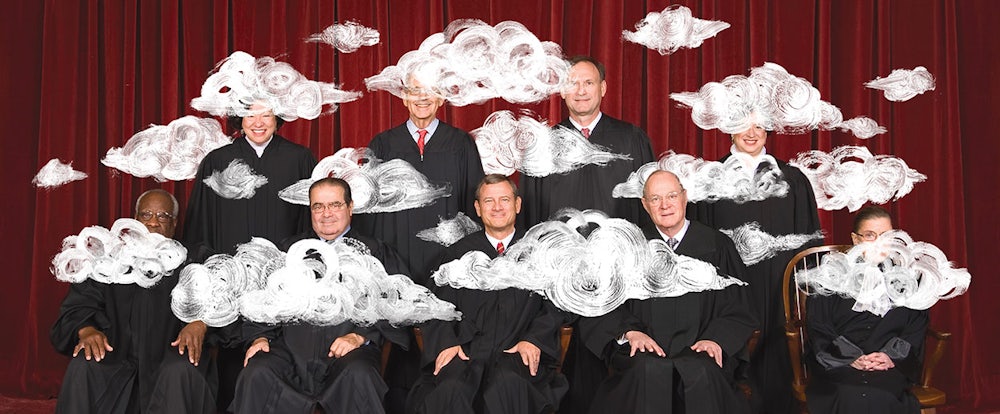
The courts have become courts of order in an age of government-sanctioned tyranny. With every ruling handed down by the courts, it becomes more apparent that we live in an age of hollow justice, with government courts, largely lacking in vision and scope, rendering narrow rulings that have nothing to do with true justice. This is true at all levels of the judiciary, but especially so in the highest court of the land, the U.S. Supreme Court, which is seemingly more concerned with establishing order and protecting government agents than with upholding the rights enshrined in the Constitution. Given the turbulence of our age, with its police overreach, military training drills on American soil, domestic surveillance, SWAT team raids, asset forfeiture, wrongful convictions, and corporate corruption, the need for a guardian of the people’s rights has never been greater. Yet when presented with an opportunity to weigh in on these issues, what does our current Supreme Court usually do? It ducks. Prevaricates. Remains silent. Speaks to the narrowest possible concern. More often than not, it gives the government and its corporate sponsors the benefit of the doubt. Rarely do the concerns of the populace prevail.

Battlefield_Cover_300As I point out in my book Battlefield America: The War on the American People, these are abuses that no American should tolerate from its government, and yet not only do we tolerate them, but we help to advance them by supporting meaningless elections, allowing ourselves to be divided by partisan politics, and failing to hold the government accountable to abiding by the rule of law, the U.S. Constitution.

Mark my words: if we do not push back against the menace of the police state now, if we fail to hold onto the Constitution and our constitutional republic, and if we allow the government to remain the greatest threat to our freedoms, then future Thanksgivings will find us paying the price with tyranny at home and anarchy throughout the world.

“Apparently, a democracy is a place where numerous elections are held at great cost without issues and with interchangeable candidates.”—Gore Vidal

The countdown has begun.

We now have less than one year until the 2016 presidential election, and you can expect to be treated to an earful of carefully crafted, expensive sound bites and political spin about climate change, education, immigration, taxes and war.

Despite the dire state of our nation, however, you can rest assured that none of the problems that continue to undermine our freedoms will be addressed in any credible, helpful way by any of the so-called viable presidential candidates and certainly not if doing so might jeopardize their standing with the unions, corporations or the moneyed elite bankrolling their campaigns.

The following are just a few of the issues that should be front and center in every presidential debate. That they are not is a reflection of our willingness as citizens to have our political elections reduced to little more than popularity contests that are, in the words of Shakespeare, “full of sound and fury, signifying nothing.”

The national debt. Why aren’t politicians talking about the whopping $18.1 trillion and rising that our government owes to foreign countries, private corporations and its retirement programs? Not only is the U.S. the largest debtor nation in the world, but according to Forbes, “the amount of interest on the national debt is estimated to be accumulating at a rate of over one million dollars per minute.” Shouldn’t the government being on the verge of bankruptcy be an issue worth talking about?

Black budget spending. It costs the American taxpayer $52.6 billion every year to be spied on by the sixteen or so intelligence agencies tasked with surveillance, data collection, counterintelligence and covert activities. The agencies operating with black budget (top secret) funds include the CIA, NSA and Justice Department. Clearly, our right to privacy seems to amount to nothing in the eyes of the government and those aspiring to office.

Government contractors. Despite all the talk about big and small government, what we have been saddled with is a government that is outsourcing much of its work to high-paid contractors at great expense to the taxpayer and with no competition, little transparency and dubious savings. According to the Washington Post, “By some estimates, there are twice as many people doing government work under contract than there are government workers.” These open-ended contracts, worth hundreds of millions of dollars, “now account for anywhere between one quarter and one half of all federal service contracting.” Moreover, any attempt to reform the system is “bitterly opposed by federal employee unions, who take it as their mission to prevent good employees from being rewarded and bad employees from being fired.”

Cost of war. Then there’s the detrimental impact the government’s endless wars (fueled by the profit-driven military industrial complex) is having on our communities, our budget and our police forces. In fact, the U.S. Department of Defense is the world’s largest employer, with more than 3.2 million employees. Since 9/11, we’ve spent more than $1.6 trillion to wage wars in Afghanistan and Iraq. When you add in our military efforts in Pakistan, as well as the lifetime price of health care for disabled veterans and interest on the national debt, that cost rises to $4.4 trillion.

Education. Despite the fact that the U.S. spends more on education than any other developed nation, our students continue to lag significantly behind other advanced industrial nations. Incredibly, teenagers in the U.S. ranked 36th in the world in math, reading and science.

Civics knowledge. Americans know little to nothing about their rights or how the government is supposed to operate. This includes educators and politicians. For example, 27 percent of elected officials cannot name even one right or freedom guaranteed by the First Amendment, while 54 percent do not know the Constitution gives Congress the power to declare war. As one law professor notes:

Only 36 percent of Americans can name the three branches of government. Fewer than half of 12th grade students can describe the meaning of federalism. Only 35% of teenagers can identify “We the People” as the first three words of the Constitution. Fifty-eight percent of Americans can’t identify a single department in the United States Cabinet. Only 5% of high school seniors can identify checks on presidential power, only 43% could name the two major political parties, only 11% knew the length of a Senator’s term, and only 23% could name the first President of the United States.

A citizenry that does not know its rights will certainly not rebel while they are being systematically indoctrinated into compliance.

Asset forfeiture. Under the guise of fighting the war on drugs, government agents (usually the police) have been given broad leeway to seize billions of dollars’ worth of private property (money, cars, TVs, etc.) they “suspect” may be connected to criminal activity. Then—and here’s the kicker—whether or not any crime is actually proven to have taken place, the government keeps the citizen’s property, often divvying it up with the local police who did the initial seizure. The police are actually being trained in seminars on how to seize the “goodies” that are on police departments’ wish lists. According to the New York Times, seized monies have been used by police to “pay for sports tickets, office parties, a home security system and a $90,000 sports car.”

Surveillance. Not only is the government spying on Americans’ phone calls and emails, but police are also being equipped with technology such as Stingray devices that can track your cell phone, as well as record the content of your calls and the phone numbers dialed. That doesn’t even touch on what the government’s various aerial surveillance devices are tracking, or the dangers posed to the privacy and safety of those on the ground. Just recently, a 243-foot, multi-billion dollar military surveillance blimp drifted off, leaving a path of wreckage and power outages in its wake, before finally crash landing.

Police misconduct. Americans have no protection against police abuse. It is no longer unusual to hear about incidents in which police shoot unarmed individuals first and ask questions later. What is increasingly common, however, is the news that the officers involved in these incidents get off with little more than a slap on the hands. Moreover, while increasing attention has been paid to excessive police force, sexual misconduct by police has been largely overlooked. A year-long investigation by the Associated Press “uncovered about 1,000 officers who lost their badges in a six-year period” for sexual misconduct. “Victims included unsuspecting motorists, schoolchildren ordered to raise their shirts in a supposed search for drugs, police interns taken advantage of, women with legal troubles who succumbed to performing sex acts for promised help, and prison inmates forced to have sex with guards.” Yet the numbers are largely underreported, covered up by police departments that “stay quiet about improprieties to limit liability, allowing bad officers to quietly resign, keep their certification and sometimes jump to other jobs.”

Prison population. With more than 2 million Americans in prison, and close to 7 million adults in correctional care, the United States has the largest prison population in the world. Many of the nation’s privately run prisons—a $5 billion industry—require the state to keep the prisons at least 90 percent full at all times, “regardless of whether crime was rising or falling.” As Mother Jones reports, “private prison companies have supported and helped write ‘three-strike’ and ‘truth-in-sentencing’ laws that drive up prison populations. Their livelihoods depend on towns, cities, and states sending more people to prison and keeping them there.” Private prisons are also doling out harsher punishments for infractions by inmates in order to keep them locked up longer in order to “boost profits” at taxpayer expense. All the while, the prisoners are being forced to provide cheap labor for private corporations.

SWAT team raids. Over 80,000 SWAT team raids are conducted on American homes and businesses each year. Police agencies, already empowered to crash through your door if they suspect you’re up to no good, now have radars that allow them to “see” through the walls of your home.

Oligarchy. We are no longer a representative republic. The U.S. has become a corporate oligarchy. As a Princeton University survey indicates, our elected officials, especially those in the nation’s capital, represent the interests of the rich and powerful rather than the average citizen.

Young people. Nearly one out of every three American children live in poverty, ranking America among the worst countries in the developed world. Patrolled by police, our schools have become little more than quasi-prisons in which kids as young as age 4 are being handcuffed for “acting up,” subjected to body searches and lockdowns, and suspended for childish behavior.

Private property. Private property means little at a time when SWAT teams and other government agents can invade your home, break down your doors, kill your dog, wound or kill you, damage your furnishings and terrorize your family. Likewise, if government officials can fine and arrest you for growing vegetables in your front yard, praying with friends in your living room, installing solar panels on your roof, and raising chickens in your backyard, you’re no longer the owner of your property.

Strip searches. Court rulings undermining the Fourth Amendment and justifying invasive strip searches have left us powerless against police empowered to forcefully draw our blood, forcibly take our DNA, strip search us, and probe us intimately. Accounts are on the rise of individuals—men and women alike—being subjected to what is essentially government-sanctioned rape by police in the course of “routine” traffic stops.

Fiscal corruption. If there is any absolute maxim by which the federal government seems to operate, it is that the American taxpayer always gets ripped off. This is true, whether you’re talking about taxpayers being forced to fund high-priced weaponry that will be used against us, endless wars that do little for our safety or our freedoms, or bloated government agencies such as the National Security Agency with its secret budgets, covert agendas and clandestine activities. Rubbing salt in the wound, even monetary awards in lawsuits against government officials who are found guilty of wrongdoing are paid by the taxpayer.

Militarized police. Americans are powerless in the face of militarized police. In early America, government agents were not permitted to enter one’s home without permission or in a deceitful manner. And citizens could resist arrest when a police officer tried to restrain them without proper justification or a warrant. Daring to dispute a warrant with a police official today who is armed with high-tech military weapons would be nothing short of suicidal. Moreover, as police forces across the country continue to be transformed into extensions of the military, Americans are finding their once-peaceful communities transformed into military outposts, complete with tanks, weaponry, and other equipment designed for the battlefield.

These are not problems that can be glibly dismissed with a few well-chosen words, as most politicians are inclined to do. Nor will the 2016 elections do much to alter our present course towards a police state. Indeed, it is doubtful whether the popularity contest for the new occupant of the White House will significantly alter the day-to-day life of the average American greatly at all. Those life-changing decisions are made elsewhere, by nameless, unelected government officials who have turned bureaucracy into a full-time and profitable business.

Battlefield_Cover_300As I point out in my book Battlefield America: The War on the American People, these problems will continue to plague our nation unless and until Americans wake up to the fact that we’re the only ones who can change things for the better and then do something about it.

This was a recurring theme for Martin Luther King Jr., who urged Americans to engage in militant nonviolent resistance in response to government corruption. In a speech delivered just a few months before his assassination, King called on Americans to march on Washington in order to take a stand against the growing problems facing the nation—problems that were being ignored by those in office because they were unpopular, not profitable or risky. “I don’t determine what is right and wrong by looking at the budget of the Southern Christian Leadership Conference. Nor do I determine what is right and wrong by taking a Gallup poll of the majority opinion,” remarked King. “Ultimately a genuine leader is not a searcher of consensus but a molder of consensus.”

Guided by Gallup polls, influenced by corporate lobbyists, and molded by party politics, the 2016 presidential candidates are playing for high stakes, but they are not looking out for the best interests of “we the people.” As King reminds us:

“Cowardice asks the question, ‘Is it safe?’ Expediency asks the question, ‘Is it politic?’ And Vanity comes along and asks the question, ‘Is it popular?’ But Conscience asks the question ‘Is it right?’ And there comes a time when one must take a position that is neither safe, nor politic, nor popular, but he must do it because Conscience tells him it is right.”

“Fear is a primitive impulse, brainless as hunger, and because the aim of horror fiction is the production of the deepest kinds of fears, the genre tends to reinforce some remarkably uncivilized ideas about self-protection. In the current crop of zombie stories, the prevailing value for the beleaguered survivors is a sort of siege mentality, a vigilance so constant and unremitting that it’s indistinguishable from the purest paranoia.”— Terrence Rafferty, New York Times

The zombies are back. They are hungry. And they are lurking around every corner.

In Kansas, Governor Sam Brownback has declared October “Zombie Preparedness Month” in an effort to help the public prepare for a possible zombie outbreak.

In New York, researchers at Cornell University have concluded that the best place to hide from the walking dead is the northern Rocky Mountains region.

And in Washington, DC, the Centers for Disease Control and Prevention have put together a zombie apocalypse preparation kit “that details everything you would need to have on hand in the event the living dead showed up at your front door.”

The undead are also wreaking havoc at gun shows, battling corsets in forthcoming movie blockbusters such as Pride and Prejudice and Zombies, running for their lives in 5K charity races, and even putting government agents through their paces in mock military drills arranged by the Dept. of Defense (DOD) and the Center for Disease Control (CDC).

The zombie narrative, popularized by the hit television series The Walking Dead, in which a small group of Americans attempt to survive in a zombie-ridden, post-apocalyptic world where they’re not only fighting off flesh-eating ghouls but cannibalistic humans, plays to our fears and paranoia.

Yet as journalist Syreeta McFadden points out, while dystopian stories used to reflect our anxieties, now they reflect our reality, mirroring how we as a nation view the world around us, how we as citizens view each other, and most of all how our government views us.

Fear the Walking Dead—AMC’s new spinoff of its popular Walking Dead series—drives this point home by dialing back the clock to when the zombie outbreak first appears and setting viewers down in the midst of societal unrest not unlike our own experiences of the past year (“a bunch of weird incidents, police protests, riots, and … rapid social entropy”). Then, as Forbes reports, “the military showed up and we fast-forwarded into an ad hoc police state with no glimpse at what was happening in the world around our main cast of hapless survivors.”

Forbes found Fear’s quick shift into a police state to be far-fetched, but anyone who has been paying attention in recent years knows that the groundwork has already been laid for the government—i.e., the military—to intervene and lock down the nation in the event of a national disaster.

Recognizing this, the Atlantic notes: “The villains of [Fear the Walking Dead] aren’t the zombies, who rarely appear, but the U.S. military, who sweep into an L.A. suburb to quarantine the survivors. Zombies are, after all, a recognizable threat—but Fear plumbs drama and horror from the betrayal by institutions designed to keep people safe.”

We’ve been so hounded in recent years with dire warnings about terrorist attacks, Ebola pandemics, economic collapse, environmental disasters, and militarized police that it’s no wonder millions of Americans have turned to zombie fiction as a way to “envision how we and our own would thrive if everything went to hell and we lost all our societal supports.” As Time magazine reporter James Poniewozik phrases it, the “apocalyptic drama lets us face the end of the world once a week and live.”

Here’s the curious thing, however: while zombies may be the personification of our darkest fears, they embody the government’s paranoia about the citizenry as potential threats that need to be monitored, tracked, surveilled, sequestered, deterred, vanquished and rendered impotent.

Why else would the government feel the need to monitor our communications, track our movements, criminalize our every action, treat us like suspects, and strip us of any means of defense while equipping its own personnel with an amazing arsenal of weapons?

For years now, the government has been carrying out military training drills with zombies as the enemy. In 2011, the DOD created a 31-page instruction manual for how to protect America from a terrorist attack carried out by zombie forces. In 2012, the CDC released a guide for surviving a zombie plague. That was followed by training drills for members of the military, police officers and first responders.

As journalist Andrea Peyser reports:

Coinciding with Halloween 2012, a five-day national conference was put on by the HALO Corp. in San Diego for more than 1,000 first responders, military personnel and law enforcement types. It included workshops produced by a Hollywood-affiliated firm in…overcoming a zombie invasion. Actors were made up to look like flesh-chomping monsters. The Department of Homeland Security even paid the $1,000 entry fees for an unknown number of participants…

“Zombie disaster” drills were held in October 2012 and ’13 at California’s Sutter Roseville Medical Center. The exercises allowed medical center staff “to test response to a deadly infectious disease, a mass-casualty event, terrorism event and security procedures”…

[In October 2014], REI outdoor-gear stores in Soho and around the country are to hold free classes in zombie preparedness, which the stores have been providing for about three years.

The zombie exercises appear to be kitschy and fun—government agents running around trying to put down a zombie rebellion—but what if the zombies in the exercises are us, the citizenry, viewed by those in power as mindless, voracious, zombie hordes?

Consider this: the government started playing around with the idea of using zombies as stand-ins for enemy combatants in its training drills right around the time the Army War College issued its 2008 report, warning that an economic crisis in the U.S. could lead to massive civil unrest that would require the military to intervene and restore order.

That same year, it was revealed that the government had amassed more than 8 million names of Americans considered a threat to national security, to be used “by the military in the event of a national catastrophe, a suspension of the Constitution or the imposition of martial law.” The program’s name, Main Core, refers to the fact that it contains “copies of the ‘main core’ or essence of each item of intelligence information on Americans produced by the FBI and the other agencies of the U.S. intelligence community.”

Also in 2008, the Pentagon launched the Minerva Initiative, a $75 million military-driven research project focused on studying social behavior in order to determine how best to cope with mass civil disobedience or uprisings. The Minerva Initiative has funded projects such as “Who Does Not Become a Terrorist, and Why?” which “conflates peaceful activists with ‘supporters of political violence’ who are different from terrorists only in that they do not embark on ‘armed militancy’ themselves.”

In 2009, the Dept. of Homeland Security issued its reports on Rightwing and Leftwing Extremism, in which the terms “extremist” and “terrorist” were used interchangeably to describe citizens who were disgruntled or anti-government.

Meanwhile, a government campaign was underway to spy on Americans’ mail, email and cell phone communications. News reports indicate that the U.S. Postal Service has handled more than 150,000 requests by federal and state law enforcement agencies to monitor Americans’ mail, in addition to photographing every piece of mail sent through the postal system.

Fast forward a few years more and you have local police being transformed into extensions of the military, taught to view members of their community as suspects, trained to shoot first and ask questions later, and equipped with all of the technology and weaponry of a soldier on a battlefield.

Most recently, the Obama administration hired a domestic terrorism czar whose job is to focus on anti-government American “extremists” who have been designated a greater threat to America than ISIS or al Qaeda. As part of the government’s so-called war on right-wing extremism, the Obama administration has agreed to partner with the United Nations to take part in its Strong Cities Network program, which will train local police agencies across America in how to identify, fight and prevent extremism.

In other words, those who believe in and exercise their rights under the Constitution (namely, the right to speak freely, worship freely, associate with like-minded individuals who share their political views, criticize the government, own a weapon, demand a warrant before being questioned or searched, or any other activity viewed as potentially anti-government, racist, bigoted, anarchic or sovereign), have just been promoted to the top of the government’s terrorism watch list.

Noticing a pattern yet?

“We the people” or, more appropriately, “we the zombies” are the enemy in the eyes of the government.

So when presented with the Defense Department’s battle plan for defeating an army of the walking dead, you might find yourself tempted to giggle over the fact that a taxpayer-funded government bureaucrat actually took the time to research and write about vegetarian zombies, evil magic zombies, chicken zombies, space zombies, bio-engineered weaponized zombies, radiation zombies, symbiant-induced zombies, and pathogenic zombies.

However, in an age of extreme government paranoia, this is no laughing matter.

The DOD’s strategy for dealing with a zombie uprising, outlined in “CONOP 8888,” is for all intents and purposes a training manual for the government in how to put down a citizen uprising or at least an uprising of individuals “infected” with dangerous ideas about freedom.

Rest assured that the tactics and difficulties outlined in the “fictional training scenario” are all too real, beginning with martial law.

As the DOD training manual states: “zombies [read: “activists”] are horribly dangerous to all human life and zombie infections have the potential to seriously undermine national security and economic activities that sustain our way of life. Therefore having a population that is not composed of zombies or at risk from their malign influence is vital to U.S. and Allied national interests.”

So how does the military plan to put down a zombie (a.k.a. disgruntled citizen) uprising?

The strategy manual outlines five phases necessary for a counter-offensive: shape, deter, seize initiative, dominate, stabilize and restore civil authority. Here are a few details:

Phase 0 (Shape): Conduct general zombie awareness training. Monitor increased threats (i.e., surveillance). Carry out military drills. Synchronize contingency plans between federal and state agencies. Anticipate and prepare for a breakdown in law and order.

Phase 1 (Deter): Recognize that zombies cannot be deterred or reasoned with. Carry out training drills to discourage other countries from developing or deploying attack zombies and publicly reinforce the government’s ability to combat a zombie threat. Initiate intelligence sharing between federal and state agencies. Assist the Dept. of Homeland Security in identifying or discouraging immigrants from areas where zombie-related diseases originate.

Phase 2 (Seize initiative): Recall all military personal to their duty stations. Fortify all military outposts. Deploy air and ground forces for at least 35 days. Carry out confidence-building measures with nuclear-armed peers such as Russia and China to ensure they do not misinterpret the government’s zombie countermeasures as preparations for war. Establish quarantine zones. Distribute explosion-resistant protective equipment. Place the military on red alert. Begin limited scale military operations to combat zombie threats. Carry out combat operations against zombie populations within the United States that were “previously” U.S. citizens.

Phase 3 (Dominate): Lock down all military bases for 30 days. Shelter all essential government personnel for at least 40 days. Equip all government agents with military protective gear. Issue orders for military to kill all non-human life on sight. Initiate bomber and missile strikes against targeted sources of zombie infection, including the infrastructure. Burn all zombie corpses. Deploy military to lock down the beaches and waterways.

Phase 4 (Stabilize): Send out recon teams to check for remaining threats and survey the status of basic services (water, power, sewage infrastructure, air, and lines of communication). Execute a counter-zombie ISR plan to ID holdout pockets of zombie resistance. Use all military resources to target any remaining regions of zombie holdouts and influence. Continue all actions from the Dominate phase.

Phase 5 (Restore civil authority): Deploy military personnel to assist any surviving civil authorities in disaster zones. Reconstitute combat capabilities at various military bases. Prepare to redeploy military forces to attack surviving zombie holdouts. Restore basic services in disaster areas.

Notice the similarities?

Surveillance. Military drills. Awareness training. Militarized police forces. Martial law.

Battlefield_Cover_300As I point out in my book, Battlefield America: The War on the American People, if there is any lesson to be learned, it is simply this: whether the threat to national security comes in the form of actual terrorists, imaginary zombies or disgruntled American citizens infected with dangerous ideas about freedom, the government’s response to such threats remains the same: detect, deter and annihilate.

To return to AMC’s Fear the Walking Dead: it’s the police state “tasked with protecting the vulnerable” that poses some of the gravest threats to the citizenry.

From the Atlantic:

When the military arrives, mowing down hostile “walkers” with ease, setting up camp to screen out any further infection, the moment is presented with an ironic note of triumph. The main character, Travis Manawa (Cliff Curtis), tells his group they can rest easy—help has finally arrived… As the soldiers begin hauling anyone spiking a fever away to quarantine zones, Travis insists their intentions are noble while the rest of his family begins to realize the military doesn’t really have a plan except to crush any potential threat. Are you a zombie? They’ll shoot you in the head. Do you look sick? You’re probably about to be a zombie. Do you have a problem with their approach? Then they have a problem with you, too.

One of the show’s most brilliant touches has been the characterization of the soldiers themselves, not as impassive robots hell-bent on enforcing martial law, but as worryingly recognizable guys around town. Whenever Travis pleads with his local commander to address community fears and complaints, he might as well be talking to an ornery bowling buddy. The soldiers are tetchy and irritable rather than monstrous, clearly overwhelmed by the impossible situation they face, and granted authority through the guns in their hands and little else. In a pivotal scene, one of them tries to cajole Travis into firing a killshot at a distant zombie through a sniper scope, even though he knows Travis believes there might be a cure. The soldiers insist the zombies are dead beyond salvation—an unfortunate truth on the show, but also a sad reflection of just how dehumanized the enemy can become in the midst of war.

The latest episode, “Cobalt,” revealed the military’s endgame: With the zombie situation deteriorating, they plan to flee and wipe out everyone they leave behind, at this point motivated only by the need to survive, rather than to protect. Countering that is the family unit that has forged new bonds in the crisis. These organically loyal communities, the writers Robert Kirkman and David Erickson argue, are the only kind that can survive in such a world… More than anything, Fear the Walking Dead is a drama about occupation, the breakdown of society, and the ease with which seemingly decent people can decide that might makes right. Like any dystopian fiction, it’s easy to dismiss as fantasy, but remove the zombies and Fear could be taking place in dozens of real-world locations… This is happening here, Kirkman and Erickson are saying, but it could happen anywhere.

“When a population becomes distracted by trivia, when cultural life is redefined as a perpetual round of entertainments, when serious public conversation becomes a form of baby talk, when, in short, a people become an audience and their public business a vaudeville act, then a nation finds itself at risk: culture-death is a clear possibility.”—Author Neil Postman

Caught up in the spectacle of the forthcoming 2016 presidential elections, Americans (never very good when it comes to long-term memory) have not only largely forgotten last year’s hullabaloo over militarized police, police shootings of unarmed citizens, asset forfeiture schemes, and government surveillance but are also generally foggy about everything that has happened since.

Then again, so much is happening on a daily basis that it’s understandable if the average American has a hard time keeping up with and remembering all of the “events,” manufactured or otherwise, which occur like clockwork and keep us distracted, deluded, amused, and insulated from reality while the government continues to amass more power and authority over the citizenry.

In fact, when we’re being bombarded with wall-to-wall news coverage and news cycles that change every few days, it’s difficult to stay focused on one thing—namely, holding the government accountable to abiding by the rule of law—and the powers-that-be understand this. As investigative journalist Mike Adams points out:

This psychological bombardment is waged primarily via the mainstream media which assaults the viewer by the hour with images of violence, war, emotions and conflict. Because the human nervous system is hard wired to focus on immediate threats accompanied by depictions of violence, mainstream media viewers have their attention and mental resources funneled into the never-ending ‘crisis of the NOW’ from which they can never have the mental breathing room to apply logic, reason or historical context.

Consider if you will the regularly scheduled trivia and/or distractions in the past year alone that have kept us tuned into the various breaking news headlines and entertainment spectacles and tuned out to the government’s steady encroachments on our freedoms:

Americans were riveted when the Republican presidential contenders went head-to-head for the second time in a three-hour debate that put Carly Fiorina in a favored position behind Donald Trump; Hillary Clinton presented the softer side of her campaign image during an appearance on The Tonight Show with Jimmy Fallon; scientists announced the discovery of what they believed to be a new pre-human species, Homo naledi, that existed 2.8 million years ago; an 8.3 magnitude earthquake hit Chile; massive wildfires burned through 73,000 acres in California; a district court judge reversed NFL player Tom Brady’s four-game suspension; tennis superstar Serena Williams lost her chance at a calendar grand slam; and President Obama and Facebook mogul Mark Zuckerberg tweeted their support for a Texas student arrested for bringing a homemade clock to school.

That was preceded by the first round of the Republican presidential debates; an immigration crisis in Europe; the relaxing of Cuba-U.S. relations; the first two women soldiers graduating from Army Ranger course; and three Americans being hailed as heroes for thwarting a train attack in France. Before that, there was the removal of the Confederate flag from the South Carolina statehouse; shootings at a military recruiting center in Tennessee and a movie theater in Louisiana; the Boy Scouts’ decision to end its ban on gay adult leaders; the first images sent by the New Horizons spacecraft of Pluto; and the victory over Japan of the U.S. in the Women’s World Cup soccer finals.

No less traumatic and distracting were the preceding months’ newsworthy events, which included a shooting at a Charleston, S.C., church; the trial and sentencing of Boston Marathon bomber suspect Dzhokhar Tsarnaev; the U.S. Supreme Court’s affirmation of same-sex marriage, Obamacare, lethal injection drugs and government censorship of Confederate flag license plates; and an Amtrak train crash in Philadelphia that left more than 200 injured and eight dead.

Also included in the mix of distressing news coverage was the death of 25-year-old Freddie Gray while in police custody and the subsequent riots in Baltimore and city-wide lockdown; the damning report by the Dept. of Justice into discriminatory and abusive practices by the Ferguson police department; the ongoing saga of Hillary Clinton’s use of a private email account while serving as secretary of state; the apparently deliberate crash by a copilot of a German jetliner in the French Alps, killing all 150 passengers and crew; the New England Patriots’ fourth Super Bowl win; a measles outbreak in Disneyland; the escalating tensions between New York police and Mayor Bill de Blasio over his seeming support for anti-police protesters; and a terror attack at the Paris office of satire magazine Charlie Hebdo.

Rounding out the year’s worth of headline-worthy new stories were protests over grand jury refusals to charge police for the deaths of Eric Garner and Michael Brown; the disappearance of an AirAsia flight over the Java Sea; an Ebola outbreak that results in several victims being transported to the U.S. for treatment; reports of domestic violence among NFL players; a security breach at the White House in which a man managed to jump the fence, cross the lawn and enter the main residence; and the reported beheading of American journalist Steven Sotloff by ISIS.

That doesn’t even begin to touch on the spate of entertainment news that tends to win the battle for Americans’ attention: Bruce Jenner’s transgender transformation to Caitlyn Jenner; the death of Whitney Houston’s daughter Bobbi Kristina Brown; Kim Kardashian’s “break the internet” nude derriere photo; sexual assault allegations against Bill Cosby; the suicide of Robin Williams; the cancellation of the comedy The Interview in movie theaters after alleged terror hack threats; the wedding of George Clooney to Amal Alamuddin; the wedding of Angelina Jolie and Brad Pitt; the ALS ice bucket challenge; and the birth of a baby girl to Prince William and Kate.

As I point out in my book Battlefield America: The War on the American People, these sleight-of-hand distractions, diversions and news spectacles are how the corporate elite controls a population by entrapping them in the “crisis of the NOW,” either inadvertently or intentionally, advancing their agenda without much opposition from the citizenry.

Professor Jacques Ellul studied this phenomenon of overwhelming news, short memories and the use of propaganda to advance hidden agendas. “One thought drives away another; old facts are chased by new ones,” wrote Ellul.

“Under these conditions there can be no thought. And, in fact, modern man does not think about current problems; he feels them. He reacts, but he does not understand them any more than he takes responsibility for them. He is even less capable of spotting any inconsistency between successive facts; man’s capacity to forget is unlimited. This is one of the most important and useful points for the propagandists, who can always be sure that a particular propaganda theme, statement, or event will be forgotten within a few weeks.”

But what exactly has the government (aided and abetted by the mainstream media) been doing while we’ve been so cooperatively fixated on whatever current sensation happens to be monopolizing the so-called “news” shows?

If properly disclosed, consistently reported on and properly digested by the citizenry, the sheer volume of the government’s activities, which undermine the Constitution and in many instances are outright illegal, would inevitably give rise to a sea change in how business is conducted in our seats of power.

Surely Americans would be concerned about the Obama administration’s plans to use behavioral science tactics to “nudge” citizens to comply with the government’s public policy and program initiatives? There would be no end to the uproar if Americans understood the ramifications of the government’s plan to train non-medical personnel—teachers, counselors and other lay people—in “mental first aid” in order to train them to screen, identify and report individuals suspected of suffering from mental illness. The problem, of course, arises when these very same mental health screeners misdiagnose opinions or behavior involving lawful First Amendment activities as a mental illness, resulting in involuntary detentions in psychiatric wards for the unfortunate victims.

Parents would be livid if they had any inkling about the school-to-prison pipeline, namely, how the public schools are being transformed from institutions of learning to prison-like factories, complete with armed police and surveillance cameras, aimed at churning out compliant test-takers rather than independent-minded citizens. And once those same young people reach college, they will be indoctrinated into believing that they have a “right” to be free from acts and expressions of intolerance with which they might disagree.

Concerned citizens should be up in arms over the government’s end-run tactics to avoid abiding by the rule of law, whether by outsourcing illegal surveillance activities to defense contractors, outsourcing inhumane torture to foreign countries, causing American citizens to disappear into secret interrogation facilities, or establishing policies that would allow the military to indefinitely detain any citizen—including journalists—considered a belligerent or enemy.

And one would hope American citizens would be incensed about being treated like prisoners in an electronic concentration camp, their every movement monitored, tracked and recorded by a growing government surveillance network that runs the gamut from traffic cameras and police body cameras to facial recognition software. Or outraged that we will be forced to fund a $93 billion drone industry that will be used to spy on our movements and activities, not to mention the fact that private prisons are getting rich (on our taxpayer dollars) by locking up infants, toddlers, children and pregnant women?

Unfortunately, while 71% of American voters are “dissatisfied” with the way things are going in the United States, that discontent has yet to bring about any significant changes in the government, nor has it caused the citizenry to get any more involved in their government beyond the ritualistic election day vote.

Professor Morris Berman suggests that the problems plaguing us as a nation—particularly as they relate to the government—have less to do with our inattention to corruption than our sanctioning, tacit or not, of such activities. “It seems to me,” writes Berman, “that the people do get the government they deserve, and even beyond that, the government who they are, so to speak.”

In other words, if we end up with a militarized police state, it will largely be because we welcomed it with open arms. In fact, according to a recent poll, almost a third of Americans would support a military coup “to take control from a civilian government which is beginning to violate the constitution.”

So where does that leave us?

As legendary television journalist Edward R. Murrow warned, “Unless we get up off our fat surpluses and recognize that television in the main is being used to distract, delude, amuse, and insulate us, then television and those who finance it, those who look at it, and those who work at it, may see a totally different picture too late.”


“Every day in communities across the United States, children and adolescents spend the majority of their waking hours in schools that have increasingly come to resemble places of detention more than places of learning. From metal detectors to drug tests, from increased policing to all-seeing electronic surveillance, the public schools of the twenty-first century reflect a society that has become fixated on crime, security and violence.”—Investigative journalist Annette Fuentes

In the American police state, you’re either a prisoner (shackled, controlled, monitored, ordered about, limited in what you can do and say, your life not your own) or a prison bureaucrat (police officer, judge, jailer, spy, profiteer, etc.).

Indeed, at a time when we are all viewed as suspects, there are so many ways in which a person can be branded a criminal for violating any number of laws, regulations or policies. Even if you haven’t knowingly violated any laws, there is still a myriad of ways in which you can run afoul of the police state and end up on the wrong side of a jail cell.

Unfortunately, when you’re a child in the American police state, life is that much worse.

Microcosms of the police state, America’s public schools contain almost every aspect of the militarized, intolerant, senseless, overcriminalized, legalistic, surveillance-riddled, totalitarian landscape that plagues those of us on the “outside.”

From the moment a child enters one of the nation’s 98,000 public schools to the moment she graduates, she will be exposed to a steady diet of draconian zero tolerance policies that criminalize childish behavior, overreaching anti-bullying statutes that criminalize speech, school resource officers (police) tasked with disciplining and/or arresting so-called “disorderly” students, standardized testing that emphasizes rote answers over critical thinking, politically correct mindsets that teach young people to censor themselves and those around them, and extensive biometric and surveillance systems that, coupled with the rest, acclimate young people to a world in which they have no freedom of thought, speech or movement.

If your child is fortunate enough to survive his encounter with the public schools, you should count yourself fortunate.

Most students are not so lucky.

By the time the average young person in America finishes their public school education, nearly one out of every three of them will have been arrested.

More than 3 million students are suspended or expelled from schools every year, often for minor misbehavior, such as “disruptive behavior” or “insubordination.” Black students are three times more likely than white students to face suspension and expulsion.

For instance, a Virginia sixth grader, the son of two school teachers and a member of the school’s gifted program, was suspended for a year after school officials found a leaf (likely a maple leaf) in his backpack that they suspected was marijuana. Despite the fact that the leaf in question was not marijuana (a fact that officials knew almost immediately), the 11-year-old was still kicked out of school, charged with marijuana possession in juvenile court, enrolled in an alternative school away from his friends, subjected to twice-daily searches for drugs, and forced to be evaluated for substance abuse problems.

As the Washington Post warns: “It doesn’t matter if your son or daughter brings a real pot leaf to school, or if he brings something that looks like a pot leaf—okra, tomato, maple, buckeye, etc. If your kid calls it marijuana as a joke, or if another kid thinks it might be marijuana, that’s grounds for expulsion.”

Many state laws require that schools notify law enforcement whenever a student is found with an “imitation controlled substance,” basically anything that look likes a drug but isn’t actually illegal. As a result, students have been suspended for bringing to school household spices such as oregano, breath mints, birth control pills and powdered sugar.

It’s not just look-alike drugs that can get a student in trouble under school zero tolerance policies. Look-alike weapons (toy guns—even Lego-sized ones, hand-drawn pictures of guns, pencils twirled in a “threatening” manner, imaginary bows and arrows, even fingers positioned like guns) can also land a student in detention.

Acts of kindness, concern or basic manners can also result in suspensions. One 13-year-old was given detention for exposing the school to “liability” by sharing his lunch with a hungry friend. A third grader was suspended for shaving her head in sympathy for a friend who had lost her hair to chemotherapy. And then there was the high school senior who was suspended for saying “bless you” after a fellow classmate sneezed.

Unfortunately, while these may appear to be isolated incidents, they are indicative of a nationwide phenomenon in which children are treated like suspects and criminals, especially within the public schools.

The schools have become a microcosm of the American police state, right down to the host of surveillance technologies, including video cameras, finger and palm scanners, iris scanners, as well as RFID and GPS tracking devices, employed to keep constant watch over their student bodies.

Making matters worse are the police.

Students accused of being disorderly or noncompliant have a difficult enough time navigating the bureaucracy of school boards, but when you bring the police into the picture, after-school detention and visits to the principal’s office are transformed into punishments such as misdemeanor tickets, juvenile court, handcuffs, tasers and even prison terms.

In the absence of school-appropriate guidelines, police are more and more “stepping in to deal with minor rulebreaking—sagging pants, disrespectful comments, brief physical skirmishes. What previously might have resulted in a detention or a visit to the principal’s office was replaced with excruciating pain and temporary blindness, often followed by a trip to the courthouse.”

Thanks to a combination of media hype, political pandering and financial incentives, the use of armed police officers to patrol school hallways has risen dramatically in the years since the Columbine school shooting (nearly 20,000 by 2003). Funded by the U.S. Department of Justice, these school resource officers (SROs) have become de facto wardens in the elementary, middle and high schools, doling out their own brand of justice to the so-called “criminals” in their midst with the help of tasers, pepperspray, batons and brute force.

The horror stories are legion.

One SRO is accused of punching a 13-year-old student in the face for cutting the cafeteria line. That same cop put another student in a chokehold a week later, allegedly knocking the student unconscious and causing a brain injury. In Pennsylvania, a student was tased after ignoring an order to put his cell phone away.

Defending the use of handcuffs and pepper spray to subdue students, one Alabama police department reasoned that if they can employ such tactics on young people away from school, they should also be permitted to do so on campus.

Now advocates for such harsh police tactics and weaponry will tell you that school safety should be our first priority lest we find ourselves with another Sandy Hook. What they will not tell you is that such shootings are rare. As one congressional report found, the schools are, generally speaking, safe places for children.

In their zeal to crack down on guns and lock down the schools, these cheerleaders for police state tactics in the schools might also fail to mention the lucrative, multi-million dollar deals being cut with military contractors such as Taser International to equip these school cops with tasers, tanks, rifles and $100,000 shooting detection systems.

Indeed, the transformation of hometown police departments into extensions of the military has been mirrored in the public schools, where school police have been gifted with high-powered M16 rifles, MRAP armored vehicles, grenade launchers, and other military gear. One Texas school district even boasts its own 12-member SWAT team.

According to one law review article on the school-to-prison pipeline, “Many school districts have formed their own police departments, some so large they rival the forces of major United States cities in size. For example, the safety division in New York City’s public schools is so large that if it were a local police department, it would be the fifth-largest police force in the country.”

The ramifications are far-reaching.

The term “school-to-prison pipeline” refers to a phenomenon in which children who are suspended or expelled from school have a greater likelihood of ending up in jail. One study found that “being suspended or expelled made a student nearly three times more likely to come into contact with the juvenile justice system within the next year.”

Not content to add police to their employee rosters, the schools have also come to resemble prisons, complete with surveillance cameras, metal detectors, drug-sniffing dogs, random locker searches and active shooter drills. The Detroit public schools boast a “‘$5.6 million 23,000-sq ft. state of the art Command Center’ and ‘$41.7 million district-wide security initiative’ including metal detectors and ID system where visitors’ names are checked against the sex offender registry.”

As if it weren’t bad enough that the nation’s schools have come to resemble prisons, the government is also contracting with private prisons to lock up our young people for behavior that once would have merited a stern lecture. Nearly 40 percent of those young people who are arrested will serve time in a private prison, where the emphasis is on making profits for large megacorporations above all else.

Private prisons, the largest among them being GEO and the Corrections Corporation of America, profit by taking over a state’s prison population for a fee. Many states, under contract with these private prisons, agree to keep the prisons full, which in turn results in more Americans being arrested, found guilty and jailed for nonviolent “crimes” such as holding Bible studies in their back yard. As the Washington Post points out, “With the growing influence of the prison lobby, the nation is, in effect, commoditizing human bodies for an industry in militant pursuit of profit… The influence of private prisons creates a system that trades money for human freedom, often at the expense of the nation’s most vulnerable populations: children, immigrants and the poor.”

This profit-driven system of incarceration has also given rise to a growth in juvenile prisons and financial incentives for jailing young people. Indeed, young people have become easy targets for the private prison industry, which profits from criminalizing childish behavior and jailing young people. For instance, two Pennsylvania judges made headlines when it was revealed that they had been conspiring with two businessmen in a $2.6 million “kids for cash” scandal that resulted in more than 2500 children being found guilty and jailed in for-profit private prisons.

It has been said that America’s schools are the training ground for future generations. Instead of raising up a generation of freedom fighters, however, we seem to be busy churning out newly minted citizens of the American police state who are being taught the hard way what it means to comply, fear and march in lockstep with the government’s dictates.

Battlefield_Cover_300As I point out in my book Battlefield America: The War on the American People, with every school police raid and overzealous punishment that is carried out in the name of school safety, the lesson being imparted is that Americans—especially young people—have no rights at all against the state or the police.

I’ll conclude with one hopeful anecdote about a Philadelphia school dubbed the “Jones Jail” because of its bad reputation for violence among the student body. Situated in a desperately poor and dangerous part of the city, the John Paul Jones Middle School’s student body had grown up among drug users, drug peddlers, prostitutes and gun violence. “By middle school,” reports The Atlantic, most of these students “have witnessed more violence than most Americans who didn’t serve in a war ever will.”

According to investigative reporters Jeff Deeney, “School police officers patrolled the building at John Paul Jones, and children were routinely submitted to scans with metal detecting wands. All the windows were covered in metal grating and one room that held computers even had thick iron prison bars on its exterior… Every day… [police] would set up a perimeter of police officers on the blocks around the school, and those police were there to protect neighbors from the children, not to protect the children from the neighborhood.”

In other words, John Paul Jones, one of the city’s most dangerous schools, was a perfect example of the school-to-prison, police state apparatus at work among the nation’s youngest and most impressionable citizens.

When management of John Paul Jones was taken over by a charter school that opted to de-escalate the police state presence, stripping away the metal detectors and barred windows, local police protested. In fact, they showed up wearing Kevlar vests. Nevertheless, school officials remained determined to do away with institutional control and surveillance, as well as aggressive security guards, and focus on noncoercive, nonviolent conflict resolution with an emphasis on student empowerment, relationship building and anger management.

The result: a 90% drop in serious incidents—drug sales, weapons, assaults, rapes—in one year alone. As one fifth-grader remarked on the changes, “There are no more fights. There are no more police. That’s better for the community.”

The lesson for the rest of us is this: you not only get what you pay for, but you reap what you sow.

If you want a nation of criminals, treat the citizenry like criminals.

If you want young people who grow up seeing themselves as prisoners, run the schools like prisons.

But if you want to raise up a generation of freedom fighters, who will actually operate with justice, fairness, accountability and equality towards each other and their government, then run the schools like freedom forums. Remove the metal detectors and surveillance cameras, re-assign the cops elsewhere, and start treating our nation’s young people like citizens of a republic and not inmates in a police state.