Posts Tagged ‘Martin Luther King Jr’

“Twelve voices were shouting in anger, and they were all alike. No question, now, what had happened to the faces of the pigs. The creatures outside looked from pig to man, and from man to pig, and from pig to man again; but already it was impossible to say which was which.” ― George Orwell, Animal Farm

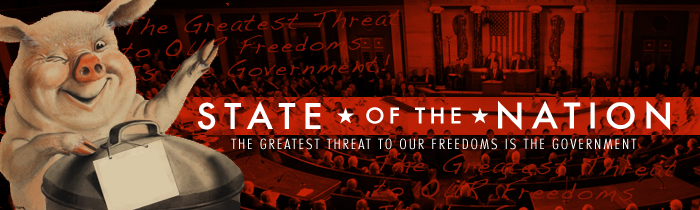
What was striking about this year’s State of the Union address was not the sheer arrogance of the president’s remarks, the staged nature of the proceedings and interactions, or the predictable posturing of the rebuttals, but the extent to which the members of the various branches of government—President Obama, Congress, the Supreme Court, and the assorted government agencies—are just one big, brawling, noisy, semi-incestuous clan.

Watching these bureaucrats, both elected and appointed, interact in the unguarded moments before the event, with their hugging and kissing and nudging and joking and hobnobbing and general high spirits, I was reminded anew that these people—Republicans and Democrats alike—are united in a common goal, and it is not to protect and defend the Constitution. No, as Orwell recognized in Animal Farm, their common goal is to maintain the status quo, a goal that is helped along by an unquestioning, easily mollified, corporate media. In this way, the carefully crafted spectacle that is the State of the Union address is just that: an exaggerated farce of political theater intended to dazzle, distract and divide us, all the while the police state marches steadily forward.

No matter what the president and his cohorts say or how convincingly they say it, the reality Americans must contend with is that the world is no better the day after President Obama’s State of the Union address than it was the day before. Indeed, if the following rundown on the actual state of our freedoms is anything to go by, the world is a far more dangerous place.

Americans have no protection against police abuse. It is no longer unusual to hear about incidents in which police shoot unarmed individuals first and ask questions later, such as the 16-year-old teenager who skipped school only to be shot by police after they mistook him for a fleeing burglar. Then there was the unarmed black man in Texas “who was pursued and shot in the back of the neck by Austin Police… after failing to properly identify himself and leaving the scene of an unrelated incident.” And who could forget the 19-year-old Seattle woman who was accidentally shot in the leg by police after she refused to show her hands? What is increasingly common, however, is the news that the officers involved in these incidents get off with little more than a slap on the hands.

Americans are little more than pocketbooks to fund the police state. If there is any absolute maxim by which the federal government seems to operate, it is that the American taxpayer always gets ripped off. This is true, whether you’re talking about taxpayers being forced to fund high-priced weaponry that will be used against us, endless wars that do little for our safety or our freedoms, or bloated government agencies such as the National Security Agency with its secret budgets, covert agendas and clandestine activities. Rubbing salt in the wound, even monetary awards in lawsuits against government officials who are found guilty of wrongdoing are paid by the taxpayer.

Americans are no longer innocent until proven guilty. We once operated under the assumption that you were innocent until proven guilty. Due in large part to rapid advances in technology and a heightened surveillance culture, the burden of proof has been shifted so that the right to be considered innocent until proven guilty has been usurped by a new norm in which all citizens are suspects. This is exemplified by police practices of stopping and frisking people who are merely walking down the street and where there is no evidence of wrongdoing. Likewise, by subjecting Americans to full-body scans and license-plate readers without their knowledge or compliance and then storing the scans for later use, the government—in cahoots with the corporate state—has erected the ultimate suspect society. In such an environment, we are all potentially guilty of some wrongdoing or other.

Americans no longer have a right to self-defense. In the wake of various shootings in recent years, “gun control” has become a resounding theme for government officials, with President Obama even going so far as to pledge to reduce gun violence “with or without Congress.” Those advocating gun reform see the Second Amendment’s right to bear arms as applying only to government officials. As a result, even Americans who legally own firearms are being treated with suspicion and, in some cases, undue violence. In one case, a Texas man had his home subjected to a no-knock raid and was shot in his bed after police, attempting to deliver a routine search warrant, learned that he was in legal possession of a firearm. In another incident, a Florida man who was licensed to carry a concealed firearm found himself detained for two hours during a routine traffic stop in Maryland while the arresting officer searched his vehicle in vain for the man’s gun, which he had left at home.

Americans no longer have a right to private property. If government agents can invade your home, break down your doors, kill your dog, damage your furnishings and terrorize your family, your property is no longer private and secure—it belongs to the government. Likewise, if government officials can fine and arrest you for growing vegetables in your front yard, praying with friends in your living room, installing solar panels on your roof, and raising chickens in your backyard, you’re no longer the owner of your property.

Americans no longer have a say about what their children are exposed to in school. Incredibly, the government continues to insist that parents essentially forfeit their rights when they send their children to a public school. This growing tension over whether young people, especially those in the public schools, are essentially wards of the state, to do with as government officials deem appropriate, in defiance of the children’s constitutional rights and those of their parents, is reflected in the debate over sex education programs that expose young people to all manner of sexual practices and terminology, zero tolerance policies that strip students of any due process rights, let alone parental involvement in school discipline, and Common Core programs that teach students to be test-takers rather than critical thinkers.

Americans are powerless in the face of militarized police. In early America, citizens were considered equals with law enforcement officials. Authorities were rarely permitted to enter one’s home without permission or in a deceitful manner. And it was not uncommon for police officers to be held personally liable for trespass when they wrongfully invaded a citizen’s home. Unlike today, early Americans could resist arrest when a police officer tried to restrain them without proper justification or a warrant—which the police had to allow citizens to read before arresting them. (Daring to dispute a warrant with a police official today who is armed with high-tech military weapons and tasers would be nothing short of suicidal.) As police forces across the country continue to be transformed into outposts of the military, with police agencies acquiring military-grade hardware in droves, Americans are finding their once-peaceful communities transformed into military outposts, complete with tanks, weaponry, and other equipment designed for the battlefield.

Americans no longer have a right to bodily integrity. Court rulings undermining the Fourth Amendment and justifying invasive strip searches have left us powerless against police empowered to forcefully draw our blood, strip search us, and probe us intimately. Accounts are on the rise of individuals—men and women—being subjected to what is essentially government-sanctioned rape by police in the course of “routine” traffic stops. Most recently, a New Mexico man was subjected to a 12-hour ordeal of anal probes, X-rays, enemas, and finally a colonoscopy because he allegedly rolled through a stop sign.

Americans no longer have a right to the expectation of privacy. Despite the staggering number of revelations about government spying on Americans’ phone calls, Facebook posts, Twitter tweets, Google searches, emails, bookstore and grocery purchases, bank statements, commuter toll records, etc., Congress, the president and the courts have done little to nothing to counteract these abuses. Instead, they seem determined to accustom us to life in this electronic concentration camp.

Americans no longer have a representative government. We have moved beyond the era of representative government and entered a new age, let’s call it the age of authoritarianism. History may show that from this point forward, we will have left behind any semblance of constitutional government and entered into a militaristic state where all citizens are suspects and security trumps freedom. Even with its constantly shifting terrain, this topsy-turvy travesty of law and government has become America’s new normal. It is not overstating matters to say that Congress, which has done its best to keep their unhappy constituents at a distance, may well be the most self-serving, semi-corrupt institution in America.

Americans can no longer rely on the courts to mete out justice. The U.S. Supreme Court was intended to be an institution established to intervene and protect the people against the government and its agents when they overstep their bounds. Yet through their deference to police power, preference for security over freedom, and evisceration of our most basic rights for the sake of order and expediency, the justices of the Supreme Court have become the architects of the American police state in which we now live, while the lower courts have appointed themselves courts of order, concerned primarily with advancing the government’s agenda, no matter how unjust or illegal.

Yes, the world is a far more dangerous place than it was a year ago. What the president failed to mention in his State of the Union address, however (and what I document in my book A Government of Wolves: The Emerging American Police State), is the fact that it’s the government that poses the gravest threat to our freedoms and way of life, and no amount of politicking, parsing or pandering will change that. — John W. Whitehead

“You gotta remember, establishment, it’s just a name for evil. The monster doesn’t care whether it kills all the students or whether there’s a revolution. It’s not thinking logically, it’s out of control.”—John Lennon (1969)

It’s been 50 years since the Beatles—John Lennon, Paul McCartney, George Harrison and Ringo Starr—first landed in America on Feb. 7, 1964, and the news media is awash with nostalgic tributes to the band that “changed everything.” The Grammys will be saluting the Beatles with a 2-hour star-studded tribute. JFK Airport plans to dedicate a historical marker to commemorate the moment the four lads from Liverpool arrived on a Pan Am flight, to be greeted by hordes of screaming fans. And all across the country, including in New York City, conferences, tribute band performances, and reenactments will pay homage to Beatlemania and their music.

While there is much to celebrate about the Beatles coming to America, there is also much to regret, starting with the fact that while we may remember the music of the Beatles, we’ve lost sight of the hope for change and revolutionary spirit that were hallmarks of those days. Indeed, the Beatles opened the floodgates of music with their riveting Feb. 9 performance on the Ed Sullivan Show which was televised to 72 million Americans in what has been dubbed “the night that changed America.” Beatlemania, in turn, helped fuel a social, cultural and political revolution that took aim at everything from war, capitalism and racism to women’s rights, militarization and equality.

Fifty years later, while we may be inundated with a glut of music that passes for art and artists that pass for activists, with no shortage of national problems plaguing us (police abuse, endless wars, government corruption, government surveillance, inequality, etc.), we are sorely lacking individuals with the kind of radicalism and willingness to challenge the status quo. This is the difference between Then and Now, between an America that was ripe for the Beatles’ music andtheir message of change and an America that is celebrating the Beatles’ music while oblivious to their radicalism.

“The Beatles were like aliens dropped into the United States of 1964,” reports Todd Leopold for CNN. Leopold continues:

Kennedy’s assassination 10 weeks earlier had left a gloom on the land. Together, the two events created a dividing line between Then and Now. “A lot of people don’t understand why (Sullivan) was a seminal moment in the history of America and, for that matter, the history of the world,” former Arkansas governor and presidential candidate Mike Huckabee recalled in a recent speech. “The country had just gone through a very painful time of mourning. … There was an extraordinary amount of despair, heartbreak, disappointment,” he continued. “I think people forget that we were still grieving as a nation. The Beatles brought something to America more than music. They brought hope.”

The Beatles converged with their era—the Sixties generation—in an almost unprecedented way. At no other time in history, or since, has a generation been so connected. The vehicle was rock music. And the Beatles helped create an aural culture. As Randy Lewis notes for the Los Angeles Times:

If they were relatively friendly revolutionaries, with their pressed suits and bemused grins and professional politesse and their malt-shop lyrics, they were revolutionaries nonetheless… Now that everything is at our fingertips, a swipe or click away at any moment anywhere, it is hard to conceive of the effect they once had. The revolution had actually been televised then… Self-contained and self-directed — notwithstanding the guidance of manager Brian Epstein and producer George Martin, who were collaborators and not directors — the Beatles were something new and in no hurry to leave or conform. Other new things followed through doors they helped open. For better or worse, for a while, the world grew young.

The burgeoning baby boomers’ fascination with music brought the sixties generation into a collective whole. “Perhaps the most important aspect of the Beatles’ attraction during that influential era,” writes author Steven Stark, “was their collective synergy.” In other words, the Beatles popularized the sanctity of “the group,” amazingly so in a time when the traditional family was beginning to disintegrate. With the Beatles, the whole was always greater than the sum of the parts. This gave them a dazzling appeal.

Unlike artists before them, the Beatles had power over millions of people worldwide. In 1967, for example, with the release of their Sgt. Peppers Lonely Hearts Club Band album, as one critic noted, it was the closest Europe had been to unification since the Congress of Vienna in 1815. Most thought North America could have been included as well. And the Beatles became the embodiment of the Summer of Love with their live global BBC television broadcast of “All You Need Is Love” in June 1967. Approximately 400 million people across five continents tuned in. This type of power was something new. Previously, only popes, kings and perhaps a few intellectuals could hope to wield such influence in their lifetime.

Some have even argued that the Beatles’ influence helped bring down the Iron Curtain. As Yuri Pelyoshonok, a Soviet Studies professor, says:

The Soviet authorities thought of the Beatles as a secret Cold War weapon. The kids lost their interest in all Soviet unshakable dogmas and ideals, and stopped thinking of an English-speaking person as the enemy. That’s when the Communists lost two generations of young people ideologically, totally lost. That was an incredible impact.

Following the assassinations of Martin Luther King Jr. and Bobby Kennedy in 1968, the optimism of the Summer of Love quickly evaporated and young people revolted worldwide. In the U.S., the cataclysm came as 10,000 demonstrators descended on the Democratic Party’s national convention in August. Police reacted by brutally beating rock-throwing demonstrators as well as passersby, journalists and volunteers. Violence and revolt were now in vogue.

The Beatles, the most influential pop voice of the time, responded to this shift towards violence with “Revolution,” the first Beatles song with an explicitly political statement. As “Revolution” stresses, it was not a movement about physically overthrowing a regime. It was a spiritual revolution, one aimed at overthrowing preconceived notions. Thus, before you can effect a lasting change, as John Lennon sings, you have to “free your mind.” As John Lennon sings in his masterpiece on the need for nonviolent change, “When you talk about destruction, don’t you know that you can count me out?”

The underground press–which at the time included such newspapers as the Village Voice–immediately criticized the song and Lennon for not urging outright rebellion against authority. Lennon was quick to point out that if they really wanted a revolution, it had to begin with changing the way people think: “I’m not only up against the establishment but you too. I’ll tell you what’s wrong with the world: people–so do you want to destroy them? Until you/we change our heads–there’s no choice.”

It didn’t take long for Lennon, the activist of the group, to recognize that he could use his celebrity status to not only communicate his own ideas about the world but change the way people thought about issues of the day. He subsequently began his quest for worldwide peace. In fact, it may be that Lennon was the last great iconic anti-war activist of our age. Indeed, by October 1969, Lennon’s “Give Peace a Chance” had become a universal chant at anti-Vietnam War demonstrations. On November 15, during a peace rally in Washington, DC, the legendary folk singer Pete Seeger led nearly half a million demonstrators in singing “Give Peace a Chance” at the Washington Monument.

Unlike the other members of the Beatles, who are largely remembered for their music, Lennon’s political activism soon became a hallmark of the man himself. As Time magazine contributor Martin Lewis recognizes, “Of all Lennon’s legacies, one of the most enduring, and perhaps the most impressive, is who his enemies were. The true measure of his greatness was that in the 1970s he terrified the most powerful man in the world.” Lewis, of course, is referring to Richard Nixon, who became a determined enemy of Lennon.

Of all the Beatles, it may be Lennon’s activism which speaks most to the concerns of our present day and the ever-growing menace of the police state. In fact, as I document in my book A Government of Wolves: The Emerging American Police State, Lennon, enemy number one in the eyes of the U.S. government, was targeted for surveillance by the FBI (most likely in conjunction with the NSA).

Fearing Lennon might incite antiwar protests, the Nixon administration directed the FBI to keep close tabs on the ex-Beatle, resulting in close to 400 pages of files on his activities during the early 1970s. But the government’s actions didn’t stop with mere surveillance. The agency went so far as to attempt to have Lennon deported on drug charges. As professor Jon Wiener, a historian who sued the federal government to have the files on Lennon made public, observed, “This is really the story of F.B.I. misconduct, of the President using the F.B.I. to get his enemies, to use federal agencies to suppress dissent and to silence critics.”

Fifty years after America first fell in love with Lennon and his mop-top comrades, the Beatles’ legacy lives on—at least, their musical legacy lives on.

Yet while the Beatles’ greatest legacy was in effecting a revolution of spirit and mind, today we’re in dire need of revolutionaries willing to challenge the status quo.

The world could use another revolution, don’t you think? — John W. Whitehead

“All governments are run by liars.”—Independent journalist I.F. “Izzy” Stone

President Obama has managed, with singular assistance from Congress and the courts, to mangle the Constitution through repeated abuses, attacks and evasions.

This is nothing new, as I’ve documented in my book A Government of Wolves: The Emerging American Police State. However, with his recent speech on the National Security Agency—a heady cocktail of lies, obfuscations, contradictions and Orwellian doublespeak—Obama has also managed to pervert and propagandize our nation’s history, starting with Paul Revere and the Sons of Liberty, likening their efforts to secure our freedoms to NSA phone surveillance. Frankly, George Orwell’s Winston Smith, rewriting news stories for Big Brother and the Ministry of Truth, couldn’t have done a better job of revising history to suit the party line.

While it didn’t bode well for what was to follow, here’s how Obama opened his speech:

At the dawn of our Republic, a small, secret surveillance committee borne out of the ‘The Sons of Liberty’ was established in Boston. And the group’s members included Paul Revere. At night, they would patrol the streets, reporting back any signs that the British were preparing raids against America’s early Patriots. Throughout American history, intelligence has helped secure our country and our freedoms.

Obama’s inference is clear: rather than condemning the NSA for encroaching on our privacy rights, we should be commending them for helping to “secure our country and our freedoms.” Never mind that the Sons of Liberty were actually working against the British government, to undermine what they perceived as a repressive regime guilty of perpetrating a host of abuses against the colonists.

After such a 1984-esque send-up, it doesn’t even really matter what else Obama had to say in his speech about NSA reforms and the like. Rest assured, it was largely a pack of lies. Mind you, Obama said it eloquently enough and interspersed it with all the appropriately glib patriotic remarks about individual freedom and the need to defend the Constitution and securing the life of our nation while preserving our liberties. After all, Obama has proven to be very good at saying one thing and doing another, whether it’s insisting that “you can keep your health care plan,” that he’ll close Guantanamo, or that his administration’s controversial drone strikes only target terrorists and not civilians.

When it comes to the NSA, Obama has been lying to the American people for quite some time now. There was the time he claimed the secret FISA court is “transparent.” Then he insisted that “we don’t have a domestic spying program.” And then, to top it all off, he actually insisted there was no evidence the NSA was “actually abusing” its power. As David Sirota writes for Salon: “it has now become almost silly to insinuate or assume that the president hasn’t also been lying. Why? Because if that’s true — if indeed he hasn’t been deliberately lying — then it means he has been dangerously, irresponsibly and negligently ignorant of not only the government he runs, but also of the news breaking around him.”

Sirota continues:

I, of course, don’t buy that at all. I don’t buy that a constitutional lawyer and legal scholar didn’t know that the FISA court is secret — aka the opposite of “transparent.” I don’t buy that he simply didn’t see any of the news showing that spying is happening in the United States. And I don’t buy that he didn’t know that there is evidence — both public and inside his own administration — of the NSA “actually abusing” its power.

I don’t buy any of that because, to say the least, it makes no sense. I just don’t buy that he’s so unaware of the world around him that he made such statements from a position of pure ignorance. On top of that, he has a motive. Yes, Obama has an obvious political interest in trying to hide as much of his administration’s potentially illegal behavior as possible, which means he has an incentive to calculatedly lie. For all of these reasons, it seems safe to suggest that when it comes to the NSA situation, the president seems to be lying.

So in terms of Obama’s latest speech on the NSA, if you read between the lines—or just ignore the president’s words and pay attention to his actions—it’s clear that nothing is going to change. The NSA will continue to abuse its power by spying on Americans’ phone calls and emails. They will continue to collect metadata on our various communications and activities. And they will continue to carry out their surveillance in secret, with no attempts at transparency or accountability.

The NSA will do so, no matter what Obama claims to the contrary, because this black ops-funded agency whose very existence is abhorrent to the Constitution has become a power unto itself. They no longer work for us or for the president, for that matter. He works for them.

Remember, Obama is the chief executive of a super secretive surveillance state whose overarching purpose is to remain in power by any means available. As such, he and his surveillance state cohorts have far more in common with King George and the British government of his day than with the American colonists who worked hard to foment a rebellion and overthrow a despotic regime.

Indeed, Obama and his speechwriters would do well to brush up on their history. In doing so, they will find that the Sons of Liberty, the “small, secret surveillance committee” they conveniently liken to the NSA, was in fact an underground, revolutionary movement that fought the established government of its day, whose members were considered agitators, traitors and terrorists not unlike Edward Snowden.

In much the same way that the U.S. government under the leadership of Barack Obama is today going after whistleblowers and activists who oppose their tactics, the British government went after the Sons of Liberty. These people were neither career politicians nor government bureaucrats. Instead, they were mechanics, merchants, artisans and the like—ordinary people groaning under the weight of Britain’s oppressive rule—who, having reached a breaking point, had decided that enough was enough. Through the use of Committees of Correspondence, they alerted the colonists to the abuses being meted out by the British crown by way of pamphlets, speeches and resolutions, inciting them to actively resist the acts of oppression, and conspiring with them to revolt.

The colonists’ treatment at the hands of the British was not much different from the abuses meted out to the American people today: they too were taxed on everything from food to labor without any real say in the matter, in addition to which they had their homes invaded, their property seized and searched, their families terrorized, their communications, associations and activities monitored, and their attempts to defend themselves and challenge the government’s abuses dismissed as belligerence, treachery, and sedition.

Unlike most Americans today, who remain ignorant of the government’s abuses, cheerfully distracted by the entertainment spectacles trotted out before them by a complicit media, readily persuaded that the government has their best interests at heart, and easily cowed by the slightest show of force, the colonists responded to the government’s abuses with outrage, activism and rebellion. They staged boycotts of British goods and organized public protests, mass meetings, parades, bonfires and other demonstrations, culminating with their most famous act of resistance, the Boston Tea Party.

On the night of December 16, 1773, a group of men dressed as Indians boarded three ships that were carrying tea. Cheered on by a crowd along the shore, they threw 342 chests of tea overboard in protest of a tax on the tea. Many American merchants were aghast at the wanton destruction of property. A town meeting in Bristol, Massachusetts, condemned the action. Ben Franklin even called on his native city to pay for the tea and apologize. But as historian Pauline Maier notes, the Boston Tea Party was a last resort for a group of people who had stated their peaceful demands but were rebuffed by the British: “The tea resistance constituted a model of justified forceful resistance upon traditional criteria.”

The rest, as they say, is history. Yet it’s a history we cannot afford to forget or allow to be rewritten. The colonists suffered under the weight of countless tyrannies before they finally were emboldened to stand their ground. They attempted to reason with the British crown, to plea their cause, even to negotiate. It was only when these means proved futile that they resorted to outright resistance, civil disobedience and eventually rebellion.

More than 200 years later, we are once again suffering under a long train of abuses and usurpations. What Americans today must decide is how committed they are to the cause of freedom and how far they’re willing to go to restore what has been lost. Nat Hentoff, one of my dearest friends and a formidable champion of the Constitution, has long advocated for the resurgence of Committees of Correspondence. As Nat noted:

This resistance to arrant tyranny first became part of our heritage when Samuel Adams and the Sons of Liberty formed the original Committees of Correspondence, a unifying source of news of British tyranny throughout the colonies that became a precipitating cause of the American Revolution. Where are the Sons of Liberty, the Committees of Correspondence and the insistently courageous city councils now, when they are crucially needed to bring back the Bill of Rights that protect every American against government tyranny worse than King George III’s? Where are the citizens demanding that these doorways to liberty be opened … What are we waiting for?

What are we waiting for, indeed? As Thomas Jefferson said, “I prefer dangerous freedom over peaceful slavery.”

“[E]verywhere, “time is winding up,” in the words of one of our spirituals, “corruption in the land, people take a stand, time is winding up.”—Martin Luther King Jr.

We now live in a two-tiered system of governance. There are two sets of laws: one set for the government and its corporate allies, and another set for you and me.

The laws which apply to the majority of the population allow the government to do things like sending SWAT teams crashing through your door in the middle of the night, rectally probing you during a roadside stop, or listening in on your phone calls and reading all of your email messages, confiscating your property, or indefinitely detaining you in a military holding cell. These are the laws which are executed every single day against a population which has up until now been blissfully ignorant of the radical shift taking place in American government.

Then there are the laws constructed for the elite, which allow bankers who crash the economy to walk free. They’re the laws which allow police officers to avoid prosecution when they shoot unarmed citizens, strip search non-violent criminals, or taser pregnant women on the side of the road, or pepper spray peaceful protestors. These are the laws of the new age we are entering, an age of neo-feudalism, in which corporate-state rulers dominate the rest of us, where the elite create the laws which can result in a person being jailed for possessing a small amount of marijuana while bankers that launder money for drug cartels walk free. In other words, we have moved into an age where we are the slaves and they are the rulers.

Unfortunately, this two-tiered system of government has been a long time coming. As I detail in my book A Government of Wolves: The Emerging American Police State, the march toward an imperial presidency, to congressional intransigence and impotence, to a corporate takeover of the mechanisms of government, and the division of America into haves and have nots has been building for years.

Thus we now find ourselves at a point where, for the first time in history, Congress is dominated by a majority of millionaires who are, on average, 14 times wealthier than the average American. Making matters worse, as the Center for Responsive Politics reports, “at a time when lawmakers are debating issues like unemployment benefits, food stamps and the minimum wage, which affect people with far fewer resources, as well as considering an overhaul of the tax code,” our so-called representatives are completely out of touch with the daily struggles of most Americans–those who live from paycheck to paycheck and are caught in the exhausting struggle to survive on a day-to-day basis.

Indeed, although America is supposed to be a representative republic, these people– who earn six-figure salaries and inhabit a world exempt from parking tickets, where gym membership is free and health care is second-to-none, where you only have to work two, maybe three days a week and get 32 fully reimbursed road trips home a year, travel to foreign lands, discounts in Capitol Hill tax-free shops and restaurants, free reserved parking at Washington National Airport, free fresh-cut flowers from the Botanic Gardens, and free assistance in the preparation of income taxes–neither represent nor serve the American people. They have instead appointed themselves our masters.

While Congress should be America’s representative body, too many of its members bear little resemblance to those they have been elected to represent. As Dan Eggen reports for The Washington Post: “The new figures underscore a long-standing trend of wealth accumulation in Congress, which is populated overwhelmingly with millionaires and near-millionaires who often own multiple homes and other assets out of reach for most of the voters they represent.”

Many of our politicians live like kings. Chauffeured around in limousines, flying in private jets and eating gourmet meals, all paid for by the American taxpayer, they are far removed from those they are supposed to represent. Such a luxurious lifestyle makes it difficult to identify with the “little guy”–the roofers, plumbers and blue-collar workers who live from paycheck to paycheck and keep the country running with their hard-earned dollars and the sweat of their brows.

The unfortunate but simple fact is that the rich sit perched at the top of the government. As Joseph Stiglitz writes for Vanity Fair:

Virtually all U.S. senators, and most of the representatives in the House, are members of the top 1 percent when they arrive, are kept in office by money from the top 1 percent, and know that if they serve the top 1 percent well they will be rewarded by the top 1 percent when they leave office. By and large, the key executive-branch policymakers on trade and economic policy also come from the top 1 percent. When pharmaceutical companies receive a trillion-dollar gift–through legislation prohibiting the government, the largest buyer of drugs, from bargaining over price–it should not come as cause for wonder. It should not make jaws drop that a tax bill cannot emerge from Congress unless big tax cuts are put in place for the wealthy. Given the power of the top 1 percent, this is the way you would expect the system to work.

Sadly, electoral politics have been so thoroughly corrupted by corporate money that there is little chance, even for a well-meaning person, to affect any real change through Congress. Whether it be the Oval Office or the halls of Congress, the road to the ballot box is an expensive one, and only the wealthy, or those supported by the wealthy, are even able to get to the starting line.

Just consider the 2012 presidential election cycle. Both parties spent $1 billion each attempting to get their candidate elected to the presidency. This money came from rich donors and corporate sponsors, intent on getting their candidate in office. Once in office, these already privileged wealthy bureaucrats enter into a life of even greater privilege, unfortunately at the expense of the American taxpayer. It doesn’t even seem to matter whether they’re Democrats or Republicans–they all take full advantage of what one news report described as “a mountain of perks that most Fortune 500 companies couldn’t begin to rival.”

Even President Obama’s closest advisers are millionaires, including those on his 15-member cabinet. It is not unusual for some of them to own vacation homes, such as Kathleen Sebelius, secretary of Health and Human Services, who owns a “summer home worth more than a million dollars.

And then there are the lobbyists, the source of much corruption and exchanging of money in Washington. With an estimated 26 lobbyists per congressman, it should come as no surprise that once elected, even those with the best of intentions seem to find it hard to resist the lure of lobbyist dollars, of which there are plenty to go around.

This lobbying is in turn buoyed by a congressional lifestyle which demands that our representatives spend the majority of their time fund raising for campaigns, rather than responding to the needs of their constituents. In November 2012, the Democratic House leadership offered a model daily schedule to newly elected Democrats which suggests a ten-hour day, five hours of which are dominated by “call time” and “strategic outreach,” including fund raisers and correspondence with potential donors. Three or four hours are for actually doing the job they were elected to do, such as attending committee meetings, voting on legislation, and interacting with constituents.

When half of one’s time is devoted to asking for money from rich individuals and special interests, there is no way that he can respond to the problems which pervade the country. Even well-meaning Congressmen face a Catch-22 where they are pushed to fundraise to secure their seats, but then once in office, it is basically impossible for them to do their jobs. The full ramifications of this are laid out by Rep. Brad Miller (D-NC):

Any member who follows that schedule will be completely controlled by their staff, handed statements that their staff prepared, speaking from talking points they get emailed from leadership… It really does affect how members of Congress behave if the most important thing they think about is fundraising. You end up being nice to people that probably somebody needs to be questioning skeptically… You won’t ask tough questions in hearings that might displease potential contributors, won’t support amendments that might anger them, will tend to vote the way contributors want you to vote.

What we are faced with is a government by oligarchy–in other words, one that is of the rich, by the rich and for the rich. Yet the Constitution’s Preamble states that it is “we the people” who are supposed to be running things. If our so-called “representative government” is to survive, we must first wrest control of our government from the wealthy elite who run it. That is a problem with no easy solutions, and voting is the least of what we should be doing.

“What they don’t want,” noted comedian George Carlin, is “a population of citizens capable of critical thinking. They don’t want well-informed, well-educated people capable of critical thinking. They’re not interested in that. That doesn’t help them. That’s against their interests.”

A population of citizens capable of critical thinking? That’s a good place to start, and it’s a sure-fire way to jumpstart a revolution. As Abraham Lincoln said, “Wise men established these great self-evident truths, that when in the distant future some man, some faction, some interest, should set up the doctrine that none but rich men, or none but white men, were entitled to life, liberty and the pursuit of happiness, their posterity should look up again at the Declaration of Independence and take courage to renew the battle which their fathers began.”

Inspiring words, but what do they really mean for those of us laboring under the weight of an overreaching, militarized, corrupt government that grows increasingly so with each passing day?

How can we change this state of affairs? The government is too big, too powerful, and its overlords too entrenched to willingly give up any of its power or wealth. The wisest option is to employ the tactics of past protest movements such as the Bonus Army, the Civil Rights Movement, and the 1960s anti-war movement, all of which used sleep-ins, sit-ins and marches to oppose government policies, counter injustice and bring about meaningful change.

For example, in May of 1932, more than 43,000 people, dubbed the Bonus Army—World War I veterans and their families—marched on Washington. Out of work, destitute and with families to feed, more than 10,000 veterans set up tent cities in the nation’s capital and refused to leave until the government agreed to pay the bonuses they had been promised as a reward for their services. The Senate voted against paying them immediately, but the protesters didn’t budge. Congress adjourned for the summer, and still the protesters remained encamped. Finally, on July 28, under orders from President Herbert Hoover, the military descended with tanks and cavalry, beating some protesters senseless and setting their makeshift camps on fire. Still, the protesters returned the following year, and eventually their efforts not only succeeded in securing payment of the bonuses but contributed to the passage of the G.I. Bill of Rights.

Similarly, the Civil Rights Movement mobilized hundreds of thousands of people to strike at the core of an unjust and discriminatory society. Likewise, while the 1960s anti-war movement began with a few thousand perceived radicals, it ended with hundreds of thousands of protesters, spanning all walks of life, demanding the end of American military aggression abroad.

What these movements had was a coherent message, the mass mobilization of a large cross section of American society, what Martin Luther King Jr. called a philosophy of “militant nonviolent resistance” and an eventual convergence on the nation’s seat of power—Washington, DC—the staging ground for the corporate coup, where the shady deals are cut, where lobbyists and politicians meet, and where corporate interests are considered above all else.

It is no coincidence that just prior to his assassination in April 1968, King was plotting “to build a shantytown in Washington, patterned after the bonus marches of the thirties, to dramatize how many people have to live in slums in our nation.”

King’s advice still rings true: “We need to put pressure on Congress to get things done. We will do this with First Amendment activity. If Congress is unresponsive, we’ll have to escalate in order to keep the issue alive and before it. This action may take on disruptive dimensions, but not violent in the sense of destroying life or property: it will be militant nonviolence.”

The balance of power that was once a hallmark of our republic no longer exists. James Madison’s warning that “the accumulation of all powers, legislative, executive, and judiciary, in the same hands, whether of one, a few, or many, and whether hereditary, self-appointed, or elected, may justly be pronounced the very definition of tyranny” has, regrettably come to pass.

Clearly, it’s time for a mass movement dedicated to change through “militant nonviolence.” If not, the shadow of tyranny that now hangs over us will eventually destroy every last semblance of freedom.

“We know through painful experience that freedom is never voluntarily given by the oppressor,” Martin Luther King Jr. warned in his “Letter from a Birmingham Jail.” “It must be demanded by the oppressed.” — John W. Whitehead

“I am in Birmingham because injustice is here.”—Martin Luther King Jr., “Letter from Birmingham Jail”

Bookended by the Newtown school shootings late last year to the most recent Boston explosions, city-wide imposition of martial law and man hunt, we’ve gone from a winter of discontent, turmoil and strife to a spring of more discontent, turmoil and strife.

No one is happy—not the politicians, who want more power, more control and less oversight; not the citizenry, who want fewer taxes, fewer regulations and greater freedom; and not small business owners, who are being strangled to death by the glut of bureaucratic red-tape being directed their way. Indeed, the only two sectors that might be reasonably content with the status quo, profiting as they do from our misery, are the corporations (especially the security and military industrial complexes) and, by extension, the corporate media.

The times are definitely calling for a change, and a significant change at that, not the cosmetic pandering that passes for political and social rhetoric today. What we are grappling with is how that change will be brought about. Clearly, the political process hasn’t worked, as evidenced by the failure in recent years by both political parties and independent movements to achieve any meaningful change. Clearly, violence is also not the answer, neither on the government’s part nor on the part of disgruntled citizens. Violence only leads to more violence.

So where does this leave us?

It was exactly fifty years ago this year that Martin Luther King Jr. found himself faced with a similar dilemma. His answer to a white populace largely satisfied with the status quo and critical of his call to activism and a black citizenry hungry for equality and immediate change was what he would later refer to as “military nonviolent resistance.”

The seething stew that was racial conflict finally boiled over in 1963, with King at the helm, leading demonstrations and marches in one segregated city after another. Jailed for participating in civil rights demonstrations in Birmingham, Alabama—one of the most racially segregated cities in the country at the time, King found himself on the defensive after eight prominent “liberal” Alabama clergypersons, all white, published an open letter castigating King for inciting civil disturbances through nonviolent resistance and calling on him to let the local and federal courts deal with the question of integration.

Although King rarely bothered to defend himself against his critics, he used his time behind bars to put pen to paper and refute those who not only opted to stand silently on the sidelines and do nothing in the face of injustice and oppression but found fault with any who took a more activist stance in the face of an urgent need. The result was King’s stirring “Letter from Birmingham City Jail,” written on April 16, 1963.

King understood that if justice and freedom were to prevail, African-Americans could not afford to be long-suffering. Quoting U.S. Supreme Court Justice Thurgood Marshall, King wrote, “Justice too long delayed is justice denied.”

Action was needed immediately. In his letter, King declared:

We are caught in an inescapable network of mutuality, tied in a single garment of destiny. Whatever affects one directly affects all indirectly. Never again can we afford to live with the narrow, provincial “outside agitator” idea. Anyone who lives in the United States can never be considered an outsider anywhere in this country…. Nonviolent direct action seeks to create such a crisis and establish such creative tension that a community that has constantly refused to negotiate is forced to confront the issue. It seeks so to dramatize the issue that it can no longer be ignored…. We know through painful experience that freedom is never voluntarily given by the oppressor; it must be demanded by the oppressed…. You express a great deal of anxiety over our willingness to break laws. This is certainly a legitimate concern…. One may well ask, “How can you advocate breaking some laws and obeying others?” The answer is found in the fact that there are two types of laws: there are just and there are unjust laws. I would agree with Saint Augustine that “An unjust law is no law at all.”… Any law that uplifts human personality is just. Any law that degrades human personality is unjust…. I submit that an individual who breaks a law that conscience tells him is unjust, and willingly accepts the penalty by staying in jail to arouse the conscience of the community over its injustice, is in reality expressing the very highest respect for law…. We can never forget that everything Hitler did in Germany was “legal” and everything the Hungarian freedom fighters did in Hungary was “illegal.” It was “illegal” to aid and comfort a Jew in Hitler’s Germany. But I am sure that if I had lived in Germany during that time I would have aided and comforted my Jewish brothers even though it was illegal…. It is the strangely irrational notion that there is something in the very flow of time that will inevitably cure all ills. Actually time is neutral. It can be used either destructively or constructively. I am coming to feel that the people of ill will have used time much more effectively than the people of good will…. But as I continued to think about the matter I gradually gained a bit of satisfaction from being considered an extremist. Was not Jesus an extremist in love—“Love your enemies, bless them that curse you, pray for them that despitefully use you.”… Was not Abraham Lincoln an extremist—“This nation cannot survive half slave and half free.” Was not Thomas Jefferson an extremist—“We hold these truths to be self-evident, that all men are created equal.” So the question is not whether we will be extremist but what kind of extremist will we be. Will we be extremists for hate or will we be extremists for love?

The word “extremist” has taken on negative connotations over the years, but it is appropriate here. When talking about the urgent need for transformative change, there can be no room for timidity or lukewarm emotions. What we need is passion and dedication and courage.

Fifty years after Martin Luther King Jr. urged Americans to stop standing on the sidelines and become extremists for love and gadflies for change, relying on militant nonviolent resistance as the means for that change, we’re in dire need of that pep talk once again, because injustice is still here. — John W. Whitehead

“The war against Bradley Manning is a war against us all.”—Chris Hedges, author and journalist

“I wanted the American public to know that not everyone in Iraq and Afghanistan are targets that needed to be neutralized, but rather people who were struggling to live in the pressure cooker environment of what we call asymmetric warfare.”—Bradley Manning

Time and again, throughout America’s history, individuals with a passion for truth and a commitment to justice have opted to defy the unjust laws and practices of the American government in order to speak up against slavery, segregation, discrimination, and war. Even when their personal safety and freedom were on the line, these individuals spoke up, knowing they would be chastised, ridiculed, arrested, branded traitors and even killed.

Indeed, while brave men and women such as Martin Luther King, Jr., Henry David Thoreau, Susan B. Anthony and Harriet Tubman are lauded as American heroes today, they were once considered enemies of the state.

Thanks to the U.S. government’s growing intolerance for dissidents who insist on transparency and accountability, oppose its endless wars and targeted killings of innocent civilians and terrorists alike, and demand that government officials abide by the rule of law, that list of so-called “enemies of the state” is growing.

One such “enemy of the state” is Bradley Manning, an intelligence analyst who has been targeted by the Obama administration for holding up a mirror to the bloated face of American empire. Manning is being prosecuted for leaking classified government documents which, like the Pentagon Papers a generation ago, expose systemic corruption within America’s military and diplomatic apparatus. The embarrassment caused by showing that the emperor has no clothes, as it were, has made Bradley Manning public enemy number one in the eyes of the federal government. 

As Chris Hedges explains:

“Manning provided to the public the most important window into the inner workings of imperial power since the release of the Pentagon Papers. The routine use of torture, the detention of Iraqis who were innocent, the inhuman conditions within our secret detention facilities, the use of State Department officials as spies in the United Nations, the collusion with corporations to keep wages low in developing countries such as Haiti, and specific war crimes such as the missile strike on a house that killed seven children in Afghanistan would have remained hidden without Manning.”

Despite not being convicted of any crime, Manning has been put through a horror trip since the first day of his incarceration in the military brig at Quantico. He has spent 1,000 days in jail without trial, a large portion of which was passed in solitary confinement, imprisoned in a windowless 6 x 12 foot cell containing a bed, a drinking fountain and a toilet. Manning was kept under Suicide and/or Prevention of Injury (POI) watch during his incarceration, largely against the advice of two forensic psychiatrists. Under suicide watch, Manning was confined to his tiny cell for 24 hours a day and stripped of all clothing with the exception of his underwear. His prescription eyeglasses were taken away, leaving him in essential blindness except for those limited times when he was permitted to read or watch television. In a thinly veiled attempt to harass him, guards would check on Manning every five minutes, asking if he was ok.

Once he was finally brought before a military court, Manning pled guilty to ten of the twenty-two charges brought against him, admitting that he leaked the documents because he believed that the public has a right to know about the government’s misdeeds. Manning’s admission guarantees that he will be put into prison for up to twenty years. However, instead of proceeding to sentencing, government prosecutors are insisting on pressing the most serious charges against him, including “aiding the enemy,” in an attempt to imprison him for life.

The government’s aim is clear: to make an example of Manning (what Yale professor Eugene Fidell describes as an attempt to “scare the daylights out of other people”), thereby discouraging anyone else from defying the regime or daring to lay bare the inner workings of a corrupt government.

Indeed, despite promising unprecedented levels of transparency when he ascended to the presidency in 2009, Obama has invoked the WWI-era Espionage Act more times than all his predecessors combined as a means of silencing all internal dissent and criticism. Obama’s administration has also launched an all-out campaign to roust out, prosecute, and imprison government whistleblowers for exposing government corruption, incompetence, and greed. Obama’s other targets include John Kiriakou, a CIA agent who was prosecuted and imprisoned for blowing the whistle on government-sponsored torture, and Peter Van Buren, who exposed the government’s incompetence and failures during the occupation of Iraq.

Thus, Bradley Manning is merely the latest whistleblower to be singled out for punishment. So determined is the government to crucify Manning that government prosecutors plan to make the case that Manning essentially aided and abetted Osama bin Laden. Manning’s trial, which promises to be a government spectacle of manufactured “shock and awe,” will feature testimony from an anonymous Navy Seal who took part in the raid on Osama bin Laden’s Abbottabad compound. This Seal will reportedly testify that he recovered computer discs in Osama bin Laden’s personal effects containing government material that originated from Manning’s leak.

What the government is attempting to suggest is that if an individual or news organization publishes information that is accessed by terrorists over the internet, for example, then those individuals or news organizations are essentially guilty of collusion.

Stacking the odds in their favor, government prosecutors have refused to allow Manning’s defense team to interview government witnesses or to introduce evidence showing that Manning’s leak of government information did little, if any, harm to U.S. interests other than showing that the Obama administration is no different from its predecessors. In fact, Defense Secretary Robert Gates said that the publication of the Iraq War Logs and the Afghan War Diary had “not revealed any sensitive intelligence sources or methods.” As for the leak of some 250,000 State Department documents, a report by Reuters indicates that the damage caused was “limited,” and was for the most part simply an embarrassment to the Obama administration.

Manning reacted as one would hope any honorable American would react when they witness their government acting in a manner that is corrupt, incompetent, inhumane, immoral and, it must be said, downright evil. Manning was particularly affected by the so-called “Collateral Murder” video in which American Apache helicopter pilots can be see firing on civilians in Iraq, including children and a Reuters journalist. “The people in the van were not a threat but merely ‘good Samaritans,’” observed Manning. “The most alarming aspect of the video to me, however, was the seemly delightful bloodlust [the American troops] appeared to have.”

To his credit, Manning refused to remain silent. He spoke out, first to his superiors, who turned a deaf ear to his concerns, then to the New York Times and Washington Post. When he still could find no one willing to alert the American people to what their government was really doing in Iraq, Afghanistan, and elsewhere, he turned to Wikileaks.

The rest, as they say, is history. — John W. Whitehead


The ultimate measure of a man is not where he stands in moments of comfort and convenience, but where he stands at times of challenge and controversy.”―  Martin Luther King Jr.

As one who came of age during the civil rights era, I was profoundly impacted by the life and teachings of Martin Luther King Jr. He taught me so much more than just what it means to look beyond the color of a person’s skin—he taught me that life means nothing if you don’t stand up for the things that truly matter. And what are the things that matter? King spoke of them incessantly, in every sermon he preached, every speech he delivered and every article he wrote. Freedom, human dignity, brotherhood, spirituality, peace, justice, equality, putting an end to war and poverty—these are just a few of the big themes that shaped King’s life and, in turn, impacted so many impressionable young people like myself.

Fast forward 40 years, and we find ourselves living through historic times, with the nation’s first black president embarking on his second term in office. The comparisons between President Obama and King have been inevitable and largely favorable, helped along by Obama, who spoke at King’s Ebenezer Baptist Church in 2008, a year before taking office—accepted the Democratic nomination on the anniversary of King’s “I Have a Dream” speech—presided over the installation and dedication of a national monument to King in Washington, DC—and took his oath of office using one of King’s Bibles on the national holiday dedicated to King.

Clearly, there are similarities between the two men. As a McClatchey news article noted: “Both battled enormous odds to build historic multi-ethnic, multi-racial coalitions—one to advance the cause of civil rights only to be assassinated in 1968, the other to win the nation’s highest office. Both won the Nobel Peace Prize. Both could use soaring rhetoric to inspire millions. Both also had to overcome critics who accused them of socialist or communist sympathies, as well as black activists who maintained that they weren’t strong advocates for African-Americans.”

Yet as Fredrick Harris, the director of the Institute for Research in African-American Studies at Columbia University, reminds us, “it is easy to assume that the president is an extension of King’s legacy and the civil rights movement. For black America, in particular, Obama has already joined the pantheon of great African American leaders, alongside Harriet Tubman, Frederick Douglass, Ida B. Wells, Malcolm X and, of course, King. He has joined their ranks not for his activism or his efforts to break down racial inequality, but for the symbolic weight of being the nation’s first black president.”

We’d be doing King and his legacy a profound disservice, however, if we do not insist that Obama do more than pay lip service to the man he credits, alongside Abraham Lincoln, as being one of his two heroes. Indeed, Obama spent much of the last four years campaigning for re-election and will likely spend the next four attempting to establish a lasting legacy for his presidency.

If Obama wants to be remembered for anything more than the color of his skin, he would do well to brush up on King’s teachings, which were far more radical than the watered-down pap about him being taught today. The following key principles, largely absent from Obama’s first term in office, formed the backbone of Rev. King’s life and work.

Practice non-violence, resist militarism and put an end to war.

I could never again raise my voice against the violence of the oppressed in the ghettos without having first spoken clearly to the greatest purveyor of violence in the world today—my own government.”—Martin Luther King Jr., Sermon at New York’s Riverside Church (April 4, 1967)

On April 4, 1967, exactly one year before his murder, King used the power of his pulpit to condemn the U.S. for “using massive doses of violence to solve its problems, to bring about the changes it wanted.” Insisting that no one who has any concern for the integrity and life of America can ignore its part in the Vietnam War, King called on the U.S. to end all bombing in Vietnam, declare a unilateral cease-fire, curtail its military buildup, and set a date for troop withdrawals. In that same sermon, King warned that “a nation that continues year after year to spend more money on military defense than on programs of social uplift is approaching spiritual death.”

Contrast this with Obama’s use of the power of his office to expand America’s military empire at great cost to the nation, authorize drone strikes which have wreaked havoc on innocent civilians, and defend indefensible police tactics used in SWAT team raids and roadside stops. Obama’s national security budget for 2013, which allots a whopping $851 billion to be spent on wars abroad, weapons and military personnel, significantly outspends the money being spent on education, poverty and disease.

Stand against injustice.

“Injustice anywhere is a threat to justice everywhere… there are two types of laws: just and unjust. I would be the first to advocate obeying just laws. One has not only a legal but a moral responsibility to obey just laws. Conversely, one has a moral responsibility to disobey unjust laws.”― Martin Luther King Jr., “Letter from a Birmingham Jail” (April 16, 1963)

Arrested and jailed for taking part in a nonviolent protest against racial segregation in Birmingham, Ala., King used his time behind bars to respond to Alabama clergymen who criticized King’s methods of civil disobedience and suggested that the courts were the only legitimate means for enacting change. His “Letter from a Birmingham Jail,” which makes the case for disobeying unjust laws, points out that “a just law is a man made code that squares with the moral law or the law of God. An unjust law is a code that is out of harmony with the moral law. To put it in the terms of St. Thomas Aquinas: An unjust law is a human law that is not rooted in eternal law and natural law. Any law that uplifts human personality is just. Any law that degrades human personality is unjust.”

Contrast this with Obama’s ongoing endorsement of clearly unjust laws and government practices, some of which he has publicly acknowledged to be problematic or altogether wrong. For example, Obama signed into law the National Defense Authorization Act of 2013 and the Foreign Intelligence Surveillance Act Amendments Act, which respectively authorize the military to indefinitely detain American citizens, as well as spy on Americans who communicate with people overseas, whether they are journalists, family members, or business associates. Obama’s Justice Dept. has also urged the U.S. Supreme Court to grant police more leeway to strip search Americans and raid homes without a warrant. As King warned, “Never forget that everything Hitler did in Germany was legal.”

Work to end poverty.

“True compassion is more than flinging a coin to a beggar; it is not haphazard and superficial. It comes to see that an edifice which produces beggars needs restructuring.”—Martin Luther King Jr., Sermon at New York’s Riverside Church (April 4, 1967)

Especially in the latter part of his life, King was unflinching in his determination to hold Americans accountable to alleviating the suffering of the poor, going so far as to call for a march on Washington, DC, to pressure Congress to pass an Economic Bill of Rights. In recounting a parable about a man who went to hell because he didn’t see the poor, King cautioned his congregants: “Dives didn’t go to hell because he was rich… Dives went to hell because he was passed by Lazarus every day and he never really saw him. He went to hell because he allowed his brother to become invisible. Dives went to hell because he maximized the minimum and minimized the maximum. Indeed, Dives went to hell because he sought to be a conscientious objector in the war against poverty.”

Prioritize people over corporations.

“When machines and computers, profit motives and property rights, are considered more important than people, the giant triplets of racism, extreme materialism, and militarism are incapable of being conquered.”—Martin Luther King Jr., Sermon at New York’s Riverside Church (April 4, 1967)

With roughly 25 lobbyists per Congressman, corporate greed largely calls the shots in the nation’s capital, enabling our elected representatives to grow richer and the people poorer. One can only imagine what King would have said about a nation whose political processes, everything from elections to legislation, are driven by war chests and corporate benefactors rather than the needs and desires of the citizenry.

Stand up for what is right, rather than what is politically expedient.

“On some positions, cowardice asks the question, is it expedient? And then expedience comes along and asks the question, is it politic? Vanity asks the question, is it popular? Conscience asks the question, is it right? There comes a time when one must take the position that is neither safe nor politic nor popular, but he must do it because conscience tells him it is right.”—Martin Luther King Jr., Sermon at National Cathedral (March 31, 1968)

Five days before his murder, King delivered a sermon at National Cathedral in Washington, DC, in which he noted that “one of the great liabilities of life is that all too many people find themselves living amid a great period of social change, and yet they fail to develop the new attitudes, the new mental responses, that the new situation demands. They end up sleeping through a revolution.”

As King recognized, there is much to be done if we are to make this world a better place, and we cannot afford to play politics when so much hangs in the balance. It’s time, Mr. President, to wake up. To quote your hero: “[O]ur very survival depends on our ability to stay awake, to adjust to new ideas, to remain vigilant and to face the challenge of change. The large house in which we live demands that we transform this world-wide neighborhood into a world-wide brotherhood. Together we must learn to live as brothers or together we will be forced to perish as fools.” — John W. Whitehead