Posts Tagged ‘history’

The whole aim of practical politics is to keep the populace alarmed (and hence clamorous to be led to safety) by an endless series of hobgoblins, most of them imaginary.”—H.L. Mencken

Let’s not mince words: every American should be alarmed by President Trump’s “Liberation Day” tactics, theatrics and threats.

What is unfolding in the nation’s capital is a hostile takeover of our constitutional republic.

This is no longer about partisan politics, wag-the-dog distractions from the Epstein debacle, or even genuine national security concerns.

This is martial law disguised as law-and-order—the oldest trick in the authoritarian playbook.

We have been traveling this slippery slope toward a police state for some time, but under Trump 2.0, the descent towards outright tyranny is accelerating.

Building on the expanded emergency powers he has claimed to wage war on immigration, wokeness and the economy, Trump is taking aim at yet another so-called “crisis”—this time, by waging war on crime in the nation’s capital, despite the fact that crime is at a 30-year low.

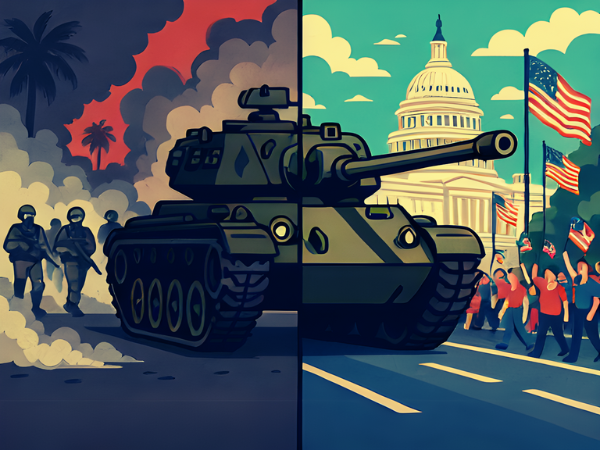
Under the guise of “restoring order” and “cleaning up” the streets, Trump has called in the National Guard, dispatched the FBI, and federalized the local police in order to take control of Washington, D.C.

This is how the Emergency State operates in the open.

A real but manageable problem—crime, homelessness, public disorder—is inflated into an existential threat.

Fear is manufactured, then exploited to seize more power. (In many cases, the “facts” fueling these crackdowns come directly from the president’s own disinformation machine—manufacturing the perception of danger to justify the expansion of control.)

Whether the trigger is terrorism, civil unrest, economic instability, or public health, the aim remains the same: expand the reach of federal authority, justify more militarized policing, and condition the public to accept the suspension of rights in the name of national security.

Once these powers are taken, they are never willingly relinquished.

Each time, Trump pushes the envelope a little, relying on military optics meant to intimidate.

For instance, on April 28, 2025, Trump signed an Executive Order authorizing mass round-ups of “violent criminals” and “gang members,” empowering federal agencies and military support for domestic law enforcement.

In June, Trump deployed the National Guard to California to quell protests over mass immigration arrests, treating political dissent as a security threat. A bench trial is currently underway to determine if Trump’s actions violated the Posse Comitatus Act, which prohibits the military from being used as a domestic police force.

By midsummer, a mental health detention directive allowed involuntary commitments of the homeless under “public health” grounds.

By August, Trump was deploying FBI agents and the National Guard into the nation’s capital in order to clear homeless encampments because the president says the city is “dirty” and “dangerous.”

At each stage, the scope of who could be targeted by these executive orders and emergency power operations grows wider.

These are not isolated decisions; they are part of a coordinated playbook for bringing local jurisdictions under direct federal control, one crisis at a time.

This is mission creep in action—by breaking the police state’s hostile takeover of the country and our Constitution into a series off incremental moves, the administration sidesteps the broad public backlash that a single, sweeping declaration of martial law would provoke.

Once the federal government claims the authority to override local control, put boots on the ground, and target a designated “dangerous class,” that authority inevitably broadens to sweep in new targets. What begins by targeting violent criminals quickly expands to hardworking immigrants, then the homeless.

Tomorrow those targeted could be protesters, journalists, or anyone deemed undesirable.

These executive orders constitute a war on the American people without a formal declaration of war. Once the definitions of “criminal,” “threat,” and “danger” are used interchangeably to advance political needs, there is no limit to who can be targeted next.

What begins with a narrow claim of emergency power is quickly normalized and made permanent.

We have seen this pattern before.

After 9/11, the Patriot Act’s surveillance powers—initially aimed at foreign terrorists—expanded to include mass monitoring of American citizens. The Transportation Security Administration began as an airport screening agency and now conducts random searches at train stations and sporting events. Predictive policing was sold as a way to stop violent crime, but it is now used to flag political activists and monitor protests.

In each case, a temporary, targeted security measure grew into a permanent tool of control.

The difference today is that the slope has become steeper and the slide faster. What once took years to creep into everyday life now happens in a matter of months.

Four months is all it took for the police state to pivot from “rounding up violent criminals” to patrolling the streets of the capital and forcibly removing the unhoused.

Today, the slope runs from undocumented immigrant sweeps to homeless sweeps.

Tomorrow, it could run from “restoring order” to suppressing lawful dissent in the same span of time.

This is the logical outcome of a formula that has been refined over decades: identify or invent a threat, stoke public fear, expand executive power to “solve” it, normalize the new level of control, then repeat with a broader definition of “threat.”

Each time the public accepts an expansion of authority in the name of security, the next expansion comes faster and goes further.

The dictatorial hunger for power, as Harvard’s Laurence Tribe has observed, is insatiable.

Every crisis becomes a test: of our willingness to let the government sidestep the Constitution, of our tolerance for militarized “solutions” to social problems, of whether the public will resist or comply, of whether those in authority can get away with moving the line yet again.

For decades—from Pearl Harbor to the Red Scare, from 9/11 to the pandemic lockdowns—we have failed that test. Each time, the line moves a little further, the slope gets a little slicker, and the public grows more accustomed to life under occupation.

The players change—Bush, Obama, Trump, Biden, and now Trump again—but the game remains the same: permanent crisis management, permanent power grabs, permanent erosion of liberty.

This is how constitutional limits die—not in one dramatic coup, but in a series of incremental “emergencies” that accustom us to living under permanent federal occupation.

By that measure, the takeover of Washington, D.C., is a chilling case study.

The issue is not whether Trump can seize control of DC. Under section 740 of the District of Columbia Home Rule Act, the president may do so for 48 hours without congressional approval and up to 30 days with notice to Congress.

It’s worth noting that this provision has never been invoked before, and certainly not for the purpose of cleaning up squalor. The law was envisioned for truly extraordinary crises—natural disasters, large-scale riots—not as a political tool for executive housecleaning.

So the question we must ask as the symbolic heart of the republic is transformed into a constitution-free zone is: Why? Why now—when crime is at its lowest level in three decades? And where do we go from here?

The federal takeover of Washington, D.C., is not the end of that slippery slope. It is merely the latest drop, and nothing in our present political climate suggests it will be the last.

The police state will always need another manufactured crisis.

Terrorist attacks, mass shootings, “unforeseen economic collapse, loss of functioning political and legal order, purposeful domestic resistance or insurgency, pervasive public health emergencies, and catastrophic natural and human disasters”: the government has been anticipating and preparing for such crises for years now.

As David C. Unger writes for the New York Times: “Life, liberty, and the pursuit of happiness have given way to permanent crisis management: to policing the planet and fighting preventative wars of ideological containment, usually on terrain chosen by, and favorable to, our enemies. Limited government and constitutional accountability have been shouldered aside by the kind of imperial presidency our constitutional system was explicitly designed to prevent.”

Given the rate at which the government keeps devising new ways to establish itself as the “solution” to all of our worldly problems at taxpayer expense, each subsequent crisis ushers in ever larger expansions of government power and fewer individual liberties.

Once the government acquires authoritarian powers—to spy, surveil, militarize police, seize funds, wage endless wars, censor speech, detain without due process, etc.—it does not willingly relinquish them.

The lesson for the ages is this: once any government is allowed to overreach and expand its powers, it’s almost impossible to put the genie back in the bottle.

History bears this out: as government expands, liberty contracts.

If the president can federalize the policing of the capital, override local control, and treat entire populations as security threats without meaningful resistance from Congress, the courts, or the public, then there is nothing to stop that same template from being applied to any city in America in the name of “security.”

What is happening in Washington today will be the model for what happens nationwide tomorrow.

Case in point: at Trump’s direction, the Pentagon—the military branch of the government—is looking to establish a “Domestic Civil Disturbance Quick Reaction Force,” made up of National Guard troops kept on standby at all times, which could be rapidly deployed to American cities “facing protests or other unrest.”

Indeed, Trump has already hinted that he plans to target Baltimore, Chicago, Los Angeles, New York and Oakland next.

This is straight out of the playbook used in that Pentagon training video created by the Army for U.S. Special Operations Command.

According to “Megacities: Urban Future, the Emerging Complexity,” the U.S. military plans to use armed forces to solve future domestic political and social problems. What they’re really talking about is martial law, packaged as a well-meaning and overriding concern for the nation’s security.

The training video is only five minutes long, but it says a lot about the government’s mindset, the way its views the citizenry, and the so-called “problems” that the government must be prepared to address in the near future through the use of martial law.

Even more troubling, however, is what this military video doesn’t say about the Constitution, about the rights of the citizenry, and about the dangers of locking down the nation and using the military to address political and social problems.

For years, the government has been warning against the dangers of domestic terrorism, erecting surveillance systems to monitor its own citizens, creating classification systems to label any viewpoints that challenge the status quo as extremist, and training law enforcement agencies to equate anyone possessing anti-government views as a domestic terrorist.

What the government failed to explain was that the domestic terrorists would be of the government’s own making, and that “we the people” would become enemy #1.

As I make clear in my book Battlefield America: The War on the American People and in its fictional counterpart The Erik Blair Diaries, “we the people” are already enemies of the state.

If we do not stop this dangerous trajectory now, the question will not be whether martial law comes to your city—it will be when, under what pretext, and whether we will have the courage and the wherewithal to resist.

Source: https://tinyurl.com/38jrjz6b

ABOUT JOHN W. WHITEHEAD

Constitutional attorney and author John W. Whitehead is founder and president of The Rutherford Institute. His most recent books are the best-selling Battlefield America: The War on the American People, the award-winning A Government of Wolves: The Emerging American Police State, and a debut dystopian fiction novel, The Erik Blair Diaries. Whitehead can be contacted at staff@rutherford.org. Nisha Whitehead is the Executive Director of The Rutherford Institute. Information about The Rutherford Institute is available at www.rutherford.org.

Publication Guidelines / Reprint Permission

John W. Whitehead’s weekly commentaries are available for publication to newspapers and web publications at no charge. 

RICHMOND, Va. — The Rutherford Institute is once again warning that if the government is allowed to deny freedom to one segment of the citizenry, it will eventually extend that tyranny to all citizens.

The Institute’s warning comes in response to a trial court’s decision in Christian Scholars Network, Inc. v. Montgomery County and Town of Blacksburg to deny equal treatment to a faith-based campus study center—despite providing tax-exempt status to other religious and charitable organizations offering similar services. At issue is whether the Christian Scholars Network (CSN)—a nonprofit religious organization that holds Bible studies, worship services, prayer meetings, and faith-based community events at its Bradley Study Center—is entitled to the same tax-exempt treatment granted to other religious groups. The case raises critical constitutional questions about religious liberty, government neutrality, and equal protection for nontraditional faith practices under the First Amendment and the Virginia Constitution.

“The First Amendment forbids the government from picking and choosing which religious groups are ‘worthy’ of constitutional protection,” said constitutional attorney John W. Whitehead, president of The Rutherford Institute and author of Battlefield America: The War on the American People. “Whether it’s a church, a synagogue, a mosque, or a campus study center, the principle is the same: all faiths must be treated equally under the law. When the government starts elevating one form of religious practice over another, it sets a dangerous precedent that threatens freedom of belief for everyone.”

The Rutherford Institute’s lawsuit on behalf of Christian Scholars Network (CSN) comes amid growing concerns about governmental attempts to define religion narrowly, often to the detriment of minority or nontraditional faith communities. In 2019, CSN, a nonprofit ministry exempt from federal income tax by the IRS under section 501(c)(3), opened the Bradley Study Center near the Virginia Tech campus to cultivate a thoughtful exploration of the Christian faith and how one’s faith connects to their studies, work, and life. CSN uses the Study Center property for worship services, prayer meetings, Bible and theological book studies, and a Fellows Program for Virginia Tech students to meet weekly for religious discussions and fellowship. Despite fulfilling a comparable mission as other religious organizations, CSN was denied a property tax exemption on the grounds that its activities allegedly did not constitute “worship” and that it is not a “religious association” under Virginia law.

In coming to CSN’s defense, attorneys for The Rutherford Institute argue that the government’s refusal to recognize CSN’s religious character violates the Establishment Clause, fosters religious discrimination, and imposes a narrow, outdated definition of worship that excludes faith communities outside traditional, hierarchical structures. Institute attorneys also pointed to the U.S. Supreme Court’s ruling in Catholic Charities Bureau v. Wisconsin, which affirms the right of faith-based organizations to operate free from government discrimination based on the structure or style of their worship and ministry. After the trial court refused to grant CSN an exemption, ruling that CSN must be like a traditional church to receive the tax exemption, attorneys with The Rutherford Institute appealed to the Virginia Court of Appeals.

Affiliate attorneys Melvin E. Williams and Meghan A. Strickler of Williams & Strickler, PLC helped advance the arguments on appeal in Christian Scholars Network, Inc. v. Montgomery County and Town of Blacksburg.

The Rutherford Institute, a nonprofit civil liberties organization, provides legal assistance at no charge to individuals whose constitutional rights have been threatened or violated, and educates the public on a wide spectrum of issues affecting their freedoms.


Case History

October 25, 2023 • Rutherford Institute Sues Over Discrimination of a Christian Study Center 

September 05, 2024 • Rutherford Institute Takes Government to Trial Over Discrimination of a Christian Study Center

Source: https://tinyurl.com/2kjxj7vx

Whatever crushes individuality is despotism, by whatever name it may be called, and whether it professes to be enforcing the will of God or the injunctions of men.”—John Stuart Mill, On Liberty

“Power to the people.”—John Lennon

What on earth is happening to this country?

How, over the course of 250 years, did we go from prizing self-government to allowing a corrupt, self-serving ruling elite to dominate us with terror campaigns, brute force, and psychological warfare?

Don’t be fooled: the madness, mayhem and malice unfolding in America is not politics as usual. It’s not partisan hardball. It’s not bureaucratic overreach.

It’s theft in the gravest sense imaginable: the theft of our nation, the theft of our sovereignty as citizens, the theft of our constitutional republic.

This isn’t just corruption—it’s a betrayal of the very purpose for which governments are instituted. As John Locke warned, when those in power break the social contract by seizing rights they were appointed to protect, they no longer govern with the consent of the people—they rule by force, and the people are justified in resisting.

The Declaration of Independence echoed this principle: “When a long train of abuses and usurpations, pursuing invariably the same Object, evinces a design to reduce them under absolute Despotism, it is their right, it is their duty, to throw off such Government.”

What we face now is just such a train of abuses—systematic, strategic, and swift.

The government is seizing what does not belong to it: our voice, our rights, our power to choose and to resist. It is robbing us of the very tools of self-government—accountability, transparency, representation, free speech, bodily autonomy—and replacing them with coercion, propaganda, and force.

So when the White House threatens to withhold FEMA aid from states that won’t endorse its foreign policy? That’s theft.

When the president attacks the courts for calling out executive overreach? That’s theft.

When the media is muzzled, the police state expands, and new concentration camps rise? All of it—theft.

We are being robbed blind in broad daylight by the very individuals entrusted with safeguarding our rights and our republic.

Despite his assurances to the contrary, Donald Trump never had any intention of draining the swamp. He is the swamp.

Yet make no mistake: this didn’t start with Trump. The groundwork for this theft was laid long before—through successive administrations, both Republican and Democrat—that expanded executive power, hollowed out the Constitution, and normalized the rule of force over the rule of law.

What Trump has done is remove the mask, weaponize the tools of tyranny, and accelerate the dismantling of the republic in full view of the people.

Here are just a few of the many ways the Trump administration—no different than its predecessors in motive, yet far more brazen in execution—is stealing the birthright of the American people and cementing the transformation of the republic into a government of wolves.

  • Police, once tasked with serving the people, now act as an occupying force—conducting no-knock raids in the dead of night, using military-grade weapons against civilians, and treating constitutional rights as optional.
  • ICE agents, incentivized by massive $50,000 bonuses and shielded from accountability, behave more like mercenaries than law enforcement—disappearing immigrants, terrorizing families, and operating far outside the bounds of due process.
  • Fourth Amendment protections, under constant assault, have become optional. Armed police raids—often executed without warrants or on faulty intelligence—are increasing in frequency and aggression. Constitution-free zones now extend well beyond the border, with entire communities living under constant threat of militarized home invasions and door-to-door sweeps.
  • Elected representatives enrich themselves through insider trading, while the crises they help manufacture devastate the populace.
  • Federal courts are being threatened or ignored outright when they attempt to check executive overreach. Judges who speak out are branded enemies of the state.
  • Whistleblowers, journalists, and truth-tellers are prosecuted, surveilled, or silenced—treated as threats to national security. Journalism, once protected as a check on power, is under siege.
  • Statisticians, public health experts, and government researchers are being purged or silenced when their data doesn’t support the administration’s narrative. We are living in the shadow of George Orwell’s Ministry of Truth, where facts are negotiable, history can be rewritten, and reality is whatever the Deep State says it is.
  • Disaster relief, foreign policy, and executive authority have been weaponized to punish dissent.
  • The Department of Justice has become a tool of loyalty enforcement—targeting dissenters while shielding cronies.
  • Meanwhile, the Epstein files remain sealed. Despite public outcry and compelling evidence of elite involvement in Jeffrey Epstein’s sex trafficking network, the Trump administration has refused to release the full client list or investigative records. In doing so, it continues the bipartisan pattern of shielding the powerful from scrutiny while everyday Americans face ever-expanding surveillance, suspicion, and punishment.
  • Public lands are being auctioned off to corporate allies without oversight or accountability.
  • Citizenship is no longer a birthright but a privilege granted or revoked by political fiat.
  • Digital platforms, pressured by federal agencies, now censor views deemed “inconvenient” to the state.
  • Education is being reshaped to discourage critical thought and enforce ideological conformity.
  • Government services, once created to serve the public good, are now political weapons—used to reward loyalty, punish dissent, and control the masses through selective aid and ideological enforcement.
  • Executive orders have become tools of rule-by-decree, bypassing Congress and obliterating checks and balances.
  • Economic chaos is being weaponized strategically. By manufacturing crises, withholding aid, and destabilizing budgets, the Deep State has found a new way to consolidate power, transfer wealth upwards, and condition compliance.
  • Corruption is not punished. It’s rewarded—so long as it serves the power elite.

And while all of this is happening, the Trump administration is doing everything it can to keep the citizenry distracted, divided, and demobilized—peddling outrage, manufacturing crises, stoking culture wars and threatening global wars.

Transparency is buried beneath spectacle. Accountability is drowned out by distraction. And by the time we look up from the latest scandal or political brawl, another piece of the republic has been carved away.

Bit by bit, freedom is being caged. And what is emerging in its place is a vast, inescapable prison—walled in not by bars, but by bureaucracy, deception, and brute force.

Aided and abetted by the Trump administration, the Deep State is turning the entire country into one sprawling, swampy, digitally surveilled Alligator Alcatraz: a carceral state in which every citizen is suspect, every movement is monitored, and escape routes are vanishing fast.

When “we the people” no longer have a say in how we’re governed—when we have no way to guard against our trust being abused and our rights violated—when we have no way to counter government efforts to silence our voices, manipulate our choices, and erase our rights—what remains is not a constitutional republic.

It’s a prison. A prison made of laws perverted, truths twisted, and power unchecked.

Yet the government—present and past—is stealing more than just power. It’s stealing the people’s ability to be the government.

This is not just about the loss of freedom. It is the systematic dismantling of self-government—of the people’s role as the final check on power. And it begins subtly. It begins with our right to know what is happening in our own government being blocked.

Transparency—the cornerstone of any functioning representative democracy—is vanishing behind a fortress of secrecy. Laws meant to hold power accountable are neutered by “national security” exemptions and stonewalled FOIA requests. The government issues secret executive orders, redacts critical information, and shields entire policy regimes from public view.

What we don’t know can and will hurt us.

Next goes the right to participate. Representation, once a sacred principle, has been reduced to a numbers game—rigged congressional maps, voter roll purges, and data-driven manipulation that keep incumbents entrenched and challengers out. The people are no longer choosing their representatives; representatives are choosing their people.

Dissent—an essential function of free government—is now pathologized, criminalized, or digitally erased. Protesters are surveilled, activists labeled extremists, and speech censored through backdoor collusion between federal agencies and tech platforms. The First Amendment is being gutted in real time.

Even physical sovereignty is under assault. The right to bodily autonomy has been quietly subverted by biometric tracking, mental health detentions, and proposed mandates for wearable surveillance devices. What was once science fiction is now federal policy. In the name of safety, every heartbeat, step, and biometric signal is being harvested, scored, and archived.

Meanwhile, civil liberties once considered foundational—due process, freedom from arbitrary detention, the presumption of innocence—are being erased by executive edict. With the stroke of a pen, entire populations (immigrants, homeless individuals, protest organizers) can be swept up, locked away, and denied basic constitutional protections.

Local communities, too, are being robbed of their self-governance. Cities that seek to set their own course—whether through sanctuary laws, public health rules, or environmental standards—are being overridden by federal command. Militarized police forces, far from acting like local peace officers, have become extensions of the government’s standing army.

Even the symbolism of the republic is being repurposed. The White House is daily becoming less a house of the people and more a gilded monument to imperial presidency.

This is not democracy.

This is the theft of a nation in real time by those entrusted with the highest offices of power, who use their power to strip “we the people” of our sovereignty and our rights.

The founders warned us against kings. What we face now is far more insidious: an executive branch that pays lip service to freedom while locking down the nation.

This is not how free people are governed.

This is how free people are ruled.

If the people are no longer allowed to check power, to criticize it, to reform it, to influence it, or even to see it—then we no longer have a government of the people, by the people, or for the people.

As I make clear in my book Battlefield America: The War on the American People and in its fictional counterpart The Erik Blair Diaries, we have a government against the people.

The answer, as the Founders understood—and as poets from Percy Bysshe Shelley to John Lennon have urged—is that there is power in our numbers if only we would stand united against tyranny.

To quote Shelley:

“Rise like Lions after slumber
In unvanquishable number—
Shake your chains to earth like dew
Which in sleep had fallen on you—
Ye are many—they are few.”

Unless we wake up to what is being stolen from us—not just our rights, but our role as masters, not servants—we may find that the chains we refused to shake off have become impossible to break.

Source: https://tinyurl.com/bdduhhm3

ABOUT JOHN W. WHITEHEAD

Constitutional attorney and author John W. Whitehead is founder and president of The Rutherford Institute. His most recent books are the best-selling Battlefield America: The War on the American People, the award-winning A Government of Wolves: The Emerging American Police State, and a debut dystopian fiction novel, The Erik Blair Diaries. Whitehead can be contacted at staff@rutherford.org. Nisha Whitehead is the Executive Director of The Rutherford Institute. Information about The Rutherford Institute is available at www.rutherford.org.

Publication Guidelines / Reprint Permission

John W. Whitehead’s weekly commentaries are available for publication to newspapers and web publications at no charge. 

“There are no dangerous thoughts; thinking itself is a dangerous activity.”—Hannah Arendt

The government’s war on homelessness—much like its war on terrorism, its war on drugs, its war on illegal immigration, and its war on COVID-19—is yet another Trojan Horse.

First, President Trump issues an executive order empowering federal agencies to clear out homeless encampments and lock up the homeless in mental institutions using involuntary civil commitment laws intended for dealing with individuals experiencing mental health crises.

Days later, a gunman allegedly suffering from a mental illness opens fire in New York City, killing four before turning the gun on himself.

Coming on the heels of Trump’s executive order aimed at “ending crime and disorder on America’s streets,” the shooting has all the makings of a modern-day Reichstag fire: a tragedy weaponized to justify allowing the government use mental illness as a pretext for locking more people up without due process.

An Orwellian exercise in doublespeak, Trump’s executive order suggests that jailing the homeless, rather than providing them with affordable housing, is the “compassionate” solution to homelessness.

According to USA Today, social workers, medical experts and mental health service providers say the president’s approach “will likely worsen homelessness across the country, particularly because Trump’s order contains no new funding for mental health or drug treatment. Additionally, they say the president appears to misunderstand the fundamental driver of homelessness: People can’t afford housing.

And then comes the kicker: Trump wants to see more use of civil commitments (forced detentions) for anyone who is perceived as posing a risk “to themselves or the public or are living on the streets and cannot care for themselves in appropriate facilities for appropriate periods of time.”

Translation: the government wants to use homelessness as a pretext for indefinitely locking up anyone who might pose a threat to its chokehold on police state power.

When you consider the ramifications of giving the American police state that kind of authority to preemptively neutralize a potential threat, you’ll understand why some might view these looming mental health round-ups with trepidation.

By directing police to carry out forced detentions of individuals based not on criminal behavior but on perceived mental instability or drug use, the Trump administration is attempting to sidestep fundamental constitutional protections—due process, probable cause, and the presumption of innocence—by substituting medical discretion for legal standards.

Taken to its authoritarian limits, this could allow the government to weaponize the label of mental illness as a means of exiling dissidents who refuse to march in lockstep with its dictates.

Police in cities like New York have already been empowered to forcibly detain individuals for psychiatric evaluations, based on vague, subjective criteria: having “firmly held beliefs not congruent with cultural ideas,” exhibiting “excessive fears,” or refusing “voluntary treatment.”

What happens when these criteria are expanded to encompass anyone who challenges the police state’s narrative?

Once the government is allowed to control the narrative over who is deemed mentally unfit, mental health care could become yet another pretext for pathologizing dissent in order to disarm and silence the government’s critics.

Take heed: this has the potential to become the next phase of the government’s war on thought crimes, cloaked in the guise of public health and safety.

According to the Associated Press, federal agencies have been exploring how to incorporate “identifiable patient data” into their surveillance toolkits, including behavioral health records.

The infrastructure is already in place to profile and detain individuals based on perceived psychological “risks.”

The government is actively exploring how to use data from wearable health devices—including heart rate, stress response, and sleep patterns—to flag individuals for intervention. Now imagine a future in which your Fitbit or Apple Watch triggers a mental health alert, resulting in your forced removal “for your own safety.”

Mass surveillance combined with artificial intelligence-powered programs that can track people by their biometrics and behavior, mental health sensor data (tracked by wearable data and monitored by government agencies such as HARPA), threat assessments, behavioral sensing warnings, precrime initiatives, red flag gun laws, mental health first-aid programs aimed at training gatekeepers to identify who might pose a threat to public safety, and government access to behavioral health records could pave the way for a regime of police state authoritarianism by way of preemptive mental health detentions.

If the police state is equipping itself to monitor, flag, and detain anyone it deems mentally unfit, without criminal charges or trial, this could be the tipping point in the government’s efforts to penalize those engaging in so-called “thought crimes.”

This is not about public safety. It’s about control.

We’ve seen this tactic before. When governments seek to suppress dissent without provoking outrage, they turn to psychiatric labels.

Throughout history, from Cold War-era Soviet gulags to modern pre-crime initiatives, authoritarian regimes have used psychiatric labels to isolate, discredit, and eliminate dissidents.  As historian Anne Applebaum notes, administrative exile, which required no trial and due process, “was an ideal punishment not only for troublemakers as such, but also for political opponents of the regime.”

The word “gulag” refers to a labor or concentration camp where prisoners (oftentimes political prisoners or so-called “enemies of the state,” real or imagined) were imprisoned as punishment for their crimes against the state. Soviet dissidents were often declared mentally ill, institutionalized in prisons disguised as psychiatric hospitals, and subjected to forced medication and psychological torture.

Totalitarian regimes used such tactics to isolate political dissidents from the rest of society, discredit their ideas, and break them physically and mentally.

In addition to declaring political dissidents mentally unsound, government officials in the Cold War-era Soviet Union also made use of an administrative process for dealing with individuals who were considered a bad influence on others or troublemakers. Author George Kennan describes a process in which:

The obnoxious person may not be guilty of any crime . . . but if, in the opinion of the local authorities, his presence in a particular place is “prejudicial to public order” or “incompatible with public tranquility,” he may be arrested without warrant, may be held from two weeks to two years in prison, and may then be removed by force to any other place within the limits of the empire and there be put under police surveillance for a period of from one to ten years.

Warrantless seizures, surveillance, indefinite detention, isolation, exile…sound familiar?

What’s unfolding in America is the modern police state’s version of that same script.

Civil commitment laws are found in all states and employed throughout American history.

Under the doctrines of parens patriae and police power, the government already claims authority to confine those deemed unable to act in their own best interest or who pose a threat to society.

When fused, these doctrines give the state enormous discretion to preemptively lock people up based on speculative future threats, not actual crimes.

This discretion is now expanding at warp speed.

The result is a Nanny State mindset carried out with the militant force of the Police State.

Once dissent is equated with danger—and danger with illness—those who challenge the state become medicalized threats, subject to detention not for what they’ve done, but for what they believe.

We’ve already seen what happens when dissent is pathologized and criminalized, and civil commitment laws are weaponized:

  • Russ Tice, an NSA whistleblower, was labeled “mentally unbalanced” after attempting to testify in Congress about the NSA’s warrantless wiretapping program.
  • Adrian Schoolcraft, an NYPD officer who exposed police corruption, was forcibly committed to a mental facility in retaliation.
  • Brandon Raub, a Marine who posted controversial political views on Facebook, was arrested and detained in a psychiatric ward under Virginia’s mental health laws.

These cases aren’t anomalies—they’re warning signs.

Government programs like Operation Vigilant Eagle, launched in 2009, characterized military veterans as potential domestic terrorists if they showed signs of being “disgruntled or disillusioned.” A 2009 DHS report broadly defined “rightwing extremists” as anyone seen as antigovernment.

The result? A surveillance dragnet aimed at military veterans, political dissidents, gun owners, and constitutionalists.

Now, under the banner of mental health, the same dragnet is being equipped with red flag gun laws, predictive policing, and involuntary detention authority.

In theory, these laws are meant to prevent harm. In practice, they punish thought, not conduct.

Trump’s latest executive order doesn’t just target the homeless—it establishes a precedent for rounding up anyone deemed a threat to the government’s version of law and order.

The same playbook that pathologized opposition to war or police brutality as “Oppositional Defiant Disorder” could now be used to classify political dissent as a psychiatric illness.

This is not hyperbole.

The government’s ability to silence dissent by labeling it as dangerous or diseased is well documented—and now it’s about to be codified into law.

Red flag gun laws, for example, authorize government officials to seize guns from individuals viewed as a danger to themselves or others. The stated intention is to disarm individuals who are potential threatsNo mental health diagnosis is required. No criminal charge. Just a hunch. Those most likely to be targeted? The people already on government watch lists: political activists, veterans, gun owners, and anyone labeled an “extremists”— a term that now applies to anyone critical of the government.

While the intention may appear reasonable—disarming people who pose an “immediate danger” to themselves or others—the problem arises when you put the power to determine who is a potential danger in the hands of a police state that equates dissent with extremism.

This is the same police state that uses the words “anti-government,” “extremist” and “terrorist” interchangeably.

The same police state whose agents are weaving a web of threat assessments, behavioral sensing warnings, flagged “words,” and “suspicious” activity reports using AI, social media surveillance, behavior sensing software, and citizen snitches to identify potential threats.

The same police state that renews the NDAA year after year—authorizing the indefinite military detention of U.S. citizens.

The same police state that considers you suspicious based on your religion, your bumper stickers, or your political beliefs.

As a New York Times editorial warns, you may be labeled an anti-government extremist (a.k.a. domestic terrorist) if you are afraid that the government is plotting to confiscate your firearms, believe the economy is about to collapse, fear the government will soon declare martial law, or display too many political and/or ideological bumper stickers on your car.

This is the same police state that now wants access to your mental health data, your digital footprint, your biometric records—and the legal authority to detain you for your own good.

And it’s the same police state that, facing rising protests, unrest, and collapsing public trust, is seeking new ways to suppress dissent—not through open force, but under the cover of public health.

This is where thought crimes become real crimes.

We’ve seen this trajectory before.

The war on drugs.

The war on terror.

The war on COVID.

Each began with real concerns. Each ended as a tool of compliance, coercion, and control.

Now, as I make clear in my book Battlefield America: The War on the American People and in its fictional counterpart The Erik Blair Diaries, we are entering a new war: the war on anti-government dissidents.

We are fast approaching a future where you can be locked up for the thoughts you think, the beliefs you hold, or the questions you ask.

The government will use any excuse to suppress dissent and control the narrative.

It will start with the homeless.

Then the mentally ill.

Then the so-called extremists.

Then the critics, the contrarians, and the constitutionalists.

Eventually, it will come for anyone who dares to get in the government’s way.

This is how tyranny rises. This is how freedom falls.

Unless we resist this creeping mental health gulag, the prison gates will eventually close on us all.

Source: https://tinyurl.com/3hy6km93

ABOUT JOHN W. WHITEHEAD

Constitutional attorney and author John W. Whitehead is founder and president of The Rutherford Institute. His most recent books are the best-selling Battlefield America: The War on the American People, the award-winning A Government of Wolves: The Emerging American Police State, and a debut dystopian fiction novel, The Erik Blair Diaries. Whitehead can be contacted at staff@rutherford.org. Nisha Whitehead is the Executive Director of The Rutherford Institute. Information about The Rutherford Institute is available at www.rutherford.org.

Publication Guidelines / Reprint Permission

John W. Whitehead’s weekly commentaries are available for publication to newspapers and web publications at no charge. 

“When a long train of abuses and usurpations… evinces a design to reduce them under absolute Despotism, it is their right, it is their duty, to throw off such Government.”—Declaration of Independence (1776)

We are now struggling to emerge from the wreckage of a constitutional republic, transformed into a kleptocracy (government by thieves), collapsing into kakistocracy (government by the worst), and enforced by a police state algogracy (rule by algorithm).

This week alone, the Trump administration is reportedly erecting protest barricades around the White House, Congress is advancing legislation that favors the wealthy, and President Trump is grandstanding at the opening of a detention center dubbed “Alligator Alcatraz.”

Against such a backdrop of government-sponsored cruelty, corruption and shameless profiteering at taxpayer expense, what, to the average American, is freedom in an age when the government plays god—determining who is worthy of rights, who qualifies as a citizen, and who can be discarded without consequence?

What are inalienable rights worth if they can be redefined, delayed, or revoked by executive order?

Frederick Douglass posed a similar challenge more than 170 years ago when he asked, “What, to the American slave, is your Fourth of July?

His question was a searing indictment not just of slavery but of a government that proclaimed liberty while denying it to millions—a hypocrisy that persists in a system still governed by institutions more committed to power than principle.

Every branch of government—executive, legislative, and judicial—has, in one way or another, abandoned its duty to uphold the Constitution. And both parties have prioritized profit and political theater over justice and the rights of the governed.

The founders of this nation believed our rights come from God, not government. That we are born free, not made free by bureaucrats or judges. That among these rights—life, liberty, and the pursuit of happiness—none can be taken away without destroying the very idea of government by consent.

And yet that is precisely what’s happening.

We now live under a government that has become judge, jury, and executioner—writing its own laws, policing its own limits, and punishing those who object.

This is not what it means to be free.

When presidents rule by fiat, when agencies strip citizenship from naturalized Americans, when police act as both enforcers and executioners, and when courts rubber-stamp the erosion of basic protections, the distinction between a citizen and a subject begins to collapse.

What do inalienable rights mean in a country where:

  • Your citizenship can be revoked based solely on the government’s say-so?
  • Your freedom can be extinguished by surveillance, asset seizure, or indefinite detention?
  • Your property can be taken, your speech censored, and your life extinguished without due process?
  • Your life can be ended without a trial, a warning, or a second thought, because the government views you as expendable?

The answer is stark: they mean nothing—unless we defend them.

When the government—whether president, Congress, court, or local bureaucrat—claims the right to determine who does and doesn’t deserve rights, then no one is safe. Individuals become faceless numbers. Human beings become statistics. Lives become expendable. Dignity becomes disposable.

It is a slippery slope—justified in the name of national security, public safety, and the so-called greater good—that leads inevitably to totalitarianism.

Unfortunately, we have been dancing with this devil for far too long, and now, the mask has come off.

This is what authoritarianism looks like in America today.

Imagine living in a country where government agents crash through doors to arrest citizens merely for criticizing government officials. Where police stop and search you on a whim. Where carrying anything that resembles a firearm might get you arrested—or killed. Where surveillance is constant, dissent is criminalized, and loyalty is enforced through fear.

If you’re thinking this sounds like America today, you wouldn’t be far wrong.

But this scenario isn’t new. It’s the same kind of tyranny that drove American colonists to sever ties with Great Britain nearly 250 years ago.

Back then, American colonists lived under the shadow of an imperial power and an early police state that censored their speech, surveilled their movements, taxed their livelihoods, searched their homes without cause, quartered troops in their towns, and punished them for daring to demand liberty.

It was only when the colonists finally got fed up with being silenced, censored, searched, frisked, threatened, and arrested that they finally revolted against the tyrant’s fetters.

The Declaration of Independence—drafted by Thomas Jefferson and signed on July 4, 1776, by 56 men who risked everything—was their response. It was more than a list of grievances. It was a document seething with outrage over a government which had betrayed its citizens, a call to arms against a system that had ceased to represent the people and instead sought to dominate them.

Labeled traitors, these men were charged with treason, a crime punishable by death, because they believed in a radical idea: that all people are created to be free. For some, their acts of rebellion would cost them their homes and their fortunes. For others, it would be the ultimate price—their lives.

Yet even knowing the heavy price they might have to pay, these men dared to speak up. They understood that silence in the face of tyranny is complicity. So they stood together, pledging “our Lives, our Fortunes, and our sacred Honor” to the cause of freedom.

Even after they had won their independence from Great Britain, these new Americans worked to ensure that the rights they had risked their lives to secure would remain secure for future generations.

The result: our Bill of Rights, the first ten amendments to the Constitution.

The Constitution and Bill of Rights were meant to enshrine the liberties they fought for: due process, privacy, free speech, the right to bear arms, and limits on government power.

Now, nearly two and a half centuries later, those freedoms hang by a thread.

Imagine the shock and outrage these 56 men would feel were they to discover that almost 250 years later, the government they had risked their lives to create has been transformed into a militaristic police state in which exercising one’s freedoms—at a minimum, merely questioning a government agent—is often viewed as a flagrant act of defiance.

In fact, had Jefferson and his compatriots written the Declaration of Independence today, they would almost certainly be labeled extremists, placed on government watchlists, targeted by surveillance, and prosecuted as domestic threats.

Read the Declaration of Independence again, and you’ll see the grievances they laid at the feet of King George—unjust laws, militarized policing, surveillance, censorship, and the denial of due process—are the very abuses “we the people” suffer under today.

Had Jefferson written the Declaration about the American police state in 2025, it might have read like a criminal indictment of the crimes perpetrated by a government that:

Polices by fear and violence:

Surveils and represses dissent:

Strips away rights:

Concentrates unchecked power in the executive:

  • bypassing Congress with executive orders, sidelining the courts, and ruling by decree;
  • weaponizing federal agencies to suppress opposition and silence critics;
  • treating constitutional limits as optional and the presidency as a personal fiefdom.

These are not isolated abuses.

They are the logical outcomes of a government that has turned against its people.

They reveal a government that has claimed the god-like power to decide who gets rights—and who doesn’t. Who counts as a citizen—and who doesn’t. Who gets to live—and who becomes expendable.

All along the spectrum of life—from the unborn child to the elderly—the government continues to treat individuals endowed by their Creator with certain unalienable rights as if they are criminals, subhumans, or enemies of the state.

That is not freedom. It is tyranny.

And it must be called by its true name.

The truth is hard, but it must be said: the American police state has grown drunk on power, money, and its own authority.

The irony is almost too painful to articulate.

On the anniversary of the signing of the Declaration of Independence—a document that rebuked government corruption, tyranny, and injustice—we find ourselves surrounded by its modern-day equivalents.

This week’s spectacle—protest barricades, legislation to benefit the rich, and Trump’s appearance at Alligator Alcatraz, a.k.a. “Gator Gitmo”—shows how completely we have inverted the spirit of 1776.

That a president would celebrate the Fourth of July while inaugurating a modern-day internment camp—far from the reach of the courts or the Constitution—speaks volumes about the state of our nation and the extent to which those in power now glorify the very forms of tyranny the Founders once rose up against.

This is not law and order.

This is political theater, carceral cruelty, and authoritarianism in plain sight.

It is what happens when a nation that once prided itself on liberty now builds monuments to its own fear and domination.

The spectacle doesn’t end with detention camps and barricades. It extends into commerce, corruption, and self-enrichment at the highest levels of power.

President Trump is now marketing his own line of fragrances—a branding exercise so absurd it would be laughable if it weren’t a flagrant violation of the Constitution’s Emoluments Clause. His investments are booming. And all across his administration, top officials are shamelessly using public office to line their pockets, even as they push legislation to strip working-class Americans of the most basic benefits and protections, while claiming to be rooting out corruption and inefficiency.

This is not governance. This is kleptocracy—and it is happening in plain sight.

In the nearly 250 years since early Americans declared their independence from Great Britain, “we the people” have worked ourselves back under the tyrant’s thumb—only this time, the tyrant is one of our own making.

The abuses they once suffered under an imperial power haven’t disappeared. They’ve evolved.

We are being robbed blind by political grifters and corporate profiteers. We are being silenced by bureaucrats and blacklists. We are being watched by data miners and digital spies. We are being caged by militarized enforcers with no regard for the Constitution. And we are being ruled by presidents who govern not by law, but by executive decree.

Given the fact that we are a relatively young nation, it hasn’t taken very long for an authoritarian regime to creep into power.

Unfortunately, the bipartisan coup that laid siege to our nation did not happen overnight.

The architecture of oppression—surveillance, militarism, censorship, propaganda—was built slowly, brick by brick, law by law, war by war.

It snuck in under our radar, hiding behind the guise of national security, the war on drugs, the war on terror, the war on immigration, political correctness, hate crimes and a host of other official-sounding programs aimed at expanding the government’s power at the expense of individual freedoms.

The building blocks for the bleak future we’re just now getting a foretaste of—police shootings of unarmed citizens, profit-driven prisons, weapons of compliance, a wall-to-wall surveillance state, pre-crime programs, a suspect society, school-to-prison pipelines, militarized police, overcriminalization, SWAT team raids, endless wars, etc.—were put in place by government officials we trusted to look out for our best interests.

The result is an empire in decline and a citizenry under siege.

But if history teaches us anything, it’s that the power of the people—when awakened—is stronger than any empire.

For decades, the Constitution has been our shield against tyranny.

But today, it’s under siege. And now we must be the shield.

Surveillance is expanding. Peaceful dissent is being punished. Judges are being targeted. The presidency is issuing decrees and bypassing the rule of law.

Every institution meant to check power is being tested—and in some cases, broken.

This is the moment to stand in front of the Constitution and defend it.

As I make clear in my book Battlefield America: The War on the American People and in its fictional counterpart The Erik Blair Diaries, the fight for freedom is never over. But neither is it lost—so long as we refuse to surrender, refuse to remain silent, and refuse to accept tyranny as the price of safety.

It is time to remember who we are. To reclaim the Constitution. To resist the march toward authoritarianism. And to reassert—boldly and without apology—that our rights are not up for negotiation.

Source: https://tinyurl.com/yc8n9rsj

ABOUT JOHN W. WHITEHEAD

Constitutional attorney and author John W. Whitehead is founder and president of The Rutherford Institute. His most recent books are the best-selling Battlefield America: The War on the American People, the award-winning A Government of Wolves: The Emerging American Police State, and a debut dystopian fiction novel, The Erik Blair Diaries. Whitehead can be contacted at staff@rutherford.org. Nisha Whitehead is the Executive Director of The Rutherford Institute. Information about The Rutherford Institute is available at www.rutherford.org.

Publication Guidelines / Reprint Permission

John W. Whitehead’s weekly commentaries are available for publication to newspapers and web publications at no charge. 

“Every gun that is made, every warship launched, every rocket fired signifies, in the final sense, a theft from those who hunger and are not fed, those who are cold and are not clothed.”—President Dwight D. Eisenhower (April 16, 1953)

Seventy years after President Dwight D. Eisenhower warned about the cost of a military-industrial complex, America is still stealing from its own people to fund a global empire.

In 2025 alone, the U.S. has launched airstrikes in Yemen (Operation Rough Rider), bombed Houthi-controlled ports and radar installations (killing scores of civilians), deployed greater numbers of troops and multiple aircraft carriers to the Middle East, and edged closer to direct war with Iran in support of Israel’s escalating conflict.

Each of these “new” fronts has been sold to the public as national defense. In truth, they are the latest outposts in a decades-long campaign of empire maintenance—one that lines the pockets of defense contractors while schools crumble, bridges collapse, and veterans sleep on the streets at home.

This isn’t about national defense. This is empire maintenance.

It’s about preserving a military-industrial complex that profits from endless war, global policing, and foreign occupations—while the nation’s infrastructure rots and its people are neglected.

The United States has spent much of the past half-century policing the globe, occupying other countries, and waging endless wars.

What most Americans fail to recognize is that these ongoing wars have little to do with keeping the country safe and everything to do with propping up a military-industrial complex that has its sights set on world domination.

War has become a huge money-making venture, and the U.S. government, with its vast military empire, is one of its best buyers and sellers.

America’s role in the Russia-Ukraine conflict has already cost taxpayers more than $112 billion.

And now, the price of empire is rising again.

Clearly, it’s time for the U.S. government to stop policing the globe.

The U.S. military reportedly has more than 1.3 million men and women on active duty, with more than 200,000 of them stationed overseas in nearly every country in the world.

American troops are stationed in Somalia, Iraq and Syria. In Germany, South Korea and Japan. In Saudi Arabia, Jordan and Oman. In Niger, Chad and Mali. In Turkey, the Philippines, and northern Australia.

Those numbers are likely significantly higher in keeping with the Pentagon’s policy of not fully disclosing where and how many troops are deployed for the sake of “operational security and denying the enemy any advantage.” As investigative journalist David Vine explains, “Although few Americans realize it, the United States likely has more bases in foreign lands than any other people, nation, or empire in history.”

Incredibly, America’s military forces aren’t being deployed abroad to protect our freedoms here at home. Rather, they’re being used to guard oil fields, build foreign infrastructure and protect the financial interests of the corporate elite. In fact, the United States military spends about $81 billion a year just to protect oil supplies around the world.

America’s military empire spans nearly 800 bases in 160 countries, operated at a cost of more than $156 billion annually. As Vine reports, “Even US military resorts and recreation areas in places like the Bavarian Alps and Seoul, South Korea, are bases of a kind. Worldwide, the military runs more than 170 golf courses.”

This is how a military empire occupies the globe.

For 20 years, the U.S. war machine propped up Afghanistan to the tune of trillions of dollars and thousands of lives lost. When troops left Afghanistan, the military-industrial complex simply shifted theaters—turning Yemen, Iran, and the Red Sea into new frontlines.

Each new conflict is marketed as national defense. In reality, it’s business as usual for the Pentagon’s global footprint, with American soldiers used as pawns in the government’s endless quest to control global markets, prop up foreign regimes, and secure oil, data, and strategic ports—all while being told it’s for liberty.

This is how the military-industrial complex, aided and abetted by the likes of Donald Trump, Joe Biden, Barack Obama, George W. Bush, Bill Clinton and others, continues to get rich at taxpayer expense.

Yet while the rationale may keep changing for why American military forces are policing the globe, these wars abroad aren’t making America—or the rest of the world—any safer, are certainly not making America great again, and are undeniably digging the U.S. deeper into debt.

War spending is bankrupting America.

Although the U.S. constitutes only 5% of the world’s population, America boasts almost 50% of the world’s total military expenditure, spending more on the military than the next 19 biggest spending nations combined.

In fact, the Pentagon spends more on war than all 50 states combined spend on health, education, welfare, and safety.

The American military-industrial complex has erected an empire unsurpassed in history in its breadth and scope, one dedicated to conducting perpetual warfare throughout the earth.

Since 2001, the U.S. government has spent more than $10 trillion waging its endless wars, much of it borrowed, much of it wasted, all of it paid for in blood and taxpayer dollars.

Add Yemen and the Middle East escalations of 2025, and the final bill for future wars and military exercises waged around the globe will total in the tens of trillions.

Co-opted by greedy defense contractors, corrupt politicians and incompetent government officials, America’s expanding military empire is bleeding the country dry at a rate of more than $32 million per hour.

In fact, the U.S. government spent more money every five seconds in Iraq than the average American earns in a year.

Talk about fiscally irresponsible: the U.S. government is spending money it doesn’t have on a military empire it can’t afford.

Even if we ended the government’s military meddling today and brought all of the troops home, it would take decades to pay down the price of these wars and get the government’s creditors off our backs.

As investigative journalist Uri Friedman puts it, for more than 15 years now, the United States has been fighting terrorism with a credit card, “essentially bankrolling the wars with debt, in the form of purchases of U.S. Treasury bonds by U.S.-based entities like pension funds and state and local governments, and by countries like China and Japan.”

War is not cheap, but it becomes outrageously costly when you factor in government incompetence, fraud, and greedy contractors. Indeed, a leading accounting firm concluded that one of the Pentagon’s largest agencies “can’t account for hundreds of millions of dollars’ worth of spending.”

Unfortunately, the outlook isn’t much better for the spending that can be tracked.

A government audit found that defense contractor Boeing has been massively overcharging taxpayers for mundane parts, resulting in tens of millions of dollars in overspending. As the report noted, the American taxpayer paid:

$71 for a metal pin that should cost just 4 cents; $644.75 for a small gear smaller than a dime that sells for $12.51: more than a 5,100 percent increase in price. $1,678.61 for another tiny part, also smaller than a dime, that could have been bought within DoD for $7.71: a 21,000 percent increase. $71.01 for a straight, thin metal pin that DoD had on hand, unused by the tens of thousands, for 4 cents: an increase of over 177,000 percent.

The fact that such price gouging has become an accepted form of corruption within the American military empire is a sad statement on how little control “we the people” have over our runaway government.

Mind you, this isn’t just corrupt behavior. It’s deadly, downright immoral behavior.

Americans have thus far allowed themselves to be spoon-fed a steady diet of pro-war propaganda that keeps them content to wave flags with patriotic fervor and less inclined to look too closely at the mounting body counts, the ruined lives, the ravaged countries, the blowback arising from ill-advised targeted-drone killings and bombing campaigns in foreign lands, or the transformation of our own homeland into a warzone.

The bombing of Yemen’s Ras Isa port by U.S. forces—killing more than 80 civilians—is just the latest example of war crimes justified as national interest.

That needs to change.

The U.S. government is not making the world any safer. It’s making the world more dangerous. It is estimated that the U.S. military drops a bomb somewhere in the world every 12 minutes. Since 9/11, the United States government has directly contributed to the deaths of around 500,000 human beings. Every one of those deaths was paid for with taxpayer funds.

With the 2025 escalation, those numbers will only rise.

The U.S. government is not making America any safer. It’s exposing American citizens to alarming levels of blowback, a CIA term referring to the unintended consequences of the U.S. government’s international activities. Chalmers Johnson, a former CIA consultant, repeatedly warned that America’s use of its military to gain power over the global economy would result in devastating blowback.

The 9/11 attacks were blowback. The Boston Marathon Bombing was blowback. The attempted Times Square bomber was blowback. The Fort Hood shooter, a major in the U.S. Army, was blowback.

The U.S. military’s ongoing drone strikes will, I fear, spur yet more blowback against the American people.

The war hawks’ militarization of America—bringing home the spoils of war (the military tanks, grenade launchers, Kevlar helmets, assault rifles, gas masks, ammunition, battering rams, night vision binoculars, etc.) and handing them over to local police, thereby turning America into a battlefield—is also blowback.

James Madison was right: “No nation could preserve its freedom in the midst of continual warfare.” As Madison explained, “Of all the enemies to public liberty war is, perhaps, the most to be dreaded because it comprises and develops the germ of every other. War is the parent of armies; from these proceed debts and taxes… known instruments for bringing the many under the domination of the few.”

We are seeing this play out before our eyes.

The government is destabilizing the economy, destroying the national infrastructure through neglect and a lack of resources, and turning taxpayer dollars into blood money with its endless wars, drone strikes and mounting death tolls.

The nation’s infrastructure is in shambles. Public schools are underfunded. Mental health care is collapsing. Basic needs like housing, transportation, and clean water go unmet. Meanwhile, government contractors drop bombs on third-world villages and call it strategy.

This isn’t just bad budgeting. It’s moral bankruptcy. A country that can’t care for its own people has no business policing the rest of the world.

Bridges collapse, water systems fail, students drown in debt, and veterans sleep on the streets—while the Pentagon builds runways in the desert and funds proxy wars no one can explain.

Clearly, our national priorities are in desperate need of overhauling.

We are funding our own collapse. The roads rot while military convoys roll. The power grid fails while the drones fly. Our national strength is being siphoned off to feed a war machine that produces nothing but death, debt, and dysfunction.

We don’t need another war. We need a resurrection of the republic.

It’s time to stop policing the world. Bring the troops home. Shut down the military bases. End the covert wars. Slash the Pentagon’s budget. The path to peace begins with a full retreat from empire.

At the height of its power, even the mighty Roman Empire could not stare down a collapsing economy and a burgeoning military. Prolonged periods of war and false economic prosperity largely led to its demise. As historian Chalmers Johnson predicts:

The fate of previous democratic empires suggests that such a conflict is unsustainable and will be resolved in one of two ways. Rome attempted to keep its empire and lost its democracy. Britain chose to remain democratic and in the process let go its empire. Intentionally or not, the people of the United States already are well embarked upon the course of non-democratic empire.

This is the “unwarranted influence, whether sought or unsought, by the military-industrial complex” that President Dwight Eisenhower warned us not to let endanger our liberties or democratic processes.

Eisenhower, who served as Supreme Commander of the Allied forces in Europe during World War II, was alarmed by the rise of the profit-driven war machine that emerged following the war—one that, in order to perpetuate itself, would have to keep waging war.

We failed to heed his warning.

As I make clear in my book Battlefield America: The War on the American People and in its fictional counterpart The Erik Blair Diaries, war is the enemy of freedom.

As long as America’s politicians continue to involve us in wars that bankrupt the nation, jeopardize our servicemen and women, increase the chances of terrorism and blowback domestically, and push the nation that much closer to eventual collapse, “we the people” will find ourselves in a perpetual state of tyranny.

In the end, it’s not just the empire that falls. It’s the republic it hollowed out along the way.

Source: https://tinyurl.com/3k2jfchj

ABOUT JOHN W. WHITEHEAD

Constitutional attorney and author John W. Whitehead is founder and president of The Rutherford Institute. His most recent books are the best-selling Battlefield America: The War on the American People, the award-winning A Government of Wolves: The Emerging American Police State, and a debut dystopian fiction novel, The Erik Blair Diaries. Whitehead can be contacted at staff@rutherford.org. Nisha Whitehead is the Executive Director of The Rutherford Institute. Information about The Rutherford Institute is available at www.rutherford.org.

Publication Guidelines / Reprint Permission

John W. Whitehead’s weekly commentaries are available for publication to newspapers and web publications at no charge.

NEWARK, NJ — Warning that the Trump administration’s actions likely pose a serious threat to constitutional rights, a federal judge has temporarily blocked the government from deporting a legal U.S. resident under a little-used statute that allows the Secretary of State to deport non-citizens for expressing views deemed contrary to U.S. foreign policy interests.

Although the Supreme Court affirmed in 1945 that freedom of speech applies to all persons within the United States, including non-citizens, the Trump Administration has systematically weaponized its immigration enforcement in order to punish political dissent, targeting university students engaged in peaceful political protests for arrests, detentions and deportations. Mahmoud Khalil, a Columbia University graduate married to a U.S. citizen and father to a newborn, was arrested on March 8, 2025, by agents with the Department of Homeland Security for his vocal yet nonviolent criticism of Israel’s military actions in Gaza. In coming to Mahmoud Khalil’s defense, a legal coalition that includes The Rutherford Institute and FIRE (the Foundation for Individual Rights and Expression) warned that allowing deportation based on a government official’s disapproval of someone’s speech threatens free expression for everyone.

“Political speech—even when unpopular or controversial—is protected under the Constitution,” said constitutional attorney John W. Whitehead, president of The Rutherford Institute and author of Battlefield America: The War on the American People. “If non-citizens can be jailed or deported simply for criticizing government policy, then we’re all at risk. The First Amendment protects everyone on American soil—citizen or not—but this case threatens to undermine that fundamental freedom.”

Although Mahmoud Khalil has not been accused of any vandalism or physical violence related to his protest activity at Columbia University, he was arrested and transported to an out-of-state detention center in Louisiana where he remains in ICE custody, far from his attorneys and family. In response to a Petition for Writ of Habeas Corpus, asking for Khalil’s release, the federal court granted a preliminary injunction prohibiting the government from detaining or deporting Khalil based on Secretary of State Marco Rubio’s determination that Khalil’s nonviolent protest activity would compromise a U.S. foreign policy interest—a determination which the court found likely violates due process rights when coupled with First Amendment protections. The judge warned that if such a law can be used against Khalil, “then other, similar statutes can also one day be made to apply. Not just in the removal context, as to foreign nationals. But also in the criminal context, as to everyone.” The court further invoked a chilling analogy: “Imagine…how quickly our constitutional [alarms] would rise if a local police chief were granted the power to arrest any person whose mere presence would cause potentially serious adverse consequences for the public peace.”

The court gave the Trump administration 40 hours to appeal or release Khalil from this charge. However, government lawyers did neither. Instead, the Trump administration pivoted, justifying Khalil’s ongoing detention on a second charge for allegedly failing to disclose that he was a member of certain humanitarian organizations—such as the U.N. Relief and Works Agency for Palestinian Refugees—on his 2024 application for lawful permanent residence.

Ronnie London, Conor Fitzpatrick, Will Creeley, and others at FIRE (the Foundation for Individual Rights and Expression) advanced the arguments in the Khalil v. Trump amicus brief.

The Rutherford Institute, a nonprofit civil liberties organization, defends individuals whose constitutional rights have been threatened or violated and educates the public on a wide spectrum of issues affecting their freedoms.


Case History

March 20, 2025 • Deporting Non-Citizen Protesters Sets a Dangerous Precedent of Punishment and Retaliation for All Americans

Litigation: Mahmoud Khalil v. Donald Trump

New Jersey District Court

Source: https://tinyurl.com/mr24wkyc

Reporter: “What’s the bar for sending in the Marines?”

Trump: “The bar is what I think it is.

In Trump’s America, the bar for martial law is no longer constitutional—it’s personal.

Indeed, if ever we needed proof that Donald Trump was an operative for the Deep State, this is it.

Despite what Trump would have us believe, the Deep State is not the vast numbers of federal employees who have been fired as part of his government purge.

Rather, the Deep State refers to the entrenched network of unelected bureaucrats, intelligence agencies, military contractors, surveillance firms, and corporate lobbyists that operate beyond the reach of democratic accountability. It is a government within a government—an intelligence-industrial complex that persists regardless of who sits in the Oval Office and whose true allegiance lies not with the Constitution but with power, profit, and control.

In other words, the Deep State doesn’t just survive presidential administrations—it recruits them. And in Trump, it has found a showman willing to turn its agenda into a public performance of raw power—militarized, theatrical, and loyal not to the Constitution, but to dominance.

What is unfolding right now in California—with hundreds of Marines deployed domestically; thousands of National Guard troops federalized; and military weapons, tactics and equipment on full display—is the latest chapter in that performance.

Trump is flexing his presidential muscles with a costly, violent, taxpayer-funded military display intended to intimidate, distract and discourage us from pulling back the curtain on the reality of the self-serving corruption, grift, graft, overreach and abuse that have become synonymous with his Administration.

Don’t be distracted. Don’t be intimidated. Don’t be sidelined by the spectacle of a police state.

As columnist Thomas Friedman predicted years ago, “Some presidents, when they get into trouble before an election, try to ‘wag the dog’ by starting a war abroad. Donald Trump seems ready to wag the dog by starting a war at home.

This is yet another manufactured crisis fomented by the Deep State.

When Trump issues a call to “BRING IN THE TROOPS!!!” explaining to reporters that he wants to have them “everywhere,” we should all be alarmed.

This is martial law without a formal declaration of war.

This heavy-handed, chest-thumping, politicized, militarized response to what is clearly a matter for local government is yet another example of Trump’s disregard for the Constitution and the limits of his power.

Political protests are protected by the First Amendment until they cross the line from non-violent to violent. Even when protests turn violent, constitutional protocols remain for safeguarding communities: law and order must flow through local and state chains of command, not from federal muscle.

By breaking that chain of command, Trump is breaking the Constitution.

Deploying the military to deal with domestic matters that can—and should—be handled by civilian police, despite the objections of local and state leaders, crosses the line into authoritarianism.

When someone shows you who they are, believe them.

In the span of a single week, the Trump administration is providing the clearest glimpse yet of its unapologetic, uncompromising, corrupt allegiance to the authoritarian Deep State.

First came the federalization of the National Guard, deployed to California in response to protests sparked by violent and aggressive Immigration and Customs Enforcement (ICE) raids across the country. Then, just days later, the president is set to preside over a lavish, taxpayer-funded military parade in the nation’s capital.

These two events bookend the administration’s unmistakable message: dissent will be crushed, and power will be performed.

Trump governs by force (military deployment), fear (ICE raids, militarized policing), and spectacle (the parade).

This is the spectacle of a police state. One side of the coin is militarized suppression. The other is theatrical dominance. Together, they constitute the language of force and authoritarian control.

Wrapped in the rhetoric of “public safety” and “restoring order,” the federalization of California’s National Guard is not about security. It’s about signaling power.

This is the first time in over half a century that a president has forcibly deployed the National Guard against a state governor’s wishes. California Gov. Gavin Newsom’s public opposition to the deployment was met not with dialogue, but with the threat of arrest from Trump himself—a move that evokes the worst abuses of executive power.

This is more than political theater; it is a constitutional crisis in motion.

As we have warned before, this tactic is familiar.

In times of political unrest, authoritarian regimes invoke national emergencies as pretexts to impose military solutions. The result? The Constitution is suspended, civilian control is overrun, and the machinery of the state turns against its own people.

This is precisely what the Founders feared when they warned against standing armies on American soil: that one day, the military might be used not to defend the people, but to control them. Where the military marches at home, the Republic trembles.

And this is not unprecedented.

It is a textbook play from the authoritarian handbook, deployed with increasing frequency under Trump. The optics are meant to intimidate, to broadcast control, and to discourage resistance before it begins.

Fear is the Deep State’s favorite tool—it doesn’t just control the people, it conditions them to surrender voluntarily.

Thus, deploying the National Guard in this manner is not just a political maneuver—it is a strategic act of fear-based governance designed to instill terror, particularly among vulnerable communities, and ensure compliance.

As President Harry S. Truman observed, “Once a government is committed to the principle of silencing the voice of opposition, it has only one way to go, and that is down the path of increasingly repressive measures, until it becomes a source of terror to all its citizens and creates a country where everyone lives in fear.”

Under Trump, the lines between a civilian democracy and a military regime continue to blur. American streets increasingly resemble war zones, where peaceful protests are met with riot gear, armored vehicles, and surveillance drones.

America is being transformed into a battlefield before our eyes.

Militarized police. Riot squads. Black uniforms. Armored vehicles. Pepper spray. Tear gas. Stun grenades. Crowd control and intimidation tactics.

From federal law enforcement to local police, from border patrol to the intelligence agencies, the guiding doctrine is the same: treat Americans as suspects first, citizens second—if at all.

This is not the language of freedom. This is not even the language of law and order.

This is the language of force.

This is what happens when the rule of law gets replaced by the rules of force: war becomes the organizing principle of domestic governance, law becomes subordinate to command, and liberty is reclassified as a liability.

The war zone mentality—where citizens are treated like insurgents to be subdued—is a hallmark of authoritarian rule.

This transformation is not accidental—it’s strategic. The government now sees the public not as constituents to be served but as potential combatants to be surveilled, managed, and subdued. In this new paradigm, dissent is treated as insurrection, and constitutional rights are treated as threats to national security.

What we are witnessing today is also part of a broader setup: an excuse to use civil unrest as a pretext for militarized overreach.

You want to turn a peaceful protest into a riot? Bring in the militarized police with their guns and black uniforms and warzone tactics and “comply or die” mindset. Ratchet up the tension across the board. Take what should be a healthy exercise in constitutional principles (free speech, assembly and protest) and turn it into a lesson in authoritarianism.

We saw signs of this strategy in Charlottesville, Virginia, where police failed to de-escalate and at times exacerbated tensions during protests that should have remained peaceful. The resulting chaos gave authorities cover to crack down—not to protect the public, but to reframe protest as provocation and dissent as disorder.

Charlottesville was the trial run—California is the main event.

Then and now, the objective wasn’t to preserve peace and protect the public. It was to delegitimize dissent and cast protest as provocation.

Yet the right to criticize the government and speak out against government wrongdoing is the quintessential freedom.

The government has become increasingly intolerant of speech that challenges its power. While all kinds of labels are now applied to “unacceptable” speech, the message is clear: Americans have no right to express themselves if what they are saying is at odds with what the government determines to be acceptable.

Where the problem arises is when you put the power to determine who is a potential danger in the hands of government agencies, the courts and the police.

Which brings us to this present moment: there’s a pattern emerging if you pay close enough attention.

Civil discontent leads to civil unrest, which leads to protests and counterprotests. Tensions rise, violence escalates, and federal armies move in. Meanwhile, despite the protests and the outrage, the government’s abuses continue unabated.

It’s all part of an elaborate setup by the architects of the Deep State. The government wants a reason to crack down and lock down and bring in its biggest guns.

They want us divided. They want us to turn on one another. They want us powerless in the face of their artillery and armed forces. They want us silent, servile and compliant.

They certainly do not want us to remember that we have rights, much less attempt to exercise those rights peaceably and lawfully.

This is how it begins.

We are moving fast down that slippery slope to an authoritarian society in which the only opinions, ideas and speech expressed are the ones permitted by the government and its corporate cohorts.

This unilateral power to muzzle free speech represents a far greater danger than any so-called right- or left-wing extremist might pose. The ramifications are so far-reaching as to render almost every American an extremist in word, deed, thought or by association.

Watch and see: we are all about to become enemies of the state.

Today, California is being staged as the test site for the coming crackdown.

The Trump administration provokes unrest through inhumane policies—in this case, mass ICE raids—then paints the resulting protests as violent threats to national security. The answer? Deploy the military.

It’s a cynical and calculated loop: create the crisis, then respond with force. This strategy transforms protest into pretext, dissent into justification for domination.

There are disturbing echoes of history in these tactics, and they come with grave legal implications. We have seen this before.

It has been 55 years since President Nixon deployed the National Guard to put down anti-war student protests, culminating in the Kent State massacre. During the civil rights era, peaceful demonstrators were met with dogs, firehoses, and police batons. In more recent memory, federal agents cracked down on Occupy Wall Street encampments and Black Lives Matter protests with militarized force.

All of it under the guise of order.

Trump’s tactics fall squarely in that lineage.

His use of the military against civilians violates the spirit—if not the letter—of the Posse Comitatus Act, which is meant to bar federal military involvement in domestic affairs. It also raises severe constitutional questions about the infringement of First Amendment rights to protest and Fourth Amendment protections against warrantless search and seizure.

Modern tools of repression compound the threat. AI-driven surveillance, predictive policing software, biometric databases, and fusion centers have made mass control seamless and silent. The state doesn’t just respond to dissent anymore; it predicts and preempts it.

While boots are on the ground in California, preparations are underway for a military spectacle in Washington, D.C.

At first glance, a military procession might seem like a patriotic display. But in this context, it is something far darker. Trump’s parade is not a celebration of service; it is a declaration of supremacy. It is not about honoring troops; it is about reminding the populace who holds the power and who wields the guns.

This is how authoritarian regimes govern—through spectacle. North Korea, Russia, and China use grandiose military pageants to project strength and silence dissent. Mussolini marched troops as theater in carefully staged public displays to bolster fascist control. Augusto Pinochet filled Chile’s streets with tanks to intimidate critics and consolidate power. All of it designed not to honor the nation—but to dominate it.

By sandwiching a military crackdown between a domestic troop deployment and a showy parade, Trump is sending a unified message: dissent is weakness. Obedience is strength. You are being watched.

This is not about immigration. It is not about security. It is not even about protest.

This is about power. Raw, unchecked, theatrical power. And whether we, the people, will accept a government that rules not by consent, but by coercion.

The Constitution was not written to accommodate authoritarian pageantry. It was written to restrain it. It was never meant to sanctify conquest as governance.

We are at a crossroads.

Governments derive their just powers from the consent of the governed. Strip away that consent, and all that remains is conquest—through force, spectacle, and fear.

As I point out in my book Battlefield America: The War on the American People and in its fictional counterpart The Erik Blair Diaries, if we allow the language of fear, the spectacle of dominance, and the machinery of militarized governance to become normalized, then we are no longer citizens of a republic—we are subjects of a police state.

The only question now is: will we rise up as citizens of a constitutional republic—or bow down as subjects of an authoritarian regime?

Source: https://tinyurl.com/y3vvk783

ABOUT JOHN W. WHITEHEAD

Constitutional attorney and author John W. Whitehead is founder and president of The Rutherford Institute. His most recent books are the best-selling Battlefield America: The War on the American People, the award-winning A Government of Wolves: The Emerging American Police State, and a debut dystopian fiction novel, The Erik Blair Diaries. Whitehead can be contacted at staff@rutherford.org. Nisha Whitehead is the Executive Director of The Rutherford Institute. Information about The Rutherford Institute is available at www.rutherford.org.

Publication Guidelines / Reprint Permission

John W. Whitehead’s weekly commentaries are available for publication to newspapers and web publications at no charge.

“Once a government is committed to the principle of silencing the voice of opposition, it has only one way to go, and that is down the path of increasingly repressive measures, until it becomes a source of terror to all its citizens and creates a country where everyone lives in fear… If the Bill of Rights were to be broken down, all groups, even the most conservative, would be in danger from the arbitrary power of government.”—President Harry S. Truman (August 8, 1950)

Let us be very clear.

The Constitution is not a suggestion or a negotiating tactic. It is not optional.

Government officials do not get to pick and choose which laws they will obey.

The Constitution is the supreme law of the land: a binding contract between “we the people” of the United States and those we hire to govern. It spells out our expectations for transparency and accountability, limits the government’s authority, affirms the purpose of government as protecter of liberty and property, and reinforces that we are the masters and government agents are the servants.

Thus, any decision by a government official to suspend the rights enshrined in the Constitution should not be undertaken lightly or for political gain or expedience, nor can it be done without following the strict parameters laid out by its creators and the courts.

Bottom line: any attempt to unilaterally override any aspect of the Constitution should alarm every American, regardless of party affiliation.

Which brings us to the Trump Administration’s ongoing attempts to weaponize concerns about national security in order to wage war on the rights enshrined in the Constitution.

We have been inundated with executive orders issued by President Trump purporting to protect national security interests by gutting free speech, eroding equal rights protections, sidestepping the separation of powers, and pushing us ever closer to martial law and outright dictatorship.

Behind the façade of national security lies a more insidious threat: a permanent shadow government—the Deep State—using every “emergency” to tighten its grip and expand unchecked executive authority.

Trump’s most effective ploy to seize power has been his use of illegal immigration to stoke fear and chill dissent. He has used it as a justification to do away with due processexpand the police statedeepen military involvement in domestic policing, and intimidate the nation into compliance.

Even his bid to unilaterally end birthright citizenship for children born in the United States to undocumented immigrants is just another Trojan horse masquerading as a concern for national security.

This is not about protecting America—it’s about redefining America from the top down.

That redefinition is already underway.

The Trump Administration has floated plans to sell $5 million “gold cards” to wealthy investors as a path to citizenship and is considering a pitch for a reality show that would “pit immigrants against each other for a chance at a fast-tracked path to citizenship.”

These proposals are not just absurd—they’re obscene. They reveal a government willing to reduce constitutional rights to commodities, auctioned off to the highest bidder or trivialized for ratings.

This governing by-way-of performance turns a constitutional guarantee into a privilege for sale or spectacle. And it’s part of a calculated effort to recast citizenship as conditional, transactional, and exclusionary. Whether by wealth, loyalty, or ideology, this emerging framework decides who is “deserving” of rights—and who is not.

It is fear-based nationalism that disguises a deeper threat: the normalization of government power to decide who is entitled to rights and who is not.

We see this in action with the Trump Administration’s stance on childbirth and citizenship.

It’s a contradiction: although the Trump Administration is so concerned about falling birth rates that it is prepared to offer financial incentives for childbirth (for example, a $5,000 “baby bonus” and expanded child tax credit), it continues to demonize birthright citizenship for the one population segment that is actually having babies.

Surely the fact that migrant communities, including undocumented immigrants, not only contribute significantly to the economy and pay into Medicare, Social Security and income taxes without any guarantee of anything in return, only adds to their appeal?

Not for Trump, who is spending tens of millions of taxpayer dollars to expel immigrants who are positively contributing to the U.S. economy, while selectively welcoming others under a vastly different standard—such as family members of a South American drug cartel leader or white Afrikaners—who will have the cost of their resettlement services, and assistance with housing, jobs, and schools paid for by the American taxpayer.

Yet this brazenly hypocritical double standard is just a distraction, part of the political theater designed to pit Americans against each other while the power brokers rewrite the rules behind closed doors.

The real power play rests in the Trump Administration’s efforts to gut the Fourteenth Amendment, sidestep the courts, and redefine who qualifies as American—all by executive fiat.

Redefining citizenship by executive order is not governance. It is a bloodless coup—one that overthrows a constitutional republic founded on the rule of law—to reconfigure the face of the nation in the image of the unelected Deep State and its machinery of control.

Enacted in the wake of the Civil War, the Fourteenth Amendment was designed to ensure that all persons born on U.S. soil would be recognized as full citizens—a direct rebuke to the Supreme Court’s infamous Dred Scott decision, which held that Black Americans could not be citizens. Its language is unambiguous: all persons born or naturalized in the U.S., and subject to its jurisdiction, are citizens.

This principle was upheld by the Supreme Court in United States v. Wong Kim Ark (1898), which affirmed that children born in the U.S. to foreign nationals are entitled to citizenship under the Fourteenth Amendment.

The ruling in Wong Kim Ark came during an era of rampant anti-Chinese sentiment, reinforcing that even in times of national xenophobia, the Constitution prevailed in affirming equality under the law.

The Court’s ruling was unequivocal: the Constitution guarantees birthright citizenship to all born on American soil, regardless of parentage.

That precedent still stands.

Yet that legacy—of constitutional protections prevailing over prejudice—is now at risk.

Some have recently argued—including the Trump Administration in legal filings—that the Fourteenth Amendment was intended solely to grant citizenship to the children of former slaves after the Civil War, and thus no longer applies to children born to undocumented immigrants. But if that logic is taken seriously, it undermines the citizenship of everyone born in America.

After all, if the government—not the Constitution—gets to decide who qualifies as a citizen, then no one’s status is secure.

If your citizenship depends on government approval, your rights aren’t inalienable—they’re transitory privileges.

Likewise, this is not a return to “originalism.” It’s a retreat from constitutional rule altogether. It suggests that citizenship is not a right guaranteed by the Constitution, but a privilege bestowed by those in power.

That’s not just bad law. It’s tyranny in the making.

The notion that a sitting president can erase a constitutional guarantee with the stroke of a pen is not only absurd—it is dangerous. Such an action would be flatly unconstitutional, lacking any legal authority and in direct contradiction to more than a century of settled law.

Despite Trump’s attempts to rule by fiat and executive order, presidents cannot pick and choose which parts of the Constitution they will honor.

Yet perhaps even more concerning than Trump’s war on birthright citizenship itself is the administration’s underlying legal strategy to test the limits of judicial authority—specifically, to restrict the power of federal district courts to issue nationwide injunctions against unconstitutional actions.

You see, this is not just an immigration battle, nor is it only a challenge to the Fourteenth Amendment.

It is a calculated attempt to strip the judiciary of its ability to check executive abuse and a full-frontal assault on the role of the judiciary as a co-equal branch of government entrusted with interpreting the law and defending individual rights against majoritarian overreach.

If successful, it would mark a seismic shift in the balance of powers, subordinating the courts to the whims of the executive branch.

As James Madison wrote, the accumulation of all powers in the same hands may justly be pronounced the very definition of tyranny.

Revoking birthright citizenship would create a stateless class of people born on U.S. soil who are denied recognition by their own country. These children would be cast into legal limbo, denied the rights and protections afforded to every other citizen.

Such a move would not only be cruel—it would be profoundly un-American.

Don’t be fooled: the same unchecked power used to deny citizenship to the children of immigrants today could just as easily be turned against you to strip you of your citizenship—based on your political beliefs, religious views, or failure to toe the party line.

This is the danger the Founders warned against: a government that grants rights only to the loyal, the favored, or the compliant.

And make no mistake: what we’re witnessing is another point along the slippery slope of the effort to recast birthright citizenship—not as a right—but as a privilege, subject to political approval and ideological purity tests.

Increasingly, the government is creating a hierarchy of so-called “deserving” citizens, where access to constitutional rights is predicated on compliance, productivity, and perceived loyalty to the state. This shift toward merit-based citizenship is in direct contradiction to the ideals laid out in the Declaration of Independence, which affirms that rights are inalienable, not contingent.

We see it in efforts to strip dissenters of their legal protections, deny free speech to the unpopular, surveil certain communities more than others, and criminalize poverty, protest, or association with disfavored political movements.

In this emerging framework, being born in America is no longer enough—you must also prove your worth, your allegiance, and your compliance.

Worse still, this would set a precedent that constitutional rights can be rewritten by executive whim, paving the way for even greater erosions of liberty.

We have seen this before.

History shows how easily rights can be suspended when fear rules and power goes unchecked.

Consider the use of emergency powers to suspend habeas corpus protections, the unilateral authorization of surveillance programs that violate the Fourth Amendment, and the declaration of national emergencies to justify military deployments or detentions without trial.

These are not hypothetical scenarios.

They have occurred under multiple administrations and show how executive power, once unrestrained, expands at the expense of individual rights.

Redefining who qualifies as an American citizen is not the end of the story—it is the beginning of a slippery slope.

If the government can deny citizenship to those born on U.S. soil, what is to stop it from stripping citizenship from naturalized citizens? Or from declaring certain classes of people—based on ideology, ethnicity, or ancestry—as unworthy of constitutional protection?

What’s at stake is not merely a policy dispute—it is the foundational principle that rights cannot be granted or revoked at the pleasure of a single ruler.

If we do not hold the line here, this erosion of liberty will only accelerate.

These power grabs rarely come without a manufactured crisis.

That’s how the Deep State operates: inflame the public, declare an emergency, and then consolidate control.

Every time the people are told to trade liberty for security, we lose both.

This is a line that must not be crossed.

Birthright citizenship is more than a legal technicality. It is a cornerstone of American democracy and equality. The attempt to destroy it through executive power is a direct threat to the rule of law, the independence of the judiciary, and the future of liberty in America.

As I make clear in my book Battlefield America: The War on the American People and in its fictional counterpart The Erik Blair Diaries, if the government can erase one constitutional right today, it can erase another tomorrow.

This is exactly why the Founders drafted a Constitution that limits power and protects individuals—not just the popular or the powerful.

Once we allow the government to decide who is “deserving” of rights, we’ve already surrendered the rule of law. What remains is not a constitutional republic—but an empire of arbitrary rule.

Source: https://tinyurl.com/bp7fh92v

ABOUT JOHN W. WHITEHEAD

Constitutional attorney and author John W. Whitehead is founder and president of The Rutherford Institute. His most recent books are the best-selling Battlefield America: The War on the American People, the award-winning A Government of Wolves: The Emerging American Police State, and a debut dystopian fiction novel, The Erik Blair Diaries. Whitehead can be contacted at staff@rutherford.org. Nisha Whitehead is the Executive Director of The Rutherford Institute. Information about The Rutherford Institute is available at www.rutherford.org.

Publication Guidelines / Reprint Permission

John W. Whitehead’s weekly commentaries are available for publication to newspapers and web publications at no charge. 

Donald Trump ran on a platform of relentless, thoroughgoing rejection of the Constitution itself, and its underlying principle of democratic self-government and individual rights. True, he never endorsed quartering of troops in private homes in time of peace, but aside from that there is hardly a provision of the Bill of Rights or later amendments he did not explicitly promise to override, from First Amendment freedom of the press and of religion to Fourth Amendment freedom from ‘unreasonable searches and seizures’ to Sixth Amendment right to counsel to Fourteenth Amendment birthright citizenship and Equal Protection and Fifteenth Amendment voting rights.”—Garrett Epps, law professor

If Donald Trump is remembered for anything, it may be his unintentional role in reviving public interest in the U.S. Constitution.

Indeed, few modern political figures have done more to prompt spontaneous national discussions about the Bill of Rights and constitutional limits on government power—if only because Trump tramples on them so frequently.

Through his routine disregard for due process, free speech, separation of powers, and the rule of law, President Trump has become a walking civics lesson.

From the First and Fourth Amendments to the Emoluments Clause, the Constitution has never had such regular airtime.

Ironically, this might be Trump’s greatest legacy: forcing Americans to learn what the Constitution actually says—by violating it.

Unfortunately, Trump himself remains constitutionally illiterate.

Days after issuing an executive order that openly hints at martial law, Trump made a mockery of his oath of office by confessing his complete ignorance about the Constitution on national television. When asked if he needs to uphold the Constitution of the United States as president, Trump replied, “I don’t know.

This is the same man who appointed himself Chair of America’s 250th anniversary celebration but seems entirely unaware of what that history represents. Asked what the Declaration of Independence means, Trump called it a “declaration of unity and love.”

In reality, it’s a fiery breakup letter—a revolutionary indictment of unchecked executive power.

If Trump had been king in 1776, Jefferson might have named him in the first paragraph.

To be clear, Donald Trump is not the first president to stretch, sidestep, or outright violate constitutional limits—Democrats and Republicans alike have done so. But Trump is singular in the sheer scope, frequency, and brazenness with which he has stress-tested every clause, amendment, and founding principle of the U.S. Constitution.

His presidency has become a full-frontal assault on the rule of law.

The good news is that Trump’s constitutional ignorance has turned millions of Americans into more alert and informed citizens. In fighting off Trump’s excesses, the nation has reawakened to the rights and principles that many had taken for granted.

Consider some of the constitutional principles that Trump can be credited with bringing into the spotlight unintentionally during his time in office.

First Amendment (free speech, press, religion, protest and assembly): Trump’s repeated confrontations with the First Amendment have transformed free expression into a battleground, making it impossible to ignore the protections it guarantees. From branding the press as “the enemy of the people” and threatening to revoke media licenses to blacklisting law firmsthreatening universities with funding cuts for not complying with the government’s ideological agenda, and detaining foreign students for their political views, Trump has treated constitutional protections not as guarantees, but as obstacles. Deportations and detentions based solely on political speech have shown the fragility of these freedoms when power goes unchecked. Even when Trump claims to be championing religious freedom for Christians, he skates close to violating the First Amendment’s Establishment Clause, which prohibits the government from favoring one religion over another.

Second Amendment (right to bear arms): Although often portrayed as a defender of the Second Amendment, Trump has shown an inconsistent and, at times, authoritarian approach to gun rights. He has publicly suggested confiscating firearms from individuals deemed dangerous—without prior due process—summed up in his infamous 2018 statement: “Take the guns first, go through due process second.” This disregard for constitutional procedure alarmed even staunch Second Amendment advocates. At the same time, Trump has encouraged the militarization of domestic police forces, blurring the line between civilian law enforcement and standing armies—a contradiction that cuts against the very spirit of the amendment, which was rooted in distrust of centralized power and standing militaries.

Fourth Amendment (protection against unreasonable searches and seizures): Under Trump, the Fourth Amendment’s shield against unreasonable searches and seizures has likewise become a focal point of concern. His expansion of no-knock raids, endorsement of sweeping surveillance tactics, sanctioning of police brutality and greater immunity for police misconduct, and the use of masked, plainclothes federal agents to seize demonstrators off the streets have revived conversations about privacy, unlawful searches, and the right to be secure in one’s person and property. Executive orders have embedded DHS agents in local policing. All of this under the guise of “law and order”—but without lawful justification.

Fifth & Fourteenth Amendments (due process and equal protection): Perhaps nowhere has Trump’s disregard been more dangerous than in his approach to due process and equal protection under the law. The Fifth and Fourteenth Amendments guarantee that neither citizens nor non-citizens can be deprived of liberty without fair procedures. Yet Trump’s Administration has repeatedly floated or enacted policies that sidestep due process, from the suggestion that he could suspend habeas corpus to the indefinite detention of individuals without trial, and openly questioned whether non-citizens deserve any constitutional protections at all. His immigration policies targeting lawful visa holders for dissent have pushed these rights to the edge of collapse. When asked if non-citizens deserve due process, Trump said, “I don’t know.” That chilling admission sums up his approach to the Fifth and Fourteenth Amendments: treat them as optional.

Sixth (right to a fair and speedy trial) and Eighth Amendments (protection against cruel and unusual punishment): Even the Sixth and Eighth Amendments have found new urgency. Trump has promoted indefinite pretrial detention for protesters and immigrants alike, while presiding over family separations, inhumane detention centers, and support for enhanced interrogation techniques. Trump has also doubled down on his administration’s commitment to carrying out more executions, including a push to impose the death penalty for crimes other than murder. What once seemed like settled moral and legal territory is now back up for debate.

Tenth Amendment (states’ rights): The Tenth Amendment, which preserves state sovereignty against federal overreach, has been tested by Trump’s threats to defund sanctuary cities, override state public health measures, and interfere in local policing and elections. His efforts to federalize domestic law enforcement have exposed the limits of decentralized power in the face of executive ambition.

Fourteenth Amendment (birthright citizenship): No clause has been more aggressively misunderstood by Trump than the Citizenship Clause of the Fourteenth Amendment. His push to strip citizenship from children born on U.S. soil to immigrant parents (birthright citizenship) ignores over a century of legal precedent affirming that citizenship cannot be denied by executive whim.

Article I, Section 8 (commerce and tariffs): Trump’s use of tariff authority provides another example of executive power run amok. Although the Constitution assigns Congress the power to regulate commerce with foreign nations, Trump has imposed sweeping tariffs on allies and used them as political leverage. These actions not only undermine the constitutional balance between the branches but also weaponize trade policy for political ends.

Article I, Section 9 (Emoluments Clause): Trump’s disregard for the Emoluments Clause—a safeguard against presidential profiteering—brought this obscure constitutional provision back into the public eye. By continuing to profit from his private businesses while in office, including his newly launched crypto companies, hosting foreign dignitaries at Trump-branded properties, and his reported willingness to accept extravagant gifts, such as a $400 million luxury plane from the Qatari government, he has raised urgent ethical and legal concerns about self-dealing, corruption and backdoor arrangements by which foreign and domestic governments can funnel money into Trump’s personal coffers.

Article I, Section 9 (power of the purse): Trump has also trampled on Congress’s exclusive power over federal spending, attempting to redirect funds by executive fiat rather than operating within Congress’ approved budgetary plan. Within the first months of his second term, Trump empowered Elon Musk’s Department of Government Efficiency (DOGE) to unilaterally slash government spending by reducing the federal workforce and dismantling whole programs. He has also threatened to withhold federal aid from states, cities, and universities deemed insufficiently loyal. These efforts to bypass congressional appropriations not only violate the Constitution’s clear separation of powers but set a dangerous precedent for future administrations to govern by fiscal coercion.

Article II (executive powers): At the heart of Trump’s governance is a dangerous misreading of Article II, which vests executive power in the president, to justify executive overreach and the concept of an all-powerful unitary executive. He has repeatedly claimed “total authority” over state matters, wielded executive orders like royal decrees in order to bypass Congress, and sought to bend the Department of Justice to his personal and political will. Trump’s use of executive orders—both in his first term and now again in 2025—reflects a belief in unchecked presidential power. He has declared “total authority,” fired independent watchdogspardoned political allies, and weaponized the DOJ. Such behavior undermines the balance of powers laid out by the framers.

Separation of Powers / Checks and Balances: This has also meant a sustained attack on the separation of powers. Trump has defied congressional subpoenas, pardoned loyalists implicated in wrongdoing, and threatened to jail political enemies. In doing so, he has tested—and often breached—the guardrails that prevent any one branch from overpowering the others.

Historical Emergency Powers and Legal Precedents: Beyond these standard constitutional provisions, Trump has also breathed new life into archaic emergency powers—tools that most Americans associate with authoritarian regimes, not a constitutional republic. His rhetoric and executive orders have invoked the Alien Enemies Act to justify rounding up, detaining and deporting undocumented immigrants without due process. He has also threatened to invoke the Insurrection Act to deploy troops domestically in order to deal with civil unrest, raising the specter of martial law cloaked in patriotic language.

In routinely violating the Constitution and crossing legal lines that were once unthinkable, Trump—who appears to have no real understanding of or regard for the Constitution—is forcing Americans to confront what the Constitution truly protects, and what it doesn’t.

So where does that leave us?

Thomas Jefferson recognized that a citizenry educated on “their rights, interests, and duties” is the only real assurance that freedom will survive. As Jefferson wrote in 1820: “I know no safe depository of the ultimate powers of our society but the people themselves; and if we think them not enlightened enough to exercise their control with a wholesome discretion, the remedy is not to take it from them, but to inform their discretion by education. This is the true corrective of abuses of constitutional power.

Still, what good is a knowledgeable citizenry if their elected officials are woefully ignorant about the Constitution or willfully disregard their sworn duty to uphold and protect it?

Jefferson again has the answer: “In questions of power then, let no more be heard of confidence in man, but bind him down from mischief by the chains of the Constitution.”

For starters, anyone taking public office, from the president on down, should have a working knowledge of the Constitution and the Bill of Rights and should be held accountable for upholding their precepts.

One way to ensure this? Require government leaders to take a course on the Constitution—and pass a thorough examination—before being allowed to take office. And if they violate their contractual obligations to uphold and defend the Constitution, vote them out—throw them out—or impeach them.

“We the people” have the power, but we must use it, or we’ll lose it.

Trump may have contributed to this revival in constitutional awareness, but as we warn in Battlefield America: The War on the American People and A Government of Wolves: The Emerging American Police State, the challenge isn’t just knowing our rights—it’s defending them, before they’re gone for good.

Source: https://tinyurl.com/454khw2x

ABOUT JOHN W. WHITEHEAD

Constitutional attorney and author John W. Whitehead is founder and president of The Rutherford Institute. His most recent books are the best-selling Battlefield America: The War on the American People, the award-winning A Government of Wolves: The Emerging American Police State, and a debut dystopian fiction novel, The Erik Blair Diaries. Whitehead can be contacted at staff@rutherford.org. Nisha Whitehead is the Executive Director of The Rutherford Institute. Information about The Rutherford Institute is available at www.rutherford.org.

Publication Guidelines / Reprint Permission

John W. Whitehead’s weekly commentaries are available for publication to newspapers and web publications at no charge.