BURLINGTON, Vt. — In the wake of a string of court challenges over its arrests, detentions and deportations of university students engaged in political protests, the Trump Administration is threatening to suspend the writ of habeas corpus, a constitutional principle with roots in British law that assures everyone in the United States, including noncitizens, of the right to challenge a detention in court.
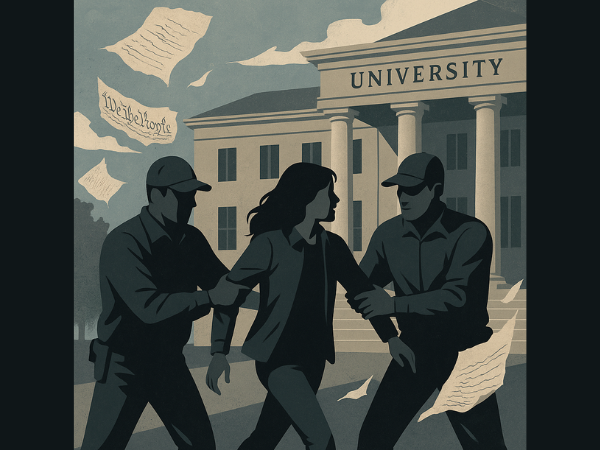
The White House’s admission that it is “actively looking at” suspending habeas corpus came on the same day that the U.S. District Court for Vermont ordered the immediate release of Rümeysa Öztürk, a Tufts University PhD student who was seized on the street near her apartment by masked, plainclothes ICE agents; shoved into an unmarked car; and transported out of state to a detention center pending deportation. Although never charged with a crime, Öztürk was targeted by government officials for co-authoring an op-ed in a student paper a year earlier expressing support for Palestinian civilians during a time of heightened international conflict. The Rutherford Institute joined a coalition of civil liberties organizations (including the Foundation for Individual Rights and Expression (FIRE), the National Coalition Against Censorship, PEN America, Cato Institute, and the First Amendment Lawyers Association) to file an amicus brief in Öztürk v. Trump challenging the legality of Öztürk’s arrest and detention through her petition for a writ of habeas corpus.
“This is not about public safety. This is about silencing dissent. The U.S. government is weaponizing immigration enforcement to punish political dissent,” said constitutional attorney John W. Whitehead, president of The Rutherford Institute and author of Battlefield America: The War on the American People. “If the government can silence, detain, and deport individuals simply for speaking out on political issues, then no one’s speech is truly safe and we’re no longer operating under the Constitution. We’re living under a system of political policing.”
Öztürk, a Turkish national lawfully present in the U.S. on a student visa, is pursuing a doctorate in the Child Study and Human Development program at Tufts University. Unbeknownst to Öztürk, Secretary of State Marco Rubio revoked her visa as part of a campaign by the Trump Administration to retaliate against those who publicly criticize Israel. Öztürk was detained without warning by masked, plainclothes agents on March 25, 2025, and transferred more than 1,500 miles away from her home in Massachusetts to the South Louisiana ICE Processing Center. In its amicus brief challenging Öztürk’s detention as unconstitutional, the legal coalition contends that the government’s actions set a dangerous precedent in which political speech can be treated as evidence of threat, opening the door for officials to selectively punish individuals based on the content and viewpoint of their expression.
The implications reach far beyond Öztürk’s case. Since returning to office, the Trump Administration has increasingly targeted immigrants and legal visa holders for arrest, deportation, or visa revocation based solely on their political expression. In one case, a legal aid attorney had her visa canceled after attending a peaceful protest. In another, a university lecturer was denied re-entry to the U.S. over critical social media posts. Such tactics, the coalition contends, create a sweeping chilling effect for anyone who dares to speak out against government policy.
Ronnie London, Conor Fitzpatrick, Colin McDonell, Will Creeley, and others at FIRE advanced the arguments in the Öztürk v. Trump amicus brief.
The Rutherford Institute, a nonprofit civil liberties organization, defends individuals whose constitutional rights have been threatened or violated and educates the public on a wide spectrum of issues affecting their freedoms.
BURLINGTON, Vt. — Warning that the U.S. government is weaponizing immigration enforcement to punish political dissent, The Rutherford Institute has joined a coalition of civil liberties organizations in challenging the arrest and detention of Rümeysa Öztürk, a Tufts University PhD student whose only alleged offense was expressing support for Palestinian civilians during a time of heightened international conflict.
In a joint amicus brief filed before the U.S. District Court for the District of Vermont in Öztürk v. Trump, the coalition—including the Foundation for Individual Rights and Expression (FIRE), the National Coalition Against Censorship, PEN America, Cato Institute, First Amendment Lawyers Association, and The Rutherford Institute—argues that Öztürk’s arrest by federal agents and the attempt to deport her represent a dangerous abuse of power rooted in viewpoint discrimination and retaliation against protected political speech.
“This is not about public safety. This is about silencing dissent,” said constitutional attorney John W. Whitehead, president of The Rutherford Institute and author of Battlefield America: The War on the American People. “If the government can silence, detain, and deport individuals simply for speaking out on political issues, then no one’s speech is truly safe and we’re no longer operating under a Constitution. We’re living under a system of political policing.”
Öztürk, a Turkish national lawfully present in the U.S. on a student visa, is pursuing a doctorate in the Child Study and Human Development program at Tufts University. She was seized on the street near her apartment on March 25, 2025, by masked, plainclothes agents who grabbed her as she screamed, handcuffed her, and took her away in an unmarked vehicle. Unbeknownst to Öztürk, Secretary of State Marco Rubio had revoked her visa, apparently in response to an op-ed she co-wrote a year earlier in which she criticized her university’s administration for dismissing student government resolutions which aimed to hold Israel accountable for alleged violations of international law in Palestine—views that diverge sharply from the Trump Administration’s. She was detained without warning and transferred more than 1,500 miles away from her home in Massachusetts to the South Louisiana ICE Processing Center.
According to the brief, there are no allegations that Öztürk engaged in violence or illegal activity. The coalition contends that the government’s effort to suppress disfavored political views is flatly prohibited by the Constitution. Moreover, the government’s actions set a dangerous precedent in which political speech can be treated as evidence of threat or disloyalty. This, the coalition warns, opens the door for officials to selectively punish individuals based on the content and viewpoint of their expression. The implications reach far beyond Öztürk’s case. Since returning to office in 2025, the Trump Administration has increasingly targeted immigrants and legal visa holders for arrest, deportation, or visa revocation based solely on their political expression. In one case, a legal aid attorney had her visa canceled after attending a peaceful protest. In another, a university lecturer was denied re-entry to the U.S. over critical social media posts. Such tactics, the coalition contends, create a sweeping chilling effect—not only for immigrants, but for anyone who dares to speak out against government policy.
Ronnie London, Conor Fitzpatrick, Colin McDonell, Will Creeley, and others at FIRE advanced the arguments in the Ozturk v. Trumpamicus brief.
The Rutherford Institute, a nonprofit civil liberties organization, defends individuals whose constitutional rights have been threatened or violated and educates the public on a wide spectrum of issues affecting their freedoms.
“Homegrowns are next. The homegrowns. You gotta build about five more places [like the CECOT prison]. It’s not big enough.”—President Trump on his desire to send American citizens to a megaprison in El Salvador, beyond the reach of U.S. courts and the Constitution
It has begun, just as we predicted, justified in the name of national security.
Mass roundups. Raids. Indefinite detentions in concentration camps. Martial law. The erosion of habeas corpus protections. The suspension of the Constitution, at least for select segments of the population. A hierarchy of rights, contingent on whether you belong to a favored political class.
This is what it looks like when the government makes itself the arbiter of who is deserving of rights and who isn’t.
Here is what we know: one segment of the population at a time, the Trump Administration is systematically and without due process attempting to cleanse the country of what it perceives to be “undesirables” as part of its purported effort to make America great again.
This is how men, women and children are being made to disappear, snatched up off the streets by press-gangs of plainclothes, masked government agents impersonating street thugs.
Presently, these so-called “undesirables” include both undocumented and legal immigrants—many labeled terrorists despite having no criminal record, no court hearing, and no due process—before being extradited to a foreign concentration camp in an effort to sidestep judicial oversight.
By including a handful of known members of a vicious gang among those being rounded up, the government is attempting to whitewash the public into believing that everyone being targeted is, in fact, a terrorist.
In recent years, the government has used the phrase “domestic terrorist” interchangeably with “anti-government,” “extremist” and “terrorist” to describe anyone who might fall somewhere on a very broad spectrum of viewpoints, characteristics and behaviors that could be considered “dangerous.”
Thus, without proof, a sheet metal worker has been labeled a terrorist. A musician has been labeled a terrorist. A makeup artist has been labeled a terrorist. A cellular biologist has been labeled a terrorist. A soccer player has been labeled a terrorist. A food delivery driver has been labeled a terrorist.
It’s only a matter of time before American citizens who refuse to march in lockstep with the government’s dictates are classified as terrorists, denied basic rights, and extradited to a foreign prison.
That time is drawing closer.
Indeed, Trump has repeatedly spoken of his desire to be able to send American citizens—whom he refers to as “homegrowns,” as in homegrown terrorists—on a one-way trip to El Salvador’s mega-prison, where conditions are so brutal that officials brag the only way out is in a coffin. His administration is currently trying to find a way to accomplish that very objective.
We’re not quite there yet, but it’s coming.
What we are witnessing is history repeating itself in real-time: the widening net that ensnares us all. In other words, it’s only a matter of time before anyone who is not fully compliant gets labeled a terrorist.
A prime example of how the government casting its net in ever-widening circles can be seen in the government’s sudden decision to target academics in the U.S. on work and student visas who have been critical of Israel’s war on Gaza, which has killed more than 50,000 people (nearly a third of them under the age of 18), as threats to national security.
Thus, the government is classifying any criticism of Israel as antisemitic and equating it with terrorism.
Under such a broad definition, Jesus himself would be considered antisemitic.
So you can add antisemitic to the list of viewpoints that could have one classified as a terrorist, rounded up by ICE, stripped of the fundamental rights to due process and a day in court, and made to disappear into a detention center.
Mind you, the government isn’t just targeting protest activities and expression that might have crossed over into civil disobedience. It’s also preemptively targeting individuals who have committed no crimes but whose views might at some point in the future run counter to the government’s self-serving interests.
This is precrime taken to a whole new level: targeting thoughts, i.e., thought crime.
The ramifications are so far-reaching as to render almost every American with an opinion about the governmentor who knows someone with an opinion about the government an extremist in word, deed, thought or by association.
As German pastor Martin Niemöller lamented:
“First they came for the socialists, and I did not speak out—because I was not a socialist. Then they came for the trade unionists, and I did not speak out— because I was not a trade unionist. Then they came for the Jews, and I did not speak out—because I was not a Jew. Then they came for me—and there was no one left to speak for me.”
You see how this works?
Let’s not mince words about what’s happening here: under the guise of fighting terrorism, the U.S. government is not just making people disappear—it is making the Constitution disappear.
When rights become privileges, the Constitution—and the rule of law—becomes optional.
The list of individuals and groups being classified as anti-American gets bigger by the day: Immigrants, both legal and undocumented. Immigration attorneys. Judges. Lawyers. Law firms. Doctors. Scientists. Students. Universities. Nonprofits.
Given what we know about the government and its expansive definition of what constitutes a threat to its power, any one of us who dare to speak truth to power could be targeted next as an enemy of the state.
Certainly, it is easy to remain silent in the face of evil.
What is harder—what we lack today and so desperately need—are those with moral courage who will risk their freedoms and lives in order to speak out against evil in its many forms.
Throughout history, individuals or groups of individuals have risen up to challenge the injustices of their age. Nazi Germany had its Dietrich Bonhoeffer. The gulags of the Soviet Union were challenged by Aleksandr Solzhenitsyn. America had its color-coded system of racial segregation and warmongering called out for what it was, blatant discrimination and profiteering, by Martin Luther King Jr.
And then there was Jesus Christ who not only died challenging the police state of his day but provided a blueprint for civil disobedience that would be followed by those, religious and otherwise, who came after him.
Any reflection on Jesus’ life and death within a police state must take into account several factors: Jesus spoke out strongly against such things as empires, controlling people, state violence and power politics. Jesus challenged the political and religious belief systems of his day. And worldly powers feared Jesus, not because he challenged them for control of thrones or government but because he undercut their claims of supremacy, and he dared to speak truth to power in a time when doing so could—and often did—cost a person his life.
It makes you wonder how Jesus—a Palestinian refugee, a radical, and a revolutionary—would have fared in the American police state under a Trump regime.
Would Jesus—who spent his adult life speaking truth to power, challenging the status quo of his day, and pushing back against the abuses of the Roman Empire—have been snatched up in the dead of night, stripped of any real due process, made to disappear into a detention center, and handed a death sentence when he was delivered into a prison where the only way out is in a wooden box?
Consider that the charges leveled against Jesus—that he was a threat to the stability of the nation, opposed paying Roman taxes and claimed to be the rightful King—were purely political, not religious.
Jesus was presented to Pontius Pilate “as a disturber of the political peace,” a leader of a rebellion, a political threat, and most gravely—a claimant to kingship, a “king of the revolutionary type.”
After Jesus was formally condemned by Pilate, he was sentenced to death by crucifixion, “the Roman means of executing criminals convicted of high treason.” The purpose of crucifixion was not so much to kill the criminal, as it was an immensely public statement intended to visually warn all those who would challenge the power of the Roman Empire. Hence, it was reserved solely for the most extreme political crimes: treason, rebellion, sedition, and banditry.
Almost 2,000 years after Jesus was crucified by the police state of his age, we find ourselves confronted by a painful irony: that in the same week commemorating the death and resurrection of Jesus, a Palestinian refugee who was killed by the police state for speaking truth to power, the U.S. government is prosecuting Palestinian refugees who are daring to challenge another modern-day police state’s injustices, while threatening to impose widespread martial law on the country to put down any future rebellions.
President Trump has hinted that he could invoke the Insurrection Act of 1807, which would allow the president to use the military on American soil.
This would in effect be a declaration of martial law.
Trump has already authorized the military to take control of the southern border, which puts parts of the domestic United States under martial law.
As Austin Sarat writes for Salon: “The president alone gets to decide what constitutes an ‘insurrection,’ ‘rebellion,’ or ‘domestic violence.’ And once troops are deployed, it will not be easy to get them off the streets in any place that the president thinks is threatened by ‘radical left lunatics.’”
So where do we go from here?
History offers some clues.
Exactly 250 years ago, on April 19, 1775, the American Revolution began with a “shot heard round the world.” It wasn’t sparked by acts of terrorism or rebellion—it was triggered by a government that had grown deaf to the cries of its people.
What we don’t need is violence in any form—by the people or their government.
WASHINGTON, D.C. — A broad coalition of legal and civil liberties organizations is once again challenging President Trump’s use of executive orders to retaliate against law firms that he perceives as political opponents, suppress opposition and chill lawful First Amendment activity.
The coalition, which includes the ACLU, ACLU of DC, CATO, Electronic Frontier Foundation, FIRE, the Institute for Justice, the Knight First Amendment Institute, the National Coalition Against Censorship, the Reporters Committee for the Freedom of the Press, the Society for the Rule of Law, and The Rutherford Institute, filed two more amicus briefs (Jenner & Block and WilmerHale) asking a federal court to strike down as illegal and unconstitutional the president’s executive orders targeting the law firms of Jenner & Block and WilmerHale. The coalition filed a similar amicus brief in Perkins Coie LLP v. U.S. Department of Justice challenging the president’s executive order as a violation of the separation of powers and an unconstitutional infringement on the rights to free speech, advocacy and due process.
“That President Trump is weaponizing the government in order to wage a war against dissent, against due process, and against the very foundations of our constitutional republic should be a warning to all Americans,” said constitutional attorney John W. Whitehead, president of The Rutherford Institute and author of Battlefield America: The War on the American People. “History shows that when governments claim the power to silence dissent—whether in the name of national security, border protection, or law and order—that power rarely remains limited. These threats against the legal community are just the beginning.”
In an effort to punish a number of major law firms and discourage others from challenging the Trump Administration’s ongoing efforts to sidestep the Constitution, President Trump issued Executive Orders directing the federal government to suspend the firms’ security clearances, cease providing all goods and services, terminate any contracts with the firms and those who do business with them, limit the firms’ access to federal buildings and employees, and refrain from hiring employees of the firms. The intent behind the president’s actions, per former advisor Steve Bannon, is to “put those law firms out of business” in response to the firms using the system of checks and balances to prevent the Administration from violating the Constitution.
Perkins Coie, Jenner & Block and WilmerHale each challenged Trump’s Orders on grounds that they violate the separation of powers and the First, Fifth, and Sixth Amendments. Warning that Trump’s actions constitute a brazen attack on the independence of the legal profession and the judicial branch, the legal coalition’s amicus briefs in support of the law firms argue that Trump’s Executive Orders not only infringe the First Amendment rights to freedom of speech and petitioning the government, but also essentially give the government an unfettered veto over a person’s right to choice of counsel due to the government pushing for a cancel culture and creating a blacklist of firms, similar to what the NRA previously claimed was done to it by a New York state official. Moreover, if the executive orders are allowed to stand, they could set a precedent for future Administrations of either political party to suppress challenges to a president’s unconstitutional policies and actions and to deter lawyers from representing the president’s political opponents or any clients adverse to the Administration.
Cecillia D. Wang, Ben Wizner, Brian Hauss, and Arthur B. Spitzer at ACLU advanced the arguments in the Perkins Coie, Jenner & Block and WilmerHale amicus briefs.
The Rutherford Institute, a nonprofit civil liberties organization, defends individuals whose constitutional rights have been threatened or violated and educates the public on a wide spectrum of issues affecting their freedoms.
You can’t live in a constitutional republic if you allow the government to act like a police state.
You can’t claim to value freedom if you allow the government to operate like a dictatorship.
You can’t expect to have your rights respected if you allow the government to treat whomever it pleases with disrespect and an utter disregard for the rule of law.
There’s always a boomerang effect.
Whatever dangerous practices you allow the government to carry out now—whether it’s in the name of national security or protecting America’s borders or making America great again—rest assured, these same practices can and will be used against you when the government decides to set its sights on you.
The chilling of political speech and suppression of dissident voices are usually among the first signs that you’re in the midst of a hostile takeover by forces that are not friendly to freedom.
This does not seem to be a regime that respects the rights of the people.
Indeed, these ICE agents, who were “just following orders” from on high, showed no concern that the orders they had been given were trumped up, politically motivated and unconstitutional.
If this is indeed the first of many arrests to come, what’s next? Or more to the point, who’s next?
We are all at risk.
History shows that when governments claim the power to silence dissent—whether in the name of national security, border protection, or law and order—that power rarely remains limited. What starts as a crackdown on so-called “threats” quickly expands to include anyone who challenges those in power.
President Trump has made it clear that Mahmoud’s arrest is just “the first arrest of many to come.” He has openly stated his intent to target noncitizens who engage in activities he deems contrary to U.S. interests—an alarmingly vague standard that seems to change at his whim, the First Amendment be damned.
If history is any guide, the next targets will not just be immigrants or foreign-born activists. They will be American citizens who dare to speak out.
If you need further proof of Trump’s disregard for constitutional rights, look no further than his recent declaration that boycotting Tesla is illegal—a chilling statement that reveals his fundamental misunderstanding of both free speech and the rule of law.
What this means is that anyone who dares to disagree with the government and its foreign policy and express that disagreement could be considered a threat to the country’s “national security interests.”
Yet the right to speak out against government wrongdoing is the quintessential freedom.
Indeed, the First Amendment does more than give us a right to criticize our country: it makes it a civic duty. Certainly, if there is one freedom among the many spelled out in the Bill of Rights that is especially patriotic, it is the right to criticize the government.
Unfortunately, the Deep State doesn’t take kindly to individuals who speak truth to power.
This is nothing new, nor is it unique to any particular presidential administration.
Regardless of party, those in power have repeatedly sought to limit free speech. What’s new is the growing willingness to criminalize political dissent under the guise of national security.
Clearly, the government has been undermining our free speech rights for quite a while now, but Trump’s antagonism towards free speech is taking this hostility to new heights.
The government has a history of using crises—real or manufactured—to expand its power.
Once dissent is labeled a threat, it’s only a matter of time before laws meant for so-called extremists are used against ordinary citizens. Criticizing policy, protesting, or even refusing to conform could be enough to put someone on a watchlist.
We’ve seen this before.
The government has a long list of “suspicious” ideologies and behaviors it uses to justify surveillance and suppression. Today’s justification may be immigration; tomorrow, it could be any form of opposition.
This is what we know: the government has the means, the muscle and the motivation to detain individuals who resist its orders and do not comply with its mandates in a vast array of prisons, detention centers, and concentration camps paid for with taxpayer dollars.
It’s just a matter of time.
It no longer matters what the hot-button issue might be (vaccine mandates, immigration, gun rights, abortion, same-sex marriage, healthcare, criticizing the government, protesting election results, etc.) or which party is wielding its power like a hammer.
The groundwork has already been laid.
Under the indefinite detention provision of the National Defense Authorization Act (NDAA), the President and the military can detain and imprison American citizens with no access to friends, family or the courts if the government believes them to be a terrorist.
After all, it doesn’t take much to be considered a terrorist anymore, especially given that the government likes to use the words “anti-government,” “extremist” and “terrorist” interchangeably.
This is what happens when you not only put the power to determine who is a potential danger in the hands of government agencies, the courts and the police but also give those agencies liberal authority to lock individuals up for perceived wrongs.
It’s a system just begging to be abused by power-hungry bureaucrats desperate to retain their power at all costs.
Having allowed the government to expand and exceed our reach, we find ourselves on the losing end of a tug-of-war over control of our country and our lives. And for as long as we let them, government officials will continue to trample on our rights, always justifying their actions as being for the good of the people.
Yet the government can only go as far as “we the people” allow. Therein lies the problem.
This is not just about one administration or one set of policies. This is a broader pattern of governmental overreach that has been allowed to unfold, unchecked and unchallenged. And at the heart of this loss of freedom is a fundamental misunderstanding—or even a deliberate abandonment—of what sovereignty really means in America.
Sovereignty is a dusty, antiquated term that harkens back to an age when kings and emperors ruled with absolute power over a populace that had no rights. Americans turned the idea of sovereignty on its head when they declared their independence from Great Britain and rejected the absolute authority of King George III. In doing so, Americans claimed for themselves the right to self-government and established themselves as the ultimate authority and power.
In other words, as the preamble to the Constitution states, in America, “we the people”—sovereign citizens—call the shots.
So, when the government acts, it is supposed to do so at our bidding and on our behalf, because we are the rulers.
That’s not exactly how it turned out, though, is it?
In the 200-plus years since we boldly embarked on this experiment in self-government, we have been steadily losing ground to the government’s brazen power grabs, foisted upon us in the so-called name of national security.
The government has knocked us off our rightful throne. It has usurped our rightful authority. It has staged the ultimate coup. Its agents no longer even pretend that they answer to “we the people.”
This is how far our republic has fallen and how desensitized “we the people” have become to this constant undermining of our freedoms.
If we are to put an end to this steady slide into totalitarianism, that goose-stepping form of tyranny in which the government has all of the power and “we the people” have none, we must begin by refusing to allow the politics of fear to shackle us to a dictatorship.
President Trump wants us to believe that the menace we face (imaginary or not) is so sinister, so overwhelming, so fearsome that the only way to surmount the danger is by empowering the government to take all necessary steps to quash it, even if that means allowing government jackboots to trample all over the Constitution.
Don’t believe it. That argument has been tried before.
The government’s overblown, extended wars on terrorism, drugs, violence and illegal immigration have all been convenient ruses used to terrorize the populace into relinquishing more of their freedoms in exchange for elusive promises of security.
We are walking a dangerous path right now.
Political arrests. Harassment. Suppression of dissident voices. Retaliation. Detention centers for political prisoners.
These are a harbinger of what’s to come if the Trump administration carries through on its threats to crack down on any and all who exercise their First Amendment rights to free speech and protest.
We are being acclimated to bolder power grabs, acts of lawlessness, and a pattern of intimidation, harassment, and human rights violations by government officials. And yet, in the midst of this relentless erosion of our freedoms, the very concept of sovereignty—the foundational idea that the people, not the government, hold ultimate power—has been all but forgotten.
“Sovereignty” used to mean something fundamental in America: the idea that the government serves at the will of the people, that “we the people” are the rightful rulers of this land, and that no one, not even the president, is above the law. But today, that notion is scarcely discussed, as the government continues its unchecked expansion.
We have lost sight of the fact that our power is meant to restrain the government, not the other way around.
Don’t allow yourselves to be distracted, derailed or desensitized.
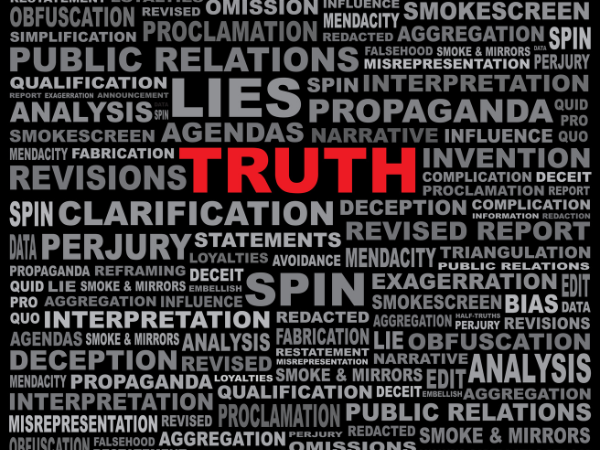
The Deep State’s war on truth is being waged with doubletalk, delusion and propaganda.
Through deliberate manipulation of language—what George Orwell called “doublespeak”—Donald Trump has provided cover for the Deep State’s continued grip on power.
While promising to drain the swamp, his administration has instead relied on contradictory policies, misinformation, and propaganda to further entrench the very system he claims to oppose. Although the Trump administration is merely the latest frontman for the Deep State’s efforts to maintain its stranglehold on power, we are approaching a tipping point beyond which there may be no turning back to freedom as we have known it.
This is how “we the people” remain on the losing end of this devil’s bargain that is life in the American police state.
What we desperately need is a reality check, and that starts by disconnecting from the Deep State’s propaganda-riddled, manipulated alternative reality about the state of our nation.
While President Trump, well versed in the “art of the deal,” appears to be saying all the right things about peace, corruption, graft, wasteful spending, free speech, equality, bloated bureaucracy, national security, etc., his administration’s actions tell a far different story about his priorities and his loyalties, which remain self-serving, imperial, flagrantly unconstitutional and intended to keep the Deep State in power.
As always, actions speak louder than words.
When the Constitution and the Bill of Rights are still missing from the White House’s website, that oversight—or deliberate omission—speaks volumes.
Any government that can’t be bothered to include the Constitution among its priorities, or include it anywhere on its administration’s website, is not a government that can be trusted to abide by the Constitution.
Then again, trust has little to do with it.
The Constitution is a contract between the people and the government. What we have been experiencing over the course of both Republican and Democratic presidencies, is a breach of contract. Where the Trump administration differs from those that have come before it is in its willingness to go rogue in defiance of Congress, the courts and the rule of law.
You don’t wage a “common sense” revolution by discarding the Constitution. That way lies dictatorship.
Remember, how you do something is just as important as why you do it.
So, what’s really going on?
As a populace, we have become so desensitized to political lies, especially Trump’s barrage of lies, that we shrug them off and move on. But in doing so, we act as enablers for what hides beneath those lies.
Make no mistake: the Deep State—the real Deep State, not the decoy version of it that Trump trots out to justify dismantling our constitutional republic—hides behind that rhetoric.
As journalist Shawn McCreesh explains, “In order to remake the government, President Trump and his administration are remaking the language used to describe the government. An entire lexicon of progressive terminology nurtured by the last administration has been squelched. In its place is a new vocabulary, honed by the president and echoed by his many imitators in the capital. It is a vocabulary containing many curious uses of doublespeak.”
The term is derived from George Orwell’s 1984, in which “doublethink” and “Newspeak” are used to manipulate the masses into going along with the government’s agenda.
For example, McCreesh points to “one presidential order titled ‘Ending the Weaponization of the Federal Government’ [that] calls for weaponizing the federal government against itself. Another titled ‘Ending Radical Indoctrination in K-12 Schooling’ demands that ‘patriotic education’ be taught to children… Even as the president signed an executive order titled ‘Restoring Freedom of Speech and Ending Federal Censorship,’ he signed other orders policing language.”
Consider some of Trump’s other uses of alternative facts, misdirection and misnomers to advance the Deep State’s agenda.
Trump’s path to nationalism by way of isolationism is in fact empire building. At the same time that Trump is declaring himself a nationalist, breaking ranks with America’s allies, withdrawing from international accords, and ceding ground to authoritarian regimes such as Russia, he is also declaring his intent to lay claim to foreign lands such as Gaza, Greenland and Canada as part of a global power grab.
Trump’s path to saving money is spending money. At the same time that Trump claims to be shining a spotlight on wasteful spending in the hopes of balancing the budget, he is also as guilty of spending—and wasting—taxpayer dollars at an alarming rate. At the same that he’s empowering Elon Musk’s Department of Government Efficiency to drastically reduce the federal workforce in a bid to save money, he is pushing tax cuts that would add $5-10 trillion to the 10-year deficit. As Reuters reports, DOGE’s savings claims are thus far “unverifiable and its calculations have been riddled with errors and corrections.”
Trump’s path to law and order is allowing the police to act lawlessly. At the same time that the Trump administration is advocating for impose harsher penalties and increased prison sentences, even for nonviolent crimes, Trump is dismantling government policies aimed at holding police accountable for official misconduct.
Trump’s path to efficiency is giving rise to even greater inefficiency. Likening DOGE to a chainsaw hacking away at a bloated bureaucracy, Musk has been wiping out whole segments of the federal workforce, agency by agency, with little thought to what programs might suffer as a result or how to keep the government functioning. As CNN reports, “There have been a lot of reports of federal workers being fired then quickly rehired once agencies realized people with critical skills had been let go…for example: Those managing the US nuclear arsenal, and those working at USDA on the response to the bird flu outbreak.”
Trump’s path to economic triumph is spelling economic disaster. Trump continues to forge ahead with his imposition of tariffs on America’s major trading partners despite warnings from economists and the business sector alike that tariffs will hurt, rather than help, the economy and could lead to a recession and a spike in inflation.
Trump’s path to free speech is censorship. At the same time that Trump claims to be liberating conservative speech from the muzzling power of political correctness, he is embarking on a massive crackdown on lawful First Amendment activities that would criminalize protest activities and punish individuals and groups advocating for policies that contradict White House executive orders.
Trump’s path to transparency is replacing watchdogs with yes-men and loyalists. At the same time that Trump claims to be bringing transparency back to government, his administration is methodically dismantling all of the systemic checks intended to protect whistleblowers and serve as bulwarks against government corruption.
When you set aside the mountain of contradictory policies and propaganda that have become hallmarks of Trump’s time in office, a grim picture emerges: Trump’s efforts to make America great again are really just a variation on one theme, which is keeping the Deep State in power at the expense of our freedoms.
Indeed, George Orwell’s fictional 1984 could increasingly be mistaken for the Trump Administration’s instruction manual on how to remake the government in the dystopian image of Oceania, the authoritarian regime run by Big Brother.
While America’s founders envisioned a separation of powers held in check by three coequal branches of government (executive, legislative and judicial) as the means of thwarting abuse by any one branch, Orwell’s Oceania has four branches of government (the Ministry of Truth, the Ministry of Peace, the Ministry of Love, and the Ministry of Plenty) that work together to maintain Big Brother’s chokehold on power.
As Orwell explains, “The Ministry of Peace concerns itself with war, the Ministry of Truth with lies, the Ministry of Love with torture and the Ministry of Plenty with starvation. These contradictions are not accidental, nor do they result from ordinary hypocrisy: they are deliberate exercises in doublethink.”
According to Orwell, “Doublethink means the power of holding two contradictory beliefs in one’s mind simultaneously, and accepting both of them.”
Thus, the Ministry of Peace is tasked with waging perpetual war in order to keep the government in power. The Ministry of Love is tasked with meting out torture and punishment in order to brainwash the populace into loving Big Brother. The Ministry of Plenty is tasked with maintaining a state of perpetual poverty, scarcity and financial shortages, the rationale being that an impoverished populace is easier to control. And the Ministry of Truth is tasked with disseminating propaganda and rewriting history and language in order to keep the citizens compliant.
The key to this last undertaking, maintaining a chokehold on power, is what Nazi propaganda chief Joseph Goebbels referred to as the “big lie.”
“If you tell a lie big enough and keep repeating it, people will eventually come to believe it,” stated Goebbels. “The lie can be maintained only for such time as the State can shield the people from the political, economic and/or military consequences of the lie. It thus becomes vitally important for the State to use all of its powers to repress dissent, for the truth is the mortal enemy of the lie, and thus by extension, the truth is the greatest enemy of the State.”
Hannah Arendt, writing in The Origins of Totalitarianism, came to the same conclusion:
Pay attention. Question everything. Dare to be different. Don’t follow the mob. Don’t let yourself become numb to the world around you. Be compassionate. Be humane. Most of all, don’t allow yourselves to become so desensitized to Trump’s brand of politics that you tolerate behavior in government officials that you would never tolerate from your own children (lying, bullying, name-calling, greed, etc.).
When all is said and done, Trump’s path to putting America First is really about putting Trump first and leaving Americans in bondage to the Deep State.
In Orwell’s world, the state maintained power through deception.
In Trump’s America, doublespeak remains the Deep State’s most powerful weapon—one that thrives as long as the public fails to recognize it for what it is—and Trump is proving to be its most effective mouthpiece.
“What makes it possible for a totalitarian or any other dictatorship to rule is that people are not informed; how can you have an opinion if you are not informed? If everybody always lies to you, the consequence is not that you believe the lies, but rather that nobody believes anything any longer… And a people that no longer can believe anything cannot make up its mind. It is deprived not only of its capacity to act but also of its capacity to think and to judge. And with such a people you can then do what you please.”—Hannah Arendt
Clinton is not alone in her distaste for unregulated, free speech online.
A bipartisan chorus that includes both presidential candidates Kamala Harris and Donald Trump has long clamored to weaken or do away with Section 230 of the Communications Decency Act, which essentially acts as a bulwark against online censorship.
As Elizabeth Nolan Brown writes for Reason, “What both the right and left attacks on the provision share is a willingness to use whatever excuses resonate—saving children, stopping bias, preventing terrorism, misogyny, and religious intolerance—to ensure more centralized control of online speech. They may couch these in partisan terms that play well with their respective bases, but their aim is essentially the same.”
In other words, the government will use any excuse to suppress dissent and control the narrative.
The internet may well be the final frontier where free speech still flourishes, especially for politically incorrect speech and disinformation, which test the limits of our so-called egalitarian commitment to the First Amendment’s broad-minded principles.
On the internet, falsehoods and lies abound, misdirection and misinformation dominate, and conspiracy theories go viral.
This is to be expected, and the response should be more speech, not less.
Yet to the government, these forms of “disinformation” rank right up there with terrorism, drugs, violence, and disease: societal evils so threatening that “we the people” should be willing to relinquish a little of our freedoms for the sake of national security.
Of course, it never works out that way.
The war on terror, the war on drugs, the war on illegal immigration, the war on COVID-19: all of these programs started out as legitimate responses to pressing concerns only to become weapons of compliance and control in the government’s hands.
Indeed, in the face of the government’s own authoritarian power-grabs, coverups, and conspiracies, a relatively unfettered internet may be our sole hope of speaking truth to power.
The right to criticize the government and speak out against government wrongdoing is the quintessential freedom.
You see, disinformation isn’t the problem. Government coverups and censorship are the problem.
Unfortunately, the government has become increasingly intolerant of speech that challenges its power, reveals its corruption, exposes its lies, and encourages the citizenry to push back against the government’s many injustices. Every day in this country, those who dare to speak their truth to the powers-that-be find themselves censored, silenced or fired.
While there are all kinds of labels being put on so-called “unacceptable” speech today, the real message being conveyed by those in power is that Americans don’t have a right to express themselves if what they are saying is unpopular, controversial or at odds with what the government determines to be acceptable.
Where the problem arises is when you put the power to determine who is a potential danger in the hands of government agencies, the courts and the police.
Remember, this is the same government that uses the words “anti-government,” “extremist” and “terrorist” interchangeably.
This is the same government whose agents are spinning a sticky spider-web of threat assessments, behavioral sensing warnings, flagged “words,” and “suspicious” activity reports using automated eyes and ears, social media, behavior sensing software, and citizen spies to identify potential threats.
This is the same government that keeps re-upping the National Defense Authorization Act (NDAA), which allows the military to detain American citizens with no access to friends, family or the courts if the government believes them to be a threat.
This is the same government that has a growing list—shared with fusion centers and law enforcement agencies—of ideologies, behaviors, affiliations and other characteristics that could flag someone as suspicious and result in their being labeled potential enemies of the state.
For instance, if you believe in and exercise your rights under the Constitution (namely, your right to speak freely, worship freely, associate with like-minded individuals who share your political views, criticize the government, own a weapon, demand a warrant before being questioned or searched, or any other activity viewed as potentially anti-government, racist, bigoted, anarchic or sovereign), you could be at the top of the government’s terrorism watch list.
Thus, no matter how well-meaning the politicians make these encroachments on our rights appear, in the right (or wrong) hands, benevolent plans can easily be put to malevolent purposes.
Even the most well-intentioned government law or program can be—and has been—perverted, corrupted and used to advance illegitimate purposes once profit and power are added to the equation. For instance, the very same mass surveillance technologies that were supposedly so necessary to fight the spread of COVID-19 are now being used to stifle dissent, persecute activists, harass marginalized communities, and link people’s health information to other surveillance and law enforcement tools.
We are moving fast down that slippery slope to an authoritarian society in which the only opinions, ideas and speech expressed are the ones permitted by the government and its corporate cohorts.
The next phase of the government’s war on anti-government speech and so-called thought crimes could well be mental health round-ups and involuntary detentions.
Under the guise of public health and safety, the government could use mental health care as a pretext for targeting and locking up dissidents, activists and anyone unfortunate enough to be placed on a government watch list.
In New York City, for example, you could find yourself forcibly hospitalized for suspected mental illness if you carry “firmly held beliefs not congruent with cultural ideas,” exhibit a “willingness to engage in meaningful discussion,” have “excessive fears of specific stimuli,” or refuse “voluntary treatment recommendations.”
While these programs are ostensibly aimed at getting the homeless off the streets, when combined with advances in mass surveillance technologies, artificial intelligence-powered programs that can track people by their biometrics and behavior, mental health sensor data (tracked by wearable data and monitored by government agencies such as HARPA), threat assessments, behavioral sensing warnings, precrime initiatives, red flag gun laws, and mental health first-aid programs aimed at training gatekeepers to identify who might pose a threat to public safety, they could well signal a tipping point in the government’s efforts to penalize those engaging in so-called “thought crimes.”
As the Associated Press reports, federal officials are already looking into how to add “‘identifiable patient data,’ such as mental health, substance use and behavioral health information from group homes, shelters, jails, detox facilities and schools,” to its surveillance toolkit.
Make no mistake: these are the building blocks for an American gulag no less sinister than that of the gulags of the Cold War-era Soviet Union.
The word “gulag” refers to a labor or concentration camp where prisoners (oftentimes political prisoners or so-called “enemies of the state,” real or imagined) were imprisoned as punishment for their crimes against the state.
This age-old practice by which despotic regimes eliminate their critics or potential adversaries by making them disappear—or forcing them to flee—or exiling them literally or figuratively or virtually from their fellow citizens—is happening with increasing frequency in America.
Now, through the use of red flag laws, behavioral threat assessments, and pre-crime policing prevention programs, the groundwork is being laid that would allow the government to weaponize the label of mental illness as a means of exiling those whistleblowers, dissidents and freedom fighters who refuse to march in lockstep with its dictates.
Each state has its own set of civil, or involuntary, commitment laws. These laws are extensions of two legal principles: parens patriae Parens patriae (Latin for “parent of the country”), which allows the government to intervene on behalf of citizens who cannot act in their own best interest, and police power, which requires a state to protect the interests of its citizens.
The fusion of these two principles, coupled with a shift towards a dangerousness standard, has resulted in a Nanny State mindset carried out with the militant force of the Police State.
The problem, of course, is that the diagnosis of mental illness, while a legitimate concern for some Americans, has over time become a convenient means by which the government and its corporate partners can penalize certain “unacceptable” social behaviors.
In fact, in recent years, we have witnessed the pathologizing of individuals who resist authority as suffering from oppositional defiant disorder (ODD), defined as “a pattern of disobedient, hostile, and defiant behavior toward authority figures.”
Under such a definition, every activist of note throughout our history—from Mahatma Gandhi to Martin Luther King Jr. to John Lennon—could be classified as suffering from an ODD mental disorder.
Of course, this is all part of a larger trend in American governance whereby dissent is criminalized and pathologized, and dissenters are censored, silenced, declared unfit for society, labelled dangerous or extremist, or turned into outcasts and exiled.
“Internet platforms have a powerful incentive to please important federal officials, and the record in this case shows that high-ranking officials skillfully exploited Facebook’s vulnerability… Not surprisingly these efforts bore fruit. Facebook adopted new rules that better conformed to the officials’ wishes, and many users who expressed disapproved views about the pandemic or COVID–19 vaccines were ‘deplatformed’ or otherwise injured.”—Justice Samuel Alito, dissenting in Murthy v. Missouri
Zuckerberg’s confession comes in the wake of a series of court rulings that turn a blind eye to the government’s technofascism.
In a 2-1 decision in Children’s Health Defense v. Meta, the Ninth Circuit Court of Appeals dismissed a lawsuit brought by Children’s Health Defense against Meta Platforms for restricting CHD’s posts, fundraising, and advertising on Facebook following communications between Meta and federal government officials.
In a unanimous decision in the combined cases of NetChoice v. Paxton and Moody v. NetChoice, the U.S. Supreme Court avoided ruling on whether the states could pass laws to prohibit censorship by Big Tech companies on social media platforms such as Facebook, TikTok, and YouTube.
And in a 6-3 ruling in Murthy v. Missouri , the Supreme Court sidestepped a challenge to the federal government’s efforts to coerce social media companies into censoring users’ First Amendment expression.
Welcome to the age of technocensorship.
On paper—under the First Amendment, at least—we are technically free to speak.
In reality, however, we are now only as free to speak as a government official—or corporate entities such as Facebook, Google or YouTube—may allow.
By “censor,” we’re referring to concerted efforts by the government to muzzle, silence and altogether eradicate any speech that runs afoul of the government’s own approved narrative.
This is political correctness taken to its most chilling and oppressive extreme.
Clothed in tyrannical self-righteousness, technofascism is powered by technological behemoths (both corporate and governmental) working in tandem to achieve a common goal.
The government is not protecting us from “dangerous” disinformation campaigns. It is laying the groundwork to insulate us from “dangerous” ideas that might cause us to think for ourselves and, in so doing, challenge the power elite’s stranglehold over our lives.
Thus far, the tech giants have been able to sidestep the First Amendment by virtue of their non-governmental status, but it’s a dubious distinction at best when they are marching in lockstep with the government’s dictates.
Nothing good can come from allowing the government to sidestep the Constitution.
The steady, pervasive censorship creep that is being inflicted on us by corporate tech giants with the blessing of the powers-that-be threatens to bring about a restructuring of reality straight out of Orwell’s 1984, where the Ministry of Truth polices speech and ensures that facts conform to whatever version of reality the government propagandists embrace.
Orwell intended 1984 as a warning. Instead, it is being used as a dystopian instruction manual for socially engineering a populace that is compliant, conformist and obedient to Big Brother.
In a world increasingly automated and filtered through the lens of artificial intelligence, we are finding ourselves at the mercy of inflexible algorithms that dictate the boundaries of our liberties.
Eventually, depending on how the government and its corporate allies define what constitutes “extremism, “we the people” might all be considered guilty of some thought crime or other.
Whatever we tolerate now—whatever we turn a blind eye to—whatever we rationalize when it is inflicted on others, whether in the name of securing racial justice or defending democracy or combatting fascism, will eventually come back to imprison us, one and all.
Watch and learn.
We should all be alarmed when any individual or group—prominent or not—is censored, silenced and made to disappear from Facebook, Twitter, YouTube and Instagram for voicing ideas that are deemed politically incorrect, hateful, dangerous or conspiratorial.
Given what we know about the government’s tendency to define its own reality and attach its own labels to behavior and speech that challenges its authority, this should be cause for alarm across the entire political spectrum.
Here’s the point: you don’t have to like or agree with anyone who has been muzzled or made to disappear online because of their views, but to ignore the long-term ramifications of such censorship is dangerously naïve, because whatever powers you allow the government and its corporate operatives to claim now will eventually be used against you by tyrants of your own making.
The glaring fallacy that always lies at the heart of pro-censorship sentiments is the gullible, delusional belief that censorship powers will be deployed only to suppress views one dislikes, but never one’s own views… Facebook is not some benevolent, kind, compassionate parent or a subversive, radical actor who is going to police our discourse in order to protect the weak and marginalized or serve as a noble check on mischief by the powerful. They are almost always going to do exactly the opposite: protect the powerful from those who seek to undermine elite institutions and reject their orthodoxies. Tech giants, like all corporations, are required by law to have one overriding objective: maximizing shareholder value. They are always going to use their power to appease those they perceive wield the greatest political and economic power.
Be warned: it’s a slippery slope from censoring so-called illegitimate ideas to silencing truth.
Eventually, as Orwell predicted, telling the truth will become a revolutionary act.
If the government can control speech, it can control thought and, in turn, it can control the minds of the citizenry.
With every passing day, we’re being moved further down the road towards a totalitarian society characterized by government censorship, violence, corruption, hypocrisy and intolerance, all packaged for our supposed benefit in the Orwellian doublespeak of national security, tolerance and so-called “government speech.”
What we are witnessing is the modern-day equivalent of book burning which involves doing away with dangerous ideas—legitimate or not—and the people who espouse them.
Seventy-plus years after Ray Bradbury’s novel Fahrenheit 451 depicted a fictional world in which books are burned in order to suppress dissenting ideas, while televised entertainment is used to anesthetize the populace and render them easily pacified, distracted and controlled, we find ourselves navigating an eerily similar reality.
The First Amendment assures us of a right to free speech.
It does not, unfortunately, explicitly assure us of a right to not be lied to by our government and its various officials. Any hope of holding government officials accountable for their lies rests with the political process, in the voting booths and through the impeachment process, which themselves have become so ineffective as to offer little real hope of transparency, accountability or reform.
We have been lied to so much, for so long, and on every subject, by government officials of every stripe that political lies have become our norm. It says something about the sorry state of our nation and the low bar we have set for those we elect to represent us.
However, although there are few consequences for government officials who lie to the public, the Deep State continues to wage war on those who challenge its lies, half-truths and obfuscations.
The Deep State has embarked on a ruthless, take-no-prisoners, all-out assault on truth-tellers.
Activists, journalists and whistleblowers alike continue to be terrorized, traumatized, tortured and subjected to the fear-inducing, mind-altering, soul-destroying, smash-your-face-in tactics employed by the superpowers-that-be.
In an age of prosecutions for thought crimes, pre-crime deterrence programs, and government agencies that operate like organized crime syndicates, this is a new kind of tyranny being imposed on those who dare to expose the crimes of the Deep State, whose reach has gone global.
What happened to Assange was intended to send a message to anyone who dares to speak truth to power: don’t even consider it.
Included among the leaked Manning material were the Collateral Murder video (April 2010), the Afghanistan war logs (July 2010), the Iraq war logs (October 2010), a quarter of a million diplomatic cables (November 2010), and the Guantánamo files (April 2011).
The Collateral Murder leak included gunsight video footage from two U.S. AH-64 Apache helicopters engaged in a series of air-to-ground attacks while air crew laughed at some of the casualties. Among the casualties were two Reuters correspondents who were gunned down after their cameras were mistaken for weapons and a driver who stopped to help one of the journalists. The driver’s two children, who happened to be in the van at the time it was fired upon by U.S. forces, suffered serious injuries.
This is morally wrong.
It shouldn’t matter which nation is responsible for these atrocities: there is no defense for such evil perpetrated in the name of profit margins and war profiteering.
In true Orwellian fashion, however, the government would have us believe that it is Assange and Manning who are the real criminals for daring to expose the war machine’s seedy underbelly.
Federal judge Anthony J. Trenga of the Eastern District of Virginia also fined Manning $500 for every day she remained in custody after 30 days, and $1,000 for every day she remained in custody after 60 days, a chilling—and financially crippling—example of the government’s heavy-handed efforts to weaponize fines and jail terms as a means of forcing dissidents to fall in line.
This is how the police state deals with those who challenge its chokehold on power.
Make no mistake: the government is waging war on journalists and whistleblowers for disclosing information relating to government misconduct that is within the public’s right to know.
Yet while this targeted campaign—aided, abetted and advanced by the Deep State’s international alliances—unfolded during President Trump’s watch, it began with the Obama Administration’s decision to revive the antiquated, hundred-year-old Espionage Act, which was intended to punish government spies, and instead use it to prosecute government whistleblowers.
Unfortunately, the Trump Administration not only continued the Obama Administration’s attack on whistleblowers. It injected this war on truth-tellers and truth-seekers with steroids and let it loose on the First Amendment.
In May 2019, Trump’s Justice Department issued a sweeping new “superseding” secret indictment of Assange—hinged on the Espionage Act—that empowered the government to determine what counts as legitimate journalism and criminalize the rest, not to mention giving “the government license to criminally punish journalists it does not like, based on antipathy, vague standards, and subjective judgments.”
Noting that the indictment signaled grave dangers for freedom of the press in general, media lawyer Theodore J. Boutrous, Jr., warned, “The indictment would criminalize the encouragement of leaks of newsworthy classified information, criminalize the acceptance of such information, and criminalize publication of it.”
Boutrous continues:
“[I]t doesn’t matter whether you think Assange is a journalist, or whether WikiLeaks is a news organization. The theory that animates the indictment targets the very essence of journalistic activity: the gathering and dissemination of information that the government wants to keep secret. You don’t have to like Assange or endorse what he and WikiLeaks have done over the years to recognize that this indictment sets an ominous precedent and threatens basic First Amendment values…. With only modest tweaking, the very same theory could be invoked to prosecute journalists for the very same crimes being alleged against Assange, simply for doing their jobs of scrutinizing the government and reporting the news to the American people.”
We desperately need greater scrutiny and transparency, not less.
Indeed, transparency is one of those things the shadow government fears the most.
Why? Because it might arouse the distracted American populace to actually exercise their rights and resist the tyranny that is inexorably asphyxiating their freedoms.
This need to shed light on government actions—to make the obscure, least transparent reaches of government accessible and accountable—was a common theme for Supreme Court Justice Louis Brandeis, who famously coined the phrase, “Sunlight is the best disinfectant.”
“Light is the only thing that can sweeten our political atmosphere—light thrown upon every detail of administration in the departments; light diffused through every policy; light blazed full upon every feature of legislation; light that can penetrate every recess or corner in which any intrigue might hide; light that will open up to view the innermost chambers of government, drive away all darkness from the treasury vaults; illuminate foreign correspondence; explore national dockyards; search out the obscurities of Indian affairs; display the workings of justice; exhibit the management of the army; play upon the sails of the navy; and follow the distribution of the mails.”
Of course, transparency is futile without a populace that is informed, engaged and prepared to hold the government accountable to abiding by the rule of law.
After all, we’re citizens, not subjects. For those who don’t fully understand the distinction between the two and why transparency is so vital to a healthy constitutional government, Manning explains it well:
Manning goes on to suggest that the U.S. “needs legislation to protect the public’s right to free speech and a free press, to protect it from the actions of the executive branch and to promote the integrity and transparency of the US government.”
Technically, we’ve already got such legislation on the books: the First Amendment.
The First Amendment gives the citizenry the right to speak freely, protest peacefully, expose government wrongdoing, and criticize the government without fear of arrest, isolation or any of the other punishments that have been meted out to whistleblowers such as Edwards Snowden, Assange and Manning.
The challenge is holding the government accountable to obeying the law.
More than 50 years ago, the U.S. Supreme Court ruled 6-3 in United States v. Washington Post Co. to block the Nixon Administration’s attempts to use claims of national security to prevent The Washington Post and The New York Times from publishing secret Pentagon papers on how America went to war in Vietnam.
As Justice William O. Douglas remarked on the ruling, “The press was protected so that it could bare the secrets of government and inform the people. Only a free and unrestrained press can effectively expose deception in government. And paramount among the responsibilities of a free press is the duty to prevent any part of the government from deceiving the people and sending them off to distant lands to die of foreign fevers and foreign shot and shell.”
More than 50 years later, the people’s right to know about government misconduct continues to be pitted against the might of the Deep State.
Yet this isn’t merely about whether whistleblowers and journalists are part of a protected class under the Constitution. It’s a debate over how long “we the people” will remain a protected class under the Constitution.
Following the current downward trajectory, it won’t be long before anyone who believes in holding the government accountable is labeled an “extremist,” is relegated to an underclass that doesn’t fit in, must be watched all the time, and is rounded up when the government deems it necessary.
Eventually, we will all be potential suspects, terrorists and lawbreakers in the eyes of the government.
All of us are in danger.
Partisan politics have no place in this debate: Americans of all stripes would do well to remember that those who question the motives of government provide a necessary counterpoint to those who would blindly follow where politicians choose to lead.
We don’t have to agree with every criticism of the government, but we must defend the rights of all individuals to speak freely without fear of punishment or threat of banishment.
Never forget: what the architects of the police state want are submissive, compliant, cooperative, obedient, meek citizens who don’t talk back, don’t challenge government authority, don’t speak out against government misconduct, and don’t step out of line.
What the First Amendment protects—and a healthy constitutional republic requires—are individuals such as Julian Assange who routinely exercise their right to speak truth to power.
If America’s schools are to impart principles of freedom and democracy to future generations, they must start by respecting the constitutional rights of their students
Take the case of Lucas Hudson.
With all the negative press being written about today’s young people, it’s refreshing to meet a young person who not only knows his rights but is prepared to stand up for them.
Lucas is a smart kid, a valedictorian of his graduating class at the Collegiate Academy at Armwood High School in Hillsborough County, Fla.
So, when school officials gave Lucas an ultimatum: either remove most of his speech’s religious references from his graduation speech—in which he thanked the people who helped shape his character, reflected on how quickly time goes by, and urged people to use whatever time they have to love others and serve the God who loves us—or he would not be speaking at all, Lucas refused to forfeit his rights.
In coming to Lucas’ defense, attorneys for The Rutherford Institute warned school officials that their attempts to browbeat Lucas into watering down his graduation speech could expose the school to a First Amendment lawsuit.
Thankfully for Lucas, the school backed down, and he was able to deliver his speech as written.
It doesn’t always work out so well, unfortunately.
Over the course of The Rutherford Institute’s 42-year history, we have defended countless young people who found themselves censored, silenced and denied their basic First Amendment rights, especially when they chose to exercise their rights to free speech and religious freedom.
In case after case, we encounter an appalling level of ignorance on the part of public school officials who mistakenly believe that the law requires anything religious be banned from public schools.
Here’s where government officials get it wrong: while the government may not establish or compel a particular religion, it also may not silence and suppress religious speech merely because others might take offense.
People are free to ignore, disagree with, or counter the religious speech of others, but the government cannot censor private religious speech.
Unfortunately, you can only defend your rights when you know them, and the American people—and those who represent them—are utterly ignorant about their freedoms, history, and how the government is supposed to operate.
As Morris Berman points out in his book Dark Ages America, “70 percent of American adults cannot name their senators or congressmen; more than half don’t know the actual number of senators, and nearly a quarter cannot name a single right guaranteed by the First Amendment. Sixty-three percent cannot name the three branches of government. Other studies reveal that uninformed or undecided voters often vote for the candidate whose name and packaging (e.g., logo) are the most powerful; color is apparently a major factor in their decision.”
More than government corruption and ineptitude, police brutality, terrorism, gun violence, drugs, illegal immigration or any other so-called “danger” that threatens our nation, civic illiteracy may be what finally pushes us over the edge.
As Thomas Jefferson warned, no nation can be both ignorant and free.
Unfortunately, the American people have existed in a technology-laden, entertainment-fueled, perpetual state of cluelessness for so long that civic illiteracy has become the new normal for the citizenry.
Not even the government bureaucrats who are supposed to represent us know much about civics, American history and geography, or the Constitution although they take an oath to uphold, support and defend the Constitution against “enemies foreign and domestic.”
Those who gave us the Constitution and the Bill of Rights believed that the government exists at the behest of its citizens. The government’s purpose is to protect, defend and even enhance our freedoms, not violate them.
It was no idle happenstance that the Constitution opens with these three powerful words: “We the people.”
Those who founded this country knew quite well that every citizen must remain vigilant or freedom would be lost. As Thomas Paine recognized, “It is the responsibility of the patriot to protect his country from its government.”
You have no rights unless you exercise them.
Still, you can’t exercise your rights unless you know what those rights are.
“If Americans do not understand the Constitution and the institutions and processes through which we are governed, we cannot rationally evaluate important legislation and the efforts of our elected officials, nor can we preserve the national unity necessary to meaningfully confront the multiple problems we face today,” warns the Brennan Center in its Civic Literacy Report Card. “Rather, every act of government will be measured only by its individual value or cost, without concern for its larger impact. More and more we will ‘want what we want, and [will be] convinced that the system that is stopping us is wrong, flawed, broken or outmoded.’”
Education precedes action.
As the Brennan Center concludes “America, unlike most of the world’s nations, is not a country defined by blood or belief. America is an idea, or a set of ideas, about freedom and opportunity. It is these ideas that bind us together as Americans and have kept us free, strong, and prosperous. But these ideas do not perpetuate themselves. They must be taught and learned anew with each generation.”
Lucas Hudson would have passed such a test with flying colors.
On graduation day, Lucas stepped up to the podium and delivered his uncensored valedictorian speech as written, without any interference by school censors.
As Lucas’s father relayed to The Rutherford Institute:
“In the end, Lucas got to give his entire speech the way he wanted to give it, and everybody was paying attention. Nobody got hurt. Nothing bad happened. It was just a young man using the First Amendment rights to speak his mind regarding his personal beliefs. [Lucas] never thought a few sentences in a speech would create such a controversy in his world, but this speech turned into a defining moment for him. He will never be the same after this experience, but this permanent change is a good thing. When it mattered, Lucas stood up for himself, and when those he stood up against tried to push him down, [The Rutherford Institute] came to his aide and backed him up to make it a fair fight. I am comforted to know you are defending the rights of the people. These fights matter. Every time you defend the rights of one person, you defend the rights of every person. You helped my son fight for his rights against the school, and, in doing so, Hillsborough County Public Schools will think twice before infringing on the rights of future students. Your defense of Lucas became an inspiration for the students in his school and sparked a healthy and meaningful debate among the teachers, students, and parents about the value of the First Amendment and the need for limits on government control over our personal beliefs. You are fighting for good and doing important work. Don’t ever stop. Thank you, Rutherford Institute, for being there for my son when he needed you most.”
America needs more freedom fighters like Lucas Hudson and The Rutherford Institute.
It’s up to us.
We have the power to make and break the government.
We the American people—the citizenry—are the arbiters and ultimate guardians of America’s welfare, defense, liberty, laws and prosperity.
We must act—and act responsibly.
A healthy, representative government is hard work. It takes a citizenry that is informed about the issues, educated about how the government operates, and willing to make the sacrifices necessary to stay involved.





 John W. Whitehead, Constitutional Attorney