


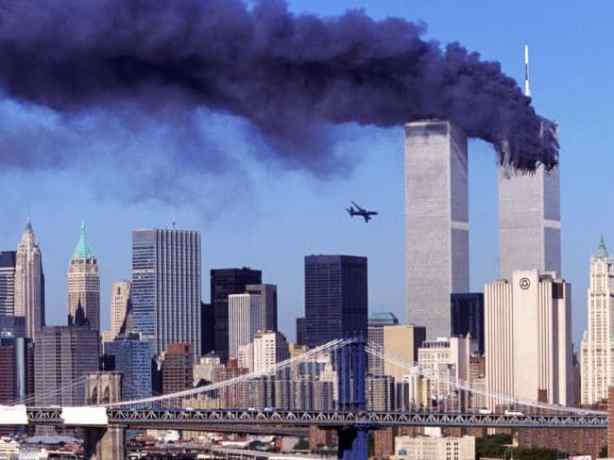
“No one ever seizes power with the intention of relinquishing it. Power is not a means; it is an end.”—George Orwell
You can map the nearly 20-year journey from the 9/11 attacks to the COVID-19 pandemic by the freedoms we’ve lost along the way.
The road we have been traveling has been littered with the wreckage of our once-vaunted liberties, especially those enshrined in the Fourth Amendment.
The assaults on our freedoms that began with the post-9/11 passage of the USA Patriot Act laid the groundwork for the eradication of every vital constitutional safeguard against government overreach, corruption and abuse.
The COVID-19 pandemic with its lockdowns, mask mandates, surveillance, snitch lines for Americans to report their fellow citizens for engaging in risky behavior, and veiled threats of forced vaccinations has merely provided the architects of the American police state with an opportunity to flex their muscles.
These have become mile markers on the road to tyranny.
Free speech, the right to protest, the right to challenge government wrongdoing, due process, a presumption of innocence, the right to self-defense, accountability and transparency in government, privacy, press, sovereignty, assembly, bodily integrity, representative government: all of these and more have become casualties in the government’s ongoing war on the American people. In the process, the American people have been treated like enemy combatants, to be spied on, tracked, scanned, frisked, searched, subjected to all manner of intrusions, intimidated, invaded, raided, manhandled, censored, silenced, shot at, locked up, denied due process, and killed.
What the past 20 years have proven is that the U.S. government poses a greater threat to our individual and collective freedoms and national security than any terrorist, foreign threat or pandemic.
In allowing ourselves to be distracted by terror drills, foreign wars, color-coded warnings, partisan politics, pandemic scares, and other carefully constructed exercises in propaganda, sleight of hand, and obfuscation, we failed to recognize that the U.S. government—the government that was supposed to be a “government of the people, by the people, for the people”—has become the enemy of the people.
Indeed, the U.S. government has grown so corrupt, greedy, power-hungry and tyrannical over the course of the past 240-plus years that our constitutional republic has since given way to an idiocracy, and representative government has given way to a kleptocracy (a government ruled by thieves) and a kakistocracy (a government run by unprincipled career politicians, corporations and thieves that panders to the worst vices in our nature and has little regard for the rights of American citizens).
Although the Bill of Rights—the first ten amendments to the Constitution—was adopted as a means of protecting the people against government tyranny, in America today, the government does whatever it wants, freedom be damned.
“We the people” have been terrorized, traumatized, and tricked into a semi-permanent state of compliance by a government that cares nothing for our lives or our liberties.
The bogeyman’s names and faces have changed over time (terrorism, the war on drugs, illegal immigration, a viral pandemic), but the end result remains the same: in the so-called name of national security, the Constitution has been steadily chipped away at, undermined, eroded, whittled down, and generally discarded with the support of Congress, the White House, and the courts.
What we are left with today is but a shadow of the robust document adopted more than two centuries ago. Sadly, most of the damage has been inflicted upon the Bill of Rights.
Here is what it means to live under the Constitution, post-9/11 and in the midst of a COVID-19 pandemic.
The First Amendment is supposed to protect the freedom to speak your mind, assemble and protest nonviolently without being bridled by the government. It also protects the freedom of the media, as well as the right to worship and pray without interference. In other words, Americans should not be silenced by the government. To the founders, all of America was a free speech zone.
Despite the clear protections found in the First Amendment, the freedoms described therein are under constant assault. Increasingly, Americans are being arrested and charged with bogus “contempt of cop” charges such as “disrupting the peace” or “resisting arrest” for daring to film police officers engaged in harassment or abusive practices. Journalists are being prosecuted for reporting on whistleblowers. States are passing legislation to muzzle reporting on cruel and abusive corporate practices. Religious ministries are being fined for attempting to feed and house the homeless. Protesters are being tear-gassed, beaten, arrested and forced into “free speech zones.” And under the guise of “government speech,” the courts have reasoned that the government can discriminate freely against any First Amendment activity that takes place within a government forum.
The Second Amendment was intended to guarantee “the right of the people to keep and bear arms.” Essentially, this amendment was intended to give the citizenry the means to resist tyrannical government. Yet while gun ownership has been recognized by the U.S. Supreme Court as an individual citizen right, Americans remain powerless to defend themselves against SWAT team raids and government agents armed to the teeth with military weapons better suited to the battlefield. As such, this amendment has been rendered null and void.
The Third Amendment reinforces the principle that civilian-elected officials are superior to the military by prohibiting the military from entering any citizen’s home without “the consent of the owner.” With the police increasingly training like the military, acting like the military, and posing as military forces—complete with heavily armed SWAT teams, military weapons, assault vehicles, etc.—it is clear that we now have what the founders feared most—a standing army on American soil.
The Fourth Amendment prohibits government agents from conducting surveillance on you or touching you or invading you, unless they have some evidence that you’re up to something criminal. In other words, the Fourth Amendment ensures privacy and bodily integrity. Unfortunately, the Fourth Amendment has suffered the greatest damage in recent years and has been all but eviscerated by an unwarranted expansion of police powers that include strip searches and even anal and vaginal searches of citizens, surveillance (corporate and otherwise) and intrusions justified in the name of fighting terrorism, as well as the outsourcing of otherwise illegal activities to private contractors.
The Fifth Amendment and the Sixth Amendment work in tandem. These amendments supposedly ensure that you are innocent until proven guilty, and government authorities cannot deprive you of your life, your liberty or your property without the right to an attorney and a fair trial before a civilian judge. However, in the new suspect society in which we live, where surveillance is the norm, these fundamental principles have been upended. Certainly, if the government can arbitrarily freeze, seize or lay claim to your property (money, land or possessions) under government asset forfeiture schemes, you have no true rights.
The Seventh Amendment guarantees citizens the right to a jury trial. Yet when the populace has no idea of what’s in the Constitution—civic education has virtually disappeared from most school curriculums—that inevitably translates to an ignorant jury incapable of distinguishing justice and the law from their own preconceived notions and fears. However, as a growing number of citizens are coming to realize, the power of the jury to nullify the government’s actions—and thereby help balance the scales of justice—is not to be underestimated. Jury nullification reminds the government that “we the people” retain the power to ultimately determine what laws are just.
The Eighth Amendment is similar to the Sixth in that it is supposed to protect the rights of the accused and forbid the use of cruel and unusual punishment. However, the Supreme Court’s determination that what constitutes “cruel and unusual” should be dependent on the “evolving standards of decency that mark the progress of a maturing society” leaves us with little protection in the face of a society lacking in morals altogether.
The Ninth Amendment provides that other rights not enumerated in the Constitution are nonetheless retained by the people. Popular sovereignty—the belief that the power to govern flows upward from the people rather than downward from the rulers—is clearly evident in this amendment. However, it has since been turned on its head by a centralized federal government that sees itself as supreme and which continues to pass more and more laws that restrict our freedoms under the pretext that it has an “important government interest” in doing so.
As for the Tenth Amendment’s reminder that the people and the states retain every authority that is not otherwise mentioned in the Constitution, that assurance of a system of government in which power is divided among local, state and national entities has long since been rendered moot by the centralized Washington, DC, power elite—the president, Congress and the courts.
If there is any sense to be made from this recitation of freedoms lost, it is simply this: our individual freedoms have been eviscerated so that the government’s powers could be expanded.
Mind you, by “government,” I’m not referring to the highly partisan, two-party bureaucracy of the Republicans and Democrats. Rather, I’m referring to the Deep State—the corporatized, militarized, entrenched bureaucracy that has set itself beyond the reach of the law and is unaffected by elections, unaltered by populist movements, and staffed by unelected officials who are, in essence, running the country and calling the shots in Washington DC, no matter who sits in the White House.
This is a government that, in conjunction with its corporate partners, views the citizenry as consumers and bits of data to be bought, sold and traded.
This is a government that spies on and treats its citizens as if they have no right to privacy, especially in their own homes.
This is a government that is laying the groundwork to weaponize the public’s biomedical data as a convenient means by which to penalize certain “unacceptable” social behaviors.
This is a government that subjects its people to scans, searches, pat downs and other indignities by the TSA and VIPR raids on so-called “soft” targets like shopping malls and bus depots by black-clad, Darth Vader look-alikes.
This is a government that uses fusion centers, which represent the combined surveillance efforts of federal, state and local law enforcement, to track the citizenry’s movements, record their conversations, and catalogue their transactions.
This is a government whose wall-to-wall surveillance has given rise to a suspect society in which the burden of proof has been reversed such that Americans are now assumed guilty until or unless they can prove their innocence.
This is a government that treats its people like second-class citizens who have no rights, and is working overtime to stigmatize and dehumanize any and all who do not fit with the government’s plans for this country.
This is a government that uses free speech zones, roving bubble zones and trespass laws to silence, censor and marginalize Americans and restrict their First Amendment right to speak truth to power. The kinds of speech the government considers dangerous enough to red flag and subject to censorship, surveillance, investigation, prosecution and outright elimination include: hate speech, bullying speech, intolerant speech, conspiratorial speech, treasonous speech, threatening speech, incendiary speech, inflammatory speech, radical speech, anti-government speech, right-wing speech, left-wing speech, extremist speech, politically incorrect speech, etc.
This is a government that adopts laws that criminalize Americans for otherwise lawful activities such as holding religious studies at home, growing vegetables in their yard, and collecting rainwater.
This is a government that persists in renewing the National Defense Authorization Act (NDAA), which allows the president and the military to arrest and detain American citizens indefinitely.
This is a government that saddled us with the Patriot Act, which opened the door to all manner of government abuses and intrusions on our privacy.
This is a government that, in direct opposition to the dire warnings of those who founded our country, has allowed the Department of Homeland Security (DHS) to establish a standing army by way of programs that transfer surplus military hardware to local and state police.
This is a government that has militarized American’s domestic police, equipping them with military weapons such as “tens of thousands of machine guns; nearly 200,000 ammunition magazines; thousands of pieces of camouflage and night-vision equipment; and hundreds of silencers, armored cars and aircraft,” in addition to armored vehicles, sound cannons and the like.
This is a government that has provided cover to police when they shoot and kill unarmed individuals just for standing a certain way, or moving a certain way, or holding something—anything—that police could misinterpret to be a gun, or igniting some trigger-centric fear in a police officer’s mind that has nothing to do with an actual threat to their safety.
This is a government that has allowed private corporations to get rich at taxpayer expense by locking people up in private prisons for non-violent crimes, while providing Corporate America with a source of cheap labor.
This is a government that has created a Constitution-free zone within 100 miles inland of the border around the United States, paving the way for Border Patrol agents to search people’s homes, intimately probe their bodies, and rifle through their belongings, all without a warrant. Incredibly, nearly 66% of Americans (2/3 of the U.S. population, 197.4 million people) now live within that 100-mile-deep, Constitution-free zone.
This is a government that treats public school students as if they were prison inmates, enforcing zero tolerance policies that criminalize childish behavior, failing to teach them their rights under the Constitution, and indoctrinating them with teaching that emphasizes rote memorization and test-taking over learning, synthesizing and critical thinking.
This is a government that is operating in the negative on every front: it’s spending far more than what it makes (and takes from the American taxpayers) and it is borrowing heavily (from foreign governments and Social Security) to keep the government operating and keep funding its endless wars abroad. Meanwhile, the nation’s sorely neglected infrastructure—railroads, water pipelines, ports, dams, bridges, airports and roads—is rapidly deteriorating.
This is a government whose gun violence—inflicted on unarmed individuals by battlefield-trained SWAT teams, militarized police, and bureaucratic government agents trained to shoot first and ask questions later—poses a greater threat to the safety and security of the nation than any mass shooter. There are now reportedly more bureaucratic (non-military) government agents armed with high-tech, deadly weapons than U.S. Marines.
This is a government that has allowed the presidency to become a dictatorship operating above and beyond the law, regardless of which party is in power.
This is a government that treats dissidents, whistleblowers and freedom fighters as enemies of the state.
This is a government—a warring empire—that forces its taxpayers to pay for wars abroad that serve no other purpose except to expand the reach of the military industrial complex.
This is a government that has in recent decades unleashed untold horrors upon the world—including its own citizenry—in the name of global conquest, the acquisition of greater wealth, scientific experimentation, and technological advances, all packaged in the guise of the greater good.
This is a government that allows its agents to break laws with immunity while average Americans get the book thrown at them.
This is a government that speaks in a language of force. What is this language of force? Militarized police. Riot squads. Camouflage gear. Black uniforms. Armored vehicles. Mass arrests. Pepper spray. Tear gas. Batons. Strip searches. Surveillance cameras. Kevlar vests. Drones. Lethal weapons. Less-than-lethal weapons unleashed with deadly force. Rubber bullets. Water cannons. Stun grenades. Arrests of journalists. Crowd control tactics. Intimidation tactics. Brutality. Contempt of cop charges.
This is a government that justifies all manner of government tyranny and power grabs in the so-called name of national security, national crises and national emergencies.
This is a government that exports violence worldwide, with one of this country’s most profitable exports being weapons. Indeed, the United States, the world’s largest exporter of arms, has been selling violence to the world in order to prop up the military industrial complex and maintain its endless wars abroad.
This is a government that is consumed with squeezing every last penny out of the population and seemingly unconcerned if essential freedoms are trampled in the process.
This is a government that believes it has the authority to search, seize, strip, scan, spy on, probe, pat down, taser, and arrest any individual at any time and for the slightest provocation, the Constitution be damned.
In sum, this is a government that routinely undermines the Constitution and rides roughshod over the rights of the citizenry.
This is not a government that believes in, let alone upholds, freedom.
So where does that leave us?
As always, the first step begins with “we the people.”
Those who gave us the Constitution and the Bill of Rights believed that the government exists at the behest of its citizens. It is there to protect, defend and even enhance our freedoms, not violate them. Our power as a citizenry comes from our ability to agree and stand united on certain freedom principles that should be non-negotiable.
It was no idle happenstance that the Constitution opens with these three powerful words: “We the people.” In other words, we have the power to make and break the government. We are the masters and they are the servants. We the American people—the citizenry—are the arbiters and ultimate guardians of America’s welfare, defense, liberty, laws and prosperity.
As I make clear in my book Battlefield America: The War on the American People, we have managed to keep the wolf at bay so far. Barely.
Our national priorities need to be re-prioritized. For instance, some argue that we need to make America great again. I, for one, would prefer to make America free again.
Source: https://bit.ly/3bCxdfk
ABOUT JOHN W. WHITEHEAD
Constitutional attorney and author John W. Whitehead is founder and president of The Rutherford Institute. His new book Battlefield America: The War on the American People is available at www.amazon.com. Whitehead can be contacted at johnw@rutherford.org.
Publication Guidelines / Reprint Permission
John W. Whitehead’s weekly commentaries are available for publication to newspapers and web publications at no charge. Please contact staff@rutherford.org to obtain reprint permission.



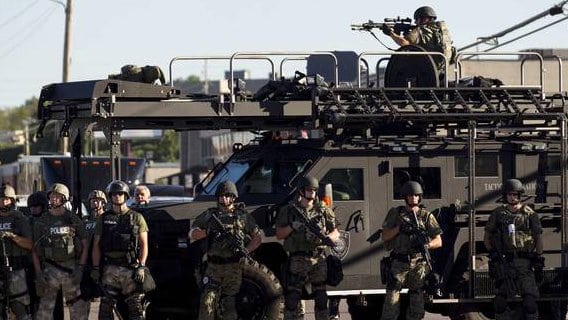
 Set against a backdrop of government surveillance, militarized police, SWAT team raids, asset forfeiture, eminent domain, overcriminalization, armed surveillance drones, whole body scanners, stop and frisk searches, roving VIPR raids and the like—all sanctioned by Congress, the White House, the courts and the like—a recitation of the Bill of Rights would understandably sound more like a eulogy to freedoms lost than an affirmation of rights we truly possess.
 The Fifth Amendment and the Sixth Amendment work in tandem. These amendments supposedly ensure that you are innocent until proven guilty, and government authorities cannot deprive you of your life, your liberty or your property without the right to an attorney and a fair trial before a civilian judge. However, in the new suspect society in which we live, where surveillance is the norm, these fundamental principles have been upended. Certainly, if the government can arbitrarily freeze, seize or lay claim to your property (money, land or possessions) under government asset forfeiture schemes, you have no true rights.
 As the National Review rightly asks, “
 Our national priorities need to be re-prioritized. For instance, Donald Trump wants to make America great again. I, for one, would prefer to make America free again.
 In Oklahoma, a 5-year-old boy watched as a
  Clearly, instead of making the schools safer, we have managed to make them more authoritarian.
 Consider that by the time the average young person in America finishes their public school education, nearly
  Indeed, the militarization of the police has been mirrored in the public schools, where

