Posts Tagged ‘civil liberties’

“He sees you when you’re sleeping.
He knows when you’re awake.
He knows if you’ve been bad or good,
So be good for goodness’ sake.”
   — “Santa Claus Is Coming to Town

For generations, “Santa Claus Is Coming to Town” has been treated as a playful reminder to children to be good because someone, somewhere, is watching.

Today, it reads less like a joke and more like a warning.

The Surveillance State is making a naughty list, and we’re all on it.

Long before Santa’s elves start loading his sleigh with toys for good girls and boys, the government’s surveillance apparatus is already at work—logging your movements, monitoring your messages, tracking your purchases, scanning your face, recording your license plate, and feeding it all into algorithmic systems designed to determine whether you belong on a government watchlist.

Unlike Santa’s naughty list, however, the consequences of landing on the government’s “naughty list” are far more severe than a stocking full of coal. They can include heightened surveillance, loss of privacy, travel restrictions, financial scrutiny, police encounters, or being flagged as a potential threat—often without notice, explanation, or recourse.

This is not fiction. This is not paranoia.

This is the modern surveillance state operating exactly as designed.

Santa Claus has long been the benign symbol of omniscient surveillance, a figure who watches, judges, and rewards. His oversight is fleeting, imaginary, and ultimately harmless.

The government’s surveillance is none of those things—and never was.

What was once dismissed as a joke—“Santa is watching”—has morphed into a chilling reality. Instead of elves, the watchers are data brokers, intelligence agencies, predictive algorithms, and fusion centers. Instead of a naughty-or-nice list, Americans are sorted into databases, risk profiles, and threat assessments—lists that never disappear.

The shift is subtle but profound.

Innocence is no longer presumed.

Everyone is watched. Everyone is scored. Everyone is a potential suspect.

This is the surveillance state in action.

Today’s surveillance state doesn’t require suspicion, a warrant, or probable cause. It is omnipresent, omniscient, and inescapable.

Your smartphone tracks your location. Your car records your movements. License plate readers log when and where you drive. Retail purchases create detailed consumer profiles. Smart speakers listen to everything you say. Home security cameras observe not just your property, but your neighbors, delivery drivers, and anyone who passes by.

The government’s appetite for data is insatiable.

In a dramatic expansion of surveillance reach, the Transportation Security Administration now shares airline passenger lists with Immigration and Customs Enforcement, enabling ICE to identify and arrest travelers at airports based on immigration status.

In one incident, ICE arrested and immediately deported a college student with no criminal record who was flying home to spend Thanksgiving with her family.

What was once routine aviation security data has been transformed into an enforcement tool—merging civilian travel records with the machinery of deportation and demonstrating how ordinary movements can be weaponized by the state.

Even the most personal acts—like Christmas shopping—are now tracked in real time. Every item you buy, where you buy it, how you pay, and who you buy it for becomes part of a permanent digital record. That data does not stay confined to retailers. It is shared, sold, aggregated, and folded into sprawling surveillance ecosystems that blur the line between corporate data collection and government intelligence.

Companies like Palantir specialize in fusing these data streams into comprehensive behavioral profiles, linking financial activity, social media behavior, geolocation data, and government records into a single, searchable identity map.

The result is not merely a government that watches what you’ve done but one that claims the power to predict what you will do next.

It is a short step from surveillance to pre-crime.

While predictive policing and AI-driven risk assessments are marketed as tools of efficiency and public safety, in reality, they represent a dangerous shift from punishing criminal acts to policing potential behavior.

Algorithms—trained on historical data already shaped by over-policing, bias, and inequality—are now used to predict who might commit a crime, who might protest, or who might pose a “risk.” Even the way you drive—where you came from, where you were going and which route you took—is being analyzed by predictive intelligence programs for suspicious patterns that could get you flagged and pulled over.

Once flagged by an algorithm, individuals often have no meaningful way to challenge the designation. The criteria are secret. The data sources opaque. The decisions automated.

Accountability disappears.

This isn’t law enforcement as envisioned by the Founders. This is pre-crime enforcement—punishing people not for what they’ve done, but for what an AI machine predicts they might do.

At the same time, President Trump has openly threatened states that attempt to regulate artificial intelligence in order to protect citizens from its discriminatory and intrusive uses—seeking to clear the way for unchecked, nationwide deployment of these systems.

No government initiative has done more to normalize, expand, and entrench mass surveillance than the Trump administration’s war on immigration.

The Trump administration’s war on immigration has become the laboratory for the modern surveillance state.

Under the guise of border security, vast stretches of the country have been transformed into Constitution-free zones—places where the Fourth Amendment is treated as optional and entire communities are subjected to constant monitoring.

The federal government has transformed immigration policy into a proving ground for authoritarian surveillance tactics—testing tools, technologies, and legal shortcuts could be deployed with minimal public resistance and quietly repurposed for use against the broader population. As journalist Todd Miller warned, these areas have been transformed into “a ripe place to experiment with tearing apart the Constitution, a place where not just undocumented border-crossers, but millions of borderland residents have become the targets of continual surveillance.”

Through ICE and DHS, the government fused immigration enforcement with corporate surveillance technologies—facial recognition, license-plate readers, cellphone tracking, and massive data-sharing agreements—creating a sprawling digital dragnet that now extends far beyond immigrants.

What began as a policy aimed at undocumented immigrants has now become a model for nationwide surveillance policing.

“What’s new,” reports the Brennan Center for Justice, “is that the federal government now openly says it will use its supercharged spy capabilities to target people who oppose ICE’s actions. Labeled as ‘domestic terrorists’ by the administration, these targets include anti-ICE protesters and anyone who allegedly funds them—all of them part of a supposed left-wing conspiracy to violently oppose the president’s agenda.”

The critical point is this: the surveillance infrastructure developed to track immigrants is now used to monitor everyone. Immigration enforcement served as the justification, the infrastructure, and the legal gray zone needed to create a permanent surveillance apparatus that treats all Americans as potential suspects.

All of this adds up to an algorithmic naughty list.

Government watchlists have exploded in size and scope.

Terrorist watchlists, no-fly lists, gang databases, protester tracking systems, and “suspicious activity” registries operate with little oversight and even less transparency.

People can be added to these lists without notification and can remain there indefinitely. Errors are common. Corrections are rare.

Social media posts are mined. Associations are mapped. Speech is scrutinized. Peaceful dissent is increasingly treated as a precursor to extremism.

The government’s watchlists aren’t just opaque databases hidden from public view. They are becoming public-facing instruments of political classification. Internal Justice Department memoranda now direct the FBI to compile lists of groups and networks it categorizes as possible domestic extremists, broadening counter-terror tools to sweep in ideological opponents and organizations without clear statutory definitions.

At the same time, the White House has launched an official “Offender Hall of Shame”—a public naughty list of journalists and media outlets it accuses of bias—even briefly circulating a video styled like Santa putting together a naughty list of offenders before deleting it amid backlash.

In this system, being “good” no longer means obeying the law. It means staying under the radar, avoiding attention, and never questioning authority.

The chilling effect is the point.

Once upon a time, privacy was recognized as a fundamental liberty—an essential buffer between the individual and the state. Today, it’s a conditional privilege, granted temporarily and revoked when it suits the police state’s purposes.

Under the banner of national security, public health, and law and order, surveillance powers continue to expand. Biometric identification—facial recognition, gait analysis, voice prints—are normalized.

What was once unthinkable has become routine.

Americans are being conditioned to accept constant monitoring as the price of safety. That resistance is suspicious. That anonymity is dangerous.

Yet history teaches us the opposite: societies that normalize surveillance do not become safer—they become more authoritarian.

A government that sees everything, everywhere, all the time, will eventually control everything.

The Founders understood this. That is why they enshrined protections against unreasonable searches and unchecked power. They knew liberty couldn’t survive under constant surveillance.

When the government knows where you go, what you buy, what you say, who you associate with, and what you believe, freedom becomes conditional.

This Christmas, we might joke about Santa watching from the North Pole, but we should be far more concerned about the watchers much closer to home.

The surveillance state doesn’t take a holiday. It doesn’t sleep. It doesn’t forget. And it doesn’t forgive easily.

So you see, the question is not whether we are being watched. We are.

The question, as I make clear in my book Battlefield America: The War on the American People and in its fictional counterpart The Erik Blair Diaries, is whether we will continue to accept a system that treats every citizen as a suspect—and whether we will reclaim the constitutional limits that once stood between liberty and the all-seeing state.

Source: https://tinyurl.com/yc6cmv9m

ABOUT JOHN W. WHITEHEAD

Constitutional attorney and author John W. Whitehead is founder and president of The Rutherford Institute. His most recent books are the best-selling Battlefield America: The War on the American People, the award-winning A Government of Wolves: The Emerging American Police State, and a debut dystopian fiction novel, The Erik Blair Diaries. Whitehead can be contacted at staff@rutherford.org. Nisha Whitehead is the Executive Director of The Rutherford Institute. Information about The Rutherford Institute is available at www.rutherford.org.

Publication Guidelines / Reprint Permission

John W. Whitehead’s weekly commentaries are available for publication to newspapers and web publications at no charge. 
“We the people are the rightful masters of both Congress and the courts, not to overthrow the Constitution but to overthrow the men who pervert the Constitution.”—Abraham Lincoln

We now live in a nation where constitutional rights exist in theory, not in practice.

Yet what good are rights on paper when every branch of government is allowed to ignore, circumvent, chip away at or hollow them out in practice?

Two hundred and thirty-four years after the ratification of the Bill of Rights on December 15, 1791, the safeguards meant to shield “We the people” from government abuse are barely recognizable.

In ways the Founders could scarcely have imagined—and would never have tolerated—the safeguards meant to restrain government overreach have become little more than empty platitudes.

America’s founders understood that power corrupts and absolute power—especially when it comes to power-hungry governments fixated on amassing institutional power at the expense of individual freedoms—corrupts absolutely. That’s why they insisted on binding down the government “with the chains of the Constitution.”

In 2025, those chains have been cut link by link.

These links were not severed in secret. They snapped under the weight of executive orders issued without congressional authority, judicial doctrines that shield misconduct from accountability, and a Congress that no longer defends its own constitutional prerogatives.

If Americans are finally learning the true significance of constitutional limits, it is because the government keeps violating them—and daring anyone to stop it. Time and again, the message is being drummed into our heads that constitutional limits no longer apply when they inconvenience those in power.

Any government that treats rights as privileges—contingent on economic status, citizenship, race, orientation, religious beliefs, or political alignment—has already abandoned the Bill of Rights.

And a government that does so with the courts’ blessing is not a constitutional republic.

When rights become privileges, what we are left with is a two-tier system of freedom: those afforded the privilege of enjoying their constitutional rights vs. those targeted for exercising those same rights.

The Bill of Rights was intended as a bulwark. Each amendment was drafted as a barrier against a specific form of tyranny.

In 2025, every one of those barriers buckled under the weight of government corruption, political expediency, partisan politics, and institutional neglect.

The following is what it looked like to live without the protections of the Bill of Rights in the American police state.

First Amendment—Speech Without Protection: In 2025, the right to speak freely was not guaranteed—it was conditional. Political activism—especially around immigration, foreign policy, or policing—was treated as a national security concern. Students questioning government actions found themselves on watchlists. ICE agents used ideology as cause for detention. Peaceful protest was conflated with domestic extremism.

This year also saw revelations—via leaked FBI planning documents—that the government is preparing an expanded “extremist” classification system that goes far beyond violence or criminal activity. The categories include broad ideological markers that include anyone expressing “opposition to law and immigration enforcement; extreme views in favor of mass migration and open borders; adherence to radical gender ideology,” as well as labels such as “anti-Americanism,” “anti-capitalism,” and “anti-Christianity.” In other words, Americans are being profiled not for what they have done, but for what the government predicts they might think, believe, or someday express. It is the architecture of a pre-crime state.

Second Amendment—The Right to Self-Defense in a Militarized Nation. While the political class fixated on culture-war debates over gun ownership, the government quietly expanded the militarization of policing, federalized National Guard units, and broadened executive authority to deploy armed agents domestically. During several high-profile ICE operations, heavily armed federal teams equipped with military-grade gear conducted raids in residential neighborhoods, making it clear that this administration intends to rule by martial law.

Third Amendment—Quartering Without Quarters: The Rise of Domestic Militarization. The Third Amendment is often dismissed as obsolete. Nothing could be further from the truth. Although Americans no longer face the literal quartering of soldiers in their homes, the spirit of the Third Amendment—prohibiting the use of the military against the civilian population—has been trampled. Its purpose was to prevent exactly what we are seeing now: a permanent, militarized presence in civilian life, illustrated vividly when armored vehicles and tactical teams patrol residential neighborhoods during ICE operations.

Fourth Amendment—Privacy Without Boundaries. The Framers wrote the Fourth Amendment in response to “general warrants”: broad, suspicionless searches by the British Crown. In 2025, the digital equivalents of general warrants have become routine, executed at the speed of an algorithm and justified by the flimsiest of standards. Americans now live under surveillance so pervasive that privacy survives mostly in legal theory. In several cities, entire apartment complexes were subjected to geofence dragnets after minor incidents, sweeping innocent residents into criminal databases simply because their phones were nearby. Geofence warrants became routine, sweeping up location data from entire neighborhoods. Predictive policing tools—fueled by Palantir-style data fusion—were treated as legitimate substitutes for suspicion or probable cause. And the Supreme Court keeps lowering the threshold for intrusion.

Fifth & Sixth Amendments—Due Process Without Process. What we have seen emerge this year is a justice system where the government is accountable only to itself. Immigration courts—already overcrowded and under-resourced—operated as Constitution-lite tribunals where counsel was scarce, evidence was opaque, and the presumption of innocence evaporated. Executive detention powers continued to expand under the radar, with little oversight. Due process now bends to government expediency. For example, asylum seekers placed into “expedited removal” proceedings were denied meaningful hearings, legal counsel, or the ability to present evidence—procedures that would never withstand constitutional scrutiny in any ordinary court of law. In some instances, hearings lasted less than ten minutes. In others, decisions were issued without the accused ever speaking to a lawyer. This is not due process. It is bureaucracy masquerading as justice.

Seventh Amendment—Civil Justice Denied by Design. The right to a civil jury trial—already inaccessible for many—continued to erode in 2025, keeping ordinary Americans from ever getting their day in court, while corporations and government agencies enjoy legal shields that no ordinary citizen can penetrate. A right that exists only in theory—and which you cannot afford to exercise—is a right that has already been lost.

Eighth Amendment—Justice Without Humanity. Cruelty, once hidden, has now been codified as policy. The federal government allocated $170 billion to expand incarceration, including the construction of Alligator Alcatraz, the first of several planned megaprison complexes. The Kilmar Garcia case exposed the brutality of a system where preventable death, medical neglect, and inhumane conditions are treated as regrettable but acceptable collateral. In one widely reported incident, a detainee held on a nonviolent immigration violation died after being denied medical care for hours—a tragedy officials dismissed as “procedurally compliant,” revealing just how low the bar has fallen. These incidents are not anomalies. They are symptoms of a system designed for maximum control and minimum accountability, a system where cruelty is not an accident but an administrative outcome.

Ninth Amendment—Unenumerated Rights Crushed by Government Power. The Ninth Amendment affirms that the people retain rights beyond those listed in the Constitution. In 2025, those inherent liberties—bodily autonomy, privacy, freedom of movement, freedom from government coercion—were repeatedly undermined. Biometric surveillance was expanded. Predictive analytics categorized individuals as pre-criminal. Mandatory data-sharing regimes blurred the boundary between state and citizen. Bodily autonomy came under attack through proposed health-tracking mandates.

The Ninth Amendment’s warning has never been more relevant: the rights of the people do not end where the government’s imagination begins.

Tenth Amendment—Powers Reserved to the People Swept Aside. Federal overreach dominated 2025. Executive orders, emergency declarations, and federalized law enforcement displaced state and local authority. The Tenth Amendment’s guarantee that powers not delegated to the federal government are reserved to the states—or to the people—has become meaningless under a system in which the executive branch claims inherent authority to:

  • deploy troops domestically,
  • commandeer local police,
  • surveil the populace, and
  • dictate immigration enforcement priorities.

When states attempted to challenge the federal deployment of troops or resist federalized policing mandates, the courts largely sided with the executive, leaving states with little more than symbolic sovereignty.

A government that disregards the Bill of Rights rarely stops there.

The collapse of the Bill of Rights would be alarming enough on its own, but it is only part of the story. Beyond these first ten amendments, the structural safeguards designed to limit government power—the separation of powers, checks and balances, transparency, and federalism—were also weakened dramatically.

Without an independent judiciary willing to restrain power, the founders recognized that the entire constitutional framework would collapse.

What we continue to witness is the U.S. Supreme Court’s abdication of its constitutional duties in favor of partisan politics. By refusing to review cases that cut to the heart of constitutional protections, the Court has effectively signaled to the executive branch that there is no constitutional line it cannot cross.

While the Supreme Court is not the only institution responsible for upholding the Constitution, when the Court refuses to act as a check on government power, every American suffers.

A constitutional crisis does not always erupt in dramatic fashion.

Sometimes it arrives quietly, in the form of a Court that declines to hear the very cases that would determine whether the Constitution still has meaning.

Here is what it means to live under the Constitution today.

For generations, Americans were taught that living under the Constitution meant:

  • The government cannot enter your home without a warrant.
  • The government cannot silence you for criticizing its actions.
  • The government cannot surveil you without probable cause.
  • The government cannot imprison you without due process.
  • The government cannot treat you as guilty until proven innocent.
  • The government cannot deploy troops against the public unless the Constitution expressly allows it.
  • The government cannot classify you as a threat solely for your beliefs.

Now consider what it means to live under the American Police State of 2025:

  • Your digital life is a government search zone.
  • Your speech can place you on a watchlist.
  • Your movements are tracked without a warrant.
  • Your property can be seized without meaningful judicial review.
  • Your community can be subjected to predictive policing algorithms with no oversight.
  • Your rights depend on which legal category you fall into.
  • And the courts increasingly refuse to intervene.

The gap between the promise of a constitutional republic and the practice of the American Police State has grown so vast that the rights Americans take for granted no longer resemble the realities they face in their daily lives.

America’s founders assumed the people—not the president, not the politicians, not the courts—would be the ones to keep the government in check.

What the police state wants is for us to meekly accept its constitutional violations as normal, inevitable, or justified. That complacency fuels and sustains tyranny.

We cannot afford to be complacent.

If Americans want a government bound by law, we must insist on it—daily, loudly, relentlessly and without apology or fear.

As I make clear in my book Battlefield America: The War on the American People and in its fictional counterpart The Erik Blair Diaries, the Constitution will not collapse all at once. It will erode one unchallenged abuse at a time—until future generations wonder how the people who inherited a framework for liberty allowed it to slip through their fingers.

If 2025 was the year the Constitution became optional, 2026 will determine whether it becomes obsolete.

Source: https://tinyurl.com/mvses7du

ABOUT JOHN W. WHITEHEAD

Constitutional attorney and author John W. Whitehead is founder and president of The Rutherford Institute. His most recent books are the best-selling Battlefield America: The War on the American People, the award-winning A Government of Wolves: The Emerging American Police State, and a debut dystopian fiction novel, The Erik Blair Diaries. Whitehead can be contacted at staff@rutherford.org. Nisha Whitehead is the Executive Director of The Rutherford Institute. Information about The Rutherford Institute is available at www.rutherford.org.

Publication Guidelines / Reprint Permission

John W. Whitehead’s weekly commentaries are available for publication to newspapers and web publications at no charge. 

WASHINGTON, DC — In a ruling that leaves thousands of military servicemembers and their families without meaningful recourse when the government’s negligence causes harm, the U.S. Supreme Court has declined to reconsider a 1950 judicial doctrine that prevents military personnel from suing the federal government for non-combat injuries deemed “incident to service,” even when a civilian in the same situation could bring a claim.

For decades, the Feres doctrine has drawn criticism across the ideological spectrum for its expansive and often devastating consequences. Courts have interpreted “incident to service” so broadly that it now bars claims arising from medical malpractice, car accidents, and even sexual assault by another servicemember—harms far removed from the battlefield. The Rutherford Institute and the Constitutional Accountability Center had filed an amicus brief in Beck v. United States, urging the Court to overturn Feres because it contradicts the text and purpose of the Federal Tort Claims Act (FTCA) and denies military families the same legal protections afforded to civilians.

“No American should be denied the right to hold the government accountable for negligence and harm merely because they wear a military uniform,” said constitutional attorney John W. Whitehead, president of The Rutherford Institute and author of Battlefield America: The War on the American People. “The Constitution does not permit a two-tiered system of justice—one for civilians and a lesser one for those who serve—and neither should we.”

Staff Sergeant Cameron Beck was living and working at Whiteman Air Force Base in Missouri, serving on active duty in the Wing Cybersecurity Office. One afternoon, he drove home for lunch with his wife and seven-year-old son. As he traveled along a Base road, a civilian federal employee—driving a government-owned van while distracted by her cell phone—struck and killed him. She later pleaded guilty to operating her vehicle in a careless and imprudent manner and admitted the crash was “100 percent” her fault.

Beck’s widow and son filed a wrongful-death lawsuit under the FTCA, the law that allows individuals to sue the federal government for negligence of its employees. But because Beck happened to be on Base, on active duty, and subject to recall—even though he was riding home during off-duty hours and was not engaged in a military activity—the lower courts dismissed the case under the Feres doctrine. Therefore, the government could not be held liable, and the family was left with no meaningful path to justice.

While the family received some limited benefits from the Department of Veterans Affairs and the Department of Defense, Justice Thomas (who dissented from the Court’s decision in this case) has pointed out that these benefits often amount to only a fraction of what a civilian family could obtain in court. Yet, Feres bars lawsuits by servicemembers when a civilian would be allowed to sue based on the same acts by the same federal employee. The amicus brief in Beck warned that the Feres doctrine has drifted so far from its original purpose that it now bars even the most straightforward negligence claims—such as the careless operation of a government vehicle by a civilian employee that results in the death of a servicemember not engaged in any military activity.

Miriam Becker-Cohen, Brianne J. Gorod, Elizabeth B. Wydra, and Nargis Aslami with the Constitutional Accountability Center advanced the arguments in the Beck amicus brief.

The Rutherford Institute, a nonprofit civil liberties organization, defends individuals whose constitutional rights have been threatened or violated and educates the public on a wide spectrum of issues affecting their freedoms.

Source: https://tinyurl.com/yc5ukebt

“The United States boldly broke with the ancient military custom of swearing loyalty to a leader. Article VI required that American Officers thereafter swear loyalty to our basic law, the Constitution… Our American Code of Military Obedience requires that, should orders and the law ever conflict, our officers must obey the law… This nation must have military leaders of principle and integrity so strong that their oaths to support and defend the Constitution will unfailingly govern their actions.”—“Loyalty to the Constitution” plaque located on the grounds of the United States Military Academy

Every military servicemember’s oath is a pledge to defend the Constitution against all enemies, foreign and domestic.

It is not an oath to a politician. It is not an oath to a party. And it is not an oath to the police state.

Yet what happens when those same men and women are being told—by their own government—that obedience to power and loyalty to a political leader come before allegiance to the Constitution they swore to uphold?

That question isn’t hypothetical.

It is the moral line now being tested in real time, and it goes to the heart of what kind of country we are: do we live in a constitutional republic governed by the rule of law, or in a militarized police state where “legality” is whatever the person with the most power and the biggest army say it is?

The answer becomes painfully clear when you look at what our troops are being ordered to do—and what “we the people” are tacitly allowing them to be ordered to do—in the so-called name of national security.

Members of the military are now being deployed domestically to police their fellow American citizens in ways that trample the spirit, if not the letter, of the Posse Comitatus Act.

It’s legally dubious enough that the military is being used to enforce immigration crackdowns and police protests in American cities. But now they’re being tasked with killing civilians far from any declared battlefield in the absence of an imminent threat—all while being told that questioning the legality of those missions is itself a form of disloyalty.

So, which is it: obedience to the Constitution or the Commander-in-Chief?

At the center of this latest maelstrom is a report that Defense Secretary Pete Hegseth issued a verbal order to “kill everybody” on a maritime vessel in the Caribbean that was suspected of transporting drugs.

According to multiple accounts, after an initial “lethal, kinetic” strike disabled the vessel and killed nine men on board, a second strike was carried out to kill two survivors clinging to the wreckage—an alleged “double tap strike” that legal experts warn could constitute murder or a war crime if the survivors no longer posed a threat.

In all, the boat was reportedly hit four times: twice to kill the eleven occupants on board and twice more to sink the boat.

Intentionally killing survivors clinging to the remains of a boat in the middle of the ocean, in the absence of an imminent threat, whether or not the U.S. is engaged in “armed conflict” with drug cartels, is unlawful.

Murder on the high seas is a crime.

Even the Pentagon’s manual on the law of war says combatants who are “wounded, sick, or shipwrecked” no longer pose a threat and should not be attacked.

Some Republicans who have, until now, turned a blind eye to the Trump administration’s most egregious offenses against the Constitution appear reluctant to let this one slide.

Not surprisingly, the Trump administration has done an about-face.

Hegseth—who bragged about watching the September 2 strike live—now claims he wasn’t in the room when the second strike happened.

Suddenly, the White House—which had been gleefully chest-thumping over its power to kill extrajudicially—is signaling its willingness to scapegoat subordinates in the chain of command.

The man with his head on the chopping block is Adm. Frank M. “Mitch” Bradley.

Clearly, it’s a lesson learned too late: when you’re dealing with power-hungry authoritarians, loyalty is no guarantee of protection. It’s always the men and women who carry out the unlawful orders—not the ones who give them—who end up paying the price.

Here’s the problem, though. While the media fixates on who will bear the blame for ordering the double-tap strike, the government war machine is moving forward, full steam ahead.

The Sept. 2 boat strike was part of a broader Trump administration campaign of maritime attacks that has already killed at least 80 people at sea, all without a formal declaration of war or due process—evidence of who they were or what they had done—to warrant an extrajudicial execution.

This is yet another of Trump’s everywhere, endless wars—this time at sea—sold as toughness on “narco-terrorists” at a moment when his poll numbers are slipping, economic promises have failed to manifest, and new Epstein-related revelations continue to surface.

When presidents manufacture new fronts in a forever war whenever they need a distraction, we should all beware.

The Trump administration has tried to frame this preemptive maritime war on suspected “narco-terrorists” as a “non-international armed conflict” with designated terrorist organizations.

Yet what it amounts to is an undeclared war, launched in international waters, without just cause and without congressional authorization.

The legal landscape is not murky—it is clear.

Most of the public debate has revolved around those technical legalities—what kind of conflict this is, which statutes apply, which court might have jurisdiction—yet what is really at stake is whether we are training a generation of American troops to believe that loyalty to a leader can excuse disobedience to, or even override, the Constitution.

Three bodies of law converge here: the Constitution’s allocation of war powers, the international law of armed conflict, and the Uniform Code of Military Justice.

First, there has been no declaration of war by Congress. Under the Constitution, only Congress can declare war. The president cannot start wars based solely on his own authority.

Second, the law of armed conflict and the law of the sea forbid killing shipwrecked survivors who pose no immediate threat.

Third, the Uniform Code of Military Justice requires every servicemember to refuse manifestly unlawful orders.

A command to “kill everybody” is precisely the kind of order these guardrails were written to forbid.

The rationale that “I was just following orders” is not a defense to war crimes. That is the core lesson of the Nuremberg Trials and the modern law of armed conflict.

Of course, the police state wants mindless automatons who obey unquestioningly.

Reporting on the trial of Nazi bureaucrat Adolf Eichmann for the New Yorker in 1963, Hannah Arendt explained, “The essence of totalitarian government, and perhaps the nature of every bureaucracy, is to make functionaries and mere cogs in the administrative machinery out of men, and thus to dehumanize them.”

Arendt, a Holocaust survivor, denounced Eichmann, a senior officer who organized Hitler’s death camps, for being a bureaucrat who unquestioningly carried out orders that were immoral, inhumane and evil. This, Arendt concluded, was the banality of evil, the ability to engage in wrongdoing or turn a blind eye to it, without taking any responsibility for your actions or inactions.

Coincidentally, the same year that Arendt’s book Eichmann in Jerusalem: A Report on the Banality of Evil was published, Martin Luther King Jr. penned his “Letter from a Birmingham Jail,” in which he points out “that everything Adolf Hitler did in Germany was ‘legal’ and everything the Hungarian freedom fighters did in Hungary was ‘illegal.’ It was ‘illegal’ to aid and comfort a Jew in Hitler’s Germany.”

In other words, there comes a time when law and order are in direct opposition to justice.

Every military recruit is supposed to learn in basic training that there is a duty to obey lawful orders, and an equal duty to disobey manifestly unlawful orders.

No president—Republican or Democrat—can override that principle.

The Commander-in-Chief may issue orders, but he does not get to erase the Constitution or rewrite the laws of war by fiat.

The White House rationale—that a preemptive “kill everybody” attack “was conducted in self-defense to protect U.S. interests”—should terrify every American.

If the government can redefine “self-defense” to justify killing incapacitated survivors on a sinking boat, then it can justify killing anyone—at home or abroad, in uniform or out of it.

No matter how the White House spins it, however, these are crimes and those involved—from Hegseth on down—could find themselves in legal jeopardy and should be held accountable.

The pressure on the military is mounting.

The Orders Project, a nonpartisan initiative that helps connect servicemembers with outside legal counsel, reports a spike in calls from military personnel concerned that they could be asked to carry out an illegal order or pressured to take part in missions that violate their training in the laws of war.

Given Hegseth’s much-publicized approach to waging war without constraints—he has openly derided the military’s Judge Advocate General corps and championed a more “unshackled” approach to lethal force—these concerns are reasonable.

Indeed, there has been enough cause for concern that six members of Congress, all with military or national security backgrounds, recorded a message reminding servicemembers what the law requires: “Our laws are clear. You can refuse illegal orders…you must refuse illegal orders. No one has to carry out orders that violate the law or our constitution.

For re-stating what every recruit is taught in basic training, these lawmakers have been accused by President Trump of “sedition” and branded as “traitors” who should be arrested and punished by death. The FBI has reportedly opened an investigation. Hegseth has even threatened to recall one of the lawmakers—Senator Mark Kelly, a retired Navy captain—to active duty in order to court-martial him for his remarks.

The message from the top could not be clearer: allegiance to the Constitution is a crime.

Every person like myself who has served in uniform has experienced the tension between following orders and honoring that oath. Discipline requires obedience, but a constitutional republic requires lawful obedience.

That is why the oath matters.

It is not an oath to a man, a party, or a policy agenda. It is an oath to a charter of law: the Constitution.

At West Point, a 1943 “Loyalty to the Constitution” plaque proclaims: “should orders and the law ever conflict, our officers must obey the law.”

That principle is not antiquated. It is the foundation of American civil-military relations. Remove it, and what remains is not a republic but a personality cult with weapons.

The danger becomes even clearer when you examine the rhetoric now shaping national policy.

For instance, Homeland Security Secretary Kristi Noem recently urged the president to impose “a full travel ban on every damn country that’s been flooding our nation with killers, leeches, and entitlement junkies.”

A harsher irony is hard to find.

A good case could be made that it is, in fact, the U.S. government that is flooding our nation with killers, leeches, and entitlement junkies. Just consider Trump’s steady spate of presidential pardons, the latest to Juan Orlando Hernández, the former president of Honduras, who had been sentenced to 45 years in prison for conspiring with drug traffickers to move cocaine into the U.S.

According to U.S. prosecutors, Hernández—quoted as saying he wanted to “shove the drugs right up the noses of the gringos by flooding the United States with cocaine”—took bribes from drug traffickers and had the country’s armed forces protect a cocaine laboratory and shipments to the U.S.

So the president is blowing up boats in the Caribbean he claims—without proof—are ferrying drugs all the while pardoning someone who was convicted of conspiring to transport hundreds of tons of cocaine into the U.S.

This corrupt double standard has become business as usual for the Trump administration.

Now Trump wants to launch land attacks on Venezuela, a country that is conveniently richer in oil reserves than Iraq—all in the so-called name of fighting the war on drugs.

The rapid buildup of U.S. military forces in the Caribbean—which according to news reports includes a range of aircraft carriers, guided-missile destroyers, and amphibious assault ships capable of landing thousands of troops, as well as a nuclear-powered submarine and spy planes—far exceeds what would be needed for a supposed counternarcotics operation and is worrisome enough on its own.

Yet conscripting the military to do the dirty work of the police state—and then throwing them under the bus for doing so—takes us into even darker territory.

The U.S. government’s weaponization of the armed forces for political power is a betrayal of the Constitution, but it is also a betrayal of the very men and women who swore to give their lives for it.

This has never been about public safety.

As I make clear in my book Battlefield America: The War on the American People and in its fictional counterpart The Erik Blair Diaries, this has always been about power—who wields it, who is protected by it, and who is crushed under it.

And once a government shows a willingness to break faith with its defenders, it will break faith with anyone.

A government that can discard its military service members can discard its whistleblowers and truth-tellers who expose corruption.

A government that can discard its military service members can discard its journalists, judges, and watchdogs in the press and the courts who insist on transparency and limits to power.

A government that can discard its military service members can discard its political opponents and dissidents, its religious and racial minorities, its immigrants and asylum seekers, its small business owners and workers who organize, its parents and community members who speak up locally, and any citizen who dares to say “no” when the state demands “yes.”

This betrayal of those who swore an oath to the Constitution is not an accident—it is a warning.

Be warned.

Source: https://tinyurl.com/5xaj9s93

ABOUT JOHN W. WHITEHEAD

Constitutional attorney and author John W. Whitehead is founder and president of The Rutherford Institute. His most recent books are the best-selling Battlefield America: The War on the American People, the award-winning A Government of Wolves: The Emerging American Police State, and a debut dystopian fiction novel, The Erik Blair Diaries. Whitehead can be contacted at staff@rutherford.org. Nisha Whitehead is the Executive Director of The Rutherford Institute. Information about The Rutherford Institute is available at www.rutherford.org.

Publication Guidelines / Reprint Permission

John W. Whitehead’s weekly commentaries are available for publication to newspapers and web publications at no charge. 

Today is Giving Tuesday—a day when people across the country choose to support the causes that matter most. And this year, the stakes for freedom could not be higher.

Everywhere we turn, the government is expanding its power:

·       Surveillance programs are monitoring ordinary Americans.

·       Executive orders are being used to bypass constitutional limits.

·       Police powers are growing more militarized and unchecked.

·       Dissenters are being censored, silenced, and punished.

·       The Bill of Rights is treated as optional—especially when inconvenient.

The Constitution cannot defend itself—and defending it has nothing to do with politics.

At a time where every issue is twisted into a partisan wedge, The Rutherford Institute remains committed to something far more enduring: the rule of law, the Bill of Rights, and the fundamental liberties that belong to all Americans—no matter who holds power.

 We don’t play politics. We don’t take sides. We stand on the side of the Constitution.

The Constitution needs people who are willing to stand up. People who refuse to surrender their freedoms quietly. People who say “no” to the steady erosion of their rights. 

The Constitution draws a clear line between the rule of law and the rule of power. The Rutherford Institute is working to hold that line.

Giving Tuesday contributions—no matter the size—help ensure that The Rutherford Institute can:

·       Challenge government abuse in the courts

·       Defend victims of censorship and retaliation

·       Expose unconstitutional behavior

·       Hold officials accountable for violating the rule of law

·       Speak truth to power without fear or favor

Our work has never been more critical. In recent months, The Rutherford Institute has:

·       Fought warrantless digital surveillance in cases challenging geofence searches and mass data sweeps.

·       Defended students, journalists, and activists targeted for their protected speech.

·       Challenged the use of excessive police force and militarized tactics in situations where the Fourth Amendment was ignored.

·       Opposed executive actions that bypass constitutional safeguards and expand unchecked government power.

Every one of these battles depends on supporters who believe the Constitution still matters.

Thanks to a $250,000 Matching Gift Challenge Grant, Giving Tuesday contributions will go twice as far in helping The Rutherford Institute hold the constitutional line against government overreach. 

“Hold on, my friends, to the Constitution and to the Republic for which it stands. Miracles do not cluster, and what has happened once in 6000 years, may not happen again. Hold on to the Constitution, for if the American Constitution should fail, there will be anarchy throughout the world.”—Daniel Webster

We find ourselves approaching that time of year when, as George Washington and Abraham Lincoln proclaimed, we’re supposed to give thanks as a nation and as individuals for our safety and our freedoms.

It’s not an easy undertaking.

The contrast between George Washington’s first Thanksgiving proclamation and the state of the nation today reveals how far we have drifted—and how low we have fallen—since Washington called upon early Americans (a nation of immigrants) to give thanks for a government that protected their safety and happiness, and for a Constitution designed to safeguard civil and religious liberty.

But how do you give thanks for freedoms that are constantly being eroded?

How do you express gratitude for one’s safety when the perils posed by the American police state grow more treacherous by the day?

How do you come together as a nation in thanksgiving when the powers-that-be continue to polarize and divide us into warring factions?

To our collective misfortune, we have been saddled with a government that is a far cry from Washington’s vision: governed by wise, just, constitutional laws; faithfully executed by principled public servants; promoting peace, virtue, and liberty; and fostering the prosperity of the nation.

Instead, the U.S. government has become a warring empire: lawless in its ambitions, militarized in its posture, abusive in its policing, and increasingly hostile to conscience, truth, and constitutional limits.

Washington never intended Thanksgiving to be a day of glib platitudes—a moment to be grateful for whatever crumbs the government chooses to bestow upon us. He intended it to be a day of reflection, honesty, and moral accounting, a day when the nation examines its failures, acknowledges its wrongs, and commits to restoring liberty in the year ahead.

If Thanksgiving is to mean anything in times such as these, it must also compel us to speak plainly about the forces that threaten our freedom. Giving thanks for our blessings requires the courage to say “no thanks” to the very forces working to strip away the blessings we claim to celebrate.

In that true spirit of Thanksgiving, here is a sobering list of things for which we should not give thanks in this age of the American police state.

Say “no thanks” to oligarchy and self-serving, pay-to-play politics. A pay-to-play culture now permeates the highest levels of government, dominated by a mindset that money—not law—defines the boundaries of power. America is being bought and sold by corporate elites and political cronies. “We the People” have been pushed into a permanent underclass, ruled by a political machine that monetizes every aspect of governance—surveillance, policing, incarceration, immigration enforcement, even war itself. Our elected officials increasingly represent the interests of the wealthy and well-connected rather than the rights and needs of the citizenry. This is oligarchy masquerading as representative government.

Say “no thanks” to an imperial presidency that rules by fiat. Executive power has metastasized into something the Framers would not recognize. In 2025 alone, we have seen:

• sweeping executive orders redefining law without Congress’ oversight or approval,
• federal agencies weaponized against political enemies,
• unilateral decisions to deploy federal troops domestically,
• and attempts to redefine constitutional rights by proclamation.

Whether the occupant of the Oval Office is a Republican or Democrat, the result is the same: presidents now behave as lawmakers, judges, and enforcers combined — a constitutional impossibility and a recipe for dictatorship. The Founders warned us plainly: when one person claims the authority to rule by decree, liberty is already in mortal danger.

Say “no thanks” to martial law and standing armies used against the American people. What once would have been unthinkable is now routine. National Guard units have been federalized to police protests. Tactical teams roam American streets outfitted like combat forces. A generation of Americans is growing up under the shadow of armored vehicles and militarized responses to ordinary civil unrest. This year’s federal deployments in California and elsewhere following ICE raids—justified by vague claims of “restoring order”—are only the latest sign. A government comfortable using soldiers against its own citizens is a government that has abandoned the constitutional line between civilian authority and military force.

Say “no thanks” to the government’s fear tactics. Fear is the oldest tool of tyranny. We have seen fear weaponized to justify:

• speech crackdowns,
• “domestic threat” watchlists,
• expanded surveillance authorities,
• “emergency powers” without end,
• and the rounding up of vulnerable populations under the guise of safety.

From mental-health “round-ups” to demands that soldiers obey unlawful commands without question, fear has become the operating currency of government power. When the people are afraid, they can be controlled. When one’s right to conscience is criminalized, that conscience can be silenced.

Say “no thanks” to endless wars. For more than two decades, the U.S. has been mired in endless wars without clear objectives, limits, or endpoints. The war footing has become perpetual—an unbroken justification for secrecy, surveillance, militarization, and unchecked executive power. Wars abroad have consequences at home: they brutalize our politics, exhaust our populace, expand federal power, and normalize the idea that violence—rather than diplomacy, law, or liberty—is the default solution for national problems.

Say “no thanks” to everywhere wars. When government can label anyone, anywhere, an “enemy” in order to wage war, we are all in danger. That danger is no longer theoretical. In the same breath that the administration touts lethal military strikes against Venezuelan boats in Caribbean waters, federal agents are conducting coordinated militarized raids on communities across the country. The lesson to be learned: a nation permanently on war footing eventually turns its war machinery inward.

Say “no thanks” to the transformation of domestic police into extensions of the military.  For decades, billions in Pentagon gear—tanks, drones, armored carriers, battlefield weapons — have been funneled to local police under the 1033 military surplus program. Training once reserved for war zones has become standard for domestic policing. The results are unmistakable:

• SWAT raids for routine warrants,
• trigger-happy policing,
• a “kill or be killed” mentality,
• and communities patrolled like occupied territories.

The police are no longer peace officers. They are an occupying force.

Say “no thanks” to ICE raids that trample constitutional rights and terrorize communities. What began as an agency tasked with immigration enforcement has mutated into something far darker: a roaming domestic strike force. ICE’s quota-driven model incentivizes arrests at all costs, creating a bounty-hunter culture in which constitutional rights are obstacles, not guarantees. From coast to coast, ICE goon squads—incognito, thuggish, fueled by profit-driven incentives and outlandish quotas, and empowered by the Trump administration to act as if they are untouchable—are prowling neighborhoods, churches, courthouses, hospitals, bus stops, and worksites, anywhere “suspected” migrants might be present, snatching people first and asking questions later. No one is off limits—not even American citizens.

Say “no thanks” to a government mindset that seeks to transform the nation into a prison state. From the creation of Alligator Alcatraz to the administration’s $170 billion plan for megaprisons, the U.S. incarceration system is being expanded at breakneck speed. Combined with predictive enforcement, surveillance dragnets, and limits on due process, the United States is rapidly becoming a prison state — one that cages not only bodies, but autonomy, dissent, and opportunity.

Say “no thanks” to a surveillance state that has become a fourth branch of government.  We now live in a world in which everything—your words, your purchases, your location, your associations—is recorded, stored, and weaponized by the government and its corporate partners in crime. The surveillance state watches, catalogs, and predicts everything we do. This year alone has seen the normalization of:

• Palantir-powered national tracking systems,
• AI threat-scoring of ordinary Americans,
• geofence warrants turning whole neighborhoods into suspects,
• biometric mandates proposed as “public health tools,”
• and the creation of federal databases of “pre-crime indicators.”

Say “no thanks” to a government that punishes the poor. 2025 has brought a brutal resurgence of debtors’ courts, cash-bail coercion, poverty penalties, and retaliatory prosecutions. The criminal legal system has become a two-tiered caste structure—harsh for the poor, lenient for the powerful.

Say “no thanks” to policies that muzzle dissent. Whistleblowers, journalists, activists, and critics continue to find themselves targeted for speaking truth to power. In a climate where thought crimes and “dangerous ideas” are policed, those who criticize the government are increasingly being portrayed as traitors and subjected to investigation and prosecution.

Say “no thanks” to courts that rubber-stamp government power. Time and again, the courts have chosen order over justice, secrecy over transparency, and government power over constitutional rights—refusing to rein in geofence warrants, no-knock raids, military deployments, or the ever-expanding surveillance state.

Say “no thanks” to a government that criminalizes the rights enshrined in the Constitution. Perhaps the most alarming development of all is the growing chorus of political voices calling for the arrest—even the execution—of those who urge members of the military to follow their conscience and refuse unlawfulunconstitutional orders. Let us be clear: the American military’s oath is to the Constitution—not to any president, political agenda, or unlawful order. Anyone who suggests otherwise should be court-martialed.

Say “no thanks” to government theft disguised as fines, fees, taxes, and forfeitures. When the government can seize your home, your car, your money, or your property without due process, you are no longer a free citizen—you are a subject. Asset forfeiture, civil penalties, red-light cameras, code-enforcement schemes, and debt-trap fines have turned the government at all levels into a predatory revenue machine. The line between public property and private property has vanished. This is legalized theft.

At some point, we’ve got to face up to the uncomfortable truth that freedom is slipping through our fingers, and that the government now poses a greater threat to our safety than any outside force ever could.

We cannot keep pretending that “it can’t happen here” while it is happening all around us.

There comes a point at which no people—not even a patient, hopeful, long-suffering people—can continue pretending that the crumbs of liberty left to them constitute freedom.

Thanksgiving is supposed to remind us of our blessings. But it is also meant to remind us of our responsibilities.

A free people must do more than count their blessings.

We must guard them. We must assert them. We must defend them—even when doing so is dangerous, costly, or unpopular.

There is still time to turn back from the brink, but the hour is late.

If we want future generations to enjoy even a measure of the freedom we inherited, then “We the People” must refuse to go quietly into the machinery of the police state.

We must refuse to be governed by fear.

We must refuse to surrender our rights for the illusion of safety.

And we must refuse to bow to those who insist that conscience is treason and obedience is the highest virtue.

The Founders gave us a constitutional republic on the condition that we fight to keep it. That responsibility cannot be outsourced to politicians, courts, or parties. It rests squarely with the people themselves, with those who refuse to surrender conscience, rights, or truth to the demands of tyrants.

As I make clear in my book Battlefield America: The War on the American People and in its fictional counterpart The Erik Blair Diaries, the only force strong enough to restrain government overreach is an informed, engaged, and courageous citizenry that will not trade its birthright for the hollow comforts of authoritarianism.

The future of freedom depends not on presidents or parties but on “We the People”—ordinary individuals who refuse to be silent, refuse to be intimidated, and refuse to give up on the promise of America.

So this Thanksgiving, let us give thanks. But let us also say—with clarity and conviction—no thanks to tyranny, in whatever form it takes.

Source: https://tinyurl.com/3z6wd9wz

ABOUT JOHN W. WHITEHEAD

Constitutional attorney and author John W. Whitehead is founder and president of The Rutherford Institute. His most recent books are the best-selling Battlefield America: The War on the American People, the award-winning A Government of Wolves: The Emerging American Police State, and a debut dystopian fiction novel, The Erik Blair Diaries. Whitehead can be contacted at staff@rutherford.org. Nisha Whitehead is the Executive Director of The Rutherford Institute. Information about The Rutherford Institute is available at www.rutherford.org.

Publication Guidelines / Reprint Permission

John W. Whitehead’s weekly commentaries are available for publication to newspapers and web publications at no charge. 
WASHINGTON, DC — In yet another ruling that contributes to the steady normalization of police overreach, the U.S. Supreme Court has refused to rein in police K-9 drug-sniff searches during traffic stops.

By declining to hear an appeal in Mumford v. Iowa, the Court let stand an Iowa Supreme Court ruling that allows police to rely on a drug dog’s intrusion into a car’s interior during a traffic stop—even when officers lack probable cause to believe the car contains contraband. In a 5-2 decision in Mumford v. Iowa, the Iowa Supreme Court upheld as constitutional a search in which a police K-9 placed its paws on a car door and inserted its snout through an open window before alerting to drugs.

The Rutherford Institute, joined by Restore the Fourth, had urged the U.S. Supreme Court to overturn the ruling, arguing that warrantless, nonconsensual intrusions into protected spaces violate the Fourth Amendment, which extends its protection to a person’s vehicle. The amicus brief further warned that allowing a police dog to breach the interior of a car provides no limiting principle: if a dog’s snout may trespass inside a vehicle without probable cause, then so might thermal-imaging devices, x-ray scanners, fiberscopes, or other police technologies.

“What this ruling makes clear is that no American is safe from government intrusion, not even during a routine traffic stop. This is how constitutional rights are lost—not in dramatic sweeps, but in small, incremental intrusions that courts refuse to check,” said constitutional attorney John W. Whitehead, president of The Rutherford Institute and author of Battlefield America: The War on the American People. “If a police dog’s snout can be used to justify a warrantless search of a car, then there is nothing to stop the government from using ever more intrusive technologies, surveillance tools, and police instrumentalities to invade our privacy with little to no judicial oversight.”

The case arose after an Iowa police officer initiated a traffic stop of Ashlee Mumford’s vehicle, claiming the last two numbers on her license plate were obscured by dirt and grime. The officer summoned a K-9 unit, and Mumford and her passenger were ordered out of the vehicle “for their own safety” while the handler walked the dog around the car to conduct a “free air sniff.” Because Mumford’s passenger had left his window open, the dog pushed its snout through the open window into the cabin before alerting to drugs. A subsequent search of the vehicle uncovered drugs in the glove compartment which apparently belonged to the passenger. Officers then searched Mumford’s purse—which she had taken with her upon exiting the vehicle—and found marijuana and a pipe.

Mumford moved to suppress all evidence found as a result of the K-9’s alert, but the Iowa Supreme Court ruled 5-2 that the dog’s intrusion through the open window of a legally stopped vehicle does not require the suppression of evidence under the Fourth Amendment. Two justices dissented, reasoning that if an officer cannot lawfully stick his head inside a car without probable cause, neither should a police dog—acting as an officer’s instrumentality—be permitted to do so. The dissent also questioned whether police could direct their drug dogs to climb entirely inside a vehicle’s passenger compartment. Pushing back against the Iowa Supreme Court’s characterization of the drug sniff intrusion as minimal, the amici warned that unconstitutional practices often gain a foothold through seemingly minor transgressions.

Anand Agneshwar, Anna K. Thompson, and Tamryn Holley of Arnold & Porter Kaye Scholer LLP advanced the arguments in the amicus brief.

The Rutherford Institute, a nonprofit civil liberties organization, defends individuals whose constitutional rights have been threatened or violated and educates the public on a wide spectrum of issues affecting their freedoms.

Source: https://tinyurl.com/bdh4v37e

“It’s not personal, Sonny. It’s strictly business.”—Michael Corleone, The Godfather

Pay-to-play schemes. Protection rackets. Extortion. Corruption. Self-enrichment. Graft. Grift. Brutality. Roaming bands of thugs smashing car windows and terrorizing communities. Immunity for criminal behavior coupled with prosecutions of whistleblowers.

This is how a crime syndicate operates—not a constitutional republic.

What we are witnessing today is the steady transformation of the federal government—especially the executive branch—into a criminalized system of power in which justice is weaponized, law is selectively enforced, and crime becomes a form of political currency.

While the American police state has long marched in lockstep with the old truism that power corrupts—and absolute power corrupts absolutely—the Trump administration has ceased even the pretense of being bound by the Constitution.

Rather than abiding by the rule of law, this administration operates as if there are two separate legal systems: one for themselves and their cronies, and one for everyone else.

The corruption is off the charts, the conflicts of interest are in your face, and the brazenness is staggering.

For instance, President Trump wants his own Justice Department to put American taxpayers on the line to pay him $230 million in damages over FBI investigations into his alleged past misconduct.

Journalist David D. Kirkpatrick calculates that Donald Trump and his immediate family have made more than $3.4 billion from his time in the White House, including more than $2.3 billion from various cryptocurrency ventures alone.

In May 2025, Trump was accused of selling access to accumulate personal wealth when he hosted a private event for 220 crypto investors who had bought into his meme coin. News reports estimate that buyers spent about $148 million in total on the coin and associated perks, with some spending $1.8 million to attend.

The average American can’t get any kind of access to our elected representatives, but the wealthy can buy their way through the door.

Measured against this reality, Thomas Jefferson’s warning to bind government down “by the chains of the Constitution” sounds almost quaint.

How do you use the Constitution to guard against government misconduct when the government has effectively rendered the Constitution null and void?

It has become increasingly difficult to pretend that we are still dealing with a functioning republic.

What we have instead is a government that behaves like a criminal enterprise: rewarding loyalty, punishing dissent, monetizing public service, and enriching itself through favors, loopholes, and outright graft.

Consider the pay-to-play culture that now permeates the highest levels of power.

The Foreign Gifts and Decoration Act bars the president and federal officials from accepting gifts worth more than $480 from foreign governments (unless they’re accepted on behalf of the United States—meaning they would then belong to the American people—or purchased by the official). Yet congressional investigators have already documented more than a hundred foreign gifts to Trump and his family that went unreported for months in violation of disclosure rules.

The publicly-reported gifts being showered upon President Trump by foreign governments and politically connected foreign corporations include: a gold crown, a Rolex desk clock and a one-kilogram personalized gold bar worth $130,000, and a $400 million luxury Boeing 747.

These are not tokens of diplomacy; they are currency—investments in influence, access, and favorable policy.

As Richard Painter, a former chief White House ethics lawyer for President George W. Bush, explains, “It’s unconstitutional in the United States for the president or anyone else in a position of power to receive anything of value from a foreign government. That is unconstitutional. But if the gift is from a foreign corporation or a private interest, it’s not technically prohibited under the emoluments clause of the Constitution. But it’s still a very, very dangerous precedent to set that foreign interests can give gifts to the president and then get a concession on tariffs or anything else.”

In many cases, these gifts went unreported to the State Department, only coming to light through House investigations and watchdog reports—concealed from the public and from Congress until after the fact.

That secrecy was not accidental. It was strategic.

At the same time, the conflicts of interest just keep piling up.

Federal contracts, regulatory decisions, and diplomatic overtures increasingly appear correlated with the interests of those giving the gifts. A growing number of domestic and foreign business interests appear to be receiving preferential treatment from agencies whose regulatory decisions align suspiciously with Trump’s personal business deals advancing behind the scenes.

And then there are more obvious pay-to-play schemes like the White House Ballroom, a projected 90,000-square-foot monstrosity funded by tech and defense giants such as Apple, Google, Palantir and Lockheed Martin—corporate donors who now help underwrite the president’s vanity project even as their regulatory and contracting interests sit squarely in his hands.

This quid pro quo governance—private profit in exchange for public policy—does not resemble republican self-government. It resembles a protection racket, where the powerful exchange favors not for the public good but for personal gain—and access and immunity are available for purchase by those willing to pay.

Meanwhile, ordinary Americans are told that the system is blind, impartial, and committed to the “rule of law.”

Nothing could be further from the truth.

According to a bombshell investigation by the New York Times, career attorneys inside the Department of Justice spent the first ten months of Trump’s second term documenting—often in real time—how the justice system was being hijacked to serve political priorities rather than legal ones.

Federal lawyers told the Times that they were instructed to drop cases for political reasons, to hunt for evidence to justify flimsy investigations, and to defend executive actions they believed had no legal basis or were plainly unlawful. They also detailed the work they were told to abandon—cases involving terrorism plots, corruption, and white-collar fraud—because those investigations did not serve the administration’s political priorities.

As Dena Robinson, a former Justice Department lawyer for the Civil Rights Division, remarked on Pam Bondi’s transformation of the department into a political tool, “One thing that stuck out to me was her insistence that we served at the pleasure of the president and that we were enforcing the president’s priorities. We swore an oath to uphold the Constitution.”

Prosecution for enemies, immunity for allies, and indifference toward actual crime: this is the Trump administration’s modus operandi.

The courts are also growing increasingly leery over the federal government’s casual relationship with the truth.

In case after case—from prosecutions tied to the politically-charged James Comey indictment, to challenges over Trump’s deployment of the National Guard, to lawsuits alleging the government is attempting to circumvent basic due process protections in immigration cases by shipping people to offshore detention facilities in third countries, often in partnership with private prison contractors, where legal safeguards are far weaker—courts have scolded federal lawyers for withholding records, mischaracterizing facts, or offering assertions that crumble under scrutiny.

When the government lies to the courts, it is not just lying to a judge but to the American people. We are the ultimate arbiters of justice. It is our rights that ultimately hang in the balance.

Unfortunately, the rot doesn’t stop there.

The presidential pardon—intended to be a mechanism for mercy—has become a political reward system.

The numbers speak volumes.

During Trump’s first term, he issued 238 pardons and commutations; less than a year into his second term, he has issued nearly 2,000 pardons, costing victims and taxpayers more than $1.3 billion.

According to The Marshall Project, among those pardoned by Trump, “One faced a four-year prison sentence in a $675 million fraud case for marketing an electric truck that wasn’t drivable. Another tried to overthrow the government. A tax cheat avoided prison and $4.4 million in restitution after his mom donated $1 million to the president.” Another pardon recipient was facing “charges of child pornography and the sexual assault of a preadolescent girl.”

Whether Trump pardons Ghislaine Maxwell, who was convicted of conspiring with Jeffrey Epstein to sex traffic teenaged girls, remains to be seen. However, since Trump has taken office, Maxwell has enjoyed dramatic improvements in her prison life: a transfer to a minimum-security federal prison, custom meals delivered to her cell, snacks and refreshments provided during private meetings with family and friends—even special access to a puppy and unlimited toilet paper.

As ProPublica details, Trump’s pardons overwhelmingly benefit political loyalists, donors, grifters, extremists, and individuals either convicted of crimes in pursuit of Trump’s ambitions or who might help to advance those ambitions in the future—or both.

A judiciary committee report found that “Trump’s pardons have made criminals $1.3 [billion] richer by allowing them to keep the money they stole from their victims and dodge their fines. The pardon power in Trump’s hands is a way to take a huge amount of wealth that is legally owed to victims and transfer it back to the criminals who stole it from them in the first place.”

These are not miscarriages of justice being corrected; they are protection payments, signals to future operatives: do what we need you to do, and we will take care of you.

The message is unmistakable: Commit crimes that benefit those in power, and those in power will absolve you.

The double standard is staggering.

Critics, journalists, students, and whistleblowers face investigations, surveillance, and in some cases arrest for constitutionally protected activities—while those charged with committing actual crimes in support of the administration are shielded, absolved, or financially rewarded.

That is not the rule of law. That is the rule of power.

In a constitutional government, the pardon power is meant to temper justice with mercy.

In an unrestrained government, the pardon power becomes a mechanism for shielding insiders, silencing potential witnesses, rewarding political operatives, and signaling to future enforcers that their loyalty will be repaid.

Once justice is weaponized—once the government becomes both the ultimate lawmaker and the ultimate lawbreaker—once the president decides that his own power, not the Constitution, is the highest authority—the distinction between governance and criminality collapses.

A government that can ignore transparency laws will hide its misconduct.

A government that can lie to the courts will lie to its people.

A government that can criminalize political opposition can criminalize anyone.

A government that can pardon loyal criminals can persecute those who expose them.

This is not hypothetical. It is happening now.

Look at the surveillance state: millions of Americans monitored through AI-powered tools, data-mined by private intelligence contractors, and flagged by opaque algorithms—while the government shields its own communications, decisions, and financial entanglements behind secrecy laws and executive privilege.

Look at policing: violent, militarized crackdowns on immigrants, journalists, and protesters—even as the administration dismisses, excuses, or encourages lawlessness among vigilantes, paramilitary groups, and politically aligned street militias.

Look at foreign policy: threats to bomb Venezuela—transparent attempts to distract from falling polling numbers and the widening Epstein scandal—being framed as “national security” rather than what they are: geopolitical aggression with no constitutional or moral grounding. This isn’t defensive war; it is a land grab masquerading as patriotism, no different in principle from Putin’s overreach in Ukraine or Israel’s expansionist aims in Gaza, except that the United States has even less pretense of legitimate territorial claim.

Look at governance: executive orders increasingly treated as substitutes for legislation, bypassing Congress, the courts, and constitutional checks. The president no longer requests authority; he assumes it.

Look at transparency: the administration’s refusal to release the October jobs numbers—an unprecedented hiding of core economic data—under the pretext that the government shutdown made the figures unusable. Former Labor Department officials warn that the missing report comes just as private data are flashing recession-level job losses. When a government refuses to share basic economic indicators with the public, it is no longer governing. It is manipulating.

This is not constitutionalism. This is consolidation—an executive branch absorbing the functions of lawmaking, law enforcement, and legal interpretation into a single, unaccountable center of power.

This is not “law and order.” This is the government redefining order in its own image and using law to enforce its will.

The Founders warned us about this.

Yet here we are, watching a government that no longer even pretends to fear the Constitution. A government that openly cultivates a culture of impunity, where criminality is not a hindrance to power but an asset—evidence of loyalty, aggression, and willingness to “do what needs to be done.”

A government like this does not serve the people—it rules them. It does not protect rights—it manages them. It does not uphold law—it deploys law as a weapon.

It is increasingly difficult to distinguish between the actions of the American government and those of a cartel—one that wears suits instead of masks, but engages in the same core behaviors: loyalty above legality, retaliation against critics, protection for insiders, secrecy, intimidation, and the monetization of public office.

This is how nations fall—not through foreign invasion but through internal corruption.

When the government becomes the greatest violator of rights, the people lose faith in justice.

When the government becomes the greatest source of disinformation, the people lose faith in truth.

When the government becomes the greatest beneficiary of criminality, the people lose faith in democracy itself.

Democracy becomes theater. Elections become rituals. Rights become privileges granted or revoked at the discretion of those in power.

The Constitution is not a self-enforcing document. It has no army, no treasury, no enforcement bureau of its own. It binds only those who agree to be bound by its edicts. When officials refuse to be bound, the Constitution becomes a relic—a symbol invoked rhetorically but ignored in practice.

The only way out is the way the Founders intended: by rebinding government down with the chains of the Constitution. But those chains must be enforced by “We the People.” They must be tightened around those who wield power.

Without constitutional chains, the president becomes an imperial dictator.

Without oversight, the justice system becomes a political weapon.

Without accountability, government becomes a self-serving, money-laundering enterprise masquerading as legitimate authority.

If America is to remain a free nation, those chains must be tightened—not loosened, ignored, or replaced with partisan loyalty.

The rule of law must apply to the powerful, not just the powerless.

The justice system must serve the public, not the president.

And as I make clear in my book Battlefield America: The War on the American People and in its fictional counterpart The Erik Blair Diaries, “We the people” must reclaim our role as the ultimate check on government misconduct.

For without constitutional restraints, there is no justice.

Without constitutional limits, there is no accountability.

And without accountability, there is no republic—only a crime syndicate masquerading as a government.

Source: https://tinyurl.com/5bnr3ebv

ABOUT JOHN W. WHITEHEAD

Constitutional attorney and author John W. Whitehead is founder and president of The Rutherford Institute. His most recent books are the best-selling Battlefield America: The War on the American People, the award-winning A Government of Wolves: The Emerging American Police State, and a debut dystopian fiction novel, The Erik Blair Diaries. Whitehead can be contacted at staff@rutherford.org. Nisha Whitehead is the Executive Director of The Rutherford Institute. Information about The Rutherford Institute is available at www.rutherford.org.

Publication Guidelines / Reprint Permission

John W. Whitehead’s weekly commentaries are available for publication to newspapers and web publications at no charge. 
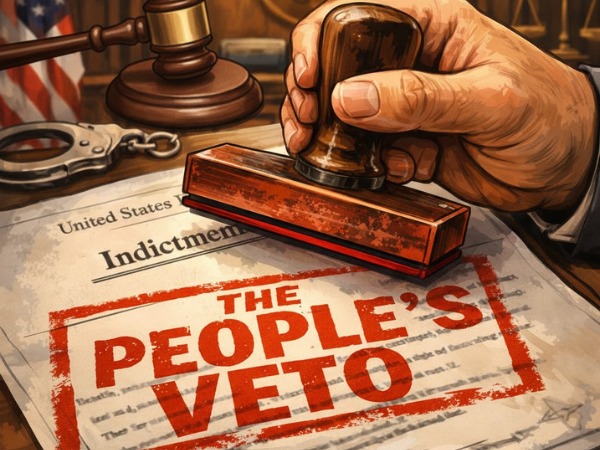
“The politicians are put there to give you the idea that you have freedom of choice. You don’t. You have no choice. You have owners. They own you. They own everything. They own all the important land. They own and control the corporations. They’ve long since bought and paid for the Senate, the Congress, the state houses, the city halls. They got the judges in their back pockets and they own all the big media companies, so they control just about all of the news and information you get to hear… They spend billions of dollars every year lobbying. Lobbying to get what they want. Well, we know what they want. They want more for themselves and less for everybody else… It’s called the American Dream, ‘cause you have to be asleep to believe it.”—George Carlin

As President Trump floats the idea of 50-year mortgages, Americans are being sold a new version of the American Dream—one that can never truly be owned, only leased from the banks, billionaires, and private equity landlords who profit from our permanent state of debt.

Which begs the question: who owns America?

Is it the government? The politicians? The corporations? The foreign investors? The American people?

While the Deep State keeps the nation divided and distracted by circus politics—the bread and circuses of empire—the police state’s stranglehold on power ensures the continuation of endless wars, runaway spending, and disregard for the rule of law.

Meanwhile, America is literally being bought and sold right out from under us.

Consider the facts.

Homeownership—the cornerstone of middle-class stability—is being transformed into a lifetime rental agreement. Cars, homes, and even college degrees have become indentured commodities in a debt-driven economy where the average American family serves as collateral for Wall Street’s profits.

This is not accidental.

It’s the natural evolution of an economy built to enrich the few at the expense of the many.

The American Dream has been repackaged as a subscription service—an illusion of ownership propped up by 0% down payments, predatory interest rates, and fine print that lasts a lifetime.

What used to be called “buying” is now simply renting from the future.

We’re losing more and more of our land every year to corporations and foreign interests. As individual Americans struggle just to make rent, corporations and foreign investors are quietly buying the country piece by piece. Foreign ownership of U.S. agricultural land has surged to more than 43 million acres—millions added in just the last few years. Meanwhile, large institutional landlords and single-family rental operators have amassed hundreds of thousands of houses across the country. Corporations now hold vast portfolios, converting would-be first-time buyers into permanent tenants. The result is a nation where more of our soil and shelter are controlled by entities whose primary allegiance is to shareholders—not communities.

The same dynamic plays out across industries.

We’re losing more and more of our businesses every year to foreign corporations and interests. Brands that once defined American enterprise—U.S. Steel, Budweiser, Jeep and Chrysler, Burger King, 7-Eleven—now fly international flags. Chinese companies and investors are also buying up major food companies, commercial and residential real estate, and other businesses. Global conglomerates have bought up the names we grew up with: U.S. Steel (now Japanese-owned); General Electric (Chinese-owned); Budweiser (Belgium); Burger King (Canada); 7-Eleven (Japan); Jeep, Chrysler, and Dodge (Netherlands); and IBM (China). The American economy has become a franchise of the world’s oligarchs.

We’re digging ourselves deeper and deeper into debt, both as a nation and as a populace. Debt has become America’s most profitable export. Washington borrows trillions it cannot repay; Wall Street packages our futures into products it can sell; and households shoulder record balances. The national debt (the amount the federal government has borrowed over the years and must pay back) has surged to more than $38 trillion under President Trump, “the fastest accumulation of a trillion dollars in debt outside of the COVID-19 pandemic.” In a nutshell, the U.S. government is funding its existence with a credit card, spending money it doesn’t have on programs it can’t afford. In this economy, debt has replaced freedom as our national currency.

The Fourth Estate—the supposed watchdog of power—has largely merged with the corporate state. Independent news agencies, which were supposed to act as bulwarks against government propaganda, have been subsumed by a global corporate takeover of newspapers, television and radio. A handful of corporations now control most of the media industry and, thus, the information dished out to the public. Likewise, with Facebook and Google having appointed themselves the arbiters of disinformation, we now find ourselves grappling with new levels of corporate censorship by entities with a history of colluding with the government to keep the citizenry mindless, muzzled and in the dark.

Most critically of all, however, the U.S. government, long ago sold to the highest bidders, now operates as a shell company for corporate interests. Nowhere is this state of affairs more evident than in the manufactured spectacle that is politics. Elections change the faces, not the system. Members of Congress do far more listening to donors than to citizens, so much so that they spend two-thirds of their time in office raising money. As Reuters reports, “It also means that lawmakers often spend more time listening to the concerns of the wealthy than anyone else.”

In the oligarchy that is the American police state, it clearly doesn’t matter who wins the White House, if they all answer to the same corporate shareholders.

So much for living the American dream.

“We the people” have become the new, permanent underclass in America.

We’re being forced to shell out money for endless wars that are bleeding us dry; money for surveillance systems to track our movements; money to further militarize our already militarized police; money to allow the government to raid our homes and bank accounts; money to fund schools where our kids learn nothing about freedom and everything about how to comply; and on and on.

This is no way of life.

It’s tempting to say that there’s little we can do about it, except that’s not quite accurate.

There are a few things we can do—demand transparency, reject cronyism and graft, insist on fair pricing and honest accounting methods, call a halt to incentive-driven government programs that prioritize profits over people—but it will require that “we the people” stop playing politics and stand united against the politicians and corporate interests who have turned our government and economy into a pay-to-play exercise in fascism.

Unfortunately, we’ve become so invested in identity politics that label us based on our political leanings that we’ve lost sight of the one label that unites us: we’re all Americans.

The powers-that-be want us to adopt an “us versus them” mindset that keeps us powerless and divided. Yet as I make clear in my book Battlefield America: The War on the American People and in its fictional counterpart The Erik Blair Diaries, the only “us versus them” that matters is “we the people” against the Deep State.

The American Dream was meant to promise opportunity, not indentured servitude.

Yet in the American Police State, freedom itself is on loan—with interest.

We can keep renting our lives from the powerful few who profit from our compliance, or we can reclaim true ownership—of our persons, our labor, our government, and our future.

For as long as we still have one, the choice is ours.

Source: https://tinyurl.com/3j5u2b8t

ABOUT JOHN W. WHITEHEAD

Constitutional attorney and author John W. Whitehead is founder and president of The Rutherford Institute. His most recent books are the best-selling Battlefield America: The War on the American People, the award-winning A Government of Wolves: The Emerging American Police State, and a debut dystopian fiction novel, The Erik Blair Diaries. Whitehead can be contacted at staff@rutherford.org. Nisha Whitehead is the Executive Director of The Rutherford Institute. Information about The Rutherford Institute is available at www.rutherford.org.

Publication Guidelines / Reprint Permission

John W. Whitehead’s weekly commentaries are available for publication to newspapers and web publications at no charge. 
Kleptocracy: a society whose leaders make themselves rich and powerful by stealing from the rest of the people.”—Cambridge Dictionary

America has been backsliding into kleptocratic territory for years now, but this may finally be it.

A kleptocracy is literally “rule by thieves.”

It is a form of government in which a network of ruling elites “steal public funds for their own private gain using public institutions.” As analyst Thomas Mayne explains, it’s “a system based on virtually unlimited grand corruption coupled with, in the words of American academic Andrew Wedeman, ‘near-total impunity for those authorized to loot by the thief-in-chief’—namely the head of state.”

One could fairly say that a kleptocracy was always going to be the end result of the oligarchy that was America.

The signs were visible long before now: power and wealth have been trading places for decades.

Indeed, it has been more than a decade since researchers at Princeton and Northwestern concluded that the U.S. is a functional oligarchy in which “political outcomes overwhelmingly favored very wealthy people, corporations, and business groups,” while the influence of ordinary citizens was at a “non-significant, near-zero level.”

So now we find ourselves in this present moment where billionaires are running the show.

The optics are undeniable: while the country suffers through a government shutdown, with welfare programs shuttered and inflation, healthcare and basic cost-of-living expenses skyrocketing, the elite are living it up.

In the White House, President Trump is redecorating, transforming what had been known as “the people’s house” into a palace fit for an American king, complete with marbled bathrooms and a sprawling, gold-fitted ballroom. The rest of the administration, taking its cue from their leader, are jetting around at taxpayer expense for lavish vacations, sporting events—and decadent parties at Mar-a-Lago, Trump’s Florida retreat.

The responses to criticisms either deflect to how other administrations wasted money or, in the case of the ballroom, insist the project is privately funded—and therefore beyond reproach because taxpayers aren’t paying for it.

But money is never truly “private” once it purchases influence over public office. The moment a government accepts such funding, it becomes indebted to the funders rather than accountable to the people.

Case in point: the list of donors to Trump’s White House ballroom.

It reads like a who’s who list of the government’s biggest contractors and those most eager to curry favor. Collectively, the corporations and individuals on the ballroom donor list have received staggering sums in government contracts in recent years, and more than half face or have faced government investigations or enforcement actions “that includes engaging in unfair labor practices, deceiving consumers and harming the environment.”

This is how you bring about a kleptocracy—one crooked buy-in at a time.

The constitutional question that follows is unavoidable: if presidents and agencies can do whatever they please simply because someone else foots the bill, what remains of constitutional, representative government?

Follow that rationale to its end and you find yourself in dangerous territory.

If a president can privately fund a ballroom, could he privately fund a battalion? If a cabinet agency can accept donations to expand its reach, could it sell policy favors to the highest bidder?

If every public act can be recast as a private transaction, then the public no longer governs—it merely observes.

That is why the defense of demolishing and reconstructing the White House ballroom—an undertaking never authorized by Congress—on the grounds that no public funds will be used does not pass constitutional muster.

The Constitution gives Congress—and only Congress—the power of the purse.

This safeguard was designed not as a bureaucratic formality but as the chief restraint on executive abuse—the people’s means of holding the presidency to account.

Once presidents can raise private money to do what the people’s representatives refuse to fund, that weapon is disarmed.

What follows is the slow unraveling of constitutional restraint, replaced by the notion that money—not law—sets the limits of power. The same mechanism that once protected the people from tyranny now becomes the means of financing it.

What was meant as a safeguard becomes a loophole—a backdoor to unchecked power.

The logic is as seductive as it is corrupting: if private dollars cover the cost, the Constitution doesn’t apply.

By that reasoning, a president could wage war, build prisons, or launch surveillance programs—all without congressional authorization—so long as a billionaire or corporate sponsor signs the check.

That’s not democracy. It’s privatized despotism.

This is how republics fall: not only through coups and crises, but through the quiet substitution of private interests for public authority.

What begins as a gift ends as a purchase. What begins as a renovation ends as a revolution in how power operates.

We have already seen this creeping privatization at every level of government: private contractors running prisons and wars, corporate donors dictating policy priorities, and surveillance and censorship outsourced to tech firms.

Now the presidency itself is for sale—brick by brick, ballroom by ballroom.

The Founders feared monarchs; they never imagined CEOs with armies or presidents who could raise war chests independent of Congress. Yet that is exactly where we are headed: toward a government financed by private power and answerable only to it.

When public power can be bought, sold, or sponsored, the Constitution becomes nothing more than a branding tool—and when a nation mistakes private funding for public legitimacy, it ceases to be a republic at all.

The power of the purse was meant to be the people’s last line of defense against tyranny.

In the architecture of the Constitution, Congress alone was entrusted with the ability to raise and spend money—not because the Founders trusted legislators more than presidents, but because they feared concentrated power. They understood that whoever controls the purse ultimately controls the government itself.

“Money,” Alexander Hamilton warned, “is the vital principle of the body politic.”

Without that restraint, the president could accumulate funds, build armies, and buy loyalty at will, consolidating power beyond constitutional limits—what Madison called “the very definition of tyranny.”

When presidents or agencies can act outside congressional appropriations by appealing to private donors, super PACs, or corporate “partners,” they dissolve the constitutional boundary between public office and private gain.  

Decisions that once required debate and oversight now happen behind closed doors, in boardrooms and donor suites. The result is a shadow government financed by privilege instead of the people.

The privatization of power isn’t theoretical—it is happening in plain sight.

As The Intercept recently revealed, the Trump administration has even floated cash bounties for private “bounty hunters” to locate and track immigrants on behalf of ICE. In other words, law enforcement is being farmed out to freelancers motivated not by duty or justice, but by profit.

This is what a pay-to-play police state looks like: private actors deputized to do the government’s bidding, free from constitutional safeguards, answerable only to the wallet that funds them.

Once the machinery of enforcement can be financed, directed, or rewarded through private channels, the rule of law gives way to the rule of money. Government ceases to function as a neutral arbiter and becomes a contractor for hire, wielding the badge, the gun, and the gavel on behalf of whoever can afford its services.

These arrangements substitute profit for principle and contract for Constitution, blurring the line between the state and its sponsors: private donors finance political events in public buildings, corporate partners shape executive policy, and billionaires underwrite the very forces—military, law enforcement, surveillance—that keep the rest of the population in check.

A police state funded by private wealth is even more dangerous than one funded by public taxes, because it answers to no electorate, no oversight committee, no constitutional restraint. Its accountability points upward—to financiers—not outward to the people it governs.

Under such a system, justice becomes transactional. Enforcement becomes selective. Rights become negotiable.

What began as the privatization of services metastasizes into the privatization of sovereignty: the executive branch no longer merely executes the law—it markets it. The idea of constitutional limits erodes the moment the state claims exemption by calling its actions “privately financed.”

And so, when a president boasts that he could raise his own army—through donors, contractors or loyalists—he is not being metaphorical. He is articulating the next logical stage of a government that has already sold itself to the highest bidders.

The Founders warned that liberty would perish when the instruments of power could be bought or sold. We are watching that prophecy unfold in real time.

In the pay-to-play police state, money doesn’t just talk—it arrests, surveils, and kills.

The fight to restore constitutional government begins where it was first betrayed: not merely with who pays, but with who decides.

If Congress no longer controls the nation’s spending—and if presidents, agencies, and corporations can bypass public consent by courting private benefactors—then the people no longer control their government.

That is not democracy; that is debt servitude to power.

The Founders knew that taxation and representation rise and fall together—and representation means more than writing a check. It means the power to set priorities, to attach conditions, to withhold funds, and to say no.

A government funded independently of its citizens will inevitably rule independently of them; it will spend without oversight, act without restraint, and enforce without accountability. That is why Madison stressed that “the power over the purse … is the most complete and effectual weapon with which any constitution can arm the people’s representatives against executive encroachments.”

The inverse is also true: once the president depends on private money, the people become dependent on the will of those who pay the president.

In other words, an oligarchy—and when that oligarchy turns government itself into a vehicle for enrichment, a kleptocracy.

To reclaim the republic, the people must reclaim ownership of both the purse and the plan—the money that funds the government and the mandates governing how those funds are used.

That requires drawing a hard constitutional line between public office and private enrichment; restoring congressional authority over every dollar spent in the name of the American people; and dismantling the system of shadow funding—super PACs, donor networks, corporate partnerships, and “public-private collaborations”—that now serve as pipelines for corruption disguised as efficiency. It also requires the sunlight of disclosure for any outside contribution touching government action, and strict prohibitions on off-budget schemes that treat private cash as a license to ignore the law.

Most of all, it requires remembering that citizenship is a public trust, not a private transaction.

We need more than the right to pay for our government—we need the right to say how those payments are used, and the power to refuse when they are misused or abused.

The moment we accept the notion that government may do whatever it wants so long as someone else pays for it, we have already sold the republic.

As we make clear in Battlefield America: The War on the American People and its fictional counterpart The Erik Blair Diaries, the restoration of liberty will not come from new donors, new deals, or new rulers—it will come from a renewed insistence that power in America flows only from one source: We the People.

Our forebears fought a revolution to end taxation without representation. We may yet have to fight another—this time, against representation without appropriation, where officials claim the right to govern without the duty to answer to those they are supposed to represent.

Remember, they are the servants. We the People are supposed to be the masters.

Source: https://tinyurl.com/492773nc

ABOUT JOHN W. WHITEHEAD

Constitutional attorney and author John W. Whitehead is founder and president of The Rutherford Institute. His most recent books are the best-selling Battlefield America: The War on the American People, the award-winning A Government of Wolves: The Emerging American Police State, and a debut dystopian fiction novel, The Erik Blair Diaries. Whitehead can be contacted at staff@rutherford.org. Nisha Whitehead is the Executive Director of The Rutherford Institute. Information about The Rutherford Institute is available at www.rutherford.org.

Publication Guidelines / Reprint Permission

John W. Whitehead’s weekly commentaries are available for publication to newspapers and web publications at no charge.