“It’s a future where you don’t forget anything…In this new future you’re never lost…We will know your position down to the foot and down to the inch over time…Your car will drive itself, it’s a bug that cars were invented before computers…you’re never lonely…you’re never bored…you’re never out of ideas… We can suggest where you go next, who to meet, what to read…What’s interesting about this future is that it’s for the average person, not just the elites.”—Google CEO Eric Schmidt on his vision of the future

Time to buckle up your seatbelts, folks. You’re in for a bumpy ride.

We’re hurtling down a one-way road toward the Police State at mind-boggling speeds, the terrain is getting more treacherous by the minute, and we’ve passed all the exit ramps. From this point forward, there is no turning back, and the signpost ahead reads “Danger.”

Indeed, as I document in my book A Government of Wolves: The Emerging American Police State, we’re about to enter a Twilight Zone of sorts, one marked by drones, smart phones, GPS devices, smart TVs, social media, smart meters, surveillance cameras, facial recognition software, online banking, license plate readers and driverless cars—all part of the interconnected technological spider’s web that is life in the American police state, and every new gadget pulls us that much deeper into the sticky snare.

In this Brave New World awaiting us, there will be no communication not spied upon, no movement untracked, no thought unheard. In other words, there will be nowhere to run and nowhere to hide.

We’re on the losing end of a technological revolution that has already taken hostage our computers, our phones, our finances, our entertainment, our shopping, our appliances, and now, it’s focused its sights on our cars. As if the government wasn’t already able to track our movements on the nation’s highways and byways by way of satellites, GPS devices, and real-time traffic cameras, government officials are now pushing to require that all new vehicles come installed with black box recorders and vehicle-to-vehicle (V2V) communications, ostensibly to help prevent crashes.

Yet strip away the glib Orwellian doublespeak, and what you will find is that these black boxes and V2V transmitters, which will not only track a variety of data, including speed, direction, location, the number of miles traveled, and seatbelt use, but will also transmit this data to other drivers, including the police, are little more than Trojan Horses, stealth attacks on our last shreds of privacy, sold to us as safety measures for the sake of the greater good, all the while poised to wreak havoc on our lives.

Black boxes and V2V transmitters are just the tip of the iceberg, though. The 2015 Corvette Stingray will be outfitted with a performance data recorder which “uses a camera mounted on the windshield and a global positioning receiver to record speed, gear selection and brake force,” but also provides a recording of the driver’s point of view as well as recording noises made inside the car. As journalist Jaclyn Trop reports for the New York Times, “Drivers can barely make a left turn, put on their seatbelts or push 80 miles an hour without their actions somehow, somewhere being tracked or recorded.” Indeed, as Jim Farley, Vice President of Marketing and Sales for Ford Motor Company all but admitted, corporations and government officials already have a pretty good sense of where you are at all times: “We know everyone who breaks the law, we know when you’re doing it. We have GPS in your car, so we know what you’re doing.”

Now that the government and its corporate partners-in-crime know where you’re going and how fast you’re going when in your car, the next big hurdle will be to know how many passengers are in your car, what contraband might be in your car (and that will largely depend on whatever is outlawed at the moment, which could be anything from Sudafed cold medicine to goat cheese), what you’re saying and exactly what you’re doing within the fiberglass and steel walls of your vehicle. That’s where drones come in.

Once drones take to the skies en masse in 2015, there will literally be no place where government agencies and private companies cannot track your movements. These drones will be equipped with cameras that provide a live video feed, as well as heat sensors, radar and thermal imaging devices capable of seeing through the walls of your car. Some will be capable of peering at figures from 20,000 feet up and 25 miles away. They will be outfitted with infrared cameras and radar which will pierce through the darkness. They can also keep track of 65 persons of interest at once. Some drones are already capable of hijacking Wi-Fi networks and intercepting electronic communications such as text messages. The Army has developed drones with facial recognition software, as well as drones that can complete a target-and-kill mission without any human instruction or interaction. These are the ultimate killing and spying machines. There will also be drones armed with “less-lethal” weaponry, including bean bag guns and tasers.

And of course all of this information, your every movement—whether you make a wrong move, or appear to be doing something suspicious, even if you don’t do anything suspicious, the information of your whereabouts, including what stores and offices you visit, what political rallies you attend, and what people you meet—will be tracked, recorded and streamed to a government command center, where it will be saved and easily accessed at a later date.

By the time you add self-driving cars into the futuristic mix, equipped with computers that know where you want to go before you do, you’ll be so far down the road to Steven Spielberg’s vision of the future as depicted in Minority Report that privacy and autonomy will be little more than distant mirages in your rearview mirror. The film, set in 2054 and based on a short story by Philip K. Dick, offered movie audiences a special effect-laden techno-vision of a futuristic world in which the government is all-seeing, all-knowing and all-powerful. And if you dare to step out of line, dark-clad police SWAT teams will bring you under control.

Mind you, while critics were dazzled by the technological wonders displayed in Minority Report, few dared to consider the consequences of a world in which Big Brother is, literally and figuratively, in the driver’s seat. Even the driverless cars in Minority Report answer to the government’s (and its corporate cohorts’) bidding.

Likewise, we are no longer autonomous in our own cars. Rather, we are captive passengers being chauffeured about by a robotic mind which answers to the government and its corporate henchmen. Soon it won’t even matter whether we are seated behind the wheel of our own vehicles, because it will be advertisers and government agents calling the shots.

Case in point: devices are now being developed for European cars that would allow police to stop a car remotely, ostensibly to end police chases. Google is partnering with car manufacturers in order to integrate apps and other smartphone-like technology into vehicles, in order to alert drivers to deals and offers at nearby businesses. As Patrick Lin, professor of Stanford’s School of Engineering, warns, in a world where third-party advertisers and data collectors control a good deal of the content we see on a daily basis, we may one day literally be driven to businesses not because we wanted to go there, but because someone paid for us to be taken there.

Rod Serling, creator of the beloved sci fi series Twilight Zone and one of the most insightful commentators on human nature, once observed, “We’re developing a new citizenry. One that will be very selective about cereals and automobiles, but won’t be able to think.”

Indeed, not only are we developing a new citizenry incapable of thinking for themselves, we’re also instilling in them a complete and utter reliance on the government and its corporate partners to do everything for them—tell them what to eat, what to wear, how to think, what to believe, how long to sleep, who to vote for, whom to associate with, and on and on.

In this way, we have created a welfare state, a nanny state, a police state, a surveillance state, an electronic concentration camp—call it what you will, the meaning is the same: in our quest for less personal responsibility, a greater sense of security, and no burdensome obligations to each other or to future generations, we have created a society in which we have no true freedom.

Pandora’s Box has been opened and there’s no way to close it. As Rod Serling prophesied in a Commencement Address at the University of Southern California in March 17, 1970:

“It’s simply a national acknowledgement that in any kind of priority, the needs of human beings must come first. Poverty is here and now. Hunger is here and now. Racial tension is here and now. Pollution is here and now. These are the things that scream for a response. And if we don’t listen to that scream – and if we don’t respond to it – we may well wind up sitting amidst our own rubble, looking for the truck that hit us – or the bomb that pulverized us. Get the license number of whatever it was that destroyed the dream. And I think we will find that the vehicle was registered in our own name.”

You can add the following to that list of needs requiring an urgent response: Police abuse is here and now. Surveillance is here and now. Imperial government is here and now. Yet while the vehicle bearing down upon us is indeed registered in our own name, we’ve allowed Big Brother to get behind the wheel, and there’s no way to put the brakes on this runaway car. — John W. Whitehead
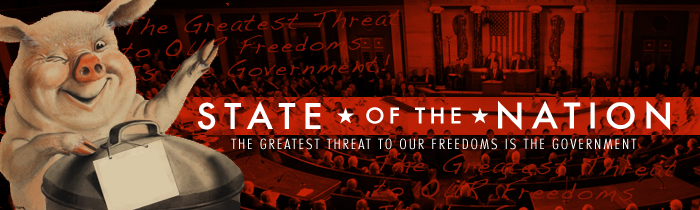
“Twelve voices were shouting in anger, and they were all alike. No question, now, what had happened to the faces of the pigs. The creatures outside looked from pig to man, and from man to pig, and from pig to man again; but already it was impossible to say which was which.” ― George Orwell, Animal Farm

What was striking about this year’s State of the Union address was not the sheer arrogance of the president’s remarks, the staged nature of the proceedings and interactions, or the predictable posturing of the rebuttals, but the extent to which the members of the various branches of government—President Obama, Congress, the Supreme Court, and the assorted government agencies—are just one big, brawling, noisy, semi-incestuous clan.

Watching these bureaucrats, both elected and appointed, interact in the unguarded moments before the event, with their hugging and kissing and nudging and joking and hobnobbing and general high spirits, I was reminded anew that these people—Republicans and Democrats alike—are united in a common goal, and it is not to protect and defend the Constitution. No, as Orwell recognized in Animal Farm, their common goal is to maintain the status quo, a goal that is helped along by an unquestioning, easily mollified, corporate media. In this way, the carefully crafted spectacle that is the State of the Union address is just that: an exaggerated farce of political theater intended to dazzle, distract and divide us, all the while the police state marches steadily forward.

No matter what the president and his cohorts say or how convincingly they say it, the reality Americans must contend with is that the world is no better the day after President Obama’s State of the Union address than it was the day before. Indeed, if the following rundown on the actual state of our freedoms is anything to go by, the world is a far more dangerous place.

Americans have no protection against police abuse. It is no longer unusual to hear about incidents in which police shoot unarmed individuals first and ask questions later, such as the 16-year-old teenager who skipped school only to be shot by police after they mistook him for a fleeing burglar. Then there was the unarmed black man in Texas “who was pursued and shot in the back of the neck by Austin Police… after failing to properly identify himself and leaving the scene of an unrelated incident.” And who could forget the 19-year-old Seattle woman who was accidentally shot in the leg by police after she refused to show her hands? What is increasingly common, however, is the news that the officers involved in these incidents get off with little more than a slap on the hands.

Americans are little more than pocketbooks to fund the police state. If there is any absolute maxim by which the federal government seems to operate, it is that the American taxpayer always gets ripped off. This is true, whether you’re talking about taxpayers being forced to fund high-priced weaponry that will be used against us, endless wars that do little for our safety or our freedoms, or bloated government agencies such as the National Security Agency with its secret budgets, covert agendas and clandestine activities. Rubbing salt in the wound, even monetary awards in lawsuits against government officials who are found guilty of wrongdoing are paid by the taxpayer.

Americans are no longer innocent until proven guilty. We once operated under the assumption that you were innocent until proven guilty. Due in large part to rapid advances in technology and a heightened surveillance culture, the burden of proof has been shifted so that the right to be considered innocent until proven guilty has been usurped by a new norm in which all citizens are suspects. This is exemplified by police practices of stopping and frisking people who are merely walking down the street and where there is no evidence of wrongdoing. Likewise, by subjecting Americans to full-body scans and license-plate readers without their knowledge or compliance and then storing the scans for later use, the government—in cahoots with the corporate state—has erected the ultimate suspect society. In such an environment, we are all potentially guilty of some wrongdoing or other.

Americans no longer have a right to self-defense. In the wake of various shootings in recent years, “gun control” has become a resounding theme for government officials, with President Obama even going so far as to pledge to reduce gun violence “with or without Congress.” Those advocating gun reform see the Second Amendment’s right to bear arms as applying only to government officials. As a result, even Americans who legally own firearms are being treated with suspicion and, in some cases, undue violence. In one case, a Texas man had his home subjected to a no-knock raid and was shot in his bed after police, attempting to deliver a routine search warrant, learned that he was in legal possession of a firearm. In another incident, a Florida man who was licensed to carry a concealed firearm found himself detained for two hours during a routine traffic stop in Maryland while the arresting officer searched his vehicle in vain for the man’s gun, which he had left at home.

Americans no longer have a right to private property. If government agents can invade your home, break down your doors, kill your dog, damage your furnishings and terrorize your family, your property is no longer private and secure—it belongs to the government. Likewise, if government officials can fine and arrest you for growing vegetables in your front yard, praying with friends in your living room, installing solar panels on your roof, and raising chickens in your backyard, you’re no longer the owner of your property.

Americans no longer have a say about what their children are exposed to in school. Incredibly, the government continues to insist that parents essentially forfeit their rights when they send their children to a public school. This growing tension over whether young people, especially those in the public schools, are essentially wards of the state, to do with as government officials deem appropriate, in defiance of the children’s constitutional rights and those of their parents, is reflected in the debate over sex education programs that expose young people to all manner of sexual practices and terminology, zero tolerance policies that strip students of any due process rights, let alone parental involvement in school discipline, and Common Core programs that teach students to be test-takers rather than critical thinkers.

Americans are powerless in the face of militarized police. In early America, citizens were considered equals with law enforcement officials. Authorities were rarely permitted to enter one’s home without permission or in a deceitful manner. And it was not uncommon for police officers to be held personally liable for trespass when they wrongfully invaded a citizen’s home. Unlike today, early Americans could resist arrest when a police officer tried to restrain them without proper justification or a warrant—which the police had to allow citizens to read before arresting them. (Daring to dispute a warrant with a police official today who is armed with high-tech military weapons and tasers would be nothing short of suicidal.) As police forces across the country continue to be transformed into outposts of the military, with police agencies acquiring military-grade hardware in droves, Americans are finding their once-peaceful communities transformed into military outposts, complete with tanks, weaponry, and other equipment designed for the battlefield.

Americans no longer have a right to bodily integrity. Court rulings undermining the Fourth Amendment and justifying invasive strip searches have left us powerless against police empowered to forcefully draw our blood, strip search us, and probe us intimately. Accounts are on the rise of individuals—men and women—being subjected to what is essentially government-sanctioned rape by police in the course of “routine” traffic stops. Most recently, a New Mexico man was subjected to a 12-hour ordeal of anal probes, X-rays, enemas, and finally a colonoscopy because he allegedly rolled through a stop sign.

Americans no longer have a right to the expectation of privacy. Despite the staggering number of revelations about government spying on Americans’ phone calls, Facebook posts, Twitter tweets, Google searches, emails, bookstore and grocery purchases, bank statements, commuter toll records, etc., Congress, the president and the courts have done little to nothing to counteract these abuses. Instead, they seem determined to accustom us to life in this electronic concentration camp.

Americans no longer have a representative government. We have moved beyond the era of representative government and entered a new age, let’s call it the age of authoritarianism. History may show that from this point forward, we will have left behind any semblance of constitutional government and entered into a militaristic state where all citizens are suspects and security trumps freedom. Even with its constantly shifting terrain, this topsy-turvy travesty of law and government has become America’s new normal. It is not overstating matters to say that Congress, which has done its best to keep their unhappy constituents at a distance, may well be the most self-serving, semi-corrupt institution in America.

Americans can no longer rely on the courts to mete out justice. The U.S. Supreme Court was intended to be an institution established to intervene and protect the people against the government and its agents when they overstep their bounds. Yet through their deference to police power, preference for security over freedom, and evisceration of our most basic rights for the sake of order and expediency, the justices of the Supreme Court have become the architects of the American police state in which we now live, while the lower courts have appointed themselves courts of order, concerned primarily with advancing the government’s agenda, no matter how unjust or illegal.

Yes, the world is a far more dangerous place than it was a year ago. What the president failed to mention in his State of the Union address, however (and what I document in my book A Government of Wolves: The Emerging American Police State), is the fact that it’s the government that poses the gravest threat to our freedoms and way of life, and no amount of politicking, parsing or pandering will change that. — John W. Whitehead

“You gotta remember, establishment, it’s just a name for evil. The monster doesn’t care whether it kills all the students or whether there’s a revolution. It’s not thinking logically, it’s out of control.”—John Lennon (1969)

It’s been 50 years since the Beatles—John Lennon, Paul McCartney, George Harrison and Ringo Starr—first landed in America on Feb. 7, 1964, and the news media is awash with nostalgic tributes to the band that “changed everything.” The Grammys will be saluting the Beatles with a 2-hour star-studded tribute. JFK Airport plans to dedicate a historical marker to commemorate the moment the four lads from Liverpool arrived on a Pan Am flight, to be greeted by hordes of screaming fans. And all across the country, including in New York City, conferences, tribute band performances, and reenactments will pay homage to Beatlemania and their music.

While there is much to celebrate about the Beatles coming to America, there is also much to regret, starting with the fact that while we may remember the music of the Beatles, we’ve lost sight of the hope for change and revolutionary spirit that were hallmarks of those days. Indeed, the Beatles opened the floodgates of music with their riveting Feb. 9 performance on the Ed Sullivan Show which was televised to 72 million Americans in what has been dubbed “the night that changed America.” Beatlemania, in turn, helped fuel a social, cultural and political revolution that took aim at everything from war, capitalism and racism to women’s rights, militarization and equality.

Fifty years later, while we may be inundated with a glut of music that passes for art and artists that pass for activists, with no shortage of national problems plaguing us (police abuse, endless wars, government corruption, government surveillance, inequality, etc.), we are sorely lacking individuals with the kind of radicalism and willingness to challenge the status quo. This is the difference between Then and Now, between an America that was ripe for the Beatles’ music andtheir message of change and an America that is celebrating the Beatles’ music while oblivious to their radicalism.

“The Beatles were like aliens dropped into the United States of 1964,” reports Todd Leopold for CNN. Leopold continues:

Kennedy’s assassination 10 weeks earlier had left a gloom on the land. Together, the two events created a dividing line between Then and Now. “A lot of people don’t understand why (Sullivan) was a seminal moment in the history of America and, for that matter, the history of the world,” former Arkansas governor and presidential candidate Mike Huckabee recalled in a recent speech. “The country had just gone through a very painful time of mourning. … There was an extraordinary amount of despair, heartbreak, disappointment,” he continued. “I think people forget that we were still grieving as a nation. The Beatles brought something to America more than music. They brought hope.”

The Beatles converged with their era—the Sixties generation—in an almost unprecedented way. At no other time in history, or since, has a generation been so connected. The vehicle was rock music. And the Beatles helped create an aural culture. As Randy Lewis notes for the Los Angeles Times:

If they were relatively friendly revolutionaries, with their pressed suits and bemused grins and professional politesse and their malt-shop lyrics, they were revolutionaries nonetheless… Now that everything is at our fingertips, a swipe or click away at any moment anywhere, it is hard to conceive of the effect they once had. The revolution had actually been televised then… Self-contained and self-directed — notwithstanding the guidance of manager Brian Epstein and producer George Martin, who were collaborators and not directors — the Beatles were something new and in no hurry to leave or conform. Other new things followed through doors they helped open. For better or worse, for a while, the world grew young.

The burgeoning baby boomers’ fascination with music brought the sixties generation into a collective whole. “Perhaps the most important aspect of the Beatles’ attraction during that influential era,” writes author Steven Stark, “was their collective synergy.” In other words, the Beatles popularized the sanctity of “the group,” amazingly so in a time when the traditional family was beginning to disintegrate. With the Beatles, the whole was always greater than the sum of the parts. This gave them a dazzling appeal.

Unlike artists before them, the Beatles had power over millions of people worldwide. In 1967, for example, with the release of their Sgt. Peppers Lonely Hearts Club Band album, as one critic noted, it was the closest Europe had been to unification since the Congress of Vienna in 1815. Most thought North America could have been included as well. And the Beatles became the embodiment of the Summer of Love with their live global BBC television broadcast of “All You Need Is Love” in June 1967. Approximately 400 million people across five continents tuned in. This type of power was something new. Previously, only popes, kings and perhaps a few intellectuals could hope to wield such influence in their lifetime.

Some have even argued that the Beatles’ influence helped bring down the Iron Curtain. As Yuri Pelyoshonok, a Soviet Studies professor, says:

The Soviet authorities thought of the Beatles as a secret Cold War weapon. The kids lost their interest in all Soviet unshakable dogmas and ideals, and stopped thinking of an English-speaking person as the enemy. That’s when the Communists lost two generations of young people ideologically, totally lost. That was an incredible impact.

Following the assassinations of Martin Luther King Jr. and Bobby Kennedy in 1968, the optimism of the Summer of Love quickly evaporated and young people revolted worldwide. In the U.S., the cataclysm came as 10,000 demonstrators descended on the Democratic Party’s national convention in August. Police reacted by brutally beating rock-throwing demonstrators as well as passersby, journalists and volunteers. Violence and revolt were now in vogue.

The Beatles, the most influential pop voice of the time, responded to this shift towards violence with “Revolution,” the first Beatles song with an explicitly political statement. As “Revolution” stresses, it was not a movement about physically overthrowing a regime. It was a spiritual revolution, one aimed at overthrowing preconceived notions. Thus, before you can effect a lasting change, as John Lennon sings, you have to “free your mind.” As John Lennon sings in his masterpiece on the need for nonviolent change, “When you talk about destruction, don’t you know that you can count me out?”

The underground press–which at the time included such newspapers as the Village Voice–immediately criticized the song and Lennon for not urging outright rebellion against authority. Lennon was quick to point out that if they really wanted a revolution, it had to begin with changing the way people think: “I’m not only up against the establishment but you too. I’ll tell you what’s wrong with the world: people–so do you want to destroy them? Until you/we change our heads–there’s no choice.”

It didn’t take long for Lennon, the activist of the group, to recognize that he could use his celebrity status to not only communicate his own ideas about the world but change the way people thought about issues of the day. He subsequently began his quest for worldwide peace. In fact, it may be that Lennon was the last great iconic anti-war activist of our age. Indeed, by October 1969, Lennon’s “Give Peace a Chance” had become a universal chant at anti-Vietnam War demonstrations. On November 15, during a peace rally in Washington, DC, the legendary folk singer Pete Seeger led nearly half a million demonstrators in singing “Give Peace a Chance” at the Washington Monument.

Unlike the other members of the Beatles, who are largely remembered for their music, Lennon’s political activism soon became a hallmark of the man himself. As Time magazine contributor Martin Lewis recognizes, “Of all Lennon’s legacies, one of the most enduring, and perhaps the most impressive, is who his enemies were. The true measure of his greatness was that in the 1970s he terrified the most powerful man in the world.” Lewis, of course, is referring to Richard Nixon, who became a determined enemy of Lennon.

Of all the Beatles, it may be Lennon’s activism which speaks most to the concerns of our present day and the ever-growing menace of the police state. In fact, as I document in my book A Government of Wolves: The Emerging American Police State, Lennon, enemy number one in the eyes of the U.S. government, was targeted for surveillance by the FBI (most likely in conjunction with the NSA).

Fearing Lennon might incite antiwar protests, the Nixon administration directed the FBI to keep close tabs on the ex-Beatle, resulting in close to 400 pages of files on his activities during the early 1970s. But the government’s actions didn’t stop with mere surveillance. The agency went so far as to attempt to have Lennon deported on drug charges. As professor Jon Wiener, a historian who sued the federal government to have the files on Lennon made public, observed, “This is really the story of F.B.I. misconduct, of the President using the F.B.I. to get his enemies, to use federal agencies to suppress dissent and to silence critics.”

Fifty years after America first fell in love with Lennon and his mop-top comrades, the Beatles’ legacy lives on—at least, their musical legacy lives on.

Yet while the Beatles’ greatest legacy was in effecting a revolution of spirit and mind, today we’re in dire need of revolutionaries willing to challenge the status quo.

The world could use another revolution, don’t you think? — John W. Whitehead

Pete Seeger and the Power of Song

“My job is to show folks there’s a lot of good music in this world, and if used right it may help to save the planet.”—Pete Seeger

“The world will be saved by people fighting for their homes. Homes will be saved by people who fight for the world.”—Pete Seeger

Pete Seeger, the 94-year-old activist-singer-songwriter who tried to change the world with every note he uttered, has died, and we are all the poorer for it.

A longtime friend whose letters I treasured for their hand-drawn embellishments and whose words of encouragement urged me to keep on fighting, Seeger belonged to a dying breed of Americans who cared more about making a difference using whatever resources were available to them than luxuriating in creature comforts and basking in the glow of their greatness.

Long before the Beatles or the Rolling Stones, Jim Hendrix or Bob Dylan, there was Pete Seeger, a lone ranger fighting injustice with little more than a five-string banjo in hand and a gift for putting words to music. Unarguably one of the most important musical influences of the 20th century, Seeger helped to lay the foundation for American protest music, singing out about the plight of everyday working folks and urging listeners to political and social activism.

Born in New York City on May 3, 1919, Seeger, whose father was a pacifist musicologist, was plunged into the world of music and politics from an early age. He studied sociology at Harvard University until 1938, when he dropped out and spent the summer bicycling through New England and New York, painting watercolors of farmers’ houses in return for food. Looking for but failing to get a job as a newspaper reporter in New York City, he then worked at the Archives of American Folk Music at the Library of Congress in Washington, D.C. In 1940, Seeger met Woody Guthrie at a Grapes of Wrath migrant-worker benefit concert. Seeger, Guthrie, Lee Hays and Millard Lampell joined together to form the Almanac Singers, which became known for its political radicalism and support of communism.

In 1942, Seeger was drafted by the U.S. Army and sent to Saipan in the Western Pacific. After the war, he helped start the People’s Songs Bulletin, later Sing Out! magazine, which combined information on folk music with social criticism. In 1950, Seeger formed The Weavers with Lee Hays, Ronnie Gilbert and Fred Hellerman. Targeted for the political messages behind some of their songs, the group was blacklisted and banned from television and radio.

In 1955, the House Committee on Un-American Activities subpoenaed Seeger to appear before them (read his testimony at http://www.peteseeger.net/HUAC.htm). During the hearings, Seeger refused to disclose his political views and the names of his political associates. When asked by the committee to name for whom he had sung, Seeger replied:

I am saying voluntarily that I have sung for almost every religious group in the country, from Jewish and Catholic, and Presbyterian and Holy Rollers and Revival Churches, and I do this voluntarily. I have sung for many, many different groups—and it is hard for perhaps one person to believe, I was looking back over the twenty years or so that I have sung around these forty-eight states, that I have sung in so many different places.

He was sentenced to one year in jail but, quoting the First Amendment, successfully appealed the decision after spending four hours behind bars. Nevertheless, he was blacklisted most of his life from normal radio and television work.

During the 1960s, Seeger traveled around the country, continuing to play his folk songs for the peace and civil rights movements. Deeply offended by the U.S. involvement in Vietnam, Seeger, along with other folk singers such as Joan Baez, led many protests.

“Wherever he was asked, when the need was the greatest, he, like Kilroy, was there. And still is,” said his long-time friend, Studs Terkel. “Though his voice is somewhat shot, he holds forth on that stage. Whether it be a concert hall, a gathering in the park, a street demonstration, any area is a battleground for human rights.”

In 1963, Seeger recorded the now-famous gospel song “We Shall Overcome.” In 1965, he sang it on the 50-mile walk from Selma to Montgomery, Alabama, with Martin Luther King, Jr. and 1,000 other marchers. That song would go on to become the anthem for the civil rights movement and be translated into many languages. Seeger also turned his attention to cleaning up the Hudson River that ran past his home. In 1966, he helped form Clearwater, an organization dedicated to educating the public on environmental concerns such as pollution and protecting the river. The group offers educational programs for children on a 76-foot replica of a traditional Hudson cargo sloop and holds a two-day festival on the banks of the Hudson River every June.

Seeger was awarded the Presidential Medal of the Arts and the prestigious Kennedy Center Award in 1994. In 1996, he was inducted into the Rock and Roll Hall of Fame for his contribution to music and to the development of rock and folk music. In April of that year, he received the Harvard Arts Medal, and after decades of creating songs, in 1997, Seeger won a Grammy Award for Best Traditional Folk Album for his album, Pete. In May 2009, a broad cross-section of musicians including Bruce Springsteen, Dave Matthews, John Mellencamp, Joan Baez, Ani DiFranco, Roger McGuinn of the Byrds, Emmylou Harris and others assembled at Madison Square Garden to pay tribute to Seeger and celebrate his 90th birthday.

Right up until the end, Seeger never stopped speaking out and he never stopped urging young people to follow their hearts and take initiative: “Well, here’s hoping all the foregoing will help you avoid a few dead-end streets (we all hit some), and here’s hoping enough of your dreams come true to keep you optimistic about the rest. We’ve got a big world to learn how to tie together. We’ve all got a lot to learn. And don’t let your studies interfere with your education.”

In an interview I conducted with Pete Seeger several years ago, I asked him whether he had found an answer to the question “When will they ever learn?” which he repeatedly posed in his song, “Where Have All the Flowers Gone.”

Seeger’s response is one for the books:

We will never know everything. But I think if we can learn within the next few decades to face the danger we all are in, I believe there will be tens of millions, maybe hundreds of millions, of human beings working wherever they are to do something good. I tell everybody a little parable about the “teaspoon brigades.” Imagine a big seesaw. One end of the seesaw is on the ground because it has a big basket half full of rocks in it. The other end of the seesaw is up in the air because it’s got a basket one quarter full of sand. Some of us have teaspoons and we are trying to fill it up. Most people are scoffing at us. They say, “People like you have been trying for thousands of years, but it is leaking out of that basket as fast as you are putting it in.” Our answer is that we are getting more people with teaspoons every day. And we believe that one of these days or years—who knows—that basket of sand is going to be so full that you are going to see that whole seesaw going zoop! in the other direction. Then people are going to say, “How did it happen so suddenly?” And we answer, “Us and our little teaspoons over thousands of years.”

But I don’t think we have forever. I now believe that all technological societies tend to self-destruct. The reason is that the very things that make us a successful technological society, such as our curiosity, our ambition and determination, will also cause us to fall.

Rest in peace, Pete, and not to worry. I and the other ragtag members of your teaspoon brigade will keep working to change the world one teaspoon at a time. — John W. Whitehead

Click here to read the Seeger interview in its entirety.

“All governments are run by liars.”—Independent journalist I.F. “Izzy” Stone

President Obama has managed, with singular assistance from Congress and the courts, to mangle the Constitution through repeated abuses, attacks and evasions.

This is nothing new, as I’ve documented in my book A Government of Wolves: The Emerging American Police State. However, with his recent speech on the National Security Agency—a heady cocktail of lies, obfuscations, contradictions and Orwellian doublespeak—Obama has also managed to pervert and propagandize our nation’s history, starting with Paul Revere and the Sons of Liberty, likening their efforts to secure our freedoms to NSA phone surveillance. Frankly, George Orwell’s Winston Smith, rewriting news stories for Big Brother and the Ministry of Truth, couldn’t have done a better job of revising history to suit the party line.

While it didn’t bode well for what was to follow, here’s how Obama opened his speech:

At the dawn of our Republic, a small, secret surveillance committee borne out of the ‘The Sons of Liberty’ was established in Boston. And the group’s members included Paul Revere. At night, they would patrol the streets, reporting back any signs that the British were preparing raids against America’s early Patriots. Throughout American history, intelligence has helped secure our country and our freedoms.

Obama’s inference is clear: rather than condemning the NSA for encroaching on our privacy rights, we should be commending them for helping to “secure our country and our freedoms.” Never mind that the Sons of Liberty were actually working against the British government, to undermine what they perceived as a repressive regime guilty of perpetrating a host of abuses against the colonists.

After such a 1984-esque send-up, it doesn’t even really matter what else Obama had to say in his speech about NSA reforms and the like. Rest assured, it was largely a pack of lies. Mind you, Obama said it eloquently enough and interspersed it with all the appropriately glib patriotic remarks about individual freedom and the need to defend the Constitution and securing the life of our nation while preserving our liberties. After all, Obama has proven to be very good at saying one thing and doing another, whether it’s insisting that “you can keep your health care plan,” that he’ll close Guantanamo, or that his administration’s controversial drone strikes only target terrorists and not civilians.

When it comes to the NSA, Obama has been lying to the American people for quite some time now. There was the time he claimed the secret FISA court is “transparent.” Then he insisted that “we don’t have a domestic spying program.” And then, to top it all off, he actually insisted there was no evidence the NSA was “actually abusing” its power. As David Sirota writes for Salon: “it has now become almost silly to insinuate or assume that the president hasn’t also been lying. Why? Because if that’s true — if indeed he hasn’t been deliberately lying — then it means he has been dangerously, irresponsibly and negligently ignorant of not only the government he runs, but also of the news breaking around him.”

Sirota continues:

I, of course, don’t buy that at all. I don’t buy that a constitutional lawyer and legal scholar didn’t know that the FISA court is secret — aka the opposite of “transparent.” I don’t buy that he simply didn’t see any of the news showing that spying is happening in the United States. And I don’t buy that he didn’t know that there is evidence — both public and inside his own administration — of the NSA “actually abusing” its power.

I don’t buy any of that because, to say the least, it makes no sense. I just don’t buy that he’s so unaware of the world around him that he made such statements from a position of pure ignorance. On top of that, he has a motive. Yes, Obama has an obvious political interest in trying to hide as much of his administration’s potentially illegal behavior as possible, which means he has an incentive to calculatedly lie. For all of these reasons, it seems safe to suggest that when it comes to the NSA situation, the president seems to be lying.

So in terms of Obama’s latest speech on the NSA, if you read between the lines—or just ignore the president’s words and pay attention to his actions—it’s clear that nothing is going to change. The NSA will continue to abuse its power by spying on Americans’ phone calls and emails. They will continue to collect metadata on our various communications and activities. And they will continue to carry out their surveillance in secret, with no attempts at transparency or accountability.

The NSA will do so, no matter what Obama claims to the contrary, because this black ops-funded agency whose very existence is abhorrent to the Constitution has become a power unto itself. They no longer work for us or for the president, for that matter. He works for them.

Remember, Obama is the chief executive of a super secretive surveillance state whose overarching purpose is to remain in power by any means available. As such, he and his surveillance state cohorts have far more in common with King George and the British government of his day than with the American colonists who worked hard to foment a rebellion and overthrow a despotic regime.

Indeed, Obama and his speechwriters would do well to brush up on their history. In doing so, they will find that the Sons of Liberty, the “small, secret surveillance committee” they conveniently liken to the NSA, was in fact an underground, revolutionary movement that fought the established government of its day, whose members were considered agitators, traitors and terrorists not unlike Edward Snowden.

In much the same way that the U.S. government under the leadership of Barack Obama is today going after whistleblowers and activists who oppose their tactics, the British government went after the Sons of Liberty. These people were neither career politicians nor government bureaucrats. Instead, they were mechanics, merchants, artisans and the like—ordinary people groaning under the weight of Britain’s oppressive rule—who, having reached a breaking point, had decided that enough was enough. Through the use of Committees of Correspondence, they alerted the colonists to the abuses being meted out by the British crown by way of pamphlets, speeches and resolutions, inciting them to actively resist the acts of oppression, and conspiring with them to revolt.

The colonists’ treatment at the hands of the British was not much different from the abuses meted out to the American people today: they too were taxed on everything from food to labor without any real say in the matter, in addition to which they had their homes invaded, their property seized and searched, their families terrorized, their communications, associations and activities monitored, and their attempts to defend themselves and challenge the government’s abuses dismissed as belligerence, treachery, and sedition.

Unlike most Americans today, who remain ignorant of the government’s abuses, cheerfully distracted by the entertainment spectacles trotted out before them by a complicit media, readily persuaded that the government has their best interests at heart, and easily cowed by the slightest show of force, the colonists responded to the government’s abuses with outrage, activism and rebellion. They staged boycotts of British goods and organized public protests, mass meetings, parades, bonfires and other demonstrations, culminating with their most famous act of resistance, the Boston Tea Party.

On the night of December 16, 1773, a group of men dressed as Indians boarded three ships that were carrying tea. Cheered on by a crowd along the shore, they threw 342 chests of tea overboard in protest of a tax on the tea. Many American merchants were aghast at the wanton destruction of property. A town meeting in Bristol, Massachusetts, condemned the action. Ben Franklin even called on his native city to pay for the tea and apologize. But as historian Pauline Maier notes, the Boston Tea Party was a last resort for a group of people who had stated their peaceful demands but were rebuffed by the British: “The tea resistance constituted a model of justified forceful resistance upon traditional criteria.”

The rest, as they say, is history. Yet it’s a history we cannot afford to forget or allow to be rewritten. The colonists suffered under the weight of countless tyrannies before they finally were emboldened to stand their ground. They attempted to reason with the British crown, to plea their cause, even to negotiate. It was only when these means proved futile that they resorted to outright resistance, civil disobedience and eventually rebellion.

More than 200 years later, we are once again suffering under a long train of abuses and usurpations. What Americans today must decide is how committed they are to the cause of freedom and how far they’re willing to go to restore what has been lost. Nat Hentoff, one of my dearest friends and a formidable champion of the Constitution, has long advocated for the resurgence of Committees of Correspondence. As Nat noted:

This resistance to arrant tyranny first became part of our heritage when Samuel Adams and the Sons of Liberty formed the original Committees of Correspondence, a unifying source of news of British tyranny throughout the colonies that became a precipitating cause of the American Revolution. Where are the Sons of Liberty, the Committees of Correspondence and the insistently courageous city councils now, when they are crucially needed to bring back the Bill of Rights that protect every American against government tyranny worse than King George III’s? Where are the citizens demanding that these doorways to liberty be opened … What are we waiting for?

What are we waiting for, indeed? As Thomas Jefferson said, “I prefer dangerous freedom over peaceful slavery.”

“[E]verywhere, “time is winding up,” in the words of one of our spirituals, “corruption in the land, people take a stand, time is winding up.”—Martin Luther King Jr.

We now live in a two-tiered system of governance. There are two sets of laws: one set for the government and its corporate allies, and another set for you and me.

The laws which apply to the majority of the population allow the government to do things like sending SWAT teams crashing through your door in the middle of the night, rectally probing you during a roadside stop, or listening in on your phone calls and reading all of your email messages, confiscating your property, or indefinitely detaining you in a military holding cell. These are the laws which are executed every single day against a population which has up until now been blissfully ignorant of the radical shift taking place in American government.

Then there are the laws constructed for the elite, which allow bankers who crash the economy to walk free. They’re the laws which allow police officers to avoid prosecution when they shoot unarmed citizens, strip search non-violent criminals, or taser pregnant women on the side of the road, or pepper spray peaceful protestors. These are the laws of the new age we are entering, an age of neo-feudalism, in which corporate-state rulers dominate the rest of us, where the elite create the laws which can result in a person being jailed for possessing a small amount of marijuana while bankers that launder money for drug cartels walk free. In other words, we have moved into an age where we are the slaves and they are the rulers.

Unfortunately, this two-tiered system of government has been a long time coming. As I detail in my book A Government of Wolves: The Emerging American Police State, the march toward an imperial presidency, to congressional intransigence and impotence, to a corporate takeover of the mechanisms of government, and the division of America into haves and have nots has been building for years.

Thus we now find ourselves at a point where, for the first time in history, Congress is dominated by a majority of millionaires who are, on average, 14 times wealthier than the average American. Making matters worse, as the Center for Responsive Politics reports, “at a time when lawmakers are debating issues like unemployment benefits, food stamps and the minimum wage, which affect people with far fewer resources, as well as considering an overhaul of the tax code,” our so-called representatives are completely out of touch with the daily struggles of most Americans–those who live from paycheck to paycheck and are caught in the exhausting struggle to survive on a day-to-day basis.

Indeed, although America is supposed to be a representative republic, these people– who earn six-figure salaries and inhabit a world exempt from parking tickets, where gym membership is free and health care is second-to-none, where you only have to work two, maybe three days a week and get 32 fully reimbursed road trips home a year, travel to foreign lands, discounts in Capitol Hill tax-free shops and restaurants, free reserved parking at Washington National Airport, free fresh-cut flowers from the Botanic Gardens, and free assistance in the preparation of income taxes–neither represent nor serve the American people. They have instead appointed themselves our masters.

While Congress should be America’s representative body, too many of its members bear little resemblance to those they have been elected to represent. As Dan Eggen reports for The Washington Post: “The new figures underscore a long-standing trend of wealth accumulation in Congress, which is populated overwhelmingly with millionaires and near-millionaires who often own multiple homes and other assets out of reach for most of the voters they represent.”

Many of our politicians live like kings. Chauffeured around in limousines, flying in private jets and eating gourmet meals, all paid for by the American taxpayer, they are far removed from those they are supposed to represent. Such a luxurious lifestyle makes it difficult to identify with the “little guy”–the roofers, plumbers and blue-collar workers who live from paycheck to paycheck and keep the country running with their hard-earned dollars and the sweat of their brows.

The unfortunate but simple fact is that the rich sit perched at the top of the government. As Joseph Stiglitz writes for Vanity Fair:

Virtually all U.S. senators, and most of the representatives in the House, are members of the top 1 percent when they arrive, are kept in office by money from the top 1 percent, and know that if they serve the top 1 percent well they will be rewarded by the top 1 percent when they leave office. By and large, the key executive-branch policymakers on trade and economic policy also come from the top 1 percent. When pharmaceutical companies receive a trillion-dollar gift–through legislation prohibiting the government, the largest buyer of drugs, from bargaining over price–it should not come as cause for wonder. It should not make jaws drop that a tax bill cannot emerge from Congress unless big tax cuts are put in place for the wealthy. Given the power of the top 1 percent, this is the way you would expect the system to work.

Sadly, electoral politics have been so thoroughly corrupted by corporate money that there is little chance, even for a well-meaning person, to affect any real change through Congress. Whether it be the Oval Office or the halls of Congress, the road to the ballot box is an expensive one, and only the wealthy, or those supported by the wealthy, are even able to get to the starting line.

Just consider the 2012 presidential election cycle. Both parties spent $1 billion each attempting to get their candidate elected to the presidency. This money came from rich donors and corporate sponsors, intent on getting their candidate in office. Once in office, these already privileged wealthy bureaucrats enter into a life of even greater privilege, unfortunately at the expense of the American taxpayer. It doesn’t even seem to matter whether they’re Democrats or Republicans–they all take full advantage of what one news report described as “a mountain of perks that most Fortune 500 companies couldn’t begin to rival.”

Even President Obama’s closest advisers are millionaires, including those on his 15-member cabinet. It is not unusual for some of them to own vacation homes, such as Kathleen Sebelius, secretary of Health and Human Services, who owns a “summer home worth more than a million dollars.

And then there are the lobbyists, the source of much corruption and exchanging of money in Washington. With an estimated 26 lobbyists per congressman, it should come as no surprise that once elected, even those with the best of intentions seem to find it hard to resist the lure of lobbyist dollars, of which there are plenty to go around.

This lobbying is in turn buoyed by a congressional lifestyle which demands that our representatives spend the majority of their time fund raising for campaigns, rather than responding to the needs of their constituents. In November 2012, the Democratic House leadership offered a model daily schedule to newly elected Democrats which suggests a ten-hour day, five hours of which are dominated by “call time” and “strategic outreach,” including fund raisers and correspondence with potential donors. Three or four hours are for actually doing the job they were elected to do, such as attending committee meetings, voting on legislation, and interacting with constituents.

When half of one’s time is devoted to asking for money from rich individuals and special interests, there is no way that he can respond to the problems which pervade the country. Even well-meaning Congressmen face a Catch-22 where they are pushed to fundraise to secure their seats, but then once in office, it is basically impossible for them to do their jobs. The full ramifications of this are laid out by Rep. Brad Miller (D-NC):

Any member who follows that schedule will be completely controlled by their staff, handed statements that their staff prepared, speaking from talking points they get emailed from leadership… It really does affect how members of Congress behave if the most important thing they think about is fundraising. You end up being nice to people that probably somebody needs to be questioning skeptically… You won’t ask tough questions in hearings that might displease potential contributors, won’t support amendments that might anger them, will tend to vote the way contributors want you to vote.

What we are faced with is a government by oligarchy–in other words, one that is of the rich, by the rich and for the rich. Yet the Constitution’s Preamble states that it is “we the people” who are supposed to be running things. If our so-called “representative government” is to survive, we must first wrest control of our government from the wealthy elite who run it. That is a problem with no easy solutions, and voting is the least of what we should be doing.

“What they don’t want,” noted comedian George Carlin, is “a population of citizens capable of critical thinking. They don’t want well-informed, well-educated people capable of critical thinking. They’re not interested in that. That doesn’t help them. That’s against their interests.”

A population of citizens capable of critical thinking? That’s a good place to start, and it’s a sure-fire way to jumpstart a revolution. As Abraham Lincoln said, “Wise men established these great self-evident truths, that when in the distant future some man, some faction, some interest, should set up the doctrine that none but rich men, or none but white men, were entitled to life, liberty and the pursuit of happiness, their posterity should look up again at the Declaration of Independence and take courage to renew the battle which their fathers began.”

Inspiring words, but what do they really mean for those of us laboring under the weight of an overreaching, militarized, corrupt government that grows increasingly so with each passing day?

How can we change this state of affairs? The government is too big, too powerful, and its overlords too entrenched to willingly give up any of its power or wealth. The wisest option is to employ the tactics of past protest movements such as the Bonus Army, the Civil Rights Movement, and the 1960s anti-war movement, all of which used sleep-ins, sit-ins and marches to oppose government policies, counter injustice and bring about meaningful change.

For example, in May of 1932, more than 43,000 people, dubbed the Bonus Army—World War I veterans and their families—marched on Washington. Out of work, destitute and with families to feed, more than 10,000 veterans set up tent cities in the nation’s capital and refused to leave until the government agreed to pay the bonuses they had been promised as a reward for their services. The Senate voted against paying them immediately, but the protesters didn’t budge. Congress adjourned for the summer, and still the protesters remained encamped. Finally, on July 28, under orders from President Herbert Hoover, the military descended with tanks and cavalry, beating some protesters senseless and setting their makeshift camps on fire. Still, the protesters returned the following year, and eventually their efforts not only succeeded in securing payment of the bonuses but contributed to the passage of the G.I. Bill of Rights.

Similarly, the Civil Rights Movement mobilized hundreds of thousands of people to strike at the core of an unjust and discriminatory society. Likewise, while the 1960s anti-war movement began with a few thousand perceived radicals, it ended with hundreds of thousands of protesters, spanning all walks of life, demanding the end of American military aggression abroad.

What these movements had was a coherent message, the mass mobilization of a large cross section of American society, what Martin Luther King Jr. called a philosophy of “militant nonviolent resistance” and an eventual convergence on the nation’s seat of power—Washington, DC—the staging ground for the corporate coup, where the shady deals are cut, where lobbyists and politicians meet, and where corporate interests are considered above all else.

It is no coincidence that just prior to his assassination in April 1968, King was plotting “to build a shantytown in Washington, patterned after the bonus marches of the thirties, to dramatize how many people have to live in slums in our nation.”

King’s advice still rings true: “We need to put pressure on Congress to get things done. We will do this with First Amendment activity. If Congress is unresponsive, we’ll have to escalate in order to keep the issue alive and before it. This action may take on disruptive dimensions, but not violent in the sense of destroying life or property: it will be militant nonviolence.”

The balance of power that was once a hallmark of our republic no longer exists. James Madison’s warning that “the accumulation of all powers, legislative, executive, and judiciary, in the same hands, whether of one, a few, or many, and whether hereditary, self-appointed, or elected, may justly be pronounced the very definition of tyranny” has, regrettably come to pass.

Clearly, it’s time for a mass movement dedicated to change through “militant nonviolence.” If not, the shadow of tyranny that now hangs over us will eventually destroy every last semblance of freedom.

“We know through painful experience that freedom is never voluntarily given by the oppressor,” Martin Luther King Jr. warned in his “Letter from a Birmingham Jail.” “It must be demanded by the oppressed.” — John W. Whitehead

“[A security camera] doesn’t respond to complaint, threats, or insults. Instead, it just watches you in a forbidding manner. Today, the surveillance state is so deeply enmeshed in our data devices that we don’t even scream back because technology companies have convinced us that we need to be connected to them to be happy.”—Pratap Chatterjee, journalist

What is most striking about the American police state is not the mega-corporations running amok in the halls of Congress, the militarized police crashing through doors and shooting unarmed citizens, or the invasive surveillance regime which has come to dominate every aspect of our lives. No, what has been most disconcerting about the emergence of the American police state is the extent to which the citizenry appears content to passively wait for someone else to solve our nation’s many problems. Unless Americans are prepared to engage in militant nonviolent resistance in the spirit of Martin Luther King Jr. and Gandhi, true reform, if any, will be a long time coming.

Yet as I detail in my book A Government of Wolves: The Emerging American Police Stateif we don’t act soon, all that is in need of fixing will soon be unfixable, especially as it relates to the police state that becomes more entrenched with each passing day. By “police state,” I am referring to more than a society overrun by the long arm of the police. I am referring to a society in which all aspects of a person’s life are policed by government agents, one in which all citizens are suspects, their activities monitored and regulated, their movements tracked, their communications spied upon, and their lives, liberties and pursuit of happiness dependent on the government’s say-so.

That said, how can anyone be expected to “fix” what is broken unless they first understand the lengths to which the government with its arsenal of technology is going in order to accustom the American people to life in a police state and why being spied on by government agents, both state and federal, as well as their partners in the corporate world, is a problem, even if you’ve done nothing wrong.

Indeed, as the trend towards overcriminalization makes clear, it won’t be long before the average law-abiding American is breaking laws she didn’t even know existed during the course of a routine day. The point, of course, is that while you may be oblivious to your so-called law-breaking—whether it was collecting rainwater to water your lawn, lighting a cigarette in the privacy of your home, or gathering with friends in your backyard for a Sunday evening Bible study—the government will know each and every transgression and use them against you.

As noted by the Brookings Institution, “For the first time ever, it will become technologically and financially feasible for authoritarian governments to record nearly everything that is said or done within their borders — every phone conversation, electronic message, social media interaction, the movements of nearly every person and vehicle, and video from every street corner.”

As the following will show, the electronic concentration camp, as I have dubbed the surveillance state, is perhaps the most insidious of the police state’s many tentacles, impacting almost every aspect of our lives and making it that much easier for the government to encroach on our most vital freedoms, ranging from free speech, assembly and the press to due process, privacy, and property, by eavesdropping on our communications, tracking our movements and spying on our activities.

Tracking you based on your consumer activities: Fusion centers, federal-state law enforcement partnerships which attempt to aggregate a variety of data on so-called “suspicious persons,” have actually collected reports on people buying pallets of bottled water, photographing government buildings, and applying for a pilot’s license as “suspicious activity.” Retailers are getting in on the surveillance game as well. Large corporations such as Target have been tracking and assessing the behavior of their customers, particularly their purchasing patterns, for years. In 2015, mega-food corporations will be rolling out high-tech shelving outfitted with cameras in order to track the shopping behavior of customers, as well as information like the age and sex of shoppers.

Tracking you based on your public activities: Sensing a booming industry, private corporations are jumping on the surveillance state bandwagon, negotiating lucrative contracts with police agencies throughout the country in order to create a web of surveillance that encompasses all major urban centers. Companies such as NICE and Bright Planet are selling equipment and services to police departments with the promise of monitoring large groups of people seamlessly, as in the case of protests and rallies. They are also engaging in extensive online surveillance, looking for any hints of “large public events, social unrest, gang communications, and criminally predicated individuals.” Defense contractors are attempting to take a bite out of this lucrative market as well. Raytheon has recently developed a software package known as Riot, which promises to predict the future behavior of an individual based upon his social media posts.

Tracking you based on your phone activities: The CIA has been paying AT&T over $10 million per year in order to gain access to data on Americans’ phone calls abroad. This is in addition to telecommunications employees being embedded in government facilities to assist with quick analysis of call records and respond to government requests for customer location data. They receive hundreds of thousands of such requests per year.

Tracking you based on your computer activities: Federal agents now employ a number of hacking methods in order to gain access to your computer activities and “see” whatever you’re seeing on your monitor. Malicious hacking software can be installed via a number of inconspicuous methods, including USB, or via an email attachment or software update. It can then be used to search through files stored on a hard drive, log keystrokes, or take real time screenshots of whatever a person is looking at on their computer, whether personal files, web pages, or email messages. It can also be used to remotely activate cameras and microphones, offering another means of glimpsing into the personal business of a target.

Tracking you based on your behavior: Thanks to a torrent of federal grants, police departments across the country are able to fund outrageous new surveillance systems that turn the most basic human behaviors into suspicious situations to be studied and analyzed. Police in California, Massachusetts, and New York have all received federal funds to create systems like that operated by the New York Police Department, which “links 3,000 surveillance cameras with license plate readers, radiation sensors, criminal databases and terror suspect lists.” Police all across the country are also now engaging in big data mining operations, often with the help of private companies, in order to develop city-wide nets of surveillance. For example, police in Fort Lauderdale, Florida, now work with IBM in order to “integrate new data and analytics tools into everyday crime fighting.”

Tracking you based on your face: Facial recognition software promises to create a society in which every individual who steps out into public is tracked and recorded as they go about their daily business. The goal is for government agents to be able to scan a crowd of people and instantaneously identify all of the individuals present. Facial recognition programs are being rolled out in states all across the country (only twelve states do not use facial recognition software). For example, in Ohio, 30,000 police officers and court employees are able to access the driver’s license images of people in the state, without any form of oversight to track their views or why they’re accessing them. The FBI is developing a $1 billion program, Next Generation Identification, which involves creating a massive database of mugshots for police all across the country.

Tracking you based on your car: License plate readers, which can identify the owner of any car that comes within its sights, are growing in popularity among police agencies. Affixed to overpasses or cop cars, these devices give police a clear idea of where your car was at a specific date and time, whether the doctor’s office, the bar, the mosque, or at a political rally. State police in Virginia used license plate readers to record every single vehicle that arrived to President Barack Obama’s inauguration in 2009 from Virginia. They also recorded the license plates of attendees at rallies prior to the election, including for then-candidate Obama and Republican vice presidential candidate Sarah Palin. This data collection came at the request of the U.S. Secret Service. Incredibly, Virginia police stored data on some 8 million license plates, some for up to three years.

Tracking you based on your social media activities: The obsession with social media as a form of surveillance will have some frightening consequences in coming years. As Helen A.S. Popkin, writing for NBC News, has astutely observed, “We may very well face a future where algorithms bust people en masse for referencing illegal ‘Game of Thrones’ downloads, or run sweeps for insurance companies seeking non-smokers confessing to lapsing back into the habit. Instead of that one guy getting busted for a lame joke misinterpreted as a real threat, the new software has the potential to roll, Terminator-style, targeting every social media user with a shameful confession or questionable sense of humor.”

Tracking you based on your metadata: Metadata is an incredibly invasive set of data to have on a person. Indeed, with access to one’s metadata, one can “identify people’s friends and associates, detect where they were at a certain time, acquire clues to religious or political affiliations, and pick up sensitive information like regular calls to a psychiatrist’s office, late-night messages to an extramarital partner or exchanges with a fellow plotter.” The National Security Agency (NSA) has been particularly interested in metadata, compiling information on Americans’ social connections “that can identify their associates, their locations at certain times, their traveling companions and other personal information.” Mainway, the main NSA tool used to connect the dots on American social connections, collected 700 million phone records per day in 2011. That number increased by 1.1 billion in August 2011. The NSA is now working on creating “a metadata repository capable of taking in 20 billion ‘record events’ daily and making them available to N.S.A. analysts within 60 minutes.”

Tracking you from the skies: Nothing, and I mean nothing, will escape government eyes, especially when drones take to the skies in 2015. These gadgets, ranging from the colossal to the miniature, will have the capability of seeing through the walls of your home and tracking your every movement.

To put it bluntly, we are living in an electronic concentration camp. Through a series of imperceptible steps, we have willingly allowed ourselves to become enmeshed in a system that knows the most intimate details of our lives, analyzes them, and treats us accordingly. Whether via fear of terrorism, narcissistic pleasure, or lazy materialism, we have slowly handed over our information to all sorts of entities, corporate and governmental, public and private, who are now using that information to cow and control us for their profit. As George Orwell warned, “You had to live—did live, from habit that became instinct—in the assumption that every sound you made was overheard, and, except in darkness, every movement scrutinized.”

Thus, we have arrived in Orwell’s world. The question now is: will we take a stand and fight to remain free or will we go gently into the concentration camp? — John W. Whitehead

No power on earth has a right to take our property from us without our consent.”—John Jay, first Chief Justice of the United States

“How ‘secure’ do our homes remain if police, armed with no warrant, can pound on doors at will and … forcibly enter?”—Supreme Court Justice Ruth Bader Ginsburg, the lone dissenter in Kentucky v. King

If the government can tell you what you can and cannot do within the privacy of your home, whether it relates to what you eat, what you smoke or whom you love, you no longer have any rights whatsoever within your home.

If government officials can fine and arrest you for growing vegetables in your front yard, praying with friends in your living room, installing solar panels on your roof, and raising chickens in your backyard, you’re no longer the owner of your property. If school officials can punish your children for what they do or say while at home or in your care, your children are not your own—they are the property of the state.

If government agents can invade your home, break down your doors, kill your dog, damage your furnishings and terrorize your family, your property is no longer private and secure—it belongs to the government. Likewise, if police can forcefully draw your blood, strip search you, and probe you intimately, your body is no longer your own, either.

This is what a world without the Fourth Amendment looks like, where the lines between private and public property have been so blurred that private property is reduced to little more than something the government can use to control, manipulate and harass you to suit its own purposes, and you the homeowner and citizen have been reduced to little more than a tenant or serf in bondage to an inflexible landlord.

Examples of this disregard for the sanctity of private property—whether in the form of one’s home, one’s possessions, or one’s person—abound. Here are just a few.

In San Rafael, California, it is now illegal to smoke a cigarette or other tobacco product inside “apartments, condos, duplexes, and multi-family houses.” Although lawmakers hope the ordinance will be “self-enforcing,” they’re encouraging landlords to threaten tenants with eviction should they run afoul of the law.

In Ohio, it’s illegal to alter one’s car with a hidden compartment if the “intent” is to conceal illegal drugs. Although Norman Gurley had no drugs on his person, nor in his car, nor could it be proven that he intended to conceal drugs, he was still arrested for the “crime” of having a hidden compartment in the trunk of his car.

In Florida and elsewhere throughout the country, home vegetable gardens are being targeted as illegal. For 17 years, Hermine Ricketts and Tom Carroll have tended the vegetable garden in their front yard, relying on it for 80 percent of their food intake, only to be told by city officials that they must get rid of it or face $50 a day in fines. The reason? The vegetable garden is “inconsistent with the city’s aesthetic character.”

In Iowa, a war veteran attempting to wean his family off expensive corporate farm products, GMOs and pesticides has been charged with violating a city ordinance and now faces up to 30 days in jail and a $600 fine for daring to raise chickens in his backyard for his personal use, despite statements of support from his neighbors.

In Virginia, school officials suspended two boys for the remainder of the school year and charged them with possession of a firearm after they were reported to the police for playing with toy airsoft guns in their front yard, while waiting for the morning school bus. At no time did the boys attempt to take the toy guns on the bus or to school.

The most obvious disrespect for property rights comes in the form of the tens of thousands of SWAT team raids that occur across the country on a yearly basis. Usually undertaken under the pretense of serving a drug warrant, these raids involve police arriving at a private residence in SWAT gear, armed to the hilt, kicking down doors, apprehending all persons inside the home, then determining if a crime has been committed. That was Judy Sanchez’s experience when FBI agents investigating gang activity used a chainsaw to cut through her door, then forced Sanchez and her child to the ground. It was only after invading Sanchez’s home and terrorizing her family that agents realized they had targeted the wrong address.

Unfortunately, we in America get so focused on the Fourth Amendment’s requirement of a warrant before government agents can invade our property (a requirement that means little in an age of kangaroo courts and rubberstamped warrant requests) that we fail to properly appreciate the first part of the statement declaring that we have a right to be secure in our “persons, houses, papers, and effects.” What this means is that the Fourth Amendment’s protections were intended to not only follow us wherever we go but also apply to all that is ours—whether you’re talking about our physical bodies, our biometric data, our possessions, our families, or our way of life. However, in an 8-1 ruling in Kentucky v. King (2011), the U.S. Supreme Court sanctioned SWAT teams smashing down doors of homes or apartments without a warrant if they happen to “suspect” you might be doing something illegal in your home.

At a time when the government routinely cites national security as the justification for its endless violations of the Constitution, the idea that a citizen can actually be “secure” or protected against such government overreach seems increasingly implausible, while suggesting that a person take steps to secure his person and property against the government could have one accused of fomenting anti-government sentiment.

Nevertheless, the reality of our age is this: if the government chooses to crash through our doors, listen to our phone calls, read our emails and text messages, fine us for growing vegetables in our front yard, jail us for raising chickens in our backyard, forcibly take our blood and saliva, and probe our vaginas and rectums, there’s little we can do to stop them. At least, not at that particular moment. When you’re face to face with a government agent who is not only armed to the hilt and inclined to shoot first and ask questions later but also woefully ignorant of the fact that he works for you, if you value your life, you don’t talk back.

This sad reality came about as a result of our being asleep at the wheel. We failed to ask questions and hold our representatives accountable to abiding by the Constitution, while the government amassed an amazing amount of power over us, and backed up that power-grab with a terrifying amount of military might and weaponry, and got the courts to sanction their actions every step of the way.

However, once the dust settles and you’ve had a chance to catch your breath, I hope you’ll remember that the Constitution begins with those three beautiful words, “We the people.” In other words, there is no government without us—our sheer numbers, our muscle, our economy, our physical presence in this land. There can also be no police state—no tyranny—no routine violations of our rights without our complicity and collusion—without our turning a blind eye, shrugging our shoulders, allowing ourselves to be distracted and our civic awareness diluted.

So where do we begin? How do we go about wresting back control over our freedoms and our lives in the face of such seemingly insurmountable odds?

There’s an old adage, albeit not a very palatable one, that says “when eating an elephant take one bite at a time.” The point is this: when facing a monumental task, take it one step at a time. In other words, we’re going to have to wage these battles house by house, car by car, and body by body. Most importantly, as I point out in my book A Government of Wolves: The Emerging American Police State, we’re going to have to stop the partisan bickering—you can leave that to the yokels in Congress—and recognize that the suffering brought about by a police state will be the great equalizer, applying to all Americans, regardless of their political leanings (the fact that we are all now being targeted for government surveillance is but a foretaste of things to come).

As John Adams rightly noted, “The Revolution was effected before the war commenced. The Revolution was in the minds and hearts of the people. This radical change in the principles, opinions, sentiments and affections of the people was the real American Revolution.”

It’s time for a second American Revolution. Not a revolution designed to kill people or tear down and physically destroy society, but a revolution of the minds and souls of human beings—a revolution promulgated to restore the freedoms for which our founders sacrificed their fortunes and their lives. — John W. Whitehead

“The privacy and dignity of our citizens [are] being whittled away by sometimes imperceptible steps. Taken individually, each step may be of little consequence. But when viewed as a whole, there begins to emerge a society quite unlike any we have seen–a society in which government may intrude into the secret regions of a [person’s] life.”—Justice William O. Douglas

Imagine a robot hovering overhead as you go about your day, driving to and from work, heading to the grocery store, or stopping by a friend’s house. The robot records your every movement with a surveillance camera and streams the information to a government command center. Whether you make a wrong move, or appear to be doing something suspicious, even if you don’t do anything suspicious, the information of your whereabouts, including what stores and offices you visit, what political rallies you attend, and what people you meet will be recorded, saved and easily accessed at a later date.

As I document in my book, A Government of Wolves: The Emerging American Police State, this scenario is inching ever closer to becoming our reality as corporations and government agencies alike prepare for their part in the coming drone invasion. The online retailer Amazon is designing its own pilotless delivery drones, octocopters, which would be used to deliver products under five pounds within a 10-mile range and with a 30 minute turnaround. The Domino’s pizza chain has also been looking to unmanned drones to give it an edge on its competitors. The “DomiCopter” is being developed to deliver two Domino’s pizzas in the company’s Heatwave bags. Not to be outdone, there’s also a TacoCopter drone—for delivering tacos—in the works. And then, of course, there’s the government, which will rely on drones for everything from border control and aerial surveillance to traffic enforcement, crowd control and fighting forest fires. Needless to say, whatever you can imagine, it will not be long before there is a drone suited to every purpose under the sun.

As Americans will soon discover first-hand, drones—unmanned aerial vehicles—come in all shapes and sizes, from nano-sized drones as small as a grain of sand that can do everything from conducting surveillance to detonating explosive charges, to middle-sized copter drones that can deliver pizzas to massive “hunter/killer” Predator warships that unleash firepower from on high.

Once used exclusively by the military to carry out aerial surveillance and attacks on enemy insurgents abroad, these remotely piloted, semi-autonomous robots have been authorized by Congress and President Obama for widespread use in American airspace starting in 2015. It is estimated that at least 30,000 drones will be airborne by 2020, all part of an $80 billion industry that is already creating a buzz in the atmosphere. In fact, there are already nine states “poised to dominate the drone economy,” those being California, Washington, Texas, Ohio, Indiana, Florida, New Mexico, Oklahoma and Alabama.

Although 83% of Americans approve of the use of drones abroad, and 65% approve of using drones to assassinate suspected terrorists abroad, even if they are American citizens, it remains to be seen how those same Americans will feel when they are the ones in the sights of the drones, even for non-military purposes and even in light of the projected increases in job creation and economic activity.

No matter what your view of drones, you won’t have to wait too long to find out, because there’s no turning back from this technology. As drone technology expert Peter W. Singer recognizes in remarks to the New York Times, “the debate over drones is like debating the merits of computers in 1979: They are here to stay, and the boom has barely begun. ‘We are at the Wright Brothers Flier stage of this.’” Indeed, with 56 government agencies authorized to use drones, including 22 law enforcement agencies and 24 universities, drones are about to become a permanent fixture in the American landscape. Included among the institutions authorized to fly drones are police departments in Arkansas, Utah and Florida as well as Virginia Tech and the University of North Dakota. The University of North Dakota even has a degree program in unmanned vehicle flight with 78 majors.

Technology has always been a double-edged sword. Delighted with technology’s conveniences, its ability to make our lives easier by performing an endless array of tasks faster and more efficiently, we have given it free rein in our lives, with little thought to the legal or moral ramifications of allowing surveillance technology, especially, to uncover nearly every intimate detail of our lives. Once it outstrips our ability as humans to control it, it inevitably becomes something akin to Frankenstein’s monster. So it was with GPS devices, which quickly became a method by which the government could track our movements, and with online banking and other transactions, which also gave the government the ability to track our purchases and activities.

So too will it be with drones, which while beneficial in many regards, are not to be underestimated. Many will come equipped with cameras that provide a live video feed, as well as heat sensors and radar. Some will be capable of peering at figures from 20,000 feet up and 25 miles away. They can also keep track of 65 persons of interest at once. Some drones are already capable of hijacking Wi-Fi networks and intercepting electronic communications such as text messages. The Army has developed drones with facial recognition software, as well as drones that can complete a target-and-kill mission without any human instruction or interaction. These are the ultimate killing and spying machines. There will also be drones armed with “less-lethal” weaponry, including bean bag guns and tasers, flying over political demonstrations, sporting events, and concert arenas, conducting surveillance for police and sweeps in advance of major “security” events.

Drones are already being outfitted with infrared cameras and radar which will pierce through the darkness, allowing the police to keep track of anyone walking around, regardless of the nature of their business. Police drones are equipped with thermal imaging devices to see through walls. Vanguard Defense Industries has confirmed that its Shadowhawk drone, which is already being sold to law enforcement agencies throughout the country, will be outfitted with lethal weapons, including a grenade launcher or a shotgun, and weapons of compliance, such as tear gas and rubber buckshot. Such aerial police weapons send a clear and chilling message to those attempting to exercise their First Amendment rights by taking to the streets and protesting government policies—the message: stay home.

As Congressmen Edward Markey and Joe Barton pointed out in a letter to the Federal Aviation Administration (FAA):

As technology advances and cost decreases—drones are already orders of magnitude less expensive to purchase and operate than piloted aircraft—the market for federal, state, and local government and commercial drones rapidly grows. Many drones are designed to carry surveillance equipment, including video cameras, infrared thermal imagers, radar, and wireless network “sniffers.” The surveillance power of drones is amplified when the information from onboard sensors is used in conjunction with facial recognition, behavior analysis, license plate recognition, or any other system that can identify and track individuals as they go about their daily lives.

While the government’s uses of drone technology poses the gravest threats to our privacy rights, it’s the commercial drones, used for deliveries, to capture news footage, to film theatrical events and feature films, or just for sport, that will really “sell” this technology to the American people.

The problem, as I have been warning repeatedly, is that while the legislation opening American skies to drones was steamrollered into place after intense corporate lobbying by drone makers and potential customers, no safeguards were put in place on either the federal or state level to establish effective safeguards for Americans’ civil liberties and privacy rights. Thus, it was at my prompting that the City of Charlottesville, Virginia, using language drafted by The Rutherford Institute, became the first city in the nation to call for limits on the use of drone technology. The City of Seattle followed suit, with its mayor ordering the police department to abandon its plan to use drones altogether. Moreover, lawmakers in at least eleven states are considering legislation to restrict the use of drones.

The Rutherford Institute’s model legislation, which was made available to the states, would prohibit the government from using data recorded via police spy drones in criminal prosecutions and prevent police agencies from utilizing drones outfitted with anti-personnel devices such as tasers and tear gas. Unfortunately, short of living in a cave, there’s no way to prevent your being filmed by a drone flying overhead. All you can hope for is that your local legislature will adopt safeguards against that footage being used against you in a court of law. Without a doubt, drones will give rise to a whole new dialogue in the courts about where to draw the line when it comes to the government’s ability to monitor one’s public versus private lives.

In the meantime, fasten your seatbelts and prepare for a rough take-off. In a matter of years, you’ll be flying the not-so-friendly surveillance skies.–John W. Whitehead

“Hold on, my friends, to the Constitution and to the Republic for which it stands. Miracles do not cluster, and what has happened once in 6000 years, may not happen again. Hold on to the Constitution, for if the American Constitution should fail, there will be anarchy throughout the world.”—Daniel Webster

I will be the first to acknowledge that there is much to be thankful for about life in America, especially when compared to those beyond our borders whose daily lives are marked by war, hunger and disease. Despite our kvetching, grumbling and complaining, most Americans have it pretty good compared to less fortunates the world over.

Still, I’d be remiss if I didn’t point out that all of our so-called blessings will amount to little more than gilding on a cage if we don’t safeguard the freedoms on which this nation was founded, freedoms which have historically made this nation a sanctuary for the oppressed and persecuted. And if there is one freedom in particular need of protecting right now, it is the Fourth Amendment, which has been on life support for quite some time.

It used to be that the First Amendment to the U.S. Constitution, which enshrines the rights to free speech, free press, assembly, religious exercise and petitioning one’s government for a redress of grievances, was considered the most critical of the amendments in the Bill of Rights. Since writing my book A Government of Wolves: The Emerging American Police State, however, I have come to believe that the Fourth Amendment, which demands that we be “secure” in our persons, houses, papers and effects against unreasonable searches and seizures by the government and, consequently, stands as a bulwark against the police state, is, in fact, the most critical.

Frankly, the right to speak freely doesn’t help you when your home is being invaded by a SWAT team or the government is spying on your emails and phone calls, and tracking your whereabouts. It certainly doesn’t help you when you’re in the back of a police cruiser or face-to-face with a cop hyped up on the power of his badge. In fact, exercising your right to free speech in such scenarios today, even nominally, will more than likely get you pepper sprayed, tasered, shot or at the very least charged with resisting arrest or disorderly conduct.

In the true spirit of Thanksgiving, then, which George Washington looked upon as a time to unite in prayer and beseech God “to render our national government a blessing to all the people, by constantly being a Government of wise, just, and constitutional laws, discreetly and faithfully executed and obeyed,” here is a list of things about this emerging police state that I am not thankful for and will never remain silent about as long as the government remains the greatest threat to our freedoms.

Police shootings of unarmed citizens. No longer is it unusual to hear about incidents in which police shoot unarmed individuals first and ask questions later. This trend originates from a police preoccupation with ensuring their own safety at all costs, with tragic consequences for the innocent civilians unlucky enough to be in the wrong place at the wrong time. For example, consider the 16-year-old teenager who skipped school only to be shot by police after they mistook him for a fleeing burglar.

SWAT team raids. On an average day in America, at least 100 Americans have their homes raided by SWAT teams (although I’ve seen estimates as high as 300 a day), which are increasingly used to deal with routine police matters: angry dogs, domestic disputes, search warrants, etc. Unfortunately, general incompetence (officers misread the address on the warrant), collateral damage (fatalities, property damage, etc.) and botched raids (officers barge into the wrong house or even the wrong building) tend to go hand in hand with this overuse of SWAT teams, with tragic consequences for the homeowner who mistakes a SWAT raid for a home invasion, such as the 107-year-old Arkansas man killed after a “shootout” with a SWAT team or the 19-year-old Seattle woman who was accidentally shot in the leg by police after she refused to show her hands.

Arresting Americans for altogether legal activities such as picking their kids up from school, holding Bible studies at home, and selling goat cheese. Unfortunately, our government’s tendency towards militarization and overcriminalization, in which routine, everyday behaviors become targets of regulation and prohibition, have resulted in Americans getting arrested for making and selling unpasteurized goat cheese, cultivating certain types of orchids, feeding a whale, holding Bible studies in their homes, and picking their kids up from school. This last incident actually happened in Tennessee, when Jim Howe, a father of two elementary school-aged kids, was arrested and jailed after insisting on walking his son home as soon as school let out rather than waiting 35 minutes for carpoolers to get their kids first.

Jailing Americans for profit. At one time, the American penal system operated under the idea that dangerous criminals needed to be put under lock and key in order to protect society. Today, as states attempt to save money by outsourcing prisons to private corporations, imprisoning Americans in private prisons run by mega-corporations has turned into a cash cow for big business, with states agreeing to maintain a 90% occupancy rate in privately run prisons for at least 20 years. And how do you keep the prisons full? By passing laws aimed at increasing the prison population, including the imposition of life sentences on people who commit minor or nonviolent crimes such as siphoning gasoline.

Transforming the schools into quasi-prisons and teaching young people that they have no rights. Zero tolerance policies which criminalize childish behavior continue to destroy the lives of young people such as the 14-year-old arrested for texting in class; the 6-year-olds suspended for using their fingers as imaginary guns in a schoolyard game of cops and robbers; the 12-year-old hauled out of school in handcuffs for doodling on her desk with an erasable marker; or the 17-year-old charged with a felony for keeping his tackle box in his car parked on school property, potentially derailing his chances of entering the Air Force.

Turning community police into a standing army, extensions of the military. What we must contend with today is the danger of having a standing army (which is what police forces, increasingly made up of individuals with military backgrounds and/or training, have evolved into) that has been trained to view the citizenry as little more than potential suspects, combatants and insurgents. It is particularly telling that whereas in the past, law enforcement strove to provide a sense of security, trust, and comfort, the impression conveyed today is one of power, dominance and inflexible authority. Yet appearances to the contrary, the American police force is not supposed to be a branch of the military, nor is it a private security force for the reigning political faction. It is supposed to be an aggregation of the countless local civilian units that exist for a sole purpose: to serve and protect the citizens of each and every American community.

Surveillance drones taking to the skies domestically. With at least 30,000 drones expected to occupy U.S. airspace by 2020, ushering in a $30 billion per year industry, police departments are already queuing up for their drones. Indeed, the drones coming to a neighborhood near you will be small, capable of flying through city streets and buildings almost undetected, while hovering over cityscapes and public events for long periods of time, providing a means of 24/7 surveillance. Able to take off and land anywhere, able to maneuver through city streets and hallways, and able to stop and turn on a dime, these micro-drones will still pack a lethal punch, equipped with an array of weapons and sensors, including tasers, bean-bag guns, “high-resolution video cameras, infrared sensors, license plate readers, [and] listening devices.”

TSA searches that accustom citizens to life in a police state. Under the direction of the Transportation Security Administration, American travelers have been subjected to all manner of searches ranging from whole-body scanners and enhanced patdowns at airports to bag searches in train stations and sports arenas. Mind you, this is the same agency that is now installing detention pods in airports, requiring passengers to submit to searches and screenings before they can exit the airport.

Illegal, invasive spying on Americans. There is no form of digital communication that the government cannot and does not monitor—phone calls, emails, text messages, tweets, Facebook posts, internet video chats, etc., are all accessible, trackable and downloadable by federal agents. In other words, there is nothing private from the government, which has used a variety of covert, unconstitutional tactics to gain access to Americans’ personal data, online purchases and banking, medical records, and online communications. The government’s methods include the use of supercomputers to hack through privacy settings, collaborations with corporations to create “back doors” for government access into encrypted files, and the use of strong-arm tactics against those technology and internet companies who refuse to cooperate. It is estimated that the National Security Agency has intercepted 15 to 20 trillion communications of American citizens since 9/11.

Thus, while there’s much to be thankful for—the blessings of family, security, food, opportunity, etc.—it’s the things I’m notthankful for that have me greatly concerned about the emerging American police state. So do me a favor. Before you get distracted by the gathering of family and friends and the feasting and the football and the fleeting sense of goodwill and the traditional counting of blessings, take a moment to remind yourself and those around you of the things we should NOT be thankful for this year—the things that no American should tolerate from its government—the things that don’t belong in the “city on a hill” envisioned by John F. Kennedy as the standard for a government “constructed and inhabited by men aware of their grave trust and their great responsibilities.”

Mind you, if we do not push back against the growing menace of the police state now, future Thanksgivings may find us giving thanks for creature comforts that serve only to lessen the pain of having lost our most basic freedoms. In other words, it’s time for “we the people” to heed Abraham Lincoln’s advice and take our place as “the rightful masters of both Congress and the Courts—not to overthrow the Constitution, but to overthrow the men who pervert the Constitution.” — John W. Whitehead

Still looking for that perfect gift for that special somebody? A Government of Wolves: The Emerging American Police State is available for a special holiday price of $15.95.