“It is perfectly possible for a man to be out of prison and yet not free—to be under no physical constraint and yet be a psychological captive, compelled to think, feel and act as the representatives of the national state, or of some private interest within the nation wants him to think, feel and act. . . . To him the walls of his prison are invisible and he believes himself to be free.”—Aldous Huxley, A Brave New World Revisited

Free worlders” is prison slang for those who are not incarcerated behind prison walls.  Supposedly, those fortunate souls live in the “free world.” However, appearances can be deceiving.

“As I got closer to retiring from the Federal Bureau of Prisons,” writes former prison employee Marlon Brock, “it began to dawn on me that the security practices we used in the prison system were being implemented outside those walls.” In fact, if Brock is right, then we “free worlders” do live in a prison—albeit, one without visible walls.

In federal prisons, cameras are everywhere in order to maintain “security” and keep track of the prisoners. Likewise, the “free world” is populated with video surveillance and tracking devices. From surveillance cameras in stores and street corners to license plate readers (with the ability to log some 1,800 license plates per hour) on police cars, our movements are being tracked virtually everywhere. With this increasing use of iris scanners and facial recognition software—which drones are equipped with—there would seem to be nowhere to hide.

Detection and confiscation of weapons (or whatever the warden deems “dangerous”) in prison is routine. The inmates must be disarmed. Pat downs, checkpoints, and random searches are second nature in ferreting out contraband.

Sound familiar?

Metal detectors are now in virtually all government buildings. There are the TSA scanning devices and metal detectors we all have to go through in airports. Police road blocks and checkpoints are used to perform warrantless searches for contraband. Those searched at road blocks can be searched for contraband regardless of their objections—just like in prison. And there are federal road blocks on American roads in the southwestern United States. Many of them are permanent and located up to 100 miles from the border.

Stop and frisk searches are taking place daily across the country. Some of them even involve anal and/or vaginal searches. In fact, the U.S. Supreme Court has approved strip searches even if you are arrested for a misdemeanor—such as a traffic stop. Just like a prison inmate.

Prison officials open, search and read every piece of mail sent to inmates. This is true of those who reside outside prison walls, as well. In fact, “the United States Postal Service uses a ‘Mail Isolation Control and Tracking Program’ to create a permanent record of who is corresponding with each other via snail mail.” Believe it or not, each piece of physical mail received by the Postal Service is photographed and stored in a database. Approximately 160 billion pieces of mail sent out by average Americans are recorded each year and the police and other government agents have access to this information.

Prison officials also monitor outgoing phone calls made by inmates. This is similar to what the NSA, the telecommunication corporation, and various government agencies do continually to American citizens. The NSA also downloads our text messages, emails, Facebook posts, and so on while watching everything we do.

Then there are the crowd control tactics: helmets, face shields, batons, knee guards, tear gas, wedge formations, half steps, full steps, pinning tactics, armored vehicles, and assault weapons. Most of these phrases are associated with prison crowd control because they were perfected by prisons.

Finally, when a prison has its daily operations disturbed, often times it results in a lockdown. What we saw with the “free world” lockdowns following the 2013 Boston Marathon bombing and the melees in Ferguson, Missouri and Baltimore, Maryland, mirror a federal prison lockdown.

These are just some of the similarities between the worlds inhabited by locked-up inmates and those of us who roam about in the so-called “free world.”

Is there any real difference?

To those of us who see the prison that’s being erected around us, it’s a bit easier to realize what’s coming up ahead, and it’s not pretty. However, and this must be emphasized, what most Americans perceive as life in the United States of America is a far cry from reality. Real agendas and real power are always hidden.

As Author Frantz Fanon notes, “Sometimes people hold a core belief that is very strong. When they are presented with evidence that works against that belief, the new evidence cannot be accepted. It would create a feeling that is extremely uncomfortable, called cognitive dissonance. And because it is so important to protect the core belief, they will rationalize, ignore and even deny anything that doesn’t fit in with the core belief.”

This state of denial and rejection of reality is the essential plot of John Carpenter’s 1988 film They Live, where a group of down-and-out homeless men discover that people have been, in effect, so hypnotized by media distractions that they do not see their prison environment and the real nature of those who control them—that is, an oligarchic elite.

Caught up in subliminal messages such as “obey” and “conform,” among others, beamed out of television and various electronic devices, billboards, and the like, people are unaware of the elite controlling their lives. As such, they exist, as media analyst Marshall McLuhan once wrote, in “prisons without walls.” And of course, any resistance is met with police aggression.

A key moment in the film occurs when John Nada, a homeless drifter, notices something strange about people hanging about a church near the homeless settlement where he lives. Nada decides to investigate. Entering the church, he sees graffiti on a door: They live, We sleep. Nada overhears two men, obviously resisters, talking about “robbing banks” and “manufacturing Hoffman lenses until we’re blue in the face.” Moments later, one of the resisters catches Nada fumbling in the church and tells him “it’s the revolution.” When Nada nervously backs off, the resister assures him, “You’ll be back.”

Rummaging through a box, Nada discovers a handful of cheap-looking sunglasses, referred to earlier as Hoffman lenses. Grabbing a pair and exiting the church, he starts walking down a busy urban street.

Sliding the sunglasses on his face, Nada is shocked to see a society bombarded and controlled on every side by subliminal messages beamed at them from every direction. Billboards are transformed into authoritative messages: a bikini-clad woman in one ad is replaced with the words “MARRY AND REPRODUCE.” Magazine racks scream “CONSUME” and “OBEY.” A wad of dollar bills in a vendor’s hand proclaims, “THIS IS YOUR GOD.”

What’s even more disturbing than the hidden messages, however, are the ghoulish-looking creatures—the elite—who appear human until viewed them through the lens of truth.

This is the subtle message of They Live, an apt analogy of our own distorted vision of life in the American police state. These things are in plain sight, but from the time we are born until the time we die, we are indoctrinated into believing that those who rule us do it for our good. The truth, far different, is that those who rule us don’t really see us as human beings with dignity and worth. They see us as if “we’re livestock.”

It’s only once Nada’s eyes have been opened that he is able to see the truth: “Maybe they’ve always been with us,” he says. “Maybe they love it—seeing us hate each other, watching us kill each other, feeding on our own cold f**in’ hearts.” Nada, disillusioned and fed up with the lies and distortions, is finally ready to fight back. “I got news for them. Gonna be hell to pay. Cause I ain’t daddy’s little boy no more.”

What about you?

Battlefield_Cover_300As I point out in my book Battlefield America: The War on the American People, the warning signs have been cautioning us for decades. Oblivious to what lies ahead, most have ignored the obvious. We’ve been manipulated into believing that if we continue to consume, obey, and have faith, things will work out. But that’s never been true of emerging regimes. And by the time we feel the hammer coming down upon us, it will be too late.

As Rod Serling warned:

All the Dachaus must remain standing. The Dachaus, the Belsens, the Buchenwalds, the Auschwitzes—all of them. They must remain standing because they are a monument to a moment in time when some men decided to turn the earth into a graveyard, into it they shoveled all of their reason, their logic, their knowledge, but worst of all their conscience. And the moment we forget this, the moment we cease to be haunted by its remembrance. Then we become the grave diggers.

The message: stay alert.

Take the warning signs seriously. And take action because the paths to destruction are well disguised by those in control.

This is the lesson of history.

“Until they become conscious, they will never rebel, and until after they have rebelled, they cannot become conscious.”—George Orwell

The more things change, the more they stay the same.

It’s a shell game intended to keep us focused on and distracted by all of the politically expedient things that are being said—about militarized police, surveillance, and government corruption—while the government continues to frogmarch us down the road toward outright tyranny.

Unarmed citizens are still getting shot by militarized police trained to view them as the enemy and treated as if we have no rights. Despite President Obama’s warning that the nation needs to do some “soul searching” about issues such as race, poverty and the strained relationship between law enforcement and the minority communities they serve, police killings and racial tensions are at an all-time high. Just recently, in Texas, a white police officer was suspended after video footage showed him “manhandling, arresting and drawing his gun on a group of black children outside a pool party.”

Americans’ private communications and data are still being sucked up by government spy agencies. The USA Freedom Act was just a placebo pill intended to make us feel better without bringing about any real change. As Bill Blunden, a cybersecurity researcher and surveillance critic, points out, “The theater we’ve just witnessed allows decision makers to boast to their constituents about reforming mass surveillance while spies understand that what’s actually transpired is hardly major change.”

Taxpayer dollars are still being squandered on roads to nowhere, endless wars that do not make us safer, and bloated government agencies that should have been shut down long ago. A good example is the Transportation Security Administration, which, despite its $7 billion annual budget, has shown itself to be bumbling and ineffective.

And military drills are still being carried out on American soil under the pretext of training soldiers for urban warfare overseas. Southeastern Michigan, the site of one of the many military training drills taking place across the country this summer, has had Black Hawk helicopters buzzing its skies and soldiers dressed for combat doing night combat drills in abandoned buildings around the state.

In other words, freedom, or what’s left of it, is being threatened from every direction. The threats are of many kinds: political, cultural, educational, media, and psychological. However, as history shows us, freedom is not, on the whole, wrested from a citizenry. It is all too often given over voluntarily and for such a cheap price: safety, security, bread, and circuses.

This is part and parcel of the propaganda churned out by the government machine. That said, what we face today—mind manipulation and systemic violence—is not new. What is different are the techniques used and the large-scale control of mass humanity, coercive police tactics and pervasive surveillance. As we have seen with the erection of the electronic concentration camp, there is virtually no escaping the invisible prison surrounding us. Once upon a time, one could run and hide or duck into a cave, but that is no longer feasible as caves are quite scarce, and those running the camp have their eyes watching everything.

Moreover, we are presented with the illusion that we act of our own volition when most of the time we are being watched, prodded, and controlled. “The nature of psychological compulsion is such that those who act under constraint remain under the impression that they are acting on their own initiative,” Aldous Huxley stated. “The victim of mind-manipulation does not know that he is a victim. To him, the walls of his prison are invisible.”

In fact, with the merger of the Internet and the corporate state, unless you are alert and aware, it will be increasingly difficult to discern the difference between freedom and enslavement. With the methods of mind manipulation available to the corporate state, the very nature of democratic government has been changed. Again, as Aldous Huxley writes:

[T]he quaint old forms—elections, parliaments, Supreme Courts and all the rest will remain. The underlying substance will be a new kind of nonviolent totalitarianism. All the traditional names, all the hallowed slogans will remain exactly what they were in the good old days. Democracy and freedom will be the theme of every broadcast and editorial . . . Meanwhile the ruling oligarchy and its highly trained elite of soldiers, policemen, thought-manufacturers and mind-manipulators will quietly run the show as they see fit.

To many, the situation seems hopeless. But is it?

From the day you’re born until the day you die, the choices you exercise are very limited. You don’t choose to be born or choose what sex you are or who your parents are or where you live. When you are a child, you are told what to do, and when you enter school, you sit plastered to a desk and are taught what others demand you should know. Yes, the indoctrinating process begins on day one.

Then there are the rules, the endless rules. If you say the wrong word, write the wrong story or wear the wrong clothes, you can get thrown out of school or even arrested. You live where you are told and eat what others think you should eat. As you grow older, this list expands into employment, marriage and so on. In other words, your so-called reality is socially constructed. It is predetermined for you, and if you step out of line and disagree with what the current society deems proper, you will be ostracized. If you speak your mind to the governing authorities, you might find yourself behind bars.

The point is that in order to develop a compliant citizenry, people must be forced to live in a mental matrix of words, ideas, ideologies, and teachings that are designed to make us conform. “As the Matrix in the movie was used to facilitate the exploitation of humans,” writes author Henry H. Lindner, “so the current ideological Matrix was created for, and serves to exploit us, turning us into unthinking workers and consumers—slaves of the ruling elite who themselves are trapped in the Matrix.” In fact, “few of us are able to escape the Matrix. We do not even know it exists.”

For there to be any hope of real change, you’ll have to change how you think about yourself, your fellow human beings, freedom, society, and the government. This means freeing your mind, realizing the truth, and unlearning all the myths you have been indoctrinated with since the day you were able to comprehend language.

Battlefield_Cover_300The following principles, taken from my new book Battlefield America: The War on the American People, may help any budding freedom fighters in the struggle to liberate themselves and our society.

First, we must come to grips with the reality that the present system does not foster freedom. It denies freedom and must be altered. “Our authoritarian system is based on cruelty and control—it increasingly drives natural love and feelings from our society and produces violence and greed,” Lindner recognizes. “Our society is deteriorating morally and intellectually. This system cannot be reformed.”

To start with, we must recognize that the government’s primary purpose is maintaining power and control. It’s an oligarchy composed of corporate giants wedded to government officials who benefit from the relationship. In other words, it is motivated by greed and exists to perpetuate itself. As George Orwell writes:

We know that no one ever seizes power with the intention of relinquishing it. Power is not a means; it is an end. One does not establish a dictatorship in order to safeguard a revolution; one makes a revolution in order to establish a dictatorship. . . .. The object of power is power.

Second, voting is practically worthless. “In principle, it is a great privilege,” Aldous Huxley recognized. “In practice, as recent history has repeatedly shown, the right to vote, by itself, is no guarantee of liberty.”

We live in a secretive surveillance state that has virtually no accountability, transparency, or checks and balances of any kind. As Jordan Michael Smith, writing for the Boston Globe, concludes about the American government:

There’s the one we elect, and then there’s the one behind it, steering huge swaths of policy almost unchecked. Elected officials end up serving as mere cover for the real decisions made by the bureaucracy.

How many times have the various politicians, when running for office, lied about all they were going to do to bring hope and change to America? Once they get elected, what do they do? They do whatever the corporate powers want. Yes, the old boss is the same as the new boss. The maxim: power follows money.

Moreover, voting is a way to keep the citizenry pacified. However, many Americans intuitively recognize that something is wrong with the way the electoral process works and have withdrawn from the process. That’s why the government places so much emphasis on the reassurance ritual of voting. It provides the illusion of participation.

Third, question everything. Don’t assume anything government does is for the good of the citizenry. Again, that is not the purpose of modern government. It exists to perpetuate a regime. Remember the words of James Madison, considered the father of the U.S. Constitution: “All men having power ought to be distrusted to a certain degree.” Power corrupts. And as the maxim goes, absolute power corrupts absolutely.

Fourth, materialism is a death knell to freedom. While it may be true that Americans are better off than citizens of other nations—we have jobs, food, entertainment, shopping malls, etc.—these are the trappings meant to anesthetize and distract us.

Like the dodo, any “bird that has learned how to grub up a good living without being compelled to use its wings will soon renounce the privilege of flight and remain forever grounded,” Huxley warned. “Same thing is true of human beings. If bread is supplied regularly and capaciously three times a day, many of them will be perfectly content to live by bread alone—or at least by bread and circuses alone.” Free as a bird, some say, but only if you’re willing to free your mind and sacrifice all for a dangerous concept—freedom.

In other words, the hope is that the cry of “‘give me television and hamburgers, but don’t bother me with the responsibilities of liberty,’ may give place, under altered circumstances, to the cry of ‘give me liberty or give me death.’” This is indeed dangerous freedom.

Fifth, there is little hope for any true resistance if you are mindlessly connected to the electronic concentration camp. Remember, what you’re being electronically fed by those in power is meant to pacify, distract, and control you. You can avoid mind manipulations to a large degree by greatly limiting your reliance on electronic devices—cell phones, laptops, televisions, and so on.

Sixth, an armed revolt will not work. Although we may have returned to a 1776 situation where we need to take drastic actions to restore freedom, this is not colonial America with its muskets and people’s armies. Local police departments have enough militarized firepower to do away with even a large-scale armed revolt. Even attempting to repel a SWAT team raid on your home is futile. You’ll get blown away.

Seventh, be wise and realize that there is power in numbers. Networks, coalitions, and movements can accomplish much—especially if their objectives are focused and practical—and they are very much feared by government authorities. That’s why the government is armed to the teeth and prepared to put down even small nonviolent protests.

Eighth, act locally but think nationally. The greatest impact can be had at local governing bodies such as city councils. Join together with friends and neighbors and start a Civil Liberties Oversight Committee. Regularly attend council meetings and demand that government corruption be brought under control and that police activities be brought under the scrutiny of local governing bodies and, thus, the citizenry.

In Albuquerque, New Mexico, for example, police were involved in 39 shootings dating back to 2010. After a 2014 police shooting of an unarmed homeless man camped out in a public park, residents engaged in nonviolent acts of civil disobedience to disrupt the normal functioning of the city government and demand that the police department be brought under control. Community activists actually went so far as to storm a city council meeting and announce that they would be performing a citizens’ arrest of the police chief, charging him with “harboring fugitives from justice at the Albuquerque police department” and “crimes against humanity.”

In Davis County, California, in August 2014, after a public uproar over the growing militarization of local police, council members ordered the police to find a way of getting rid of the department’s newly acquired MRAP tank. One man at the council meeting was quoted as saying: “I would like to say I do not suggest you take this vehicle and send it out of Davis, I demand it.”

Ninth, local towns, cities and states can nullify or say “no” to federal laws that violate the rights and freedoms of the citizenry. In fact, several states have passed laws stating that they will not comply with the National Defense Authorization Act which allows for the military to indefinitely detain (imprison) American citizens. Again, when and if you see such federal laws passed, gather your coalition of citizens and demand that your local town council nullify such laws. If enough towns and cities across the country would speak truth to power in this way, we might see some positive movement from the federal governmental machine.

Tenth, understand what freedom is all about. “Who were the first persons to get the unusual idea that being free was not only a value to be cherished but the most important thing that someone can possess?” asks Professor Orlando Patterson. “The answer in a word: slaves.”

Freedom arose from the hearts and minds of those who realized that they were slaves. It became a primary passion of those who were victims of slavery.

Some Americans are beginning to realize that they are slaves and that if they don’t act soon, they will find themselves imprisoned in the electronic concentration camp indefinitely. Mind you, there may not be any chains hanging from the dungeon walls, but it is a prison nonetheless, and we are, without a doubt, inmates serving life sentences.

A person under surveillance is no longer free; a society under surveillance is no longer a democracy.”—Writers Against Mass Surveillance

THE GOOD NEWS: Americans have a right to freely express themselves on the Internet, including making threatening—even violent—statements on Facebook, provided that they don’t intend to actually inflict harm.

The Supreme Court’s ruling in Elonis v. United States threw out the conviction of a Pennsylvania man who was charged with making unlawful threats (it was never proven that he intended to threaten anyone) and sentenced to 44 months in jail after he posted allusions to popular rap lyrics and comedy routines on his Facebook page. It’s a ruling that has First Amendment implications for where the government can draw the line when it comes to provocative and controversial speech that is protected and permissible versus speech that could be interpreted as connoting a criminal intent.

That same day, Section 215 of the USA Patriot Act, the legal justification allowing the National Security Agency (NSA) to carry out warrantless surveillance on Americans, officially expired. Over the course of nearly a decade, if not more, the NSA had covertly spied on millions of Americans, many of whom were guilty of nothing more than using a telephone, and stored their records in government databases. For those who have been fighting the uphill battle against the NSA’s domestic spying program, it was a small but symbolic victory.

THE BAD NEWS: Congress’ legislative “fix,” intended to mollify critics of the NSA, will ensure that the agency is not in any way hindered in its ability to keep spying on Americans’ communications.

The USA FREEDOM Act could do more damage than good by creating a false impression that Congress has taken steps to prevent the government from spying on the telephone calls of citizens, while in fact ensuring the NSA’s ability to continue invading the privacy and security of Americans.

For instance, the USA FREEDOM Act not only reauthorizes Section 215 of the Patriot Act for a period of time, but it also delegates to telecommunications companies the responsibility of carrying out phone surveillance on American citizens.

AND NOW FOR THE DOWNRIGHT UGLY NEWS: Nothing is going to change.

As journalist Conor Friedersdorf warns, “Americans concerned by mass surveillance and the national security state’s combination of power and secrecy should keep worrying.”

In other words, telephone surveillance by the NSA is the least of our worries.

Even with restrictions on its ability to collect mass quantities of telephone metadata, the government and its various spy agencies, from the NSA to the FBI, can still employ an endless number of methods for carrying out warrantless surveillance on Americans, all of which are far more invasive than the bulk collection program.

As I point out in my new book Battlefield America: The War on the American People, just about every branch of the government—from the Postal Service to the Treasury Department and every agency in between—now has its own surveillance sector, authorized to spy on the American people. Just recently, for example, it was revealed that the FBI has been employing a small fleet of low-flying planes to carry out video and cell phone surveillance over American cities.

Then there are the fusion and counterterrorism centers that gather all of the data from the smaller government spies—the police, public health officials, transportation, etc.—and make it accessible for all those in power.

And of course that doesn’t even begin to touch on the complicity of the corporate sector, which buys and sells us from cradle to grave, until we have no more data left to mine. Indeed, Facebook, Amazon and Google are among the government’s closest competitors when it comes to carrying out surveillance on Americans, monitoring the content of your emails, tracking your purchases and exploiting your social media posts.

“Few consumers understand what data are being shared, with whom, or how the information is being used,” reports the Los Angeles Times. “Most Americans emit a stream of personal digital exhaust — what they search for, what they buy, who they communicate with, where they are — that is captured and exploited in a largely unregulated fashion.”

It’s not just what we say, where we go and what we buy that is being tracked. We’re being surveilled right down to our genes, thanks to a potent combination of hardware, software and data collection that scans our biometrics—our faces, irises, voices, genetics, even our gait—runs them through computer programs that can break the data down into unique “identifiers,” and then offers them up to the government and its corporate allies for their respective uses.

All of those internet-connected gadgets we just have to have (Forbes refers to them as “(data) pipelines to our intimate bodily processes”)—the smart watches that can monitor our blood pressure and the smart phones that let us pay for purchases with our fingerprints and iris scans—are setting us up for a brave new world where there is nowhere to run and nowhere to hide.

For instance, imagine what the NSA could do (and is likely already doing) with voiceprint technology, which has been likened to a fingerprint. Described as “the next frontline in the battle against overweening public surveillance,” the collection of voiceprints is a booming industry for governments and businesses alike. As The Guardian reports, “voice biometrics could be used to pinpoint the location of individuals. There is already discussion about placing voice sensors in public spaces, and [Lee Tien, senior staff attorney with the Electronic Frontier Foundation] said that multiple sensors could be triangulated to identify individuals and specify their location within very small areas.”

Suddenly the NSA’s telephone metadata program seems like child’s play compared to what’s coming down the pike.

That, of course, is the point.

Whatever recent victories we’ve enjoyed—the Second Circuit ruling declaring the NSA’s metadata program to be illegal, Congress’ inability to reauthorize Section 215 of the Patriot Act, even the Supreme Court’s recognition that free speech on the internet may be protected—amount to little in the face of the government’s willful disregard of every constitutional safeguard put in place to protect us from abusive, intrusive government agencies out to control the populace.

Already the American people are starting to lose interest in the spectacle of Congress wrangling, debating and negotiating over the NSA and the Patriot Act.

Already the media outlets are being seduced by other, more titillating news: Caitlyn Jenner’s Vanity Fair cover, Kim Kardashian’s pregnancy announcement, and the new Fifty Shades of Grey book told from Christian’s perspective.

What remains to be seen is whether, when all is said and done, the powers-that-be succeed in distracting us from the fact that the government’s unauthorized and unwarranted surveillance powers go far beyond anything thus far debated by Congress or the courts.

WASHINGTON, D.C. — Calling the expiration of Section 215 of the Patriot Act, cited as the legal authority for the National Security Agency’s (NSA) domestic surveillance program, an historic opportunity to not only end the government’s unconstitutional practice but rein in the NSA, The Rutherford Institute is cautioning the United States Senate against adopting the proposed USA FREEDOM Act as a legislative solution because it could do more damage than good.

In a letter urging members of the U.S. Senate to take action to stop the pervasive surveillance of citizens by the government, Rutherford Institute president John W. Whitehead points out that the USA FREEDOM Act would actually reauthorize Section 215 of the Patriot Act while failing to end other programs the government is using to collect information about individuals without a warrant. Moreover, Whitehead points out that the USA FREEDOM Act does not prevent government surveillance; it merely delegates it to communication services providers.

Battlefield_Cover_300“While the USA FREEDOM Act has been hailed as a step in the right direction, it amounts to little more than a paper tiger: threatening in appearance, but lacking any real bite. Indeed, the Act endangers the cause of citizen privacy by creating a false impression that Congress has taken steps to prevent the government from spying on the telephone calls of citizens, while in fact ensuring the NSA’s ability to continue invading the privacy and security of Americans,” said constitutional attorney John W. Whitehead, president of The Rutherford Institute and author of Battlefield America: The War on the American People. “As long as government agencies are allowed to make a mockery of the law—be it the Constitution, the FISA Act or any other law intended to limit their reach and curtail their activities—and are permitted to operate behind closed doors, relaying on secret courts, secret budgets and secret interpretations of the laws of the land, there can be no true reform.”

In the wake of the terrorist attacks of September 11, 2001, the United States government sought to enhance security by adopting the Patriot Act, which included authorization for indefinite detention of immigrants, the use of National Security Letters to conduct searches without court orders, and other intrusions into the liberty and privacy of citizens. Section 215 of the Patriot Act expanded the authority of the government to seek orders from the Foreign Intelligence Surveillance Court for the production of any “tangible thing” related to a person suspected of being agents of foreign governments. Subsequent amendments to Section 215 further expanded the government’s authority to seek the production of tangible things “relevant to an authorized investigation,” and the government seized on these provisions as authorizing court orders allowing the collection of data about virtually all telephone calls made to or from the United States.

Although Section 215 contained provisions for its expiration, it was continually reauthorized by Congress through June 1, 2015. After the collection of data was revealed by Edward Snowden in June 2013, some in Congress sought to limit the government’s spying on telephone calls under Section 215. Legislative action increased after a federal appeals court ruled in May 2015 that the bulk collection of data exceeded the authority for spying granted by Section 215. In mid-May, the House of Representatives passed the USA FREEDOM Act, which was initially defeated in the Senate but is pending reconsideration in light of the expiration of Section 215.

WASHINGTON, D.C. — Ruling in a case that will significantly impact expression on Facebook, Twitter and other social networks, a near-unanimous U.S. Supreme Court declared in Anthony D. Elonis v. United States of America that threats made over the Internet are protected unless they are malevolent or reckless. In weighing in on the case, The Rutherford Institute had argued that the First Amendment protects even inflammatory statements that may give offense or cause concern to others unless the statements were a credible threat to engage in violence against another and made by the defendant with the intent to cause fear in the alleged victim.

The case arises out of Facebook postings made by Anthony Elonis expressing his anger about events in his life, and which were based upon rap lyrics of artists such as Eminem and a comedy sketch of the group The Whitest Kids U’ Know. The Court’s ruling throws out the conviction of Elonis, who was charged with making unlawful threats (it was never proven that he intended to threaten anyone) and sentenced to 44 months in jail after he posted allusions to popular song lyrics and comedy routines on his Facebook page. In a related case, The Rutherford Institute is representing Marine Brandon Raub, who was arrested, detained in a psychiatric ward, and forced to undergo psychological evaluations based solely on the controversial nature of lines from song lyrics, political messages and virtual card games which he posted to his private Facebook page.

The Rutherford Institute’s amicus brief in Elonis v. United States is available at www.rutherford.org.

Battlefield_Cover_300“Whether it’s a Marine arrested for criticizing the government on Facebook or an ex-husband jailed for expressing his frustrations through rap lyrics on Facebook, the end result is the same—the criminalization of free speech,” said John W. Whitehead, president of The Rutherford Institute and author of Battlefield America: The War on the American People. “While social media and the Internet have become critical forums for individuals to freely share information and express their ideas, they have unfortunately also become tools for the government to monitor, control and punish the populace for behavior and speech that may be controversial but are far from criminal.”

Anthony Elonis was an active poster on Facebook who often used references to popular culture to express his views, feelings and frustration about events in his life. In May 2010, after Elonis’ wife left him and took his two children, he began listening to rap music and alluding to the sometimes violent lyrics of rap songs on his Facebook page.  Elonis would couple these postings with statements acknowledging that the lyrics were fictitious and that he was simply exercising his First Amendment right of expression. After his estranged wife obtained a protection order against him, Elonis posted a reference to a comedy sketch of The Whitest Kids U’ Know about threatening language that Elonis changed to include a reference about harming his wife. In another post, Elonis used the lyrics of Eminem in which the rap artist included fantasized thoughts about shooting up a school. After federal agents were alerted to some of his postings, an investigator was sent to speak with Elonis. In response, Elonis posted rap lyrics he wrote containing fantasized language about having a bomb strapped to his body and doing violence to the agent. In response to these postings, the federal government charged Elonis under a statute making it a crime to transmit in interstate commerce any communication containing a threat to injure another. Elonis was convicted on four counts of violating this statute but appealed his conviction, arguing that the government should have been required to prove that he intended to threaten the alleged victims, not simply that the victims could reasonably have believed the words were “true threats.”

In weighing in on the case before the U.S. Supreme Court, Rutherford Institute attorneys argue that “(i)n order to protect the First Amendment rights of speakers, courts must ensure that they are criminalizing more than just the unrealized and unrealizable fears of particularly sensitive listeners.”

“The ultimate goal of the NSA is total population control.”—William Binney, NSA whistleblower

We now have a fourth branch of government.

As I document in my new book Battlefield America: The War on the American People, this fourth branch came into being without any electoral mandate or constitutional referendum, and yet it possesses superpowers, above and beyond those of any other government agency save the military. It is all-knowing, all-seeing and all-powerful. It operates beyond the reach of the president, Congress and the courts, and it marches in lockstep with the corporate elite who really call the shots in Washington, DC.

You might know this branch of government as Surveillance, but I prefer “technotyranny,” a term coined by investigative journalist James Bamford to refer to an age of technological tyranny made possible by government secrets, government lies, government spies and their corporate ties.

Beware of what you say, what you read, what you write, where you go, and with whom you communicate, because it will all be recorded, stored and used against you eventually, at a time and place of the government’s choosing. Privacy, as we have known it, is dead.

The police state is about to pass off the baton to the surveillance state.

Having already transformed local police into extensions of the military, the Department of Homeland Security, the Justice Department and the FBI are preparing to turn the nation’s soldier cops into techno-warriors, complete with iris scanners, body scanners, thermal imaging Doppler radar devices, facial recognition programs, license plate readers, cell phone Stingray devices and so much more.

This is about to be the new face of policing in America.

The National Security Agency (NSA) has been a perfect red herring, distracting us from the government’s broader, technology-driven campaign to render us helpless in the face of its prying eyes. In fact, long before the NSA became the agency we loved to hate, the Justice Department, the FBI, and the Drug Enforcement Administration were carrying out their own secret mass surveillance on an unsuspecting populace.

Just about every branch of the government—from the Postal Service to the Treasury Department and every agency in between—now has its own surveillance sector, authorized to spy on the American people. Then there are the fusion and counterterrorism centers that gather all of the data from the smaller government spies—the police, public health officials, transportation, etc.—and make it accessible for all those in power. And of course that doesn’t even begin to touch on the complicity of the corporate sector, which buys and sells us from cradle to grave, until we have no more data left to mine.

The raging debate over the fate of the NSA’s blatantly unconstitutional, illegal and ongoing domestic surveillance programs is just so much noise, what Shakespeare referred to as “sound and fury, signifying nothing.”

It means nothing: the legislation, the revelations, the task forces, and the filibusters.

The government is not giving up, nor is it giving in. It has stopped listening to us. It has long since ceased to take orders from “we the people.”

If you haven’t figured it out yet, none of it—the military drills, the surveillance, the militarized police, the strip searches, the random pat downs, the stop-and-frisks, even the police-worn body cameras—is about fighting terrorism. It’s about controlling the populace.

Despite the fact that its data snooping has been shown to be ineffective at detecting, let alone stopping, any actual terror attacks, the NSA continues to operate largely in secret, carrying out warrantless mass surveillance on hundreds of millions of Americans’ phone calls, emails, text messages and the like, beyond the scrutiny of most of Congress and the taxpayers who are forced to fund its multi-billion dollar secret black ops budget.

Legislation such as the USA Patriot Act serves only to legitimize the actions of a secret agency run by a shadow government. Even the proposed and ultimately defeated USA Freedom Act, which purported to restrict the reach of the NSA’s phone surveillance program—at least on paper—by requiring the agency to secure a warrant before surveillance could be carried out on American citizens and prohibiting the agency from storing any data collected on Americans, amounted to little more than a paper tiger: threatening in appearance, but lacking any real bite.

The question of how to deal with the NSA—an agency that operates outside of the system of checks and balances established by the Constitution—is a divisive issue that polarizes even those who have opposed the NSA’s warrantless surveillance from the get-go, forcing all of us—cynics, idealists, politicians and realists alike—to grapple with a deeply unsatisfactory and dubious political “solution” to a problem that operates beyond the reach of voters and politicians: how do you trust a government that lies, cheats, steals, sidesteps the law, and then absolves itself of wrongdoing to actually obey the law?

Since its official start in 1952, when President Harry S. Truman issued a secret executive order establishing the NSA as the hub of the government’s foreign intelligence activities, the agency—nicknamed “No Such Agency”—has operated covertly, unaccountable to Congress all the while using taxpayer dollars to fund its secret operations. It was only when the agency ballooned to 90,000 employees in 1969, making it the largest intelligence agency in the world with a significant footprint outside Washington, DC, that it became more difficult to deny its existence.

In the aftermath of Watergate in 1975, the Senate held meetings under the Church Committee in order to determine exactly what sorts of illicit activities the American intelligence apparatus was engaged in under the direction of President Nixon, and how future violations of the law could be stopped. It was the first time the NSA was exposed to public scrutiny since its creation.

The investigation revealed a sophisticated operation whose surveillance programs paid little heed to such things as the Constitution. For instance, under Project SHAMROCK, the NSA spied on telegrams to and from the U.S., as well as the correspondence of American citizens. Moreover, as the Saturday Evening Post reports, “Under Project MINARET, the NSA monitored the communications of civil rights leaders and opponents of the Vietnam War, including targets such as Martin Luther King, Jr., Mohammed Ali, Jane Fonda, and two active U.S. Senators. The NSA had launched this program in 1967 to monitor suspected terrorists and drug traffickers, but successive presidents used it to track all manner of political dissidents.”

Senator Frank Church (D-Ida.), who served as the chairman of the Select Committee on Intelligence that investigated the NSA, understood only too well the dangers inherent in allowing the government to overstep its authority in the name of national security. Church recognized that such surveillance powers “at any time could be turned around on the American people, and no American would have any privacy left, such is the capability to monitor everything: telephone conversations, telegrams, it doesn’t matter. There would be no place to hide.”

Noting that the NSA could enable a dictator “to impose total tyranny” upon an utterly defenseless American public, Church declared that he did not “want to see this country ever go across the bridge” of constitutional protection, congressional oversight and popular demand for privacy. He avowed that “we,” implicating both Congress and its constituency in this duty, “must see to it that this agency and all agencies that possess this technology operate within the law and under proper supervision, so that we never cross over that abyss. That is the abyss from which there is no return.”

The result was the passage of the Foreign Intelligence Surveillance Act (FISA), and the creation of the FISA Court, which was supposed to oversee and correct how intelligence information is collected and collated. The law requires that the NSA get clearance from the FISA Court, a secret surveillance court, before it can carry out surveillance on American citizens. Fast forward to the present day, and the so-called solution to the problem of government entities engaging in unjustified and illegal surveillance—the FISA Court—has unwittingly become the enabler of such activities, rubberstamping almost every warrant request submitted to it.

The 9/11 attacks served as a watershed moment in our nation’s history, ushering in an era in which immoral and/or illegal government activities such as surveillance, torture, strip searches, SWAT team raids are sanctioned as part of the quest to keep us “safe.”
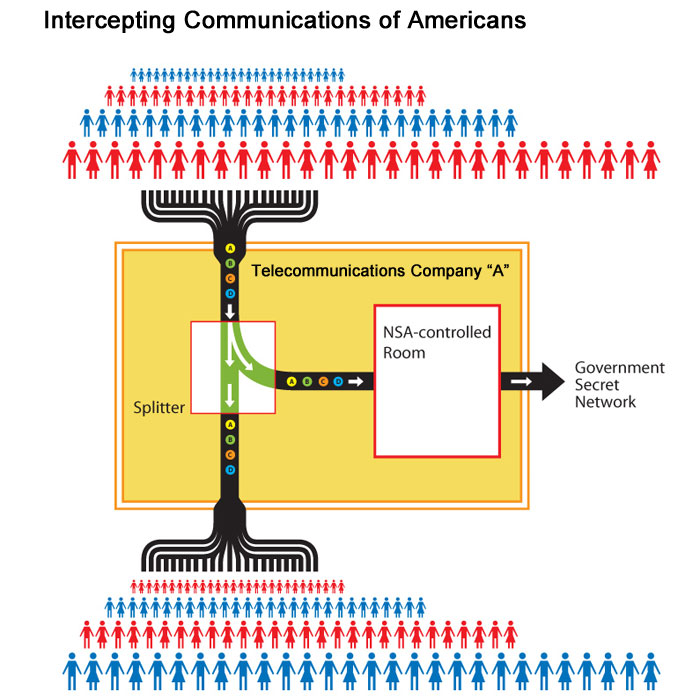
In the wake of the 9/11 attacks, George W. Bush secretly authorized the NSA to conduct warrantless surveillance on Americans’ phone calls and emails. That wireless wiretap program was reportedly ended in 2007 after the New York Times reported on it, to mass indignation.

Nothing changed under Barack Obama. In fact, the violations worsened, with the NSA authorized to secretly collect internet and telephone data on millions of Americans, as well as on foreign governments.

It was only after whistleblower Edward Snowden’s revelations in 2013 that the American people fully understood the extent to which they had been betrayed once again.

What this brief history of the NSA makes clear is that you cannot reform the NSA.

As long as the government is allowed to make a mockery of the law—be it the Constitution, the FISA Act or any other law intended to limit its reach and curtail its activities—and is permitted to operate behind closed doors, relaying on secret courts, secret budgets and secret interpretations of the laws of the land, there will be no reform.

Presidents, politicians, and court rulings have come and gone over the course of the NSA’s 60-year history, but none of them have done much to put an end to the NSA’s “technotyranny.”

The beast has outgrown its chains. It will not be restrained.

The growing tension seen and felt throughout the country is a tension between those who wield power on behalf of the government—the president, Congress, the courts, the military, the militarized police, the technocrats, the faceless unelected bureaucrats who blindly obey and carry out government directives, no matter how immoral or unjust, and the corporations—and those among the populace who are finally waking up to the mounting injustices, seething corruption and endless tyrannies that are transforming our country into a technocrized police state.

At every turn, we have been handicapped in our quest for transparency, accountability and a representative democracy by an establishment culture of secrecy: secret agencies, secret experiments, secret military bases, secret surveillance, secret budgets, and secret court rulings, all of which exist beyond our reach, operate outside our knowledge, and do not answer to “we the people.”

What we have failed to truly comprehend is that the NSA is merely one small part of a shadowy permanent government comprised of unelected bureaucrats who march in lockstep with profit-driven corporations that actually runs Washington, DC, and works to keep us under surveillance and, thus, under control. For example, Google openly works with the NSA, Amazon has built a massive $600 million intelligence database for the CIA, and the telecommunications industry is making a fat profit by spying on us for the government.

In other words, Corporate America is making a hefty profit by aiding and abetting the government in its domestic surveillance efforts. Conveniently, as the Intercept recently revealed, many of the NSA’s loudest defenders have financial ties to NSA contractors.

Thus, if this secret regime not only exists but thrives, it is because we have allowed it through our ignorance, apathy and naïve trust in politicians who take their orders from Corporate America rather than the Constitution.

If this shadow government persists, it is because we have yet to get outraged enough to push back against its power grabs and put an end to its high-handed tactics.

And if this unelected bureaucracy succeeds in trampling underfoot our last vestiges of privacy and freedom, it will be because we let ourselves be fooled into believing that politics matters, that voting makes a difference, that politicians actually represent the citizenry, that the courts care about justice, and that everything that is being done is in our best interests.

Indeed, as political scientist Michael J. Glennon warns, you can vote all you want, but the people you elect aren’t actually the ones calling the shots. “The American people are deluded … that the institutions that provide the public face actually set American national security policy,” stated Glennon. “They believe that when they vote for a president or member of Congress or succeed in bringing a case before the courts, that policy is going to change. But … policy by and large in the national security realm is made by the concealed institutions.”

In other words, it doesn’t matter who occupies the White House: the secret government with its secret agencies, secret budgets and secret programs won’t change. It will simply continue to operate in secret until some whistleblower comes along to momentarily pull back the curtain and we dutifully—and fleetingly—play the part of the outraged public, demanding accountability and rattling our cages, all the while bringing about little real reform.

Thus, the lesson of the NSA and its vast network of domestic spy partners is simply this: once you allow the government to start breaking the law, no matter how seemingly justifiable the reason, you relinquish the contract between you and the government which establishes that the government works for and obeys you, the citizen—the employer—the master.

Once the government starts operating outside the law, answerable to no one but itself, there’s no way to rein it back in, short of revolution. And by revolution, I mean doing away with the entire structure, because the corruption and lawlessness have become that pervasive.

NEW YORK, N.Y.—Constitutional attorney John W. Whitehead will appear in “The Root: Excessive Force,” a special documentary hosted by Glenn Beck about what happens to civil liberties when the government favors police state tactics such as lockdowns, SWAT team raids, and mass surveillance.  “The Root: Excessive Force” will air at 5 pm EST on May 21, 2015, TheBlazeTV. The airing of the documentary coincides with the Obama administration’s release of a 120-page “Task Force on 21st Century Policing” report and the announcement that the president will limit some of the military weapons being passed along to local police departments.

“It remains to be seen whether this overture on Obama’s part, coming in the midst of heightened tensions between the nation’s police forces and the populace they’re supposed to protect, opens the door to actual reform or is merely a political gambit to appease the masses all the while further acclimating the populace to life in a police state,” stated Whitehead, president of The Rutherford Institute and author of Battlefield America: The War on the American People. “Certainly, on its face, the ban does nothing to roll back the deadly menace of overzealous police agencies corrupted by money, power and institutional immunity. And it certainly fails to recognize the terrible toll that has been inflicted on our communities, our fragile ecosystem of a democracy, and our freedoms as a result of the government’s determination to bring the war home.”

Battlefield_Cover_300Congress launched the 1033 Program in the 1980s to allow the Department of Defense to transfer surplus military goods to state and local police agencies. The 1033 program has grown dramatically, with some 13,000 police agencies in all 50 states and four US territories currently participating. In 2012, the federal government transferred $546 million worth of property to state and local police agencies. This 1033 program allows small towns like Rising Star, Texas, with a population of 835 and only one full-time police officer, to acquire $3.2 million worth of goods and military gear from the federal government over the course of fourteen months. Military equipment sent to small towns has included high-powered weapons, assault vehicles and tactical gear. However, after it was discovered that local police agencies were failing to keep inventories of their acquired firearms and in some cases, selling the equipment for a profit, the transfer of firearms was temporarily suspended until October 2013. Police agencies have also been given a variety of other toys and gizmos, including “aircraft, boats, Humvees, body armor, weapon scopes, infrared imaging systems and night-vision goggles,” not to mention more general items such as “bookcases, hedge trimmers, telescopes, brassieres, golf carts, coffee makers and television sets.”

In addition to equipping police with militarized weapons and equipment, the government has also instituted an incentive program of sorts, the Byrne Formula Grant Program, which awards federal grants based upon “the number of overall arrests, the number of warrants served or the number of drug seizures.” A sizable chunk of taxpayer money has kept the program in full swing over the years. The Clinton administration funded the program with about $500 million. By 2008, the Bush administration had reduced the budget to about $170 million, less out of concern for the militarization of police forces and more to reduce federal influence on law enforcement matters. However, Obama boosted the program, using the 2009 American Recovery and Reinvestment Act to inject $2 billion into the program. As a result of local police forces receiving militarized equipment and grants, heavily armed SWAT teams have also been increasingly used to carry out routine police procedures such as routine search warrants. Consequently, SWAT team raids, which once numbered a few thousand per year in the 1980s, have grown to over 80,000 per year.

“If we’re training cops as soldiers, giving them equipment like soldiers, dressing them up as soldiers, when are they going to pick up the mentality of soldiers? If you look at the police department, their creed is to protect and to serve. A soldier’s mission is to engage his enemy in close combat and kill him. Do we want police officers to have that mentality? Of course not.”— Arthur Rizer, former civilian police officer and member of the military

Talk about poor timing. Then again, perhaps it’s brilliant timing.

Only now—after the Departments of Justice, Homeland Security (DHS) and Defense have passed off billions of dollars worth of military equipment to local police forces, after police agencies have been trained in the fine art of war, after SWAT team raids have swelled in number to more than 80,000 a year, after it has become second nature for local police to look and act like soldiers, after communities have become acclimated to the presence of militarized police patrolling their streets, after Americans have been taught compliance at the end of a police gun or taser, after lower income neighborhoods have been transformed into war zones, after hundreds if not thousands of unarmed Americans have lost their lives at the hands of police who shoot first and ask questions later, after a whole generation of young Americans has learned to march in lockstep with the government’s dictates—only now does President Obama lift a hand to limit the number of military weapons being passed along to local police departments.

Not all, mind you, just some.

Talk about too little, too late.

Months after the White House defended a federal program that distributed $18 billion worth of military equipment to local police, Obama has announced that he will ban the federal government from providing local police departments with tracked armored vehicles, weaponized aircraft and vehicles, bayonets, grenade launchers, camouflage uniforms and large-caliber firearms.

Obama also indicated that less heavy-duty equipment (armored vehicles, tactical vehicles, riot gear and specialized firearms and ammunition) will reportedly be subject to more regulations such as local government approval, and police being required to undergo more training and collect data on the equipment’s use. Perhaps hoping to sweeten the deal, the Obama administration is also offering $163 million in taxpayer-funded grants to “incentivize police departments to adopt the report’s recommendations.”

While this is a grossly overdue first step of sorts, it is nevertheless a first step from an administration that has been utterly complicit in accelerating the transformation of America’s police forces into extensions of the military. Indeed, as investigative journalist Radley Balko points out, while the Obama administration has said all the right things about the need to scale back on a battlefield mindset, it has done all the wrong things to perpetuate the problem:

  • distributed equipment designed for use on the battlefield to local police departments,
  • provided private grants to communities to incentivize SWAT team raids,
  • redefined “community policing” to reflect aggressive police tactics and funding a nationwide COPS (Community Oriented Policing Services) program that has contributed to dramatic rise in SWAT teams,
  • encouraged the distribution of DHS anti-terror grants and the growth of “contractors that now cater to police agencies looking to cash DHS checks in exchange for battle-grade gear,”
  • ramped up the use of military-style raids to crack down on immigration laws and target “medical marijuana growers, shops, and dispensaries in states that have legalized the drug,”
  • defended as “reasonable” aggressive, militaristic police tactics in cases where police raided a guitar shop in defense of an obscure environmental law, raided a home looking for a woman who had defaulted on her student loans, and terrorized young children during a raid on the wrong house based on a mistaken license plate,
  • and ushered in an era of outright highway robbery in which asset forfeiture laws have been used to swindle Americans out of cash, cars, houses, or other property that government agents can “accuse” of being connected to a crime.

It remains to be seen whether this overture on Obama’s part, coming in the midst of heightened tensions between the nation’s police forces and the populace they’re supposed to protect, opens the door to actual reform or is merely a political gambit to appease the masses all the while further acclimating the populace to life in a police state.

Certainly, on its face, it does nothing to ease the misery of the police state that has been foisted upon us. In fact, Obama’s belated gesture of concern does little to roll back the deadly menace of overzealous police agencies corrupted by money, power and institutional immunity. And it certainly fails to recognize the terrible toll that has been inflicted on our communities, our fragile ecosystem of a democracy, and our freedoms as a result of the government’s determination to bring the war home.

Will the young black man guilty of nothing more than running away from brutish police officers be any safer in the wake of Obama’s edict? It’s unlikely.

Will the old man reaching for his cane have a lesser chance of being shot? It’s doubtful.

Will the little girl asleep under her princess blanket live to see adulthood when a SWAT team crashes through her door? I wouldn’t count on it.

It’s a safe bet that our little worlds will be no safer following Obama’s pronouncement and the release of his “Task Force on 21st Century Policing” report. In fact, there is a very good chance that life in the American police state will become even more perilous.

Among the report’s 50-page list of recommendations is a call for more police officer boots on the ground, training for police “on the importance of de-escalation of force,” and “positive non-enforcement activities” in high-crime communities to promote trust in the police such as sending an ice cream truck across the city.

Curiously, nowhere in the entire 120-page report is there a mention of the Fourth Amendment, which demands that the government respect citizen privacy and bodily integrity. The Constitution is referenced once, in the Appendix, in relation to Obama’s authority as president. And while the word “constitutional” is used 15 times within the body of the report, its use provides little assurance that the Obama administration actually understands the clear prohibitions against government overreach as enshrined in the U.S. Constitution.

For instance, in the section of the report on the use of technology and social media, the report notes: “Though all constitutional guidelines must be maintained in the performance of law enforcement duties, the legal framework (warrants, etc.) should continue to protect law enforcement access to data obtained from cell phones, social media, GPS, and other sources, allowing officers to detect, prevent, or respond to crime.”

Battlefield_Cover_300Translation: as I document in my book Battlefield America: The War on the American People, the new face of policing in America is about to shift from waging its war on the American people using primarily the weapons of the battlefield to the evermore-sophisticated technology of the battlefield where government surveillance of our everyday activities will be even more invasive.

This emphasis on technology, surveillance and social media is nothing new. In much the same way the federal government used taxpayer-funded grants to “gift” local police agencies with military weapons and equipment, it is also funding the distribution of technology aimed at making it easier for police to monitor, track and spy on Americans. For instance, license plate readers, stingray devices and fusion centers are all funded by grants from the DHS. Funding for drones at the state and local levels also comes from the federal government, which in turn accesses the data acquired by the drones for its own uses.

If you’re noticing a pattern here, it is one in which the federal government is not merely transforming local police agencies into extensions of itself but is in fact federalizing them, turning them into a national police force that answers not to “we the people” but to the Commander in Chief. Yet the American police force is not supposed to be a branch of the military, nor is it a private security force for the reigning political faction. It is supposed to be an aggregation of the countless local civilian units that exist for a sole purpose: to serve and protect the citizens of each and every American community.

So where does that leave us?

There’s certainly no harm in embarking on a national dialogue on the dangers of militarized police, but if that’s all it amounts to—words that sound good on paper and in the press but do little to actually respect our rights and restore our freedoms—then we’re just playing at politics with no intention of actually bringing about reform.

Despite the Obama Administration’s lofty claims of wanting to “ensure that public safety becomes more than the absence of crime, that it must also include the presence of justice,” this is the reality we must contend with right now:

Americans still have no real protection against police abuse. Americans still have no right to self-defense in the face of SWAT teams mistakenly crashing through our doors, or police officers who shoot faster than they can reason. Americans are still no longer innocent until proven guilty. Americans still don’t have a right to private property. Americans are still powerless in the face of militarized police. Americans still don’t have a right to bodily integrity. Americans still don’t have a right to the expectation of privacy. Americans are still being acclimated to a police state through the steady use and sight of military drills domestically, a heavy militarized police presence in public places and in the schools, and a taxpayer-funded propaganda campaign aimed at reassuring the public that the police are our “friends.” And to top it all off, Americans still can’t rely on the courts, Congress or the White House to mete out justice when our rights are violated by police.

To sum it all up: the problems we’re grappling with have been building for more than 40 years. They’re not going to go away overnight, and they certainly will not be resolved by a report that instructs the police to simply adopt different tactics to accomplish the same results—i.e., maintain the government’s power, control and wealth at all costs.

This is the sad reality of life in the American police state.


“The government is merely a servant―merely a temporary servant; it cannot be its prerogative to determine what is right and what is wrong, and decide who is a patriot and who isn’t. Its function is to obey orders, not originate them.” ― Mark Twain

How many Americans have actually bothered to read the Constitution, let alone the first ten amendments to the Constitution, the Bill of Rights (a quick read at 462 words)?

Take a few minutes and read those words for yourself—rather than having some court or politician translate them for you—and you will be under no illusion about where to draw the line when it comes to speaking your mind, criticizing your government, defending what is yours, doing whatever you want on your own property, and keeping the government’s nose out of your private affairs.

In an age of overcriminalization, where the average citizen unknowingly commits three crimes a day, and even the most mundane activities such as fishing and gardening are regulated, government officials are constantly telling Americans what not to do. Yet it was not always this way. It used to be “we the people” telling the government what it could and could not do. Indeed, the three words used most frequently throughout the Bill of Rights in regards to the government are “no,” “not” and “nor.”

Compare the following list of “don’ts” the government is prohibited from doing with the growing list of abuses to which “we the people” are subjected on a daily basis, and you will find that we have reached a state of crisis wherein the government is routinely breaking the law and violating its contractual obligations.

For instance, the government is NOT allowed to restrict free speech, press, assembly or the citizenry’s ability to protest and correct government wrongdoing. Nevertheless, the government continues to prosecute whistleblowers, persecute journalists, cage protesters, criminalize expressive activities, crack down on large gatherings of citizens mobilizing to voice their discontent with government policies, and insulate itself and its agents from any charges of wrongdoing (or what the courts refer to as “qualified immunity”).

The government may NOT infringe on a citizen’s right to defend himself. Nevertheless, in many states, it’s against the law to carry a concealed weapon (gun, knife or even pepper spray), and the average citizen is permitted little self-defense against militarized police officers who shoot first and ask questions later.

The government may NOT enter or occupy a citizen’s house without his consent (the quartering of soldiers). Nevertheless, government soldiers (i.e., militarized police) carry out more than 80,000 no-knock raids on private homes every year, while maiming children, killing dogs and shooting citizens.

The government may NOT carry out unreasonable searches and seizures on the citizenry or their possessions. NOR can government officials issue warrants without some evidence of wrongdoing (probable cause). Unfortunately, what is unreasonable to the average American is completely reasonable to a government agent, for whom the ends justify the means. In such a climate, we have no protection against roadside strip searches, blood draws, DNA collection, SWAT team raids, surveillance or any other privacy-stripping indignity to which the government chooses to subject us.

The government is NOT to deprive anyone of life, liberty or property without due process. Nevertheless, the government continues to incarcerate tens of thousands of Americans whose greatest crime is being poor and brown-skinned. The same goes for those who are put to death, some erroneously, by a system weighted in favor of class and wealth.

The government may NOT take private property for public use without just compensation. Nevertheless, under the guise of the “greater public interest,” the government often hides behind eminent domain laws in order to allow megacorporations to tear down homes occupied by less prosperous citizens in order to build high-priced resorts and shopping malls.

Government agents may NOT force a citizen to testify against himself. Yet what is the government’s extensive surveillance network that spies on all of our communications but a thinly veiled attempt at using our own words against us?

The government is NOT allowed to impose excessive fines on the citizenry or inflict cruel and unusual punishments upon them. Nevertheless Americans are subjected to egregious fines and outrageous punishments for minor traffic violations, student tardiness and absence from school, and generally having the misfortune of being warm bodies capable of filling privatized, profit-driven jails.

The government is NOT permitted to claim any powers that are not expressly granted to them by the Constitution. This prohibition has become downright laughable as the government continues to claim for itself every authority that serves to swell its coffers, cement its dominion, and expand its reach.

Despite what some special interest groups have suggested to the contrary, the problems we’re experiencing today did not arise because the Constitution has outlived its usefulness or become irrelevant, nor will they be solved by a convention of states or a ratification of the Constitution.

Battlefield_Cover_300No, as I document in my new book Battlefield America: The War on the American People, the problem goes far deeper. It can be traced back to the point at which “we the people” were overthrown as the center of the government. As a result, our supremacy has been undone, our authority undermined, and our experiment in democratic self-governance left in ruins. No longer are we the rulers of this land. We have long since been deposed and dethroned, replaced by corporate figureheads with no regard for our sovereignty, no thought for our happiness, and no respect for our rights.

In other words, without our say-so and lacking any mandate, the point of view of the Constitution has been shifted from “we the people” to “we the government.” Our taxpayer-funded employees—our appointed servants—have stopped looking upon us as their superiors and started viewing as their inferiors. Unfortunately, we’ve gotten so used to being dictated to by government agents, bureaucrats and militarized police alike that we’ve forgotten that WE are supposed to be the ones calling the shots and determining what is just, reasonable and necessary.

Then again, we’re not the only ones guilty of forgetting that the government was established to serve us as well as obey us. Every branch of government, from the Executive to the Judicial and Legislative, seems to be suffering this same form of amnesia. Certainly, when government programs are interpreted from the government’s point of view (i.e., the courts and legislatures), there is little the government CANNOT do in its quest for power and control.

We’ve been so brainwashed and indoctrinated into believing that the government is actually looking out for our best interests, when in fact the only compelling interesting driving government programs is maintain power and control by taking away our money and control. This vital truth, that the government exists for our benefit and operates at our behest, seems to have been lost in translation over two centuries dominated by government expansion, endless wars and centralized federal power.

Have you ever wondered why the Constitution begins with those three words “we the people”? It was intended to be a powerful reminder that everything flows from the citizenry. We the people are the center of the government and the source of its power. That “we” is crucial because it reminds us that there is power and safety in numbers, provided we stand united. We can accomplish nothing alone.

This is the underlying lesson of the Constitution, which outlines the duties and responsibilities of government. It was a mutual agreement formed by early Americans in order to ensure that when problems arose, they could address them together.

It’s like the wagon trains of the Old West, comprised of individual groups of pioneers. They rarely ventured out alone but instead traveled as convoys. And when faced with a threat, these early Americans formed their wagons into a tight circle in order to defend against invaders. In doing so, they presented a unified front and provided protection against an outside attack. In much the same way, the Constitution was intended to work as an institutionalized version of the wagon circle, serving as a communal shield against those who would harm us.

Unfortunately, we have been ousted from that protected circle, left to fend for ourselves in the wilderness that is the American frontier today. Those who did the ousting—the courts, the politicians, and the corporations—have since replaced us with yes-men, shills who dance to the tune of an elite ruling class. In doing so, they have set themselves as the central source of power and the arbiters of what is just and reasonable.

Once again we’re forced to navigate hostile terrain, unsure of how to protect ourselves and our loved ones from militarized police, weaponized drones, fusion centers, Stingray devices, SWAT team raids, the ongoing military drills on American soil, the government stockpiling of ammunition, the erection of mass detention centers across the country, and all other manner of abuses.

Read the smoke signals, and the warning is clear: It’s time to circle the wagons, folks. The government is on the warpath, and if we are to have any hope of surviving whatever is coming at us, we’ll need to keep our wits about us and present a unified front. Most of all, we need to restore “we the people” to our rightful place at the center of government. How we do that depends largely on each community’s willingness to get past their partisan politics and blind allegiance to uniformed government officials and find common ground.

To put it a little more bluntly, stop thinking like mindless government robots and start acting like a powerhouse of citizens vested with the power to say “enough is enough.” We have the numbers to stand our ground. Now we just need the will.

NEW YORK, N.Y. — Describing the National Security Agency’s (NSA) domestic spying program that collects data about virtually all telephone calls made in the United States as “staggering” in its scope and unauthorized by the Patriot Act, a federal appeals court has struck down the agency’s surveillance program, ruling that the program violates a federal law authorizing more limited investigations in support of national security. The unanimous decision in ACLU v. Clapper vacated a ruling upholding the NSA’s bulk collection of telephone metadata, which has continued since 2006, and instructed the lower court to consider whether to order the government to stop the surveillance. The Rutherford Institute filed an amicus curiae brief in the case likening the program to the abusive colonial-era general warrants and writs of assistance which prompted the Framers of the U.S. Constitution to adopt the Fourth Amendment’s ban on unreasonable searches and seizures.

“James Madison, who was one of the primary drafters of our Constitution, once warned that we should take alarm at the first experiment with our liberties,” stated John W. Whitehead, president of The Rutherford Institute and author ofBattlefield America: The War on the American People. “While it is heartening that at least some Americans are starting to heed Madison’s warning, this ruling doesn’t alter the fact that the government not only views the citizenry as suspects but treats them as suspects, as well. The fact that the NSA is routinely operating outside of the law and overstepping its legal authority by carrying out surveillance on American citizens is a result of giving the government broad powers and allowing government agencies to routinely sidestep the Constitution.”

In the weeks after the September 11, 2001, terrorist attacks, the NSA began a program of collecting telephone call records in bulk. After continuing the program without judicial authorization, in 2006, the government sought and obtained authorization from the FISC, a special court established to consider government applications for surveillance of foreign agents and which conducts its activities largely in secret. The 2006 order, which has been renewed several times since, allows the NSA to collect “telephone metadata,” which includes the telephone numbers placing and receiving the call, the date, time and duration of the call, and other session-identifying information, and applies to every call placed or received within the United States. The government retains this information and has the ability to conduct computer analysis to determine patterns of behavior that can reveal personal information about citizens. The program remained secret until June 2013 when information leaked by former NSA contractor Edward Snowden was made public. That same month, the American Civil Liberties Union and affiliated entities filed a lawsuit alleging that the program violated statutory restrictions imposed by the Foreign Intelligence Surveillance Act and the Fourth Amendment.

In December 2013, a federal district court in New York rejected the legal challenge to the government’s surveillance and upheld the program, ruling that because telephone users “voluntarily” disclose information to telephone companies, the collection of information by the government does not constitute an illegal search. In weighing in on the case, The Rutherford Institute argues that “the bulk metadata collection order is no different from the abusive general warrants colonies suffered under and which were intended to be outlawed with the adoption of the Bill of Rights.” Institute attorneys have asked the court to reverse the lower court decision on the grounds that it runs headlong against the principles and purposes that were the foundation for the adoption of Bill of Rights prohibition on unreasonable searches and seizures.

To donate via PayPal, please click below: