“The ultimate goal of the NSA is total population control.”—William Binney, NSA whistleblower

We now have a fourth branch of government.

As I document in my new book Battlefield America: The War on the American People, this fourth branch came into being without any electoral mandate or constitutional referendum, and yet it possesses superpowers, above and beyond those of any other government agency save the military. It is all-knowing, all-seeing and all-powerful. It operates beyond the reach of the president, Congress and the courts, and it marches in lockstep with the corporate elite who really call the shots in Washington, DC.

You might know this branch of government as Surveillance, but I prefer “technotyranny,” a term coined by investigative journalist James Bamford to refer to an age of technological tyranny made possible by government secrets, government lies, government spies and their corporate ties.

Beware of what you say, what you read, what you write, where you go, and with whom you communicate, because it will all be recorded, stored and used against you eventually, at a time and place of the government’s choosing. Privacy, as we have known it, is dead.

The police state is about to pass off the baton to the surveillance state.

Having already transformed local police into extensions of the military, the Department of Homeland Security, the Justice Department and the FBI are preparing to turn the nation’s soldier cops into techno-warriors, complete with iris scanners, body scanners, thermal imaging Doppler radar devices, facial recognition programs, license plate readers, cell phone Stingray devices and so much more.

This is about to be the new face of policing in America.

The National Security Agency (NSA) has been a perfect red herring, distracting us from the government’s broader, technology-driven campaign to render us helpless in the face of its prying eyes. In fact, long before the NSA became the agency we loved to hate, the Justice Department, the FBI, and the Drug Enforcement Administration were carrying out their own secret mass surveillance on an unsuspecting populace.

Just about every branch of the government—from the Postal Service to the Treasury Department and every agency in between—now has its own surveillance sector, authorized to spy on the American people. Then there are the fusion and counterterrorism centers that gather all of the data from the smaller government spies—the police, public health officials, transportation, etc.—and make it accessible for all those in power. And of course that doesn’t even begin to touch on the complicity of the corporate sector, which buys and sells us from cradle to grave, until we have no more data left to mine.

The raging debate over the fate of the NSA’s blatantly unconstitutional, illegal and ongoing domestic surveillance programs is just so much noise, what Shakespeare referred to as “sound and fury, signifying nothing.”

It means nothing: the legislation, the revelations, the task forces, and the filibusters.

The government is not giving up, nor is it giving in. It has stopped listening to us. It has long since ceased to take orders from “we the people.”

If you haven’t figured it out yet, none of it—the military drills, the surveillance, the militarized police, the strip searches, the random pat downs, the stop-and-frisks, even the police-worn body cameras—is about fighting terrorism. It’s about controlling the populace.

Despite the fact that its data snooping has been shown to be ineffective at detecting, let alone stopping, any actual terror attacks, the NSA continues to operate largely in secret, carrying out warrantless mass surveillance on hundreds of millions of Americans’ phone calls, emails, text messages and the like, beyond the scrutiny of most of Congress and the taxpayers who are forced to fund its multi-billion dollar secret black ops budget.

Legislation such as the USA Patriot Act serves only to legitimize the actions of a secret agency run by a shadow government. Even the proposed and ultimately defeated USA Freedom Act, which purported to restrict the reach of the NSA’s phone surveillance program—at least on paper—by requiring the agency to secure a warrant before surveillance could be carried out on American citizens and prohibiting the agency from storing any data collected on Americans, amounted to little more than a paper tiger: threatening in appearance, but lacking any real bite.

The question of how to deal with the NSA—an agency that operates outside of the system of checks and balances established by the Constitution—is a divisive issue that polarizes even those who have opposed the NSA’s warrantless surveillance from the get-go, forcing all of us—cynics, idealists, politicians and realists alike—to grapple with a deeply unsatisfactory and dubious political “solution” to a problem that operates beyond the reach of voters and politicians: how do you trust a government that lies, cheats, steals, sidesteps the law, and then absolves itself of wrongdoing to actually obey the law?

Since its official start in 1952, when President Harry S. Truman issued a secret executive order establishing the NSA as the hub of the government’s foreign intelligence activities, the agency—nicknamed “No Such Agency”—has operated covertly, unaccountable to Congress all the while using taxpayer dollars to fund its secret operations. It was only when the agency ballooned to 90,000 employees in 1969, making it the largest intelligence agency in the world with a significant footprint outside Washington, DC, that it became more difficult to deny its existence.

In the aftermath of Watergate in 1975, the Senate held meetings under the Church Committee in order to determine exactly what sorts of illicit activities the American intelligence apparatus was engaged in under the direction of President Nixon, and how future violations of the law could be stopped. It was the first time the NSA was exposed to public scrutiny since its creation.

The investigation revealed a sophisticated operation whose surveillance programs paid little heed to such things as the Constitution. For instance, under Project SHAMROCK, the NSA spied on telegrams to and from the U.S., as well as the correspondence of American citizens. Moreover, as the Saturday Evening Post reports, “Under Project MINARET, the NSA monitored the communications of civil rights leaders and opponents of the Vietnam War, including targets such as Martin Luther King, Jr., Mohammed Ali, Jane Fonda, and two active U.S. Senators. The NSA had launched this program in 1967 to monitor suspected terrorists and drug traffickers, but successive presidents used it to track all manner of political dissidents.”

Senator Frank Church (D-Ida.), who served as the chairman of the Select Committee on Intelligence that investigated the NSA, understood only too well the dangers inherent in allowing the government to overstep its authority in the name of national security. Church recognized that such surveillance powers “at any time could be turned around on the American people, and no American would have any privacy left, such is the capability to monitor everything: telephone conversations, telegrams, it doesn’t matter. There would be no place to hide.”

Noting that the NSA could enable a dictator “to impose total tyranny” upon an utterly defenseless American public, Church declared that he did not “want to see this country ever go across the bridge” of constitutional protection, congressional oversight and popular demand for privacy. He avowed that “we,” implicating both Congress and its constituency in this duty, “must see to it that this agency and all agencies that possess this technology operate within the law and under proper supervision, so that we never cross over that abyss. That is the abyss from which there is no return.”

The result was the passage of the Foreign Intelligence Surveillance Act (FISA), and the creation of the FISA Court, which was supposed to oversee and correct how intelligence information is collected and collated. The law requires that the NSA get clearance from the FISA Court, a secret surveillance court, before it can carry out surveillance on American citizens. Fast forward to the present day, and the so-called solution to the problem of government entities engaging in unjustified and illegal surveillance—the FISA Court—has unwittingly become the enabler of such activities, rubberstamping almost every warrant request submitted to it.

The 9/11 attacks served as a watershed moment in our nation’s history, ushering in an era in which immoral and/or illegal government activities such as surveillance, torture, strip searches, SWAT team raids are sanctioned as part of the quest to keep us “safe.”

In the wake of the 9/11 attacks, George W. Bush secretly authorized the NSA to conduct warrantless surveillance on Americans’ phone calls and emails. That wireless wiretap program was reportedly ended in 2007 after the New York Times reported on it, to mass indignation.

Nothing changed under Barack Obama. In fact, the violations worsened, with the NSA authorized to secretly collect internet and telephone data on millions of Americans, as well as on foreign governments.

It was only after whistleblower Edward Snowden’s revelations in 2013 that the American people fully understood the extent to which they had been betrayed once again.

What this brief history of the NSA makes clear is that you cannot reform the NSA.

As long as the government is allowed to make a mockery of the law—be it the Constitution, the FISA Act or any other law intended to limit its reach and curtail its activities—and is permitted to operate behind closed doors, relaying on secret courts, secret budgets and secret interpretations of the laws of the land, there will be no reform.

Presidents, politicians, and court rulings have come and gone over the course of the NSA’s 60-year history, but none of them have done much to put an end to the NSA’s “technotyranny.”

The beast has outgrown its chains. It will not be restrained.

The growing tension seen and felt throughout the country is a tension between those who wield power on behalf of the government—the president, Congress, the courts, the military, the militarized police, the technocrats, the faceless unelected bureaucrats who blindly obey and carry out government directives, no matter how immoral or unjust, and the corporations—and those among the populace who are finally waking up to the mounting injustices, seething corruption and endless tyrannies that are transforming our country into a technocrized police state.

At every turn, we have been handicapped in our quest for transparency, accountability and a representative democracy by an establishment culture of secrecy: secret agencies, secret experiments, secret military bases, secret surveillance, secret budgets, and secret court rulings, all of which exist beyond our reach, operate outside our knowledge, and do not answer to “we the people.”
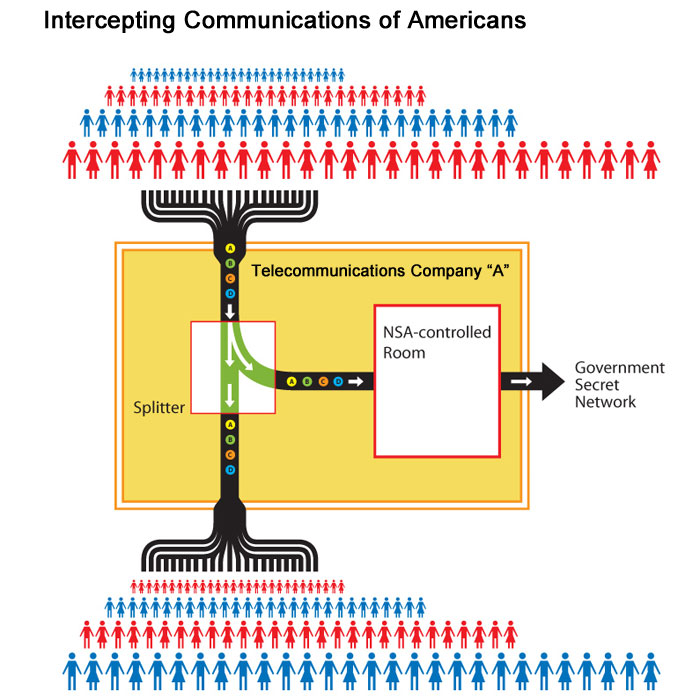
What we have failed to truly comprehend is that the NSA is merely one small part of a shadowy permanent government comprised of unelected bureaucrats who march in lockstep with profit-driven corporations that actually runs Washington, DC, and works to keep us under surveillance and, thus, under control. For example, Google openly works with the NSA, Amazon has built a massive $600 million intelligence database for the CIA, and the telecommunications industry is making a fat profit by spying on us for the government.

In other words, Corporate America is making a hefty profit by aiding and abetting the government in its domestic surveillance efforts. Conveniently, as the Intercept recently revealed, many of the NSA’s loudest defenders have financial ties to NSA contractors.

Thus, if this secret regime not only exists but thrives, it is because we have allowed it through our ignorance, apathy and naïve trust in politicians who take their orders from Corporate America rather than the Constitution.

If this shadow government persists, it is because we have yet to get outraged enough to push back against its power grabs and put an end to its high-handed tactics.

And if this unelected bureaucracy succeeds in trampling underfoot our last vestiges of privacy and freedom, it will be because we let ourselves be fooled into believing that politics matters, that voting makes a difference, that politicians actually represent the citizenry, that the courts care about justice, and that everything that is being done is in our best interests.

Indeed, as political scientist Michael J. Glennon warns, you can vote all you want, but the people you elect aren’t actually the ones calling the shots. “The American people are deluded … that the institutions that provide the public face actually set American national security policy,” stated Glennon. “They believe that when they vote for a president or member of Congress or succeed in bringing a case before the courts, that policy is going to change. But … policy by and large in the national security realm is made by the concealed institutions.”

In other words, it doesn’t matter who occupies the White House: the secret government with its secret agencies, secret budgets and secret programs won’t change. It will simply continue to operate in secret until some whistleblower comes along to momentarily pull back the curtain and we dutifully—and fleetingly—play the part of the outraged public, demanding accountability and rattling our cages, all the while bringing about little real reform.

Thus, the lesson of the NSA and its vast network of domestic spy partners is simply this: once you allow the government to start breaking the law, no matter how seemingly justifiable the reason, you relinquish the contract between you and the government which establishes that the government works for and obeys you, the citizen—the employer—the master.

Once the government starts operating outside the law, answerable to no one but itself, there’s no way to rein it back in, short of revolution. And by revolution, I mean doing away with the entire structure, because the corruption and lawlessness have become that pervasive.

NEW YORK, N.Y.—Constitutional attorney John W. Whitehead will appear in “The Root: Excessive Force,” a special documentary hosted by Glenn Beck about what happens to civil liberties when the government favors police state tactics such as lockdowns, SWAT team raids, and mass surveillance.  “The Root: Excessive Force” will air at 5 pm EST on May 21, 2015, TheBlazeTV. The airing of the documentary coincides with the Obama administration’s release of a 120-page “Task Force on 21st Century Policing” report and the announcement that the president will limit some of the military weapons being passed along to local police departments.

“It remains to be seen whether this overture on Obama’s part, coming in the midst of heightened tensions between the nation’s police forces and the populace they’re supposed to protect, opens the door to actual reform or is merely a political gambit to appease the masses all the while further acclimating the populace to life in a police state,” stated Whitehead, president of The Rutherford Institute and author of Battlefield America: The War on the American People. “Certainly, on its face, the ban does nothing to roll back the deadly menace of overzealous police agencies corrupted by money, power and institutional immunity. And it certainly fails to recognize the terrible toll that has been inflicted on our communities, our fragile ecosystem of a democracy, and our freedoms as a result of the government’s determination to bring the war home.”

Battlefield_Cover_300Congress launched the 1033 Program in the 1980s to allow the Department of Defense to transfer surplus military goods to state and local police agencies. The 1033 program has grown dramatically, with some 13,000 police agencies in all 50 states and four US territories currently participating. In 2012, the federal government transferred $546 million worth of property to state and local police agencies. This 1033 program allows small towns like Rising Star, Texas, with a population of 835 and only one full-time police officer, to acquire $3.2 million worth of goods and military gear from the federal government over the course of fourteen months. Military equipment sent to small towns has included high-powered weapons, assault vehicles and tactical gear. However, after it was discovered that local police agencies were failing to keep inventories of their acquired firearms and in some cases, selling the equipment for a profit, the transfer of firearms was temporarily suspended until October 2013. Police agencies have also been given a variety of other toys and gizmos, including “aircraft, boats, Humvees, body armor, weapon scopes, infrared imaging systems and night-vision goggles,” not to mention more general items such as “bookcases, hedge trimmers, telescopes, brassieres, golf carts, coffee makers and television sets.”

In addition to equipping police with militarized weapons and equipment, the government has also instituted an incentive program of sorts, the Byrne Formula Grant Program, which awards federal grants based upon “the number of overall arrests, the number of warrants served or the number of drug seizures.” A sizable chunk of taxpayer money has kept the program in full swing over the years. The Clinton administration funded the program with about $500 million. By 2008, the Bush administration had reduced the budget to about $170 million, less out of concern for the militarization of police forces and more to reduce federal influence on law enforcement matters. However, Obama boosted the program, using the 2009 American Recovery and Reinvestment Act to inject $2 billion into the program. As a result of local police forces receiving militarized equipment and grants, heavily armed SWAT teams have also been increasingly used to carry out routine police procedures such as routine search warrants. Consequently, SWAT team raids, which once numbered a few thousand per year in the 1980s, have grown to over 80,000 per year.

“If we’re training cops as soldiers, giving them equipment like soldiers, dressing them up as soldiers, when are they going to pick up the mentality of soldiers? If you look at the police department, their creed is to protect and to serve. A soldier’s mission is to engage his enemy in close combat and kill him. Do we want police officers to have that mentality? Of course not.”— Arthur Rizer, former civilian police officer and member of the military

Talk about poor timing. Then again, perhaps it’s brilliant timing.

Only now—after the Departments of Justice, Homeland Security (DHS) and Defense have passed off billions of dollars worth of military equipment to local police forces, after police agencies have been trained in the fine art of war, after SWAT team raids have swelled in number to more than 80,000 a year, after it has become second nature for local police to look and act like soldiers, after communities have become acclimated to the presence of militarized police patrolling their streets, after Americans have been taught compliance at the end of a police gun or taser, after lower income neighborhoods have been transformed into war zones, after hundreds if not thousands of unarmed Americans have lost their lives at the hands of police who shoot first and ask questions later, after a whole generation of young Americans has learned to march in lockstep with the government’s dictates—only now does President Obama lift a hand to limit the number of military weapons being passed along to local police departments.

Not all, mind you, just some.

Talk about too little, too late.

Months after the White House defended a federal program that distributed $18 billion worth of military equipment to local police, Obama has announced that he will ban the federal government from providing local police departments with tracked armored vehicles, weaponized aircraft and vehicles, bayonets, grenade launchers, camouflage uniforms and large-caliber firearms.

Obama also indicated that less heavy-duty equipment (armored vehicles, tactical vehicles, riot gear and specialized firearms and ammunition) will reportedly be subject to more regulations such as local government approval, and police being required to undergo more training and collect data on the equipment’s use. Perhaps hoping to sweeten the deal, the Obama administration is also offering $163 million in taxpayer-funded grants to “incentivize police departments to adopt the report’s recommendations.”

While this is a grossly overdue first step of sorts, it is nevertheless a first step from an administration that has been utterly complicit in accelerating the transformation of America’s police forces into extensions of the military. Indeed, as investigative journalist Radley Balko points out, while the Obama administration has said all the right things about the need to scale back on a battlefield mindset, it has done all the wrong things to perpetuate the problem:

  • distributed equipment designed for use on the battlefield to local police departments,
  • provided private grants to communities to incentivize SWAT team raids,
  • redefined “community policing” to reflect aggressive police tactics and funding a nationwide COPS (Community Oriented Policing Services) program that has contributed to dramatic rise in SWAT teams,
  • encouraged the distribution of DHS anti-terror grants and the growth of “contractors that now cater to police agencies looking to cash DHS checks in exchange for battle-grade gear,”
  • ramped up the use of military-style raids to crack down on immigration laws and target “medical marijuana growers, shops, and dispensaries in states that have legalized the drug,”
  • defended as “reasonable” aggressive, militaristic police tactics in cases where police raided a guitar shop in defense of an obscure environmental law, raided a home looking for a woman who had defaulted on her student loans, and terrorized young children during a raid on the wrong house based on a mistaken license plate,
  • and ushered in an era of outright highway robbery in which asset forfeiture laws have been used to swindle Americans out of cash, cars, houses, or other property that government agents can “accuse” of being connected to a crime.

It remains to be seen whether this overture on Obama’s part, coming in the midst of heightened tensions between the nation’s police forces and the populace they’re supposed to protect, opens the door to actual reform or is merely a political gambit to appease the masses all the while further acclimating the populace to life in a police state.

Certainly, on its face, it does nothing to ease the misery of the police state that has been foisted upon us. In fact, Obama’s belated gesture of concern does little to roll back the deadly menace of overzealous police agencies corrupted by money, power and institutional immunity. And it certainly fails to recognize the terrible toll that has been inflicted on our communities, our fragile ecosystem of a democracy, and our freedoms as a result of the government’s determination to bring the war home.

Will the young black man guilty of nothing more than running away from brutish police officers be any safer in the wake of Obama’s edict? It’s unlikely.

Will the old man reaching for his cane have a lesser chance of being shot? It’s doubtful.

Will the little girl asleep under her princess blanket live to see adulthood when a SWAT team crashes through her door? I wouldn’t count on it.

It’s a safe bet that our little worlds will be no safer following Obama’s pronouncement and the release of his “Task Force on 21st Century Policing” report. In fact, there is a very good chance that life in the American police state will become even more perilous.

Among the report’s 50-page list of recommendations is a call for more police officer boots on the ground, training for police “on the importance of de-escalation of force,” and “positive non-enforcement activities” in high-crime communities to promote trust in the police such as sending an ice cream truck across the city.

Curiously, nowhere in the entire 120-page report is there a mention of the Fourth Amendment, which demands that the government respect citizen privacy and bodily integrity. The Constitution is referenced once, in the Appendix, in relation to Obama’s authority as president. And while the word “constitutional” is used 15 times within the body of the report, its use provides little assurance that the Obama administration actually understands the clear prohibitions against government overreach as enshrined in the U.S. Constitution.

For instance, in the section of the report on the use of technology and social media, the report notes: “Though all constitutional guidelines must be maintained in the performance of law enforcement duties, the legal framework (warrants, etc.) should continue to protect law enforcement access to data obtained from cell phones, social media, GPS, and other sources, allowing officers to detect, prevent, or respond to crime.”

Battlefield_Cover_300Translation: as I document in my book Battlefield America: The War on the American People, the new face of policing in America is about to shift from waging its war on the American people using primarily the weapons of the battlefield to the evermore-sophisticated technology of the battlefield where government surveillance of our everyday activities will be even more invasive.

This emphasis on technology, surveillance and social media is nothing new. In much the same way the federal government used taxpayer-funded grants to “gift” local police agencies with military weapons and equipment, it is also funding the distribution of technology aimed at making it easier for police to monitor, track and spy on Americans. For instance, license plate readers, stingray devices and fusion centers are all funded by grants from the DHS. Funding for drones at the state and local levels also comes from the federal government, which in turn accesses the data acquired by the drones for its own uses.

If you’re noticing a pattern here, it is one in which the federal government is not merely transforming local police agencies into extensions of itself but is in fact federalizing them, turning them into a national police force that answers not to “we the people” but to the Commander in Chief. Yet the American police force is not supposed to be a branch of the military, nor is it a private security force for the reigning political faction. It is supposed to be an aggregation of the countless local civilian units that exist for a sole purpose: to serve and protect the citizens of each and every American community.

So where does that leave us?

There’s certainly no harm in embarking on a national dialogue on the dangers of militarized police, but if that’s all it amounts to—words that sound good on paper and in the press but do little to actually respect our rights and restore our freedoms—then we’re just playing at politics with no intention of actually bringing about reform.

Despite the Obama Administration’s lofty claims of wanting to “ensure that public safety becomes more than the absence of crime, that it must also include the presence of justice,” this is the reality we must contend with right now:

Americans still have no real protection against police abuse. Americans still have no right to self-defense in the face of SWAT teams mistakenly crashing through our doors, or police officers who shoot faster than they can reason. Americans are still no longer innocent until proven guilty. Americans still don’t have a right to private property. Americans are still powerless in the face of militarized police. Americans still don’t have a right to bodily integrity. Americans still don’t have a right to the expectation of privacy. Americans are still being acclimated to a police state through the steady use and sight of military drills domestically, a heavy militarized police presence in public places and in the schools, and a taxpayer-funded propaganda campaign aimed at reassuring the public that the police are our “friends.” And to top it all off, Americans still can’t rely on the courts, Congress or the White House to mete out justice when our rights are violated by police.

To sum it all up: the problems we’re grappling with have been building for more than 40 years. They’re not going to go away overnight, and they certainly will not be resolved by a report that instructs the police to simply adopt different tactics to accomplish the same results—i.e., maintain the government’s power, control and wealth at all costs.

This is the sad reality of life in the American police state.


“The government is merely a servant―merely a temporary servant; it cannot be its prerogative to determine what is right and what is wrong, and decide who is a patriot and who isn’t. Its function is to obey orders, not originate them.” ― Mark Twain

How many Americans have actually bothered to read the Constitution, let alone the first ten amendments to the Constitution, the Bill of Rights (a quick read at 462 words)?

Take a few minutes and read those words for yourself—rather than having some court or politician translate them for you—and you will be under no illusion about where to draw the line when it comes to speaking your mind, criticizing your government, defending what is yours, doing whatever you want on your own property, and keeping the government’s nose out of your private affairs.

In an age of overcriminalization, where the average citizen unknowingly commits three crimes a day, and even the most mundane activities such as fishing and gardening are regulated, government officials are constantly telling Americans what not to do. Yet it was not always this way. It used to be “we the people” telling the government what it could and could not do. Indeed, the three words used most frequently throughout the Bill of Rights in regards to the government are “no,” “not” and “nor.”

Compare the following list of “don’ts” the government is prohibited from doing with the growing list of abuses to which “we the people” are subjected on a daily basis, and you will find that we have reached a state of crisis wherein the government is routinely breaking the law and violating its contractual obligations.

For instance, the government is NOT allowed to restrict free speech, press, assembly or the citizenry’s ability to protest and correct government wrongdoing. Nevertheless, the government continues to prosecute whistleblowers, persecute journalists, cage protesters, criminalize expressive activities, crack down on large gatherings of citizens mobilizing to voice their discontent with government policies, and insulate itself and its agents from any charges of wrongdoing (or what the courts refer to as “qualified immunity”).

The government may NOT infringe on a citizen’s right to defend himself. Nevertheless, in many states, it’s against the law to carry a concealed weapon (gun, knife or even pepper spray), and the average citizen is permitted little self-defense against militarized police officers who shoot first and ask questions later.

The government may NOT enter or occupy a citizen’s house without his consent (the quartering of soldiers). Nevertheless, government soldiers (i.e., militarized police) carry out more than 80,000 no-knock raids on private homes every year, while maiming children, killing dogs and shooting citizens.

The government may NOT carry out unreasonable searches and seizures on the citizenry or their possessions. NOR can government officials issue warrants without some evidence of wrongdoing (probable cause). Unfortunately, what is unreasonable to the average American is completely reasonable to a government agent, for whom the ends justify the means. In such a climate, we have no protection against roadside strip searches, blood draws, DNA collection, SWAT team raids, surveillance or any other privacy-stripping indignity to which the government chooses to subject us.

The government is NOT to deprive anyone of life, liberty or property without due process. Nevertheless, the government continues to incarcerate tens of thousands of Americans whose greatest crime is being poor and brown-skinned. The same goes for those who are put to death, some erroneously, by a system weighted in favor of class and wealth.

The government may NOT take private property for public use without just compensation. Nevertheless, under the guise of the “greater public interest,” the government often hides behind eminent domain laws in order to allow megacorporations to tear down homes occupied by less prosperous citizens in order to build high-priced resorts and shopping malls.

Government agents may NOT force a citizen to testify against himself. Yet what is the government’s extensive surveillance network that spies on all of our communications but a thinly veiled attempt at using our own words against us?

The government is NOT allowed to impose excessive fines on the citizenry or inflict cruel and unusual punishments upon them. Nevertheless Americans are subjected to egregious fines and outrageous punishments for minor traffic violations, student tardiness and absence from school, and generally having the misfortune of being warm bodies capable of filling privatized, profit-driven jails.

The government is NOT permitted to claim any powers that are not expressly granted to them by the Constitution. This prohibition has become downright laughable as the government continues to claim for itself every authority that serves to swell its coffers, cement its dominion, and expand its reach.

Despite what some special interest groups have suggested to the contrary, the problems we’re experiencing today did not arise because the Constitution has outlived its usefulness or become irrelevant, nor will they be solved by a convention of states or a ratification of the Constitution.

Battlefield_Cover_300No, as I document in my new book Battlefield America: The War on the American People, the problem goes far deeper. It can be traced back to the point at which “we the people” were overthrown as the center of the government. As a result, our supremacy has been undone, our authority undermined, and our experiment in democratic self-governance left in ruins. No longer are we the rulers of this land. We have long since been deposed and dethroned, replaced by corporate figureheads with no regard for our sovereignty, no thought for our happiness, and no respect for our rights.

In other words, without our say-so and lacking any mandate, the point of view of the Constitution has been shifted from “we the people” to “we the government.” Our taxpayer-funded employees—our appointed servants—have stopped looking upon us as their superiors and started viewing as their inferiors. Unfortunately, we’ve gotten so used to being dictated to by government agents, bureaucrats and militarized police alike that we’ve forgotten that WE are supposed to be the ones calling the shots and determining what is just, reasonable and necessary.

Then again, we’re not the only ones guilty of forgetting that the government was established to serve us as well as obey us. Every branch of government, from the Executive to the Judicial and Legislative, seems to be suffering this same form of amnesia. Certainly, when government programs are interpreted from the government’s point of view (i.e., the courts and legislatures), there is little the government CANNOT do in its quest for power and control.

We’ve been so brainwashed and indoctrinated into believing that the government is actually looking out for our best interests, when in fact the only compelling interesting driving government programs is maintain power and control by taking away our money and control. This vital truth, that the government exists for our benefit and operates at our behest, seems to have been lost in translation over two centuries dominated by government expansion, endless wars and centralized federal power.

Have you ever wondered why the Constitution begins with those three words “we the people”? It was intended to be a powerful reminder that everything flows from the citizenry. We the people are the center of the government and the source of its power. That “we” is crucial because it reminds us that there is power and safety in numbers, provided we stand united. We can accomplish nothing alone.

This is the underlying lesson of the Constitution, which outlines the duties and responsibilities of government. It was a mutual agreement formed by early Americans in order to ensure that when problems arose, they could address them together.

It’s like the wagon trains of the Old West, comprised of individual groups of pioneers. They rarely ventured out alone but instead traveled as convoys. And when faced with a threat, these early Americans formed their wagons into a tight circle in order to defend against invaders. In doing so, they presented a unified front and provided protection against an outside attack. In much the same way, the Constitution was intended to work as an institutionalized version of the wagon circle, serving as a communal shield against those who would harm us.

Unfortunately, we have been ousted from that protected circle, left to fend for ourselves in the wilderness that is the American frontier today. Those who did the ousting—the courts, the politicians, and the corporations—have since replaced us with yes-men, shills who dance to the tune of an elite ruling class. In doing so, they have set themselves as the central source of power and the arbiters of what is just and reasonable.

Once again we’re forced to navigate hostile terrain, unsure of how to protect ourselves and our loved ones from militarized police, weaponized drones, fusion centers, Stingray devices, SWAT team raids, the ongoing military drills on American soil, the government stockpiling of ammunition, the erection of mass detention centers across the country, and all other manner of abuses.

Read the smoke signals, and the warning is clear: It’s time to circle the wagons, folks. The government is on the warpath, and if we are to have any hope of surviving whatever is coming at us, we’ll need to keep our wits about us and present a unified front. Most of all, we need to restore “we the people” to our rightful place at the center of government. How we do that depends largely on each community’s willingness to get past their partisan politics and blind allegiance to uniformed government officials and find common ground.

To put it a little more bluntly, stop thinking like mindless government robots and start acting like a powerhouse of citizens vested with the power to say “enough is enough.” We have the numbers to stand our ground. Now we just need the will.

NEW YORK, N.Y. — Describing the National Security Agency’s (NSA) domestic spying program that collects data about virtually all telephone calls made in the United States as “staggering” in its scope and unauthorized by the Patriot Act, a federal appeals court has struck down the agency’s surveillance program, ruling that the program violates a federal law authorizing more limited investigations in support of national security. The unanimous decision in ACLU v. Clapper vacated a ruling upholding the NSA’s bulk collection of telephone metadata, which has continued since 2006, and instructed the lower court to consider whether to order the government to stop the surveillance. The Rutherford Institute filed an amicus curiae brief in the case likening the program to the abusive colonial-era general warrants and writs of assistance which prompted the Framers of the U.S. Constitution to adopt the Fourth Amendment’s ban on unreasonable searches and seizures.

“James Madison, who was one of the primary drafters of our Constitution, once warned that we should take alarm at the first experiment with our liberties,” stated John W. Whitehead, president of The Rutherford Institute and author ofBattlefield America: The War on the American People. “While it is heartening that at least some Americans are starting to heed Madison’s warning, this ruling doesn’t alter the fact that the government not only views the citizenry as suspects but treats them as suspects, as well. The fact that the NSA is routinely operating outside of the law and overstepping its legal authority by carrying out surveillance on American citizens is a result of giving the government broad powers and allowing government agencies to routinely sidestep the Constitution.”

In the weeks after the September 11, 2001, terrorist attacks, the NSA began a program of collecting telephone call records in bulk. After continuing the program without judicial authorization, in 2006, the government sought and obtained authorization from the FISC, a special court established to consider government applications for surveillance of foreign agents and which conducts its activities largely in secret. The 2006 order, which has been renewed several times since, allows the NSA to collect “telephone metadata,” which includes the telephone numbers placing and receiving the call, the date, time and duration of the call, and other session-identifying information, and applies to every call placed or received within the United States. The government retains this information and has the ability to conduct computer analysis to determine patterns of behavior that can reveal personal information about citizens. The program remained secret until June 2013 when information leaked by former NSA contractor Edward Snowden was made public. That same month, the American Civil Liberties Union and affiliated entities filed a lawsuit alleging that the program violated statutory restrictions imposed by the Foreign Intelligence Surveillance Act and the Fourth Amendment.

In December 2013, a federal district court in New York rejected the legal challenge to the government’s surveillance and upheld the program, ruling that because telephone users “voluntarily” disclose information to telephone companies, the collection of information by the government does not constitute an illegal search. In weighing in on the case, The Rutherford Institute argues that “the bulk metadata collection order is no different from the abusive general warrants colonies suffered under and which were intended to be outlawed with the adoption of the Bill of Rights.” Institute attorneys have asked the court to reverse the lower court decision on the grounds that it runs headlong against the principles and purposes that were the foundation for the adoption of Bill of Rights prohibition on unreasonable searches and seizures.

To donate via PayPal, please click below:

Police officers are more likely to be struck by lightning than be held financially accountable for their actions.—Law professor Joanna C. Schwartz (paraphrased)

“In a democratic society,” observed Oakland police chief Sean Whent, “people have a say in how they are policed.”

Unfortunately, if you can be kicked, punched, tasered, shot, intimidated, harassed, stripped, searched, brutalized, terrorized, wrongfully arrested, and even killed by a police officer, and that officer is never held accountable for violating your rights and his oath of office to serve and protect, never forced to make amends, never told that what he did was wrong, and never made to change his modus operandi, then you don’t live in a constitutional republic.

You live in a police state.

It doesn’t even matter that “crime is at historic lows and most cities are safer than they have been in generations, for residents and officers alike,” as the New York Times reports.

What matters is whether you’re going to make it through a police confrontation alive and with your health and freedoms intact. For a growing number of Americans, those confrontations do not end well.

As David O. Brown, the Dallas chief of police, noted: “Sometimes it seems like our young officers want to get into an athletic event with people they want to arrest. They have a ‘don’t retreat’ mentality. They feel like they’re warriors and they can’t back down when someone is running from them, no matter how minor the underlying crime is.”

Making matters worse, in the cop culture that is America today, the Bill of Rights doesn’t amount to much. Unless, that is, it’s the Law Enforcement Officers’ Bill of Rights (LEOBoR), which protects police officers from being subjected to the kinds of debilitating indignities heaped upon the average citizen.

Most Americans, oblivious about their own rights, aren’t even aware that police officers have their own Bill of Rights. Yet at the same time that our own protections against government abuses have been reduced to little more than historic window dressing, 14 states have already adopted LEOBoRs—written by police unions and being considered by many more states and Congress—which provides police officers accused of a crime with special due process rights and privileges not afforded to the average citizen.

In other words, the LEOBoR protects police officers from being treated as we are treated during criminal investigations: questioned unmercifully for hours on end, harassed, harangued, browbeaten, denied food, water and bathroom breaks, subjected to hostile interrogations, and left in the dark about our accusers and any charges and evidence against us.

Not only are officers given a 10-day “cooling-off period” during which they cannot be forced to make any statements about the incident, but when they are questioned, it must be “for a reasonable length of time, at a reasonable hour, by only one or two investigators (who must be fellow policemen), and with plenty of breaks for food and water.”

According to investigative journalist Eli Hager, the most common rights afforded police officers accused of wrongdoing are as follows:

  • If a department decides to pursue a complaint against an officer, the department must notify the officer and his union.
  • The officer must be informed of the complainants, and their testimony against him, before he is questioned.
  • During questioning, investigators may not harass, threaten, or promise rewards to the officer, as interrogators not infrequently do to civilian suspects.
  • Bathroom breaks are assured during questioning.
  • In Maryland, the officer may appeal his case to a “hearing board,” whose decision is binding, before a final decision has been made by his superiors about his discipline. The hearing board consists of three of the suspected offender’s fellow officers.
  • In some jurisdictions, the officer may not be disciplined if more than a certain number of days (often 100) have passed since his alleged misconduct, which limits the time for investigation.
  • Even if the officer is suspended, the department must continue to pay salary and benefits, as well as the cost of the officer’s attorney.

It’s a pretty sweet deal if you can get it, I suppose: protection from the courts, immunity from wrongdoing, paid leave while you’re under investigation, and the assurance that you won’t have to spend a dime of your own money in your defense. And yet these LEOBoR epitomize everything that is wrong with America today.

Once in a while, the system appears to work on the side of justice, and police officers engaged in wrongdoing are actually charged for abusing their authority and using excessive force against American citizens.

Yet even in these instances, it’s still the American taxpayer who foots the bill.

For example, Baltimore taxpayers have paid roughly $5.7 million since 2011 over lawsuits stemming from police abuses, with an additional $5.8 million going towards legal fees. If the six Baltimore police officers charged with the death of Freddie Gray are convicted, you can rest assured it will be the Baltimore taxpayers who feel the pinch.

New York taxpayers have shelled out almost $1,130 per year per police officer (there are 34,500 officers in the NYPD) to address charges of misconduct. That translates to $38 million every year just to clean up after these so-called public servants.

Over a 10-year-period, Oakland, Calif., taxpayers were made to cough up more than $57 million (curiously enough, the same amount as the city’s deficit back in 2011) in order to settle accounts with alleged victims of police abuse.

Chicago taxpayers were asked to pay out nearly $33 million on one day alone to victims of police misconduct, with one person slated to receive $22.5 million, potentially the largest single amount settled on any one victim. The City has paid more than half a billion dollars to victims over the course of a decade. The Chicago City Council actually had to borrow $100 million just to pay off lawsuits arising over police misconduct in 2013. The city’s payout for 2014 was estimated to be in the same ballpark, especially with cases pending such as the one involving the man who was reportedly sodomized by a police officer’s gun in order to force him to “cooperate.”

Over 78% of the funds paid out by Denver taxpayers over the course of a decade arose as a result of alleged abuse or excessive use of force by the Denver police and sheriff departments. Meanwhile, taxpayers in Ferguson, Missouri, are being asked to pay $40 million in compensation—more than the city’s entire budget—for police officers treating them “‘as if they were war combatants,’ using tactics like beating, rubber bullets, pepper spray, and stun grenades, while the plaintiffs were peacefully protesting, sitting in a McDonalds, and in one case walking down the street to visit relatives.”

That’s just a small sampling of the most egregious payouts, but just about every community—large and small—feels the pinch when it comes to compensating victims who have been subjected to deadly or excessive force by police.

The ones who rarely ever feel the pinch are the officers accused or convicted of wrongdoing, “even if they are disciplined or terminated by their department, criminally prosecuted, or even imprisoned.” Indeed, a study published in the NYU Law Review reveals that 99.8% of the monies paid in settlements and judgments in police misconduct cases never come out of the officers’ own pockets, even when state laws require them to be held liable. Moreover, these officers rarely ever have to pay for their own legal defense.

For instance, law professor Joanna C. Schwartz references a case in which three Denver police officers chased and then beat a 16-year-old boy, stomping “on the boy’s back while using a fence for leverage, breaking his ribs and causing him to suffer kidney damage and a lacerated liver.” The cost to Denver taxpayers to settle the lawsuit: $885,000. The amount the officers contributed: 0.

Kathryn Johnston, 92 years old, was shot and killed during a SWAT team raid that went awry. Attempting to cover their backs, the officers falsely claimed Johnston’s home was the site of a cocaine sale and went so far as to plant marijuana in the house to support their claim. The cost to Atlanta taxpayers to settle the lawsuit: $4.9 million. The amount the officers contributed: 0.

Meanwhile, in Albuquerque, a police officer was convicted of raping a woman in his police car, in addition to sexually assaulting four other women and girls, physically abusing two additional women, and kidnapping or falsely imprisoning five men and boys. The cost to the Albuquerque taxpayers to settle the lawsuit: $1,000,000. The amount the officer contributed: 0.

Human Rights Watch notes that taxpayers actually pay three times for officers who repeatedly commit abuses: “once to cover their salaries while they commit abuses; next to pay settlements or civil jury awards against officers; and a third time through payments into police ‘defense’ funds provided by the cities.”

Still, the number of times a police officer is actually held accountable for wrongdoing while on the job is miniscule compared to the number of times cops are allowed to walk away with little more than a slap on the wrist.

A large part of the problem can be chalked up to influential police unions and laws providing for qualified immunity, not to mention these Law Enforcement Officers’ Bill of Rights laws, which allow officers to walk away without paying a dime for their wrongdoing.

Another part of the problem is rampant cronyism among government bureaucrats: those deciding whether a police officer should be immune from having to personally pay for misbehavior on the job all belong to the same system, all with a vested interest in protecting the police and their infamous code of silence: city and county attorneys, police commissioners, city councils and judges.

Most of all, what we’re dealing with is systemic corruption that protects wrongdoing and recasts it in a noble light. However, there is nothing noble about government agents who kick, punch, shoot and kill defenseless individuals. There is nothing just about police officers rendered largely immune from prosecution for wrongdoing. There is nothing democratic about the word of a government agent being given greater weight in court than that of the average citizen. And no good can come about when the average citizen has no real means of defense against a system that is weighted in favor of government bureaucrats.

So if you want a recipe for disaster, this is it: Take police cadets, train them in the ways of war, dress and equip them for battle, teach them to see the people they serve not as human beings but as suspects and enemies, and then indoctrinate them into believing that their main priority is to make it home alive at any cost. While you’re at it, spend more time drilling them on how to use a gun (58 hours) and employ defensive tactics (49 hours) than on how to calm a situation before resorting to force (8 hours).

Then, once they’re hyped up on their own authority and the power of the badge and their gun, throw in a few court rulings suggesting that security takes precedence over individual rights, set it against a backdrop of endless wars and militarized law enforcement, and then add to the mix a populace distracted by entertainment, out of touch with the workings of their government, and more inclined to let a few sorry souls suffer injustice than challenge the status quo or appear unpatriotic.

That’s not to discount the many honorable police officers working thankless jobs across the country in order to serve and protect their fellow citizens, but there can be no denying that, as journalist Michael Daly acknowledges, there is a troublesome “cop culture that tends to dehumanize or at least objectify suspected lawbreakers of whatever race. The instant you are deemed a candidate for arrest, you become not so much a person as a ‘perp.’”

Older cops are equally troubled by this shift in how police are being trained to view Americans—as things, not people. Daly had a veteran police officer join him to review the video footage of 43-year-old Eric Garner crying out and struggling to breathe as cops held him in a chokehold. (In yet another example of how the legal system and the police protect their own, no police officers were charged for Garner’s death.) Daly describes the veteran officer’s reaction to the footage, which as Daly points out, “constitutes a moral indictment not so much of what the police did but of what the police did not do”:

“I don’t see anyone in that video saying, ‘Look, we got to ease up,’” says the veteran officer. “Where’s the human side of you in that you’ve got a guy saying, ‘I can’t breathe?’” The veteran officer goes on, “Somebody needs to say, ‘Stop it!’ That’s what’s missing here was a voice of reason. The only voice we’re hearing is of Eric Garner.” The veteran officer believes Garner might have survived had anybody heeded his pleas. “He could have had a chance,” says the officer, who is black. “But you got to believe he’s a human being first. A human being saying, ‘I can’t breathe.’”

As I point out in my new book Battlefield America: The War on the American People, when all is said and done, the various problems we’re facing today—militarized police, police shootings of unarmed people, the electronic concentration camp being erected around us, SWAT team raids, etc.—can be attributed to the fact that our government and its agents have ceased to see us as humans first.

Battlefield_Cover_300Then again, perhaps we are just as much to blame for this sorry state of affairs. After all, if we want to be treated like human beings—with dignity and worth—then we need to start treating those around us in the same manner. As Martin Luther King Jr. warned in a speech given exactly one year to the day before he was killed: “We must rapidly begin the shift from a ‘thing-oriented’ society to a ‘person-oriented’ society. When machines and computers, profit motives and property rights are considered more important than people, the giant triplets of racism, materialism, and militarism are incapable of being conquered.”

VICTORY: Harrisonburg Officials Rescind Threat of Criminal Charges Against Local Church Over Its Display of Pro-Life Messages on Private Property

HARRISONBURG, Va. — The City of Harrisonburg, Virginia, has rescinded a threat made by zoning officials to levy criminal charges at a local church over its display of pro-life messages on private property. The city’s reversal came after attorneys for The Rutherford Institute intervened on behalf of Valley Church of Christ, which had been ordered to take down signs on its property that quote Mother Teresa and the Bible on the sanctity of human life. In coming to the defense of the Harrisonburg church, Rutherford Institute attorneys pointed out that the City’s actions constituted discrimination based on the content of the church’s signs, which is a clear violation of the First Amendment.

“Under the First Amendment, the government has no authority to pick and choose what type of speech it approves,” said John W. Whitehead, president of The Rutherford Institute and author of Battlefield America: The War on the American People. “While we are pleased that Harrisonburg city officials were quick to set things right in this matter, this is merely one example out of a hundreds of incidents taking place across the country in which speech and expressive activities that the government perceives as controversial, politically incorrect or unpopular are criminalized, caged, censored or silenced.”

Valley Church of Christ is located at the corner of Virginia Avenue and Acorn Drive in the City of Harrisonburg. To show its strong religious beliefs in the sanctity of human life, the church put up two signs on a chain link fence running along the Acorn Drive side of the property. One sign shows a fetus cradled in a pair of hands with a quote from Mother Teresa: “It is a poverty to decide that a child must die so that you may live as you wish.” The other sign quotes Jeremiah 1:5, “Before I formed you in the Womb I Knew You,” with a picture of the face of a baby.

On April 20, 2015, the church received a letter from the City’s zoning inspector advising the church that a complaint had been received about the signs and that the church was in violation of a section of the City’s sign ordinance which prohibits banners, pennants and flags. However, the section cited by the City contains several exemptions from the prohibition, allowing national flags, flags of political subdivisions, corporate/business flags, flags of civic and charitable organization, and banners pertaining to holidays or civic events. The City’s letter ordered that the church correct the “violation” within 10 days or it could be charged with a Class 1 misdemeanor, which carries a penalty of up to 12 months in jail and a fine of up to $2,500.

In its letter to the City on behalf of the church, The Rutherford Institute pointed out that the City Code section relied upon in its letter to the church makes content-based distinctions on those banners and flags that are allowable and those that are not. “This kind of preference for banners that express certain messages and discrimination against banners that express other messages is precisely the kind of content-based regulation of speech the First Amendment prohibits,” the Institute’s letter contended. The letter also cited court decisions which have found similar laws regulating the display of flags and banners unconstitutional.

This press release is also available at http://ow.ly/MvKQa.

RICHMOND, Va. — A federal appeals court has refused to reinstate the lawsuit of  decorated Marine Brandon Raub who was seized by a swarm of Secret Service, FBI and local police officials and involuntarily committed for a week because of controversial song lyrics and political views he posted on his Facebook page. The decision of the U.S. Court of Appeals for the Fourth Circuit in Brandon Raub v. Michael Campbell refused to hold the mental health screener liable for Raub’s seizure and commitment and the subsequent deprivation of his rights under the First and Fourth Amendments to the U.S. Constitution. Attorneys for The Rutherford Institute will appeal the Raub ruling to the U.S. Supreme Court. In a related matter, Rutherford Institute attorneys are awaiting a ruling by the U.S. Supreme Court in Elonis v. United States in which a Pennsylvania man was charged with making unlawful threats and sentenced to 44 months in jail after he posted allusions to popular song lyrics and comedy routines on his Facebook page.

The Appeals Court’s opinion in Brandon Raub v. Michael Campbell is available at www.rutherford.org.

“Today’s court ruling is part of a recent trend toward granting government officials—be they police officers or health care workers—‘qualified immunity’ in lawsuits over alleged constitutional violations,” stated constitutional attorney John W. Whitehead, president of The Rutherford Institute and author of Battlefield America: The War on the American People. “Unfortunately, such rulings prevent American citizens from gaining true justice while incentivizing government officials to violate constitutional rights without fear of repercussion.”

Brandon Raub, a decorated Marine who has served tours in Iraq and Afghanistan, uses his Facebook page to post song lyrics and air his political opinions. On Aug.16, 2012, Chesterfield police, Secret Service and FBI agents arrived at Raub’s home, asked to speak with him about his Facebook posts, and without providing any explanation, levying any charges against Raub or reading him his rights, handcuffed Raub and transported him to police headquarters, then to a medical facility, where he was held against his will for psychological evaluation and treatment.

In coming to Raub’s aid, Rutherford Institute attorneys challenged the government’s actions as a violation of Raub’s First and Fourth Amendment rights. On Aug. 23, Circuit Court Judge Allan Sharrett ordered Raub’s immediate release, stating that the government’s case was “so devoid of any factual allegations that it could not be reasonably expected to give rise to a case or controversy.” Rutherford Institute attorneys filed a lawsuit in May 2013, challenging the government’s actions as procedurally improper and legally unjustified. In February 2014, a U.S. District Court judge dismissed the lawsuit, rejecting concerns over government suppression of dissident speech as “far-fetched.” In appealing to the Fourth Circuit, Institute attorneys claimed that the Chesterfield County mental health screener who recommended Raub’s seizure and commitment failed to exercise reasonable professional judgment in interviewing and in wrongly determining that Raub was mentally ill and dangerous, thereby violating Raub’s rights under the Fourth Amendment. The lawsuit also asserted that Raub’s seizure and detention were the result of a mental health screener’s dislike of Raub’s “unpatriotic” views on federal government misconduct, thereby violating the ex-Marine’s First Amendment right to freedom of speech.

Attorneys William H. Hurd and Stephen C. Piepgrass of Troutman Sanders and Anthony Troy and Charles A. Zdebski of Eckert Seamens Cherin & Mellott are assisting The Rutherford Institute by representing Brandon Raub.

To donate via PayPal, please click below:

CASE HISTORY

April 29, 2015 • Federal Appeals Court Refuses to Reinstate Lawsuit Over Marine’s Arrest, Detention Due to Facebook Posts; Attorneys Plan to Appeal to Supreme Court

January 27, 2015 • Warning Against a Government Campaign to Clamp Down on 1st Amendment Activity in Social Media, Rutherford Institute Defends Marine’s Rights

October 10, 2014 • Warning Against a Government Campaign to Clamp Down on First Amendment Activity in Social Media, Rutherford Institute Asks Court to Affirm Marine’s Free Speech Rights

August 26, 2014 • Citing First & Fourth Amendments, Rutherford Institute Asks Appeals Court to Reinstate Lawsuit Over Marine’s Arrest, Detention Due to Facebook Posts

March 27, 2014 • Rutherford Institute Asks Appeals Court to Reject Lower Court Dismissal & Reinstate Lawsuit Over Marine’s Arrest, Detention Due to Facebook Posts

March 03, 2014 • Rejecting Concerns Over Gov’t Suppression of Dissident Speech as ‘Far-Fetched’, Fed. Court Dismisses Suit Over Marine’s Arrest, Detention Due to Facebook Posts

August 03, 2013 • VICTORY: Federal Court Affirms 1st & 4th Amdt. Rights, Denies Gov’t Attempt to Dismiss Lawsuit Over Marine’s Wrongful Arrest, Detention Due to Facebook Posts

July 17, 2013 • Rutherford Institute Counters Government Attempt to Dismiss Lawsuit Over Wrongful Arrest, Psych Ward Detention of Marine Because of Facebook Posts

May 22, 2013 • Rutherford Institute Attorneys File Civil Rights Lawsuit Over Wrongful Arrest, Detention in Psych Ward of Marine Brandon Raub Because of Facebook Posts

August 29, 2012 • Rutherford Institute Attorneys to File Civil Lawsuit Over Wrongful Arrest, Detention in Psych Ward of Marine Brandon Raub Because of Facebook Posts

August 28, 2012 • TRI Exclusive: Marine Brandon Raub Issues First Public Comments Since Being Arrested, Detained in Psych Ward Over Views, Lyrics Posted on Facebook

August 23, 2012 • VICTORY: Circuit Court Orders Brandon Raub Released, Dismisses Case Against Marine Arrested, Detained in Veterans Admin. Psych Ward over Political Views, Song Lyrics Posted on Facebook

August 22, 2012 • Rutherford Institute Files Notice of Appeal Challenging Arrest & Detention of Marine in Psych Ward for Posting Political Views, Song Lyrics to Facebook

August 21, 2012 • District Court Refuses to Stop Transfer of Marine Brandon Raub to Salem Psych Ward, 3 Hrs. Away, for Posting Political Views, Song Lyrics to Facebook

August 20, 2012 • Rutherford Institute Defends Marine Arrested, Incarcerated in Psych Ward & Detained Indefinitely for Posting Political Views, Song Lyrics to Facebook

LEGAL ACTION

Click here to read the Appeals Court’s opinion in Brandon Raub v. Michael Campbell

Click here to read The Rutherford Institute’s reply brief in Brandon Raub v. Michael Campbell

Click here to read The Rutherford Institute’s brief in Brandon Raub v. Michael Campbell

Click here to read Judge Hudson’s decision in Raub v. Bowen et. al.

Click here to read The Rutherford Institute’s complaint in Raub v. Bowen et. al.

In the councils of government, we must guard against the acquisition of unwarranted influence, whether sought or unsought, by the military industrial complex. The potential for the disastrous rise of misplaced power exists and will persist. We must never let the weight of this combination endanger our liberties or democratic processes. We should take nothing for granted. Only an alert and knowledgeable citizenry can compel the proper meshing of the huge industrial and military machinery of defense with our peaceful methods and goals, so that security and liberty may prosper together.—President Dwight D. Eisenhower, 1961


A standing army—something that propelled the early colonists into revolution—strips the American people of any vestige of freedom. How can there be any semblance of freedom when there are tanks in the streets, military encampments in cities, Blackhawk helicopters and armed drones patrolling overhead?

It was for this reason that those who established America vested control of the military in a civilian government, with a civilian commander-in-chief. They did not want a military government, ruled by force. Rather, they opted for a republic bound by the rule of law: the U.S. Constitution.

Unfortunately, with the Constitution under constant attack, the military’s power, influence and authority have grown dramatically. Even the Posse Comitatus Act of 1878, which makes it a crime for the government to use the military to carry out arrests, searches, seizure of evidence and other activities normally handled by a civilian police force, has been weakened by both Barack Obama and George W. Bush, who ushered in exemptions allowing troops to deploy domestically and arrest civilians in the wake of alleged terrorist acts.

Now we find ourselves struggling to retain some semblance of freedom in the face of police and law enforcement agencies that look and act like the military and have just as little regard for the Fourth Amendment, laws such as the NDAA that allow the military to arrest and indefinitely detain American citizens, and military drills that acclimate the American people to the sight of armored tanks in the streets, military encampments in cities, and combat aircraft patrolling overhead.

Making matters worse, we find out that the military plans to use southwestern states as staging grounds for guerilla warfare drills in which highly-trained military troops equipped with all manner of weapons turn American towns and cities in quasi-battlefields. Why? As they tell us, it’s so that special operations forces can get “realistic military training” in “hostile” territory.

They’ve even got a name for the exercise: Jade Helm 15.

Whether or not Americans have anything to fear from Jade Helm 15, a covert, multi-agency, multi-state, eight-week military training exercise set to take place this summer from July 15 through Sept. 15, remains to be seen.

Insisting that there’s nothing to be alarmed about, the Washington Post took great pains to point out that these military exercises on American soil are nothing new. For instance, there was Operation Bold Alligator, in which in which thousands of Marines and sailors carried out amphibious exercises against “insurgent” forces in Georgia and Florida. Operation Robin Sage had Green Beret soldiers engaging in guerrilla warfare in North Carolina. And Operation Derna Bridge sends Marine special forces into parts of South Carolina and the National Forest.

Yet if Americans are uneasy about this summer’s planned Jade Helm 15 military exercises, they have every right to be.

After all, haven’t we been urged time and time again to just “trust” the government to respect our rights and abide by the rule of law only to find that, in fact, our rights were being plundered and the Constitution disregarded at every turn?

Let’s assume, for the moment, that Jade Helm 15 is not a thinly veiled military plot to take over the country lifted straight out of director John Frankenheimer’s 1964 political thriller Seven Days in May, as some fear, but is merely a “routine” exercise for troops, albeit a blatantly intimidating flexing of the military’s muscles.

The problem arises when you start to add Jade Helm onto the list of other troubling developments that have taken place over the past 30 years or more: the expansion of the military industrial complex and its influence in Washington DC, the rampant surveillance, the corporate-funded elections and revolving door between lobbyists and elected officials, the militarized police, the loss of our freedoms, the injustice of the courts, the privatized prisons, the school lockdowns, the roadside strip searches, the military drills on domestic soil, the fusion centers and the simultaneous fusing of every branch of law enforcement (federal, state and local), the stockpiling of ammunition by various government agencies, the active shooter drills that are indistinguishable from actual crises, the economy flirting with near collapse, etc.

Suddenly, the overall picture seems that much more sinister. Clearly, as I point out in my new book Battlefield America: The War on the American People, there’s a larger agenda at work here.

Battlefield_Cover_300Seven years ago, the U.S. Army War College issued a report calling on the military to be prepared should they need to put down civil unrest within the country. Summarizing the report, investigative journalist Chris Hedges declared, “The military must be prepared, the document warned, for a ‘violent, strategic dislocation inside the United States,’ which could be provoked by ‘unforeseen economic collapse,’ ‘purposeful domestic resistance,’ ‘pervasive public health emergencies’ or ‘loss of functioning political and legal order.’ The ‘widespread civil violence,’ the document said, ‘would force the defense establishment to reorient priorities in extremis to defend basic domestic order and human security.’”

At what point will all of the government’s carefully drawn plans for dealing with civil unrest, “homegrown” terrorism and targeting pre-crime become a unified blueprint for locking down the nation?

For instance, what’s the rationale behind turning government agencies into military outposts? There has been a notable buildup in recent years of SWAT teams within non-security-related federal agencies such as Department of Agriculture, the Railroad Retirement Board, the Tennessee Valley Authority, the Office of Personnel Management, the Consumer Product Safety Commission, the U.S. Fish and Wildlife Service and the Education Department. As of 2008, “73 federal law enforcement agencies… [employ] approximately 120,000 armed full-time on-duty officers with arrest authority.” Four-fifths of those officers are under the command of either the Department of Homeland Security (DHS) or the Department of Justice.

What’s with all of the government agencies stockpiling hollow point bullets? For example, why does the Department of Agriculture need .40 caliber semiautomatic submachine guns and 320,000 rounds of hollow point bullets? For that matter, why do its agents need ballistic vests and body armor?

Why does the Postal Service need “assorted small arms ammunition”? Why did the DHS purchase “1.6 billion rounds of hollow-point ammunition, along with 7,000 fully-automatic 5.56x45mm NATO ‘personal defense weapons’ plus a huge stash of 30-round high-capacity magazines”? That’s in addition to the FBI’s request for 100 million hollow-point rounds. The Department of Education, IRS, the Social Security Administration, and the National Oceanic and Atmospheric Administration, which oversees the National Weather Service, are also among the federal agencies which have taken to purchasing ammunition and weaponry in bulk.

Why is the federal government distributing obscene amounts of military equipment, weapons and ammunition to police departments around the country? And why is DHS acquiring more than 2,500 Mine-Resistant Armored Protection (MRAP) vehicles, only to pass them around to local police departments across the country? According to the New York Times:

[A]s President Obama ushers in the end of what he called America’s “long season of war,” the former tools of combat — M-16 rifles, grenade launchers, silencers and more — are ending up in local police departments, often with little public notice. During the Obama administration, according to Pentagon data, police departments have received tens of thousands of machine guns; nearly 200,000 ammunition magazines; thousands of pieces of camouflage and night-vision equipment; and hundreds of silencers, armored cars and aircraft. The equipment has been added to the armories of police departments that already look and act like military units.

Why is the military partnering with local police to conduct training drills around the country? And what exactly are they training for? In Richland, South Carolina, for instance, U.S. army special forces participated in joint and secretive exercises and training with local deputies. The public was disallowed from obtaining any information about the purpose of the drills, other than being told that they might be loud and to not be alarmed. The Army and DHS also carried out similar drills and maneuvers involving Black Hawk helicopters in Texas, Florida, and other locations throughout the U.S., ostensibly in order to provide local police with “realistic” urban training.

What is being done to protect the American populace from the threat of military arms and forces, including unarmed drones, being used against them? Policy analysts point to Directive No. 3025.18, “Defense Support of Civil Authorities” (issued on Dec. 29, 2010), as justification for the government’s use of military force to put down civil unrest within the United States.

Why is FEMA stockpiling massive quantities of emergency supplies? On January 10, 2014, FEMA made a statement enlisting the service of contractors who could “supply medical biohazard disposal capabilities and 40 yard dumpsters to 1,000 tent hospitals across the United States; all required on 24-48 hour notice.” This coincides with other medical requests seeking massive amounts of supplies, such as “31,000,000 flu vaccinations,” “100,000 each of winter shirts and pants and the same for summer” and other goods and services requests as well like tarps, manufactured housing units, and beverages. And why does the TSA need $21,000 worth of potassium chlorate, a chemical compound often used in explosives?

Why is the Pentagon continuing to purchase mass amounts of ammunition while at the same time preparing to destroy more than $1 billion worth of bullets and missiles that are still viable?

Moreover, what is really being done to hold the Pentagon accountable for its doctored ledgers, fraud, waste and mismanagement, which has cost the taxpayer trillions of dollars? According to Reuters, “The Pentagon is the only federal agency that has not complied with a law that requires annual audits of all government departments. That means that the $8.5 trillion in taxpayer money doled out by Congress to the Pentagon since 1996, the first year it was supposed to be audited, has never been accounted for. That sum exceeds the value of China’s economic output.”

Given the similarities between the government’s Live Active Shooter Drill training exercises, carried out at schools, in shopping malls, and on public transit, which can and do fool law enforcement officials, students, teachers and bystanders into thinking it’s a real crisis, how much of what is being passed off as real is, in fact, being staged by DHS for the “benefit” of training law enforcement, leaving us none the wiser? These training exercises come complete with their own set of professionally trained Crisis Actors playing the parts of shooters, bystanders and victims in order to help schools and first responders create realistic drills, full-scale exercises, high-fidelity simulations, and interactive 3D films.

Given that Americans are 110 times more likely to die of foodborne illness than in a terrorist attack, why is the government spending trillions of dollars on “national security”? How exactly is the $75 billion given to various intelligence agencies annually to keep us “safe” being spent? And why is the DHS giving away millions of dollars’ worth of federal security grants to states that federal intelligence agencies ruled have “no specific foreign or domestic terrorism threat”?

Why is the government amassing names and information on Americans considered to be threats to the nation, and what criteria is the government using for this database? Keep in mind that this personal information is being acquired and kept without warrant or court order. It’s been suggested that in the event of nuclear war, the destruction of the U.S. Government, and the declaration of martial law, this Main Core database, which as of 2008 contained some 8 million names of Americans, would be used by military officials to locate and round up Americans seen as threats to national security, a program to be carried about by the Army and FEMA.

Taken individually, these questions are alarming enough. But put them together and they add up to the kind of trouble that the American founding fathers not only warned against but from which they fought to free themselves.

Indeed, when viewed collectively, they leave one wondering what exactly the U.S. government is preparing for and whether American citizens shouldn’t be preparing, as well, for that eventuality when our so-called “government of the people, by the people, for the people” is no longer answerable to “we the people.”

WASHINGTON, D.C. —Rejecting the idea that some violations of the Constitution are insignificant, the U.S. Supreme Court ruled today that police may not extend the time needed to conduct an ordinary traffic stop in order to subject the vehicle and its occupants to an examination by a drug-detecting dog unless they have specific reasons to suspect the car is carrying contraband. In its 6-3 ruling in Rodriguez v. United States, the Court held that a police officer violated the Fourth Amendment rights of motorist Dennys Rodriguez and his passenger when, after giving Rodriguez a written warning for a minor driving infraction, he continued to make them wait while a drug-sniffing dog patrolled the exterior of the vehicle.

“While this ruling is certainly a step in the right direction, as long as the courts continue to bend the Constitution to favor the police, there is little to celebrate. After all, the police are still empowered to stop cars based on anonymous tips, carry out warrantless searches of cars using drug-sniffing dogs, and subject Americans to virtual strip searches, no matter the offense,” said constitutional attorney John W. Whitehead, president of The Rutherford Institute and author ofBattlefield America: The War on the American People. “Whether it’s police officers breaking through people’s front doors and shooting them dead in their homes or strip searching innocent motorists on the side of the road, these instances of abuse are continually validated by a judicial system that kowtows to virtually every police demand, no matter how unjust, no matter how in opposition to the Constitution.”

Battlefield_Cover_300In March 2012, police officer Morgan Struble was on early-morning patrol in Nebraska when he observed a vehicle momentarily veer onto the shoulder of the highway. Struble, who is a K-9 officer and had his dog with him at the time, pulled the vehicle over and upon approaching it determined that the driver was Dennys Rodriguez and that there was a passenger in the front seat. After Rodriguez explained that he had swerved in order to avoid a pothole, Struble obtained Rodriguez’s license, registration and proof of insurance and ran a check to determine if all the paperwork was valid and whether there were any outstanding arrest warrants for Rodriguez. After the officer determined that everything was in order and that neither Rodriguez nor the passenger were wanted, he wrote up a warning ticket for Rodriguez for violating a state law prohibiting driving on highway shoulders. Upon returning to the vehicle and giving Rodriguez back the papers, Struble asked Rodriguez for permission to allow his dog to walk around the vehicle. Rodriguez refused to give permission. Struble then ordered Rodriguez to turn the car off and exit the vehicle. Rodriguez complied and Struble led the dog around the vehicle. Although the dog did nothing during the first pass, on the second pass the dog alerted. Based on this alert, Struble and another officer searched the vehicle and found methamphetamine. This evidence was the basis for a federal indictment against Rodriguez.

Before his trial, Rodriguez moved to suppress evidence of the methamphetamine, arguing that the officer violated the Fourth Amendment’s prohibition on unreasonable searches and seizures by holding him after all matters related to the driving infraction had been completed. However, Rodriguez’s argument was rejected by the trial court, which ruled that the additional seizure of Rodriguez for the seven to eight minutes the dog sniff took was a “de minimis intrusion on Rodriguez’s Fourth Amendment rights” and was not a sufficient basis to order suppression. The court of appeals affirmed the ruling on Rodriguez’s appeal, but the U.S. Supreme Court agreed to review the case. In reversing the lower courts’ decisions, the Supreme Court adhered to prior cases holding that a traffic stop can become unlawful in prolonged beyond the time required to meet the mission of issuing a ticket.