What happens to a dream deferred?
Does it dry up
like a raisin in the sun?
Or fester like a sore—
And then run?
Does it stink like rotten meat?
Or crust and sugar over—
like a syrupy sweet?
Maybe it just sags
like a heavy load.
Or does it explode?—Langston Hughes, “Harlem”
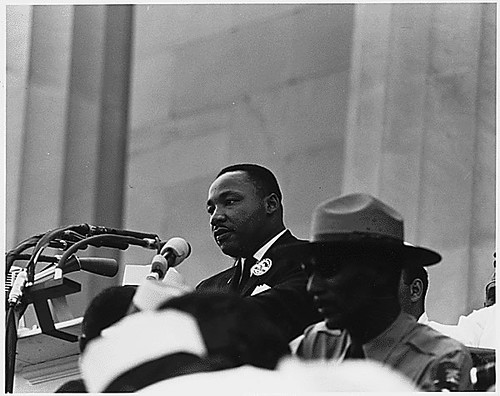
Martin Luther King Jr. could tell you what happens to dreams deferred. They explode.
As I point out in my book Battlefield America: The War on the American People, more than 50 years after King was assassinated, his dream of a world without racism, militarism and materialism remains a distant dream.
Indeed, the reality we must contend with is far different from King’s dream for the future: America has become a ticking time bomb of racial unrest and injustice, police militarization, surveillance, government corruption and ineptitude, the blowblack from a battlefield mindset and endless wars abroad, and a growing economic inequality between the haves and have nots.
King’s own legacy has suffered in the process.
The image of the hard-talking, charismatic leader, voice of authority, and militant, nonviolent activist minister/peace warrior who staged sit-ins, boycotts and marches and lived through police attack dogs, water cannons and jail cells has been so watered down that younger generations recognize his face but know very little about his message.
Rubbing salt in the wound, while those claiming to honor King’s legacy pay lip service to his life and the causes for which he died, they have done little to combat the evils about which King spoke and opposed so passionately: injustice, war, racism and economic inequality.
For instance, President Obama speaks frequently of King, but what has he done to bring about peace or combat the racial injustices that continue to be meted out to young black Americans by the police state?
Republican presidential candidate Donald Trump plans to “honor” Martin Luther King Jr.’s legacy by speaking at a convocation at Liberty University, but what has he done to combat economic injustice?
Democratic presidential contender Hillary Clinton will pay tribute to King’s legacy by taking part in Columbia, South Carolina’s King Day at the Dome event, but has she done anything to dispel her track record’s impression that “machines and computers, profit motives and property rights are still considered more important than people”?
 Unlike the politicians of our present day, King was a clear moral voice that cut through the fog of distortion. He spoke like a prophet and commanded that you listen. King dared to speak truth to the establishment and called for an end to oppression and racism. He raised his voice against the Vietnam War and challenged the military-industrial complex. And King didn’t just threaten boycotts and sit-ins for the sake of photo ops and media headlines. Rather, he carefully planned and staged them to great effect.
The following key principles formed the backbone of Rev. King’s life and work. King spoke of them incessantly, in every sermon he preached, every speech he delivered and every article he wrote. They are the lessons we failed to learn and, in failing to do so, we have set ourselves up for a future in which a militarized surveillance state is poised to eradicate freedom.
Practice militant non-violence, resist militarism and put an end to war.
“I could never again raise my voice against the violence of the oppressed in the ghettos without having first spoken clearly to the greatest purveyor of violence in the world today—my own government.”—Martin Luther King Jr., Sermon at New York’s Riverside Church (April 4, 1967)
On April 4, 1967, exactly one year before his murder, King used the power of his pulpit to condemn the U.S. for “using massive doses of violence to solve its problems, to bring about the changes it wanted.” King called on the U.S. to end all bombing in Vietnam, declare a unilateral cease-fire, curtail its military buildup, and set a date for troop withdrawals. In that same sermon, King warned that “a nation that continues year after year to spend more money on military defense than on programs of social uplift is approaching spiritual death.”
Fifty-some years later, America’s military empire has been expanded at great cost to the nation, with the White House leading the charge. Indeed, in his recent State of the Union address, President Obama bragged that the U.S. spends more on its military than the next eight nations combined. Mind you, the money spent on wars abroad, weapons and military personnel is money that is not being spent on education, poverty and disease.
Stand against injustice.
“Injustice anywhere is a threat to justice everywhere… there are two types of laws: just and unjust. I would be the first to advocate obeying just laws. One has not only a legal but a moral responsibility to obey just laws. Conversely, one has a moral responsibility to disobey unjust laws.”― Martin Luther King Jr., “Letter from a Birmingham Jail” (April 16, 1963)
Arrested and jailed for taking part in a nonviolent protest against racial segregation in Birmingham, Ala., King used his time behind bars to respond to Alabama clergymen who criticized his methods of civil disobedience and suggested that the courts were the only legitimate means for enacting change. His “Letter from a Birmingham Jail,” makes the case for disobeying unjust laws when they are “out of harmony with the moral law.”
Fifty-some years later, we are being bombarded with unjust laws at both the national and state levels, from laws authorizing the military to indefinitely detain American citizens and allowing the NSA to spy on American citizens to laws making it illegal to protest near an elected official or in front of the U.S. Supreme Court. As King warned, “Never forget that everything Hitler did in Germany was legal.”
Work to end poverty. Prioritize people over corporations.
“When machines and computers, profit motives and property rights, are considered more important than people, the giant triplets of racism, extreme materialism, and militarism are incapable of being conquered.” —Martin Luther King Jr., Sermon at New York’s Riverside Church (April 4, 1967)
Especially in the latter part of his life, King was unflinching in his determination to hold Americans accountable to alleviating the suffering of the poor, going so far as to call for a march on Washington, DC, to pressure Congress to pass an Economic Bill of Rights.
Fifty-some years later, a monied, oligarchic elite calls the shots in Washington, while militarized police and the surveillance sector keep the masses under control. With roughly 23 lobbyists per Congressman, corporate greed largely dictates what happens in the nation’s capital, enabling our so-called elected representatives to grow richer and the people poorer. One can only imagine what King would have said about a nation whose political processes, everything from elections to legislation, are driven by war chests and corporate benefactors rather than the needs and desires of the citizenry.
 Stand up for what is right, rather than what is politically expedient.
“On some positions, cowardice asks the question, is it expedient? And then expedience comes along and asks the question, is it politic? Vanity asks the question, is it popular? Conscience asks the question, is it right? There comes a time when one must take the position that is neither safe nor politic nor popular, but he must do it because conscience tells him it is right.”—Martin Luther King Jr., Sermon at National Cathedral (March 31, 1968)
Five days before his assassination, King delivered a sermon at National Cathedral in Washington, DC, in which he noted that “one of the great liabilities of life is that all too many people find themselves living amid a great period of social change, and yet they fail to develop the new attitudes, the new mental responses, that the new situation demands. They end up sleeping through a revolution.”
Freedom, human dignity, brotherhood, spirituality, peace, justice, equality, putting an end to war and poverty: these are just a few of the big themes that shaped King’s life and his activism. As King recognized, there is much to be done if we are to make this world a better place, and we cannot afford to play politics when so much hangs in the balance.
It’s time to wake up, America.
To quote my hero: “[O]ur very survival depends on our ability to stay awake, to adjust to new ideas, to remain vigilant and to face the challenge of change. The large house in which we live demands that we transform this world-wide neighborhood into a world-wide brotherhood. Together we must learn to live as brothers or together we will be forced to perish as fools.”
Original post can be found at http://rutherford.org/publications_resources/john_whiteheads_commentary/what_happens_to_a_dream_deferred_ask_martin_luther_king_jr

 Yet as Barack
  On any given night,
  Government incompetence, corruption and lack of accountability continue to result in the loss of vast amounts of money and weapons. A Reuters investigation revealed
 ere the public is allowed to gather and converse, and is in all relevant respects like a public square or park where citizens have traditionally met to express their views on matters of public interest. However, Hodge was handcuffed, placed under arrest, and then transported to U.S. Capitol Police Headquarters for violating 40 U.S.C. § 6135, which broadly makes it unlawful to display any flag, banner, or device designed to bring into public notice a party, organization, or movement while on the grounds of the U.S. Supreme Court, thereby banning expressive activity on the Supreme Court plaza. Rutherford Institute attorneys subsequently filed a lawsuit challenging § 6135, and in June 2013 a district court judge struck down the law finding the ban to be “repugnant” to the Constitution, “unreasonable, substantially overbroad, and irreconcilable with the First Amendment,” not to mention “plainly unconstitutional on its face.” In response, the government not only appealed that ruling, but the marshal for the Supreme Court—with the approval of Chief Justice John Roberts—issued even more strident regulations outlawing expressive activity on the grounds of the high court, including the plaza. Rutherford Institute attorneys have since filed a related lawsuit challenging the Supreme Court’s more strident regulations.
 A handful of armed protesters are not going to fix what’s broken in the government by forcing a showdown with government agents. In fact, this kind of scenario plays right into the government’s hands by provoking a violent confrontation that allows government officials to sanctimoniously justify their use of surveillance, military weaponry and tactics, and laws criminalizing guns and hate speech in order to target anyone who even vaguely resembles an “anti-government extremist.”
 In 2009, the Department of Homeland Security (DHS) released two reports, one on “
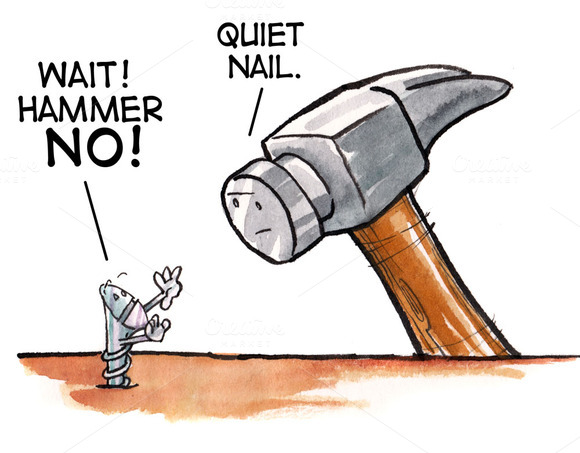 This phenomenon is what philosopher Abraham Kaplan referred to as the law of the instrument, which essentially says that to a hammer, everything looks like a nail. In the scenario that has been playing out in recent years, we the citizenry have become the nails to be hammered by the government’s battalion of laws and law enforcers: its police officers, technicians, bureaucrats, spies, snitches, inspectors, accountants, etc.

 More police shootings of unarmed citizens. Owing in large part to the militarization of local law enforcement agencies, not a week goes by without more reports of hair-raising incidents by police imbued with a take-no-prisoners attitude and a battlefield approach to the communities in which they serve.
 More SWAT team raids. More than
  More strip searches and the denigration of bodily integrity. The Fourth Amendment to the U.S. Constitution was intended to protect the citizenry from being subjected to “unreasonable searches and seizures” by government agents. While the literal purpose of the amendment is to protect our property and our bodies from unwarranted government intrusion, the moral intention behind it is to protect our human dignity. Unfortunately, court
  More political spectacles. Americans continue to naively buy into the idea that politics matter, as if there really were a difference between the Republicans and Democrats (
 More dumbed down, locked down public schools. Our schools have become training grounds for compliant citizens. Despite the fact that
  More censorship. First Amendment activities are being pummeled, punched, kicked, choked, chained and generally gagged all across the country. The reasons for such censorship vary widely from political correctness, safety concerns and bullying to national security and hate crimes but the end result remains the same: the complete eradication of what Benjamin Franklin referred to as the “
 If you’re in the business of making New Year’s resolutions, why not resolve that 2016 will be the year we break the cycle of tyranny and get back on the road to freedom? No matter what the politicians say about the dire state of our nation, you can rest assured that none of the problems that continue to plague our lives and undermine our freedoms will be resolved by our so-called elected representatives in any credible, helpful way in the new year.
 Rather than traveling to Bethlehem for a census, Jesus’ parents would have been mailed a 28-page American Community Survey, a
  According to scripture, Jesus, at the age of twelve, wandered the temple courts in Jerusalem alone and unsupervised. Today, had Jesus disappeared for a few hours let alone days, his parents would have been
 _-_James_Tissot_-_overall.jpg) Had his travels taken him from community to community, Jesus might have been reported to government officials as “suspicious” under the Department of Homeland Security’s “See Something, Say Something” programs. Many states, including New York, are providing individuals with
Had his travels taken him from community to community, Jesus might have been reported to government officials as “suspicious” under the Department of Homeland Security’s “See Something, Say Something” programs. Many states, including New York, are providing individuals with  Had Jesus attempted to feed large crowds of people, he would have been threatened with arrest for violating various ordinances prohibiting the distribution of food without a permit. Florida officials
 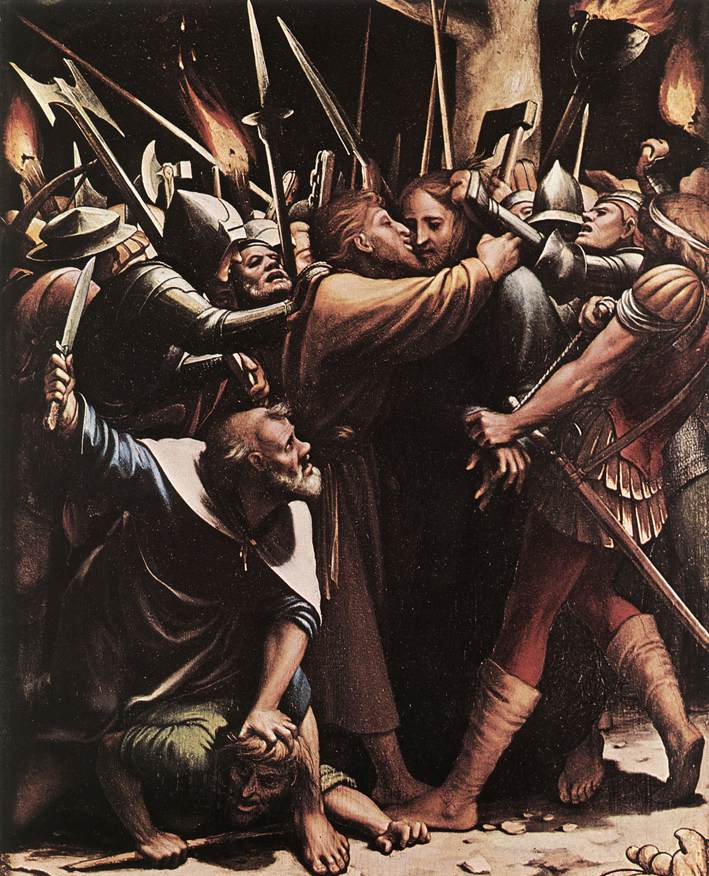 Instead of being detained by Roman guards, Jesus might have been made to “disappear” into a secret government detention center where he would have been interrogated, tortured and subjected to all manner of abuses.
 After endless months of being mired in gloom and doom, we now find ourselves just a few weeks away from Christmas, struggling to latch onto that spirit of joy, excitement, innocence, magic and hope we had as
  It’s A Wonderful Life
 Miracle on 34th Street
 One Magic Christmas
 Home Alone
 Get Santa
 We’re being fed a constant diet of fear: fear of terrorists, fear of illegal immigrants, fear of people who are too religious, fear of people who are not religious enough, fear of Muslims, fear of extremists, fear of the government, fear of those who fear the government. The list goes on and on.
 All the while, those in power—bought and paid for by lobbyists and corporations—move their costly agendas forward, and “we the suckers” get saddled with the tax bills and subjected to pat downs, police raids and round-the-clock surveillance.
 Even in the wake of the shootings in San Bernardino and Paris, statistics show that
 For example, neuroscientists observed how quickly fear can travel through generations of mice DNA. As The Washington Post
  “Big Brother in the form of an increasingly powerful government and in an increasingly powerful private sector will pile the records high with reasons why privacy should give way to national security, to law and order […] and the like.” ― William O. Douglas, Supreme Court Justice
 Credit for this particular brainchild goes to the Obama administration, which issued
  Now there are still those who insist that they have nothing to hide from the surveillance state and nothing to fear from the police state because they have done nothing wrong.
 Endless wars have resulted in a battlefield mindset that is infecting the nation. The Departments of Justice, Homeland Security (DHS) and Defense have passed off
  The schools, modeled after quasi-prisons, are churning out future compliant citizens. Within America’s public schools can be found almost every aspect of the American police state that plagues those of us on the “outside”: metal detectors, surveillance cameras, militarized police, drug-sniffing dogs, tasers, cyber-surveillance, random searches, senseless arrests, jail time, the list goes on. Whether it takes the form of draconian zero tolerance policies, overreaching anti-bullying statutes, police officers charged with tasering and arresting so-called unruly children, standardized testing with its emphasis on rote answers, political correctness, or the extensive surveillance systems cropping up in schools all over the country, young people in America are first in line to be indoctrinated into compliant citizens of the new American police state.