“American citizens have a right to know when government agencies and government officials have engaged in wrongdoing,” said constitutional attorney John W. Whitehead, president of The Rutherford Institute and author ofBattlefield America: The War on the American People. “Whether those individuals occupy a public office or are employed by a law enforcement agency is immaterial. If a government employee has been charged with misconduct, it is the right of the taxpayer to know both the name of the individual and the charge against them.’”
At a time when Americans all across the country are clamoring for increased transparency and accountability of police departments and officers in the wake of police shootings of unarmed individuals and subsequent agency cover-ups, the Virginia Senate has approved legislation, Senate Bill 552, that proposes to change Virginia’s Freedom of Information Act (FOIA) requirement that governments disclose the identity of their employees and other employment-related information of the bodies’ officers and employees by prohibiting the public’s access to the “names and training records of law-enforcement officers.” As Rutherford Institute attorneys point out, the scope of the information that would no longer be accessible under SB 552 is staggering, given that “law-enforcement officer” is defined in the Virginia Code as any full-time or part-time employee of a police department or sheriff’s office which is a part of or administered by the Commonwealth or any political subdivision thereof” as well as a host of other officers of state and local departments with law enforcement responsibility.
The Rutherford Institute’s letter to the General Assembly outlines its concerns with the proposed legislation, notably that if adopted, SB 552 will undermine public trust in government agencies, create an unaccountable secret police force, and do away with critical legal remedies available to victims of police misconduct. As Whitehead notes, “Efforts to circumvent greater government transparency which, in the process, potentially shields government wrongdoing will only weaken that which makes our system of government strong: a system of checks and balances, public accountability, and government agencies and employees that are fully cognizant of the fact that they serve the taxpayers.” Having already been approved by the Virginia Senate, the bill is scheduled for a hearing before a subcommittee of the House General Laws committee, chaired by Del. James LeMunyon (R-Fairfax). If passed, the bill would go before the entire committee, then possibly sent out to the entire House of Delegates.
“I was astonished, bewildered. This was America, a country where, whatever its faults, people could speak, write, assemble, demonstrate without fear. It was in the Constitution, the Bill of Rights. We were a democracy… But I knew it wasn’t a dream; there was a painful lump on the side of my head… The state and its police were not neutral referees in a society of contending interests. They were on the side of the rich and powerful. Free speech? Try it and the police will be there with their horses, their clubs, their guns, to stop you. From that moment on, I was no longer a liberal, a believer in the self-correcting character of American democracy. I was a radical, believing that something fundamental was wrong in this country—not just the existence of poverty amidst great wealth, not just the horrible treatment of black people, but something rotten at the root. The situation required not just a new president or new laws, but an uprooting of the old order, the introduction of a new kind of society—cooperative, peaceful, egalitarian.” ― Historian Howard Zinn
America is at a crossroads.
History may show that from this point forward, we will have left behind any semblance of constitutional government and entered into a militaristic state where all citizens are suspects and security trumps freedom.
Certainly, this is a time when government officials operate off their own inscrutable, self-serving playbook with little in the way of checks and balances, while American citizens are subjected to all manner of indignities and violations with little hope of defending themselves.
As I make clear in my book Battlefield America: The War on the American People, we have moved beyond the era of representative government and entered a new age—the age of authoritarianism. Even with its constantly shifting terrain, this topsy-turvy travesty of law and government has become America’s new normal.
Don’t believe me?
Let me take you on a brief guided tour, but prepare yourself. The landscape is particularly disheartening to anyone who remembers what America used to be.
The Executive Branch: Whether it’s the Obama administration’s war on whistleblowers, the systematic surveillance of journalists and regular citizens, the continued operation of Guantanamo Bay, or the occupation of Afghanistan, Barack Obama has surpassed his predecessors in terms of his abuse of the Constitution and the rule of law. President Obama, like many of his predecessors, has routinely disregarded the Constitution when it has suited his purposes, operating largely above the law and behind a veil of secrecy, executive orders and specious legal justifications. Rest assured that no matter who wins this next presidential election, very little will change. The policies of the American police state will continue.
The Legislative Branch: It is not overstating matters to say that Congress may well be the most self-serving, semi-corrupt institution in America. Abuses of office run the gamut from elected representatives neglecting their constituencies to engaging in self-serving practices, including the misuse of eminent domain, earmarking hundreds of millions of dollars in federal contracting in return for personal gain and campaign contributions, having inappropriate ties to lobbyist groups and incorrectly or incompletely disclosing financial information. Pork barrel spending, hastily passed legislation, partisan bickering, a skewed work ethic, graft and moral turpitude have all contributed to the public’s increasing dissatisfaction with congressional leadership. No wonder 86 percent of Americans disapprove of the job Congress is doing.
The Judicial Branch: The Supreme Court was intended to be an institution established to intervene and protect the people against the government and its agents when they overstep their bounds. Yet through their deference to police power, preference for security over freedom, and evisceration of our most basic rights for the sake of order and expediency, the justices of the United States Supreme Court have become the guardians of the American police state in which we now live. As a result, sound judgment and justice have largely taken a back seat to legalism, statism and elitism, while preserving the rights of the people has been deprioritized and made to play second fiddle to both governmental and corporate interests.
Shadow Government: America’s next president will inherit more than a bitterly divided nation teetering on the brink of financial catastrophe when he or she assumes office. He or she will also inherit a shadow government, one that is fully operational and staffed by unelected officials who are, in essence, running the country. Referred to as the Deep State, this shadow government is comprised of unelected government bureaucrats, corporations, contractors, paper-pushers, and button-pushers who are actually calling the shots behind the scenes right now.
Law Enforcement: By and large the term “law enforcement” encompasses all agents within a militarized police state, including the military, local police, and the various agencies such as the Secret Service, FBI, CIA, NSA, etc. Having been given the green light to probe, poke, pinch, taser, search, seize, strip and generally manhandle anyone they see fit in almost any circumstance, all with the general blessing of the courts, America’s law enforcement officials, no longer mere servants of the people entrusted with keeping the peace but now extensions of the military, are part of an elite ruling class dependent on keeping the masses corralled, under control, and treated like suspects and enemies rather than citizens. In the latest move to insulate police from charges of misconduct, Virginia lawmakers are considering legislation to keep police officers’ names secret, ostensibly creating secret police forces.
Military Empire: America’s endless global wars and burgeoning military empire—funded by taxpayer dollars—have depleted our resources, over-extended our military and increased our similarities to the Roman Empire and its eventual demise. The U.S. now operates approximately 800 military bases in foreign countries around the globe at an annual cost of at least $156 billion. The consequences of financing a global military presence are dire. In fact, David Walker, former comptroller general of the U.S., believes there are “striking similarities” between America’s current situation and the factors that contributed to the fall of Rome, including “declining moral values and political civility at home, an over-confident and over-extended military in foreign lands and fiscal irresponsibility by the central government.”
I haven’t even touched on the corporate state, the military industrial complex, SWAT team raids, invasive surveillance technology, zero tolerance policies in the schools, overcriminalization, or privatized prisons, to name just a few, but what I have touched on should be enough to show that the landscape of our freedoms has already changed dramatically from what it once was and will no doubt continue to deteriorate unless Americans can find a way to wrest back control of their government and reclaim their freedoms.
That brings me to the final and most important factor in bringing about America’s shift into authoritarianism: “we the people.” We are the government. Thus, if the government has become a tyrannical agency, it is because we have allowed it to happen, either through our inaction or our blind trust.
Essentially, there are four camps of thought among the citizenry when it comes to holding the government accountable. Which camp you fall into says a lot about your view of government—or, at least, your view of whichever administration happens to be in power at the time.
In the first camp are those who trust the government to do the right thing, despite the government’s repeated failures in this department. In the second camp are those who not only don’t trust the government but think the government is out to get them. In the third camp are those who see government neither as an angel nor a devil, but merely as an entity that needs to be controlled, or as Thomas Jefferson phrased it, bound “down from mischief with the chains of the Constitution.”
Then there’s the fourth camp, comprised of individuals who pay little to no attention to the workings of government, so much so that they barely vote, let alone know who’s in office. Easily entertained, easily distracted, easily led, these are the ones who make the government’s job far easier than it should be.
It is easy to be diverted, distracted and amused by the antics of the presidential candidates, the pomp and circumstance of awards shows, athletic events, and entertainment news, and the feel-good evangelism that passes for religion today. What is far more difficult to face up to is the reality of life in America, where unemployment, poverty, inequality, injustice and violence by government agents are increasingly norms.
The powers-that-be want us to remain divided, alienated from each other based on our politics, our bank accounts, our religion, our race and our value systems. Yet as George Orwell observed, “The real division is not between conservatives and revolutionaries but between authoritarians and libertarians.”
The only distinction that matters anymore is where you stand in the American police state. In other words, you’re either part of the problem or part of the solution.
RICHMOND, Va. — The Rutherford Institute and a coalition of educational, legal, human rights and media organizations, including the ACLU, Wikipedia, Amnesty International, Human Rights Watch, and the National Association of Criminal Defense Lawyers, have asked the Fourth Circuit Court of Appeals to reinstate a lawsuit challenging the government’s mass surveillance programs.
Despite extensive evidence that the government is systematically copying and substantially reviewing all international text-based communications, a Maryland federal court dismissed the lawsuit, ruling that the coalition of national and international groups does not have standing to bring the First and Fourth Amendment lawsuit against the National Security Agency (NSA), the U.S. Department of Justice and their directors. The Obama administration has argued that the organizations do not have concrete evidence their communications have been monitored under the secret program.
In their appeal brief, The Rutherford Institute and its coalition cite a vast array of sources rebutting the administration’s claim, including statements by former intelligence officials such as Edward Snowden, that corroborate allegations that the NSA’s program involves copying and sifting through the contents of international internet traffic.
“On any given day, the average American going about his daily business will be monitored, surveilled, spied on and tracked in more than 20 different ways, by both government and corporate eyes and ears,” said constitutional attorney John W. Whitehead, president of The Rutherford Institute and author of Battlefield America: The War on the American People. “Revelations about the NSA’s spying programs only scrape the surface in revealing the lengths to which government agencies and their corporate allies will go to conduct mass surveillance on Americans’ communications and transactions. Senator Ron Wyden was right when he warned, ‘If we do not seize this unique moment in our constitutional history to reform our surveillance laws and practices, we are all going to live to regret it.’”
The lawsuit brought by The Rutherford Institute, the ACLU, Wikipedia, Amnesty International, Human Rights Watch, the National Association of Criminal Defense Lawyers and other educational, legal, human rights and media organizations arises from efforts by the U.S. government since the 9/11 terrorist attacks to increase the surveillance and monitoring of U.S. citizens and foreign nationals. Although Congress had previously authorized the issuance of orders for electronic surveillance of foreign agents for intelligence purposes under the Foreign Intelligence Surveillance Act (FISA) in October 2001, President George W. Bush secretly authorized warrantless interception of emails and telephone calls involving persons within the United States if NSA personnel had a “reasonable basis” to believe one party was connected with al Qaeda. When a judge refused to authorize the continuation of this program, the Bush administration obtained amendments to FISA in 2008 authorizing the acquisition without individualized suspicion of the international communications of U.S. citizens that are with or are about foreigners who the NSA chooses to target.
In carrying out this broad authority under the 2008 law, the NSA has engaged in so-called “Upstream surveillance,” which according to the complaint “involves the NSA’s seizing and searching the internet communications of U.S. citizens and residents en mass as those communications travel across the internet ‘backbone’ in the United States—the network of high-capacity cables, switches and routers that facilitates both domestic and international communications via the internet.” Upstream surveillance encompasses the copying of virtually all international text-based communications, review of the content of those communications by the NSA, and the retention of the copied communications for future use and analysis.
“We are not to simply bandage the wounds of victims beneath the wheels of injustice, we are to drive a spoke into the wheel itself.”—Dietrich Bonhoeffer
Republicans and Democrats, eager to take advantage of an opening on the Supreme Court, have been quick to advance their ideas about Scalia’s replacement. This is just the beginning of the furor over who gets to appoint the next U.S. Supreme Court justice (President Obama or his successor), when (as soon as Obama chooses or as long as Congress can delay), how (whether by way of a recess appointment or while Congress is in session), and where any judicial nominee will stand on the hot-button political issues of our day (same-sex marriage, Obamacare, immigration, the environment, and abortion).
This is yet another spectacle, not unlike the carnival-like antics of the presidential candidates, to create division, dissension and discord and distract the populace from the nation’s steady march towards totalitarianism.
Not to worry. This is a done deal. There are no surprises awaiting us.
We may not know the gender, the orientation, the politics, or the ethnicity of Justice Scalia’s replacement, but those things are relatively unimportant in the larger scheme of things.
The powers-that-be have already rigged the system. They—the corporations, the military industrial complex, the surveillance state, the monied elite, etc.—will not allow anyone to be appointed to the Supreme Court who will dial back the police state. They will not tolerate anyone who will undermine their policies, threaten their profit margins, or overturn their apple cart.
Scalia’s replacement will be safe (i.e., palatable enough to withstand Congress’ partisan wrangling), reliable and most important of all, an extension of the American police state.
With the old order dying off or advancing into old age rapidly, we’ve arrived at a pivotal point in the makeup of the Supreme Court. With every vacant seat on the Court and in key judgeships around the country, we are witnessing a transformation of the courts into pallid, legalistic bureaucracies governed by a new breed of judges who have beencareful to refrain from saying, doing or writing anything that might compromise their future ambitions.
Today, the judges most likely to get appointed today are well-heeled, well-educated (all of them attended either Yale or Harvard law schools) blank slates who have traveled a well-worn path from an elite law school to a prestigious judicial clerkship and then a pivotal federal judgeship. Long gone are the days when lawyers without judicial experience such as Earl Warren, William Rehnquist, Felix Frankfurter, and Louis Brandeis could be appointed to the Supreme Court.
As Supreme Court correspondent Dahlia Lithwick points out, “a selection process that discourages political or advocacy experience and reduces the path to the Supreme Court to a funnel” results in “perfect judicial thoroughbreds who have spent their entire adulthoods on the same lofty, narrow trajectory.”
In other words, it really doesn’t matter whether a Republican or Democratic president appoints the next Supreme Court justice, because they will all look alike (in terms of their educational and professional background) and sound alike (they are primarily advocates for the government).
Given the turbulence of our age, with its police overreach, military training drills on American soil, domestic surveillance, SWAT team raids, asset forfeiture, wrongful convictions, and corporate corruption, the need for a guardian of the people’s rights has never been greater.
Unfortunately, as I document in Battlefield America: The War on the American People, what we have been saddled with instead are government courts dominated by technicians and statists who march in lockstep with the American police state.
This is true at all levels of the judiciary.
Thus, while what the nation needs is a constitutionalist, what we will get is a technician.
It’s an important distinction.
A legal constitutionalist believes that the authority of government derives from and is limited by a body of fundamental law (the Constitution) and strives to hold the government accountable to abiding by the Constitution. A judge of this order will uphold the rights of the citizenry in the face of government abuses.
Justice William O. Douglas, who served on the Supreme Court for 36 years, was such a constitutionalist. He believed that the “Constitution is not neutral. It was designed to take the government off the backs of the people.” Considered the most “committed civil libertarian ever to sit on the court,” Douglas was frequently controversial and far from perfect (he was part of a 6-3 majority in Korematsu vs. United States that supported the government’s internment of American citizens of Japanese descent during World War II). Even so, his warnings against a domineering, suspicious, totalitarian, police-driven surveillance state resonate still today.
A legal technician, on the other hand, is an arbitrator of the government’s plethora of laws whose priority is maintaining order and preserving government power. As such, these judicial technicians are deferential to authority, whether government or business, and focused on reconciling the massive number of laws handed down by the government.
John Roberts who joined the Supreme Court in 2005 as Chief Justice is a prime example of a legal technician. His view that the “role of the judge is limited…to decide the cases before them” speaks to a mindset that places the judge in the position of a referee. As USA Today observes, “Roberts’ tenure has been marked by an incremental approach to decision-making — issuing narrow rather than bold rulings that have the inevitable effect of bringing the same issues back to the high court again and again.”
Roberts’ approach to matters of law and justice can best be understood by a case dating back to his years on the U.S. Court of Appeals for the District of Columbia. The case involved a 12-year-old black girl who was handcuffed, searched and arrested by police—all for eating a single French fry in violation of a ban on food in the D.C. metro station. Despite Roberts’ ability to recognize the harshness of the treatment meted out to Ansche Hedgepeth for such a minor violation—the little girl was transported in the windowless rear compartment of a police vehicle to a juvenile processing center, where she was booked, fingerprinted, and detained for three hours, and was “frightened, embarrassed, and crying throughout the ordeal”—Roberts ruled that the girl’s constitutional rights had not been violated in any way.
This is not justice meted out by a constitutionalist.
This is how a technician rules, according to the inflexible letter of the law.
Circuit Judge Sri Srinivasan of the DC Court of Appeals, who is rumored to be a favorite pick for Scalia’s spot on the court, is another such technician. When asked to strike down a 60-year-old ban on expressive activities in front of the Supreme Court Plaza, Srinivasan turned a blind eye to the First Amendment. (Ironically, the Supreme Court must now decide whether to declare its own free speech ban unconstitutional.)
By ruling in favor of the ban, Srinivasan also affirmed that police were correct to arrest an African-American protester who was standing silently in front of the Supreme Court wearing a sign protesting the police state on a snowy day when no one was on the plaza except him.
Srinivasan’s rationale? “Allowing demonstrations directed at the Court, on the Court’s own front terrace, would tend to yield the opposite impression: that of a Court engaged with — and potentially vulnerable to — outside entreaties by the public.”
This view of the Supreme Court as an entity that must be sheltered from select outside influences—for example, the views of the citizenry—is shared by the members of the Court itself to a certain extent. As Lithwick points out:
“The Court has become worryingly cloistered, even for a famously cloistered institution… today’s justices filter out anything that might challenge their perspectives. Antonin Scalia won’t read newspapers that conflict with his views and claims to often get very little from amicus briefs. John Roberts has said that he doesn’t believe that most law-review articles—where legal scholars advance new thinking on contemporary problems—are relevant to the justices’ work. Ruth Bader Ginsburg, Scalia’s opera-going buddy, increasingly seems to revel in, rather than downplay, her status as a liberal icon. Kennedy spends recesses guest-teaching law school courses in Salzburg.”
Are you getting the picture yet?
The members of the Supreme Court are part of a ruling aristocracy composed of men and women who primarily come from privileged backgrounds and who have a vested interest in maintaining the status quo.
When you’re cocooned within the rarefied, elitist circles in which most of the judiciary operate, it can be difficult to see the humanity behind the facts of a case, let alone identify with the terror and uncertainty that most people feel when heavily armed government agents invade their homes, or subject them to a virtual strip search, or taser them into submission.
If you’ve never had to worry about police erroneously crashing through your door in the dead of night, then it might not be a hardship to rule as the Court did in Kentucky v. King that police should have greater leeway to break into homes or apartments without a warrant.
If you have no fear of ever being strip searched yourself, it would be easy to suggest as the Court did in Florence v. Burlington that it’s more important to make life easier for overworked jail officials than protect Americans from debasing strip searches.
And if you have never had to submit to anyone else’s authority—especially a militarized police officer with no knowledge of the Constitution’s prohibitions against excessive force, warrantless searches and illegal seizures, then you would understandably give police the benefit of the doubt as the Court did in Brooks v. City of Seattle, when they let stand a ruling that police officers who had clearly used excessive force when they repeatedly tasered a pregnant woman during a routine traffic stop were granted immunity from prosecution.
Likewise, if you’re not able to understand what it’s like to be one of the “little guys,” afraid to lose your home because some local government wants to commandeer it and sell it to a larger developer for profit, it would be relatively easy to rule, as the Supreme Court did in Kelo v. New London, that the government is within its right to do so.
Now do you understand why the Supreme Court’s decisions in recent years, which have run the gamut from suppressing free speech activities and justifying suspicionless strip searches to warrantless home invasions and conferring constitutional rights on corporations, while denying them to citizens, have been characterized most often by an abject deference to government authority, military and corporate interests?
They no longer work for us. They no longer represent us. They can no longer relate to our suffering.
In the same way that the Legislative Branch, having been co-opted by lobbyists, special interests, and the corporate elite, has ceased to function as a vital check on abuses by the other two branches of government, the Judicial Branch has also become part of the same self-serving bureaucracy.
Sound judgment, compassion and justice have taken a back seat to legalism, statism and elitism.
Preserving the rights of the people has been deprioritized and made to play second fiddle to both governmental and corporate interests.
In the case of the People vs. the Police State, the ruling is 9-0 against us.
So where does that leave us?
The Supreme Court of old is gone, if not for good then at least for now.
It will be a long time before we have another court such as the Warren Court (1953-1969), when Earl Warren served alongside such luminaries as William J. Brennan, Jr., William O. Douglas, Hugo Black, Felix Frankfurter and Thurgood Marshall.
The Warren Court handed down rulings that were instrumental in shoring up critical legal safeguards against government abuse and discrimination. Without the Warren Court, there would be no Miranda warnings, no desegregation of the schools and no civil rights protections for indigents.
Yet more than any single ruling, what Warren and his colleagues did best was embody what the Supreme Court should always be—an institution established to intervene and protect the people against the government and its agents when they overstep their bounds.
That is no longer the case.
We can no longer depend on the federal courts to protect us against the government. They are the government.
Yet as is the case with most things, the solution is far simpler and at the same time more complicated than space allows, but it starts with local action—local change—and local justice. If you want a revolution, start small, in your own backyard, and the impact will trickle up.
If you don’t like the way justice is being meted out in America, then start demanding justice in your own hometown, before your local judges. Serve on juries, nullify laws that are egregious, picket in front of the courthouse, vote out judges (and prosecutors) who aren’t practicing what the Constitution preaches, encourage your local newspapers to report on cases happening in your town, educate yourself about your rights, and make sure your local judges understand that they work for you and are not to be extensions of the police, prosecutors and politicians.
This is the only way we will ever have any hope of pushing back against the police state.
“If you can’t say ‘Fuck’ you can’t say, ‘Fuck the government.’” ― Lenny Bruce
Not only has free speech become a four-letter word—profane, obscene, uncouth, not to be uttered in so-called public places—but in more and more cases, the government deems free speech to be downright dangerous and in some instances illegal.
The U.S. government has become particularly intolerant of speech that challenges the government’s power, reveals the government’s corruption, exposes the government’s lies, and encourages the citizenry to push back against the government’s many injustices.
Indeed, there is a long and growing list of the kinds of speech that the government considers dangerous enough to red flag and subject to censorship, surveillance, investigation and prosecution: hate speech, bullying speech, intolerant speech, conspiratorial speech, treasonous speech, threatening speech, incendiary speech, inflammatory speech, radical speech, anti-government speech, right-wing speech, extremist speech, etc.
Yet by allowing the government to whittle away at cherished First Amendment freedoms—which form the backbone of the Bill of Rights—we have evolved into a society that would not only be abhorrent to the founders of this country but would be hostile to the words they used to birth this nation.
Don’t believe me?
Conduct your own experiment into the government’s tolerance of speech that challenges its authority, and see for yourself.
Stand on a street corner—or in a courtroom, at a city council meeting or on a university campus—and recite some of the rhetoric used by the likes of Thomas Jefferson, Patrick Henry, John Adams and Thomas Paine without referencing them as the authors.
For that matter, just try reciting the Declaration of Independence, which rejects tyranny, establishes Americans as sovereign beings, recognizes God as a Supreme power, portrays the government as evil, and provides a detailed laundry list of abuses that are as relevant today as they were 240 years ago.
My guess is that you won’t last long before you get thrown out, shut up, threatened with arrest or at the very least accused of being a radical, a troublemaker, a sovereign citizen, a conspiratorialist or an extremist.
Try suggesting, as Thomas Jefferson and Benjamin Franklin did, that Americans should not only take up arms but be prepared to shed blood in order to protect their liberties, and you might find yourself placed on a terrorist watch list and vulnerable to being rounded up by government agents.
“What country can preserve its liberties if their rulers are not warned from time to time that their people preserve the spirit of resistance. Let them take arms,” declared Jefferson. He also concluded that “the tree of liberty must be refreshed from time to time with the blood of patriots and tyrants.” Observed Franklin: “Democracy is two wolves and a lamb voting on what to have for lunch. Liberty is a well-armed lamb contesting the vote!”
Better yet, try suggesting as Thomas Paine, Marquis De Lafayette, John Adams and Patrick Henry did that Americans should, if necessary, defend themselves against the government if it violates their rights, and you will be labeled a domestic extremist.
“It is the duty of the patriot to protect his country from its government,” insisted Paine. “When the government violates the people’s rights,” Lafayette warned, “insurrection is, for the people and for each portion of the people, the most sacred of the rights and the most indispensable of duties.” Adams cautioned, “A settled plan to deprive the people of all the benefits, blessings and ends of the contract, to subvert the fundamentals of the constitution, to deprive them of all share in making and executing laws, will justify a revolution.” And who could forget Patrick Henry with his ultimatum: “Give me liberty or give me death!”
Then again, perhaps you don’t need to test the limits of free speech for yourself. One such test is playing out before our very eyes in Portland, Oregon, where radio “shock jock” Pete Santilli, a new media journalist who broadcasts his news reports over YouTube and streaming internet radio, is sitting in jail.
Santilli, notorious for his controversial topics, vocal outrage over government abuses, and inflammatory rhetoric, is not what anyone would consider an objective reporter. His radio show, aptly titled “Telling You the Truth…Whether You Like It or Not,” makes it clear that Santilli has a viewpoint (namely, that the government has overstepped its bounds), and he has no qualms about sharing it with his listeners.
It was that viewpoint that landed Santilli in jail.
In early January 2016, a group of armed activists, reportedly protesting the federal government’s management of federal lands and its prosecution of two local ranchers convicted of arson, staged an act of civil disobedience by occupying the Malheur National Wildlife Refuge in Burns, Oregon. Santilli, who has covered such protests in the past, including the April 2014 standoff in Nevada between the Bundy ranching family and the federal government over grazing rights, reported on the occupation in Burns as an embedded journalist, albeit one who was sympathetic to the complaints (although not the tactics) of the occupiers.
When asked to clarify his role in relation to the occupation, Santilli declared, “My role is the same here that it was at the Bundy ranch. To talk about the constitutional implications of what is going on here. The Constitution cannot be negotiated.”
Well, it turns out that the Constitution can be negotiated, at least when the government gets involved.
Long a thorn in the side of the FBI, Santilli was arrested by the FBI following its ambush and arrest of key leaders of the movement. He was charged, along with the armed resistors, with conspiracy to impede federal officers from discharging their duties by use of force, intimidation, or threats—the same charge being levied against those who occupied the refuge—which carries a maximum sentence of six years in prison.
Notably, Santilli is the only journalist among those covering the occupation to be charged with conspiracy, despite the fact that he did not participate in the takeover of the refuge, nor did he ever spend a night on the grounds of the refuge, nor did he ever represent himself as anything but a journalist covering the occupation.
Read between the lines and you’ll find that what the government is really accusing Santilli of is employing dangerous speech. As court documents indicate, the government is prosecuting Santilli solely as a reporter of information. In other words, they’re making an example of him, which is consistent with the government’s ongoing efforts to intimidate members of the media who portray the government in a less than favorable light.
This is not a new tactic.
During the protests in Ferguson, Missouri, and Baltimore, Maryland, numerous journalists were arrested while covering the regions’ civil unrest and the conditions that spawned that unrest. These attempts to muzzle the press were clearly concerted, top-down efforts to restrict the fundamental First Amendment rights of the public and the press.
The Obama administration’s treatment of reporters has caused controversy before. In 2009, the Department of Justice targeted a Fox News reporter in an investigation. Three years later, DOJ seized Associated Press reporters’ phone records. After that, former Attorney General Eric Holder ordered a review of the Justice Department’s news media policies. DOJ employees must consult with a unit within the Criminal Division before they arrest someone when there is a “question regarding whether an individual or entity is a ‘member of the news media,’” according to a January 2015 memo from Holder to DOJ employees.”
That the government is choosing to target Santilli for prosecution, despite the fact that they do not recognize new media journalists as members of the mainstream media, signals a broadening of the government’s efforts to suppress what it considers dangerous speech and stamp out negative coverage.
The message is clear: whether a journalist is acting alone or is affiliated with an established news source, the government has no qualms about subjecting them to harassment, arrest, jail time and trumped up charges if doing so will discourage others from openly opposing or exposing the government.
You see, the powers-that-be understand that if the government can control speech, it controls thought and, in turn, it can control the minds of the citizenry.
Where the government has gone wrong is in hinging its case against Santilli based solely on his incendiary rhetoric, which is protected by the First Amendment and which bears a striking resemblance to disgruntled patriots throughout American history.
Here’s what Santilli said: “What we need, most importantly, is one hundred thousand unarmed men and women to stand together. It is the most powerful weapon in our arsenal.”
Now compare that with the call to action from Joseph Warren, a leader of the Sons of Liberty and a principal figure within the American Revolution: “Stain not the glory of your worthy ancestors, but like them resolve never to part with your birthright; be wise in your deliberations, and determined in your exertions for the preservation of your liberties. Follow not the dictates of passion, but enlist yourselves under the sacred banner of reason; use every method in your power to secure your rights.”
Indeed, Santilli comes across as relatively docile compared to some of our nation’s more outspoken firebrands.
Santilli: “I’m not armed. I am armed with my mouth. I’m armed with my live stream. I’m armed with a coalition of like-minded individuals who sit at home and on YouTube watch this.”
Now compare that to what George Washington had to say: “Unhappy it is, though, to reflect that a brother’s sword has been sheathed in a brother’s breast and that the once-happy plains of America are either to be drenched with blood or inhabited by slaves. Sad alternative! But can a virtuous man hesitate in his choice?”
And then there was Andrew Jackson, a hothead if ever there was one. He came of age in the early days of the republic, served as the seventh president of the United States, and was not opposed to shedding blood when necessary: “Peace, above all things, is to be desired, but blood must sometimes be spilled to obtain it on equable and lasting terms.”
This is how freedom rises or falls.
There have always been those willing to speak their minds despite the consequences. Where freedom hangs in the balance is when “we the people” are called on to stand with or against individuals who actually exercise their rights and, in the process, push the envelope far enough to get called out on the carpet for it.
Do we negotiate the Constitution, or do we embrace it, no matter how uncomfortable it makes us feel, no matter how hateful or ugly it gets, and no matter how much we may dislike its flag-bearers?
Comedian Lenny Bruce laid the groundwork for the George Carlins that would follow in his wake: foul-mouthed, insightful, irreverent, incredibly funny, and one of the First Amendment’s greatest champions who dared to “speak the unspeakable” about race, religion, sexuality and politics. As Village Voice writer Nat Hentoff attests, Bruce was “not only a paladin of free speech but also a still-penetrating, woundingly hilarious speaker of truth to the powerful and the complacent.”
Bruce died in 1966, but not before being convicted of alleged obscenity for challenging his audience’s covert prejudices by brandishing unmentionable words that, if uttered today, would not only get you ostracized but could get you arrested and charged with a hate crime. Hentoff, who testified in Bruce’s defense at his trial, recounts that Lenny used to say, “What I wanted people to dig is the lie. Certain words were suppressed to keep the lie going. But if you do them, you should be able to say the words.”
Not much has changed in the 50 years since Bruce died. In fact, it’s gotten worse.
What we’re dealing with today is a government that wants to suppress dangerous words—words about its warring empire, words about its land grabs, words about its militarized police, words about its killing, its poisoning and its corruption—in order to keep its lies going.
As I document in my book Battlefield America: The War on the American People, what we are witnessing is a nation undergoing a nervous breakdown over this growing tension between our increasingly untenable reality and the lies being perpetrated by a government that has grown too power-hungry, egotistical, militaristic and disconnected from its revolutionary birthright.
The only therapy is the truth and nothing but the truth.
Otherwise, there will be no more First Amendment. There will be no more Bill of Rights. And there will be no more freedom in America as we have known it.
As the insightful and brash comedian George Carlin observed:
“Rights aren’t rights if someone can take them away. They’re privileges. That’s all we’ve ever had in this country, is a bill of temporary privileges. And if you read the news even badly, you know that every year the list gets shorter and shorter. Sooner or later, the people in this country are gonna realize the government does not give a fuck about them! The government doesn’t care about you, or your children, or your rights, or your welfare or your safety. It simply does not give a fuck about you! It’s interested in its own power. That’s the only thing. Keeping it and expanding it wherever possible.”
Big Brother does not watch us, by his choice. We watch him, by ours. There is no need for wardens or gates or Ministries of Truth. When a population becomes distracted by trivia, when cultural life is redefined as a perpetual round of entertainments, when serious public conversation becomes a form of baby-talk, when, in short, a people become an audience and their public business a vaudeville act, then a nation finds itself at risk; a culture-death is a clear possibility. — Professor Neil Postman
If there are two spectacles that are almost guaranteed to render Americans passive viewers, incapable of doing little more than cheering on their respective teams, it’s football and politics—specifically, the Super Bowl and the quadrennial presidential election.
Both football and politics encourage zealous devotion among their followers, both create manufactured divisions that alienate one group of devotees from another, and both result in a strange sort of tunnel vision that leaves the viewer oblivious to anything else going on around them apart from the “big game.”
Both football and politics are televised, big-money, advertising-driven exercises in how to cultivate a nation of armchair enthusiasts who are content to sit, watch and be entertained, all the while convincing themselves that they are active contributors to the outcome. Even the season schedules are similar in football and politics: the weekly playoffs, the blow-by-blow recaps, the betting pools and speculation, the conferences, and then the final big championship game.
In the same way, both championship events are costly entertainment extravaganzas that feed the nation’s appetite for competition, consumerism and carnivalesque stunts. In both scenarios, cities bid for the privilege of hosting key athletic and political events. For example, San Francisco had to raise close to $50 million just to host the 50th Super Bowl, with its deluxe stadium, Super Bowl City, free fan village, interactive theme park, and free Alicia Keys concert, not including the additional $5 million cost to taxpayers for additional security. Likewise, it costs cities more than $60 million to host the national presidential nominating conventions for the Republicans and Democrats.
Don’t get me wrong. I’m not suggesting that there is anything wrong with enjoying the entertainment that is football or politics.
However, where we go wrong as a society is when we become armchair quarterbacks, so completely immersed in the Big Game or the Big Campaign that we are easily controlled by the powers-that-be—the megacorporations who run both shows—and oblivious to what is really going on around us.
For instance, while mainstream America has been fixated on the contenders for the Vince Lombardi Trophy and the White House, the militarized, warring surveillance state has been moving steadily forward. Armed drones, increased government surveillance and spying, SWAT team raids, police shootings of unarmed citizens, and the like continue to plague the country. None of these dangers have dissipated. They have merely disappeared from our televised news streams.
In this way, television is a “dream come true” for an authoritarian society.
Television isolates people so they are not joining together to govern themselves. As clinical psychologist Bruce Levine notes, viewing television puts one in a brain state that makes it difficult to think critically, and it quiets and subdues a population. And spending one’s free time isolated and watching TV interferes with our ability to translate our outrage over governmental injustice into activism, and thus makes it easier to accept an authority’s version of society and life.
Supposedly the reason why television—and increasingly movies—are so effective in subduing and pacifying us is that viewers are mesmerized by what TV-insiders call “technical events.” These, according to Levine, are “quick cuts, zoom-ins, zoom-outs, rolls, pans, animation, music, graphics, and voice-overs, all of which lure viewers to continue watching even though they have no interest in the content.” Such technical events, which many action films now incorporate, spellbind people to continue watching.
Televised entertainment, no matter what is being broadcast, has become the nation’s new drug high. Researchers found that “almost immediately after turning on the TV, subjects reported feeling more relaxed, and because this occurs so quickly and the tension returns so rapidly after the TV is turned off, people are conditioned to associate TV viewing with a lack of tension.”
Not surprisingly, the United States is one of the highest TV-viewing nations in the world.
Indeed, a Nielsen study reports that American screen viewing is at an all-time high. For example, the average American watches approximately 151 hours of television per month. That does not include the larger demographic of screen-watchers who watch their entertainment via their laptops, personal computers, cell phones, tablets and so on.
Historically, television has been used by those in authority to quiet citizen unrest and pacify disruptive people. In fact, television-viewing has also been a proven tactic for ensuring compliance in prisons. “Faced with severe overcrowding and limited budgets for rehabilitation and counseling, more and more prison officials are using TV to keep inmates quiet,” according to Newsweek. Joe Corpier, a convicted murderer, when interviewed said, “If there’s a good movie, it’s usually pretty quiet through the whole institution.”
Television viewing, no matter what we’re collectively watching—whether it’s American Idol, the presidential debates or the Super Bowl—is a group activity that immobilizes us and mesmerizes us with collective programming. In fact, research also shows that regardless of the programming, viewers’ brain waves slow down, thus transforming them into a more passive, nonresistant state.
By replacing “marching” with electronic screen devices, we have the equivalent of Hitler’s method of population control. Gross writes:
As a technique of immobilizing people, marching requires organization and, apart from the outlay costs involved, organized groups are a potential danger. They might march to a different drum or in the wrong direction….TV is more effective. It captures many more people than would ever fill the streets by marching—and without interfering with automobile traffic.
Equally disturbing is a university study which indicates that we become less aware of our individual selves and moral identity in a group. The study’s findings strongly suggest that when we act in groups, we tend to consider our moral behavior less while moving in lockstep with the group. Thus, what the group believes or does, be it violence or inhumanity, does not seem to lessen the need to be a part of a group, whether it be a mob or political gathering.
So what does this have to do with the Super Bowl and the upcoming presidential election?
If fear-based TV programming—or programming that encourages rivalries and factions—makes people more afraid and distrustful of one another, then our current television lineup is exactly what is needed by an authoritarian society that depends on a “divide and conquer” strategy.
What this means is that Super Bowl matches and presidential contests are merely more palatable, less bloody, manifestations of war suitable for television viewing audiences.
This also explains why television has become the medium of choice for charismatic politicians with a strong screen presence. They are essentially television performers—actors, if you will. Indeed, any successful candidate for political office—especially the President—must come off well on TV. Television has the lure of involvement. A politically adept president can actually make you believe you are involved in the office of the presidency.
The effective president, then, is essentially a television performer. As the renowned media analyst Marshall McLuhan recognized concerning television: “Potentially, it can transform the presidency into a monarchist dynasty.”
If what we see and what we are told through the entertainment industrial complex—which includes so-called “news” shows—is what those in power deem to be in their best interests, then endless screen viewing is not a great thing for a citizenry who believe they possess choice and freedom. Mind you, the majority of what Americans watch on television is provided through channels controlled by a corporate elite of six megacorporations with the ability to foster a particular viewpoint or pacify its viewers on a large scale.
Unfortunately for us, the direction of the future, then, may be towards a Brave New World scenario where the populace is constantly distracted by entertainment, hooked on prescription drugs and controlled by a technological elite.
Freedom, as I make clear in my book Battlefield America: The War on the American People, is an action word. It means turning off your screen devices—or at least greatly reducing your viewing time—and getting active to take to stave off the emerging authoritarian government.
Aldous Huxley, George Orwell, and the countless science fiction writers and commentators have warned that we are in a race between getting actively involved in the world around us or facing disaster.
If we’re watching, we’re not doing.
As television journalist Edward R. Murrow warned in a 1958 speech:
We have currently a built-in allergy to unpleasant or disturbing information. Our mass media reflect this. But unless we get up off our fat surpluses and recognize that television in the main is being used to distract, delude, amuse, and insulate us, then television and those who finance it, those who look at it, and those who work at it, may see a totally different picture too late.
“Never has our future been more unpredictable, never have we depended so much on political forces that cannot be trusted to follow the rules of common sense and self-interest—forces that look like sheer insanity, if judged by the standards of other centuries.” ― Hannah Arendt, The Origins of Totalitarianism
As if we need any more proof that politics in America has been reduced to a three-ring circus complete with carnival barkers, acrobats, contortionists, jugglers, lion tamers, animal trainers, tight rope walkers, freaks, strong men, magicians, snake charmers, fire eaters, sword swallowers, knife throwers, ringmasters and clowns.
Truly, who needs bread and circuses when you have the assortment of clowns and contortionists that are running for the White House?
No matter who wins the presidential election come November, it’s a sure bet that the losers will be the American people.
Despite what is taught in school and the propaganda that is peddled by the media, the 2016 presidential election is not a populist election for a representative. Rather, it’s a gathering of shareholders to select the next CEO, a fact reinforced by the nation’s archaic electoral college system.
Anyone who believes that this election will bring about any real change in how the American government does business is either incredibly naïve, woefully out-of-touch, or oblivious to the fact that as an in-depth Princeton University study shows, we now live in an oligarchy that is “of the rich, by the rich and for the rich.”
As author Noam Chomsky rightly observed, “It is important to bear in mind that political campaigns are designed by the same people who sell toothpaste and cars.”
In other words, we’re being sold a carefully crafted product by a monied elite who are masters in the art of making the public believe that they need exactly what is being sold to them, whether it’s the latest high-tech gadget, the hottest toy, or the most charismatic politician.
As political science professor Gene Sharp notes in starker terms, “Dictators are not in the business of allowing elections that could remove them from their thrones.”
To put it another way, the Establishment—the shadow government and its corporate partners that really run the show, pull the strings and dictate the policies, no matter who occupies the Oval Office—are not going to allow anyone to take office who will unravel their power structures. Those who have attempted to do so in the past have been effectively put out of commission.
So what is the solution to this blatant display of imperial elitism disguising itself as a populist exercise in representative government?
Stop playing the game. Stop supporting the system. Stop defending the insanity. Just stop.
Washington thrives on money, so stop giving them your money. Stop throwing your hard-earned dollars away on politicians and Super PACs who view you as nothing more than a means to an end. There are countless worthy grassroots organizations and nonprofits working in your community to address real needs like injustice, poverty, homelessness, etc. Support them and you’ll see change you really can believe in in your own backyard.
Politicians depend on votes, so stop giving them your vote unless they have a proven track record of listening to their constituents, abiding by their wishes and working hard to earn and keep their trust.
Stop buying into the lie that your vote matters. Your vote doesn’t elect a president. Despite the fact that there are 218 million eligible voters in this country (only half of whom actually vote), it is the electoral college, made up of 538 individuals handpicked by the candidates’ respective parties, that actually selects the next president.
The only thing you’re accomplishing by taking part in the “reassurance ritual” of voting is sustaining the illusion that we have a democratic republic. What we have is a dictatorship, or as political scientists Martin Gilens and Benjamin Page more accurately term it, we are suffering from an “economic élite domination.”
Of course, we’ve done it to ourselves.
The American people have a history of choosing bread-and-circus distractions over the tedious work involved in self-government.
As a result, we have created an environment in which the economic elite (lobbyists, corporations, monied special interest groups) could dominate, rather than insisting that the views and opinions of the masses—“we the people”—dictate national policy. As the Princeton University oligarchy study indicates, our elected officials, especially those in the nation’s capital, represent the interests of the rich and powerful rather than the average citizen. As such, the citizenry has little if any impact on the policies of government.
We allowed our so-called representatives to distance themselves from us, so much so that we are prohibited from approaching them in public, all the while they enjoy intimate relationships with those who can pay for access—primarily the Wall Street financiers. There are 131 lobbyists to every Senator, reinforcing concerns that the government represents the corporate elite rather than the citizenry.
We said nothing while our elections were turned into popularity contests populated by individuals better suited to be talk-show hosts rather than intelligent, reasoned debates on issues of domestic and foreign policy by individuals with solid experience, proven track records and tested integrity.
We turned our backs on things like wisdom, sound judgment, morality and truth, shrugging them off as old-fashioned, only to find ourselves saddled with lying politicians incapable of making fair and impartial decisions.
We let ourselves be persuaded that those yokels in Washington could do a better job of running this country than we could. It’s not a new problem. As former Senator Joseph S. Clark Jr. acknowledged in a 1955 article titled, “Wanted: Better Politicians”: “[W]e have too much mediocrity in the business of running the government of the country, and it troubles me that this should be so at a time of such complexity and crisis… Government by amateurs, semi-pros, and minor-leaguers will not meet the challenge of our times. We must realize that it takes great competence to run a country which, in spite of itself, has succeeded to world leadership in a time of deadly peril.”
We indulged our craving for entertainment news at the expense of our need for balanced reporting by a news media committed to asking the hard questions of government officials. The result, as former congressman Jim Leach points out, leaves us at a grave disadvantage: “At a time when in-depth analysis of the issues of the day has never been more important, quality journalism has been jeopardized by financial considerations and undercut by purveyors of ideology who facilely design news, like clothes, to appeal to a market segment.”
We bought into the fairytale that politicians are saviors, capable of fixing what’s wrong with our communities and our lives, when in fact, most politicians lead such sheltered lives that they have no clue about what their constituents must do to make ends meet. As political scientists Morris Fiorina and Samuel Abrams conclude, “In America today, there is a disconnect between an unrepresentative political class and the citizenry it purports to represent. The political process today not only is less representative than it was a generation ago and less supported by the citizenry, but the outcomes of that process are at a minimum no better.”
We let ourselves be saddled with a two-party system and fooled into believing that there’s a difference between the Republicans and Democrats, when in fact, the two parties are exactly the same. As one commentator noted, both parties support endless war, engage in out-of-control spending, ignore the citizenry’s basic rights, have no respect for the rule of law, are bought and paid for by Big Business, care most about their own power, and have a long record of expanding government and shrinking liberty.
Then, when faced with the prospect of voting for the lesser of two evils, many simply compromise their principles and overlook the fact that the lesser of two evils is still evil.
Perhaps worst of all, we allowed the cynicism of our age and the cronyism and corruption of Beltway politics to discourage us from believing that there was any hope for the American experiment in liberty.
Granted, it’s easy to become discouraged about the state of our nation. We’re drowning under the weight of too much debt, too many wars, too much power in the hands of a centralized government, too many militarized police, too many laws, too many lobbyists, and generally too much bad news.
It’s harder to believe that change is possible, that the system can be reformed, that politicians can be principled, that courts can be just, that good can overcome evil, and that freedom will prevail.
So where does that leave us?
Benjamin Franklin provided the answer. As the delegates to the Constitutional Convention trudged out of Independence Hall on September 17, 1787, an anxious woman in the crowd waiting at the entrance inquired of Franklin, “Well, Doctor, what have we got, a republic or a monarchy?” “A republic,” Franklin replied, “if you can keep it.”
What Franklin meant, of course, is that when all is said and done, we get the government we deserve.
A healthy, representative government is hard work. It takes a citizenry that is informed about the issues, educated about how the government operates, and willing to make the sacrifices necessary to stay involved, whether that means forgoing Monday night football in order to attend a city council meeting or risking arrest by picketing in front of a politician’s office.
Most of all, it takes a citizenry willing to do more than grouse and complain.
We must act—and act responsibly—keeping in mind that the duties of citizenship extend beyond the act of voting.
The powers-that-be want us to believe that our job as citizens begins and ends on Election Day. They want us to believe that we have no right to complain about the state of the nation unless we’ve cast our vote one way or the other. They want us to remain divided over politics, hostile to those with whom we disagree politically, and intolerant of anyone or anything whose solutions to what ails this country differ from our own.
What they don’t want us talking about is the fact that the government is corrupt, the system is rigged, the politicians don’t represent us, the electoral college is a joke, most of the candidates are frauds, and, as I point out in my book Battlefield America: The War on the American People, we as a nation are repeating the mistakes of history—namely, allowing a totalitarian state to reign over us.
Former concentration camp inmate Hannah Arendt warned against this when she wrote, “No matter what the specifically national tradition or the particular spiritual source of its ideology, totalitarian government always transformed classes into masses, supplanted the party system, not by one-party dictatorships, but by mass movement, shifted the center of power from the army to the police, and established a foreign policy openly directed toward world domination.”
Clearly, “we the people” have a decision to make.
Do we simply participate in the collapse of the American republic as it degenerates toward a totalitarian regime, or do we take a stand at this moment in history and reject the pathetic excuse for government that is being fobbed off on us?
March on Albany, NYPL Digital Collection, Image ID 1602566
“If liberty means anything at all, it means the right to tell people what they do not want to hear.”― George Orwell
Free speech is not for the faint of heart.
Nor is it for those who are easily offended, readily intimidated or who need everything wrapped in a neat and tidy bow. Free speech is often messy, foul-mouthed, obscene, intolerant, undignified, insensitive, cantankerous, bawdy and volatile.
While free speech can also be tender, tolerant, soft-spoken, sensitive and sweet, it is free speech’s hot-blooded alter ego—the wretched, brutal, beastly Mr. Hyde to its restrained, dignified and civil Dr. Jekyll—that tests the limits of our so-called egalitarian commitment to its broad-minded principles.
Unfortunately, our appreciation for a robust freedom of speech has worn thin over the years.
Many Americans have become fearfully polite, careful to avoid offense, and largely unwilling to be labeled intolerant, hateful, closed-minded or any of the other toxic labels that carry a badge of shame today. We’ve come to prize civility over freedom. Most of all, too many Americans, held hostage by their screen devices and the talking heads on television, have lost the ability to think critically.
Societies that cherish free speech relish open debates and controversy and, in turn, produce a robust citizenry who will stand against authoritarian government. Indeed, oppressive regimes of the past have understood the value of closed-mouthed, closed-minded citizens and the power inherent in controlling speech and, thus, controlling how a people view their society and government.
We in the United States have a government with a ravenous appetite for power and a seeming desire to turn the two-way dialogue that is our constitutional republic into a one-way dictatorship. Emboldened by phrases such as “hate crimes,” “bullying,” “extremism” and “microaggressions,” the government is whittling away at free speech, confining it to carefully constructed “free speech zones,” criminalizing it when it skates too close to challenging the status quo, shaming it when it butts up against politically correct ideals, and muzzling it when it appears dangerous.
Free speech is no longer free.
Nor is free speech still considered an inalienable right or an essential liberty, even by those government entities entrusted with protecting it.
We’ve entered into an egotistical, insulated, narcissistic era in which free speech has become regulated speech: to be celebrated when it reflects the values of the majority and tolerated otherwise, unless it moves so far beyond our political, religious and socio-economic comfort zones as to be rendered dangerous and unacceptable.
Consider some of the kinds of speech being targeted for censorship or outright elimination.
Offensive, politically incorrect and “unsafe” speech: Disguised as tolerance, civility and love, political correctness has resulted in the chilling of free speech and the demonizing of viewpoints that run counter to the cultural elite. Consequently, college campuses have become hotbeds of student-led censorship, trigger warnings, microaggressions, and “red light” speech policies targeting anything that might cause someone to feel uncomfortable, unsafe or offended.
Bullying, intimidating speech: Warning that “school bullies become tomorrow’s hate crimes defendants,” the Justice Department has led the way in urging schools to curtail bullying, going so far as to classify “teasing” as a form of “bullying,” and “rude” or “hurtful” “text messages” as “cyberbullying.”
Dangerous, anti-government speech: As part of its newly unveiled war on “extremism,” the Obama administration is partnering with the tech industry to establish a task force to counter online “propaganda” by terrorists hoping to recruit support or plan attacks. In this way, anyone who criticizes the government online is considered an extremist and will have their content reported to government agencies for further investigation or deleted.
The upshot of all of this editing, parsing, banning and silencing is the emergence of a new language, what George Orwell referred to as Newspeak, which places the power to control language in the hands of the totalitarian state. Under such a system, language becomes a weapon to change the way people think by changing the words they use. The end result is control.
In totalitarian regimes—a.k.a. police states—where conformity and compliance are enforced at the end of a loaded gun, the government dictates what words can and cannot be used. In countries where the police state hides behind a benevolent mask and disguises itself as tolerance, the citizens censor themselves, policing their words and thoughts to conform to the dictates of the mass mind lest they find themselves ostracized or placed under surveillance.
Even when the motives behind this rigidly calibrated reorientation of societal language appear well-intentioned—discouraging racism, condemning violence, denouncing discrimination and hatred—inevitably, the end result is the same: intolerance, indoctrination and infantilism.
Thus, while on paper, we are technically still free to speak, in reality, we are only as free to speak as a government official or corporate censor may allow.
The U.S. Supreme Court has long been the referee in the tug-of-war over the nation’s tolerance for free speech and other expressive activities protected by the First Amendment. Yet as I point out in my book Battlefield America: The War on the American People, the Supreme Court’s role as arbiter of justice in these disputes is undergoing a sea change. Except in cases where it has no vested interest, the Court has begun to advocate for the government’s outsized interests, ruling in favor of the government in matters of war, national security, commerce and speech. When asked to choose between the rule of law and government supremacy, this Court tends to side with the government.
In the 225 years since the First Amendment to the U.S. Constitution was adopted, the rights detailed in that amendment—which assures the American people of the right to speak freely, worship freely, peaceably assemble, petition the government for a redress of grievances, and have a free press—have certainly taken a beating, but none more so than the right to free speech.
Nowhere in the First Amendment does it permit the government to limit speech in order to avoid causing offense, hurting someone’s feelings, safeguarding government secrets, protecting government officials, insulating judges from undue influence, discouraging bullying, penalizing hateful ideas and actions, eliminating terrorism, combatting prejudice and intolerance, and the like.
Unfortunately, in the war being waged between free speech purists who believe that free speech is an inalienable right and those who believe that free speech should be regulated, the censors are winning. Free speech zones, bubble zones, trespass zones, anti-bullying legislation, zero tolerance policies, hate crime laws and a host of other legalistic maladies dreamed up by politicians and prosecutors have conspired to corrode our core freedoms.
If we no longer have the right to tell a Census Worker to get off our property, if we no longer have the right to tell a police officer to get a search warrant before they dare to walk through our door, if we no longer have the right to stand in front of the Supreme Court wearing a protest sign or approach an elected representative to share our views, if we no longer have the right to voice our opinions in public—no matter how misogynistic, hateful, prejudiced, intolerant, misguided or politically incorrect they might be—then we do not have free speech.
What we have instead is regulated, controlled speech, and that’s a whole other ballgame.
Just as surveillance has been shown to “stifle and smother dissent, keeping a populace cowed by fear,” government censorship gives rise to self-censorship, breeds compliance, makes independent thought all but impossible, and ultimately foments a seething discontent that has no outlet but violence.
The First Amendment is a steam valve. It allows people to speak their minds, air their grievances and contribute to a larger dialogue that hopefully results in a more just world. When there is no steam valve—when there is no one to hear what the people have to say—frustration builds, anger grows and people become more volatile and desperate to force a conversation.
The problem as I see it is that we’ve lost faith in the average citizen to do the right thing. We’ve allowed ourselves to be persuaded that we need someone else to think and speak for us. The result is a society in which we’ve stopped debating among ourselves, stopped thinking for ourselves, and stopped believing that we can fix our own problems and resolve our own differences.
In short, we have reduced ourselves to a largely silent, passive populace, content to watch and not do. In this way, we have become our worst enemy. As U.S. Supreme Court Justice Louis Brandeis once warned, a silent, inert citizenry is the greatest menace to freedom.
Brandeis provided a well-reasoned argument against government censorship in his concurring opinion in Whitney v. California (1927). It’s not a lengthy read, but here it is boiled down to ten basic truths:
1. The purpose of government is to make men free to develop their faculties, i.e., THINK. 2. The freedom to think as you will and to speak as you think are essential to the discovery and spread of political truth. 3. Without free speech and assembly, discussion would be futile. 4. The greatest menace to freedom is a silent people. 5. Public discussion is a political duty, and should be a fundamental principle of the American government. 6. Order cannot be secured through censorship. 7. Fear breeds repression; repression breeds hate; and hate menaces stable government. 8. The power of reason as applied through public discussion is always superior to silence coerced by law. 9. Free speech and assembly were guaranteed in order to guard against the occasional tyrannies of governing majorities. 10. To justify suppression of free speech, there must be reasonable ground (a clear and present danger) to believe that the danger apprehended is imminent, and that the evil to be prevented is a serious one.
Perhaps the most important point that Brandeis made is that freedom requires courage. “Those who won our independence by revolution were not cowards,” he wrote. “They did not fear political change. They did not exalt order at the cost of liberty.” Rather, they were “courageous, self-reliant men, with confidence in the power of free and fearless reasoning applied through the processes of popular government.”
In other words, the founders did not fear the power of speech. Rather, they embraced it, knowing all too well that a nation without a hearty tolerance for free speech, no matter how provocative, insensitive or dangerous, will be easy prey for a police state where only government speech is allowed.
What the police state wants is a nation of sheep that will docilely march in lockstep with its dictates. What early Americans envisioned was a nation of individualists who knew exactly when to tell the government to go to hell.
What happens to a dream deferred?
Does it dry up
like a raisin in the sun?
Or fester like a sore—
And then run?
Does it stink like rotten meat?
Or crust and sugar over—
like a syrupy sweet?
Maybe it just sags
like a heavy load.
Or does it explode?—Langston Hughes, “Harlem”
Martin Luther King Jr. could tell you what happens to dreams deferred. They explode.
As I point out in my book Battlefield America: The War on the American People, more than 50 years after King was assassinated, his dream of a world without racism, militarism and materialism remains a distant dream.
Indeed, the reality we must contend with is far different from King’s dream for the future: America has become a ticking time bomb of racial unrest and injustice, police militarization, surveillance, government corruption and ineptitude, the blowblack from a battlefield mindset and endless wars abroad, and a growing economic inequality between the haves and have nots.
King’s own legacy has suffered in the process.
The image of the hard-talking, charismatic leader, voice of authority, and militant, nonviolent activist minister/peace warrior who staged sit-ins, boycotts and marches and lived through police attack dogs, water cannons and jail cells has been so watered down that younger generations recognize his face but know very little about his message.
Rubbing salt in the wound, while those claiming to honor King’s legacy pay lip service to his life and the causes for which he died, they have done little to combat the evils about which King spoke and opposed so passionately: injustice, war, racism and economic inequality.
For instance, President Obama speaks frequently of King, but what has he done to bring about peace or combat the racial injustices that continue to be meted out to young black Americans by the police state?
Democratic presidential contender Hillary Clinton will pay tribute to King’s legacy by taking part in Columbia, South Carolina’s King Day at the Dome event, but has she done anything to dispel her track record’s impression that “machines and computers, profit motives and property rights are still considered more important than people”?
Unlike the politicians of our present day, King was a clear moral voice that cut through the fog of distortion. He spoke like a prophet and commanded that you listen. King dared to speak truth to the establishment and called for an end to oppression and racism. He raised his voice against the Vietnam War and challenged the military-industrial complex. And King didn’t just threaten boycotts and sit-ins for the sake of photo ops and media headlines. Rather, he carefully planned and staged them to great effect.
The following key principles formed the backbone of Rev. King’s life and work. King spoke of them incessantly, in every sermon he preached, every speech he delivered and every article he wrote. They are the lessons we failed to learn and, in failing to do so, we have set ourselves up for a future in which a militarized surveillance state is poised to eradicate freedom.
Practice militant non-violence, resist militarism and put an end to war.
“I could never again raise my voice against the violence of the oppressed in the ghettos without having first spoken clearly to the greatest purveyor of violence in the world today—my own government.”—Martin Luther King Jr., Sermon at New York’s Riverside Church (April 4, 1967)
On April 4, 1967, exactly one year before his murder, King used the power of his pulpit to condemn the U.S. for “using massive doses of violence to solve its problems, to bring about the changes it wanted.” King called on the U.S. to end all bombing in Vietnam, declare a unilateral cease-fire, curtail its military buildup, and set a date for troop withdrawals. In that same sermon, King warned that “a nation that continues year after year to spend more money on military defense than on programs of social uplift is approaching spiritual death.”
Fifty-some years later, America’s military empire has been expanded at great cost to the nation, with the White House leading the charge. Indeed, in his recent State of the Union address, President Obama bragged that the U.S. spends more on its military than the next eight nations combined. Mind you, the money spent on wars abroad, weapons and military personnel is money that is not being spent on education, poverty and disease.
Stand against injustice.
“Injustice anywhere is a threat to justice everywhere… there are two types of laws: just and unjust. I would be the first to advocate obeying just laws. One has not only a legal but a moral responsibility to obey just laws. Conversely, one has a moral responsibility to disobey unjust laws.”― Martin Luther King Jr., “Letter from a Birmingham Jail” (April 16, 1963)
Arrested and jailed for taking part in a nonviolent protest against racial segregation in Birmingham, Ala., King used his time behind bars to respond to Alabama clergymen who criticized his methods of civil disobedience and suggested that the courts were the only legitimate means for enacting change. His “Letter from a Birmingham Jail,” makes the case for disobeying unjust laws when they are “out of harmony with the moral law.”
Fifty-some years later, we are being bombarded with unjust laws at both the national and state levels, from laws authorizing the military to indefinitely detain American citizens and allowing the NSA to spy on American citizens to laws making it illegal to protest near an elected official or in front of the U.S. Supreme Court. As King warned, “Never forget that everything Hitler did in Germany was legal.”
Work to end poverty. Prioritize people over corporations.
“When machines and computers, profit motives and property rights, are considered more important than people, the giant triplets of racism, extreme materialism, and militarism are incapable of being conquered.” —Martin Luther King Jr., Sermon at New York’s Riverside Church (April 4, 1967)
Especially in the latter part of his life, King was unflinching in his determination to hold Americans accountable to alleviating the suffering of the poor, going so far as to call for a march on Washington, DC, to pressure Congress to pass an Economic Bill of Rights.
Fifty-some years later, a monied, oligarchic elite calls the shots in Washington, while militarized police and the surveillance sector keep the masses under control. With roughly 23 lobbyists per Congressman, corporate greed largely dictates what happens in the nation’s capital, enabling our so-called elected representatives to grow richer and the people poorer. One can only imagine what King would have said about a nation whose political processes, everything from elections to legislation, are driven by war chests and corporate benefactors rather than the needs and desires of the citizenry.
Stand up for what is right, rather than what is politically expedient.
“On some positions, cowardice asks the question, is it expedient? And then expedience comes along and asks the question, is it politic? Vanity asks the question, is it popular? Conscience asks the question, is it right? There comes a time when one must take the position that is neither safe nor politic nor popular, but he must do it because conscience tells him it is right.”—Martin Luther King Jr., Sermon at National Cathedral (March 31, 1968)
Five days before his assassination, King delivered a sermon at National Cathedral in Washington, DC, in which he noted that “one of the great liabilities of life is that all too many people find themselves living amid a great period of social change, and yet they fail to develop the new attitudes, the new mental responses, that the new situation demands. They end up sleeping through a revolution.”
Freedom, human dignity, brotherhood, spirituality, peace, justice, equality, putting an end to war and poverty: these are just a few of the big themes that shaped King’s life and his activism. As King recognized, there is much to be done if we are to make this world a better place, and we cannot afford to play politics when so much hangs in the balance.
It’s time to wake up, America.
To quote my hero: “[O]ur very survival depends on our ability to stay awake, to adjust to new ideas, to remain vigilant and to face the challenge of change. The large house in which we live demands that we transform this world-wide neighborhood into a world-wide brotherhood. Together we must learn to live as brothers or together we will be forced to perish as fools.”
Original post can be found at http://rutherford.org/publications_resources/john_whiteheads_commentary/what_happens_to_a_dream_deferred_ask_martin_luther_king_jr
“There will be, in the next generation or so, a pharmacological method of making people love their servitude, and producing dictatorship without tears, so to speak, producing a kind of painless concentration camp for entire societies, so that people will in fact have their liberties taken away from them, but will rather enjoy it, because they will be distracted from any desire to rebel by propaganda or brainwashing, or brainwashing enhanced by pharmacological methods. And this seems to be the final revolution.”—Aldous Huxley
There’s a man who contacts me several times a week to disagree with my assessments of the American police state. According to this self-avowed Pollyanna who is tired of hearing “bad news,” the country is doing just fine, the government’s intentions are honorable, anyone in authority should be blindly obeyed, those individuals who are being arrested, shot and imprisoned must have done something to deserve such treatment, and if you have nothing to hide, you shouldn’t care whether the government is spying on you.
In other words, this man trusts the government with his life, his loved ones and his property, and anyone who doesn’t feel the same should move elsewhere.
It’s tempting to write this man off as dangerously deluded, treacherously naïve, and clueless to the point of civic incompetence. However, he is not alone in his goose-stepping, comfort-loving, TV-watching, insulated-from-reality devotion to the alternate universe constructed for us by the Corporate State with its government propaganda, pseudo-patriotism and contrived political divisions.
As The Washington Post concludes, “Americans hate government, but they like what it does.” Indeed, kvetching aside, Americans want the government to keep providing institutionalized comforts such as Social Security, public schools, and unemployment benefits, fighting alleged terrorists and illegal immigrants, defending the nation from domestic and foreign threats, and maintaining the national infrastructure. And it doesn’t matter that the government has shown itself to be corrupt, abusive, hostile to citizens who disagree, wasteful and unconcerned about the plight of the average American.
For the moment, Americans are continuing to play by the government’s rules. Indeed, Americans may not approve the jobs being done by their elected leaders, and they may have little to no access to those same representatives, but they remain committed to the political process, so much so that they are working themselves into a frenzy over the upcoming presidential election, with contributions to the various candidates nearing $500 million.
Yet as Barack Obama’s tenure in the White House shows, no matter how much hope and change were promised, what we’ve ended up with is not only more of the same, but something worse: an invasive, authoritarian surveillance state armed and ready to eliminate any opposition.
The state of our nation under Obama has become more bureaucratic, more debt-ridden, more violent, more militarized, more fascist, more lawless, more invasive, more corrupt, more untrustworthy, more mired in war, and more unresponsive to the wishes and needs of the electorate. Most of all, the government, already diabolical and manipulative to the nth degree, has mastered the art of “do what I say and not what I do” hypocrisy.
For example, the government’s arsenal is growing. While the Obama administration is working to limit the public’s access to guns by pushing for greater gun control, it’s doing little to scale back on the federal government’s growing arsenal of firepower and militarized equipment.
In fact, it’s not just the Department of Defense that’s in the business of waging war. Government agencies focused largely on domestic matters continue to spend tens of millions of taxpayer dollars to purchase SWAT and military-style equipment such as body armor, riot helmets and shields, cannon launchers and police firearms and ammunition. The Department of Veterans Affairs spent nearly $2 million on riot helmets, defender shields, body armor, a “milo return fire cannon system,” armored mobile shields, Kevlar blankets, tactical gear and equipment for crowd control. The Food and Drug Administration purchased “ballistic vests and carriers.” The Environmental Protection Agency shelled out $200,000 for body armor. And the Smithsonian Institution procured $28,000 worth of body armor for its “zoo police and security officers.”
The national debt is growing. In fact, it’s almost doubled during Obama’s time in office to nearly $20 trillion. Much of this debt is owed to foreign countries such as China, which have come to exert an undue degree of influence on various aspects of the American economy.
While crime is falling, the number of laws creating new crimes is growing at an alarming rate. Congress creates, on average, more than 50 new criminal laws each year. This adds up to more than 4,500 federal criminal laws and an even greater number of state laws.
The prison population is growing at an alarming rate. Owing largely to overcriminalization, the nation’s prison population has quadrupled since 1980 to 2.4 million, which breaks down to more than one out of every 100 American adults behind bars. According to The Washington Post, it costs $21,000 a year to keep someone in a minimum-security federal prison and $33,000 a year for a maximum-security federal prison. Those costs are expected to increase 30 percent by 2020. Translation: while the American taxpayer will be forced to shell out more money for its growing prison population, the private prison industry will be making a hefty profit.
The nation’s infrastructure—railroads, water pipelines, ports, dams, bridges, airports and roads—is rapidly deteriorating. An estimated $1.7 trillion will be needed by 2020 to improve surface transportation, but with vital funds being siphoned off by the military industrial complex, there’s little relief in sight.
The expense of those endless wars in Afghanistan and Iraq will cost taxpayers $4 trillion to $6 trillion. That does not include the cost of military occupations and exercises elsewhere around the globe. Unfortunately, that’s money that is not being invested in America, nor is it being used to improve the lives of Americans.
Government incompetence, corruption and lack of accountability continue to result in the loss of vast amounts of money and weapons. A Reuters investigation revealed $8.5 trillion in “taxpayer money doled out by Congress to the Pentagon since 1996 that has never been accounted for.” Then there was the $500 million in Pentagon weapons, aircraft and equipment (small arms, ammunition, night-vision goggles, patrol boats, vehicles and other supplies) that the U.S. military somehow lost track of.
If this brief catalogue of our national woes proves anything at all, it is that the American experiment in liberty has failed, and as political economist Lawrence Hunter warns, it is only a matter of time before people realize it. Writing for Forbes, Hunter notes:
The greatest fear of America’s Founding Fathers has been realized: The U.S. Constitution has been unable to thwart the corrosive dynamics of majority-rule democracy, which in turn has mangled the Constitution beyond recognition. The real conclusion of the American Experiment is that democracy ultimately undermines liberty and leads to tyranny and oppression by elected leaders and judges, their cronies and unelected bureaucrats. All of this is done in the name of “the people” and the “general welfare,” of course. But in fact, democracy oppresses the very demos in whose name it operates, benefiting string-pullers within the Establishment and rewarding the political constituencies they manage by paying off special interests with everyone else’s money forcibly extracted through taxation. The Founding Fathers (especially Washington, Jefferson, Franklin, Adams, Madison, and James Monroe), as well as outside observers of the American Experiment such as Alexis de Tocqueville all feared democracy and dreaded this outcome. But, they let hope and faith in their ingenious constitutional engineering overcome their fear of the democratic state, only to discover they had replaced one tyranny with another.
So are there any real, workable solutions to the emerging American police state?
A second American Revolution will not work. In the first revolution, the colonists were able to dispatch the military occupation and take over the running of the country. However, the Orwellian state is here and it is so pervasive that government agents are watching, curtailing and putting down any resistance before it can get started.
A violent overthrow of the government will not work. Government agents are armed to the teeth and will easily blow away any insurgency when and if necessary.
Politics will not help things along. As history has made clear, the new boss is invariably the same as or worse than the old boss—all controlled by a monied, oligarchic elite.
As I make clear in my book Battlefield America: The War on the American People, there is only one feasible solution left to us short of fleeing the country for parts unknown: grassroots activism that strives to reform the government locally and trickles up.
Unfortunately, such a solution requires activism, engagement, vigilance, sacrifice, individualism, community-building, nullification and a communal willingness to reject the federal government’s handouts and, when needed, respond with what Martin Luther King Jr. referred to as “militant nonviolent resistance.”
That means forgoing Monday night football in order to actively voice your concerns at city council meetings, turning off the television and spending an hour reading your local newspaper (if you still have one that reports local news) from front to back, showing your displeasure by picketing in front of government offices, risking your reputation by speaking up and disagreeing with the majority when necessary, refusing to meekly accept whatever the government dictates, reminding government officials—including law enforcement—that they work for you, and working together with your neighbors to present a united front against an overreaching government.
Unfortunately, we now live in a ubiquitous Orwellian society with all the trappings of Huxley’s A Brave New World. We have become a society of watchers rather than activists who are distracted by even the clumsiest government attempts at sleight-of-hand.
There are too many Americans who are reasonably content with the status quo and too few Americans willing to tolerate the discomfort of a smaller, more manageable government and a way of life that is less convenient, less entertaining, and less comfortable.
It well may be that Huxley was right, and that the final revolution is behind us. Certainly, most Americans seem to have learned to love their prison walls and take comfort in a dictatorship without tears.


 At a time when Americans all across the country are clamoring for increased transparency and accountability of police departments and officers in the wake of police shootings of unarmed individuals and subsequent agency cover-ups, the Virginia Senate has approved legislation, Senate Bill 552, that proposes to change Virginia’s Freedom of Information Act (FOIA) requirement that governments disclose the identity of their employees and other employment-related information of the bodies’ officers and employees by prohibiting the public’s access to the “names and training records of law-enforcement officers.” As Rutherford Institute attorneys point out, the scope of the information that would no longer be accessible under SB 552 is staggering, given that “law-enforcement officer” is defined in the Virginia Code as any full-time or part-time employee of a police department or sheriff’s office which is a part of or administered by the Commonwealth or any political subdivision thereof” as well as a host of other officers of state and local departments with law enforcement responsibility.


 The Judicial Branch: The Supreme Court was intended to be an institution established to intervene and protect the people against the government and its agents when they overstep their bounds. Yet through their deference to police power, preference for security over freedom, and evisceration of our most basic rights for the sake of order and expediency, the justices of the United States Supreme Court have become the
  A Suspect Surveillance Society: Every dystopian sci-fi film we’ve ever seen is suddenly converging into this present moment in a dangerous trifecta between science, technology and a government that wants to be all-seeing, all-knowing and all-powerful. By tapping into your phone lines and cell phone communications, the
  I haven’t even touched on the corporate state, the military industrial complex, SWAT team raids, invasive surveillance technology, zero tolerance policies in the schools, overcriminalization, or privatized prisons, to name just a few, but what I have touched on should be enough to show that the landscape of our freedoms has already changed dramatically from what it once was and will no doubt continue to deteriorate unless Americans can find a way to wrest back control of their government and reclaim their freedoms.
 It is easy to be diverted, distracted and amused by the antics of the presidential candidates, the pomp and circumstance of awards shows, athletic events, and entertainment news, and the feel-good evangelism that passes for religion today. What is far more difficult to face up to is the reality of life in America, where unemployment, poverty, inequality, injustice and violence by government agents are increasingly norms.
 RICHMOND, Va. —

 We may not know the gender, the orientation, the politics, or the ethnicity of Justice Scalia’s replacement, but those things are relatively unimportant in the larger scheme of things.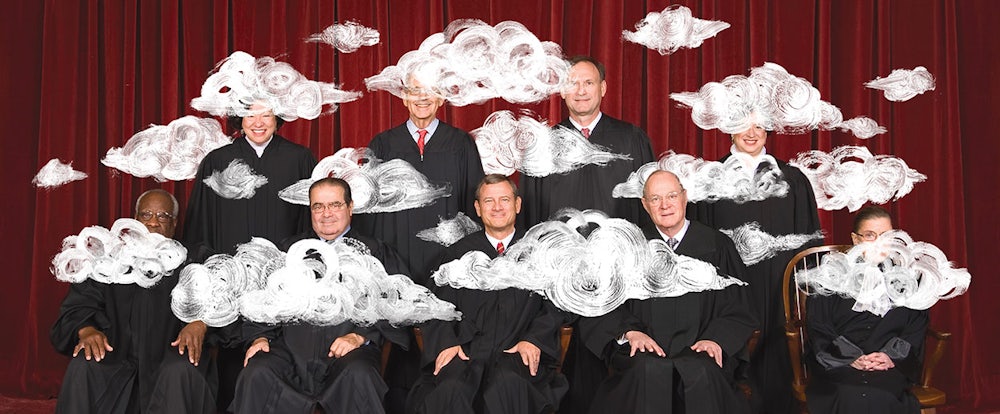
 Justice William O. Douglas, who served on the Supreme Court for 36 years, was such a constitutionalist. He believed that the “Constitution is not neutral. It was designed to take the government off the backs of the people.” Considered the most “committed civil libertarian ever to sit on the court,” Douglas was frequently controversial and far from perfect (he was part of a 6-3 majority in
  Roberts’ approach to matters of law and justice can best be understood by a case dating back to his years on the U.S. Court of Appeals for the District of Columbia. The case involved a 12-year-old black girl who was handcuffed, searched and arrested by police—all for eating a single French fry in violation of a ban on food in the D.C. metro station. Despite Roberts’ ability to recognize the harshness of the treatment meted out to Ansche Hedgepeth for such a minor violation—the little girl was transported in the windowless rear compartment of a police vehicle to a juvenile processing center, where she was booked, fingerprinted, and detained for three hours, and was “
 By ruling in favor of the ban, Srinivasan also affirmed that police were correct to arrest an African-American protester who was standing silently in front of the Supreme Court wearing a sign protesting the police state on a snowy day when no one was on the plaza except him.
 When you’re cocooned within the rarefied, elitist circles in which most of the judiciary operate, it can be difficult to see the humanity behind the facts of a case, let alone identify with the terror and uncertainty that most people feel when heavily armed government agents invade their homes, or subject them to a virtual strip search, or taser them into submission.
 In the same way that the Legislative Branch, having been co-opted by lobbyists, special interests, and the corporate elite, has ceased to function as a vital check on abuses by the other two branches of government, the Judicial Branch has also become part of the same self-serving bureaucracy.
 For that matter, just try reciting the
 Now compare that with the call to action from Joseph Warren, a
 In the same way, both championship events are
  Historically, television has been used by those in authority to quiet citizen unrest and pacify disruptive people. In fact, television-viewing has also been a proven tactic for ensuring compliance in prisons. “Faced with severe overcrowding and limited budgets for rehabilitation and counseling, more and more
  This also explains why television has become the medium of choice for charismatic politicians with a strong screen presence. They are essentially television performers—actors, if you will. Indeed, any successful candidate for political office—especially the President—must come off well on TV. Television has the lure of involvement. A politically adept president can actually make you believe you are involved in the office of the presidency.
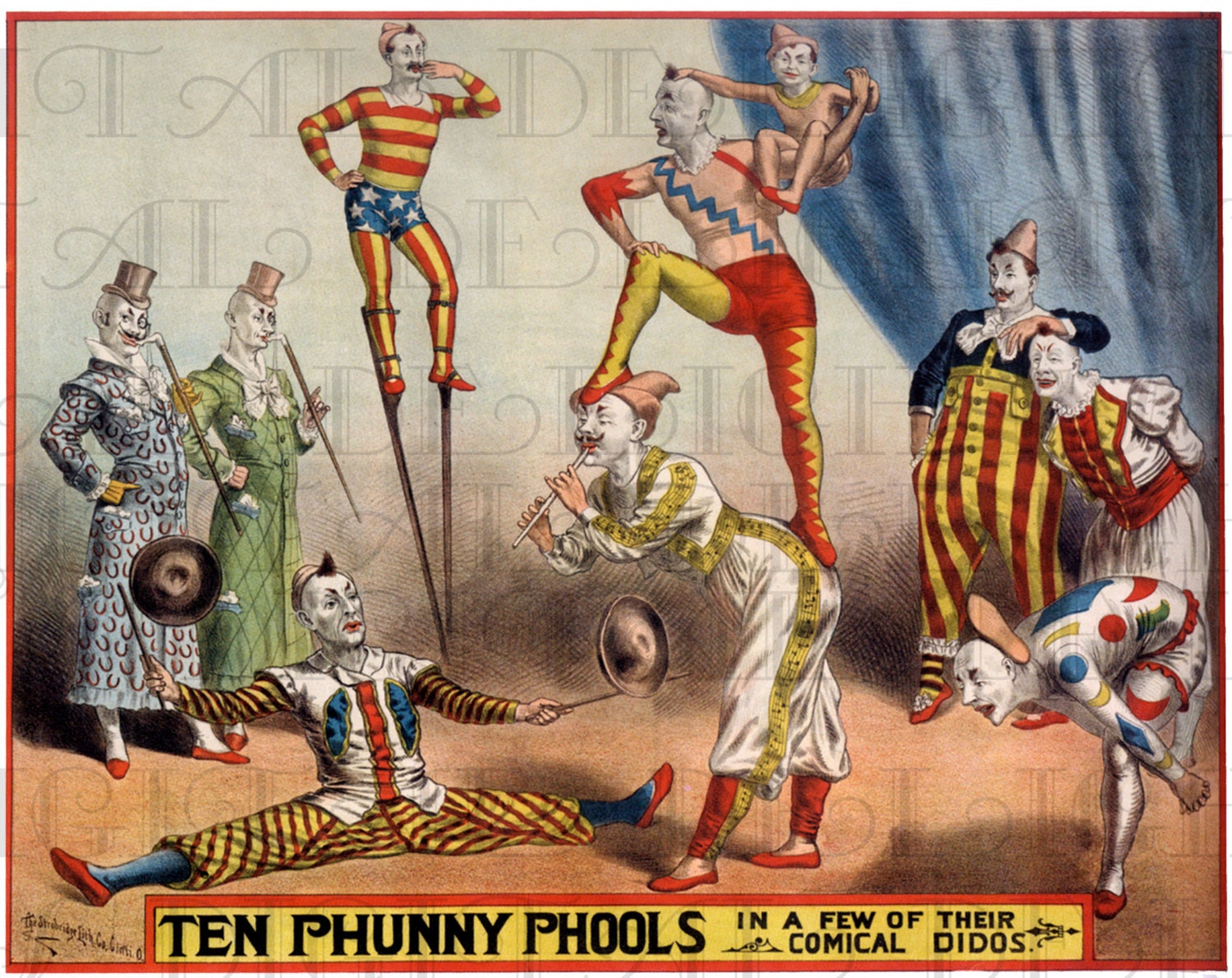
 In other words, we’re being sold a carefully crafted product by a monied elite who are masters in the art of making the public believe that they need exactly what is being sold to them, whether it’s the latest high-tech gadget, the hottest toy, or the most charismatic politician.
 We let ourselves be persuaded that those yokels in Washington could do a better job of running this country than we could. It’s not a new problem. As former Senator Joseph S. Clark Jr. acknowledged in a 1955 article titled, “
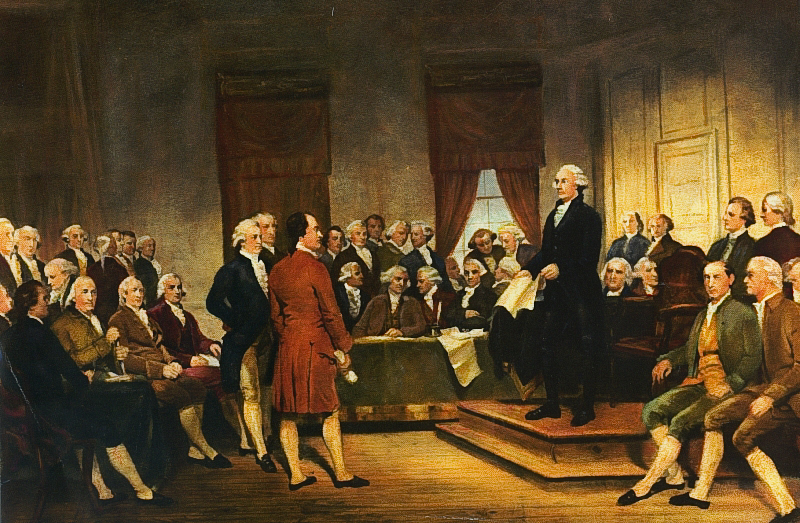 Benjamin Franklin provided the answer. As the delegates to the Constitutional Convention trudged out of Independence Hall on September 17, 1787, an anxious woman in the crowd waiting at the entrance inquired of Franklin, “Well, Doctor, what have we got, a republic or a monarchy?” “A republic,” Franklin replied, “if you can keep it.”

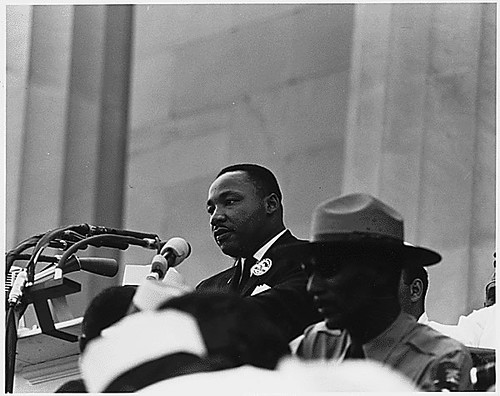
 Unlike the politicians of our present day, King was a clear moral voice that cut through the fog of distortion. He spoke like a prophet and commanded that you listen. King dared to speak truth to the establishment and called for an end to oppression and racism. He raised his voice against the Vietnam War and challenged the military-industrial complex. And King didn’t just threaten boycotts and sit-ins for the sake of photo ops and media headlines. Rather, he carefully planned and staged them to great effect.
 Stand up for what is right, rather than what is politically expedient.
 Yet as Barack
  On any given night,
  Government incompetence, corruption and lack of accountability continue to result in the loss of vast amounts of money and weapons. A Reuters investigation revealed
 John W. Whitehead, Constitutional Attorney