


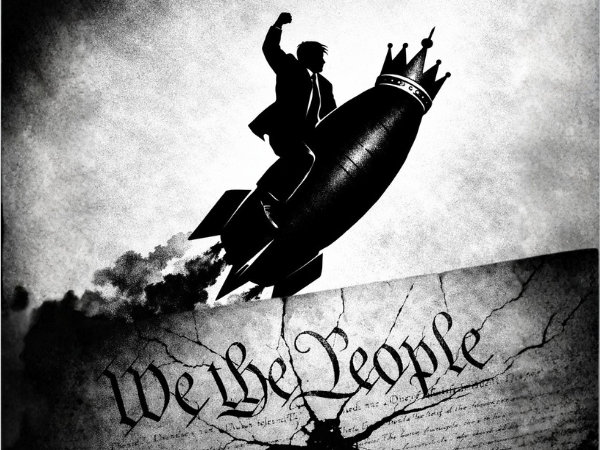
“From the least to the greatest, all are greedy for gain; prophets and priests alike, all practice deceit. They dress the wound of my people as though it were not serious. ‘Peace, peace,’ they say, when there is no peace.”—Jeremiah 6:13–14
“This is insane. Regime change will result in a bloody civil war… Resist this!”—Charlie Kirk (2025)
The military-industrial complex and the American police state have joined forces.
War abroad and war at home are no longer separate enterprises. They have fused.
This did not happen overnight.
Every modern president has stretched the limits of war-making power. Some have shredded those limits altogether.
Each time that boundary is breached, the Constitution recedes a little further.
This is one of those moments.
In a complete about-face from his claims to being a peace president, Donald Trump has authorized yet another preemptive strike—this time against Iran—without a declaration of war from Congress, without meaningful public debate, and without constitutional clarity.
The gravity of that decision cannot be overstated.
While American troops were being ordered into harm’s way, Trump was hosting a $1 million-a-ticket fundraiser for himself at Mar-a-Lago, trotting out his signature dance moves between curtained war briefings.
That spectacle tells you everything you need to know.
That is how we arrived at Operation Epic Fury.
With its Orwellian proclamations of “peace through strength,” Operation Epic Fury is less strategy than spectacle—an egotistical, muscle-flexing distraction by the Trump administration and an overarching attempt to normalize the use of unilateral force by the executive branch without congressional input or authorization.
This was never about peace. It was always about power.
And the Constitution is clear about how this is supposed to work, even if the White House is not.
Article I, Section 8 grants Congress—not the president—the power to declare war. The president under Article II, Section 2 is designated as commander-in-chief with the power to command the military. He is not commander-of-everything.
Yet here we are.
The Trump administration is advancing a global policing doctrine that mirrors the domestic police state: strike first, ask questions later.
Since January 2025, Trump has carried out more than 600 military strikes on foreign targets that include Iran, Yemen, Nigeria and Venezuela, while threatening forceful military takeovers of Greenland, Colombia and Mexico.
Preemptive force has become policy.
Call it what it is: war.
Despite the word games over its war games—the administration insists its actions in Iran do not constitute a war—members of Trump’s Cabinet use the word “war” freely until congressional authorization is mentioned.
And when the administration is asked to explain themselves, the answer is not constitutional deference but open defiance.
Clearly, they have lost sight of who they answer to—and who funds their war chests: we the taxpayers.
Pete Hegseth—the self-righteous blowhard who brags about lethal weapons and has rebranded the Defense Department as the Department of War—dismissed public accountability outright, expressing in no uncertain terms that it’s none of our business: “Why in the world would we tell you, you, the enemy, anybody what we will or will not do in pursuit of an objective. We fight to win. We fight to achieve the objectives the President of the United States has laid out and we will do so unapologetically.”
The Constitution is the “why.”
The American people have a right to debate war before it begins. We have a right to know how our tax dollars are spent. We have a right to insist our representatives authorize the use of force. We have a right to know why our sons and daughters are sent into harm’s way. We have a right to refuse to have our tax dollars used to kill other people’s daughters and sons.
As Rick Steves, the globetrotting travel writer, put it:
“As an American taxpayer, I believe that every US bomb that falls and every bullet that flies has my name on it. In the last year, our president (who won votes by promising to keep America out of wars and is now famously agitating for a Nobel Peace Prize) has dropped bombs on seven foreign countries—and each of those bombs has your name on it, too…including the one that just recklessly decapitated a nation of 90 million people in a war-torn corner of our world.”
He is right. War is not abstract—it is done with our money, and too often without our consent.
As Cato Institute’s Katherine Thompson explains, “War…costs American blood and treasure. The Founders placed the power to initiate it in Congress precisely to ensure those costs are confronted and debated before the country walks into battle.”
That safeguard is being ignored.
And the damage does not stop at constitutional injury, because war is not only a constitutional problem. It is an economic one.
War fuels defense contracts, reconstruction deals and intelligence budgets. It sustains a vast military-industrial apparatus whose profits depend on instability.
Nothing about Operation Epic Fury puts America first. It pushes us toward a fiscal cliff.
Within days, the costs were staggering: $300 million for three F-15E jets downed by “friendly” fire. $630 million to transport troops, ships and aircraft to the region in advance of the attacks. More than 50,000 troops deployed to the region. $13 million a day just for two aircraft carriers stationed nearby. $43.8 million for 1,250 Kamikaze drones. $2 million each for Tomahawk missiles. $12.8 million each for anti-ballistic missile interceptors.
Forbes estimates that Trump’s military strikes in Iran have already cost American taxpayers over $1 billion, “with a price tag that could approach $100 billion, depending on how long it can stretch on.” The total economic cost of the conflict “could trigger an economic loss for the U.S. of between $50 billion and $210 billion.”
And that is before accounting for the human cost.
Innocent civilians—over a hundred young girls between the ages of 7 and 12—have died because the U.S. and Israel reportedly launched a deadly strike on a girls’ elementary school in Iran using outdated maps.
American servicepeople are dying because of one man’s unilateral decision to play at war.
So much for “America First.”
Permanent war places empire first.
And as usual, “we the people” will be forced pay for another unpopular forever war—financially, constitutionally, and domestically—and for the presidential hubris and the greed of the military-industrial complex and Deep State undergirding it all.
Congress anticipated this danger.
The War Powers Act was meant to rein in presidents who bypass Congress. But laws are only as strong as the institutions willing to enforce them.
Without congressional authorization, without meaningful debate, without constitutional clarity, the executive branch claims the unilateral authority to wage war.
This is how dictatorships arise and republics erode.
It happens when a president is allowed to treat constitutional limits as inconveniences rather than restraints.
Trump routinely dismisses unfavorable polls, ignores the courts, sidesteps Congress, shows contempt for the will of the American people, and ignorance about the fact that he works for “we the people.” He behaves not as a public servant but as a potentate.
As John Jay warned in The Federalist No. 4:
“Absolute monarchs will often make war when their nations are to get nothing by it, but for the purposes and objects merely personal, such as thirst for military glory, revenge for personal affronts, ambition, or private compacts to aggrandize or support their particular families or partisans. These and a variety of other motives, which affect only the mind of the sovereign, often lead him to engage in wars not sanctified by justice or the voice and interests of his people.”
If this were merely a constitutional dispute, it would be grave enough.
But it is not merely constitutional.
The consequences are immediate, political, and profoundly destabilizing.
Trump has a tendency to bulldoze through constitutional and legal restraints, creating a spectacle or a crisis, and then leaving others to clean up the fallout—whether it is a gutted ballroom, an eviscerated federal agency, a chaotic immigration crackdown, or now a widening war in the Middle East.
Long after the headlines move on, the wreckage remains.
And when the crisis involves war, the consequences are not merely bureaucratic or political — they are measured in lives and liberties.
War, in particular, has always been the most convenient tool of presidents facing troubles at home. When approval ratings slide, when economic policy falters, when scandal threatens to consume the headlines, foreign conflict has a way of shifting the narrative.
Trump’s Iran escalation—a deadly, costly, immoral, unpopular distraction from missteps of Trump’s own making—comes amid dismal polling, a faltering economy, escalating immigration crackdowns, eroding constitutional protections, and renewed scrutiny tied to the Epstein files.
Six out of ten Americans disapprove of Trump’s military action against Iran.
And while there is little to defend about Iran—it is a brutal regime—no nation has the right to declare itself judge, jury and executioner of another without lawful authority. To suggest otherwise is the language of strongmen.
Moreover, what happens abroad does not stay abroad.
The same government that claims unilateral authority to bomb foreign nations claims expanded authority to surveil, detain and silence domestically.
The military-industrial complex and the police state operate in tandem.
At home, we are being subjected to many of the same tactics and technologies deployed overseas. This is how America becomes a battlefield.
The pattern is not new. George W. Bush expanded warrantless surveillance. Obama normalized drone warfare. Presidents of both parties have stretched executive power.
Trump inherited the imperial presidency—and leaned into it. He boasts of his authority, derides the courts, dismisses Congress, and treats constitutional limits as inconveniences rather than guardrails.
He governs as though Article II were a royal charter.
Defense contractors may prosper in such a climate. The Constitution does not.
History teaches that war abroad produces blowback at home. Twenty-five years ago, 9/11 was itself blowback—the consequence of decades of military intervention and occupation in the Middle East.
Blowback justifies emergency powers. Emergency powers justify a police state. A police state justifies a permanent national security state.
The “war on terror” did not end terrorism. It institutionalized emergency. And permanent emergency makes constitutional government fragile.
James Madison warned that “the means of defense against foreign danger have been always the instruments of tyranny at home.”
We have seen it unfold over the past quarter century: the militarization of police, battlefield tactics in American neighborhoods, expansive surveillance justified by counterterrorism. The same tactics and rationale deployed abroad eventually get used against the American people here at home.
War abroad justifies control at home. That is the pattern.
As legal scholar Aziz Huq, professor of law at the University of Chicago, warns, the same national-security powers used to justify bombing foreign nations can be turned inward—against domestic opponents and even against the electoral process itself.
That is the long game being played right now.
This unprovoked attack on Iran is turning the Middle East into a war zone, in turn laying the groundwork for Trump to act on the fantasies he has long entertained about cancelling the mid-term elections.
It is not far-fetched to imagine he might attempt it. He has repeatedly hinted about it and has already demonstrated how far he is willing to go to overturn an election.
On the very day bombs began falling on Tehran, Huq notes that the White House was reportedly considering a unilateral executive order asserting the power to control how and when Americans vote in the upcoming midterm elections—citing “national security” and alleged foreign meddling as justification.
As Huq explains, the presidency is especially weakly bound by law when “national security” is invoked. The absence of legal authority did not prevent the strikes on Iran—strikes that are unlawful under the Constitution, which assigns Congress alone the power to initiate war.
If national security can be invoked to bypass Congress abroad, it can be invoked to bypass constitutional limits at home.
In other words, if a president can launch a war without congressional authorization, he can claim similar emergency authority to restrict voting, suppress dissent, or silence opposition.
This is not republican governance. It is rule by force.
Even some of Trump’s former allies sense the instability. As Marjorie Taylor Greene bluntly put it, “I think it’s time for America to rip the Band-Aid off and we need to have a serious conversation about what the f— is happening in this country and who in the hell are these decisions being made for and who is making these decisions.”
America’s founders understood this danger. They structured the Constitution to prevent any one man from dragging the nation into war.
In making the case that decisions about war should never be left to one man, legal scholar David French quotes then-Congressman Abraham Lincoln at the close of the Mexican-American War in 1948: “Kings had always been involving and impoverishing their people in wars, pretending generally, if not always, that the good of the people was the object. This, our convention understood to be the most oppressive of all kingly oppressions and they resolved to so frame the Constitution that no one man should hold the power of bringing this oppression upon us.”
Concludes French: “Those words were true then, and they’re true now. No matter what he thinks, Trump is not a king. But by taking America to war all on his own, he is acting like one.”
If we are to preserve any semblance of constitutional government, Congress must reclaim its war powers. The War Powers Resolution must be enforced. Emergency powers must be narrowed, sunsetted and restrained. Surveillance must be reined in. Domestic military deployment must be limited to the most narrow, exceptional circumstances.
But structural reform alone will not save a republic that has grown comfortable with permanent war. Because once war abroad and war at home fully merge, the Constitution becomes little more than words on paper.
War is not peace. Preemptive war is not strength. And an imperial presidency—no matter how loudly it wraps itself in flags—is not constitutional government.
The Founders understood that the gravest threat to liberty would not come from foreign enemies alone, but from the concentration of power in the hands of one man who believed himself indispensable.
A president who can send bombs abroad without consent can silence opposition at home without hesitation.
A government that governs by the rule of emergency eventually ceases to govern by the rule of law.
And a nation that trades liberty for spectacle will wake up to find that it has neither.
History is a relentless teacher: military empires may rise on the back of war, but they fall just as quickly from being spread too thin. Already, days after the start of this debacle of a war on Iran, U.S. forces are being used to combat drug trafficking in Ecuador.
As I make clear in my book Battlefield America: The War on the American People and in its fictional counterpart The Erik Blair Diaries, the question is no longer whether America can police the globe. The question is whether our Republic can survive the weight of the Empire it has become.
We are at the point where we must choose: the spectacle of permanent war, or the survival of the American experiment in freedom.
We cannot have both.
Source: https://tinyurl.com/u65m2syb
ABOUT JOHN W. WHITEHEAD
Constitutional attorney and author John W. Whitehead is founder and president of The Rutherford Institute. His most recent books are the best-selling Battlefield America: The War on the American People, the award-winning A Government of Wolves: The Emerging American Police State, and a debut dystopian fiction novel, The Erik Blair Diaries. Whitehead can be contacted at staff@rutherford.org. Nisha Whitehead is the Executive Director of The Rutherford Institute. Information about The Rutherford Institute is available at www.rutherford.org.
Publication Guidelines / Reprint Permission
John W. Whitehead’s weekly commentaries are available for publication to newspapers and web publications at no charge.





 John W. Whitehead, Constitutional Attorney