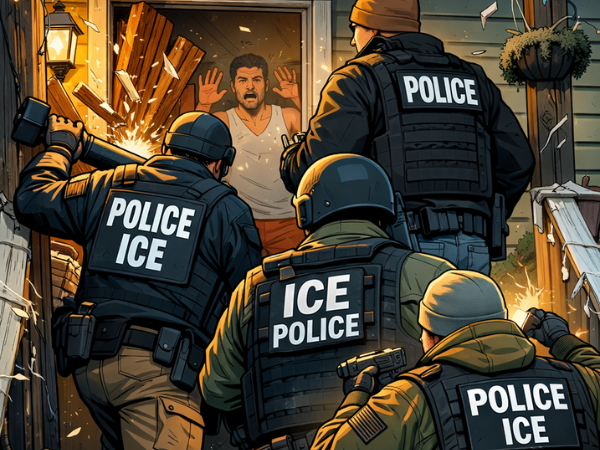
WASHINGTON, D.C. — One year after the U.S. Supreme Court declined to protect homeowners from warrantless searches by police based merely on a suspicion that a person on probation or parole resides on the premises, agents with Immigration and Customs Enforcement are now forcibly entering private homes without a judge’s warrant.
According to reporting by the Associated Press, ICE officers are being instructed that they may use force to enter a residence based solely on an administrative arrest warrant tied to a final order of removal—despite prior guidelines and legal precedent holding that such warrants do not authorize entry into a private home absent consent or exigent circumstances.
“This is not law enforcement. It’s a home-invasion policy,” said constitutional attorney John W. Whitehead, president of The Rutherford Institute and author of Battlefield America: The War on the American People. “The Fourth Amendment does not disappear at the doorstep simply because the government labels a piece of paper an ‘administrative warrant.’ Judicial oversight is not optional. It is the Constitution’s first line of defense against tyranny.”
The Rutherford Institute warned one year ago that the Supreme Court’s refusal to intervene in Bailey v. Arkansas set the nation on a slippery slope toward a society in which police may invade homes based on nothing more than a hunch. That warning now carries graver weight in light of ICE’s newly revealed internal memo authorizing officers to forcibly enter private residences without judicial approval—a sweeping assertion of power that directly collides with the Fourth Amendment’s core protections against unreasonable searches and seizures. Disturbingly, these warrantless raids are not confined to non-citizens. In a widely reported incident, ICE agents forced open the door to the Minnesota home of ChongLy Thao, a U.S. citizen, dragged him outside in his underwear, and detained him without a judicial warrant—despite his repeated assertions of citizenship. The incident underscores the real-world consequences of treating administrative authority as a substitute for constitutional safeguards. Unlike judicial warrants issued by neutral judges upon a showing of probable cause, ICE administrative warrants are signed internally by immigration officials—allowing the same agency to act as lawmaker, judge, and enforcer. Civil liberties advocates warn that this concentration of power invites precisely the kind of warrantless, militarized home raids the Fourth Amendment was written to prevent.
For years, The Rutherford Institute has documented the steady erosion of Fourth Amendment protections through no-knock raids, militarized policing, and “Constitution-free” enforcement tactics—often targeting the most vulnerable communities first. ICE’s new guidance represents a dangerous escalation of that trend. “This memo doesn’t just threaten immigrants. It normalizes the idea that armed government agents may force their way into a home without judicial approval. Once that line is crossed, no one’s privacy is secure—not even citizens,” Whitehead said. “The government is once again testing how much lawlessness the public will tolerate. History shows that when agencies are allowed to ignore the Fourth Amendment in the name of expediency, abuse follows—and freedom is the casualty.”
The Rutherford Institute, a nonprofit civil liberties organization, defends individuals whose constitutional rights have been threatened or violated and educates the public on a wide spectrum of issues affecting their freedoms.
“It’s not personal, Sonny. It’s strictly business.”—Michael Corleone, The Godfather
Pay-to-play schemes. Protection rackets. Extortion. Corruption. Self-enrichment. Graft. Grift. Brutality. Roaming bands of thugs smashing car windows and terrorizing communities. Immunity for criminal behavior coupled with prosecutions of whistleblowers.
This is how a crime syndicate operates—not a constitutional republic.
What we are witnessing today is the steady transformation of the federal government—especially the executive branch—into a criminalized system of power in which justice is weaponized, law is selectively enforced, and crime becomes a form of political currency.
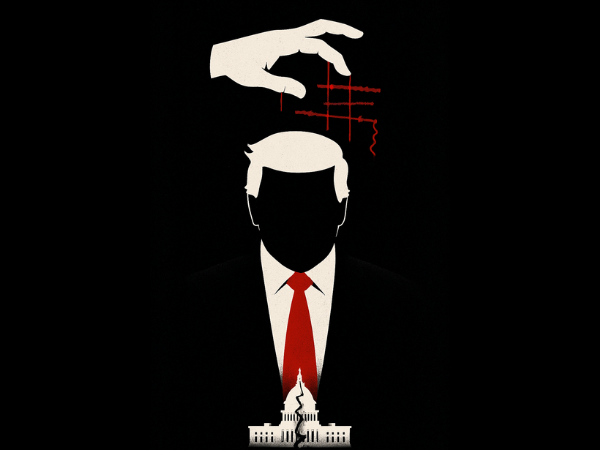
While the American police state has long marched in lockstep with the old truism that power corrupts—and absolute power corrupts absolutely—the Trump administration has ceased even the pretense of being bound by the Constitution.
Rather than abiding by the rule of law, this administration operates as if there are two separate legal systems: one for themselves and their cronies, and one for everyone else.
The corruption is off the charts, the conflicts of interest are in your face, and the brazenness is staggering.
Journalist David D. Kirkpatrick calculates that Donald Trump and his immediate family have made more than $3.4 billion from his time in the White House, including more than $2.3 billion from various cryptocurrency ventures alone.
In May 2025, Trump was accused of selling access to accumulate personal wealth when he hosted a private event for 220 crypto investors who had bought into his meme coin. News reports estimate that buyers spent about $148 million in total on the coin and associated perks, with some spending $1.8 million to attend.
The average American can’t get any kind of access to our elected representatives, but the wealthy can buy their way through the door.
Measured against this reality, Thomas Jefferson’s warning to bind government down “by the chains of the Constitution” sounds almost quaint.
How do you use the Constitution to guard against government misconduct when the government has effectively rendered the Constitution null and void?
It has become increasingly difficult to pretend that we are still dealing with a functioning republic.
What we have instead is a government that behaves like a criminal enterprise: rewarding loyalty, punishing dissent, monetizing public service, and enriching itself through favors, loopholes, and outright graft.
Consider the pay-to-play culture that now permeates the highest levels of power.
The Foreign Gifts and Decoration Act bars the president and federal officials from accepting gifts worth more than $480 from foreign governments (unless they’re accepted on behalf of the United States—meaning they would then belong to the American people—or purchased by the official). Yet congressional investigators have already documented more than a hundred foreign gifts to Trump and his family that went unreported for months in violation of disclosure rules.
The publicly-reported gifts being showered upon President Trump by foreign governments and politically connected foreign corporations include: a gold crown, a Rolex desk clock and a one-kilogram personalized gold bar worth $130,000, and a $400 million luxury Boeing 747.
These are not tokens of diplomacy; they are currency—investments in influence, access, and favorable policy.
As Richard Painter, a former chief White House ethics lawyer for President George W. Bush, explains, “It’s unconstitutional in the United States for the president or anyone else in a position of power to receive anything of value from a foreign government. That is unconstitutional. But if the gift is from a foreign corporation or a private interest, it’s not technically prohibited under the emoluments clause of the Constitution. But it’s still a very, very dangerous precedent to set that foreign interests can give gifts to the president and then get a concession on tariffs or anything else.”
In many cases, these gifts went unreported to the State Department, only coming to light through House investigations and watchdog reports—concealed from the public and from Congress until after the fact.
That secrecy was not accidental. It was strategic.
Federal contracts, regulatory decisions, and diplomatic overtures increasingly appear correlated with the interests of those giving the gifts. A growing number of domestic and foreign business interests appear to be receiving preferential treatment from agencies whose regulatory decisions align suspiciously with Trump’s personal business deals advancing behind the scenes.
And then there are more obvious pay-to-play schemes like the White House Ballroom, a projected 90,000-square-foot monstrosity funded by tech and defense giants such as Apple, Google, Palantir and Lockheed Martin—corporate donors who now help underwrite the president’s vanity project even as their regulatory and contracting interests sit squarely in his hands.
This quid pro quo governance—private profit in exchange for public policy—does not resemble republican self-government. It resembles a protection racket, where the powerful exchange favors not for the public good but for personal gain—and access and immunity are available for purchase by those willing to pay.
Meanwhile, ordinary Americans are told that the system is blind, impartial, and committed to the “rule of law.”
Nothing could be further from the truth.
According to a bombshell investigation by the New York Times, career attorneys inside the Department of Justice spent the first ten months of Trump’s second term documenting—often in real time—how the justice system was being hijacked to serve political priorities rather than legal ones.
Federal lawyers told the Times that they were instructed to drop cases for political reasons, to hunt for evidence to justify flimsy investigations, and to defend executive actions they believed had no legal basis or were plainly unlawful. They also detailed the work they were told to abandon—cases involving terrorism plots, corruption, and white-collar fraud—because those investigations did not serve the administration’s political priorities.
As Dena Robinson, a former Justice Department lawyer for the Civil Rights Division, remarked on Pam Bondi’s transformation of the department into a political tool, “One thing that stuck out to me was her insistence that we served at the pleasure of the president and that we were enforcing the president’s priorities. We swore an oath to uphold the Constitution.”
Prosecution for enemies, immunity for allies, and indifference toward actual crime: this is the Trump administration’s modus operandi.
In case after case—from prosecutions tied to the politically-charged James Comey indictment, to challenges over Trump’s deployment of the National Guard, to lawsuits alleging the government is attempting to circumvent basic due process protections in immigration cases by shipping people to offshore detention facilities in third countries, often in partnership with private prison contractors, where legal safeguards are far weaker—courts have scolded federal lawyers for withholding records, mischaracterizing facts, or offering assertions that crumble under scrutiny.
When the government lies to the courts, it is not just lying to a judge but to the American people. We are the ultimate arbiters of justice. It is our rights that ultimately hang in the balance.
Unfortunately, the rot doesn’t stop there.
The presidential pardon—intended to be a mechanism for mercy—has become a political reward system.
The numbers speak volumes.
During Trump’s first term, he issued 238 pardons and commutations; less than a year into his second term, he has issued nearly 2,000 pardons, costing victims and taxpayers more than $1.3 billion.
According to The Marshall Project, among those pardoned by Trump, “One faced a four-year prison sentence in a $675 million fraud case for marketing an electric truck that wasn’t drivable. Another tried to overthrow the government. A tax cheat avoided prison and $4.4 million in restitution after his mom donated $1 million to the president.” Another pardon recipient was facing “charges of child pornography and the sexual assault of a preadolescent girl.”
Whether Trump pardons Ghislaine Maxwell, who was convicted of conspiring with Jeffrey Epstein to sex traffic teenaged girls, remains to be seen. However, since Trump has taken office, Maxwell has enjoyed dramatic improvements in her prison life: a transfer to a minimum-security federal prison, custom meals delivered to her cell, snacks and refreshments provided during private meetings with family and friends—even special access to a puppy and unlimited toilet paper.
As ProPublicadetails, Trump’s pardons overwhelmingly benefit political loyalists, donors, grifters, extremists, and individuals either convicted of crimes in pursuit of Trump’s ambitions or who might help to advance those ambitions in the future—or both.
These are not miscarriages of justice being corrected; they are protection payments, signals to future operatives: do what we need you to do, and we will take care of you.
The message is unmistakable: Commit crimes that benefit those in power, and those in power will absolve you.
The double standard is staggering.
Critics, journalists, students, and whistleblowers face investigations, surveillance, and in some cases arrest for constitutionally protected activities—while those charged with committing actual crimes in support of the administration are shielded, absolved, or financially rewarded.
That is not the rule of law. That is the rule of power.
In a constitutional government, the pardon power is meant to temper justice with mercy.
In an unrestrained government, the pardon power becomes a mechanism for shielding insiders, silencing potential witnesses, rewarding political operatives, and signaling to future enforcers that their loyalty will be repaid.
Once justice is weaponized—once the government becomes both the ultimate lawmaker and the ultimate lawbreaker—once the president decides that his own power, not the Constitution, is the highest authority—the distinction between governance and criminality collapses.
A government that can ignore transparency laws will hide its misconduct.
A government that can lie to the courts will lie to its people.
A government that can criminalize political opposition can criminalize anyone.
A government that can pardon loyal criminals can persecute those who expose them.
This is not hypothetical. It is happening now.
Look at the surveillance state: millions of Americans monitored through AI-powered tools, data-mined by private intelligence contractors, and flagged by opaque algorithms—while the government shields its own communications, decisions, and financial entanglements behind secrecy laws and executive privilege.
Look at policing: violent, militarized crackdowns on immigrants, journalists, and protesters—even as the administration dismisses, excuses, or encourages lawlessness among vigilantes, paramilitary groups, and politically aligned street militias.
Look at foreign policy: threats to bomb Venezuela—transparent attempts to distract from falling polling numbers and the widening Epstein scandal—being framed as “national security” rather than what they are: geopolitical aggression with no constitutional or moral grounding. This isn’t defensive war; it is a land grab masquerading as patriotism, no different in principle from Putin’s overreach in Ukraine or Israel’s expansionist aims in Gaza, except that the United States has even less pretense of legitimate territorial claim.
Look at governance: executive orders increasingly treated as substitutes for legislation, bypassing Congress, the courts, and constitutional checks. The president no longer requests authority; he assumes it.
Look at transparency: the administration’s refusal to release the October jobs numbers—an unprecedented hiding of core economic data—under the pretext that the government shutdown made the figures unusable. Former Labor Department officials warn that the missing report comes just as private data are flashing recession-level job losses. When a government refuses to share basic economic indicators with the public, it is no longer governing. It is manipulating.
This is not constitutionalism. This is consolidation—an executive branch absorbing the functions of lawmaking, law enforcement, and legal interpretation into a single, unaccountable center of power.
This is not “law and order.” This is the government redefining order in its own image and using law to enforce its will.
The Founders warned us about this.
Yet here we are, watching a government that no longer even pretends to fear the Constitution. A government that openly cultivates a culture of impunity, where criminality is not a hindrance to power but an asset—evidence of loyalty, aggression, and willingness to “do what needs to be done.”
A government like this does not serve the people—it rules them. It does not protect rights—it manages them. It does not uphold law—it deploys law as a weapon.
It is increasingly difficult to distinguish between the actions of the American government and those of a cartel—one that wears suits instead of masks, but engages in the same core behaviors: loyalty above legality, retaliation against critics, protection for insiders, secrecy, intimidation, and the monetization of public office.
This is how nations fall—not through foreign invasion but through internal corruption.
When the government becomes the greatest violator of rights, the people lose faith in justice.
When the government becomes the greatest source of disinformation, the people lose faith in truth.
When the government becomes the greatest beneficiary of criminality, the people lose faith in democracy itself.
Democracy becomes theater. Elections become rituals. Rights become privileges granted or revoked at the discretion of those in power.
The Constitution is not a self-enforcing document. It has no army, no treasury, no enforcement bureau of its own. It binds only those who agree to be bound by its edicts. When officials refuse to be bound, the Constitution becomes a relic—a symbol invoked rhetorically but ignored in practice.
The only way out is the way the Founders intended: by rebinding government down with the chains of the Constitution. But those chains must be enforced by “We the People.” They must be tightened around those who wield power.
Without constitutional chains, the president becomes an imperial dictator.
Without oversight, the justice system becomes a political weapon.
Without accountability, government becomes a self-serving, money-laundering enterprise masquerading as legitimate authority.
If America is to remain a free nation, those chains must be tightened—not loosened, ignored, or replaced with partisan loyalty.
The rule of law must apply to the powerful, not just the powerless.
The justice system must serve the public, not the president.
“When they came in the middle of the night, they terrorized the families that were living there. There were children who were without clothing, they were zip tied, taken outside at 3 o’clock in the morning. A senior resident, an American citizen with no warrants, was taken outside and handcuffed for three hours. Doors were blown off their hinges, walls were broken through, immigration agents coming from Black Hawk helicopters … This is America.”—Chicago Mayor Brandon Johnson
When the government can label anyone or anything an enemy in order to wage war, we are all in danger.
This “everywhere war” depends on a simple redefinition: call it a war, and the target becomes a combatant. Call the city a battlespace, and its residents become suspects.
What the White House is doing overseas to vessels it deems part of a terrorist network (without any credible proof or due process), it is now mimicking at home with door-kicking raids, mass surveillance, and ideological watchlists.
With the stroke of a pen, President Trump continues to set aside the constitutional safeguards meant to restrain exactly this kind of mission creep, handing himself and his agencies sweeping authority to disregard the very principles on which this nation was founded—principles intended to serve as constitutional safeguards against tyranny, corruption, abuse and overreach put in place by America’s founding fathers.
What makes NSPM-7 so dangerous is not only its declared purpose but its breadth and secrecy. There are no clearly defined standards, no meaningful transparency, and no external oversight. The public is told only that the government will protect them—by watching them.
Yet the danger is not only in what the government hides, but in what it chooses to see.
Even more troubling is the way “threats” are defined.
What is being sold as a campaign to disrupt left-wing conspiracies has expanded to include ideology, rhetoric, and belief.
Clearly, this is not just another surveillance program.
The government has a long history of using vague definitions of “extremism” to justify ever-expanding control. Once dissent is rebranded as danger, every act of resistance can be swept into the government’s dragnet.
Whether through counterinsurgency tactics abroad or domestic militarization at home, the pattern is the same: dissent is rebranded as danger, and those who resist government narratives become subjects of investigation.
NSPM-7 merely formalizes this cycle of suspicion.
It also resurrects an old playbook with new machinery—COINTELPRO, digitized and centralized. The tools may be different, but the logic—neutralize dissent—is the same, now scaled up with modern surveillance and stitched together under executive direction. From there, the apparatus needs only a pretext—a checklist of behaviors, viewpoints, associations and beliefs—to justify recasting citizens as suspects.
For years now, the government has flagged certain viewpoints and phrases as potential markers of extremism.
To that list, you can now add “anti-Christian,” “anti-capitalist,” and “anti-American,” among others.
What this means, in practice, is that sermons, protests, blog posts, or donor lists could all be flagged as precursors to terrorism.
Under this policy, America’s founders would be terrorists. Jesus himself would be blacklisted as “anti-Christian” and “anti-capitalist.”
Anything can be declared a war, and anyone can be redefined as an enemy combatant.
The definition shifts with political convenience, but the result is always the same: unchecked executive power.
The president has already labeled drug cartels “unlawful combatants” and insists the United States is in a “non-international armed conflict.”
The raids in Chicago and the White House’s evolving attitude towards surveillance confirm what follows from that logic: this war footing is not confined to foreign shores. It is being turned inward—toward journalists, political opponents, and ordinary citizens whose beliefs or associations are deemed “anti-American.”
By anti-American, this administration really means anti-government, especially when Trump is calling the shots.
According to local news reports, agents arrived in Black Hawk helicopters, trucks and military-style vans, using power tools to breach perimeter fencing, destroying property to gain entry, and zip-tying family members—including children—as they were separated and escorted from the building.
The imagery is unmistakably martial: a domestic operation staged and executed with battlefield methods.
This “everywhere war” lands on a country already saturated with domestic watchlists and dragnet filters.
Federal agencies have leaned on banks and data brokers to run broad, warrantless screens of ordinary Americans’ purchases and movements for so-called “extremism” indicators—everything from buying religious materials to shopping at outdoor stores or booking travel—none of which are crimes.
The point isn’t probable cause; it’s preemptive suspicion.
At the same time, geofence warrants and other bulk location grabs have exposed who went where and with whom—scooping up churchgoers, hotel guests, and passersby across entire city blocks—while a sprawling web of fusion and “real-time crime” centers ingests camera feeds, social posts, license-plate scans, facial recognition, and predictive-policing scores to flag “persons of interest” who have done nothing wrong.
This is how dissent gets relabeled as danger: by surrounding every American with the presumption of guilt first, and constitutional safeguards—if any—much later.
When merely looking a certain way or talking a certain way or voting a certain way is enough to get you singled out and subjected to dehumanizing, cruel treatment by government agents, we are all in danger.
When the police state has a growing list of innocuous terms and behaviors that are suspicious enough to classify someone a terrorist, we are all in danger.
Today it is drug cartels. Yesterday it was immigrants. Tomorrow it could be journalists, political opponents, or ordinary citizens who express views deemed “anti-American.”
With NSPM-7, the Trump White House is not merely amplifying surveillance power—it is institutionalizing a regime in which thought, dissent, and ideological posture become the raw material for domestic investigations and suppression.
Make no mistake: this is an unprecedented escalation in the government’s war on privacy, dissent, and constitutional limits.
Consider the secret phone-records dragnet operated for more than a decade across multiple administrations—formerly “Hemisphere,” now “Data Analytical Services.”
By paying AT&T and exploiting privacy loopholes, the government has gained warrantless access to more than a trillion domestic call records a year, sweeping in not only suspects but their spouses, parents, children, friends—anyone they might have called. Training on the program has reportedly reached beyond drug agents to postal inspectors, prison officials, highway patrol, border units, and even the National Guard.
This is how a surveillance apparatus becomes a governing philosophy.
A presidency armed with NSPM-7 can fuse that kind of dragnet data with interagency “threat” frameworks and ideological watchlists, collapsing the wall between intelligence gathering and political control.
This is how tyrants justify tyranny in order to stay in power.
This is McCarthyism in a digital uniform.
Joseph McCarthy branded critics as Communist infiltrators. Donald Trump brands enemies as “combatants.”
The mechanism is the same: redefine dissent as treachery, then prosecute it under extraordinary powers.
For those old enough to have lived through the McCarthy era, there is a whiff of something in the air that reeks of the heightened paranoia, finger-pointing, fear-mongering, totalitarian tactics that were hallmarks of the 1950s.
Back then, it was the government—spearheaded by Senator McCarthy and the House Un-American Activities Committee—working in tandem with private corporations and individuals to blacklist Americans suspected of being communist sympathizers.
By the time the witch hunts drew to a close, thousands of individuals (the vast majority innocent of any crime) had been accused of communist ties, investigated, subpoenaed, and blacklisted. Careers were ruined, suicides followed, immigration tightened, and free expression chilled.
Seventy-five years later, the same vitriol, fear-mongering, and knee-jerk intolerance are once again being deployed against anyone who dares to think for themselves.
All the while, the American police state continues to march inexorably forward.
This is how fascism, which silences all dissenting views, prevails.
The silence is becoming deafening.
What is unfolding is the logical culmination of years of bipartisan betrayals of the Bill of Rights, from the Cold War to the digital panopticon
What once operated in the shadows of intelligence agencies is now openly coordinated from the Oval Office.
For decades, presidents of both parties have waged a steady assault on the Constitution. Each crisis—Cold War, 9/11, pandemic—became an excuse to concentrate more power in the executive branch.
The Patriot Act normalized warrantless surveillance. The FISA courts gave secret cover for dragnet spying. The NSA’s metadata sweeps exposed millions of Americans’ phone records. Predictive policing and geofencing warrants turned smartphones into government informants.
Each measure, we were told, was temporary, limited, and necessary. None were rolled back. Each became the foundation for the next expansion.
Against this backdrop, NSPM-7 emerges as the next, more dangerous iteration.
What distinguishes it is not merely scale but centralization: the government has moved from piecemeal encroachments to a bold, centralized framework in which the White House claims the prerogative to oversee surveillance across agencies with virtually no external checks.
Oversight by Congress and the courts is reduced to a fig leaf.
This is how liberties die: not with a sudden coup, but with the gradual normalization of extraordinary powers until they are no longer extraordinary at all.
It is the embodiment of James Madison’s nightmare: the accumulation of all powers, legislative, executive, and judicial, in the same hands.
From red-flag seizures and “disinformation” hunts to mail imaging, biometric databases, license-plate grids, and a border-zone where two-thirds of Americans now live under looser search rules, the default has flipped: everyone is collectible, everyone is rankable, and everyone is interruptible.
That is how a free people become reduced to databits first and citizens as an afterthought.
The constitutional stakes couldn’t be higher.
The Fourth Amendment promises that people shall be secure against unreasonable searches and seizures. That promise is empty if the President can authorize the government to sweep up data, monitor communications, and track movements without individualized warrants or probable cause.
The First Amendment protects freedom of speech, association, and press. Those protections mean little if journalists fear their calls are tapped, if activists believe their networks are infiltrated, or if citizens censor themselves out of fear.
Separation of powers itself is on the line. By directing surveillance policy across government without legislative debate or judicial review, the White House is usurping authority never meant to rest in a single set of hands.
The risks are not hypothetical.
COINTELPRO targeted civil rights leaders and dissidents. The NSA’s bulk collection swept up millions of innocents. Fusion centers today track and analyze daily life.
What was once shocking—the idea that the government might listen in on every phone call or sift through every email—is now treated as the price of living in modern America.
If those older, less centralized programs were abused, why would NSPM-7—with broader reach and weaker oversight—be any different?
This is not speculation. We have seen this progression before.
In 2009, the Department of Homeland Security issued reports on so-called “rightwing extremism” that swept broadly across the ideological spectrum. Economic anxiety, anti-immigration views, gun rights advocacy, even the military service of returning veterans were flagged as potential red flags for extremism.
The backlash was immediate, and DHS was forced to walk back the report, but the damage was done: dissenting views had been equated with dangerous plots.
That same playbook now risks becoming institutionalized under NSPM-7, which consolidates ideological profiling into a White House-directed mandate.
Imagine a journalist investigating corruption within the administration. Under NSPM-7, their sources and communications could be quietly monitored.
Imagine a nonprofit advocating for immigration reform. Its donors and staff could be swept into a database of “domestic threats.”
Imagine an attorney representing a controversial client. Even attorney-client privilege, once considered sacrosanct, could be eroded under a regime that treats dissent as subversion.
These scenarios are not alarmist—they are logical extensions of a system that places no real limits on executive discretion.
With NSPM-7, the line between foreign and domestic surveillance blurs entirely, and every citizen becomes a potential target of investigation.
Unless “we the people” demand accountability, NSPM-7 will become the new normal, entrenched in the machinery of government long after this administration has passed.
We must insist that surveillance be subject to the same constitutional limits that govern every other exercise of state power. We must demand transparency. We must pressure Congress to reclaim its role and courts to enforce constitutional duty. Most of all, we must cultivate a culture of resistance.
The Bill of Rights is not self-executing; it depends on the vigilance of the citizenry.
Civil liberties groups have already sounded the alarm, warning that NSPM-7 authorizes government-wide investigations into nonprofits, activists, and donors. Law scholars call it a dangerous overreach, a program as vague as it is menacing. Even law firms, normally cautious about critiquing executive power, are voicing concern about the risks it poses to attorney-client privilege.
When so many diverse voices converge in warning, we should pay attention.
And yet warnings alone will not stop this juggernaut, because NSPM-7 is not simply about technology or data collection. It is about power—and how fear is weaponized to consolidate that power.
If we are silent now, if we allow NSPM-7 to pass unchallenged, we will have no excuse when the surveillance state tightens its grip further.
When ideas themselves become a trigger for surveillance, the First Amendment loses.
America has entered dangerous territory.
A government that answers only to itself is not a constitutional republic—it is a rogue state. And NSPM-7, far from securing our freedoms, threatens to extinguish them.
Unchecked power is unconstitutional power.
As U.S. District Judge Sparkle L. Sooknanan cautioned in a recent ruling: “The government’s arguments paint with a broad brush and threaten to upend fundamental protections in our Constitution. But ours is not an autocracy; it is a system of checks and balances.”
Those checks only function if we insist on them.
With congressional Republicans having traded their constitutional autonomy for a place in Trump’s authoritarian regime, the courts—and the power of the people themselves—remain the last hope for reining in this runaway police state.
Cognizant that a unified populace poses the greatest threat to its power grabs, the Deep State—having co-opted Trump and the MAGA movement—is doing everything it can to keep the public polarized and fearful.
This has been a long game.
The contagion of fear that McCarthy once spread with the help of government agencies, corporations, and the power elite never truly died; it merely evolved.
NSPM-7 is its modern form, and Trump a modern-day McCarthy.
That anyone would support a politician whose every move has become antithetical to freedom is mind-boggling, but that is the power of politics as a drug for the masses.
That anyone who claims to want to “Make America Great Again” would sell out the country—and the Constitution—to do so says a lot.
That judges, journalists and activists are being threatened for daring to hold the line against the government’s overreaches and abuses speaks volumes.
One of Trump’s supporters sent an anonymous postcard to Judge William G. Young, a Reagan appointee assigned to a case challenging the Trump administration’s effort to deny full First Amendment protection to non-citizens lawfully present in the United States. The postcard taunted: “Trump has pardons and tanks… What do you have?”
Judge Young opened his opinion with a direct reply: “Dear Mr. or Ms. Anonymous, Alone, I have nothing but my sense of duty. Together, We the People—you and me—have our magnificent Constitution. Here’s how that works in a specific case.”
The judge then proceeded to issue a blistering 161-page opinion that hinges on the language of the First Amendment: “Congress shall make no law respecting an establishment of religion, or prohibiting the free exercise thereof; or abridging the freedom of speech, or of the press; or the right of the people peaceably to assemble, and to petition the Government for a redress of grievances.”
“No law” means “no law,” concluded Judge Young,
In other words, the First Amendment is not negotiable.
Non-citizens lawfully present in the United States “have the same free speech rights as the rest of us.”
This is the constitutional answer to NSPM-7’s everywhere-war logic.
When a president declares anything a battlefield and anyone a combatant, the First Amendment answers back: No law means no law.
It is not a permission slip the government can offer only to favored citizens or compliant viewpoints. It is a boundary the government may not cross.
So the question returns to us, the ones Judge Young addressed: “What do we have, and will we keep it?”
We have a constitutional republic, and we keep it by holding fast to the Constitution.
We keep it by refusing the normalization of the Executive Branch’s extraordinary overreaches and power grabs.
We keep it by insisting that dissent is not danger, speech is not suspicion, and watchlists are not warrants.
We keep it by demanding congressional oversight with teeth, courts that enforce first principles, and communities that resist fear when fear is used to rule.
“That was when they suspended the Constitution… There wasn’t even an enemy you could put your finger on.”—Margaret Atwood, The Handmaid’s Tale
What we are witnessing is not a government of the people, by the people, and for the people; it is a government over the people.
Call it what it is: political gaslighting—the regime says one thing while doing the opposite, and insists on the citizenry’s trust while dismantling the very checks and balances that make trust possible.
So when the powers-that-be claim to be protecting the Constitution, they’re dismantling it at every turn. In this way, the mechanisms of constitutional government—separation of powers, federalism, due process, and the Bill of Rights—are being hollowed out in plain sight.
Although this dismantling did not start with President Trump, it has accelerated beyond imagining.
What was once a slow bleed is now a hemorrhage—and it is not random. The damage is unfolding on two parallel tracks: a steady, methodical, bureaucratic erosion (rule changes, executive orders, new databases) paired with shock-and-awe surges (National Guard deployments, mass round-ups, headline-grabbing prosecutions).
The words may say “freedom” and “order,” but the deeds smack of tyranny.
Rights are framed as absolute for friends and privileges for critics. That is the opposite of constitutional government, which holds everyone—especially those in power—to the same rule of law, applied evenly.
If the government can police ideas, deploy troops at home, run dragnets by algorithm, disappear people into distant prisons, build spectacle cages, and amass power in one office, then no American is safe—including those who cheer these efforts today.
If you believe in limited government, equal justice, and due process—whatever your party—these double standards should alarm you most, because the precedents being cheered today will be wielded against you tomorrow.
What follows is a running ledger of the gaslighting playbook and its constitutional costs.
The Gaslight: “We’re Restoring the Constitution.” Reality: The “temporary” powers created after 9/11 have hardened into a permanent police-state architecture—Patriot Act surveillance, secret FISA processes and National Security Letters, DHS fusion centers, a diluted Fourth Amendment “border zone,” civil-asset forfeiture, Pentagon 1033 militarization, Real ID, facial-recognition and geofence warrants—now run at full throttle across administrations. The Cost: A police state.
The Gaslight: “We Value Law and Order.” Reality: The administration deployed Marines and the National Guard into American streets to police protests protected by the First Amendment. On September 2, 2025, a federal judge ruled that the administration’s deployment of thousands of Guard troops and U.S. Marines to Los Angeles—ostensibly for immigration protests—violated the Posse Comitatus Act, describing a “top-down, systemic effort” to militarize civil law enforcement. The Constitution’s framers feared standing armies and military occupations of American communities. The Cost: The death of Posse Comitatus.
The Gaslight: “We Defend Free Speech.” Reality: Dissent is criminalized, expressive conduct is relitigated, and disfavored groups face terror labels and IRS pressure. Protest is a right, not a privilege, yet the government increasingly recasts organized dissent as conspiracy. After the Charlie Kirk shooting, the White House floated designating “antifa” and other liberal groups as domestic terrorists, bringing racketeering cases against funders, and targeting nonprofits critical of the administration—all while downplaying right-wing violence. Fold in Bondi’s vow to target “hateful” speech and Vance’s pledge to eradicate “leftist ideology,” and power slides from punishing unlawful acts to policing ideas. The Cost: A weaponized First Amendment.
The Gaslight: “We’re Protecting You from Extremists.” Reality: Watchlists without due process, elastic “material support” theories, politicized “extremism” labels, and donor targeting that treat journalists, whistleblowers, activists—even parents at school boards—as suspects first and citizens second. Speaking truth to power is reframed as a security risk. In free societies, the state fears the citizen; in unfree ones, the citizen fears the state. The Cost: Dissent rebranded as extremism.
The Gaslight: “We’re Ending Federal Censorship.” Reality: On Day One, the President signed an order to “end federal censorship.” Read closely, it asserts sweeping control over how agencies interact with media platforms and broadcasters, rebranding ordinary outreach and fact-checking as First Amendment violations, while positioning the Executive as referee of the private square. By centralizing power over the flow of information in the Executive Branch, it threatens the independence of the very private forums where Americans speak. The test of free speech is whether the government stays out of the marketplace of ideas—not whether it curates it to the President’s liking. The Cost: The state as speech referee.
The Gaslight: “We Use Smart Tech, Not Dragnet Surveillance.” Reality: The administration is fusing government databases and outsourcing “intelligence” to private vendors in such a way that data becomes the warrant. ICE’s new $30 million deal with Palantir to build “ImmigrationOS” promises to identify, track, and deport people using AI-driven analytics and cross-agency data sharing. Add in geofence warrants, face-scan dragnets, and fusion-center “suspicious activity” pipelines, and you get a domestic intelligence system that presumes guilt by data trail. The Cost: Probable cause replaced by algorithms.
The Gaslight: “We’re Tough on Crime.” Reality: This year, U.S. agencies financed the transfer of migrants to El Salvador’s mega-prison (CECOT), where families and lawyers lost contact with detainees for months. Florida’s “Alligator Alcatraz” detention site whetted the government’s appetite for scaled-up incarceration, converting state prisons into immigration jails nationwide. These attempts by the Trump administration constitute an end run around longstanding constitutional protections for anyone accused of a crime. The common denominator is spectacle over justice, expansion over restraint. The Cost: The death of due process.
The Gaslight: “We’re Compassionate, Not Cruel.” Reality: The push to clear homeless encampments combines criminalization with expanded involuntary commitments. A July 24, 2025 executive order encourages states to funnel people into institutions and mental-health courts, tying funding to “maximum” use of commitments—an end-run around the presumption of liberty that undergirds due process. The Cost: Bureaucratic coercion over compassion.
The Gaslight: “We’re Streamlining Government.” Reality: The separation of powers was intended to serve as a check against any one government agency becoming too powerful. Yet the administration has pressed an aggressive unitary-executive theory to encroach on independent agencies, such as the Federal Reserve. Scholars warn this could erase the independence of agencies designed to check the White House. The Cost: Checks and balances gutted.
The Gaslight: “We’re Keeping America Safe Overseas.” Reality: Killing by assassination, not authorization. Twice in recent months, U.S. forces have launched unannounced attacks on Venezuelan boats, killing crews without warning or due process, on the mere assertion that they were drug traffickers. The Cost: War powers and judicial oversight bypassed.
The Gaslight: “We’re Fixing Wasteful Spending.” Reality: Having poured billions into surveillance, prisons, and domestic deployments, the “police-state budget” unravels the economy while eroding liberty. The Cost: A debt-funded police state.
Many who cherish ordered liberty, limited government, fiscal restraint, and constitutional morality would normally recoil at these tactics under any other administration, so why not now?
Principles should not change because the party in power has changed, and yet that’s exactly what continues to drive the double standard.
If there’s a constitutional scorecard, “we the people” are on the losing team right now.
The First Amendment is buckling as protest is chilled, expressive conduct is targeted, opponents are threatened with terror labels, and the Executive Branch expands control over the speech ecosystem.
The Fourth and Fifth Amendments have been weakened by AI surveillance and cross-agency fusion that normalize suspicionless tracking, while offshore detention and coerced commitments compromise due process.
The Eighth Amendment is mocked by harsh, theatrical detention regimes.
Federalism and the Tenth Amendment give way when federal troops step into local policing.
Separation of powers erodes as an inflated unitary-executive theory encroaches on independent agencies.
War powers are skirted by extrajudicial killings abroad. And fiscal responsibility is inverted as surveillance and prison appropriations swell while liberty contracts.
What must happen now?
Congress must codify guardrails against domestic military use—tighten Posse Comitatus, narrow Insurrection Act exceptions, and mandate transparency for any domestic mission. Courts and prosecutors should reaffirm expressive rights, rejecting end-runs around Texas v. Johnson and refusing cases that criminalize symbolism.
Lawmakers must impose bright-line limits on data fusion, bar cross-agency pooling for generalized surveillance, and require algorithmic transparency and adversarial testing before any tool touches liberty. The U.S. must prohibit outsourcing detention to abusive regimes, close loopholes, and apply human-rights scrutiny to every foreign arrangement.
The independence of watchdogs and the Fed needs protection through clear “for cause” standards. States and cities should decriminalize homelessness and fund housing-first approaches instead of coercive commitments.
Congress must reassert war powers, requiring explicit authorization before any attack abroad. And fiscal sanity must be restored: sunset emergency outlays for surveillance and prison build-outs, mandate GAO audits of domestic deployments and fusion contracts, and attach civil-liberties impact statements to major security spending.
Our job as citizens is not to trust the government but to bind it down with the Constitution. “In questions of power,” Thomas Jefferson warned, we must “bind [government] down from mischief by the chains of the Constitution.”
Whatever you do, don’t trust the government with your privacy. Don’t trust it with your property: no-knock raids and forfeiture turn “private” property into whatever authorities permit you to keep.
Don’t trust it with your finances: Washington spends money it doesn’t have on programs it can’t afford. Don’t trust it with your life: force without accountability is not protection.
Above all, don’t trust it with your freedoms: on paper, rights endure; in practice, they are rationed by policy memos, watchlists, and shifting lines in the sand.
This should never be a right-vs-left debate; it’s the State vs. your liberty.
If you wouldn’t trust your worst political enemy with these weaponized tools, you shouldn’t trust your favorite politician with them either.
So think nationally, act locally.
Rebuild the habits of self-government where you live: know your neighbors and officials; know your rights and your city charter; ask who runs the jail and demand transparency; vet the people you entrust with power; and hold officials to account—show up, file requests, appeal, document, organize.
This is the work in front of us—not knee-jerk outrage, but persistent, consistent work to fortify the “chains of the Constitution.”
As I make clear in my book Battlefield America: The War on the American People and in its fictional counterpart The Erik Blair Diaries, if we let emergency rule become ordinary rule—military troops as beat cops, protest as crime, data as warrant, assassination as policy, money as politics—there won’t be a Constitution left to defend.
This war at home is quieter but no less destructive. The casualties are not in distant deserts or foreign cities. They are our freedoms, our communities, and the Constitution itself.
And the agents of this domestic war? Masked thugs. Unmarked vans. Raids. Roundups.
Detentions without due process. Retaliation against those who dare to question or challenge government authority. People made to disappear into bureaucratic black holes. Fear campaigns targeting immigrant communities and political dissenters alike. Surveillance weaponized to monitor and suppress lawful activity.
Packaged under the guise of national security—as all power grabs tend to be—this government-sanctioned thuggery masquerading as law-and-order is the face of the Trump Administration’s so-called war on illegal immigration.
The real threat to our way of life comes not from outside invaders, but from within: an unelected, unaccountable enforcement agency operating above the law.
By painting enforcement as narrowly targeted, the administration obscures a far broader dragnet that sweeps up legal residents, naturalized citizens, and native-born Americans alike.
This isn’t targeted enforcement—it’s indiscriminate purging.
What ICE—an agency that increasingly resembles a modern-day Gestapo—is doing to immigrants today, it can and will do to citizens tomorrow: these are the early warning signs of a system already in motion.
The machinery is in place. The abuses are ongoing. And the constitutional safeguards we rely on are being ignored, dismantled, or bypassed entirely.
When legal residents, naturalized citizens, and native-born Americans are swept up in ICE’s raids, detained without cause, and subjected to treatment that defies every constitutional protection against government overreach, this isn’t about immigration.
It’s not about danger. It’s about power—unchecked and absolute.
This is authoritarianism by design.
Here are just a few examples of how ICE’s reach now extends far beyond a criminal class of undocumented immigrants:
ICE has even conducted raids at churches—sanctuaries meant to offer refuge—violating not just constitutional rights but community trust and religious protections.
This pattern of abuse is not accidental.
It reflects a deliberate strategy of fear and domination by ICE agents acting like an occupying army, intent on intimidating the population into submission while the Trump Administration redraws the boundaries of the Constitution for all within America’s borders, citizen and immigrant alike.
This is how you dismantle a constitutional republic: not in one dramatic moment, but through the steady erosion of rights, accountability, and rule of law—first for the marginalized, then for everyone.
When constitutional guarantees become conditional and oversight is systematically evaded, all Americans—regardless of status—stand vulnerable to a regime that governs by fear rather than freedom.
We’ve seen this playbook before.
It’s the same strategy used by fascist regimes to consolidate power—using fear, force, and propaganda to turn public institutions into instruments of oppression.
ICE raids often occur without warrants. Agents frequently detain individuals not charged with any crime. Homes, schools, hospitals, workplaces, and courthouses have all become targets. Agents in plain clothes swarm unsuspecting individuals, arrest them without explanation, and separate families under the pretense of national security. In many cases, masked agents refuse to identify themselves at all—creating a climate of terror where the public cannot distinguish lawful enforcement from lawless abduction.
This is not justice. It is intimidation. And it has become business as usual.
Through an expanded network of partnerships, ICE has turned routine traffic stops into pipelines for deportation. According to The Washington Post, immigrants stopped on the way to volleyball practice, picking up baby formula, or heading to job sites have been detained and, in some cases, sent to a notorious mega-prison in El Salvador.
This is what politicizing and weaponizing local police looks like.
Even members of Congress attempting to exercise constitutional oversight have been turned away from ICE facilities. As The New York Timesreported, ICE now claims the authority to “deny a request or otherwise cancel” congressional visits based on vague “operational concerns”—effectively placing its operations beyond democratic scrutiny.
Beyond the high-profile arrests, the abuse runs deeper.
Julio Noriega, a 54-year-old American citizen, was snatched up off the street and detained in Chicago for 10 hours without explanation. Leonardo Garcia Venegas, a U.S.-born citizen, was detained because ICE dismissed his REAL ID as fake. Cary López Alvarado, a pregnant U.S. citizen, was handcuffed and arrested for challenging ICE agents who had followed her fiancé to work. Children, veterans, and immunocompromised individuals have all suffered under ICE’s dragnet.
These are not outliers. They are the product of a system that operates without meaningful checks.
ICE agents are rarely held accountable. Internal investigations are ineffective. Congress has abdicated oversight. Directives from the Trump administration—including those authored by Stephen Miller—have turbocharged deportations and loosened any remaining restraints.
From boots on the ground to bytes in the cloud, ICE’s unchecked power reflects a broader shift toward authoritarianism, fueled by high-tech surveillance, public indifference and minimal judicial oversight. The agency operates a sprawling digital dragnet: facial recognition, license plate readers, cellphone tracking, and partnerships with tech giants like Amazon and Palantir feed massive databases—often without warrants or oversight.
These same tools—hallmarks of a growing surveillance state—are now being quietly repurposed across other federal agencies, setting the stage for an integrated surveillance-policing regime that threatens the constitutional rights of every American.
This isn’t about safety. It’s about control.
These tools aren’t just targeting undocumented immigrants—they’re laying the digital scaffolding for a future in which everyone is watched, scored, and subject to state suspicion.
Quotas over justice. Algorithms over rights.
ICE’s operations have little to do with individualized threat assessments. What drives these raids is not public safety but bureaucratic performance. Field offices are under pressure to meet arrest quotas, creating a system that incentivizes indiscriminate sweeps over focused investigations.
As Jennie Taer writes for the NY Post:
“The Trump administration’s mandate to arrest 3,000 illegal migrants per day is forcing ICE agents to deprioritize going after dangerous criminals and targets with deportation orders, insiders warn. Instead, federal immigration officers are spending more time rounding up people off the streets… Agents are desperate to meet the White House’s high expectations, leading them to leave some dangerous criminal illegal migrants on the streets, and instead look for anyone they can get their hands on at the local Home Depot or bus stop.”
Predictive algorithms and flawed databases replace constitutional suspicion with digital hunches, turning enforcement into a numbers game and transforming communities into statistical targets.
Constitutional safeguards are being replaced by digital suspicion.
We now live in a nation where lawful dissent—especially from immigrants or those perceived as outsiders—can place someone under state suspicion. The line between investigation and persecution has been erased.
Fear needs fuel.
And ICE finds it in propaganda: just as the Gestapo used propaganda to justify its cruelty, ICE relies on the language of fear and division. When the government labels people “invaders,” “animals,” or “thugs,” it strips them of humanity—and strips us of our conscience.
This rhetoric serves to distract and divide. It normalizes abuse. And it ensures that, once targeted, no one is safe.
The construction of a new ICE mega-prison in Florida—nicknamed “Alligator Alcatraz” for its proposed moat and remote location—serves as a grotesque symbol of the Trump Administration’s mass deportation agenda: out of sight, beyond accountability, and surrounded by literal and bureaucratic barriers to due process.
But the crisis isn’t just rhetorical. It’s systemic. Agents are trained to obey, not to question. Immunity shields misconduct. Whistleblowers are punished. Watchdogs are ignored. Courts too often defer to executive power.
This is not law enforcement—it is authoritarian enforcement.
And it’s not limited to immigrants. It’s creeping into every corner of American life.
When a government can detain its own citizens without due process, punish political dissent, and target individuals for what they believe or how they look, it is no longer governed by law. It is governed by fear.
The Constitution was designed to prevent this. But rights are meaningless when no one is held accountable for violating them.
That is why the solution must go beyond the ballot box.
We must dismantle the machinery of oppression that enables ICE to act as judge, jury, and jailer.
Congress must ban warrantless raids, end predictive profiling, and prohibit mass surveillance. It must enforce real oversight and revoke the legal shields that insulate abusive agents from consequences.
We must reassert the rule of law, not just through legislation, but through a cultural recommitment to constitutional values. That includes transparency, demilitarization, and equal protection for all—citizens and non-citizens alike.
This is not just a fight over immigration policy. It’s a battle for the soul of our nation.
If we fail to dismantle the ICE model, we normalize it—and risk reproducing it everywhere else.
ICE has become the beta test—perfecting the merger of technology, policing, and executive power that could soon define American governance as a whole.
Make no mistake: when fear becomes law, freedom is the casualty.
If we don’t act soon, we may find that the Constitution is the next to be detained.
James Madison warned that “the accumulation of all powers, legislative, executive, and judiciary, in the same hands… may justly be pronounced the very definition of tyranny.”
When ICE acts as enforcer, jailer, and judge for the president, those fears are no longer theoretical—they are the daily reality for countless people within U.S. borders.




 John W. Whitehead, Constitutional Attorney