WASHINGTON, DC — If you carried a cell phone past the wrong street corner at the wrong moment, police could already have your movements, your digital trail, and your identity—without ever suspecting you of a crime. That is the reality of geofence warrants, a powerful surveillance tool whose use by police is now being challenged before the U.S. Supreme Court.
Warning that geofence warrants constitute digital fishing expeditions that force millions of innocent Americans to prove they’re not suspects, The Rutherford Institute is urging the Supreme Court to hold that geofence warrants are unconstitutional general warrants—an abuse of power the Founders sought to prohibit through the Fourth Amendment. Historically, general warrants gave government agents sweeping authority to search wherever they pleased, without probable cause or particularized suspicion limited to particular individuals, locations, or materials. As Institute attorneys warn in an amicus brief in Wells v. Texas, geofence warrants revive that same abuse in digital form, allowing the government to rummage through the location histories of untold numbers of innocent people in the hope that someone, somewhere, might be connected to a crime.
“Geofence warrants turn the Fourth Amendment on its head. If the government can track where we go, who we associate with, and when we were present—without probable cause—then no one’s movements are truly private,” said constitutional attorney John W. Whitehead, president of The Rutherford Institute and author of Battlefield America: The War on the American People. “This case is about whether the Constitution still places meaningful limits on government surveillance in the digital age.”
When police have no suspect but assume—correctly—that nearly everyone carries a cell phone, geofence warrants allow them to compel technology companies to turn over location data for every device within a defined area and time period, regardless of suspicion. Police can then narrow that data through successive requests—tracking movements, reviewing account information, and ultimately identifying individuals—until a suspect emerges. Geofence warrants have been used by law enforcement since at least 2016.
In Wells v. Texas, Texas police obtained a geofence warrant directing Google to identify devices located near the scene of a crime during a specific time window. Through successive data requests, police ultimately identified a cell phone associated with the defendant as being in the area, leading to a conviction. In a divided decision, the Texas Court of Criminal Appeals upheld the geofence warrant as constitutional. Two judges went further, asserting that no warrant was required at all because cell phone users lack a reasonable expectation of privacy in information they “voluntarily” share with third parties such as Google. That reasoning directly conflicts with a ruling in another case from the Fifth Circuit Court of Appeals, which held that geofence warrants are general warrants categorically prohibited by the Fourth Amendment.
In asking the U.S. Supreme Court to review the case, The Rutherford Institute warns that geofence warrants pose a grave and growing threat to the privacy of all Americans. By normalizing suspicionless surveillance, these warrants establish a dangerous precedent in which vast numbers of innocent people must surrender their privacy simply for existing in public space with a smartphone in their pocket.
Ethan H. Townsend and Maura R. Cremin of McDermott Will & Schulte LLP advanced the arguments in the amicus brief.
The Rutherford Institute, a nonprofit civil liberties organization, defends individuals whose constitutional rights have been threatened or violated and educates the public on a wide spectrum of issues affecting their freedoms.
“Have you ever wondered who’s pulling the strings? … Anything we touch is a weapon. We can deceive, persuade, change, influence, inspire. We come in many forms. We are everywhere.”— U.S. Army Psychological Operations recruitment video
From viral memes to military-grade influence operations, the government is waging a full-spectrum psychological war—not against foreign enemies but against its own citizens.
The goal? Compliance. Control. Conformity.
The battlefield is no longer physical—it is psychological—and the American people are the targets.
From AI-manipulated narratives and National Guard psyops to loyalty scorecards for businesses, the Deep State’s war on truth and independent thought is no longer covert. It is coordinated, calculated, and by design.
Yet while both major parties—long in service to the Deep State—have weaponized mass communication to shape public opinion, the Trump administration is elevating it into a new art form that combines meme warfare, influencer psyops, and viral digital content to control narratives and manufacture consensus.
In doing so, President Trump and his influencers are capitalizing on a propaganda system long cultivated by the security-industrial complex.
Psychological warfare, as defined by the Rand Corporation, “involves the planned use of propaganda and other psychological operations to influence the opinions, emotions, attitudes, and behavior of opposition groups.”
Today, those “opposition groups” include the American public.
For years, the government has been bombarding the citizenry with propaganda and psychological operations aimed at conditioning us to be compliant, easily manipulated and supportive of the police state’s growing domestic and global power.
This is the danger that lurks in plain sight: a government so immersed in the art of mind manipulation that it no longer sees its citizens as individuals, but as targets.
Of all the weapons in the government’s vast arsenal, psychological warfare may be the most insidious.
Yet increasingly, these operations are being used not just abroad—but at home.
The government has made clear in word and deed that “we the people” are domestic enemies to be targeted, tracked, manipulated, micromanaged, surveilled, viewed as suspects, and treated as if our fundamental rights are mere privileges that can be easily discarded.
Aided by technological advances and behavioral science, the U.S. government has become a master manipulator of minds, perception, and belief—an agitator of the masses.
As J. Edgar Hoover once observed: “It is the function of mass agitation to exploit all the grievances, hopes, aspirations, prejudices, fears, and ideals of all the special groups that make up our society, social, religious, economic, racial, political. Stir them up. Set one against the other. Divide and conquer. That’s the way to soften up a democracy.”
Here are just a few ways psychological warfare is being waged against the American people:
Weaponizing violence. Recurring mass shootings, domestic unrest, and acts of terrorism traumatize the public, destabilize communities, and give the government greater pretext to crack down, lock down, and clamp down—all in the name of national security.
Weaponizing surveillance and pre-crime. Digital surveillance, AI threat detection, and predictive policing have created a society in which everyone is watched, profiled, and potentially punished before any crime occurs. The government’s war on crime has also veered into the realm of social media and technological entrapment, with government agents adopting fake social media identities and AI-created profile pictures in order to surveil, target and capture potential suspects. It has all the markings of a digital panopticon optimized for psychological control.
Weaponizing digital tools and censorship. Digital censorship is just the beginning. Tech giants, working with the government, now determine who can speak, bank, travel, or participate in society. Digital currencies (which can be used as “a tool for government surveillance of citizens and control over their financial transactions”), combined with social credit systems and surveillance capitalism create a litmus test to determine who is worthy enough to be part of society and punish individuals for moral lapses and social transgressions (and reward them for adhering to government-sanctioned behavior).
For example, the Trump White House recently rolled out a pilot program using a loyalty scorecard to evaluate businesses, echoing China’s social credit system. Businesses deemed “non-compliant” with patriotic messaging or flagged for “ideological extremism” based on their social media posts, public statements, or advertising content are at risk of being barred from federal contracts.
Weaponizing compliance. From the war on terror to COVID mandates, nearly every government “crisis response” has been weaponized to normalize surveillance and control, and demand obedience in exchange for perceived safety.
Weaponizing behavioral science and nudging. The government’s “nudge units” use psychology and data science to steer public behavior. It may begin with paperwork, but it ends with worldview manipulation—conditioning the population to think and act as the state prefers, all while maintaining the illusion of free will.
Weaponizing desensitization. Lockdowns, SWAT raids, and threat alerts desensitize us to authoritarianism. What once shocked is now routine. That’s by design. The more accustomed we become to surveillance, policing, and crisis, the more willingly we embrace it.
Weaponizing fear. Fear is the preferred tool of totalitarians. It divides the public into factions—persuading them to see each other as the enemy, empowers the government, and numbs rational thinking. The more frightened the population, the easier it is to control. This Machiavellian scheme has so ensnared the nation that few Americans even realize they are being manipulated into adopting an “us” against “them” mindset.
Weaponizing genetics. Fear doesn’t just condition us—it can alter us. Trauma and fear responses can be encoded in DNA and passed on to future generations, as studies in epigenetic inheritance have shown.
Weaponizing the future. The Pentagon’s chilling Megacities training video predicts that by 2030, armed forces would be used against civilian populations to solve domestic political and social problems. Under Trump’s expanded domestic security powers, the National Guard has been increasingly deployed in civil contexts—most recently to address squalor and crime in Washington DC and other parts of the country.
None of this is speculative. It’s well-documented.
These are the modern tools of psychological warfare. But the blueprint goes back decades.
The end goal of these mind control campaigns—packaged in the guise of the greater good—is to see how far the American people will allow the government to go in re-shaping the country in the image of a totalitarian police state.
It wasn’t until the 1970s that a portion of the CIA’s criminal activities under MKUltra came to light. Congress’s Church Committee investigations revealed that the CIA had spent over $20 million attempting to control human thought and behavior, reportedly as a means of programming people to carry out assassinations (i.e., national defense).
Similarly, the top-secret Montauk Project allegedly was working to develop mind-control techniques that could trigger crime waves.
These were not fringe experiments—they were official policy.
As journalist Lorraine Boissoneault noted, “The same methods that had once been used to train American soldiers ended up being used to extract information from terrorists in Abu Ghraib, Iraq and Guantanamo Bay.”
Fast forward to the present day, and it’s clear the government’s psyops warfare has not ended—it has simply gone digital.
Today’s psyops rely on mass media, AI, algorithmic censorship, and behavioral economics—not LSD. But the goal remains the same: shape thought, induce obedience, silence dissent.
More recently, COVID-19 gave the government a global platform to deploy fear-based compliance strategies. Science writer David Robson explains: “Fears of contagion lead us to become more conformist and tribalistic… [we] value conformity and obedience over eccentricity or rebellion.”
That is precisely the point.
By constantly invoking crisis, the government keeps us reactive, not rational. Fear shuts down the brain’s prefrontal cortex—our center for reasoning and critical thought. A population that stops thinking for itself is one easily led.
This is how the government persuades people to surveil themselves, police their neighbors, and conform to shifting norms: through fear, repetition, and psychological fatigue.
It’s classic Orwell: through censorship, disinformation crackdowns, and hate crime laws, speech becomes thoughtcrime and conformity becomes patriotism.
Edward Bernays, the father of modern propaganda, warned of this nearly a century ago: “We are governed, our minds are molded, our tastes formed, our ideas suggested, largely by men we have never heard of.” They are, he concluded, “the true ruling power of our country.”
This “invisible government”—the Deep State—has perfected the art of psychological control.
With the approach of the 2026 midterm elections, this psychological warfare will only escalate: more fear-based narratives, more digital manipulation, more pressure to conform.
We must reject the Deep State’s mind games in order to reclaim sovereignty over our mental space and remind the government that “we the people” are not puppets to be manipulated or threats to be neutralized.
We are the rightful rulers of a free republic, and that starts with the right to think for ourselves.
Bodily autonomy—the right to privacy and integrity over our own bodies—is rapidly vanishing.
The debate now extends beyond forced vaccinations or invasive searches to include biometric surveillance, wearable tracking, and predictive health profiling.
We are entering a new age of algorithmic, authoritarian control, where our thoughts, moods, and biology are monitored and judged by the state.
Under the guise of public health and personal empowerment, this initiative is nothing less than the normalization of 24/7 bodily surveillance—ushering in a world where every step, heartbeat, and biological fluctuation is monitored not only by private companies but also by the government.
In this emerging surveillance-industrial complex, health data becomes currency. Tech firms profit from hardware and app subscriptions, insurers profit from risk scoring, and government agencies profit from increased compliance and behavioral insight.
This convergence of health, technology, and surveillance is not a new strategy—it’s just the next step in a long, familiar pattern of control.
Surveillance has always arrived dressed as progress.
Every new wave of surveillance technology—GPS trackers, red light cameras, facial recognition, Ring doorbells, Alexa smart speakers—has been sold to us as a tool of convenience, safety, or connection. But in time, each became a mechanism for tracking, monitoring, or controlling the public.
What began as voluntary has become inescapable and mandatory.
The moment we accepted the premise that privacy must be traded for convenience, we laid the groundwork for a society in which nowhere is beyond the government’s reach—not our homes, not our cars, not even our bodies.
RFK Jr.’s wearable plan is just the latest iteration of this bait-and-switch: marketed as freedom, built as a cage.
According to Kennedy’s plan, which has been promoted as part of a national campaign to “Make America Healthy Again,” wearable devices would track glucose levels, heart rate, activity, sleep, and more for every American.
Participation may not be officially mandatory at the outset, but the implications are clear: get on board, or risk becoming a second-class citizen in a society driven by data compliance.
What began as optional self-monitoring tools marketed by Big Tech is poised to become the newest tool in the surveillance arsenal of the police state.
Devices like Fitbits, Apple Watches, glucose trackers, and smart rings collect astonishing amounts of intimate data—from stress and depression to heart irregularities and early signs of illness. When this data is shared across government databases, insurers, and health platforms, it becomes a potent tool not only for health analysis—but for control.
Once symbols of personal wellness, these wearables are becoming digital cattle tags—badges of compliance tracked in real time and regulated by algorithm.
And it won’t stop there.
The body is fast becoming a battleground in the government’s expanding war on the inner realms.
In the eyes of the surveillance state, these could be red flags—justification for intervention, inquiry, or worse.
RFK Jr.’s embrace of wearable tech is not a neutral innovation. It is an invitation to expand the government’s war on thought crimes, health noncompliance, and individual deviation.
It shifts the presumption of innocence to a presumption of diagnosis. You are not well until the algorithm says you are.
The government has already weaponized surveillance tools to silence dissent, flag political critics, and track behavior in real time. Now, with wearables, they gain a new weapon: access to the human body as a site of suspicion, deviance, and control.
While government agencies pave the way for biometric control, it will be corporations—insurance companies, tech giants, employers—who act as enforcers for the surveillance state.
Wearables don’t just collect data. They sort it, interpret it, and feed it into systems that make high-stakes decisions about your life: whether you get insurance coverage, whether your rates go up, whether you qualify for employment or financial aid.
As reported by ABC News, a JAMA article warns that wearables could easily be used by insurers to deny coverage or hike premiums based on personal health metrics like calorie intake, weight fluctuations, and blood pressure.
It’s not a stretch to imagine this bleeding into workplace assessments, credit scores, or even social media rankings.
Employers already offer discounts for “voluntary” wellness tracking—and penalize nonparticipants. Insurers give incentives for healthy behavior—until they decide unhealthy behavior warrants punishment. Apps track not just steps, but mood, substance use, fertility, and sexual activity—feeding the ever-hungry data economy.
This dystopian trajectory has been long foreseen and forewarned.
In Brave New World by Aldous Huxley (1932), compliance is maintained not through violence but by way of pleasure, stimulation, and chemical sedation. The populace is conditioned to accept surveillance in exchange for ease, comfort, and distraction.
In THX 1138 (1971), George Lucas envisions a corporate-state regime where biometric monitoring, mood-regulating drugs, and psychological manipulation reduce people to emotionless, compliant biological units.
Gattaca (1997) imagines a world in which genetic and biometric profiling predetermines one’s fate, eliminating privacy and free will in the name of public health and societal efficiency.
In The Matrix (1999), written and directed by the Wachowskis, human beings are harvested as energy sources while trapped inside a simulated reality—an unsettling parallel to our increasing entrapment in systems that monitor, monetize, and manipulate our physical selves.
Minority Report (2002), directed by Steven Spielberg, depicts a pre-crime surveillance regime driven by biometric data. Citizens are tracked via retinal scans in public spaces and targeted with personalized ads—turning the body itself into a surveillance passport.
The anthology series Black Mirror, inspired by The Twilight Zone, brings these warnings into the digital age, dramatizing how constant monitoring of behavior, emotion, and identity breeds conformity, judgment, and fear.
Taken collectively, these cultural touchstones deliver a stark message: dystopia doesn’t arrive overnight.
As Margaret Atwood warned in The Handmaid’s Tale, “Nothing changes instantaneously: in a gradually heating bathtub, you’d be boiled to death before you knew it.” Though Atwood’s novel focuses on reproductive control, its larger warning is deeply relevant: when the state presumes authority over the body—whether through pregnancy registries or biometric monitors—bodily autonomy becomes conditional, fragile, and easily revoked.
The tools may differ, but the logic of domination is the same.
What Atwood portrayed as reproductive control, we now face in a broader, digitized form: the quiet erosion of autonomy through the normalization of constant monitoring.
When both government and corporations gain access to our inner lives, what’s left of the individual?
We must ask: when surveillance becomes a condition of participation in modern life—employment, education, health care—are we still free? Or have we become, as in every great dystopian warning, conditioned not to resist, but to comply?
That’s the hidden cost of these technological conveniences: today’s wellness tracker is tomorrow’s corporate leash.
In a society where bodily data is harvested and analyzed, the body itself becomes government and corporate property. Your body becomes a form of testimony, and your biometric outputs are treated as evidence. The list of bodily intrusions we’ve documented—forced colonoscopies, blood draws, DNA swabs, cavity searches, breathalyzer tests—is growing.
To this list we now add a subtler, but more insidious, form of intrusion: forced biometric consent.
Once health tracking becomes a de facto requirement for employment, insurance, or social participation, it will be impossible to “opt out” without penalty. Those who resist may be painted as irresponsible, unhealthy, or even dangerous.
We’ve already seen chilling previews of where this could lead. In states with abortion restrictions, digital surveillance has been weaponized to track and prosecute individuals for seeking abortions—using period-tracking apps, search histories, and geolocation data.
When bodily autonomy becomes criminalized, the data trails we leave behind become evidence in a case the state has already decided to make.
This is not merely the expansion of health care. It is the transformation of health into a mechanism of control—a Trojan horse for the surveillance state to claim ownership over the last private frontier: the human body.
Because ultimately, this isn’t just about surveillance—it’s about who gets to live.
Too often, these debates are falsely framed as having only two possible outcomes: safety vs. freedom, health vs. privacy, compliance vs. chaos. But these are illusions. A truly free and just society can protect public health without sacrificing bodily autonomy or human dignity.
We must resist the narrative that demands our total surrender in exchange for security.
Once biometric data becomes currency in a health-driven surveillance economy, it’s only a matter of time before that data is used to determine whose lives are worth investing in—and whose are not.
We’ve seen this dystopia before.
In the 1973 film Soylent Green, the elderly become expendable when resources grow scarce. My good friend Nat Hentoff—an early and principled voice warning against the devaluation of human life—sounded this alarm decades ago. Once pro-choice, Hentoff came to believe that the erosion of medical ethics—particularly the growing acceptance of abortion, euthanasia, and selective care—was laying the groundwork for institutionalized dehumanization.
Hentoff referred to this as “naked utilitarianism—the greatest good for the greatest number. And individuals who are in the way—in this case, the elderly poor—have to be gotten out of the way. Not murdered, heaven forbid. Just made comfortable until they die with all deliberate speed.”
That concern is no longer theoretical.
In 1996, writing about the Supreme Court’s consideration of physician-assisted suicide, Hentoff warned that once a state decides who shall die “for their own good,” there are “no absolute limits.” He cited medical leaders and disability advocates who feared that the poor, elderly, disabled, and chronically ill would become targets of a system that valued efficiency over longevity.
Today, data collected through wearables—heart rate, mood, mobility, compliance—can shape decisions about insurance, treatment, and life expectancy. How long before an algorithm quietly decided whose suffering is too expensive, whose needs are too inconvenient, or whose body no longer qualifies as worth saving?
This isn’t a left or right issue.
Dehumanization—the process of stripping individuals or groups of their dignity, autonomy, or moral worth—cuts across the political spectrum.
Today, dehumanizing language and policies aren’t confined to one ideology—they’re weaponized across the political divide. Prominent figures have begun referring to political opponents, immigrants, and other marginalized groups as “unhuman”—a disturbing echo of the labels that have justified atrocities throughout history.
How can any party credibly claim to be “pro‑life” when it devalues the humanity of entire groups, stripping them of the moral worth that should be fundamental to civil society?
When the state and its corporate allies treat people as data, as compliance issues, or as “unworthy,” they dismantle the very notion of equal human dignity.
In such a world, rights—including the right to bodily autonomy, health care, or even life itself—become privileges doled out only to the “worthy.”
This is why our struggle must be both political and moral. We can’t defend bodily sovereignty without defending every human being’s equal humanity.
The dehumanization of the vulnerable crosses political lines. It manifests differently—through budget cuts here, through mandates and metrics there—but the outcome is the same: a society that no longer sees human beings, only data points.
The conquest of physical space—our homes, cars, public squares—is nearly complete.
What remains is the conquest of inner space: our biology, our genetics, our psychology, our emotions. As predictive algorithms grow more sophisticated, the government and its corporate partners will use them to assess risk, flag threats, and enforce compliance in real time.
The goal is no longer simply to monitor behavior but to reshape it—to preempt dissent, deviance, or disease before it arises. This is the same logic that drives Minority Report-style policing, pre-crime mental health interventions, and AI-based threat assessments.
If this is the future of “health freedom,” then freedom has already been redefined as obedience to the algorithm.
We must resist the surveillance of our inner and outer selves.
We must reject the idea that safety requires total transparency, or that health requires constant monitoring. We must reclaim the sanctity of the human body as a space of freedom—not as a data point.
The push for mass adoption of wearables is not about health. It is about habituation.
The goal is to train us—subtly, systematically—to accept government and corporate ownership of our bodies.
We must not forget that our nation was founded on the radical idea that all human beings are created equal, “endowed by their Creator with certain unalienable Rights,” among them life, liberty, and the pursuit of happiness.
These rights are not granted by the government, the algorithm, or the market. They are inherent. They are indivisible. And they apply to all of us—or they will soon apply to none of us.
The Founders got this part right: their affirmation of our shared humanity is more vital than ever before.
As I make clear in my book Battlefield America: The War on the American People and in its fictional counterpart The Erik Blair Diaries, the task before us is whether we will defend that humanity—or surrender it, one wearable at a time. Now is the time to draw the line—before the body becomes just another piece of state property.
This isn’t about national security. It’s about control.
According to news reports, the Trump administration is quietly collaborating with Palantir Technologies—the data-mining behemoth co-founded by billionaire Peter Thiel—to construct a centralized, government-wide surveillance system that would consolidate biometric, behavioral, and geolocation data into a single, weaponized database of Americans’ private information.
This isn’t about protecting freedom. It’s about rendering freedom obsolete.
What we’re witnessing is the transformation of America into a digital prison—one where the inmates are told we’re free while every move, every word, every thought is monitored, recorded, and used to assign a “threat score” that determines our place in the new hierarchy of obedience.
This puts us one more step down the road to China’s dystopian system of social credit scores and Big Brother surveillance.
The tools enabling this all-seeing surveillance regime are not new, but under Trump’s direction, they are being fused together in unprecedented ways—with Palantir at the center of this digital dragnet.
Palantir, long criticized for its role in powering ICE (Immigration and Customs Enforcement) raids and predictive policing, is now poised to become the brain of Trump’s surveillance regime.
Under the guise of “data integration” and “public safety,” this public-private partnership would deploy AI-enhanced systems to comb through everything from facial recognition feeds and license plate readers to social media posts and cellphone metadata—cross-referencing it all to assess a person’s risk to the state.
Palantir’s Gotham platform, used by law enforcement and military agencies, has long been the backbone of real-time tracking and predictive analysis. Now, with Trump’s backing, it threatens to become the central nervous system of a digitally enforced authoritarianism.
As Palantir itself admits, its mission is to “augment human decision-making.” In practice, that means replacing probable cause with probability scores, courtrooms with code, and due process with data pipelines.
In this new regime, your innocence will be irrelevant. The algorithm will decide who you are.
To understand the full danger of this moment, we must trace the long arc of government surveillance—from secret intelligence programs like COINTELPRO to today’s AI-driven digital dragnet embodied by data fusion centers.
The threat posed by today’s surveillance state did not emerge overnight. The groundwork was laid decades ago through covert government programs such as COINTELPRO (Counter Intelligence Program), launched by the FBI in the 1950s and continuing through the 1970s. Its explicit mission was to “disrupt, misdirect, discredit, or otherwise neutralize” political dissidents, including civil rights leaders, Vietnam War protesters, and Black liberation groups.
Though exposed and publicly condemned by Congress, the spirit of COINTELPRO never died—it merely went underground and digital.
Post-9/11 legislation like the USA PATRIOT Act provided legal cover for mass surveillance, allowing intelligence agencies to collect phone records, monitor internet activity, and build profiles on American citizens without meaningful oversight. Fusion centers, initially conceived to coordinate counterterrorism efforts, became clearinghouses for domestic spying, facilitating data-sharing between federal agencies and local police.
Today, this infrastructure has merged with the tools of Big Tech.
With Palantir and similar firms at the helm, the government can now watch more people, more closely, for more arbitrary reasons than ever before. Dissent is once again being criminalized. Free expression is being categorized as extremism. And citizens—without ever committing a crime—can be flagged, tracked, and punished by an invisible digital bureaucracy that operates with impunity.
Building on this foundation of historical abuse, the government has evolved its tactics, replacing human informants with algorithms and wiretaps with metadata, ushering in an age where pre-crime prediction is treated as prosecution.
In the age of AI, your digital footprint is enough to convict you—not in a court of law, but in the court of preemptive suspicion.
Every smartphone ping, GPS coordinate, facial scan, online purchase, and social media like becomes part of your “digital exhaust”—a breadcrumb trail of metadata that the government now uses to build behavioral profiles. The FBI calls it “open-source intelligence.” But make no mistake: this is dragnet surveillance, and it is fundamentally unconstitutional.
Already, government agencies are mining this data to generate “pattern of life” analyses, flag “radicalized” individuals, and preemptively investigate those who merely share anti-government views. Whistleblowers have revealed that the FBI has flagged individuals as potential threats based on their internet search history, social media posts, religious beliefs, or associations with activist groups.
In a growing number of cases, individuals have found themselves visited by agents simply for attending a protest, making a political post, or appearing on the “wrong” side of a digital algorithm.
This is not law enforcement. This is thought-policing by machine.
The FBI has developed detailed dossiers on individuals based not on criminal activity, but on constitutionally protected expression—flagging citizens for visiting alternative media websites, criticizing government policies, or supporting causes deemed “extreme.”
According to leaked memos and internal documents, terms like “liberty,” “sovereignty,” and even the Gadsden flag have been cited as potential indicators of domestic extremism. In one case, a peaceful protester was interrogated for merely using encrypted messaging apps. In another, churchgoers were surveilled because their religious leader spoke critically of the government.
These are the logical outcome of a system that criminalizes dissent and deputizes algorithms to do the targeting.
Nor is this entirely new.
For decades, the federal government has reportedly maintained a highly classified database known as Main Core, designed to collect and store information on Americans deemed potential threats to national security.
Trump’s embrace of Palantir, and its unparalleled ability to fuse surveillance feeds, social media metadata, public records, and AI-driven predictions, marks a dangerous evolution: a modern-day resurrection of Main Core, digitized, centralized, and fully automated.
What was once covert contingency planning is now becoming active policy.
What has emerged is a surveillance model more vast than anything dreamed up by past regimes—a digital panopticon in which every citizen becomes both observed and self-regulating.
Imagine a society in which every citizen is watched constantly, and every move is logged in a government database.
Imagine a state where facial recognition cameras scan your face at protests and concerts, where your car’s location is tracked by automatic license plate readers, where your biometric data is captured by drones, and where AI programs assign you a “threat assessment” score based on your behavior, opinions, associations, and even your purchases.
Our every move is being monitored, our every word recorded, our every action judged and categorized—not by humans, but by machines without conscience, without compassion, and without constitutional limits.
And in this surveillance state, the people have become inventory. Lives reduced to data points. Choices reduced to algorithms. Freedom reduced to a permission slip. You are no longer the customer. You are the product.
In this new reality, we are not only watched—we are measured, categorized, and sold back to the very systems that enslave us.
We are no longer free citizens.
We are data points in a digital control grid—commodified, categorized, and exploited.
In this new digital economy, our lives have become profit centers for corporations that track, trade, and monetize our every move.
The surveillance state is powered not only by authoritarian government impulses but by a corporate ecosystem that sees no distinction between the marketplace and the public square.
We are being bought and sold, not as citizens with rights, but as consumers to be studied and shaped.
Our autonomy is being eroded by design, not by accident.
This modern surveillance state knows everything about you—where you go, what you buy, what you read, who you associate with—and it uses that information to predict your behavior, shape your preferences, and ultimately control your actions.
Your phone is tracking you.
Your car is tracking you.
Your smart TV, internet searches, and digital assistant—all of it is being harvested to feed a growing network of AI-powered surveillance.
Even your refrigerator and your doorbell are reporting on you.
This is the machinery of oppression, and it is being refined daily.
The difference between past regimes and the one being constructed now is its subtlety. Today’s totalitarianism doesn’t come with jackboots and secret police. It comes with convenience. With apps. With “national security” justifications. With the illusion of safety.
As in the dystopian world of Soylent Green, where the individual is reduced to a consumable product of the system, today’s surveillance state treats Americans not as citizens but as data points to be harvested, scored, and fed back into the machine of control.
We are no longer governed—we are managed.
It is no less dangerous—just more efficient.
The tragedy, however, is that most Americans don’t see the bars being built around them, because the architecture of tyranny is disguised as convenience and cloaked in comfort.
Most Americans are still asleep to the danger. They live in a prison masquerading as paradise, where surveillance is sold as safety, compliance is branded as patriotism, and convenience has become the currency of captivity.
We have been conditioned to love our servitude, to decorate our cells with apps and smart devices, and to mistake technological dependency for freedom.
The prison walls are invisible, the bars digital, the guards automated.
We are inmates in a high-tech prison, lulled by convenience and pacified by illusion. We carry our tracking devices in our pockets. We whisper our secrets into microphones embedded in our own devices. We voluntarily surrender our privacy to digital overlords.
Meanwhile, those who dare question this system—journalists, whistleblowers, dissidents—are silenced, surveilled, and punished. All under color of law.
Consider:
The FBI has used geofence warrants to identify individuals at protests based solely on their location.
This is predictive policing turned preemptive prosecution. It is the very definition of a surveillance state.
As this technological tyranny expands, the foundational safeguards of the Constitution—those supposed bulwarks against arbitrary power—are quietly being nullified and its protections rendered meaningless.
What does the Fourth Amendment mean in a world where your entire life can be searched, sorted, and scored without a warrant? What does the First Amendment mean when expressing dissent gets you flagged as an extremist? What does the presumption of innocence mean when algorithms determine guilt?
The Constitution was written for humans—not for machine rule. It cannot compete with predictive analytics trained to bypass rights, sidestep accountability, and automate tyranny.
And that is the endgame: the automation of authoritarianism. An unblinking, AI-powered surveillance regime that renders due process obsolete and dissent fatal.
Still, it is not too late to resist—but doing so requires awareness, courage, and a willingness to confront the machinery of our own captivity.
Make no mistake: the government is not your friend in this. Neither are the corporations building this digital prison. They thrive on your data, your fear, and your silence.
To resist, we must first understand the weaponized AI tools being used against us.
We must demand transparency, enforce limits on data collection, ban predictive profiling, and dismantle the fusion centers feeding this machine.
We must treat AI surveillance with the same suspicion we once reserved for secret police. Because that is what AI-powered governance has become—secret police—only smarter, faster, and less accountable.
We must stop cooperating with our captors. Stop consenting to our own control. Stop feeding the surveillance machine with our data, our time, and our trust.
We don’t have much time.
Trump’s alliance with Palantir is a warning sign—not just of where we are, but of where we’re headed. A place where freedom is conditional, rights are revocable, and justice is decided by code.
The question is no longer whether we’re being watched—that is now a given—but whether we will meekly accept it. Will we dismantle this electronic concentration camp, or will we continue building the infrastructure of our own enslavement?
As I point out in my book Battlefield America: The War on the American People and in its fictional counterpart The Erik Blair Diaries, if we trade liberty for convenience and privacy for security, we will find ourselves locked in a prison we helped build, and the bars won’t be made of steel. They will be made of data.
“If one company or small group of people manages to develop godlike digital superintelligence, they could take over the world. At least when there’s an evil dictator, that human is going to die. But for an AI, there would be no death. It would live forever. And then you’d have an immortal dictator from which we can never escape.”—Elon Musk
The Deep State is not going away. It’s just being replaced.
Replaced not by a charismatic autocrat or even a shadowy bureaucracy, but by artificial intelligence (AI)—unfeeling, unaccountable, and immortal.
As we stand on the brink of a new technological order, the machinery of power is quietly shifting into the hands of algorithms.
Under Donald Trump’s watch, that shift is being locked in for at least a generation.
Trump’s latest legislative initiative—a 10-year ban on AI regulation buried within the “One Big Beautiful Bill”—strips state and local governments of the ability to impose any guardrails on artificial intelligence until 2035.
Despite bipartisan warnings from 40 state attorneys general, the bill passed the House and awaits Senate approval. It is nothing less than a federal green light for AI to operate without oversight in every sphere of life, from law enforcement and employment to healthcare, education, and digital surveillance.
This is not innovation.
This is institutionalized automation of tyranny.
This is how, within a state of algorithmic governance, code quickly replaces constitutional law as the mechanism for control.
We are rapidly moving from a society ruled by laws and due process to one ruled by software.
Algorithmic governance refers to the use of machine learning and automated decision-making systems to carry out functions once reserved for human beings: policing, welfare eligibility, immigration vetting, job recruitment, credit scoring, and judicial risk assessments.
In this regime, the law is no longer interpreted. It is executed. Automatically. Mechanically. Without room for appeal, discretion, or human mercy.
These AI systems rely on historical data—data riddled with systemic bias and human error—to make predictions and trigger decisions. Predictive policing algorithms tell officers where to patrol and whom to stop. Facial recognition technology flags “suspects” based on photos scraped from social media. Risk assessment software assigns threat scores to citizens with no explanation, no oversight, and no redress.
These algorithms operate in black boxes, shielded by trade secrets and protected by national security exemptions. The public cannot inspect them. Courts cannot challenge them. Citizens cannot escape them.
The result? A population sorted, scored, and surveilled by machinery.
This is the practical result of the Trump administration’s deregulation agenda: AI systems given carte blanche to surveil, categorize, and criminalize the public without transparency or recourse.
And these aren’t theoretical dangers—they’re already happening.
Examples of unchecked AI and predictive policing show that precrime is already here.
Once you are scored and flagged by a machine, the outcome can be life-altering—as it was for Michael Williams, a 65-year-old man who spent nearly a year in jail for a crime he didn’t commit. Williams was behind the wheel when a passing car fired at his vehicle, killing his 25-year-old passenger, who had hitched a ride.
Despite no motive, no weapon, and no eyewitnesses, police charged Williams based on an AI-powered gunshot detection program called ShotSpotter. The system picked up a loud bang near the area and triangulated it to Williams’ vehicle. The charge was ultimately dropped for lack of evidence.
This is precrime in action. A prediction, not proof. An algorithm, not an eyewitness.
Programs like ShotSpotter are notorious for misclassifying noises like fireworks and construction as gunfire. Employees have even manually altered data to fit police narratives. And yet these systems are being combined with predictive policing software to generate risk maps, target individuals, and justify surveillance—all without transparency or accountability.
Under the guise of “efficiency,” constitutional protections are being erased.
Trump’s 10-year moratorium on AI regulation is the logical next step. It dismantles the last line of defense—state-level resistance—and ensures a uniform national policy of algorithmic dominance.
The result is a system in which government no longer governs. It processes.
The federal government’s AI expansion is building a surveillance state that no human authority can restrain.
Welcome to Surveillance State 2.0, the Immortal Machine.
Over 1700 uses of AI have already been reported across federal agencies, with hundreds directly impacting safety and rights. Many agencies, including the Departments of Homeland Security, Veterans Affairs, and Health and Human Services, are deploying AI for decision-making without public input or oversight.
This is what the technocrats call an “algocracy”—rule by algorithm.
In an algocracy, unelected developers and corporate contractors hold more power over your life than elected officials.
Your health, freedom, mobility, and privacy are subject to automated scoring systems you can’t see and can’t appeal.
And unlike even the most entrenched human dictators, these systems do not die. They do not forget. They are not swayed by mercy or reason. They do not stand for re-election.
They persist.
When AI governs by prediction, due process disappears in a haze of machine logic.
The most chilling effect of this digital regime is the death of due process.
What court can you appeal to when an algorithm has labeled you a danger? What lawyer can cross-examine a predictive model? What jury can weigh the reasoning of a neural net trained on flawed data?
You are guilty because the machine says so. And the machine is never wrong.
When due process dissolves into data processing, the burden of proof flips. The presumption of innocence evaporates. Citizens are forced to prove they are not threats, not risks, not enemies.
And most of the time, they don’t even know they’ve been flagged.
This erosion of due process is not just a legal failure—it is a philosophical one, reducing individuals to data points in systems that no longer recognize their humanity.
Writer and visionary Rod Serling warned of this very outcome more than half a century ago: a world where technology, masquerading as progress under the guise of order and logic, becomes the instrument of tyranny.
That future is no longer fiction. What Serling imagined is now reality.
The time to resist is now, before freedom becomes obsolete.
To those who call the shots in the halls of government, “we the people” are merely the means to an end.
“We the people”—who think, who reason, who take a stand, who resist, who demand to be treated with dignity and care, who believe in freedom and justice for all—have become obsolete, undervalued citizens of a totalitarian state that, in the words of Serling, “has patterned itself after every dictator who has ever planted the ripping imprint of a boot on the pages of history since the beginning of time. It has refinements, technological advances, and a more sophisticated approach to the destruction of human freedom.”
In this sense, we are all Romney Wordsworth, the condemned man in Serling’s Twilight Zone episode “The Obsolete Man.”
“The Obsolete Man,” a story arc about the erasure of individual worth by a mechanized state, underscores the danger of rendering humans irrelevant in a system of cold automation and speaks to the dangers of a government that views people as expendable once they have outgrown their usefulness to the State. Yet—and here’s the kicker—this is where the government through its monstrous inhumanity also becomes obsolete.
Like Serling’s totalitarian state, our future will be defined by whether we conform to a dehumanizing machine order—or fight back before the immortal dictator becomes absolute.
We now face a fork in the road: resist the rise of the immortal dictator or submit to the reign of the machine.
This is not a battle against technology, but a battle against the unchecked, unregulated, and undemocratic use of technology to control people.
We must demand algorithmic transparency, data ownership rights, and legal recourse against automated decisions. We need a Digital Bill of Rights that guarantees:
The right to know how algorithms affect us.
The right to challenge and appeal automated decisions.
The right to privacy and data security.
The right to be free from automated surveillance and predictive policing.
The right to be forgotten.
Otherwise, AI becomes the ultimate enforcer of a surveillance state from which there is no escape.
The purpose of a good government is to protect the lives and liberties of its people.
Unfortunately, we have gone so far in the opposite direction from the ideals of a good government that it’s hard to see how this trainwreck can be redeemed.
According to the San Francisco Police Department’s draft policy, “Robots will only be used as a deadly force option when risk of loss of life to members of the public or officers is imminent and outweighs any other force option available to SFPD.”
Yet as investigative journalist Sam Biddle points out, this is “what nearly every security agency says when it asks the public to trust it with an alarming new power: We’ll only use it in emergencies—but we get to decide what’s an emergency.”
A last-minute amendment to the SFPD policy limits the decision-making authority for deploying robots as a deadly force option to high-ranking officers, and only after using alternative force or de-escalation tactics, or concluding they would not be able to subdue the suspect through those alternative means.
In other words, police now have the power to kill with immunity using remote-controlled robots.
It’s only a matter of time before these killer robots intended for use as a last resort become as common as SWAT teams.
Frequently justified as vital tools necessary to combat terrorism and deal with rare but extremely dangerous criminal situations, such as those involving hostages, SWAT teams—which first appeared on the scene in California in the 1960s—have now become intrinsic parts of local law enforcement operations, thanks in large part to substantial federal assistance and the Pentagon’s military surplus recycling program, which allows the transfer of military equipment, weapons and training to local police for free or at sharp discounts.
Given the widespread use of these SWAT teams and the eagerness with which police agencies have embraced them, it’s likely those raids number upwards of 120,000 by now.
A California SWAT team drove an armored Lenco Bearcat into Roger Serrato’s yard, surrounded his home with paramilitary troops wearing face masks, threw a fire-starting flashbang grenade into the house, then when Serrato appeared at a window, unarmed and wearing only his shorts, held him at bay with rifles. Serrato died of asphyxiation from being trapped in the flame-filled house. Incredibly, the father of four had done nothing wrong. The SWAT team had misidentified him as someone involved in a shooting.
These incidents are just the tip of the iceberg.
Nationwide, SWAT teams have been employed to address an astonishingly trivial array of nonviolent criminal activity or mere community nuisances: angry dogs, domestic disputes, improper paperwork filed by an orchid farmer, and misdemeanor marijuana possession, to give a brief sampling.
If these raids are becoming increasingly common and widespread, you can chalk it up to the “make-work” philosophy, by which police justify the acquisition of sophisticated military equipment and weapons and then rationalize their frequent use.
Mind you, SWAT teams originated as specialized units that were supposed to be dedicated to defusing extremely sensitive, dangerous situations (that language is almost identical to the language being used to rationalize adding armed robots to local police agencies). They were never meant to be used for routine police work such as serving a warrant.
As the role of paramilitary forces has expanded, however, to include involvement in nondescript police work targeting nonviolent suspects, the mere presence of SWAT units has actually injected a level of danger and violence into police-citizen interactions that was not present as long as these interactions were handled by traditional civilian officers.
How long before these armed, militarized robots, authorized to use lethal force against American citizens, become as commonplace as SWAT teams and just as deadly?
Likewise, how long before mistakes are made, technology gets hacked or goes haywire, robots are deployed based on false or erroneous information, and innocent individuals get killed in the line of fire?
And who will shoulder the blame and the liability for rogue killer robots? Given the government’s track record when it comes to sidestepping accountability for official misconduct through the use of qualified immunity, it’s completely feasible that they’d get a free pass here, too.
We’re gaining ground fast on the kind of autonomous, robotic assassins that Terminator envisioned would be deployed by 2029.
If these killer robots follow the same trajectory as militarized weapons, which, having been deployed to local police agencies as part of the Pentagon’s 1033 recycling program, are turning America into a battlefield, it’s just a matter of time before they become the first line of defense in interactions between police and members of the public.
As Sam Biddle writes for The Intercept, “As with any high-tech toy, the temptation to use advanced technology may surpass whatever institutional guardrails the police have in place.”
There are thousands of police robots across the country, and those numbers are growing exponentially. It won’t take much in the way of weaponry and programming to convert these robots to killer robots, and it’s coming.
The first time police used a robot as a lethal weapon was in 2016, when it was deployed with an explosive device to kill a sniper who had shot and killed five police officers.
This scenario has been repeatedly trotted out by police forces eager to add killer robots to their arsenal of deadly weapons. Yet as Paul Scharre, author of Army Of None: Autonomous Weapons And The Future Of War, recognizes, presenting a scenario in which the only two options are to use a robot for deadly force or put law enforcement officers at risk sets up a false choice that rules out any consideration of non-lethal options.
“Once a technology is feasible and permitted, it tends to linger. Just as drones, mine-proof trucks, and Stingray devices drifted from Middle Eastern battlefields to American towns, critics of … police’s claims that lethal robots would only be used in one-in-a-million public emergencies isn’t borne out by history. The recent past is littered with instances of technologies originally intended for warfare mustered instead against, say, constitutionally protected speech, as happened frequently during the George Floyd protests.”
This gradual dismantling of cultural, legal and political resistance to what was once considered unthinkable is what Liz O’Sullivan, a member of the International Committee for Robot Arms Control, refers to as “a well-executed playbook to normalize militarization.”
It’s the boiling frog analogy all over again, and yet there’s more at play than just militarization or suppressing dissent.
There’s a philosophical underpinning to this debate over killer robots that we can’t afford to overlook, and that is the government’s expansion of its power to kill the citizenry.
Although the government was established to protect the inalienable rights to life, liberty and the pursuit of happiness of the American people, the Deep State has been working hard to strip us of any claims to life and liberty, while trying to persuade us that happiness can be found in vapid pursuits, entertainment spectacles and political circuses.
Having claimed the power to kill through the use of militarized police who shoot first and ask questions later, SWAT team raids, no-knock raids, capital punishment, targeted drone attacks, grisly secret experiments on prisoners and unsuspecting communities, weapons of mass destruction, endless wars, etc., the government has come to view “we the people” as collateral damage in its pursuit of absolute power.
John W. Whitehead’s weekly commentaries are available for publication to newspapers and web publications at no charge. Please contact staff@rutherford.org to obtain reprint permission.
“If this government ever became a tyranny, if a dictator ever took charge in this country, the technological capacity that the intelligence community has given the government could enable it to impose total tyranny, and there would be no way to fight back.”—Senator Frank Church
The votes are in.
No matter who runs for office, no matter who controls the White House, Senate or the House of Representatives now or in the future, “we the people” have already lost.
We have lost because the future of this nation is being forged beyond the reach of our laws, elections and borders by techno-authoritarian powers with no regard for individuality, privacy or freedom.
The fate of America is being made in China, our role model for all things dystopian.
An economic and political powerhouse that owns more of America’s debt than any other country and is buying up American businesses across the spectrum, China is a vicious totalitarian regime that routinely employs censorship, surveillance, and brutal police state tactics to intimidate its populace, maintain its power, and expand the largesse of its corporate elite.
Where China goes, the United States eventually follows. This way lies outright tyranny.
Censorship. China’s censorship machine is straight out of Orwell’s 1984 with government agencies and corporations working together to limit the populace’s freedom of expression. Just a few years ago, in fact, China banned the use of the word “disagree,” as well as references to George Orwell’s novels Animal Farm and 1984. Government agencies routinely harass and intimidate anyone seen as non-compliant. Activists are frequently penalized for gathering in public places and charged criminally with “picking quarrels and provoking trouble.” China has also gone to great lengths to muzzle journalists reporting on corruption or human rights abuses.
Social media credit scores. Prior to the coronavirus outbreak, the Chinese surveillance state had already been hard at work tracking its citizens through the use of some 200 million security cameras installed nationwide. Equipped with facial recognition technology, the cameras allow authorities to track so-called criminal acts, such as jaywalking, which factor into a person’s social credit score. Social media credit scores assigned to Chinese individuals and businesses categorize them on whether or not they are “good” citizens. A “citizen score” determines one’s place in society based on one’s loyalty to the government. A real-name system—which requires people to use government-issued ID cards to buy mobile sims, obtain social media accounts, take a train, board a plane, or even buy groceries—coupled with social media credit scores ensures that those blacklisted as “unworthy” are banned from accessing financial markets, buying real estate or travelling by air or train. Among the activities that can get you labeled unworthy are taking reserved seats on trains or allegedly causing trouble in hospitals.
Safe, smart cities. Having pioneered the development of so-called “safe” smart cities, China is exporting worldwide the high-tech communities in which residents are monitored round the clock, their every action under constant surveillance, and every device is connected to a central brain operated by artificial intelligence. As privacy expert Vincent Mosco concludes, “The benefit from smart cities clearly goes to the authorities who are able to use the promise of the modern, high-tech city to extend and deepen surveillance. It also goes to the big tech companies who profit first from building the smart city infrastructure and secondly by commodifying the entire smart city space. Citizens gain some operational efficiency but at great cost to their liberty.”
Digital authoritarianism will redefine what it means to be free in almost every aspect of our lives. Again, we must look to China to understand what awaits us. As Human Rights Watch analyst Maya Wang explains: “Chinese authorities use technology to control the population all over the country in subtler but still powerful ways. The central bank is adopting digital currency, which will allow Beijing to surveil—and control—people’s financial transactions. China is building so-called safe cities, which integrate data from intrusive surveillance systems to predict and prevent everything from fires to natural disasters and political dissent. The government believes that these intrusions, together with administrative actions, such as denying blacklisted people access to services, will nudge people toward ‘positive behaviors,’ including greater compliance with government policies and healthy habits such as exercising.”
While countries with authoritarian regimes have been eager to adopt AI surveillance, as the Carnegie Endowment’s research makes clear, liberal democracies are also “aggressively using AI tools to police borders, apprehend potential criminals, monitor citizens for bad behavior, and pull out suspected terrorists from crowds.” Moreover, it’s easy to see how the China model for internet control has been integrated into the American police state’s efforts to flush out so-called anti-government, domestic extremists. This is how totalitarianism conquers the world.
Secret police. According to recent reports, China has planted more than 54 secret police forces in 25 cities around the world, including the United States, as part of their efforts to track and threaten dissidents and deport them back to China for prosecution. The campaign to surveil, intimidate and punish ex-patriates living abroad engaging in dissent has been dubbed Operation Fox Hunt. As one human rights agency noted, “The message from the [Chinese] ministry of foreign affairs – that you are not safe anywhere, that we can find you and that we can get to you – is very effective.”
Police brutality. Not much has changed about China’s brutal crackdown on protesters in the wake of the Tiananmen Square massacre. Chinese policing remains brutal, excessive and inflexible, now with the added power of the surveillance state behind it.
Intimidation tactics. China has mastered the art of intimidation tactics, threatening activists, their families and their livelihood should they fail to comply with the government’s dictates. As one activist explained, “There have been telephone calls in the middle of the night that family members won’t find work if you don’t cooperate with the government, or that your parents’ phone number will be posted online and they’ll be harassed. Or with Uyghurs, that the rest of your family will be put in camps.”
Disappearance, brainwashing and torture. Those who fail to fall in line with China’s dictates are often made to disappear, arrested in the dead of night and imprisoned in Orwellian re-education camps. China has built more than 400 of these internment camps in recent years to detain people for offenses that run the gamut from challenging the government to so-called religious crimes such as owning a Qur’an or abstaining from eating pork. As the Guardian reports, “abuses include detailed arbitrary detentions, torture and medical neglect in the detention camps and coercive birth control.”
China’s global influence, its technological reach, its quest for world domination, and its rigid demand for compliance are pushing us towards a world in chains.
Through its growing stranglehold on surveillance technology, China has erected the world’s first digital totalitarian state, and in the process, has made itself a model for aspiring dictators everywhere.
What too many fail to recognize, however, is that China and the American Deep State have joined forces.
Yet while Dick’s vision of a world in which totalitarianism has been normalized is chilling, our growing reality of a world in which the Deep State is not merely entrenched but has gone global is downright terrifying.
Our national flag may not boast the red and white stripes with a swastika on a field of blue as depicted in The Man in the High Castle, but be warned: we are no less occupied.
John W. Whitehead’s weekly commentaries are available for publication to newspapers and web publications at no charge. Please contact staff@rutherford.org to obtain reprint permission.
It’s pretty clear that the goals of this section of the law are to reduce drunk driving fatalities and crashes via still-undetermined technological tools that somehow are able to “passively monitor the performance of a driver of a motor vehicle to accurately identify whether that driver may be impaired,” and/or “passively and accurately detect whether the blood alcohol concentration of a driver of a motor vehicle is equal to or greater than the blood alcohol concentration described in section 163(a) of title 23, United States Code,” and if either or both of these conditions are proven to be positive — if the car thinks you’re drunk, then it may “prevent or limit motor vehicle operation.”
As expected, the details are disconcertingly vague, which leaves the government with a wide berth to sow the seeds of mischief and mayhem. For instance, nowhere does the legislation indicate how such a so-called “kill switch” would work, what constitutes a driver who is “impaired,” and what “other purposes” might warrant the government using such a backdoor kill switch.
Everything about this mandatory measure should set off red flares. First, use of the word “passively” suggests the system will always be on and constantly monitoring the vehicle. Secondly, the system must connect to the vehicle’s operational controls, so as to disable the vehicle either before driving or during, when impairment is detected. Thirdly, it will be an “open” system, or at least one with a backdoor, meaning authorized (or unauthorized) third-parties can remotely access the system’s data at any time.
This is a privacy disaster in the making, and the fact that the provision made it through the Congress reveals — yet again — how little its members care about the privacy of their constituents… The lack of ultimate control over one’s vehicle presents numerous and extremely serious safety issues… If that is not reason enough for concern, there are serious legal issues with this mandate. Other vehicle-related enforcement methods used by the Nanny State, such as traffic cameras and license plate readers, have long presented constitutional problems; notably with the 5th Amendment’s right to not self-incriminate, and the 6th Amendment’s right to face one’s accuser.
Once again, the burden of proof is reversed, and “we the people” find ourselves no longer presumed innocent until proven guilty but suspects in a suspect society.
These “vehicle kill switches” may be sold to the public as a safety measure aimed at keeping drunk drivers off the roads, but they will quickly become a convenient tool in the hands of government agents to put the government in the driver’s seat while rendering null and void the Constitution’s requirements of privacy and its prohibitions against unreasonable searches and seizures.
Indeed, when you think about it, these vehicle kill switches are a perfect metaphor for the government’s efforts to not only take control of our cars but also our freedoms and our lives.
For too long, we have been captive passengers in a driverless car controlled by the government, losing more and more of our privacy and autonomy the further down the road we go.
Just think of all the ways in which the government has been empowered to dictate what we say, do and think; where we go; with whom we associate; how we raise our families; how we live our lives; what we consume; how we spend our money; how we protect ourselves and our loved ones; and to what extent our rights as individuals can be displaced for the sake of the so-called greater good.
In this way, we have arrived, way ahead of schedule, into the dystopian future dreamed up by such science fiction writers as George Orwell, Aldous Huxley, Margaret Atwood and Philip K. Dick.
In keeping with Dick’s darkly prophetic vision of a dystopian police state—which became the basis for Steven Spielberg’s futuristic thriller Minority Report, which was released 20 years ago—we have been imprisoned in a world in which the government is all-seeing, all-knowing and all-powerful, and if you dare to step out of line, dark-clad police SWAT teams and pre-crime units will crack a few skulls to bring the populace under control.
Minority Report is set in the year 2054, but it could just as well have taken place in 2022.
Incredibly, as the various nascent technologies employed and shared by the government and corporations alike—facial recognition, iris scanners, massive databases, behavior prediction software, and so on—are incorporated into a complex, interwoven cyber network aimed at tracking our movements, predicting our thoughts and controlling our behavior, Spielberg’s unnerving vision of the future is fast becoming our reality.
Both worlds—our present-day reality and Minority Report’s celluloid vision of the future—are characterized by widespread surveillance, behavior prediction technologies, data mining, fusion centers, driverless cars, voice-controlled homes, facial recognition systems, cybugs and drones, and predictive policing (pre-crime) aimed at capturing would-be criminals before they can do any damage.
Surveillance cameras are everywhere. Government agents listen in on our telephone calls and read our emails. Political correctness—a philosophy that discourages diversity—has become a guiding principle of modern society.
The courts have shredded the Fourth Amendment’s protections against unreasonable searches and seizures. In fact, SWAT teams battering down doors without search warrants and FBI agents acting as a secret police that investigate dissenting citizens are common occurrences in contemporary America.
We are increasingly ruled by multi-corporations wedded to the police state. Much of the population is either hooked on illegal drugs or ones prescribed by doctors. And bodily privacy and integrity has been utterly eviscerated by a prevailing view that Americans have no rights over what happens to their bodies during an encounter with government officials, who are allowed to search, seize, strip, scan, spy on, probe, pat down, taser, and arrest any individual at any time and for the slightest provocation.
We’re on the losing end of a technological revolution that has already taken hostage our computers, our phones, our finances, our entertainment, our shopping, our appliances, and now, our cars. As if the government wasn’t already able to track our movements on the nation’s highways and byways by way of satellites, GPS devices, and real-time traffic cameras, performance data recorders, black box recorders and vehicle-to-vehicle (V2V) communications will monitor our vehicle’s speed, direction, location, gear selection, brake force, the number of miles traveled and seatbelts use, and transmit this data to other drivers, including the police.
In this Brave New World, there is no communication not spied upon, no movement untracked, no thought unheard. In other words, there is nowhere to run and nowhere to hide.
Herded along by drones, smart phones, GPS devices, smart TVs, social media, smart meters, surveillance cameras, facial recognition software, online banking, license plate readers and driverless cars, we are quickly approaching a point of singularity with the interconnected technological metaverse that is life in the American police state.
Every new piece of technologically-enabled gadget we acquire and technologically-boobytrapped legislation that Congress enacts pulls us that much deeper into the sticky snare.
These vehicle kill switches are yet another Trojan Horse: sold to us as safety measures for the sake of the greater good, all the while poised to wreak havoc on what little shreds of autonomy we have left.
As I make clear in my book Battlefield America: The War on the American People and in its fictional counterpart The Erik Blair Diaries, we’re hurtling down a one-way road at mind-boggling speeds to a destination not of our choosing, the terrain is getting more treacherous by the minute, and we’ve passed all the exit ramps.
From this point forward, there is no turning back, and the signpost ahead reads “Danger.”
Time to buckle up your seatbelts, folks. We’re in for a bumpy ride.
John W. Whitehead’s weekly commentaries are available for publication to newspapers and web publications at no charge. Please contact staff@rutherford.org to obtain reprint permission.
Welcome to the Matrix (i.e. the metaverse), where reality is virtual, freedom is only as free as one’s technological overlords allow, and artificial intelligence is slowly rendering humanity unnecessary, inferior and obsolete.
Mark Zuckerberg, the CEO of Facebook, sees this digital universe—the metaverse—as the next step in our evolutionary transformation from a human-driven society to a technological one.
Yet while Zuckerberg’s vision for this digital frontier has been met with a certain degree of skepticism, the truth—as journalist Antonio García Martínez concludes—is that we’re already living in the metaverse.
The metaverse is, in turn, a dystopian meritocracy, where freedom is a conditional construct based on one’s worthiness and compliance.
In a meritocracy, rights are privileges, afforded to those who have earned them. There can be no tolerance for independence or individuality in a meritocracy, where political correctness is formalized, legalized and institutionalized. Likewise, there can be no true freedom when the ability to express oneself, move about, engage in commerce and function in society is predicated on the extent to which you’re willing to “fit in.”
We are almost at that stage now.
Consider that in our present virtue-signaling world where fascism disguises itself as tolerance, the only way to enjoy even a semblance of freedom is by opting to voluntarily censor yourself, comply, conform and march in lockstep with whatever prevailing views dominate.
Fail to do so—by daring to espouse “dangerous” ideas or support unpopular political movements—and you will find yourself shut out of commerce, employment, and society: Facebook will ban you, Twitter will shut you down, Instagram will de-platform you, and your employer will issue ultimatums that force you to choose between your so-called freedoms and economic survival.
This is exactly how Corporate America plans to groom us for a world in which “we the people” are unthinking, unresistant, slavishly obedient automatons in bondage to a Deep State policed by computer algorithms.
Science fiction has become fact.
Twenty-some years after the Wachowskis’ iconic film, The Matrix, introduced us to a futuristic world in which humans exist in a computer-simulated non-reality powered by authoritarian machines—a world where the choice between existing in a denial-ridden virtual dream-state or facing up to the harsh, difficult realities of life comes down to a blue pill or a red pill—we stand at the precipice of a technologically-dominated matrix of our own making.
We are living the prequel to The Matrix with each passing day, falling further under the spell of technologically-driven virtual communities, virtual realities and virtual conveniences managed by artificially intelligent machines that are on a fast track to replacing human beings and eventually dominating every aspect of our lives.
In The Matrix, computer programmer Thomas Anderson a.k.a. hacker Neo is wakened from a virtual slumber by Morpheus, a freedom fighter seeking to liberate humanity from a lifelong hibernation state imposed by hyper-advanced artificial intelligence machines that rely on humans as an organic power source. With their minds plugged into a perfectly crafted virtual reality, few humans ever realize they are living in an artificial dream world.
Neo is given a choice: to take the red pill, wake up and join the resistance, or take the blue pill, remain asleep and serve as fodder for the powers-that-be.
Most people opt for the blue pill.
In our case, the blue pill—a one-way ticket to a life sentence in an electronic concentration camp—has been honey-coated to hide the bitter aftertaste, sold to us in the name of expediency and delivered by way of blazingly fast Internet, cell phone signals that never drop a call, thermostats that keep us at the perfect temperature without our having to raise a finger, and entertainment that can be simultaneously streamed to our TVs, tablets and cell phones.
Yet we are not merely in thrall with these technologies that were intended to make our lives easier. We have become enslaved by them.
Look around you. Everywhere you turn, people are so addicted to their internet-connected screen devices—smart phones, tablets, computers, televisions—that they can go for hours at a time submerged in a virtual world where human interaction is filtered through the medium of technology.
This is not freedom. This is not even progress.
This is technological tyranny and iron-fisted control delivered by way of the surveillance state, corporate giants such as Google and Facebook, and government spy agencies such as the National Security Agency.
So consumed are we with availing ourselves of all the latest technologies that we have spared barely a thought for the ramifications of our heedless, headlong stumble towards a world in which our abject reliance on internet-connected gadgets and gizmos is grooming us for a future in which freedom is an illusion.
Yet it’s not just freedom that hangs in the balance. Humanity itself is on the line.
If ever Americans find themselves in bondage to technological tyrants, we will have only ourselves to blame for having forged the chains through our own lassitude, laziness and abject reliance on internet-connected gadgets and gizmos that render us wholly irrelevant.
Indeed, we’re fast approaching Philip K. Dick’s vision of the future as depicted in the film Minority Report. There, police agencies apprehend criminals before they can commit a crime, driverless cars populate the highways, and a person’s biometrics are constantly scanned and used to track their movements, target them for advertising, and keep them under perpetual surveillance.
Cue the dawning of the Age of the Internet of Things (IoT), in which internet-connected “things” monitor your home, your health and your habits in order to keep your pantry stocked, your utilities regulated and your life under control and relatively worry-free.
By the end of 2018, “there were an estimated 22 billion internet of things connected devices in use around the world… Forecasts suggest that by 2030 around 50 billion of these IoT devices will be in use around the world, creating a massive web of interconnected devices spanning everything from smartphones to kitchen appliances.”
As the technologies powering these devices have become increasingly sophisticated, they have also become increasingly widespread, encompassing everything from toothbrushes and lightbulbs to cars, smart meters and medical equipment.
Between driverless cars that completely lacking a steering wheel, accelerator, or brake pedal, and smart pills embedded with computer chips, sensors, cameras and robots, we are poised to outpace the imaginations of science fiction writers such as Philip K. Dick and Isaac Asimov. (By the way, there is no such thing as a driverless car. Someone or something will be driving, but it won’t be you.)
These Internet-connected techno gadgets include smart light bulbs that discourage burglars by making your house look occupied, smart thermostats that regulate the temperature of your home based on your activities, and smart doorbells that let you see who is at your front door without leaving the comfort of your couch.
Nest, Google’s suite of smart home products, has been at the forefront of the “connected” industry, with such technologically savvy conveniences as a smart lock that tells your thermostat who is home, what temperatures they like, and when your home is unoccupied; a home phone service system that interacts with your connected devices to “learn when you come and go” and alert you if your kids don’t come home; and a sleep system that will monitor when you fall asleep, when you wake up, and keep the house noises and temperature in a sleep-conducive state.
The aim of these internet-connected devices, as Nest proclaims, is to make “your house a more thoughtful and conscious home.” For example, your car can signal ahead that you’re on your way home, while Hue lights can flash on and off to get your attention if Nest Protect senses something’s wrong. Your coffeemaker, relying on data from fitness and sleep sensors, will brew a stronger pot of coffee for you if you’ve had a restless night.
Yet given the speed and trajectory at which these technologies are developing, it won’t be long before these devices are operating entirely independent of their human creators, which poses a whole new set of worries. As technology expert Nicholas Carr notes, “As soon as you allow robots, or software programs, to act freely in the world, they’re going to run up against ethically fraught situations and face hard choices that can’t be resolved through statistical models. That will be true of self-driving cars, self-flying drones, and battlefield robots, just as it’s already true, on a lesser scale, with automated vacuum cleaners and lawnmowers.”
Moreover, it’s not just our homes and personal devices that are being reordered and reimagined in this connected age: it’s our workplaces, our health systems, our government, our bodies and our innermost thoughts that are being plugged into a matrix over which we have no real control.
It is expected that by 2030, we will all experience The Internet of Senses (IoS), enabled by Artificial Intelligence (AI), Virtual Reality (VR), Augmented Reality (AR), 5G, and automation. The Internet of Senses relies on connected technology interacting with our senses of sight, sound, taste, smell, and touch by way of the brain as the user interface. As journalist Susan Fourtane explains:
Many predict that by 2030, the lines between thinking and doing will blur. Fifty-nine percent of consumers believe that we will be able to see map routes on VR glasses by simply thinking of a destination… By 2030, technology is set to respond to our thoughts, and even share them with others… Using the brain as an interface could mean the end of keyboards, mice, game controllers, and ultimately user interfaces for any digital device. The user needs to only think about the commands, and they will just happen. Smartphones could even function without touch screens.
In other words, the IoS will rely on technology being able to access and act on your thoughts.
1: Thoughts become action: using the brain as the interface, for example, users will be able to see map routes on VR glasses by simply thinking of a destination.
2: Sounds will become an extension of the devised virtual reality: users could mimic anyone’s voice realistically enough to fool even family members.
3: Real food will become secondary to imagined tastes. A sensory device for your mouth could digitally enhance anything you eat, so that any food can taste like your favorite treat.
4: Smells will become a projection of this virtual reality so that virtual visits, to forests or the countryside for instance, would include experiencing all the natural smells of those places.
5: Total touch: Smartphones with screens will convey the shape and texture of the digital icons and buttons they are pressing.
6: Merged reality: VR game worlds will become indistinguishable from physical reality by 2030.
This is the metaverse, wrapped up in the siren-song of convenience and sold to us as the secret to success, entertainment and happiness.
It’s a false promise, a wicked trap to snare us, with a single objective: total control.
Orwell’s masterpiece, 1984, portrays a global society of total control in which people are not allowed to have thoughts that in any way disagree with the corporate state. There is no personal freedom, and advanced technology has become the driving force behind a surveillance-driven society. Snitches and cameras are everywhere. And people are subject to the Thought Police, who deal with anyone guilty of thought crimes. The government, or “Party,” is headed by Big Brother, who appears on posters everywhere with the words: “Big Brother is watching you.”
John W. Whitehead’s weekly commentaries are available for publication to newspapers and web publications at no charge. Please contact staff@rutherford.org to obtain reprint permission.
Face recognition, surveillance concepts. Hand holding smartphone with watching eye on screen. Mobile phone with eye icon. Modern flat design, vector illustration. Phone is watching you art concept.
“You had to live—did live, from habit that became instinct—in the assumption that every sound you made was overheard, and, except in darkness, every movement scrutinized.”—George Orwell, 1984
It had the potential for disaster.
Early in the morning of Monday, December 15, 2020, Google suffered a major worldwide outage in which all of its internet-connected services crashed, including Nest, Google Calendar, Gmail, Docs, Hangouts, Maps, Meet and YouTube.
The outage only lasted an hour, but it was a chilling reminder of how reliant the world has become on internet-connected technologies to do everything from unlocking doors and turning up the heat to accessing work files, sending emails and making phone calls.
Twenty-some years after the Wachowskis’ iconic film, The Matrix, introduced us to a futuristic world in which humans exist in a computer-simulated non-reality powered by authoritarian machines—a world where the choice between existing in a denial-ridden virtual dream-state or facing up to the harsh, difficult realities of life comes down to a blue pill or a red pill—we stand at the precipice of a technologically-dominated matrix of our own making.
We are living the prequel to The Matrix with each passing day, falling further under the spell of technologically-driven virtual communities, virtual realities and virtual conveniences managed by artificially intelligent machines that are on a fast track to replacing human beings and eventually dominating every aspect of our lives.
Science fiction has become fact.
In The Matrix, computer programmer Thomas Anderson a.k.a. hacker Neo is wakened from a virtual slumber by Morpheus, a freedom fighter seeking to liberate humanity from a lifelong hibernation state imposed by hyper-advanced artificial intelligence machines that rely on humans as an organic power source. With their minds plugged into a perfectly crafted virtual reality, few humans ever realize they are living in an artificial dream world.
Neo is given a choice: to take the red pill, wake up and join the resistance, or take the blue pill, remain asleep and serve as fodder for the powers-that-be.
Most people opt for the blue pill.
In our case, the blue pill—a one-way ticket to a life sentence in an electronic concentration camp—has been honey-coated to hide the bitter aftertaste, sold to us in the name of expediency and delivered by way of blazingly fast Internet, cell phone signals that never drop a call, thermostats that keep us at the perfect temperature without our having to raise a finger, and entertainment that can be simultaneously streamed to our TVs, tablets and cell phones.
Yet we are not merely in thrall with these technologies that were intended to make our lives easier. We have become enslaved by them.
Look around you. Everywhere you turn, people are so addicted to their internet-connected screen devices—smart phones, tablets, computers, televisions—that they can go for hours at a time submerged in a virtual world where human interaction is filtered through the medium of technology.
This is not freedom.
This is not even progress.
This is technological tyranny and iron-fisted control delivered by way of the surveillance state, corporate giants such as Google and Facebook, and government spy agencies such as the National Security Agency.
So consumed are we with availing ourselves of all the latest technologies that we have spared barely a thought for the ramifications of our heedless, headlong stumble towards a world in which our abject reliance on internet-connected gadgets and gizmos is grooming us for a future in which freedom is an illusion.
Yet it’s not just freedom that hangs in the balance. Humanity itself is on the line.
If ever Americans find themselves in bondage to technological tyrants, we will have only ourselves to blame for having forged the chains through our own lassitude, laziness and abject reliance on internet-connected gadgets and gizmos that render us wholly irrelevant.
Indeed, we’re fast approaching Philip K. Dick’s vision of the future as depicted in the film Minority Report. There, police agencies apprehend criminals before they can commit a crime, driverless cars populate the highways, and a person’s biometrics are constantly scanned and used to track their movements, target them for advertising, and keep them under perpetual surveillance.
Cue the dawning of the Age of the Internet of Things (IoT), in which internet-connected “things” monitor your home, your health and your habits in order to keep your pantry stocked, your utilities regulated and your life under control and relatively worry-free.
By the end of 2018, “there were an estimated 22 billion internet of things connected devices in use around the world… Forecasts suggest that by 2030 around 50 billion of these IoT devices will be in use around the world, creating a massive web of interconnected devices spanning everything from smartphones to kitchen appliances.”
As the technologies powering these devices have become increasingly sophisticated, they have also become increasingly widespread, encompassing everything from toothbrushes and lightbulbs to cars, smart meters and medical equipment.
Between driverless cars that completely lacking a steering wheel, accelerator, or brake pedal, and smart pills embedded with computer chips, sensors, cameras and robots, we are poised to outpace the imaginations of science fiction writers such as Philip K. Dick and Isaac Asimov. (By the way, there is no such thing as a driverless car. Someone or something will be driving, but it won’t be you.)
These Internet-connected techno gadgets include smart light bulbs that discourage burglars by making your house look occupied, smart thermostats that regulate the temperature of your home based on your activities, and smart doorbells that let you see who is at your front door without leaving the comfort of your couch.
Nest, Google’s suite of smart home products, has been at the forefront of the “connected” industry, with such technologically savvy conveniences as a smart lock that tells your thermostat who is home, what temperatures they like, and when your home is unoccupied; a home phone service system that interacts with your connected devices to “learn when you come and go” and alert you if your kids don’t come home; and a sleep system that will monitor when you fall asleep, when you wake up, and keep the house noises and temperature in a sleep-conducive state.
The aim of these internet-connected devices, as Nest proclaims, is to make “your house a more thoughtful and conscious home.” For example, your car can signal ahead that you’re on your way home, while Hue lights can flash on and off to get your attention if Nest Protect senses something’s wrong. Your coffeemaker, relying on data from fitness and sleep sensors, will brew a stronger pot of coffee for you if you’ve had a restless night.
Yet given the speed and trajectory at which these technologies are developing, it won’t be long before these devices are operating entirely independent of their human creators, which poses a whole new set of worries. As technology expert Nicholas Carr notes, “As soon as you allow robots, or software programs, to act freely in the world, they’re going to run up against ethically fraught situations and face hard choices that can’t be resolved through statistical models. That will be true of self-driving cars, self-flying drones, and battlefield robots, just as it’s already true, on a lesser scale, with automated vacuum cleaners and lawnmowers.”
For instance, just as the robotic vacuum, Roomba, “makes no distinction between a dust bunny and an insect,” weaponized drones—poised to take to the skies en masse this year—will be incapable of distinguishing between a fleeing criminal and someone merely jogging down a street. For that matter, how do you defend yourself against a robotic cop—such as the Atlas android being developed by the Pentagon—that has been programmed to respond to any perceived threat with violence?
Moreover, it’s not just our homes and personal devices that are being reordered and reimagined in this connected age: it’s our workplaces, our health systems, our government, our bodies and our innermost thoughts that are being plugged into a matrix over which we have no real control.
Indeed, it is expected that by 2030, we will all experience The Internet of Senses (IoS), enabled by Artificial Intelligence (AI), Virtual Reality (VR), Augmented Reality (AR), 5G, and automation. The Internet of Senses relies on connected technology interacting with our senses of sight, sound, taste, smell, and touch by way of the brain as the user interface. As journalist Susan Fourtane explains:
Many predict that by 2030, the lines between thinking and doing will blur. Fifty-nine percent of consumers believe that we will be able to see map routes on VR glasses by simply thinking of a destination… By 2030, technology is set to respond to our thoughts, and even share them with others… Using the brain as an interface could mean the end of keyboards, mice, game controllers, and ultimately user interfaces for any digital device. The user needs to only think about the commands, and they will just happen. Smartphones could even function without touch screens.
In other words, the IoS will rely on technology being able to access and act on your thoughts.
1: Thoughts become action: using the brain as the interface, for example, users will be able to see map routes on VR glasses by simply thinking of a destination.
2: Sounds will become an extension of the devised virtual reality: users could mimic anyone’s voice realistically enough to fool even family members.
3: Real food will become secondary to imagined tastes. A sensory device for your mouth could digitally enhance anything you eat, so that any food can taste like your favorite treat.
4: Smells will become a projection of this virtual reality so that virtual visits, to forests or the countryside for instance, would include experiencing all the natural smells of those places.
5: Total touch: Smartphones with screens will convey the shape and texture of the digital icons and buttons they are pressing.
6: Merged reality: VR game worlds will become indistinguishable from physical reality by 2030.
Unfortunately, in our race to the future, we have failed to consider what such dependence on technology might mean for our humanity, not to mention our freedoms.
Ingestible or implantable chips are a good example of how unprepared we are, morally and otherwise, to navigate this uncharted terrain. Hailed as revolutionary for their ability to access, analyze and manipulate your body from the inside, these smart pills can remind you to take your medication, search for cancer, and even send an alert to your doctor warning of an impending heart attack.
Sure, the technology could save lives, but is that all we need to know?
Have we done our due diligence in asking all the questions that need to be asked before unleashing such awesome technology on an unsuspecting populace?
What kind of warnings should users receive about the risks of implanting chip technology inside a body, for instance? How will patients be assured that the technology won’t be used to compel them to take medications they don’t really want to take? Could law enforcement obtain data that would reveal which individuals abuse drugs or sell them on the black market? Could what started as a voluntary experiment be turned into a compulsory government identification program that could erode civil liberties?
Let me put it another way.
If you were shocked by Edward Snowden’s revelations about how NSA agents have used surveillance to spy on Americans’ phone calls, emails and text messages, can you imagine what unscrupulous government agents could do with access to your internet-connected car, home and medications? Imagine what a SWAT team could do with the ability to access, monitor and control your internet-connected home—locking you in, turning off the lights, activating alarms, etc.
While President Trump signed the Internet of Things Cybersecurity Improvement Act into law on Dec. 4, 2020, in order to establish a baseline for security protection for the billions of IoT devices flooding homes and businesses, the law does little to protect the American people against corporate and governmental surveillance.
After all, who cares if the government can track your whereabouts on your GPS-enabled device so long as it helps you find the fastest route from Point A to Point B? Who cares if the NSA is listening in on your phone calls and downloading your emails so long as you can get your phone calls and emails on the go and get lightning fast Internet on the fly? Who cares if the government can monitor your activities in your home by tapping into your internet-connected devices—thermostat, water, lights—so long as you can control those things with the flick of a finger, whether you’re across the house or across the country?
Control is the key here.
As I make clear in my book Battlefield America: The War on the American People, total control over every aspect of our lives, right down to our inner thoughts, is the objective of any totalitarian regime.
Orwell’s masterpiece, 1984, portrays a global society of total control in which people are not allowed to have thoughts that in any way disagree with the corporate state. There is no personal freedom, and advanced technology has become the driving force behind a surveillance-driven society. Snitches and cameras are everywhere. And people are subject to the Thought Police, who deal with anyone guilty of thought crimes. The government, or “Party,” is headed by Big Brother, who appears on posters everywhere with the words: “Big Brother is watching you.”
Make no mistake: the Internet of Things and its twin, the Internet of Senses, is just Big Brother in disguise.
John W. Whitehead’s weekly commentaries are available for publication to newspapers and web publications at no charge. Please contact staff@rutherford.org to obtain reprint permission.


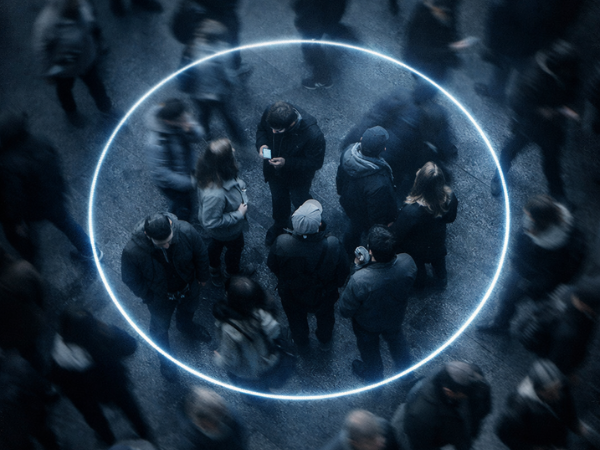




 John W. Whitehead, Constitutional Attorney