Posts Tagged ‘SWAT’

The world will soon understand nothing can stop what is coming.”—President Trump

Donald Trump has always been a master of imagery.

From his red MAGA hats to his choreographed rallies, he understands the language of spectacle. Now he has discovered the perfect propaganda machine: AI-generated images.

AI allows the creation of endless variations of Trump-as-warrior, Trump-as-enforcer, Trump-as-savior. These images spread across social media, replicated, remixed, and shared until they become familiar, even normalized.

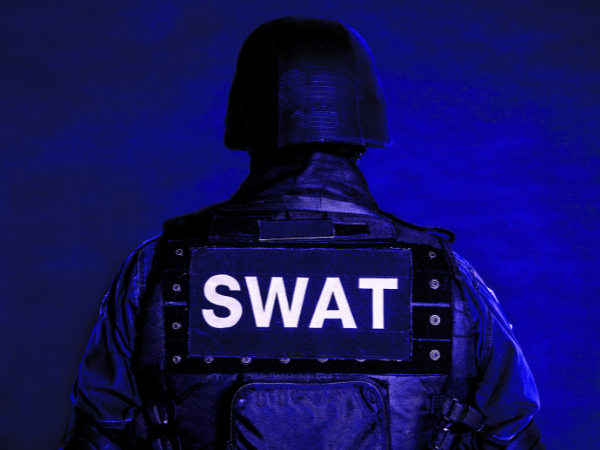
The latest AI-generated images of Trump, shared on his social media accounts, depict him in the militarized black uniform of a SWAT officer, or in police dress blues.

These memes are carefully crafted signals of how Trump envisions power in America.

These algorithmically perfected images, generated to flood the digital landscape and shape the subconscious of millions, are neither accidental nor new: they are psychological warfare—propaganda that is as old as time.

Propaganda does not persuade through logic. It persuades through familiarity. And Trump’s AI propaganda machine is doing its job: normalizing the sight of a president in a SWAT uniform.

Throughout history, despots have used martial imagery to elevate themselves above the people and justify power by force.

Mussolini wrapped himself in the black shirts of his paramilitaries to rally fascist Italy. Hitler’s carefully staged uniforms and parades signaled total control of the German nation. Stalin and Mao surrounded themselves with martial iconography to convey power over life, death, and law.

The message was always the same: I am not just your leader—I am your protector, your executioner, your law.

Today, Trump joins that lineage—not on a battlefield, but in digital space.

But unlike his predecessors, Trump does not need mass rallies or parades to craft this imagery. Algorithms now do the work of propaganda ministries. And unlike past dictators who required massive propaganda apparatuses, Trump needs only an internet connection and an AI tool to clothe himself in the trappings of authoritarianism.

This may be political theater, but it is also authoritarian propaganda that sends a message that Trump sees himself not as the servant of the people—bound by the Constitution—but as the nation’s chief cop, judge, and executioner.

Under a police state presidency, there are no checks and balances, no due process, no Bill of Rights that should stand in his way. By collapsing the distinction between civil government and militarized force, the president, self-styled as a SWAT chief, suggests that dissent will not be debated—it will be policed.

When Trump dons a SWAT uniform—even digitally—he is telling Americans: this is how I see power. Not as persuasion, not as consent of the governed, but as force delivered at gunpoint.

The SWAT image is the visual embodiment of a police state presidency:

  • It signals raids on the homeless, as Trump’s July 2025 executive order mandated when it directed federal agencies to clear encampments nationwide.
  • It signals mass arrests of immigrants and families rounded up in early morning ICE sweeps.
  • It signals military deployments to American cities, e.g., when Trump sent the National Guard to Los Angeles, a move a federal court recently ruled a violation of the Posse Comitatus Act.
  • It signals treating dissent as criminality, and opposition as insurgency.

For decades, Americans have watched the rise of SWAT teams transform America—and domestic policing—into a militarized state: battering rams breaking down doors, no-knock raids in the dead of night, armored vehicles patrolling suburban streets, flashbang grenades tossed into homes.

SWAT was originally conceived for rare, high-risk emergencies like hostage situations. Today, it has become the default face of the American police state.

The numbers tell the story.

In 1980, there were roughly 3,000 SWAT raids per year in the United States. By the 2000s, that number had skyrocketed to 80,000 annually.

What was once a rare tactic reserved for hostage situations or heavily armed standoffs is now routine police work. The result has been predictably tragic. Children injured by flash-bang grenades. Elderly homeowners killed when they mistook armed agents for intruders. Family dogs shot in the chaos of mistaken raids.

SWAT culture has normalized the use of military tactics against civilians. It has conditioned Americans to accept armored vehicles on Main Street, black-clad officers in ski masks battering down doors, and neighborhoods transformed into war zones.

The courts have long warned against this drift into militarized policing. Yet what good are limits when the president himself imagines donning the uniform of those who kick down doors?

A Constitution that is ignored in practice, even if acknowledged on paper, is no safeguard at all.

Trump’s AI propaganda takes this dangerous normalization a step further: it places the president himself at the head of the raid—the enforcer-in-chief—rendering him the law, the enforcer, and the judge. This is the very definition of dictatorship.

The Constitution was written precisely to prevent such concentration of power. It was written to prevent the rise of a lawless ruler who would make himself enforcer as well as lawgiver.

That is why the Bill of Rights exists—to put clear, inviolable limits on government power. The Fourth Amendment protects against unreasonable searches and seizures. The First protects dissenters and protesters. The Fifth guarantees due process before life, liberty, or property can be taken.

But in the American police state that is rapidly unfolding, citizens are not sovereign individuals but potential suspects. Dissent is not free expression but insurgency. And the citizenry are not seen as equal participants in a social contract but as a populace to be subdued.

This is not merely unconstitutional. It is anti-constitutional.

What makes Trump’s propaganda even more dangerous is how well it aligns with America’s existing drift toward militarization.

  • Police departments nationwide already deploy surplus military equipment: tanks, drones, battlefield weapons.
  • Federal agencies like Homeland Security and ICE conduct raids that look indistinguishable from military operations.
  • Surveillance technology powered by Palantir and other private firms tracks the movements of ordinary citizens.
  • Protests are met with riot gear, tear gas, and mass arrests.
  • The carceral prison state is rapidly expanding. Congressional funding for Trump’s $170 billion prison expansion threatens to make incarceration the government’s default solution to social problems.
  • Military forces are being used for domestic policing. The federalization of the National Guard to suppress immigration protests in Los Angeles, already struck down as unlawful, is a warning of how military power is being recast as domestic policing.

It must be said: Trump did not create this police state reality. But his presidency gleefully amplifies it, recasting America as a nation where “law and order” means rule at gunpoint.

This shift matters because it changes how people imagine power. A president who wears a SWAT uniform—even in AI fantasy—is telling the public: I am not one of you. I am over you.

The most insidious part of this propaganda is not its shock value but its normalizing function, part of a deliberate strategy to acclimate Americans to authoritarian rule.

Images once seen as dystopian now appear as campaign memes. The president as militarized enforcer becomes a shareable joke, a collectible, a digital poster for the faithful.

But every meme conditions the public to accept what would once have been unthinkable. Today it is a picture. Tomorrow it is policy.

This is how authoritarianism advances—not always through tanks in the streets, but through the slow, steady normalization of force as governance.

Every authoritarian regime has used uniforms and slogans to rebrand tyranny as order. The Nazis had their SS uniforms, the Soviets their red star, the Chinese Communists their Mao suits. Symbols matter because they carry meaning deeper than words.

Trump’s SWAT imagery is America’s warning sign. It is the uniform of repression, masquerading as protection. It is the costume of a ruler who governs by intimidation, not law.

We ignore this at our peril.

If we fail to see the danger, if we laugh it off as mere fantasy, we will wake up one day to find the fantasy has become reality.

The Constitution does not permit presidents to be SWAT chiefs. It does not allow them to enforce laws by decree, to jail dissenters at will, or to treat citizens as insurgents. It insists that the president is a public servant, bound by law and accountable to the people.

But that system only survives if “we the people” demand it.

Nothing can stop what is coming,” declares Trump? On the contrary: tyranny can always be stopped—if liberty lies in the hearts of the people.

The choice before us is clear: do we accept the imagery of the president as SWAT chief, or do we reaffirm the vision of the founders that no man is above the law?

The time to decide is now. The Constitution will not defend itself.

Trump’s AI propaganda declares that law is whatever the president enforces. It declares that rights are privileges, granted or withdrawn by armored men. It declares that nothing—not law, not courts, not people—can stop what is coming.

But as I make clear in my book Battlefield America: The War on the American People and in its fictional counterpart The Erik Blair Diaries, that is not the American way.

In a constitutional republic, nothing—not presidents, not uniforms, not threats at gunpoint, not tyranny—should ever be unstoppable.

Americans must decide: will we be governed by the Constitution, or will we be policed by the image of a SWAT-clad ruler who tells us resistance is futile?

The Founders knew the answer. So should we.

Source: https://tinyurl.com/59y3m29c

ABOUT JOHN W. WHITEHEAD

Constitutional attorney and author John W. Whitehead is founder and president of The Rutherford Institute. His most recent books are the best-selling Battlefield America: The War on the American People, the award-winning A Government of Wolves: The Emerging American Police State, and a debut dystopian fiction novel, The Erik Blair Diaries. Whitehead can be contacted at staff@rutherford.org. Nisha Whitehead is the Executive Director of The Rutherford Institute. Information about The Rutherford Institute is available at www.rutherford.org.

Publication Guidelines / Reprint Permission

John W. Whitehead’s weekly commentaries are available for publication to newspapers and web publications at no charge. 

WASHINGTON, DC — In a unanimous opinion, the U.S. Supreme Court has ruled that the federal government can be held accountable for a botched FBI SWAT raid that targeted the wrong home and terrorized an innocent family.

The case stems from a middle-of-the-night SWAT raid in which heavily armed FBI agents in tactical gear stormed the home of Curtrina Martin, deployed a flashbang grenade, and held Hilliard Cliatt and Martin at gunpoint before realizing they had the wrong address. The Supreme Court’s decision in Martin v. United States affirms that the Constitution’s Supremacy Clause does not shield the federal government from liability under the Federal Tort Claims Act (FTCA). The Rutherford Institute and the National Police Accountability Project filed an amicus brief urging the Court to allow victims of such reckless raids to hold the government accountable.

“These SWAT raids have become a thinly veiled, court-sanctioned excuse to let heavily armed police crash through doors in the dead of night,” said constitutional attorney John W. Whitehead, president of The Rutherford Institute and author of Battlefield America: The War on the American People. “Too often, they’re marked by incompetence, devastation, and death—leaving a trail of broken homes and broken lives, while law enforcement escapes accountability.”

As part of “Operation Red Tape,” an FBI initiative targeting gang activity in Georgia, agents sought to execute an arrest warrant at the home of a suspected gang member. However, during a pre-raid drive-by, the team leader used his personal GPS and misidentified the home—failing to verify the street name and house number. Hours later, as part of a pre-dawn raid, the SWAT team descended on Martin’s house, a block from the actual target, breached the front door, and deployed a flashbang. Believing they were being burglarized, Martin attempted to reach her 7-year-old child. Only after detaining Cliatt and Martin at gunpoint did agents realize their mistake in targeting the wrong house.

Having been “left with personal injuries and property damage—but few explanations and no compensation,” the family filed a lawsuit alleging negligence, trespass, false arrest and imprisonment, emotional distress, and assault and battery under the FTCA. Although the Eleventh Circuit dismissed the case—holding that the Supremacy Clause barred such claims—the Supreme Court reversed. Pointing out that “the Supremacy Clause supplies a rule of decision when federal and state laws conflict”, the Supreme Court explained that the FTCA itself is the “supreme” federal law and explicitly allows state-law tort claims against the government. In a concurring opinion, Justices Sotomayor and Jackson noted that Congress specifically amended the FTCA to hold the federal government accountable after a 1973 incident where 15 officers mistakenly raided multiple homes, holding innocent families at gunpoint. That amendment, they emphasized, was designed to ensure accountability for precisely these kinds of abuses. The Court sent the lawsuit back for further proceedings.

The amicus brief in Martin v. United States was authored by Eugene R. Fidell with the Yale Law School Supreme Court Clinic, along with Charles A. Rothfeld of Mayer Brown LLP and Paul W. Hughes of McDermott Will & Emery LLP.

The Rutherford Institute, a nonprofit civil liberties organization, defends individuals whose constitutional rights have been threatened or violated and educates the public on a wide spectrum of issues affecting their freedoms.


Case History

April 10, 2025 • Wrong Address, Wrong Target, Real Terror: U.S. Supreme Court Agrees to Hear FBI Raid Case

Source: https://tinyurl.com/yc38sh3n

WASHINGTON, DC — The U.S. Supreme Court has agreed to hear a case that could determine whether FBI agents can be held accountable for a botched SWAT raid that terrorized an innocent family in the middle of the night.

As detailed in Martin v. United States, a heavily armed FBI SWAT team mistakenly stormed a Georgia home—armed with rifles, clad in tactical gear, and deploying a flashbang grenade—causing the family inside, with a 7-year-old son, to fear they were being burglarized. In an amicus brief filed jointly with the National Police Accountability Project, The Rutherford Institute urged the Court to hold federal agents accountable under the Federal Tort Claims Act (FTCA) for recklessly invading the wrong residence, located a block away from the intended target: a suspected violent gang member. Fearing they were being burglarized, Ms. Martin tried to get to her 7-year-old son before officers forced one family member onto the bedroom floor at gunpoint, and then pointed a gun in Ms. Martin’s face.

“These SWAT raids have become a thinly veiled, court-sanctioned excuse to let heavily armed police crash through doors in the dead of night,” said constitutional attorney John W. Whitehead, president of The Rutherford Institute and author of Battlefield America: The War on the American People. “Too often, they’re marked by incompetence, devastation, and death—leaving a trail of broken homes and broken lives, while law enforcement escapes accountability.”

As part of the FBI’s “Operation Red Tape” to address violent gang activity in Georgia, an FBI SWAT team was deployed to execute an arrest warrant at the home of a suspected gang member. Although the team leader had previously conducted a site survey and received a photograph, map, and directions to the correct location, he relied on his personal GPS during a pre-raid drive-by. That GPS led him instead to the home of Curtrina Martin, which looked similar to the target residence. Critically, he failed to verify the street number. During the predawn hours, the SWAT leader led a caravan of vehicles with FBI SWAT team agents and members of the Atlanta Police Department to Martin’s house, thinking it was the target house. SWAT team members surrounded the home, breached the front door, and deployed a flashbang. Fearing they were under attack, Martin tried to reach her 7-year-old son. Only after detaining the family did the agents realize they had the wrong man—he lacked the gang suspect’s identifying face and neck tattoos—and that the house number did not match their intended destination.

The family subsequently filed a lawsuit for negligence, infliction of emotional distress, trespass, false arrest and imprisonment, and assault and battery under the Federal Tort Claims Act, which allows plaintiffs to bring state-law torts against the United States. However, the Eleventh Circuit Court of Appeals dismissed the lawsuit, citing the FBI’s lack of any formal policy for verifying target locations during warrant executions. Although the Supreme Court previously refused to hear Jimerson v. Lewis, a similar case involving a local SWAT team raid on the wrong home, it has agreed to take up Martin, which involves federal agents and the scope of the Federal Tort Claims Act.

Eugene R. Fidell with the Yale Law School Supreme Court Clinic, along with Charles A. Rothfeld of Mayer Brown LLP and Paul W. Hughes of McDermott Will & Emery LLP, advanced the arguments in the Martin amicus brief.

The Rutherford Institute, a nonprofit civil liberties organization, defends individuals whose constitutional rights have been threatened or violated and educates the public on a wide spectrum of issues affecting their freedoms.

Source: https://tinyurl.com/yu9ff4st

We’re all potential victims.”—Peter Christ, retired police officer

Sometimes ten seconds is all the warning you get.

Sometimes you don’t get a warning before all hell breaks loose.

Imagine it, if you will: It’s the middle of the night. Your neighborhood is in darkness. Your household is asleep. Suddenly, you’re awakened by a loud noise.

Barely ten seconds later, someone or an army of someones has crashed through your front door.

The intruders are in your home.

Your heart begins racing. Your stomach is tied in knots. The adrenaline is pumping through you.

You’re not just afraid. You’re terrified.

Desperate to protect yourself and your loved ones from whatever threat has invaded your home, you scramble to lay hold of something—anything—that you might use in self-defense. It might be a flashlight, a baseball bat, or that licensed and registered gun you thought you’d never need.

You brace for the confrontation.

Shadowy figures appear at the doorway, screaming orders, threatening violence, launching flash bang grenades.

Chaos reigns.

You stand frozen, your hands gripping whatever means of self-defense you could find.

Just that simple act—of standing frozen in fear and self-defense—is enough to spell your doom.

The assailants open fire, sending a hail of bullets in your direction.

In your final moments, you get a good look at your assassins: it’s the police.

Brace yourself, because this hair-raising, heart-pounding, jarring account of a SWAT team raid is what passes for court-sanctioned policing in America today, and it could happen to any one of us or our loved ones.

Nationwide, SWAT teams routinely invade homes, break down doors, kill family pets (they always shoot the dogs first), damage furnishings, terrorize families, and wound or kill those unlucky enough to be present during a raid.

No longer reserved exclusively for deadly situations, SWAT teams are now increasingly being deployed for relatively routine police matters such as serving a search warrant, with some SWAT teams being sent out as much as five times a day.

SWAT teams have been employed to address an astonishingly trivial array of so-called criminal activity or mere community nuisances: angry dogs, domestic disputesimproper paperwork filed by an orchid farmer, and misdemeanor marijuana possession, to give a brief sampling.

Police have also raided homes on the basis of mistaking the presence or scent of legal substances for drugs. Incredibly, these substances have included tomatoes, sunflowers, fish, elderberry bushes, kenaf plants, hibiscus, and ragweed. In some instances, SWAT teams are even employed, in full armament, to perform routine patrols.

These raids, which might be more aptly referred to as “knock-and-shoot” policing, have become a thinly veiled, court-sanctioned means of giving heavily armed police the green light to crash through doors in the middle of the night.

No-knock raids, a subset of the violent, terror-inducing raids carried out by police SWAT teams on unsuspecting households, differ in one significant respect: they are carried out without police even having to announce themselves.

Warning or not, to the unsuspecting homeowner woken from sleep by the sounds of a violent entry, there is no way of distinguishing between a home invasion by criminals as opposed to a police mob. In many instances, there is little real difference.

According to an in-depth investigative report by The Washington Post, “police carry out tens of thousands of no-knock raids every year nationwide.”

While the Fourth Amendment requires that police obtain a warrant based on probable cause before they can enter one’s home, search and seize one’s property, or violate one’s privacy, SWAT teams are granted “no-knock” warrants at high rates such that the warrants themselves are rendered practically meaningless.

In addition to the terror brought on by these raids, general incompetence, collateral damage (fatalities, property damage, etc.) and botched raids are also characteristic of these SWAT team raids.

In some cases, officers misread the address on the warrant. In others, they simply barge into the wrong house or even the wrong building. In another subset of cases, SWAT teams have conducted multiple, sequential raids on wrong addresses; executed search warrants despite the fact that the suspect is already in police custody; or conducted a search of a building where the suspect no longer resides.

That appeared to be the case in Ohio, when a botched SWAT team raid in pursuit of stolen guns at a home where the suspects no longer resided resulted in a 17-month-old baby with a heart defect and a breathing disorder ending up in the ICU with burns around the eyes, chest and neck. In that Jan. 10, 2024, incident, police waited all of six seconds after knocking on the door before using a battering ram to break in and simultaneously launch two flash-bang grenades into the home. The baby’s mother, having lived in the house for a week, barely had time to approach the door before she was grabbed at gunpoint, handcuffed and hustled outside. Only later did police allow her to enter the home to check on the baby, who had been hooked up to a ventilator near the window that police shattered before deploying the flash grenades. 

Aiyana Jones is dead because of a SWAT raid gone awry. The 7-year-old was killed after a Detroit SWAT team—searching for a suspect—launched a flash-bang grenade into her family’s apartment, broke through the door and opened fire, hitting the little girl who was asleep on the living room couch. The cops weren’t even in the right apartment.

Exhibiting a similar lack of basic concern for public safety, a Georgia SWAT team launched a flash-bang grenade into the house in which Baby Bou Bou, his three sisters and his parents were staying. The grenade landed in the 2-year-old’s crib, burning a hole in his chest and leaving him with scarring that a lifetime of surgeries will not be able to easily undo.

The horror stories have become legion in which homeowners are injured or killed simply because they mistook a SWAT team raid by police for a home invasion by criminals.

That’s exactly what happened to a 16-year-old Alabama boy. Mistaking a pre-dawn SWAT team raid for a home invasion, the boy grabbed a gun to protect his family only to be gunned down by police attempting to execute a search warrant for drugs. The boy’s brother, not home at the time of the raid, was later arrested with 8 grams of marijuana.

Then there was Jose Guerena, the young ex-Marine who was killed after a SWAT team kicked open the door of his Arizona home during a drug raid and opened fire. According to news reports, Guerena, 26 years old and the father of two young children, grabbed a gun in response to the forced invasion but never fired. In fact, the safety was still on his gun when he was killed. Police officers were not as restrained. The young Iraqi war veteran was allegedly fired upon 71 times. Guerena had no prior criminal record, and the police found nothing illegal in his home.

All too often, botched SWAT team raids have resulted in one tragedy after another for those targeted with little consequences for law enforcement.

The problem, as one reporter rightly concluded, is “not that life has gotten that much more dangerous, it’s that authorities have chosen to respond to even innocent situations as if they were in a warzone.”

A study by a political scientist at Princeton University concludes that militarizing police and SWAT teams “provide no detectable benefits in terms of officer safety or violent crime reduction.” The study, the first systematic analysis on the use and consequences of militarized force, reveals that “police militarization neither reduces rates of violent crime nor changes the number of officers assaulted or killed.”

SWAT teams, designed to defuse dangerous situations such as those involving hostages, were never meant to be used for routine police work targeting nonviolent suspects, yet they have become intrinsic parts of federal and local law enforcement operations.

There are few communities without a SWAT team today.

In 1980, there were roughly 3,000 SWAT team-style raids in the US.

Incredibly, that number has since grown to more than 80,000 SWAT team raids per year, often for routine law enforcement tasks.

In the state of Maryland alone, 92 percent of 8200 SWAT missions were used to execute search or arrest warrants.

Police in both Baltimore and Dallas have used SWAT teams to bust up poker games.

A Connecticut SWAT team swarmed a bar suspected of serving alcohol to underage individuals.

In Arizona, a SWAT team was used to break up an alleged cockfighting ring.

An Atlanta SWAT team raided a music studio, allegedly out of a concern that it might have been involved in illegal music piracy.

And then there are the SWAT team raids arising from red flag gun laws, which gives police the authority to preemptively raid homes of people “suspected” of being threats who might be in possession of a gun, legal or otherwise.

With more states adding red flag gun laws to their books, what happened to Duncan Lemp—who was gunned down in his bedroom during an early morning, no-knock SWAT team raid on his family’s home—could very well happen to more people.

At 4:30 a.m. on March 12, 2020, in the midst of a COVID-19 pandemic that had most of the country under a partial lockdown and sheltering at home, a masked SWAT team—deployed to execute a “high risk” search warrant for unauthorized firearms—stormed the suburban house where 21-year-old Duncan lived with his parents and 19-year-old brother. The entire household, including Lemp and his girlfriend, was reportedly asleep when the SWAT team directed flash bang grenades and gunfire through Lemp’s bedroom window. Lemp was killed and his girlfriend injured.

No one in the house that morning, including Lemp, had a criminal record.

No one in the house that morning, including Lemp, was considered an “imminent threat” to law enforcement or the public, at least not according to the search warrant.

So, what was so urgent that militarized police felt compelled to employ battlefield tactics in the pre-dawn hours of a day when most people are asleep in bed, not to mention stuck at home as part of a nationwide lockdown?

According to police, they were tipped off that Lemp was in possession of “firearms.”

Thus, rather than approaching the house by the front door at a reasonable hour in order to investigate this complaint—which is what the Fourth Amendment requires—police instead strapped on their guns, loaded up their flash bang grenades and acted like battle-crazed warriors.

This is what happens when you use SWAT teams to carry out routine search warrants.

These incidents underscore a dangerous mindset in which the citizenry (often unarmed and defenseless) not only have less rights than militarized police, but also one in which the safety of the citizenry is treated as a lower priority than the safety of their police counterparts (who are armed to the hilt with an array of lethal and nonlethal weapons).

Yet it wasn’t always this way.

There was a time in America when a person’s home was a sanctuary, safe and secure from the threat of invasion by government agents, who were held at bay by the dictates of the Fourth Amendment, which protects American citizens from unreasonable searches and seizures.

The Fourth Amendment, in turn, was added to the U.S. Constitution by colonists still smarting from the abuses they had been forced to endure while under British rule, among these home invasions by the military under the guise of “writs of assistance.” These writs gave British soldiers blanket authority to raid homes, damage property and wreak havoc for any reason whatsoever, without any expectation of probable cause.

We have come full circle to a time before the American Revolution when government agents—with the blessing of the courts—could force their way into a citizen’s home, with seemingly little concern for lives lost and property damaged in the process.

If these aggressive, excessive police tactics have also become troublingly commonplace, it is in large part due to judges who largely rubberstamp the warrant requests based only on the word of police; police who have been known to lie or fabricate the facts in order to justify their claims of “reasonable suspicion” (as opposed to the higher standard of probable cause, which is required by the Constitution before any government official can search an individual or his property); and software that allows judges to remotely approve requests using computers, cellphones or tablets.

This sorry state of affairs is made even worse by the U.S. Supreme Court, which tends to shield police under the guise of qualified immunity. As Reuters concluded, “the Supreme Court has built qualified immunity into an often insurmountable police defense.”

Rubber-stamped, court-issued warrants for no-knock SWAT team raids have become the modern-day equivalent of colonial-era writs of assistance.

Given President Biden’s determination to expand law enforcement and so-called crime prevention at taxpayer expense, our privacy, property and security may be in even greater danger from government intrusion.

Be warned: as I make clear in my book Battlefield America: The War on the American People and in its fictional counterpart The Erik Blair Diaries, the American police state has become a powder keg waiting for a lit match.

Source: http://tinyurl.com/yurfnxub

ABOUT JOHN W. WHITEHEAD

Constitutional attorney and author John W. Whitehead is founder and president of The Rutherford Institute. His most recent books are the best-selling Battlefield America: The War on the American People, the award-winning A Government of Wolves: The Emerging American Police State, and a debut dystopian fiction novel, The Erik Blair Diaries. Whitehead can be contacted at staff@rutherford.org. Nisha Whitehead is the Executive Director of The Rutherford Institute. Information about The Rutherford Institute is available at www.rutherford.org.

Publication Guidelines / Reprint Permission

John W. Whitehead’s weekly commentaries are available for publication to newspapers and web publications at no charge.

“Plays, farces, spectacles, gladiators, strange beasts, medals, pictures, and other such opiates, these were for ancient peoples the bait toward slavery, the price of their liberty, the instruments of tyranny. By these practices and enticements the ancient dictators so successfully lulled their subjects under the yoke, that the stupefied peoples, fascinated by the pastimes and vain pleasures flashed before their eyes, learned subservience as naively, but not so creditably, as little children learn to read by looking at bright picture books.”—Etienne de La Boétie, “The Discourse on Voluntary Servitude: How Do Tyrants Secure Cooperation?” (1548)

Americans love their reality TV shows—the drama, the insults, the bullying, the callousness, the damaged relationships delivered through the lens of a surveillance camera—and there’s no shortage of such dehumanizing spectacles to be found on or off screen, whether it’s Cops, Real Housewives or the heavy-handed tactics of police officers who break down doors first and ask questions later.

Where things get tricky is when we start to lose our grasp on what is real vs. unreal and what is an entertainment spectacle that distracts us vs. a real-life drama that impacts us.

For example, do we tune into Bruce Jenner’s gender transformation as it unfolds on reality TV, follow the sniping over Navy sharpshooter Chris Kyle’s approach to war and killing, or chart the progress of the Keystone oil pipeline as it makes it work through Congress? Do we debate the merits of Katy Perry’s Superbowl XLIX halftime performance, or speculate on which politicians will face off in the 2016 presidential election?

Here’s a hint: it’s all spectacle.

Studies suggest that the more reality TV people watch—and I would posit that it’s all reality TV—the more difficult it becomes to distinguish between what is real and what is carefully crafted farce. Unfortunately, Americans have a voracious appetite for TV entertainment. On average, Americans spend five hours a day watching television. By the time we reach age 65, we’re watching more than 50 hours of television a week, and that number increases as we get older. And reality TV programming consistently captures the largest percentage of TV watchers every season by an almost 2-1 ratio.

As journalist Scott Collins notes, “reality is a cheap way to fill prime time.”

A Government of Wolves book coverYet it’s more than just economics at play. As I make clear in my book A Government of Wolves: The Emerging American Police State, we’re being subjected to a masterful sociological experiment in how to dumb down and desensitize a population.

This doesn’t bode well for a citizenry able to sift through masterfully-produced propaganda in order to think critically about the issues of the day. Then again, it can be hard to distinguish between the two. As cognitive scientist Steven Pinkerpoints out, the hallmark of well-told fiction is that the audience can’t tell the difference.

Concerning reality TV, journalist Chris Weller explains:

Producers have become so good at their job of constructing a cohesive narrative, one that imitates life – albeit, dramatically so – that the narrative ends up compelling life to imitate it. This is an important distinction…. drama doesn’t emerge accidentally. It’s intentional. But not everyone knows that.

Reality TV is fiction sold as nonfiction, to an audience that likes to believe both are possible simultaneously in life,” continues Weller. “It’s entertainment, in the same way Cirque du Soleil enchants and The Hunger Games enthralls. But what are we to make of unreal realness? And what does it make of its viewers? Do they…mimic the medium? Do they become shallow, volatile, mean?”

The answer is yes, they do mimic the medium.

Studies suggest that those who watch reality shows tend to view what they see as the “norm.” Thus, those who watch shows characterized by lying, aggression and meanness not only come to see such behavior as acceptable but find it entertaining.

It’s a phenomenon called “humilitainment,” a term coined by media scholars Brad Waite and Sara Booker to refer to the tendency for viewers to take pleasure in someone else’s humiliation, suffering and pain. It largely explains not only why American TV watchers are so fixated on reality TV programming but how American citizens, largely insulated from what is really happening in the world around them by layers of technology, entertainment, and other distractions, are being programmed to accept the brutality, surveillance and dehumanizing treatment of the American police state as things happening to other people.

This is what happens when an entire nation, unable to distinguish between what is real and unreal and increasingly inclined to accept as normal the tactics being played out before them in hi-def, not only ceases to be outraged by the treatment being meted out to their fellow citizens but takes joy in it.

Unfortunately, for the majority of Americans who spend their waking, leisure hours transfixed in front of the television or watching programming on their digital devices, the American police state itself has become reality TV programming—a form of programming that keeps us distracted, entertained, occasionally a little bit outraged but overall largely uninvolved, content to remain in the viewer’s seat.

In fact, we don’t even have to change the channel when the subject matter becomes too monotonous. That’s taken care of for us by the programmers (the corporate media and the police state). Before we got too worked up over government surveillance, they changed the channels on us and switched us over to militarized police. Before our outrage could be transformed into action, they changed the channel once again. Next up: ISIS beheadings, plane crashes, terrorist shootings and politicians lip-synching to a teleprompter.

In this way, televised events of recent years—the Ferguson shooting and riots, the choke-hold of Eric Garner, the Boston Marathon manhunt and city-wide lockdown, etc.—became reality TV programming choices on a different channel.

The more that is beamed at us, the more inclined we are to settle back in our comfy recliners and become passive viewers rather than active participants as unsettling, frightening events unfold. Reality and fiction merge as everything around us becomes entertainment fodder. This holds true whether we’re watching American Idol, American Sniper or America’s Newsroom.

With every SWAT team raid, police shooting and terrorist attack—real or staged, we’re being systematically desensitized and acclimated to the trappings of the police state. This is borne out by numerous studies indicating that the more violence we watch on television—whether real or fictional—the less outraged we will be by similar acts of real-life aggression.

For instance, tasers were sold to the American public as a way to decrease the use of deadly force by police, reduce the overall number of use-of-force incidents, and limit the number of people seriously injured. Instead, we’ve witnessed an increase in the use of force by police and a desensitizing of the public to police violence. As Professor Victor E. Kappeler points out, “no one riots because the police stunned-gunned a drunk for non-compliance or because a cop pepper-sprayed a group of protesters.”

Indeed, notes Kappeler:

Police officers possessing less-than-lethal weapons are often more inclined to use these weapons in situations where they would not have been legally justified in using traditional weapons, or for that matter any level of force at whatsoever. This phenomenon is known as net widening. As use of force technologies improve, police become more likely to apply force in a greater number of situations, in less serious situations, to more vulnerable people and resort to force in cases where people simply do not immediately comply with their directives.

What we’re witnessing is net widening of the police state and, incredibly, it’s taking place while the citizenry watches.

Viewed through the lens of “reality” TV programming, the NSA and other government surveillance has become a done deal. Militarized police are growing more militant by the day. And you can rest assured that police-worn body cameras, being hailed by police and activists alike as a sure-fire fix for police abuses, will only add to this net widening.

Ironically, whether we like it or not, these cameras—directed at us—will turn “we the people” into the stars of our own reality shows. As Kelefa Sanneh, writing for the New Yorker, points out, “Cops,” the longest-running reality show of all which has “viewers ride with police officers as they drive around, in search of perpetrators… makes it easy to think of a video camera as a weapon, there to keep the peace and to discipline violators.”

Ultimately, that’s what this is all about: the reality shows, the drama, the entertainment spectacles, the surveillance are all intended to keep us in line, using all the weapons available to the powers-that-be. It’s the modern-day equivalent of bread and circuses.

As for the sleepwalking masses convinced that all of the bad things happening in the police state—the police shootings, the police beatings, the raids, the roadside strip searches—are happening to other people, eventually, the things happening to other people will start happening to us and our loved ones.

When that painful reality sinks in, it will hit with the force of a SWAT team crashing through your door, a taser being aimed at your stomach, and a gun pointed at your head. And there will be no channel to change, no reality to alter, no manufactured farce to hide behind.

By that time, however, it will be too late to do anything more than submit.

Professor Neil Postman saw this eventuality coming. “There are two ways by which the spirit of a culture may be shriveled,” he predicted. “In the first—the Orwellian—culture becomes a prison. In the second—the Huxleyan—culture becomes a burlesque.” Postman concludes:

No one needs to be reminded that our world is now marred by many prison-cultures…. it makes little difference if our wardens are inspired by right- or left-wing ideologies. The gates of the prison are equally impenetrable, surveillance equally rigorous, icon-worship pervasive…. Big Brother does not watch us, by his choice. We watch him, by ours…. When a population becomes distracted by trivia, when cultural life is redefined as a perpetual round of entertainments, when serious public conversation becomes a form of baby-talk, when, in short, a people become an audience, and their public business a vaudeville act, then a nation finds itself at risk; culture-death is a clear possibility.

“As nightfall does not come at once, neither does oppression. In both instances, there is a twilight when everything remains seemingly unchanged. And it is in such twilight that we all must be most aware of change in the air – however slight – lest we become unwitting victims of the darkness.” ― Supreme Court Justice William O. Douglas

No matter what the politicians say about how great America is and how we, as a people, will always triumph, the fact is that the nation seems to be imploding.

Despite the dire state of our nation, however, you can rest assured that none of the problems that continue to plague our lives and undermine our freedoms will be addressed by our so-called elected representatives in any credible, helpful way, and certainly not during a State of the Union address.

Consider the following facts:

Our government is massively in debt. Currently, the national debt is somewhere in the vicinity of $18 trillion. More than a third of our debt is owned by foreign countries, namely China and Japan.

Our education system is abysmal. Despite the fact that we spend more than most of the world on education ($115,000 per student), we rank 36th in the world when it comes to math, reading and science, far below most of our Asian counterparts. Even so, we continue to insist on standardized programs such as Common Core, which teach students to be test-takers rather than thinkers.

Source: USA Today

Our homes provide little protection against government intrusions. Police agencies, already empowered to crash through your door if they suspect you’re up to no good, now have radars that allow them to “see” through the walls of your home.

Our prisons, housing the largest number of inmates in the world and still growing, have become money-making enterprises for private corporations that rely on the inmates for cheap labor.

We are no longer a representative republic. The U.S. has become a corporate oligarchy. As a recent survey indicates, our elected officials, especially those in the nation’s capital, represent the interests of the rich and powerful rather than the average citizen.

We’ve got the most expensive, least effective health care system in the world compared to other western, industrialized nations.

The air pollution levels are dangerously high for almost half of the U.S. population, putting Americans at greater risk of premature death, aggravated asthma, difficulty breathing and future cardiovascular problems.

Despite outlandish amounts of money being spent on the nation’s “infrastructure,” there are more than 63,000 bridges—one out of every 10 bridges in the country—in urgent need of repair. Some of these bridges are used 250 million times a day by trucks, school buses, passenger cars and other vehicles.

Americans know little to nothing about their rights or how the government is supposed to operate. This includes educators and politicians. For example, 27 percent of elected officials cannot name even one right or freedom guaranteed by the First Amendment, while 54 percent do not know the Constitution gives Congress the power to declare war.

Nearly one out of every three American children live in poverty, ranking us among the worst in the developed world.

Patrolled by police, our schools have become little more than quasi-prisons in which kids as young as age 4 are being handcuffed for “acting up,” subjected to body searches and lockdowns, and suspended for childish behavior.

We’re no longer innocent until proven guilty. In our present surveillance state, that burden of proof has now been shifted so that we are all suspects to be spied on, searched, scanned, frisked, monitored, tracked and treated as if we’re potentially guilty of some wrongdoing or other.

Parents, no longer viewed as having an inherent right to raise their children as they see fit, are increasingly being arrested for letting their kids walk to the playground alone, or play outside alone. Similarly, parents who challenge a doctor’s finding or request a second opinion regarding their children’s health care needs are being charged with medical child abuse and, in a growing number of cases, losing custody of their children to the government.

Private property means little at a time when SWAT teams and other government agents can invade your home, break down your doors, kill your dog, wound or kill you, damage your furnishings and terrorize your family. Likewise, if government officials can fine and arrest you for growing vegetables in your front yard, praying with friends in your living room, installing solar panels on your roof, and raising chickens in your backyard, you’re no longer the owner of your property.

Court rulings undermining the Fourth Amendment and justifying invasive strip searches have left us powerless against police empowered to forcefully draw our blood, forcibly take our DNA, strip search us, and probe us intimately. Accounts are on the rise of individuals—men and women alike—being subjected to what is essentially government-sanctioned rape by police in the course of “routine” traffic stops.

Americans can no longer rely on the courts to mete out justice. The courts were established to intervene and protect the people against the government and its agents when they overstep their bounds. Yet the courts increasingly march in lockstep with the police state, while concerned themselves primarily with advancing the government’s agenda, no matter how unjust or illegal.

Americans have no protection against police abuse. It is no longer unusual to hear about incidents in which police shoot unarmed individuals first and ask questions later. What is increasingly common, however, is the news that the officers involved in these incidents get off with little more than a slap on the hands.

If there is any absolute maxim by which the federal government seems to operate, it is that the American taxpayer always gets ripped off. This is true, whether you’re talking about taxpayers being forced to fund high-priced weaponry that will be used against us, endless wars that do little for our safety or our freedoms, or bloated government agencies such as the National Security Agency with its secret budgets, covert agendas and clandestine activities. Rubbing salt in the wound, even monetary awards in lawsuits against government officials who are found guilty of wrongdoing are paid by the taxpayer.

Americans are powerless in the face of militarized police. In early America, government agents were not permitted to enter one’s home without permission or in a deceitful manner. And citizens could resist arrest when a police officer tried to restrain them without proper justification or a warrant. Daring to dispute a warrant with a police official today who is armed with high-tech military weapons would be nothing short of suicidal. Moreover, as police forces across the country continue to be transformed into extensions of the military, Americans are finding their once-peaceful communities transformed into military outposts, complete with tanks, weaponry, and other equipment designed for the battlefield.

A Government of Wolves book coverNow these are not problems that you can just throw money at, as most politicians are inclined to do. As I point out in my book A Government of Wolves: The Emerging American Police State, these are problems that will continue to plague our nation unless and until Americans wake up to the fact that we’re the only ones who can change things.

For starters, we’ll need to actually pay attention to what’s going on around us, and I don’t mean by turning on the TV news, which is little more than government propaganda. Pay attention to what your local city councils are enacting. Pay attention to what your school officials are teaching and not teaching. Pay attention to whom your elected officials are allowing to wine and dine them.

Most of all, stop acting like it really matters whether you vote for a Republican or Democrat, because it doesn’t, and start acting like citizens who expect the government to work for them, rather than the other way around.

While that bloated beast called the federal government may not listen to you, you can have a great impact on your local governing bodies. This will mean gathering together with your friends and neighbors and, for example, forcing your local city council to start opposing state and federal programs that are ripping you off. And if need be, your local city council can refuse to abide by the dictates that continue to flow from Washington, DC.

All of the signs point to something nasty up ahead. The time to act is now.