WASHINGTON, DC — In a ruling that leaves thousands of military servicemembers and their families without meaningful recourse when the government’s negligence causes harm, the U.S. Supreme Court has declined to reconsider a 1950 judicial doctrine that prevents military personnel from suing the federal government for non-combat injuries deemed “incident to service,” even when a civilian in the same situation could bring a claim.
For decades, the Feres doctrine has drawn criticism across the ideological spectrum for its expansive and often devastating consequences. Courts have interpreted “incident to service” so broadly that it now bars claims arising from medical malpractice, car accidents, and even sexual assault by another servicemember—harms far removed from the battlefield. The Rutherford Institute and the Constitutional Accountability Center had filed an amicus brief in Beck v. United States, urging the Court to overturn Feres because it contradicts the text and purpose of the Federal Tort Claims Act (FTCA) and denies military families the same legal protections afforded to civilians.
“No American should be denied the right to hold the government accountable for negligence and harm merely because they wear a military uniform,” said constitutional attorney John W. Whitehead, president of The Rutherford Institute and author of Battlefield America: The War on the American People. “The Constitution does not permit a two-tiered system of justice—one for civilians and a lesser one for those who serve—and neither should we.”
Staff Sergeant Cameron Beck was living and working at Whiteman Air Force Base in Missouri, serving on active duty in the Wing Cybersecurity Office. One afternoon, he drove home for lunch with his wife and seven-year-old son. As he traveled along a Base road, a civilian federal employee—driving a government-owned van while distracted by her cell phone—struck and killed him. She later pleaded guilty to operating her vehicle in a careless and imprudent manner and admitted the crash was “100 percent” her fault.
Beck’s widow and son filed a wrongful-death lawsuit under the FTCA, the law that allows individuals to sue the federal government for negligence of its employees. But because Beck happened to be on Base, on active duty, and subject to recall—even though he was riding home during off-duty hours and was not engaged in a military activity—the lower courts dismissed the case under the Feres doctrine. Therefore, the government could not be held liable, and the family was left with no meaningful path to justice.
While the family received some limited benefits from the Department of Veterans Affairs and the Department of Defense, Justice Thomas (who dissented from the Court’s decision in this case) has pointed out that these benefits often amount to only a fraction of what a civilian family could obtain in court. Yet, Feres bars lawsuits by servicemembers when a civilian would be allowed to sue based on the same acts by the same federal employee. The amicus brief in Beckwarned that the Feres doctrine has drifted so far from its original purpose that it now bars even the most straightforward negligence claims—such as the careless operation of a government vehicle by a civilian employee that results in the death of a servicemember not engaged in any military activity.
Miriam Becker-Cohen, Brianne J. Gorod, Elizabeth B. Wydra, and Nargis Aslami with the Constitutional Accountability Center advanced the arguments in the Beck amicus brief.
The Rutherford Institute, a nonprofit civil liberties organization, defends individuals whose constitutional rights have been threatened or violated and educates the public on a wide spectrum of issues affecting their freedoms.
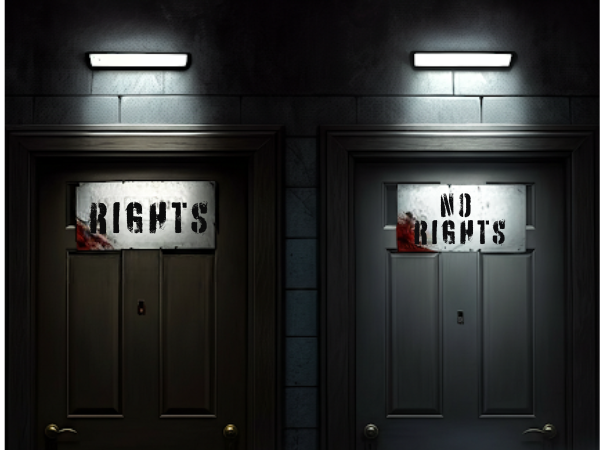
“Rights aren’t rights if someone can take them away. They’re privileges. That’s all we’ve ever had in this country is a ‘Bill of Temporary Privileges.’ And if you read the news, even badly, you know that the list gets shorter and shorter.”—George Carlin
Disguising its power grabs in the self-righteous fervor of national security, the Deep State has mastered the art of the bait-and-switch.
It works like this: first, the government foments fear about some crisis or threat to national security, then they capitalize on it by seizing greater power and using those powers against the American people.
We’ve seen this play out over and over again.
The government used its so-called War on Terror to transform itself into a police state.
Then the police state used its War on COVID-19 to claim lockdown powers.
All indications are that the government’s promised War on Illegal Immigration will be yet another sleight of hand that allows the powers-that-be to engage in greater power grabs while weakening the Constitution.
Therein lies the danger of the government’s growing addiction to power.
Whatever dangerous practices you allow the government to carry out now—whether it’s in the name of national security or protecting America’s borders or making America healthy again—inevitably, these same practices can and will be used against you when the government decides to set its sights on you.
The slippery slope that starts with illegal immigration has all the makings of a thinly veiled plot to empower the government to become the arbiter of who is deserving of rights and who isn’t.
That quickly, we could find ourselves navigating a world in which the rights enshrined in the Constitution for all persons living in the United States are transformed into privileges enjoyed only by those whom the government chooses to recognize as legitimate.
By persuading the public that non-citizens, particularly illegal immigrants, do not enjoy the same inalienable rights as law-abiding citizens (a fact refuted by the Constitution and every credible legal scholar in the country), the Deep State is leading us down a road in which all rights are transitory.
This is how you establish a hierarchy of rights, contingent on whether you belong to a favored political class.
Be warned.
At such a time as the government is emboldened to flip that switch and appoint itself the ultimate authority on which protected class of individuals gets to enjoy the rights enshrined within the Constitution, the dividing line will not be between legal citizens and illegal immigrants.
It will not even be between Republicans and Democrats.
Rather, the purpose of that line of demarcation will be to distinguish the compliant, obedient, subservient vassal of the American police state (the so-called Loyalists) from everyone else.
We’re almost at that point now.
This is how tyranny rises and freedom falls.
Here are some of the inherent dangers in allowing the government to become the arbiter of who is deserving of rights:
It leads to the erosion of universal rights. The Bill of Rights was designed to protect the fundamental rights of all persons within the United States, regardless of their citizenship status, race, religion, or any other factor. When the government starts making distinctions about who is entitled to these rights, it undermines the universality that makes them so powerful. This creates a slippery slope where rights become privileges, subject to the whims of those in power.
It gives rise to authoritarianism. History is replete with examples of governments that consolidated power by first stripping away the rights of marginalized groups. Once the principle of universal rights is breached, it becomes easier to target other groups deemed “undesirable” or “unworthy.” This paves the way for authoritarianism, where the government dictates who enjoys freedom and who does not.
It creates a two-tiered society. A hierarchy of rights inevitably leads to a two-tiered society, where some individuals enjoy full protection under the law while others are relegated to second-class status. This fosters resentment, division, and social unrest. It also creates a vulnerable population that can be easily exploited and abused.
It undermines the rule of law. The rule of law is a fundamental principle of a just society. It means that everyone is subject to the same laws and that no one is above the law. When the government selectively applies the law based on arbitrary criteria, it undermines the rule of law and erodes trust in the legal system.
It chills free speech and dissent, i.e., the right to criticize the government. When people fear that their rights are contingent on their political views or social status, they are less likely to speak out against injustice or challenge the government. This chilling effect on dissent stifles free speech and creates a climate of fear and conformity.
It contributes to the loss of moral authority. A nation that claims to champion liberty and justice for all loses its moral authority when it denies those principles to certain groups within its borders. This undermines its standing in the world and diminishes its ability to promote human rights abroad.
Remember, the erosion of inalienable rights often starts subtly, with the government chipping away at the edges of those rights for specific groups.
The pattern is subtle at first, with government officials exploiting fear and prejudice in order to target groups that are already marginalized or perceived as “outsiders.” Incrementally, the net is cast wider and wider, so that by the time the injustice is widespread enough to inspire outrage in the greater populace, it’s too late to resist.
Historic examples abound of how the government has manufactured a blatantly unjust hierarchy of rights in order to diminish certain segments of society. These run the gamut from slavery and the persecution of Native Americans to the Japanese internment camps and segregation.
More recently, we’ve seen this tactic deployed in order to justify policies that run afoul of the Constitution, ranging from immigration policies and mass surveillance programs to SWAT team raids, voting rights, and the erosion of due process.
Clearly, Martin Niemöller’s warning about the widening net that ensnares us all, a warning issued in response to the threat posed by Nazi Germany’s fascist regime, still applies.
“First they came for the socialists, and I did not speak out—because I was not a socialist. Then they came for the trade unionists, and I did not speak out— because I was not a trade unionist. Then they came for the Jews, and I did not speak out—because I was not a Jew. Then they came for me—and there was no one left to speak for me.”
This is how the slippery slope to all-out persecution starts.
Such civic illiteracy lays the groundwork for all manner of tyrannies to follow. After all, how can you defend your rights if you don’t know what those rights are?
Then again, civic illiteracy among government officials, who are entrusted with upholding and protecting the Constitution, doesn’t appear to be much better.
It was ten years ago on December 15, National Bill of Rights Day, that the U.S. Supreme Court in its 8-1 ruling in Heien v. State of North Carolina gave police in America one more ready excuse to routinely violate the laws of the land, this time under the guise of ignorance.
The Heien case, which started with an improper traffic stop based on a police officer’s ignorance of the law and ended with an unlawful search, seizure and arrest, was supposed to ensure that ignorance of the law did not become a ready excuse for government officials to routinely violate the law.
It failed to do so.
In failing to enforce the Constitution, the Court gave police the go-ahead to justify a laundry list of misconduct, from police shootings of unarmed citizens to SWAT team raids, roadside strip searches, and the tasering of vulnerable individuals with paltry excuses such as “they looked suspicious” and “she wouldn’t obey our orders.”
Ignorance of the law has become an all-too-convenient cover for all manner of abuses by government officials who should know better.
I’m not sure which is worse: government officials who know nothing about the laws they have sworn to uphold, support and defend, or a constitutionally illiterate citizenry so clueless about their rights that they don’t even know when those rights are being violated.
This much I do know, however: for anyone to advocate terminating or suspending the Constitution is tantamount to a declaration of war against the founding principles of our representative government and the rule of law.
If there is one point on which there should be no political parsing, no legal jockeying, and no disagreement, it is this.
Then again, as I make clear in my book Battlefield America: The War on the American People and in its fictional counterpart The Erik Blair Diaries, one could well make the case that the Constitution has already been terminated after years on life support, given the extent to which the safeguards enshrined in the Bill of Rights—adopted 233 years ago as a means of protecting the people against government overreach and abuse—have been steadily chipped away at, undermined, eroded, whittled down, and generally discarded with the support of Congress, the White House, and the courts.
History provides chilling examples of how quickly rights can vanish, even in a nation such as ours founded on the principles of freedom. As George Carlin astutely observed:
“If you think you do have rights, next time you’re at the computer, get on the internet, go to Wikipedia. When you get to Wikipedia, in the search field for Wikipedia, I want you to type in ‘Japanese Americans 1942’ and you’ll find out all about your precious … rights. In 1942, there were 110,000 Japanese American citizens in good standing, law-abiding people, who were thrown into internment camps simply because their parents were born in the wrong country. That’s all they did wrong. They had no right to a lawyer, no right to a fair trial, no right to a jury of their peers, no right to due process of any kind. The only right they had: ‘right this way’ into the internment camps. Just when these American citizens needed their rights the most, their government took them away. And rights aren’t rights if someone can take them away.”
Remember you were warned, folks.
At the point that rights become privileges, then the Constitution and the government’s adherence to the rule of law will become optional.
“When players are piled on top of each other after a mad scramble for a loose ball, it’s a free-for-all. There are no rules. Anything goes. That’s because there’s nobody in the pile to monitor what’s going on.”—Mike Thomas, sports editor
What is playing out before our eyes right now should be familiar to any fan of football: it’s called the pile on, a brutal, frenzied, desperate play to seize control and gain power while crushing the opposition.
In this particular analogy, “we the people” are trapped at the bottom of that pile, buried under a mountain of bread-and-circus distractions, economic worries, environmental disasters, power plays, power grabs, police raids, indictments and circus politics.
The Maui wildfires. The Trump indictments. Hunter Biden’s legal troubles. The looming 2024 presidential election. The Ukraine-Russia conflict.
In the midst of this pile on of woes, worries and semi-manufactured crises falling with sledgehammer-like frequency, monopolizing the media narrative and eclipsing all other news, it’s difficult to stay focused on what’s really going on, and yet something is brewing.
Pay attention.
Caught up in the partisan boxing match that is politics today, it’s easy to lose sight of what’s real.
The indictments against Trump, the investigation of Hunter Biden, and the chatter of the political classes aren’t real; they are more sound and fury, signifying nothing in the end.
As Aldous Huxley observed in Brave New World Revisited:
“Non-stop distractions of the most fascinating nature are deliberately used as instruments of policy, for the purpose of preventing people from paying too much attention to the realities of the social and political situation… Only the vigilant can maintain their liberties, and only those who are constantly and intelligently on the spot can hope to govern themselves effectively by democratic procedures.”
So what is real?
What’s real is the $5,000 fine and five-year jail sentence that could be levied against anyone found driving an illegal immigrant in their car in the state of Florida.
What’s real is what happened in Marion, Kansas, on Fri., Aug. 11, 2023, when police raided the office of the Marion County Record, blowing past the constitutional safeguards intended to safeguard the freedom of the press.
Are you starting to get the picture yet?
The manufactured media spectacles, piled on one after another, have a very real purpose, which is to distract us from the government’s constant encroachments on our freedoms.
In the larger scheme of things, these individual incidents—the police raid of a small-town newspaper, a state ban on who gets to be inside your car, an outrageous fine for feeding the destitute, a politician’s use of an enemies list to silence critics—might easily go unremarked, yet they are all part of the police state’s tendency to pile on: pile on the distractions, pile on the retribution, pile on the show of force in order to completely eviscerate anything that even remotely resembles opposition.
The police state has embarked on a ruthless, take-no-prisoners, all-out assault on anyone who even questions its authority, let alone challenges its chokehold on power.
“We the people”—the proverbial nails to the police state’s heavy-handed tactics—will be hammered into compliance, intimidated into subservience, and terrorized into silence.
It doesn’t matter which party dominates in Congress or the White House: all of us are in danger from these fear-inducing, mind-altering, soul-destroying, smash-your-face-in tactics.
In this way, anarchy is being loosed upon the nation.
Day after day, the government’s crimes against the citizenry grow more egregious, more treacherous and more tragic. And day after day, the prison walls holding the American people captive become ever more inescapable.
The upcoming election and its aftermath will undoubtedly keep the citizenry divided and at each other’s throats, so busy fighting each other that they never manage to present a unified front against tyranny in any form.
Yet the winner has already been decided.
As American satirist H.L. Mencken predicted almost a century ago:
You cannot have a republican form of government—nor a democratic one, for that matter—when the government views itself as superior to the citizenry, when it no longer operates for the benefit of the people, when the people are no longer able to peacefully reform their government, when government officials cease to act like public servants, when elected officials no longer represent the will of the people, when the government routinely violates the rights of the people and perpetrates more violence against the citizenry than the criminal class, when government spending is unaccountable and unaccounted for, when the judiciary act as courts of order rather than justice, and when the government is no longer bound by the laws of the Constitution.
John W. Whitehead’s weekly commentaries are available for publication to newspapers and web publications at no charge. Please contact staff@rutherford.org to obtain reprint permission.
“You know, when police start becoming their own executioners, where’s it gonna end? Pretty soon, you’ll start executing people for jaywalking, and executing people for traffic violations. Then you end up executing your neighbor ‘cause his dog pisses on your lawn.”—“Dirty Harry” Callahan, Magnum Force
When I say that warrior cops—hyped up on their own authority and the power of the badge—have not made America any safer or freer, I am not disrespecting any of the fine, decent, lawful police officers who take seriously their oath of office to serve and protect their fellow citizens, uphold the Constitution, and maintain the peace.
My concern rests with the cops who feel empowered to act as judge, jury and executioner.
These death squads believe they can kill, shoot, taser, abuse and steal from American citizens in the so-called name of law and order.
The driver, 17-year-old Erik Cantu and his girlfriend, were eating burgers inside the car when the police officer—suspecting the car might have been one that fled an attempted traffic stop the night before—abruptly opened the driver side door, ordered the teenager to get out, and when he did not comply, shot ten times at the car, hitting Cantu multiple times.
Mind you, this wasn’t a life-or-death situation.
It was two teenagers eating burgers in a parking lot, and a cop fresh out of the police academy taking justice into his own hands.
This wasn’t an isolated incident, either.
In Hugo, Oklahoma, plain clothes police officers opened fire on a pickup truck parked in front of a food bank, heedless of the damage such a hail of bullets—26 shots were fired—could have on those in the vicinity. Three of the four children inside the parked vehicle were shot: a 4-year-old girl was shot in the head and ended up with a bullet in the brain; a 5-year-old boy received a skull fracture; and a 1-year-old girl had deep cuts on her face from gunfire or shattered window glass. The reason for the use of such excessive force? Police were searching for a suspect in a weeks-old robbery of a pizza parlor that netted $400.
In Arizona, a 7-year-old girl watched panic-stricken as a state trooper pointed his gun at her and her father during a traffic stop and reportedly threated to shoot her father in the back (twice) based on the mistaken belief that they were driving a stolen rental car.
This is how we have gone from a nation of laws—where the least among us had just as much right to be treated with dignity and respect as the next person (in principle, at least)—to a nation of law enforcers (revenue collectors with weapons) who treat the citizenry like suspects and criminals.
The lesson for all of us: at a time when police have almost absolute discretion to decide who is a threat, what constitutes resistance, and how harshly they can deal with the citizens they were appointed to “serve and protect”—and a “fear” for officer safety is used to justify all manner of police misconduct—“we the people” are at a severe disadvantage.
Add a traffic stop to the mix, and that disadvantage increases dramatically.
This free-handed approach to traffic stops has resulted in drivers being stopped for windows that are too heavily tinted, for driving too fast, driving too slow, failing to maintain speed, following too closely, improper lane changes, distracted driving, screeching a car’s tires, and leaving a parked car door open for too long.
Motorists can also be stopped by police for driving near a bar or on a road that has large amounts of drunk driving, driving a certain make of car (Mercedes, Grand Prix and Hummers are among the most ticketed vehicles), having anything dangling from the rearview mirror (air fresheners, handicap parking permits, toll transponders or rosaries), and displaying pro-police bumper stickers.
Equally appalling, in Heien v. North Carolina, the U.S. Supreme Court—which has largely paved the way for the police and other government agents to probe, poke, pinch, taser, search, seize, strip and generally manhandle anyone they see fit in almost any circumstance—allowed police officers to stop drivers who appear nervous, provided they provide a palatable pretext for doing so.
Traffic stops aren’t just dangerous. They can be downright deadly.
Patrick Lyoya was pulled over for having a mismatched license plate. The unarmed man was shot in the back of the head while on the ground during a subsequent struggle with a Michigan police officer.
Levar Jones was stopped for a seatbelt offense, just as he was getting out of his car to enter a convenience store. Directed to show his license, Jones leaned into his car to get his wallet, only to be shot four times by the “fearful” officer. Jones was also unarmed.
Bobby Canipe was pulled over for having an expired registration. When the 70-year-old reached into the back of his truck for his walking cane, the officer fired several shots at him, hitting him once in the abdomen.
Dontrell Stevens was stopped “for not bicycling properly.” The officer pursuing him “thought the way Stephens rode his bike was suspicious. He thought the way Stephens got off his bike was suspicious.” Four seconds later, sheriff’s deputy Adams Lin shot Stephens four times as he pulled out a black object from his waistband. The object was his cell phone. Stephens was unarmed.
That police are choosing to fatally resolve these encounters by using their guns on fellow citizens speaks volumes about what is wrong with policing in America today, where police officers are being dressed in the trappings of war, drilled in the deadly art of combat, and trained to look upon “every individual they interact with as an armed threat and every situation as a deadly force encounter in the making.”
Keep in mind, from the moment those lights start flashing and that siren goes off, we’re all in the same boat. Yet it’s what happens after you’ve been pulled over that’s critical.
Trying to predict the outcome of any encounter with the police is a bit like playing Russian roulette: most of the time you will emerge relatively unscathed, although decidedly poorer and less secure about your rights, but there’s always the chance that an encounter will turn deadly.
Survival is key.
Technically, you have the right to remain silent (beyond the basic requirement to identify yourself and show your registration). You have the right to refuse to have your vehicle searched. You have the right to film your interaction with police. You have the right to ask to leave. You also have the right to resist an unlawful order such as a police officer directing you to extinguish your cigarette, put away your phone or stop recording them.
However, there is a price for asserting one’s rights. That price grows more costly with every passing day.
If you ask cops and their enablers what Americans should do to stay alive during encounters with police, they will tell you to comply, cooperate, obey, not resist, not argue, not make threatening gestures or statements, avoid sudden movements, and submit to a search of their person and belongings.
Unfortunately, in the American police state, compliance is no guarantee that you will survive an encounter with the police with your life and liberties intact.
More often than not, it seems as if all you have to do to be shot and killed by police is stand a certain way, or move a certain way, or hold something—anything—that police could misinterpret to be a gun, or ignite some trigger-centric fear in a police officer’s mind that has nothing to do with an actual threat to their safety.
Now politicians, police unions, law enforcement officials and individuals who are more than happy to march in lockstep with the police state make all kinds of excuses to justify these shootings. However, to suggest that a good citizen is a compliant citizen and that obedience will save us from the police state is not only recklessly irresponsible, but it is also deluded.
In a nutshell, the following are your basic rights when it comes to interactions with the police as outlined in the Bill of Rights:
You have the right under the First Amendment to ask questions and express yourself. You have the right under the Fourth Amendment to not have your person or your property searched by police or any government agent unless they have a search warrant authorizing them to do so. You have the right under the Fifth Amendment to remain silent, to not incriminate yourself and to request an attorney. Depending on which state you live in and whether your encounter with police is consensual as opposed to your being temporarily detained or arrested, you may have the right to refuse to identify yourself. Not all states require citizens to show their ID to an officer (although drivers in all states must do so).
As a rule of thumb, you should always be sure to clarify in any police encounter whether or not you are being detained, i.e., whether you have the right to walk away. That holds true whether it’s a casual “show your ID” request on a boardwalk, a stop-and-frisk search on a city street, or a traffic stop for speeding or just to check your insurance. If you feel like you can’t walk away from a police encounter of your own volition—and more often than not you can’t, especially when you’re being confronted by someone armed to the hilt with all manner of militarized weaponry and gear—then for all intents and purposes, you’re essentially under arrest from the moment a cop stops you. Still, it doesn’t hurt to clarify that distinction.
While technology is always going to be a double-edged sword, with the gadgets that are the most useful to us in our daily lives—GPS devices, cell phones, the internet—being the very tools used by the government to track us, monitor our activities, and generally spy on us, cell phones are particularly useful for recording encounters with the police and have proven to be increasingly powerful reminders to police that they are not all powerful.
Knowing your rights is only part of the battle, unfortunately.
As I point out in my book Battlefield America: The War on the American People and in its fictional counterpart The Erik Blair Diaries, the danger arises when the burden of proof is reversed, “we the people” are assumed guilty, and we have to exercise our rights while simultaneously attempting to prove our innocence to trigger-happy cops with no understanding of the Bill of Rights.
John W. Whitehead’s weekly commentaries are available for publication to newspapers and web publications at no charge. Please contact staff@rutherford.org to obtain reprint permission.





 John W. Whitehead, Constitutional Attorney