Posts Tagged ‘President Trump’

“Experience should teach us to be most on our guard to protect liberty when the government’s purposes are beneficent. Men born to freedom are naturally alert to repel invasion of their liberty by evil-minded rulers. The greatest dangers to liberty lurk in insidious encroachment by men of zeal, well-meaning but without understanding.”—Justice Louis D. Brandeis

While the U.S. wages war abroad—bombing Iran, escalating conflict, and staging a spectacle of power for political gain—a different kind of war is being waged here at home.

This war at home is quieter but no less destructive. The casualties are not in distant deserts or foreign cities. They are our freedoms, our communities, and the Constitution itself.

And the agents of this domestic war? Masked thugs. Unmarked vans. Raids. Roundups.

Detentions without due process. Retaliation against those who dare to question or challenge government authority. People made to disappear into bureaucratic black holes. Fear campaigns targeting immigrant communities and political dissenters alike. Surveillance weaponized to monitor and suppress lawful activity.

Packaged under the guise of national security—as all power grabs tend to be—this government-sanctioned thuggery masquerading as law-and-order is the face of the Trump Administration’s so-called war on illegal immigration.

Don’t fall for the propaganda that claims we’re being overrun by criminals or driven into the poorhouse by undocumented immigrants living off welfare.

The real threat to our way of life comes not from outside invaders, but from within: an unelected, unaccountable enforcement agency operating above the law.

President Trump insists that ICE (Immigration and Customs Enforcement) is focused on violent criminals, but the facts tell a different story (non-criminal ICE arrests have surged 800% in six months)—and that myth is precisely what enables the erosion of rights for everyone.

By painting enforcement as narrowly targeted, the administration obscures a far broader dragnet that sweeps up legal residents, naturalized citizens, and native-born Americans alike.

What begins with immigrants rarely ends there.

According to the Cato Institute, 65 percent of people taken by ICE had no convictions, and 93 percent had no violent convictions at all.

This isn’t targeted enforcement—it’s indiscriminate purging.

What ICE—an agency that increasingly resembles a modern-day Gestapo—is doing to immigrants today, it can and will do to citizens tomorrow: these are the early warning signs of a system already in motion.

The machinery is in place. The abuses are ongoing. And the constitutional safeguards we rely on are being ignored, dismantled, or bypassed entirely.

When legal residents, naturalized citizens, and native-born Americans are swept up in ICE’s raids, detained without cause, and subjected to treatment that defies every constitutional protection against government overreach, this isn’t about immigration.

It’s not about danger. It’s about power—unchecked and absolute.

This is authoritarianism by design.

Here are just a few examples of how ICE’s reach now extends far beyond a criminal class of undocumented immigrants:

This pattern of abuse is not accidental.

It reflects a deliberate strategy of fear and domination by ICE agents acting like an occupying army, intent on intimidating the population into submission while the Trump Administration redraws the boundaries of the Constitution for all within America’s borders, citizen and immigrant alike.

This is how you dismantle a constitutional republic: not in one dramatic moment, but through the steady erosion of rights, accountability, and rule of law—first for the marginalized, then for everyone.

When constitutional guarantees become conditional and oversight is systematically evaded, all Americans—regardless of status—stand vulnerable to a regime that governs by fear rather than freedom.

We’ve seen this playbook before.

It’s the same strategy used by fascist regimes to consolidate power—using fear, force, and propaganda to turn public institutions into instruments of oppression.

ICE raids often occur without warrants. Agents frequently detain individuals not charged with any crime. Homes, schools, hospitals, workplaces, and courthouses have all become targets. Agents in plain clothes swarm unsuspecting individuals, arrest them without explanation, and separate families under the pretense of national security. In many cases, masked agents refuse to identify themselves at all—creating a climate of terror where the public cannot distinguish lawful enforcement from lawless abduction.

This is not justice. It is intimidation. And it has become business as usual.

ICE has even begun deputizing local police departments to carry out these raids.

Through an expanded network of partnerships, ICE has turned routine traffic stops into pipelines for deportation. According to The Washington Post, immigrants stopped on the way to volleyball practice, picking up baby formula, or heading to job sites have been detained and, in some cases, sent to a notorious mega-prison in El Salvador.

This is what politicizing and weaponizing local police looks like.

Even members of Congress attempting to exercise constitutional oversight have been turned away from ICE facilities. As The New York Times reported, ICE now claims the authority to “deny a request or otherwise cancel” congressional visits based on vague “operational concerns”—effectively placing its operations beyond democratic scrutiny.

Beyond the high-profile arrests, the abuse runs deeper.

Julio Noriega, a 54-year-old American citizen, was snatched up off the street and detained in Chicago for 10 hours without explanation. Leonardo Garcia Venegas, a U.S.-born citizen, was detained because ICE dismissed his REAL ID as fake. Cary López Alvarado, a pregnant U.S. citizen, was handcuffed and arrested for challenging ICE agents who had followed her fiancé to work. Children, veterans, and immunocompromised individuals have all suffered under ICE’s dragnet.

These are not outliers. They are the product of a system that operates without meaningful checks.

ICE agents are rarely held accountable. Internal investigations are ineffective. Congress has abdicated oversight. Directives from the Trump administration—including those authored by Stephen Miller—have turbocharged deportations and loosened any remaining restraints.

From boots on the ground to bytes in the cloud, ICE’s unchecked power reflects a broader shift toward authoritarianism, fueled by high-tech surveillance, public indifference and minimal judicial oversight. The agency operates a sprawling digital dragnet: facial recognition, license plate readers, cellphone tracking, and partnerships with tech giants like Amazon and Palantir feed massive databases—often without warrants or oversight.

These same tools—hallmarks of a growing surveillance state—are now being quietly repurposed across other federal agencies, setting the stage for an integrated surveillance-policing regime that threatens the constitutional rights of every American.

This isn’t about safety. It’s about control.

These tools aren’t just targeting undocumented immigrants—they’re laying the digital scaffolding for a future in which everyone is watched, scored, and subject to state suspicion.

Quotas over justice. Algorithms over rights.

ICE’s operations have little to do with individualized threat assessments. What drives these raids is not public safety but bureaucratic performance. Field offices are under pressure to meet arrest quotas, creating a system that incentivizes indiscriminate sweeps over focused investigations.

As Jennie Taer writes for the NY Post:

“The Trump administration’s mandate to arrest 3,000 illegal migrants per day is forcing ICE agents to deprioritize going after dangerous criminals and targets with deportation orders, insiders warn. Instead, federal immigration officers are spending more time rounding up people off the streets… Agents are desperate to meet the White House’s high expectations, leading them to leave some dangerous criminal illegal migrants on the streets, and instead look for anyone they can get their hands on at the local Home Depot or bus stop.”

Predictive algorithms and flawed databases replace constitutional suspicion with digital hunches, turning enforcement into a numbers game and transforming communities into statistical targets.

Constitutional safeguards are being replaced by digital suspicion.

We now live in a nation where lawful dissent—especially from immigrants or those perceived as outsiders—can place someone under state suspicion. The line between investigation and persecution has been erased.

Fear needs fuel.

And ICE finds it in propaganda: just as the Gestapo used propaganda to justify its cruelty, ICE relies on the language of fear and division. When the government labels people “invaders,” “animals,” or “thugs,” it strips them of humanity—and strips us of our conscience.

This rhetoric serves to distract and divide. It normalizes abuse. And it ensures that, once targeted, no one is safe.

The construction of a new ICE mega-prison in Florida—nicknamed “Alligator Alcatraz” for its proposed moat and remote location—serves as a grotesque symbol of the Trump Administration’s mass deportation agenda: out of sight, beyond accountability, and surrounded by literal and bureaucratic barriers to due process.

And Trump’s shifting stance on industries that rely on migrant labor—one moment threatening crackdowns, the next signaling exemptions for hotels, farms, and construction—reveals what this campaign is really about: not security, but political theater.

It’s not about danger; it’s about dominance.

But the crisis isn’t just rhetorical. It’s systemic. Agents are trained to obey, not to question. Immunity shields misconduct. Whistleblowers are punished. Watchdogs are ignored. Courts too often defer to executive power.

This is not law enforcement—it is authoritarian enforcement.

And it’s not limited to immigrants. It’s creeping into every corner of American life.

When a government can detain its own citizens without due process, punish political dissent, and target individuals for what they believe or how they look, it is no longer governed by law. It is governed by fear.

The Constitution was designed to prevent this. But rights are meaningless when no one is held accountable for violating them.

That is why the solution must go beyond the ballot box.

We must dismantle the machinery of oppression that enables ICE to act as judge, jury, and jailer.

Congress must ban warrantless raids, end predictive profiling, and prohibit mass surveillance. It must enforce real oversight and revoke the legal shields that insulate abusive agents from consequences.

We must reassert the rule of law, not just through legislation, but through a cultural recommitment to constitutional values. That includes transparency, demilitarization, and equal protection for all—citizens and non-citizens alike.

This is not just a fight over immigration policy. It’s a battle for the soul of our nation.

ICE is not the exception. It is the prototype.

As I make clear in my books Battlefield America: The War on the American People and A Government of Wolves: The Emerging American Police State, the same blueprint is being applied across the federal landscape: to protest monitoring, dissent suppression, and data-mined predictive policing.

If we fail to dismantle the ICE model, we normalize it—and risk reproducing it everywhere else.

ICE has become the beta test—perfecting the merger of technology, policing, and executive power that could soon define American governance as a whole.

Make no mistake: when fear becomes law, freedom is the casualty.

If we don’t act soon, we may find that the Constitution is the next to be detained.

James Madison warned that “the accumulation of all powers, legislative, executive, and judiciary, in the same hands… may justly be pronounced the very definition of tyranny.”

When ICE acts as enforcer, jailer, and judge for the president, those fears are no longer theoretical—they are the daily reality for countless people within U.S. borders.

Source: https://tinyurl.com/fc2ffn45

ABOUT JOHN W. WHITEHEAD

Constitutional attorney and author John W. Whitehead is founder and president of The Rutherford Institute. His most recent books are the best-selling Battlefield America: The War on the American People, the award-winning A Government of Wolves: The Emerging American Police State, and a debut dystopian fiction novel, The Erik Blair Diaries. Whitehead can be contacted at staff@rutherford.org. Nisha Whitehead is the Executive Director of The Rutherford Institute. Information about The Rutherford Institute is available at www.rutherford.org.

Publication Guidelines / Reprint Permission

John W. Whitehead’s weekly commentaries are available for publication to newspapers and web publications at no charge.
Donald Trump ran on a platform of relentless, thoroughgoing rejection of the Constitution itself, and its underlying principle of democratic self-government and individual rights. True, he never endorsed quartering of troops in private homes in time of peace, but aside from that there is hardly a provision of the Bill of Rights or later amendments he did not explicitly promise to override, from First Amendment freedom of the press and of religion to Fourth Amendment freedom from ‘unreasonable searches and seizures’ to Sixth Amendment right to counsel to Fourteenth Amendment birthright citizenship and Equal Protection and Fifteenth Amendment voting rights.”—Garrett Epps, law professor

If Donald Trump is remembered for anything, it may be his unintentional role in reviving public interest in the U.S. Constitution.

Indeed, few modern political figures have done more to prompt spontaneous national discussions about the Bill of Rights and constitutional limits on government power—if only because Trump tramples on them so frequently.

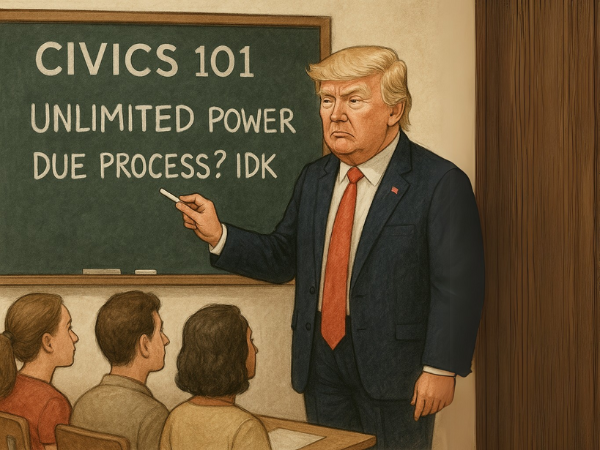
Through his routine disregard for due process, free speech, separation of powers, and the rule of law, President Trump has become a walking civics lesson.

From the First and Fourth Amendments to the Emoluments Clause, the Constitution has never had such regular airtime.

Ironically, this might be Trump’s greatest legacy: forcing Americans to learn what the Constitution actually says—by violating it.

Unfortunately, Trump himself remains constitutionally illiterate.

Days after issuing an executive order that openly hints at martial law, Trump made a mockery of his oath of office by confessing his complete ignorance about the Constitution on national television. When asked if he needs to uphold the Constitution of the United States as president, Trump replied, “I don’t know.

This is the same man who appointed himself Chair of America’s 250th anniversary celebration but seems entirely unaware of what that history represents. Asked what the Declaration of Independence means, Trump called it a “declaration of unity and love.”

In reality, it’s a fiery breakup letter—a revolutionary indictment of unchecked executive power.

If Trump had been king in 1776, Jefferson might have named him in the first paragraph.

To be clear, Donald Trump is not the first president to stretch, sidestep, or outright violate constitutional limits—Democrats and Republicans alike have done so. But Trump is singular in the sheer scope, frequency, and brazenness with which he has stress-tested every clause, amendment, and founding principle of the U.S. Constitution.

His presidency has become a full-frontal assault on the rule of law.

The good news is that Trump’s constitutional ignorance has turned millions of Americans into more alert and informed citizens. In fighting off Trump’s excesses, the nation has reawakened to the rights and principles that many had taken for granted.

Consider some of the constitutional principles that Trump can be credited with bringing into the spotlight unintentionally during his time in office.

First Amendment (free speech, press, religion, protest and assembly): Trump’s repeated confrontations with the First Amendment have transformed free expression into a battleground, making it impossible to ignore the protections it guarantees. From branding the press as “the enemy of the people” and threatening to revoke media licenses to blacklisting law firmsthreatening universities with funding cuts for not complying with the government’s ideological agenda, and detaining foreign students for their political views, Trump has treated constitutional protections not as guarantees, but as obstacles. Deportations and detentions based solely on political speech have shown the fragility of these freedoms when power goes unchecked. Even when Trump claims to be championing religious freedom for Christians, he skates close to violating the First Amendment’s Establishment Clause, which prohibits the government from favoring one religion over another.

Second Amendment (right to bear arms): Although often portrayed as a defender of the Second Amendment, Trump has shown an inconsistent and, at times, authoritarian approach to gun rights. He has publicly suggested confiscating firearms from individuals deemed dangerous—without prior due process—summed up in his infamous 2018 statement: “Take the guns first, go through due process second.” This disregard for constitutional procedure alarmed even staunch Second Amendment advocates. At the same time, Trump has encouraged the militarization of domestic police forces, blurring the line between civilian law enforcement and standing armies—a contradiction that cuts against the very spirit of the amendment, which was rooted in distrust of centralized power and standing militaries.

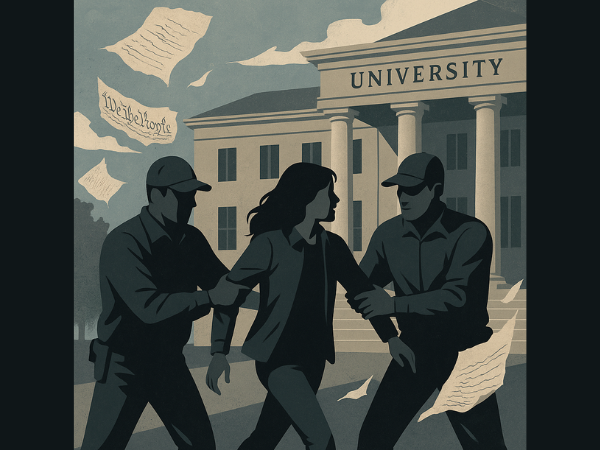
Fourth Amendment (protection against unreasonable searches and seizures): Under Trump, the Fourth Amendment’s shield against unreasonable searches and seizures has likewise become a focal point of concern. His expansion of no-knock raids, endorsement of sweeping surveillance tactics, sanctioning of police brutality and greater immunity for police misconduct, and the use of masked, plainclothes federal agents to seize demonstrators off the streets have revived conversations about privacy, unlawful searches, and the right to be secure in one’s person and property. Executive orders have embedded DHS agents in local policing. All of this under the guise of “law and order”—but without lawful justification.

Fifth & Fourteenth Amendments (due process and equal protection): Perhaps nowhere has Trump’s disregard been more dangerous than in his approach to due process and equal protection under the law. The Fifth and Fourteenth Amendments guarantee that neither citizens nor non-citizens can be deprived of liberty without fair procedures. Yet Trump’s Administration has repeatedly floated or enacted policies that sidestep due process, from the suggestion that he could suspend habeas corpus to the indefinite detention of individuals without trial, and openly questioned whether non-citizens deserve any constitutional protections at all. His immigration policies targeting lawful visa holders for dissent have pushed these rights to the edge of collapse. When asked if non-citizens deserve due process, Trump said, “I don’t know.” That chilling admission sums up his approach to the Fifth and Fourteenth Amendments: treat them as optional.

Sixth (right to a fair and speedy trial) and Eighth Amendments (protection against cruel and unusual punishment): Even the Sixth and Eighth Amendments have found new urgency. Trump has promoted indefinite pretrial detention for protesters and immigrants alike, while presiding over family separations, inhumane detention centers, and support for enhanced interrogation techniques. Trump has also doubled down on his administration’s commitment to carrying out more executions, including a push to impose the death penalty for crimes other than murder. What once seemed like settled moral and legal territory is now back up for debate.

Tenth Amendment (states’ rights): The Tenth Amendment, which preserves state sovereignty against federal overreach, has been tested by Trump’s threats to defund sanctuary cities, override state public health measures, and interfere in local policing and elections. His efforts to federalize domestic law enforcement have exposed the limits of decentralized power in the face of executive ambition.

Fourteenth Amendment (birthright citizenship): No clause has been more aggressively misunderstood by Trump than the Citizenship Clause of the Fourteenth Amendment. His push to strip citizenship from children born on U.S. soil to immigrant parents (birthright citizenship) ignores over a century of legal precedent affirming that citizenship cannot be denied by executive whim.

Article I, Section 8 (commerce and tariffs): Trump’s use of tariff authority provides another example of executive power run amok. Although the Constitution assigns Congress the power to regulate commerce with foreign nations, Trump has imposed sweeping tariffs on allies and used them as political leverage. These actions not only undermine the constitutional balance between the branches but also weaponize trade policy for political ends.

Article I, Section 9 (Emoluments Clause): Trump’s disregard for the Emoluments Clause—a safeguard against presidential profiteering—brought this obscure constitutional provision back into the public eye. By continuing to profit from his private businesses while in office, including his newly launched crypto companies, hosting foreign dignitaries at Trump-branded properties, and his reported willingness to accept extravagant gifts, such as a $400 million luxury plane from the Qatari government, he has raised urgent ethical and legal concerns about self-dealing, corruption and backdoor arrangements by which foreign and domestic governments can funnel money into Trump’s personal coffers.

Article I, Section 9 (power of the purse): Trump has also trampled on Congress’s exclusive power over federal spending, attempting to redirect funds by executive fiat rather than operating within Congress’ approved budgetary plan. Within the first months of his second term, Trump empowered Elon Musk’s Department of Government Efficiency (DOGE) to unilaterally slash government spending by reducing the federal workforce and dismantling whole programs. He has also threatened to withhold federal aid from states, cities, and universities deemed insufficiently loyal. These efforts to bypass congressional appropriations not only violate the Constitution’s clear separation of powers but set a dangerous precedent for future administrations to govern by fiscal coercion.

Article II (executive powers): At the heart of Trump’s governance is a dangerous misreading of Article II, which vests executive power in the president, to justify executive overreach and the concept of an all-powerful unitary executive. He has repeatedly claimed “total authority” over state matters, wielded executive orders like royal decrees in order to bypass Congress, and sought to bend the Department of Justice to his personal and political will. Trump’s use of executive orders—both in his first term and now again in 2025—reflects a belief in unchecked presidential power. He has declared “total authority,” fired independent watchdogspardoned political allies, and weaponized the DOJ. Such behavior undermines the balance of powers laid out by the framers.

Separation of Powers / Checks and Balances: This has also meant a sustained attack on the separation of powers. Trump has defied congressional subpoenas, pardoned loyalists implicated in wrongdoing, and threatened to jail political enemies. In doing so, he has tested—and often breached—the guardrails that prevent any one branch from overpowering the others.

Historical Emergency Powers and Legal Precedents: Beyond these standard constitutional provisions, Trump has also breathed new life into archaic emergency powers—tools that most Americans associate with authoritarian regimes, not a constitutional republic. His rhetoric and executive orders have invoked the Alien Enemies Act to justify rounding up, detaining and deporting undocumented immigrants without due process. He has also threatened to invoke the Insurrection Act to deploy troops domestically in order to deal with civil unrest, raising the specter of martial law cloaked in patriotic language.

In routinely violating the Constitution and crossing legal lines that were once unthinkable, Trump—who appears to have no real understanding of or regard for the Constitution—is forcing Americans to confront what the Constitution truly protects, and what it doesn’t.

So where does that leave us?

Thomas Jefferson recognized that a citizenry educated on “their rights, interests, and duties” is the only real assurance that freedom will survive. As Jefferson wrote in 1820: “I know no safe depository of the ultimate powers of our society but the people themselves; and if we think them not enlightened enough to exercise their control with a wholesome discretion, the remedy is not to take it from them, but to inform their discretion by education. This is the true corrective of abuses of constitutional power.

Still, what good is a knowledgeable citizenry if their elected officials are woefully ignorant about the Constitution or willfully disregard their sworn duty to uphold and protect it?

Jefferson again has the answer: “In questions of power then, let no more be heard of confidence in man, but bind him down from mischief by the chains of the Constitution.”

For starters, anyone taking public office, from the president on down, should have a working knowledge of the Constitution and the Bill of Rights and should be held accountable for upholding their precepts.

One way to ensure this? Require government leaders to take a course on the Constitution—and pass a thorough examination—before being allowed to take office. And if they violate their contractual obligations to uphold and defend the Constitution, vote them out—throw them out—or impeach them.

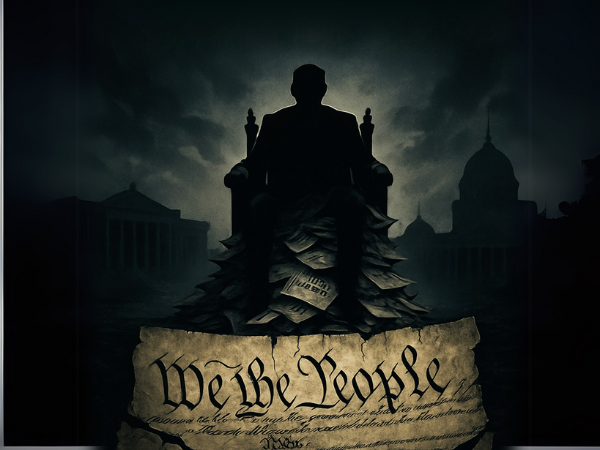
“We the people” have the power, but we must use it, or we’ll lose it.

Trump may have contributed to this revival in constitutional awareness, but as we warn in Battlefield America: The War on the American People and A Government of Wolves: The Emerging American Police State, the challenge isn’t just knowing our rights—it’s defending them, before they’re gone for good.

Source: https://tinyurl.com/454khw2x

ABOUT JOHN W. WHITEHEAD

Constitutional attorney and author John W. Whitehead is founder and president of The Rutherford Institute. His most recent books are the best-selling Battlefield America: The War on the American People, the award-winning A Government of Wolves: The Emerging American Police State, and a debut dystopian fiction novel, The Erik Blair Diaries. Whitehead can be contacted at staff@rutherford.org. Nisha Whitehead is the Executive Director of The Rutherford Institute. Information about The Rutherford Institute is available at www.rutherford.org.

Publication Guidelines / Reprint Permission

John W. Whitehead’s weekly commentaries are available for publication to newspapers and web publications at no charge. 
BURLINGTON, Vt. — In the wake of a string of court challenges over its arrests, detentions and deportations of university students engaged in political protests, the Trump Administration is threatening to suspend the writ of habeas corpus, a constitutional principle with roots in British law that assures everyone in the United States, including noncitizens, of the right to challenge a detention in court.

The White House’s admission that it is “actively looking at” suspending habeas corpus came on the same day that the U.S. District Court for Vermont ordered the immediate release of Rümeysa Öztürk, a Tufts University PhD student who was seized on the street near her apartment by masked, plainclothes ICE agents; shoved into an unmarked car; and transported out of state to a detention center pending deportation. Although never charged with a crime, Öztürk was targeted by government officials for co-authoring an op-ed in a student paper a year earlier expressing support for Palestinian civilians during a time of heightened international conflict. The Rutherford Institute joined a coalition of civil liberties organizations (including the Foundation for Individual Rights and Expression (FIRE), the National Coalition Against Censorship, PEN America, Cato Institute, and the First Amendment Lawyers Association) to file an amicus brief in Öztürk v. Trump challenging the legality of Öztürk’s arrest and detention through her petition for a writ of habeas corpus.

“This is not about public safety. This is about silencing dissent. The U.S. government is weaponizing immigration enforcement to punish political dissent,” said constitutional attorney John W. Whitehead, president of The Rutherford Institute and author of Battlefield America: The War on the American People. “If the government can silence, detain, and deport individuals simply for speaking out on political issues, then no one’s speech is truly safe and we’re no longer operating under the Constitution. We’re living under a system of political policing.”

Öztürk, a Turkish national lawfully present in the U.S. on a student visa, is pursuing a doctorate in the Child Study and Human Development program at Tufts University. Unbeknownst to Öztürk, Secretary of State Marco Rubio revoked her visa as part of a campaign by the Trump Administration to retaliate against those who publicly criticize Israel. Öztürk was detained without warning by masked, plainclothes agents on March 25, 2025, and transferred more than 1,500 miles away from her home in Massachusetts to the South Louisiana ICE Processing Center. In its amicus brief challenging Öztürk’s detention as unconstitutional, the legal coalition contends that the government’s actions set a dangerous precedent in which political speech can be treated as evidence of threat, opening the door for officials to selectively punish individuals based on the content and viewpoint of their expression.

The implications reach far beyond Öztürk’s case. Since returning to office, the Trump Administration has increasingly targeted immigrants and legal visa holders for arrest, deportation, or visa revocation based solely on their political expression. In one case, a legal aid attorney had her visa canceled after attending a peaceful protest. In another, a university lecturer was denied re-entry to the U.S. over critical social media posts. Such tactics, the coalition contends, create a sweeping chilling effect for anyone who dares to speak out against government policy.

Ronnie London, Conor Fitzpatrick, Colin McDonell, Will Creeley, and others at FIRE advanced the arguments in the Öztürk v. Trump amicus brief.

The Rutherford Institute, a nonprofit civil liberties organization, defends individuals whose constitutional rights have been threatened or violated and educates the public on a wide spectrum of issues affecting their freedoms.


Case History

May 01, 2025 • Civil Liberties Advocates Sound Alarm Over Arrest of PhD Student for Political Views

Source: https://tinyurl.com/22v9an5u

“We are fast approaching the stage of the ultimate inversion: the stage where the government is free to do anything it pleases, while the citizens may act only by permission; which is the stage of the darkest periods of human history, the stage of rule by brute force.” — Ayn Rand

130 executive orders in under 100 days.

Sweeping powers claimed in the name of “security” and “efficiency.”

One president acting as lawmaker, enforcer, and judge.

No debate. No oversight. No limits.

This is how the Constitution dies—not with a coup, but with a pen.

The Unitary Executive Theory is no longer a theory—it’s the architecture of a dictatorship in motion.

Where past presidents have used executive orders, decrees, memorandums, proclamations, national security directives and legislative signing statements to circumvent Congress or sidestep the rule of law, President Trump is using executive orders to advance his “unitary executive theory” of governance, which is a thinly disguised excuse for a government by fiat.

In other words, these executive orders are the mechanism by which we finally arrive at a full-blown dictatorship.

America’s founders established a system of checks and balances to prevent the concentration of power in any single branch. To this end, the Constitution establishes three separate but equal branches of government: the legislative branch, which makes the law; the executive branch, which enforces the law; and the judicial branch, which interprets the law.

And yet, despite this carefully balanced structure, we now find ourselves in a place the founders warned against.

Despite Trump’s attempts to rule by fiat, the president has no unilateral authority to operate outside the Constitution’s system of checks and balances—no matter how urgent the crisis or how well-meaning the intentions.

This is what government by fiat looks like.

Where Congress was once the nation’s lawmaking body, its role is now being eclipsed by a deluge of executive directives—each one issued without public debate, legislative compromise, or judicial review.

These executive orders aren’t mere administrative housekeeping. They represent a radical shift in how power is exercised in America, bypassing democratic institutions in favor of unilateral command. From trade and immigration to surveillance, speech regulation, and policing, the president is claiming broad powers that traditionally reside with the legislative and judicial branches.

Some orders invoke national security to disrupt global markets. Others attempt to override congressional control over tariffsfast-track weapons exports, or alter long-standing public protections through regulatory rollbacks. A few go even further—flirting with ideological loyalty tests for citizenshipchilling dissent through financial coercion, and expanding surveillance in ways that undermine due process and privacy.

Yet here’s where these actions run into constitutional peril: they redefine executive authority in ways that bypass the checks and balances enshrined in the Constitution. They centralize decision-making in the White House, sideline the legislative process, and reduce the judiciary to an afterthought—if not an outright obstacle.

Each of these directives, taken individually, might seem technocratic or temporary. But taken together, they reveal the architecture of a parallel legal order—one in which the president acts as lawmaker, enforcer, and judge. That is not how a constitutional republic operates. That is how a dictatorship begins.

Each of these orders marks another breach in the constitutional levee, eroding the rule of law and centralizing unchecked authority in the executive.

This is not merely policy by another name—it is the construction of a parallel legal order, where the president acts as lawmaker, enforcer, and judge—the very state of tyranny our founders sought to prevent.

This legal theory—the so-called Unitary Executive—is not new. But under this administration, it has metastasized into something far more dangerous: a doctrine of presidential infallibility.

What began as a constitutional interpretation that the president controls the executive branch has morphed into an ideological justification for unchecked power.

Under this theory, all executive agencies, decisions, and even enforcement priorities bend entirely to the will of the president—obliterating the idea of an independent bureaucracy or impartial governance.

The result? An imperial presidency cloaked in legalism.

Historically, every creeping dictatorship has followed this pattern: first, undermine the legislative process; then, centralize enforcement powers; finally, subjugate the judiciary or render it irrelevant. America is following that roadmap, one executive order at a time.

Even Supreme Court justices and legal scholars who once defended broad executive authority are beginning to voice concern.

Yet the real danger of the Unitary Executive Theory is not simply that it concentrates power in the hands of the president—it’s that it does so by ignoring the rest of the Constitution.

Respect for the Constitution means obeying it even when it’s inconvenient to do so.

We’re watching the collapse of constitutional constraints not through tanks in the streets, but through policy memos drafted in the West Wing.

No matter how well-meaning the politicians make these encroachments on our rights appear, in the right (or wrong) hands, benevolent plans can easily be put to malevolent purposes. Even the most principled policies can be twisted to serve illegitimate ends once power and profit enter the equation.

The war on terror, the war on drugs, the war on illegal immigration, asset forfeiture schemes, road safety schemes, school safety schemes, eminent domain: all of these programs started out as legitimate responses to pressing concerns and have since become weapons of compliance and control in the police state’s hands.

We are approaching critical mass.

The groundwork has been laid for a new kind of government where it doesn’t matter if you’re innocent or guilty, whether you’re a threat to the nation, or even if you’re a citizen.

What will matter is what the government—or whoever happens to be calling the shots at the time—thinks. And if the powers-that-be think you’re a threat to the nation and should be locked up, then you’ll be locked up with no access to the protections our Constitution provides.

In effect, you will disappear.

Our freedoms are already being made to disappear.

This is how tyranny arrives: not with a constitutional amendment, but with a series of executive orders; not with a military coup, but with a legal memo; not with martial law, but with bureaucratic obedience and public indifference.

A government that rules by fiat, outside of constitutional checks and balances, is not a republic. It is a dictatorship in everything but name.

If freedom is to survive this constitutional crisis, We the People must reclaim our role as the ultimate check on government power.

That means holding every branch of government accountable to the rule of law. It means demanding that Congress do its job—not merely as a rubber stamp or partisan enabler, but as a coequal branch with the courage to rein in executive abuses.

It means insisting that the courts serve justice, not politics.

And it means refusing to normalize rule by decree, no matter who sits in the Oval Office.

There is no freedom without limits on power.

There is no Constitution if it can be ignored by those who swear to uphold it.

The presidency was never meant to be a throne. The Constitution was never meant to be optional. And the people were never meant to be silent.

As I make clear in my book Battlefield America: The War on the American People and in its fictional counterpart The Erik Blair Diaries, the time to speak out is now.

As our revolutionary forefathers learned the hard way, once freedom is lost, it is rarely regained without a fight.

Source: https://tinyurl.com/mr2hvf3h

ABOUT JOHN W. WHITEHEAD

Constitutional attorney and author John W. Whitehead is founder and president of The Rutherford Institute. His most recent books are the best-selling Battlefield America: The War on the American People, the award-winning A Government of Wolves: The Emerging American Police State, and a debut dystopian fiction novel, The Erik Blair Diaries. Whitehead can be contacted at staff@rutherford.org. Nisha Whitehead is the Executive Director of The Rutherford Institute. Information about The Rutherford Institute is available at www.rutherford.org.

Publication Guidelines / Reprint Permission

John W. Whitehead’s weekly commentaries are available for publication to newspapers and web publications at no charge. 

This is economic sabotage. Whether through malice or incompetence or, more likely, both Trump is isolating the United States on the world stage, tanking the markets, worsening inflation, and burdening working families with the cost of his 18th-century cosplay. These aren’t policies. They’re performance art. And the rest of us are footing the bill.”—Oregon’s Bay Area (blog post)

What we’re witnessing is the calculated use of emergency powers to concentrate power in the hands of the president, enrich the Deep State, and dismantle what remains of economic and constitutional safeguards.

Nearly 250 years after our nation’s founders rebelled over abused property rights, Americans are once again being subjected to taxation without any real representation, all the while the government continues to do whatever it likes—levy taxes, rack up debt, spend outrageously and irresponsibly—with little concern for the plight of its citizens.

Nothing has changed for the better with Donald Trump. Indeed, it’s getting worse by the day.

Having inherited one of the strongest economies in the world, President Trump—whose credentials as a businessman include multiple failed business venturesbankruptcies, and a mountain of debt and unpaid bills—has managed to singlehandedly torch the economy with his misguided tariffs and self-serving schemes, which are being carried out without any oversight or checks from Congress.

Yet it is Congress, not the president, that holds the authority to control government spending.

This is spelled out in the Appropriations Clause, found in Article I, Section 9, Clause 7 of the Constitution, which establishes a rule of law about how the monies paid to the government by the taxpayers are to be governed, and in the Taxing and Spending Clause of Article I, Section 8, Clause 1. In a nutshell, Congress is in charge of accounting for those funds and authorizing how those funds are spent (or not spent).

The founders intended this regulatory power, referred to as the “power of the purse” (to determine what funds can be spent and what funds can be withheld) to serve as a potent check on any government agency that exceeds its authority, especially the executive branch.

As law professor Zachary Price observes, “Given how strong this check is, it may not be surprising that presidents have sought ways to get around it.”

Woven throughout the history of the United States are examples of this constant power struggle.

For instance, Congress used the power of the purse to end the Vietnam War and pull the U.S. military from Lebanon.

Yet while past presidents have sought to expand their authority under the guise of national emergency declarations, Trump simply taken this executive overreach to unprecedented extremes.

Price explains how various presidents from Obama to Biden to Trump have attempted to subvert that same congressional power to press their own agendas, whether by funding the Affordable Care Act, advancing student debt, or as in Trump’s case, by dismantling and defunding agencies funded by Congress.

Executive orders and national emergencies have become a favored tool by which presidents attempt to govern unilaterally. As the Brennan Center reports, presidents have access to 150 such emergency powers, which essentially allow them to become limited dictators with greatly enhanced powers upon declaration of an emergency.

Because the National Emergencies Act does not actually define what constitutes an emergency, presidents have an incredible amount of room to wreak constitutional mischief on the citizenry.

While presidents on both sides of the aisle have abused these powers, Trump is attempting to test the limits of these emergency powers by declaring a national emergency anytime he wants to sidestep Congress and quickly impose his will on the nation.

Trump’s liberal use of emergency powers to sidestep the rule of law underscores the danger they pose to our constitutional system of checks and balances.

Since taking office in January 2025, Trump has used his presidential emergency powers in a multitude of ways in order to mount brazen power grabs thinly disguised as concerns for national security, thereby allowing him to justify tapping into the nation’s natural resources, rounding up and deporting vast numbers of migrants (both documented and undocumented), and imposing duties and tariffs against longtime allies and trade partners.

Thus far, the Republican-controlled Congress, which has the power to terminate an emergency with a two-thirds vote, has done nothing to rein in Trump’s dictatorial tendencies. 

These unchecked powers aren’t just a threat to the balance of government—they have immediate, devastating consequences for the economy and working Americans.

Economists fear the ramifications of Trump’s latest national emergency, which he claims will usher in “the golden age of America” through the imposition of heavy tariffs on foreign nations, could push the U.S. and the rest of the world into a major recession by inciting a global trade-war, isolating America economically from the rest of the world, and flat-lining businesses that had expected to boom.

Fears of a recession are growing stronger by the hour.

In addition to sabotaging the economy, laying off tens of thousands of federal employees and dismantling those parts of government which serve the interests of working-class Americans, as well as its aging, disabled and homeless populations, Trump and his cabal of billionaire buddies are dismantling the few remaining checks on public and private corruption—fueling corporate greed at every turn.

This is how the man who promised to drain the swamp continues to mire us in the swamp.

Meanwhile, taxpayers—whose retirement savings have taken a nosedive—are expected to foot the bill to the tune of tens of millions of dollars for Trump’s frequent golf trips to his own golf courses (he’s also charging exorbitant rates to Secret Service to stay at his properties while protecting him), his multimillion-dollar photo ops at the Super Bowl and the Daytona 500, his desire to redo the White House gardens and build a $100 million ballroom, and his latest demand for a costly military parade in honor of his 79th birthday.

While President Trump may talk a good game about his plans for making America richer, it’s becoming increasingly clear that the only person he’s making richer—at taxpayer expense—is himself.

This fiscal insanity, coupled with Trump’s imperialistic and tyrannical ambitions, echoes the very abuses that drove America’s founders to rebel against King George III.

In other words, the government is still robbing us blind.

Trump hasn’t reined in the government’s greed—he’s just been using a different playbook to get the same result: beg, borrow or steal, the government wants more of our hard-earned dollars any way it can get it.

This is what comes of those multi-trillion dollar spending bills: someone’s got to foot the bill for the government’s fiscal insanity, and that “someone” is always the U.S. taxpayer.

The government’s schemes to swindle, cheat, scam, and generally defraud taxpayers of their hard-earned dollars have run the gamut from wasteful pork barrel legislation, cronyism and graft to asset forfeiture, costly stimulus packages, and a national security complex that continues to undermine our freedoms while failing to making us any safer.

Americans have also been made to pay through the nose for the government’s endless wars, subsidization of foreign nations, military empire, welfare state, roads to nowhere, bloated workforce, secret agencies, fusion centers, private prisons, biometric databases, invasive technologies, arsenal of weapons, and every other budgetary line item that is contributing to the fast-growing wealth of the corporate elite at the expense of those who are barely making ends meet—that is, we the taxpayers.

Trump, a master at saying one thing and doing another, has made a great show of touting his claims to cutting back on government spending through crippling cuts that will impact almost every sector of the American landscape. However, what Trump fails to mention are all the costly big-budget items he’s tacking on that will not only consume his modest claims to saving money by axing essential programs but further mire the country in debt.

Indeed, Trump, the self-proclaimed “debt king,” has presided over one of the most reckless expansions of government spending in modern history while posturing as a fiscal conservative.

Consider that during Trump’s first term, the national debt rose by almost $7.8 trillion.

According to ProPublica, “That’s nearly twice as much as what Americans owe on student loans, car loans, credit cards and every other type of debt other than mortgages, combined… It amounts to about $23,500 in new federal debt for every person in the country. The growth in the annual deficit under Trump ranks as the third-biggest increase, relative to the size of the economy, of any U.S. presidential administration… And unlike George W. Bush and Abraham Lincoln, who oversaw the larger relative increases in deficits, Trump did not launch two foreign conflicts or have to pay for a civil war.”

If Trump’s first term was a preview, his second is a full-blown financial coup—waged against the American people with borrowed money.

Let’s talk numbers, shall we?

The national debt (the amount the federal government has borrowed over the years and must pay back) is more than $36 trillion and will grow another $19 trillion by 2033.

The bulk of that debt has been amassed over the past two decades, thanks in large part to the fiscal shenanigans of four presidents, 10 sessions of Congress and two wars.

It’s estimated that the amount this country owes is now 130% greater than its gross domestic product (all the products and services produced in one year by labor and property supplied by the citizens).

In other words, the government is spending more than it brings in and, in the process, drowning us in an empire of debt.

Interest payments on the national debt are more than $582 billion, which is significantly more than the government spends on veterans’ benefits and services, and according to Pew Research Center, more than it will spend on elementary and secondary education, disaster relief, agriculture, science and space programs, foreign aid, and natural resources and environmental protection combined.

According to the Committee for a Reasonable Federal Budget, the interest we’ve paid on this borrowed money is “nearly twice what the federal government will spend on transportation infrastructure, over four times as much as it will spend on K-12 education, almost four times what it will spend on housing, and over eight times what it will spend on science, space, and technology.”

In ten years, those interest payments will exceed our entire military budget.

This isn’t governance. It’s looting—by legislation, debt, and design.

We’ve been sold a bill of goods by politicians who promise to pay down the debt, rebuild the economy, and protect our freedoms—but deliver only more debt and more control.

Indeed, the national deficit (the difference between what the government spends and the revenue it takes in) remains at more than $1.5 trillion.

According to the number crunchers with the Committee for a Responsible Federal Budget, in order to spend money it doesn’t have on programs it can’t afford, the government is borrowing roughly $6 billion a day.

Basically, the U.S. government is funding its existence with a credit card.

If Americans managed their personal finances the way the government mismanages the nation’s finances, we’d all be in debtors’ prison by now.

Despite the government propaganda being peddled by the politicians and news media, however, the government isn’t spending our tax dollars to make our lives better.

We’re being robbed blind so the governmental elite can get richer.

This is financial tyranny.

In the eyes of the government, “we the people, the voters, the consumers, and the taxpayers” are little more than pocketbooks waiting to be picked.

“We the people” have become the new, permanent underclass in America.

We have no real say in how the government runs, or in how our tax dollars are spent, but we’re being forced to pay through the nose, anyhow.

We have no real say, but that doesn’t prevent the government from fleecing us at every turn and forcing us to pay for endless wars that do more to fund the military industrial complex than protect us, pork barrel projects that produce little to nothing, and a police state that serves only to imprison us within its walls.

While we’re struggling to get by, and making tough decisions about how to spend what little money actually makes it into our pockets after the federal, state and local governments take their share (this doesn’t include the stealth taxes imposed through tolls, fines and other fiscal penalties), the government continues to do whatever it likes—levy taxes, rack up debt, spend outrageously and irresponsibly—with little thought for the plight of its citizens.

And now Trump, eager to do away with goods and services for the poor and needy while imposing a greater tax burden on the working-class citizenry (a burden not shared by the nation’s financial elite), wants $1 trillion for the military so it can be even more lethal and prepared to unleash violence around the globe.

That’s in addition to the nearly $1 billion the Pentagon has already spent on Trump’s largely futile bombing campaign in Yemen.

Incredibly, all of these wars the U.S. is so eager to fight abroad are being waged with borrowed funds. As The Atlantic reports, “U.S. leaders are essentially bankrolling the wars with debt, in the form of purchases of U.S. Treasury bonds by U.S.-based entities like pension funds and state and local governments, and by countries like China and Japan.”

Of course, we the taxpayers are the ones who have to repay that borrowed debt.

As Dwight D. Eisenhower warned in a 1953 speech, this is how the military industrial complex continues to get richer, while the American taxpayer is forced to pay for programs that do little to protect our rights or improve our lives.

This is no way of life.

Once again, we have a despotic regime with an imperial ruler doing as they please.

Once again, we have a judicial system that insists we have no rights in the face of a government that demands total compliance.

And once again, we’ve got to decide whether we’ll keep footing the bill for tyranny.

As I make clear in my book Battlefield America: The War on the American People and in its fictional counterpart The Erik Blair Diaries, if you have no choice, no voice, and no real say over how your money is used, you’re not free. You’re being ruled.

This is no longer the American dream. It’s a financial nightmare.

As political analyst Robert Reich warns, “Make no mistake about what’s really going on here. While the United States has plenty of real problems to deal with, Trump is ignoring them to manufacture the fake emergencies he needs to further enlarge and centralize his power. America’s real national emergency is Donald J. Trump.

Until we push back, this nightmare will only deepen.

Source: https://tinyurl.com/58mupx9x

ABOUT JOHN W. WHITEHEAD

Constitutional attorney and author John W. Whitehead is founder and president of The Rutherford Institute. His most recent books are the best-selling Battlefield America: The War on the American People, the award-winning A Government of Wolves: The Emerging American Police State, and a debut dystopian fiction novel, The Erik Blair Diaries. Whitehead can be contacted at staff@rutherford.org. Nisha Whitehead is the Executive Director of The Rutherford Institute. Information about The Rutherford Institute is available at www.rutherford.org.

Publication Guidelines / Reprint Permission

John W. Whitehead’s weekly commentaries are available for publication to newspapers and web publications at no charge. 

WASHINGTON, D.C. — Denouncing the Trump Administration’s ongoing attempts to suppress dissent and chill lawful First Amendment activity, The Rutherford Institute has joined a broad coalition of eleven legal and civil liberties organizations to challenge President Trump’s use of presidential executive orders to retaliate against perceived political opponents.

The coalition, which includes the ACLU, ACLU of DC, CATO, Electronic Frontier Foundation, FIRE, the Institute for Justice, the Knight First Amendment Institute, the National Coalition Against Censorship, the Reporters Committee for the Freedom of the Press, the Society for the Rule of Law, and The Rutherford Institute, filed an amicus brief in Perkins Coie LLP v. U.S. Department of Justice asking a federal court to strike down the president’s executive order as a violation of the separation of powers and an unconstitutional infringement on the rights to free speech, advocacy and due process.

“That the Trump Administration is weaponizing the government in order to wage a war against dissent, against due process, and against the very foundations of our constitutional republic should be a warning to all Americans,” said constitutional attorney John W. Whitehead, president of The Rutherford Institute and author of Battlefield America: The War on the American People. “History shows that when governments claim the power to silence dissent—whether in the name of national security, border protection, or law and order—that power rarely remains limited. These threats against the legal community and ‘we the people’ are merely the first round of the Trump Administration’s effort to turn the Bill of Rights into a Bill of Conditional Privileges.”

In an effort to punish the law firm of Perkins Coie and discourage any other law firms from challenging the Trump Administration’s ongoing efforts to sidestep the Constitution, President Trump issued an Executive Order directing the federal government to suspend the firm’s security clearances, cease providing all goods and services, terminate any contracts with the firm and those who do business with the firm, limit the firm’s access to federal buildings and employees, and refrain from hiring employees of the firm. The intent behind the president’s actions, per former advisor Steve Bannon, is to “put those law firms out of business” so that they can no longer use the system of checks and balances to prevent the Administration from violating the Constitution.

Perkins Coie filed a lawsuit to prevent the implementation of Trump’s Order on grounds that it violates the separation of powers and the First, Fifth, and Sixth Amendments. Warning that Trump’s actions constitute a brazen attack on the independence of the legal profession and the judicial branch, the legal coalition’s amicus brief argues that Trump’s Executive Order not only infringes the First Amendment rights to freedom of speech and petitioning the government, but it also essentially gives the government an unfettered veto over a person’s right to choice of counsel due to the government pushing for a cancel culture and creating a blacklist of firms, similar to what the NRA previously claimed was done to it by a New York state official. Moreover, if the executive order is allowed to stand, it could set a precedent for future Administrations of either political party to suppress challenges to a president’s unconstitutional policies and actions and to deter lawyers from representing the president’s political opponents and any clients adverse to the Administration.

Cecillia D. Wang, Ben Wizner, Brian Hauss, and Arthur B. Spitzer at ACLU advanced the arguments in the Perkins Coie LLP v. U.S. Department of Justice, et al. amicus brief.

The Rutherford Institute, a nonprofit civil liberties organization, defends individuals whose constitutional rights have been threatened or violated and educates the public on a wide spectrum of issues affecting their freedoms.

Source: https://tinyurl.com/2rnskzh5

This is war.”—President Trump

President Trump’s declaration of war as a justification for using wartime powers to sidestep constitutional protections is indeed a war, but it is a war waged by the president against dissent, against due process, and against the very foundations of our constitutional republic.

This is what it means to weaponize the government.

When the government turns its power against its own people—through surveillance, retaliation, censorship, and intimidation—it ceases to serve the public and instead becomes a weapon of oppression.

According to the Political Dictionary:

The term ‘weaponize’ refers to the strategic manipulation or transformation of information, institutions, or social issues into tools for gaining political advantage. This could involve exploiting existing laws, harnessing social media algorithms for disinformation campaigns, or turning otherwise neutral or benign elements of governance into divisive issues for the purpose of delegitimizing opponents or rallying a base.”

Time and again, leaders have stretched—or outright shattered—the limits of power, weaponizing government power through unjust laws, surveillance, or outright suppression.

Each power grab is a step toward the erosion of liberty.

John Adams used the Alien and Sedition Acts to prosecute journalists and political opponents.

Abraham Lincoln suspended habeas corpus, allowing the military to detain individuals without trail and suppressing Confederate sympathizers and political dissenters.

Under Woodrow Wilson, the Espionage and Sedition Acts were used to crack down on anti-war activists, socialists, and labor organizers, including Eugene V. Debs, who spoke out against World War I.

Franklin D. Roosevelt issued an executive order that led to the internment of over 120,000 Japanese Americans during World War II, based on suspicions of disloyalty, despite little to no evidence.

Richard Nixon harnessed the power of the FBI, CIA, and IRS, to harass, spy on and sabotage his political opponents and perceived enemies.

Spanning numerous presidential administrations, from FDR to Nixon, the FBI’s covert intelligence program COINTELPRO was used to infiltrate, discredit and disrupt civil rights leaders, anti-war activists, and other political dissidents.

In a bid to fight so-called disinformation, Biden pressured social media companies to censor and suppress individuals expressing views perceived as conspiratorial or extremist, especially as they related to COVID-19.

And then there’s Donald Trump, who is setting new records for how far he’s willing to go to retaliate against his perceived enemies and sidestep the rule of law.

Indeed, Ken Hughes, an investigative journalist who spent two decades listening to Richard Nixon’s Secret White House Tapes, has concluded that Nixon’s abuses of presidential power—which included weaponizing the government to “sabotage Vietnam peace talks to damage the Democrats’ 1968 presidential campaign, to time his withdrawal from Vietnam to help his 1972 reelection campaign, and to spring former Teamsters president Jimmy Hoffa from prison in return for the union’s political support”—pale beside Trump’s abuses.

Trump, who once vowed to end government overreach and the weaponization of the federal government, now openly uses its full force against his critics, dismantling democratic norms, consolidating power in ways that defy the Constitution, and directing an all-out weaponization of the federal government against his perceived enemies, which translates to anyone who dares to oppose him.

If Trump were just a petty blowhard, that would be one thing.

Unfortunately, having populated his administration with individuals more loyal to him than to the Constitution, Trump is getting drunk on power.

The danger is not so much Trump as it is his enablers-to-abuse, the many minions within his administration and beyond who are eager to carry out unlawful orders, defy the courts, ignore Congress’ mandate, trample rights, and butcher the Constitution, all in the so-called name of putting America first.

If this keeps up, America, once looked upon as a bastion of freedom and economic opportunity, will be the last place anyone ever thinks of when they hear the words freedom, justice and equality.

Every action taken by the Trump administration in defiance of the rule of law—whether or not that action is motivated by a legitimate concern for national security—pushes us that much closer to the complete dismantling of our constitutional republic.

Don’t be so carried away by fear-inducing tales of rapists and foreign invaders and corruption that you let the government get away with murder… the painful execution of our rights.

That way lies tyranny.

You can see the pattern forming already.

When anti-war protesters are made to disappear—snatched up late at night by plain-clothes men who refuse to identify themselves and then transported thousands of miles away, to a private prison in a state more favorable to dubious detentions—we are wading deep into authoritarian territory.

When Venezuelan migrants are rounded up and deported out of the country, heads shaven and in chains, without any due process—without being identified, without being charged formally with a crime, without getting a chance to plead their innocence against those charges and, if found guilty, then convicted—we are wading deep into authoritarian territory.

When major law firms are barred from interacting with federal agencies or entering federal buildings—an outright attempt to chill First Amendment activity and hamstring businesses that challenge government overreach—we are wading deep into authoritarian territory.

When huge swaths of our nation’s history (including the Constitution and Bill of Rights) are being erased from websites, government buildings, archives, educational curriculum—in the so-called name of combatting discrimination—we are wading deep into authoritarian territory.

When Trump administration sycophants from the vice president on down are openly deriding and defying the courts while proclaiming the imperial supremacy of their exalted leader, we are wading deep into authoritarian territory.

When the president of the United States threatens other nations militarily, talks openly about seizing foreign lands, stirs up international tensions, and rattles the war drums, we are wading deep into authoritarian territory.

Trump, adept at twisting facts and spinning lies, is working hard to insist that these end-runs around the rule of law are for our safety.

Don’t believe him. Words are cheap.

More importantly, don’t trust him. Bind him down with the chains of the Constitution.

The only real protection we have against tyranny is the rule of law, provided that you have a populace and a system of government that holds the rule of law as inviolable.

That is our real power: the extent to which we hold fast to the Constitution and demand that the government and its agents do so, as well.

The moment that we relent in that commitment—the moment that we look the other way and let first a few encroachments slide, then ever more and more—is the moment that the Constitution loses its power to protect us against tyranny.

That is what is unfolding right now.

This is the devil’s bargain that we are being asked to enter into with Trump: empty promises and a one-way street to a dictatorship in exchange for our freedoms.

Watch out.

When any politician claims to be saving you money by imposing tariffs that ramp up inflation and cutting government programs aimed at educating the massesfeeding the hungry, and helping the poor, disabled and elderly, all the while spending taxpayer money on his own lavish lifestyle and self-serving government programs, you’d better beware. Your hard-earned dollars will be next in line to be seized, spent and squandered.

When any politician suggests that you relinquish your freedoms—of speech, assembly, due process, association, etc.—in exchange for promises of greater security, you’d better beware. Your freedoms will be next on the chopping block.

When any politician persuades you to look the other way while innocent individuals are rounded up alongside suspected criminals just because they look a certain way or talk a certain way or belong to a particular demographic, you’d better beware. Your right to due process will be next.

When any politician comes up with a vast array of reasons why he doesn’t need to obey court rulings—because they were issued verbally, because his power trumps that of the courts, because he doesn’t need to follow the law outside America’s borders—you’d better beware. This shifty reasoning for breaking the law could be used against you next.

There can be no doubt about the nature of what is taking place right now.

This is war.

President Trump’s justification for defying the courts and doing whatever he wants in pursuit of his political agenda (arresting protesters, carrying out mass arrests and deportations, muzzling critics, seizing funds, dismantling agencies, usurping congressional powers) is that “this is war.”

Here’s the thing, though: Trump may be using his war powers as commander-in-chief to bypass the Constitution at every turn, but the only war being waged is a war against the Constitution and the rule of law and the American people.

Congress, which has the sole power to declare war under Article I, Section 8, Clause 11, has yet to do so. And still Trump is using the emergency wartime powers of the presidency to sidestep accountability and due process.

In ruling after ruling, the courts, which have the judicial power to rein in overreach and misconduct, are repeatedly declaring unconstitutional the Trump administration’s steady dismantling of the government and refusal to stay within the purview of his official powers. And still Trump is unilaterally hacking away at the very foundations of our system of government.

If the president refuses to be held accountable, if he insists that his power is supreme, if he abuses the power of his office to wreak havoc and revenge, if he reduces our republic to rubble and tramples over the Constitution and disregards the rule of law, he is aligning himself with every despot, dictator and tyrant to have walked the earth.

We’ve been here before. We know how this story ends.

It takes time and effort and a willingness on the part of “we the people” to look beyond our differences and stand united in opposition to oppression, but when we do that, freedom prevails in the end.

Next year will be the 250th anniversary of the birth of this country, when America’s founders declared their independence from King George’s tyranny. What’s just as important, however, is what came before that: the small steps of rebellion, resistance and outrage that said, “enough is enough.”

What we are now experiencing is a civil war, devised and instigated in part by the Deep State.

The objective: compliance and control.

The strategy: destabilize the economy, polarize the populace, escalate racial and political tensions, intensify the use of violence, and then, when all hell breaks loose, clamp down on the nation for the good of the people and the security of the nation.

The outcome for this particular conflict is already foregone: the Deep State wins.

The Deep State wins by ensuring that we are censored, silenced, muzzled, gagged, zoned out, caged in and shut down. It wins by monitoring our speech and activities for any sign of “extremist” activity. It wins by ensuring that we are estranged from each other and kept at a distance from those who are supposed to represent us. It wins by saddling us with taxation without representation and a government without the consent of the governed.

It wins by terminating the Constitution (or rewriting the Constitution).

So where does that leave us?

“We” may have contributed to our downfall through our inaction and gullibility, but we are also the only hope for a free future.

After all, the Constitution begins with those three beautiful words, “We the people.”

Those three words were intended as a reminder to future generations that there is no government without us: our sheer numbers, our muscle, our economy, our physical presence in this land.

When we forget that, when we allow the “Me” of a self-absorbed, narcissistic, politically polarizing culture to override our civic duties as citizens to collectively stand up to tyranny and make the government play by the rules of the Constitution, that is when tyranny rises and freedom falls

Remember, there is power in numbers.

Not the kinds of numbers that Trump likes to spout about landslide victories and electoral mandates, but the most powerful numbers of all: the sheer, overwhelming mass of humanity that is “we the people” of these United States of America.

If there is any means left to us for thwarting the government in its relentless march towards outright dictatorship, it rests with us.

Ultimately, that’s what the Tenth Amendment to the Constitution is all about: it affirms that “we the people” have all the power, and what powers we do not explicitly give to the federal government or the states, we retain. We may appoint government representatives to act in our stead, but we never relinquish that power altogether.

That’s where Trump and his Deep State handlers get it wrong. Speaking through him and his administration, they claim that this dismantling of the federal government is a bid to return power to local communities and state governments, but it’s not their government to dismantle, nor is it their power to return.

We are the government, and we are the power, and it’s time “we the people” reminded the government and its henchmen of that important fact.

The power still lies with us.

We must resist every attempt to erode our freedoms, demand accountability, and uphold the Constitution—before it’s too late.

It’s time to invalidate governmental laws, tactics and policies that are illegitimate, egregious or blatantly unconstitutional.

Nullify everything the government does that flies in the face of the Constitution.

Flood your representatives’ phone lines, inboxes and townhall meetings with your discontent.

Protest everything that tramples on the Constitution.

Stand up for your own rights, of course, but more importantly, stand up for the rights of those with whom you might disagree.

Defend freedom at all costs. Defend justice at all costs. Make no exceptions based on race, religion, creed, politics, immigration status, sexual orientation, etc.

Don’t play semantics. Don’t justify. Don’t politicize it.

If it carries even a whiff of tyranny, oppose it.

Demand that your representatives in government cut you a better deal, one that abides by the Constitution and doesn’t just attempt to sidestep it. That’s their job: make them do it.

As I make clear in my book Battlefield America: The War on the American People and in its fictional counterpart The Erik Blair Diaries, all freedoms hang together. They fall together, as well.

Source: https://tinyurl.com/2r86htbz

ABOUT JOHN W. WHITEHEAD

Constitutional attorney and author John W. Whitehead is founder and president of The Rutherford Institute. His most recent books are the best-selling Battlefield America: The War on the American People, the award-winning A Government of Wolves: The Emerging American Police State, and a debut dystopian fiction novel, The Erik Blair Diaries. Whitehead can be contacted at staff@rutherford.org. Nisha Whitehead is the Executive Director of The Rutherford Institute. Information about The Rutherford Institute is available at www.rutherford.org.

Publication Guidelines / Reprint Permission

John W. Whitehead’s weekly commentaries are available for publication to newspapers and web publications at no charge. 
“Every day I ask myself the same question: How can this be happening in America? How can people like these be in charge of our country? If I didn’t see it with my own eyes, I’d think I was having a hallucination.”—Philip Roth, novelist

Things are falling apart.

How much longer we can sustain the fiction that we live in a constitutional republic, I cannot say, but anarchy is being loosed upon the nation.

We are witnessing the unraveling of the American dream one injustice at a time.

Day after day, the government’s crimes against the citizenry grow more egregious, more treacherous and more tragic. And day after day, the American people wake up a little more to the grim realization that they have become captives in a prison of their own making.

No longer a free people, we are now pushed and prodded and watched over by twitchy, hyper-sensitive, easily-spooked armed guards who care little for the rights, humanity or well-being of those in their care.

The death toll is mounting.

The carnage is heartbreaking.

The public’s faith in the government to do its job—which is to protect our freedoms—is deteriorating.

It doesn’t take a weatherman to realize when a storm is brewing: clouds gather, the wind begins to blow, and an almost-palpable tension builds.

It’s the same way with freedom.

The warning signs are everywhere.

“Things fall apart,” wrote W.B. Yeats in his dark, forbidding poem “The Second Coming.” “The centre cannot hold; mere anarchy is loosed upon the world, the blood-dimmed tide is loosed, and everywhere the ceremony of innocence is drowned … Surely some revelation is at hand.”

The upcoming election and its aftermath will undoubtedly keep the citizenry divided and at each other’s throats, so busy fighting each other that they never manage to present a unified front against tyranny in any form. Yet the winner has already been decided. As American satirist H.L. Mencken predicted almost a century ago:

“All the odds are on the man who is, intrinsically, the most devious and mediocre — the man who can most adeptly disperse the notion that his mind is a virtual vacuum. The Presidency tends, year by year, to go to such men. As democracy is perfected, the office of president represents, more and more closely, the inner soul of the people. On some great and glorious day the plain folks of the land will reach their heart’s desire at last and the White House will be adorned by a downright moron.”

In other words, nothing will change.

You cannot have a republican form of government—nor a democratic one, for that matter—when the government views itself as superior to the citizenry, when it no longer operates for the benefit of the people, when the people are no longer able to peacefully reform their government, when government officials cease to act like public servants, when elected officials no longer represent the will of the people, when the government routinely violates the rights of the people and perpetrates more violence against the citizenry than the criminal class, when government spending is unaccountable and unaccounted for, when the judiciary act as courts of order rather than justice, and when the government is no longer bound by the laws of the Constitution.

For too long, the American people have obeyed the government’s dictates, no matter now unjust.

We have paid its taxes, penalties and fines, no matter how outrageous. We have tolerated its indignities, insults and abuses, no matter how egregious. We have turned a blind eye to its indiscretions and incompetence, no matter how imprudent. We have held our silence in the face of its lawlessness, licentiousness and corruption, no matter how illicit.

We have suffered. Oh how we have suffered.

How much longer we will continue to suffer at the hands of a tyrannical police state depends on how much we’re willing to give up for the sake of freedom.

It may well be that Professor Morris Berman is correct: perhaps we are entering into the dark ages that signify the final phase of the American Empire. “It seems to me,” writes Berman, “that the people do get the government they deserve, and even beyond that, the government who they are, so to speak. In that regard, we might consider, as an extreme version of this… that Hitler was as much an expression of the German people at that point in time as he was a departure from them.”

For the moment, the American people seem content to sit back and watch the reality TV programming that passes for politics today. It’s the modern-day equivalent of bread and circuses, a carefully calibrated exercise in how to manipulate, polarize, propagandize and control a population.

As French philosopher Etienne de La Boétie observed half a millennium ago:

“Plays, farces, spectacles, gladiators, strange beasts, medals, pictures, and other such opiates, these were for ancient peoples the bait toward slavery, the price of their liberty, the instruments of tyranny. By these practices and enticements the ancient dictators so successfully lulled their subjects under the yoke, that the stupefied peoples, fascinated by the pastimes and vain pleasures flashed before their eyes, learned subservience as naively, but not so creditably, as little children learn to read by looking at bright picture books.”

The bait towards slavery. The price of liberty. The instruments of tyranny.

Yes, that sounds about right.

“We the people” have learned only too well how to be slaves. Worse, we have come to enjoy our voluntary servitude, which masquerades as citizenship.

This presidential election is yet another pacifier to lull us into complacency and blind us to the monsters in our midst.

I refuse to be pacified, patronized or placated.

Here’s my plan: rather than staying glued to my TV set, watching politicians and talking heads regurgitate the same soundbites over and over, I’m going to keep doing the hard work that needs to be done to keep freedom alive in this country.

That’s why, almost 40 years ago, I founded The Rutherford Institute: as a nonpartisan, apolitical organization committed to the principles enshrined in the Constitution and Bill of Rights that would work tirelessly to reshape the government from the bottom up into one that respects freedom, recognizes our worth as human beings, resists corruption, and abides by the rule of law.

It’s a thankless, never-ending job, but someone’s got to do it. And I can promise you that when I do eventually turn on the TV, John Carpenter—not Donald Trump or Joe Biden—will be my pick for escapist entertainment.

Carpenter’s films, known primarily for their horror themes, are infused with strong anti-authoritarian, overarching themes that speak to the filmmaker’s concerns about the unraveling of our society, particularly our government. Even among a pantheon of dystopian films such as Minority ReportNineteen Eighty-FourThe MatrixV for Vendetta, and Land of the Blind, Carpenter’s work stands out for its clarity of vision.

Carpenter sees the government working against its own citizens.

Yet while Carpenter is a skeptic and critic, there’s also a strange optimism that runs through his films. “A close view of Carpenter’s work reveals a romantic streak beneath the skepticism,” John Muir writes in his insightful book The Films of John Carpenter, “a belief down deep—far below the anti-establishment hatred—that a single committed and idealistic person can make a difference, even if society does not recognize that person as valuable or good.”

In fact, Carpenter’s central characters are always out of step with their times. Underneath their machismo, they still believe in the ideals of liberty and equal opportunity. Their beliefs place them in constant opposition with the law and the establishment, but they are nonetheless freedom fighters. When, for example, John Nada destroys the alien hypno-transmitter in They Live, he restores hope by delivering America a wake-up call for freedom.

This is the theme that runs throughout Carpenter’s films—the belief in American ideals and in people. “He believes that man can do better,” writes Muir, “and his heroes consistently prove that worthy goals (such as saving the Earth from malevolent shape-shifters) can be accomplished, but only through individuality.”

Thus, John Carpenter is more than a filmmaker. He is a cultural analyst and a keen observer of the unraveling of the American psyche. “I’m disgusted by what we’ve become in America,” said Carpenter. “I truly believe there is brain death in this country. Everything we see is designed to sell us something. The only thing they want to do is take our money.”

The following are my favorite Carpenter films.

Assault on Precinct 13 (1976): This is essentially a remake of Howard Hawks’ 1959 classic western Rio Bravo—much beloved by Carpenter. A street gang and assorted criminals surround and assault a police station. Paranoia abounds as the police are attacked from all sides and can see no way out. Indeed, Carpenter repeatedly has his characters comment, in disbelief, that “This can’t happen, not today!” or “We’re in the middle of a city … in a police station … someone will drive by eventually!” Or will they?

Halloween (1978): This low-budget horror masterpiece launched Carpenter’s career. Acclaimed as the most successful independent motion picture of all time, the story centers on a deranged youth who returns to his hometown to conduct a murderous rampage after fifteen years in an asylum. This film, which assumes that there is a form of evil so dark that it can’t be killed, deconstructs our technological existence while reminding us that in the end, we all may have to experience Orwell’s stamping boot on our faces forever.

The Fog (1980): This is a disturbing ghost story made in the mode of Alfred Hitchcock’s The Birds (1963). Here the menace besieging a small town is not a pack of winged pests but rather a deadly fog bank that cloaks vengeful, faceless, evil spirits from which there may be no escape.

Escape from New York (1981): This is the ultimate urban nightmare. A ruined Manhattan of the future is an anarchic prison for America’s worst criminals. When the U.S. president is captured as a hostage, the government sends a disgraced, rebellious war hero into Manhattan in what seems to be an impossible rescue mission. In fact, this film sees fascism as the future of America.

The Thing (1982): Considered by many as one of Carpenter’s best films, this is a remake of the 1951 sci-fi classic of the same name. A team of scientists in a remote Antarctic outpost discover a buried spaceship with a ravenous, mutating alien that eventually creates a claustrophobic, paranoid environment within their compound. The social commentary is obvious as the horrible creature literally erupts and bursts out of human flesh. This film presupposes that increasingly we are all becoming dehumanized. Thus, in the end, we are all potential aliens.

Christine (1983): This film adaptation of Stephen King’s novel finds a young man with a classic automobile that is demonically possessed. The car, representing technology with a will and consciousness of its own, goes on a murderous rampage. Do we now face the same possibility with the predominance of artificial intelligence?

Starman (1984): An alien from an advanced civilization takes on the guise of a young widow’s recently deceased husband. The couple then takes off on a long drive to rendezvous with the alien spacecraft so he can return home. Surprisingly, as John Muir recognizes, this film is a Christ allegory with the alien visitor possessing extraordinary powers to heal the sick, resurrect the dead, and perform miracles. The question posed is whether the only hope for humanity is a visitor from another world.

They Live (1988): This film, which I explore in detail in my books, assumes the future has already arrived. John Nada is a homeless person who stumbles across a resistance movement and finds a pair of sunglasses that enables him to see the real world around him. What he discovers is a monochrome reality in a world controlled by ominous beings who bombard the citizens with subliminal messages such as “obey” and “conform.” Carpenter makes an effective political point about the underclass (everyone except those in power, that is): we, the prisoners of our devices, are too busy sucking up the entertainment trivia beamed into our brains and attacking each other to start an effective resistance movement. As the Bearded Man in They Live tells us:

The poor and the underclass are growing. Racial justice and human rights are non-existent. They have created a repressive society and we are their unwitting accomplices . . . They are dismantling the sleeping middle class. More and more people are becoming poor. We are their cattle. We are being bred for slavery.

In the Mouth of Madness (1995): A successful horror novelist’s fans become so engrossed in his stories that they slip into dementia and carry out the grisly acts depicted in his books. When this film was being conceived, politicians were criticizing horror movies for promoting violence. Carpenter parodied this argument while noting that evil grows when people lose “the ability to know the difference between reality and fantasy.” As we lose ourselves in ever-evolving technology, we are increasingly blurring that distinction. Does that mean evil will eventually overcome us all?

Madness. Delusion. Denial. Paranoia. Inhumanity. These are some of the monsters of our age.

In the cinematic world of John Carpenter, whenever freedom falls to tyranny, it is because the people allowed it to happen.

It works that way in the real world, too.

The lesson, as I make clear in my book Battlefield America: The War on the American People: they—the tyrants, the bogeymen, the strongmen, the enemies of freedom—live, because “we the people” sleep.

Time to wake up, America, and break free of your chains.

Something wicked this way comes.

Source: https://bit.ly/35ygY0g

ABOUT JOHN W. WHITEHEAD

Constitutional attorney and author John W. Whitehead is founder and president of The Rutherford Institute. His new book Battlefield America: The War on the American People  is available at www.amazon.com. Whitehead can be contacted at johnw@rutherford.org.

Publication Guidelines / Reprint Permission

John W. Whitehead’s weekly commentaries are available for publication to newspapers and web publications at no charge. Please contact staff@rutherford.org to obtain reprint permission.
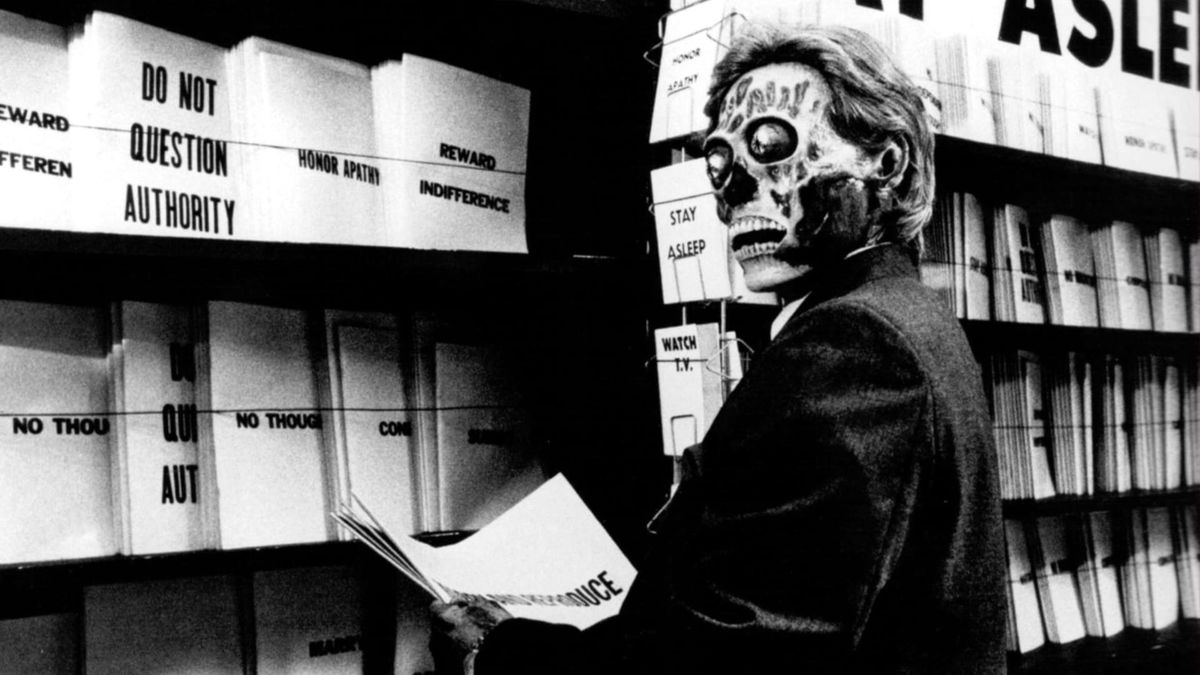
 

Since when have we Americans been expected to bow submissively to authority and speak with awe and reverence to those who represent us? The constitutional theory is that we the people are the sovereigns, the state and federal officials only our agents. We who have the final word can speak softly or angrily. We can seek to challenge and annoy, as we need not stay docile and quiet.”— Justice William O. Douglas

Unjust. Brutal. Criminal. Corrupt. Inept. Greedy. Power-hungry. Racist. Immoral. Murderous. Evil. Dishonest. Crooked. Excessive. Deceitful. Untrustworthy. Unreliable. Tyrannical.

These are all words that have at some time or other been used to describe the U.S. government.

These are all words that I have used at some time or other to describe the U.S. government. That I may feel morally compelled to call out the government for its wrongdoing does not make me any less of an American.

If I didn’t love this country, it would be easy to remain silent. However, it is because I love my country, because I believe fervently that if we lose freedom here, there will be no place to escape to, I will not remain silent.

Nor should you.

Nor should any other man, woman or child—no matter who they are, where they come from, what they look like, or what they believe.

This is the beauty of the dream-made-reality that is America. As Chelsea Manning recognized, “We’re citizens, not subjects. We have the right to criticize government without fear.

Indeed, the First Amendment does more than give us a right to criticize our country: it makes it a civic duty. Certainly, if there is one freedom among the many spelled out in the Bill of Rights that is especially patriotic, it is the right to criticize the government.

The right to speak out against government wrongdoing is the quintessential freedom.

Unfortunately, those who run the government don’t take kindly to individuals who speak truth to power. In fact, the government has become increasingly intolerant of speech that challenges its power, reveals its corruption, exposes its lies, and encourages the citizenry to push back against the government’s many injustices.

This is nothing new, nor is it unique to any particular presidential administration.

President Trump, who delights in exercising his right to speak (and tweet) freely about anything and everything that raises his ire, has shown himself to be far less tolerant of those with whom he disagrees, especially when they exercise their right to criticize the government.

In his first few years in office, Trump has declared the media to be “the enemy of the people,” suggested that protesting should be illegal, and that NFL players who kneel in protest during the national anthem “shouldn’t be in the country.” More recently, Trump lashed out at four Democratic members of Congress—all women of color— who have been particularly critical of his policies, suggesting that they “go back and help fix the totally broken and crime infested places from which they came.”

Fanning the flames of controversy, White House advisor Kellyanne Conway suggested that anyone who criticizes the country, disrespects the flag, and doesn’t support the Trump Administration’s policies should also leave the country.

The uproar over Trump’s “America—love it or leave it” remarks have largely focused on its racist overtones, but that misses the point: it’s un-American to be anti-free speech.

It’s unfortunate that Trump and his minions are so clueless about the Constitution. Then again, Trump is not alone in his presidential disregard for the rights of the citizenry, especially as it pertains to the right of the people to criticize those in power.

President Obama signed into law anti-protest legislation that makes it easier for the government to criminalize protest activities (10 years in prison for protesting anywhere in the vicinity of a Secret Service agent). The Obama Administration also waged a war on whistleblowers, which The Washington Post described as “the most aggressive I’ve seen since the Nixon administration,” and “spied on reporters by monitoring their phone records.”

Part of the Patriot Act signed into law by President George W. Bush made it a crime for an American citizen to engage in peaceful, lawful activity on behalf of any group designated by the government as a terrorist organization. Under this provision, even filing an amicus brief on behalf of an organization the government has labeled as terrorist would constitute breaking the law.

President Franklin D. Roosevelt authorized the FBI to censor all news and control communications in and out of the country in the wake of the attack on Pearl Harbor. Roosevelt also signed into law the Smith Act, which made it a crime to advocate by way of speech for the overthrow of the U.S. government by force or violence.

President Woodrow Wilson signed into law the Espionage and Sedition Acts, which made it illegal to criticize the government’s war efforts.

President Abraham Lincoln seized telegraph lines, censored mail and newspaper dispatches, and shut down members of the press who criticized his administration.

In 1798, during the presidency of John Adams, Congress passed the Alien and Sedition Acts, which made it a crime to “write, print, utter or publish … any false, scandalous, and malicious” statements against the government, Congress or president of the United States.

Clearly, the government has been undermining our free speech rights for quite a while now, but Trump’s antagonism towards free speech is much more overt.

For example, at a recent White House Social Media Summit, Trump defined free speech as follows: “To me free speech is not when you see something good and then you purposely write bad. To me that’s very dangerous speech, and you become angry at it. But that’s not free speech.”

Except Trump is about as wrong as one can be on this issue.

Good, bad or ugly, it’s all free speech unless as defined by the government it falls into one of the following categories: obscenity, fighting words, defamation (including libel and slander), child pornography, perjury, blackmail, incitement to imminent lawless action, true threats, and solicitations to commit crimes.

This idea of “dangerous” speech, on the other hand, is peculiarly authoritarian in nature. What it amounts to is speech that the government fears could challenge its chokehold on power.

The kinds of speech the government considers dangerous enough to red flag and subject to censorship, surveillance, investigation, prosecution and outright elimination include: hate speech, bullying speech, intolerant speech, conspiratorial speech, treasonous speech, threatening speech, incendiary speech, inflammatory speech, radical speech, anti-government speech, right-wing speech, left-wing speech, extremist speech, politically incorrect speech, etc.

Conduct your own experiment into the government’s tolerance of speech that challenges its authority, and see for yourself.

Stand on a street corner—or in a courtroom, at a city council meeting or on a university campus—and recite some of the rhetoric used by the likes of Thomas Jefferson, Patrick Henry, John Adams and Thomas Paine without referencing them as the authors.

For that matter, just try reciting the Declaration of Independence, which rejects tyranny, establishes Americans as sovereign beings, recognizes God (not the government) as the Supreme power, portrays the government as evil, and provides a detailed laundry list of abuses that are as relevant today as they were 240-plus years ago.

My guess is that you won’t last long before you get thrown out, shut up, threatened with arrest or at the very least accused of being a radical, a troublemaker, a sovereign citizen, a conspiratorialist or an extremist.

Try suggesting, as Thomas Jefferson and Benjamin Franklin did, that Americans should not only take up arms but be prepared to shed blood in order to protect their liberties, and you might find yourself placed on a terrorist watch list and vulnerable to being rounded up by government agents.

“What country can preserve its liberties if their rulers are not warned from time to time that their people preserve the spirit of resistance. Let them take arms,” declared Jefferson. He also concluded that “the tree of liberty must be refreshed from time to time with the blood of patriots and tyrants.” Observed Franklin: “Democracy is two wolves and a lamb voting on what to have for lunch. Liberty is a well-armed lamb contesting the vote!”

Better yet, try suggesting as Thomas Paine, Marquis De Lafayette, John Adams and Patrick Henry did that Americans should, if necessary, defend themselves against the government if it violates their rights, and you will be labeled a domestic extremist.

“It is the duty of the patriot to protect his country from its government,” insisted Paine. “When the government violates the people’s rights,” Lafayette warned, “insurrection is, for the people and for each portion of the people, the most sacred of the rights and the most indispensable of duties.” Adams cautioned, “A settled plan to deprive the people of all the benefits, blessings and ends of the contract, to subvert the fundamentals of the constitution, to deprive them of all share in making and executing laws, will justify a revolution.” And who could forget Patrick Henry with his ultimatum: “Give me liberty or give me death!”

Then again, perhaps you don’t need to test the limits of free speech for yourself.

One such test is playing out before our very eyes on the national stage led by none other than the American Police State’s self-appointed Censor-in-Chief, who seems to believe that only individuals who agree with the government are entitled to the protections of the First Amendment.

To the contrary, James Madison, the father of the Constitution, was very clear about the fact that the First Amendment was established to protect the minority against the majority.

I’ll take that one step further: the First Amendment was intended to protect the citizenry from the government’s tendency to censor, silence and control what people say and think.

Having lost our tolerance for free speech in its most provocative, irritating and offensive forms, the American people have become easy prey for a police state where only government speech is allowed. You see, the powers-that-be understand that if the government can control speech, it controls thought and, in turn, it can control the minds of the citizenry.

This is how freedom rises or falls.

As Hermann Goering, one of Hitler’s top military leaders, remarked during the Nuremberg trials:

It is always a simple matter to drag the people along, whether it is a democracy, or a fascist dictatorship, or a parliament, or a communist dictatorship. Voice or no voice, the people can always be brought to the bidding of the leaders. That is easy. All you have to do is to tell them they are being attacked, and denounce the pacifists for lack of patriotism and exposing the country to danger. It works the same in any country.

It is working the same in this country, as well.

Americans of all stripes would do well to remember that those who question the motives of government provide a necessary counterpoint to those who would blindly follow where politicians choose to lead.

We don’t have to agree with every criticism of the government, but we must defend the rights of allindividuals to speak freely without fear of punishment or threat of banishment.

Never forget: what the architects of the police state want are submissive, compliant, cooperative, obedient, meek citizens who don’t talk back, don’t challenge government authority, don’t speak out against government misconduct, and don’t step out of line.

What the First Amendment protects—and a healthy constitutional republic requires—are citizens who routinely exercise their right to speak truth to power.

As I point out in my book Battlefield America: The War on the American People, tolerance for dissent is vital if we are to survive as a free nation.

While there are all kinds of labels being put on so-called “unacceptable” speech today, the real message being conveyed by those in power is that Americans don’t have a right to express themselves if what they are saying is unpopular, controversial or at odds with what the government determines to be acceptable.

By suppressing free speech, the government is contributing to a growing underclass of Americans who are being told that they can’t take part in American public life unless they “fit in.”

Mind you, it won’t be long before anyone who believes in holding the government accountable to respecting our rights and abiding by the rule of law is labeled an “extremist,” is relegated to an underclass that doesn’t fit in, must be watched all the time, and is rounded up when the government deems it necessary.

It doesn’t matter how much money you make, what politics you subscribe to, or what God you worship: we are all potential suspects, terrorists and lawbreakers in the eyes of the government.

In other words, if and when this nation falls to tyranny, we will all suffer the same fate: we will fall together.

The stamping boot of tyranny is but one crashing foot away.

Source: https://bit.ly/32xFNXZ

ABOUT JOHN W. WHITEHEAD

Constitutional attorney and author John W. Whitehead is founder and president of The Rutherford Institute. His new book Battlefield America: The War on the American People  is available at www.amazon.com. Whitehead can be contacted at johnw@rutherford.org.

Publication Guidelines / Reprint Permission

John W. Whitehead’s weekly commentaries are available for publication to newspapers and web publications at no charge. Please contact staff@rutherford.org to obtain reprint permission.

 

“Jesus! Where will it end? How low do you have to stoop in this country to be President? … We’ve come to a point where every four years this national fever rises up — this hunger for the Saviour, the White Knight, the Man on Horseback — and whoever wins becomes so immensely powerful … that when you vote for President today you’re talking about giving a man dictatorial power for four years… The whole framework of the presidency is getting out of hand. It’s come to the point where you almost can’t run unless you can cause people to salivate and whip each other with big sticks. You almost have to be a rock star to get the kind of fever you need to survive in American politics.” —Hunter S. Thompson, gonzo journalist

Here’s the question I pose to you: has Donald Trump been a blessing or a curse to the architects of the American police state?

One thing is for sure: a year into his presidency, Trump hasn’t done much to improve the lot of the American people.

The predators of the police state are still wreaking havoc on our freedoms, our communities, and our lives. The government still doesn’t listen to the citizenry, it still refuses to abide by the Constitution, which is our rule of law, and it still treats the citizenry as a source of funding and little else. Police officers are still shooting unarmed citizens and their household pets. Government agents—including local police—are still being armed to the teeth and encouraged to act like soldiers on a battlefield. Bloated government agencies are still fleecing taxpayers. Government technicians are still spying on our emails and phone calls. Government contractors are still making a killing by waging endless wars abroad.

In other words, the American police state is still alive and well and flourishing.

Nothing has changed.

Rather than draining the corrupt swamps of Washington, as he repeatedly promised, Trump and his brand of reality TV politics have merely redirected our attention.

Trust me, the swamps are still stagnant with corruption.

Indeed, we are still the unwitting victims of a system so corrupt that those who stand up for the rule of law and aspire to transparency in government are in the minority. This corruption is so vast it spans all branches of government—from the power-hungry agencies under the executive branch and the corporate puppets within the legislative branch to a judiciary that is, more often than not, elitist and biased towards government entities and corporations.

We are still ruled by an elite class of individuals who are completely out of touch with the travails of the average American.

We are still viewed as relatively expendable in the eyes of government: faceless numbers of individuals who serve one purpose, which is to keep the government machine running through our labor and our tax dollars. Those in power aren’t losing any sleep over the indignities we are being made to suffer or the possible risks to our health. All they seem to care about are power and control.

We are still being made to suffer countless abuses at the government’s hands.

We still have little protection against standing armies (domestic and military), invasive surveillance, marauding SWAT teams, an overwhelming government arsenal of assault vehicles and firepower, and a barrage of laws that criminalize everything from vegetable gardens to lemonade stands.

In the name of national security, we’re still being subjected to government agencies such as the NSA, FBI and others listening in on our phone calls, reading our mail, monitoring our emails, and carrying out warrantless “black bag” searches of our homes. Adding to the abuse, we still have to deal with surveillance cameras mounted on street corners and in traffic lights, weather satellites co-opted for use as spy cameras from space, and thermal sensory imaging devices that can detect heat and movement through the walls of our homes. That doesn’t even begin to touch on the many ways in which our Fourth Amendment rights are still being trampled upon by militarized police and SWAT teams empowered to act as laws unto themselves.

In other words, despite Trump (or because of him), freedom—or what’s left of it—is still being threatened from every direction.

Trump has done nothing to wrest control of the government from the Deep State, that shadowy elite group of powerbrokers and corporations who call the shots in Washington.

Trump has done nothing to prevent the government from continuing to plunder and steal from the American taxpayer. In fact, his administration has paved the way for even more theft in the form of civil asset forfeiture.

Trump has failed to end the government’s endless wars. To the contrary, he has fallen in line with the military industrial complex.

Most of all, Trump has proven to be as deaf, dumb and blind as every president before him when it comes to the plight of the citizenry.

The new boss really is just the same as the old boss.

We’re still on the losing end of a tug-of-war over control of our country and our lives.

The Deep State is winning.

Get ready.

We’re just a few short years away from the dystopian future depicted in the film V for Vendetta, which is no future at all.

Written and produced by the Wachowskis, V for Vendetta (2005) provides a powerful visual commentary on how totalitarian governments such as our own exploit fear and use mass surveillance, censorship, terrorism, and militarized tactics to control, oppress and enslave.

The year is 2027 and the country is ruled by a totalitarian corporate state where concentration camps (jails, private prisons and detention facilities) have been established to house political prisoners and others deemed to be enemies of the state. Executions of undesirables (extremists, troublemakers and the like) are common, while other enemies of the state are made to “disappear.” The television networks are controlled by the government with the purpose of perpetuating the regime. And most of the population is hooked into an entertainment mode and are clueless.

Enter V, a vigilante in a Guy Fawkes mask, who rails against the people’s loss of freedom at the hands of a fascist government. Says V:

Where once you had the freedom to object, to think and speak as you saw fit, you now have censors and systems of surveillance coercing your conformity and soliciting your submission. How did this happen? Who’s to blame? Well certainly there are those more responsible than others, and they will be held accountable, but again truth be told, if you’re looking for the guilty, you need only look into a mirror. I know why you did it. I know you were afraid. Who wouldn’t be? War, terror, disease. There were a myriad of problems which conspired to corrupt your reason and rob you of your common sense. Fear got the best of you, and in your panic, you turned to the now high chancellor… He promised you order, he promised you peace, and all he demanded in return was your silent, obedient consent.

Sounds painfully familiar, doesn’t it?

We, too, have relinquished control over the most intimate aspects of our lives to government officials who, while they may occupy seats of authority, are neither wiser, smarter, more in tune with our needs, more knowledgeable about our problems, nor more aware of what is really in our best interests.

Yet having bought into the false notion that the government knows best and can ensure not only our safety but our happiness and will take care of us from cradle to grave, we have allowed ourselves to be bridled and turned into slaves at the bidding of a government that cares little for our freedoms or our happiness.

The lesson is this: once a free people allows the government to make inroads into their freedoms or uses those same freedoms as bargaining chips for security, it quickly becomes a slippery slope to outright tyranny.

As V remarks, “Since mankind’s dawn, a handful of oppressors have accepted the responsibility over our lives that we should have accepted for ourselves. By doing so, they took our power. By doing nothing, we gave it away. We’ve seen where their way leads, through camps and wars, towards the slaughterhouse.”

In other words, it makes no difference whether it’s a Democrat or a Republican at the helm, because the bureaucratic mindset on both sides of the aisle now embodies the same philosophy of authoritarian government, whose priority is to remain in power.

When our own government no longer sees us as human beings with dignity and worth but as things to be manipulated, maneuvered, mined for data, manhandled by police, conned into believing it has our best interests at heart, mistreated, and then jails us if we dare step out of line, punishes us unjustly without remorse, and refuses to own up to its failings, we are no longer operating under a constitutional republic.

Instead, what we are experiencing is a pathocracy: tyranny at the hands of a psychopathic government.

So where does that leave us?

In V for Vendetta, it takes a desperate act of terrorism (V blows up the seat of government on the fifth of November) for the people to finally mobilize and stand up to the government’s tyranny.

This is what happens when a parasitical government muzzles the citizenry, fences them in, herds them, brands them, whips them into submission, forces them to ante up the sweat of their brows while giving them little in return, and then provides them with little to no outlet for voicing their discontent: people get desperate, citizens lose hope, and lawful, nonviolent resistance gives way to unlawful, violent resistance.

As John F. Kennedy warned, “Those who make peaceful revolution impossible will make violent revolution inevitable.”

Do not wait to act until there is no alternative but violence.

As director James McTeighe observed about the tyrannical regime in V for Vendetta, “It really showed what can happen when society is ruled by government, rather than the government being run as a voice of the people. I don’t think it’s such a big leap to say things like that can happen when leaders stop listening to the people.”

What will it take for the government to start listening to the people again?

We’ve got to make them hear us using every nonviolent means available to us: picket, protest, march, boycott, speak up, sound off and reclaim control over the narrative about what is really going on in this country.

Mind you, the government doesn’t want to hear us. It doesn’t even want us to speak. In fact, it’s done a diabolically good job of establishing roadblocks to prevent us from exercising our First Amendment right to speech and assembly and protest.

Still we must persist.

As author Erich Fromm warned in his book On Disobedience and Other Essays, “At this point in history, the capacity to doubt, to criticize and to disobey may be all that stands between a future for mankind and the end of civilization.”

In other words, stop worshipping false idols. Stop waiting for Trump to drain the swamps, or some whistleblower to topple the tyrants, or some other political savior to swoop in and fix all that’s wrong with this country. Stop allowing yourselves to be drawn into divisive party politics. Stop thinking of yourselves as members of a particular political party, as opposed to citizens of the United States. Most of all, stop looking away from the injustices and cruelties and endless acts of tyranny that have become hallmarks of American police state.

As war journalist Chris Hedges concluded, “Not having to make moral choice frees you from a great deal of anxiety. It frees you from responsibility. And it assures that you will always be wrapped in the embrace of the powerful as long as, of course, you will do or dance to the tune the powers play… when you do what is right, you often have to understand that you are not going to be lauded and praised for it. Making a moral decision always entails risks, certainly to one’s career and to one’s standing in the community.”

Remember, remember the fifth of November.

Why should we remember the fifth of November?

Because it commemorates a day in history when a desperate vigilante tried to bring about a violent revolution.

Trust me, no one wants a violent revolution.

Americans speak reverently of how our founders mounted a revolution to secure our freedoms, but our platitudes gloss over the terrible toll it demanded of them: families torn apart, lives lost and years of misery and hardship.

As I make clear in my book Battlefield America: The War on the American People, the moral choice before us is clear: it is the choice between tyranny and freedom, dictatorship and autonomy, peaceful slavery and dangerous freedom, and manufactured pipedreams of what America used to be versus the gritty reality of what she is today.

WC: 2163

ABOUT JOHN W. WHITEHEAD

Constitutional attorney and author John W. Whitehead is founder and president of The Rutherford Institute. His new book Battlefield America: The War on the American People (SelectBooks, 2015) is available online at http://www.amazon.com. Whitehead can be contacted at johnw@rutherford.org.

PUBLICATION GUIDELINES / REPRINT PERMISSION

John W. Whitehead’s weekly commentaries are available for publication to newspapers and web publications at no charge. Please contact staff@rutherford.org to obtain reprint permission.