Posts Tagged ‘police state’

“We’re gonna win so much, you may even get tired of winning. And you’ll say, ‘Please, please. It’s too much winning. We can’t take it anymore. Mr. President, it’s too much.’”—Donald Trump

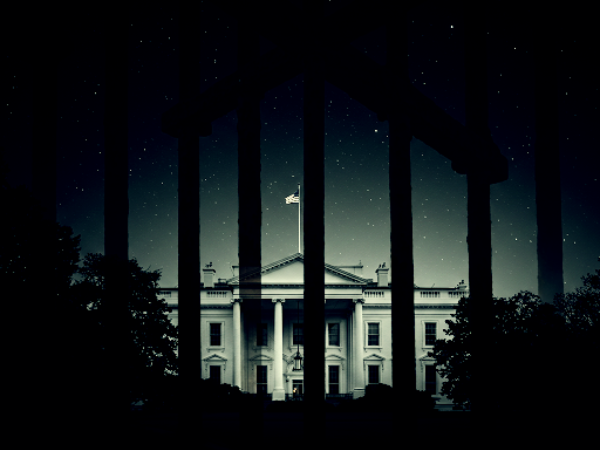
Almost one month into the Trump presidency, and the Constitution and the entire section on the various branches of government and how they work together are still missing from the White House website.

This is no small thing.

This omission, deliberate or inadvertent, speaks volumes about the priorities of this current administration. It also explains a lot about the legal mindset that is driving the Trump train, which continues to push forward with a theory of unitary executive power.

You know what is not driving the Trump government? Any sense that it is bound by the rule of law, i.e, the U.S. Constitution. As Trump recently declared, “He who saves his Country does not violate any Law.

Then again, Trump has never made any pretense of his aspirations to rule as a strongman. As the Washington Post reports:

In 2017, he claimed “an absolute right to do what I want with the Justice Department.” In 2019, he claimed that Article II of the Constitution gave him “the right to do whatever I want as president.” In 2020, he said he could override state and local public health orders related to the coronavirus pandemic by saying: “When somebody is the president of the United States, the authority is total. And that’s the way it’s got to be. It’s total.” In 2022, he said that purported voter fraud in the 2020 election “allows for the termination of all rules, regulations, and articles, even those found in the Constitution.” In 2023, he mused that he would be a dictator, but only on Day One of his presidency. And a year ago, he argued that presidents should have total immunity from criminal prosecution, even for “EVENTS THAT ‘CROSS THE LINE.’ ”

Listen, when someone shows you who they are, believe them.

Then again, maybe the majority of Americans just don’t care about the Constitution anymore.

Maybe, as journalist Zeynep Tufekci suggests, Americans want an authoritarian leader who embraces an “ends-justify-the-means leadership style.”

Maybe all they care about are the “endless wins” that the Trump administration never ceases to claim for itself, but if we’re being brutally honest about the state of the country, “we the people” are on a solid losing streak.

While the team colors and the police state’s outward allegiances may have changed, from a constitutional perspective, we’re still losing in all the ways that matter, and the Deep State is still winning.

Indeed, far from protecting our freedoms, the Trump administration is taking the Deep State’s unconstitutional disregard for civil liberties to new extremes.

When you step away from the polarizing rhetoric and government spin long enough to look at the many ways in which the American police state is continuing to lockdown our freedoms, you’ll notice that not much has changed for the better.

Has the Trump administration put an end to the police state’s use of surveillance on the American people? Has it scaled back the deployment of military forces domestically in violation of Posse Comitatus? Has it ceased the government’s war on cash? Has it stepped back from the NDAA’s threat of indefinite detentions? Has it de-militarized the police? Has it kicked the oligarchs out of the government’s inner circle? Has it been transparent and accountable in all of its dealings?

The answer to all of those questions is a resounding “no.”

Rather than minimizing the power of the police state, the Trump administration appears to be doubling down on its commitment to police state tactics of fear, intimidation and brutality.

Consider for yourselves.

Free speech is still being undermined. The First Amendment prohibits the government from suppressing free speech activities by the public, the media, protesters, religious individuals, or by restricting the right of the people to assemble and associate with one another, yet we no longer have any real freedom of speech. We are moving fast down a slippery slope to an authoritarian society in which the only opinions, ideas and speech expressed are the ones permitted by the government and its corporate cohorts. In more and more cases, the government is declaring war on what should be protected political speech whenever it challenges the government’s power, reveals the government’s corruption, exposes the government’s lies, and encourages the citizenry to push back against the government’s many injustices. The ramifications are so far-reaching as to render almost every American who criticizes the government an extremist in word, deed, thought or by association. Although President Trump issued an executive order denouncing government censorship, primarily for speech with which he agrees, his administration has ostensibly engaged in a campaign of intimidation and coercion against news organizations that dare to disagree with or criticize his administration, as well as whistleblowers. Likewise, under the guise of fighting politically correct DEI (diversity, equity and inclusion) policies and cancel culture, the Trump administration is engaging in its own campaign to cancel out expressive activities and content of which it disapproves, including anti-war protests.

We’re still being subjected to expansive surveillance. All of the monitoring tools and weapons in the government’s surveillance arsenal that are being used to identify, track and target those on the Trump’s administration’s enemies list—facial recognition, biometrics, license plate readers, fusion centers, cell phone location tracking, etc.—can and will be used against the American people. AI surveillance harnesses the power of artificial intelligence and widespread surveillance technology to do what the police state lacks the manpower and resources to do efficiently or effectively: be everywhere, watch everyone and everything, monitor, identify, catalogue, cross-check, cross-reference, and collude. Everything that was once private is now up for grabs to the right buyer. With every new AI surveillance technology that is adopted and deployed without any regard for privacy, Fourth Amendment rights and due process, the rights of the citizenry are being marginalized, undermined and eviscerated.

The government’s police powers are still being weaponized. With Trump claiming the power to target anyone or any group he perceives as a “threat,” i.e., an “enemy from within,” anyone who disagrees with the government could be placed on a government watch list. Having transformed local law enforcement into extensions of the military, the Department of Homeland Security, the Justice Department and the FBI are turning the nation’s police officers into techno-warriors, complete with iris scanners, body scanners, thermal imaging Doppler radar devices, facial recognition programs, license plate readers, cell phone extraction software, Stingray devices and so much more.

Government whistleblowers are still being persecuted. While claiming to be rooting out inefficiency, the Trump administration has been methodically dismantling all of the agencies charged with acting as nonpartisan watchdogs of government corruption.

Americans are still being treated as suspects. The groundwork has been laid for a new kind of government where it won’t matter if you’re innocent or guilty, whether you’re a threat to the nation, or even if you’re a citizen. What will matter is what the government—or whoever happens to be calling the shots at the time—thinks. And if the powers-that-be think you’re a threat to the nation and should be locked up, then you’ll be locked up with no access to the protections our Constitution provides. Having launched a precrime program during his first administration, the Trump administration would have no qualms about using AI predictive and surveillance technologies to classify, segregate and flag the populace.

We’re still unofficially under martial law. We have what the founders feared most: a “standing” or permanent army on American soil. This de facto standing army is made up of weaponized, militarized domestic police forces which look like, dress like, and act like the military; are armed with guns, ammunition and military-style equipment; are authorized to make arrests; and are trained in military tactics. With Trump having pledged to deploy the military domestically to work in conjunction with local police to address domestic threats, including political enemies, dissenters and immigrants, the American homeland is increasingly being transformed into a battlefield.

We’re still being flagged based on our viewpoints, activities and associations. The government has a growing list—shared with fusion centers and law enforcement agencies—of ideologies, behaviors, affiliations and other characteristics that could flag someone as suspicious and result in their being labeled potential enemies of the state. Before long, every household in America will be flagged as a threat and assigned a threat score. It’s just a matter of time before you find yourself wrongly accused, investigated and confronted by police based on a data-driven algorithm or risk assessment culled together by a computer program run by artificial intelligence.

Police shootings of unarmed citizens will continue. In the wake of Trump’s decision to reverse and revoke many of the policies intended to implement police reform and discourage police misconduct and stem the time of police brutality, we can expect the use of excessive force by police to continue unabated.

We still don’t have a government of the people, by the people and for the people. In fact, a study conducted by Princeton and Northwestern University concluded that the U.S. government does not represent the majority of American citizens. Instead, the study found that the government is ruled by the rich and powerful, or the so-called “economic elite.” Moreover, the researchers concluded that policies enacted by this governmental elite nearly always favor special interests and lobbying groups. In other words, we are being ruled by an oligarchy disguised as a democracy, and arguably on our way towards fascism—a form of government where private corporate interests rule, money calls the shots, and the people are seen as mere subjects to be controlled.

We still have an imperial president. Although President Trump has made no secret of his authoritarian impulses, he is not the first president to rule by fiat through the use of executive orders, decrees, memorandums, proclamations, national security directives and legislative signing statements. These unchecked powers enable all sitting president to operate above the law and beyond the reach of the Constitution.

In other words, the seeds of chaos are still being sown, and it’s the U.S. government that will reap the harvest.

My friends, if this is winning, I can’t imagine what losing will look like, but it won’t be pretty.

All of this dismantling of government agencies, weakening of the economy, and fomenting of civil unrest feeds right back into the Deep State’s plot to destabilize the nation.

Remember that Pentagon training video created by the Army for U.S. Special Operations Command which anticipated that all hell would break loose by 2030?

That’s barely five short years away now, but we’re being moved steadily in that direction.

According to “Megacities: Urban Future, the Emerging Complexity,” the U.S. military plans to use armed forces to solve future domestic political and social problems. What they’re really talking about is martial law, packaged as a well-meaning and overriding concern for the nation’s security.

The training video is only five minutes long, but it says a lot about the government’s mindset, the way its views the citizenry, and the so-called “problems” that the government must be prepared to address in the near future through the use of martial law.

Even more troubling, however, is what this military video doesn’t say about the Constitution, about the rights of the citizenry, and about the dangers of locking down the nation and using the military to address political and social problems.

Be warned: in the future envisioned by the government, we will not be viewed as Republicans or Democrats. Rather, “we the people” will be enemies of the state.

For years, the government has been warning against the dangers of domestic terrorism, erecting surveillance systems to monitor its own citizens, creating classification systems to label any viewpoints that challenge the status quo as extremist, and training law enforcement agencies to equate anyone possessing anti-government views as a domestic terrorist.

What the government failed to explain was that the domestic terrorists would be of the government’s own making, and that “we the people” would become enemy #1.

We’re already enemies of the state.

You want to bring about real change? Start by wresting back control of our government from the oligarchs, technocrats and Deep State operatives who are still running the show.

Reject the propaganda and the polarizing rhetoric and the “us vs. them” tactics that reduce the mass power of the populace to warring, powerless factions.

Find common ground with your fellow citizens and push back against the government’s brutality, inhumanity, greed, corruption and power grabs.

Be dangerous in the best way possible: by thinking for yourself, by refusing to be silenced, by choosing sensible solutions over political expediency and bureaucracy.

As I make clear in my book Battlefield America: The War on the American People and in its fictional counterpart The Erik Blair Diaries, the solution to what ails this country is really not that complicated: decency, compassion, common sense, generosity balanced by fiscal responsibility, fairness, a commitment to freedom principles, and a firm rejection of the craven, partisan politics of the Beltway elites who have laid the groundwork for the Deep State’s ongoing authoritarian coup d’etat.

Source: https://tinyurl.com/4bpah8sw

ABOUT JOHN W. WHITEHEAD

Constitutional attorney and author John W. Whitehead is founder and president of The Rutherford Institute. His most recent books are the best-selling Battlefield America: The War on the American People, the award-winning A Government of Wolves: The Emerging American Police State, and a debut dystopian fiction novel, The Erik Blair Diaries. Whitehead can be contacted at staff@rutherford.org. Nisha Whitehead is the Executive Director of The Rutherford Institute. Information about The Rutherford Institute is available at www.rutherford.org.

Publication Guidelines / Reprint Permission

John W. Whitehead’s weekly commentaries are available for publication to newspapers and web publications at no charge.

“Never has our future been more unpredictable, never have we depended so much on political forces that cannot be trusted to follow the rules of common sense and self-interest — forces that look like sheer insanity, if judged by the standards of other centuries.”—Hannah Arendt, The Origins of Totalitarianism

This has all the makings of a constitutional crisis.

According to law professor Amanda Frost, “a constitutional crisis occurs when one branch of government, usually the executive, ‘blatantly, flagrantly and regularly exceeds its constitutional authority — and the other branches are either unable or unwilling to stop it.’”

Consider for yourself.

The president has gone rogue, doubling down on his belief that “I have the right to do whatever I want as president.”

The vice president believes the president should be a law unto himself, i.e., unaccountable to the other branches of the government.

The Republican-controlled Congress appears to be deaf, dumb and blind to the Executive Branch’s blatantly unconstitutional overreaches.

The courts, which have in recent years largely rubberstamped the government’s power grabs, are ill-prepared to rein in a sitting president who is determined to do whatever he wants, the Constitution be damned.

In fact, the U.S. Supreme Court preemptively gave future presidents the green light to engage in all manner of criminal activities when it ruled 6-3 that presidents have absolute immunity from prosecution, provided the lawbreaking is related to their official duties.

Meanwhile, the Constitution is still missing from the White House’s website.

This last point is not an oversight.

Rather, it speaks volumes about the priorities of the current presidential administration, which operates as if the rule of law does not apply to itself.

Indeed, while President Trump’s predecessors paid lip service to the rule of law while sidestepping it at every opportunity, Trump has been unapologetic about his intentions to set aside whatever legal, moral or political barricades stand in the way of his end goals.

Rule by fiat—when presidents attempt to unilaterally impose their will through the use of executive orders, decrees, memorandums, proclamations, national security directives and legislative signing statements—is an offense to the Constitution.

It was offensive when Biden did it. It was offensive when Obama did it. And it is just as offensive when Trump does it.

Already, Trump has signed more executive orders in his first month than any other president in their first 100 days.

This is not a sign of strength and leadership. This is a red flag.

In bypassing Congress in order to carry out his ambitious agenda to “make America safe again,” “make America affordable and energy dominant again,” “drain the swamp,” and “bring back American values,” the Trump Administration risks transforming the executive branch into something akin to the very entities it often criticizes: an overreaching surveillance state, a nanny state that dictates individual choices, and a police state that prioritizes compliance over freedom.

It is particularly telling that while Trump and his Musk-led Department of Government Efficiency (DOGE) are pledging to lay off huge swaths of federal employees and replace the workforce with artificial intelligence, the police state’s martial law apparatus will remain largely untouched.

This is how you prepare to lock down a nation.

This danger transcends party lines and tests the resilience of our constitutional framework. 

How far will “we the people” allow the Executive Branch to continue to expand its power at the expense of established legal principles and the rule of law?

As much as past occupants of the White House and Congress would like us to believe otherwise, winning an election is not a populist mandate for one-party rule.

This way lies totalitarianism, by way of authoritarianism, and those who insist it can’t happen here need to pay better attention.

It’s happening already.

The following are 15 benchmarks of a totalitarian regime, according to Benjamin Carlson, a former editor at The Atlantic.  

  1. Media is controlled.
  2. Dissent is equated to violence.
  3. Legal system is co-opted by the state.
  4. Power is exerted to prevent dissent.
  5. State police are directed to protect the regime, not the people.
  6. Financial, legal, and civil rights are contingent on compliance.
  7. There is a mass conformity of behaviors and beliefs.
  8. Power is concentrated in an inner ring of people and institutions.
  9. Semi-organized violence is permitted.
  10. Propaganda targets enemies of the state.
  11. Whole classes of people are scapegoated and singled out for persecution.
  12. Extra-legal action against internal enemies is condoned.
  13. Unpredictable and harsh enforcement is used against unfavored classes.
  14. The language of the constitution serves as a facade for the exercise of power.
  15. And all private and public levers of power are used to enforce adherence to state orthodoxy.

To guard against these pitfalls, we must start by understanding the rule of law, and how it functions within our system of checks and balances.

The rule of law is the principle that everyone, including the government—and the president—must obey the law, which is embodied in the U.S. Constitution.

In a nutshell, the Constitution is the social contract—the people’s contract with the government—which outlines our expectations about the role of the government and its limits, a system of checks and balances dependent on a separation of powers, and the rights of the citizenry.

America’s founders established a system of checks and balances to prevent the concentration of power in any single branch. To this end, the Constitution establishes three separate but equal branches of government: the legislative branch, which makes the law; the executive branch, which enforces the law; and the judicial branch, which interprets the law.

As constitutional scholar Linda Monk explains, “Within the separation of powers, each of the three branches of government has ‘checks and balances’ over the other two. For instance, Congress makes the laws, but the President can veto them, and the Supreme Court can declare them unconstitutional. The President enforces the law, but Congress must approve executive appointments and the Supreme Court rules whether executive action is constitutional. The Supreme Court can strike down actions by both the legislative and executive branches, but the President nominates Supreme Court justices, and the Senate confirms or denies their nominations.”

Despite Trump’s attempts to rule by fiat, nowhere in the Constitution is the president granted unilateral authority to act outside these established checks and balances, no matter how well-meaning his intentions might be or how worthy the goals (a balanced budget, safety, economic prosperity, etc.).

Writing for The Washington Post, Alan Charles Raul, general counsel of the Office of Management and Budget under Presidents Reagan and George H.W. Bush, warns that not only is Trump acting extra-constitutionally, i.e., beyond the scope of the Constitution, but he lays out the case for why DOGE itself is unconstitutional:

“The protocols of the Constitution do not permit statutorily mandated agencies and programs to be transformed — or reorganized out of existence — without congressional authorization… The radical reorganization now underway is not just footfaulting over procedural lines; it is shattering the fundamental checks and balances of our constitutional order. The DOGE process, if that is what it is, mocks two basic tenets of our government: that we are nation of laws, not men and that it is Congress which controls spending and passes legislation. The president must faithfully execute Congress’s laws and manage the executive agencies consistent with the Constitution and lawmakers’ appropriations — not by any divine right or absolute power… [T]here is no reading of the Constitution that allows any president to claim that a political mandate, or a political promise made, obviates or supersedes the role for Congress… Even under the most aggressive view of the president’s ‘unitary executive’ control over the entire executive branch and independent agencies, it is Congress’s sole authority to appropriate and legislate for our entire government… [I]n the end, the president is constitutionally stuck with the policies for the federal government that Congress enacts and appropriates. No one man in America is the law — not even a Trump or an Elon Musk.

Allowing the president to bypass established legal procedures in order to prioritize his own power over adherence to the rule of law ultimately undermines the principles of a constitutional government.

Which brings us to the present moment.

With Congress on the sidelines, the momentum is building for a constitutional showdown between the White House and the judiciary.

This is as it should be.

The job of the courts is to maintain the rule of law and serve as the referees in the power struggle between the President and Congress. That delicate balance between the three branches of government was intended to serve as a bulwark against tyranny and a deterrent to any who would overreach.

So for anyone, especially someone who has sworn to uphold and defend the Constitution, to suggest that “judges aren’t allowed to control the executive’s legitimate power” constitutes either an appalling admission of civic illiteracy or a bold-faced attempt to sidestep accountability.

When all is said and done, however, it is supposed to be “we the people” who hold the real power—not the president, not Congress, and not the courts. As the Tenth Amendment proclaims, “The powers not delegated to the United States by the Constitution, nor prohibited by it to the States, are reserved to the States respectively, or to the people.”

The government’s purpose is to serve the people, not the other way around.

Those first three words of the preamble to the Constitution say it all:

“We the People of the United States, in Order to form a more perfect Union, establish Justice, insure domestic Tranquility, provide for the common defense, promote the general Welfare, and secure the Blessings of Liberty to ourselves and our Posterity, do ordain and establish this Constitution for the United States of America.”

This is a government of the people, by the people and for the people.

This is not a monarchy with an imperial ruler. It is not a theocracy with a religious order. It is not a banana republic policed by a junta. It is not a crime syndicate with a mob boss. Nor is it a democracy with mob rule.

So, what’s the answer?

As I point out in my book Battlefield America: The War on the American People and in its fictional counterpart The Erik Blair Diaries, America’s founders were very clear about what to do when the government oversteps.

Bind them down from mischief with the chains of the Constitution, advised Thomas Jefferson.

Take alarm at the first experiment on your freedoms, cautioned James Madison.

And if government leaders attempt to abuse their powers and usurp the rights of the people, get rid of them, warned the Declaration of Independence.

Source: https://tinyurl.com/bdcr9f54

ABOUT JOHN W. WHITEHEAD

Constitutional attorney and author John W. Whitehead is founder and president of The Rutherford Institute. His most recent books are the best-selling Battlefield America: The War on the American People, the award-winning A Government of Wolves: The Emerging American Police State, and a debut dystopian fiction novel, The Erik Blair Diaries. Whitehead can be contacted at staff@rutherford.org. Nisha Whitehead is the Executive Director of The Rutherford Institute. Information about The Rutherford Institute is available at www.rutherford.org.

Publication Guidelines / Reprint Permission

John W. Whitehead’s weekly commentaries are available for publication to newspapers and web publications at no charge. 

This is what militaries do during coups: you capture the major targets, with government buildings high on the list, and you take over communications and other systems.”—Ruth Ben-Ghiat, historian on fascism and authoritarian leaders

How something is done is just as important as why something is done.

To suggest that the ends justify the means is to launch oneself down a moral, ethical and legal rabbit hole that leaves us in a totalitarian bind.

We are already halfway down that road.

Whatever the justifications for discarding, even temporarily, the constitutional framework and protocols that have long served as the foundations for our republic (national security, an economic crisis, terrorists at the border, a global pandemic, etc.), none of them are worth the price we are being asked to pay—the rule of law—for what is amounting to a hostile takeover of the U.S. government by an oligarchic elite.

This is no longer a conversation about stolen elections, insurrections, or even the Deep State.

This has become a lesson in how quickly things can fall apart.

This is what all those years of partisan double standards and constitutional undermining and legislative sell-outs and judicial betrayals add up to: a coup by oligarchic forces intent on a hostile takeover.

The government’s past efforts to sidestep the rule of law pale in comparison to what is unfolding right now, which is nothing less than the complete dismantling of every last foundational principle for a representative government that answers to “we the people.”

This shock-and-awe blitz campaign of daily seizures, raids and overreaching executive orders is a deliberate attempt to keep us distracted and diverted while the government is remade in the image of an autocracy, one in which privacy, due process, the rule of law, free speech, and equality will all be contingent on whether you are worthy of the privilege of rights.

I have long insisted on the need to recalibrate the government, but this is not how one goes about it.

The issue is not whether the actions being taken by the Trump Administration are right or wrong—although there are many that are egregiously wrong and some that are long overdue—but whether the Executive Branch has the power to unilaterally override the Constitution.

If we allow this imperial coup to move forward without pushback or protest, we will be just as culpable as those signing the death warrant for our freedoms.

Power corrupts.

And absolute power corrupts absolutely.

However, it takes a culture of entitlement and a nation of compliant, willfully ignorant, politically divided citizens to provide the foundations of tyranny.

For too long now, America has played politics with its principles and allowed the president and his colleagues to act in violation of the rule of law.

“We the people” are paying the price for it now.

Since the early days of our republic, we have operated under the principle that no one is above the law.

As Thomas Paine observed in Common Sense, “In America, the law is king. For as in absolute governments the King is law, so in free countries the law ought to be king; and there ought to be no other.”

Several years later, John Adams, seeking to reinforce this important principle, declared in the Massachusetts Constitution that they were seeking to establish “a government of laws and not of men.”

The history of our nation over the past 200-plus years has been the history of a people engaged in a constant struggle to maintain that tenuous balance between the rule of law—in our case, the United States Constitution—and the government leaders entrusted with protecting it, upholding it and abiding by it.

At various junctures, when that necessary balance has been thrown off by overreaching government bodies or overly ambitious individuals, we have found ourselves faced with a crisis of constitutional proportions.

Each time, we have taken the painful steps needed to restore our constitutional equilibrium.

That was then, this is now, and for too long now, we have failed to recognize and rectify the danger in allowing a single individual to declare himself the exception to the rule of law and assume the role of judge, jury, and executioner.

For all intents and purposes, we have become a nation ruled not by laws but by men, and fallible, imperfect men, at that.

We allowed Bush to overstep. We allowed Obama to overstep. We allowed Trump to overstep. We allowed Biden to overstep.

These power grabs by the Trump Administration, aided and abetted by Elon Musk, are more than an overstep, however.

All of us are in danger.

Those cheering the erection of migrant camps at Guantanamo, take heed: you could be next.

It’s no longer a question of whether the government will lock up Americans for defying its mandates but when.

Partisan politics have no place in what is unfolding now.

This is what we know: the government has the means, the muscle and the motivation to detain individuals who resist its orders and do not comply with its mandates in a vast array of prisons, detention centers, and concentration camps paid for with taxpayer dollars.

It’s just a matter of time.

It no longer matters what the hot-button issue might be (vaccine mandates, immigration, gun rights, abortion, same-sex marriage, healthcare, criticizing the government, protesting election results, etc.) or which party is wielding its power like a hammer.

The groundwork has already been laid.

Under the indefinite detention provision of the National Defense Authorization Act (NDAA), the President and the military can detain and imprison American citizens with no access to friends, family or the courts if the government believes them to be a terrorist.

So, it should come as no surprise that merely criticizing the government could get you labeled as a terrorist.

After all, it doesn’t take much to be considered a terrorist anymore, especially given that the government likes to use the words “anti-government,” “extremist” and “terrorist” interchangeably.

This is what happens when you not only put the power to determine who is a potential danger in the hands of government agencies, the courts and the police but also give those agencies liberal authority to lock individuals up for perceived wrongs.

It’s a system just begging to be abused by power-hungry bureaucrats desperate to retain their power at all costs.

It’s happened before.

As history shows, the U.S. government is not averse to locking up its own citizens for its own purposes.

One need only go back to the 1940s, when the federal government proclaimed that Japanese-Americans, labeled potential dissidents, could be put in concentration (a.k.a. internment) camps based only upon their ethnic origin, to see the lengths the federal government will go to in order to maintain “order” in the homeland.

The U.S. Supreme Court validated the detention program in Korematsu v. US (1944), concluding that the government’s need to ensure the safety of the country trumped personal liberties.

Although that Korematsu decision was never formally overturned, Chief Justice Roberts opined in Trump v. Hawaii (2018) that “the forcible relocation of U. S. citizens to concentration camps, solely and explicitly on the basis of race, is objectively unlawful and outside the scope of Presidential authority.”

Roberts’ statements provide little assurance of safety in light of the government’s tendency to sidestep the rule of law when it suits its purposes. Pointing out that such blatantly illegal detentions could happen again—with the blessing of the courts—Justice Scalia once warned, “In times of war, the laws fall silent.”

We seem to be coming full circle on many fronts.

Consider that two decades ago we were debating whether non-citizens—for example, so-called enemy combatants being held at Guantanamo Bay and Muslim-Americans rounded up in the wake of 9/11—were entitled to protections under the Constitution, specifically as they relate to indefinite detention.

Americans weren’t overly concerned about the rights of non-citizens then, nor do they seem all that concerned now. And yet in the near future we could well be the ones in the unenviable position of being targeted for indefinite detention by our own government.

Similarly, most Americans weren’t unduly concerned when the U.S. Supreme Court gave Arizona police officers the green light to stop, search and question anyone—ostensibly those fitting a particular racial profile—they suspect might be an illegal immigrant. More than a decade later, the cops largely have carte blanche authority to stop any individual, citizen and non-citizen alike, they suspect might be doing something illegal.

As I point out in my book Battlefield America: The War on the American People and in its fictional counterpart The Erik Blair Diaries, it will only be a matter of time before those brainwashed into believing that they have nothing to worry about learn the hard way that in a police state, it doesn’t matter who you are or how righteous you claim to be, because eventually, you will be lumped in with everyone else and everything you do will be “wrong” and suspect.

Martin Niemöller learned that particular lesson the hard way.

A German military officer turned theologian, Niemöller was an early supporter of Hitler’s rise to power. It was only when Hitler threatened to attack the churches that Niemöller openly opposed the regime. For his efforts, Niemöller was arrested, charged with activities against the government, fined, detained, and eventually interned in the Sachsenhausen and Dachau concentration camps from 1938 to 1945.

As Niemöller reportedly replied when asked by his cellmate why he ever supported the Nazi party:

“I find myself wondering about that too. I wonder about it as much as I regret it. Still, it is true that Hitler betrayed me… Hitler promised me on his word of honor, to protect the Church, and not to issue any anti-Church laws. He also agreed not to allow pogroms against the Jews… Hitler’s assurance satisfied me at the time…I am paying for that mistake now; and not me alone, but thousands of other persons like me.”

Source: https://tinyurl.com/mcta3fj3

ABOUT JOHN W. WHITEHEAD

Constitutional attorney and author John W. Whitehead is founder and president of The Rutherford Institute. His most recent books are the best-selling Battlefield America: The War on the American People, the award-winning A Government of Wolves: The Emerging American Police State, and a debut dystopian fiction novel, The Erik Blair Diaries. Whitehead can be contacted at staff@rutherford.org. Nisha Whitehead is the Executive Director of The Rutherford Institute. Information about The Rutherford Institute is available at www.rutherford.org.

Publication Guidelines / Reprint Permission

John W. Whitehead’s weekly commentaries are available for publication to newspapers and web publications at no charge. 
WASHINGTON, DC — Should police be made to answer for their reckless actions leading to use of deadly force against unarmed citizens? That’s what the U.S. Supreme Court must decide.

Even as the Trump administration scales back oversight into police misconduct, it appears that the U.S. Supreme Court may be open to overturning the “moment-of-threat doctrine,” which has contributed to a climate where police unnecessarily escalate situations over relatively minor crimes and then respond to the perceived danger with excessive or deadly force. For instance, an Illinois sheriff’s deputy shot and killed Sonya Massey in her home after the deputy terrified her to seek cover by unnecessarily drawing his gun and then placed himself in close proximity to where he claimed she might throw hot water on him. In Ohio, pregnant mother Ta’Kiya Young was killed by a police officer who chose to place himself in front of her car as she slowly pulled out of her parking space. And in Arizona, police officers repeatedly punched and tasered Tyron McAlpin, who is deaf and has cerebral palsy, due to his startled response when the officers suddenly jumped out of their car at him. Weighing in on Barnes v. Felix, The Rutherford Institute warned that the “moment-of-threat doctrine” not only violates established Fourth Amendment principles for determining what constitutes a reasonable use of force, but it also encourages police to act recklessly with impunity

“In an age when police are increasingly militarized, weaponized and protected by the courts, run-of-the mill encounters between police and citizens are now inherently dangerous for any individual unlucky enough to be in a situation where police are inclined to respond to perceived challenges to their ‘authority’ by drawing and using their weapons,” said constitutional attorney John W. Whitehead, president of The Rutherford Institute and author of Battlefield America: The War on the American People. “Unfortunately, this mindset that any challenge to police authority is a threat that needs to be ‘neutralized’ is a dangerous one that is part of a greater nationwide trend that sets law enforcement officers beyond the reach of the Fourth Amendment.”

In the afternoon of April 28, 2016, a Harris County Texas police officer initiated a traffic stop of Ashtian Barnes due to a report by the Toll Road Authority that the license plate number on his vehicle had outstanding toll violations. When asked for proof of insurance, Barnes explained that the car had been rented a week earlier by his girlfriend and the documentation might be in the trunk. The officer claimed he smelled marijuana and ordered Barnes to open the trunk. A few seconds after Barnes opened the trunk, the car’s blinker toward the side of the Tollway to which Barnes pulled over turned off for about ten seconds. Once the same blinker turned back on, the officer shouted at Barnes not to move, stepped onto the door sill where the driver-side door was open, and shoved his gun into Barnes’s head. At that point, the car started to move, and the officer fired two shots into the car, killing Barnes. The incident was recorded on video. Barnes’s parents filed a lawsuit arguing that Barnes did not pose a threat justifying deadly force, especially in light of the fact that the officer jumped onto the car, but the trial court dismissed the case, concluding that the officer’s use of deadly force was “presumptively reasonable” because the moment of threat occurred when the officer was hanging onto the moving vehicle and feared for his safety. The Fifth Circuit Court of Appeals affirmed the dismissal under its moment-of-threat doctrine, and the Supreme Court subsequently agreed to review the case on appeal.

Angela M. Liu, Peter J. McGinley, Christopher J. Merken, Steven Oberlander, Shane Sanderson, and Luke D. Yamulla of Dechert LLP advanced the arguments in the Barnes v. Felix amicus briefs.

The Rutherford Institute, a nonprofit civil liberties organization, defends individuals whose constitutional rights have been threatened or violated and educates the public on a wide spectrum of issues affecting their freedoms.

Source: https://tinyurl.com/zdppzwry

“If one company or small group of people manages to develop godlike digital superintelligence, they could take over the world. At least when there’s an evil dictator, that human is going to die. But for an AI, there would be no death. It would live forever. And then you’d have an immortal dictator from which we can never escape.”—Elon Musk (2018)

The Deep State is about to go turbocharged.

While the news media fixates on the extent to which Project 2025 may be the Trump Administration’s playbook for locking down the nation, there is a more subversive power play taking place under cover of Trump’s unique brand of circus politics.

Take a closer look at what’s unfolding, and you will find that all appearances to the contrary, Trump isn’t planning to do away with the Deep State. Rather, he was hired by the Deep State to usher in the golden age of AI.

Get ready for Surveillance State 2.0.

To achieve this turbocharged surveillance state, the government is turning to its most powerful weapon yet: artificial intelligence. AI, with its ability to learn, adapt, and operate at speeds unimaginable to humans, is poised to become the engine of this new world order.

Over the course of 70 years, the technology has developed so rapidly that it has gone from early computers exhibiting a primitive form of artificial intelligence to machine learning (AI systems that learn from historic data) to deep learning (machine learning that mimics the human brain) to generative AI, which can create original content, i.e., it appears able to think for itself.

What we are approaching is the point of no return.

In tech speak, this point of no return is more aptly termed “singularity,” the point at which AI eclipses its human handlers and becomes all-powerful. Elon Musk has predicted that singularity could happen by 2026. AI scientist Ray Kurzweil imagines it happening it closer to 2045.

While the scientific community has a lot to say about the world-altering impact of artificial intelligence on every aspect of our lives, little has been said about its growing role in government and its oppressive effect on our freedoms, especially “the core democratic principles of privacy, autonomy, equality, the political process, and the rule of law.”

According to a report from Accenture, it is estimated that across both the public and private sectors, generative AI has the potential to automate a significant portion of jobs across various sectors.

Here’s a thought: what if Trump’s pledge to cut the federal work force isn’t really about eliminating government bureaucracy but outsourcing it to the AI tech sector?

Certainly, Trump has made no secret of his plans to make AI a priority. Indeed, Trump signed the first-ever Executive Order on AI in 2019. More recently, Trump issued an executive order giving the technology sector a green light to develop and deploy AI without any guardrails in place to limit the risks it might pose to U.S. national security, the economy, public health or safety.

President Biden was no better, mind you. His executive order, which Trump repealed, merely instructed the tech sector to share the results of AI safety tests with the U.S. government.

Yet following much the same pattern that we saw with the rollout of drones, while the government has been quick to avail itself of AI technology, it has done little to nothing to ensure that rights of the American people are protected.

Indeed, we are altogether lacking any guardrails for transparency, accountability and adherence to the rule of law when it comes to the government’s use of AI.

As Karl Manheim and Lyric Kaplan point out in a chilling article in the Yale Journal of Law & Technology about the risks to privacy and democracy posed by AI, “[a]rtificial intelligence is the most disruptive technology of the modern era… Its impact is likely to dwarf even the development of the internet as it enters every corner of our lives… Advances in AI herald not just a new age in computing, but also present new dangers to social values and constitutional rights. The threat to privacy from social media algorithms and the Internet of Things is well known. What is less appreciated is the even greater threat that AI poses to democracy itself.”

Cue the rise of “digital authoritarianism” or “algocracy—rule by algorithm.”

In an algocracy, “Mark Zuckerberg and Sundar Pichai, CEOs of Facebook and Google, have more control over Americans’ lives and futures than do the representatives we elect.”

Digital authoritarianism, as the Center for Strategic and International Studies cautions, involves the use of information technology to surveil, repress, and manipulate the populace, endangering human rights and civil liberties, and co-opting and corrupting the foundational principles of democratic and open societies, “including freedom of movement, the right to speak freely and express political dissent, and the right to personal privacy, online and off.”

How do we protect our privacy against the growing menace of overreach and abuse by a technological sector working with the government?

The ability to do so may already be out of our hands.

In 2024, at least 37 federal government agencies ranging from the Departments of Homeland Security and Veterans Affairs to Health and Human Services reported more than 1700 uses of AI in carrying out their work, double from the year before. That does not even begin to touch on agencies that did not report their usage, or usage at the state and local levels.

Of those 1700 cases at the federal level, 227 were labeled rights- or safety-impacting.

A particularly disturbing example of how AI is being used by government agencies in rights- and safety-impacting scenarios comes from an investigative report by The Washington Post on how law enforcement agencies across the nation are using “artificial intelligence tools in a way they were never intended to be used: as a shortcut to finding and arresting suspects without other evidence.”

This is what is referred to within tech circles as “automation bias,” a tendency to blindly trust decisions made by powerful software, ignorant to its risks and limitations. In one particular case, police used AI-powered facial recognition technology to arrest and jail a 29-year-old man for brutally assaulting a security guard. It would take Christopher Gatlin two years to clear his name.

Gatlin is one of at least eight known cases nationwide in which police reliance on AI facial recognition software has resulted in resulted in wrongful arrests arising from an utter disregard for basic police work (such as checking alibis, collecting evidence, corroborating DNA and fingerprint evidence, ignoring suspects’ physical characteristics) and the need to meet constitutional standards of due process and probable cause. According to The Washington Post, “Asian and Black people were up to 100 times as likely to be misidentified by some software as White men.”

The numbers of cases in which AI is contributed to false arrests and questionable police work is likely much higher, given the extent to which police agencies across the country are adopting the technology and will only rise in the wake of the Trump Administration’s intent to shut down law enforcement oversight and policing reforms.

“How do I beat a machine?” asked one man who was wrongly arrested by police for assaulting a bus driver based on an incorrect AI match.

It is becoming all but impossible to beat the AI machine.

When used by agents of the police state, it leaves “we the people” even more vulnerable.

So where do we go from here?

For the Trump Administration, it appears to be full steam ahead, starting with Stargate, a $500 billion AI infrastructure venture aimed at building massive data centers. Initial reports suggest that the AI data centers could be tied to digital health records and used to develop a cancer vaccine. Of course, massive health data centers for use by AI will mean that one’s health records are fair game for any and all sorts of identification, tracking and flagging.

But that’s just the tip of the iceberg.

The surveillance state, combined with AI, is creating a world in which there’s nowhere to run and nowhere to hide. We’re all presumed guilty until proven innocent now.

Thanks to the 24/7 surveillance being carried out by the government’s sprawling spy network of fusion centers, we are all just sitting ducks, waiting to be tagged, flagged, targeted, monitored, manipulated, investigated, interrogated, heckled and generally harassed by agents of the American police state.

Without having ever knowingly committed a crime or been convicted of one, you and your fellow citizens have likely been assessed for behaviors the government might consider devious, dangerous or concerning; assigned a threat score based on your associations, activities and viewpoints; and catalogued in a government database according to how you should be approached by police and other government agencies based on your particular threat level.

Before long, every household in America will be flagged as a threat and assigned a threat score.

It’s just a matter of time before you find yourself wrongly accused, investigated and confronted by police based on a data-driven algorithm or risk assessment culled together by a computer program run by artificial intelligence.

It’s a setup ripe for abuse.

Writing for the Yale Journal, Manheim and Kaplan conclude that “[h]umans may not be at risk as a species, but we are surely at risk in terms of our democratic institutions and values.”

Privacy­—Manheim and Kaplan succinctly describe it as “the right to make personal decisions for oneself, the right to keep one’s personal information confidential, and the right to be left alone are all ingredients of the fundamental right of privacy”— is especially at risk.

Indeed, with every new AI surveillance technology that is adopted and deployed without any regard for privacy, Fourth Amendment rights and due process, the rights of the citizenry are being marginalized, undermined and eviscerated.

We teeter on the cusp of a cultural, technological and societal revolution the likes of which have never been seen before.

AI surveillance is already re-orienting our world into one in which freedom is almost unrecognizable by doing what the police state lacks the manpower and resources to do efficiently or effectively: be everywhere, watch everyone and everything, monitor, identify, catalogue, cross-check, cross-reference, and collude.

As Eric Schmidt, the former Google CEO remarked, “We know where you are. We know where you’ve been. We can more or less know what you’re thinking about… Your digital identity will live forever… because there’s no delete button.

The ramifications of any government wielding such unregulated, unaccountable power are chilling, as AI surveillance provides the ultimate means of repression and control for tyrants and benevolent dictators alike.

Indeed, China’s social credit system, where citizens are assigned scores based on their behavior and compliance, offers a glimpse into this dystopian future.

This is not a battle against technology itself, but against its misuse. It’s a fight to retain our humanity, our dignity, and our freedom in the face of unprecedented technological power. It’s a struggle to ensure that AI serves us, not the other way around.

Faced with this looming threat, the time to act is now, before the lines between citizen and subject, between freedom and control, become irrevocably blurred.

The future of freedom depends on it.

So demand transparency. Demand accountability.

Demand an Electronic Bill of Rights that protects “we the people” from the encroaching surveillance state.

We need safeguards in place to ensure the right to data ownership and control (the right to know what data is being collected about them, how it’s being used, who has access to it, and the right to be “forgotten”); the right to algorithmic transparency (to understand how algorithms that affect them make decisions, particularly in areas like loan applications, job hiring, and criminal justice) and due process accountability; the right to privacy and data security, including restrictions on government and corporate use of AI-powered surveillance technologies, particularly facial recognition and predictive policing; the right to digital self-determination (freedom from automated discrimination based on algorithmic profiling) and the ability to manage and control one’s online identity and reputation; and effective mechanisms to seek redress for harms caused by AI systems.

AI deployed without any safeguards in place to protect against overreach and abuse, especially within government agencies, has the potential to become what Elon Musk described as an “immortal dictator,” one that lives forever and from which there is no escape.

Whatever you choose to call it—the police state, the Deep State, the surveillance state—this “immortal dictator” will be the future face of the government unless we rein it in now.

As I point out in my book Battlefield America: The War on the American People and in its fictional counterpart The Erik Blair Diaries, next year could be too late.

Source: https://tinyurl.com/yy8etm6d

ABOUT JOHN W. WHITEHEAD

Constitutional attorney and author John W. Whitehead is founder and president of The Rutherford Institute. His most recent books are the best-selling Battlefield America: The War on the American People, the award-winning A Government of Wolves: The Emerging American Police State, and a debut dystopian fiction novel, The Erik Blair Diaries. Whitehead can be contacted at staff@rutherford.org. Nisha Whitehead is the Executive Director of The Rutherford Institute. Information about The Rutherford Institute is available at www.rutherford.org.

Publication Guidelines / Reprint Permission

John W. Whitehead’s weekly commentaries are available for publication to newspapers and web publications at no charge.

WASHINGTON, DC —The U.S. Supreme Court has declined to protect homeowners from warrantless searches by police based merely on a suspicion that a person on probation or parole resides on the premises.

In refusing to hear an appeal in Bailey v. Arkansas, the Supreme Court let stand a lower court ruling that could, as Rutherford Institute attorneys warned in their amicus brief, establish a slippery slope that allows police to carry out warrantless searches when police merely suspect but do not know or have probable cause to believe that a probationer lives on the premises.

“This case is about a creeping erosion of our Fourth Amendment rights that threatens every homeowner in America,” said constitutional attorney John W. Whitehead, president of The Rutherford Institute and author of Battlefield America: The War on the American People. “We’re on a slippery slope towards a society where police can invade any home based on nothing more than a hunch. It’s an affront to the Constitution and a danger to us all.”

Under Arkansas Code § 16-93-106, persons who are placed on supervised probation or parole are required to agree to a waiver that allows any law enforcement officer to conduct a warrantless search of their person, residence, electronic device, or motor vehicle at any time, day or night, whenever requested by the law enforcement officer, and the search does not need to be based on an articulable suspicion that the person is committing or has committed a new criminal offense. If a person refuses to waive their Fourth Amendment rights, then they will not be eligible for supervised release. The Rutherford Institute’s amicus brief noted that nearly four million individuals across the country are subject to supervised probation or parole, and about 65% of jurisdictions require similar waivers while many other jurisdictions are in states, like Arkansas, which impose the waiver as a condition of supervised release. This raises a concern, potentially affecting millions of innocent third parties throughout the country, when police officers mistakenly suspect that a probationer who has waived his Fourth Amendment rights is living at another’s residence, and then use that waiver as justification to search the home without a warrant or any indication of criminal activity.

The Arkansas Supreme Court ruled that police officers merely need reasonable suspicion to believe that the home is the probationer’s residence in order to conduct a search. But because police will often have reason to suspect a probationer or parolee is residing with a parent, sibling, or friend, The Rutherford Institute’s amicus brief warned that those relatives and friends will then lose their right to security in their homes. The brief highlighted many cases where the rights of innocent third parties have been violated by police searching their homes based on a mistaken suspicion that a family member or friend who was on probation or the subject of an arrest warrant lived there—in one case the police shot and killed the owner’s dog, and in other cases police drew guns in front of children and traumatized a parolee’s mother who then went to the hospital and took several days to recover. The Institute’s brief argued that police officers must at least establish the higher standard of probable cause that a home is actually the probationer’s residence to avoid such reckless and damaging searches.

Derek C. Reinbold, Brenna L. Darling, and Sven E. (Trip) Henningson of Kellogg, Hansen, Todd, Figel & Frederick P.L.L.C. advanced the arguments in the Bailey v. Arkansas amicus brief.

The Rutherford Institute, a nonprofit civil liberties organization, defends individuals whose constitutional rights have been threatened or violated and educates the public on a wide spectrum of issues affecting their freedoms.

Source: https://tinyurl.com/4kfbmpze

Rule by indefinite emergency edict risks leaving all of us with a shell of a democracy and civil liberties just as hollow.”—Justice Neil Gorsuch

That didn’t take long.

Within days of Donald Trump’s second term, the U.S. Constitution and Bill of Rights disappeared from the White House’s website.

While the Trump Administration insists the removal of these foundational documents will eventually be restored to the site, the timing and symbolism of their removal is hard to ignore. Especially in light of the flurry of executive orders issued by President Trump as a means of bypassing the very rule of law those documents were intended to ensure.

Already, Trump has unilaterally declared two national states of emergency, announced his intention to disregard the 14th Amendment’s assurance of birthright citizenship, established two new government agencies, and pushed for an expansion of the death penalty.

So much for the Founders’ efforts to guard against this kind of concentrated, absolute power by establishing a system of checks of balances that separate and shares power between three co-equal branches to ensure that no single authority is entrusted with all the powers of government.

Mind you, Trump is not unique in his use of executive orders to bypass Congress and unilaterally impose his will upon the nation, but it is indicative of the fact that he, like his predecessors, will continue to serve as an imperial president, using executive orders, decrees, memorandums, proclamations, national security directives and legislative signing statements to operate above the law and beyond the reach of the Constitution.

America, meet your latest dictator-in-chief.

Be warned: what is happening right now is political theater. Allow yourself to be distracted by it, and you will miss the real power play afoot: the expansion of unaccountable presidential power that exposes us to constitutional peril.

The Deep State is counting on us to be distracted.

Don’t fall for it.

We must be particularly leery when political promises to fix everything that is wrong with the nation are dependent on presidential power grabs and manufactured crises.

That’s the oldest trick in the book.

Whether the ends justify the means is never the point.

It is especially when the ends seem to justify the means that one must tread with particular caution.

That’s how we landed in this mess in the first place.

Power-hungry and lawless, the government has weaponized one national crisis after another in order to expand its powers and justify all manner of government tyranny in the so-called name of national security.

As a result, we have become a nation in a permanent state of emergency.

That indefinite state of crisis has remained constant, no matter which party has controlled Congress and the White House.

The seeds of this present madness were sown almost two decades ago when George W. Bush stealthily issued two presidential directives that granted the president the power to unilaterally declare a national emergency, which is loosely defined as “any incident, regardless of location, that results in extraordinary levels of mass casualties, damage, or disruption severely affecting the U.S. population, infrastructure, environment, economy, or government functions.

Comprising the country’s Continuity of Government (COG) plan, these directives (National Security Presidential Directive 51 and Homeland Security Presidential Directive 20) provide a skeletal outline of the actions the president will take in the event of a “national emergency.”

Just what sort of actions the president will take once he declares a national emergency can barely be discerned from the barebones directives. However, one thing is clear: in the event of a national emergency, the COG directives give unchecked executive, legislative and judicial power to the president.

It doesn’t even matter what the nature of the crisis might be: civil unrest, the national emergencies, “unforeseen economic collapse, loss of functioning political and legal order, purposeful domestic resistance or insurgency, pervasive public health emergencies, and catastrophic natural and human disasters.”

They have all become fair game to a government that continues to quietly assemble, test and deploy emergency powers a long laundry list of terrifying powers that override the Constitution and can be activated at a moment’s notice.

We’re talking about lockdown powers (at both the federal and state level): the ability to suspend the Constitution, indefinitely detain American citizens, bypass the courts, quarantine whole communities or segments of the population, override the First Amendment by outlawing religious gatherings and assemblies of more than a few people, shut down entire industries and manipulate the economy, muzzle dissidents, “stop and seize any plane, train or automobile to stymie the spread of contagious disease,” reshape financial markets, create a digital currency (and thus further restrict the use of cash), determine who should live or die.

While these are powers the police state has been working to make permanent, they barely scratch the surface of the far-reaching powers the government has unilaterally claimed for itself without any pretense of being reined in or restricted in its power grabs by Congress, the courts or the citizenry.

As David C. Unger, observes in The Emergency State: America’s Pursuit of Absolute Security at All Costs:

“For seven decades we have been yielding our most basic liberties to a secretive, unaccountable emergency state – a vast but increasingly misdirected complex of national security institutions, reflexes, and beliefs that so define our present world that we forget that there was ever a different America. … Life, liberty, and the pursuit of happiness have given way to permanent crisis management: to policing the planet and fighting preventative wars of ideological containment, usually on terrain chosen by, and favorable to, our enemies. Limited government and constitutional accountability have been shouldered aside by the kind of imperial presidency our constitutional system was explicitly designed to prevent.”

This is all happening according to schedule.

The civil unrest, the national emergencies, “unforeseen economic collapse, loss of functioning political and legal order, purposeful domestic resistance or insurgency, pervasive public health emergencies, and catastrophic natural and human disasters,” the government’s reliance on the armed forces to solve domestic political and social problems, the implicit declaration of martial law packaged as a well-meaning and overriding concern for the nation’s security: the powers-that-be have been planning and preparing for such a crisis for years now.

As we have witnessed in recent years, that national emergency can take any form, can be manipulated for any purpose and can be used to justify any end goal—all on the say so of the president.

The emergency powers that we know about which presidents might claim during such states of emergency are vast, ranging from imposing martial law and suspending habeas corpus to shutting down all forms of communications, including implementing an internet kill switch, and restricting travel.

Yet according to documents obtained by the Brennan Center, there may be many more secret powers that presidents may institute in times of so-called crisis without oversight from Congress, the courts, or the public.

Remember, these powers do not expire at the end of a president’s term. They remain on the books, just waiting to be used or abused by the next political demagogue.

So, too, every action taken by the current occupant of the White House and his predecessors to weaken the system of checks and balances, sidestep the rule of law, and expand the power of the executive branch of government makes us that much more vulnerable to those who would abuse those powers in the future.

Although the Constitution invests the President with very specific, limited powers, in recent years, American presidents (Biden, Trump, Obama, Bush, Clinton, etc.) have claimed the power to completely and almost unilaterally alter the landscape of this country for good or for ill.

The Executive Branch’s willingness to circumvent the Constitution by leaning heavily on the president’s so-called emergency powers constitutes a gross perversion of what limited power the Constitution affords the president.

As law professor William P. Marshall explains, “every extraordinary use of power by one President expands the availability of executive branch power for use by future Presidents.” Moreover, it doesn’t even matter whether other presidents have chosen not to take advantage of any particular power, because “it is a President’s action in using power, rather than forsaking its use, that has the precedential significance.”

In other words, each successive president continues to add to his office’s list of extraordinary orders and directives, expanding the reach and power of the presidency and granting him- or herself near dictatorial powers.

All of the imperial powers amassed by Obama, Bush, Trump, Biden and now Trump again—to kill American citizens without due process, to detain suspects (including American citizens) indefinitely, to strip Americans of their citizenship rights, to carry out mass surveillance on Americans without probable cause, to wage wars without congressional authorization, to suspend laws during wartime, to disregard laws with which he might disagree, to conduct secret wars and convene secret courts, to sanction torture, to sidestep the legislatures and courts with executive orders and signing statements, to direct the military to operate beyond the reach of the law, to establish a standing army on American soil, to operate a shadow government, to declare national emergencies for any manipulated reason, and to act as a dictator and a tyrant, above the law and beyond any real accountability—have become a permanent part of the president’s toolbox of terror.

This is what you might call a stealthy, creeping, silent, slow-motion coup d’état.

As an investigative report by the Brennan Center explains:

“There are currently 41 declared national emergencies, most of which have been in place for more than a decade… Some of the emergency powers Congress has made available to the president are so breathtaking in their vastness that they would make an autocrat do a spit take. Presidents can use emergency declarations to shut down communications infrastructure, freeze private assets without judicial process, control domestic transportation, or even suspend the prohibition on government testing of chemical and biological agents on unwitting human subjects.”

We must recalibrate the balance of power.

For starters, Congress should put an end to the use of presidential executive orders, decrees, memorandums, proclamations, national security directives and legislative signing statements as a means of getting around Congress and the courts.

At a minimum, as The Washington Post suggests, “all emergency declarations [s]hould expire automatically after three or six months, whereupon Congress would need to vote upon any proposed extension. It is time for both parties to recognize that governing via endless crises — even when they are employed to implement broadly popular policies that win plaudits from key political constituencies — subverts our system of constitutional government.”

We’ve got to start making both the president and the police state play by the rules of the Constitution.

As Justice Gorsuch recognized:

“Fear and the desire for safety are powerful forces. They can lead to a clamor for action—almost any action—as long as someone does something to address a perceived threat. A leader or an expert who claims he can fix everything, if only we do exactly as he says, can prove an irresistible force. We do not need to confront a bayonet, we need only a nudge, before we willingly abandon the nicety of requiring laws to be adopted by our legislative representatives and accept rule by decree. Along the way, we will accede to the loss of many cherished civil liberties—the right to worship freely, to debate public policy without censorship, to gather with friends and family, or simply to leave our homes. We may even cheer on those who ask us to disregard our normal lawmaking processes and forfeit our personal freedoms. Of course, this is no new story. Even the ancients warned that democracies can degenerate toward autocracy in the face of fear.”

If we continue down this road, there can be no surprise about what awaits us at the end.

After all, it is a tale that has been told time and again throughout history.

For example, over 90 years ago, the citizens of another democratic world power elected a leader who promised to protect them from all dangers. In return for this protection, and under the auspice of fighting terrorism, he was given absolute power.

This leader went to great lengths to make his rise to power appear both legal and necessary, masterfully manipulating much of the citizenry and their government leaders.

Unnerved by threats of domestic terrorism and foreign invaders, the people had little idea that the domestic turmoil of the times—such as street rioting and the fear of Communism taking over the country—was staged by the leader in an effort to create fear and later capitalize on it. In the ensuing months, this charismatic leader ushered in a series of legislative measures that suspended civil liberties and habeas corpus rights and empowered him as a dictator.

On March 23, 1933, the nation’s legislative body passed the Enabling Act, formally referred to as the “Law to Remedy the Distress of the People and the Nation,” which appeared benign and allowed the leader to pass laws by decree in times of emergency.

What it succeeded in doing, however, was ensuring that the leader became a law unto himself.

The leader’s name was Adolf Hitler.

The rest, as they say, is history. Yet as I point out in my book Battlefield America: The War on the American People and in its fictional counterpart The Erik Blair Diaries, history has a way of repeating itself.

Hitler’s rise to power should serve as a stark lesson to always be leery of granting any government leader sweeping powers.

Source: https://tinyurl.com/3xtduj5u

ABOUT JOHN W. WHITEHEAD

Constitutional attorney and author John W. Whitehead is founder and president of The Rutherford Institute. His most recent books are the best-selling Battlefield America: The War on the American People, the award-winning A Government of Wolves: The Emerging American Police State, and a debut dystopian fiction novel, The Erik Blair Diaries. Whitehead can be contacted at staff@rutherford.org. Nisha Whitehead is the Executive Director of The Rutherford Institute. Information about The Rutherford Institute is available at www.rutherford.org.

Publication Guidelines / Reprint Permission

John W. Whitehead’s weekly commentaries are available for publication to newspapers and web publications at no charge. 

“No question, now, what had happened to the faces of the pigs. The creatures outside looked from pig to man, and from man to pig, and from pig to man again; but already it was impossible to say which was which.”—George Orwell, Animal Farm

It cost the American taxpayer $24 million to find out what we knew all along: politics is corrupt.

After four years of being subjected to special prosecutor Jack Smith’s dogged investigation into alleged election interference by Donald Trump, the Justice Department has concluded that Trump would have been convicted of breaking the law if only he hadn’t gotten re-elected.

In other words, the Deep State wins again.

The revelation here is not that Trump broke the law but the extent to which sitting presidents get a free pass when it comes to misconduct.

None of this is news.

The Deep State has been operating from this exact same playbook for decades, regardless of which party has occupied the White House.

Indeed, Richard Nixon let the cat out of the bag when he explained that the very act of being president places one beyond the rule of law (“when the president does it … that means that it is not illegal”).

This is how we ended up with an imperial president—empowered to act as a dictator, above the law and beyond any real accountability—and why “we the people” keep finding ourselves mired in a political swamp of lies, graft, cronyism and corruption.

George Orwell, who died 75 years ago on Jan. 21, 1950, must be rolling in his grave.

In the 75 years since George Orwell died, his works of dystopian fiction—which warn against rampant abuse of power, mind control and mass manipulation coupled with the rise of ubiquitous technology, fascism and totalitarianism—have become operation manuals for power-hungry political regimes wedded to the corporate state.

While Orwell’s novel 1984 foreshadowed the rise of an omnipresent, modern-day surveillance state, his novel Animal Farm aptly sums up the state of politics today, propped up by a two-party system designed to maintain the illusion that voting matters.

Orwell understood what many Americans, caught up in their partisan flag-waving, are still struggling to come to terms with: that there is no such thing as a government organized for the good of the people—even the best intentions among those in government inevitably give way to the desire to maintain power and control at all costs.

As Orwell explains:

“The Party seeks power entirely for its own sake. We are not interested in the good of others; we are interested solely in power, pure power. What pure power means you will understand presently. We are different from the oligarchies of the past in that we know what we are doing. All the others, even those who resembled ourselves, were cowards and hypocrites. The German Nazis and the Russian Communists came very close to us in their methods, but they never had the courage to recognize their own motives. They pretended, perhaps they even believed, that they had seized power unwillingly and for a limited time, and that just around the corner there lay a paradise where human beings would be free and equal. We are not like that. We know that no one ever seizes power with the intention of relinquishing it. Power is not a means; it is an end. One does not establish a dictatorship in order to safeguard a revolution; one makes the revolution in order to establish the dictatorship.”

No doubt about it: the revolution was successful.

That January 6, 2021 attempt by President Trump and his followers to overturn the election results was not the revolution, however.

Those who answered President Trump’s call to march on the Capitol were merely the fall guys, manipulated into creating the perfect crisis for the Deep State—a.k.a. the Police State a.k.a. the Military Industrial Complex a.k.a. the Techno-Corporate State a.k.a. the Surveillance State—to amass even greater powers.

It took no time at all for the switch to be thrown and the nation’s capital to be placed under a military lockdown, online speech forums restricted, and individuals with subversive or controversial viewpoints ferreted out, investigated, shamed and/or shunned.

It was a set-up, folks.

The Justice Department’s policy of not prosecuting a sitting president was the tell.

The only coup d’etat to undermine the will of the people happened when our government “of the people, by the people, for the people” was overthrown by a profit-driven, militaristic, techno-corporate state that is in cahoots with a government “of the rich, by the elite, for the corporations.”

This swamp is of the Deep State’s making to such an extent that every successive president starting with Franklin D. Roosevelt has been bought lock, stock and barrel and made to dance to the Deep State’s  tune.

Beneath the power suits, they’re all alike.

Donald Trump, the candidate who swore to drain the swamp in Washington DC, merely paved the way for lobbyists, corporations, the military industrial complex, and the Deep State to feast on the carcass of the dying American republic.

Joe Biden was no different: his job was to keep the Deep State in power.

Trump’s return to the White House has already thrown wide the gates to all manner of swampiness.

Follow the money.  It always points the way.

As Bertram Gross noted in Friendly Fascism: The New Face of Power in America, “evil now wears a friendlier face than ever before in American history.”
Writing in 1980, Gross predicted a future in which he saw:

“…a new despotism creeping slowly across America. Faceless oligarchs sit at command posts of a corporate-government complex that has been slowly evolving over many decades. In efforts to enlarge their own powers and privileges, they are willing to have others suffer the intended or unintended consequences of their institutional or personal greed. For Americans, these consequences include chronic inflation, recurring recession, open and hidden unemployment, the poisoning of air, water, soil and bodies, and, more important, the subversion of our constitution. More broadly, consequences include widespread intervention in international politics through economic manipulation, covert action, or military invasion…”

This stealthy, creeping, silent coup that Gross prophesied is the same danger that writer Rod Serling envisioned in the 1964 political thriller Seven Days in May, a clear warning to beware of martial law packaged as a well-meaning and overriding concern for the nation’s security.

Incredibly enough, more than 60 years later, we find ourselves hostages to a government run more by military doctrine and corporate greed than by the rule of law established in the Constitution. Indeed, proving once again that fact and fiction are not dissimilar, today’s current events could well have been lifted straight out of Seven Days in May, which takes viewers into eerily familiar terrain.

The premise is straightforward.

With the Cold War at its height, an unpopular U.S. President signs a momentous nuclear disarmament treaty with the Soviet Union. Believing that the treaty constitutes an unacceptable threat to the security of the United States and certain that he knows what is best for the nation, General James Mattoon Scott (played by Burt Lancaster), the head of the Joint Chiefs of Staff and presidential hopeful, plans a military takeover of the national government.  When Gen. Scott’s aide, Col. Casey (Kirk Douglas), discovers the planned military coup, he goes to the President with the information. The race for command of the U.S. government begins, with the clock ticking off the hours until the military plotters plan to overthrow the President.

Needless to say, while on the big screen, the military coup is foiled and the republic is saved in a matter of hours, in the real world, the plot thickens and spreads out over the past half century.

We’ve been losing our freedoms so incrementally for so long—sold to us in the name of national security and global peace, maintained by way of martial law disguised as law and order, and enforced by a standing army of militarized police and a political elite determined to maintain their powers at all costs—that it’s hard to pinpoint exactly when it all started going downhill, but we’ve been on that fast-moving, downward trajectory for some time now.

The question is no longer whether the U.S. government will be preyed upon and taken over by the military industrial complex. That’s a done deal, but martial law disguised as national security is only one small part of the greater deception we’ve been fooled into believing is for our own good.

How do you get a nation to docilely accept a police state? How do you persuade a populace to accept metal detectors and pat downs in their schools, bag searches in their train stations, tanks and military weaponry used by their small-town police forces, surveillance cameras in their traffic lights, police strip searches on their public roads, unwarranted blood draws at drunk driving checkpoints, whole body scanners in their airports, and government agents monitoring their communications?

Try to ram such a state of affairs down the throats of the populace, and you might find yourself with a rebellion on your hands. Instead, you bombard them with constant color-coded alerts, terrorize them with shootings and bomb threats in malls, schools, and sports arenas, desensitize them with a steady diet of police violence, and sell the whole package to them as being for their best interests.

The 2021 military occupation of the nation’s capital by 25,000 troops as part of the so-called “peaceful” transfer of power from one administration to the next is telling.

That was not the language of a free people. This is the language of force.

January 6, 2021, and its aftermath merely provided the government and its corporate technocrats the perfect excuse to show off all of the powers they’ve been amassing so assiduously over the years.

Mind you, by “government,” I’m not referring to the highly partisan, two-party bureaucracy of the Republicans and Democrats.

I’m referring to “government” with a capital “G,” the entrenched Deep State that is unaffected by elections, unaltered by populist movements, and has set itself beyond the reach of the law.

I’m referring to the corporatized, militarized, entrenched bureaucracy that is fully operational and staffed by unelected officials who are, in essence, running the country and calling the shots in Washington DC, no matter who sits in the White House.

This brings us back to Orwell’s Animal Farm, which turns 80 this year.

Originally titled a fairy story, the satirical allegory recounts the revolutionary struggle of a group of farm animals living in squalor and neglect on a poorly run farm managed by a derelict farmer.

Hoping to create a society where all animals are equal, the farm animals mount a revolution, ejecting the farmer, taking control of the farm, establishing their own Bill of Rights, and operating under the mantra “four legs good, two legs bad.” Not surprisingly, as is the case with most revolutions, the new boss—a pig named Napoleon—turns out to be no different from their old human oppressor. Over time, a ruling class of pigs comes to dominate on the farm, which is policed by dogs, with the pigs starting to dress, walk and talk like their human counterparts. Eventually, the pigs forge an alliance with their former two-legged adversaries in order to maintain their power over the rest of the farm animals. Before long, the pigs’ transformation into two-legged overlords is complete: “they were all alike.”

Much like the gullible, easily led creatures of Animal Farm, we find ourselves being brainwashed into believing that the tyrannies meted out against us are for our own good; that the trials are tribulations we experience at the hands of the ruling elite are privileges for which we should feel grateful; and that our bondage to the Deep State is actually, appearances to the contrary, freedom.

Over time, without their realizing it, the Seven Commandments of liberation and equality that were so central to Animal Farm’s revolutionary movement are whittled down to a single commandment: “ALL ANIMALS ARE EQUAL BUT SOME ANIMALS ARE MORE EQUAL THAN OTHERS.”

And that, as I make clear in my book Battlefield America: The War on the American People and in its fictional counterpart The Erik Blair Diaries, is the lesson for all of us in the American Police State as we prepare for yet another changing of the guard in Washington, DC.

The more things change, the more they stay the same.

Source: https://tinyurl.com/3pdsaraf

ABOUT JOHN W. WHITEHEAD

Constitutional attorney and author John W. Whitehead is founder and president of The Rutherford Institute. His most recent books are the best-selling Battlefield America: The War on the American People, the award-winning A Government of Wolves: The Emerging American Police State, and a debut dystopian fiction novel, The Erik Blair Diaries. Whitehead can be contacted at staff@rutherford.org. Nisha Whitehead is the Executive Director of The Rutherford Institute. Information about The Rutherford Institute is available at www.rutherford.org.

Publication Guidelines / Reprint Permission

John W. Whitehead’s weekly commentaries are available for publication to newspapers and web publications at no charge. 

“There is no greater tyranny than that which is perpetrated under the shield of the law and in the name of justice.”—Montesquieu, Enlightenment philosopher

Wondering what to expect from the government in 2025?

So far, it looks like it will be more of the same ill-advised, costly, greedy, taxpayer-funded, dunderheaded power grabs, saber-rattling, graft, corruption, and make-works programming that leaves us no better off than where we started.

Indeed, we’ve been down this road so many times before that there should be no surprise when, no matter who occupies the White House, we find ourselves subjected to more of the same when it comes to the erosion of civil liberties and the increasing power of the government and its corporate partners-in-crime.

Digital prisons. Unceasingly, the government and its corporate partners are pushing for a national digital ID system. Local police agencies have already been given access to facial recognition software and databases containing billions of images, the precursor to a digital ID. Eventually, a digital ID will be required to gain access to all aspects of life: government, work, travel, healthcare, financial services, shopping, etc. Before long, biometrics (iris scans, face print, voice, DNA, etc.), will become the de facto digital ID.

Precrime. Under the pretext of helping overwhelmed government agencies work more efficiently, AI predictive and surveillance technologies are being used to classify, segregate and flag the populace with little concern for privacy rights or due process. All of this sorting, sifting and calculating is being done swiftly, secretly and incessantly with the help of AI technology and a surveillance state that monitors your every move. AI predictive tools are being deployed in almost every area of life.

Mandatory quarantines. Building on precedents established during the COVID-19 pandemic, government agents may be empowered to indefinitely detain anyone they suspect of posing a medical risk to others without providing an explanation, subject them to medical tests without their consent, and carry out such detentions and quarantines without any kind of due process or judicial review.

Mental health assessments by non-medical personnel. As a result of a nationwide push to train a broad spectrum of so-called gatekeepers in mental health first-aid training, more Americans are going to run the risk of being reported by non-medical personnel and detained for having mental health issues.

Tracking chips for citizens. Momentum is building for corporations and the government alike to be able to track the populace, whether through the use of RFID chips embedded in a national ID card, microscopic chips embedded in one’s skin, or tags in retail products.

Military involvement domestically. The future, according to a Pentagon training video, will be militaristic, dystopian and far from friendly to freedom. Indeed, all signs point to the battlefield of the future being the American home front. Anticipating this, the government plans to have the military work in conjunction with local police to quell civil unrest domestically.

Government censorship of anything it classifies as disinformation. In the government’s ongoing assault on those who criticize the government—whether that criticism manifests itself in word, deed or thought—government and corporate censors claiming to protect us from dangerous, disinformation campaigns are, in fact, laying the groundwork now to preempt any “dangerous” ideas that might challenge the power elite’s stranglehold over our lives.

Threat assessments. The government has a growing list—shared with fusion centers and law enforcement agencies—of ideologies, behaviors, affiliations and other characteristics that could flag someone as suspicious and result in their being labeled potential enemies of the state. Before long, every household in America will be flagged as a threat and assigned a threat score. It’s just a matter of time before you find yourself wrongly accused, investigated and confronted by police based on a data-driven algorithm or risk assessment culled together by a computer program run by artificial intelligence.

War on cash. The government and its corporate partners are engaged in a concerted campaign to shift consumers towards a digital mode of commerce that can easily be monitored, tracked, tabulated, mined for data, hacked, hijacked and confiscated when convenient. This push for a digital currency dovetails with the government’s war on cash, which it has been subtly waging for some time now. In recent years, just the mere possession of significant amounts of cash could implicate you in suspicious activity and label you a criminal.

Expansive surveillance. AI surveillance harnesses the power of artificial intelligence and widespread surveillance technology to do what the police state lacks the manpower and resources to do efficiently or effectively: be everywhere, watch everyone and everything, monitor, identify, catalogue, cross-check, cross-reference, and collude. Everything that was once private is now up for grabs to the right buyer. With every new AI surveillance technology that is adopted and deployed without any regard for privacy, Fourth Amendment rights and due process, the rights of the citizenry are being marginalized, undermined and eviscerated.

Militarized police. Having transformed local law enforcement into extensions of the military, the Department of Homeland Security, the Justice Department and the FBI are moving into the next phase of the transformation, turning the nation’s police officers into techno-warriors, complete with iris scanners, body scanners, thermal imaging Doppler radar devices, facial recognition programs, license plate readers, cell phone extraction software, Stingray devices and so much more.

Police shootings of unarmed citizens. Owing in large part to the militarization of local law enforcement agencies, not a week goes by without more reports of hair-raising incidents by police imbued with a take-no-prisoners attitude and a battlefield approach to the communities in which they serve. Police brutality and the use of excessive force continues unabated.

False flags and terrorist attacks. Almost every tyranny being perpetrated by the U.S. government against the citizenry—purportedly to keep us safe and the nation secure—has come about as a result of some threat manufactured in one way or another by our own government. This has become the shadow government’s modus operandi regardless of which party is in power: the government creates a menace—knowing full well the ramifications such a danger might pose to the public—then without ever owning up to the part it played in unleashing that particular menace on an unsuspecting populace, it demands additional powers in order to protect “we the people” from the threat.

Endless wars to keep America’s military’s empire employed. The military and security industrial complexes that have advocated that the U.S. remain at war, year after year, are the very entities that will continue to profit the most from America’s expanding military empire abroad and here at home.

Erosions of private property. Private property means little at a time when SWAT teams and other government agents can invade your home, break down your doors, kill your dog, wound or kill you, damage your furnishings and terrorize your family. Likewise, if government officials can fine and arrest you for growing vegetables in your front yard, praying with friends in your living room, installing solar panels on your roof, and raising chickens in your backyard, you’re no longer the owner of your property.

Overcriminalization. The government has increasingly adopted the authoritarian notion that it knows best and therefore must control, regulate and dictate almost everything about the citizenry’s public, private and professional lives. Overregulation and overcriminalization have been pushed to such outrageous limits that federal and state governments now require on penalty of a fine that individuals apply for permission before they can grow exotic orchids, host elaborate dinner parties, gather friends in one’s home for Bible studies, give coffee to the homeless, let their kids manage a lemonade stand, keep chickens as pets, or braid someone’s hair.

Strip searches and the denigration of bodily integrity. Court rulings undermining the Fourth Amendment and justifying invasive strip searches have left us powerless against police empowered to forcefully draw our blood, forcibly take our DNA, strip search us, and probe us intimately. Individuals—men and women alike—continue to be subjected to what is essentially government-sanctioned rape by police in the course of “routine” traffic stops.

Censorship. First Amendment activities are being pummeled, punched, kicked, choked, chained and generally gagged all across the country. Free speech zones, bubble zones, trespass zones, anti-bullying legislation, zero tolerance policies, hate crime laws and a host of other legalistic maladies dreamed up by politicians and prosecutors have conspired to corrode our core freedoms. The reasons for such censorship vary widely from political correctness, safety concerns and bullying to national security and hate crimes but the end result remains the same: the complete eradication of what Benjamin Franklin referred to as the “principal pillar of a free government.”

Taxation Without Any Real Representation. As a Princeton University survey indicates, our elected officials, especially those in the nation’s capital, represent the interests of the rich and powerful rather than the average citizen. We are no longer a representative republic. With Big Business and Big Government having fused into a corporate state, the president and his state counterparts—the governors—have become little more than CEOs of the Corporate State, which day by day is assuming more government control over our lives. Never before have average Americans had so little say in the workings of their government and even less access to their so-called representatives.

Clearly, the year 2025 presents a crossroads: we can passively accept the ongoing erosion of our freedoms, or we can rise to the challenge and defend the principles that have made America great.

History has shown that even in the darkest of times, the flame of liberty can never be truly extinguished.

As I make clear in my book Battlefield America: The War on the American People and in its fictional counterpart The Erik Blair Diaries, the choice is ours.

Source: https://tinyurl.com/bdhsttmh

ABOUT JOHN W. WHITEHEAD

Constitutional attorney and author John W. Whitehead is founder and president of The Rutherford Institute. His most recent books are the best-selling Battlefield America: The War on the American People, the award-winning A Government of Wolves: The Emerging American Police State, and a debut dystopian fiction novel, The Erik Blair Diaries. Whitehead can be contacted at staff@rutherford.org. Nisha Whitehead is the Executive Director of The Rutherford Institute. Information about The Rutherford Institute is available at www.rutherford.org.

Publication Guidelines / Reprint Permission

John W. Whitehead’s weekly commentaries are available for publication to newspapers and web publications at no charge. 

“Everyday the future looks a little bit darker.” ― Alan Moore, Watchmen

We have become a nation adrift in a sea of government overreach, abuse and corruption.

The following is a sobering account of the challenges we faced in 2024, which were marked by the government’s never-ending power grabs and relentless assaults on our civil liberties.

2024 saw a continued rise in government overreach and abuse of power. The militarization of police forces continued unabated, with local departments increasingly resembling extensions of the military. Schools, meant to be places of learning and growth, became more prison-like with the implementation of “safety” measures that criminalize minor infractions and create an environment of fear. The right to private property was further eroded, with the government increasingly empowered to seize assets under various pretexts. The plight of the homeless worsened, with cities criminalizing homelessness and implementing policies designed to make their lives even more difficult. Military veterans, once hailed as heroes, were increasingly treated with suspicion and subjected to surveillance.

On almost every front this year, the government overreached and abused its powers.

With every new law enacted by federal and state legislatures, every new ruling handed down by government courts, and every new military weapon, invasive tactic and egregious protocol employed by government agents, we were reminded that in the eyes of the government and its corporate accomplices, “we the people” possess no rights except for that which the Deep State grants on an as-needed basis.

Surveillance eroded what little privacy we have left. The Surveillance State grew even more pervasive. Facial recognition technology expanded into new areas of our lives, with vast amounts of our biometric data collected, often without our knowledge or consent, eroding our anonymity and enabling unprecedented tracking of our movements. Data breaches continued to expose the vulnerability of our personal information.

Free speech continued to be under attack. Protest laws, free speech zones, and other restrictions made it more difficult for citizens to exercise their First Amendment rights. Social media companies, often in collusion with the government, engaged in censorship of viewpoints they deemed unacceptable. This online censorship creates an echo chamber and limits the free flow of information.

The influence of the Deep State and the military-industrial complex continued to grow. Endless wars abroad drained the nation’s resources while doing little to make Americans safer. The military-industrial complex’s grip on almost every aspect of American life tightened.

The government failed to protect our lives, liberty and happiness. The predators of the police state wreaked havoc on our freedoms, our communities, and our lives. The government didn’t listen to the citizenry, refused to abide by the Constitution, and treated the citizenry as a source of funding and little else. Police officers shot unarmed citizens and their household pets. Government agents—including local police—were armed to the teeth and encouraged to act like soldiers on a battlefield. Bloated government agencies were allowed to fleece taxpayers. Government technicians spied on our emails and phone calls. And government contractors made a killing by waging endless wars abroad.

The president became more imperial. Although the Constitution invests the President with very specific, limited powers, in recent years, American presidents have claimed the power to completely and almost unilaterally alter the landscape of this country for good or for ill. The powers amassed by each successive president through the negligence of Congress and the courts—powers which add up to a toolbox of terror for an imperial ruler—empower whoever occupies the Oval Office to act as a dictator, above the law and beyond any real accountability. The presidency itself has become an imperial one with permanent powers.

The cost of endless wars drove the nation deeper into debt. Policing the globe and waging endless wars abroad hasn’t made America—or the rest of the world—any safer, but it has made the military industrial complex rich at taxpayer expense.

The courts failed to uphold justice. Time and time again, the Supreme Court failed to right the wrongs being meted out by the American police state. A review of critical court rulings over the past decade or so, including some ominous ones by the U.S. Supreme Court, reveals a startling and steady trend towards pro-police state rulings by an institution concerned more with establishing order and protecting the ruling class and government agents than with upholding the rights enshrined in the Constitution.

Mass shootings claimed more lives. Mass shootings have taken place at churches, in nightclubs, on college campuses, on military bases, in elementary schools, in government offices, and at concerts. In almost every instance, you can connect the dots back to the military-industrial complex, which continues to dominate, dictate and shape almost every aspect of our lives.

The rich got richer, and the poor went to jail. Not content to expand the police state’s power to search, strip, seize, raid, steal from, arrest and jail Americans for any infraction, no matter how insignificant, the courts continued their practice of jailing individuals who are unable to pay the hefty fines imposed by the American police state. These debtors’ prisons play right into the hands of those who make a profit by jailing Americans.  This is no longer a government “of the people, by the people, for the people.” It is fast becoming a government “of the rich, by the elite, for the corporations,” and its rise to power is predicated on shackling the American taxpayer to a debtors’ prison guarded by a phalanx of politicians, bureaucrats and militarized police with no hope of parole and no chance for escape.

Police became even more militarized and weaponized. Despite concerns about the government’s steady transformation of local police into a standing military army, local police agencies continued to acquire weaponry, training and equipment suited for the battlefield. There are now reportedly more bureaucratic (non-military) government civilians armed with high-tech, deadly weapons than U.S. Marines.

Schools turned into prisons. So-called school “safety” policies, which run the gamut from zero tolerance policies that punish all infractions harshly to surveillance cameras, metal detectors, random searches, drug-sniffing dogs, school-wide lockdowns, active-shooter drills and militarized police officers, turned schools into prisons and young people into prisoners.

The government waged a renewed war on private property. The battle to protect our private property has become the final constitutional frontier, the last holdout against our freedoms being usurped. We no longer have any real property rights. That house you live in, the car you drive, the small (or not so small) acreage of land that has been passed down through your family or that you scrimped and saved to acquire, whatever money you manage to keep in your bank account after the government and its cronies have taken their first and second and third cut…none of it is safe from the government’s greedy grasp. At no point do you ever have any real ownership in anything other than the clothes on your back. Everything else can be seized by the government under one pretext or another (civil asset forfeiture, unpaid taxes, eminent domain, public interest, etc.).

The plight of the nation’s homeless worsened. In communities across the country, legislators adopted a variety of methods (parking meters, zoning regulations, tickets, and even robots) to discourage the homeless from squatting, loitering and panhandling. One of the most common—and least discussed—practices: homeless relocation programs that bus the homeless outside city limits.

The government waged war on military veterans. The government has done a pitiful job of respecting the freedoms of military veterans and caring for their needs once out of uniform. The plight of veterans today is America’s badge of shame, with large numbers of veterans impoverished, unemployed, traumatized mentally and physically, struggling with depression, suicide, and marital stress, homeless, subjected to sub-par treatment at clinics and hospitals, left to molder while their paperwork piles up within Veterans Administration offices, and increasingly treated like criminals— targeted for surveillance, censorship, threatened with incarceration or involuntary commitment, labeled as extremists and/or mentally ill, and stripped of their Second Amendment rights—for daring to speak out against government misconduct.

In sum, 2024 was a disheartening year for those who cherish freedom.

Yet no matter who sits in the White House, politics won’t fix a system that is broken beyond repair.

As I make clear in my book Battlefield America: The War on the American People and in its fictional counterpart The Erik Blair Diaries, we are at our most vulnerable right now: the gravest threat facing us as a nation in 2025 is not extremism but despotism, exercised by a ruling class whose only allegiance is to power and money.

Source: https://tinyurl.com/5b7a84ud

ABOUT JOHN W. WHITEHEAD

Constitutional attorney and author John W. Whitehead is founder and president of The Rutherford Institute. His most recent books are the best-selling Battlefield America: The War on the American People, the award-winning A Government of Wolves: The Emerging American Police State, and a debut dystopian fiction novel, The Erik Blair Diaries. Whitehead can be contacted at staff@rutherford.org. Nisha Whitehead is the Executive Director of The Rutherford Institute. Information about The Rutherford Institute is available at www.rutherford.org.

Publication Guidelines / Reprint Permission

John W. Whitehead’s weekly commentaries are available for publication to newspapers and web publications at no charge.