Posts Tagged ‘police state’

the-joker-psychopath-or-sociopath-4f36c685-a1a6-474e-a070-0d15f6a26328-jpeg-284572

Politicians are more likely than people in the general population to be sociopaths. I think you would find no expert in the field of sociopathy/psychopathy/antisocial personality disorder who would dispute this… That a small minority of human beings literally have no conscience was and is a bitter pill for our society to swallow — but it does explain a great many things, shamelessly deceitful political behavior being one.”—Dr. Martha Stout, clinical psychologist and former instructor at Harvard Medical School

Twenty years ago, a newspaper headline asked the question: “What’s the difference between a politician and a psychopath?

The answer, then and now, remains the same: None.

There is no difference between psychopaths and politicians.

Nor is there much of a difference between the havoc wreaked on innocent lives by uncaring, unfeeling, selfish, irresponsible, parasitic criminals and elected officials who lie to their constituents, trade political favors for campaign contributions, turn a blind eye to the wishes of the electorate, cheat taxpayers out of hard-earned dollars, favor the corporate elite, entrench the military industrial complex, and spare little thought for the impact their thoughtless actions and hastily passed legislation might have on defenseless citizens.

Psychopaths and politicians both have a tendency to be selfish, callous, remorseless users of others, irresponsible, pathological liars, glib, con artists, lacking in remorse and shallow.

Charismatic politicians, like criminal psychopaths, exhibit a failure to accept responsibility for their actions, have a high sense of self-worth, are chronically unstable, have socially deviant lifestyle, need constant stimulation, have parasitic lifestyles and possess unrealistic goals.

It doesn’t matter whether you’re talking about Democrats or Republicans.

studies-show-psychopaths-and-sociopaths-rule-the-world-7Political psychopaths are all largely cut from the same pathological cloth, brimming with seemingly easy charm and boasting calculating minds. Such leaders eventually create pathocracies—totalitarian societies bent on power, control, and destruction of both freedom in general and those who exercise their freedoms.

Once psychopaths gain power, the result is usually some form of totalitarian government or a pathocracy. “At that point, the government operates against the interests of its own people except for favoring certain groups,” author James G. Long notes. “We are currently witnessing deliberate polarizations of American citizens, illegal actions, and massive and needless acquisition of debt. This is typical of psychopathic systems, and very similar things happened in the Soviet Union as it overextended and collapsed.”

In other words, electing a psychopath to public office is tantamount to national hara-kiri, the ritualized act of self-annihilation, self-destruction and suicide. It signals the demise of democratic government and lays the groundwork for a totalitarian regime that is legalistic, militaristic, inflexible, intolerant and inhuman.

So why do we keep doing it over and over again?

There’s no shortage of dire warnings about the devastation that could be wrought if any one of the current crop of candidates running for the White House gets elected. Yet where the doomsayers go wrong is by ignoring the damage that has already been inflicted on our nation and its citizens by a psychopathic government.

According to investigative journalist Zack Beauchamp, “In 2012, a group of psychologists evaluated every President from Washington to Bush II using ‘psychopathy trait estimates derived from personality data completed by historical experts on each president.’ They found that presidents tended to have the psychopath’s characteristic fearlessness and low anxiety levels — traits that appear to help Presidents, but also might cause them to make reckless decisions that hurt other people’s lives.”

The willingness to prioritize power above all else, including the welfare of their fellow human beings, ruthlessness, callousness and an utter lack of conscience are among the defining traits of the sociopath.

When our own government no longer sees us as human beings with dignity and worth but as things to be manipulated, maneuvered, mined for data, manhandled by police, conned into believing it has our best interests at heart, mistreated, jailed if we dare step out of line, and then punished unjustly without remorse—all the while refusing to own up to its failings—we are no longer operating under a constitutional republic.

Battlefield_Cover_300Instead, as I point out in my book Battlefield America: The War on the American People, what we are experiencing is a pathocracy: tyranny at the hands of a psychopathic government, which “operates against the interests of its own people except for favoring certain groups.”

Worse, psychopathology is not confined to those in high positions of government. It can spread like a virus among the populace. As an academic study into pathocracy concluded, “[T]yranny does not flourish because perpetuators are helpless and ignorant of their actions. It flourishes because they actively identify with those who promote vicious acts as virtuous.”

People don’t simply line up and salute. It is through one’s own personal identification with a given leader, party or social order that they become agents of good or evil.

Much depends on how leaders “cultivate a sense of identification with their followers,” says Professor Alex Haslam. “I mean one pretty obvious thing is that leaders talk about ‘we’ rather than ‘I,’ and actually what leadership is about is cultivating this sense of shared identity about ‘we-ness’ and then getting people to want to act in terms of that ‘we-ness,’ to promote our collective interests. . . . [We] is the single word that has increased in the inaugural addresses over the last century . . . and the other one is ‘America.’”

The goal of the modern corporate state is obvious: to promote, cultivate, and embed a sense of shared identification among its citizens. To this end, “we the people” have become “we the police state.”

We are fast becoming slaves in thrall to a faceless, nameless, bureaucratic totalitarian government machine that relentlessly erodes our freedoms through countless laws, statutes, and prohibitions.

Any resistance to such regimes depends on the strength of opinions in the minds of those who choose to fight back. What this means is that we the citizenry must be very careful that we are not manipulated into marching in lockstep with an oppressive regime.

Writing for ThinkProgress, Beauchamp suggests that “one of the best cures to bad leaders may very well be political democracy.” He advocates for the media holding politicians accountable for their actions and the actions of their staff. While psychopaths may not care about how their actions harm other people, notes Beauchamp, “they very much do care about being able to hold on to their positions of power. A system that actually holds people accountable to the broader conscience of society may be one of the best ways to keep conscienceless people in check.”

psychopaths_ruleThat said, if we allow the ballot box to become our only means of pushing back against the police state, the battle is already lost.

Resistance will require a citizenry willing to be active at the local level.

If you wait to act until the SWAT team is crashing through your door, until your name is placed on a terror watch list, untilyou are reported for such outlawed activities as collecting rainwater or letting your children play outside unsupervised, then it will be too late.

This much I know: we are not faceless numbers. We are not cogs in the machine. We are not slaves.

We are human beings, and for the moment, we have the opportunity to remain free—that is, if we tirelessly advocate for our rights and resist at every turn attempts by the government to place us in chains.

The Founders understood that our freedoms do not flow from the government. They were not given to us only to be taken away by the will of the State. They are inherently ours. In the same way, the government’s appointed purpose is not to threaten or undermine our freedoms, but to safeguard them.

Until we can get back to this way of thinking, until we can remind our fellow Americans what it really means to be a free American, and until we can learn to stand our ground in the face of threats to those freedoms and encourage our fellow citizens to stop being cogs in the machine, we will continue to be treated like slaves in thrall to a bureaucratic police state run by political psychopaths.
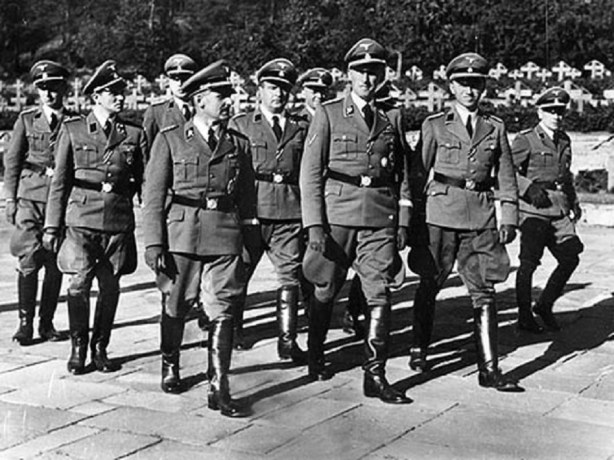
heinrich20mc3bcller20with20reinhard20heydrich20and20gestapo20officers

We want no Gestapo or secret police. The FBI is tending in that direction. They are dabbling in sex-life scandals and plain blackmail. J. Edgar Hoover would give his right eye to take over, and all congressmen and senators are afraid of him.”—President Harry S. Truman

Don’t Be a Puppet” is the message the FBI is sending young Americans.

As part of the government’s so-called ongoing war on terror, the nation’s de facto secret police force is now recruiting students and teachers to spy on each other and report anyone who appears to have the potential to be “anti-government” or “extremist.”

Using the terms “anti-government,” “extremist” and “terrorist” interchangeably, the government continues to add to its growing list of characteristics that could distinguish an individual as a potential domestic terrorist.

fbipuppetgame1For instance, you might be a domestic terrorist in the eyes of the FBI (and its network of snitches) if you:
  • express libertarian philosophies (statements, bumper stickers)
  • exhibit Second Amendment-oriented views (NRA or gun club membership)
  • read survivalist literature, including apocalyptic fictional books
  • show signs of self-sufficiency (stockpiling food, ammo, hand tools, medical supplies)
  • fear an economic collapse
  • buy gold and barter items
  • subscribe to religious views concerning the book of Revelation
  • voice fears about Big Brother or big government
  • expound about constitutional rights and civil liberties
  • believe in a New World Order conspiracy

Despite its well-publicized efforts to train students, teachers, police officers, hairdressers, store clerks, etc., into government eyes and ears, the FBI isn’t relying on a nation of snitches to carry out its domestic spying.

There’s no need.

The nation’s largest law enforcement agency rivals the NSA in resources, technology, intelligence, and power. Yet while the NSA has repeatedly come under fire for its domestic spying programs, the FBI has continued to operate its subversive and clearly unconstitutional programs with little significant oversight or push-back from the public, Congress or the courts. Just recently, for example, a secret court gave the agency the green light to quietly change its privacy rules for accessing NSA data on Americans’ international communications.

Battlefield_Cover_300Indeed, as I point out in my book Battlefield America: The War on the American People, the FBI has become the embodiment of how power, once acquired, can be easily corrupted and abused.

When and if a true history of the FBI is ever written, it will not only track the rise of the American police state but it will also chart the decline of freedom in America.

Owing largely to the influence and power of the FBI, the United States—once a nation that abided by the rule of law and held the government accountable for its actions—has steadily devolved into a police state where justice is one-sided, a corporate elite runs the show, representative government is a mockery, police are extensions of the military, surveillance is rampant, privacy is extinct, and the law is little more than a tool for the government to browbeat the people into compliance.

The FBI’s laundry list of crimes against the American people includes surveillance, disinformation, blackmail, entrapment, intimidation tactics, harassment and indoctrination, governmental overreach, abuse, misconduct, trespassing, enabling criminal activity, and damaging private property.

And that’s just based on what we know.

Whether the FBI is planting undercover agents in churches, synagogues and mosques; issuing fake emergency letters to gain access to Americans’ phone records; using intimidation tactics to silence Americans who are critical of the government; recruiting high school students to spy on and report fellow students who show signs of being future terrorists; or persuading impressionable individuals to plot acts of terror and then entrapping them, the overall impression of the nation’s secret police force is that of a well-dressed thug, flexing its muscles and doing the boss’ dirty work of ensuring compliance, keeping tabs on potential dissidents, and punishing those who dare to challenge the status quo.

The FBI was established in 1908 as a small task force assigned to deal with specific domestic crimes. Initially quite limited in its abilities to investigate so-called domestic crimes, the FBI has been transformed into a mammoth federal policing and surveillance agency. Unfortunately, whatever minimal restrictions kept the FBI’s surveillance activities within the bounds of the law all but disappeared in the wake of the 9/11 attacks. The USA Patriot Act gave the FBI and other intelligence agencies carte blanche authority in investigating Americans suspected of being anti-government.

As the FBI’s powers have grown, its abuses have mounted.

The FBI continues to monitor Americans engaged in lawful First Amendment activities.

john-lennon-j-edgar-hooverCOINTELPRO, the FBI program created to “disrupt, misdirect, discredit, and neutralize” groups and individuals the government considers politically objectionable, was aimed not so much at the criminal element but at those who challenged the status quo—namely, those expressing anti-government sentiments such as Martin Luther King Jr. and John Lennon. It continues to this day, albeit in other guises.

The FBI has become a master in the art of entrapment.

In the wake of the 9/11 terrorist attacks the FBI has not only targeted vulnerable individuals but has also lured them into fake terror plots while actually equipping them with the organization, money, weapons and motivation to carry out the plots—entrapment—and then jailing them for their so-called terrorist plotting. This is what the FBI characterizes as “forward leaning—preventative—prosecutions.”

FBI agents are among the nation’s most notorious lawbreakers.

In addition to creating certain crimes in order to then “solve” them, the FBI also gives certain informants permission to break the law, “including everything from buying and selling illegal drugs to bribing government officials and plotting robberies,” in exchange for their cooperation on other fronts. USA Today estimates that agents have authorized criminals to engage in as many as 15 crimes a day. Some of these informants are getting paid astronomical sums: one particularly unsavory fellow, later arrested for attempting to run over a police officer, was actually paid $85,000 for his help laying the trap for an entrapment scheme.

The FBI’s powers, expanded after 9/11, have given its agents carte blanche access to Americans’ most personal information.

The agency’s National Security Letters, one of the many illicit powers authorized by the USA Patriot Act, allows the FBI to secretly demand that banks, phone companies, and other businesses provide them with customer information and not disclose the demands. An internal audit of the agency found that the FBI practice of issuing tens of thousands of NSLs every year for sensitive information such as phone and financial records, often in non-emergency cases, is riddled withwidespread violations.

The FBI’s spying capabilities are on a par with the NSA.

fjhy5eruh84o0mga8tviThe FBI’s surveillance technology boasts an invasive collection of spy tools ranging from Stingray devices that can track the location of cell phones to Triggerfish devices which allow agents to eavesdrop on phone calls.  In one case, the FBI actually managed to remotely reprogram a “suspect’s” wireless internet card so that it would send “real-time cell-site location data to Verizon, which forwarded the data to the FBI.”

The FBI’s hacking powers have gotten downright devious.

FBI agents not only have the ability to hack into any computer, anywhere in the world, but they can also control that computer and all its stored information, download its digital contents, switch its camera or microphone on or off and even control other computers in its network. Given the breadth of the agency’s powers, the showdown between Apple and the FBI over customer privacy appears to be more spectacle than substance.

James Comey, current director of the FBI, knows enough to say all the right things about the need to abide by the Constitution, all the while his agency routinely discards it. Comey argues that the government’s powers shouldn’t be limited, especially when it comes to carrying out surveillance on American citizens. Comey continues to lobby Congress and the White House to force technology companies such as Apple and Google to keep providing the government withbackdoor access to Americans’ cell phones.

The FBI’s reach is more invasive than ever.

This is largely due to the agency’s nearly unlimited resources (its minimum budget alone in fiscal year 2015 was $8.3 billion), the government’s vast arsenal of technology, the interconnectedness of government intelligence agencies, and information sharing through fusion centers—data collecting intelligence agencies spread throughout the country that constantly monitor communications (including those of American citizens), everything from internet activity and web searches to text messages, phone calls and emails.

Today, the FBI employs more than 35,000 individuals and operates more than 56 field offices in major cities across the U.S., as well as 400 resident agencies in smaller towns, and more than 50 international offices. In addition to their “data campus,” which houses more than 96 million sets of fingerprints from across the United States and elsewhere, the FBI is also, according to The Washington Post, “building a vast repository controlled by people who work in a top-secret vault on the fourth floor of the J. Edgar Hoover FBI Building in Washington. This one stores the profiles of tens of thousands of Americans and legal residents who are not accused of any crime. What they have done is appear to be acting suspiciously to a town sheriff, a traffic cop or even a neighbor.”

If there’s one word to describe the FBI’s covert tactics, it’s creepy.

fbi_biometrics_32012The agency’s biometric database has grown to massive proportions, the largest in the world, encompassing everything from fingerprints, palm, face and iris scans to DNA, and is being increasingly shared between federal, state and local law enforcement agencies in an effort to target potential criminals long before they ever commit a crime.

This is what’s known as pre-crime.

If it were just about fighting the “bad guys,” that would be one thing. But as countless documents make clear, the FBI has no qualms about using its extensive powers in order to blackmail politicians, spy on celebrities and high-ranking government officials, and intimidate dissidents of all stripes.

It’s an old tactic, used effectively by former authoritarian regimes.

In fact, as historian Robert Gellately documents, the Nazi police state was repeatedly touted as a model for other nations to follow, so much so that Hoover actually sent one of his right-hand men, Edmund Patrick Coffey, to Berlin in January 1938 at the invitation of Germany’s secret police. As Gellately noted, “[A]fter five years of Hitler’s dictatorship, the Nazi police had won the FBI’s seal of approval.”

Nazi Social SecurityIndeed, so impressed was the FBI with the Nazi order that, as the New York Times revealed, in the decades after World War II, the FBI, along with other government agencies, aggressively recruited at least a thousand Nazis, including some of Hitler’s highest henchmen, brought them to America, hired them on as spies and informants, and then carried out a massive cover-up campaign to ensure that their true identities and ties to Hitler’s holocaust machine would remain unknown. Moreover, anyone who dared to blow the whistle on the FBI’s illicit Nazi ties found himself spied upon, intimidated, harassed and labeled a threat to national security.

So not only have American taxpayers been paying to keep ex-Nazis on the government payroll for decades but we’ve been subjected to the very same tactics used by the Third Reich: surveillance, militarized police, overcriminalization, and a government mindset that views itself as operating outside the bounds of the law.

This is how freedom falls, and tyrants come to power.thought_police_by_libertymaniacs_7876

The similarities between the American police state and past totalitarian regimes such as Nazi Germany grow more pronounced with each passing day.
Secret police. Secret courts. Secret government agencies. Surveillance. Intimidation. Harassment. Torture. Brutality. Widespread corruption. Entrapment. Indoctrination. These are the hallmarks of every authoritarian regime from the Roman Empire to modern-day America.

Yet it’s the secret police—tasked with silencing dissidents, ensuring compliance, and maintaining a climate of fear—who sound the death knell for freedom in every age.

“I was astonished, bewildered. This was America, a country where, whatever its faults, people could speak, write, assemble, demonstrate without fear. It was in the Constitution, the Bill of Rights. We were a democracy… But I knew it wasn’t a dream; there was a painful lump on the side of my head… The state and its police were not neutral referees in a society of contending interests. They were on the side of the rich and powerful. Free speech? Try it and the police will be there with their horses, their clubs, their guns, to stop you. From that moment on, I was no longer a liberal, a believer in the self-correcting character of American democracy. I was a radical, believing that something fundamental was wrong in this country—not just the existence of poverty amidst great wealth, not just the horrible treatment of black people, but something rotten at the root. The situation required not just a new president or new laws, but an uprooting of the old order, the introduction of a new kind of society—cooperative, peaceful, egalitarian.” ― Historian Howard Zinn

America is at a crossroads.

History may show that from this point forward, we will have left behind any semblance of constitutional government and entered into a militaristic state where all citizens are suspects and security trumps freedom.

Certainly, this is a time when government officials operate off their own inscrutable, self-serving playbook with little in the way of checks and balances, while American citizens are subjected to all manner of indignities and violations with little hope of defending themselves.

Battlefield_Cover_300As I make clear in my book Battlefield America: The War on the American People, we have moved beyond the era of representative government and entered a new age—the age of authoritarianism. Even with its constantly shifting terrain, this topsy-turvy travesty of law and government has become America’s new normal.

Don’t believe me?

Let me take you on a brief guided tour, but prepare yourself. The landscape is particularly disheartening to anyone who remembers what America used to be.

The Executive Branch: Whether it’s the Obama administration’s war on whistleblowers, the systematic surveillance of journalists and regular citizens, the continued operation of Guantanamo Bay, or the occupation of Afghanistan, Barack Obama has surpassed his predecessors in terms of his abuse of the Constitution and the rule of law. President Obama, like many of his predecessors, has routinely disregarded the Constitution when it has suited his purposes, operating largely above the law and behind a veil of secrecy, executive orders and specious legal justifications. Rest assured that no matter who wins this next presidential election, very little will change. The policies of the American police state will continue.

The Legislative Branch:  It is not overstating matters to say that Congress may well be the most self-serving, semi-corrupt institution in America. Abuses of office run the gamut from elected representatives neglecting their constituencies to engaging in self-serving practices, including the misuse of eminent domain, earmarking hundreds of millions of dollars in federal contracting in return for personal gain and campaign contributions, having inappropriate ties to lobbyist groups and incorrectly or incompletely disclosing financial information. Pork barrel spending, hastily passed legislation, partisan bickering, a skewed work ethic, graft and moral turpitude have all contributed to the public’s increasing dissatisfaction with congressional leadership. No wonder 86 percent of Americans disapprove of the job Congress is doing.

The Judicial Branch: The Supreme Court was intended to be an institution established to intervene and protect the people against the government and its agents when they overstep their bounds. Yet through their deference to police power, preference for security over freedom, and evisceration of our most basic rights for the sake of order and expediency, the justices of the United States Supreme Court have become the guardians of the American police state in which we now live. As a result, sound judgment and justice have largely taken a back seat to legalism, statism and elitism, while preserving the rights of the people has been deprioritized and made to play second fiddle to both governmental and corporate interests.

Shadow Government: America’s next president will inherit more than a bitterly divided nation teetering on the brink of financial catastrophe when he or she assumes office. He or she will also inherit a shadow government, one that is fully operational and staffed by unelected officials who are, in essence, running the country. Referred to as the Deep State, this shadow government is comprised of unelected government bureaucrats, corporations, contractors, paper-pushers, and button-pushers who are actually calling the shots behind the scenes right now.

Law Enforcement: By and large the term “law enforcement” encompasses all agents within a militarized police state, including the military, local police, and the various agencies such as the Secret Service, FBI, CIA, NSA, etc. Having been given the green light to probe, poke, pinch, taser, search, seize, strip and generally manhandle anyone they see fit in almost any circumstance, all with the general blessing of the courts, America’s law enforcement officials, no longer mere servants of the people entrusted with keeping the peace but now extensions of the military, are part of an elite ruling class dependent on keeping the masses corralled, under control, and treated like suspects and enemies rather than citizens. In the latest move to insulate police from charges of misconduct, Virginia lawmakers are considering legislation to keep police officers’ names secret, ostensibly creating secret police forces.

A Suspect Surveillance Society: Every dystopian sci-fi film we’ve ever seen is suddenly converging into this present moment in a dangerous trifecta between science, technology and a government that wants to be all-seeing, all-knowing and all-powerful. By tapping into your phone lines and cell phone communications, the government knows what you say. By uploading all of your emails, opening your mail, and reading your Facebook posts and text messages, the government knows what you write. By monitoring your movements with the use of license plate readers, surveillance cameras and other tracking devices, the government knows where you go. By churning through all of the detritus of your life—what you read, where you go, what you say—the government can predict what you will do. By mapping the synapses in your brain, scientists—and in turn, the government—will soon know what you remember. And by accessing your DNA, the government will soon know everything else about you that they don’t already know: your family chart, your ancestry, what you look like, your health history, your inclination to follow orders or chart your own course, etc. Consequently, in the face of DNA evidence that places us at the scene of a crime, behavior sensing technology that interprets our body temperature and facial tics as suspicious, and government surveillance devices that cross-check our biometricslicense plates and DNA against a growing database of unsolved crimes and potential criminals, we are no longer “innocent until proven guilty.”

Military Empire: America’s endless global wars and burgeoning military empire—funded by taxpayer dollars—have depleted our resources, over-extended our military and increased our similarities to the Roman Empire and its eventual demise. The U.S. now operates approximately 800 military bases in foreign countries around the globe at an annual cost of at least $156 billion. The consequences of financing a global military presence are dire. In fact, David Walker, former comptroller general of the U.S., believes there are “striking similarities” between America’s current situation and the factors that contributed to the fall of Rome, including “declining moral values and political civility at home, an over-confident and over-extended military in foreign lands and fiscal irresponsibility by the central government.”

I haven’t even touched on the corporate state, the military industrial complex, SWAT team raids, invasive surveillance technology, zero tolerance policies in the schools, overcriminalization, or privatized prisons, to name just a few, but what I have touched on should be enough to show that the landscape of our freedoms has already changed dramatically from what it once was and will no doubt continue to deteriorate unless Americans can find a way to wrest back control of their government and reclaim their freedoms.

That brings me to the final and most important factor in bringing about America’s shift into authoritarianism: “we the people.” We are the government. Thus, if the government has become a tyrannical agency, it is because we have allowed it to happen, either through our inaction or our blind trust.

Essentially, there are four camps of thought among the citizenry when it comes to holding the government accountable. Which camp you fall into says a lot about your view of government—or, at least, your view of whichever administration happens to be in power at the time.

In the first camp are those who trust the government to do the right thing, despite the government’s repeated failures in this department. In the second camp are those who not only don’t trust the government but think the government is out to get them. In the third camp are those who see government neither as an angel nor a devil, but merely as an entity that needs to be controlled, or as Thomas Jefferson phrased it, bound “down from mischief with the chains of the Constitution.”

Then there’s the fourth camp, comprised of individuals who pay little to no attention to the workings of government, so much so that they barely vote, let alone know who’s in office. Easily entertained, easily distracted, easily led, these are the ones who make the government’s job far easier than it should be.

It is easy to be diverted, distracted and amused by the antics of the presidential candidates, the pomp and circumstance of awards shows, athletic events, and entertainment news, and the feel-good evangelism that passes for religion today. What is far more difficult to face up to is the reality of life in America, where unemployment, poverty, inequality, injustice and violence by government agents are increasingly norms.

The powers-that-be want us to remain divided, alienated from each other based on our politics, our bank accounts, our religion, our race and our value systems. Yet as George Orwell observed, “The real division is not between conservatives and revolutionaries but between authoritarians and libertarians.”

The only distinction that matters anymore is where you stand in the American police state. In other words, you’re either part of the problem or part of the solution.

“We are not to simply bandage the wounds of victims beneath the wheels of injustice, we are to drive a spoke into the wheel itself.”—Dietrich Bonhoeffer

The untimely death of Supreme Court Justice Antonin Scalia has predictably created a political firestorm.

Republicans and Democrats, eager to take advantage of an opening on the Supreme Court, have been quick to advance their ideas about Scalia’s replacement. This is just the beginning of the furor over who gets to appoint the next U.S. Supreme Court justice (President Obama or his successor), when (as soon as Obama chooses or as long as Congress can delay), how (whether by way of a recess appointment or while Congress is in session), and where any judicial nominee will stand on the hot-button political issues of our day (same-sex marriage, Obamacare, immigration, the environment, and abortion).

This is yet another spectacle, not unlike the carnival-like antics of the presidential candidates, to create division, dissension and discord and distract the populace from the nation’s steady march towards totalitarianism.

Not to worry. This is a done deal. There are no surprises awaiting us.

We may not know the gender, the orientation, the politics, or the ethnicity of Justice Scalia’s replacement, but those things are relatively unimportant in the larger scheme of things.
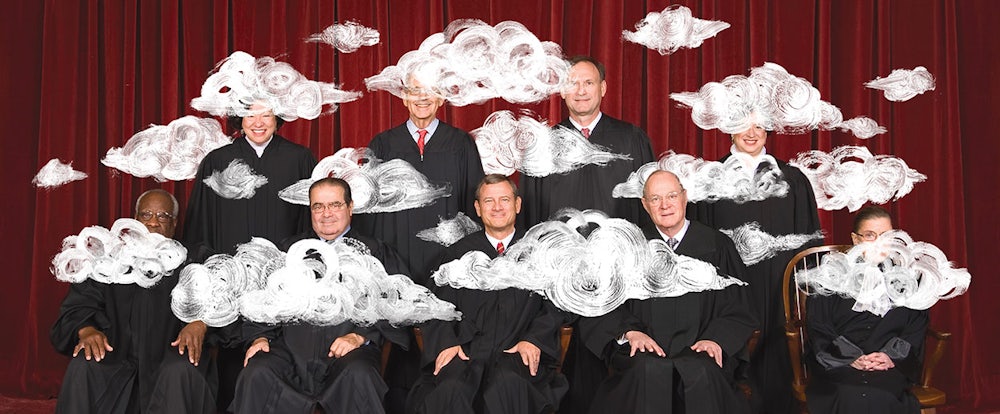
The powers-that-be have already rigged the system. They—the corporations, the military industrial complex, the surveillance state, the monied elite, etc.—will not allow anyone to be appointed to the Supreme Court who will dial back the police state. They will not tolerate anyone who will undermine their policies, threaten their profit margins, or overturn their apple cart.

Scalia’s replacement will be safe (i.e., palatable enough to withstand Congress’ partisan wrangling), reliable and most important of all, an extension of the American police state.

With the old order dying off or advancing into old age rapidly, we’ve arrived at a pivotal point in the makeup of the Supreme Court. With every vacant seat on the Court and in key judgeships around the country, we are witnessing a transformation of the courts into pallid, legalistic bureaucracies governed by a new breed of judges who have beencareful to refrain from saying, doing or writing anything that might compromise their future ambitions.

Today, the judges most likely to get appointed today are well-heeled, well-educated (all of them attended either Yale or Harvard law schools) blank slates who have traveled a well-worn path from an elite law school to a prestigious judicial clerkship and then a pivotal federal judgeship. Long gone are the days when lawyers without judicial experience such as Earl Warren, William Rehnquist, Felix Frankfurter, and Louis Brandeis could be appointed to the Supreme Court.

As Supreme Court correspondent Dahlia Lithwick points out, “a selection process that discourages political or advocacy experience and reduces the path to the Supreme Court to a funnel” results in “perfect judicial thoroughbreds who have spent their entire adulthoods on the same lofty, narrow trajectory.”

In other words, it really doesn’t matter whether a Republican or Democratic president appoints the next Supreme Court justice, because they will all look alike (in terms of their educational and professional background) and sound alike (they are primarily advocates for the government).

Given the turbulence of our age, with its police overreach, military training drills on American soil, domestic surveillance, SWAT team raids, asset forfeiture, wrongful convictions, and corporate corruption, the need for a guardian of the people’s rights has never been greater.

Unfortunately, as I document in Battlefield America: The War on the American People, what we have been saddled with instead are government courts dominated by technicians and statists who march in lockstep with the American police state.

This is true at all levels of the judiciary.

Thus, while what the nation needs is a constitutionalist, what we will get is a technician.

It’s an important distinction.

A legal constitutionalist believes that the authority of government derives from and is limited by a body of fundamental law (the Constitution) and strives to hold the government accountable to abiding by the Constitution. A judge of this order will uphold the rights of the citizenry in the face of government abuses.

Justice William O. Douglas, who served on the Supreme Court for 36 years, was such a constitutionalist. He believed that the “Constitution is not neutral. It was designed to take the government off the backs of the people.” Considered the most “committed civil libertarian ever to sit on the court,” Douglas was frequently controversial and far from perfect (he was part of a 6-3 majority in Korematsu vs. United States that supported the government’s internment of American citizens of Japanese descent during World War II). Even so, his warnings against a domineering, suspicious, totalitarian, police-driven surveillance state resonate still today.

A legal technician, on the other hand, is an arbitrator of the government’s plethora of laws whose priority is maintaining order and preserving government power. As such, these judicial technicians are deferential to authority, whether government or business, and focused on reconciling the massive number of laws handed down by the government.

John Roberts who joined the Supreme Court in 2005 as Chief Justice is a prime example of a legal technician. His view that the “role of the judge is limited…to decide the cases before them” speaks to a mindset that places the judge in the position of a referee. As USA Today observes, “Roberts’ tenure has been marked by an incremental approach to decision-making — issuing narrow rather than bold rulings that have the inevitable effect of bringing the same issues back to the high court again and again.”

Roberts’ approach to matters of law and justice can best be understood by a case dating back to his years on the U.S. Court of Appeals for the District of Columbia. The case involved a 12-year-old black girl who was handcuffed, searched and arrested by police—all for eating a single French fry in violation of a ban on food in the D.C. metro station. Despite Roberts’ ability to recognize the harshness of the treatment meted out to Ansche Hedgepeth for such a minor violation—the little girl was transported in the windowless rear compartment of a police vehicle to a juvenile processing center, where she was booked, fingerprinted, and detained for three hours, and was “frightened, embarrassed, and crying throughout the ordeal”—Roberts ruled that the girl’s constitutional rights had not been violated in any way.

This is not justice meted out by a constitutionalist.

This is how a technician rules, according to the inflexible letter of the law.

Circuit Judge Sri Srinivasan of the DC Court of Appeals, who is rumored to be a favorite pick for Scalia’s spot on the court, is another such technician. When asked to strike down a 60-year-old ban on expressive activities in front of the Supreme Court Plaza, Srinivasan turned a blind eye to the First Amendment. (Ironically, the Supreme Court must now decide whether to declare its own free speech ban unconstitutional.)

By ruling in favor of the ban, Srinivasan also affirmed that police were correct to arrest an African-American protester who was standing silently in front of the Supreme Court wearing a sign protesting the police state on a snowy day when no one was on the plaza except him.

Srinivasan’s rationale? “Allowing demonstrations directed at the Court, on the Court’s own front terrace, would tend to yield the opposite impression: that of a Court engaged with — and potentially vulnerable to — outside entreaties by the public.”

This view of the Supreme Court as an entity that must be sheltered from select outside influences—for example, the views of the citizenry—is shared by the members of the Court itself to a certain extent. As Lithwick points out:

The Court has become worryingly cloistered, even for a famously cloistered institution… today’s justices filter out anything that might challenge their perspectives. Antonin Scalia won’t read newspapers that conflict with his views and claims to often get very little from amicus briefs. John Roberts has said that he doesn’t believe that most law-review articles—where legal scholars advance new thinking on contemporary problems—are relevant to the justices’ work. Ruth Bader Ginsburg, Scalia’s opera-going buddy, increasingly seems to revel in, rather than downplay, her status as a liberal icon. Kennedy spends recesses guest-teaching law school courses in Salzburg.”

Are you getting the picture yet?

The members of the Supreme Court are part of a ruling aristocracy composed of men and women who primarily come from privileged backgrounds and who have a vested interest in maintaining the status quo.

These justices, all of whom are millionaires in their own rights, circulate among an elite, privileged class of individuals, attending exclusive events at private resorts orchestrated by billionaire oil barons, traveling on the private jets of billionaires, and delivering paid speeches in far-flung locales such as Berlin, London and Zurich.

When you’re cocooned within the rarefied, elitist circles in which most of the judiciary operate, it can be difficult to see the humanity behind the facts of a case, let alone identify with the terror and uncertainty that most people feel when heavily armed government agents invade their homes, or subject them to a virtual strip search, or taser them into submission.

If you’ve never had to worry about police erroneously crashing through your door in the dead of night, then it might not be a hardship to rule as the Court did in Kentucky v. King that police should have greater leeway to break into homes or apartments without a warrant.

If you have no fear of ever being strip searched yourself, it would be easy to suggest as the Court did in Florence v. Burlington that it’s more important to make life easier for overworked jail officials than protect Americans from debasing strip searches.

And if you have never had to submit to anyone else’s authority—especially a militarized police officer with no knowledge of the Constitution’s prohibitions against excessive force, warrantless searches and illegal seizures, then you would understandably give police the benefit of the doubt as the Court did in Brooks v. City of Seattle, when they let stand a ruling that police officers who had clearly used excessive force when they repeatedly tasered a pregnant woman during a routine traffic stop were granted immunity from prosecution.

Likewise, if you’re not able to understand what it’s like to be one of the “little guys,” afraid to lose your home because some local government wants to commandeer it and sell it to a larger developer for profit, it would be relatively easy to rule, as the Supreme Court did in Kelo v. New London, that the government is within its right to do so.

Now do you understand why the Supreme Court’s decisions in recent years, which have run the gamut from suppressing free speech activities and justifying suspicionless strip searches to warrantless home invasions and conferring constitutional rights on corporations, while denying them to citizens, have been characterized most often by an abject deference to government authority, military and corporate interests?

They no longer work for us. They no longer represent us. They can no longer relate to our suffering.

In the same way that the Legislative Branch, having been co-opted by lobbyists, special interests, and the corporate elite, has ceased to function as a vital check on abuses by the other two branches of government, the Judicial Branch has also become part of the same self-serving bureaucracy.

Sound judgment, compassion and justice have taken a back seat to legalism, statism and elitism.

Preserving the rights of the people has been deprioritized and made to play second fiddle to both governmental and corporate interests.

In the case of the People vs. the Police State, the ruling is 9-0 against us.

So where does that leave us?

The Supreme Court of old is gone, if not for good then at least for now.

It will be a long time before we have another court such as the Warren Court (1953-1969), when Earl Warren served alongside such luminaries as William J. Brennan, Jr., William O. Douglas, Hugo Black, Felix Frankfurter and Thurgood Marshall.

The Warren Court handed down rulings that were instrumental in shoring up critical legal safeguards against government abuse and discrimination. Without the Warren Court, there would be no Miranda warnings, no desegregation of the schools and no civil rights protections for indigents.

Yet more than any single ruling, what Warren and his colleagues did best was embody what the Supreme Court should always be—an institution established to intervene and protect the people against the government and its agents when they overstep their bounds.

That is no longer the case.

We can no longer depend on the federal courts to protect us against the government. They are the government.

Yet as is the case with most things, the solution is far simpler and at the same time more complicated than space allows, but it starts with local action—local change—and local justice. If you want a revolution, start small, in your own backyard, and the impact will trickle up.

If you don’t like the way justice is being meted out in America, then start demanding justice in your own hometown, before your local judges. Serve on juries, nullify laws that are egregious, picket in front of the courthouse, vote out judges (and prosecutors) who aren’t practicing what the Constitution preaches, encourage your local newspapers to report on cases happening in your town, educate yourself about your rights, and make sure your local judges understand that they work for you and are not to be extensions of the police, prosecutors and politicians.

This is the only way we will ever have any hope of pushing back against the police state.

Big Brother does not watch us, by his choice. We watch him, by ours. There is no need for wardens or gates or Ministries of Truth. When a population becomes distracted by trivia, when cultural life is redefined as a perpetual round of entertainments, when serious public conversation becomes a form of baby-talk, when, in short, a people become an audience and their public business a vaudeville act, then a nation finds itself at risk; a culture-death is a clear possibility. — Professor Neil Postman

If there are two spectacles that are almost guaranteed to render Americans passive viewers, incapable of doing little more than cheering on their respective teams, it’s football and politics—specifically, the Super Bowl and the quadrennial presidential election.

Both football and politics encourage zealous devotion among their followers, both create manufactured divisions that alienate one group of devotees from another, and both result in a strange sort of tunnel vision that leaves the viewer oblivious to anything else going on around them apart from the “big game.”

Both football and politics are televised, big-money, advertising-driven exercises in how to cultivate a nation of armchair enthusiasts who are content to sit, watch and be entertained, all the while convincing themselves that they are active contributors to the outcome. Even the season schedules are similar in football and politics: the weekly playoffs, the blow-by-blow recaps, the betting pools and speculation, the conferences, and then the final big championship game.

In the same way, both championship events are costly entertainment extravaganzas that feed the nation’s appetite for competition, consumerism and carnivalesque stunts. In both scenarios, cities bid for the privilege of hosting key athletic and political events. For example, San Francisco had to raise close to $50 million just to host the 50th Super Bowl, with its deluxe stadium, Super Bowl City, free fan village, interactive theme park, and free Alicia Keys concert, not including the additional $5 million cost to taxpayers for additional security. Likewise, it costs cities more than $60 million to host the national presidential nominating conventions for the Republicans and Democrats.

Don’t get me wrong. I’m not suggesting that there is anything wrong with enjoying the entertainment that is football or politics.

However, where we go wrong as a society is when we become armchair quarterbacks, so completely immersed in the Big Game or the Big Campaign that we are easily controlled by the powers-that-be—the megacorporations who run both shows—and oblivious to what is really going on around us.

For instance, while mainstream America has been fixated on the contenders for the Vince Lombardi Trophy and the White House, the militarized, warring surveillance state has been moving steadily forward. Armed drones, increased government surveillance and spying, SWAT team raids, police shootings of unarmed citizens, and the like continue to plague the country. None of these dangers have dissipated. They have merely disappeared from our televised news streams.

In this way, television is a “dream come true” for an authoritarian society.

Television isolates people so they are not joining together to govern themselves. As clinical psychologist Bruce Levine notes, viewing television puts one in a brain state that makes it difficult to think critically, and it quiets and subdues a population. And spending one’s free time isolated and watching TV interferes with our ability to translate our outrage over governmental injustice into activism, and thus makes it easier to accept an authority’s version of society and life.

Supposedly the reason why television—and increasingly movies—are so effective in subduing and pacifying us is that viewers are mesmerized by what TV-insiders call “technical events.” These, according to Levine, are “quick cuts, zoom-ins, zoom-outs, rolls, pans, animation, music, graphics, and voice-overs, all of which lure viewers to continue watching even though they have no interest in the content.” Such technical events, which many action films now incorporate, spellbind people to continue watching.

Televised entertainment, no matter what is being broadcast, has become the nation’s new drug high. Researchers found that “almost immediately after turning on the TV, subjects reported feeling more relaxed, and because this occurs so quickly and the tension returns so rapidly after the TV is turned off, people are conditioned to associate TV viewing with a lack of tension.”

Not surprisingly, the United States is one of the highest TV-viewing nations in the world.

Indeed, a Nielsen study reports that American screen viewing is at an all-time high. For example, the average American watches approximately 151 hours of television per month. That does not include the larger demographic of screen-watchers who watch their entertainment via their laptops, personal computers, cell phones, tablets and so on.

Historically, television has been used by those in authority to quiet citizen unrest and pacify disruptive people. In fact, television-viewing has also been a proven tactic for ensuring compliance in prisons. “Faced with severe overcrowding and limited budgets for rehabilitation and counseling, more and more prison officials are using TV to keep inmates quiet,” according to Newsweek. Joe Corpier, a convicted murderer, when interviewed said, “If there’s a good movie, it’s usually pretty quiet through the whole institution.”

In other words, television and other screen viewing not only helps to subdue people but, as Levine concludes, it alsozombifies and pacifies us and subverts democracy.

Television viewing, no matter what we’re collectively watching—whether it’s American Idol, the presidential debates or the Super Bowl—is a group activity that immobilizes us and mesmerizes us with collective programming. In fact, research also shows that regardless of the programming, viewers’ brain waves slow down, thus transforming them into a more passive, nonresistant state.

As such, television watching today results in passive group compliance in much the same way that marching was used by past regimes to create group indoctrination. Political advisor Bertram Gross documents how Adolf Hitler employed marching as a technique to mobilize people in groups by immobilizing them. Hitler and his regime leaders discovered that when people gather in groups and do the same thing—such as marching or cheering at an entertainment or sporting event—they became passive, non-thinking non-individuals.

By replacing “marching” with electronic screen devices, we have the equivalent of Hitler’s method of population control. Gross writes:

As a technique of immobilizing people, marching requires organization and, apart from the outlay costs involved, organized groups are a potential danger. They might march to a different drum or in the wrong direction….TV is more effective. It captures many more people than would ever fill the streets by marching—and without interfering with automobile traffic.

Equally disturbing is a university study which indicates that we become less aware of our individual selves and moral identity in a group. The study’s findings strongly suggest that when we act in groups, we tend to consider our moral behavior less while moving in lockstep with the group. Thus, what the group believes or does, be it violence or inhumanity, does not seem to lessen the need to be a part of a group, whether it be a mob or political gathering.

So what does this have to do with the Super Bowl and the upcoming presidential election?

If fear-based TV programming—or programming that encourages rivalries and factions—makes people more afraid and distrustful of one another, then our current television lineup is exactly what is needed by an authoritarian society that depends on a “divide and conquer” strategy.

Moreover, according to Levine, authoritarian-based programming is more technically interesting to viewers than democracy-based programming. War and violence, for example, may be rather unpleasant in real life. However, peace and cooperation make for “boring television.”

What this means is that Super Bowl matches and presidential contests are merely more palatable, less bloody, manifestations of war suitable for television viewing audiences.

This also explains why television has become the medium of choice for charismatic politicians with a strong screen presence. They are essentially television performers—actors, if you will. Indeed, any successful candidate for political office—especially the President—must come off well on TV. Television has the lure of involvement. A politically adept president can actually make you believe you are involved in the office of the presidency.
The effective president, then, is essentially a television performer. As the renowned media analyst Marshall McLuhan recognized concerning television: “Potentially, it can transform the presidency into a monarchist dynasty.”

If what we see and what we are told through the entertainment industrial complex—which includes so-called “news” shows—is what those in power deem to be in their best interests, then endless screen viewing is not a great thing for a citizenry who believe they possess choice and freedom. Mind you, the majority of what Americans watch on television is provided through channels controlled by a corporate elite of six megacorporations with the ability to foster a particular viewpoint or pacify its viewers on a large scale.

Unfortunately for us, the direction of the future, then, may be towards a Brave New World scenario where the populace is constantly distracted by entertainment, hooked on prescription drugs and controlled by a technological elite.

Freedom, as I make clear in my book Battlefield America: The War on the American People, is an action word. It means turning off your screen devices—or at least greatly reducing your viewing time—and getting active to take to stave off the emerging authoritarian government.

Battlefield_Cover_300Aldous Huxley, George Orwell, and the countless science fiction writers and commentators have warned that we are in a race between getting actively involved in the world around us or facing disaster.

If we’re watching, we’re not doing.

As television journalist Edward R. Murrow warned in a 1958 speech:

We have currently a built-in allergy to unpleasant or disturbing information. Our mass media reflect this. But unless we get up off our fat surpluses and recognize that television in the main is being used to distract, delude, amuse, and insulate us, then television and those who finance it, those who look at it, and those who work at it, may see a totally different picture too late.

What happens to a dream deferred?
Does it dry up
like a raisin in the sun?
Or fester like a sore—
And then run?
Does it stink like rotten meat?
Or crust and sugar over—
like a syrupy sweet?
Maybe it just sags
like a heavy load.
Or does it explode?—Langston Hughes, “Harlem”

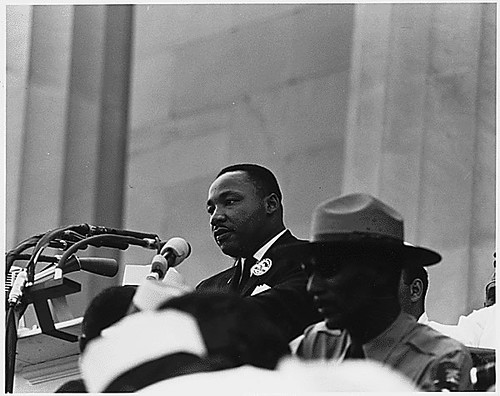
Martin Luther King Jr. could tell you what happens to dreams deferred. They explode.

As I point out in my book Battlefield America: The War on the American People, more than 50 years after King was assassinated, his dream of a world without racism, militarism and materialism remains a distant dream.

Indeed, the reality we must contend with is far different from King’s dream for the future: America has become a ticking time bomb of racial unrest and injustice, police militarization, surveillance, government corruption and ineptitude, the blowblack from a battlefield mindset and endless wars abroad, and a growing economic inequality between the haves and have nots.

King’s own legacy has suffered in the process.

The image of the hard-talking, charismatic leader, voice of authority, and militant, nonviolent activist minister/peace warrior who staged sit-ins, boycotts and marches and lived through police attack dogs, water cannons and jail cells has been so watered down that younger generations recognize his face but know very little about his message.

Rubbing salt in the wound, while those claiming to honor King’s legacy pay lip service to his life and the causes for which he died, they have done little to combat the evils about which King spoke and opposed so passionately: injustice, war, racism and economic inequality.

For instance, President Obama speaks frequently of King, but what has he done to bring about peace or combat the racial injustices that continue to be meted out to young black Americans by the police state?

Republican presidential candidate Donald Trump plans to “honor” Martin Luther King Jr.’s legacy by speaking at a convocation at Liberty University, but what has he done to combat economic injustice?

Democratic presidential contender Hillary Clinton will pay tribute to King’s legacy by taking part in Columbia, South Carolina’s King Day at the Dome event, but has she done anything to dispel her track record’s impression that “machines and computers, profit motives and property rights are still considered more important than people”?

Unlike the politicians of our present day, King was a clear moral voice that cut through the fog of distortion. He spoke like a prophet and commanded that you listen. King dared to speak truth to the establishment and called for an end to oppression and racism. He raised his voice against the Vietnam War and challenged the military-industrial complex. And King didn’t just threaten boycotts and sit-ins for the sake of photo ops and media headlines. Rather, he carefully planned and staged them to great effect.

The following key principles formed the backbone of Rev. King’s life and work. King spoke of them incessantly, in every sermon he preached, every speech he delivered and every article he wrote. They are the lessons we failed to learn and, in failing to do so, we have set ourselves up for a future in which a militarized surveillance state is poised to eradicate freedom.

Practice militant non-violence, resist militarism and put an end to war.

“I could never again raise my voice against the violence of the oppressed in the ghettos without having first spoken clearly to the greatest purveyor of violence in the world today—my own government.”—Martin Luther King Jr., Sermon at New York’s Riverside Church (April 4, 1967)

On April 4, 1967, exactly one year before his murder, King used the power of his pulpit to condemn the U.S. for “using massive doses of violence to solve its problems, to bring about the changes it wanted.” King called on the U.S. to end all bombing in Vietnam, declare a unilateral cease-fire, curtail its military buildup, and set a date for troop withdrawals. In that same sermon, King warned that “a nation that continues year after year to spend more money on military defense than on programs of social uplift is approaching spiritual death.”

Fifty-some years later, America’s military empire has been expanded at great cost to the nation, with the White House leading the charge. Indeed, in his recent State of the Union address, President Obama bragged that the U.S. spends more on its military than the next eight nations combined. Mind you, the money spent on wars abroad, weapons and military personnel is money that is not being spent on education, poverty and disease.

Stand against injustice.

“Injustice anywhere is a threat to justice everywhere… there are two types of laws: just and unjust. I would be the first to advocate obeying just laws. One has not only a legal but a moral responsibility to obey just laws. Conversely, one has a moral responsibility to disobey unjust laws.”― Martin Luther King Jr., “Letter from a Birmingham Jail” (April 16, 1963)

Arrested and jailed for taking part in a nonviolent protest against racial segregation in Birmingham, Ala., King used his time behind bars to respond to Alabama clergymen who criticized his methods of civil disobedience and suggested that the courts were the only legitimate means for enacting change. His “Letter from a Birmingham Jail,” makes the case for disobeying unjust laws when they are “out of harmony with the moral law.”

Fifty-some years later, we are being bombarded with unjust laws at both the national and state levels, from laws authorizing the military to indefinitely detain American citizens and allowing the NSA to spy on American citizens to laws making it illegal to protest near an elected official or in front of the U.S. Supreme Court. As King warned, “Never forget that everything Hitler did in Germany was legal.”

Work to end poverty. Prioritize people over corporations.

“When machines and computers, profit motives and property rights, are considered more important than people, the giant triplets of racism, extreme materialism, and militarism are incapable of being conquered.” —Martin Luther King Jr., Sermon at New York’s Riverside Church (April 4, 1967)

Especially in the latter part of his life, King was unflinching in his determination to hold Americans accountable to alleviating the suffering of the poor, going so far as to call for a march on Washington, DC, to pressure Congress to pass an Economic Bill of Rights.

Fifty-some years later, a monied, oligarchic elite calls the shots in Washington, while militarized police and the surveillance sector keep the masses under control. With roughly 23 lobbyists per Congressman, corporate greed largely dictates what happens in the nation’s capital, enabling our so-called elected representatives to grow richer and the people poorer. One can only imagine what King would have said about a nation whose political processes, everything from elections to legislation, are driven by war chests and corporate benefactors rather than the needs and desires of the citizenry.

Stand up for what is right, rather than what is politically expedient.

“On some positions, cowardice asks the question, is it expedient? And then expedience comes along and asks the question, is it politic? Vanity asks the question, is it popular? Conscience asks the question, is it right? There comes a time when one must take the position that is neither safe nor politic nor popular, but he must do it because conscience tells him it is right.”—Martin Luther King Jr., Sermon at National Cathedral (March 31, 1968)

Five days before his assassination, King delivered a sermon at National Cathedral in Washington, DC, in which he noted that “one of the great liabilities of life is that all too many people find themselves living amid a great period of social change, and yet they fail to develop the new attitudes, the new mental responses, that the new situation demands. They end up sleeping through a revolution.”

Freedom, human dignity, brotherhood, spirituality, peace, justice, equality, putting an end to war and poverty: these are just a few of the big themes that shaped King’s life and his activism. As King recognized, there is much to be done if we are to make this world a better place, and we cannot afford to play politics when so much hangs in the balance.

It’s time to wake up, America.

To quote my hero: “[O]ur very survival depends on our ability to stay awake, to adjust to new ideas, to remain vigilant and to face the challenge of change. The large house in which we live demands that we transform this world-wide neighborhood into a world-wide brotherhood. Together we must learn to live as brothers or together we will be forced to perish as fools.”

Original post can be found at http://rutherford.org/publications_resources/john_whiteheads_commentary/what_happens_to_a_dream_deferred_ask_martin_luther_king_jr


“There will be, in the next generation or so, a pharmacological method of making people love their servitude, and producing dictatorship without tears, so to speak, producing a kind of painless concentration camp for entire societies, so that people will in fact have their liberties taken away from them, but will rather enjoy it, because they will be distracted from any desire to rebel by propaganda or brainwashing, or brainwashing enhanced by pharmacological methods. And this seems to be the final revolution.”—Aldous Huxley

There’s a man who contacts me several times a week to disagree with my assessments of the American police state. According to this self-avowed Pollyanna who is tired of hearing “bad news,” the country is doing just fine, the government’s intentions are honorable, anyone in authority should be blindly obeyed, those individuals who are being arrested, shot and imprisoned must have done something to deserve such treatment, and if you have nothing to hide, you shouldn’t care whether the government is spying on you.

In other words, this man trusts the government with his life, his loved ones and his property, and anyone who doesn’t feel the same should move elsewhere.

It’s tempting to write this man off as dangerously deluded, treacherously naïve, and clueless to the point of civic incompetence. However, he is not alone in his goose-stepping, comfort-loving, TV-watching, insulated-from-reality devotion to the alternate universe constructed for us by the Corporate State with its government propaganda, pseudo-patriotism and contrived political divisions.

While only 1 in 5 Americans claim to trust the government to do what is right, the majority of the people are not quite ready to ditch the American experiment in liberty. Or at least they’re not quite ready to ditch the government with which they have been saddled.

As The Washington Post concludes, “Americans hate government, but they like what it does.” Indeed, kvetching aside, Americans want the government to keep providing institutionalized comforts such as Social Security, public schools, and unemployment benefits, fighting alleged terrorists and illegal immigrants, defending the nation from domestic and foreign threats, and maintaining the national infrastructure. And it doesn’t matter that the government has shown itself to be corrupt, abusive, hostile to citizens who disagree, wasteful and unconcerned about the plight of the average American.

For the moment, Americans are continuing to play by the government’s rules. Indeed, Americans may not approve the jobs being done by their elected leaders, and they may have little to no access to those same representatives, but they remain committed to the political process, so much so that they are working themselves into a frenzy over the upcoming presidential election, with contributions to the various candidates nearing $500 million.

Yet as Barack Obama’s tenure in the White House shows, no matter how much hope and change were promised, what we’ve ended up with is not only more of the same, but something worse: an invasive, authoritarian surveillance state armed and ready to eliminate any opposition.

The state of our nation under Obama has become more bureaucratic, more debt-ridden, more violent, more militarized, more fascist, more lawless, more invasive, more corrupt, more untrustworthy, more mired in war, and more unresponsive to the wishes and needs of the electorate. Most of all, the government, already diabolical and manipulative to the nth degree, has mastered the art of “do what I say and not what I do” hypocrisy.

For example, the government’s arsenal is growing. While the Obama administration is working to limit the public’s access to guns by pushing for greater gun control, it’s doing little to scale back on the federal government’s growing arsenal of firepower and militarized equipment.

In fact, it’s not just the Department of Defense that’s in the business of waging war. Government agencies focused largely on domestic matters continue to spend tens of millions of taxpayer dollars to purchase SWAT and military-style equipment such as body armor, riot helmets and shields, cannon launchers and police firearms and ammunition. The Department of Veterans Affairs spent nearly $2 million on riot helmets, defender shields, body armor, a “milo return fire cannon system,” armored mobile shields, Kevlar blankets, tactical gear and equipment for crowd control. The Food and Drug Administration purchased “ballistic vests and carriers.” The Environmental Protection Agency shelled out $200,000 for body armor. And the Smithsonian Institution procured $28,000 worth of body armor for its “zoo police and security officers.”

The national debt is growing. In fact, it’s almost doubled during Obama’s time in office to nearly $20 trillion. Much of this debt is owed to foreign countries such as China, which have come to exert an undue degree of influence on various aspects of the American economy.

Meanwhile, almost half of Americans are struggling to save for emergencies and retirement, 43% can’t afford to go more than one month without a paycheck, and 24% have less than $250 in their bank accounts preceding payday.

On any given night, over half a million people in the U.S. are homeless, and half of them are elderly. In fact, studies indicate that the homeless are aging faster than the general population in the U.S.

While the U.S. spends more on education than almost any other country, American schools rank 28th in the world, below much poorer countries such as the Czech Republic and Vietnam.

The American police state’s payroll is expanding. Despite the fact that violent crime is at a 40-year-low, there are more than 1.1 million persons employed on a full-time basis by state and local law enforcement in this country. That doesn’t include the more than 120,000 full-time officers on the federal payroll.

While crime is falling, the number of laws creating new crimes is growing at an alarming rate. Congress creates, on average, more than 50 new criminal laws each year. This adds up to more than 4,500 federal criminal laws and an even greater number of state laws.

The prison population is growing at an alarming rate. Owing largely to overcriminalization, the nation’s prison population has quadrupled since 1980 to 2.4 million, which breaks down to more than one out of every 100 American adults behind bars. According to The Washington Post, it costs $21,000 a year to keep someone in a minimum-security federal prison and $33,000 a year for a maximum-security federal prison. Those costs are expected to increase 30 percent by 2020. Translation: while the American taxpayer will be forced to shell out more money for its growing prison population, the private prison industry will be making a hefty profit.

The nation’s infrastructure—railroads, water pipelines, ports, dams, bridges, airports and roads—is rapidly deteriorating. An estimated $1.7 trillion will be needed by 2020 to improve surface transportation, but with vital funds being siphoned off by the military industrial complex, there’s little relief in sight.

The expense of those endless wars in Afghanistan and Iraq will cost taxpayers $4 trillion to $6 trillion. That does not include the cost of military occupations and exercises elsewhere around the globe. Unfortunately, that’s money that is not being invested in America, nor is it being used to improve the lives of Americans.

Government incompetence, corruption and lack of accountability continue to result in the loss of vast amounts of money and weapons. A Reuters investigation revealed $8.5 trillion in “taxpayer money doled out by Congress to the Pentagon since 1996 that has never been accounted for.” Then there was the $500 million in Pentagon weapons, aircraft and equipment (small arms, ammunition, night-vision goggles, patrol boats, vehicles and other supplies) that the U.S. military somehow lost track of.

Rounding out the bad news, many Americans know little to nothing about their rights and the government. Only 31% can name all three branches of the U.S. government, while one in three says that the Bill of Rights guarantees the right to own your own home, while one in four thinks that it guarantees “equal pay for equal work.” One in 10 Americans (12%) says the Bill of Rights includes the right to own a pet.

If this brief catalogue of our national woes proves anything at all, it is that the American experiment in liberty has failed, and as political economist Lawrence Hunter warns, it is only a matter of time before people realize it. Writing for Forbes, Hunter notes:

The greatest fear of America’s Founding Fathers has been realized: The U.S. Constitution has been unable to thwart the corrosive dynamics of majority-rule democracy, which in turn has mangled the Constitution beyond recognition. The real conclusion of the American Experiment is that democracy ultimately undermines liberty and leads to tyranny and oppression by elected leaders and judges, their cronies and unelected bureaucrats.  All of this is done in the name of “the people” and the “general welfare,” of course.  But in fact, democracy oppresses the very demos in whose name it operates, benefiting string-pullers within the Establishment and rewarding the political constituencies they manage by paying off special interests with everyone else’s money forcibly extracted through taxation. The Founding Fathers (especially Washington, Jefferson, Franklin, Adams, Madison, and James Monroe), as well as outside observers of the American Experiment such as Alexis de Tocqueville all feared democracy and dreaded this outcome.  But, they let hope and faith in their ingenious constitutional engineering overcome their fear of the democratic state, only to discover they had replaced one tyranny with another.

So are there any real, workable solutions to the emerging American police state?

A second American Revolution will not work. In the first revolution, the colonists were able to dispatch the military occupation and take over the running of the country. However, the Orwellian state is here and it is so pervasive that government agents are watching, curtailing and putting down any resistance before it can get started.

A violent overthrow of the government will not work. Government agents are armed to the teeth and will easily blow away any insurgency when and if necessary.

Politics will not help things along. As history has made clear, the new boss is invariably the same as or worse than the old boss—all controlled by a monied, oligarchic elite.

Battlefield_Cover_300As I make clear in my book Battlefield America: The War on the American People, there is only one feasible solution left to us short of fleeing the country for parts unknown: grassroots activism that strives to reform the government locally and trickles up.

Unfortunately, such a solution requires activism, engagement, vigilance, sacrifice, individualism, community-building, nullification and a communal willingness to reject the federal government’s handouts and, when needed, respond with what Martin Luther King Jr. referred to as “militant nonviolent resistance.”

That means forgoing Monday night football in order to actively voice your concerns at city council meetings, turning off the television and spending an hour reading your local newspaper (if you still have one that reports local news) from front to back, showing your displeasure by picketing in front of government offices, risking your reputation by speaking up and disagreeing with the majority when necessary, refusing to meekly accept whatever the government dictates, reminding government officials—including law enforcement—that they work for you, and working together with your neighbors to present a united front against an overreaching government.

Unfortunately, we now live in a ubiquitous Orwellian society with all the trappings of Huxley’s A Brave New World. We have become a society of watchers rather than activists who are distracted by even the clumsiest government attempts at sleight-of-hand.

There are too many Americans who are reasonably content with the status quo and too few Americans willing to tolerate the discomfort of a smaller, more manageable government and a way of life that is less convenient, less entertaining, and less comfortable.

It well may be that Huxley was right, and that the final revolution is behind us. Certainly, most Americans seem to have learned to love their prison walls and take comfort in a dictatorship without tears.

“When it gets down to having to use violence, then you are playing the system’s game. The establishment will irritate you – pull your beard, flick your face – to make you fight. Because once they’ve got you violent, then they know how to handle you. The only thing they don’t know how to handle is non-violence and humor.”—John Lennon

Yes, the government is corrupt.

Yes, the system is broken. By broken, I mean it’s “dysfunctional, gridlocked, and, in general, incapable of doing what needs to be done.”

Yes, the government is out of control and overreaching on almost every front.

Yes, the government’s excesses—pork barrel spending, endless wars, etc.—are pushing the nation to a breaking point.

Yes, many Americans are afraid. Who wouldn’t be afraid of an increasingly violent and oppressive federal government?

Yes, the citizenry has little protection against standing armies (domestic and military), invasive surveillance, marauding SWAT teams, an overwhelming government arsenal of assault vehicles and firepower, and a barrage of laws that criminalize everything from vegetable gardens to lemonade stands.

Yes, in the eyes of the American surveillance state, “we the people” are little more than suspects and criminals to be monitored, policed, prosecuted and imprisoned. As former law professor John Baker, who has studied the growing problem of overcriminalization, noted, “There is no one in the United States over the age of 18 who cannot be indicted for some federal crime.”

Yes, the United States of America is not the democracy that is purports to be, but rather an oligarchy ruled by a wealthy corporate elite.

Yes, politics is a sham. Average Americans have largely lost all of the conventional markers of influencing government, whether through elections, petition, or protest, have no way to impact their government, no way to be heard, and no assurance that their concerns are truly being represented.

Yes, the Obama administration’s efforts to identify, target and punish “domestic extremists” through the use of surveillance, corporate spies, global police and the Strong Cities network sends a troubling message to all Americans that any opposition to the government—no matter how benign—will be viewed with suspicion and will likely be treated with hostility.

Yes, we have reached a tipping point. The freedoms we once enjoyed are increasingly being eroded: speech, assembly, association, privacy, etc.

Yes, something needs to be done about the government’s long train of abuses, power grabs, erosion of private property, and overt acts of tyranny.

Yes, many Americans, increasingly dissatisfied with the government and its heavy-handed tactics, are tired of being used and abused and are ready to say “enough is enough.”

No, violence is not the answer.

A handful of armed protesters are not going to fix what’s broken in the government by forcing a showdown with government agents. In fact, this kind of scenario plays right into the government’s hands by provoking a violent confrontation that allows government officials to sanctimoniously justify their use of surveillance, military weaponry and tactics, and laws criminalizing guns and hate speech in order to target anyone who even vaguely resembles an “anti-government extremist.”

Take the latest spectacle in Oregon, for example.

Armed activists led by brothers Ryan and Ammon Bundy have occupied a federal wildlife refuge. The Bundys (infamous for their 2014 standoff with the Bureau of Land Management over grazing rights on federal land in Nevada) are protesting the government’s prosecution of two ranchers, Dwight and Steven Hammond, who have been sentenced to five years in prison for allegedly setting back fires on government-owned land in Oregon. (Mind you, the government owns more than half the land in Oregon.)

Few conflicts are ever black and white, and this situation involving the Bundys, the Hammonds and the BLM is no exception. Yet the issue is not whether the Hammonds are arsonists as the government claims, or whether the Bundys are anti-government extremists as the government claims, or even whether ranchers should have their access to government-owned lands regulated as the BLM claims.

Battlefield_Cover_300No, as I point out in my book Battlefield America: The War on the American People, the larger question at play here is who owns—or controls—the government: is it “we the people” or private corporations?

Are American citizens shareholders of the government’s vast repositories, or are we merely serfs and tenant farmers in bondage to corporate overlords? Do we have a say in how the government is run, or are we merely on the receiving end of the government’s dictates? What recourse do we have if we don’t approve of the government’s actions?

Almost every struggle between the citizenry and the government is, at its core, about whether we are masters or slaves in this constantly evolving relationship with the government.

  • Do parents have a right to allow their children to play outside alone, or must they abide by the government’s dictates about how to raise their families?
  • Do activists have a right to freely associate with one another, assemble in public, and voice their opinions publicly or privately, or must they be constrained by what the government and its corporate partners deem to be appropriate?
  • Do residents of a community have to obey whatever a police officer says, lawful or not, or do Americans have a right to resist an unlawful order without getting shot or arrested?

It doesn’t matter what the issue is—whether it’s a rancher standing his ground over grazing rights, a minister jailed for holding a Bible study in his own home, or a community outraged over police shootings of unarmed citizens—these are the building blocks of a political powder keg.

Much like the heated protests that arose after the police shootings in Ferguson and Baltimore, there’s a subtext to the Oregon incident that must not be ignored, and it is simply this: America is a pressure cooker with no steam valve, and things are about to blow.

This is what happens when a parasitical government muzzles the citizenry, fences them in, herds them, brands them, whips them into submission, forces them to ante up the sweat of their brows while giving them little in return, and then provides them with little to no outlet for voicing their discontent.

As psychologist Erich Fromm recognized in his insightful book, On Civil Disobedience: “If a man can only obey and not disobey, he is a slave; if he can only disobey and not obey, he is a rebel (not a revolutionary). He acts out of anger, disappointment, resentment, yet not in the name of a conviction or a principle.”

Let me say it again: an armed occupation of a government property only plays right into the government’s hands and increases its power over the citizenry. Yet it speaks to a growing tension over how to bring about meaningful change when dealing with a government that refuses to listen to its citizens.

This is what happens when people get desperate, when citizens lose hope, and when lawful, nonviolent alternatives appear pointless.

Whether the parties involved are blameless or not, whether they’re using the wrong tactics or not, whether their agendas are selfless or not, this is the face of a nation undergoing a nervous breakdown on all fronts.

Now all that remains is a spark, and it need not be a very big one, to set the whole powder keg aflame.

The government has been anticipating and preparing for such an explosion for years. For example, in 2008, a U.S. Army War College report warned that the military must be prepared for a “violent, strategic dislocation inside the United States,” which could be provoked by “unforeseen economic collapse,” “purposeful domestic resistance,” “pervasive public health emergencies” or “loss of functioning political and legal order”—all related to dissent and protests over America’s economic and political disarray. Consequently, predicted the report, the “widespread civil violence would force the defense establishment to reorient priorities in extremis to defend basic domestic order and human security.”

In 2009, the Department of Homeland Security (DHS) released two reports, one on “Rightwing Extremism,” which broadly defines rightwing extremists as individuals and groups “that are mainly antigovernment, rejecting federal authority in favor of state or local authority, or rejecting government authority entirely,” and one on “Leftwing Extremism,” which labeled environmental and animal rights activist groups as extremists.
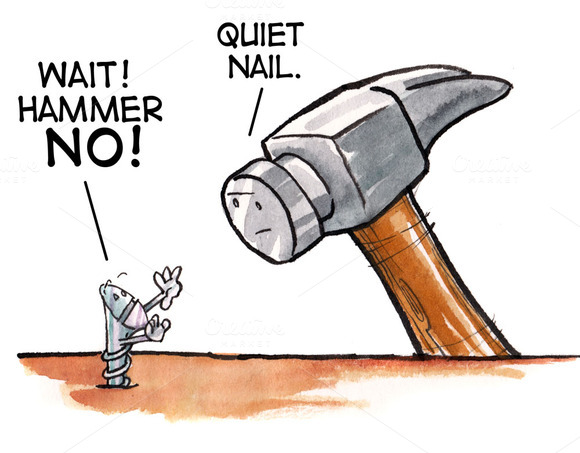
Incredibly, both reports use the words terrorist and extremist interchangeably.

That same year, the DHS launched Operation Vigilant Eagle, which calls for surveillance of military veterans returning from Iraq and Afghanistan, characterizing them as extremists and potential domestic terrorist threats because they may be “disgruntled, disillusioned or suffering from the psychological effects of war.” These reports indicate that for the government, anyone seen as opposing the government—whether they’re Left, Right or somewhere in between—can be labeled an extremist. Under such a definition, John Lennon, Martin Luther King Jr., Patrick Henry, Thomas Jefferson and Samuel Adams—all of whom protested and passionately spoke out against government practices with which they disagreed—would be prime targets.

Fast forward a few years, and you have the National Defense Authorization Act (NDAA), which President Obama has continually re-upped, that allows the military to take you out of your home, lock you up with no access to friends, family or the courts if you’re seen as an extremist. Now connect the dots, from the 2009 Extremism reports to the NDAA and the UN’s Strong Cities Network with its globalized police forces, the National Security Agency’s far-reaching surveillance networks, and fusion centers that collect and share surveillance data between local, state and federal police agencies.

Add in tens of thousands of armed, surveillance drones that will soon blanket American skies, facial recognition technology that will identify and track you wherever you go and whatever you do. And then to complete the circle, toss in the real-time crime centers being deployed in cities across the country, which will be attempting to “predict” crimes and identify criminals before they happen based on widespread surveillance, complex mathematical algorithms and prognostication programs.

Hopefully you’re getting the picture, which is how easy it is for the government to identify, label and target individuals as “extremist.”

All that we have been subjected to in recent years—living under the shadow of NSA spying; motorists strip searched and anally probed on the side of the road; innocent Americans spied upon while going about their daily business in schools and stores; homeowners having their doors kicked in by militarized SWAT teams serving routine warrants—illustrates how the government deals with people it views as potential “extremists”: with heavy-handed tactics designed to intimidate the populace into submission and discourage anyone from stepping out of line or challenging the status quo.

What we’re grappling with is a double standard in what the government metes out to the citizenry, and how the citizenry is supposed to treat the government.

SWAT teams can crash through our doors without impunity, but if we dare to defend ourselves against unknown government assailants, we’ll be shot or jailed.

Government agents can confiscate our homes, impound our cars and seize our bank accounts on the slightest suspicion of wrongdoing, but we’ll face jail time and fines for refusing to pay taxes in support of government programs with which we might disagree.

Government spies can listen in on our phone calls, read our emails and text messages, track our movements, photograph our license plates, and even enter our biometric information into DNA databases, but those who dare to film potential police misconduct will likely get roughed up by the police, arrested, and charged with violating various and sundry crimes.

This phenomenon is what philosopher Abraham Kaplan referred to as the law of the instrument, which essentially says that to a hammer, everything looks like a nail. In the scenario that has been playing out in recent years, we the citizenry have become the nails to be hammered by the government’s battalion of laws and law enforcers: its police officers, technicians, bureaucrats, spies, snitches, inspectors, accountants, etc.

This is exactly what those who drafted the U.S. Constitution feared: that laws and law enforcers would be used as tools by a despotic government to wage war against the citizenry.

That is exactly what we are witnessing today: a war against the American citizenry.

Is it any wonder then that Americans are starting to resist?

*This article can also be found at The Rutherford Institute.

“Those who cannot remember the past are condemned to repeat it.”—George Santayana, The Life of Reason, Vol. 1

In Harold Ramis’ classic 1993 comedy Groundhog Day, TV weatherman Phil Connors (played by Bill Murray) is forced to live the same day over and over again until he not only gains some insight into his life but changes his priorities.

Battlefield_Cover_300Similarly, as I illustrate in my book Battlefield America: The War on the American People, we in the emerging American police state find ourselves reliving the same set of circumstances over and over again—egregious surveillance, strip searches, police shootings of unarmed citizens, government spying, the criminalization of lawful activities, war-mongering, etc.—although with far fewer moments of comic hilarity.

What remains to be seen is whether 2016 will bring more of the same or whether “we the people” will wake up from our somnambulant states. Indeed, when it comes to civil liberties and freedom, 2015 was far from a banner year.

The following is just a sampling of what we can look forward to repeating if we don’t find some way to push back against the menace of an overreaching, aggressive, invasive, militarized surveillance state.

More surveillance. The surveillance state is alive and well and kicking privacy to shreds in America. Whether you’re walking through a store, driving your car, checking email, or talking to friends and family on the phone, you can be sure that some government agency, whether the NSA or some other entity, will still be listening in and tracking your behavior. This doesn’t even begin to touch on the corporate trackers that monitor your purchases, web browsing, Facebook posts and other activities taking place in the cyber sphere. We are now in a state of transition with the police state shifting into high-gear under the auspices of the surveillance state. In such an environment, we are all suspects to be spied on, searched, scanned, frisked, monitored, tracked and treated as if we’re potentially guilty of some wrongdoing or other. Even our homes provide little protection against government intrusions. Police agencies, already empowered to crash through your door if they suspect you’re up to no good, now have radars that allow them to “see” through the walls of your home.

More militarized police. Americans will continue to be rendered powerless in the face of militarized police. In early America, government agents were not permitted to enter one’s home without permission or in a deceitful manner. And citizens could resist arrest when a police officer tried to restrain them without proper justification or a warrant. Daring to dispute a warrant with a police official today who is armed with high-tech military weapons would be nothing short of suicidal. Moreover, as police forces across the country continue to be transformed into extensions of the military, Americans are finding their once-peaceful communities transformed into military outposts, complete with tanks, weaponry, and other equipment designed for the battlefield. Having already transformed local police into extensions of the military, now the Department of Homeland Security, the Justice Department and the FBI are preparing to turn the nation’s police officers into techno-warriors, complete with iris scanners, body scanners, thermal imaging Doppler radar devices, facial recognition programs, license plate readers, cell phone Stingray devices and so much more.

More police shootings of unarmed citizens. Owing in large part to the militarization of local law enforcement agencies, not a week goes by without more reports of hair-raising incidents by police imbued with a take-no-prisoners attitude and a battlefield approach to the communities in which they serve.

More so-called “terrorist” attacks. Despite the government’s endless propaganda about the threat of terrorism and even in the wake of the shootings in San Bernardino and Paris, statistics show that you are 17,600 times more likely to die from heart disease than from a terrorist attack. You are 11,000 times more likely to die from an airplane accident than from a terrorist plot involving an airplane. You are 1,048 times more likely to die from a car accident than a terrorist attack. You are 404 times more likely to die in a fall than from a terrorist attack. And you are 8 times more likely to be killed by a police officer than by a terrorist.

More costly wars. The military industrial complex that has advocated that the U.S. remain at war, year after year, is the very entity that will continue to profit the most from America’s expanding military empire. The U.S. Department of Defense is the world’s largest employer, with more than 3.2 million employees. Thus far, the U.S. taxpayer has been made to shell out more than $1.6 trillion to wage wars in Afghanistan and Iraq. When you add in our military efforts in Pakistan, as well as the lifetime price of health care for disabled veterans and interest on the national debt, that cost rises to $4.4 trillion.

More attempts by the government to identify, target and punish so-called domestic “extremists.” In much the same way that the USA Patriot Act was used as a front to advance the surveillance state, the government’s anti-extremism program will, in many cases, be utilized to render otherwise lawful, nonviolent activities as potentially extremist. To this end, police will identify, monitor and deter individuals who exhibit, express or engage in anything that could be construed as extremist before they can become actual threats. This is pre-crime on an ideological scale and it’s been a long time coming. Moreover, under the guise of fighting violent extremism “in all of its forms and manifestations” in cities and communities across the world, the Obama administration has agreed to partner with the United Nations to take part in its Strong Cities Network program and hire a domestic extremism czar.

More SWAT team raids. More than 80% of American communities have their own SWAT teams, with more than 80,000 of these paramilitary raids are carried out every year. That translates to more than 200 SWAT team raids every day in which police crash through doors, damage private property, kill citizens, terrorize adults and children alike, kill family pets, assault or shoot anyone that is perceived as threatening—and all in the pursuit of someone merely suspected of a crime, usually some small amount of drugs.

More erosions of private property. Private property means little at a time when SWAT teams and other government agents can invade your home, break down your doors, kill your dog, wound or kill you, damage your furnishings and terrorize your family. Likewise, if government officials can fine and arrest you for growing vegetables in your front yard, praying with friends in your living room, installing solar panels on your roof, and raising chickens in your backyard, you’re no longer the owner of your property.

More debt. Currently, the national debt is somewhere in the vicinity of a whopping $18.1 trillion and rising that our government owes to foreign countries, private corporations and its retirement programs. Not only is the U.S. the largest debtor nation in the world, but according to Forbes, “the amount of interest on the national debt is estimated to be accumulating at a rate of over one million dollars per minute.”

More government contractors. Despite all the talk about big and small government, what we have been saddled with is a government that is outsourcing much of its work to high-paid contractors at great expense to the taxpayer and with no competition, little transparency and dubious savings. According to the Washington Post, “By some estimates, there aretwice as many people doing government work under contract than there are government workers.” These open-ended contracts, worth hundreds of millions of dollars, “now account for anywhere between one quarter and one half of all federal service contracting.”

More overcriminalization. The government’s tendency towards militarization and overcriminalization, in which routine, everyday behaviors become targets of regulation and prohibition, have resulted in Americans getting arrested for making and selling unpasteurized goat cheese, cultivating certain types of orchids, feeding a whale, holding Bible studies in their homes, and picking their kids up from school.

More strip searches and the denigration of bodily integrity. The Fourth Amendment to the U.S. Constitution was intended to protect the citizenry from being subjected to “unreasonable searches and seizures” by government agents. While the literal purpose of the amendment is to protect our property and our bodies from unwarranted government intrusion, the moral intention behind it is to protect our human dignity. Unfortunately, court rulings undermining the Fourth Amendment and justifying invasive strip searches have left us powerless against police empowered to forcefully draw our blood, forcibly take our DNA, strip search us, and probe us intimately. Accounts are on the rise of individuals—men and women alike—being subjected to what is essentially government-sanctioned rape by police in the course of “routine” traffic stops.

More injustice. Americans can no longer rely on the courts to mete out justice. The courts were established to intervene and protect the people against the government and its agents when they overstep their bounds. Yet the courts increasingly march in lockstep with the police state, while concerned themselves primarily with advancing the government’s agenda, no matter how unjust or illegal. As a result, Americans have no protection against police abuse. It is no longer unusual to hear about incidents in which police shoot unarmed individuals first and ask questions later. What is increasingly common, however, is the news that the officers involved in these incidents get off with little more than a slap on the hands.

More political spectacles. Americans continue to naively buy into the idea that politics matter, as if there really were a difference between the Republicans and Democrats (there’s not). As if Barack Obama proved to be any different from George W. Bush (he has not). As if Hillary Clinton’s values are any different from Donald Trump’s (with both of them, money talks). As if when we elect a president, we’re getting someone who truly represents “we the people” rather than the corporate state (in fact, in the oligarchy that is the American police state, an elite group of wealthy donors is calling the shots). Politics in America is a game, a joke, a hustle, a con, a distraction, a spectacle, a sport, and for many devout Americans, a religion. In other words, it’s a sophisticated ruse aimed at keeping us divided and fighting over two parties whose priorities are exactly the same.

More drones. As corporations and government agencies alike prepare for their part in the coming drone invasion—it is expected that at least 30,000 drones will occupy U.S. airspace by 2020, ushering in a $30 billion per year industry—it won’t be long before American citizens who will be the target of these devices discover first-hand that drones—unmanned aerial vehicles—come in all shapes and sizes, from nano-sized drones as small as a grain of sand that can do everything from conducting surveillance to detonating explosive charges, to middle-sized copter drones that can deliver pizzas to massive “hunter/killer” Predator warships that unleash firepower from on high.

More dumbed down, locked down public schools. Our schools have become training grounds for compliant citizens. Despite the fact that we spend more than most of the world on education ($115,000 per student), we rank 36th in the world when it comes to math, reading and science, far below most of our Asian counterparts. Even so, we continue to insist on standardized programs such as Common Core, which teach students to be test-takers rather than thinkers. Making matters worse is the heavy police presence in schools, which have become little more than quasi-prisons in which classrooms are locked down and kids as young as age 4 are being handcuffed for “acting up,” subjected to body searches, and suspended for childish behavior.

More ignorance about our rights. Americans know little to nothing about their rights or how the government is supposed to operate. This includes educators and politicians. For example, 27 percent of elected officials cannot name even one right or freedom guaranteed by the First Amendment, while 54 percent do not know the Constitution gives Congress the power to declare war.

More prisons. Our prisons, housing the largest number of inmates in the world and still growing, have become money-making enterprises for private corporations that manage the prisons in exchange for the states agreeing to maintain a 90% occupancy rate for at least 20 years. And how do you keep the prisons full? By passing laws aimed at increasing the prison population, including the imposition of life sentences on people who commit minor or nonviolent crimes such as siphoning gasoline. Little surprise, then, that the United States has 5% of the world’s population, but 25% of the world’s prisoners.

More corruption. If there is any absolute maxim by which the federal government seems to operate, it is that the American taxpayer always gets ripped off. This is true, whether you’re talking about taxpayers being forced to fund high-priced weaponry that will be used against us, endless wars that do little for our safety or our freedoms, or bloated government agencies such as the National Security Agency with its secret budgets, covert agendas and clandestine activities. Rubbing salt in the wound, even monetary awards in lawsuits against government officials who are found guilty of wrongdoing are paid by the taxpayer.

More censorship. First Amendment activities are being pummeled, punched, kicked, choked, chained and generally gagged all across the country. The reasons for such censorship vary widely from political correctness, safety concerns and bullying to national security and hate crimes but the end result remains the same: the complete eradication of what Benjamin Franklin referred to as the “principal pillar of a free government.” Free speech zones, bubble zones, trespass zones, anti-bullying legislation, zero tolerance policies, hate crime laws and a host of other legalistic maladies dreamed up by politicians and prosecutors have conspired to corrode our core freedoms. As a result, we are no longer a nation of constitutional purists for whom the Bill of Rights serves as the ultimate authority. We have litigated and legislated our way into a new governmental framework where the dictates of petty bureaucrats carry greater weight than the inalienable rights of the citizenry.

More fascism. As a Princeton University survey indicates, our elected officials, especially those in the nation’s capital, represent the interests of the rich and powerful rather than the average citizen. We are no longer a representative republic. With Big Business and Big Government having fused into a corporate state, the president and his state counterparts—the governors, have become little more than CEOs of the Corporate State, which day by day is assuming more government control over our lives. Never before have average Americans had so little say in the workings of their government and even less access to their so-called representatives.

More fear. We’re being fed a constant diet of fear, which has resulted in Americans adopting an “us” against “them” mindset that keeps us divided into factions, unable to reach consensus about anything and too distracted to notice the police state closing in on us.

James Madison, the father of the Constitution, put it best: “Take alarm,” he warned, “at the first experiment with liberties.” Anyone with even a casual knowledge about current events knows that the first experiment on our freedoms happened long ago. Worse, we have not heeded the warnings of Madison and those like him who understood that if you give the government an inch, they will take a mile. Unfortunately, the government has not only taken a mile, they have taken mile after mile after mile after mile with seemingly no end in sight for their power grabs.

If you’re in the business of making New Year’s resolutions, why not resolve that 2016 will be the year we break the cycle of tyranny and get back on the road to freedom? No matter what the politicians say about the dire state of our nation, you can rest assured that none of the problems that continue to plague our lives and undermine our freedoms will be resolved by our so-called elected representatives in any credible, helpful way in the new year.

“We the people”—the citizenry, not the politicians—are the only ones who have ever been able to enact effective change, and there is a lot that needs to change.

All of the signs point to something nasty up ahead.

“Two thousand years later … the memory of the revolutionary zealot who walked across Galilee gathering an army of disciples with the goal of establishing the Kingdom of God on earth, the magnetic preacher who defied the authority of the Temple priesthood in Jerusalem, the radical Jewish nationalist who challenged the Roman occupation and lost, has been almost completely lost to history.” ― Reza Aslan, religious scholar

The Christmas narrative of a baby born in a manger is a familiar one.

The Roman Empire, a police state in its own right, had ordered that a census be conducted. Joseph and his pregnant wife Mary traveled to the little town of Bethlehem so that they could be counted. There being no room for the couple at any of the inns, they stayed in a stable, where Mary gave birth to a baby boy. That boy, Jesus, would grow up to undermine the political and religious establishment of his day and was eventually crucified as a warning to others not to challenge the powers-that-be.

But what if Jesus, the revered preacher, teacher, radical and prophet, had been born 2,000 years later? How would Jesus’ life have been different had he be born and raised in the American police state?

Consider the following if you will.

Had Jesus been born in the year 2015…

Rather than traveling to Bethlehem for a census, Jesus’ parents would have been mailed a 28-page American Community Survey, a mandatory government questionnaire documenting their habits, household inhabitants, work schedule, and even how many toilets were in their home, etc. The penalty for not responding to this invasive survey would have resulted in a fine of $5,000.

Instead of being born in a manger, Jesus might have been born at home. Rather than wise men and shepherds bringing gifts, however, the baby’s parents might have been forced to ward off visits from state social workers intent on prosecuting them for the home birth. One couple in Washington had all three of their children removed after social services objected to the two youngest being birthed in an unassisted home delivery.

Had Jesus been born in a hospital, his blood and DNA would have been taken and entered into a government biobank without his parents’ knowledge or consent. While most states require newborn screening, a growing number are indefinitely holding onto that genetic material long-term for research, analysis and purposes yet to be disclosed.

Then again, had his parents been undocumented immigrants, they and the newborn baby might have been shuffled to aprofit-driven, private detention center for illegals. There’s quite a lot of money to be made from imprisoning immigrants, especially when taxpayers are footing the bill.

Once in school, Jesus would have been drilled in lessons of compliance and obedience to government authorities, all the while learning little about his own rights. And if he dared to challenge school officials, he might have found himself suspended under a school zero tolerance policy that punishes minor infractions (such as doodling or talking in class) as harshly as more serious offenses (such as bringing a weapon to class).

According to scripture, Jesus, at the age of twelve, wandered the temple courts in Jerusalem alone and unsupervised. Today, had Jesus disappeared for a few hours let alone days, his parents would have been handcuffed, arrested and jailed for parental negligence. Parents across the country have been arrested for far less “offenses” such as allowing their children to walk to the park unaccompanied and play in their front yard alone.

Rather than disappearing from the history books from his early teenaged years to adulthood, Jesus’ movements and personal data—including his biometrics—would have been documented, tracked, monitored and filed by governmental agencies and corporations such as Google and Microsoft. Incredibly, 95 percent of school districts share their student records with outside companies contracted to manage the data.

If Jesus were to ever make contact with the likes of John the Baptist, he would have been flagged for surveillance because of his association with a prominent activist, peaceful or otherwise. Since 9/11, the FBI has actively carried out surveillance and intelligence-gathering operations on a broad range of activist groups, from animal rights groups to poverty relief and anti-war organizations.

Rather than being permitted to live as an itinerant preacher, Jesus might have found himself threatened with arrest for daring to live off the grid or sleeping outside. In fact, the number of cities that have resorted to criminalizing homelessness by enacting bans on camping, sleeping in vehicles, loitering and begging in public has doubled in recent years.

Had his travels taken him from community to community, Jesus might have been reported to government officials as “suspicious” under the Department of Homeland Security’s “See Something, Say Something” programs. Many states, including New York, are providing individuals with phone apps that allow them to take photos of suspicious activity and report them to their state Intelligence Center, where they are reviewed and forwarded to law-enforcement agencies.

Perceived as a dissident and a potential threat to the government’s power, Jesus might have had government spies planted among his followers in order to monitor his activities, report on his movements, and entrap him into breaking the law.

Jesus’ anti-government views would certainly have resulted in him being labeled a domestic extremist. Law enforcement agencies are being trained to recognize signs of anti-government extremism during interactions with potential extremists who share a “belief in the approaching collapse of government and the economy.”

Assuming Jesus used the internet to spread his radical message of peace and love, he might have found his blog posts infiltrated by government spies attempting to undermine his integrity, discredit him or plant incriminating information online about him. At the very least, he would have had his website hacked and his email monitored.

Had Jesus attempted to feed large crowds of people, he would have been threatened with arrest for violating various ordinances prohibiting the distribution of food without a permit. Florida officials arrested a 90-year-old man for feeding the homeless on a public beach.
Had Jesus spoken publicly about his 40 days in the desert and his conversations with the devil, he might have been labeled mentally ill and detained in a psych ward against his will for a mandatory involuntary psychiatric hold with no access to family or friends. One Virginia man was arrested, strip searched, handcuffed to a table, diagnosed as having “mental health issues,” and locked up for five days in a mental health facility against his will apparently because of his slurred speech and unsteady gait.

Without a doubt, had Jesus attempted to overturn tables in a Jewish temple and raged against the materialism of religious institutions, he would have been charged with a hate crime. Currently, 45 states and the federal government have hate crime laws on the books.

Rather than having armed guards capture Jesus in a public place, government officials would have ordered that a SWAT team carry out a raid on Jesus and his followers, complete with flash-bang grenades and military equipment. There are upwards of 80,000 such SWAT team raids carried out every year, many on unsuspecting Americans who have no defense against such government invaders, even when such raids are done in error.

Instead of being detained by Roman guards, Jesus might have been made to “disappear” into a secret government detention center where he would have been interrogated, tortured and subjected to all manner of abuses. Chicago police “disappeared” more than 7,000 people into a secret, off-the-books interrogation warehouse at Homan Square.

Charged with treason and labeled a domestic terrorist, Jesus might have been sentenced to a life-term in a private prison where he would have been forced to provide slave labor for corporations or put to death by way of the electric chair or a lethal mixture of drugs.

Either way, as I make clear in my book Battlefield America: The War on the American People, whether Jesus had been born in our modern age or his own, he still would have died at the hands of a police state.