Posts Tagged ‘police state’

“Whenever any American’s life is taken by another American unnecessarily—whether it is done in the name of the law or in the defiance of law, by one man or a gang, in cold blood or in passion, in an attack of violence or in response to violence—whenever we tear at the fabric of life which another man has painfully and clumsily woven for himself and his children, the whole nation is degraded.”— Robert F. Kennedy on the assassination of Martin Luther King Jr. (1968)

There’s a subtext to this assassination attempt on former President Trump that must not be ignored, and it is simply this: America is being pushed to the brink of a national nervous breakdown.

More than 50 years after John F. Kennedy, Martin Luther King Jr., and Robert F. Kennedy were assassinated, America has become a ticking time bomb of political violence in words and deeds.

Magnified by an echo chamber of nasty tweets and government-sanctioned brutality, our politically polarizing culture of callousness, cruelty, meanness, ignorance, incivility, hatred, intolerance, indecency and injustice have only served to ratchet up the tension.

Consumed with back-biting, partisan politics, sniping, toxic hate, meanness and materialism, a culture of meanness has come to characterize many aspects of the nation’s governmental and social policies. “Meanness today is a state of mind,” writes professor Nicolaus Mills in his book The Triumph of Meanness, “the product of a culture of spite and cruelty that has had an enormous impact on us.”

This casual cruelty is made possible by a growing polarization within the populace that emphasizes what divides us—race, religion, economic status, sexuality, ancestry, politics, etc.—rather than what unites us: we are all Americans, and in a larger, more global sense, we are all human.

This is what writer Anna Quindlen refers to as “the politics of exclusion, what might be thought of as the cult of otherness… It divides the country as surely as the Mason-Dixon line once did. And it makes for mean-spirited and punitive politics and social policy.”

This is more than meanness, however.

We are imploding on multiple fronts, all at once.

This is what happens when ego, greed and power are allowed to take precedence over liberty, equality and justice.

This is the psychopathic mindset adopted by the architects of the Deep State, and it applies equally whether you’re talking about Democrats or Republicans.

Beware, because this kind of psychopathology can spread like a virus among the populace.

As an academic study into pathocracy concluded, “[T]yranny does not flourish because perpetuators are helpless and ignorant of their actions. It flourishes because they actively identify with those who promote vicious acts as virtuous.”

People don’t simply line up and salute. It is through one’s own personal identification with a given leader, party or social order that they become agents of good or evil. To this end, “we the people” have become “we the police state.”

By failing to actively take a stand for good, we become agents of evil. It’s not the person in charge who is solely to blame for the carnage. It’s the populace that looks away from the injustice, that empowers the totalitarian regime, that welcomes the building blocks of tyranny.

This realization hit me full-force a few years ago. I had stopped into a bookstore and was struck by all of the books on Hitler, everywhere I turned. Yet had there been no Hitler, there still would have been a Nazi regime. There still would have been gas chambers and concentration camps and a Holocaust.

Hitler wasn’t the architect of the Holocaust. He was merely the figurehead. Same goes for the American police state: had there been no Trump or Obama or Bush, there still would have been a police state. There still would have been police shootings and private prisons and endless wars and government pathocracy.

Why? Because “we the people” have paved the way for this tyranny to prevail.

By turning Hitler into a super-villain who singlehandedly terrorized the world—not so different from how Trump is often depicted—historians have given Hitler’s accomplices (the German government, the citizens that opted for security and order over liberty, the religious institutions that failed to speak out against evil, the individuals who followed orders even when it meant a death sentence for their fellow citizens) a free pass.

This is how tyranny rises and freedom falls.

None of us who remain silent and impassive in the face of evil, racism, extreme materialism, meanness, intolerance, cruelty, injustice and ignorance get a free pass.

Those among us who follow figureheads without question, who turn a blind eye to injustice and turn their backs on need, who march in lockstep with tyrants and bigots, who allow politics to trump principle, who give in to meanness and greed, and who fail to be outraged by the many wrongs being perpetrated in our midst, it is these individuals who must shoulder the blame when the darkness wins.

Darkness cannot drive out darkness; only light can do that. Hate cannot drive out hate, only love can do that,” Martin Luther King Jr. sermonized.

The darkness is winning.

It’s not just on the world stage we must worry about the darkness winning.

The darkness is winning in our communities. It’s winning in our homes, our neighborhoods, our churches and synagogues, and our government bodies. It’s winning in the hearts of men and women the world over who are embracing hatred over love. It’s winning in every new generation that is being raised to care only for themselves, without any sense of moral or civic duty to stand for freedom.

John F. Kennedy, killed by an assassin’s bullet five years before King would be similarly executed, spoke of a torch that had been “passed to a new generation of Americans—born in this century, tempered by war, disciplined by a hard and bitter peace, proud of our ancient heritage—and unwilling to witness or permit the slow undoing of those human rights to which this nation has always been committed, and to which we are committed today at home and around the world.”

Once again, a torch is being passed to a new generation, but this torch is setting the world on fire, burning down the foundations put in place by our ancestors, and igniting all of the ugliest sentiments in our hearts.

This fire is not liberating; it is destroying.

We are teaching our children all the wrong things: we are teaching them to hate, teaching them to worship false idols (materialism, celebrity, technology, politics), teaching them to prize vain pursuits and superficial ideals over kindness, goodness and depth.

We are on the wrong side of the revolution.

“If we are to get on to the right side of the world revolution,” advised King, “we as a nation must undergo a radical revolution of values. We must rapidly begin the shift from a thing-oriented society to a person-oriented society.

Freedom demands responsibility.

Freedom demands that we stop thinking as Democrats and Republicans and start thinking like human beings, or at the very least, Americans.

JFK was killed in 1963 for daring to challenge the Deep State.

King was killed in 1968 for daring to challenge the military industrial complex.

Robert F. Kennedy offered these remarks to a polarized nation in the wake of King’s assassination:

“In this difficult day, in this difficult time for the United States, it is perhaps well to ask what kind of a nation we are and what direction we want to move in. [Y]ou can be filled with bitterness, with hatred, and a desire for revenge. We can move in that direction as a country, in great polarization…filled with hatred toward one another. Or we can make an effort … to understand and to comprehend, and to replace that violence, that stain of bloodshed that has spread across our land, with an effort to understand with compassion and love… What we need in the United States is not division; what we need in the United States is not hatred; what we need in the United States is not violence or lawlessness; but love and wisdom, and compassion toward one another, and a feeling of justice toward those who still suffer within our country, whether they be white or they be black.”

Two months later, RFK was also killed by an assassin’s bullet.

Fifty-plus years later, we’re still being terrorized by assassins’ bullets, but what these madmen are really trying to kill is that dream of a world in which all Americans “would be guaranteed the unalienable rights of life, liberty, and the pursuit of happiness.”

We haven’t dared to dream that dream in such a long time.

But imagine…

Imagine what this country would be like if Americans put aside their differences and dared to stand up—united—for freedom.

Imagine what this country would be like if Americans put aside their differences and dared to speak out—with one voice—against injustice.

Imagine what this country would be like if Americans put aside their differences and dared to push back—with the full force of our collective numbers—against government corruption and despotism.

As I make clear in my book Battlefield America: The War on the American People and in its fictional counterpart The Erik Blair Diaries, tyranny wouldn’t stand a chance.

Source: https://tinyurl.com/2twu3k76

ABOUT JOHN W. WHITEHEAD

Constitutional attorney and author John W. Whitehead is founder and president of The Rutherford Institute. His most recent books are the best-selling Battlefield America: The War on the American People, the award-winning A Government of Wolves: The Emerging American Police State, and a debut dystopian fiction novel, The Erik Blair Diaries. Whitehead can be contacted at staff@rutherford.org. Nisha Whitehead is the Executive Director of The Rutherford Institute. Information about The Rutherford Institute is available at www.rutherford.org.

Publication Guidelines / Reprint Permission

John W. Whitehead’s weekly commentaries are available for publication to newspapers and web publications at no charge. 

“The biggest mistake I see is people waiting for A Big Sign that’ll tell them that things have gone too far. One Big Thing that police or lawmakers or the president/leaders will do that will cross the line. It’ll never come because they won’t cross it. They’ll move the line. That line you think you stand behind is shifting everyday with little actions, bills, legislations… That line will stop moving one day, & it’ll be too late… Every day, your sensitivity is being eroded by these willful atrocities. The envelope for what you’ll accept is being pushed. One day, all of these things will be your new normal.”—Nigerian writer Suyi Davies Okungbowa

The U.S. government is working to re-shape the country in the image of a totalitarian state.

This has remained true over the past 50-plus years no matter which political party held office.

This will remain true no matter who wins the 2024 presidential election.

In the midst of the partisan furor over Project 2025, a 920-page roadmap for how to re-fashion the government to favor so-called conservative causes, both the Right and the Left have proven themselves woefully naive about the dangers posed by the power-hungry Deep State.

Yet we must never lose sight of the fact that both the Right and the Left and their various operatives are extensions of the Deep State, which continues to wage psychological warfare on the American people.

Psychological warfare, according to the Rand Corporation, “involves the planned use of propaganda and other psychological operations to influence the opinions, emotions, attitudes, and behavior of opposition groups.”

For years now, the government has been bombarding the citizenry with propaganda campaigns and psychological operations aimed at keeping us compliant, easily controlled and supportive of the government’s various efforts abroad and domestically.

The government is so confident in its Orwellian powers of manipulation that it’s taken to bragging about them. For example, in 2022, the U.S. Army’s 4th Psychological Operations Group, the branch of the military responsible for psychological warfare, released a recruiting video that touts its efforts to pull the strings, turn everything they touch into a weapon, be everywhere, deceive, persuade, change, influence, and inspire.

Have you ever wondered who’s pulling the strings?” the psyops video posits. “Anything we touch is a weapon. We can deceive, persuade, change, influence, inspire. We come in many forms. We are everywhere.”

This is the danger that lurks in plain sight.

Of the many weapons in the government’s vast arsenal, psychological warfare may be the most devastating in terms of the long-term consequences.

As the military journal Task and Purpose explains, “Psychological warfare is all about influencing governments, people of power, and everyday citizens.”

Mind you, these psyops (psychological operations) campaigns aren’t only aimed at foreign enemies. The government has made clear in word and deed that “we the people” are domestic enemies to be targeted, tracked, manipulated, micromanaged, surveilled, viewed as suspects, and treated as if our fundamental rights are mere privileges that can be easily discarded.

This is what is referred to as “apple-pie propaganda.”

Aided and abetted by technological advances and scientific experimentation, the government has been subjecting the American people to “apple-pie propaganda” for the better part of the last century.

Consider some of the ways in which the government continues to wage psychological warfare on a largely unsuspecting citizenry in order to acclimate us to the Deep State’s totalitarian agenda.

Weaponizing violence in order to institute martial law. With alarming regularity, the nation continues to be subjected to spates of violence that terrorizes the public, destabilizes the country’s ecosystem, and gives the government greater justifications to crack down, lock down, and institute even more authoritarian policies for the so-called sake of national security without many objections from the citizenry.

Weaponizing surveillance, pre-crime and pre-thought campaigns. Surveillance, digital stalking and the data mining of the American people add up to a society in which there’s little room for indiscretions, imperfections, or acts of independence. When the government sees all and knows all and has an abundance of laws to render even the most seemingly upstanding citizen a criminal and lawbreaker, then the old adage that you’ve got nothing to worry about if you’ve got nothing to hide no longer applies. Add pre-crime programs into the mix with government agencies and corporations working in tandem to determine who is a potential danger and spin a sticky spider-web of threat assessments, behavioral sensing warnings, flagged “words,” and “suspicious” activity reports using automated eyes and ears, social media, behavior sensing software, and citizen spies, and you having the makings for a perfect dystopian nightmare. The government’s war on crime has now veered into the realm of social media and technological entrapment, with government agents adopting fake social media identities and AI-created profile pictures in order to surveil, target and capture potential suspects.

Weaponizing digital currencies, social media scores and censorship. Tech giants, working with the government, have been meting out their own version of social justice by way of digital tyranny and corporate censorship, muzzling whomever they want, whenever they want, on whatever pretext they want in the absence of any real due process, review or appeal. Unfortunately, digital censorship is just the beginning. Digital currencies (which can be used as “a tool for government surveillance of citizens and control over their financial transactions”), combined with social media scores and surveillance capitalism create a litmus test to determine who is worthy enough to be part of society and punish individuals for moral lapses and social transgressions (and reward them for adhering to government-sanctioned behavior). In China, millions of individuals and businesses, blacklisted as “unworthy” based on social media credit scores that grade them based on whether they are “good” citizens, have been banned from accessing financial markets, buying real estate or travelling by air or train.

Weaponizing compliance. Even the most well-intentioned government law or program can be—and has been—perverted, corrupted and used to advance illegitimate purposes once profit and power are added to the equation. The war on terror, the war on drugs, the war on COVID-19, the war on illegal immigration, asset forfeiture schemes, road safety schemes, school safety schemes, eminent domain: all of these programs started out as legitimate responses to pressing concerns and have since become weapons of compliance and control in the police state’s hands.

Weaponizing entertainment. For the past century, the Department of Defense’s Entertainment Media Office has provided Hollywood with equipment, personnel and technical expertise at taxpayer expense. In exchange, the military industrial complex has gotten a starring role in such blockbusters as Top Gun and its rebooted sequel Top Gun: Maverick, which translates to free advertising for the war hawks, recruitment of foot soldiers for the military empire, patriotic fervor by the taxpayers who have to foot the bill for the nation’s endless wars, and Hollywood visionaries working to churn out dystopian thrillers that make the war machine appear relevant, heroic and necessary. As Elmer Davis, a CBS broadcaster who was appointed the head of the Office of War Information, observed, “The easiest way to inject a propaganda idea into most people’s minds is to let it go through the medium of an entertainment picture when they do not realize that they are being propagandized.”

Weaponizing behavioral science and nudging. Apart from the overt dangers posed by a government that feels justified and empowered to spy on its people and use its ever-expanding arsenal of weapons and technology to monitor and control them, there’s also the covert dangers associated with a government empowered to use these same technologies to influence behaviors en masse and control the populace. In fact, it was President Obama who issued an executive order directing federal agencies to use “behavioral science” methods to minimize bureaucracy and influence the way people respond to government programs. It’s a short hop, skip and a jump from a behavioral program that tries to influence how people respond to paperwork to a government program that tries to shape the public’s views about other, more consequential matters. Thus, increasingly, governments around the world—including in the United States—are relying on “nudge units” to steer citizens in the direction the powers-that-be want them to go, while preserving the appearance of free will.

Weaponizing desensitization campaigns aimed at lulling us into a false sense of security. The events of recent years—the invasive surveillance, the extremism reports, the civil unrest, the protests, the shootings, the bombings, the military exercises and active shooter drills, the lockdowns, the color-coded alerts and threat assessments, the fusion centers, the transformation of local police into extensions of the military, the distribution of military equipment and weapons to local police forces, the government databases containing the names of dissidents and potential troublemakers—have conspired to acclimate the populace to accept a police state willingly, even gratefully.

Weaponizing politics. The language of fear is spoken effectively by politicians on both sides of the aisle, shouted by media pundits from their cable TV pulpits, marketed by corporations, and codified into bureaucratic laws that do little to make our lives safer or more secure. Fear, as history shows, is the method most often used by politicians to increase the power of government and control a populace, dividing the people into factions, and persuading them to see each other as the enemy. This Machiavellian scheme has so ensnared the nation that few Americans even realize they are being manipulated into adopting an “us” against “them” mindset. Instead, fueled with fear and loathing for phantom opponents, they agree to pour millions of dollars and resources into political elections, militarized police, spy technology and endless wars, hoping for a guarantee of safety that never comes. All the while, those in power—bought and paid for by lobbyists and corporations—move their costly agendas forward, and “we the suckers” get saddled with the tax bills and subjected to pat downs, police raids and round-the-clock surveillance.

Weaponizing genetics. Not only does fear grease the wheels of the transition to fascism by cultivating fearful, controlled, pacified, cowed citizens, but it also embeds itself in our very DNA so that we pass on our fear and compliance to our offspring. It’s called epigenetic inheritance, the transmission through DNA of traumatic experiences. For example, neuroscientists observed that fear can travel through generations of mice DNA. As The Washington Post reports, “Studies on humans suggest that children and grandchildren may have felt the epigenetic impact of such traumatic events such as famine, the Holocaust and the Sept. 11, 2001, terrorist attacks.”

Weaponizing the dystopian future. With greater frequency, the government has been issuing warnings about the dire need to prepare for the dystopian future that awaits us. For instance, the Pentagon training video, “Megacities: Urban Future, the Emerging Complexity,” predicts that by 2030 (coincidentally, the same year that society begins to achieve singularity with the metaverse) the military would be called on to use armed forces to solve future domestic political and social problems. What they’re really talking about is martial law, packaged as a well-meaning and overriding concern for the nation’s security. The chilling five-minute training video paints an ominous picture of the future bedeviled by “criminal networks,” “substandard infrastructure,” “religious and ethnic tensions,” “impoverishment, slums,” “open landfills, over-burdened sewers,” a “growing mass of unemployed,” and an urban landscape in which the prosperous economic elite must be protected from the impoverishment of the have nots. “We the people” are the have-nots.

The end goal of these mind control campaigns—packaged in the guise of the greater good—is to see how far the American people will allow the government to go in undermining our freedoms.

The facts speak for themselves.

Whatever else it may be—a danger, a menace, a threat—the U.S. government is certainly not looking out for our best interests, nor is it in any way a friend to freedom.

When the government views itself as superior to the citizenry, when it no longer operates for the benefit of the people, when the people are no longer able to peacefully reform their government, when government officials cease to act like public servants, when elected officials no longer represent the will of the people, when the government routinely violates the rights of the people and perpetrates more violence against the citizenry than the criminal class, when government spending is unaccountable and unaccounted for, when the judiciary act as courts of order rather than justice, and when the government is no longer bound by the laws of the Constitution, then you no longer have a government “of the people, by the people and for the people.”

What we have, as I make clear in my book Battlefield America: The War on the American People and in its fictional counterpart The Erik Blair Diaries, is a government of wolves.

Source: https://tinyurl.com/24yph2j8

ABOUT JOHN W. WHITEHEAD

Constitutional attorney and author John W. Whitehead is founder and president of The Rutherford Institute. His most recent books are the best-selling Battlefield America: The War on the American People, the award-winning A Government of Wolves: The Emerging American Police State, and a debut dystopian fiction novel, The Erik Blair Diaries. Whitehead can be contacted at staff@rutherford.org. Nisha Whitehead is the Executive Director of The Rutherford Institute. Information about The Rutherford Institute is available at www.rutherford.org.

Publication Guidelines / Reprint Permission

John W. Whitehead’s weekly commentaries are available for publication to newspapers and web publications at no charge. 

“The relationship between the President and the people he serves has shifted irrevocably. In every use of official power, the President is now a king above the law.”—Justice Sonia Sotomayor dissenting in Trump v. United States

The U.S. Supreme Court has made it official: the president of the United States can now literally get away with murder.

In a devastating 6-3 ruling in Trump v. United States that is equal parts politically short-sighted, self-servingly partisan, and utterly devoid of any pretense that the president is anything other than a dictator, the Supreme Court has validated what Richard Nixon once claimed: “When the president does it, that means that it is not illegal.”

As Justice Sotomayor concluded in her powerful dissent:

“The President of the United States is the most powerful person in the country, and possibly the world. When he uses his official powers in any way, under the majority’s reasoning, he now will be insulated from criminal prosecution. Orders the Navy’s Seal Team 6 to assassinate a political rival? Immune. Organizes a military coup to hold onto power? Immune. Takes a bribe in exchange for a pardon? Immune. Immune, immune, immune. Let the President violate the law, let him exploit the trappings of his office for personal gain, let him use his official power for evil ends. Because if he knew that he may one day face liability for breaking the law, he might not be as bold and fearless as we would like him to be. That is the majority’s message today. Even if these nightmare scenarios never play out, and I pray they never do, the damage has been done.”

The damage has indeed been done. Indubitably. Irrevocably. Unarguably.

Every American should be outraged, offended and afraid of what this ruling means for the future of our nation.

There can be no more pretending that we live in a constitutional republic. It’s all out in the open now. This is a dictatorship: Hitler has finally stepped out of the shadows.

The rule of law may have been on life support for a long time, but this ruling pulls the plug.

The facts of the case itself, which asks whether former president Donald Trump is immune from prosecution on charges that he attempted to overturn the 2020 presidential election, are less important than the ramifications of this ruling, which go so far as to dramatically expand the power of the presidency, rendering whoever occupies the Oval Office lawless and unaccountable.

This is exactly how tyranny rises and freedom falls.

In a textbook example of doublespeak, Chief Justice John Roberts, writing for the Supreme Court’s six-person conservative majority, essentially declared that presidents are not above the law and then turned right around and ensured that president can do whatever they want in their official capacity without being held accountable or criminally liable.

As Roberts noted, “We conclude that under our constitutional structure of separated powers, the nature of presidential power requires that a former president have some immunity from criminal prosecution for official acts during his tenure in office. At least with respect to the President’s exercise of his core constitutional powers, this immunity must be absolute.”

Here’s the thing, however: this isn’t anything new. Not really.

Although the Constitution invests the President with very specific, limited powers, in recent years, American presidents have claimed the power to completely and almost unilaterally alter the landscape of this country for good or for ill. The powers amassed by each successive president through the negligence of Congress and the courts—powers which add up to a toolbox of terror for an imperial ruler—empower whoever occupies the Oval Office to act as a dictator, above the law and beyond any real accountability.

As law professor William P. Marshall explains, “every extraordinary use of power by one President expands the availability of executive branch power for use by future Presidents.”

Moreover, it doesn’t even matter whether other presidents have chosen not to take advantage of any particular power, because “it is a President’s action in using power, rather than forsaking its use, that has the precedential significance.”

In other words, each successive president continues to add to his office’s list of extraordinary orders and directives, expanding the reach and power of the presidency and granting him- or herself near dictatorial powers.

All of the imperial powers amassed by past presidents—to kill American citizens without due process, to detain suspects indefinitely, to strip Americans of their citizenship rights, to carry out mass surveillance on Americans without probable cause, to suspend laws during wartime, to disregard laws with which he might disagree, to conduct secret wars and convene secret courts, to sanction torture, to sidestep the legislatures and courts with executive orders and signing statements, to direct the military to operate beyond the reach of the law, to operate a shadow government, and to act as a dictator and a tyrant, above the law and beyond any real accountability—were passed from Clinton to Bush to Obama to Trump to Biden and will be passed along to the next president.

These presidential powers—acquired through the use of executive orders, decrees, memorandums, proclamations, national security directives and legislative signing statements and which can be activated by any sitting president—enable past, president and future presidents to operate above the law and beyond the reach of the Constitution.

These are the powers that continue to be passed along to each successive heir to the Oval Office, the Constitution be damned.

So you see, the Supreme Court didn’t make the president a dictator. It merely confirmed what we’ve been warning about all along: the president is already an imperial, unaccountable and unconstitutional dictator with permanent powers.

Absolute power absolutely corrupted the presidency.

As for Trump, his concept of power, immunity and the presidency has always been troubling, self-serving and corrupt.

For instance, in 2016, Trump bragged, “I could stand in the middle of Fifth Avenue and shoot somebody and wouldn’t lose any voters, okay?”

In 2019, Trump declared, “I have to the right to do whatever I want as president.

And in 2023, Trump promised if he were reelected to only be a dictator on “day one.”

Any presidential candidate who promises to be a dictator on day one will be a dictator-in-chief for life. The government does not voluntarily relinquish those powers once it acquires, uses and inevitably abuses them.

As political science professor Gene Sharp warned, “Dictators are not in the business of allowing elections that could remove them from their thrones.”

Which brings me back to the Supreme Court’s ruling on July 1, 2024, which was handed down mere days before the nation celebrates the anniversary of its declaration of independence from the heavy-handed tyranny of King George.

A document seething with outrage over a government which had betrayed its citizens, the Declaration of Independence was signed on July 4, 1776, by 56 men who laid everything on the line, pledged it all—“our Lives, our Fortunes, and our sacred Honor”—because they sought to free the American people from the reign of a dictatorial British emperor and believed in a radical idea: that all people are created to be free.

Labeled traitors, these men were charged with treason, a crime punishable by death. For some, their acts of rebellion would cost them their homes and their fortunes. For others, it would be the ultimate price—their lives.

Yet even knowing the heavy price they might have to pay, these men dared to speak up when silence could not be tolerated. Even after they had won their independence from Great Britain, these new Americans worked to ensure that the rights they had risked their lives to secure would remain secure for future generations.

The result: our Bill of Rights, the first ten amendments to the Constitution.

Imagine the shock and outrage these 56 men would feel were they to discover that 248 years later, the government they had risked their lives to create has been transformed into a militaristic police state in which exercising one’s freedoms—at a minimum, merely questioning a government agent—is often viewed as a flagrant act of defiance.

In fact, had the Declaration of Independence been written today, it would have rendered its signers extremists or terrorists, resulting in them being placed on a government watch list, targeted for surveillance of their activities and correspondence, and potentially arrested, held indefinitely, stripped of their rights and labeled enemy combatants.

Read the Declaration of Independence again, and ask yourself if the list of complaints tallied by Jefferson don’t bear a startling resemblance to the abuses “we the people” are suffering at the hands of the American police state.

In the 248 years since early Americans first declared and eventually won their independence from Great Britain, “we the people” have managed to work ourselves right back under the tyrant’s thumb.

Only this time, the tyrant is one of our own making. The abuses meted out by an imperial government and endured by the American people have not ended. They have merely evolved.

Given the fact that America is a relatively young nation, it hasn’t taken very long for an authoritarian regime to creep into power.

Unfortunately, the bipartisan coup that laid siege to our nation did not happen overnight.

It snuck in under our radar, hiding behind the guise of national security, the war on drugs, the war on terror, the war on immigration, political correctness, hate crimes and a host of other official-sounding programs aimed at expanding the government’s power at the expense of individual freedoms.

The building blocks for the bleak future we’re just now getting a foretaste of—police shootings of unarmed citizens, profit-driven prisons, weapons of compliance, a wall-to-wall surveillance state, pre-crime programs, a suspect society, school-to-prison pipelines, militarized police, overcriminalization, SWAT team raids, endless wars, etc.—were put in place by government officials we trusted to look out for our best interests.

Yet as I make clear in my book Battlefield America: The War on the American People and in its fictional counterpart The Erik Blair Diaries, that does not mean we should give up or give in or tune out.

Folks, if ever there were a time to declare our independence from tyranny, it’s now.

Source: https://tinyurl.com/fk7jb787

ABOUT JOHN W. WHITEHEAD

Constitutional attorney and author John W. Whitehead is founder and president of The Rutherford Institute. His most recent books are the best-selling Battlefield America: The War on the American People, the award-winning A Government of Wolves: The Emerging American Police State, and a debut dystopian fiction novel, The Erik Blair Diaries. Whitehead can be contacted at staff@rutherford.org. Nisha Whitehead is the Executive Director of The Rutherford Institute. Information about The Rutherford Institute is available at www.rutherford.org.

Publication Guidelines / Reprint Permission

John W. Whitehead’s weekly commentaries are available for publication to newspapers and web publications at no charge.
“If liberty means anything at all, it means the right to tell people what they do not want to hear.”—George Orwell

No matter what carefully crafted sound bites and political spin get trotted out by Joe Biden and Donald Trump in advance of the 2024 presidential election, you can rest assured that none of the problems that continue to undermine our freedoms will be addressed in any credible, helpful way by either candidate, despite the dire state of our nation.

Certainly not if doing so might jeopardize their standing with the unions, corporations or the moneyed elite bankrolling their campaigns.

Indeed, the 2024 elections will not do much to alter our present course towards a police state.

Nor will the popularity contest for the new occupant of the White House significantly alter the day-to-day life of the average American greatly at all. Those life-changing decisions are made elsewhere, by nameless, unelected government officials who have turned bureaucracy into a full-time and profitable business.

In the interest of liberty and truth, here are a few uncomfortable truths about life in the American police state that we will not be hearing from either of the two leading presidential candidates.

1. The government is not our friend. Nor does it work for “we the people.” Our so-called government representatives do not actually represent us, the citizenry. We are now ruled by an oligarchic elite of governmental and corporate interests whose main interest is in perpetuating power and control.

2. By gradually whittling away at our freedoms—free speech, assembly, due process, privacy, etc.—the government has, in effect, liberated itself from its contractual agreement to respect our constitutional rights while resetting the calendar back to a time when we had no Bill of Rights to protect us from the long arm of the government.

3. Republicans and Democrats like to act as if there’s a huge difference between them and their policies. However, they are not sworn enemies so much as they are partners in crime, united in a common goal, which is to maintain the status quo.

4. Presidential elections merely serve to maintain the status quo. Once elected president, that person becomes part of the dictatorial continuum that is the American imperial presidency today.

5. The U.S. government is spending money it doesn’t have on foreign aid programs it can’t afford, all the while the national debt continues to grow, our domestic infrastructure continues to deteriorate, and our borders continue to be breached. What is going on? It’s obvious that a corporatized, militarized, entrenched global bureaucracy is running the country.

6. Forty years past the time that George Orwell envisioned the stomping boot of Big Brother, the police state is about to pass off the baton to the surveillance state. 1984 has become an operation manual for the omnipresent, modern-day surveillance state. For all intents and purposes, we now have a fourth branch of government. This fourth branch came into being without any electoral mandate or constitutional referendum, and yet it possesses superpowers, above and beyond those of any other government agency save the military. It is all-knowing, all-seeing and all-powerful. It operates beyond the reach of the president, Congress and the courts, and it marches in lockstep with the corporate elite who really call the shots in Washington, DC. The government’s “technotyranny” surveillance apparatus has become so entrenched and entangled with its police state apparatus that it’s hard to know anymore where law enforcement ends and surveillance begins. They have become one and the same entity.

7. When exposing a crime is treated as committing a crime, you are being ruled by criminals. In the current governmental climate, obeying one’s conscience and speaking truth to the power of the police state can easily render you an “enemy of the state.” The government’s list of so-called “enemies of the state” is growing by the day. What we are dealing with is a government so power-hungry, paranoid and afraid of losing its stranglehold on power that it is conspiring to wage war on anyone who dares to challenge its authority.

8. If voting made any difference, they wouldn’t let us do it. Americans only think they’re choosing the next president. In truth, however, they’re engaging in the illusion of participation culminating in the reassurance ritual of voting. It’s just another manufactured illusion conjured up in order to keep the populace compliant and convinced that their vote counts and that they still have some influence over the political process.

9. More than terrorism, more than domestic extremism, more than gun violence and organized crime, the U.S. government has become a greater menace to the life, liberty and property of its citizens than any of the so-called dangers from which the government claims to protect us.

10. The government knows exactly which buttons to push in order to manipulate the populace and gain the public’s cooperation and compliance. This draconian exercise in how to divide, conquer and subdue a nation is succeeding. This is how you use the politics of fear to persuade a freedom-endowed people to shackle themselves to a dictatorship.

11. The government long ago sold us out to the highest bidder. The highest bidder, by the way, has always been the Deep State. America’s shadow government—which is comprised of unelected government bureaucrats, corporations, contractors, paper-pushers, and button-pushers who are actually calling the shots behind the scenes right now and operates beyond the reach of the Constitution with no real accountability to the citizenry—is the real reason why “we the people” have no control over our government.

12. Every U.S. citizen is now guilty until proven innocent.

13. “We the people” are no longer shielded by the rule of law. While the First Amendment—which gives us a voice—is being muzzled, the Fourth Amendment—which protects us from being bullied, badgered, beaten, broken and spied on by government agents—is being disemboweled.

14. Privacy, as we have known it, is dead. Every second of every day, the American people are being spied on by the U.S. government’s vast network of digital Peeping Toms, electronic eavesdroppers and robotic snoops. Government eyes are watching you. They see your every move: what you read, how much you spend, where you go, with whom you interact, when you wake up in the morning, what you’re watching on television and reading on the internet. Every move you make is being monitored, mined for data, crunched, and tabulated in order to form a picture of who you are, what makes you tick, and how best to control you when and if it becomes necessary to bring you in line. Beware of what you say, what you read, what you write, where you go, and with whom you communicate, because it will all be recorded, stored and used against you eventually, at a time and place of the government’s choosing.

15. Private property means nothing if the government can take your home, car or money under the flimsiest of pretexts, whether it be asset forfeiture schemes, eminent domain or overdue property taxes. Likewise, private property means little at a time when SWAT teams and other government agents can invade your home, break down your doors, kill your dog, wound or kill you, damage your furnishings and terrorize your family.

16. If there is an absolute maxim by which the federal government seems to operate, it is that the American taxpayer always gets ripped off. The government’s schemes to swindle, cheat, scam, and generally defraud taxpayers of their hard-earned dollars have run the gamut from wasteful pork barrel legislation, cronyism and graft to asset forfeiture, costly stimulus packages, and a national security complex that continues to undermine our freedoms while failing to making us any safer. Americans have also been made to pay through the nose for the government’s endless wars, subsidization of foreign nations, military empire, welfare state, roads to nowhere, bloated workforce, secret agencies, fusion centers, private prisons, biometric databases, invasive technologies, arsenal of weapons, and every other budgetary line item that is contributing to the fast-growing wealth of the corporate elite at the expense of those who are barely making ends meet—that is, we the taxpayers.

17. From the moment they are born to the time they legally come of age, young people are now wards of the state. Parents no longer have the final say over what their kids are taught, how they are disciplined, or what kinds of medical care they need.

18. All you need to do in order to be flagged as a suspicious character, labeled an enemy of the state and locked up like a dangerous criminal is use certain trigger words, surf the internet, communicate using a cell phone, drive a car, stay at a hotel, purchase materials at a hardware store, take flying or boating lessons, appear suspicious, question government authority, or generally live in the United States.

19. The government is pushing us ever closer to a constitutional crisis.

20. Our freedoms—especially the Fourth Amendment—continue to be choked out by a prevailing view among government bureaucrats that they have the right to search, seize, strip, scan, spy on, probe, pat down, taser, and arrest any individual at any time and for the slightest provocation. Forced cavity searches, forced colonoscopies, forced blood draws, forced breath-alcohol tests, forced DNA extractions, forced eye scans, and forced inclusion in biometric databases are just a few ways in which Americans continue to be reminded that we have no control over what happens to our bodies during an encounter with government officials.

These are not problems that can be glibly dismissed with a few well-chosen words, as most politicians are inclined to do.

No matter which candidate wins this election, the citizenry and those who represent us need to own up to the fact that there can be no police state—no tyranny—no routine violations of our rights without our complicity and collusion—without our turning a blind eye, shrugging our shoulders, allowing ourselves to be distracted and our civic awareness diluted.

Likewise, as I make clear in my book Battlefield America: The War on the American People and in its fictional counterpart The Erik Blair Diaries, these problems will continue to plague our nation unless and until Americans wake up to the fact that we’re the only ones who can change things for the better and then do something about it. After all, the Constitution opens with those three vital words, “We the people.”

There is no government without us—our sheer numbers, our muscle, our economy, our physical presence in this land.

We are the government.

Source: https://tinyurl.com/3pp4p6zx

ABOUT JOHN W. WHITEHEAD

Constitutional attorney and author John W. Whitehead is founder and president of The Rutherford Institute. His most recent books are the best-selling Battlefield America: The War on the American People, the award-winning A Government of Wolves: The Emerging American Police State, and a debut dystopian fiction novel, The Erik Blair Diaries. Whitehead can be contacted at staff@rutherford.org. Nisha Whitehead is the Executive Director of The Rutherford Institute. Information about The Rutherford Institute is available at www.rutherford.org.

Publication Guidelines / Reprint Permission

John W. Whitehead’s weekly commentaries are available for publication to newspapers and web publications at no charge. 
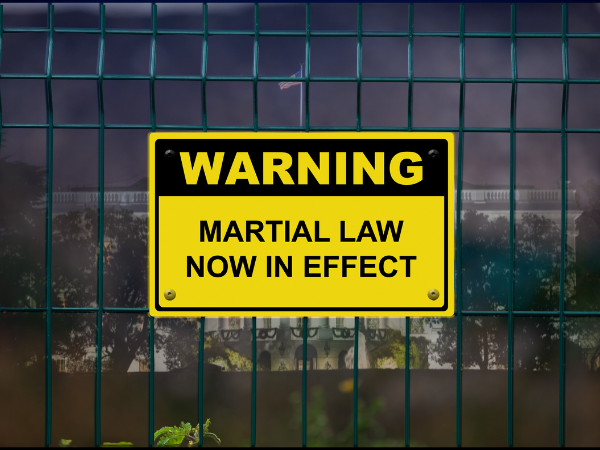
“In a fully developed bureaucracy there is nobody left with whom one can argue, to whom one can present grievances, on whom the pressures of power can be exerted. Bureaucracy is the form of government in which everybody is deprived of political freedom, of the power to act; for the rule by Nobody is not no-rule, and where all are equally powerless, we have a tyranny without a tyrant.” ― Hannah Arendt, On Violence

Like the proverbial boiling frogs, the government has been gradually acclimating us to the specter of a police state for years now: Militarized police. Riot squads. Camouflage gear. Black uniforms. Armored vehicles. Mass arrests. Pepper spray. Tear gas. Batons. Strip searches. Surveillance cameras. Kevlar vests. Drones. Lethal weapons. Less-than-lethal weapons unleashed with deadly force. Rubber bullets. Water cannons. Stun grenades. Arrests of journalists. Crowd control tactics. Intimidation tactics. Brutality.

This is how you prepare a populace to accept a police state willingly, even gratefully.

You don’t scare them by making dramatic changes. Rather, you acclimate them slowly to their prison walls. Persuade the citizenry that their prison walls are merely intended to keep them safe and danger out. Desensitize them to violence, acclimate them to a military presence in their communities, and persuade them that only a militarized government can alter the seemingly hopeless trajectory of the nation.

It’s happening already.

Yet we’re not just being acclimated to the trappings of a police state. We’re also being bullied into silence and subservience in the face of outright injustice and heavy-handed political correctness, while simultaneously being groomed into accepting government tyranny, corruption and bureaucratic ineptitude as societal norms.

What exactly is going on?

Whatever it is, this—the racial hypersensitivity without racial justice, the kowtowing to politically correct bullies with no regard for anyone else’s free speech rights, the violent blowback after years of government-sanctioned brutality, the mob mindset that is overwhelming the rights of the individual, the oppressive glowering of the Nanny State, the seemingly righteous indignation full of sound and fury that in the end signifies nothing, the partisan divide that grows more impassable with every passing day—is not leading us anywhere good.

Certainly, it’s not leading to more freedom.

This draconian exercise in how to divide, conquer and subdue a nation is succeeding.

It must be said: the various protests from both the Right and the Left in recent years have not helped. Inadvertently or intentionally, these protests have politicized what should never have been politicized: police brutality and the government’s ongoing assaults on our freedoms.

We may be worse off now than we were before.

Suddenly, no one seems to be talking about any of the egregious governmental abuses that are still wreaking havoc on our freedoms: police shootings of unarmed individuals, invasive surveillance, roadside blood draws, roadside strip searches, SWAT team raids gone awry, the military industrial complex’s costly wars, pork barrel spending, pre-crime laws, civil asset forfeiture, fusion centers, militarization, armed drones, smart policing carried out by AI robots, courts that march in lockstep with the police state, schools that function as indoctrination centers, bureaucrats that keep the Deep State in power.

The more things change, the more they stay the same.

How do you persuade a populace to embrace totalitarianism, that goose-stepping form of tyranny in which the government has all of the power and “we the people” have none?

You persuade the people that the menace they face (imaginary or not) is so sinister, so overwhelming, so fearsome that the only way to surmount the danger is by empowering the government to take all necessary steps to quash it, even if that means allowing government jackboots to trample all over the Constitution.

This is how you use the politics of fear to persuade a freedom-endowed people to shackle themselves to a dictatorship.

It works the same way every time.

The government’s overblown, extended wars on terrorism, drugs, violence, illegal immigration, and so-called domestic extremism have been convenient ruses used to terrorize the populace into relinquishing more of their freedoms in exchange for elusive promises of security.

Having allowed our fears to be codified and our actions criminalized, we now find ourselves in a strange new world where just about everything we do is criminalized.

Strangely enough, in the face of outright corruption and incompetency on the part of our elected officials, Americans in general remain relatively gullible, eager to be persuaded that the government headed up by their particular brand of political savior can solve the problems that plague us.

We have relinquished control over the most intimate aspects of our lives to government officials who, while they may occupy seats of authority, are neither wiser, smarter, more in tune with our needs, more knowledgeable about our problems, nor more aware of what is really in our best interests.

Yet having bought into the false notion that the government does indeed know what’s best for us and can ensure not only our safety but our happiness and will take care of us from cradle to grave—that is, from daycare centers to nursing homes—we have in actuality allowed ourselves to be bridled and turned into slaves at the bidding of a government that cares little for our freedoms or our happiness.

The lesson is this: once a free people allows the government inroads into their freedoms or uses those same freedoms as bargaining chips for security, it quickly becomes a slippery slope to outright tyranny.

Nor does it seem to matter whether it’s a Democrat or a Republican at the helm anymore. Indeed, the bureaucratic mindset on both sides of the aisle now seems to embody the same philosophy of authoritarian government, whose priorities are to milk “we the people” of our hard-earned money (by way of taxes, fines and fees) and remain in control and in power.

Modern government in general—ranging from the militarized police in SWAT team gear crashing through our doors to the rash of innocent citizens being gunned down by police to the invasive spying on everything we do—is acting illogically, even psychopathically. (The characteristics of a psychopath include a “lack of remorse and empathy, a sense of grandiosity, superficial charm, conning and manipulative behavior, and refusal to take responsibility for one’s actions, among others.”)

When our own government no longer sees us as human beings with dignity and worth but as things to be manipulated, maneuvered, mined for data, manhandled by police, conned into believing it has our best interests at heart, mistreated, and then jails us if we dare step out of line, punishes us unjustly without remorse, and refuses to own up to its failings, we are no longer operating under a constitutional republic. Instead, what we are experiencing is a pathocracy: tyranny at the hands of a psychopathic government, which “operates against the interests of its own people except for favoring certain groups.”

So where does that leave us?

Having allowed the government to expand and exceed our reach, we find ourselves on the losing end of a tug-of-war over control of our country and our lives. And for as long as we let them, government officials will continue to trample on our rights, always justifying their actions as being for the good of the people.

Yet the government can only go as far as “we the people” allow. Therein lies the problem.

We are fast approaching a moment of reckoning where we will be forced to choose between the vision of what America was intended to be (a model for self-governance where power is vested in the people) and the reality of what it has become (a police state where power is vested in the government).

This slide into totalitarianism—helped along by overcriminalization, government surveillance, militarized police, neighbors turning in neighbors, privatized prisons, and forced labor camps, to name just a few similarities—is tracking very closely with what happened in Germany in the years leading up to Hitler’s rise to power.

We are walking a dangerous path right now.

No matter who wins the presidential election come November, it’s a sure bet that the losers will be the American people.

Despite what is taught in school and the propaganda that is peddled by the media, the 2024 presidential election is not a populist election for a representative. Rather, it’s a gathering of shareholders to select the next CEO, a fact reinforced by the nation’s archaic electoral college system.

Anyone who believes that this election will bring about any real change in how the American government does business is either incredibly naïve, woefully out-of-touch, or oblivious to the fact that as an in-depth Princeton University study shows, we now live in an oligarchy that is “of the rich, by the rich and for the rich.”

Be warned, however: the Establishment—the Deep State and its corporate partners that really run the show, pull the strings and dictate the policies, no matter who occupies the Oval Office—is not going to allow anyone to take office who will unravel their power structures. Those who have attempted to do so in the past have been effectively put out of commission.

Voting sustains the illusion that we have a democratic republic, but it is merely a dictatorship in disguise, or what political scientists Martin Gilens and Benjamin Page more accurately refer to as an “economic élite domination.”

In such an environment, the economic elite (lobbyists, corporations, monied special interest groups) dictate national policy. As the Princeton University oligarchy study indicates, our elected officials, especially those in the nation’s capital, represent the interests of the rich and powerful rather than the average citizen. As such, the citizenry has little if any impact on the policies of government.

We have been saddled with a two-party system and fooled into believing that there’s a difference between the Republicans and Democrats, when in fact, the two parties are exactly the same. As one commentator noted, both parties support endless war, engage in out-of-control spending, ignore the citizenry’s basic rights, have no respect for the rule of law, are bought and paid for by Big Business, care most about their own power, and have a long record of expanding government and shrinking liberty.

We’re drowning under the weight of too much debt, too many wars, too much power in the hands of a centralized government run by a corporate elite, too many militarized police, too many laws, too many lobbyists, and generally too much bad news.

The powers-that-be want us to believe that our job as citizens begins and ends on Election Day. They want us to believe that we have no right to complain about the state of the nation unless we’ve cast our vote one way or the other. They want us to remain divided over politics, hostile to those with whom we disagree politically, and intolerant of anyone or anything whose solutions to what ails this country differ from our own.

What they don’t want us talking about is the fact that the government is corrupt, the system is rigged, the politicians don’t represent us, the electoral college is a joke, most of the candidates are frauds, and we as a nation are repeating the mistakes of history—namely, allowing a totalitarian state to reign over us.

“We the people” have a decision to make: do we simply participate in the collapse of the American republic as it degenerates toward a totalitarian regime, or do we take a stand and reject the pathetic excuse for government that is being fobbed off on us?

Never forget, as I make clear in my book Battlefield America: The War on the American People and in its fictional counterpart The Erik Blair Diaries, that the lesser of two evils is still evil.

Source: https://tinyurl.com/2sv86dmf

ABOUT JOHN W. WHITEHEAD

Constitutional attorney and author John W. Whitehead is founder and president of The Rutherford Institute. His most recent books are the best-selling Battlefield America: The War on the American People, the award-winning A Government of Wolves: The Emerging American Police State, and a debut dystopian fiction novel, The Erik Blair Diaries. Whitehead can be contacted at staff@rutherford.org. Nisha Whitehead is the Executive Director of The Rutherford Institute. Information about The Rutherford Institute is available at www.rutherford.org.

Publication Guidelines / Reprint Permission

John W. Whitehead’s weekly commentaries are available for publication to newspapers and web publications at no charge. 
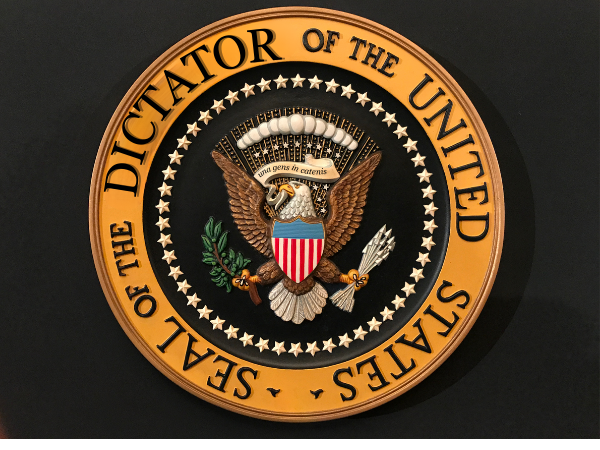
“Take alarm at the first experiment on our liberties.” — James Madison

James Madison, often referred to as the “Father of the Constitution,” once predicted that the Bill of Rights would become mere “parchment barrier,” words on paper ignored by successive generations of Americans.

How right he was.

Although Madison initially felt that the inclusion of a bill of rights in the originally ratified Constitution was unnecessary to its success, Thomas Jefferson persuaded him that “a bill of rights is what the people are entitled to against every government on earth, general or particular, & what no just government should refuse, or rest on inferences.”

The Bill of Rights drafted by Madison—the first ten amendments to the Constitution—was a document so revolutionary at the time that it would come to be viewed as the epitome of American liberty. The rights of the people reflected in those ten amendments encapsulated much of Madison’s views about government, the corrupting influence of power, and the need for safeguards against tyranny.

Madison’s writings speak volumes to the present constitutional crisis in the country.

Read them and weep.  

“The accumulation of all powers, Legislative, Executive, and Judiciary, in the same hands, whether of one, a few, or many, and whether hereditary, self-appointed, or elective, may justly be pronounced the very definition of tyranny.” — James Madison

“The people are the only legitimate fountain of power, and it is from them that the constitutional charter, under which the several branches of government hold their power, is derived.” — James Madison

“If men were angels, no government would be necessary. If angels were to govern men, neither external nor internal controls on government would be necessary. In framing a government which is to be administered by men over men, the great difficulty lies in this: you must first enable the government to control the governed; and in the next place oblige it to control itself.” — James Madison

“A standing military force, with an overgrown Executive will not long be safe companions to liberty. The means of defence against foreign danger have been always the instruments of tyranny at home.” — James Madison

“Wherever the real power in a Government lies, there is the danger of oppression.” — James Madison

“Knowledge will forever govern ignorance: And a people who mean to be their own Governors, must arm themselves with the power which knowledge gives.” — James Madison

I believe there are more instances of the abridgement of the freedom of the people by gradual and silent encroachments of those in power than by violent and sudden usurpations.”— James Madison

In the years since the founders laid their lives on the line to pursue the dream of individual freedom and self-government, big government has grown bigger and the rights of the citizenry have grown smaller.

However, there are certain principles—principles that every American should know—which undergird the American system of government and form the basis of our freedoms.

The following seven principles are a good starting point for understanding what free government is really all about.

First, the maxim that power corrupts is an absolute truth. Realizing this, those who drafted the Constitution and the Bill of Rights held one principle sacrosanct: a distrust of all who hold governmental power. As James Madison proclaimed, “All men having power ought to be distrusted to a certain degree.” Moreover, in questions of power, Thomas Jefferson warned, “Let no more be heard of confidence in man, but bind him down from mischief by the chains of the Constitution.” As such, those who drafted our founding documents would see today’s government as an out-of-control, unmanageable beast.

The second principle is that governments primarily exist to secure rights, an idea that is central to constitutionalism. In appointing the government as the guardian of the people’s rights, the people give it only certain, enumerated powers, which are laid out in a written constitution. The idea of a written constitution actualizes the two great themes of the Declaration of Independence: consent and protection of equal rights. Thus, the purpose of constitutionalism is to limit governmental power and ensure that the government performs its basic function: to preserve and protect our rights, especially our unalienable rights to life, liberty and the pursuit of happiness, and our civil liberties. Unfortunately, the government today has discarded this principle and now sees itself as our master, not our servant. The obvious next step, unless we act soon, is tyranny.

The third principle revolves around the belief that no one is above the law, not even those who make the law. This is termed rule of law. Richard Nixon’s statement, “When the President does it, that means it is not illegal,” would have been an anathema to the Framers of the Constitution. If all people possess equal rights, the people who live under the laws must be allowed to participate in making those laws. By that same token, those who make the laws must live under the laws they make.

Fourth, separation of powers ensures that no single authority is entrusted with all the powers of government. People are not perfect, whether they are in government or out of it. As history makes clear, those in power tend to abuse it. The government is thus divided into three co-equal branches: legislative, executive and judicial. Placing all three powers in the same branch of government was considered the very definition of tyranny. The fact that the president today has dictatorial powers would have been considered an offense to every principle for which the Framers took their revolutionary stand.

Fifth, a system of checks and balances, essential if a constitutional government is to succeed, strengthens the separation of powers and prevents legislative despotism. Such checks and balances include dividing Congress into two houses, with different constituencies, term lengths, sizes and functions; granting the president a limited veto power over congressional legislation; and appointing an independent judiciary capable of reviewing ordinary legislation in light of the written Constitution, which is referred to as “judicial review.” The Framers feared that Congress could abuse its powers and potentially emerge as the tyrannous branch because it had the power to tax. But they did not anticipate the emergence of presidential powers as they have come to dominate modern government or the inordinate influence of corporate powers on governmental decision-making. Indeed, as recent academic studies now indicate, we are now ruled by a monied oligarchy that serves itself and not “we the people.”

Sixth, representation allows the people to have a voice in government by sending elected representatives to do their bidding while avoiding the need of each and every citizen to vote on every issue considered by government. In a country as large as the United States, it is not feasible to have direct participation in governmental affairs. Hence, we have a representative government. If the people don’t agree with how their representatives are conducting themselves, they can and should vote them out. However, as the citizenry has grown lazy and been distracted by the entertainment spectacles of modern society, government bureaucrats churn out numerous laws each year resulting in average citizens being rendered lawbreakers and jailed for what used to be considered normal behavior.

Finally, federalism is yet another constitutional device to limit the power of government by dividing power and, thus, preventing tyranny. In America, the levels of government generally break down into federal, state and local branches (which further divide into counties and towns or cities). Because local and particular interests differ from place to place, such interests are better handled at a more intimate level by local governments, not a bureaucratic national government. Remarking on the benefits of the American tradition of local self-government in the 1830s, the French historian Alexis de Tocqueville observed: “Local institutions are to liberty what primary schools are to science; they put it within the people’s reach; they teach people to appreciate its peaceful enjoyment and accustom them to make use of it. Without local institutions a nation may give itself a free government, but it has not got the spirit of liberty.”

These seven vital principles have been largely forgotten in recent years, obscured by the haze of a centralized government, a citizenry that no longer thinks analytically, and schools that don’t adequately teach our young people about their history and their rights.

Yet here’s the rub: while Americans wander about in their brainwashed states, their “government of the people, by the people and for the people” has largely been taken away from them.

The answer: get un-brainwashed.

Learn your rights.

Stand up for the founding principles.

Make your voice and your vote count for more than just political posturing.

Never cease to vociferously protest the erosion of your freedoms at the local and national level.

Most of all, do these things today.

If we wait until the votes have all been counted or hang our hopes on our particular candidate to win and fix what’s wrong with the country, “we the people” will continue to lose.

Whether we ever realize it not, the enemy is not across party lines, as they would have us believe. It has us surrounded on all sides.

Even so, we’re not yet defeated.

We could still overcome our oppressors if we cared enough to join forces and launch a militant nonviolent revolution—a people’s revolution that starts locally and trickles upwards—but that will take some doing.

It will mean turning our backs on the political jousting contests taking place at all levels of government and rejecting their appointed jesters as false prophets. It will mean not allowing ourselves to be corralled like cattle and branded with political labels that have no meaning anymore. It will mean recognizing that all the evils that surround us today—endless wars, drone strikes, invasive surveillance, militarized police, poverty, asset forfeiture schemes, overcriminalization, etc.—are not of our making but came about as a way to control and profit from us.

It will mean “voting with our feet” through sustained, mass civil disobedience.

Ultimately, as I make clear in my book Battlefield America: The War on the American People and in its fictional counterpart The Erik Blair Diaries, it will mean refusing to be divided, one against each other, by politics and instead uniting behind the only distinction that has ever mattered: “we the people” against tyranny.

Source: https://tinyurl.com/mpfzatb8

ABOUT JOHN W. WHITEHEAD

Constitutional attorney and author John W. Whitehead is founder and president of The Rutherford Institute. His most recent books are the best-selling Battlefield America: The War on the American People, the award-winning A Government of Wolves: The Emerging American Police State, and a debut dystopian fiction novel, The Erik Blair Diaries. Whitehead can be contacted at staff@rutherford.org. Nisha Whitehead is the Executive Director of The Rutherford Institute. Information about The Rutherford Institute is available at www.rutherford.org.

Publication Guidelines / Reprint Permission

John W. Whitehead’s weekly commentaries are available for publication to newspapers and web publications at no charge. 
“I did not know Israel was capturing or recording my face. [But Israel has] been watching us for years from the sky with their drones. They have been watching us gardening and going to schools and kissing our wives. I feel like I have been watched for so long.”—Mosab Abu Toha, Palestinian poet

If you want a glimpse of the next stage of America’s transformation into a police state, look no further than how Israel—a long-time recipient of hundreds of billions of dollars in foreign aid from the U.S.—uses its high-tech military tactics, surveillance and weaponry to advance its authoritarian agenda.

Military checkpoints. Wall-to-wall mass surveillance. Predictive policing. Aerial surveillance that tracks your movements wherever you go and whatever you do. AI-powered facial recognition and biometric programs carried out with the knowledge or consent of those targeted by it. Cyber-intelligence. Detention centers. Brutal interrogation tactics. Weaponized drones. Combat robots.

We’ve already seen many of these military tactics and technologies deployed on American soil and used against the populace, especially along the border regions, a testament to the heavy influence Israel’s military-industrial complex has had on U.S. policing.

Indeed, Israel has become one of the largest developers and exporters of military weapons and technologies of oppression worldwide.

Journalist Antony Loewenstein has warned that Pegasus, one of Israel’s most invasive pieces of spyware, which allows any government or military intelligence or police department to spy on someone’s phone and get all the information from that phone, has become a favorite tool of oppressive regimes around the world. The FBI and NYPD have also been recipients of the surveillance technology which promises to turn any “target’s smartphone into an intelligence gold mine.”

Yet it’s not just military weapons that Israel is exporting. They’re also helping to transform local police agencies into extensions of the military.

According to The Intercept, thousands of American law enforcement officers frequently travel for training to Israel, “one of the few countries where policing and militarism are even more deeply intertwined than they are here,” as part of an ongoing exchange program that largely flies under the radar of public scrutiny.

A 2018 investigative report concluded that imported military techniques by way of these exchange programs that allow police to study in Israel have changed American policing for the worse. “Upon their return, U.S. law enforcement delegates implement practices learned from Israel’s use of invasive surveillance, blatant racial profiling, and repressive force against dissent,” the report states. “Rather than promoting security for all, these programs facilitate an exchange of methods in state violence and control that endanger us all.”

“At the very least,” notes journalist Matthew Petti, “visits to Israel have helped American police justify more snooping on citizens and stricter secrecy. Critics also assert that Israeli training encourages excessive force.”

Petti documents how the NYPD set up a permanent liaison office in Israel in the wake of 9/11, eventually implementing “one of the first post-9/11 counterterrorism programs that explicitly followed the Israeli model. In 2002, the NYPD tasked a secret ‘Demographics Unit’ with spying on Muslim-American communities. Dedicated ‘mosque crawlers’ infiltrated local Muslim congregations and attempted to bait worshippers with talk of violent revolution.”

That was merely the start of American police forces being trained in martial law by foreign nations under the guise of national security theater. It has all been downhill from there.

As Alex Vitale, a sociology professor who has studied the rise of global policing, explains, “The focus of this training is on riot suppression, counterinsurgency, and counterterrorism—all of which are essentially irrelevant or should be irrelevant to the vast majority of police departments. They shouldn’t be suppressing protest, they shouldn’t be engaging in counterinsurgency, and almost none of them face any real threat from terrorism.”

This ongoing transformation of the American homeland into a techno-battlefield tracks unnervingly with the dystopian cinematic visions of Steven Spielberg’s Minority Report and Neill Blomkamp’s Elysium, both of which are set 30 years from now, in the year 2054.

In Minority Reportpolice agencies harvest intelligence from widespread surveillance, behavior prediction technologies, data mining, precognitive technology, and neighborhood and family snitch programs in order to capture would-be criminals before they can do any damage.

While Blomkamp’s Elysium acts as a vehicle to raise concerns about immigration, access to healthcare, worker’s rights, and socioeconomic stratification, what was most striking was its eerie depiction of how the government will employ technologies such as drones, tasers and biometric scanners to track, target and control the populace, especially dissidents.

With Israel in the driver’s seat and Minority Report and Elysium on the horizon, it’s not so far-fetched to imagine how the American police state will use these emerging technologies to lock down the populace, root out dissidents, and ostensibly establish an “open-air prison” with disconcerting similarities to Israel’s technological occupation of present-day Palestine.

For those who insist that such things are celluloid fantasies with no connection to the present, we offer the following as a warning of the totalitarian future at our doorsteps.

Facial Recognition

Fiction: One of the most jarring scenes in Elysium occurs towards the beginning of the film, when the protagonist Max Da Costa waits to board a bus on his way to work. While standing in line, Max is approached by two large robotic police officers, who quickly scan Max’s biometrics, cross-check his data against government files, and identify him as a former convict in need of close inspection. They demand to search his bag, a request which Max resists, insisting that there is nothing for them to see. The robotic cops respond by manhandling Max, throwing him to the ground, and breaking his arm with a police baton. After determining that Max poses no threat, they leave him on the ground and continue their patrol. Likewise, in Minority Report, police use holographic data screens, city-wide surveillance cameras, dimensional maps and database feeds to monitor the movements of its citizens and preemptively target suspects for interrogation and containment.

Fact: We now find ourselves in the unenviable position of being monitored, managed, corralled and controlled by technologies that answer to government and corporate rulers. This is exactly how Palestinian poet and New Yorker contributor Mosab Abu Toha found himself, within minutes of passing through an Israeli military checkpoint in Gaza with his wife and children in tow, asked to step out line, only to be blindfolded, handcuffed, interrogated, then imprisoned in an Israeli detention center for two days, beaten and further interrogated. Toha was finally released in what Israeli soldiers chalked up to a “mistake,” yet there was no mistaking the AI-powered facial recognition technology that was used to pull him out of line, identify him, and label him (erroneously) as a person of interest.

Drones

Fiction: In another Elysium scene, Max is hunted by four drones while attempting to elude the authorities. The drones, equipped with x-ray cameras, biometric readers, scanners and weapons, are able to scan whole neighborhoods, identify individuals from a distance—even through buildings, report their findings back to police handlers, pursue a suspect, and target them with tasers and an array of lethal weapons.

Fact: Drones, some deceptively small and yet powerful enough to capture the facial expressions of people hundreds of feet below them, have ushered in a new age of surveillance. Not even those indoors, in the privacy of their homes, will be safe from these aerial spies, which can be equipped with technology capable of peering through walls. In addition to their surveillance capabilities, drones can also be equipped with automatic weapons, grenade launchers, tear gas, and tasers.

Biometric scanners and national IDs

Fiction: Throughout Elysium, citizens are identified, sorted and dealt with by way of various scanning devices that read their biometrics—irises, DNA, etc.—as well as their national ID numbers, imprinted by a laser into their skin. In this way, citizens are tracked, counted, and classified. Likewise, in Minority Report, tiny sensory-guided spider robots converge on a suspected would-be criminal, scan his biometric data and feed it into a central government database. The end result is that there is nowhere to run and nowhere to hide to escape the government’s all-seeing eyes.

Fact: Given the vast troves of data that various world governments, including Israel and the U.S., is collecting on its citizens and non-citizens alike, we are not far from a future where there is nowhere to run and nowhere to hide. In fact, between the facial recognition technology being handed out to law enforcement, license plate readers being installed on police cruisers, local police creating DNA databases by extracting DNA from non-criminals, including the victims of crimes, and police collecting more and more biometric data such as iris scans, we are approaching the end of anonymity. It won’t be long before police officers will be able to pull up a full biography on any given person instantaneously, including their family and medical history, bank accounts, and personal peccadilloes. It’s already moving in that direction in more authoritarian regimes.

Predictive Policing

Fiction: In Minority Report, John Anderton, Chief of the Department of Pre-Crime, finds himself identified as the next would-be criminal and targeted for preemptive measures by the very technology that he relies on for his predictive policing. Consequently, Anderton finds himself not only attempting to prove his innocence but forced to take drastic measures in order to avoid capture in a surveillance state that uses biometric data and sophisticated computer networks to track its citizens.

Fact: Precrime, which aims to prevent crimes before they happen, has justified the use of widespread surveillance, behavior prediction technologies, data mining, precognitive technology, and snitch programs. As political science professor Anwar Mhajne documents, Israel has used all of these tools in its military engagements with Palestine: deploying AI surveillance and predictive policing systems in Palestinian territories; utilizing facial recognition technology to monitor and regulate the movement of Palestinians; subjecting Palestinians to facial recognition scans at checkpoints, with a color-coded mechanism to dictate who should be allowed to proceed, subjected to further questioning, or detained.

Making the Leap from Fiction to Reality

When Aldous Huxley wrote Brave New World in 1931, he was convinced that there was “still plenty of time” before his dystopian vision became a nightmare reality. It wasn’t long, however, before he realized that his prophecies were coming true far sooner than he had imagined.

Israel’s military influence on the United States, its advances in technological weaponry, and its rigid demand for compliance are pushing us towards a world in chains.

Through its oppressive use of surveillance technology, Israel has erected the world’s first open-air prison, and in the process, has made itself a model for the United States.

What we cannot afford to overlook, however, is the extent to which the American Police State is taking its cues from Israel.

As I make clear in my book Battlefield America: The War on the American People and in its fictional counterpart The Erik Blair Diaries, we may not be an occupied territory, but that does not make the electronic concentration camp being erected around us any less of a prison.

Source: https://tinyurl.com/5n73uf7e

ABOUT JOHN W. WHITEHEAD

Constitutional attorney and author John W. Whitehead is founder and president of The Rutherford Institute. His most recent books are the best-selling Battlefield America: The War on the American People, the award-winning A Government of Wolves: The Emerging American Police State, and a debut dystopian fiction novel, The Erik Blair Diaries. Whitehead can be contacted at staff@rutherford.org. Nisha Whitehead is the Executive Director of The Rutherford Institute. Information about The Rutherford Institute is available at www.rutherford.org.

Publication Guidelines / Reprint Permission

John W. Whitehead’s weekly commentaries are available for publication to newspapers and web publications at no charge. 
“Politicians of both parties want to use the power of government to silence their foes. Some in the university community seek to drive it from their campuses. And an entire generation of Americans is being taught that free speech should be curtailed as soon as it makes someone else feel uncomfortable.”—William Ruger, “Free Speech Is Central to Our Dignity as Humans

The police state does not want citizens who know their rights.

Nor does the police state want citizens prepared to exercise those rights.

This year’s graduates are a prime example of this master class in compliance. Their time in college has been set against a backdrop of crackdowns, lockdowns and permacrises ranging from the government’s authoritarian COVID-19 tactics to its more recent militant response to campus protests.

Born in the wake of the 9/11 attacks, these young people have been raised without any expectation of privacy in a technologically-driven, mass surveillance state; educated in schools that teach conformity and compliance; saddled with a debt-ridden economy on the brink of implosion; made vulnerable by the blowback from a military empire constantly waging war against shadowy enemies; policed by government agents armed to the teeth ready and able to lock down the country at a moment’s notice; and forced to march in lockstep with a government that no longer exists to serve the people but which demands they be obedient slaves or suffer the consequences.

And now, when they should be empowered to take their rightful place in society as citizens who fully understand and exercise their right to speak truth to power, they are being censored, silenced and shut down.

Consider what happened recently in Charlottesville, Va., when riot police were called in to shut down campus protests at the University of Virginia staged by students and members of the community to express their opposition to the ongoing humanitarian crisis in Palestine.

As the local newspaper reported, “State police sporting tactical gear and riot shields moved in on the demonstrators, using pepper spray and sheer force to disperse the group and arrest the roughly 15 or so at the camp, where for days students, faculty and community members had sang songs, read poetry and painted signs in protest of Israel’s ongoing war in the Palestinian territory of Gaza.”

What a sad turn-about for an institution which was founded as an experiment in cultivating an informed citizenry by Thomas Jefferson, the author of the Declaration of Independence, champion of the Bill of Rights, and the nation’s third president.

Unfortunately, the University of Virginia is not unique in its heavy-handed response to what have been largely peaceful anti-war protests. According to the Washington Postmore than 2300 people have been arrested for taking part in similar campus protests across the country.

These lessons in compliance, while expected, are what comes of challenging the police state.

What was unexpected were the campus protests themselves.

For those of us who came of age in the 1960s, college campuses were once the bastion of free speech, awash with student protests, sit-ins, marches, pamphleteering, and other expressive acts showing our displeasure with war, the Establishment and the status quo.

Contrast that with college campuses today, which have become breeding grounds for compliant citizens and bastions of censorship, trigger warningsmicroaggressions, and “red light” speech policies targeting anything that might cause someone to feel uncomfortable, unsafe or offended.

Free speech can certainly not be considered “free” when expressive activities across the nation are being increasingly limited, restricted to so-called free speech zones, or altogether blocked.

Remember, the First Amendment gives every American the right to “petition his government for a redress of grievances.”

There was a time in this country, back when the British were running things, that if you spoke your mind and it ticked off the wrong people, you’d soon find yourself in jail for offending the king.

Reacting to this injustice, when it was time to write the Constitution, America’s founders argued for a Bill of Rights, of which the First Amendment protects the right to free speech. James Madison, the father of the Constitution, was very clear about the fact that he wrote the First Amendment to protect the minority against the majority.

What Madison meant by minority is “offensive speech.”

Unfortunately, we don’t honor that principle as much as we should today. In fact, we seem to be witnessing a politically correct philosophy at play, one shared by both the extreme left and the extreme right, which aims to stifle all expression that doesn’t fit within their parameters of what they consider to be “acceptable” speech.

There are all kinds of labels put on such speech—it’s been called politically incorrect speech, hate speech, offensive speech, and so on—but really, the message being conveyed is that you don’t have a right to express yourself if certain people or groups don’t like or agree with what you are saying.

Hence, we have seen the caging of free speech in recent years, through the use of so-called “free speech zones” on college campuses and at political events, the requirement of speech permits in parks and community gatherings, and the policing of online forums.

Clearly, this elitist, monolithic mindset is at odds with everything America is supposed to stand for.

Indeed, we should be encouraging people to debate issues and air their views. Instead, by muzzling free speech, we are contributing to a growing underclass of Americans—many of whom have been labeled racists, rednecks and religious bigots—who are being told that they can’t take part in American public life unless they “fit in.”

Remember, the First Amendment acts as a steam valve. It allows people to speak their minds, air their grievances and contribute to a larger dialogue that hopefully results in a more just world. When there is no steam valve to release the pressure, frustration builds, anger grows and people become more volatile and desperate to force a conversation.

The attempt to stifle certain forms of speech is where we go wrong.

In fact, the U.S. Supreme Court has held that it is “a bedrock principle underlying the First Amendment…that the government may not prohibit the expression of an idea simply because society finds the idea offensive or disagreeable.” For example, it is not a question of whether the Confederate flag represents racism but whether banning it leads to even greater problems, namely, the loss of freedom in general.

Along with the constitutional right to peacefully (and that means non-violently) assemble, the right to free speech allows us to challenge the government through protests and demonstrations and to attempt to change the world around us—for the better or the worse—through protests and counterprotests.

If citizens cannot stand out in the open and voice their disapproval of their government, its representatives and its policies without fearing prosecution, then the First Amendment with all its robust protections for free speech, assembly and the right to petition one’s government for a redress of grievances is little more than window-dressing on a store window—pretty to look at but serving little real purpose.

After all, living in a representative republic means that each person has the right to take a stand for what they think is right, whether that means marching outside the halls of government, wearing clothing with provocative statements, or simply holding up a sign.

That’s what the First Amendment is supposed to be about: it assures the citizenry of the right to express their concerns about their government to their government, in a time, place and manner best suited to ensuring that those concerns are heard.

Unfortunately, through a series of carefully crafted legislative steps and politically expedient court rulings, government officials have managed to disembowel this fundamental freedom, rendering it with little more meaning than the right to file a lawsuit against government officials.

In more and more cases, the government is declaring war on what should be protected political speech whenever it challenges the government’s power, reveals the government’s corruption, exposes the government’s lies, and encourages the citizenry to push back against the government’s many injustices.

Indeed, there is a long and growing list of the kinds of speech that the government considers dangerous enough to red flag and subject to censorship, surveillance, investigation and prosecution: hate speech, conspiratorial speech, treasonous speech, threatening speech, inflammatory speech, radical speech, anti-government speech, extremist speech, etc.

Clearly, the government has no interest in hearing what “we the people” have to say.

Yet if Americans are not able to peacefully assemble for expressive activity outside of the halls of government or on public roads on which government officials must pass, or on college campuses, the First Amendment has lost all meaning.

If we cannot stand peacefully outside of the Supreme Court or the Capitol or the White House, our ability to hold the government accountable for its actions is threatened, and so are the rights and liberties that we cherish as Americans.

And if we cannot proclaim our feelings about the government, no matter how controversial, on our clothing, or to passersby, or to the users of the world wide web, then the First Amendment really has become an exercise in futility.

The source of the protest shouldn’t matter. The politics of the protesters are immaterial.

To play politics with the First Amendment encourages a double standard that will see us all muzzled in the end.

You don’t have to agree with someone to defend their freedoms.

Responsible citizenship means being outraged at the loss of others’ freedoms, even when our own are not directly threatened. It means remembering that the prime function of any free government is to protect the weak against the strong. And it means speaking up for those with whom you might disagree.

The Framers of the Constitution knew very well that whenever and wherever democratic governments had failed, it was because the people had abdicated their responsibility as guardians of freedom. They also knew that whenever in history the people rejected this responsibility, an authoritarian regime arose which eventually denied the people the right to govern themselves.

The demons of our age—some of whom disguise themselves as politicians—delight in fomenting violence, sowing distrust and prejudice, and persuading the public to support tyranny disguised as patriotism.

Overcoming the evils of our age will require us to stop marching in lockstep with the police state and start thinking—and speaking—for ourselves.

It doesn’t matter how old you are or what your political ideology is: it’s our civic duty to make the government hear us—and heed us—using every nonviolent means available to us: picket, protest, march, boycott, speak up, sound off and reclaim control over the narrative about what is really going on in this country.

The power elite has made their intentions clear: they will pursue and prosecute any and all words, thoughts and expressions that challenge their authority.

As I make clear in my book Battlefield America: The War on the American People and in its fictional counterpart The Erik Blair Diaries, this is the final link in the police state chain.

If ever there were a time for us to stand up for the right to speak freely, even if it’s freedom for speech we hate, the time is now.

Source: https://tinyurl.com/bddvzsnf

ABOUT JOHN W. WHITEHEAD

Constitutional attorney and author John W. Whitehead is founder and president of The Rutherford Institute. His most recent books are the best-selling Battlefield America: The War on the American People, the award-winning A Government of Wolves: The Emerging American Police State, and a debut dystopian fiction novel, The Erik Blair Diaries. Whitehead can be contacted at staff@rutherford.org. Nisha Whitehead is the Executive Director of The Rutherford Institute. Information about The Rutherford Institute is available at www.rutherford.org.

Publication Guidelines / Reprint Permission

John W. Whitehead’s weekly commentaries are available for publication to newspapers and web publications at no charge. 

“Whether the mask is labeled fascism, democracy, or dictatorship of the proletariat, our great adversary remains the apparatus—the bureaucracy, the police, the military.”—Simone Weil, French philosopher

We are caught in a vicious cycle of too many laws, too many cops, and too little freedom.

It’s hard to say whether we’re dealing with a kleptocracy (a government ruled by thieves), a kakistocracy (a government run by unprincipled career politicians, corporations and thieves that panders to the worst vices in our nature and has little regard for the rights of American citizens), or a Nanny State Idiocracy

Whatever the label, this overbearing despotism is what happens when government representatives (those elected and appointed to work for us) adopt the authoritarian notion that the government knows best and therefore must control, regulate and dictate almost everything about the citizenry’s public, private and professional lives.

The government’s bureaucratic attempts at muscle-flexing by way of overregulation and overcriminalization have reached such outrageous limits that federal and state governments now require on penalty of a fine that individuals apply for permission before they can grow exotic orchids, host elaborate dinner parties, gather friends in one’s home for Bible studies, give coffee to the homeless, let their kids manage a lemonade stand, keep chickens as pets, or braid someone’s hair, as ludicrous as that may seem.

As the Regulatory Transparency Project explains, “There are over 70 federal regulatory agencies, employing hundreds of thousands of people to write and implement regulations. Every year, they issue about 3,500 new rules, and the regulatory code now is over 168,000 pages long.”

In his CrimeADay Twitter feed, Mike Chase highlights some of the more arcane and inane laws that render us all guilty of violating some law or other.

As Chase notes, it’s against the law to try to make an unreasonable noise while a horse is passing by in a national park; to leave Michigan with a turkey that was hunted with a drone; to refill a liquor bottle with different liquor than it had in it when it was originally filled; to offer to buy swan feathers so you can make a woman’s hat with them; to enter a design in the Federal Duck Stamp contest if waterfowl are not the dominant feature of the design; to transport a cougar without a cougar license; to sell spray deodorant without telling people to avoid spraying it in their eyes; and to transport “meat loaf” unless it’s in loaf form.

In such a society, we are all petty criminals.

In fact, Boston lawyer Harvey Silvergate estimates that the average American now unknowingly commits three felonies a day, thanks to an overabundance of vague laws that render otherwise innocent activity illegal and an inclination on the part of prosecutors to reject the idea that there can’t be a crime without criminal intent. 

The bigger the government grows, the worse the red tape becomes.

Almost every aspect of American life today, including the job sector, is now subject to this kind of heightened scrutiny and ham-fisted control.

Whereas 70 years ago, one out of every 20 U.S. jobs required a state license, today, almost 1 in 4 American occupations requires a license.

According to business analyst Kaylyn McKenna, more than 41 states require that makeup artists be licensed. Twenty-eight states require a license before you can work as a residential painter. Funeral attendants, whose duties include placing caskets in visitation rooms, arranging flowers and directing mourners, have to be licensed to do so in Kansas, Maine and Massachusetts.

The problem of overregulation has become so bad that, as one analyst notes, “getting a license to style hair in Washington takes more instructional time than becoming an emergency medical technician or a firefighter.”

This is what happens when bureaucrats run the show, and the rule of law becomes little more than a cattle prod for forcing the citizenry to march in lockstep with the government.

Overregulation is just the other side of the coin to overcriminalization, that phenomenon in which everything is rendered illegal, and everyone becomes a lawbreaker.

As policy analyst Michael Van Beek warns, the problem with overcriminalization is that there are so many laws at the federal, state and local levels—that we can’t possibly know them all.

“It’s also impossible to enforce all these laws. Instead, law enforcement officials must choose which ones are important and which are not. The result is that they pick the laws Americans really must follow, because they’re the ones deciding which laws really matter,” concludes Van Beek. “Federal, state and local regulations — rules created by unelected government bureaucrats — carry the same force of law and can turn you into a criminal if you violate any one of them… if we violate these rules, we could be prosecuted as criminals. No matter how antiquated or ridiculous, they still carry the full force of the law. By letting so many of these sit around, just waiting to be used against us, we increase the power of law enforcement, which has lots of options to charge people with legal and regulatory violations.”

Case in point: in New Jersey, in what journalist Billy Binion describes as “yet another example of the effects of overcriminalization, which increases interactions between civilians and police with little benefit to actual public safety,” police went so far as to arrest a teenager and seize other teen’s bicycles for so-called traffic violations and a failure to register their bikes with the state.

This is the police state’s superpower: it has been vested with the authority to make our lives a bureaucratic hell.

That explains how a fisherman can be saddled with 20 years’ jail time for throwing fish that were too small back into the water. Or why police arrested a 90-year-old man for violating an ordinance that prohibits feeding the homeless in public unless portable toilets are also made available. Or how states across the country, in a misguided attempt to disperse homeless populations, have criminalized sitting, sleeping, or resting in public spaces; sharing food with people; and camping in public.

The laws can get downright silly.

For instance, in Florida, it’s against the law to eat a frog that was used in a frog-jumping contest. You could also find yourself passing time in a Florida slammer for such inane activities as singing in a public place while wearing a swimsuit, breaking more than three dishes per day, farting in a public place after 6 pm on a Thursday, and skateboarding without a license.

“Such laws,” notes journalist George Will, “which enable government zealots to accuse almost anyone of committing three felonies in a day, do not just enable government misconduct, they incite prosecutors to intimidate decent people who never had culpable intentions. And to inflict punishments without crimes.”

Unfortunately, the consequences are all too serious for those whose lives become grist for the police state’s mill.

In this way, America has gone from being a beacon of freedom to a locked down nation.

We labor today under the weight of countless tyrannies, large and small, carried out in the so-called name of the national good by an elite class of governmental and corporate officials who are largely insulated from the ill effects of their actions.

We increasingly find ourselves badgered, bullied and browbeaten into bearing the brunt of their arrogance, paying the price for their greed, suffering the backlash for their militarism, agonizing as a result of their inaction, feigning ignorance about their backroom dealings, overlooking their incompetence, turning a blind eye to their misdeeds, cowering from their heavy-handed tactics, and blindly hoping for change that never comes. 

The overt signs of the despotism exercised by the increasingly authoritarian regime that passes itself off as the United States government (and its corporate partners in crime) are all around us: censorship, criminalizing, shadow banning and de-platforming of individuals who express ideas that are politically incorrect or unpopular; warrantless surveillance of Americans’ movements and communications; SWAT team raids of Americans’ homes; shootings of unarmed citizens by police; harsh punishments meted out to schoolchildren in the name of zero tolerance; community-wide lockdowns and health mandates that strip Americans of their freedom of movement and bodily integrity; armed drones taking to the skies domestically; endless wars; out-of-control spending; militarized police; roadside strip searches; privatized prisons with a profit incentive for jailing Americans; fusion centers that spy on, collect and disseminate data on Americans’ private transactions; and militarized agencies with stockpiles of ammunition, to name some of the most appalling.

Yet as egregious as these incursions on our rights may be, it’s the endless, petty tyrannies—the heavy-handed, punitive-laden dictates inflicted by a self-righteous, Big-Brother-Knows-Best bureaucracy on an overtaxed, overregulated, and underrepresented populace—that illustrate so clearly the degree to which “we the people” are viewed as incapable of common sense, moral judgment, fairness, and intelligence, not to mention lacking a basic understanding of how to stay alive, raise a family, or be part of a functioning community.

In exchange for the promise of an end to global pandemics, lower taxes, lower crime rates, safe streets, safe schools, blight-free neighborhoods, and readily accessible technology, health care, water, food and power, we’ve opened the door to lockdowns, militarized police, government surveillance, asset forfeiture, school zero tolerance policies, license plate readers, red light cameras, SWAT team raids, health care mandates, overcriminalization, overregulation and government corruption.

We relied on the government to help us safely navigate national emergencies (terrorism, natural disasters, global pandemics, etc.) only to find ourselves forced to relinquish our freedoms on the altar of national security, yet we’re no safer (or healthier) than before.

We asked our lawmakers to be tough on crime, and we’ve been saddled with an abundance of laws that criminalize almost every aspect of our lives.

We wanted criminals taken off the streets, and we didn’t want to have to pay for their incarceration. What we’ve gotten is a nation that boasts the highest incarceration rate in the world, with many doing time for relatively minor, nonviolent crimes, and a private prison industry fueling the drive for more inmates.

We wanted law enforcement agencies to have the necessary resources to fight the nation’s wars on terror, crime and drugs. What we got instead were militarized police decked out with M-16 rifles, grenade launchers, silencers, battle tanks and hollow point bullets—gear designed for the battlefield, more than 80,000 SWAT team raids carried out every year (many for routine police tasks, resulting in losses of life and property), and profit-driven schemes that add to the government’s largesse such as asset forfeiture, where police seize property from “suspected criminals.”

We fell for the government’s promise of safer roads, only to find ourselves caught in a tangle of profit-driven red light cameras, which ticket unsuspecting drivers in the so-called name of road safety while ostensibly fattening the coffers of local and state governments.

This is what happens when the American people get duped, deceived, double-crossed, cheated, lied to, swindled and conned into believing that the government and its army of bureaucrats—the people we appointed to safeguard our freedoms—actually have our best interests at heart.

As I make clear in my book Battlefield America: The War on the American People and in its fictional counterpart The Erik Blair Diaries, the problem with these devil’s bargains is that there is always a catch, always a price to pay for whatever it is we valued so highly as to barter away our most precious possessions.

In the end, such bargains always turn sour.

Source: https://tinyurl.com/4nxxuxxj

ABOUT JOHN W. WHITEHEAD

Constitutional attorney and author John W. Whitehead is founder and president of The Rutherford Institute. His most recent books are the best-selling Battlefield America: The War on the American People, the award-winning A Government of Wolves: The Emerging American Police State, and a debut dystopian fiction novel, The Erik Blair Diaries. Whitehead can be contacted at staff@rutherford.org. Nisha Whitehead is the Executive Director of The Rutherford Institute. Information about The Rutherford Institute is available at www.rutherford.org.

Publication Guidelines / Reprint Permission

John W. Whitehead’s weekly commentaries are available for publication to newspapers and web publications at no charge. 

“The privacy and dignity of our citizens is being whittled away by sometimes imperceptible steps. Taken individually, each step may be of little consequence. But when viewed as a whole, there begins to emerge a society quite unlike any we have seen—a society in which government may intrude into the secret regions of man’s life at will.”—Justice William O. Douglas

The spirit of the Constitution, drafted by men who chafed against the heavy-handed tyranny of an imperial ruler, would suggest that one’s home is a fortress, safe from almost every kind of intrusion.

Unfortunately, a collective assault by the government’s cabal of legislators, litigators, judges and militarized police has all but succeeded in reducing that fortress—and the Fourth Amendment alongside it—to a crumbling pile of rubble.

We are no longer safe in our homes, not from the menace of a government and its army of Peeping Toms who are waging war on the last stronghold of privacy left to us as a free people.

The weapons of this particular war on the privacy and sanctity of our homes are being wielded by the government and its army of bureaucratized, corporatized, militarized mercenaries.

Government agents—with or without a warrant, with or without probable cause that criminal activity is afoot, and with or without the consent of the homeowner—are now justified in mounting virtual home invasions using surveillance technology—with or without the blessing of the courts—to invade one’s home with wiretaps, thermal imaging, surveillance cameras, aerial drones, and other monitoring devices.

Just recently, in fact, the Michigan Supreme Court gave the government the green light to use warrantless aerial drone surveillance to snoop on citizens at home and spy on their private property.

While the courts have given police significant leeway at times when it comes to physical intrusions into the privacy of one’s home (the toehold entry, the battering ram, the SWAT raid, the knock-and-talk conversation, etc.), the menace of such virtual intrusions on our Fourth Amendment rights has barely begun to be litigated, legislated and debated.

Consequently, we now find ourselves in the unenviable position of being monitored, managed, corralled and controlled by technologies that answer to government and corporate rulers.

Indeed, almost anything goes when it comes to all the ways in which the government can now invade your home and lay siege to your property.

Consider that on any given day, the average American going about his daily business will be monitored, surveilled, spied on and tracked in more than 20 different ways, by both government and corporate eyes and ears.

A byproduct of this surveillance age in which we live, whether you’re walking through a store, driving your car, checking email, or talking to friends and family on the phone, you can be sure that some government agency is listening in and tracking your behavior.

This doesn’t even begin to touch on the corporate trackers that monitor your purchases, web browsing, Facebook posts and other activities taking place in the cyber sphere.

Stingray devices mounted on police cars to warrantlessly track cell phones, Doppler radar devices that can detect human breathing and movement within in a home, license plate readers that can record up to 1800 license plates per minutesidewalk and “public space” cameras coupled with facial recognition and behavior-sensing technology that lay the groundwork for police “pre-crime” programspolice body cameras that turn police officers into roving surveillance cameras, the internet of things: all of these technologies (and more) add up to a society in which there’s little room for indiscretions, imperfections, or acts of independence—especially not when the government can listen in on your phone calls, read your emails, monitor your driving habits, track your movements, scrutinize your purchases and peer through the walls of your home.

Without our realizing it, the American Police State passed the baton off to a fully-fledged Surveillance State that gives the illusion of freedom while functioning all the while like an electronic prison: controlled, watchful, inflexible, punitive, deadly and inescapable.

Nowhere to run and nowhere to hide: this is the mantra of the architects of the Surveillance State and their corporate collaborators.

Government eyes see your every move: what you read, how much you spend, where you go, with whom you interact, when you wake up in the morning, what you’re watching on television and reading on the internet.

Every move you make is being monitored, mined for data, crunched, and tabulated in order to amass a profile of who you are, what makes you tick, and how best to control you when and if it becomes necessary to bring you in line.

Cue the dawning of the Age of the Internet of Things (IoT), in which internet-connected “things” monitor your home, your health and your habits in order to keep your pantry stocked, your utilities regulated and your life under control and relatively worry-free.

The key word here, however, is control.

In the not-too-distant future, “just about every device you have—and even products like chairs, that you don’t normally expect to see technology in—will be connected and talking to each other.”

By the end of 2018, “there were an estimated 22 billion internet of things connected devices in use around the world… Forecasts suggest that by 2030 around 50 billion of these IoT devices will be in use around the world, creating a massive web of interconnected devices spanning everything from smartphones to kitchen appliances.”

As the technologies powering these devices have become increasingly sophisticated, they have also become increasingly widespread, encompassing everything from toothbrushes and lightbulbs to cars, smart meters and medical equipment.

It is estimated that 127 new IoT devices are connected to the web every second.

These Internet-connected techno gadgets include smart light bulbs that discourage burglars by making your house look occupied, smart thermostats that regulate the temperature of your home based on your activities, and smart doorbells that let you see who is at your front door without leaving the comfort of your couch.

Nest, Google’s suite of smart home products, has been at the forefront of the “connected” industry, with such technologically savvy conveniences as a smart lock that tells your thermostat who is home, what temperatures they like, and when your home is unoccupied; a home phone service system that interacts with your connected devices to “learn when you come and go” and alert you if your kids don’t come home; and a sleep system that will monitor when you fall asleep, when you wake up, and keep the house noises and temperature in a sleep-conducive state.

The aim of these internet-connected devices, as Nest proclaims, is to make “your house a more thoughtful and conscious home.” For example, your car can signal ahead that you’re on your way home, while Hue lights can flash on and off to get your attention if Nest Protect senses something’s wrong. Your coffeemaker, relying on data from fitness and sleep sensors, will brew a stronger pot of coffee for you if you’ve had a restless night.

Yet given the speed and trajectory at which these technologies are developing, it won’t be long before these devices become government informants, reporting independently on anything you might do that runs afoul of the Nanny State.

Moreover, it’s not just our homes and personal devices that are being reordered and reimagined in this connected age: it’s our workplaces, our health systems, our government, our bodies and our innermost thoughts that are being plugged into a matrix over which we have no real control.

It is expected that by 2030, we will all experience The Internet of Senses (IoS), enabled by Artificial Intelligence (AI), Virtual Reality (VR), Augmented Reality (AR), 5G, and automation. The Internet of Senses relies on connected technology interacting with our senses of sight, sound, taste, smell, and touch by way of the brain as the user interface. As journalist Susan Fourtane explains:

Many predict that by 2030, the lines between thinking and doing will blur. Fifty-nine percent of consumers believe that we will be able to see map routes on VR glasses by simply thinking of a destination… By 2030, technology is set to respond to our thoughts, and even share them with others… Using the brain as an interface could mean the end of keyboards, mice, game controllers, and ultimately user interfaces for any digital device. The user needs to only think about the commands, and they will just happen. Smartphones could even function without touch screens.

Once technology is able to access and act on your thoughts, not even your innermost thoughts will be safe from the Thought Police.

Thus far, the public response to concerns about government surveillance has amounted to a collective shrug. Yet when the government sees all and knows all and has an abundance of laws to render even the most seemingly upstanding citizen a criminal and lawbreaker, then the old adage that you’ve got nothing to worry about if you’ve got nothing to hide no longer applies.

To our detriment, we are fast approaching a world without the Fourth Amendment, where the lines between private and public property are so blurred that private property is reduced to little more than something the government can use to control, manipulate and harass you to suit its own purposes, and you the homeowner and citizen have been reduced to little more than a tenant or serf in bondage to an inflexible landlord.

When people talk about privacy, they mistakenly assume it protects only that which is hidden behind a wall or under one’s clothing. The courts have fostered this misunderstanding with their constantly shifting delineation of what constitutes an “expectation of privacy.” And technology has furthered muddied the waters.

However, privacy is so much more than what you do or say behind locked doors. It is a way of living one’s life firm in the belief that you are the master of your life, and barring any immediate danger to another person (which is far different from the carefully crafted threats to national security the government uses to justify its actions), it’s no one’s business what you read, what you say, where you go, whom you spend your time with, and how you spend your money.

As Glenn Greenwald notes:

“The way things are supposed to work is that we’re supposed to know virtually everything about what [government officials] do: that’s why they’re called public servants. They’re supposed to know virtually nothing about what we do: that’s why we’re called private individuals. This dynamic—the hallmark of a healthy and free society—has been radically reversed. Now, they know everything about what we do, and are constantly building systems to know more. Meanwhile, we know less and less about what they do, as they build walls of secrecy behind which they function. That’s the imbalance that needs to come to an end. No democracy can be healthy and functional if the most consequential acts of those who wield political power are completely unknown to those to whom they are supposed to be accountable.”

As I make clear in my book Battlefield America: The War on the American People and in its fictional counterpart The Erik Blair Diaries, none of this will change, no matter which party controls Congress or the White House, because despite all of the work being done to help us buy into the fantasy that things will change if we just elect the right candidate, we’ll still be prisoners of the electronic concentration camp.

Source: https://tinyurl.com/uezfx4t9

ABOUT JOHN W. WHITEHEAD

Constitutional attorney and author John W. Whitehead is founder and president of The Rutherford Institute. His most recent books are the best-selling Battlefield America: The War on the American People, the award-winning A Government of Wolves: The Emerging American Police State, and a debut dystopian fiction novel, The Erik Blair Diaries. Whitehead can be contacted at staff@rutherford.org. Nisha Whitehead is the Executive Director of The Rutherford Institute. Information about The Rutherford Institute is available at www.rutherford.org.

Publication Guidelines / Reprint Permission

John W. Whitehead’s weekly commentaries are available for publication to newspapers and web publications at no charge.