


“The way things are supposed to work is that we’re supposed to know virtually everything about what [government officials] do: that’s why they’re called public servants. They’re supposed to know virtually nothing about what we do: that’s why we’re called private individuals. This dynamic – the hallmark of a healthy and free society – has been radically reversed. Now, they know everything about what we do, and are constantly building systems to know more. Meanwhile, we know less and less about what they do, as they build walls of secrecy behind which they function. That’s the imbalance that needs to come to an end. No democracy can be healthy and functional if the most consequential acts of those who wield political power are completely unknown to those to whom they are supposed to be accountable.” ― Glenn Greenwald
Government eyes are watching you.
They see your every move: what you read, how much you spend, where you go, with whom you interact, when you wake up in the morning, what you’re watching on television and reading on the internet.
Every move you make is being monitored, mined for data, crunched, and tabulated in order to form a picture of who you are, what makes you tick, and how best to control you when and if it becomes necessary to bring you in line.
Simply by liking or sharing this article on Facebook or retweeting it on Twitter, you’re most likely flagging yourself as a potential renegade, revolutionary or anti-government extremist—a.k.a. terrorist.
Yet whether or not you like or share this particular article, simply by reading it or any other articles related to government wrongdoing, surveillance, police misconduct or civil liberties is enough to get you categorized as a particular kind of person with particular kinds of interests that reflect a particular kind of mindset that might just lead you to engage in a particular kinds of activities.
 Chances are, as the Washington Post reports, you have already been assigned a color-coded threat score—green, yellow or red—so police are forewarned about your potential inclination to be a troublemaker depending on whether you’ve had a career in the military, posted a comment perceived as threatening on Facebook, suffer from a particular medical condition, or know someone who knows someone who might have committed a crime.
In other words, you might already be flagged as potentially anti-government in a government database somewhere—Main Core, for example—that identifies and tracks individuals who aren’t inclined to march in lockstep to the police state’s dictates.
The government has the know-how.
As The Intercept recently reported, the FBI, CIA, NSA and other government agencies are increasingly investing in and relying on corporate surveillance technologies that can mine constitutionally protected speech on social media platforms such as Facebook, Twitter and Instagram in order to identify potential extremists and predict who might engage in future acts of anti-government behavior.
Now all it needs is the data, which more than 90% of young adults and 65% of American adults are happy to provide.
When the government sees all and knows all and has an abundance of laws to render even the most seemingly upstanding citizen a criminal and lawbreaker, then the old adage that you’ve got nothing to worry about if you’ve got nothing to hide no longer applies.
Apart from the obvious dangers posed by a government that feels justified and empowered to spy on its people and use its ever-expanding arsenal of weapons and technology to monitor and control them, we’re approaching a time in which we will be forced to choose between obeying the dictates of the government—i.e., the law, or whatever a government official deems the law to be—and maintaining our individuality, integrity and independence.
 When people talk about privacy, they mistakenly assume it protects only that which is hidden behind a wall or under one’s clothing. The courts have fostered this misunderstanding with their constantly shifting delineation of what constitutes an “expectation of privacy.” And technology has furthered muddied the waters. However, privacy is so much more than what you do or say behind locked doors. It is a way of living one’s life firm in the belief that you are the master of your life, and barring any immediate danger to another person (which is far different from the carefully crafted threats to national security the government uses to justify its actions), it’s no one’s business what you read, what you say, where you go, whom you spend your time with, and how you spend your money.
Unfortunately, privacy as we once knew it is dead.
George Orwell’s 1984—where “you had to live—did live, from habit that became instinct—in the assumption that every sound you made was overheard, and, except in darkness, every movement scrutinized”—has become our reality.
We now find ourselves in the unenviable position of being monitored, managed and controlled by our technology, which answers not to us but to our government and corporate rulers.
Consider that on any given day, the average American going about his daily business will be monitored, surveilled, spied on and tracked in more than 20 different ways, by both government and corporate eyes and ears. A byproduct of this new age in which we live, whether you’re walking through a store, driving your car, checking email, or talking to friends and family on the phone, you can be sure that some government agency, whether the NSA or some other entity, is listening in and tracking your behavior.
As I point out in my book Battlefield America: The War on the American People, this doesn’t even begin to touch on the corporate trackers that monitor your purchases, web browsing, Facebook posts and other activities taking place in the cyber sphere.
For example, police have been using Stingray devices mounted on their cruisers to intercept cell phone calls and text messages without court-issued search warrants.
Doppler radar devices, which can detect human breathing and movement within in a home, are already being employed by the police to deliver arrest warrants and are being challenged in court.
 License plate readers, yet another law enforcement spying device made possible through funding by the Department of Homeland Security, can record up to 1800 license plates per minute. Moreover, these surveillance cameras can also photograph those inside a moving car. Reports indicate that the Drug Enforcement Administration has been using the cameras in conjunction with facial recognition software to build a “vehicle surveillance database” of the nation’s cars, drivers and passengers.
Sidewalk and “public space” cameras, sold to gullible communities as a sure-fire means of fighting crime, is yet another DHS program that is blanketing small and large towns alike with government-funded and monitored surveillance cameras. It’s all part of a public-private partnership that gives government officials access to all manner of surveillance cameras, on sidewalks, on buildings, on buses, even those installed on private property.
Couple these surveillance cameras with facial recognition and behavior-sensing technology and you have the makings of“pre-crime” cameras, which scan your mannerisms, compare you to pre-set parameters for “normal” behavior, and alert the police if you trigger any computerized alarms as being “suspicious.”
State and federal law enforcement agencies are pushing to expand their biometric and DNA databases by requiring that anyone accused of a misdemeanor have their DNA collected and catalogued. However, technology is already available that allows the government to collect biometrics such as fingerprints from a distance, without a person’s cooperation or knowledge. One system can actually scan and identify a fingerprint from nearly 20 feet away.
Developers are hard at work on a radar gun that can actually show if you or someone in your car is texting. Another technology being developed, dubbed a “textalyzer” device, would allow police to determine whether someone was driving while distracted. Refusing to submit one’s phone to testing could result in a suspended or revoked driver’s license.
It’s a sure bet that anything the government welcomes (and funds) too enthusiastically is bound to be a Trojan horse full of nasty, invasive surprises. Case in point: police body cameras. Hailed as the easy fix solution to police abuses, these body cameras—made possible by funding from the Department of Justice—will turn police officers into roving surveillance cameras. Of course, if you try to request access to that footage, you’ll find yourself being led a merry and costly chase through miles of red tape, bureaucratic footmen and unhelpful courts.
 The “internet of things” refers to the growing number of “smart” appliances and electronic devices now connected to the internet and capable of interacting with each other and being controlled remotely. These range from thermostats and coffee makers to cars and TVs. Of course, there’s a price to pay for such easy control and access. That price amounts to relinquishing ultimate control of and access to your home to the government and its corporate partners. For example, while Samsung’s Smart TVs are capable of “listening” to what you say, thereby allowing users to control the TV using voice commands, it also records everything you say and relays it to a third party, e.g., the government.
Then again, the government doesn’t really need to spy on you using your smart TV when the FBI can remotely activate the microphone on your cellphone and record your conversations. The FBI can also do the same thing to laptop computers without the owner knowing any better.
Drones, which are taking to the skies en masse, are the converging point for all of the weapons and technology already available to law enforcement agencies. In fact, drones that can listen in on your phone calls, see through the walls of your home, scan your biometrics, photograph you and track your movements, and even corral you with sophisticated weaponry.
Technology has upped the stakes dramatically.
All of these technologies add up to a society in which there’s little room for indiscretions, imperfections, or acts of independence—especially not when the government can listen in on your phone calls, monitor your driving habits, track your movements, scrutinize your purchases and peer through the walls of your home.
In such an environment, you’re either a paragon of virtue, or you’re a criminal.

Support the work of The Rutherford Institute with a tax-deductible donation today.
This is the creepy, calculating yet diabolical genius of the American police state: the very technology we hailed as revolutionary and liberating has become our prison, jailer, probation officer, Big Brother and Father Knows Best all rolled into one.
Thus, to be an individual today, to not conform, to have even a shred of privacy, and to live beyond the reach of the government’s roaming eyes and technological spies, one must not only be a rebel but rebel.
As Philip K. Dick, the visionary who gave us Minority Report and Blade Runner, advised:
If, as it seems, we are in the process of becoming a totalitarian society in which the state apparatus is all-powerful, the ethics most important for the survival of the true, free, human individual would be: cheat, lie, evade, fake it, be elsewhere, forge documents, build improved electronic gadgets in your garage that’ll outwit the gadgets used by the authorities.
There is no gray area any longer.
 “Big Brother in the form of an increasingly powerful government and in an increasingly powerful private sector will pile the records high with reasons why privacy should give way to national security, to law and order […] and the like.” ― William O. Douglas, Supreme Court Justice
 Credit for this particular brainchild goes to the Obama administration, which issued
  Now there are still those who insist that they have nothing to hide from the surveillance state and nothing to fear from the police state because they have done nothing wrong.

 The release of Lennon’s Sometime in New York City album, which contained a radical anti-government message in virtually every song and depicted President Richard Nixon and Chinese Chairman Mao Tse-tung dancing together nude on the cover, only fanned the flames of the conflict to come.
 That very night, when Lennon returned to his New York apartment building,
  “If everyone demanded peace instead of another television set, then there’d be peace.”
 Metal detectors
 Caught up in subliminal messages such as “obey” and “conform,” among others, beamed out of television and various electronic devices, billboards, and the like, people are unaware of the elite controlling their lives. As such, they exist, as media analyst Marshall McLuhan once wrote, in “prisons without walls.” And of course, any resistance is met with police aggression.
 The National Security Agency (NSA) has been a perfect red herring, distracting us from the government’s broader, technology-driven campaign to render us helpless in the face of its prying eyes. In fact, long before the NSA became the agency we loved to hate, the Justice Department, the FBI, and the Drug Enforcement Administration were
  If you haven’t figured it out yet, none of it—the military drills, the surveillance, the militarized police, the strip searches, the random pat downs, the stop-and-frisks, even the police-worn body cameras—is about fighting terrorism. It’s about controlling the populace.
 In the aftermath of Watergate in 1975, the Senate held meetings under the Church Committee in order to determine exactly what sorts of illicit activities the American intelligence apparatus was engaged in under the direction of President Nixon, and how future violations of the law could be stopped. It was the first time the NSA was exposed to public scrutiny since its creation.
 The 9/11 attacks served as a watershed moment in our nation’s history, ushering in an era in which immoral and/or illegal government activities such as surveillance, torture, strip searches, SWAT team raids are sanctioned as part of the quest to keep us “safe.”
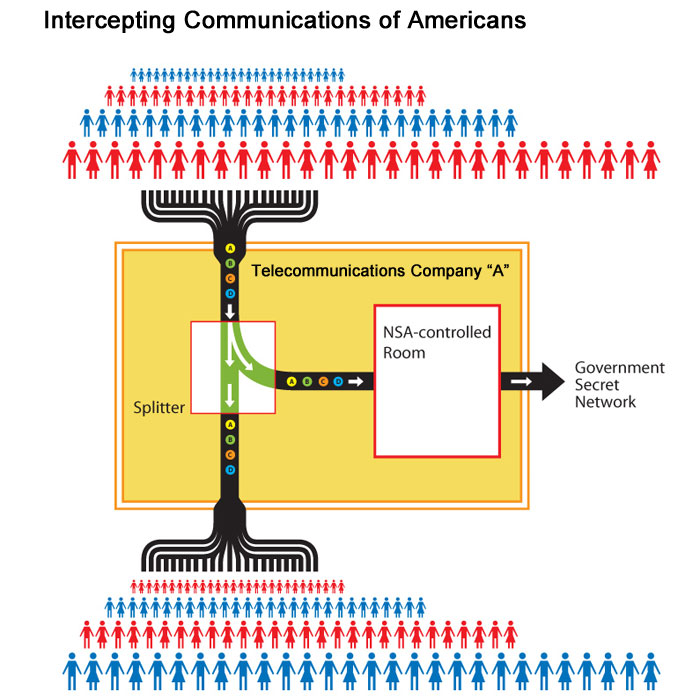 What we have failed to truly comprehend is that the NSA is merely one small part of a shadowy permanent government comprised of unelected bureaucrats who march in lockstep with profit-driven corporations that actually runs Washington, DC, and works to keep us under surveillance and, thus, under control. For example,
 A good case in point is the
  Take this anything-goes attitude towards government surveillance, combine it with Big Business’ complicity over the government’s blatantly illegal acts, the ongoing trend towards overcriminalization, in which minor acts are treated as major crimes, and the rise of private prisons, which have created a profit motive for jailing Americans, and you have all the makings of a fascist police state.
 It won’t be Congress, either (
 Mind you, this is the same agency, rightly dubbed a “
 In the second camp are those who not only don’t trust the government but think the government is out to get them. Sadly, they’ve got good reason to distrust the government, especially when it comes to abusing its powers and violating our rights. For example, consider that government surveillance of innocent Americans has exploded over the past decade. In fact, Wall Street Journal reporter Julia Angwin has concluded that, as a result of its spying and data collection, the
  In the meantime, surveillance has become the new normal, and the effects of this endless surveillance are taking a toll,

 For example, police have been using Stingray devices mounted on their cruisers to intercept cell phone calls and text messages without court-issued search warrants. Thwarting efforts to learn how and when these devices are being used against an unsuspecting populace, the FBI is insisting that
  Sidewalk and “public space” cameras
 Drones, which will begin to take to the skies en masse this year, will be the converging point for all of the weapons and technology already available to law enforcement agencies. This means drones that can listen in on your phone calls, see through the walls of your home, scan your biometrics, photograph you and track your movements, and even corral you with sophisticated weaponry.
 Why would anyone put up with
 We’re still bartering our freedoms away for the phantom promise of security, and we’re no safer and much less freer than we were two decades ago. First, it was the
  Every once in a while, we get tossed a bone to satisfy that gnawing, nagging hunger for something that looks and tastes like freedom, democracy and free enterprise. Political elections, town-hall meetings, awards ceremonies, sports spectacles,
  Perhaps I stay because I was raised to believe that anything worth having is worth fighting for, and I believe with every fiber of my being that freedom matters. In fact, I come from a long line of Americans who understood that there is a price to be paid for freedom, whether that means standing up to the British military, sitting down in a bus seat reserved for “whites only,” or pushing back against corporations who pollute our waters and pillage our lands for profit.
 For example, do we tune into
 The more that is beamed at us, the more inclined we are to settle back in our comfy recliners and become passive viewers rather than active participants as unsettling, frightening events unfold. Reality and fiction merge as everything around us becomes entertainment fodder. This holds true whether we’re watching American Idol, American Sniper or America’s Newsroom.
 Ironically, whether we like it or not, these cameras—directed at us—will turn “we the people” into the stars of our own reality shows. As Kelefa Sanneh,
 By 2018, it is estimated there will be
  The aim of these internet-connected devices, as Nest proclaims, is to make “
 Sure, the technology could save lives, but is that all we need to know? Have we done our due diligence in asking all the questions that need to be asked before unleashing such awesome technology on an unsuspecting populace?
 This was the underlying lesson of The Matrix, the Wachowski brothers’ futuristic thriller about human beings enslaved by autonomous technological beings that call the shots. As Morpheus, one of the characters in The Matrix, explains:
 John W. Whitehead, Constitutional Attorney