Posts Tagged ‘news’

“Those who created this country chose freedom. With all of its dangers. And do you know the riskiest part of that choice they made? They actually believed that we could be trusted to make up our own minds in the whirl of differing ideas. That we could be trusted to remain free, even when there were very, very seductive voices—taking advantage of our freedom of speech—who were trying to turn this country into the kind of place where the government could tell you what you can and cannot do.”—Nat Hentoff

The Trump administration is taking its war on free speech into the realm of thought crimes.

This is more than politics.

In declaring “Antifa”—a loose ideology based on opposition to fascism—as a domestic terrorist organization, the government has given itself a green light to treat speech, belief, and association as criminal acts. With this one executive order, political dissent has been rebranded as terrorism and free thought recast as a crime.

Critics will argue that “Antifa” means rioting and property destruction. But violent acts are already crimes, handled under ordinary law.

What’s new—and dangerous—is punishing people not for violence, but for what they believe, say, or with whom they associate. Peaceful protest, political speech, and nonviolent dissent are now being lumped together with terrorism.

Violence should be prosecuted. But when peaceful protest and dissent are treated as terrorism, the line between crime and thought crime disappears.

When the government polices political belief, we’re no longer talking about crime—we’re talking about thought control.

This opens the door to guilt by association, thought crimes, and McCarthy-style blacklists, making it possible for the government to treat peaceful protesters, critics, or even casual sympathizers as terrorists.  

Protesters who identify with anti-fascist beliefs—or who, under this administration, simply challenge its power grabs and overreaches—can now be surveilled, prosecuted, and silenced, not for acts of violence but for what they think, say, or believe.

Under this executive order, George Orwell—the antifascist author of 1984would become an enemy of the state.

This is how dissent becomes labeled as “terrorism” in a police state: by targeting political thought instead of criminal conduct.

Once you can be investigated and punished for your associations or sympathies, the First Amendment is reduced to empty words on paper.

Nor is this an isolated development. It is part of a larger pattern in which the right to think and speak freely without government interference or fear of retribution—long the bedrock of American liberty—is treated as a conditional privilege rather than an inalienable right, granted only to those who toe the official line and revoked from those who dare dissent.

The warning signs are everywhere.

The Pentagon now requires reporters to pledge not to publish “unauthorized” information. Broadcasters silence comedians after political outrage. Social media platforms delete or deplatform disfavored viewpoints.

The common thread running through these incidents is not their subject matter but their method.

Government officials don’t need to pass laws criminalizing dissent when they can simply ensure that dissent is punished and compliance rewarded.

The result is a culture of self-censorship.

The First Amendment was written precisely to prevent this kind of chilling effect.

The U.S. Supreme Court has long recognized that speech does not lose protection simply because it is offensive, controversial, or even hateful.

Yet today, by redefining unpopular expression as “dangerous” or “unauthorized,” government officials have come up with a far more insidious way of silencing their critics.

In fact, the Court has held that it is “a bedrock principle underlying the First Amendment…that the government may not prohibit the expression of an idea simply because society finds the idea offensive or disagreeable.” It is not, for example, a question of whether the Confederate flag represents racism but whether banning it leads to even greater problems—namely, the loss of freedom in general.

Along with the constitutional right to peacefully (and that means non-violently) assemble, the right to free speech allows us to challenge the government through protests and demonstrations and to attempt to change the world around us—for the better or the worse—through protests and counterprotests.

If citizens cannot stand out in the open and voice their disapproval of their government, its representatives, and its policies without fearing prosecution, then the First Amendment—with all its robust protections for speech, assembly, and petition—is little more than window dressing: pretty to look at, but serving little real purpose.

Living in a representative republic means that each person has the right to take a stand for what they think is right—whether that means marching outside the halls of government, wearing clothing with provocative statements, or simply holding up a sign.

That is what the First Amendment is supposed to be about: assuring the citizenry of the right to express their concerns about their government, in the time, place, and manner best suited to ensuring those concerns are heard.

Unfortunately, through a series of carefully crafted legislative steps and politically expedient court rulings, government officials have managed to disembowel this fundamental freedom, rendering it little more than the right to file a lawsuit against those in power.

In more and more cases, the government is declaring war on what should be protected political speech whenever it challenges authority, exposes corruption, or encourages the citizenry to push back against injustice.

The machinery of censorship is more entrenched than ever.

With growing monopolies of the media, a handful of corporate gatekeepers dominate the digital public square. Government regulators hold powerful levers—licenses, contracts, antitrust threats—that can be used to manipulate content so that only what is approved is publicized. And a public increasingly conditioned to equate harm with offense becomes an unwitting accomplice to suppression, cheering the silencing of adversaries without realizing that the same tools will be used against them tomorrow.

This crackdown on expression is not limited to government action.

Corporate America has now taken the lead in policing speech online, with social media giants such as Facebook, Twitter, and YouTube using their dominance to censor, penalize, and regulate what users can say. Under the banner of “community standards” against obscenity, violence, hate speech, or intolerance, they suspend or ban users whose content strays from approved orthodoxy.

Make no mistake: this is fascism, American-style.

As presidential advisor Bertram Gross warned in Friendly Fascism: The New Face of Power in America, “Anyone looking for black shirts, mass parties, or men on horseback will miss the telltale clues of creeping fascism. . . . In America, it would be super modern and multi-ethnic—as American as Madison Avenue, executive luncheons, credit cards, and apple pie. It would be fascism with a smile. As a warning against its cosmetic façade, subtle manipulation, and velvet gloves, I call it friendly fascism. What scares me most is its subtle appeal.”

The appeal here is the self-righteous claim to be fighting evils—hatred, violence, intolerance—using the weapons of Corporate America. But those weapons are easily redirected. Today they are aimed at “hate.” Tomorrow they will be aimed at dissent.

The effect is the same: the range of permissible ideas shrinks until only government-approved truths remain.

Combine this with Trump’s Antifa executive order, and the danger becomes unmistakable.

By labeling a loose ideology as terrorism, the government opens the door to treat political opposition as criminal conspiracy. Combine that with corporate censorship, and the result is chilling.

Together, they create a chokehold on dissent.

The Constitution’s promise of free speech becomes little more than words on paper if every outlet for expression—public or private—is policed, monitored, or denied.

Free speech for me but not for thee” is how my good friend and free speech purist Nat Hentoff used to sum up this double standard.

We have entered an era in which free speech has become regulated speech: celebrated when it reflects the values of the majority, tolerated when it doesn’t, and branded “dangerous” when it dares to challenge political, religious, or cultural comfort zones.

President Trump, who regularly mocks critics while trying to muzzle those who speak out against him, may be the perfect poster child for this age of intoleranceProtest laws, free speech zones, bubble zones, anti-bullying policies, hate-crime statutes, zero-tolerance rules—these legalistic tools, championed by politicians and prosecutors across the political spectrum, have steadily corroded the core freedom to speak one’s mind.

The U.S. government has become particularly intolerant of speech that challenges its power, reveals its corruption, exposes its lies, and encourages the citizenry to push back against its many injustices.

Indeed, there is a long and growing list of the kinds of speech that is being flagged, censored, surveilled, or investigated by the government: “hate speech,” “intolerant speech,” “conspiratorial speech,” “treasonous speech,” “incendiary speech,” “anti-government speech,” “extremist speech,” and more.

By rebranding dissent as dangerous speech, government officials have given themselves the power to police expression without judicial oversight.

This is not a partisan issue.

Under one administration, speech may be stifled in the name of fighting “misinformation.” Under another, it may be curbed in the name of rooting out “dangerous” or “hateful” speech.

The justifications change with the politics of the moment, but the outcome is the same: less speech, narrower debate, and more fear.

The stakes could not be higher.

If we no longer have the right to tell an ICE agent to get off our property, to tell a police officer to get a search warrant before entering our home, to stand outside the Supreme Court with a protest sign, to approach an elected representative to share our views, or  if we no longer have the right to voice our opinions in public—no matter how offensive, intolerant, or politically incorrect—then we do not have free speech.

Just as surveillance stifles dissent, government censorship gives rise to self-censorship, breeds compliance, smothers independent thought, and fuels the kind of frustration that can erupt in violence.

The First Amendment is meant to be a steam valve: allowing people to speak their minds, air grievances, and contribute to a dialogue that hopefully results in a more just world. When that valve is shut—when there is no one to hear what people have to say— frustration builds, anger grows, and society becomes more volatile.

Silencing unpopular viewpoints with which the majority might disagree—whether by shouting them down, censoring them, or criminalizing them—only empowers the Deep State. The motives—discouraging racism, condemning violence, promoting civility—may sound well-intentioned, but the result is always the same: intolerance, indoctrination, and infantilism.

The police state could not ask for better citizens than those who do its censoring for it.

This is how a nation of free people becomes an extension of the surveillance state, turning citizens against each other while the government grows stronger.

The path forward is clear.

As Justice William O. Douglas wrote in his dissent in Colten v. Kentucky, “we need not stay docile and quiet” in the face of authority.

The Constitution does not require Americans to be servile or even civil to government officials.

What is required is more speech not less—even when it offends.

As I make clear in my book Battlefield America: The War on the American People and in its fictional counterpart The Erik Blair Diaries, it’s time to make the government hear us—see us—and heed us.

This is the ultimate power of free speech.

Source: https://tinyurl.com/2s49rpmp

ABOUT JOHN W. WHITEHEAD

Constitutional attorney and author John W. Whitehead is founder and president of The Rutherford Institute. His most recent books are the best-selling Battlefield America: The War on the American People, the award-winning A Government of Wolves: The Emerging American Police State, and a debut dystopian fiction novel, The Erik Blair Diaries. Whitehead can be contacted at staff@rutherford.org. Nisha Whitehead is the Executive Director of The Rutherford Institute. Information about The Rutherford Institute is available at www.rutherford.org.

Publication Guidelines / Reprint Permission

John W. Whitehead’s weekly commentaries are available for publication to newspapers and web publications at no charge. 

SAN FRANCISCO, Calif. — A coalition of free speech organizations is asking the federal courts to rein in President Trump’s unprecedented use of the military against civilians, especially as a means of silencing and punishing disfavored speech, warning that such actions echo the very abuses the nation’s Founders sought to prevent. The filing comes amid Trump’s ongoing threats to deploy troops to Memphis, Baltimore, San Francisco, Chicago, and New York City, often over the objections of state governors.

In an amicus brief before the Ninth Circuit Court of Appeals in Newsom v. Trump, The Rutherford Institute joined the ACLU, its state affiliates, and the Knight First Amendment Institute at Columbia University to challenge Trump’s June 2025 order federalizing the California National Guard and deploying active-duty Marines in Los Angeles to quell protests against his immigration raids. The coalition’s brief argues that the President’s claim of unilateral, unreviewable authority to deploy troops on American streets is “extreme, unprecedented, and incompatible with the history, traditions, and laws of the United States.”

“The Founders warned against standing armies on American soil, fearing that the military might be used not to defend the people, but to control them,” said constitutional attorney John W. Whitehead, president of The Rutherford Institute and author of Battlefield America: The War on the American People. “Deploying the military to deal with domestic matters that can—and should—be handled by local police violates the Posse Comitatus Act and crosses the line into authoritarianism.”

On June 7, 2025, President Trump invoked a rarely used statute, 10 U.S.C. § 12406, to forcibly federalize the California National Guard and deploy thousands of troops against largely peaceful protesters in Los Angeles. The protests erupted after armed federal agents carried out aggressive immigration raids, sparking public outrage. The federal government escalated the situation by unleashing military troops armed with tear gas, pepper balls, and flash-bang grenades on demonstrators that included journalists, legal observers, clergy, children, and elected officials. Trump claimed that the protests “constitute a form of rebellion against the authority of the Government.”

Five days later, the federal district court found that “[Trump’s] actions were illegal—both exceeding the scope of his statutory authority and violating the Tenth Amendment,” and thus issued a temporary restraining order to return control of the National Guard to the Governor. But a panel of the Ninth Circuit then stayed that initial restraining order pending appeal, giving high deference to the President’s authority. While this appeal has been pending, the district court ruled on Sept. 2, 2025, that the federal government also violated the Posse Comitatus Act, which forbids the use of the military for domestic policing absent express constitutional or statutory authorization.

The coalition’s brief before the Ninth Circuit stresses that: 1) History and tradition strictly limit military deployments against civilians; 2) Military policing threatens the First Amendment by suppressing lawful protests, political dissent, and association; and 3) Unchecked troop deployments risk authoritarian abuse, because the President cannot label ordinary political opposition as “rebellion” to justify military force. With 300 National Guard troops to remain deployed in Los Angeles through Election Day, the dangers of Trump’s military deployments are not theoretical: internal assessments reveal that troops’ presence in Washington, D.C. has been perceived by the public as “leveraging fear.”  

Hina Shamsi, Charlie Hogle, Sean M. Lau, and other ACLU attorneys advanced the arguments in the amicus brief.

The Rutherford Institute is a nonprofit civil liberties organization dedicated to making the government play by the rules of the Constitution. To this end, the Institute defends individuals whose constitutional rights have been threatened or violated and educates the public on a broad range of issues affecting their freedoms.  

Source: tinyurl.com/2bmsy45p

“That was when they suspended the Constitution… There wasn’t even an enemy you could put your finger on.”—Margaret Atwood, The Handmaid’s Tale

What we are witnessing is not a government of the people, by the people, and for the people; it is a government over the people.

Call it what it is: political gaslighting—the regime says one thing while doing the opposite, and insists on the citizenry’s trust while dismantling the very checks and balances that make trust possible.

So when the powers-that-be claim to be protecting the Constitution, they’re dismantling it at every turn. In this way, the mechanisms of constitutional government—separation of powers, federalism, due process, and the Bill of Rights—are being hollowed out in plain sight.

Although this dismantling did not start with President Trump, it has accelerated beyond imagining.

What was once a slow bleed is now a hemorrhage—and it is not random. The damage is unfolding on two parallel tracks: a steady, methodical, bureaucratic erosion (rule changes, executive orders, new databases) paired with shock-and-awe surges (National Guard deployments, mass round-ups, headline-grabbing prosecutions).

The words may say “freedom” and “order,” but the deeds smack of tyranny.

Attorney General Pam Bondi vows to punish “hateful” speech even as the administration normalizes hateful rhetoric and violent imagery. Vice President JD Vance promises to “go after” those with a “leftist” ideology while preaching free-speech absolutism for allies.

The Trump administration denounces “hate speech” even as it excuses and downplays the Jan. 6 riots; pledges fiscal restraint while shoveling billions into surveillance, prisons, and domestic deployments; wraps itself in law-and-order while tolerating lawlessness by cronies; sermonizes about faith and morality while normalizing cruelty as governance; and peddles outrage over waste while spending lavishly on the trappings of office.

Rights are framed as absolute for friends and privileges for critics. That is the opposite of constitutional government, which holds everyone—especially those in power—to the same rule of law, applied evenly.

If the government can police ideas, deploy troops at home, run dragnets by algorithm, disappear people into distant prisons, build spectacle cages, and amass power in one office, then no American is safe—including those who cheer these efforts today.

If you believe in limited government, equal justice, and due process—whatever your party—these double standards should alarm you most, because the precedents being cheered today will be wielded against you tomorrow.

What follows is a running ledger of the gaslighting playbook and its constitutional costs.

The Gaslight: “We’re Restoring the Constitution.”
Reality: The “temporary” powers created after 9/11 have hardened into a permanent police-state architecture—Patriot Act surveillance, secret FISA processes and National Security Letters, DHS fusion centers, a diluted Fourth Amendment “border zone,” civil-asset forfeiture, Pentagon 1033 militarization, Real ID, facial-recognition and geofence warrants—now run at full throttle across administrations.
The Cost: A police state.

The Gaslight: “We Value Law and Order.”
Reality: The administration deployed Marines and the National Guard into American streets to police protests protected by the First Amendment. On September 2, 2025, a federal judge ruled that the administration’s deployment of thousands of Guard troops and U.S. Marines to Los Angeles—ostensibly for immigration protests—violated the Posse Comitatus Act, describing a “top-down, systemic effort” to militarize civil law enforcement. The Constitution’s framers feared standing armies and military occupations of American communities.
The Cost: The death of Posse Comitatus.

The Gaslight: “We Defend Free Speech.”
Reality: Dissent is criminalized, expressive conduct is relitigated, and disfavored groups face terror labels and IRS pressure. Protest is a right, not a privilege, yet the government increasingly recasts organized dissent as conspiracy. After the Charlie Kirk shooting, the White House floated designating “antifa” and other liberal groups as domestic terrorists, bringing racketeering cases against funders, and targeting nonprofits critical of the administration—all while downplaying right-wing violence. Fold in Bondi’s vow to target “hateful” speech and Vance’s pledge to eradicate “leftist ideology,” and power slides from punishing unlawful acts to policing ideas.
The Cost: A weaponized First Amendment.

The Gaslight: “We’re Protecting You from Extremists.”  
Reality: Watchlists without due process, elastic “material support” theories, politicized “extremism” labels, and donor targeting that treat journalists, whistleblowers, activists—even parents at school boards—as suspects first and citizens second. Speaking truth to power is reframed as a security risk. In free societies, the state fears the citizen; in unfree ones, the citizen fears the state.
The Cost: Dissent rebranded as extremism.

The Gaslight: “We’re Ending Federal Censorship.”
Reality: On Day One, the President signed an order to “end federal censorship.” Read closely, it asserts sweeping control over how agencies interact with media platforms and broadcasters, rebranding ordinary outreach and fact-checking as First Amendment violations, while positioning the Executive as referee of the private square. By centralizing power over the flow of information in the Executive Branch, it threatens the independence of the very private forums where Americans speak. The test of free speech is whether the government stays out of the marketplace of ideas—not whether it curates it to the President’s liking.
The Cost: The state as speech referee.

The Gaslight: “We Use Smart Tech, Not Dragnet Surveillance.”
Reality: The administration is fusing government databases and outsourcing “intelligence” to private vendors in such a way that data becomes the warrant. ICE’s new $30 million deal with Palantir to build “ImmigrationOS” promises to identify, track, and deport people using AI-driven analytics and cross-agency data sharing. Add in geofence warrants, face-scan dragnets, and fusion-center “suspicious activity” pipelines, and you get a domestic intelligence system that presumes guilt by data trail.
The Cost: Probable cause replaced by algorithms.

The Gaslight: “We’re Tough on Crime.”
Reality: This year, U.S. agencies financed the transfer of migrants to El Salvador’s mega-prison (CECOT), where families and lawyers lost contact with detainees for months. Florida’s “Alligator Alcatraz” detention site whetted the government’s appetite for scaled-up incarceration, converting state prisons into immigration jails nationwide. These attempts by the Trump administration constitute an end run around longstanding constitutional protections for anyone accused of a crime. The common denominator is spectacle over justice, expansion over restraint.  
The Cost: The death of due process.

The Gaslight: “We’re Compassionate, Not Cruel.”  
Reality: The push to clear homeless encampments combines criminalization with expanded involuntary commitments. A July 24, 2025 executive order encourages states to funnel people into institutions and mental-health courts, tying funding to “maximum” use of commitments—an end-run around the presumption of liberty that undergirds due process.
The Cost: Bureaucratic coercion over compassion.

The Gaslight: “We’re Streamlining Government.”
Reality: The separation of powers was intended to serve as a check against any one government agency becoming too powerful. Yet the administration has pressed an aggressive unitary-executive theory to encroach on independent agencies, such as the Federal Reserve. Scholars warn this could erase the independence of agencies designed to check the White House.
The Cost: Checks and balances gutted.

The Gaslight: “We’re Keeping America Safe Overseas.”
Reality: Killing by assassination, not authorization. Twice in recent months, U.S. forces have launched unannounced attacks on Venezuelan boats, killing crews without warning or due process, on the mere assertion that they were drug traffickers.
The Cost: War powers and judicial oversight bypassed.

The Gaslight: “We’re Fixing Wasteful Spending.”
Reality: Having poured billions into surveillance, prisons, and domestic deployments, the “police-state budget” unravels the economy while eroding liberty.
The Cost: A debt-funded police state.

Many who cherish ordered liberty, limited government, fiscal restraint, and constitutional morality would normally recoil at these tactics under any other administration, so why not now?

Principles should not change because the party in power has changed, and yet that’s exactly what continues to drive the double standard.

If there’s a constitutional scorecard, “we the people” are on the losing team right now.

The First Amendment is buckling as protest is chilled, expressive conduct is targeted, opponents are threatened with terror labels, and the Executive Branch expands control over the speech ecosystem.

The Fourth and Fifth Amendments have been weakened by AI surveillance and cross-agency fusion that normalize suspicionless tracking, while offshore detention and coerced commitments compromise due process.

The Eighth Amendment is mocked by harsh, theatrical detention regimes.

Federalism and the Tenth Amendment give way when federal troops step into local policing.

Separation of powers erodes as an inflated unitary-executive theory encroaches on independent agencies.

War powers are skirted by extrajudicial killings abroad. And fiscal responsibility is inverted as surveillance and prison appropriations swell while liberty contracts.

What must happen now?

Congress must codify guardrails against domestic military use—tighten Posse Comitatus, narrow Insurrection Act exceptions, and mandate transparency for any domestic mission. Courts and prosecutors should reaffirm expressive rights, rejecting end-runs around Texas v. Johnson and refusing cases that criminalize symbolism.

Lawmakers must impose bright-line limits on data fusion, bar cross-agency pooling for generalized surveillance, and require algorithmic transparency and adversarial testing before any tool touches liberty. The U.S. must prohibit outsourcing detention to abusive regimes, close loopholes, and apply human-rights scrutiny to every foreign arrangement.

The independence of watchdogs and the Fed needs protection through clear “for cause” standards. States and cities should decriminalize homelessness and fund housing-first approaches instead of coercive commitments.

Congress must reassert war powers, requiring explicit authorization before any attack abroad. And fiscal sanity must be restored: sunset emergency outlays for surveillance and prison build-outs, mandate GAO audits of domestic deployments and fusion contracts, and attach civil-liberties impact statements to major security spending.

Our job as citizens is not to trust the government but to bind it down with the Constitution. “In questions of power,” Thomas Jefferson warned, we must “bind [government] down from mischief by the chains of the Constitution.”

Whatever you do, don’t trust the government with your privacy. Don’t trust it with your property: no-knock raids and forfeiture turn “private” property into whatever authorities permit you to keep.

Don’t trust it with your finances: Washington spends money it doesn’t have on programs it can’t afford. Don’t trust it with your life: force without accountability is not protection.

Above all, don’t trust it with your freedoms: on paper, rights endure; in practice, they are rationed by policy memos, watchlists, and shifting lines in the sand.

This should never be a right-vs-left debate; it’s the State vs. your liberty.

If you wouldn’t trust your worst political enemy with these weaponized tools, you shouldn’t trust your favorite politician with them either.

So think nationally, act locally.

Rebuild the habits of self-government where you live: know your neighbors and officials; know your rights and your city charter; ask who runs the jail and demand transparency; vet the people you entrust with power; and hold officials to account—show up, file requests, appeal, document, organize.

This is the work in front of us—not knee-jerk outrage, but persistent, consistent work to fortify the “chains of the Constitution.”

As I make clear in my book Battlefield America: The War on the American People and in its fictional counterpart The Erik Blair Diaries, if we let emergency rule become ordinary rule—military troops as beat cops, protest as crime, data as warrant, assassination as policy, money as politics—there won’t be a Constitution left to defend.

Source: https://tinyurl.com/ydxdjx5b

ABOUT JOHN W. WHITEHEAD

Constitutional attorney and author John W. Whitehead is founder and president of The Rutherford Institute. His most recent books are the best-selling Battlefield America: The War on the American People, the award-winning A Government of Wolves: The Emerging American Police State, and a debut dystopian fiction novel, The Erik Blair Diaries. Whitehead can be contacted at staff@rutherford.org. Nisha Whitehead is the Executive Director of The Rutherford Institute. Information about The Rutherford Institute is available at www.rutherford.org.

Publication Guidelines / Reprint Permission

John W. Whitehead’s weekly commentaries are available for publication to newspapers and web publications at no charge. 

BOSTON, Mass. — In a major victory for the First Amendment and academic freedom, a federal court has ruled that the Trump administration’s blatant attempt to force Harvard University to conform to the government’s ideological viewpoint is unconstitutional.

The ruling by Judge Allison D. Burroughs of the U.S. District Court in Boston found that the Trump administration violated the First Amendment when it froze $2.2 billion dollars in research funding in an effort “to require Harvard to overhaul its governance, hiring, and academic programs to comport with the government’s ideology and prescribed viewpoint.” The Rutherford Institute joined a broad coalition of civil liberties organizations—including the ACLU, ACLU of Massachusetts, Cato Institute, Electronic Frontier Foundation, Knight First Amendment Institute, National Coalition Against Censorship, and the Reporters Committee for the Freedom of the Press—in opposing the Trump administration’s attempts to wage a political war on academic freedom and ideological independence.

“This ruling is a powerful rebuke of the government’s attempt to police thought and punish dissent,” said constitutional attorney John W. Whitehead, president of The Rutherford Institute and author of Battlefield America: The War on the American People. “By weaponizing federal funding to force ideological conformity, the Trump administration wasn’t just targeting Harvard—it was launching a war on the First Amendment itself. If the government can dictate what is taught in a university classroom, it won’t stop there—it will try to dictate what is preached in the pulpit, printed in the press, and spoken in the streets. This kind of ideological tyranny is the very danger the First Amendment was written to prevent.”

The district court’s ruling comes in response to an April 2025 move by the Trump administration to cancel billions in research funding and blacklist Harvard from future grants unless the university agreed to: vet students, faculty, and departments for “viewpoint diversity”; alter its hiring, admissions, and curriculum choices to conform to the government’s ideological preferences; submit to a third-party audit of programs that “reflect ideological capture”; and install new leadership committed to enforcing the government’s demands. Refusing to “surrender its independence or relinquish its constitutional rights” and “be taken over by the federal government,” Harvard then filed a lawsuit challenging the government’s actions.

In coming to Harvard’s defense, the coalition’s amicus brief argued that the government cannot use its financial power to force any private institution—liberal or conservative—to adopt state-sanctioned views. The First Amendment, the brief emphasizes, guarantees that private universities retain autonomy over what to teach, how to teach, who will teach, and whom to admit—free from government control or interference. The federal court agreed, ordering the restoration of all previously withdrawn grants and prohibiting the federal government from denying future research funding to Harvard in retaliation for the exercise of its First Amendment rights.

Cecillia D. Wang, Ben Wizner, Vera Eidelman, Brian Hauss, Jessie J. Rossman, and Rachel E. Davidson at ACLU advanced the arguments in the amicus brief in President and Fellows of Harvard College v. U.S. Department of Health and Human Services.

The Rutherford Institute is a nonprofit civil liberties organization dedicated to making the government play by the rules of the Constitution. To this end, the Institute defends individuals whose constitutional rights have been threatened or violated and educates the public on a broad range of issues affecting their freedoms.

Source: tinyurl.com/ycx9acu7

There is more than one way to burn a book. And the world is full of people running about with lit matches.”—Ray Bradbury

Cancel culture—political correctness amped up on steroids, the self-righteousness of a narcissistic age, and a mass-marketed pseudo-morality that is little more than fascism disguised as tolerance—has shifted us into an Age of Intolerance.

Nothing illustrates this more clearly than President Trump’s latest executive order calling for criminal charges for anyone who burns the American flag—a symbolic act long upheld by the Supreme Court as protected political expression.

This push is not about patriotism—it is political theater.

For an administration under fire—from the Epstein cover-up to tanking approval ratings and mounting constitutional crises—flag burning serves as symbolic outrage staged as political cover, a culture-war diversion to distract from more serious abuses of power.

Consider the timing: on the very same day Trump announced penalties for flag burning, he also signed an executive order establishing “specialized” National Guard units to patrol American cities under the guise of addressing crime.

This is the real bait-and-switch: cloak military policing in patriotic theater and hope no one notices the deeper constitutional violations taking root.

In other words, Trump’s flag fight is a decoy.

Yet in today’s climate, where mobs on the left and censors on the right compete to silence speech they dislike, even this form of protest is under fire.

In 1989, the U.S. Supreme Court ruled 5-4 in Texas v. Johnson that burning the flag of the United States in protest is an act of protected free speech under the First Amendment.

Today, that ruling matters more than ever, yet there is an important distinction: the First Amendment protects the right to burn your own flag as political expression but not to vandalize public property in the process.

That distinction matters: the Constitution protects dissent, not destruction.

And it’s exactly that distinction—between lawful protest and punished expression—that makes the flag-burning debate so important.

Although the courts have held that symbolic acts of protest deserve the highest protection, the culture wars have turned those protections into battlegrounds. For decades, mobs, politicians, and bureaucrats alike have worked to silence unpopular or politically incorrect opinions.

Whether it’s a student disciplined for refusing to recite the Pledge, an athlete demonized for kneeling during the National Anthem, or a dissenter deplatformed for expressing views outside the mainstream, the message is the same: toe the line or be punished.

This new Age of Intolerance is not limited to the cultural left.

President Trump has been waging his own right-wing brand of cancel culture: sanitizing museums, scrubbing exhibits of “unpatriotic” narratives, renaming anything that doesn’t fit his preferred version of history, and punishing dissenters with executive orders and loyalty oaths.

What the left enforces with trigger warnings and deplatforming, Trump enforces with prosecutions, cultural re-branding and militarization.

They are snowflakes of a different political persuasion, but the result is the same: dissent is silenced, history is rewritten, and only the approved narrative remains.

And here’s the danger: when symbolic outrage is used as a political smokescreen for militarization and constitutional erosion, it distracts Americans from the machinery of control being built in real time. The fight over flags and museums is not just about culture—it is the smokescreen for expanding surveillance, militarization, and police-state powers.

That is why the sudden outrage over disrespect for the country’s patriotic symbols rings so hollow. In a culture where the flag is already plastered on bikinis, beer koozies, and billboards—with little outcry—it’s not reverence that’s driving this crackdown. It’s control.

Worse, it divides the nation and distracts us from the steady rise of the police state.

So, what do the courts actually say about patriotic symbols and protest?

As the U.S. Supreme Court has made clear, Americans have a right to abstain from patriotic demonstrations (West Virginia State Board of Ed. v. Barnette, 1943) and/or actively protest that demonstration, for example, by raising one’s fist during the Pledge of Allegiance (Holloman ex rel. Holloman v. Harland, 2004). These First Amendment protections also extend to military uniforms (worn to criticize the military) and military funeral protests (Snyder v. Phelps, 2011).

Likewise, Americans have a First Amendment right to display, alter or destroy the U.S. flag as acts of symbolic protest speech.

In fact, in Street v. New York (1969), the Supreme Court held that the government may not punish a person for uttering words critical of the flag, writing that “the constitutionally guaranteed ‘freedom to be intellectually . . . diverse or even contrary,’ and the ‘right to differ as to things that touch the heart of the existing order,’ encompass the freedom to express publicly one’s opinions about our flag, including those opinions which are defiant or contemptuous.”

The case arose after Sidney Street, hearing about the attempted murder of civil rights leader James Meredith in Mississippi, burned a 48-star American flag on a New York City street corner to protest what he saw as the government’s failure to protect Meredith. Upon being questioned about the flag, Street responded, “Yes; that is my flag; I burned it. If they let that happen to Meredith, we don’t need an American flag.”

In Spence v. Washington (1974), the Court ruled that the right to display the American flag with any mark or design upon it is a protected act of expression. The case involved a college student who had placed a peace symbol on a three by five foot American flag using removable black tape and displayed it upside down from his apartment window.

Finally, in Texas v. Johnson (1989), the Court held that flag burning was protected speech under the First Amendment. The case arose from a demonstration near the site of the Republican National Convention in Dallas during which protesters marched through the streets, chanted political slogans, staged “die-ins” in front of several corporate offices to dramatize the consequences of nuclear war, and burned the flag as a means of political protest.

In other words, it is precisely the unpopular, controversial, and even offensive expression that the First Amendment exists to protect. As Justice William Brennan wrote in Texas v. Johnson, “If there is a bedrock principle underlying the First Amendment, it is that the government may not prohibit the expression of an idea simply because society finds the idea offensive or disagreeable.”

More three decades later, that principle is constantly betrayed in practice.

In today’s climate, both political tribes are eager to wield censorship as a weapon. One side shouts down speakers; the other side bans books, rewrites curricula, and prosecutes symbolic dissent like flag burning.

The battlegrounds may differ—college campuses versus classrooms, corporate platforms versus government edicts—but the impulse is the same: to punish those who dare to disagree.

It’s all part of the same authoritarian playbook.

Seen in this light, censorship creep in the name of tolerance becomes even more dangerous.

Everything is now fair game for censorship if it can be construed as hateful, hurtful, bigoted or offensive—provided that it runs counter to the established viewpoint.

This is why unpopular political protests such as flag burning matter so much: they are the test case for whether we still believe in freedom “for the thought that we hate.”

If freedom means anything, it means that those exercising their right to protest are showing the greatest respect for the principles on which this nation was founded: the right to free speech and the right to dissent.

Frankly, the First Amendment does more than give us a right to criticize our country: it makes it a civic duty.

Let’s not confuse patriotism (love for or devotion to one’s country) with blind obedience to the government’s dictates. That is the first step towards creating an authoritarian regime.

One can be patriotic and love one’s country while at the same time disagreeing with the government or protesting government misconduct. As journalist Barbara Ehrenreich recognizes, “Dissent, rebellion, and all-around hell-raising remain the true duty of patriots.”

That spirit is disappearing. Instead, Americans now rush to silence those they dislike.

This selective tolerance—the essence of cancel culture—is exactly what my late friend and First Amendment champion Nat Hentoff used to denounce as “Free speech for me but not for thee.”

Once that mindset takes root, the First Amendment is already half-lost.

That double standard lies at the heart of our present crisis.

Indeed, I would venture to say that if you’re not speaking out or taking a stand against government wrongdoing—if you’re marching in lockstep with anything the government and its agents dole out—and if you’re prioritizing partisan politics over the principles enshrined in the Constitution, then you’re not a true patriot.

Real patriots care enough to take a stand, speak out, protest and challenge the government whenever it steps out of line.

There is nothing patriotic about the lengths to which Americans have allowed the government to go in its efforts to dismantle our constitutional republic and shift the country into a police state.

The irony is this: it’s not anti-American to be anti-war or anti-police misconduct or anti-racial discrimination—but it is anti-American to be anti-freedom.

What we are witnessing, in the flag-burning debate and far beyond, is a culture war in which political tribes police thought, speech, and even symbolic protest. Those who refuse to conform—whether they burn a flag, take a knee, question authority, or simply refuse to parrot the official line—are demonized, deplatformed, and sometimes even criminalized.

The upshot of all this editing, parsing, banning and silencing is the emergence of a new language, what George Orwell referred to as Newspeak, which places the power to control language in the hands of the totalitarian state. Under such a system, language becomes a weapon to change the way people think by changing the words they use.

And while Orwell imagined it as dystopian fiction, we are living its early chapters now.

The First Amendment is being whittled down not just by government decree but by a culture that rewards conformity and punishes divergence.

In such an environment, burning a flag is not the real danger. The real danger is a society that no longer tolerates free thought at all.

The First Amendment is a steam valve. It allows people to speak their minds, air their grievances and contribute to a larger dialogue that hopefully results in a more just world. When there is no steam valve to release the pressure, frustration builds, anger grows, and people become more volatile and desperate to force a conversation.

The lesson is clear: America requires more than voters inclined to pay lip service to a false sense of patriotism. It requires doers—a well-informed and very active group of doers—if we are to have any chance of holding the government accountable and maintaining our freedoms.

We need to stop acting as if showing “respect” for the country, flag and national anthem is more important than the freedoms they represent.

Listen: I served in the Army. I lived through the Civil Rights era. I came of age during the Sixties, when activists took to the streets to protest war and economic and racial injustice. As a constitutional lawyer, I defend people daily whose civil liberties are being violated, including high school students prohibited from wearing American flag t-shirts to school, allegedly out of a fear that it might be disruptive.

I understand the price that must be paid for freedom.

None of the people I served with or marched with or represented put our lives or our liberties on the line for a piece of star-spangled cloth: we took our stands and made our sacrifices because we believed we were fighting to maintain our freedoms and bring about justice for all Americans.

Responsible citizenship means being outraged at the loss of others’ freedoms, even when our own are not directly threatened.

The Framers of the Constitution knew very well that whenever and wherever democratic governments had failed, it was because the people had abdicated their responsibility as guardians of freedom. They also knew that whenever in history the people denied this responsibility, an authoritarian regime arose which eventually denied the people the right to govern themselves.

Citizens must be willing to stand and fight to protect their freedoms. And if need be, it will entail criticizing the government.

This is true patriotism in action.

Love of country will sometimes entail carrying a picket sign or going to jail or taking a knee or burning a flag, if necessary, to challenge injustice.

As I make clear in my book Battlefield America: The War on the American People and in its fictional counterpart The Erik Blair Diaries, the real danger isn’t someone burning the flag.

The greatest danger we face is the U.S. government torching the Constitution.

Source: https://tinyurl.com/y3hyuj8p

ABOUT JOHN W. WHITEHEAD

Constitutional attorney and author John W. Whitehead is founder and president of The Rutherford Institute. His most recent books are the best-selling Battlefield America: The War on the American People, the award-winning A Government of Wolves: The Emerging American Police State, and a debut dystopian fiction novel, The Erik Blair Diaries. Whitehead can be contacted at staff@rutherford.org. Nisha Whitehead is the Executive Director of The Rutherford Institute. Information about The Rutherford Institute is available at www.rutherford.org.

Publication Guidelines / Reprint Permission

John W. Whitehead’s weekly commentaries are available for publication to newspapers and web publications at no charge. 
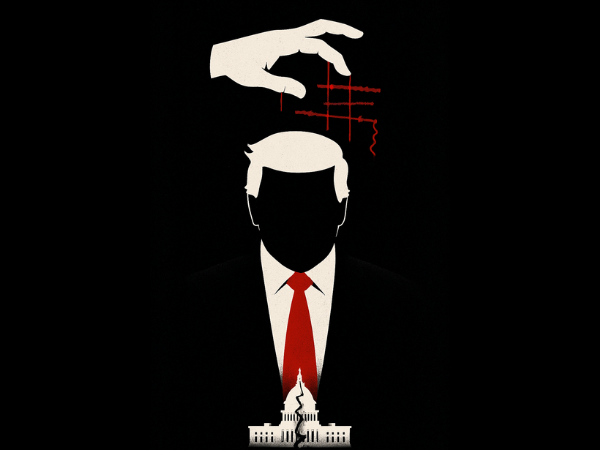
Have you ever wondered who’s pulling the strings? … Anything we touch is a weapon. We can deceive, persuade, change, influence, inspire. We come in many forms. We are everywhere.”— U.S. Army Psychological Operations recruitment video

From viral memes to military-grade influence operations, the government is waging a full-spectrum psychological war—not against foreign enemies but against its own citizens.

The goal? Compliance. Control. Conformity.

The battlefield is no longer physical—it is psychological—and the American people are the targets.

From AI-manipulated narratives and National Guard psyops to loyalty scorecards for businesses, the Deep State’s war on truth and independent thought is no longer covert. It is coordinated, calculated, and by design.

Yet while both major parties—long in service to the Deep State—have weaponized mass communication to shape public opinion, the Trump administration is elevating it into a new art form that combines meme warfare, influencer psyops, and viral digital content to control narratives and manufacture consensus.

In doing so, President Trump and his influencers are capitalizing on a propaganda system long cultivated by the security-industrial complex.

What we’re witnessing is not just propaganda. It is psychological warfare.

Psychological warfare, as defined by the Rand Corporation, “involves the planned use of propaganda and other psychological operations to influence the opinions, emotions, attitudes, and behavior of opposition groups.”

Today, those “opposition groups” include the American public.

For years, the government has been bombarding the citizenry with propaganda and psychological operations aimed at conditioning us to be compliant, easily manipulated and supportive of the police state’s growing domestic and global power.

The government is so confident in its Orwellian powers of manipulation that it’s taken to bragging about them. For example, the U.S. Army’s 4th Psychological Operations Group, the branch of the military responsible for psychological warfare, released a recruiting video that touts its efforts to pull the strings, turn everything they touch into a weapon, be everywhere, deceive, persuade, change, influence, and inspire.

This is the danger that lurks in plain sight: a government so immersed in the art of mind manipulation that it no longer sees its citizens as individuals, but as targets.

Of all the weapons in the government’s vast arsenal, psychological warfare may be the most insidious.

As the military journal Task and Purpose explains, “Psychological warfare is all about influencing governments, people of power, and everyday citizens.” PSYOP soldiers aim to influence “emotions, notices, reasoning, and behavior of foreign governments and citizens,” and “deliberately deceive” enemy forces.

Yet increasingly, these operations are being used not just abroad—but at home.

The government has made clear in word and deed that “we the people” are domestic enemies to be targeted, tracked, manipulated, micromanaged, surveilled, viewed as suspects, and treated as if our fundamental rights are mere privileges that can be easily discarded.

Aided by technological advances and behavioral science, the U.S. government has become a master manipulator of minds, perception, and belief—an agitator of the masses.

As J. Edgar Hoover once observed: “It is the function of mass agitation to exploit all the grievances, hopes, aspirations, prejudices, fears, and ideals of all the special groups that make up our society, social, religious, economic, racial, political. Stir them up. Set one against the other. Divide and conquer. That’s the way to soften up a democracy.”

Here are just a few ways psychological warfare is being waged against the American people:

Weaponizing violence. Recurring mass shootings, domestic unrest, and acts of terrorism traumatize the public, destabilize communities, and give the government greater pretext to crack down, lock down, and clamp down—all in the name of national security.

Weaponizing surveillance and pre-crime. Digital surveillance, AI threat detection, and predictive policing have created a society in which everyone is watched, profiled, and potentially punished before any crime occurs. The government’s war on crime has also veered into the realm of social media and technological entrapment, with government agents adopting fake social media identities and AI-created profile pictures in order to surveil, target and capture potential suspects. It has all the markings of a digital panopticon optimized for psychological control.

Weaponizing digital tools and censorship. Digital censorship is just the beginning. Tech giants, working with the government, now determine who can speak, bank, travel, or participate in society. Digital currencies (which can be used as “a tool for government surveillance of citizens and control over their financial transactions”), combined with social credit systems and surveillance capitalism create a litmus test to determine who is worthy enough to be part of society and punish individuals for moral lapses and social transgressions (and reward them for adhering to government-sanctioned behavior).

For example, the Trump White House recently rolled out a pilot program using a loyalty scorecard to evaluate businesses, echoing China’s social credit system. Businesses deemed “non-compliant” with patriotic messaging or flagged for “ideological extremism” based on their social media posts, public statements, or advertising content are at risk of being barred from federal contracts.

Weaponizing compliance. From the war on terror to COVID mandates, nearly every government “crisis response” has been weaponized to normalize surveillance and control, and demand obedience in exchange for perceived safety.

Weaponizing entertainment. Hollywood and the Pentagon have a long, symbiotic relationship. The military provides equipment, personnel, and funding in exchange for favorable portrayals of war, surveillance, and state power. As Elmer Davis, a CBS broadcaster who was appointed the head of the Office of War Information, observed, “The easiest way to inject a propaganda idea into most people’s minds is to let it go through the medium of an entertainment picture when they do not realize that they are being propagandized.”

Weaponizing behavioral science and nudging. The government’s “nudge units” use psychology and data science to steer public behavior. It may begin with paperwork, but it ends with worldview manipulation—conditioning the population to think and act as the state prefers, all while maintaining the illusion of free will.

Weaponizing desensitization. Lockdowns, SWAT raids, and threat alerts desensitize us to authoritarianism. What once shocked is now routine. That’s by design. The more accustomed we become to surveillance, policing, and crisis, the more willingly we embrace it.

Weaponizing fear. Fear is the preferred tool of totalitarians. It divides the public into factions—persuading them to see each other as the enemy, empowers the government, and numbs rational thinking. The more frightened the population, the easier it is to control. This Machiavellian scheme has so ensnared the nation that few Americans even realize they are being manipulated into adopting an “us” against “them” mindset.

Weaponizing genetics. Fear doesn’t just condition us—it can alter us. Trauma and fear responses can be encoded in DNA and passed on to future generations, as studies in epigenetic inheritance have shown.

Weaponizing the future. The Pentagon’s chilling Megacities training video predicts that by 2030, armed forces would be used against civilian populations to solve domestic political and social problems. Under Trump’s expanded domestic security powers, the National Guard has been increasingly deployed in civil contexts—most recently to address squalor and crime in Washington DC and other parts of the country.

None of this is speculative. It’s well-documented.

In 2022, the Pentagon was forced to investigate reports that the military was creating fake social media profiles with AI-generated photos and fictitious news sites to manipulate users.

These are the modern tools of psychological warfare. But the blueprint goes back decades.

The end goal of these mind control campaigns—packaged in the guise of the greater good—is to see how far the American people will allow the government to go in re-shaping the country in the image of a totalitarian police state.

In the 1950s, the CIA’s MKUltra program tested LSD, electroshock, hypnosis, and other behavior modification techniques on civilians and soldiers—American citizens—often without their knowledge or consent. CIA agents hired prostitutes to lure men into bugged rooms, then dosed them with drugs and observed their behavior. Some detainees were interrogated to death in efforts to erase memories or induce compliance.

It wasn’t until the 1970s that a portion of the CIA’s criminal activities under MKUltra came to light. Congress’s Church Committee investigations revealed that the CIA had spent over $20 million attempting to control human thought and behavior, reportedly as a means of programming people to carry out assassinations (i.e., national defense).

Similarly, the top-secret Montauk Project allegedly was working to develop mind-control techniques that could trigger crime waves.

These were not fringe experiments—they were official policy.

As journalist Lorraine Boissoneault noted, “The same methods that had once been used to train American soldiers ended up being used to extract information from terrorists in Abu Ghraib, Iraq and Guantanamo Bay.”

Fast forward to the present day, and it’s clear the government’s psyops warfare has not ended—it has simply gone digital.

Today’s psyops rely on mass media, AI, algorithmic censorship, and behavioral economics—not LSD. But the goal remains the same: shape thought, induce obedience, silence dissent.

In 2014, for example, a Fusion Center in Washington State mistakenly released records detailing government interest in “psycho-electronic” weapons—remote mind control tactics allegedly capable of controlling people or subjecting them to varying degrees of pain from a distance.

More recently, COVID-19 gave the government a global platform to deploy fear-based compliance strategies. Science writer David Robson explains: “Fears of contagion lead us to become more conformist and tribalistic… [we] value conformity and obedience over eccentricity or rebellion.”

That is precisely the point.

By constantly invoking crisis, the government keeps us reactive, not rational. Fear shuts down the brain’s prefrontal cortex—our center for reasoning and critical thought. A population that stops thinking for itself is one easily led.

This is how the government persuades people to surveil themselves, police their neighbors, and conform to shifting norms: through fear, repetition, and psychological fatigue.

It’s classic Orwell: through censorship, disinformation crackdowns, and hate crime laws, speech becomes thoughtcrime and conformity becomes patriotism.

Edward Bernays, the father of modern propaganda, warned of this nearly a century ago: “We are governed, our minds are molded, our tastes formed, our ideas suggested, largely by men we have never heard of.”  They are, he concluded, “the true ruling power of our country.”

This “invisible government”—the Deep State—has perfected the art of psychological control.

With the approach of the 2026 midterm elections, this psychological warfare will only escalate: more fear-based narratives, more digital manipulation, more pressure to conform.

But the battlefield is not lost—not yet.

As I stress in my book Battlefield America: The War on the American People and in its fictional counterpart The Erik Blair Diaries, the first step in resisting tyranny is recognizing its tools: fear, deception, division, and control.

We must reject the Deep State’s mind games in order to reclaim sovereignty over our mental space and remind the government that “we the people” are not puppets to be manipulated or threats to be neutralized.

We are the rightful rulers of a free republic, and that starts with the right to think for ourselves.

Source: https://tinyurl.com/2c5byxmz

ABOUT JOHN W. WHITEHEAD

Constitutional attorney and author John W. Whitehead is founder and president of The Rutherford Institute. His most recent books are the best-selling Battlefield America: The War on the American People, the award-winning A Government of Wolves: The Emerging American Police State, and a debut dystopian fiction novel, The Erik Blair Diaries. Whitehead can be contacted at staff@rutherford.org. Nisha Whitehead is the Executive Director of The Rutherford Institute. Information about The Rutherford Institute is available at www.rutherford.org.

Publication Guidelines / Reprint Permission

John W. Whitehead’s weekly commentaries are available for publication to newspapers and web publications at no charge. 

The whole aim of practical politics is to keep the populace alarmed (and hence clamorous to be led to safety) by an endless series of hobgoblins, most of them imaginary.”—H.L. Mencken

Let’s not mince words: every American should be alarmed by President Trump’s “Liberation Day” tactics, theatrics and threats.

What is unfolding in the nation’s capital is a hostile takeover of our constitutional republic.

This is no longer about partisan politics, wag-the-dog distractions from the Epstein debacle, or even genuine national security concerns.

This is martial law disguised as law-and-order—the oldest trick in the authoritarian playbook.

We have been traveling this slippery slope toward a police state for some time, but under Trump 2.0, the descent towards outright tyranny is accelerating.

Building on the expanded emergency powers he has claimed to wage war on immigration, wokeness and the economy, Trump is taking aim at yet another so-called “crisis”—this time, by waging war on crime in the nation’s capital, despite the fact that crime is at a 30-year low.

Under the guise of “restoring order” and “cleaning up” the streets, Trump has called in the National Guard, dispatched the FBI, and federalized the local police in order to take control of Washington, D.C.

This is how the Emergency State operates in the open.

A real but manageable problem—crime, homelessness, public disorder—is inflated into an existential threat.

Fear is manufactured, then exploited to seize more power. (In many cases, the “facts” fueling these crackdowns come directly from the president’s own disinformation machine—manufacturing the perception of danger to justify the expansion of control.)

Whether the trigger is terrorism, civil unrest, economic instability, or public health, the aim remains the same: expand the reach of federal authority, justify more militarized policing, and condition the public to accept the suspension of rights in the name of national security.

Once these powers are taken, they are never willingly relinquished.

Each time, Trump pushes the envelope a little, relying on military optics meant to intimidate.

For instance, on April 28, 2025, Trump signed an Executive Order authorizing mass round-ups of “violent criminals” and “gang members,” empowering federal agencies and military support for domestic law enforcement.

In June, Trump deployed the National Guard to California to quell protests over mass immigration arrests, treating political dissent as a security threat. A bench trial is currently underway to determine if Trump’s actions violated the Posse Comitatus Act, which prohibits the military from being used as a domestic police force.

By midsummer, a mental health detention directive allowed involuntary commitments of the homeless under “public health” grounds.

By August, Trump was deploying FBI agents and the National Guard into the nation’s capital in order to clear homeless encampments because the president says the city is “dirty” and “dangerous.”

At each stage, the scope of who could be targeted by these executive orders and emergency power operations grows wider.

These are not isolated decisions; they are part of a coordinated playbook for bringing local jurisdictions under direct federal control, one crisis at a time.

This is mission creep in action—by breaking the police state’s hostile takeover of the country and our Constitution into a series off incremental moves, the administration sidesteps the broad public backlash that a single, sweeping declaration of martial law would provoke.

Once the federal government claims the authority to override local control, put boots on the ground, and target a designated “dangerous class,” that authority inevitably broadens to sweep in new targets. What begins by targeting violent criminals quickly expands to hardworking immigrants, then the homeless.

Tomorrow those targeted could be protesters, journalists, or anyone deemed undesirable.

These executive orders constitute a war on the American people without a formal declaration of war. Once the definitions of “criminal,” “threat,” and “danger” are used interchangeably to advance political needs, there is no limit to who can be targeted next.

What begins with a narrow claim of emergency power is quickly normalized and made permanent.

We have seen this pattern before.

After 9/11, the Patriot Act’s surveillance powers—initially aimed at foreign terrorists—expanded to include mass monitoring of American citizens. The Transportation Security Administration began as an airport screening agency and now conducts random searches at train stations and sporting events. Predictive policing was sold as a way to stop violent crime, but it is now used to flag political activists and monitor protests.

In each case, a temporary, targeted security measure grew into a permanent tool of control.

The difference today is that the slope has become steeper and the slide faster. What once took years to creep into everyday life now happens in a matter of months.

Four months is all it took for the police state to pivot from “rounding up violent criminals” to patrolling the streets of the capital and forcibly removing the unhoused.

Today, the slope runs from undocumented immigrant sweeps to homeless sweeps.

Tomorrow, it could run from “restoring order” to suppressing lawful dissent in the same span of time.

This is the logical outcome of a formula that has been refined over decades: identify or invent a threat, stoke public fear, expand executive power to “solve” it, normalize the new level of control, then repeat with a broader definition of “threat.”

Each time the public accepts an expansion of authority in the name of security, the next expansion comes faster and goes further.

The dictatorial hunger for power, as Harvard’s Laurence Tribe has observed, is insatiable.

Every crisis becomes a test: of our willingness to let the government sidestep the Constitution, of our tolerance for militarized “solutions” to social problems, of whether the public will resist or comply, of whether those in authority can get away with moving the line yet again.

For decades—from Pearl Harbor to the Red Scare, from 9/11 to the pandemic lockdowns—we have failed that test. Each time, the line moves a little further, the slope gets a little slicker, and the public grows more accustomed to life under occupation.

The players change—Bush, Obama, Trump, Biden, and now Trump again—but the game remains the same: permanent crisis management, permanent power grabs, permanent erosion of liberty.

This is how constitutional limits die—not in one dramatic coup, but in a series of incremental “emergencies” that accustom us to living under permanent federal occupation.

By that measure, the takeover of Washington, D.C., is a chilling case study.

The issue is not whether Trump can seize control of DC. Under section 740 of the District of Columbia Home Rule Act, the president may do so for 48 hours without congressional approval and up to 30 days with notice to Congress.

It’s worth noting that this provision has never been invoked before, and certainly not for the purpose of cleaning up squalor. The law was envisioned for truly extraordinary crises—natural disasters, large-scale riots—not as a political tool for executive housecleaning.

So the question we must ask as the symbolic heart of the republic is transformed into a constitution-free zone is: Why? Why now—when crime is at its lowest level in three decades? And where do we go from here?

The federal takeover of Washington, D.C., is not the end of that slippery slope. It is merely the latest drop, and nothing in our present political climate suggests it will be the last.

The police state will always need another manufactured crisis.

Terrorist attacks, mass shootings, “unforeseen economic collapse, loss of functioning political and legal order, purposeful domestic resistance or insurgency, pervasive public health emergencies, and catastrophic natural and human disasters”: the government has been anticipating and preparing for such crises for years now.

As David C. Unger writes for the New York Times: “Life, liberty, and the pursuit of happiness have given way to permanent crisis management: to policing the planet and fighting preventative wars of ideological containment, usually on terrain chosen by, and favorable to, our enemies. Limited government and constitutional accountability have been shouldered aside by the kind of imperial presidency our constitutional system was explicitly designed to prevent.”

Given the rate at which the government keeps devising new ways to establish itself as the “solution” to all of our worldly problems at taxpayer expense, each subsequent crisis ushers in ever larger expansions of government power and fewer individual liberties.

Once the government acquires authoritarian powers—to spy, surveil, militarize police, seize funds, wage endless wars, censor speech, detain without due process, etc.—it does not willingly relinquish them.

The lesson for the ages is this: once any government is allowed to overreach and expand its powers, it’s almost impossible to put the genie back in the bottle.

History bears this out: as government expands, liberty contracts.

If the president can federalize the policing of the capital, override local control, and treat entire populations as security threats without meaningful resistance from Congress, the courts, or the public, then there is nothing to stop that same template from being applied to any city in America in the name of “security.”

What is happening in Washington today will be the model for what happens nationwide tomorrow.

Case in point: at Trump’s direction, the Pentagon—the military branch of the government—is looking to establish a “Domestic Civil Disturbance Quick Reaction Force,” made up of National Guard troops kept on standby at all times, which could be rapidly deployed to American cities “facing protests or other unrest.”

Indeed, Trump has already hinted that he plans to target Baltimore, Chicago, Los Angeles, New York and Oakland next.

This is straight out of the playbook used in that Pentagon training video created by the Army for U.S. Special Operations Command.

According to “Megacities: Urban Future, the Emerging Complexity,” the U.S. military plans to use armed forces to solve future domestic political and social problems. What they’re really talking about is martial law, packaged as a well-meaning and overriding concern for the nation’s security.

The training video is only five minutes long, but it says a lot about the government’s mindset, the way its views the citizenry, and the so-called “problems” that the government must be prepared to address in the near future through the use of martial law.

Even more troubling, however, is what this military video doesn’t say about the Constitution, about the rights of the citizenry, and about the dangers of locking down the nation and using the military to address political and social problems.

For years, the government has been warning against the dangers of domestic terrorism, erecting surveillance systems to monitor its own citizens, creating classification systems to label any viewpoints that challenge the status quo as extremist, and training law enforcement agencies to equate anyone possessing anti-government views as a domestic terrorist.

What the government failed to explain was that the domestic terrorists would be of the government’s own making, and that “we the people” would become enemy #1.

As I make clear in my book Battlefield America: The War on the American People and in its fictional counterpart The Erik Blair Diaries, “we the people” are already enemies of the state.

If we do not stop this dangerous trajectory now, the question will not be whether martial law comes to your city—it will be when, under what pretext, and whether we will have the courage and the wherewithal to resist.

Source: https://tinyurl.com/38jrjz6b

ABOUT JOHN W. WHITEHEAD

Constitutional attorney and author John W. Whitehead is founder and president of The Rutherford Institute. His most recent books are the best-selling Battlefield America: The War on the American People, the award-winning A Government of Wolves: The Emerging American Police State, and a debut dystopian fiction novel, The Erik Blair Diaries. Whitehead can be contacted at staff@rutherford.org. Nisha Whitehead is the Executive Director of The Rutherford Institute. Information about The Rutherford Institute is available at www.rutherford.org.

Publication Guidelines / Reprint Permission

John W. Whitehead’s weekly commentaries are available for publication to newspapers and web publications at no charge. 
Whatever crushes individuality is despotism, by whatever name it may be called, and whether it professes to be enforcing the will of God or the injunctions of men.”—John Stuart Mill, On Liberty

“Power to the people.”—John Lennon

What on earth is happening to this country?

How, over the course of 250 years, did we go from prizing self-government to allowing a corrupt, self-serving ruling elite to dominate us with terror campaigns, brute force, and psychological warfare?

Don’t be fooled: the madness, mayhem and malice unfolding in America is not politics as usual. It’s not partisan hardball. It’s not bureaucratic overreach.

It’s theft in the gravest sense imaginable: the theft of our nation, the theft of our sovereignty as citizens, the theft of our constitutional republic.

This isn’t just corruption—it’s a betrayal of the very purpose for which governments are instituted. As John Locke warned, when those in power break the social contract by seizing rights they were appointed to protect, they no longer govern with the consent of the people—they rule by force, and the people are justified in resisting.

The Declaration of Independence echoed this principle: “When a long train of abuses and usurpations, pursuing invariably the same Object, evinces a design to reduce them under absolute Despotism, it is their right, it is their duty, to throw off such Government.”

What we face now is just such a train of abuses—systematic, strategic, and swift.

The government is seizing what does not belong to it: our voice, our rights, our power to choose and to resist. It is robbing us of the very tools of self-government—accountability, transparency, representation, free speech, bodily autonomy—and replacing them with coercion, propaganda, and force.

So when the White House threatens to withhold FEMA aid from states that won’t endorse its foreign policy? That’s theft.

When the president attacks the courts for calling out executive overreach? That’s theft.

When the media is muzzled, the police state expands, and new concentration camps rise? All of it—theft.

We are being robbed blind in broad daylight by the very individuals entrusted with safeguarding our rights and our republic.

Despite his assurances to the contrary, Donald Trump never had any intention of draining the swamp. He is the swamp.

Yet make no mistake: this didn’t start with Trump. The groundwork for this theft was laid long before—through successive administrations, both Republican and Democrat—that expanded executive power, hollowed out the Constitution, and normalized the rule of force over the rule of law.

What Trump has done is remove the mask, weaponize the tools of tyranny, and accelerate the dismantling of the republic in full view of the people.

Here are just a few of the many ways the Trump administration—no different than its predecessors in motive, yet far more brazen in execution—is stealing the birthright of the American people and cementing the transformation of the republic into a government of wolves.

  • Police, once tasked with serving the people, now act as an occupying force—conducting no-knock raids in the dead of night, using military-grade weapons against civilians, and treating constitutional rights as optional.
  • ICE agents, incentivized by massive $50,000 bonuses and shielded from accountability, behave more like mercenaries than law enforcement—disappearing immigrants, terrorizing families, and operating far outside the bounds of due process.
  • Fourth Amendment protections, under constant assault, have become optional. Armed police raids—often executed without warrants or on faulty intelligence—are increasing in frequency and aggression. Constitution-free zones now extend well beyond the border, with entire communities living under constant threat of militarized home invasions and door-to-door sweeps.
  • Elected representatives enrich themselves through insider trading, while the crises they help manufacture devastate the populace.
  • Federal courts are being threatened or ignored outright when they attempt to check executive overreach. Judges who speak out are branded enemies of the state.
  • Whistleblowers, journalists, and truth-tellers are prosecuted, surveilled, or silenced—treated as threats to national security. Journalism, once protected as a check on power, is under siege.
  • Statisticians, public health experts, and government researchers are being purged or silenced when their data doesn’t support the administration’s narrative. We are living in the shadow of George Orwell’s Ministry of Truth, where facts are negotiable, history can be rewritten, and reality is whatever the Deep State says it is.
  • Disaster relief, foreign policy, and executive authority have been weaponized to punish dissent.
  • The Department of Justice has become a tool of loyalty enforcement—targeting dissenters while shielding cronies.
  • Meanwhile, the Epstein files remain sealed. Despite public outcry and compelling evidence of elite involvement in Jeffrey Epstein’s sex trafficking network, the Trump administration has refused to release the full client list or investigative records. In doing so, it continues the bipartisan pattern of shielding the powerful from scrutiny while everyday Americans face ever-expanding surveillance, suspicion, and punishment.
  • Public lands are being auctioned off to corporate allies without oversight or accountability.
  • Citizenship is no longer a birthright but a privilege granted or revoked by political fiat.
  • Digital platforms, pressured by federal agencies, now censor views deemed “inconvenient” to the state.
  • Education is being reshaped to discourage critical thought and enforce ideological conformity.
  • Government services, once created to serve the public good, are now political weapons—used to reward loyalty, punish dissent, and control the masses through selective aid and ideological enforcement.
  • Executive orders have become tools of rule-by-decree, bypassing Congress and obliterating checks and balances.
  • Economic chaos is being weaponized strategically. By manufacturing crises, withholding aid, and destabilizing budgets, the Deep State has found a new way to consolidate power, transfer wealth upwards, and condition compliance.
  • Corruption is not punished. It’s rewarded—so long as it serves the power elite.

And while all of this is happening, the Trump administration is doing everything it can to keep the citizenry distracted, divided, and demobilized—peddling outrage, manufacturing crises, stoking culture wars and threatening global wars.

Transparency is buried beneath spectacle. Accountability is drowned out by distraction. And by the time we look up from the latest scandal or political brawl, another piece of the republic has been carved away.

Bit by bit, freedom is being caged. And what is emerging in its place is a vast, inescapable prison—walled in not by bars, but by bureaucracy, deception, and brute force.

Aided and abetted by the Trump administration, the Deep State is turning the entire country into one sprawling, swampy, digitally surveilled Alligator Alcatraz: a carceral state in which every citizen is suspect, every movement is monitored, and escape routes are vanishing fast.

When “we the people” no longer have a say in how we’re governed—when we have no way to guard against our trust being abused and our rights violated—when we have no way to counter government efforts to silence our voices, manipulate our choices, and erase our rights—what remains is not a constitutional republic.

It’s a prison. A prison made of laws perverted, truths twisted, and power unchecked.

Yet the government—present and past—is stealing more than just power. It’s stealing the people’s ability to be the government.

This is not just about the loss of freedom. It is the systematic dismantling of self-government—of the people’s role as the final check on power. And it begins subtly. It begins with our right to know what is happening in our own government being blocked.

Transparency—the cornerstone of any functioning representative democracy—is vanishing behind a fortress of secrecy. Laws meant to hold power accountable are neutered by “national security” exemptions and stonewalled FOIA requests. The government issues secret executive orders, redacts critical information, and shields entire policy regimes from public view.

What we don’t know can and will hurt us.

Next goes the right to participate. Representation, once a sacred principle, has been reduced to a numbers game—rigged congressional maps, voter roll purges, and data-driven manipulation that keep incumbents entrenched and challengers out. The people are no longer choosing their representatives; representatives are choosing their people.

Dissent—an essential function of free government—is now pathologized, criminalized, or digitally erased. Protesters are surveilled, activists labeled extremists, and speech censored through backdoor collusion between federal agencies and tech platforms. The First Amendment is being gutted in real time.

Even physical sovereignty is under assault. The right to bodily autonomy has been quietly subverted by biometric tracking, mental health detentions, and proposed mandates for wearable surveillance devices. What was once science fiction is now federal policy. In the name of safety, every heartbeat, step, and biometric signal is being harvested, scored, and archived.

Meanwhile, civil liberties once considered foundational—due process, freedom from arbitrary detention, the presumption of innocence—are being erased by executive edict. With the stroke of a pen, entire populations (immigrants, homeless individuals, protest organizers) can be swept up, locked away, and denied basic constitutional protections.

Local communities, too, are being robbed of their self-governance. Cities that seek to set their own course—whether through sanctuary laws, public health rules, or environmental standards—are being overridden by federal command. Militarized police forces, far from acting like local peace officers, have become extensions of the government’s standing army.

Even the symbolism of the republic is being repurposed. The White House is daily becoming less a house of the people and more a gilded monument to imperial presidency.

This is not democracy.

This is the theft of a nation in real time by those entrusted with the highest offices of power, who use their power to strip “we the people” of our sovereignty and our rights.

The founders warned us against kings. What we face now is far more insidious: an executive branch that pays lip service to freedom while locking down the nation.

This is not how free people are governed.

This is how free people are ruled.

If the people are no longer allowed to check power, to criticize it, to reform it, to influence it, or even to see it—then we no longer have a government of the people, by the people, or for the people.

As I make clear in my book Battlefield America: The War on the American People and in its fictional counterpart The Erik Blair Diaries, we have a government against the people.

The answer, as the Founders understood—and as poets from Percy Bysshe Shelley to John Lennon have urged—is that there is power in our numbers if only we would stand united against tyranny.

To quote Shelley:

“Rise like Lions after slumber
In unvanquishable number—
Shake your chains to earth like dew
Which in sleep had fallen on you—
Ye are many—they are few.”

Unless we wake up to what is being stolen from us—not just our rights, but our role as masters, not servants—we may find that the chains we refused to shake off have become impossible to break.

Source: https://tinyurl.com/bdduhhm3

ABOUT JOHN W. WHITEHEAD

Constitutional attorney and author John W. Whitehead is founder and president of The Rutherford Institute. His most recent books are the best-selling Battlefield America: The War on the American People, the award-winning A Government of Wolves: The Emerging American Police State, and a debut dystopian fiction novel, The Erik Blair Diaries. Whitehead can be contacted at staff@rutherford.org. Nisha Whitehead is the Executive Director of The Rutherford Institute. Information about The Rutherford Institute is available at www.rutherford.org.

Publication Guidelines / Reprint Permission

John W. Whitehead’s weekly commentaries are available for publication to newspapers and web publications at no charge. 

“There are no dangerous thoughts; thinking itself is a dangerous activity.”—Hannah Arendt

The government’s war on homelessness—much like its war on terrorism, its war on drugs, its war on illegal immigration, and its war on COVID-19—is yet another Trojan Horse.

First, President Trump issues an executive order empowering federal agencies to clear out homeless encampments and lock up the homeless in mental institutions using involuntary civil commitment laws intended for dealing with individuals experiencing mental health crises.

Days later, a gunman allegedly suffering from a mental illness opens fire in New York City, killing four before turning the gun on himself.

Coming on the heels of Trump’s executive order aimed at “ending crime and disorder on America’s streets,” the shooting has all the makings of a modern-day Reichstag fire: a tragedy weaponized to justify allowing the government use mental illness as a pretext for locking more people up without due process.

An Orwellian exercise in doublespeak, Trump’s executive order suggests that jailing the homeless, rather than providing them with affordable housing, is the “compassionate” solution to homelessness.

According to USA Today, social workers, medical experts and mental health service providers say the president’s approach “will likely worsen homelessness across the country, particularly because Trump’s order contains no new funding for mental health or drug treatment. Additionally, they say the president appears to misunderstand the fundamental driver of homelessness: People can’t afford housing.

And then comes the kicker: Trump wants to see more use of civil commitments (forced detentions) for anyone who is perceived as posing a risk “to themselves or the public or are living on the streets and cannot care for themselves in appropriate facilities for appropriate periods of time.”

Translation: the government wants to use homelessness as a pretext for indefinitely locking up anyone who might pose a threat to its chokehold on police state power.

When you consider the ramifications of giving the American police state that kind of authority to preemptively neutralize a potential threat, you’ll understand why some might view these looming mental health round-ups with trepidation.

By directing police to carry out forced detentions of individuals based not on criminal behavior but on perceived mental instability or drug use, the Trump administration is attempting to sidestep fundamental constitutional protections—due process, probable cause, and the presumption of innocence—by substituting medical discretion for legal standards.

Taken to its authoritarian limits, this could allow the government to weaponize the label of mental illness as a means of exiling dissidents who refuse to march in lockstep with its dictates.

Police in cities like New York have already been empowered to forcibly detain individuals for psychiatric evaluations, based on vague, subjective criteria: having “firmly held beliefs not congruent with cultural ideas,” exhibiting “excessive fears,” or refusing “voluntary treatment.”

What happens when these criteria are expanded to encompass anyone who challenges the police state’s narrative?

Once the government is allowed to control the narrative over who is deemed mentally unfit, mental health care could become yet another pretext for pathologizing dissent in order to disarm and silence the government’s critics.

Take heed: this has the potential to become the next phase of the government’s war on thought crimes, cloaked in the guise of public health and safety.

According to the Associated Press, federal agencies have been exploring how to incorporate “identifiable patient data” into their surveillance toolkits, including behavioral health records.

The infrastructure is already in place to profile and detain individuals based on perceived psychological “risks.”

The government is actively exploring how to use data from wearable health devices—including heart rate, stress response, and sleep patterns—to flag individuals for intervention. Now imagine a future in which your Fitbit or Apple Watch triggers a mental health alert, resulting in your forced removal “for your own safety.”

Mass surveillance combined with artificial intelligence-powered programs that can track people by their biometrics and behavior, mental health sensor data (tracked by wearable data and monitored by government agencies such as HARPA), threat assessments, behavioral sensing warnings, precrime initiatives, red flag gun laws, mental health first-aid programs aimed at training gatekeepers to identify who might pose a threat to public safety, and government access to behavioral health records could pave the way for a regime of police state authoritarianism by way of preemptive mental health detentions.

If the police state is equipping itself to monitor, flag, and detain anyone it deems mentally unfit, without criminal charges or trial, this could be the tipping point in the government’s efforts to penalize those engaging in so-called “thought crimes.”

This is not about public safety. It’s about control.

We’ve seen this tactic before. When governments seek to suppress dissent without provoking outrage, they turn to psychiatric labels.

Throughout history, from Cold War-era Soviet gulags to modern pre-crime initiatives, authoritarian regimes have used psychiatric labels to isolate, discredit, and eliminate dissidents.  As historian Anne Applebaum notes, administrative exile, which required no trial and due process, “was an ideal punishment not only for troublemakers as such, but also for political opponents of the regime.”

The word “gulag” refers to a labor or concentration camp where prisoners (oftentimes political prisoners or so-called “enemies of the state,” real or imagined) were imprisoned as punishment for their crimes against the state. Soviet dissidents were often declared mentally ill, institutionalized in prisons disguised as psychiatric hospitals, and subjected to forced medication and psychological torture.

Totalitarian regimes used such tactics to isolate political dissidents from the rest of society, discredit their ideas, and break them physically and mentally.

In addition to declaring political dissidents mentally unsound, government officials in the Cold War-era Soviet Union also made use of an administrative process for dealing with individuals who were considered a bad influence on others or troublemakers. Author George Kennan describes a process in which:

The obnoxious person may not be guilty of any crime . . . but if, in the opinion of the local authorities, his presence in a particular place is “prejudicial to public order” or “incompatible with public tranquility,” he may be arrested without warrant, may be held from two weeks to two years in prison, and may then be removed by force to any other place within the limits of the empire and there be put under police surveillance for a period of from one to ten years.

Warrantless seizures, surveillance, indefinite detention, isolation, exile…sound familiar?

What’s unfolding in America is the modern police state’s version of that same script.

Civil commitment laws are found in all states and employed throughout American history.

Under the doctrines of parens patriae and police power, the government already claims authority to confine those deemed unable to act in their own best interest or who pose a threat to society.

When fused, these doctrines give the state enormous discretion to preemptively lock people up based on speculative future threats, not actual crimes.

This discretion is now expanding at warp speed.

The result is a Nanny State mindset carried out with the militant force of the Police State.

Once dissent is equated with danger—and danger with illness—those who challenge the state become medicalized threats, subject to detention not for what they’ve done, but for what they believe.

We’ve already seen what happens when dissent is pathologized and criminalized, and civil commitment laws are weaponized:

  • Russ Tice, an NSA whistleblower, was labeled “mentally unbalanced” after attempting to testify in Congress about the NSA’s warrantless wiretapping program.
  • Adrian Schoolcraft, an NYPD officer who exposed police corruption, was forcibly committed to a mental facility in retaliation.
  • Brandon Raub, a Marine who posted controversial political views on Facebook, was arrested and detained in a psychiatric ward under Virginia’s mental health laws.

These cases aren’t anomalies—they’re warning signs.

Government programs like Operation Vigilant Eagle, launched in 2009, characterized military veterans as potential domestic terrorists if they showed signs of being “disgruntled or disillusioned.” A 2009 DHS report broadly defined “rightwing extremists” as anyone seen as antigovernment.

The result? A surveillance dragnet aimed at military veterans, political dissidents, gun owners, and constitutionalists.

Now, under the banner of mental health, the same dragnet is being equipped with red flag gun laws, predictive policing, and involuntary detention authority.

In theory, these laws are meant to prevent harm. In practice, they punish thought, not conduct.

Trump’s latest executive order doesn’t just target the homeless—it establishes a precedent for rounding up anyone deemed a threat to the government’s version of law and order.

The same playbook that pathologized opposition to war or police brutality as “Oppositional Defiant Disorder” could now be used to classify political dissent as a psychiatric illness.

This is not hyperbole.

The government’s ability to silence dissent by labeling it as dangerous or diseased is well documented—and now it’s about to be codified into law.

Red flag gun laws, for example, authorize government officials to seize guns from individuals viewed as a danger to themselves or others. The stated intention is to disarm individuals who are potential threatsNo mental health diagnosis is required. No criminal charge. Just a hunch. Those most likely to be targeted? The people already on government watch lists: political activists, veterans, gun owners, and anyone labeled an “extremists”— a term that now applies to anyone critical of the government.

While the intention may appear reasonable—disarming people who pose an “immediate danger” to themselves or others—the problem arises when you put the power to determine who is a potential danger in the hands of a police state that equates dissent with extremism.

This is the same police state that uses the words “anti-government,” “extremist” and “terrorist” interchangeably.

The same police state whose agents are weaving a web of threat assessments, behavioral sensing warnings, flagged “words,” and “suspicious” activity reports using AI, social media surveillance, behavior sensing software, and citizen snitches to identify potential threats.

The same police state that renews the NDAA year after year—authorizing the indefinite military detention of U.S. citizens.

The same police state that considers you suspicious based on your religion, your bumper stickers, or your political beliefs.

As a New York Times editorial warns, you may be labeled an anti-government extremist (a.k.a. domestic terrorist) if you are afraid that the government is plotting to confiscate your firearms, believe the economy is about to collapse, fear the government will soon declare martial law, or display too many political and/or ideological bumper stickers on your car.

This is the same police state that now wants access to your mental health data, your digital footprint, your biometric records—and the legal authority to detain you for your own good.

And it’s the same police state that, facing rising protests, unrest, and collapsing public trust, is seeking new ways to suppress dissent—not through open force, but under the cover of public health.

This is where thought crimes become real crimes.

We’ve seen this trajectory before.

The war on drugs.

The war on terror.

The war on COVID.

Each began with real concerns. Each ended as a tool of compliance, coercion, and control.

Now, as I make clear in my book Battlefield America: The War on the American People and in its fictional counterpart The Erik Blair Diaries, we are entering a new war: the war on anti-government dissidents.

We are fast approaching a future where you can be locked up for the thoughts you think, the beliefs you hold, or the questions you ask.

The government will use any excuse to suppress dissent and control the narrative.

It will start with the homeless.

Then the mentally ill.

Then the so-called extremists.

Then the critics, the contrarians, and the constitutionalists.

Eventually, it will come for anyone who dares to get in the government’s way.

This is how tyranny rises. This is how freedom falls.

Unless we resist this creeping mental health gulag, the prison gates will eventually close on us all.

Source: https://tinyurl.com/3hy6km93

ABOUT JOHN W. WHITEHEAD

Constitutional attorney and author John W. Whitehead is founder and president of The Rutherford Institute. His most recent books are the best-selling Battlefield America: The War on the American People, the award-winning A Government of Wolves: The Emerging American Police State, and a debut dystopian fiction novel, The Erik Blair Diaries. Whitehead can be contacted at staff@rutherford.org. Nisha Whitehead is the Executive Director of The Rutherford Institute. Information about The Rutherford Institute is available at www.rutherford.org.

Publication Guidelines / Reprint Permission

John W. Whitehead’s weekly commentaries are available for publication to newspapers and web publications at no charge. 

Now by coming in and being part of the cover-up, the Trump administration has become part of it. I mean, it’s just you cannot see it any other way.”—Alex Jones, InfoWars

Once again, the American police state is choosing to protect predators, not victims.

Jeffrey Epstein—the hedge fund billionaire/convicted serial pedophile and sex trafficker—may be dead, but the machinery that empowered and protected him is still very much alive.

You see, the Epstein case was never just about Epstein—it was about the entire edifice of power that shields the ruling class, silences victims, and erases accountability.

Thus, the latest about-face declarations from the Trump administration—that Epstein had no client list, that he did in fact kill himself, and that there’s nothing more to discuss or investigate so we should just move on—have only reinforced what many have suspected all along: the system is rigged in order to protect the power elite because the power elite are the system.

In this age of partisan politics and a deeply polarized populace, corruption—especially when it involves sexual debauchery, depravity and predatory behavior—has become the great equalizer.

With the reemergence of Jeffrey Epstein’s ghost in the public discourse, we are once again reminded of just how deep the rot goes.

Politics, religion, entertainment, business, law enforcement, the military—it doesn’t matter the arena or affiliation: all are riddled with the kind of seedy, depraved behavior that gets a free pass when it involves the powerful.

For years, the Epstein case has stood as a grotesque emblem of the depravity within America’s power elite: billionaires, politicians, and celebrities who allegedly trafficked in sex with young girls while insulated from accountability.

It is believed that Epstein, who died in jail after being arrested on charges of molesting, raping and sex trafficking dozens of young girls, operated a sex trafficking ring not only for his own personal pleasure but also for that of his friends and business associates.

According to The Washington Post, “several of the young women…say they were offered to the rich and famous as sex partners at Epstein’s parties.”

Despite the government’s insistence there’s nothing more to see, here’s what the public record already reveals:

  • Epstein ferried his friends about on his private plane, nicknamed the “Lolita Express” after the Nabokov novel, due to the presence of what appeared to be underage girls on board.
  • Both Bill Clinton and Donald Trump were counted among Epstein’s friends.
  • Both Clinton and Trump were at one time passengers on the Lolita Express.
  • Both Clinton and Trump are renowned womanizers who have been accused of sexual impropriety by a significant number of women over the years. In fact, The Rutherford Institute represented Paula Jones in her landmark sexual harassment lawsuit against then-President Clinton—a case that helped expose how far the political establishment will go to shield its own.

So you have to wonder… when President Trump, who has used his administration’s war on human trafficking to justify expanding the government’s police state powers, quietly dismantles the very government agencies tasked with investigating and exposing sex trafficking… what exactly is going on?

The message from the top is clear: there will be no accountability.

President Trump has flatly refused to appoint a special prosecutor. His allies in Congress have gone silent. And the same politicians who demand the harshest punishments for undocumented immigrants, protesters, or whistleblowers have nothing to say about the systematic abuse of minors by men in their own orbit.

This isn’t justice. It’s a double standard—one set of rules for the untouchables, and another for everyone else.

If it looks like a cover-up, smells like a cover-up, and appears to benefit all the usual suspects, is it so far-fetched to suspect that the government is once again closing ranks to protect the members of its power elite?

We’ve seen it before: from the CIA’s MK-Ultra experiments and the FBI’s COINTELPRO operations to the Pentagon Papers, Iran-Contra, CIA black sites, and NSA mass surveillance.

Each time, secrecy protected the powerful and betrayed the people.

And it will keep happening—again and again—unless we confront the truth hiding in plain sight: that abuse of power is not an aberration of the system—it is the system.

Nowhere is that more apparent than in the shadow economy of sex trafficking, where power, profit, and predation converge.

The trafficking of children, the shielding of perpetrators, the systematic silencing of victims—this isn’t a conspiracy theory. It’s a business model.

This is America’s seedy underbelly.

Child sex trafficking—the buying and selling of women, young girls and boys for sex, some as young as 9 years old—has become big business in America. It is the fastest growing business in organized crime and the second most-lucrative commodity traded illegally after drugs and guns.

Adults purchase children for sex at least 2.5 million times a year in the United States.

It’s not just young girls who are vulnerable to these predators, either. Boys account for over a third of victims in the U.S. sex industry.

Who buys a child for sex?

Otherwise ordinary men from all walks of life. “They could be your co-worker, doctor, pastor or spouse,” writes journalist Tim Swarens, who spent more than a year investigating the sex trade in America.

Ordinary men, yes. But then there are the so-called extraordinary men—like Jeffrey Epstein—with wealth, connections, and protection who are allowed to operate according to their own rules.

These men skate free of accountability because the criminal justice system panders to the powerful, the wealthy and the elite.

Over a decade ago, when Epstein was first charged with raping and molesting young girls, he was gifted a secret plea deal with then-U.S. Attorney Alexander Acosta, President Trump’s first term Labor Secretary, that allowed him to evade federal charges and be given the equivalent of a slap on the wrist: allowed to “work” at home six days a week before returning to jail to sleep.

That secret plea deal has since been ruled illegal by a federal judge.

Yet here’s the thing: Epstein did not act alone.

I refer not only to Epstein’s accomplices, who recruited and groomed the young girls he is accused of raping and molesting, but his circle of influential friends and colleagues that at one time included Bill Clinton and Donald Trump.

As the Associated Press points out, “The arrest of the billionaire financier on child sex trafficking charges is raising questions about how much his high-powered associates knew about the hedge fund manager’s interactions with underage girls, and whether they turned a blind eye to potentially illegal conduct.”

In fact, a decision by the Second Circuit Court of Appeals allowing a 2,000-page document linked to the Epstein case to be unsealed references allegations of sexual abuse involving “numerous prominent American politicians, powerful business executives, foreign presidents, a well-known Prime Minister, and other world leaders.”

This is not a minor incident involving minor players. Nor are these partisan missteps.

They are systemic betrayals. The predators wear red and blue alike, and the silence spans both aisles of power.

This is the darkness at the heart of the American police state: a system built to shield the powerful from justice.

Sex slaves. Sex trafficking. Secret societies. Powerful elites. Government corruption. Judicial cover-ups.

Once again, fact and fiction mirror each other.

Twenty years ago, Stanley Kubrick’s final film Eyes Wide Shut provided viewing audiences with a sordid glimpse into a secret sex society that indulged the basest urges of its affluent members while preying on vulnerable young women. It is not so different from the real world, where powerful men, insulated from accountability, indulge their base urges.

Kubrick suggested these secret societies flourish because the public chooses not to see what’s right in front of them, content to navigate life in denial about the ugly, obvious truths in our midst.

In so doing, we become accomplices to abusive behavior in our midst.

This is how corruption by the power elite flourishes.

For years, investigative journalists and survivors have documented how blackmail, intelligence agency ties, and financial leverage helped shield elite sexual predators—not just from prosecution, but from public scrutiny.

For every Epstein who is—finally—called to account for his illegal sexual exploits after years of being given a free pass by those in power, there are hundreds (perhaps thousands) more in the halls of power and wealth whose predation continues unabated.

While Epstein’s alleged crimes are heinous enough on their own, he is part of a larger narrative of how a culture of entitlement becomes a cesspool and a breeding ground for despots and predators.

Power corrupts. Worse, as 19th-century historian Lord Acton concluded, absolute power corrupts absolutely.

Give any one person—or government agency—too much power and allow them to believe that they are entitled, untouchable and will not be held accountable for their actions, and those powers will be abused.

History proves it. The present moment confirms it.

We see this dynamic play out every day in communities across America.

A cop shoots an unarmed citizen for no credible reason and gets away with it. A president employs executive orders to sidestep the Constitution and gets away with it. A government agency spies on its citizens’ communications and gets away with it. An entertainment mogul sexually harasses aspiring actresses and gets away with it. The U.S. military bombs a civilian hospital and gets away with it.

It’s no coincidence that the same administration dismantling offices tasked with fighting human trafficking is also defunding the few agencies left to hold law enforcement accountable.

Under President Trump, the Department of Justice has been restructured to prioritize loyalty over justice, protection over prosecution. Offices once dedicated to civil rights enforcement, police oversight, and public accountability have been gutted or quietly sidelined.

Consider the case of former Louisville officer Brett Hankison, who blindly fired ten rounds into Breonna Taylor’s apartment during a botched no-knock raid. Hankison was ultimately convicted—not for killing Taylor, but for depriving others of their civil rights. And yet Trump’s DOJ asked the court to sentence Hankison to one day in prison—the equivalent of time served during booking.

In other words, in Trump’s view, the powerful and their enforcers should walk free while the dead are buried and the public is told to move on.

And it’s not just trigger-happy policing that goes unpunished.

Across the country, law enforcement officers have repeatedly been caught running sex trafficking rings, abusing women and girls in their custody, or exploiting their badge to coerce sex—with little to no consequence.

From Louisiana to Ohio to New York, officers have been arrested for trafficking underage girls, assaulting vulnerable women, and raping detainees—often shielded by unions, prosecutors, or a blue wall of silence.

This isn’t a few bad apples. It’s a culture of impunity baked into the system.

This is how the system works, protecting the untouchables—not because they’re innocent, but because the system has made them immune.

Abuse of power—and the ambition-fueled hypocrisy and deliberate disregard for misconduct that make those abuses possible—works the same whether you’re talking about sex crimes, government corruption, or the rule of law.

It’s the same old story all over again: man rises to power, man abuses power abominably, man intimidates and threatens anyone who challenges him with retaliation or worse, and man gets away with it because of a culture of compliance in which no one speaks up because they don’t want to lose their job or their money or their place among the elite.

Sexual predators aren’t the only threat.

For every Epstein or Clinton, every Weinstein, Ailes, Cosby, or Trump who eventually gets called out for his sexual misbehavior, there are hundreds—thousands—of others in the American police state who are getting away with murder—in many cases, literally—simply because they can.

Unless something changes in the way we deal with these ongoing, egregious abuses of power, the predators of the police state will continue to wreak havoc on our freedoms, our communities, and our lives.

For too long now, Americans have tolerated an oligarchy in which a powerful, elite group of wealthy donors is calling the shots.

We need to restore the rule of law for all people, no exceptions.

The rule of law means no one gets a free pass—no matter their wealth, status, or political connections.

As I make clear in my book Battlefield America: The War on the American People and in its fictional counterpart The Erik Blair Diaries, the empowerment of petty tyrants and political gods must end.

Source: https://tinyurl.com/y6fycmbz

ABOUT JOHN W. WHITEHEAD

Constitutional attorney and author John W. Whitehead is founder and president of The Rutherford Institute. His most recent books are the best-selling Battlefield America: The War on the American People, the award-winning A Government of Wolves: The Emerging American Police State, and a debut dystopian fiction novel, The Erik Blair Diaries. Whitehead can be contacted at staff@rutherford.org. Nisha Whitehead is the Executive Director of The Rutherford Institute. Information about The Rutherford Institute is available at www.rutherford.org.

Publication Guidelines / Reprint Permission

John W. Whitehead’s weekly commentaries are available for publication to newspapers and web publications at no charge.