


“The whole aim of practical politics is to keep the populace alarmed (and hence clamorous to be led to safety) by an endless series of hobgoblins, most of them imaginary.”—H.L. Mencken
Let’s not mince words: every American should be alarmed by President Trump’s “Liberation Day” tactics, theatrics and threats.
What is unfolding in the nation’s capital is a hostile takeover of our constitutional republic.
This is no longer about partisan politics, wag-the-dog distractions from the Epstein debacle, or even genuine national security concerns.
This is martial law disguised as law-and-order—the oldest trick in the authoritarian playbook.
We have been traveling this slippery slope toward a police state for some time, but under Trump 2.0, the descent towards outright tyranny is accelerating.
Building on the expanded emergency powers he has claimed to wage war on immigration, wokeness and the economy, Trump is taking aim at yet another so-called “crisis”—this time, by waging war on crime in the nation’s capital, despite the fact that crime is at a 30-year low.
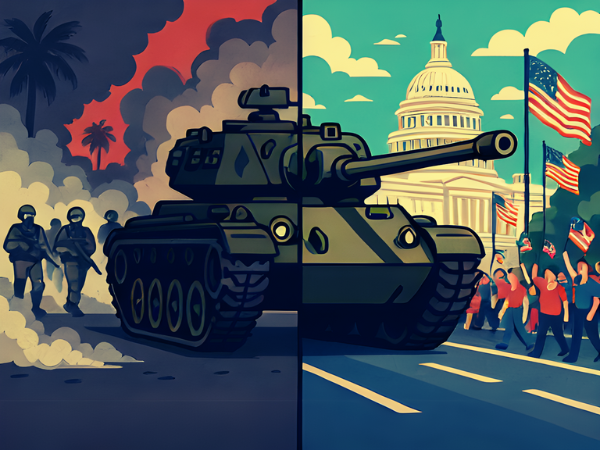
Under the guise of “restoring order” and “cleaning up” the streets, Trump has called in the National Guard, dispatched the FBI, and federalized the local police in order to take control of Washington, D.C.
This is how the Emergency State operates in the open.
A real but manageable problem—crime, homelessness, public disorder—is inflated into an existential threat.
Fear is manufactured, then exploited to seize more power. (In many cases, the “facts” fueling these crackdowns come directly from the president’s own disinformation machine—manufacturing the perception of danger to justify the expansion of control.)
Whether the trigger is terrorism, civil unrest, economic instability, or public health, the aim remains the same: expand the reach of federal authority, justify more militarized policing, and condition the public to accept the suspension of rights in the name of national security.
Once these powers are taken, they are never willingly relinquished.
Each time, Trump pushes the envelope a little, relying on military optics meant to intimidate.
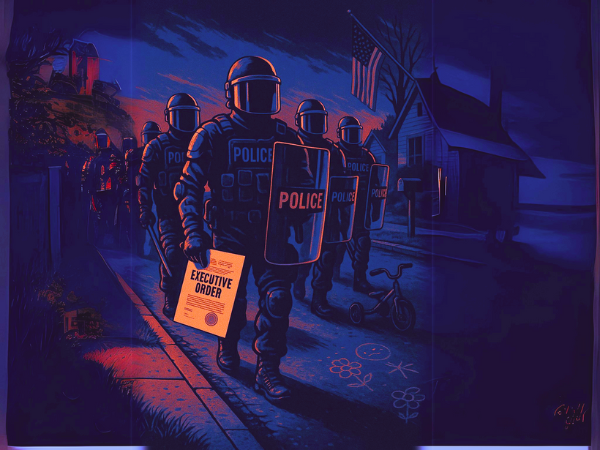
For instance, on April 28, 2025, Trump signed an Executive Order authorizing mass round-ups of “violent criminals” and “gang members,” empowering federal agencies and military support for domestic law enforcement.
In June, Trump deployed the National Guard to California to quell protests over mass immigration arrests, treating political dissent as a security threat. A bench trial is currently underway to determine if Trump’s actions violated the Posse Comitatus Act, which prohibits the military from being used as a domestic police force.
By midsummer, a mental health detention directive allowed involuntary commitments of the homeless under “public health” grounds.
By August, Trump was deploying FBI agents and the National Guard into the nation’s capital in order to clear homeless encampments because the president says the city is “dirty” and “dangerous.”
At each stage, the scope of who could be targeted by these executive orders and emergency power operations grows wider.
These are not isolated decisions; they are part of a coordinated playbook for bringing local jurisdictions under direct federal control, one crisis at a time.
This is mission creep in action—by breaking the police state’s hostile takeover of the country and our Constitution into a series off incremental moves, the administration sidesteps the broad public backlash that a single, sweeping declaration of martial law would provoke.
Once the federal government claims the authority to override local control, put boots on the ground, and target a designated “dangerous class,” that authority inevitably broadens to sweep in new targets. What begins by targeting violent criminals quickly expands to hardworking immigrants, then the homeless.
Tomorrow those targeted could be protesters, journalists, or anyone deemed undesirable.
These executive orders constitute a war on the American people without a formal declaration of war. Once the definitions of “criminal,” “threat,” and “danger” are used interchangeably to advance political needs, there is no limit to who can be targeted next.
What begins with a narrow claim of emergency power is quickly normalized and made permanent.
We have seen this pattern before.
After 9/11, the Patriot Act’s surveillance powers—initially aimed at foreign terrorists—expanded to include mass monitoring of American citizens. The Transportation Security Administration began as an airport screening agency and now conducts random searches at train stations and sporting events. Predictive policing was sold as a way to stop violent crime, but it is now used to flag political activists and monitor protests.
In each case, a temporary, targeted security measure grew into a permanent tool of control.
The difference today is that the slope has become steeper and the slide faster. What once took years to creep into everyday life now happens in a matter of months.
Four months is all it took for the police state to pivot from “rounding up violent criminals” to patrolling the streets of the capital and forcibly removing the unhoused.
Today, the slope runs from undocumented immigrant sweeps to homeless sweeps.
Tomorrow, it could run from “restoring order” to suppressing lawful dissent in the same span of time.
This is the logical outcome of a formula that has been refined over decades: identify or invent a threat, stoke public fear, expand executive power to “solve” it, normalize the new level of control, then repeat with a broader definition of “threat.”
Each time the public accepts an expansion of authority in the name of security, the next expansion comes faster and goes further.
The dictatorial hunger for power, as Harvard’s Laurence Tribe has observed, is insatiable.
Every crisis becomes a test: of our willingness to let the government sidestep the Constitution, of our tolerance for militarized “solutions” to social problems, of whether the public will resist or comply, of whether those in authority can get away with moving the line yet again.
For decades—from Pearl Harbor to the Red Scare, from 9/11 to the pandemic lockdowns—we have failed that test. Each time, the line moves a little further, the slope gets a little slicker, and the public grows more accustomed to life under occupation.
The players change—Bush, Obama, Trump, Biden, and now Trump again—but the game remains the same: permanent crisis management, permanent power grabs, permanent erosion of liberty.
This is how constitutional limits die—not in one dramatic coup, but in a series of incremental “emergencies” that accustom us to living under permanent federal occupation.
By that measure, the takeover of Washington, D.C., is a chilling case study.
The issue is not whether Trump can seize control of DC. Under section 740 of the District of Columbia Home Rule Act, the president may do so for 48 hours without congressional approval and up to 30 days with notice to Congress.
It’s worth noting that this provision has never been invoked before, and certainly not for the purpose of cleaning up squalor. The law was envisioned for truly extraordinary crises—natural disasters, large-scale riots—not as a political tool for executive housecleaning.
So the question we must ask as the symbolic heart of the republic is transformed into a constitution-free zone is: Why? Why now—when crime is at its lowest level in three decades? And where do we go from here?
The federal takeover of Washington, D.C., is not the end of that slippery slope. It is merely the latest drop, and nothing in our present political climate suggests it will be the last.
The police state will always need another manufactured crisis.
Terrorist attacks, mass shootings, “unforeseen economic collapse, loss of functioning political and legal order, purposeful domestic resistance or insurgency, pervasive public health emergencies, and catastrophic natural and human disasters”: the government has been anticipating and preparing for such crises for years now.
As David C. Unger writes for the New York Times: “Life, liberty, and the pursuit of happiness have given way to permanent crisis management: to policing the planet and fighting preventative wars of ideological containment, usually on terrain chosen by, and favorable to, our enemies. Limited government and constitutional accountability have been shouldered aside by the kind of imperial presidency our constitutional system was explicitly designed to prevent.”
Given the rate at which the government keeps devising new ways to establish itself as the “solution” to all of our worldly problems at taxpayer expense, each subsequent crisis ushers in ever larger expansions of government power and fewer individual liberties.
Once the government acquires authoritarian powers—to spy, surveil, militarize police, seize funds, wage endless wars, censor speech, detain without due process, etc.—it does not willingly relinquish them.
The lesson for the ages is this: once any government is allowed to overreach and expand its powers, it’s almost impossible to put the genie back in the bottle.
History bears this out: as government expands, liberty contracts.
If the president can federalize the policing of the capital, override local control, and treat entire populations as security threats without meaningful resistance from Congress, the courts, or the public, then there is nothing to stop that same template from being applied to any city in America in the name of “security.”
What is happening in Washington today will be the model for what happens nationwide tomorrow.
Case in point: at Trump’s direction, the Pentagon—the military branch of the government—is looking to establish a “Domestic Civil Disturbance Quick Reaction Force,” made up of National Guard troops kept on standby at all times, which could be rapidly deployed to American cities “facing protests or other unrest.”
Indeed, Trump has already hinted that he plans to target Baltimore, Chicago, Los Angeles, New York and Oakland next.
This is straight out of the playbook used in that Pentagon training video created by the Army for U.S. Special Operations Command.
According to “Megacities: Urban Future, the Emerging Complexity,” the U.S. military plans to use armed forces to solve future domestic political and social problems. What they’re really talking about is martial law, packaged as a well-meaning and overriding concern for the nation’s security.
The training video is only five minutes long, but it says a lot about the government’s mindset, the way its views the citizenry, and the so-called “problems” that the government must be prepared to address in the near future through the use of martial law.
Even more troubling, however, is what this military video doesn’t say about the Constitution, about the rights of the citizenry, and about the dangers of locking down the nation and using the military to address political and social problems.
For years, the government has been warning against the dangers of domestic terrorism, erecting surveillance systems to monitor its own citizens, creating classification systems to label any viewpoints that challenge the status quo as extremist, and training law enforcement agencies to equate anyone possessing anti-government views as a domestic terrorist.
What the government failed to explain was that the domestic terrorists would be of the government’s own making, and that “we the people” would become enemy #1.
As I make clear in my book Battlefield America: The War on the American People and in its fictional counterpart The Erik Blair Diaries, “we the people” are already enemies of the state.
If we do not stop this dangerous trajectory now, the question will not be whether martial law comes to your city—it will be when, under what pretext, and whether we will have the courage and the wherewithal to resist.
Source: https://tinyurl.com/38jrjz6b
ABOUT JOHN W. WHITEHEAD
Constitutional attorney and author John W. Whitehead is founder and president of The Rutherford Institute. His most recent books are the best-selling Battlefield America: The War on the American People, the award-winning A Government of Wolves: The Emerging American Police State, and a debut dystopian fiction novel, The Erik Blair Diaries. Whitehead can be contacted at staff@rutherford.org. Nisha Whitehead is the Executive Director of The Rutherford Institute. Information about The Rutherford Institute is available at www.rutherford.org.
Publication Guidelines / Reprint Permission
John W. Whitehead’s weekly commentaries are available for publication to newspapers and web publications at no charge.





 The events of recent years: the invasive surveillance, the extremism reports, the civil unrest, the protests, the shootings, the bombings, the military exercises and active shooter drills, the color-coded alerts and threat assessments, the fusion centers, the transformation of local police into extensions of the military, the distribution of military equipment and weapons to local police forces, the government databases containing the names of dissidents and potential troublemakers.
 We’ve allowed ourselves to be acclimated to the occasional lockdown of government buildings,
  I’m referring to the corporatized, militarized, entrenched bureaucracy that is fully operational and staffed by unelected officials who are, in essence, running the country and calling the shots in Washington DC, no matter who sits in the White House.
 ABOUT JOHN W. WHITEHEAD
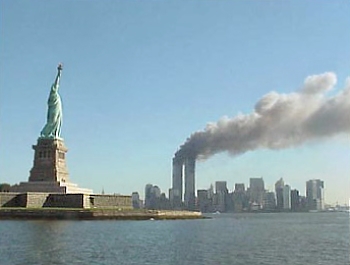 What remains to be seen is whether France, standing where the United States did 14 years ago, will follow in America’s footsteps as she grapples with the best way to shore up her defenses, where to draw the delicate line in balancing security with liberty, and what it means to secure justice for those whose lives were taken.
 Allowing the government to spy on the citizenry will not reduce acts of terrorism, but it will result in a watched, submissive, surveillance society. A byproduct of this post 9/11-age in which we live, whether you’re walking through a store, driving your car, checking email, or talking to friends and family on the phone, you can be sure that some government agency, whether the NSA or some other entity, is listening in and tracking your behavior. This doesn’t even begin to touch on the corporate trackers such as Google that monitor your purchases, web browsing, Facebook posts and other activities taking place in the cyber sphere. We are all becoming data collected in government files. The
  Do not turn your country into a battlefield, your citizens into enemy combatants, and your law enforcement officers into extensions of the military. A standing army—something that propelled the early colonists into revolution—strips the citizenry of any vestige of freedom. How can there be any semblance of freedom when there are tanks in the streets, military encampments in cities, Blackhawk helicopters and armed drones patrolling overhead? It was for this reason that those who established America vested control of the military in a civilian government, with a civilian commander-in-chief. They did not want a military government, ruled by force. Rather, they opted for a republic bound by the rule of law: the U.S. Constitution. Unfortunately, we in America now find ourselves struggling to retain some semblance of freedom in the face of police and law enforcement agencies that look and act like the military and have just as little regard for the Fourth Amendment, laws such as the NDAA that allow the military to arrest and indefinitely detain American citizens, and military drills that acclimate the American people to the sight of armored tanks in the streets, military encampments in cities, and combat aircraft patrolling overhead.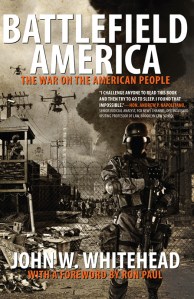
 John W. Whitehead, Constitutional Attorney