WASHINGTON, D.C. — One year after the U.S. Supreme Court declined to protect homeowners from warrantless searches by police based merely on a suspicion that a person on probation or parole resides on the premises, agents with Immigration and Customs Enforcement are now forcibly entering private homes without a judge’s warrant.
According to reporting by the Associated Press, ICE officers are being instructed that they may use force to enter a residence based solely on an administrative arrest warrant tied to a final order of removal—despite prior guidelines and legal precedent holding that such warrants do not authorize entry into a private home absent consent or exigent circumstances.
“This is not law enforcement. It’s a home-invasion policy,” said constitutional attorney John W. Whitehead, president of The Rutherford Institute and author of Battlefield America: The War on the American People. “The Fourth Amendment does not disappear at the doorstep simply because the government labels a piece of paper an ‘administrative warrant.’ Judicial oversight is not optional. It is the Constitution’s first line of defense against tyranny.”
The Rutherford Institute warned one year ago that the Supreme Court’s refusal to intervene in Bailey v. Arkansas set the nation on a slippery slope toward a society in which police may invade homes based on nothing more than a hunch. That warning now carries graver weight in light of ICE’s newly revealed internal memo authorizing officers to forcibly enter private residences without judicial approval—a sweeping assertion of power that directly collides with the Fourth Amendment’s core protections against unreasonable searches and seizures. Disturbingly, these warrantless raids are not confined to non-citizens. In a widely reported incident, ICE agents forced open the door to the Minnesota home of ChongLy Thao, a U.S. citizen, dragged him outside in his underwear, and detained him without a judicial warrant—despite his repeated assertions of citizenship. The incident underscores the real-world consequences of treating administrative authority as a substitute for constitutional safeguards. Unlike judicial warrants issued by neutral judges upon a showing of probable cause, ICE administrative warrants are signed internally by immigration officials—allowing the same agency to act as lawmaker, judge, and enforcer. Civil liberties advocates warn that this concentration of power invites precisely the kind of warrantless, militarized home raids the Fourth Amendment was written to prevent.
For years, The Rutherford Institute has documented the steady erosion of Fourth Amendment protections through no-knock raids, militarized policing, and “Constitution-free” enforcement tactics—often targeting the most vulnerable communities first. ICE’s new guidance represents a dangerous escalation of that trend. “This memo doesn’t just threaten immigrants. It normalizes the idea that armed government agents may force their way into a home without judicial approval. Once that line is crossed, no one’s privacy is secure—not even citizens,” Whitehead said. “The government is once again testing how much lawlessness the public will tolerate. History shows that when agencies are allowed to ignore the Fourth Amendment in the name of expediency, abuse follows—and freedom is the casualty.”
The Rutherford Institute, a nonprofit civil liberties organization, defends individuals whose constitutional rights have been threatened or violated and educates the public on a wide spectrum of issues affecting their freedoms.
Masked gunmen. Tasers. Tear gas. Pepper spray. Unmarked vehicles. Intimidation tactics. Brutality. Racial profiling. Children traumatized. Families terrorized. Journalists targeted. Citizens detained. Disabled individuals, minors, the elderly, pregnant women, military veterans—snatched off the streets. Private property destroyed.
This is not a war zone. This is America.
This is what now passes for law-and-order policing by ICE agents in Trump’s America—and it is not making America safer or greater.
What began as an agency tasked with enforcing immigration law has metastasized into a domestic terror force.
From coast to coast, ICE goon squads—incognito, thuggish, fueled by profit-driven incentives and outlandish quotas, and empowered by the Trump administration to act as if they are untouchable—are prowling neighborhoods, churches, courthouses, hospitals, bus stops, and worksites, anywhere “suspected” migrants might be present, snatching people first and asking questions later.
Sometimes “later” comes hours, days or even weeks afterwards.
No one is off limits—not even American citizens.
Make no mistake: this is not how a constitutional republic operates. It is how a dictatorship behaves when it decides the rule of law—in this case, the Bill of Rights—is optional.
Journalists are being shoved to the pavement, forced into chokeholds, teargassed, and brutalized—in violation of the First Amendment. U.S. citizens, including toddlers, are being snatched up and carted off—in violation of the Fourth Amendment. People with no criminal records who have lived, worked and paid taxes in this country for decades are being made to disappear—in violation of habeas corpus.
This is not public safety. It is domestic terrorism, carried out by masked, militarized, lawless bounty hunters.
In California, ICE agents stopped a U.S. citizen and military veteran on his way to work. According to George Retes, agents fired tear gas, broke his car window, and applied physical force, including kneeling on him. Retes spent three days in federal custody with no charges, no call to his family, no access to a judge or an attorney, no shower, and no explanation for ICE’s actions before being released.
Two sisters were stopped outside a school, surrounded by at least ten ICE agents, who broke into their locked vehicle, dragged them out, and pinned them to the ground. Both women were later released without explanation.
Each of these incidents is presented as routine immigration enforcement. Yet collectively they reveal a government agency that has abandoned the principles of restraint, accountability, and due process in favor of brute force.
Justifying extreme measures—martial law, mass surveillance, suspension of constitutional safeguards— as necessary for “national security” has always been the refuge of tyrants, and this American police state is no different.
The rationalizations have become bolder, the violence more normalized, and the lies more transparent.
The biggest lie of all is the Department of Homeland Security’s claim that its costly, ego-driven, and unnecessary military invasion of Chicago—Operation Midway Blitz—rounded up “the worst of the worst pedophiles, child abusers, kidnappers, gang members, and armed robbers.” In fact, DHS’ own data shows that out of more than 1,000 people rounded up, only 10 had criminal records.
The blatantly false claim that immigrants are inherently violent criminals has also been repeatedly refuted by studies showing that immigrants—including undocumented ones—are less likely to commit crimes than Americans born in the U.S.
Even Trump’s insistence that certain states or cities are overrun with crime, thus necessitating his military invasions, collapses under scrutiny: crime remains at record lows nationwide.
The data simply does not support the rhetoric.
Violence rises and falls with social conditions, not partisan control. Yet, conveniently, only those states that have challenged the Trump administration’s abuses have been singled out for invasion by ICE and the National Guard.
Clearly, this is not about crime, safety, or jobs.
So what is really driving this campaign of terror?
What we are witnessing is the weaponization of fear.
A government that profits from panic and rewards blind obedience has turned immigration enforcement into a spectacle of domination—part deterrent, part distraction, and all political theater.
The timing is no coincidence.
The Trump administration has just announced its fifth military strike on a Venezuelan vessel it claims—without evidence—was engaged in illegal activity. The propaganda might scream about “foreign threats,” but these spectacles serve a different purpose: to divert public outrage away from falling poll numbers, a faltering economy, and growing unrest over the regime’s corruption and incompetence.
At home, ICE raids perform the same function as those boat strikes abroad—they keep the public frightened and the cameras fixed on the wrong enemy. Meanwhile, the scandals that should command national attention—the Epstein files implicating powerful allies, the graft, the insider enrichment—sink beneath the noise.
Each new show of force, each televised arrest or explosion, is meant to remind the populace who holds the power and how easily it can be turned inward.
This is not about border control or law enforcement. It is about control, period.
When a political regime begins to equate its own survival with the nation’s survival, every citizen becomes a potential suspect and every act of dissent a potential crime.
Against such a backdrop, ICE’s strategy is predatory and deliberate.
Lower court rulings have affirmed that ICE, DHS and the Trump Administration are willfully trampling the First, Fourth and Fifth Amendments.
When ICE agents hunt people the way one might hunt animals in the wild, they cease to be officers of the law and become roving packs of lawless predators.
In addition to recruiting ICE agents with $50,000 signing bonuses and $60,000 in student loan forgiveness, DHS is also promising to lavishly reward police agencies that allow their officers to operate as extensions of ICE with salary reimbursements, overtime pay and monthly bonuses.
No wonder citizens, lawful residents and immigrants with no criminal history are getting swept up. There simply aren’t enough violent criminals to fill these quotas.
While some lower courts have attempted to rein in ICE’s abuses, the U.S. Supreme Court has largely empowered them.
In Noem v. Vasquez Perdomo, a 6–3 Supreme Court order paused a district court injunction that would have barred ICE from stopping people based on perceived race, accent, or workplace location—in effect greenlighting racial profiling and roving patrols.
The court ruled that ICE’s criteria for targeting individuals—judging people by race, language, or job—does not rise to the constitutional level of reasonable suspicion.
But for an administration that mistakes might for right, the law is whatever justifies the hunt. “Everything we’re doing is very lawful,” Trump declared. “What they’re doing is not lawful.”
Martin Luther King Jr. offered the clearest rebuttal to that logic more than sixty years ago.
In his “Letter from a Birmingham Jail,” written while jailed for participating in nonviolent demonstrations against segregation, King reminded the world “that everything Adolf Hitler did in Germany was ‘legal’ and everything the Hungarian freedom fighters did in Hungary was ‘illegal.’”
King then went on to explain how to distinguish between just and unjust laws:
“I would be the first to advocate obeying just laws. One has not only a legal but a moral responsibility to obey just laws. Conversely, one has a moral responsibility to disobey unjust laws. I would agree with St. Augustine that ‘an unjust law is no law at all.’ Now, what is the difference between the two? How does one determine whether a law is just or unjust? A just law is a man made code that squares with the moral law or the law of God. An unjust law is a code that is out of harmony with the moral law. To put it in the terms of St. Thomas Aquinas: An unjust law is a human law that is not rooted in eternal law and natural law. Any law that uplifts human personality is just. Any law that degrades human personality is unjust.”
King’s message was not about politics but about principle. His words remind us that legality and morality are not always the same — and that a nation that abandons moral law will soon find itself without any law at all.
A government that chains pregnant women, assaults journalists, and detains citizens without cause has lost its moral authority to govern.
King warned that the gravest threat to justice is not the clamor of bad people but the appalling silence of good ones. The same holds true today: silence in the face of government brutality is itself a form of consent.
Even in the face of the Trump administration’s heavy-handed repression, citizens have stepped up to meet military intimidation with moral conscience.
In Portland and other cities, protesters have embraced creative, nonviolent acts of symbolic resistance—appearing unclothed to expose the government’s hypocrisy, donning costumes to mock its fear, and standing silently before armed agents as living reminders of what it means to resist tyranny without becoming it.
These creative gestures recall the kind of moral witness King described: the courage to confront injustice with peace and strip it of its disguise.
The bottom line, as always, rests with “we the people.”
ICE does not protect America—it terrorizes America. And until it is reined in, dismantled, or reformed to operate wholly within constitutional boundaries, it will remain a standing army on domestic soil: unaccountable, unconstitutional, and un-American.
Tyranny always cloaks itself in the language of welfare and safety. And constitutional abuse transcends party lines.
Every regime that seeks to entrench its power begins by promising to protect the people from chaos, crime, or foreign enemies—then proceeds to manufacture both.
The raids, the strikes, the distractions are all part of the same design: to condition obedience, erase accountability, and cement totalitarian rule under the pretense of “law and order.”
The Constitution is not a suggestion; it is the rule of law.
If ICE—and by extension, the DHS and the entire Trump regime—cannot operate within those limits, if it must hide behind masks and military might to exercise its power, then it has ceased to be lawful.
It has become exactly what the Framers of the Constitution feared: a government that wages war on its own people.
Having figured out how to parlay presidential authority in foreign affairs in order to sidestep the Constitution, President Trump is using his immigration enforcement powers to lock up—and lock down—the nation.
After all, a police state requires a prison state. And no one is cheering louder than the private prison corporations making money hand over fist from Trump’s expansion of federal detention.
At the center of this campaign is Alligator Alcatraz, a federal detention facility built in the Florida Everglades and hailed by the White House as a model for the future of federal incarceration. But this is more than a new prison—it is the architectural symbol of a carceral state being quietly constructed in plain sight.
With over $170 billion allocated through Trump’s megabill, we are witnessing the creation of a vast, permanent enforcement infrastructure aimed at turning the American police state into a prison state.
Yet be warned: what begins with ICE rarely ends with ICE.
Trump’s initial promise to crack down on “violent illegal criminals” has evolved into a sweeping mandate: a mass, quota-driven roundup campaign that detains anyone the administration deems a threat, regardless of legal status and at significant expense to the American taxpayer: immigrants, activists, journalists, business owners, military veterans, and even spouses of American citizens.
What’s more, the vast majority of those being detained are not violent criminals.
Removing these individuals from the workforce and imprisoning them not only devastates families and communities—it burdens taxpayers and weakens the economy.
These are the workers who keep industries running—doing the jobs many Americans refuse. Locking them up doesn’t save money; it dismantles the very labor force that sustains the economy.
Like so many of the Trump administration’s grandiose plans, the math doesn’t add up.
Just as Trump’s tariffs have failed to revive American manufacturing and instead raised consumer prices, this detention-state spending spree will cost taxpayers far more than it saves.
It’s not just authoritarian—it’s bad economics, funneling tax dollars into a bureaucracy that grows government while delivering no real public benefit.
We’re being told it’s about public safety and border control—but in reality, it’s a bloated, inefficient bureaucracy that shifts billions from productive parts of the economy into a black hole of surveillance, cement, and razor wire.
Making matters worse, many of these detained immigrants are then exploited as a pool of cheap labor inside the very facilities where they’re held.
In other words, this isn’t just a prison expansion—it’s a taxpayer-funded machine that extracts labor from the very people it imprisons, while draining billions from the economy and undermining the industries it claims to protect in order to help corporations make a larger profit.
According to The New York Times, at least 60,000 immigrants were put to work in ICE detention centers in 2013—more than were employed by any single private employer in the country at the time. Paid as little as 13 cents an hour—or nothing at all—these civil detainees were used to prepare meals, clean facilities, and even provide services to other government institutions.
Unlike convicted criminals, these individuals are not serving sentences. Most are civil detainees awaiting immigration hearings, and roughly half are ultimately allowed to stay in the country. Yet while they await due process, they are locked up, stripped of their rights, and forced to work for pennies on the dollar—all while the government and its contractors avoid paying minimum wage and save tens of millions a year in labor costs.
This isn’t just about cutting corners. It’s a taxpayer-subsidized racket—a corporatist scheme where politically connected companies profit from government largesse, growing the very bureaucratic state that so-called fiscal conservatives once claimed to oppose.
This kind of exploitation is not limited to immigration detention.
An investigation by the Associated Press found that prisoners in the United States—many held in private or underregulated facilities—are part of a multibillion-dollar empire that supplies a hidden labor supply chain linked to hundreds of popular food brands and supply companies.
As the Associated Press reports, “The goods these prisoners produce wind up in the supply chains of a dizzying array of products found in most American kitchens, from Frosted Flakes cereal and Ball Park hot dogs to Gold Medal flour, Coca-Cola and Riceland rice. They are on the shelves of virtually every supermarket in the country, including Kroger, Target, Aldi and Whole Foods. And some goods are exported, including to countries that have had products blocked from entering the U.S. for using forced or prison labor.”
It’s no coincidence that 90 percent of people in immigration detention are held in privately run facilities. These corporations profit from every additional body behind bars—and have lobbied aggressively for the policies that keep the beds full. Their contracts often guarantee minimum occupancy levels, creating perverse incentives to detain more people, for longer periods, at the expense of justice and human rights.
The implications for Trump’s detention empire are chilling.
At a time when the administration is promising mass deportations to appease anti-immigrant hardliners, it is simultaneously constructing a parallel economy in which detained migrants can be pressed into near-free labor to satisfy the needs of industries that depend on migrant work.
What Trump is building isn’t just a prison state—it’s a forced labor regime, where confinement and exploitation go hand in hand. And it’s a high price to pay for a policy that creates more problems than it solves.
As the enforcement dragnet expands, so too does the definition of who qualifies as an enemy of the state.
Erected under the banner of law and order, this permanent infrastructure of incarceration and enforcement is being put in place now for use tomorrow—not just against violent criminals who happen to be undocumented immigrants, but against whoever the government deems undesirable.
Increasingly, not even citizenship is a safeguard against the carceral state—as one recent case involving a legal U.S. resident arrested for his political views makes chillingly clear.
Unfortunately, the government’s definition of “national security threat” is so broad, vague and unconstitutional that it could encompass anyone engaged in peaceful, nonviolent, constitutionally protected activities—including criticism of government policy or the policies of allied governments like Israel.
In Trump’s prison state, no one is beyond the government’s reach.
Just ask Mahmoud Khalil, a legal U.S. resident married to a U.S. citizen who was detained for months by ICE for daring to peacefully oppose Israel’s war efforts in Gaza. Khalil’s arrest was not based on any crime—but on his political views, which the government labeled a national security concern under a little-used statute that allows the Secretary of State to deport non-citizens for expressing views deemed contrary to U.S. foreign policy interests.
In other words, exercising your First Amendment rights can land you in a cell—citizen or not.
Despite the Trump administration’s efforts to criminalize dissent and expand the machinery needed to enforce it, this is not a partisan expansion—it’s a structural one and it is being built to outlast any single presidency.
Look closer and you’ll see the outlines of a system built not for justice, but for mass containment and control.
This isn’t speculation. We’ve seen this trajectory before.
Critics of the post-9/11 security state—left, right, and libertarian alike—have long warned that the powers granted to fight terrorism and control immigration would eventually be turned inward, used against dissidents, protestors, and ordinary citizens.
That moment has arrived.
Power, once granted, rarely shrinks. It merely changes hands.
That’s why the Founders placed limits on federal power in the first place—because they knew that even well-meaning government programs would metastasize into tyranny if left unchecked.
Yet Trump’s most vocal supporters remain dangerously convinced they have nothing to fear from this expanding enforcement machine. But history—and the Constitution—say otherwise.
Our founders understood that unchecked government power, especially in the name of public safety, is the most dangerous threat to liberty. That’s why they enshrined rights like due process, trial by jury, and protection from unreasonable searches.
Those safeguards are now being hollowed out.
Immigration courts already operate without juries and allow indefinite detention. Civil liberties have been eroded by predictive policing, no-knock raids, and dragnet surveillance. Asset forfeiture laws allow the government to seize property without charges.
Now, with billions more in detention funding, these tactics are being scaled up and normalized for broader use.
And the public is being conditioned to accept it.
The pageantry surrounding Alligator Alcatraz isn’t just about capacity—it’s about spectacle. The prison, which was built in eight days, features more than 200 security cameras, 28,000-plus feet of barbed wire and 400 security personnel.
This is not a correctional facility. It’s a warning.
A government that rules by fear must maintain that fear.
Trump’s detention expansion—like the mass surveillance programs before it—is not about making America safe. It’s about following the blueprints for authoritarian control in order to lock down the country.
The Trump administration claims its expanding detention regime is aimed at curbing illegal immigration and violent crime. In reality, the new federal budget significantly broadens ICE’s mandate and resources, supercharges its reach through private-public surveillance partnerships, and grants it sweeping policing powers to investigate so-called domestic threats, operate pretrial detention centers, and detain individuals without formal charges under emergency powers.
These are not the tools of a free society. They are the instruments of a permanent security state.
We’re told we must trade liberty for security. But whose security, and at what cost?
With this expansion, we are moving from a nation of laws to a nation of executive decrees, predictive enforcement, and pre-crime detention. Already, courtrooms have become conveyor belts to prison, designed to serve the state, not justice.
The government’s targets may be the vulnerable today—but the infrastructure is built for everyone: Trump’s administration is laying the legal groundwork for indefinite detention of citizens and noncitizens alike.
Executive power during a declared emergency knows few bounds. And those bounds are becoming looser with every new bill, every new detention center, every new algorithm.
This is not just about building prisons. It’s about dismantling the constitutional protections that make us free.
A nation cannot remain free while operating as a security state. And a government that treats liberty as a threat will soon treat the people as enemies.
This is not a partisan warning. It is a constitutional one.
Trump’s supporters may cheer the crackdown now, but what happens when these powers are turned inward?
What happens when a future administration—left, right, or otherwise—decides that your political speech, your religious views, or your refusal to comply with a federal mandate constitutes a threat to order?
What happens when you’re arrested under suspicion, held without trial, and processed through a court system designed for speed, not fairness?
What happens when Alligator Alcatraz becomes the model for every state?
We are dangerously close to losing the constitutional guardrails that keep power in check.
The very people who once warned against Big Government—the ones who decried the surveillance state, the IRS, and federal overreach—are now cheering for the most dangerous part of it: the unchecked power to surveil, detain, and disappear citizens without full due process.
Limited government, not mass incarceration, is the backbone of liberty.
The Founders warned that the greatest threat to liberty was not a foreign enemy, but domestic power left unchecked. That’s exactly what we’re up against now. A nation cannot claim to defend freedom while building a surveillance-fueled, prison-industrial empire.
Trump’s prison state is not a defense of America. It’s the destruction of everything America was meant to defend.
We can pursue justice without abandoning the Constitution. We can secure our borders and our communities without turning every American into a suspect and building a federal gulag.
If we continue down this path, cheering on bigger prisons, broader police powers, and unchecked executive authority—if we fail to reject the dangerous notion that more prisons, more power, and fewer rights will somehow make us safer—if we fail to restore the foundational limits that protect us from government overreach before those limits are gone for good—we may wake up to find that the prisons and concentration camps the police state is building won’t just hold others.
This war at home is quieter but no less destructive. The casualties are not in distant deserts or foreign cities. They are our freedoms, our communities, and the Constitution itself.
And the agents of this domestic war? Masked thugs. Unmarked vans. Raids. Roundups.
Detentions without due process. Retaliation against those who dare to question or challenge government authority. People made to disappear into bureaucratic black holes. Fear campaigns targeting immigrant communities and political dissenters alike. Surveillance weaponized to monitor and suppress lawful activity.
Packaged under the guise of national security—as all power grabs tend to be—this government-sanctioned thuggery masquerading as law-and-order is the face of the Trump Administration’s so-called war on illegal immigration.
The real threat to our way of life comes not from outside invaders, but from within: an unelected, unaccountable enforcement agency operating above the law.
By painting enforcement as narrowly targeted, the administration obscures a far broader dragnet that sweeps up legal residents, naturalized citizens, and native-born Americans alike.
This isn’t targeted enforcement—it’s indiscriminate purging.
What ICE—an agency that increasingly resembles a modern-day Gestapo—is doing to immigrants today, it can and will do to citizens tomorrow: these are the early warning signs of a system already in motion.
The machinery is in place. The abuses are ongoing. And the constitutional safeguards we rely on are being ignored, dismantled, or bypassed entirely.
When legal residents, naturalized citizens, and native-born Americans are swept up in ICE’s raids, detained without cause, and subjected to treatment that defies every constitutional protection against government overreach, this isn’t about immigration.
It’s not about danger. It’s about power—unchecked and absolute.
This is authoritarianism by design.
Here are just a few examples of how ICE’s reach now extends far beyond a criminal class of undocumented immigrants:
ICE has even conducted raids at churches—sanctuaries meant to offer refuge—violating not just constitutional rights but community trust and religious protections.
This pattern of abuse is not accidental.
It reflects a deliberate strategy of fear and domination by ICE agents acting like an occupying army, intent on intimidating the population into submission while the Trump Administration redraws the boundaries of the Constitution for all within America’s borders, citizen and immigrant alike.
This is how you dismantle a constitutional republic: not in one dramatic moment, but through the steady erosion of rights, accountability, and rule of law—first for the marginalized, then for everyone.
When constitutional guarantees become conditional and oversight is systematically evaded, all Americans—regardless of status—stand vulnerable to a regime that governs by fear rather than freedom.
We’ve seen this playbook before.
It’s the same strategy used by fascist regimes to consolidate power—using fear, force, and propaganda to turn public institutions into instruments of oppression.
ICE raids often occur without warrants. Agents frequently detain individuals not charged with any crime. Homes, schools, hospitals, workplaces, and courthouses have all become targets. Agents in plain clothes swarm unsuspecting individuals, arrest them without explanation, and separate families under the pretense of national security. In many cases, masked agents refuse to identify themselves at all—creating a climate of terror where the public cannot distinguish lawful enforcement from lawless abduction.
This is not justice. It is intimidation. And it has become business as usual.
Through an expanded network of partnerships, ICE has turned routine traffic stops into pipelines for deportation. According to The Washington Post, immigrants stopped on the way to volleyball practice, picking up baby formula, or heading to job sites have been detained and, in some cases, sent to a notorious mega-prison in El Salvador.
This is what politicizing and weaponizing local police looks like.
Even members of Congress attempting to exercise constitutional oversight have been turned away from ICE facilities. As The New York Timesreported, ICE now claims the authority to “deny a request or otherwise cancel” congressional visits based on vague “operational concerns”—effectively placing its operations beyond democratic scrutiny.
Beyond the high-profile arrests, the abuse runs deeper.
Julio Noriega, a 54-year-old American citizen, was snatched up off the street and detained in Chicago for 10 hours without explanation. Leonardo Garcia Venegas, a U.S.-born citizen, was detained because ICE dismissed his REAL ID as fake. Cary López Alvarado, a pregnant U.S. citizen, was handcuffed and arrested for challenging ICE agents who had followed her fiancé to work. Children, veterans, and immunocompromised individuals have all suffered under ICE’s dragnet.
These are not outliers. They are the product of a system that operates without meaningful checks.
ICE agents are rarely held accountable. Internal investigations are ineffective. Congress has abdicated oversight. Directives from the Trump administration—including those authored by Stephen Miller—have turbocharged deportations and loosened any remaining restraints.
From boots on the ground to bytes in the cloud, ICE’s unchecked power reflects a broader shift toward authoritarianism, fueled by high-tech surveillance, public indifference and minimal judicial oversight. The agency operates a sprawling digital dragnet: facial recognition, license plate readers, cellphone tracking, and partnerships with tech giants like Amazon and Palantir feed massive databases—often without warrants or oversight.
These same tools—hallmarks of a growing surveillance state—are now being quietly repurposed across other federal agencies, setting the stage for an integrated surveillance-policing regime that threatens the constitutional rights of every American.
This isn’t about safety. It’s about control.
These tools aren’t just targeting undocumented immigrants—they’re laying the digital scaffolding for a future in which everyone is watched, scored, and subject to state suspicion.
Quotas over justice. Algorithms over rights.
ICE’s operations have little to do with individualized threat assessments. What drives these raids is not public safety but bureaucratic performance. Field offices are under pressure to meet arrest quotas, creating a system that incentivizes indiscriminate sweeps over focused investigations.
As Jennie Taer writes for the NY Post:
“The Trump administration’s mandate to arrest 3,000 illegal migrants per day is forcing ICE agents to deprioritize going after dangerous criminals and targets with deportation orders, insiders warn. Instead, federal immigration officers are spending more time rounding up people off the streets… Agents are desperate to meet the White House’s high expectations, leading them to leave some dangerous criminal illegal migrants on the streets, and instead look for anyone they can get their hands on at the local Home Depot or bus stop.”
Predictive algorithms and flawed databases replace constitutional suspicion with digital hunches, turning enforcement into a numbers game and transforming communities into statistical targets.
Constitutional safeguards are being replaced by digital suspicion.
We now live in a nation where lawful dissent—especially from immigrants or those perceived as outsiders—can place someone under state suspicion. The line between investigation and persecution has been erased.
Fear needs fuel.
And ICE finds it in propaganda: just as the Gestapo used propaganda to justify its cruelty, ICE relies on the language of fear and division. When the government labels people “invaders,” “animals,” or “thugs,” it strips them of humanity—and strips us of our conscience.
This rhetoric serves to distract and divide. It normalizes abuse. And it ensures that, once targeted, no one is safe.
The construction of a new ICE mega-prison in Florida—nicknamed “Alligator Alcatraz” for its proposed moat and remote location—serves as a grotesque symbol of the Trump Administration’s mass deportation agenda: out of sight, beyond accountability, and surrounded by literal and bureaucratic barriers to due process.
But the crisis isn’t just rhetorical. It’s systemic. Agents are trained to obey, not to question. Immunity shields misconduct. Whistleblowers are punished. Watchdogs are ignored. Courts too often defer to executive power.
This is not law enforcement—it is authoritarian enforcement.
And it’s not limited to immigrants. It’s creeping into every corner of American life.
When a government can detain its own citizens without due process, punish political dissent, and target individuals for what they believe or how they look, it is no longer governed by law. It is governed by fear.
The Constitution was designed to prevent this. But rights are meaningless when no one is held accountable for violating them.
That is why the solution must go beyond the ballot box.
We must dismantle the machinery of oppression that enables ICE to act as judge, jury, and jailer.
Congress must ban warrantless raids, end predictive profiling, and prohibit mass surveillance. It must enforce real oversight and revoke the legal shields that insulate abusive agents from consequences.
We must reassert the rule of law, not just through legislation, but through a cultural recommitment to constitutional values. That includes transparency, demilitarization, and equal protection for all—citizens and non-citizens alike.
This is not just a fight over immigration policy. It’s a battle for the soul of our nation.
If we fail to dismantle the ICE model, we normalize it—and risk reproducing it everywhere else.
ICE has become the beta test—perfecting the merger of technology, policing, and executive power that could soon define American governance as a whole.
Make no mistake: when fear becomes law, freedom is the casualty.
If we don’t act soon, we may find that the Constitution is the next to be detained.
James Madison warned that “the accumulation of all powers, legislative, executive, and judiciary, in the same hands… may justly be pronounced the very definition of tyranny.”
When ICE acts as enforcer, jailer, and judge for the president, those fears are no longer theoretical—they are the daily reality for countless people within U.S. borders.
NEWARK, NJ — Warning that the Trump administration’s actions likely pose a serious threat to constitutional rights, a federal judge has temporarily blocked the government from deporting a legal U.S. resident under a little-used statute that allows the Secretary of State to deport non-citizens for expressing views deemed contrary to U.S. foreign policy interests.
Although the Supreme Court affirmed in 1945 that freedom of speech applies to all persons within the United States, including non-citizens, the Trump Administration has systematically weaponized its immigration enforcement in order to punish political dissent, targeting university students engaged in peaceful political protests for arrests, detentions and deportations. Mahmoud Khalil, a Columbia University graduate married to a U.S. citizen and father to a newborn, was arrested on March 8, 2025, by agents with the Department of Homeland Security for his vocal yet nonviolent criticism of Israel’s military actions in Gaza. In coming to Mahmoud Khalil’s defense, a legal coalition that includes The Rutherford Institute and FIRE (the Foundation for Individual Rights and Expression) warned that allowing deportation based on a government official’s disapproval of someone’s speech threatens free expression for everyone.
“Political speech—even when unpopular or controversial—is protected under the Constitution,” said constitutional attorney John W. Whitehead, president of The Rutherford Institute and author of Battlefield America: The War on the American People. “If non-citizens can be jailed or deported simply for criticizing government policy, then we’re all at risk. The First Amendment protects everyone on American soil—citizen or not—but this case threatens to undermine that fundamental freedom.”
Although Mahmoud Khalil has not been accused of any vandalism or physical violence related to his protest activity at Columbia University, he was arrested and transported to an out-of-state detention center in Louisiana where he remains in ICE custody, far from his attorneys and family. In response to a Petition for Writ of Habeas Corpus, asking for Khalil’s release, the federal court granted a preliminary injunction prohibiting the government from detaining or deporting Khalil based on Secretary of State Marco Rubio’s determination that Khalil’s nonviolent protest activity would compromise a U.S. foreign policy interest—a determination which the court found likely violates due process rights when coupled with First Amendment protections. The judge warned that if such a law can be used against Khalil, “then other, similar statutes can also one day be made to apply. Not just in the removal context, as to foreign nationals. But also in the criminal context, as to everyone.” The court further invoked a chilling analogy: “Imagine…how quickly our constitutional [alarms] would rise if a local police chief were granted the power to arrest any person whose mere presence would cause potentially serious adverse consequences for the public peace.”
The court gave the Trump administration 40 hours to appeal or release Khalil from this charge. However, government lawyers did neither. Instead, the Trump administration pivoted, justifying Khalil’s ongoing detention on a second charge for allegedly failing to disclose that he was a member of certain humanitarian organizations—such as the U.N. Relief and Works Agency for Palestinian Refugees—on his 2024 application for lawful permanent residence.
Ronnie London, Conor Fitzpatrick, Will Creeley, and others at FIRE (the Foundation for Individual Rights and Expression) advanced the arguments in the Khalil v. Trump amicus brief.
The Rutherford Institute, a nonprofit civil liberties organization, defends individuals whose constitutional rights have been threatened or violated and educates the public on a wide spectrum of issues affecting their freedoms.
“Once a government is committed to the principle of silencing the voice of opposition, it has only one way to go, and that is down the path of increasingly repressive measures, until it becomes a source of terror to all its citizens and creates a country where everyone lives in fear… If the Bill of Rights were to be broken down, all groups, even the most conservative, would be in danger from the arbitrary power of government.”—President Harry S. Truman (August 8, 1950)
Let us be very clear.
The Constitution is not a suggestion or a negotiating tactic. It is not optional.
Government officials do not get to pick and choose which laws they will obey.
The Constitution is the supreme law of the land: a binding contract between “we the people” of the United States and those we hire to govern. It spells out our expectations for transparency and accountability, limits the government’s authority, affirms the purpose of government as protecter of liberty and property, and reinforces that we are the masters and government agents are the servants.
Thus, any decision by a government official to suspend the rights enshrined in the Constitution should not be undertaken lightly or for political gain or expedience, nor can it be done without following the strict parameters laid out by its creators and the courts.
Bottom line: any attempt to unilaterally override any aspect of the Constitution should alarm every American, regardless of party affiliation.
Which brings us to the Trump Administration’s ongoing attempts to weaponize concerns about national security in order to wage war on the rights enshrined in the Constitution.
We have been inundated with executive orders issued by President Trump purporting to protect national security interests by gutting free speech, eroding equal rights protections, sidestepping the separation of powers, and pushing us ever closer to martial law and outright dictatorship.
Behind the façade of national security lies a more insidious threat: a permanent shadow government—the Deep State—using every “emergency” to tighten its grip and expand unchecked executive authority.
Trump’s most effective ploy to seize power has been his use of illegal immigration to stoke fear and chill dissent. He has used it as a justification to do away with due process, expand the police state, deepen military involvement in domestic policing, and intimidate the nation into compliance.
Even his bid to unilaterally end birthright citizenship for children born in the United States to undocumented immigrants is just another Trojan horse masquerading as a concern for national security.
This is not about protecting America—it’s about redefining America from the top down.
That redefinition is already underway.
The Trump Administration has floated plans to sell $5 million “gold cards” to wealthy investors as a path to citizenship and is considering a pitch for a reality show that would “pit immigrants against each other for a chance at a fast-tracked path to citizenship.”
These proposals are not just absurd—they’re obscene. They reveal a government willing to reduce constitutional rights to commodities, auctioned off to the highest bidder or trivialized for ratings.
This governing by-way-of performance turns a constitutional guarantee into a privilege for sale or spectacle. And it’s part of a calculated effort to recast citizenship as conditional, transactional, and exclusionary. Whether by wealth, loyalty, or ideology, this emerging framework decides who is “deserving” of rights—and who is not.
It is fear-based nationalism that disguises a deeper threat: the normalization of government power to decide who is entitled to rights and who is not.
We see this in action with the Trump Administration’s stance on childbirth and citizenship.
It’s a contradiction: although the Trump Administration is so concerned about falling birth rates that it is prepared to offer financial incentives for childbirth (for example, a $5,000 “baby bonus” and expanded child tax credit), it continues to demonize birthright citizenship for the one population segment that is actually having babies.
Yet this brazenly hypocritical double standard is just a distraction, part of the political theater designed to pit Americans against each other while the power brokers rewrite the rules behind closed doors.
The real power play rests in the Trump Administration’s efforts to gut the Fourteenth Amendment, sidestep the courts, and redefine who qualifies as American—all by executive fiat.
Redefining citizenship by executive order is not governance. It is a bloodless coup—one that overthrows a constitutional republic founded on the rule of law—to reconfigure the face of the nation in the image of the unelected Deep State and its machinery of control.
Enacted in the wake of the Civil War, the Fourteenth Amendment was designed to ensure that all persons born on U.S. soil would be recognized as full citizens—a direct rebuke to the Supreme Court’s infamous Dred Scott decision, which held that Black Americans could not be citizens. Its language is unambiguous: all persons born or naturalized in the U.S., and subject to its jurisdiction, are citizens.
The ruling in Wong Kim Ark came during an era of rampant anti-Chinese sentiment, reinforcing that even in times of national xenophobia, the Constitution prevailed in affirming equality under the law.
The Court’s ruling was unequivocal: the Constitution guarantees birthright citizenship to all born on American soil, regardless of parentage.
That precedent still stands.
Yet that legacy—of constitutional protections prevailing over prejudice—is now at risk.
After all, if the government—not the Constitution—gets to decide who qualifies as a citizen, then no one’s status is secure.
If your citizenship depends on government approval, your rights aren’t inalienable—they’re transitory privileges.
Likewise, this is not a return to “originalism.” It’s a retreat from constitutional rule altogether. It suggests that citizenship is not a right guaranteed by the Constitution, but a privilege bestowed by those in power.
That’s not just bad law. It’s tyranny in the making.
The notion that a sitting president can erase a constitutional guarantee with the stroke of a pen is not only absurd—it is dangerous. Such an action would be flatly unconstitutional, lacking any legal authority and in direct contradiction to more than a century of settled law.
Despite Trump’s attempts to rule by fiat and executive order, presidents cannot pick and choose which parts of the Constitution they will honor.
Yet perhaps even more concerning than Trump’s war on birthright citizenship itself is the administration’s underlying legal strategy to test the limits of judicial authority—specifically, to restrict the power of federal district courts to issue nationwide injunctions against unconstitutional actions.
You see, this is not just an immigration battle, nor is it only a challenge to the Fourteenth Amendment.
It is a calculated attempt to strip the judiciary of its ability to check executive abuse and a full-frontal assault on the role of the judiciary as a co-equal branch of government entrusted with interpreting the law and defending individual rights against majoritarian overreach.
If successful, it would mark a seismic shift in the balance of powers, subordinating the courts to the whims of the executive branch.
Revoking birthright citizenship would create a stateless class of people born on U.S. soil who are denied recognition by their own country. These children would be cast into legal limbo, denied the rights and protections afforded to every other citizen.
Such a move would not only be cruel—it would be profoundly un-American.
Don’t be fooled: the same unchecked power used to deny citizenship to the children of immigrants today could just as easily be turned against you to strip you of your citizenship—based on your political beliefs, religious views, or failure to toe the party line.
This is the danger the Founders warned against: a government that grants rights only to the loyal, the favored, or the compliant.
And make no mistake: what we’re witnessing is another point along the slippery slope of the effort to recast birthright citizenship—not as a right—but as a privilege, subject to political approval and ideological purity tests.
Increasingly, the government is creating a hierarchy of so-called “deserving” citizens, where access to constitutional rights is predicated on compliance, productivity, and perceived loyalty to the state. This shift toward merit-based citizenship is in direct contradiction to the ideals laid out in the Declaration of Independence, which affirms that rights are inalienable, not contingent.
We see it in efforts to strip dissenters of their legal protections, deny free speech to the unpopular, surveil certain communities more than others, and criminalize poverty, protest, or association with disfavored political movements.
In this emerging framework, being born in America is no longer enough—you must also prove your worth, your allegiance, and your compliance.
Worse still, this would set a precedent that constitutional rights can be rewritten by executive whim, paving the way for even greater erosions of liberty.
We have seen this before.
History shows how easily rights can be suspended when fear rules and power goes unchecked.
Consider the use of emergency powers to suspend habeas corpus protections, the unilateral authorization of surveillance programs that violate the Fourth Amendment, and the declaration of national emergencies to justify military deployments or detentions without trial.
These are not hypothetical scenarios.
They have occurred under multiple administrations and show how executive power, once unrestrained, expands at the expense of individual rights.
Redefining who qualifies as an American citizen is not the end of the story—it is the beginning of a slippery slope.
If the government can deny citizenship to those born on U.S. soil, what is to stop it from stripping citizenship from naturalized citizens? Or from declaring certain classes of people—based on ideology, ethnicity, or ancestry—as unworthy of constitutional protection?
What’s at stake is not merely a policy dispute—it is the foundational principle that rights cannot be granted or revoked at the pleasure of a single ruler.
If we do not hold the line here, this erosion of liberty will only accelerate.
These power grabs rarely come without a manufactured crisis.
That’s how the Deep State operates: inflame the public, declare an emergency, and then consolidate control.
Every time the people are told to trade liberty for security, we lose both.
This is a line that must not be crossed.
Birthright citizenship is more than a legal technicality. It is a cornerstone of American democracy and equality. The attempt to destroy it through executive power is a direct threat to the rule of law, the independence of the judiciary, and the future of liberty in America.
This is exactly why the Founders drafted a Constitution that limits power and protects individuals—not just the popular or the powerful.
Once we allow the government to decide who is “deserving” of rights, we’ve already surrendered the rule of law. What remains is not a constitutional republic—but an empire of arbitrary rule.
BURLINGTON, Vt. — Warning that the U.S. government is weaponizing immigration enforcement to punish political dissent, The Rutherford Institute has joined a coalition of civil liberties organizations in challenging the arrest and detention of Rümeysa Öztürk, a Tufts University PhD student whose only alleged offense was expressing support for Palestinian civilians during a time of heightened international conflict.
In a joint amicus brief filed before the U.S. District Court for the District of Vermont in Öztürk v. Trump, the coalition—including the Foundation for Individual Rights and Expression (FIRE), the National Coalition Against Censorship, PEN America, Cato Institute, First Amendment Lawyers Association, and The Rutherford Institute—argues that Öztürk’s arrest by federal agents and the attempt to deport her represent a dangerous abuse of power rooted in viewpoint discrimination and retaliation against protected political speech.
“This is not about public safety. This is about silencing dissent,” said constitutional attorney John W. Whitehead, president of The Rutherford Institute and author of Battlefield America: The War on the American People. “If the government can silence, detain, and deport individuals simply for speaking out on political issues, then no one’s speech is truly safe and we’re no longer operating under a Constitution. We’re living under a system of political policing.”
Öztürk, a Turkish national lawfully present in the U.S. on a student visa, is pursuing a doctorate in the Child Study and Human Development program at Tufts University. She was seized on the street near her apartment on March 25, 2025, by masked, plainclothes agents who grabbed her as she screamed, handcuffed her, and took her away in an unmarked vehicle. Unbeknownst to Öztürk, Secretary of State Marco Rubio had revoked her visa, apparently in response to an op-ed she co-wrote a year earlier in which she criticized her university’s administration for dismissing student government resolutions which aimed to hold Israel accountable for alleged violations of international law in Palestine—views that diverge sharply from the Trump Administration’s. She was detained without warning and transferred more than 1,500 miles away from her home in Massachusetts to the South Louisiana ICE Processing Center.
According to the brief, there are no allegations that Öztürk engaged in violence or illegal activity. The coalition contends that the government’s effort to suppress disfavored political views is flatly prohibited by the Constitution. Moreover, the government’s actions set a dangerous precedent in which political speech can be treated as evidence of threat or disloyalty. This, the coalition warns, opens the door for officials to selectively punish individuals based on the content and viewpoint of their expression. The implications reach far beyond Öztürk’s case. Since returning to office in 2025, the Trump Administration has increasingly targeted immigrants and legal visa holders for arrest, deportation, or visa revocation based solely on their political expression. In one case, a legal aid attorney had her visa canceled after attending a peaceful protest. In another, a university lecturer was denied re-entry to the U.S. over critical social media posts. Such tactics, the coalition contends, create a sweeping chilling effect—not only for immigrants, but for anyone who dares to speak out against government policy.
Ronnie London, Conor Fitzpatrick, Colin McDonell, Will Creeley, and others at FIRE advanced the arguments in the Ozturk v. Trumpamicus brief.
The Rutherford Institute, a nonprofit civil liberties organization, defends individuals whose constitutional rights have been threatened or violated and educates the public on a wide spectrum of issues affecting their freedoms.
“Homegrowns are next. The homegrowns. You gotta build about five more places [like the CECOT prison]. It’s not big enough.”—President Trump on his desire to send American citizens to a megaprison in El Salvador, beyond the reach of U.S. courts and the Constitution
It has begun, just as we predicted, justified in the name of national security.
Mass roundups. Raids. Indefinite detentions in concentration camps. Martial law. The erosion of habeas corpus protections. The suspension of the Constitution, at least for select segments of the population. A hierarchy of rights, contingent on whether you belong to a favored political class.
This is what it looks like when the government makes itself the arbiter of who is deserving of rights and who isn’t.
Here is what we know: one segment of the population at a time, the Trump Administration is systematically and without due process attempting to cleanse the country of what it perceives to be “undesirables” as part of its purported effort to make America great again.
This is how men, women and children are being made to disappear, snatched up off the streets by press-gangs of plainclothes, masked government agents impersonating street thugs.
Presently, these so-called “undesirables” include both undocumented and legal immigrants—many labeled terrorists despite having no criminal record, no court hearing, and no due process—before being extradited to a foreign concentration camp in an effort to sidestep judicial oversight.
By including a handful of known members of a vicious gang among those being rounded up, the government is attempting to whitewash the public into believing that everyone being targeted is, in fact, a terrorist.
In recent years, the government has used the phrase “domestic terrorist” interchangeably with “anti-government,” “extremist” and “terrorist” to describe anyone who might fall somewhere on a very broad spectrum of viewpoints, characteristics and behaviors that could be considered “dangerous.”
Thus, without proof, a sheet metal worker has been labeled a terrorist. A musician has been labeled a terrorist. A makeup artist has been labeled a terrorist. A cellular biologist has been labeled a terrorist. A soccer player has been labeled a terrorist. A food delivery driver has been labeled a terrorist.
It’s only a matter of time before American citizens who refuse to march in lockstep with the government’s dictates are classified as terrorists, denied basic rights, and extradited to a foreign prison.
That time is drawing closer.
Indeed, Trump has repeatedly spoken of his desire to be able to send American citizens—whom he refers to as “homegrowns,” as in homegrown terrorists—on a one-way trip to El Salvador’s mega-prison, where conditions are so brutal that officials brag the only way out is in a coffin. His administration is currently trying to find a way to accomplish that very objective.
We’re not quite there yet, but it’s coming.
What we are witnessing is history repeating itself in real-time: the widening net that ensnares us all. In other words, it’s only a matter of time before anyone who is not fully compliant gets labeled a terrorist.
A prime example of how the government casting its net in ever-widening circles can be seen in the government’s sudden decision to target academics in the U.S. on work and student visas who have been critical of Israel’s war on Gaza, which has killed more than 50,000 people (nearly a third of them under the age of 18), as threats to national security.
Thus, the government is classifying any criticism of Israel as antisemitic and equating it with terrorism.
Under such a broad definition, Jesus himself would be considered antisemitic.
So you can add antisemitic to the list of viewpoints that could have one classified as a terrorist, rounded up by ICE, stripped of the fundamental rights to due process and a day in court, and made to disappear into a detention center.
Mind you, the government isn’t just targeting protest activities and expression that might have crossed over into civil disobedience. It’s also preemptively targeting individuals who have committed no crimes but whose views might at some point in the future run counter to the government’s self-serving interests.
This is precrime taken to a whole new level: targeting thoughts, i.e., thought crime.
The ramifications are so far-reaching as to render almost every American with an opinion about the governmentor who knows someone with an opinion about the government an extremist in word, deed, thought or by association.
As German pastor Martin Niemöller lamented:
“First they came for the socialists, and I did not speak out—because I was not a socialist. Then they came for the trade unionists, and I did not speak out— because I was not a trade unionist. Then they came for the Jews, and I did not speak out—because I was not a Jew. Then they came for me—and there was no one left to speak for me.”
You see how this works?
Let’s not mince words about what’s happening here: under the guise of fighting terrorism, the U.S. government is not just making people disappear—it is making the Constitution disappear.
When rights become privileges, the Constitution—and the rule of law—becomes optional.
The list of individuals and groups being classified as anti-American gets bigger by the day: Immigrants, both legal and undocumented. Immigration attorneys. Judges. Lawyers. Law firms. Doctors. Scientists. Students. Universities. Nonprofits.
Given what we know about the government and its expansive definition of what constitutes a threat to its power, any one of us who dare to speak truth to power could be targeted next as an enemy of the state.
Certainly, it is easy to remain silent in the face of evil.
What is harder—what we lack today and so desperately need—are those with moral courage who will risk their freedoms and lives in order to speak out against evil in its many forms.
Throughout history, individuals or groups of individuals have risen up to challenge the injustices of their age. Nazi Germany had its Dietrich Bonhoeffer. The gulags of the Soviet Union were challenged by Aleksandr Solzhenitsyn. America had its color-coded system of racial segregation and warmongering called out for what it was, blatant discrimination and profiteering, by Martin Luther King Jr.
And then there was Jesus Christ who not only died challenging the police state of his day but provided a blueprint for civil disobedience that would be followed by those, religious and otherwise, who came after him.
Any reflection on Jesus’ life and death within a police state must take into account several factors: Jesus spoke out strongly against such things as empires, controlling people, state violence and power politics. Jesus challenged the political and religious belief systems of his day. And worldly powers feared Jesus, not because he challenged them for control of thrones or government but because he undercut their claims of supremacy, and he dared to speak truth to power in a time when doing so could—and often did—cost a person his life.
It makes you wonder how Jesus—a Palestinian refugee, a radical, and a revolutionary—would have fared in the American police state under a Trump regime.
Would Jesus—who spent his adult life speaking truth to power, challenging the status quo of his day, and pushing back against the abuses of the Roman Empire—have been snatched up in the dead of night, stripped of any real due process, made to disappear into a detention center, and handed a death sentence when he was delivered into a prison where the only way out is in a wooden box?
Consider that the charges leveled against Jesus—that he was a threat to the stability of the nation, opposed paying Roman taxes and claimed to be the rightful King—were purely political, not religious.
Jesus was presented to Pontius Pilate “as a disturber of the political peace,” a leader of a rebellion, a political threat, and most gravely—a claimant to kingship, a “king of the revolutionary type.”
After Jesus was formally condemned by Pilate, he was sentenced to death by crucifixion, “the Roman means of executing criminals convicted of high treason.” The purpose of crucifixion was not so much to kill the criminal, as it was an immensely public statement intended to visually warn all those who would challenge the power of the Roman Empire. Hence, it was reserved solely for the most extreme political crimes: treason, rebellion, sedition, and banditry.
Almost 2,000 years after Jesus was crucified by the police state of his age, we find ourselves confronted by a painful irony: that in the same week commemorating the death and resurrection of Jesus, a Palestinian refugee who was killed by the police state for speaking truth to power, the U.S. government is prosecuting Palestinian refugees who are daring to challenge another modern-day police state’s injustices, while threatening to impose widespread martial law on the country to put down any future rebellions.
President Trump has hinted that he could invoke the Insurrection Act of 1807, which would allow the president to use the military on American soil.
This would in effect be a declaration of martial law.
Trump has already authorized the military to take control of the southern border, which puts parts of the domestic United States under martial law.
As Austin Sarat writes for Salon: “The president alone gets to decide what constitutes an ‘insurrection,’ ‘rebellion,’ or ‘domestic violence.’ And once troops are deployed, it will not be easy to get them off the streets in any place that the president thinks is threatened by ‘radical left lunatics.’”
So where do we go from here?
History offers some clues.
Exactly 250 years ago, on April 19, 1775, the American Revolution began with a “shot heard round the world.” It wasn’t sparked by acts of terrorism or rebellion—it was triggered by a government that had grown deaf to the cries of its people.
What we don’t need is violence in any form—by the people or their government.
“If tyranny and oppression come to this land, it will be in the guise of fighting a foreign enemy.”—James Madison
It’s no joke: America is becoming a Constitution-free zone.
Little by little, our rights are being whittled down in the name of national security.
Where do you draw the line?
How much tyranny will Americans tolerate in the name of national security?
At what point does this slippery slope of power grabs lead to dictatorship?
Will we let border police trample on the rights of everyone they encounter, including legal residents and citizens? Turn a blind eye when men, women and children are forcibly detained by gangs of plainclothes agents and made to disappear? Will we accept a national ID card that enables the government to target individuals and groups it deems undesirable? Will we tolerate AI-powered surveillance cameras and drones that track us more effectively than they protect us? Will we censor ourselves, fearing that any expression of dissent will mark us as anti-government?
Will we abandon the constitutional principles our founders fought for? This is the bargain the police state demands of us.
Take immigration, for example.
President Trump wants us to believe that the nation’s security is so threatened by illegal immigrants that we should tolerate roving bands of ICE and border patrol agents disregarding the Constitution at every turn.
But these government agents aren’t just disregarding it—they’re trampling it with the blessing of the man who swore to “preserve, protect and defend” that very same Constitution.
First Amendment rights to free speech, assembly, and protest. Fourth Amendment protections against unreasonable searches and seizures. Fifth Amendment guarantees of due process. Sixth Amendment protections ensuring a right to legal counsel. Eighth Amendment protections against cruel and unusual punishments. Fourteenth Amendment rights to equal protection under the law.
All of these and more are being imperiously swept aside in the Trump Administration’s pursuit of an America “for Americans and Americans only.”
Trump has invoked wartime powers under the Alien Enemies Act to justify the expulsion of illegal immigrants, whom Trump has likened to terrorists, killers, criminals, and enemies of the state.
However, with national security being used as a pretext to strip away rights on a larger scale than just criminals, the individuals targeted by the Trump Administration’s overreach represent a broader cross-section of American society: immigrants, both documented and undocumented, who live and work in the mainland of the United States. (It is estimated that undocumented immigrants paid nearly $97 billion in federal, state and local taxes in 2022, contributing $59.4 billion to the federal government, including payments for federal income tax and federal social insurance such as Social Security, Medicare and Unemployment Insurance. In other words, they are paying for entitlement programs for which they do not receive benefits.)
Individuals whose visas allow them to legally reside in the U.S. are also being rounded up and made to disappear without due process.
Some are being targeted based on their nationality. Some are being racially profiled. Some are being classified as criminal based solely on the fact that they have tattoos. Some, like Abrego Garcia, are being mistakenly snatched up and deported to private prisons in foreign countries, beyond the physical reach of U.S. courts.
And then there are the scientists, doctors, academics and students who are being rounded up because at some point they voiced their concerns about the mounting death toll in Palestine.
For example, Tufts University PhD student Rumeysa Ozturk wrote an op-ed calling for the university to divest from companies with ties to Israel. That’s all it took for her to be placed on the government’s enemies list, stripped of her visa without warning or notice, surrounded on the street by a small army of masked agents, and whisked out of state to a detention center 1500 miles away without any family or friend knowing her whereabouts.
These arbitrary roundups and deportations are not just violations of the Fifth Amendment’s due process protections. They also trample the First Amendment’s right to free speech and assembly, particularly for those who speak out against government policies.
These actions are not limited to just immigrants or perceived enemies—they extend to anyone daring to challenge the status quo. Whether it’s activists, academics, or everyday citizens, being targeted for political expression is an assault on the very essence of free speech.
In this way, these round-ups represent the beginning of the slippery slope, leading not just to arbitrary detentions and the expansion of private prisons as an extension of the police state but to an eventual authoritarian regime where dissent is suppressed, and constitutional rights are discarded.
These round-ups are increasingly occurring in cities like New York, Boston, and northern Virginia, with many U.S. citizens also being swept up in warrantless searches, surveillance, and overreach from federal and local law enforcement.
Where once the nation’s border constituted a thin line, it is becoming an ever-thickening zone dominated by authoritarianism and an utter disregard for the rule of law.
This zone impacts millions of Americans who have never been near a border—citizens who live in everyday places, like urban and suburban areas, yet are subject to government overreach.
As journalist Todd Miller explains, that expanding border region now extends “100 miles inland around the United States—along the 2,000-mile southern border, the 4,000-mile northern border and both coasts… This ‘border’ region now covers places where two-thirds of the US population (197.4 million people) live… The ‘border’ has by now devoured the full states of Maine and Florida and much of Michigan.”
In this authoritarian reshaping of America, no one is safe, not even in their own homes.
The government’s ever-expanding, Constitution-free zone translates to greater numbers of Americans being subject to warrantless searches, ID checkpoints, transportation checks, and even surveillance on private property far beyond the boundaries of the borderlands.
With Trump considering plans to turn a portion of the southern border into an expansive military installation policed by active-duty troops, we’re going to see even more of these assaults on our freedoms. As Trump promised after Columbia University graduate Mahmoud Khalil was arrested because of his anti-war activism, “This is the first arrest of many to come.”
Across the nation, local police forces are becoming militarized extensions of federal agencies like CBP and DHS, routinely receiving federal funds and training to act as armed enforcers of national security policies. By the time you add the military into that equation, you’ve got all the necessary ingredients for martial law.
The CBP, with its more than 60,000 Customs and Border Protection employees, supplemented by the National Guard and the U.S. military, is an arm of the Department of Homeland Security (DHS), a national police force imbued with all the brutality, ineptitude and corruption such a role implies.
Just about every nefarious deed, tactic or thuggish policy advanced by the government today can be traced back to the DHS, its police state mindset, and the billions of dollars it distributes to local police agencies in the form of grants to transform them into extensions of the military.
As Miller points out, the government has turned the nation’s expanding border regions into “a ripe place to experiment with tearing apart the Constitution, a place where not just undocumented border-crossers, but millions of borderland residents have become the targets of continual surveillance.”
In much the same way that police across the country have been schooled in the art of sidestepping the Constitution, border agents have nearly unlimited discretion to stop, search, interrogate and arrest anyone they “suspect,” based on arbitrary factors such as:
Driving an unusual vehicle.
Passengers appearing “suspicious.”
Having a dusty or modified car.
Avoiding eye contact or looking too long at an officer.
These arbitrary and broad criteria make it easy for any citizen to be targeted without just cause, turning everyday travel into a potential confrontation with law enforcement. In other words, anything goes when it comes to the police state’s justifications for undermining our rights.
These troubling developments at the borders are just one part of a broader erosion of constitutional rights that has been underway for decades in the name of national security.
When we look back at history, we see a consistent pattern of political power grabbing in the name of national security. From the Alien and Sedition Acts to the War on Terror, the price of security is always paid by our freedoms—and each step we take brings us closer to a system where those in power determine the limits of our liberty by using national security as an excuse to curtail fundamental freedoms.
Fast-forward to the present, and Donald Trump capitalized on this historical pattern by claiming that the only way to keep America safe from dangerous immigrants was to build an expensive border wall, expand the reach of border patrol, and enlist the military to “assist” with border control.
Continuing this trend, Joe Biden sent thousands of active-duty troops to the southern border, in anticipation of more than 10,000 illegal crossings per day—reinforcing the military presence and fortifying the unchecked power at the border.
And now Trump is doubling down on everything he and his predecessors have done to fortify this unchecked power.
This pattern of exploiting national security fears for authoritarian control has continued into the present day with Trump’s immigration crisis becoming a pretext for greater control, a strategy to stoke fear and justify authoritarianism.
Yet despite the propaganda coming from the White House, the looming problem is not so much that the U.S. is being invaded by hostile forces at the border, but rather that the U.S. Constitution is under assault from within by a power-hungry cabal at the highest levels of power.
Before long, the only Americans qualified to live freely in Trump’s America will be those who march in lockstep with the Deep State’s dictates, and even absolute compliance is no guarantee of safety.
It used to be that the Constitution was our only reliable safety net, but that is being systematically dismantled.
“If Trump can disappear them, he can disappear you. The Trump regime is already targeting immigrants who are here legally simply because they expressed opinions that Trump disagreed with. What makes you think he’ll stop there? With no court to verify anything the Trump regime alleges, you could be arrested and sent to a prison in El Salvador for having views the regime dislikes.”—Robert Reich
Imagine this: you’re rounded up in the dead of night by government agents, arrested and sent to a detention center. The arresting agents don’t identify themselves, nor do they provide any documentation indicating why you are being detained. Nevertheless, without your family or friends knowing that you have been taken hostage, without anyone knowing where you are being transported or why, and without any opportunity to defend yourself or proclaim your innocence, you are flown out of the country to a foreign prison in a police state where you will have no rights whatsoever.
There can be no understating the danger.
The war on due process is here.
No trials. No hearings. No rights. Just indefinite detention and secret deportations.
This is the fate that awaits every one of us, not just immigrants (legal or otherwise), if the government’s war on the Constitution remains unchecked.
As historian Timothy Snyder warns, “If you accept that non-citizens have no right to due process, you are accepting that citizens have no right to due process. All the government has to do is claim that you are not a citizen; without due process you have no chance to prove the contrary.”
More than two decades after the U.S. government in its post-9/11 frenzy transported individuals, some of whom had not been charged let alone convicted of a crime, to CIA black sites (secret detention centers located outside the U.S. authorized to torture detainees) as a means of sidestepping legal protocols, the Trump Administration is using extraordinary rendition to make those on its so-called “enemies list” disappear.
The first round of arrests and deportations to a mega-prison in El Salvador supposedly targeted members of the infamous Venezuelan gang Tren de Aragua.
“Nazis got better treatment under the Alien Enemies Act than has happened here,” declared U.S. Circuit Judge Patricia Millett. “Y’all could have put me up on Saturday and thrown me on a plane, thinking I’m a member of Tren de Aragua and giving me no chance to protest it and say somehow it’s a violation of presidential war powers.”
Carried out with little evidence and without court hearings or due process, these roundups reportedly may also have swept up individuals with no apparent connection to gang activity apart from common tattoos (firearms, trains, dice, roses, tigers and jaguars) and other circumstantial evidence.
In other words, the government is prepared to preemptively arrest and make people disappear, without any regard for legal protocols or due process, based solely on the president’s claim that they could at some point in the future pose a threat to national security.
This takes pre-crime and preemptive arrests to a whole new sinister level of potential abuses.
Are you starting to sense how quickly this could go off the rails?
This is how democracies collapse. This is how rights disappear overnight.
The most egregious of these incidents involve college students, scientists and doctors, all of them legal permanent residents of the U.S. who, while never having been charged with a crime, are accused of threatening national security by taking part in anti-war protests over the growing death toll in Gaza as a result of the Israeli-Hamas war, or sympathizing with the Palestinians, or being associated with someone who might sympathize with the Palestinians.
When merely exercising one’s right to criticize the government in word, deed or thought is equated to an act of domestic terrorism, we are all in trouble.
Whether those being rounded up and deported have done anything criminally wrong is not the point. That’s what the courts and the Constitution are for: to ensure that justice is served through due process and the right of the accused to have their day in court.
It’s not always a perfect system, but it is better than the alternative, which is outright tyranny.
Indeed, it appears that President Trump is borrowing heavily from the lockdown script used by Nayib Bukele, president of El Salvadora, another police state characterized by arbitrary detentions, systemic violations, brutality, and censorship, which has been under a permanent state of emergency since 2022.
Yet as Amnesty International warns, “‘Security’ at the expense of human rights,” increased militarization, and armed repression coupled with “efforts by state agents to stigmatise human rights organisations and the free press and to thwart their efforts, has fostered a climate of fear and intimidation that stifles civil society and spurs self-censorship.”
Under Bukele, who used a war on gang violence as the pretext for seizing power, constitutional rights have been suspended, with attorneys general fired, judges replaced by loyalists, the legislative and judicial branches coalesced under one party, presidential term limits set aside, innocent individuals swept up in mass arrests, Bitcoin declared legal currency, and friendly overtures made to Russia and China.
Through his use of executive orders, proclamations and so-called national emergencies, President Trump has essentially declared war on the rule of law.
Make no mistake: while immigrants, illegal and legal alike, have largely been the first victims of the Trump administration’s efforts to circumvent the Constitution in order to make them disappear, it’s our very freedoms that are being made to disappear.
At the heart of these freedoms is the right of habeas corpus.
Translated as “you should have the body,” habeas corpus is a legal action by which those imprisoned unlawfully can seek relief from their imprisonment.
Derived from English common law, habeas corpus first appeared in the Magna Carta of 1215 and is the oldest human right in the history of English-speaking civilization. The doctrine of habeas corpus stems from the requirement that a government must either charge a person or let him go free.
Without habeas corpus, other rights become vulnerable to executive overreach.
The Framers of the Constitution, having experienced first-hand what it was like to be labeled enemy combatants, imprisoned indefinitely and not given the opportunity to appear before an impartial judge, were acutely aware of the potential for government tyranny. Thus, they enshrined the writ in Article I, Section IX, of the Constitution, rather than the Bill of Rights, underscoring its fundamental importance as a safeguard against arbitrary detention and ensuring its protection at the federal level.
It has all been downhill since then.
History has shown us the dangers of unchecked executive power. Lincoln’s suspension of habeas corpus during the Civil War led to mass arrests without trial, setting a dangerous precedent.
Decades later, the internment of Japanese Americans during World War II demonstrated how easily fear can be weaponized to justify the imprisonment of innocent people.
Each time habeas corpus has been weakened, it has taken years—sometimes generations—for justice to be restored, if ever.
We cannot afford to repeat these mistakes.
While the Constitution allows the writ of habeas corpus to be suspended in cases of rebellion or invasion when public safety is imperiled, the Trump Administration’s efforts to keep the nation in a permanent state of emergency in order to justify its power grabs leaves “we the people” subject to the kinds of arbitrary mass round-ups, arrests and deportations that have been favored by despots and dictators.
This is usually where the self-righteous defenders of Trump’s blatantly unconstitutional tactics insist that the protections of the Constitution only apply to U.S. citizens.
They are wrong.
At a minimum, as the U.S. Supreme Court has affirmed, the rights enshrined in the first ten amendments to the Constitution apply to all people in the United States, regardless of their citizenship or immigration status. Those rights include free speech, peaceful protest and criticism of the government, assembly, religious freedom, equal protection under the law, due process, legal representation, privacy, among others.
Then again, what good are rights if the government doesn’t respect them?
What good are rights if the president is empowered to nullify them whenever he wants?
For that matter, what good is a government that betrays its own citizens?
When not even citizenship is protection against the abuses of an authoritarian regime, it’s time to do what our forefathers did when they finally got fed up with being silenced, censored, searched, frisked, threatened, and arrested: revolt against the tyrant’s fetters.
History has shown us that when governments operate without checks and balances, tyranny follows. The question is not whether mass arrests and indefinite detentions could be expanded to American citizens—it’s how long before they are.
If we allow the erosion of due process, if we accept that a president can unilaterally decide who is a threat without oversight, then we have already lost the freedoms that define us as a nation.
This is not just about immigrants.
It’s about every American who values liberty over unchecked power.
We must demand accountability. We must challenge policies that violate constitutional protections. We must support organizations fighting for civil liberties, educate ourselves on our rights, and refuse to be silenced by fear. Because when the government starts making people disappear, the only way to stop it is by making our voices impossible to ignore.


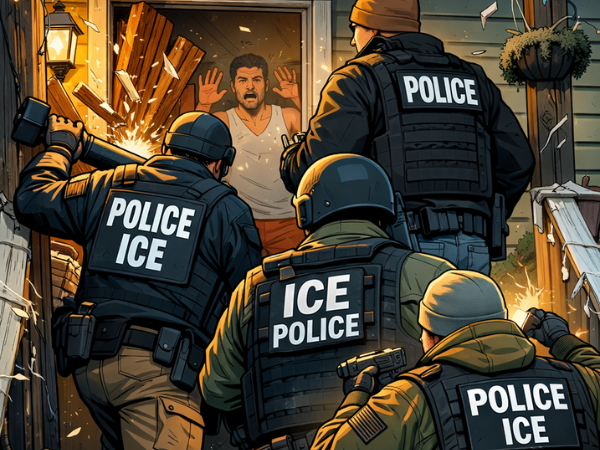


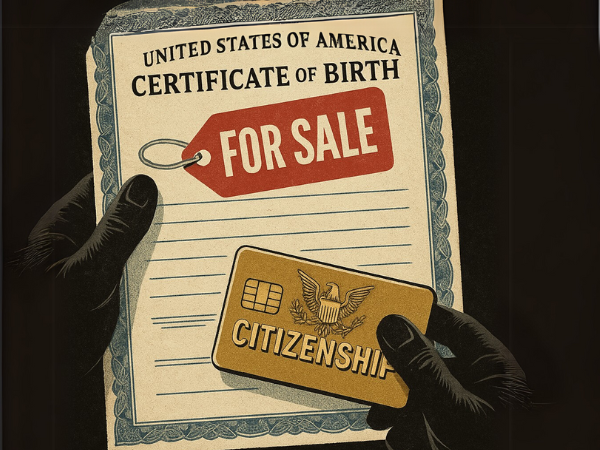
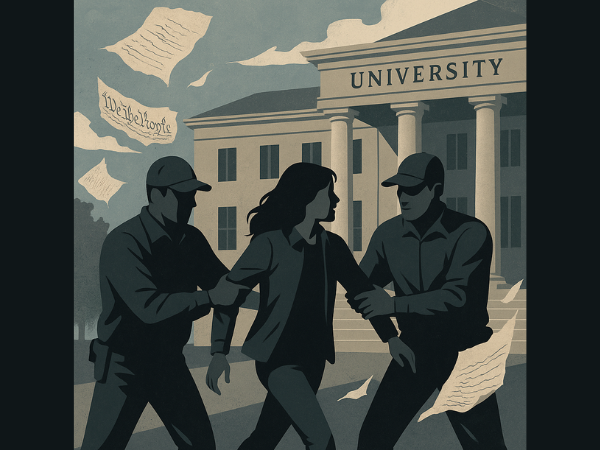


 John W. Whitehead, Constitutional Attorney