Posts Tagged ‘ICE’

Brother, I am American. You are twisting my arm.”— Man shouts “I am American” while ICE agents detain him

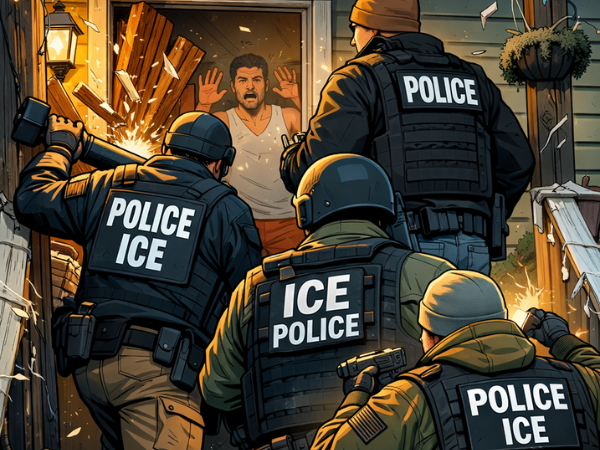
Masked gunmen. Tasers. Tear gas. Pepper spray. Unmarked vehicles. Intimidation tactics. Brutality. Racial profiling. Children traumatized. Families terrorized. Journalists targeted. Citizens detained. Disabled individuals, minors, the elderly, pregnant women, military veterans—snatched off the streets. Private property destroyed.

This is not a war zone. This is America.

This is what now passes for law-and-order policing by ICE agents in Trump’s America—and it is not making America safer or greater.

What began as an agency tasked with enforcing immigration law has metastasized into a domestic terror force.

From coast to coast, ICE goon squads—incognito, thuggish, fueled by profit-driven incentives and outlandish quotas, and empowered by the Trump administration to act as if they are untouchable—are prowling neighborhoods, churches, courthouses, hospitals, bus stops, and worksites, anywhere “suspected” migrants might be present, snatching people first and asking questions later.

Sometimes “later” comes hours, days or even weeks afterwards.

No one is off limits—not even American citizens.

Make no mistake: this is not how a constitutional republic operates. It is how a dictatorship behaves when it decides the rule of law—in this case, the Bill of Rights—is optional.

Journalists are being shoved to the pavement, forced into chokeholds, teargassed, and brutalized—in violation of the First Amendment. U.S. citizens, including toddlers, are being snatched up and carted off—in violation of the Fourth Amendment. People with no criminal records who have lived, worked and paid taxes in this country for decades are being made to disappear—in violation of habeas corpus.

This is not public safety. It is domestic terrorism, carried out by masked, militarized, lawless bounty hunters.

In California, ICE agents stopped a U.S. citizen and military veteran on his way to work. According to George Retes, agents fired tear gas, broke his car window, and applied physical force, including kneeling on him. Retes spent three days in federal custody with no charges, no call to his family, no access to a judge or an attorney, no shower, and no explanation for ICE’s actions before being released.

In Portland, a U.S. citizen outside his workplace was detained by masked, plainclothes agents who refused to identify themselves, threatened him with a dog, handcuffed him, hauled away in an unmarked vehicle, and held for hours without justification.

In Chicago, a local TV journalist was violently knocked to the ground by masked agents, handcuffed, arrested, and hauled to a detention center—then released without charges.

In Los Angeles, ICE agents handcuffed and detained a 23-year-old, heavily pregnant woman for over eight hours with a chain around her belly, accusing the native-born American of being from Mexico. Bruised and in labor, she went straight to the hospital upon release.

Two sisters were stopped outside a school, surrounded by at least ten ICE agents, who broke into their locked vehicle, dragged them out, and pinned them to the ground. Both women were later released without explanation.

Each of these incidents is presented as routine immigration enforcement. Yet collectively they reveal a government agency that has abandoned the principles of restraint, accountability, and due process in favor of brute force.

Justifying extreme measures—martial law, mass surveillance, suspension of constitutional safeguards— as necessary for “national security” has always been the refuge of tyrants, and this American police state is no different.

Under Trump, however, things are so much worse.

The rationalizations have become bolder, the violence more normalized, and the lies more transparent.

The biggest lie of all is the Department of Homeland Security’s claim that its costly, ego-driven, and unnecessary military invasion of Chicago—Operation Midway Blitz—rounded up “the worst of the worst pedophiles, child abusers, kidnappers, gang members, and armed robbers.” In fact, DHS’ own data shows that out of more than 1,000 people rounded up, only 10 had criminal records.

As one Chicago resident remarked, “When Donald Trump campaigned, he said he was going after criminals, rapists and drug dealers. Now, they’re assaulting women, deporting children, mothers and fathers—not criminals. And if they’re criminals, he needs to prove it. We haven’t seen that evidence yet.”

Indeed, even the courts are finding the Trump administration’s so-called “evidence” of crime to be scant and/or unreliable.

Nationally, more than 70% of individuals rounded up by ICE nationally have no criminal convictions. Many have lived in the U.S. for decades, raised families, paid taxes, contributed to the economy, and worked the jobs most Americans refuse to do.

The blatantly false claim that immigrants are inherently violent criminals has also been repeatedly refuted by studies showing that immigrants—including undocumented ones—are less likely to commit crimes than Americans born in the U.S.

Even Trump’s insistence that certain states or cities are overrun with crime, thus necessitating his military invasions, collapses under scrutiny: crime remains at record lows nationwide.

The data simply does not support the rhetoric.

Violence rises and falls with social conditions, not partisan control. Yet, conveniently, only those states that have challenged the Trump administration’s abuses have been singled out for invasion by ICE and the National Guard.

Clearly, this is not about crime, safety, or jobs.

So what is really driving this campaign of terror?

What we are witnessing is the weaponization of fear.

A government that profits from panic and rewards blind obedience has turned immigration enforcement into a spectacle of domination—part deterrent, part distraction, and all political theater.

The timing is no coincidence.

The Trump administration has just announced its fifth military strike on a Venezuelan vessel it claims—without evidence—was engaged in illegal activity. The propaganda might scream about “foreign threats,” but these spectacles serve a different purpose: to divert public outrage away from falling poll numbers, a faltering economy, and growing unrest over the regime’s corruption and incompetence.

At home, ICE raids perform the same function as those boat strikes abroad—they keep the public frightened and the cameras fixed on the wrong enemy. Meanwhile, the scandals that should command national attention—the Epstein files implicating powerful allies, the graft, the insider enrichment—sink beneath the noise.

Each new show of force, each televised arrest or explosion, is meant to remind the populace who holds the power and how easily it can be turned inward.

This is not about border control or law enforcement. It is about control, period.

When a political regime begins to equate its own survival with the nation’s survival, every citizen becomes a potential suspect and every act of dissent a potential crime.

Against such a backdrop, ICE’s strategy is predatory and deliberate.

Lower court rulings have affirmed that ICE, DHS and the Trump Administration are willfully trampling the First, Fourth and Fifth Amendments.

When ICE agents hunt people the way one might hunt animals in the wild, they cease to be officers of the law and become roving packs of lawless predators.

Lawless, paid predators, that is.

Thanks to the vast sums of taxpayer money funneled into ICE under Trump’s “One Big Beautiful Bill,” financial incentives are turning ICE agents into bounty hunters.

In addition to recruiting ICE agents with $50,000 signing bonuses and $60,000 in student loan forgiveness, DHS is also promising to lavishly reward police agencies that allow their officers to operate as extensions of ICE with salary reimbursements, overtime pay and monthly bonuses.

Then there is the Trump administration’s directive to ICE to carry out a minimum of 3,000 arrests a day.  

No wonder citizens, lawful residents and immigrants with no criminal history are getting swept up. There simply aren’t enough violent criminals to fill these quotas.

While some lower courts have attempted to rein in ICE’s abuses, the U.S. Supreme Court has largely empowered them.

In Noem v. Vasquez Perdomo, a 6–3 Supreme Court order paused a district court injunction that would have barred ICE from stopping people based on perceived race, accent, or workplace location—in effect greenlighting racial profiling and roving patrols.

The court ruled that ICE’s criteria for targeting individuals—judging people by race, language, or job—does not rise to the constitutional level of reasonable suspicion.

But for an administration that mistakes might for right, the law is whatever justifies the hunt. “Everything we’re doing is very lawful,” Trump declared. “What they’re doing is not lawful.”

Martin Luther King Jr. offered the clearest rebuttal to that logic more than sixty years ago.

In his “Letter from a Birmingham Jail,” written while jailed for participating in nonviolent demonstrations against segregation, King reminded the world “that everything Adolf Hitler did in Germany was ‘legal’ and everything the Hungarian freedom fighters did in Hungary was ‘illegal.’”

King then went on to explain how to distinguish between just and unjust laws:

“I would be the first to advocate obeying just laws. One has not only a legal but a moral responsibility to obey just laws. Conversely, one has a moral responsibility to disobey unjust laws. I would agree with St. Augustine that ‘an unjust law is no law at all.’ Now, what is the difference between the two? How does one determine whether a law is just or unjust? A just law is a man made code that squares with the moral law or the law of God. An unjust law is a code that is out of harmony with the moral law. To put it in the terms of St. Thomas Aquinas: An unjust law is a human law that is not rooted in eternal law and natural law. Any law that uplifts human personality is just. Any law that degrades human personality is unjust.”

King’s message was not about politics but about principle. His words remind us that legality and morality are not always the same — and that a nation that abandons moral law will soon find itself without any law at all.

A government that chains pregnant women, assaults journalists, and detains citizens without cause has lost its moral authority to govern.

King warned that the gravest threat to justice is not the clamor of bad people but the appalling silence of good ones. The same holds true today: silence in the face of government brutality is itself a form of consent.

Even in the face of the Trump administration’s heavy-handed repression, citizens have stepped up to meet military intimidation with moral conscience.

In Portland and other cities, protesters have embraced creative, nonviolent acts of symbolic resistance—appearing unclothed to expose the government’s hypocrisy, donning costumes to mock its fear, and standing silently before armed agents as living reminders of what it means to resist tyranny without becoming it.

These creative gestures recall the kind of moral witness King described: the courage to confront injustice with peace and strip it of its disguise.

The bottom line, as always, rests with “we the people.”

ICE does not protect America—it terrorizes America. And until it is reined in, dismantled, or reformed to operate wholly within constitutional boundaries, it will remain a standing army on domestic soil: unaccountable, unconstitutional, and un-American.

Tyranny always cloaks itself in the language of welfare and safety. And constitutional abuse transcends party lines.

Every regime that seeks to entrench its power begins by promising to protect the people from chaos, crime, or foreign enemies—then proceeds to manufacture both.

The raids, the strikes, the distractions are all part of the same design: to condition obedience, erase accountability, and cement totalitarian rule under the pretense of “law and order.”

As I make clear in my book Battlefield America: The War on the American People and in its fictional counterpart The Erik Blair Diaries, the Constitution is not a suggestion; it is the rule of law.

The Constitution is not a suggestion; it is the rule of law.

If ICE—and by extension, the DHS and the entire Trump regime—cannot operate within those limits, if it must hide behind masks and military might to exercise its power, then it has ceased to be lawful.

It has become exactly what the Framers of the Constitution feared: a government that wages war on its own people.

Source: https://tinyurl.com/65fmpevj

ABOUT JOHN W. WHITEHEAD

Constitutional attorney and author John W. Whitehead is founder and president of The Rutherford Institute. His most recent books are the best-selling Battlefield America: The War on the American People, the award-winning A Government of Wolves: The Emerging American Police State, and a debut dystopian fiction novel, The Erik Blair Diaries. Whitehead can be contacted at staff@rutherford.org. Nisha Whitehead is the Executive Director of The Rutherford Institute. Information about The Rutherford Institute is available at www.rutherford.org.

Publication Guidelines / Reprint Permission

John W. Whitehead’s weekly commentaries are available for publication to newspapers and web publications at no charge. 
“You think we’re arresting people now? You wait till we get the funding to do what we got to do.”—Tom Homan, Trump’s border czar

America is rapidly becoming a nation of prisons.

Having figured out how to parlay presidential authority in foreign affairs in order to sidestep the Constitution, President Trump is using his immigration enforcement powers to lock up—and lock down—the nation.

After all, a police state requires a prison state. And no one is cheering louder than the private prison corporations making money hand over fist from Trump’s expansion of federal detention.

Under the guise of national security and public safety, the Trump administration is engineering the largest federal expansion of incarceration and detention powers in U.S. history.

At the center of this campaign is Alligator Alcatraz, a federal detention facility built in the Florida Everglades and hailed by the White House as a model for the future of federal incarceration. But this is more than a new prison—it is the architectural symbol of a carceral state being quietly constructed in plain sight.

With over $170 billion allocated through Trump’s megabill, we are witnessing the creation of a vast, permanent enforcement infrastructure aimed at turning the American police state into a prison state.

The scope of this expansion is staggering.

The bill allocates $45 billion just to expand immigrant detention—a move that will make ICE the best-funded federal law enforcement agency in American history, with more money than the FBI, the DEA, and the Bureau of Prisons combined.

Yet be warned: what begins with ICE rarely ends with ICE.

Trump’s initial promise to crack down on “violent illegal criminals” has evolved into a sweeping mandate: a mass, quota-driven roundup campaign that detains anyone the administration deems a threat, regardless of legal status and at significant expense to the American taxpayer: immigrants, activists, journalists, business owners, military veterans, and even spouses of American citizens.

What’s more, the vast majority of those being detained are not violent criminals.

According to analyst Robert Reich, 71.7 percent of ICE detainees have no criminal record. Many are longtime residents, laborers, and small business owners—people who have contributed to the economy for years.

Removing these individuals from the workforce and imprisoning them not only devastates families and communities—it burdens taxpayers and weakens the economy.

According to the Department of Homeland Security, it costs more than $150 a day to detain a single immigrant—totaling over $3 billion annually for ICE detention alone. Meanwhile, undocumented workers contribute an estimated $96 billion in federal, state and local taxes each year, and billions more in Social Security and Medicare taxes that they can never claim.

These are the workers who keep industries running—doing the jobs many Americans refuse. Locking them up doesn’t save money; it dismantles the very labor force that sustains the economy.

Like so many of the Trump administration’s grandiose plans, the math doesn’t add up.

Just as Trump’s tariffs have failed to revive American manufacturing and instead raised consumer prices, this detention-state spending spree will cost taxpayers far more than it saves.

It’s not just authoritarian—it’s bad economics, funneling tax dollars into a bureaucracy that grows government while delivering no real public benefit.

We’re being told it’s about public safety and border control—but in reality, it’s a bloated, inefficient bureaucracy that shifts billions from productive parts of the economy into a black hole of surveillance, cement, and razor wire.

Making matters worse, many of these detained immigrants are then exploited as a pool of cheap labor inside the very facilities where they’re held.

In other words, this isn’t just a prison expansion—it’s a taxpayer-funded machine that extracts labor from the very people it imprisons, while draining billions from the economy and undermining the industries it claims to protect in order to help corporations make a larger profit.

According to The New York Timesat least 60,000 immigrants were put to work in ICE detention centers in 2013—more than were employed by any single private employer in the country at the time. Paid as little as 13 cents an hour—or nothing at all—these civil detainees were used to prepare meals, clean facilities, and even provide services to other government institutions.

Unlike convicted criminals, these individuals are not serving sentences. Most are civil detainees awaiting immigration hearings, and roughly half are ultimately allowed to stay in the country. Yet while they await due process, they are locked up, stripped of their rights, and forced to work for pennies on the dollar—all while the government and its contractors avoid paying minimum wage and save tens of millions a year in labor costs.

This isn’t just about cutting corners. It’s a taxpayer-subsidized racket—a corporatist scheme where politically connected companies profit from government largesse, growing the very bureaucratic state that so-called fiscal conservatives once claimed to oppose.

This kind of exploitation is not limited to immigration detention.

An investigation by the Associated Press found that prisoners in the United States—many held in private or underregulated facilities—are part of a multibillion-dollar empire that supplies a hidden labor supply chain linked to hundreds of popular food brands and supply companies.

As the Associated Press reports, “The goods these prisoners produce wind up in the supply chains of a dizzying array of products found in most American kitchens, from Frosted Flakes cereal and Ball Park hot dogs to Gold Medal flour, Coca-Cola and Riceland rice. They are on the shelves of virtually every supermarket in the country, including Kroger, Target, Aldi and Whole Foods. And some goods are exported, including to countries that have had products blocked from entering the U.S. for using forced or prison labor.”

It’s no coincidence that 90 percent of people in immigration detention are held in privately run facilities. These corporations profit from every additional body behind bars—and have lobbied aggressively for the policies that keep the beds full. Their contracts often guarantee minimum occupancy levels, creating perverse incentives to detain more people, for longer periods, at the expense of justice and human rights.

The implications for Trump’s detention empire are chilling.

At a time when the administration is promising mass deportations to appease anti-immigrant hardliners, it is simultaneously constructing a parallel economy in which detained migrants can be pressed into near-free labor to satisfy the needs of industries that depend on migrant work.

What Trump is building isn’t just a prison state—it’s a forced labor regime, where confinement and exploitation go hand in hand. And it’s a high price to pay for a policy that creates more problems than it solves.

As the enforcement dragnet expands, so too does the definition of who qualifies as an enemy of the state.

Erected under the banner of law and order, this permanent infrastructure of incarceration and enforcement is being put in place now for use tomorrow—not just against violent criminals who happen to be undocumented immigrants, but against whoever the government deems undesirable.

Increasingly, not even citizenship is a safeguard against the carceral state—as one recent case involving a legal U.S. resident arrested for his political views makes chillingly clear.

The Trump administration is now pushing to review and revoke the citizenship of Americans it deems national security risks—targeting them for arrest, detention, and deportation.

Unfortunately, the government’s definition of “national security threat” is so broad, vague and unconstitutional that it could encompass anyone engaged in peaceful, nonviolent, constitutionally protected activities—including criticism of government policy or the policies of allied governments like Israel.

In Trump’s prison state, no one is beyond the government’s reach.

Just ask Mahmoud Khalil, a legal U.S. resident married to a U.S. citizen who was detained for months by ICE for daring to peacefully oppose Israel’s war efforts in Gaza. Khalil’s arrest was not based on any crime—but on his political views, which the government labeled a national security concern under a little-used statute that allows the Secretary of State to deport non-citizens for expressing views deemed contrary to U.S. foreign policy interests.

A federal judge ultimately ordered Khalil’s release, finding that the detention likely violates due process rights when coupled with First Amendment protections. As the judge warned, if such a law can be used against Khalil, “then other, similar statutes can also one day be made to apply. Not just in the removal context, as to foreign nationals. But also in the criminal context, as to everyone.

In other words, exercising your First Amendment rights can land you in a cell—citizen or not.

Despite the Trump administration’s efforts to criminalize dissent and expand the machinery needed to enforce it, this is not a partisan expansion—it’s a structural one and it is being built to outlast any single presidency.

Look closer and you’ll see the outlines of a system built not for justice, but for mass containment and control.

This isn’t speculation. We’ve seen this trajectory before.

Critics of the post-9/11 security state—left, right, and libertarian alike—have long warned that the powers granted to fight terrorism and control immigration would eventually be turned inward, used against dissidents, protestors, and ordinary citizens.

That moment has arrived.

Power, once granted, rarely shrinks. It merely changes hands.

That’s why the Founders placed limits on federal power in the first place—because they knew that even well-meaning government programs would metastasize into tyranny if left unchecked.

Yet Trump’s most vocal supporters remain dangerously convinced they have nothing to fear from this expanding enforcement machine. But history—and the Constitution—say otherwise.

Our founders understood that unchecked government power, especially in the name of public safety, is the most dangerous threat to liberty. That’s why they enshrined rights like due process, trial by jury, and protection from unreasonable searches.

Those safeguards are now being hollowed out.

Immigration courts already operate without juries and allow indefinite detention. Civil liberties have been eroded by predictive policing, no-knock raids, and dragnet surveillance. Asset forfeiture laws allow the government to seize property without charges.

Now, with billions more in detention funding, these tactics are being scaled up and normalized for broader use.

And the public is being conditioned to accept it.

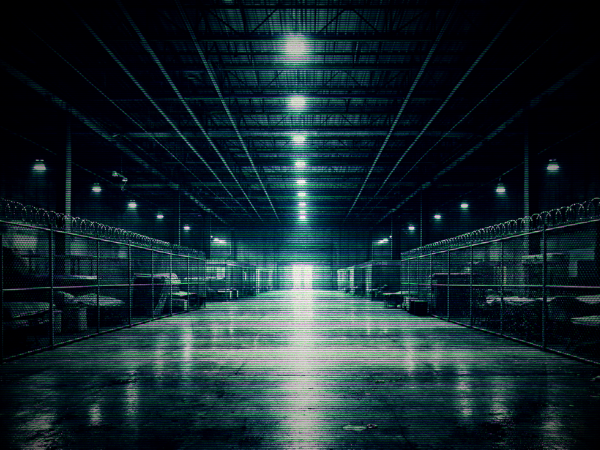
The pageantry surrounding Alligator Alcatraz isn’t just about capacity—it’s about spectacle. The prison, which was built in eight days, features more than 200 security cameras, 28,000-plus feet of barbed wire and 400 security personnel.

This is not a correctional facility. It’s a warning.

A government that rules by fear must maintain that fear.

Trump’s detention expansion—like the mass surveillance programs before it—is not about making America safe. It’s about following the blueprints for authoritarian control in order to lock down the country.

The Trump administration claims its expanding detention regime is aimed at curbing illegal immigration and violent crime. In reality, the new federal budget significantly broadens ICE’s mandate and resources, supercharges its reach through private-public surveillance partnerships, and grants it sweeping policing powers to investigate so-called domestic threats, operate pretrial detention centers, and detain individuals without formal charges under emergency powers.

These are not the tools of a free society. They are the instruments of a permanent security state.

We’re told we must trade liberty for security. But whose security, and at what cost?

With this expansion, we are moving from a nation of laws to a nation of executive decrees, predictive enforcement, and pre-crime detention. Already, courtrooms have become conveyor belts to prison, designed to serve the state, not justice.

The government’s targets may be the vulnerable today—but the infrastructure is built for everyone: Trump’s administration is laying the legal groundwork for indefinite detention of citizens and noncitizens alike.

Executive power during a declared emergency knows few bounds. And those bounds are becoming looser with every new bill, every new detention center, every new algorithm.

This is not just about building prisons. It’s about dismantling the constitutional protections that make us free.

A nation cannot remain free while operating as a security state. And a government that treats liberty as a threat will soon treat the people as enemies.

This is not a partisan warning. It is a constitutional one.

Trump’s supporters may cheer the crackdown now, but what happens when these powers are turned inward?

What happens when a future administration—left, right, or otherwise—decides that your political speech, your religious views, or your refusal to comply with a federal mandate constitutes a threat to order?

What happens when you’re arrested under suspicion, held without trial, and processed through a court system designed for speed, not fairness?

What happens when Alligator Alcatraz becomes the model for every state?

We are dangerously close to losing the constitutional guardrails that keep power in check.

The very people who once warned against Big Government—the ones who decried the surveillance state, the IRS, and federal overreach—are now cheering for the most dangerous part of it: the unchecked power to surveil, detain, and disappear citizens without full due process.

Limited government, not mass incarceration, is the backbone of liberty.

The Founders warned that the greatest threat to liberty was not a foreign enemy, but domestic power left unchecked. That’s exactly what we’re up against now. A nation cannot claim to defend freedom while building a surveillance-fueled, prison-industrial empire.

Trump’s prison state is not a defense of America. It’s the destruction of everything America was meant to defend.

We can pursue justice without abandoning the Constitution. We can secure our borders and our communities without turning every American into a suspect and building a federal gulag.

But we must act now.

History has shown us where this road leads. As I make clear in my book Battlefield America: The War on the American People and in its fictional counterpart The Erik Blair Diaries, once the machinery of tyranny is built, it rarely stays idle.

If we continue down this path, cheering on bigger prisons, broader police powers, and unchecked executive authority—if we fail to reject the dangerous notion that more prisons, more power, and fewer rights will somehow make us safer—if we fail to restore the foundational limits that protect us from government overreach before those limits are gone for good—we may wake up to find that the prisons and concentration camps the police state is building won’t just hold others.

One day, they may hold us all.

Source: https://tinyurl.com/mrx94ftu

ABOUT JOHN W. WHITEHEAD

Constitutional attorney and author John W. Whitehead is founder and president of The Rutherford Institute. His most recent books are the best-selling Battlefield America: The War on the American People, the award-winning A Government of Wolves: The Emerging American Police State, and a debut dystopian fiction novel, The Erik Blair Diaries. Whitehead can be contacted at staff@rutherford.org. Nisha Whitehead is the Executive Director of The Rutherford Institute. Information about The Rutherford Institute is available at www.rutherford.org.

Publication Guidelines / Reprint Permission

John W. Whitehead’s weekly commentaries are available for publication to newspapers and web publications at no charge.