


“Once a government is committed to the principle of silencing the voice of opposition, it has only one way to go, and that is down the path of increasingly repressive measures, until it becomes a source of terror to all its citizens and creates a country where everyone lives in fear… If the Bill of Rights were to be broken down, all groups, even the most conservative, would be in danger from the arbitrary power of government.”—President Harry S. Truman (August 8, 1950)
Let us be very clear.
The Constitution is not a suggestion or a negotiating tactic. It is not optional.
Government officials do not get to pick and choose which laws they will obey.
The Constitution is the supreme law of the land: a binding contract between “we the people” of the United States and those we hire to govern. It spells out our expectations for transparency and accountability, limits the government’s authority, affirms the purpose of government as protecter of liberty and property, and reinforces that we are the masters and government agents are the servants.
Thus, any decision by a government official to suspend the rights enshrined in the Constitution should not be undertaken lightly or for political gain or expedience, nor can it be done without following the strict parameters laid out by its creators and the courts.
Bottom line: any attempt to unilaterally override any aspect of the Constitution should alarm every American, regardless of party affiliation.
Which brings us to the Trump Administration’s ongoing attempts to weaponize concerns about national security in order to wage war on the rights enshrined in the Constitution.
We have been inundated with executive orders issued by President Trump purporting to protect national security interests by gutting free speech, eroding equal rights protections, sidestepping the separation of powers, and pushing us ever closer to martial law and outright dictatorship.
Behind the façade of national security lies a more insidious threat: a permanent shadow government—the Deep State—using every “emergency” to tighten its grip and expand unchecked executive authority.
Trump’s most effective ploy to seize power has been his use of illegal immigration to stoke fear and chill dissent. He has used it as a justification to do away with due process, expand the police state, deepen military involvement in domestic policing, and intimidate the nation into compliance.
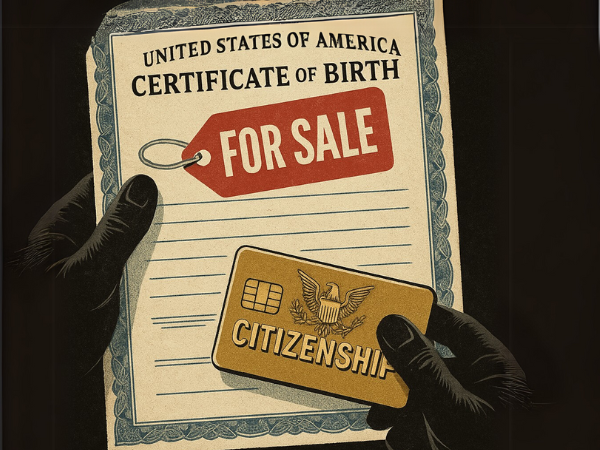
Even his bid to unilaterally end birthright citizenship for children born in the United States to undocumented immigrants is just another Trojan horse masquerading as a concern for national security.
This is not about protecting America—it’s about redefining America from the top down.
That redefinition is already underway.
The Trump Administration has floated plans to sell $5 million “gold cards” to wealthy investors as a path to citizenship and is considering a pitch for a reality show that would “pit immigrants against each other for a chance at a fast-tracked path to citizenship.”
These proposals are not just absurd—they’re obscene. They reveal a government willing to reduce constitutional rights to commodities, auctioned off to the highest bidder or trivialized for ratings.
This governing by-way-of performance turns a constitutional guarantee into a privilege for sale or spectacle. And it’s part of a calculated effort to recast citizenship as conditional, transactional, and exclusionary. Whether by wealth, loyalty, or ideology, this emerging framework decides who is “deserving” of rights—and who is not.
It is fear-based nationalism that disguises a deeper threat: the normalization of government power to decide who is entitled to rights and who is not.
We see this in action with the Trump Administration’s stance on childbirth and citizenship.
It’s a contradiction: although the Trump Administration is so concerned about falling birth rates that it is prepared to offer financial incentives for childbirth (for example, a $5,000 “baby bonus” and expanded child tax credit), it continues to demonize birthright citizenship for the one population segment that is actually having babies.
Surely the fact that migrant communities, including undocumented immigrants, not only contribute significantly to the economy and pay into Medicare, Social Security and income taxes without any guarantee of anything in return, only adds to their appeal?
Not for Trump, who is spending tens of millions of taxpayer dollars to expel immigrants who are positively contributing to the U.S. economy, while selectively welcoming others under a vastly different standard—such as family members of a South American drug cartel leader or white Afrikaners—who will have the cost of their resettlement services, and assistance with housing, jobs, and schools paid for by the American taxpayer.
Yet this brazenly hypocritical double standard is just a distraction, part of the political theater designed to pit Americans against each other while the power brokers rewrite the rules behind closed doors.
The real power play rests in the Trump Administration’s efforts to gut the Fourteenth Amendment, sidestep the courts, and redefine who qualifies as American—all by executive fiat.
Redefining citizenship by executive order is not governance. It is a bloodless coup—one that overthrows a constitutional republic founded on the rule of law—to reconfigure the face of the nation in the image of the unelected Deep State and its machinery of control.
Enacted in the wake of the Civil War, the Fourteenth Amendment was designed to ensure that all persons born on U.S. soil would be recognized as full citizens—a direct rebuke to the Supreme Court’s infamous Dred Scott decision, which held that Black Americans could not be citizens. Its language is unambiguous: all persons born or naturalized in the U.S., and subject to its jurisdiction, are citizens.
This principle was upheld by the Supreme Court in United States v. Wong Kim Ark (1898), which affirmed that children born in the U.S. to foreign nationals are entitled to citizenship under the Fourteenth Amendment.
The ruling in Wong Kim Ark came during an era of rampant anti-Chinese sentiment, reinforcing that even in times of national xenophobia, the Constitution prevailed in affirming equality under the law.
The Court’s ruling was unequivocal: the Constitution guarantees birthright citizenship to all born on American soil, regardless of parentage.
That precedent still stands.
Yet that legacy—of constitutional protections prevailing over prejudice—is now at risk.
Some have recently argued—including the Trump Administration in legal filings—that the Fourteenth Amendment was intended solely to grant citizenship to the children of former slaves after the Civil War, and thus no longer applies to children born to undocumented immigrants. But if that logic is taken seriously, it undermines the citizenship of everyone born in America.
After all, if the government—not the Constitution—gets to decide who qualifies as a citizen, then no one’s status is secure.
If your citizenship depends on government approval, your rights aren’t inalienable—they’re transitory privileges.
Likewise, this is not a return to “originalism.” It’s a retreat from constitutional rule altogether. It suggests that citizenship is not a right guaranteed by the Constitution, but a privilege bestowed by those in power.
That’s not just bad law. It’s tyranny in the making.
The notion that a sitting president can erase a constitutional guarantee with the stroke of a pen is not only absurd—it is dangerous. Such an action would be flatly unconstitutional, lacking any legal authority and in direct contradiction to more than a century of settled law.
Despite Trump’s attempts to rule by fiat and executive order, presidents cannot pick and choose which parts of the Constitution they will honor.
Yet perhaps even more concerning than Trump’s war on birthright citizenship itself is the administration’s underlying legal strategy to test the limits of judicial authority—specifically, to restrict the power of federal district courts to issue nationwide injunctions against unconstitutional actions.
You see, this is not just an immigration battle, nor is it only a challenge to the Fourteenth Amendment.
It is a calculated attempt to strip the judiciary of its ability to check executive abuse and a full-frontal assault on the role of the judiciary as a co-equal branch of government entrusted with interpreting the law and defending individual rights against majoritarian overreach.
If successful, it would mark a seismic shift in the balance of powers, subordinating the courts to the whims of the executive branch.
As James Madison wrote, the accumulation of all powers in the same hands may justly be pronounced the very definition of tyranny.
Revoking birthright citizenship would create a stateless class of people born on U.S. soil who are denied recognition by their own country. These children would be cast into legal limbo, denied the rights and protections afforded to every other citizen.
Such a move would not only be cruel—it would be profoundly un-American.
Don’t be fooled: the same unchecked power used to deny citizenship to the children of immigrants today could just as easily be turned against you to strip you of your citizenship—based on your political beliefs, religious views, or failure to toe the party line.
This is the danger the Founders warned against: a government that grants rights only to the loyal, the favored, or the compliant.
And make no mistake: what we’re witnessing is another point along the slippery slope of the effort to recast birthright citizenship—not as a right—but as a privilege, subject to political approval and ideological purity tests.
Increasingly, the government is creating a hierarchy of so-called “deserving” citizens, where access to constitutional rights is predicated on compliance, productivity, and perceived loyalty to the state. This shift toward merit-based citizenship is in direct contradiction to the ideals laid out in the Declaration of Independence, which affirms that rights are inalienable, not contingent.
We see it in efforts to strip dissenters of their legal protections, deny free speech to the unpopular, surveil certain communities more than others, and criminalize poverty, protest, or association with disfavored political movements.
In this emerging framework, being born in America is no longer enough—you must also prove your worth, your allegiance, and your compliance.
Worse still, this would set a precedent that constitutional rights can be rewritten by executive whim, paving the way for even greater erosions of liberty.
We have seen this before.
History shows how easily rights can be suspended when fear rules and power goes unchecked.
Consider the use of emergency powers to suspend habeas corpus protections, the unilateral authorization of surveillance programs that violate the Fourth Amendment, and the declaration of national emergencies to justify military deployments or detentions without trial.
These are not hypothetical scenarios.
They have occurred under multiple administrations and show how executive power, once unrestrained, expands at the expense of individual rights.
Redefining who qualifies as an American citizen is not the end of the story—it is the beginning of a slippery slope.
If the government can deny citizenship to those born on U.S. soil, what is to stop it from stripping citizenship from naturalized citizens? Or from declaring certain classes of people—based on ideology, ethnicity, or ancestry—as unworthy of constitutional protection?
What’s at stake is not merely a policy dispute—it is the foundational principle that rights cannot be granted or revoked at the pleasure of a single ruler.
If we do not hold the line here, this erosion of liberty will only accelerate.
These power grabs rarely come without a manufactured crisis.
That’s how the Deep State operates: inflame the public, declare an emergency, and then consolidate control.
Every time the people are told to trade liberty for security, we lose both.
This is a line that must not be crossed.
Birthright citizenship is more than a legal technicality. It is a cornerstone of American democracy and equality. The attempt to destroy it through executive power is a direct threat to the rule of law, the independence of the judiciary, and the future of liberty in America.
As I make clear in my book Battlefield America: The War on the American People and in its fictional counterpart The Erik Blair Diaries, if the government can erase one constitutional right today, it can erase another tomorrow.
This is exactly why the Founders drafted a Constitution that limits power and protects individuals—not just the popular or the powerful.
Once we allow the government to decide who is “deserving” of rights, we’ve already surrendered the rule of law. What remains is not a constitutional republic—but an empire of arbitrary rule.
Source: https://tinyurl.com/bp7fh92v
ABOUT JOHN W. WHITEHEAD
Constitutional attorney and author John W. Whitehead is founder and president of The Rutherford Institute. His most recent books are the best-selling Battlefield America: The War on the American People, the award-winning A Government of Wolves: The Emerging American Police State, and a debut dystopian fiction novel, The Erik Blair Diaries. Whitehead can be contacted at staff@rutherford.org. Nisha Whitehead is the Executive Director of The Rutherford Institute. Information about The Rutherford Institute is available at www.rutherford.org.
Publication Guidelines / Reprint Permission
John W. Whitehead’s weekly commentaries are available for publication to newspapers and web publications at no charge.


 For example,
  John W. Whitehead, Constitutional Attorney