Posts Tagged ‘first amendment’

BrandonRaub_2WASHINGTON, D.C. —  The U.S. Supreme Court has refused to hear the case of decorated Marine Brandon Raub, who was seized by a swarm of Secret Service, FBI and local police officials and involuntarily committed to a mental institution for a week after posting controversial song lyrics and political views critical of the government on his Facebook page. In asking the Supreme Court to hear the case, Rutherford Institute attorneys were seeking to overturn lower court rulings dismissing the case, which characterized concerns over government suppression of dissident speech as “far-fetched.” In rejecting the appeal, the Supreme Court also refused to establish standards to guide and constrain mental health professionals when they seek to commit individuals and to prevent commitment on the basis of a person’s exercise of his right to free speech.

“This case was about more than one Marine’s right to not be targeted for speaking out against the government. It was about whether Americans have the freedom to criticize the government without being labeled ‘domestic extremists’ and stripped of their rights,” said constitutional attorney John W. Whitehead, president of The Rutherford Institute and author of Battlefield America: The War on the American People. “Unfortunately, in refusing to hear this case, the Supreme Court has left us all vulnerable to the possibility that we can be declared mentally unfit, handcuffed, arrested and locked up against our will simply for exercising our right to speak truth to power.”

Brandon Raub, a decorated Marine who has served tours in Iraq and Afghanistan, uses his Facebook page to post song lyrics and air his political opinions. On Aug.16, 2012, Chesterfield police, Secret Service and FBI agents arrived at Raub’s home, asked to speak with him about his Facebook posts, and without providing any explanation, levying any charges against Raub or reading him his rights, handcuffed Raub and transported him to police headquarters, then to a medical facility, where he was held against his will for psychological evaluation and treatment.

In coming to Raub’s aid, Rutherford Institute attorneys challenged the government’s actions as a violation of Raub’s First and Fourth Amendment rights. On Aug. 23, Circuit Court Judge Allan Sharrett ordered Raub’s immediate release, stating that the government’s case was “so devoid of any factual allegations that it could not be reasonably expected to give rise to a case or controversy.” Rutherford Institute attorneys filed a lawsuit in May 2013, challenging the government’s actions as procedurally improper and legally unjustified. In February 2014, a U.S. District Court judge dismissed the lawsuit, rejecting concerns over government suppression of dissident speech as “far-fetched.” On appeal to the Court of Appeals for the Fourth Circuit, Institute attorneys claimed that the Chesterfield County mental health screener who recommended Raub’s seizure and commitment failed to exercise reasonable professional judgment in wrongly determining that Raub was mentally ill and dangerous, and that Raub’s seizure and detention were the result of a mental health screener’s dislike of Raub’s “unpatriotic” views on federal government misconduct, thereby violating the ex-Marine’s First Amendment right to freedom of speech. The appeals court subsequently affirmed the lower court judgment.

Attorneys William H. Hurd and Stephen C. Piepgrass of Troutman Sanders and Anthony Troy and Charles A. Zdebski of Eckert Seamens Cherin & Mellott assisted The Rutherford Institute in its defense of Brandon Raub.

RICHMOND, Va. —The Rutherford Institute has asked a federal appeals court to reject a lower court ruling that confers sweeping power on the government to police private ideas and equates a trademark registration with a form of government-sanctioned speech. Weighing in before the U.S. Court of Appeals for the Fourth Circuit in Pro-Football, Inc. v. Amanda Blackhorse, et al., attorneys for The Rutherford Institute and The Cato Institute argue that a district court order allowing the government to cancel the federal trademark registration of the NFL Redskins and refuse registration to other applications it deems “offensive” constitutes blatant content and viewpoint discrimination and imposes a “hecklers veto” on speech that violates the First Amendment’s protection of even unpopular speech.

In a related matter, attorneys for The Rutherford Institute have filed an amicus brief in In re: Simon Shiao Tam, coming to the defense of “The Slants,” an Asian-American dance rock band whose trademark application was denied by the U.S. Patent and Trademark Office on the grounds that the trademark might disparage or offend persons of Asian heritage.

Click here to read The Rutherford Institute’s amicus brief in Pro-Football, Inc. v. Amanda Blackhorse .

“Whether the debate is over a trademark for the Slants, the Redskins, or a specialty license plate for the Sons of Confederate Veterans, the sticking point remains the same: how much do we really value the First Amendment, and how far are we willing to go to protect someone else’s freedom of speech, even if that speech might be offensive to some?” asked constitutional attorney John W. Whitehead, president of The Rutherford Institute and author of Battlefield America: The War on the American People. “The end result remains the same: outright censorship and the creation of a class system that renders speech perceived as politically incorrect, hateful or offensive as inferior and less entitled to the full protection of the law.”

The Redskins have been waging a 20-year battle to protect the football team’s name in the face of charges that it is offensive to Native Americans. In 2014, the Trademark Trial and Appeal Board voted to cancel the Redskins’ trademark, declaring it to be offensive to Native Americans and therefore in violation of the Lanham Act, which prohibits names that “may disparage” or bring people into contempt or disrepute. In asserting the team’s First Amendment right to retain its name, the Redskins argued that the team name is a valuable commodity, in which the NFL team has invested millions of dollars for promotions and protections of trademarks. Moreover, the team claims that the Redskins name honors Native Americans rather than disrespecting them. The Redskins brought an action challenging the TTAB’s cancellation of the trademarks in Virginia federal district court, but that court upheld the ruling asserting that cancellation did not violate any First Amendment rights of the Redskins.

In challenging the district court’s ruling, The Rutherford Institute argued that the trademark statute allowing cancellation or denial of registration if a mark “may disparage” a particular group is unconstitutional on its face because it discriminates against speech that a government official or body considers inappropriate or offensive.

Affiliate attorneys Megan L. Brown, Joshua Turner, Christopher Kelly, Jennifer Elgin, and Dwayne D. Sam of Wiley Rein LLP in Washington, D.C., assisted The Rutherford Institute and The Cato Institute in advancing the arguments in thePro-Football, Inc., brief.

Screen Shot 2015-09-01 at 9.56.09 AMWASHINGTON, DC — A federal appeals court has summarily rejected a request that it reconsider its ruling that a 60-year old federal statute criminalizing expressive First Amendment activity on the Supreme Court plaza is “reasonable” and does not violate the First Amendment, setting up an appeal to the U.S. Supreme Court.

The U.S. Court of Appeals for the District of Columbia denied without explanation a petition for rehearing filed by The Rutherford Institute in Hodge v. Talkin, in which Institute attorneys pointed out that the ruling by a three-judge panel of the Court upholding the ban on speech on the plaza conflicts with earlier decisions construing a nearly-identical statute. The panel decision reversed a lower court decision finding the ban to be “repugnant” to the Constitution and “unreasonable, substantially overbroad, and irreconcilable with the First Amendment.” Rutherford Institute attorneys filed the lawsuit on behalf of activist Harold Hodge, who was arrested while standing silently in front of the U.S. Supreme Court on a snowy day wearing a sign voicing his concerns about the government’s disparate treatment of African-Americans and Hispanics.

“Through a series of carefully crafted legislative steps and politically expedient court rulings, government officials have managed to disembowel this fundamental freedom, rendering the First Amendment with little more meaning than the right to file a lawsuit against government officials,” said constitutional attorney John W. Whitehead, president of The Rutherford Institute and author of Battlefield America: The War on the American People. “Ironically, when we appeal this case, it will be the justices of the U.S. Supreme Court who will eventually be asked to decide the constitutionality of their own statute, yet they have already made their views on the subject quite clear.”

On January 28, 2011, Harold Hodge quietly and peacefully stood in the plaza area near the steps leading to the United States Supreme Court Building, wearing a 3’ X 2’ sign around his neck that proclaimed: “The U.S. Gov. Allows Police To Illegally Murder And Brutalize African Americans And Hispanic People.” The plaza is a place where the public is allowed to gather and converse, and is in all relevant respects like a public square or park where citizens have traditionally met to express their views on matters of public interest. However, Hodge was handcuffed, placed under arrest, and then transported to U.S. Capitol Police Headquarters for violating 40 U.S.C. § 6135, which broadly makes it unlawful to display any flag, banner, or device designed to bring into public notice a party, organization, or movement while on the grounds of the U.S. Supreme Court, thereby banning expressive activity on the Supreme Court plaza. Rutherford Institute attorneys subsequently filed a lawsuit challenging § 6135, and in June 2013 a district court judge struck down the law finding it “plainly unconstitutional on its face.” In response, the government not only appealed that ruling, but the marshal for the Supreme Court—with the approval of Chief Justice John Roberts—issued even more strident regulations outlawing expressive activity on the grounds of the high court, including the plaza. Rutherford Institute attorneys have since filed a related lawsuit challenging the Supreme Court’s more strident regulations.

Affiliate attorney Jeffrey Light is assisting The Rutherford Institute with Hodge.


LAWRENCEVILLE, Va. — Attorneys for The Rutherford Institute have filed a petition with a Virginia Circuit Court challenging an order of the state Department of Motor Vehicles (DMV) cancelling, revoking and/or demanding the return of specialty commemorative license plates issued to the Sons of Confederate Veterans (SCV) bearing the Confederate battle flag on the grounds that such a recall is unauthorized by Virginia law and beyond the power of the DMV. The DMV’s order comes in the wake of a U.S. Supreme Court decision holding that states issuing specialty license plates may engage in viewpoint discrimination when granting applications for specialty license plate designs. However, in the petition challenging the DMV’s September 2015 order, Rutherford Institute attorneys assert the order is unlawful and does not comply with Virginia statutes relating to the cancellation and recall of license plates.

“No matter what the U.S. Supreme Court might say about the matter, the First Amendment is unmistakably clear about the fact that the government has no right to dictate how we should act, what we should believe or what we should say, nor should it be in the business of determining what is or is not offensive, whether such expression appears on a license plate, a T-shirt, or a protest sign,” said John W. Whitehead, president of The Rutherford Institute and author of Battlefield America: The War on the American People.

Under Virginia law, specialty Virginia license plates bearing an organization’s logo and motto in addition to letters and numbers as found on other Virginia license plates may be issued to members and supporters of various organizations or groups. In 1999, The Rutherford Institute and the Sons of Confederate Veterans (SCV), a non-profit organization dedicated to preserving the history and legacy of citizen-soldiers who fought for the Confederacy in the Civil War, brought a lawsuit against Virginia and the DMV challenging its refusal to include the logo of the SCV which includes the Confederate battle flag. A federal district court ruled in 2001 that the State’s refusal to include the Confederate battle flag on SCV specialty plates constituted viewpoint discrimination in violation of the First Amendment. This ruling was upheld by the Fourth Circuit Court of Appeals in 2002.

Shortly thereafter, the DMV began issuing SCV specialty license plates which included a display of the Confederate battle flag. However, in June 2015, the U.S. Supreme Court ruled in Walker v. Tex. Div. of SCV that specialty license plates do not represent the speech of the individual motorists who purchase them, and that Texas could refuse to issue plates with the SCV’s Confederate battle flag logo. Following the ruling, Virginia’s DMV was granted permission by a federal court to be relieved from the orders entered in 2001 and 2002 respecting the SCV specialty plates. Soon after, the DMV notified SCV members that the previously-issued plates had been cancelled and were being recalled. In legal papers filed with the Circuit Court for Brunswick County, on behalf of Leonard Tracy Clary, Rutherford Institute attorneys challenge the DMV’s decision to cancel, revoke and/or demand the return of the SCV license plates, while ordering that recipients display new plates that do not bear the true logo of the SCV, which includes the Confederate battle flag.

Attorney Fred D. Taylor of Bush & Taylor, P.C., in Suffolk, Va., is assisting The Rutherford Institute in representing Clary and challenging the DMV order.


RICHMOND, Va. — A federal court has rejected an attempt by a Virginia police officer to dismiss a lawsuit filed by The Rutherford Institute on behalf of a man who was arrested as he was engaged in a First Amendment protest against President Obama while lawfully carrying a rifle.

The order entered in Brandon Howard v. John Hunter, allows the lawsuit to move forward.

Rutherford Institute attorneys assert that the police violated Howard’s First Amendment right to free speech, Second Amendment right to bear arms, and Fourth Amendment right to be free from a groundless arrest when they confronted him with guns drawn and ordered him to the ground on the unfounded belief that Howard was violating the law by being in public with a rifle slung over his shoulder, when in fact his possession and display of the rifle was wholly legal and did not make him subject to an arrest.  Soon after the incident, the City of Hopewell Police Department  admitted in writing that the incident involved a violation of department policy.

Click here to read The Rutherford Institute’s reply brief in Brandon Howard v. John Hunter .

“As this case shows, if you feel like you can’t walk away from a police encounter of your own volition—and more often than not you can’t, especially when you’re being confronted by someone armed to the hilt with all manner of militarized weaponry and gear—then for all intents and purposes, you’re under arrest from the moment a cop stops you,” said constitutional attorney John W. Whitehead, president of The Rutherford Institute and author of Battlefield America: The War on the American People. “Certainly, if you’ve been placed in handcuffs and transported to a police station against your will, that constitutes an arrest.”

On Monday, Aug. 26, 2013, Brandon Howard arrived at an overpass above Interstate 295 in the City of Hopewell, Va., and displayed a 6 foot by 4 foot sign that read “Impeach Obama.” Howard was carrying a DMTS Panther Arms AR-15 rifle slung over his shoulder on a strap, and a .380 caliber Bersa Thunder sidearm pistol in a belted holster on his waist. Howard lawfully owned each firearm and did not point or brandish them at any time while engaged in his First Amendment protest activity on the overpass. Howard displayed his protest sign for 30 minutes, but Howard did not directly engage with anyone.

At about 5:30 p.m., a police officer pulled up to the area, remained in his car and observed Howard. Thereafter, three to five additional police cruisers arrived at the scene with emergency lights engaged.  Approximately eight officers exited these vehicles with their guns drawn and ordered Howard to drop his sign and get on the ground with his hands spread above his head. Howard complied with the officers’ orders.

Despite the fact that Howard at no time made any threatening action toward the officers or anyone else, one police officer allegedly asked Howard, “What do you think you are doing threatening people on my interstate?” Howard explained that he had not threatened anyone but was simply exercising his First and Second amendment rights. Howard was then handcuffed and transported to the police station, where he was left, handcuffed, in an interrogation room for 90 minutes, after which time he had his firearms returned and was released. A month later, the Deputy Chief of Police acknowledged in writing that an internal investigation had concluded that one of the officers violated department policy and would be disciplined and sent to remedial training. Attorney Raul Novo of Richmond, Va., is assisting The Rutherford Institute with the lawsuit.

______

Support the Fight


The Rutherford Institute, a nonprofit civil liberties organization based in Charlottesville, Va., is deeply committed to protecting the constitutional freedoms of every American and the integral human rights of all people through its extensive legal and educational programs. The Institute provides its legal services at no charge to those whose constitutional and human rights have been threatened or violated.

Every dollar donated to support The Rutherford Institute’s legal and educational work helps to safeguard someone’s constitutional rights and religious freedoms. Whether you are a new donor, a Supporting Member wishing to renew your gift, or interested in becoming a Supporting Member, your generous support is crucial to continuing success in The Rutherford Institute’s fight for freedom.

The Rutherford Institute is a 501(c)(3) organization, gifts to which are deductible as charitable contributions for Federal income tax purposes.

You can use your credit or debit card to make an online donation right now—it’s fast, it’s easy, and it’s totally secure.


If you answered yes to any of the above questions, you may be an anti-government extremist (a.k.a. domestic terrorist) in the eyes of the police.

As such, you are now viewed as a greater threat to America than ISIS or al Qaeda.

Let that sink in a moment.

If you believe in and exercise your rights under the Constitution (namely, your right to speak freely, worship freely, associate with like-minded individuals who share your political views, criticize the government, own a weapon, demand a warrant before being questioned or searched, or any other activity viewed as potentially anti-government, racist, bigoted, anarchic or sovereign), you have just been promoted to the top of the government’s terrorism watch list.

I assure you I’m not making this stuff up.

Police agencies now believe the “main terrorist threat in the United States is not from violent Muslim extremists, but from right-wing extremists.”

A New York Times editorial backs up these findings:

Law enforcement agencies around the country are training their officers to recognize signs of anti-government extremism and to exercise caution during routine traffic stops, criminal investigations and other interactions with potential extremists. “The threat is real,” says the handout from one training program sponsored by the Department of Justice. Since 2000, the handout notes, 25 law enforcement officers have been killed by right-wing extremists, who share a “fear that government will confiscate firearms” and a “belief in the approaching collapse of government and the economy.”

So what is the government doing about these so-called terrorists?

The government is going to war.

Again.

Only this time, it has declared war against so-called American “extremists.”

After decades spent waging costly, deadly and ineffective military campaigns overseas in pursuit of elusive ISIS and al Qaeda operatives and terror cells (including the recent “accidental” bombing of a Doctors Without Borders hospital in Afghanistan that left 22 patients and medical staff dead), the Obama administration has announced a campaign to focus its terror-fighting forces inwards.

Under the guise of fighting violent extremism “in all of its forms and manifestations” in cities and communities across the world, the Obama administration has agreed to partner with the United Nations to take part in its Strong Cities Network program. Funded by the State Department through 2016, after which “charities are expected to take over funding,” the cities included in the global network include New York City, Atlanta, Denver, Minneapolis, Paris, London, Montreal, Beirut and Oslo.

Working with the UN, the federal government will train local police agencies across America in how to identify, fight and prevent extremism, as well as address intolerance within their communities, using all of the resources at their disposal.

What this program is really all about, however, is community policing on a global scale.

Community policing, which relies on a “broken windows” theory of policing, calls for police to engage with the community in order to prevent local crime by interrupting or preventing minor offenses before they could snowball into bigger, more serious and perhaps violent crime. The problem with the broken windows approach is that it has led to zero tolerance policing and stop-and-frisk practices among other harsh police tactics.

When applied to the Strong Cities Network program, the objective is ostensibly to prevent violent extremism by targeting its source: racism, bigotry, hatred, intolerance, etc.

In other words, police—acting ostensibly as extensions of the United Nations—will identify, monitor and deter individuals who exhibit, express or engage in anything that could be construed as extremist.

Consider how Attorney General Loretta Lynch describes the initiative:

As residents and experts in their communities, local leaders are often best positioned to pinpoint sources of unrest and discord; best equipped to identify signs of potential danger; and best able to recognize and accommodate community cultures, traditions, sensitivities, and customs. By creating a series of partnerships that draws on the knowledge and expertise of our local officials, we can create a more effective response to this virulent threat.

Translation: U.S. police agencies are embarking on an effort to identify and manage potential extremist “threats,” violent or otherwise, before they can become actual threats. (If you want a foretaste of how “extreme” things could get in the U.S.: new anti-terrorism measures in the U.K. require that extremists be treated like pedophiles and banned from working with youngsters and vulnerable people.)

The government’s war on extremists, of which the Strong Cities program is a part, is being sold to Americans in much the same way that the USA Patriot Act was sold to Americans: as a means of combatting terrorists who seek to destroy America.

For instance, making the case for the government’s war on domestic extremism, the Obama administration has suggested that it may require greater legal powers to combat violent attacks by lone wolves (such as “people motivated by racial and religious hatred and anti-government views” who “communicate their hatred over the Internet and through social media”).

Enter the government’s newest employee: a domestic terrorism czar.

However, as we now know, the USA Patriot Act was used as a front to advance the surveillance state, allowing the government to establish a far-reaching domestic spying program that has turned every American citizen into a criminal suspect.

Similarly, the concern with the government’s anti-extremism program is that it will, in many cases, be utilized to render otherwise lawful, nonviolent activities as potentially extremist.

Keep in mind that the government agencies involved in ferreting out American “extremists” will carry out their objectives—to identify and deter potential extremists—in concert with fusion centers (of which there are 78 nationwide, with partners in the private sector and globally), data collection agencies, behavioral scientists, corporations, social media, and community organizers and by relying on cutting-edge technology for surveillance, facial recognition, predictive policing, biometrics, and behavioral epigenetics (in which life experiences alter one’s genetic makeup).

This is pre-crime on an ideological scale and it’s been a long time coming.

For example, in 2009, the Department of Homeland Security (DHS) released two reports, one on “Rightwing Extremism,” which broadly defines rightwing extremists as individuals and groups “that are mainly antigovernment, rejecting federal authority in favor of state or local authority, or rejecting government authority entirely,” and one on “Leftwing Extremism,” which labeled environmental and animal rights activist groups as extremists.

Incredibly, both reports use the words terrorist and extremist interchangeably.

That same year, the DHS launched Operation Vigilant Eagle, which calls for surveillance of military veterans returning from Iraq and Afghanistan, characterizing them as extremists and potential domestic terrorist threats because they may be “disgruntled, disillusioned or suffering from the psychological effects of war.”

These reports indicate that for the government, anyone seen as opposing the government—whether they’re Left, Right or somewhere in between—can be labeled an extremist.

Fast forward a few years, and you have the National Defense Authorization Act (NDAA), which President Obama has continually re-upped, that allows the military to take you out of your home, lock you up with no access to friends, family or the courts if you’re seen as an extremist.

Now connect the dots, from the 2009 Extremism reports to the NDAA and the UN’s Strong Cities Network with its globalized police forces, the National Security Agency’s far-reaching surveillance networks, and fusion centers that collect and share surveillance data between local, state and federal police agencies.

Add in tens of thousands of armed, surveillance drones that will soon blanket American skies, facial recognition technology that will identify and track you wherever you go and whatever you do. And then to complete the circle, toss in the real-time crime centers being deployed in cities across the country, which will be attempting to “predict” crimes and identify criminals before they happen based on widespread surveillance, complex mathematical algorithms and prognostication programs.

Hopefully you’re getting the picture, which is how easy it is for the government to identify, label and target individuals as “extremist.”

We’re living in a scary world.

Unless we can put the brakes on this dramatic expansion and globalization of the government’s powers, we’re not going to recognize this country 20 years from now.

Battlefield_Cover_300Frankly, as I make clear in my book Battlefield America: The War on the American People, the landscape has already shifted dramatically from what it was like 10 or 20 years ago. It’s taken less than a generation for our freedoms to be eroded and the police state structure to be erected, expanded and entrenched.

Rest assured that the government will not save us from the chains of the police state. The UN’s Strong Cities Network program will not save us. The next occupant of the White House will not save us. For that matter, anarchy and violent revolution will not save us.

If there is to be any hope of freeing ourselves, it rests—as it always has—at the local level, with you and your fellow citizens taking part in grassroots activism, which takes a trickle-up approach to governmental reform by implementing change at the local level.

Attend local city council meetings, speak up at town hall meetings, organize protests and letter-writing campaigns, employ “militant nonviolent resistance” and civil disobedience, which Martin Luther King Jr. used to great effect through the use of sit-ins, boycotts and marches.

And then, while you’re at it, urge your local governments to nullify everything the federal government does that is illegitimate, egregious or blatantly unconstitutional.

If this sounds anti-government or extremist, perhaps it is, in much the same way that King himself was considered anti-government and extremist. Recognizing that “freedom is never voluntarily given by the oppressor; it must be demanded by the oppressed,” King’s tactics—while nonviolent—were extreme by the standards of his day.

As King noted in his 1963 “Letter from Birmingham City Jail”:

[A]s I continued to think about the matter I gradually gained a bit of satisfaction from being considered an extremist. Was not Jesus an extremist in love—“Love your enemies, bless them that curse you, pray for them that despitefully use you.” Was not Abraham Lincoln an extremist—“This nation cannot survive half slave and half free.” Was not Thomas Jefferson an extremist—“We hold these truths to be self-evident, that all men are created equal.” So the question is not whether we will be extremist but what kind of extremist will we be. Will we be extremists for hate or will we be extremists for love?

So how do you not only push back against the police state’s bureaucracy, corruption and cruelty but also launch a counterrevolution aimed at reclaiming control over the government using nonviolent means?

Take a cue from King.


“Since mankind’s dawn, a handful of oppressors have accepted the responsibility over our lives that we should have accepted for ourselves. By doing so, they took our power. By doing nothing, we gave it away. We’ve seen where their way leads, through camps and wars, towards the slaughterhouse.” ― Alan Moore, V for Vendetta

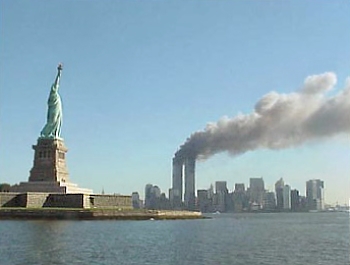
What began with the passage of the USA Patriot Act in October 2001 has snowballed into the eradication of every vital safeguard against government overreach, corruption and abuse. Since then, we have been terrorized, traumatized, and acclimated to life in the American Surveillance State.

The bogeyman’s names and faces change over time, but the end result remains the same: our unquestioning acquiescence to anything the government wants to do in exchange for the phantom promise of safety and security has transitioned us to life in a society where government agents routinely practice violence on the citizens while, in conjunction with the Corporate State, spying on the most intimate details of our personal lives.

Ironically, the 14th anniversary of the 9/11 attacks occurs just days before the 228th anniversary of the ratification of our Constitution. Yet while there is much to mourn about the loss of our freedoms in the years since 9/11, there is virtually nothing to celebrate.

The Constitution has been steadily chipped away at, undermined, eroded, whittled down, and generally discarded to such an extent that what we are left with today is but a shadow of the robust document adopted more than two centuries ago. Most of the damage has been inflicted upon the Bill of Rights—the first ten amendments to the Constitution—which has historically served as the bulwark from government abuse.

Set against a backdrop of government surveillance, militarized police, SWAT team raids, asset forfeiture, eminent domain, overcriminalization, armed surveillance drones, whole body scanners, stop and frisk searches, roving VIPR raids and the like—all sanctioned by a corrupt government run by Congress, the White House and the courts—a recitation of the Bill of Rights now sounds more like a eulogy to freedoms lost than an affirmation of rights we should possess.

Battlefield_Cover_300As I make clear in my book Battlefield America: The War on the American People, the Constitution has been on life support for some time now and all efforts at resuscitating it may soon prove futile.

We can pretend that the Constitution, which was written to hold the government accountable, is still our governing document. However, the reality we must come to terms with is that in the America we live in today, the government does whatever it wants, freedom be damned, and “we the people” are seen as little more than cattle to be branded and eventually led to the slaughterhouse.

Consider the state of our freedoms, and judge for yourself whether Osama Bin Laden was right when he warned that “freedom and human rights in America are doomed,” and that the “U.S. government will lead the American people in — and the West in general — into an unbearable hell and a choking life.”

Here is what it means to live under the Constitution today.

The First Amendment is supposed to protect the freedom to speak your mind, assemble and protest nonviolently without being bridled by the government. It also protects the freedom of the media, as well as the right to worship and pray without interference. In other words, Americans should not be silenced by the government. To the founders, all of America was a free speech zone.

Yet despite the clear protections found in the First Amendment, the freedoms described therein are under constant assault. Increasingly, Americans are being arrested and charged with bogus “contempt of cop” charges such as “disrupting the peace” or “resisting arrest” for daring to film police officers engaged in harassment or abusive practices. Journalists are being prosecuted for reporting on whistleblowers. States are passing legislation to muzzle reporting on cruel and abusive corporate practices. Religious ministries are being fined for attempting to feed and house the homeless. Protesters are being tear-gassed, beaten, arrested and forced into “free speech zones.” And under the guise of “government speech,” the courts have reasoned that the government can discriminate freely against any First Amendment activity that takes place within a government forum.

The Second Amendment was intended to guarantee “the right of the people to keep and bear arms.” Yet while gun ownership has been recognized by the U.S. Supreme Court as an individual citizen right, Americans remain powerless to defend themselves against SWAT team raids and government agents armed to the teeth with military weapons better suited for the battlefield than for a country founded on freedom. Police shootings of unarmed citizens continue to outrage communities, while little is really being done to demilitarize law enforcement agencies. Indeed, just recently, North Dakota became the first state to legalize law enforcement use of drones armed with weapons such as tear gas, rubber bullets, beanbags, pepper spray and Tasers.

The Third Amendment reinforces the principle that civilian-elected officials are superior to the military by prohibiting the military from entering any citizen’s home without “the consent of the owner.” With the police increasingly training like the military, acting like the military, and posing as military forces—complete with military weapons, assault vehicles, etc.—it is clear that we now have what the founders feared most—a standing army on American soil. Moreover, as a result of SWAT team raids (more than 80,000 a year) where police invade homes, often without warrants, and injure and even kill unarmed citizens, the barrier between public and private property has been done away with, leaving us with armed government agents who act as if they own our property.

The Fourth Amendment prohibits the government from conducting surveillance on you or touching you or invading you, unless they have some evidence that you’re up to something criminal. In other words, the Fourth Amendment ensures privacy and bodily integrity. Unfortunately, the Fourth Amendment has suffered the greatest damage in recent years and been all but eviscerated by an unwarranted expansion of police powers that include strip searches and even anal and vaginal searches of citizens, surveillance and intrusions justified in the name of fighting terrorism, as well as the outsourcing of otherwise illegal activities to private contractors. Case in point: Texas police forced a 21-year-old woman to undergo a warrantless vaginal search by the side of the road after she allegedly “rolled” through a stop sign.

The use of civil asset forfeiture schemes to swell the coffers of police forces has also continued to grow in popularity among cash-strapped states. The federal government continues to strong-arm corporations into providing it with access to Americans’ private affairs, from emails and online transactions to banking and web surfing. Coming in the wake of massive leaks about the inner workings of the NSA and the massive secretive surveillance state, it was revealed that the government threatened to fine Yahoo $250,000 every day for failing to comply with the NSA’s mass data collection program known as PRISM. Meanwhile, AT&T has enjoyed a profitable and “extraordinary, decades-long” relationship with the NSA.

The technological future appears to pose even greater threats to what’s left of our Fourth Amendment rights, with advances in biometric identification and microchip implants on the horizon making it that much easier for the government to track not only our movements and cyber activities but our very cellular beings. Barclays has already begun using a finger-scanner as a form of two-step authentication to give select customers access to their accounts. Similarly, Motorola has been developing thin “digital tattoos” that will ensure that a phone’s owner is the only person who may unlock it. Not to be overlooked are the aerial spies—surveillance drones—about to take to the skies in coming years, as well as the Drive Smart programs that will spy on you (your speed, movements, passengers, etc.) while you travel the nation’s highways and byways.

The Fifth Amendment and the Sixth Amendment work in tandem. These amendments supposedly ensure that you are innocent until proven guilty, and government authorities cannot deprive you of your life, your liberty or your property without the right to an attorney and a fair trial before a civilian judge. However, in the new suspect society in which we live, where surveillance is the norm, these fundamental principles have been upended. Certainly, if the government can arbitrarily freeze, seize or lay claim to your property (money, land or possessions) under government asset forfeiture schemes, you have no true rights. That’s the crux of a case before the U.S. Supreme Court challenging the government’s use of asset forfeiture to strip American citizens of the funds needed to hire a defense attorney of their choosing.

The Seventh Amendment guarantees citizens the right to a jury trial. However, when the populace has no idea of what’s in the Constitution—civic education has virtually disappeared from most school curriculums—that inevitably translates to an ignorant jury incapable of distinguishing justice and the law from their own preconceived notions and fears. However, as a growing number of citizens are coming to realize, the power of the jury to nullify the government’s actions—and thereby help balance the scales of justice—is not to be underestimated. Jury nullification reminds the government that it’s “we the people” who can and should be determining what laws are just, what activities are criminal and who can be jailed for what crimes.

The Eighth Amendment is similar to the Sixth in that it is supposed to protect the rights of the accused and forbid the use of cruel and unusual punishment. However, the Supreme Court’s determination that what constitutes “cruel and unusual” should be dependent on the “evolving standards of decency that mark the progress of a maturing society” leaves us with little protection in the face of a society lacking in morals altogether. For example, a California appeals court is being asked to consider “whether years of unpredictable delays from conviction to execution” constitute cruel and unusual punishment. For instance, although 900 individuals have been sentenced to death in California since 1978, only 13 have been executed. As CBS News reports, “More prisoners have died of natural causes on death row than have perished in the death chamber.”

The Ninth Amendment provides that other rights not enumerated in the Constitution are nonetheless retained by the people. Popular sovereignty—the belief that the power to govern flows upward from the people rather than downward from the rulers—is clearly evident in this amendment. However, it has since been turned on its head by a centralized federal government that sees itself as supreme and which continues to pass more and more laws that restrict our freedoms under the pretext that it has an “important government interest” in doing so. Thus, once the government began violating the non-enumerated rights granted in the Ninth Amendment, it was only a matter of time before it began to trample the enumerated rights of the people, as explicitly spelled out in the rest of the Bill of Rights.

As for the Tenth Amendment’s reminder that the people and the states retain every authority that is not otherwise mentioned in the Constitution, that assurance of a system of government in which power is divided among local, state and national entities has long since been rendered moot by the centralized Washington, DC, power elite—the president, Congress and the courts. Indeed, the federal governmental bureaucracy has grown so large that it has made local and state legislatures relatively irrelevant. Through its many agencies and regulations, the federal government has stripped states of the right to regulate countless issues that were originally governed at the local level.

If there is any sense to be made from this recitation of freedoms lost, it is simply this: our individual freedoms have been eviscerated so that the government’s powers could be expanded, while reducing us to a system of slavery disguised as a democracy.

The film V for Vendetta is a powerful commentary on how totalitarian governments such as our own exploit fear and use mass surveillance, censorship, terrorism, and militarized tactics to control, oppress and enslave.

As the lead character V observes:

Where once you had the freedom to object, to think and speak as you saw fit, you now have censors and systems of surveillance coercing your conformity and soliciting your submission. How did this happen? Who’s to blame? Well certainly there are those more responsible than others, and they will be held accountable, but again truth be told, if you’re looking for the guilty, you need only look into a mirror. I know why you did it. I know you were afraid. Who wouldn’t be? War, terror, disease. There were a myriad of problems which conspired to corrupt your reason and rob you of your common sense. Fear got the best of you, and in your panic you turned to the now high chancellor, Adam Sutler. He promised you order, he promised you peace, and all he demanded in return was your silent, obedient consent.

How will you have it? Will you simply comply while the train heads down the track to a modern-day Auschwitz? Or will you become a free person and resist? To quote Patrick Henry, “Is life so dear, or peace so sweet, as to be purchased at the price of chains and slavery? Forbid it, Almighty God! — I know not what course others may take; but as for me, give me liberty or give me death!”

“If the freedom of speech be taken away, then dumb and silent we may be led, like sheep to the slaughter.”—George Washington

The architects of the American police state must think we’re idiots.

With every passing day, we’re being moved further down the road towards a totalitarian society characterized by government censorship, violence, corruption, hypocrisy and intolerance, all packaged for our supposed benefit in the Orwellian doublespeak of national security, tolerance and so-called “government speech.”

Long gone are the days when advocates of free speech could prevail in a case such as Tinker v. Des Moines. Indeed, it’s been 50 years since 13-year-old Mary Beth Tinker was suspended for wearing a black armband to school in protest of the Vietnam War. In taking up her case, the U.S. Supreme Court declared that students do not “shed their constitutional rights to freedom of speech or expression at the schoolhouse gate.”

Were Tinker to make its way through the courts today, it would have to overcome the many hurdles being placed in the path of those attempting to voice sentiments that may be construed as unpopular, offensive, conspiratorial, violent, threatening or anti-government.

Consider, if you will, that the U.S. Supreme Court, historically a champion of the First Amendment, has declared that citizens can exercise their right to free speech everywhere it’s lawful—online, in social media, on a public sidewalk, etc.—as long as they don’t do so in front of the Court itself.

What is the rationale for upholding this ban on expressive activity on the Supreme Court plaza?

“Allowing demonstrations directed at the Court, on the Court’s own front terrace, would tend to yield the…impression…of a Court engaged with — and potentially vulnerable to — outside entreaties by the public.”

Translation: The appellate court that issued that particular ruling in Hodge v. Talkin actually wants us to believe that the Court is so impressionable that the justices could be swayed by the sight of a single man, civil rights activist Harold Hodge, standing alone and silent in the snow in a 20,000 square-foot space in front of the Supreme Court building wearing a small sign protesting the toll the police state is taking on the lives of black and Hispanic Americans. [You can watch the video here: https://www.youtube.com/watch?v=xy1HQm67b2c]

My friends, we’re being played for fools.

The Supreme Court is not going to be swayed by you or me or Harold Hodge.

For that matter, the justices—all of whom hale from one of two Ivy League schools (Harvard or Yale) and most of whom are now millionaires and enjoy such rarefied privileges as lifetime employment, security details, ample vacations and travel perks—are anything but impartial.

If they are partial, it is to those with whom they are on intimate terms: with Corporate America and the governmental elite who answer to them, and they show their favor by investing in their businesses, socializing at their events, and generally marching in lockstep with their values and desires in and out of the courtroom.

Screen Shot 2015-09-01 at 9.56.09 AMTo suggest that Harold Hodge, standing in front of the Supreme Court building on a day when the Court was not in session hearing arguments or issuing rulings, is a threat to the Court’s neutrality, while their dalliances with Corporate America is not, is utter hypocrisy.

Making matters worse, the Supreme Court has the effrontery to suggest that the government can discriminate freely against First Amendment activity that takes place within a government forum. Justifying such discrimination as “government speech,” the Court ruled that the Texas Dept. of Motor Vehicles could refuse to issue specialty license plate designs featuring a Confederate battle flag because it was offensive.

If it were just the courts suppressing free speech, that would be one thing to worry about, but First Amendment activities are being pummeled, punched, kicked, choked, chained and generally gagged all across the country.

The reasons for such censorship vary widely from political correctness, safety concerns and bullying to national security and hate crimes but the end result remains the same: the complete eradication of what Benjamin Franklin referred to as the “principal pillar of a free government.”

Officials at the University of Tennessee, for instance, recently introduced an Orwellian policy that would prohibit students from using gender specific pronouns and be more inclusive by using gender “neutral” pronouns such as ze, hir, zir, xe, xem and xyr, rather than he, she, him or her.

On many college campuses, declaring that “America is the land of opportunity” or asking someone “Where were you born?” are now considered microaggressions, “small actions or word choices that seem on their face to have no malicious intent but that are thought of as a kind of violence nonetheless.”  Trigger warnings are also being used to alert students to any material or ideas they might read, see or hear that might upset them.

More than 50 percent of the nation’s colleges, including Boston University, Harvard University, Columbia University and Georgetown University, subscribe to “red light” speech policies that restrict or ban so-called offensive speech, or limit speakers to designated areas on campus. The campus climate has become so hypersensitive that comedians such as Chris Rock and Jerry Seinfeld refuse to perform stand-up routines to college crowds anymore.

What we are witnessing is an environment in which political correctness has given rise to “vindictive protectiveness,” a term coined by social psychologist Jonathan Haidt and educational First Amendment activist Greg Lukianoff. It refers to a society in which “everyone must think twice before speaking up, lest they face charges of insensitivity, aggression or worse.”

This is particularly evident in the public schools where students are insulated from anything—words, ideas and images—that might create unease or offense. For instance, the thought police at schools in Charleston, South Carolina, have instituted a ban on displaying the Confederate flag on clothing, jewelry and even cars on campus.

Added to this is a growing list of programs, policies, laws and cultural taboos that defy the First Amendment’s safeguards for expressive speech and activity. Yet as First Amendment scholar Robert Richards points out, “The categories of speech that fall outside of [the First Amendment’s] protection are obscenity, child pornography, defamation, incitement to violence and true threats of violence. Even in those categories, there are tests that have to be met in order for the speech to be illegal. Beyond that, we are free to speak.”

Technically, Richards is correct. On paper, we are free to speak.

In reality, however, we are only as free to speak as a government official may allow.

Free speech zones, bubble zones, trespass zones, anti-bullying legislation, zero tolerance policies, hate crime laws and a host of other legalistic maladies dreamed up by politicians and prosecutors have conspired to corrode our core freedoms.

Battlefield_Cover_300As a result, we are no longer a nation of constitutional purists for whom the Bill of Rights serves as the ultimate authority. As I make clear in my book Battlefield America: The War on the American People, we have litigated and legislated our way into a new governmental framework where the dictates of petty bureaucrats carry greater weight than the inalienable rights of the citizenry.

It may seem trivial to be debating the merits of free speech at a time when unarmed citizens are being shot, stripped, searched, choked, beaten and tasered by police for little more than daring to frown, smile, question, challenge an order, or just breathe.

However, while the First Amendment provides no tangible protection against a gun wielded by a government agent, nor will it save you from being wrongly arrested or illegally searched, or having your property seized in order to fatten the wallets of government agencies, without the First Amendment, we are utterly helpless.

It’s not just about the right to speak freely, or pray freely, or assemble freely, or petition the government for a redress of grievances, or have a free press. The unspoken freedom enshrined in the First Amendment is the right to think freely and openly debate issues without being muzzled or treated like a criminal.

Just as surveillance has been shown to “stifle and smother dissent, keeping a populace cowed by fear,” government censorship gives rise to self-censorship, breeds compliance and makes independent thought all but impossible.

In the end, censorship and political correctness not only produce people that cannot speak for themselves but also people who cannot think for themselves. And a citizenry that can’t think for itself is a citizenry that will neither rebel against the government’s dictates nor revolt against the government’s tyranny.

The end result: a nation of sheep who willingly line up for the slaughterhouse.

The cluttered cultural American landscape today is one in which people are so distracted by the military-surveillance-entertainment complex that critical thinkers are in the minority and frank, unfiltered, uncensored speech is considered uncivil, uncouth and unacceptable.

That’s the point, of course.

The architects, engineers and lever-pullers who run the American police state want us to remain deaf, dumb and silent. They want our children raised on a vapid diet of utter nonsense, where common sense is in short supply and the only viewpoint that matters is the government’s.

We are becoming a nation of idiots, encouraged to spout political drivel and little else.

In so doing, we have adopted the lexicon of Newspeak, the official language of George Orwell’s fictional Oceania, which was “designed not to extend but to diminish the range of thought.” As Orwell explained in 1984, “The purpose of Newspeak was not only to provide a medium of expression for the world-view and mental habits proper to the devotees of IngSoc [the state ideology of Oceania], but to make all other modes of thought impossible.”

If Orwell envisioned the future as a boot stamping on a human face, a fair representation of our present day might well be a muzzle on that same human face.

If we’re to have any hope for the future, it will rest with those ill-mannered, bad-tempered, uncivil, discourteous few who are disenchanted enough with the status quo to tell the government to go to hell using every nonviolent means available.

However, as Orwell warned, you cannot become conscious until you rebel.

WASHINGTON, D.C. — Delivering a sharp blow to the First Amendment, a 5-4 U.S. Supreme Court has declared specialty license plates to be “government speech” and not private speech and, thus, subject to censorship by government officials. The Rutherford Institute warns that the ruling could set a dangerous precedent, paving the way for the government to censor private speech whenever it occurs in a public or government forum. At issue in Walker v. Texas Division, Sons of Confederate Veterans, Inc., was whether Texas officials violated the First Amendment when they denied a Civil War heritage group’s request for a specialty plate bearing the Confederate battle flag, allegedly because the Department of Motor Vehicles was concerned some people would be offended by the Confederate flag.

In weighing in on the case, The Rutherford Institute had urged the Court to affirm that specialty license plates—which run the gamut in Texas from college alumni associations and fast food chains to real estate brokers and Dr. Pepper—are private speech which may not be censored on the basis of viewpoint. Institute attorneys also argued that by inviting groups to engage in private speech and contribute to the marketplace of ideas, the government surrendered the right to treat the license plate as “government speech” subject to any censorship the state deems appropriate.

“This ruling sanctions total government censorship. We are witnessing an elitist philosophy at play, one shared by both the extreme left and the extreme right, which aims to stifle all expression that doesn’t fit within their parameters of what they consider to be ‘acceptable’ speech, ” said John W. Whitehead, president of The Rutherford Institute and author of Battlefield America: The War on the American People. “There are all kinds of labels put on such speech: it’s been called politically incorrect speech, hate speech, offensive speech, and so on, but really, the message being conveyed is that you don’t have a right to express yourself if certain people don’t like or agree with what you are saying.”

Like many states, Texas allows motorists to use specialty license plates, which display a message or symbol supporting a cause or nonprofit group. By law, any nonprofit organization is allowed to apply for a specialty plate by submitting a design to be approved by the Department of Motor Vehicles. In 2009, Texas SCV, a nonprofit organization that works to preserve the memory and reputation of soldiers who fought for the Confederacy during the Civil War, applied for a specialty license plate and submitted a design that featured the SCV logo, which is a Confederate battle flag framed on all four sides by the words “Sons of Confederate Veterans 1896.” When the matter reached the DMV, it asked for public comment on approval of the application, and in response received comments both supporting and against the application. Eventually, the DMV voted to deny the application, explaining that some of the public comments found the Confederate flag portion of the propose plate offensive. The SCV then filed suit, alleging that the denial of the application constituted viewpoint discrimination in violation of the First Amendment. A district court subsequently ruled that the state did not violate the Constitution. On appeal, however, the Court of Appeals for the Fifth Circuit reversed that decision, holding that the specialty license plates are private speech protected by the First Amendment. Moreover, the Fifth Circuit ruled that the DMV unconstitutionally discriminated against the SCV by classifying as offensive its view that the Confederate flag is a symbol of sacrifice, independence, and Southern heritage.

Affiliate attorneys D. Alicia Hickok and Todd N. Hutchinson of Drinker, Biddle & Reath LLP, in Philadelphia, assisted The Rutherford Institute in advancing the arguments in the amicus brief before the U.S. Supreme Court.


“The government is merely a servant―merely a temporary servant; it cannot be its prerogative to determine what is right and what is wrong, and decide who is a patriot and who isn’t. Its function is to obey orders, not originate them.” ― Mark Twain

How many Americans have actually bothered to read the Constitution, let alone the first ten amendments to the Constitution, the Bill of Rights (a quick read at 462 words)?

Take a few minutes and read those words for yourself—rather than having some court or politician translate them for you—and you will be under no illusion about where to draw the line when it comes to speaking your mind, criticizing your government, defending what is yours, doing whatever you want on your own property, and keeping the government’s nose out of your private affairs.

In an age of overcriminalization, where the average citizen unknowingly commits three crimes a day, and even the most mundane activities such as fishing and gardening are regulated, government officials are constantly telling Americans what not to do. Yet it was not always this way. It used to be “we the people” telling the government what it could and could not do. Indeed, the three words used most frequently throughout the Bill of Rights in regards to the government are “no,” “not” and “nor.”

Compare the following list of “don’ts” the government is prohibited from doing with the growing list of abuses to which “we the people” are subjected on a daily basis, and you will find that we have reached a state of crisis wherein the government is routinely breaking the law and violating its contractual obligations.

For instance, the government is NOT allowed to restrict free speech, press, assembly or the citizenry’s ability to protest and correct government wrongdoing. Nevertheless, the government continues to prosecute whistleblowers, persecute journalists, cage protesters, criminalize expressive activities, crack down on large gatherings of citizens mobilizing to voice their discontent with government policies, and insulate itself and its agents from any charges of wrongdoing (or what the courts refer to as “qualified immunity”).

The government may NOT infringe on a citizen’s right to defend himself. Nevertheless, in many states, it’s against the law to carry a concealed weapon (gun, knife or even pepper spray), and the average citizen is permitted little self-defense against militarized police officers who shoot first and ask questions later.

The government may NOT enter or occupy a citizen’s house without his consent (the quartering of soldiers). Nevertheless, government soldiers (i.e., militarized police) carry out more than 80,000 no-knock raids on private homes every year, while maiming children, killing dogs and shooting citizens.

The government may NOT carry out unreasonable searches and seizures on the citizenry or their possessions. NOR can government officials issue warrants without some evidence of wrongdoing (probable cause). Unfortunately, what is unreasonable to the average American is completely reasonable to a government agent, for whom the ends justify the means. In such a climate, we have no protection against roadside strip searches, blood draws, DNA collection, SWAT team raids, surveillance or any other privacy-stripping indignity to which the government chooses to subject us.

The government is NOT to deprive anyone of life, liberty or property without due process. Nevertheless, the government continues to incarcerate tens of thousands of Americans whose greatest crime is being poor and brown-skinned. The same goes for those who are put to death, some erroneously, by a system weighted in favor of class and wealth.

The government may NOT take private property for public use without just compensation. Nevertheless, under the guise of the “greater public interest,” the government often hides behind eminent domain laws in order to allow megacorporations to tear down homes occupied by less prosperous citizens in order to build high-priced resorts and shopping malls.

Government agents may NOT force a citizen to testify against himself. Yet what is the government’s extensive surveillance network that spies on all of our communications but a thinly veiled attempt at using our own words against us?

The government is NOT allowed to impose excessive fines on the citizenry or inflict cruel and unusual punishments upon them. Nevertheless Americans are subjected to egregious fines and outrageous punishments for minor traffic violations, student tardiness and absence from school, and generally having the misfortune of being warm bodies capable of filling privatized, profit-driven jails.

The government is NOT permitted to claim any powers that are not expressly granted to them by the Constitution. This prohibition has become downright laughable as the government continues to claim for itself every authority that serves to swell its coffers, cement its dominion, and expand its reach.

Despite what some special interest groups have suggested to the contrary, the problems we’re experiencing today did not arise because the Constitution has outlived its usefulness or become irrelevant, nor will they be solved by a convention of states or a ratification of the Constitution.

Battlefield_Cover_300No, as I document in my new book Battlefield America: The War on the American People, the problem goes far deeper. It can be traced back to the point at which “we the people” were overthrown as the center of the government. As a result, our supremacy has been undone, our authority undermined, and our experiment in democratic self-governance left in ruins. No longer are we the rulers of this land. We have long since been deposed and dethroned, replaced by corporate figureheads with no regard for our sovereignty, no thought for our happiness, and no respect for our rights.

In other words, without our say-so and lacking any mandate, the point of view of the Constitution has been shifted from “we the people” to “we the government.” Our taxpayer-funded employees—our appointed servants—have stopped looking upon us as their superiors and started viewing as their inferiors. Unfortunately, we’ve gotten so used to being dictated to by government agents, bureaucrats and militarized police alike that we’ve forgotten that WE are supposed to be the ones calling the shots and determining what is just, reasonable and necessary.

Then again, we’re not the only ones guilty of forgetting that the government was established to serve us as well as obey us. Every branch of government, from the Executive to the Judicial and Legislative, seems to be suffering this same form of amnesia. Certainly, when government programs are interpreted from the government’s point of view (i.e., the courts and legislatures), there is little the government CANNOT do in its quest for power and control.

We’ve been so brainwashed and indoctrinated into believing that the government is actually looking out for our best interests, when in fact the only compelling interesting driving government programs is maintain power and control by taking away our money and control. This vital truth, that the government exists for our benefit and operates at our behest, seems to have been lost in translation over two centuries dominated by government expansion, endless wars and centralized federal power.

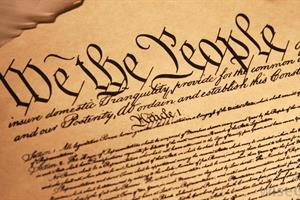
Have you ever wondered why the Constitution begins with those three words “we the people”? It was intended to be a powerful reminder that everything flows from the citizenry. We the people are the center of the government and the source of its power. That “we” is crucial because it reminds us that there is power and safety in numbers, provided we stand united. We can accomplish nothing alone.

This is the underlying lesson of the Constitution, which outlines the duties and responsibilities of government. It was a mutual agreement formed by early Americans in order to ensure that when problems arose, they could address them together.

It’s like the wagon trains of the Old West, comprised of individual groups of pioneers. They rarely ventured out alone but instead traveled as convoys. And when faced with a threat, these early Americans formed their wagons into a tight circle in order to defend against invaders. In doing so, they presented a unified front and provided protection against an outside attack. In much the same way, the Constitution was intended to work as an institutionalized version of the wagon circle, serving as a communal shield against those who would harm us.

Unfortunately, we have been ousted from that protected circle, left to fend for ourselves in the wilderness that is the American frontier today. Those who did the ousting—the courts, the politicians, and the corporations—have since replaced us with yes-men, shills who dance to the tune of an elite ruling class. In doing so, they have set themselves as the central source of power and the arbiters of what is just and reasonable.

Once again we’re forced to navigate hostile terrain, unsure of how to protect ourselves and our loved ones from militarized police, weaponized drones, fusion centers, Stingray devices, SWAT team raids, the ongoing military drills on American soil, the government stockpiling of ammunition, the erection of mass detention centers across the country, and all other manner of abuses.

Read the smoke signals, and the warning is clear: It’s time to circle the wagons, folks. The government is on the warpath, and if we are to have any hope of surviving whatever is coming at us, we’ll need to keep our wits about us and present a unified front. Most of all, we need to restore “we the people” to our rightful place at the center of government. How we do that depends largely on each community’s willingness to get past their partisan politics and blind allegiance to uniformed government officials and find common ground.

To put it a little more bluntly, stop thinking like mindless government robots and start acting like a powerhouse of citizens vested with the power to say “enough is enough.” We have the numbers to stand our ground. Now we just need the will.