BURLINGTON, Vt. — In the wake of a string of court challenges over its arrests, detentions and deportations of university students engaged in political protests, the Trump Administration is threatening to suspend the writ of habeas corpus, a constitutional principle with roots in British law that assures everyone in the United States, including noncitizens, of the right to challenge a detention in court.
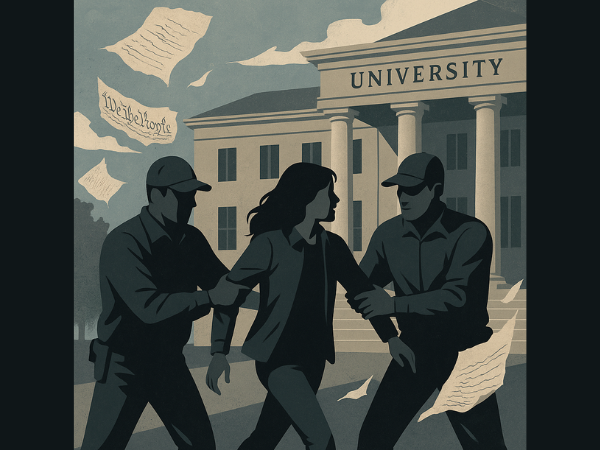
The White House’s admission that it is “actively looking at” suspending habeas corpus came on the same day that the U.S. District Court for Vermont ordered the immediate release of Rümeysa Öztürk, a Tufts University PhD student who was seized on the street near her apartment by masked, plainclothes ICE agents; shoved into an unmarked car; and transported out of state to a detention center pending deportation. Although never charged with a crime, Öztürk was targeted by government officials for co-authoring an op-ed in a student paper a year earlier expressing support for Palestinian civilians during a time of heightened international conflict. The Rutherford Institute joined a coalition of civil liberties organizations (including the Foundation for Individual Rights and Expression (FIRE), the National Coalition Against Censorship, PEN America, Cato Institute, and the First Amendment Lawyers Association) to file an amicus brief in Öztürk v. Trump challenging the legality of Öztürk’s arrest and detention through her petition for a writ of habeas corpus.
“This is not about public safety. This is about silencing dissent. The U.S. government is weaponizing immigration enforcement to punish political dissent,” said constitutional attorney John W. Whitehead, president of The Rutherford Institute and author of Battlefield America: The War on the American People. “If the government can silence, detain, and deport individuals simply for speaking out on political issues, then no one’s speech is truly safe and we’re no longer operating under the Constitution. We’re living under a system of political policing.”
Öztürk, a Turkish national lawfully present in the U.S. on a student visa, is pursuing a doctorate in the Child Study and Human Development program at Tufts University. Unbeknownst to Öztürk, Secretary of State Marco Rubio revoked her visa as part of a campaign by the Trump Administration to retaliate against those who publicly criticize Israel. Öztürk was detained without warning by masked, plainclothes agents on March 25, 2025, and transferred more than 1,500 miles away from her home in Massachusetts to the South Louisiana ICE Processing Center. In its amicus brief challenging Öztürk’s detention as unconstitutional, the legal coalition contends that the government’s actions set a dangerous precedent in which political speech can be treated as evidence of threat, opening the door for officials to selectively punish individuals based on the content and viewpoint of their expression.
The implications reach far beyond Öztürk’s case. Since returning to office, the Trump Administration has increasingly targeted immigrants and legal visa holders for arrest, deportation, or visa revocation based solely on their political expression. In one case, a legal aid attorney had her visa canceled after attending a peaceful protest. In another, a university lecturer was denied re-entry to the U.S. over critical social media posts. Such tactics, the coalition contends, create a sweeping chilling effect for anyone who dares to speak out against government policy.
Ronnie London, Conor Fitzpatrick, Colin McDonell, Will Creeley, and others at FIRE advanced the arguments in the Öztürk v. Trump amicus brief.
The Rutherford Institute, a nonprofit civil liberties organization, defends individuals whose constitutional rights have been threatened or violated and educates the public on a wide spectrum of issues affecting their freedoms.
“A standing military force, with an overgrown Executive will not long be safe companions to liberty.”—James Madison
We are being frog-marched into tyranny at the end of a loaded gun. Or rather, hundreds of thousands of loaded guns.
Let’s not mince words: President Trump’s April 28 executive order is the oldest trick in the authoritarian playbook: martial law masquerading as law and order.
The order doesn’t merely expand policing—it institutionalizes repression.
It sets us squarely on the road to martial law.
If allowed to stand, Trump’s executive order completes our shift from a nation of laws—where even the least among us had the right to due process—to a nation of enforcers: vigilantes with badges who treat “we the people” as suspects and subordinates.
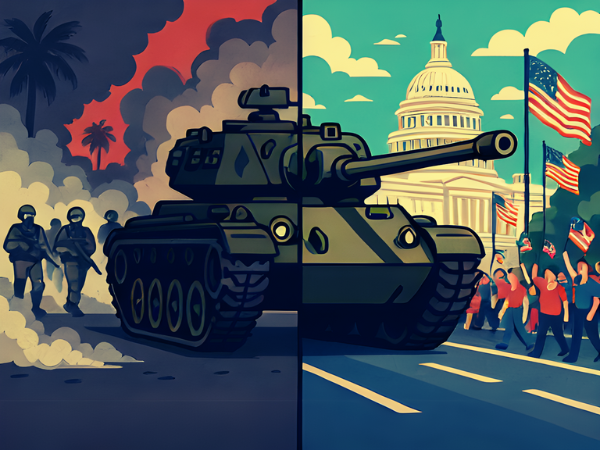
Without invoking the Insurrection Act or deploying active-duty military forces, Trump has accelerated the transformation of domestic police into his own paramilitary force.
Authorizing the DOJ to defend officers accused of civil rights violations;
Increasing the transfer of military equipment to local police;
Shielding law enforcement from judicial oversight;
Prioritizing law enforcement protection over civil liberties;
Embedding DHS and federal agents more deeply into local policing.
Since taking office in January 2025, Trump has moved systematically to dismantle what little accountability remains:
Terminating the National Law Enforcement Accountability Database;
Halting DOJ investigations into abusive police departments;
Expanding immigration enforcement while eliminating oversight;
Dismissing internal watchdogs at DOJ and DHS;
Weakening civil rights tools and body camera requirements;
Suspending or eliminating consent decrees nationwide.
All of this has occurred without congressional debate, judicial review, or constitutional scrutiny.
Through it all, Trump has emboldened police forces to act with near impunity, reinforcing a trend long embraced by powerful police unions, bureaucratic cronyism, and laws providing for qualified immunity that shield misconduct from public consequence.
For years, we have watched as the government transformed local law enforcement into extensions of the military: outfitted with military hardware and trained in battlefield tactics.
However, this executive order goes one step further—creating not just a de facto standing army but Trump’s own army: loyal not to the Constitution or the people, but to the president.
This is the very danger the Founders feared: a militarized police force answerable to a powerful executive, operating outside the bounds of the law.
While the Posse Comitatus Act was intended to prevent the military from becoming a domestic police force, this administration has found a workaround: transforming civilian police into a paramilitary force armed and trained like the military, but without the legal constraints.
In doing so, the federal government has effectively sidestepped both constitutional checks and statutory prohibitions meant to guard against military rule on American soil.
This is martial law without a declaration.
The battlefield is here.
Law enforcement today is equipped like the military, trained in battlefield tactics, and given broad discretion over who to target and how to respond. But these are not soldiers bound by the laws of war. They are civilian enforcers, wielding unchecked power with minimal oversight.
And they are everywhere.
Armored vehicles on neighborhood streets. Flashbang raids on family homes. Riot police in small towns. SWAT-style teams deployed by federal agencies. Drones overhead. Mass surveillance below.
We are fast approaching a reality where constitutional rights exist in name only.
In practice, we are ruled by a quasi-military bureaucracy empowered to:
Detain without trial;
Punish political dissent;
Seize property under civil asset forfeiture;
Classify critics as extremists or terrorists;
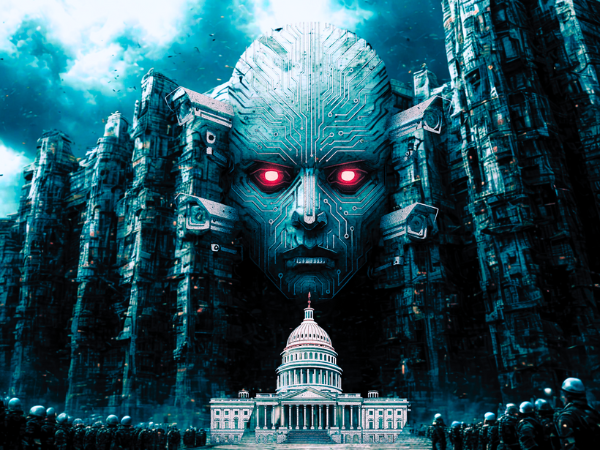
Conduct mass surveillance on the populace;
Raid homes in the name of “public safety”;
Use deadly force at the slightest provocation.
In other words, we’ve got freedom in name only.
It’s the same scenario nationwide: in big cities and small towns alike, militarized “warrior” cops—hyped up on power—ride roughshod over individual rights by exercising almost absolute discretion over who is a threat, what constitutes resistance, and how harshly they can deal with the citizens they were appointed to “serve and protect.”
This nationwide epidemic of court-sanctioned police violence has already ensured that unarmed Americans—many of them mentally ill, elderly, disabled, or simply noncompliant—will continue to die at the hands of militarized police.
From individuals shot for holding garden hoses, to those killed after calling 911 for help, these tragedies underscore a chilling truth: in a police state, the only truly “safe” person is one who offers no resistance at all.
These killings are the inevitable result of a system that rewards vigilante aggression by warrior cops and punishes accountability.
These so-called warrior cops, trained to act as judge, jury and executioner, increasingly outnumber those who still honor their oath to uphold the Constitution and serve the public.
Now, under the cover of executive orders and nationalist rhetoric, that warrior mentality is being redirected toward a more dangerous mission: silencing political dissent.
Emboldened by Trump’s call to reopen Alcatraz and target so-called “homegrown” threats, these forces are no longer going to be tasked with enforcing the law—they will be deployed to enforce political obedience.
Backed by the full power of the state and unbound by meaningful accountability, these police state enforcers operate with the tactics of a military force but without its legal constraints. They are not soldiers governed by the rules of war. They are the foot soldiers of the police state.
And their numbers are growing.
This is not a theory. It is a reality unfolding before our eyes.
Battlefield tactics. Camouflage gear. Mass arrests. Tear gas. Strip searches. Drones. Water cannons. Rubber bullets. Concussion grenades. Intimidation. Laws abandoned at will.
We are living in a creeping state of undeclared martial law.
The militarization of police and federal agencies over recent decades has only accelerated the timeline toward authoritarianism.
The groundwork was laid long ago: the NDAA’s indefinite detention powers; court rulings that excuse shootings of unarmed citizens; the normalization of asset forfeiture, round-the-clock surveillance, and militarized drills in American cities.
This regime of lawless enforcement has been built over time—by legislators, courts, and a public too willing to look the other way.
Don’t be fooled: this is not law and order. This is constitutional demolition under the color of authority.
We are being trained to accept militarized policing, normalized surveillance, and injustice disguised as safety.
This is how freedom ends—not with a loud decree, but with the quiet, calculated erosion of every principle we once held sacred.
We’ve come full circle—from resisting British redcoats to submitting to American forces with the same disdain for liberty.
Our constitutional foundation is crumbling, and with it, any illusion that those in power still serve the public good.
Congress, for its part, has abdicated its role as a constitutional check on executive power—passing sweeping authorizations with little scrutiny and failing to rein in executive overreach. The courts, too, have in the past sanctioned many of these abuses in the name of national security, public order, or qualified immunity. Instead of acting as constitutional safeguards, these institutions have largely become rubber stamps.
Indeed, the president, Congress, the courts, and the police have come to embody the very abuse the Founders fought to resist. Only now are the courts beginning to show glimmers of allegiance to the Constitution.
This is not about partisanship. This is about power without restraint.
As tempting as it is to place full blame on Trump for this full-throttle shift into martial law, he is not the architect of this police state. He is its most shameless enabler—a useful frontman for the Deep State in its ongoing war on the American people.
BURLINGTON, Vt. — Warning that the U.S. government is weaponizing immigration enforcement to punish political dissent, The Rutherford Institute has joined a coalition of civil liberties organizations in challenging the arrest and detention of Rümeysa Öztürk, a Tufts University PhD student whose only alleged offense was expressing support for Palestinian civilians during a time of heightened international conflict.
In a joint amicus brief filed before the U.S. District Court for the District of Vermont in Öztürk v. Trump, the coalition—including the Foundation for Individual Rights and Expression (FIRE), the National Coalition Against Censorship, PEN America, Cato Institute, First Amendment Lawyers Association, and The Rutherford Institute—argues that Öztürk’s arrest by federal agents and the attempt to deport her represent a dangerous abuse of power rooted in viewpoint discrimination and retaliation against protected political speech.
“This is not about public safety. This is about silencing dissent,” said constitutional attorney John W. Whitehead, president of The Rutherford Institute and author of Battlefield America: The War on the American People. “If the government can silence, detain, and deport individuals simply for speaking out on political issues, then no one’s speech is truly safe and we’re no longer operating under a Constitution. We’re living under a system of political policing.”
Öztürk, a Turkish national lawfully present in the U.S. on a student visa, is pursuing a doctorate in the Child Study and Human Development program at Tufts University. She was seized on the street near her apartment on March 25, 2025, by masked, plainclothes agents who grabbed her as she screamed, handcuffed her, and took her away in an unmarked vehicle. Unbeknownst to Öztürk, Secretary of State Marco Rubio had revoked her visa, apparently in response to an op-ed she co-wrote a year earlier in which she criticized her university’s administration for dismissing student government resolutions which aimed to hold Israel accountable for alleged violations of international law in Palestine—views that diverge sharply from the Trump Administration’s. She was detained without warning and transferred more than 1,500 miles away from her home in Massachusetts to the South Louisiana ICE Processing Center.
According to the brief, there are no allegations that Öztürk engaged in violence or illegal activity. The coalition contends that the government’s effort to suppress disfavored political views is flatly prohibited by the Constitution. Moreover, the government’s actions set a dangerous precedent in which political speech can be treated as evidence of threat or disloyalty. This, the coalition warns, opens the door for officials to selectively punish individuals based on the content and viewpoint of their expression. The implications reach far beyond Öztürk’s case. Since returning to office in 2025, the Trump Administration has increasingly targeted immigrants and legal visa holders for arrest, deportation, or visa revocation based solely on their political expression. In one case, a legal aid attorney had her visa canceled after attending a peaceful protest. In another, a university lecturer was denied re-entry to the U.S. over critical social media posts. Such tactics, the coalition contends, create a sweeping chilling effect—not only for immigrants, but for anyone who dares to speak out against government policy.
Ronnie London, Conor Fitzpatrick, Colin McDonell, Will Creeley, and others at FIRE advanced the arguments in the Ozturk v. Trumpamicus brief.
The Rutherford Institute, a nonprofit civil liberties organization, defends individuals whose constitutional rights have been threatened or violated and educates the public on a wide spectrum of issues affecting their freedoms.
“One of the most essential branches of English liberty is the freedom of one’s house. A man’s house is his castle.”—James Otis, Revolutionary War activist, on the Writs of Assistance, 1761
What the Founders rebelled against—armed government agents invading homes without cause—we are now being told to accept in the so-called name of law and order.
Imagine it: it’s the middle of the night. Your neighborhood is asleep. Suddenly, your front door is splintered by battering rams. Shadowy figures flood your home, screaming orders, pointing guns, threatening violence. You and your children are dragged out into the night—barefoot, in your underwear, in the rain.
Your home is torn apart. Your valuables seized. Your sense of safety, demolished.
But this isn’t a robbery by lawless criminals.
This is what terror policing looks like in Trump’s America: raids by night, flashbangs at dawn, mistaken identities, and shattered lives.
On April 24, 2025, in Oklahoma City, 20 heavily armed federal agents from ICE, the FBI, and DHS kicked in the door of a home where a woman and her three daughters—all American citizens—were sleeping. They were forced out of bed at gunpoint and made to wait in the rain while agents ransacked the house, confiscating their belongings.
It was the wrong house. The wrong family.
There were no apologies. No compensation. No accountability.
This is the new face of American policing, and it’s about to get so much worse thanks to the President Trump’s latest executive order, which aims to eliminate federal oversight and empower local law enforcement to act with impunity.
Trump’s supporters have long praised his efforts to deregulate business and government under the slogan of “no handcuffs.” But when that logic is applied to law enforcement, the result isn’t freedom—it’s unchecked power.
What it really means is no restraints on police power—while the rest of us are left with fewer rights, less recourse, and a Constitution increasingly ignored behind the barrel of a gun.
This isn’t just a political shift. It’s a constitutional unraveling.
These aren’t abstract freedoms—they’re the bedrock of the Bill of Rights: the Fourth Amendment’s shield against warrantless searches, the Fifth Amendment’s promise of due process, and the First Amendment’s guarantee that we may speak, protest, and petition without fear of state retaliation.
Yet the build-up of the police state didn’t begin with Trump. What he has done is seize upon decades of bipartisan failure—and strip away the last remaining restraints.
For years, under both Republican and Democratic administrations, policing in America has grown more militarized, aggressive, and unaccountable. At times, there were modest attempts to rein in the worst excesses—like curbing the flow of military surplus equipment to local police—but these efforts were short-lived, inconsistent, and easily undone.
Trump’s executive order doesn’t just abandon those reforms. It bulldozes the guardrails. It hands law enforcement a blank check: more weapons, more power, and fewer consequences.
The result is not safety. It’s state-sanctioned violence.
It’s a future in which no home is safe, no knock is required, and no officer is ever held accountable.
That future is already here.
Just a few days before Trump signed the order, that reality played out in Oklahoma City when ICE, FBI, and DHS agents stormed the wrong home and terrorized a mother and her daughters.
Unfortunately, this is not an isolated incident.
In the 30 years since the first federal Crime Bill helped militarize local police forces, the use of SWAT teams has exploded. What was once a rare tactic for hostage situations is now used tens of thousands of times a year, often for nonviolent offenses or mere suspicion. These raids leave behind broken doors, traumatized children, and, too often, dead bodies. And yet, when families seek justice, they’re met with a legal wall called qualified immunity.
Under this doctrine, courts excuse even blatant misconduct by law enforcement unless an almost identical case has already been ruled unconstitutional. It’s legal sleight of hand—a get-out-of-jail-free card for government agents who trample on the Constitution.
We’ve entered an era in which federal agents can destroy your home, traumatize your family, and violate the Fourth Amendment with impunity. And the courts have said: that’s just how it works.
More than 80,000 SWAT raids now occur annually in the United States, most of them for nonviolent offenses like drug possession or administrative code violations.
Many are botched. Few are ever investigated.
In Martin v. United States, now before the Supreme Court, a heavily armed FBI SWAT team mistakenly stormed a Georgia home—armed with rifles, clad in tactical gear, and deploying a flashbang grenade—causing the family inside, with a 7-year-old son, to fear they were being burglarized.
Only after detaining the family—forcing one family member onto the bedroom floor at gunpoint, and then pointing a gun in the mother’s face—did the officers realize their mistake.
The Rutherford Institute, alongside the National Police Accountability Project, filed an amicus brief urging the Court to deny qualified immunity for the agents. But if history is any guide, justice may prove elusive.
Just last year, the Court refused to hold a SWAT team leader accountable for raiding the wrong house, wrecking the wrong home, and terrorizing an innocent family.
In Jimerson v. Lewis, the SWAT team ignored clear differences between the actual target house and the Jimerson residence—missing house numbers, architectural mismatches, a wheelchair ramp where none should have been—and still received qualified immunity.
These rulings aren’t exceptions—they reflect a growing doctrine of unaccountability enshrined by the courts and now supercharged by the Trump administration.
Trump wants to give police even more immunity.
Brace yourselves for a new era of lawless policing.
President Trump’s call for a new crime bill that would further insulate police from liability, accountability and charges of official misconduct could usher in a new era of police brutality, lawlessness and the reckless deployment of lethal force on unarmed civilians.
This is how the rights of ordinary Americans get trampled under the boots of unchecked power.
Even when SWAT commanders disregard warrants, ignore addresses, and terrorize innocent families, the courts shield them from consequences.
These SWAT raids have become a thinly veiled, court-sanctioned excuse to let heavily armed police crash through doors in the dead of night. Too often, they’re marked by incompetence, devastation, and death—leaving a trail of broken homes and broken lives, while law enforcement escapes accountability.
There was a time in America when a person’s home was a sanctuary, protected by the Fourth Amendment from unlawful searches and seizures.
That promise is dead.
We have returned to the era of the King’s Writ—blanket search powers once used by British soldiers to invade colonial homes without cause. As James Otis warned in 1761, such writs “annihilate the privilege” of privacy and due process, allowing agents of the state to enter homes “when they please.”
Trump’s new executive order revives this tyranny in modern form: armored vehicles, night raids, no-knock warrants, federal immunity. It empowers police to act without restraint, and it rewards those who brutalize with impunity.
Even more alarming, the order sets the stage for future legislation that could effectively codify qualified immunity into federal law, making it nearly impossible for victims of police violence to sue.
This is how constitutional protections are dismantled—not in one dramatic blow, but in a thousand raids, a thousand broken doors, a thousand courts that look the other way.
Let’s not pretend we’re safe. Who will protect us from the police when the police have become the law unto themselves?
The war on the American people is no longer metaphorical.
Government agents can now kick in your door without warning, shoot your dog, point a gun at your children, and suffer no legal consequences—so long as they claim it was a “reasonable” mistake. They are judge, jury, and executioner.
With Trump’s new order, the architecture of a police state is no longer theoretical. It is being built in real time. It is being normalized.
It’s not just the poor, the marginalized, or the criminalized who should be afraid. It’s every homeowner, every parent, every citizen who still believes in the Bill of Rights.
Nowhere is this threat more visible than in the unholy alliance between ICE and militarized police forces.
This is where the danger deepens: when ICE and SWAT join forces, no one is safe.
This is more than just a problem of policing—it’s the convergence of two of the most dangerous arms of the modern security state: the merging of federal immigration enforcement with militarized domestic operations, creating a volatile blend of ICE lawlessness and militarized SWAT-style brute force.
Together, they’ve created a government apparatus that acts first and justifies itself later, if at all.
What used to be separate spheres—immigration enforcement and local policing—have now, under the pretense of national security, merged into a seamless operation of nighttime raids, heavy weaponry, blacked-out uniforms, and unmarked vehicles.
Armed federal agents, often operating in plainclothes and without clearly presented warrants, storm homes in the dead of night.
The distinction between a SWAT raid and an ICE operation has disappeared.
ICE agents—often masked, plainclothes, and operating without judicial oversight—are executing aggressive home invasions indistinguishable from SWAT team raids. These officers operate in secret, detaining individuals without clear warrants, sometimes without charges, and often without informing families of where their loved ones have been taken.
This alliance of ICE and SWAT has turned the American home into a battlefield, especially for those deemed politically inconvenient or “suspect” by the state.
These raids aren’t limited to those suspected of crimes.
Legal residents, asylum seekers, and even U.S. citizens have found themselves disappeared under vague claims of national security or immigration violations.
It is policing by fear and disappearance. And it runs counter to everything the Bill of Rights was designed to prevent: punishment without trial, surveillance without suspicion, and power without accountability.
When ICE agents armed with military-grade equipment conduct predawn raids alongside SWAT teams, with little to no accountability, the result is not public safety. It is state terror. And it’s exactly the kind of unchecked power the Constitution was written to prevent.
The Constitution is supposed to be a shield—especially the Fourth Amendment, which guards against unreasonable searches and seizures. But in this new reality, the government has nullified that shield.
All of America is fast becoming a Constitution-free zone.
What started as an exception—the so-called Constitution-free zone at the border—is fast becoming the norm across America, where due process is optional, and law enforcement acts more like a domestic army than a public servant.
The government no longer needs to prove its authority in court before violating your rights. It only needs to assert it on your doorstep—with flashbangs and rifles at the ready.
The only castle left may be the one you’re willing to defend.
The Founders knew the dangers of unchecked power. That’s why they gave us the Fourth Amendment. But rights are only as strong as the public’s willingness to defend them.
If we allow the government to turn our homes into war zones—if we continue to reward police for lawless raids, ignore the courts for rubber-stamping abuse, and cheer political leaders who promise “no more handcuffs”—we will lose the last refuge of freedom: the right to be left alone.
“We are fast approaching the stage of the ultimate inversion: the stage where the government is free to do anything it pleases, while the citizens may act only by permission; which is the stage of the darkest periods of human history, the stage of rule by brute force.” — Ayn Rand
In other words, these executive orders are the mechanism by which we finally arrive at a full-blown dictatorship.
America’s founders established a system of checks and balances to prevent the concentration of power in any single branch. To this end, the Constitution establishes three separate but equal branches of government: the legislative branch, which makes the law; the executive branch, which enforces the law; and the judicial branch, which interprets the law.
And yet, despite this carefully balanced structure, we now find ourselves in a place the founders warned against.
Despite Trump’s attempts to rule by fiat, the president has no unilateral authority to operate outside the Constitution’s system of checks and balances—no matter how urgent the crisis or how well-meaning the intentions.
This is what government by fiat looks like.
Where Congress was once the nation’s lawmaking body, its role is now being eclipsed by a deluge of executive directives—each one issued without public debate, legislative compromise, or judicial review.
These executive orders aren’t mere administrative housekeeping. They represent a radical shift in how power is exercised in America, bypassing democratic institutions in favor of unilateral command. From trade and immigration to surveillance, speech regulation, and policing, the president is claiming broad powers that traditionally reside with the legislative and judicial branches.
Yet here’s where these actions run into constitutional peril: they redefine executive authority in ways that bypass the checks and balances enshrined in the Constitution. They centralize decision-making in the White House, sideline the legislative process, and reduce the judiciary to an afterthought—if not an outright obstacle.
Each of these directives, taken individually, might seem technocratic or temporary. But taken together, they reveal the architecture of a parallel legal order—one in which the president acts as lawmaker, enforcer, and judge. That is not how a constitutional republic operates. That is how a dictatorship begins.
Each of these orders marks another breach in the constitutional levee, eroding the rule of law and centralizing unchecked authority in the executive.
This is not merely policy by another name—it is the construction of a parallel legal order, where the president acts as lawmaker, enforcer, and judge—the very state of tyranny our founders sought to prevent.
This legal theory—the so-called Unitary Executive—is not new. But under this administration, it has metastasized into something far more dangerous: a doctrine of presidential infallibility.
What began as a constitutional interpretation that the president controls the executive branch has morphed into an ideological justification for unchecked power.
Under this theory, all executive agencies, decisions, and even enforcement priorities bend entirely to the will of the president—obliterating the idea of an independent bureaucracy or impartial governance.
The result? An imperial presidency cloaked in legalism.
Historically, every creeping dictatorship has followed this pattern: first, undermine the legislative process; then, centralize enforcement powers; finally, subjugate the judiciary or render it irrelevant. America is following that roadmap, one executive order at a time.
Even Supreme Court justices and legal scholars who once defended broad executive authority are beginning to voice concern.
Yet the real danger of the Unitary Executive Theory is not simply that it concentrates power in the hands of the president—it’s that it does so by ignoring the rest of the Constitution.
Respect for the Constitution means obeying it even when it’s inconvenient to do so.
We’re watching the collapse of constitutional constraints not through tanks in the streets, but through policy memos drafted in the West Wing.
No matter how well-meaning the politicians make these encroachments on our rights appear, in the right (or wrong) hands, benevolent plans can easily be put to malevolent purposes. Even the most principled policies can be twisted to serve illegitimate ends once power and profit enter the equation.
The war on terror, the war on drugs, the war on illegal immigration, asset forfeiture schemes, road safety schemes, school safety schemes, eminent domain: all of these programs started out as legitimate responses to pressing concerns and have since become weapons of compliance and control in the police state’s hands.
We are approaching critical mass.
The groundwork has been laid for a new kind of government where it doesn’t matter if you’re innocent or guilty, whether you’re a threat to the nation, or even if you’re a citizen.
What will matter is what the government—or whoever happens to be calling the shots at the time—thinks. And if the powers-that-be think you’re a threat to the nation and should be locked up, then you’ll be locked up with no access to the protections our Constitution provides.
In effect, you will disappear.
Our freedoms are already being made to disappear.
This is how tyranny arrives: not with a constitutional amendment, but with a series of executive orders; not with a military coup, but with a legal memo; not with martial law, but with bureaucratic obedience and public indifference.
A government that rules by fiat, outside of constitutional checks and balances, is not a republic. It is a dictatorship in everything but name.
If freedom is to survive this constitutional crisis, We the People must reclaim our role as the ultimate check on government power.
That means holding every branch of government accountable to the rule of law. It means demanding that Congress do its job—not merely as a rubber stamp or partisan enabler, but as a coequal branch with the courage to rein in executive abuses.
It means insisting that the courts serve justice, not politics.
And it means refusing to normalize rule by decree, no matter who sits in the Oval Office.
There is no freedom without limits on power.
There is no Constitution if it can be ignored by those who swear to uphold it.
The presidency was never meant to be a throne. The Constitution was never meant to be optional. And the people were never meant to be silent.
“Homegrowns are next. The homegrowns. You gotta build about five more places [like the CECOT prison]. It’s not big enough.”—President Trump on his desire to send American citizens to a megaprison in El Salvador, beyond the reach of U.S. courts and the Constitution
It has begun, just as we predicted, justified in the name of national security.
Mass roundups. Raids. Indefinite detentions in concentration camps. Martial law. The erosion of habeas corpus protections. The suspension of the Constitution, at least for select segments of the population. A hierarchy of rights, contingent on whether you belong to a favored political class.
This is what it looks like when the government makes itself the arbiter of who is deserving of rights and who isn’t.
Here is what we know: one segment of the population at a time, the Trump Administration is systematically and without due process attempting to cleanse the country of what it perceives to be “undesirables” as part of its purported effort to make America great again.
This is how men, women and children are being made to disappear, snatched up off the streets by press-gangs of plainclothes, masked government agents impersonating street thugs.
Presently, these so-called “undesirables” include both undocumented and legal immigrants—many labeled terrorists despite having no criminal record, no court hearing, and no due process—before being extradited to a foreign concentration camp in an effort to sidestep judicial oversight.
By including a handful of known members of a vicious gang among those being rounded up, the government is attempting to whitewash the public into believing that everyone being targeted is, in fact, a terrorist.
In recent years, the government has used the phrase “domestic terrorist” interchangeably with “anti-government,” “extremist” and “terrorist” to describe anyone who might fall somewhere on a very broad spectrum of viewpoints, characteristics and behaviors that could be considered “dangerous.”
Thus, without proof, a sheet metal worker has been labeled a terrorist. A musician has been labeled a terrorist. A makeup artist has been labeled a terrorist. A cellular biologist has been labeled a terrorist. A soccer player has been labeled a terrorist. A food delivery driver has been labeled a terrorist.
It’s only a matter of time before American citizens who refuse to march in lockstep with the government’s dictates are classified as terrorists, denied basic rights, and extradited to a foreign prison.
That time is drawing closer.
Indeed, Trump has repeatedly spoken of his desire to be able to send American citizens—whom he refers to as “homegrowns,” as in homegrown terrorists—on a one-way trip to El Salvador’s mega-prison, where conditions are so brutal that officials brag the only way out is in a coffin. His administration is currently trying to find a way to accomplish that very objective.
We’re not quite there yet, but it’s coming.
What we are witnessing is history repeating itself in real-time: the widening net that ensnares us all. In other words, it’s only a matter of time before anyone who is not fully compliant gets labeled a terrorist.
A prime example of how the government casting its net in ever-widening circles can be seen in the government’s sudden decision to target academics in the U.S. on work and student visas who have been critical of Israel’s war on Gaza, which has killed more than 50,000 people (nearly a third of them under the age of 18), as threats to national security.
Thus, the government is classifying any criticism of Israel as antisemitic and equating it with terrorism.
Under such a broad definition, Jesus himself would be considered antisemitic.
So you can add antisemitic to the list of viewpoints that could have one classified as a terrorist, rounded up by ICE, stripped of the fundamental rights to due process and a day in court, and made to disappear into a detention center.
Mind you, the government isn’t just targeting protest activities and expression that might have crossed over into civil disobedience. It’s also preemptively targeting individuals who have committed no crimes but whose views might at some point in the future run counter to the government’s self-serving interests.
This is precrime taken to a whole new level: targeting thoughts, i.e., thought crime.
The ramifications are so far-reaching as to render almost every American with an opinion about the governmentor who knows someone with an opinion about the government an extremist in word, deed, thought or by association.
As German pastor Martin Niemöller lamented:
“First they came for the socialists, and I did not speak out—because I was not a socialist. Then they came for the trade unionists, and I did not speak out— because I was not a trade unionist. Then they came for the Jews, and I did not speak out—because I was not a Jew. Then they came for me—and there was no one left to speak for me.”
You see how this works?
Let’s not mince words about what’s happening here: under the guise of fighting terrorism, the U.S. government is not just making people disappear—it is making the Constitution disappear.
When rights become privileges, the Constitution—and the rule of law—becomes optional.
The list of individuals and groups being classified as anti-American gets bigger by the day: Immigrants, both legal and undocumented. Immigration attorneys. Judges. Lawyers. Law firms. Doctors. Scientists. Students. Universities. Nonprofits.
Given what we know about the government and its expansive definition of what constitutes a threat to its power, any one of us who dare to speak truth to power could be targeted next as an enemy of the state.
Certainly, it is easy to remain silent in the face of evil.
What is harder—what we lack today and so desperately need—are those with moral courage who will risk their freedoms and lives in order to speak out against evil in its many forms.
Throughout history, individuals or groups of individuals have risen up to challenge the injustices of their age. Nazi Germany had its Dietrich Bonhoeffer. The gulags of the Soviet Union were challenged by Aleksandr Solzhenitsyn. America had its color-coded system of racial segregation and warmongering called out for what it was, blatant discrimination and profiteering, by Martin Luther King Jr.
And then there was Jesus Christ who not only died challenging the police state of his day but provided a blueprint for civil disobedience that would be followed by those, religious and otherwise, who came after him.
Any reflection on Jesus’ life and death within a police state must take into account several factors: Jesus spoke out strongly against such things as empires, controlling people, state violence and power politics. Jesus challenged the political and religious belief systems of his day. And worldly powers feared Jesus, not because he challenged them for control of thrones or government but because he undercut their claims of supremacy, and he dared to speak truth to power in a time when doing so could—and often did—cost a person his life.
It makes you wonder how Jesus—a Palestinian refugee, a radical, and a revolutionary—would have fared in the American police state under a Trump regime.
Would Jesus—who spent his adult life speaking truth to power, challenging the status quo of his day, and pushing back against the abuses of the Roman Empire—have been snatched up in the dead of night, stripped of any real due process, made to disappear into a detention center, and handed a death sentence when he was delivered into a prison where the only way out is in a wooden box?
Consider that the charges leveled against Jesus—that he was a threat to the stability of the nation, opposed paying Roman taxes and claimed to be the rightful King—were purely political, not religious.
Jesus was presented to Pontius Pilate “as a disturber of the political peace,” a leader of a rebellion, a political threat, and most gravely—a claimant to kingship, a “king of the revolutionary type.”
After Jesus was formally condemned by Pilate, he was sentenced to death by crucifixion, “the Roman means of executing criminals convicted of high treason.” The purpose of crucifixion was not so much to kill the criminal, as it was an immensely public statement intended to visually warn all those who would challenge the power of the Roman Empire. Hence, it was reserved solely for the most extreme political crimes: treason, rebellion, sedition, and banditry.
Almost 2,000 years after Jesus was crucified by the police state of his age, we find ourselves confronted by a painful irony: that in the same week commemorating the death and resurrection of Jesus, a Palestinian refugee who was killed by the police state for speaking truth to power, the U.S. government is prosecuting Palestinian refugees who are daring to challenge another modern-day police state’s injustices, while threatening to impose widespread martial law on the country to put down any future rebellions.
President Trump has hinted that he could invoke the Insurrection Act of 1807, which would allow the president to use the military on American soil.
This would in effect be a declaration of martial law.
Trump has already authorized the military to take control of the southern border, which puts parts of the domestic United States under martial law.
As Austin Sarat writes for Salon: “The president alone gets to decide what constitutes an ‘insurrection,’ ‘rebellion,’ or ‘domestic violence.’ And once troops are deployed, it will not be easy to get them off the streets in any place that the president thinks is threatened by ‘radical left lunatics.’”
So where do we go from here?
History offers some clues.
Exactly 250 years ago, on April 19, 1775, the American Revolution began with a “shot heard round the world.” It wasn’t sparked by acts of terrorism or rebellion—it was triggered by a government that had grown deaf to the cries of its people.
What we don’t need is violence in any form—by the people or their government.
WASHINGTON, D.C. — A broad coalition of legal and civil liberties organizations is once again challenging President Trump’s use of executive orders to retaliate against law firms that he perceives as political opponents, suppress opposition and chill lawful First Amendment activity.
The coalition, which includes the ACLU, ACLU of DC, CATO, Electronic Frontier Foundation, FIRE, the Institute for Justice, the Knight First Amendment Institute, the National Coalition Against Censorship, the Reporters Committee for the Freedom of the Press, the Society for the Rule of Law, and The Rutherford Institute, filed two more amicus briefs (Jenner & Block and WilmerHale) asking a federal court to strike down as illegal and unconstitutional the president’s executive orders targeting the law firms of Jenner & Block and WilmerHale. The coalition filed a similar amicus brief in Perkins Coie LLP v. U.S. Department of Justice challenging the president’s executive order as a violation of the separation of powers and an unconstitutional infringement on the rights to free speech, advocacy and due process.
“That President Trump is weaponizing the government in order to wage a war against dissent, against due process, and against the very foundations of our constitutional republic should be a warning to all Americans,” said constitutional attorney John W. Whitehead, president of The Rutherford Institute and author of Battlefield America: The War on the American People. “History shows that when governments claim the power to silence dissent—whether in the name of national security, border protection, or law and order—that power rarely remains limited. These threats against the legal community are just the beginning.”
In an effort to punish a number of major law firms and discourage others from challenging the Trump Administration’s ongoing efforts to sidestep the Constitution, President Trump issued Executive Orders directing the federal government to suspend the firms’ security clearances, cease providing all goods and services, terminate any contracts with the firms and those who do business with them, limit the firms’ access to federal buildings and employees, and refrain from hiring employees of the firms. The intent behind the president’s actions, per former advisor Steve Bannon, is to “put those law firms out of business” in response to the firms using the system of checks and balances to prevent the Administration from violating the Constitution.
Perkins Coie, Jenner & Block and WilmerHale each challenged Trump’s Orders on grounds that they violate the separation of powers and the First, Fifth, and Sixth Amendments. Warning that Trump’s actions constitute a brazen attack on the independence of the legal profession and the judicial branch, the legal coalition’s amicus briefs in support of the law firms argue that Trump’s Executive Orders not only infringe the First Amendment rights to freedom of speech and petitioning the government, but also essentially give the government an unfettered veto over a person’s right to choice of counsel due to the government pushing for a cancel culture and creating a blacklist of firms, similar to what the NRA previously claimed was done to it by a New York state official. Moreover, if the executive orders are allowed to stand, they could set a precedent for future Administrations of either political party to suppress challenges to a president’s unconstitutional policies and actions and to deter lawyers from representing the president’s political opponents or any clients adverse to the Administration.
Cecillia D. Wang, Ben Wizner, Brian Hauss, and Arthur B. Spitzer at ACLU advanced the arguments in the Perkins Coie, Jenner & Block and WilmerHale amicus briefs.
The Rutherford Institute, a nonprofit civil liberties organization, defends individuals whose constitutional rights have been threatened or violated and educates the public on a wide spectrum of issues affecting their freedoms.
WASHINGTON, DC — The U.S. Supreme Court has agreed to hear a case that could determine whether FBI agents can be held accountable for a botched SWAT raid that terrorized an innocent family in the middle of the night.
As detailed in Martin v. United States, a heavily armed FBI SWAT team mistakenly stormed a Georgia home—armed with rifles, clad in tactical gear, and deploying a flashbang grenade—causing the family inside, with a 7-year-old son, to fear they were being burglarized. In an amicus brief filed jointly with the National Police Accountability Project, The Rutherford Institute urged the Court to hold federal agents accountable under the Federal Tort Claims Act (FTCA) for recklessly invading the wrong residence, located a block away from the intended target: a suspected violent gang member. Fearing they were being burglarized, Ms. Martin tried to get to her 7-year-old son before officers forced one family member onto the bedroom floor at gunpoint, and then pointed a gun in Ms. Martin’s face.
“These SWAT raids have become a thinly veiled, court-sanctioned excuse to let heavily armed police crash through doors in the dead of night,” said constitutional attorney John W. Whitehead, president of The Rutherford Institute and author of Battlefield America: The War on the American People. “Too often, they’re marked by incompetence, devastation, and death—leaving a trail of broken homes and broken lives, while law enforcement escapes accountability.”
As part of the FBI’s “Operation Red Tape” to address violent gang activity in Georgia, an FBI SWAT team was deployed to execute an arrest warrant at the home of a suspected gang member. Although the team leader had previously conducted a site survey and received a photograph, map, and directions to the correct location, he relied on his personal GPS during a pre-raid drive-by. That GPS led him instead to the home of Curtrina Martin, which looked similar to the target residence. Critically, he failed to verify the street number. During the predawn hours, the SWAT leader led a caravan of vehicles with FBI SWAT team agents and members of the Atlanta Police Department to Martin’s house, thinking it was the target house. SWAT team members surrounded the home, breached the front door, and deployed a flashbang. Fearing they were under attack, Martin tried to reach her 7-year-old son. Only after detaining the family did the agents realize they had the wrong man—he lacked the gang suspect’s identifying face and neck tattoos—and that the house number did not match their intended destination.
The family subsequently filed a lawsuit for negligence, infliction of emotional distress, trespass, false arrest and imprisonment, and assault and battery under the Federal Tort Claims Act, which allows plaintiffs to bring state-law torts against the United States. However, the Eleventh Circuit Court of Appeals dismissed the lawsuit, citing the FBI’s lack of any formal policy for verifying target locations during warrant executions. Although the Supreme Court previously refused to hear Jimerson v. Lewis, a similar case involving a local SWAT team raid on the wrong home, it has agreed to take up Martin, which involves federal agents and the scope of the Federal Tort Claims Act.
Eugene R. Fidell with the Yale Law School Supreme Court Clinic, along with Charles A. Rothfeld of Mayer Brown LLP and Paul W. Hughes of McDermott Will & Emery LLP, advanced the arguments in the Martin amicus brief.
The Rutherford Institute, a nonprofit civil liberties organization, defends individuals whose constitutional rights have been threatened or violated and educates the public on a wide spectrum of issues affecting their freedoms.
“This is economic sabotage. Whether through malice or incompetence or, more likely, both Trump is isolating the United States on the world stage, tanking the markets, worsening inflation, and burdening working families with the cost of his 18th-century cosplay. These aren’t policies. They’re performance art. And the rest of us are footing the bill.”—Oregon’s Bay Area (blog post)
What we’re witnessing is the calculated use of emergency powers to concentrate power in the hands of the president, enrich the Deep State, and dismantle what remains of economic and constitutional safeguards.
Nearly 250 years after our nation’s founders rebelled over abused property rights, Americans are once again being subjected to taxation without any real representation, all the while the government continues to do whatever it likes—levy taxes, rack up debt, spend outrageously and irresponsibly—with little concern for the plight of its citizens.
Nothing has changed for the better with Donald Trump. Indeed, it’s getting worse by the day.
Yet it is Congress, not the president, that holds the authority to control government spending.
This is spelled out in the Appropriations Clause, found in Article I, Section 9, Clause 7 of the Constitution, which establishes a rule of law about how the monies paid to the government by the taxpayers are to be governed, and in the Taxing and Spending Clause of Article I, Section 8, Clause 1. In a nutshell, Congress is in charge of accounting for those funds and authorizing how those funds are spent (or not spent).
The founders intended this regulatory power, referred to as the “power of the purse” (to determine what funds can be spent and what funds can be withheld) to serve as a potent check on any government agency that exceeds its authority, especially the executive branch.
Woven throughout the history of the United States are examples of this constant power struggle.
For instance, Congress used the power of the purse to end the Vietnam War and pull the U.S. military from Lebanon.
Yet while past presidents have sought to expand their authority under the guise of national emergency declarations, Trump simply taken this executive overreach to unprecedented extremes.
Price explains how various presidents from Obama to Biden to Trump have attempted to subvert that same congressional power to press their own agendas, whether by funding the Affordable Care Act, advancing student debt, or as in Trump’s case, by dismantling and defunding agencies funded by Congress.
Executive orders and national emergencies have become a favored tool by which presidents attempt to govern unilaterally. As the Brennan Center reports, presidents have access to 150 such emergency powers, which essentially allow them to become limited dictators with greatly enhanced powers upon declaration of an emergency.
Because the National Emergencies Act does not actually define what constitutes an emergency, presidents have an incredible amount of room to wreak constitutional mischief on the citizenry.
While presidents on both sides of the aisle have abused these powers, Trump is attempting to test the limits of these emergency powers by declaring a national emergency anytime he wants to sidestep Congress and quickly impose his will on the nation.
Trump’s liberal use of emergency powers to sidestep the rule of law underscores the danger they pose to our constitutional system of checks and balances.
Since taking office in January 2025, Trump has used his presidential emergency powers in a multitude of ways in order to mount brazen power grabs thinly disguised as concerns for national security, thereby allowing him to justify tapping into the nation’s natural resources, rounding up and deporting vast numbers of migrants (both documented and undocumented), and imposing duties and tariffs against longtime allies and trade partners.
Thus far, the Republican-controlled Congress, which has the power to terminate an emergency with a two-thirds vote, has done nothing to rein in Trump’s dictatorial tendencies.
These unchecked powers aren’t just a threat to the balance of government—they have immediate, devastating consequences for the economy and working Americans.
Economists fear the ramifications of Trump’s latest national emergency, which he claims will usher in “the golden age of America” through the imposition of heavy tariffs on foreign nations, could push the U.S. and the rest of the world into a major recession by inciting a global trade-war, isolating America economically from the rest of the world, and flat-lining businesses that had expected to boom.
Fears of a recession are growing stronger by the hour.
While President Trump may talk a good game about his plans for making America richer, it’s becoming increasingly clear that the only person he’s making richer—at taxpayer expense—is himself.
This fiscal insanity, coupled with Trump’s imperialistic and tyrannical ambitions, echoes the very abuses that drove America’s founders to rebel against King George III.
In other words, the government is still robbing us blind.
Trump hasn’t reined in the government’s greed—he’s just been using a different playbook to get the same result: beg, borrow or steal, the government wants more of our hard-earned dollars any way it can get it.
This is what comes of those multi-trillion dollar spending bills: someone’s got to foot the bill for the government’s fiscal insanity, and that “someone” is always the U.S. taxpayer.
The government’s schemes to swindle, cheat, scam, and generally defraud taxpayers of their hard-earned dollars have run the gamut from wasteful pork barrel legislation, cronyism and graft to asset forfeiture, costly stimulus packages, and a national security complex that continues to undermine our freedoms while failing to making us any safer.
Americans have also been made to pay through the nose for the government’s endless wars, subsidization of foreign nations, military empire, welfare state, roads to nowhere, bloated workforce, secret agencies, fusion centers, private prisons, biometric databases, invasive technologies, arsenal of weapons, and every other budgetary line item that is contributing to the fast-growing wealth of the corporate elite at the expense of those who are barely making ends meet—that is, we the taxpayers.
Trump, a master at saying one thing and doing another, has made a great show of touting his claims to cutting back on government spending through crippling cuts that will impact almost every sector of the American landscape. However, what Trump fails to mention are all the costly big-budget items he’s tacking on that will not only consume his modest claims to saving money by axing essential programs but further mire the country in debt.
Indeed, Trump, the self-proclaimed “debt king,” has presided over one of the most reckless expansions of government spending in modern history while posturing as a fiscal conservative.
According to ProPublica, “That’s nearly twice as much as what Americans owe on student loans, car loans, credit cards and every other type of debt other than mortgages, combined… It amounts to about $23,500 in new federal debt for every person in the country. The growth in the annual deficit under Trump ranks as the third-biggest increase, relative to the size of the economy, of any U.S. presidential administration… And unlike George W. Bush and Abraham Lincoln, who oversaw the larger relative increases in deficits, Trump did not launch two foreign conflicts or have to pay for a civil war.”
If Trump’s first term was a preview, his second is a full-blown financial coup—waged against the American people with borrowed money.
Let’s talk numbers, shall we?
The national debt (the amount the federal government has borrowed over the years and must pay back) is more than $36 trillion and will grow another $19 trillion by 2033.
The bulk of that debt has been amassed over the past two decades, thanks in large part to the fiscal shenanigans of four presidents, 10 sessions of Congress and two wars.
In other words, the government is spending more than it brings in and, in the process, drowning us in an empire of debt.
Interest payments on the national debt are more than $582 billion, which is significantly more than the government spends on veterans’ benefits and services, and according to Pew Research Center, more than it will spend on elementary and secondary education, disaster relief, agriculture, science and space programs, foreign aid, and natural resources and environmental protection combined.
According to the Committee for a Reasonable Federal Budget, the interest we’ve paid on this borrowed money is “nearly twice what the federal government will spend on transportation infrastructure, over four times as much as it will spend on K-12 education, almost four times what it will spend on housing, and over eight times what it will spend on science, space, and technology.”
This isn’t governance. It’s looting—by legislation, debt, and design.
We’ve been sold a bill of goods by politicians who promise to pay down the debt, rebuild the economy, and protect our freedoms—but deliver only more debt and more control.
Indeed, the national deficit (the difference between what the government spends and the revenue it takes in) remains at more than $1.5 trillion.
According to the number crunchers with the Committee for a Responsible Federal Budget, in order to spend money it doesn’t have on programs it can’t afford, the government is borrowing roughly $6 billion a day.
Basically, the U.S. government is funding its existence with a credit card.
If Americans managed their personal finances the way the government mismanages the nation’s finances, we’d all be in debtors’ prison by now.
Despite the government propaganda being peddled by the politicians and news media, however, the government isn’t spending our tax dollars to make our lives better.
We’re being robbed blind so the governmental elite can get richer.
This is financial tyranny.
In the eyes of the government, “we the people, the voters, the consumers, and the taxpayers” are little more than pocketbooks waiting to be picked.
“We the people” have become the new, permanent underclass in America.
We have no real say in how the government runs, or in how our tax dollars are spent, but we’re being forced to pay through the nose, anyhow.
We have no real say, but that doesn’t prevent the government from fleecing us at every turn and forcing us to pay for endless wars that do more to fund the military industrial complex than protect us, pork barrel projects that produce little to nothing, and a police state that serves only to imprison us within its walls.
While we’re struggling to get by, and making tough decisions about how to spend what little money actually makes it into our pockets after the federal, state and local governments take their share (this doesn’t include the stealth taxes imposed through tolls, fines and other fiscal penalties), the government continues to do whatever it likes—levy taxes, rack up debt, spend outrageously and irresponsibly—with little thought for the plight of its citizens.
And now Trump, eager to do away with goods and services for the poor and needy while imposing a greater tax burden on the working-class citizenry (a burden not shared by the nation’s financial elite), wants $1 trillion for the military so it can be even more lethal and prepared to unleash violence around the globe.
Incredibly, all of these wars the U.S. is so eager to fight abroad are being waged with borrowed funds. As The Atlantic reports, “U.S. leaders are essentially bankrolling the wars with debt, in the form of purchases of U.S. Treasury bonds by U.S.-based entities like pension funds and state and local governments, and by countries like China and Japan.”
Of course, we the taxpayers are the ones who have to repay that borrowed debt.
As Dwight D. Eisenhower warned in a 1953 speech, this is how the military industrial complex continues to get richer, while the American taxpayer is forced to pay for programs that do little to protect our rights or improve our lives.
This is no way of life.
Once again, we have a despotic regime with an imperial ruler doing as they please.
Once again, we have a judicial system that insists we have no rights in the face of a government that demands total compliance.
And once again, we’ve got to decide whether we’ll keep footing the bill for tyranny.
This is no longer the American dream. It’s a financial nightmare.
As political analyst Robert Reich warns, “Make no mistake about what’s really going on here. While the United States has plenty of real problems to deal with, Trump is ignoring them to manufacture the fake emergencies he needs to further enlarge and centralize his power. America’s real national emergency is Donald J. Trump.”
Until we push back, this nightmare will only deepen.
WASHINGTON, D.C. — Denouncing the Trump Administration’s ongoing attempts to suppress dissent and chill lawful First Amendment activity, The Rutherford Institute has joined a broad coalition of eleven legal and civil liberties organizations to challenge President Trump’s use of presidential executive orders to retaliate against perceived political opponents.
The coalition, which includes the ACLU, ACLU of DC, CATO, Electronic Frontier Foundation, FIRE, the Institute for Justice, the Knight First Amendment Institute, the National Coalition Against Censorship, the Reporters Committee for the Freedom of the Press, the Society for the Rule of Law, and The Rutherford Institute, filed an amicus brief in Perkins Coie LLP v. U.S. Department of Justice asking a federal court to strike down the president’s executive order as a violation of the separation of powers and an unconstitutional infringement on the rights to free speech, advocacy and due process.
“That the Trump Administration is weaponizing the government in order to wage a war against dissent, against due process, and against the very foundations of our constitutional republic should be a warning to all Americans,” said constitutional attorney John W. Whitehead, president of The Rutherford Institute and author of Battlefield America: The War on the American People. “History shows that when governments claim the power to silence dissent—whether in the name of national security, border protection, or law and order—that power rarely remains limited. These threats against the legal community and ‘we the people’ are merely the first round of the Trump Administration’s effort to turn the Bill of Rights into a Bill of Conditional Privileges.”
In an effort to punish the law firm of Perkins Coie and discourage any other law firms from challenging the Trump Administration’s ongoing efforts to sidestep the Constitution, President Trump issued an Executive Order directing the federal government to suspend the firm’s security clearances, cease providing all goods and services, terminate any contracts with the firm and those who do business with the firm, limit the firm’s access to federal buildings and employees, and refrain from hiring employees of the firm. The intent behind the president’s actions, per former advisor Steve Bannon, is to “put those law firms out of business” so that they can no longer use the system of checks and balances to prevent the Administration from violating the Constitution.
Perkins Coie filed a lawsuit to prevent the implementation of Trump’s Order on grounds that it violates the separation of powers and the First, Fifth, and Sixth Amendments. Warning that Trump’s actions constitute a brazen attack on the independence of the legal profession and the judicial branch, the legal coalition’s amicus brief argues that Trump’s Executive Order not only infringes the First Amendment rights to freedom of speech and petitioning the government, but it also essentially gives the government an unfettered veto over a person’s right to choice of counsel due to the government pushing for a cancel culture and creating a blacklist of firms, similar to what the NRA previously claimed was done to it by a New York state official. Moreover, if the executive order is allowed to stand, it could set a precedent for future Administrations of either political party to suppress challenges to a president’s unconstitutional policies and actions and to deter lawyers from representing the president’s political opponents and any clients adverse to the Administration.
The Rutherford Institute, a nonprofit civil liberties organization, defends individuals whose constitutional rights have been threatened or violated and educates the public on a wide spectrum of issues affecting their freedoms.