


“Never has our future been more unpredictable, never have we depended so much on political forces that cannot be trusted to follow the rules of common sense and self-interest — forces that look like sheer insanity, if judged by the standards of other centuries.”—Hannah Arendt, The Origins of Totalitarianism
This has all the makings of a constitutional crisis.
According to law professor Amanda Frost, “a constitutional crisis occurs when one branch of government, usually the executive, ‘blatantly, flagrantly and regularly exceeds its constitutional authority — and the other branches are either unable or unwilling to stop it.’”
Consider for yourself.
The president has gone rogue, doubling down on his belief that “I have the right to do whatever I want as president.”
The vice president believes the president should be a law unto himself, i.e., unaccountable to the other branches of the government.
The Republican-controlled Congress appears to be deaf, dumb and blind to the Executive Branch’s blatantly unconstitutional overreaches.
The courts, which have in recent years largely rubberstamped the government’s power grabs, are ill-prepared to rein in a sitting president who is determined to do whatever he wants, the Constitution be damned.
In fact, the U.S. Supreme Court preemptively gave future presidents the green light to engage in all manner of criminal activities when it ruled 6-3 that presidents have absolute immunity from prosecution, provided the lawbreaking is related to their official duties.
Meanwhile, the Constitution is still missing from the White House’s website.
This last point is not an oversight.
Rather, it speaks volumes about the priorities of the current presidential administration, which operates as if the rule of law does not apply to itself.
Indeed, while President Trump’s predecessors paid lip service to the rule of law while sidestepping it at every opportunity, Trump has been unapologetic about his intentions to set aside whatever legal, moral or political barricades stand in the way of his end goals.
Rule by fiat—when presidents attempt to unilaterally impose their will through the use of executive orders, decrees, memorandums, proclamations, national security directives and legislative signing statements—is an offense to the Constitution.
It was offensive when Biden did it. It was offensive when Obama did it. And it is just as offensive when Trump does it.
Already, Trump has signed more executive orders in his first month than any other president in their first 100 days.
This is not a sign of strength and leadership. This is a red flag.
In bypassing Congress in order to carry out his ambitious agenda to “make America safe again,” “make America affordable and energy dominant again,” “drain the swamp,” and “bring back American values,” the Trump Administration risks transforming the executive branch into something akin to the very entities it often criticizes: an overreaching surveillance state, a nanny state that dictates individual choices, and a police state that prioritizes compliance over freedom.
It is particularly telling that while Trump and his Musk-led Department of Government Efficiency (DOGE) are pledging to lay off huge swaths of federal employees and replace the workforce with artificial intelligence, the police state’s martial law apparatus will remain largely untouched.
This is how you prepare to lock down a nation.
This danger transcends party lines and tests the resilience of our constitutional framework.
How far will “we the people” allow the Executive Branch to continue to expand its power at the expense of established legal principles and the rule of law?
As much as past occupants of the White House and Congress would like us to believe otherwise, winning an election is not a populist mandate for one-party rule.
This way lies totalitarianism, by way of authoritarianism, and those who insist it can’t happen here need to pay better attention.
It’s happening already.
The following are 15 benchmarks of a totalitarian regime, according to Benjamin Carlson, a former editor at The Atlantic.
- Media is controlled.
- Dissent is equated to violence.
- Legal system is co-opted by the state.
- Power is exerted to prevent dissent.
- State police are directed to protect the regime, not the people.
- Financial, legal, and civil rights are contingent on compliance.
- There is a mass conformity of behaviors and beliefs.
- Power is concentrated in an inner ring of people and institutions.
- Semi-organized violence is permitted.
- Propaganda targets enemies of the state.
- Whole classes of people are scapegoated and singled out for persecution.
- Extra-legal action against internal enemies is condoned.
- Unpredictable and harsh enforcement is used against unfavored classes.
- The language of the constitution serves as a facade for the exercise of power.
- And all private and public levers of power are used to enforce adherence to state orthodoxy.
To guard against these pitfalls, we must start by understanding the rule of law, and how it functions within our system of checks and balances.
The rule of law is the principle that everyone, including the government—and the president—must obey the law, which is embodied in the U.S. Constitution.
In a nutshell, the Constitution is the social contract—the people’s contract with the government—which outlines our expectations about the role of the government and its limits, a system of checks and balances dependent on a separation of powers, and the rights of the citizenry.
America’s founders established a system of checks and balances to prevent the concentration of power in any single branch. To this end, the Constitution establishes three separate but equal branches of government: the legislative branch, which makes the law; the executive branch, which enforces the law; and the judicial branch, which interprets the law.
As constitutional scholar Linda Monk explains, “Within the separation of powers, each of the three branches of government has ‘checks and balances’ over the other two. For instance, Congress makes the laws, but the President can veto them, and the Supreme Court can declare them unconstitutional. The President enforces the law, but Congress must approve executive appointments and the Supreme Court rules whether executive action is constitutional. The Supreme Court can strike down actions by both the legislative and executive branches, but the President nominates Supreme Court justices, and the Senate confirms or denies their nominations.”
Despite Trump’s attempts to rule by fiat, nowhere in the Constitution is the president granted unilateral authority to act outside these established checks and balances, no matter how well-meaning his intentions might be or how worthy the goals (a balanced budget, safety, economic prosperity, etc.).
Writing for The Washington Post, Alan Charles Raul, general counsel of the Office of Management and Budget under Presidents Reagan and George H.W. Bush, warns that not only is Trump acting extra-constitutionally, i.e., beyond the scope of the Constitution, but he lays out the case for why DOGE itself is unconstitutional:
“The protocols of the Constitution do not permit statutorily mandated agencies and programs to be transformed — or reorganized out of existence — without congressional authorization… The radical reorganization now underway is not just footfaulting over procedural lines; it is shattering the fundamental checks and balances of our constitutional order. The DOGE process, if that is what it is, mocks two basic tenets of our government: that we are nation of laws, not men and that it is Congress which controls spending and passes legislation. The president must faithfully execute Congress’s laws and manage the executive agencies consistent with the Constitution and lawmakers’ appropriations — not by any divine right or absolute power… [T]here is no reading of the Constitution that allows any president to claim that a political mandate, or a political promise made, obviates or supersedes the role for Congress… Even under the most aggressive view of the president’s ‘unitary executive’ control over the entire executive branch and independent agencies, it is Congress’s sole authority to appropriate and legislate for our entire government… [I]n the end, the president is constitutionally stuck with the policies for the federal government that Congress enacts and appropriates. No one man in America is the law — not even a Trump or an Elon Musk.”
Allowing the president to bypass established legal procedures in order to prioritize his own power over adherence to the rule of law ultimately undermines the principles of a constitutional government.
Which brings us to the present moment.
With Congress on the sidelines, the momentum is building for a constitutional showdown between the White House and the judiciary.
This is as it should be.
The job of the courts is to maintain the rule of law and serve as the referees in the power struggle between the President and Congress. That delicate balance between the three branches of government was intended to serve as a bulwark against tyranny and a deterrent to any who would overreach.
So for anyone, especially someone who has sworn to uphold and defend the Constitution, to suggest that “judges aren’t allowed to control the executive’s legitimate power” constitutes either an appalling admission of civic illiteracy or a bold-faced attempt to sidestep accountability.
When all is said and done, however, it is supposed to be “we the people” who hold the real power—not the president, not Congress, and not the courts. As the Tenth Amendment proclaims, “The powers not delegated to the United States by the Constitution, nor prohibited by it to the States, are reserved to the States respectively, or to the people.”
The government’s purpose is to serve the people, not the other way around.
Those first three words of the preamble to the Constitution say it all:
“We the People of the United States, in Order to form a more perfect Union, establish Justice, insure domestic Tranquility, provide for the common defense, promote the general Welfare, and secure the Blessings of Liberty to ourselves and our Posterity, do ordain and establish this Constitution for the United States of America.”
This is a government of the people, by the people and for the people.
This is not a monarchy with an imperial ruler. It is not a theocracy with a religious order. It is not a banana republic policed by a junta. It is not a crime syndicate with a mob boss. Nor is it a democracy with mob rule.
So, what’s the answer?
As I point out in my book Battlefield America: The War on the American People and in its fictional counterpart The Erik Blair Diaries, America’s founders were very clear about what to do when the government oversteps.
Bind them down from mischief with the chains of the Constitution, advised Thomas Jefferson.
Take alarm at the first experiment on your freedoms, cautioned James Madison.
And if government leaders attempt to abuse their powers and usurp the rights of the people, get rid of them, warned the Declaration of Independence.
Source: https://tinyurl.com/bdcr9f54
ABOUT JOHN W. WHITEHEAD
Constitutional attorney and author John W. Whitehead is founder and president of The Rutherford Institute. His most recent books are the best-selling Battlefield America: The War on the American People, the award-winning A Government of Wolves: The Emerging American Police State, and a debut dystopian fiction novel, The Erik Blair Diaries. Whitehead can be contacted at staff@rutherford.org. Nisha Whitehead is the Executive Director of The Rutherford Institute. Information about The Rutherford Institute is available at www.rutherford.org.
Publication Guidelines / Reprint Permission
John W. Whitehead’s weekly commentaries are available for publication to newspapers and web publications at no charge.

 The National Security Agency (NSA) has been a perfect red herring, distracting us from the government’s broader, technology-driven campaign to render us helpless in the face of its prying eyes. In fact, long before the NSA became the agency we loved to hate, the Justice Department, the FBI, and the Drug Enforcement Administration were
  If you haven’t figured it out yet, none of it—the military drills, the surveillance, the militarized police, the strip searches, the random pat downs, the stop-and-frisks, even the police-worn body cameras—is about fighting terrorism. It’s about controlling the populace.
 In the aftermath of Watergate in 1975, the Senate held meetings under the Church Committee in order to determine exactly what sorts of illicit activities the American intelligence apparatus was engaged in under the direction of President Nixon, and how future violations of the law could be stopped. It was the first time the NSA was exposed to public scrutiny since its creation.
 The 9/11 attacks served as a watershed moment in our nation’s history, ushering in an era in which immoral and/or illegal government activities such as surveillance, torture, strip searches, SWAT team raids are sanctioned as part of the quest to keep us “safe.”
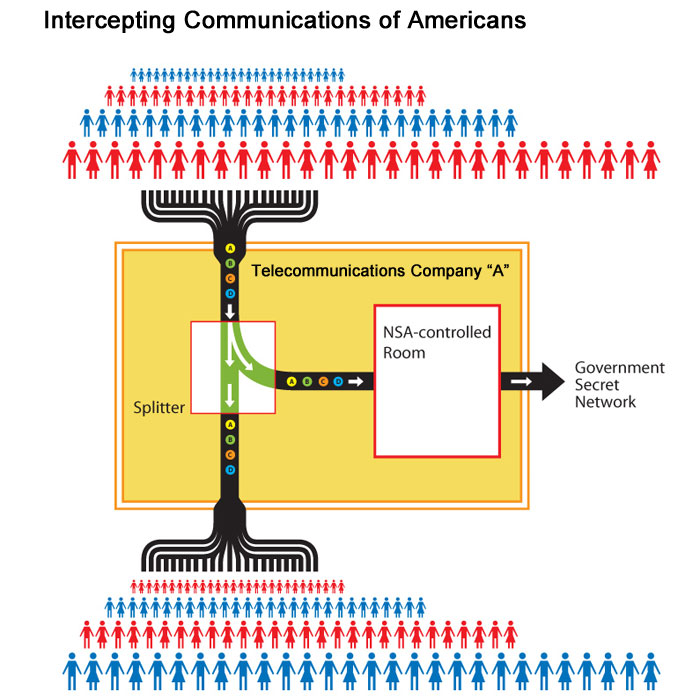 What we have failed to truly comprehend is that the NSA is merely one small part of a shadowy permanent government comprised of unelected bureaucrats who march in lockstep with profit-driven corporations that actually runs Washington, DC, and works to keep us under surveillance and, thus, under control. For example,
  John W. Whitehead, Constitutional Attorney