


“Donald Trump ran on a platform of relentless, thoroughgoing rejection of the Constitution itself, and its underlying principle of democratic self-government and individual rights. True, he never endorsed quartering of troops in private homes in time of peace, but aside from that there is hardly a provision of the Bill of Rights or later amendments he did not explicitly promise to override, from First Amendment freedom of the press and of religion to Fourth Amendment freedom from ‘unreasonable searches and seizures’ to Sixth Amendment right to counsel to Fourteenth Amendment birthright citizenship and Equal Protection and Fifteenth Amendment voting rights.”—Garrett Epps, law professor
If Donald Trump is remembered for anything, it may be his unintentional role in reviving public interest in the U.S. Constitution.
Indeed, few modern political figures have done more to prompt spontaneous national discussions about the Bill of Rights and constitutional limits on government power—if only because Trump tramples on them so frequently.
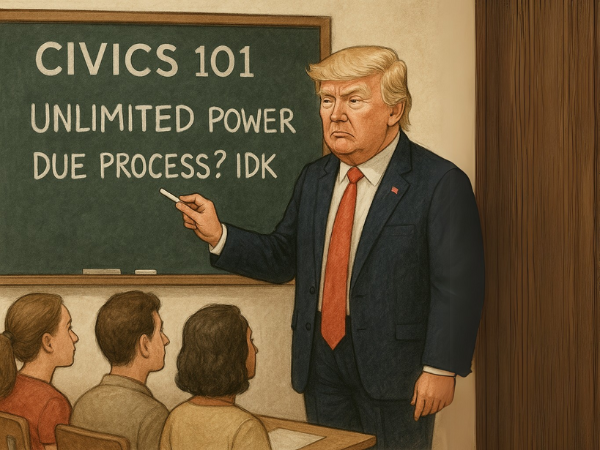
Through his routine disregard for due process, free speech, separation of powers, and the rule of law, President Trump has become a walking civics lesson.
From the First and Fourth Amendments to the Emoluments Clause, the Constitution has never had such regular airtime.
Ironically, this might be Trump’s greatest legacy: forcing Americans to learn what the Constitution actually says—by violating it.
Unfortunately, Trump himself remains constitutionally illiterate.
Days after issuing an executive order that openly hints at martial law, Trump made a mockery of his oath of office by confessing his complete ignorance about the Constitution on national television. When asked if he needs to uphold the Constitution of the United States as president, Trump replied, “I don’t know.”
This is the same man who appointed himself Chair of America’s 250th anniversary celebration but seems entirely unaware of what that history represents. Asked what the Declaration of Independence means, Trump called it a “declaration of unity and love.”
In reality, it’s a fiery breakup letter—a revolutionary indictment of unchecked executive power.
If Trump had been king in 1776, Jefferson might have named him in the first paragraph.
To be clear, Donald Trump is not the first president to stretch, sidestep, or outright violate constitutional limits—Democrats and Republicans alike have done so. But Trump is singular in the sheer scope, frequency, and brazenness with which he has stress-tested every clause, amendment, and founding principle of the U.S. Constitution.
His presidency has become a full-frontal assault on the rule of law.
The good news is that Trump’s constitutional ignorance has turned millions of Americans into more alert and informed citizens. In fighting off Trump’s excesses, the nation has reawakened to the rights and principles that many had taken for granted.
Consider some of the constitutional principles that Trump can be credited with bringing into the spotlight unintentionally during his time in office.
First Amendment (free speech, press, religion, protest and assembly): Trump’s repeated confrontations with the First Amendment have transformed free expression into a battleground, making it impossible to ignore the protections it guarantees. From branding the press as “the enemy of the people” and threatening to revoke media licenses to blacklisting law firms, threatening universities with funding cuts for not complying with the government’s ideological agenda, and detaining foreign students for their political views, Trump has treated constitutional protections not as guarantees, but as obstacles. Deportations and detentions based solely on political speech have shown the fragility of these freedoms when power goes unchecked. Even when Trump claims to be championing religious freedom for Christians, he skates close to violating the First Amendment’s Establishment Clause, which prohibits the government from favoring one religion over another.
Second Amendment (right to bear arms): Although often portrayed as a defender of the Second Amendment, Trump has shown an inconsistent and, at times, authoritarian approach to gun rights. He has publicly suggested confiscating firearms from individuals deemed dangerous—without prior due process—summed up in his infamous 2018 statement: “Take the guns first, go through due process second.” This disregard for constitutional procedure alarmed even staunch Second Amendment advocates. At the same time, Trump has encouraged the militarization of domestic police forces, blurring the line between civilian law enforcement and standing armies—a contradiction that cuts against the very spirit of the amendment, which was rooted in distrust of centralized power and standing militaries.
Fourth Amendment (protection against unreasonable searches and seizures): Under Trump, the Fourth Amendment’s shield against unreasonable searches and seizures has likewise become a focal point of concern. His expansion of no-knock raids, endorsement of sweeping surveillance tactics, sanctioning of police brutality and greater immunity for police misconduct, and the use of masked, plainclothes federal agents to seize demonstrators off the streets have revived conversations about privacy, unlawful searches, and the right to be secure in one’s person and property. Executive orders have embedded DHS agents in local policing. All of this under the guise of “law and order”—but without lawful justification.
Fifth & Fourteenth Amendments (due process and equal protection): Perhaps nowhere has Trump’s disregard been more dangerous than in his approach to due process and equal protection under the law. The Fifth and Fourteenth Amendments guarantee that neither citizens nor non-citizens can be deprived of liberty without fair procedures. Yet Trump’s Administration has repeatedly floated or enacted policies that sidestep due process, from the suggestion that he could suspend habeas corpus to the indefinite detention of individuals without trial, and openly questioned whether non-citizens deserve any constitutional protections at all. His immigration policies targeting lawful visa holders for dissent have pushed these rights to the edge of collapse. When asked if non-citizens deserve due process, Trump said, “I don’t know.” That chilling admission sums up his approach to the Fifth and Fourteenth Amendments: treat them as optional.
Sixth (right to a fair and speedy trial) and Eighth Amendments (protection against cruel and unusual punishment): Even the Sixth and Eighth Amendments have found new urgency. Trump has promoted indefinite pretrial detention for protesters and immigrants alike, while presiding over family separations, inhumane detention centers, and support for enhanced interrogation techniques. Trump has also doubled down on his administration’s commitment to carrying out more executions, including a push to impose the death penalty for crimes other than murder. What once seemed like settled moral and legal territory is now back up for debate.
Tenth Amendment (states’ rights): The Tenth Amendment, which preserves state sovereignty against federal overreach, has been tested by Trump’s threats to defund sanctuary cities, override state public health measures, and interfere in local policing and elections. His efforts to federalize domestic law enforcement have exposed the limits of decentralized power in the face of executive ambition.
Fourteenth Amendment (birthright citizenship): No clause has been more aggressively misunderstood by Trump than the Citizenship Clause of the Fourteenth Amendment. His push to strip citizenship from children born on U.S. soil to immigrant parents (birthright citizenship) ignores over a century of legal precedent affirming that citizenship cannot be denied by executive whim.
Article I, Section 8 (commerce and tariffs): Trump’s use of tariff authority provides another example of executive power run amok. Although the Constitution assigns Congress the power to regulate commerce with foreign nations, Trump has imposed sweeping tariffs on allies and used them as political leverage. These actions not only undermine the constitutional balance between the branches but also weaponize trade policy for political ends.
Article I, Section 9 (Emoluments Clause): Trump’s disregard for the Emoluments Clause—a safeguard against presidential profiteering—brought this obscure constitutional provision back into the public eye. By continuing to profit from his private businesses while in office, including his newly launched crypto companies, hosting foreign dignitaries at Trump-branded properties, and his reported willingness to accept extravagant gifts, such as a $400 million luxury plane from the Qatari government, he has raised urgent ethical and legal concerns about self-dealing, corruption and backdoor arrangements by which foreign and domestic governments can funnel money into Trump’s personal coffers.
Article I, Section 9 (power of the purse): Trump has also trampled on Congress’s exclusive power over federal spending, attempting to redirect funds by executive fiat rather than operating within Congress’ approved budgetary plan. Within the first months of his second term, Trump empowered Elon Musk’s Department of Government Efficiency (DOGE) to unilaterally slash government spending by reducing the federal workforce and dismantling whole programs. He has also threatened to withhold federal aid from states, cities, and universities deemed insufficiently loyal. These efforts to bypass congressional appropriations not only violate the Constitution’s clear separation of powers but set a dangerous precedent for future administrations to govern by fiscal coercion.
Article II (executive powers): At the heart of Trump’s governance is a dangerous misreading of Article II, which vests executive power in the president, to justify executive overreach and the concept of an all-powerful unitary executive. He has repeatedly claimed “total authority” over state matters, wielded executive orders like royal decrees in order to bypass Congress, and sought to bend the Department of Justice to his personal and political will. Trump’s use of executive orders—both in his first term and now again in 2025—reflects a belief in unchecked presidential power. He has declared “total authority,” fired independent watchdogs, pardoned political allies, and weaponized the DOJ. Such behavior undermines the balance of powers laid out by the framers.
Separation of Powers / Checks and Balances: This has also meant a sustained attack on the separation of powers. Trump has defied congressional subpoenas, pardoned loyalists implicated in wrongdoing, and threatened to jail political enemies. In doing so, he has tested—and often breached—the guardrails that prevent any one branch from overpowering the others.
Historical Emergency Powers and Legal Precedents: Beyond these standard constitutional provisions, Trump has also breathed new life into archaic emergency powers—tools that most Americans associate with authoritarian regimes, not a constitutional republic. His rhetoric and executive orders have invoked the Alien Enemies Act to justify rounding up, detaining and deporting undocumented immigrants without due process. He has also threatened to invoke the Insurrection Act to deploy troops domestically in order to deal with civil unrest, raising the specter of martial law cloaked in patriotic language.
In routinely violating the Constitution and crossing legal lines that were once unthinkable, Trump—who appears to have no real understanding of or regard for the Constitution—is forcing Americans to confront what the Constitution truly protects, and what it doesn’t.
So where does that leave us?
Thomas Jefferson recognized that a citizenry educated on “their rights, interests, and duties” is the only real assurance that freedom will survive. As Jefferson wrote in 1820: “I know no safe depository of the ultimate powers of our society but the people themselves; and if we think them not enlightened enough to exercise their control with a wholesome discretion, the remedy is not to take it from them, but to inform their discretion by education. This is the true corrective of abuses of constitutional power.”
Still, what good is a knowledgeable citizenry if their elected officials are woefully ignorant about the Constitution or willfully disregard their sworn duty to uphold and protect it?
Jefferson again has the answer: “In questions of power then, let no more be heard of confidence in man, but bind him down from mischief by the chains of the Constitution.”
For starters, anyone taking public office, from the president on down, should have a working knowledge of the Constitution and the Bill of Rights and should be held accountable for upholding their precepts.
One way to ensure this? Require government leaders to take a course on the Constitution—and pass a thorough examination—before being allowed to take office. And if they violate their contractual obligations to uphold and defend the Constitution, vote them out—throw them out—or impeach them.
“We the people” have the power, but we must use it, or we’ll lose it.
Trump may have contributed to this revival in constitutional awareness, but as we warn in Battlefield America: The War on the American People and A Government of Wolves: The Emerging American Police State, the challenge isn’t just knowing our rights—it’s defending them, before they’re gone for good.
Source: https://tinyurl.com/454khw2x
ABOUT JOHN W. WHITEHEAD
Constitutional attorney and author John W. Whitehead is founder and president of The Rutherford Institute. His most recent books are the best-selling Battlefield America: The War on the American People, the award-winning A Government of Wolves: The Emerging American Police State, and a debut dystopian fiction novel, The Erik Blair Diaries. Whitehead can be contacted at staff@rutherford.org. Nisha Whitehead is the Executive Director of The Rutherford Institute. Information about The Rutherford Institute is available at www.rutherford.org.
Publication Guidelines / Reprint Permission
John W. Whitehead’s weekly commentaries are available for publication to newspapers and web publications at no charge.
 John W. Whitehead, Constitutional Attorney