If you drive a car, I’ll tax the street,
If you try to sit, I’ll tax your seat.
If you get too cold I’ll tax the heat,
If you take a walk, I’ll tax your feet.

Don’t ask me what I want it for
If you don’t want to pay some more
‘Cause I’m the taxman, yeah, I’m the taxman…
And you’re working for no one but me.
— George Harrison, “Taxman”

We’re not living the American Dream. We’re in the grip of a financial nightmare.

“We the people” have become the new, permanent underclass in America.

We get taxed on how much we earn, taxed on what we eat, taxed on what we buy, taxed on where we go, taxed on what we drive, and taxed on how much is left of our assets when we die, and yet we have no real say in how the government runs, or how our taxpayer funds are used.

Case in point: Lawmakers across the country have been acting as fronts for corporations, sponsoring more than 10,000 model laws written by corporations, industry groups and think tanks such as the American Legislative Exchange Council.

Make no mistake: this is fascism disguised as legislative expediency.

As a recent investigative report by USA TODAY, The Arizona Republic and the Center for Public Integrity points out, these copycat bills have been used to “override the will of local voters” and advance the agendas of the corporate state. “Disguised as the work of lawmakers, these so-called ‘model’ bills get copied in one state Capitol after another, quietly advancing the agenda of the people who write them.”

In this way, laws that promise to protect the public “actually bolster the corporate bottom line.”

For example, “The Asbestos Transparency Act didn’t help people exposed to asbestos. It was written by corporations who wanted to make it harder for victims to recoup money. The ‘HOPE Act,’ introduced in nine states, was written by a conservative advocacy group to make it more difficult for people to get food stamps.”

Talk about Orwellian.

So we have no real say in how the government runs, or how our taxpayer funds are used, but that doesn’t prevent the government from fleecing us at every turn.

This is true whether you’re talking about taxpayers being forced to fund high-priced weaponry that will be used against us, endless wars that do little for our safety or our freedoms, or bloated government agencies such as the National Security Agency with its secret budgets, covert agendas and clandestine activities. Even monetary awards in lawsuits against government officials who are found guilty of wrongdoing are paid by the taxpayer.

We’re being forced to pay for endless wars that do more to fund the military industrial complex than protect us, for misguided pork barrel projects that do little to enhance our lives, and for the trappings of a police state that serves only to imprison us within its walls.

All the while the government continues to do whatever it likes—levy taxes, rack up debt, spend outrageously and irresponsibly—with little thought for the plight of its citizens.

We’re being played as easy marks by hustlers bearing the imprimatur of the government.

Truly, if there is an absolute maxim by which the federal government seems to operate, it is that the taxpayers—who fuel the nation’s economy and fund the government’s programs—always get ripped off.

Examples abound of wasteful government spending.

$28 million for a camouflage pattern for the Afghan National Army’s uniforms that had to be discarded because it clashes with the desert; $80 million to corral wild horses that would fare better unpenned; $5 million for a study to conclude that fraternity and sorority members drink more than their peers; and more than $1 billion worth of small arms, mortars, Humvees, and other equipment that has gone “missing” in Iraq.

If Americans managed their personal finances the way the government mismanages the nation’s finances, we’d all be in debtors’ prison by now.

Still, the government remains unrepentant, unfazed and undeterred in its money grabs.

Because the government’s voracious appetite for money, power and control has grown out of control, its agents have devised other means of funding its excesses and adding to its largesse through taxes disguised as fines, taxes disguised as fees, and taxes disguised as tolls, tickets and penalties.

With every new tax, fine, fee and law adopted by our so-called representatives, the yoke around the neck of the average American seems to tighten just a little bit more.

Everywhere you go, everything you do, and every which way you look, we’re getting swindled, cheated, conned, robbed, raided, pickpocketed, mugged, deceived, defrauded, double-crossed and fleeced by governmental and corporate shareholders of the American police state out to make a profit at taxpayer expense.

The overt and costly signs of the despotism exercised by the increasingly authoritarian regime that passes itself off as the United States government are all around us: warrantless surveillance of Americans’ private phone and email conversations by the NSA; SWAT team raids of Americans’ homes; shootings of unarmed citizens by police; harsh punishments meted out to schoolchildren in the name of zero tolerance; armed drones taking to the skies domestically; endless wars; out-of-control spending; militarized police; roadside strip searches; roving TSA sweeps; privatized prisons with a profit incentive for jailing Americans; fusion centers that collect and disseminate data on Americans’ private transactions; and militarized agencies such as the IRS, Dept. of Education, the Smithsonian and others with stockpiles of ammunition, to name some of the most appalling.

Meanwhile, the three branches of government (Executive, Legislative and Judicial) and the agencies under their command—Defense, Commerce, Education, Homeland Security, Justice, Treasury, etc.—have switched their allegiance to the Corporate State with its unassailable pursuit of profit at all costs and by any means possible.

We are now ruled by a government consumed with squeezing every last penny out of the population and seemingly unconcerned if essential freedoms are trampled in the process.

While we’re struggling to get by, and making tough decisions about how to spend what little money actually makes it into our pockets after the federal, state and local governments take their share (this doesn’t include the stealth taxes imposed through tolls, fines and other fiscal penalties), the police state is spending our hard-earned tax dollars to further entrench its powers and entrap its citizens.

If you want to know the real motives behind the government’s agenda, follow the money trail.

When you dig down far enough, you quickly find that those who profit from Americans being surveilled, fined, scanned, searched, probed, tasered, arrested and imprisoned are none other than the police who arrest them, the courts which try them, the prisons which incarcerate them, and the corporations, which manufacture the weapons, equipment and prisons used by the American police state.

It gets worse.

Americans have also been made to pay through the nose for the government’s endless wars, subsidization of foreign nations, military empire, welfare state, roads to nowhere, bloated workforce, secret agencies, fusion centers, private prisons, biometric databases, invasive technologies, arsenal of weapons, and every other budgetary line item that is contributing to the fast-growing wealth of the corporate elite at the expense of those who are barely making ends meet—that is, we the taxpayers.

Those football stadiums that charge exorbitant sums for nosebleed seats? Our taxpayer dollars subsidize them.

Those blockbuster war films? Yep, we were the silent investors on those, too.

This isn’t freedom.

You’re not free if the government can seize your home and your car (which you’ve bought and paid for) over nonpayment of taxes.

You’re not free if government agents can freeze and seize your bank accounts and other valuables if they merely “suspect” wrongdoing.

And you’re certainly not free if the IRS gets the first cut of your salary to pay for government programs over which you have no say.

If you have no choice, no voice, and no real options when it comes to the government’s claims on your property and your money, you’re not free.

As former Congressman Ron Paul observed, “The Founding Fathers never intended a nation where citizens would pay nearly half of everything they earn to the government.”

Unfortunately, somewhere over the course of the past 240-plus years, democracy has given way to kleptocracy (a government ruled by thieves), and representative government has been rejected in favor of a kakistocracy (a government run by the most unprincipled citizens that panders to the worst vices in our nature: greed, violence, hatred, prejudice and war) ruled by career politicians, corporations and thieves—individuals and entities with little regard for the rights of American citizens.

The American kleptocracy continues to suck the American people down a rabbit hole into a parallel universe in which the Constitution is meaningless, the government is all-powerful, and the citizenry is powerless to defend itself against government agents who steal, spy, lie, plunder, kill, abuse and generally inflict mayhem and sow madness on everyone and everything in their sphere.

This dissolution of that sacred covenant between the citizenry and the government—establishing “we the people” as the masters and the government as the servant—didn’t happen overnight.

It didn’t happen because of one particular incident or one particular president.

It has been a process, one that began long ago and continues in the present day, aided and abetted by politicians who have mastered the polarizing art of how to “divide and conquer.”

By playing on our prejudices about those who differ from us, capitalizing on our fears for our safety, and deepening our distrust of those fellow citizens whose opinions run counter to our own, the powers-that-be have effectively divided us into polarized, warring camps incapable of finding consensus on the one true menace that is an immediate threat to all of our freedoms: the U.S. government.

We are now the subjects of a militarized, corporate empire in which the vast majority of the citizenry work their hands to the bone for the benefit of a privileged few.

Adding injury to the ongoing insult of having our tax dollars misused and our so-called representatives bought and paid for by the moneyed elite, the government then turns around and uses the money we earn with our blood, sweat and tears to target, imprison and entrap us.

All of those nefarious government deeds that you read about in the paper every day: those are your tax dollars at work.

So what are you going to do about it?

There was a time in our history when our forebears said “enough is enough” and stopped paying their taxes to what they considered an illegitimate government. They stood their ground and refused to support a system that was slowly choking out any attempts at self-governance, and which refused to be held accountable for its crimes against the people. Their resistance sowed the seeds for the revolution that would follow.

Unfortunately, in the 200-plus years since we established our own government, we’ve let bankers, turncoats and number-crunching bureaucrats muddy the waters and pilfer the accounts to such an extent that we’re back where we started.

Once again, we’ve got a despotic regime with an imperial ruler doing as they please.

Once again, we’ve got a judicial system insisting we have no rights under a government which demands that the people march in lockstep with its dictates.

And once again, we’ve got to decide whether we’ll keep marching or break stride and make a turn toward freedom.

But what if we didn’t just pull out our pocketbooks and pony up to the federal government’s outrageous demands for more money?

What if we didn’t just dutifully line up to drop our hard-earned dollars into the collection bucket, no questions asked about how it will be spent?

What if, instead of quietly sending in our tax checks, hoping vainly for some meager return, we did a little calculating of our own and started deducting from our taxes those programs that we refuse to support?

As I make clear in my book Battlefield America: The War on the American People, if we don’t have the right to decide what happens to our hard-earned cash, then we don’t have any rights at all.

After all, the government isn’t taking our money to make our lives better.

We’re being robbed blind so the governmental elite can get richer.

This is nothing less than financial tyranny.

WC: 2069

Source: https://rutherford.org/publications_resources/john_whiteheads_commentary/financial_tyranny_america_has_become_a_pay_to_play_exercise_in_fascism
ABOUT JOHN W. WHITEHEAD

Constitutional attorney and author John W. Whitehead is founder and president of The Rutherford Institute. His book Battlefield America: The War on the American People is available online at http://www.amazon.com. Whitehead can be contacted at johnw@rutherford.org.

Publication Guidelines / Reprint Permission

John W. Whitehead’s weekly commentaries are available for publication to newspapers and web publications at no charge. Please contact staff@rutherford.org to obtain reprint permission.



We’re developing a new citizenry. One that will be very selective about cereals and automobiles, but won’t be able to think.”—Rod Serling

Have you noticed how much life increasingly feels like an episode of The Twilight Zone?

Only instead of Rod Serling’s imaginary “land of both shadow and substance, of things and ideas,” we’re trapped in a topsy-turvy, all-too-real land of corruption, brutality and lies, where freedom, justice and integrity play second fiddle to political ambition, corporate greed, and bureaucratic tyranny.

It’s not merely that life in the American Police State is more brutal, or more unjust, or even more corrupt. It’s getting more idiotic, more perverse, and more outlandish by the day.

Somewhere over the course of the past 240-plus years, democracy has given way to idiocracy,  and representative government has given way to a kleptocracy (a government ruled by thieves) and a kakistocracy (a government run by unprincipled career politicians, corporations and thieves that panders to the worst vices in our nature and has little regard for the rights of American citizens).

Examples abound.

In Georgia, political organizers posted a “Black Media Only” sign outside a Baptist Church, barring white reporters from attending a meeting about an upcoming mayoral election.

In Arizona, a SWAT team raided a family’s home in the middle of the night on the say-so of Child Protective Services, which sounded the alarm after the parents determined that their 2-year-old—who had been suffering a 100-degree fever—was feeling better and didn’t need to be admitted to the hospital.

In Virginia, landlords are requiring dog-owning tenants to submit their pets’ DNA to a database that will be used to track down (and fine) owners who fail to clean up after their dogs poop in public.

In Texas, a police officer who allegedly gave a homeless man a sandwich with dog feces won’t be held accountable for his actions.

In Illinois, Chicago police used a battering ram and a sledgehammer to crash into a family’s home with weapons drawn, terrorizing the young children gathered for a 4-year-old’s birthday party, only to find that they were at the wrong house.

In Kansas, a 61-year-old back man in the process of moving into his new house found himself held at gunpoint and handcuffed by police, who refused to believe he was a homeowner and not a burglar.

If you’re starting to notice a pattern here, it speaks to the fact that nearly 50 years after Serling’s creative brainchild, The Twilight Zone, premiered on national television, we’re still fumbling around in the dark, trying to make sense of a world dominated by racism, cruelty, war, violence, poverty, prejudice, intolerance, ignorance, injustice and a host of other social maladies and spiritual evils.

The Twilight Zone was an oasis in television wasteland: a show that captured imaginations; challenged moral hypocrisy and societal prejudices; and railed against inhumanity, racism, prejudice, the mechanization of human beings by way of their technology, tyrants of all shapes and colors, a passive populace, war, injustice, the surveillance state, corporate greed.

Fifty years later, with so much having changed legally, technologically and politically, so much still remains the same. Fear is the same. Prejudice is the same. Ignorance is the same. Hate and war and tyranny are unchanged. Police officers are still shooting unarmed citizens. Bloated government agencies are still fleecing taxpayers. Government technicians are still spying on our communications. And American citizens are still allowing themselves to be manipulated by their fears and pitted one against the other.

All of these themes can be found in The Twilight Zone.

Serling, a truth-teller who pulled no punches when it came to calling out the evils of his day, channeled his moral outrage into storytelling. As his daughter Anne explained, “The Twilight Zone was more than just the strangest show on TV, with the best theme song, but back in the 50’s Rod Serling was serving up social commentary through science fiction.”

That social commentary disguised as entertainment tackled some of the most pressing issues of Serling’s day. “It dealt with human issues which I guess is why it’s lasted so long, because it dealt with racism and mob mentality and scapegoating and things that are still very, very prevalent and relevant today sadly,” said Anne. “We don’t seem to be able to move ahead and change.”

Serling would have no shortage of material to draw from today, given the government’s greed for money and power, its disregard for human life, its corruption and graft, its pollution of the environment, its reliance on excessive force in order to ensure compliance, its covert activities, its illegal surveillance, and its blatant disdain for the rule of law.

“I can tell you [my dad] would be absolutely apoplectic about what’s happening in the world today. And deeply saddened,” said his daughter Anne Serling. “There are moments that I’m glad he’s not here to see.”

It boggles the mind how relevant The Twilight Zone and its unique brand of truth-telling are to an age in which truth has become a convenient fiction for those in power, what researchers refer to as “Truth Decay.”

As a report from the Rand Corporation explains, “Truth Decay is defined as a set of four related trends: increasing disagreement about facts and analytical interpretations of facts and data; a blurring of the line between opinion and fact; an increase in the relative volume, and resulting influence, of opinion and personal experience over fact; and declining trust in formerly respected sources of factual information.”

Serling would have had a lot to say about the lies that masquerade as truth today.

I’m not sure that Serling would have been surprised by current events, though. After all, this was the man who concluded that people are alike all over: that was the kernel of truth in one of Serling’s episodes about a pair of astronauts who journey to Mars only to find that while they may have landed on an alien planet, inhabited by alien creatures, the ignorance, fear and prejudice of the “foreigner” was the same.

So many truths, packaged in 156 episodes that aired from 1959 to 1964.

Serling took pride in the writing, penning 92 of the 156 episodes himself. For the rest, he enlisted some of the best writers of the 20th century to lend their talents to Zone episodes: Ray Bradbury, Richard Matheson, Charles Beaumont, Earl Hamner, to mention a few. As such, the Twilight Zone became the embodiment of great story-telling.

If you want to watch something that fuses time and space into reality by way of a fictional setting, then I suggest that you tune into The Twilight Zone.

Director Jordan Peele has taken Serling’s material out for a new spin in a reboot airing on CBS All Access, but if you haven’t experienced the original series, do yourself a favor and spend some time with them.

There are so many to choose from, but the following are 12 of my personal favorites:

Time Enough at Last: Mild-mannered Henry Bemis (Burgess Meredith), hen-pecked by his wife and brow-beaten by his boss, sneaks into a bank vault on his lunch hour to read. He is knocked unconscious by a shockwave that turns out to be a nuclear war. When Bemis regains consciousness, he realizes that he is the last person on earth.

I Shot an Arrow into the Air: Three astronauts survive a crash after their craft disappears from the radar screen. They find themselves on what they believe to be a dry, lifeless asteroid. Only five gallons of water separate them from dehydration and death. And temperamental crew member Corey (Dewey Martin) goes to great lengths to ensure his survival.

The Howling Man: During a walking tour of Europe after World War I, David loses his way and comes to a remote monastery. He is turned away but passes out, and the monks take him in. David regains consciousness and hears a bizarre howling. He eventually finds a man in a jail cell who the monks say is the Devil himself, kept in his prison by the “staff of truth.”

Eye of the Beholder: Janet lies in a hospital bed, her face wrapped in bandages, hiding the hideous face that has made her an outcast all her life. This is her eleventh hospital visit and the last allowed by the government. The faces of the doctors and nurses are also hidden by shadows and camera angles. Janet’s bandages are finally removed, and the medical staff retreat in disgust.

The Invaders: A haggard woman (Agnes Morehead) hears a strange sound on the roof. She climbs up to see a miniature flying saucer and tiny spacemen who invade her home. Their small ray guns sting, but she fights back.

Shadow Play: Adam (Dennis Weaver) is on trial, and the judge gives him the electric chair. Adam chortles that it’s all a joke, a recurring nightmare in which all the participants are bit players in a scripted play. But will anyone listen?

The Obsolete Man: Romney (Burgess Meredith) is a God-fearing librarian in a totalitarian state in which books and religion have been banned. Romney is judged obsolete by the government chancellor but is granted several requests before he dies. He chooses to have a television audience watch his execution. Forty-five minutes before he is to die, he invites the chancellor to his room and locks them both inside.

Nightmare at 20,000 Feet: Robert (William Shatner) boards an airplane after having been discharged from a mental hospital for a nervous breakdown. He looks out his window during the flight and sees a weird creature on the wing. Alarmed, he alerts others. However, when they look out, the creature disappears. Robert eventually realizes that what he sees is a demon trying to dismantle the plane so it will crash. Robert decides to act.

Living Doll: Erich (Telly Savalas) is angry at his wife for buying his stepdaughter an expensive doll. Erich has a nasty disposition and soon discovers that the doll has a life of its own and it dislikes him. In fact, the doll tells him so. Talky Tina says emphatically “I hate you” and “I’m going to kill you.”

The Masks: On his deathbed, Jason Foster calls his four heirs to his side on a Mardi Gras evening. Each heir has a character flaw—self-pity, avarice, vanity or cruelty. Foster demands that each wear a mask he has fashioned for them. If they refuse to keep the masks on until midnight, they will be disinherited. The masks are hideous, and the heirs do not want to don them. But out of greed, they slide them onto their faces.

It’s a Good Life: Peaksville, Ohio, a small community, has been “taken away” from the so-called normal world—ravaged by 6-year-old “monster” Anthony (Billy Mumy). By mere thought and/or wishes, Anthony can make things and people disappear or turn into hideous creatures. All of the adults kowtow to his every desire.

To Serve Man: The Kanamits—nine-foot-tall, large-headed creatures—come to Earth from outer space, bringing gifts, spouting peace and promising to end famine. After some initial resistance by earthlings, the world relents and humans become entranced by the visitors. However, government agent Mike (Lloyd Chambers) soon discovers a sinister and shocking plot being hatched by the Kanamits.

The Twilight Zone was a paradox.

Although the series is often seen as science fiction, ultimately it was not science fiction.

Whatever weird or far out setting may have been involved in a particular episode, the focus was always on the angst, pain and suffering we face in the so-called “real” world. As author Marc Scott Zicree writes:

The Twilight Zone was the first, and possibly only, TV series to deal on a regular basis with the theme of alienation—particularly urban alienation…. Repeatedly, it states a simple message: The only escape from alienation lies in reaching out to others, trusting in their common humanity. Give in to the fear and you are lost.

Fifty years after the original The Twilight Zone series questioned whether we can maintain our humanity in the face of authoritarian forces trying to reduce us to mindless automatons, we’re still struggling with the demons of our age who delight in fomenting violence, sowing distrust and prejudice, and persuading the public to support tyranny disguised as patriotism.

Yet as I make clear in my book Battlefield America: The War on the American People, we don’t have to be stranded in this alternate universe, this twilight zone of tyranny, brutality and injustice.

We still have the power to change our circumstances for the better.

However, overcoming the evils of our age will require more than intellect and activism. It will require decency, morality, goodness, truth and toughness.

As Serling concluded in his remarks to the graduating class of 1968:

Toughness is the singular quality most required of you… we have left you a world far more botched than the one that was left to us… Part of your challenge is to seek out truth, to come up with a point of view not dictated to you by anyone, be he a congressman, even a minister… Are you tough enough to take the divisiveness of this land of ours, the fact that everything is polarized, black and white, this or that, absolutely right or absolutely wrong. This is one of the challenges. Be prepared to seek out the middle ground … that wondrous and very difficult-to-find Valhalla where man can look to both sides and see the errant truths that exist on both sides. If you must swing left or you must swing right—respect the other side. Honor the motives that come from the other side. Argue, debate, rebut—but don’t close those wondrous minds of yours to opposition. In their eyes, you’re the opposition. And ultimately … ultimately—you end divisiveness by compromise. And so long as men walk and breathe—there must be compromise.”

WC: 2321

Source: https://rutherford.org/publications_resources/john_whiteheads_commentary/american_idiocracy_50_years_later_were_still_stranded_in_the_twilight_zone
ABOUT JOHN W. WHITEHEAD

Constitutional attorney and author John W. Whitehead is founder and president of The Rutherford Institute. His book Battlefield America: The War on the American People is available online at http://www.amazon.com. Whitehead can be contacted at johnw@rutherford.org.

Publication Guidelines / Reprint Permission

John W. Whitehead’s weekly commentaries are available for publication to newspapers and web publications at no charge. Please contact staff@rutherford.org to obtain reprint permission.
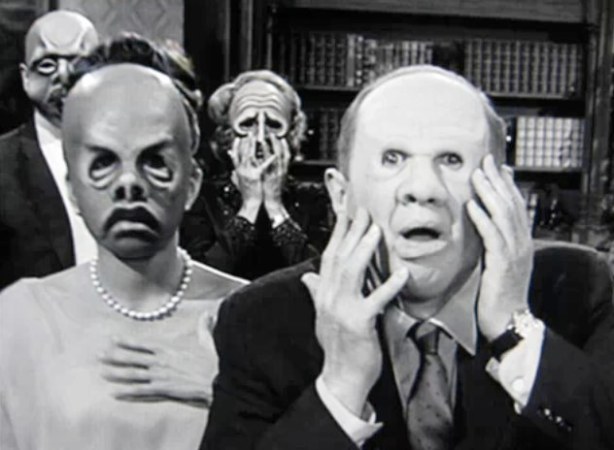
 

“But these weren’t the kind of monsters that had tentacles and rotting skin, the kind a seven-year-old might be able to wrap his mind around—they were monsters with human faces, in crisp uniforms, marching in lockstep, so banal you don’t recognize them for what they are until it’s too late.” — Ransom Riggs, Miss Peregrine’s Home for Peculiar Children

The U.S. government, in its pursuit of so-called monsters, has itself become a monster.

This is not a new development, nor is it a revelation.

This is a government that has in recent decades unleashed untold horrors upon the world—including its own citizenry—in the name of global conquest, the acquisition of greater wealth, scientific experimentation, and technological advances, all packaged in the guise of the greater good.

Mind you, there is no greater good when the government is involved. There is only greater greed for money and power.

Unfortunately, the public has become so easily distracted by the political spectacle coming out of Washington, DC, that they are altogether oblivious to the grisly experiments, barbaric behavior and inhumane conditions that have become synonymous with the U.S. government.

These horrors are being meted out against humans and animals alike.

It’s heartbreaking enough when you hear about police shooting family dogs that pose no threat—beloved pets that are “guilty” of little more than barking, or wagging a tag, or racing towards them in greeting—at an alarming rate somewhere in the vicinity of 500 dogs a day.

What I’m about to share goes beyond heartbreaking to horrifying.

For instance, did you know that the U.S. government has been buying hundreds of dogs and cats from “Asian meat markets” as part of a gruesome experiment into food-borne illnesses? The cannibalistic experiments involve killing cats and dogs purchased from Colombia, Brazil, Vietnam, China and Ethiopia, and then feeding the dead remains to laboratory kittens, bred in government laboratories for the express purpose of being infected with a disease and then killed.

It gets more gruesome.

The Department of Veterans Affairs has been removing parts of dogs’ brains to see how it affects their breathing; applying electrodes to dogs’ spinal cords (before and after severing them) to see how it impacts their cough reflexes; and implanting pacemakers in dogs’ hearts and then inducing them to have heart attacks (before draining their blood). All of the laboratory dogs are killed during the course of these experiments.

It’s not just animals that are being treated like lab rats by government agencies.

“We the people” have also become the police state’s guinea pigs: to be caged, branded, experimented upon without our knowledge or consent, and then conveniently discarded and left to suffer from the after-effects.

Back in 2017, FEMA “inadvertently” exposed nearly 10,000 firefighters, paramedics and other responders to a deadly form of ricin during simulated bioterrorism response sessions. In 2015, it was discovered that an Army lab had been “mistakenly” shipping deadly anthrax to labs and defense contractors for a decade.

While these particular incidents have been dismissed as “accidents,” you don’t have to dig very deep or go very back in the nation’s history to uncover numerous cases in which the government deliberately conducted secret experiments on an unsuspecting populace—citizens and noncitizens alike—making healthy people sick by spraying them with chemicals, injecting them with infectious diseases and exposing them to airborne toxins.

At the time, the government reasoned that it was legitimate to experiment on people who did not have full rights in society such as prisoners, mental patients, and poor blacks.

In Alabama, for example, 600 black men with syphilis were allowed to suffer without proper medical treatment in order to study the natural progression of untreated syphilis. In California, older prisoners had testicles from livestock and from recently executed convicts implanted in them to test their virility. In Connecticut, mental patients were injected with hepatitis.

In Maryland, sleeping prisoners had a pandemic flu virus sprayed up their noses. In Georgia, two dozen “volunteering” prison inmates had gonorrhea bacteria pumped directly into their urinary tracts through the penis. In Michigan, male patients at an insane asylum were exposed to the flu after first being injected with an experimental flu vaccine. In Minnesota, 11 public service employee “volunteers” were injected with malaria, then starved for five days.

In New York, dying patients had cancer cells introduced into their systems. In Ohio, over 100 inmates were injected with live cancer cells. Also in New York, prisoners at a reformatory prison were also split into two groups to determine how a deadly stomach virus was spread: the first group was made to swallow an unfiltered stool suspension, while the second group merely breathed in germs sprayed into the air. And in Staten Island, children with mental retardation were given hepatitis orally and by injection to see if they could then be cured.

As the Associated Press reports, “The late 1940s and 1950s saw huge growth in the U.S. pharmaceutical and health care industries, accompanied by a boom in prisoner experiments funded by both the government and corporations. By the 1960s, at least half the states allowed prisoners to be used as medical guinea pigs … because they were cheaper than chimpanzees.”

Moreover, “Some of these studies, mostly from the 1940s to the ’60s, apparently were never covered by news media. Others were reported at the time, but the focus was on the promise of enduring new cures, while glossing over how test subjects were treated.”

Media blackouts, propaganda, spin. Sound familiar?

How many government incursions into our freedoms have been blacked out, buried under “entertainment” news headlines, or spun in such a way as to suggest that anyone voicing a word of caution is paranoid or conspiratorial?

Unfortunately, these incidents are just the tip of the iceberg when it comes to the atrocities the government has inflicted on an unsuspecting populace in the name of secret experimentation.

For instance, there was the U.S. military’s secret race-based testing of mustard gas on more than 60,000 enlisted men. As NPR reports, “All of the World War II experiments with mustard gas were done in secret and weren’t recorded on the subjects’ official military records. Most do not have proof of what they went through. They received no follow-up health care or monitoring of any kind. And they were sworn to secrecy about the tests under threat of dishonorable discharge and military prison time, leaving some unable to receive adequate medical treatment for their injuries, because they couldn’t tell doctors what happened to them.”

And then there was the CIA’s MKULTRA program in which hundreds of unsuspecting American civilians and military personnel were dosed with LSD, some having the hallucinogenic drug slipped into their drinks at the beach, in city bars, at restaurants. As Time reports, “before the documentation and other facts of the program were made public, those who talked of it were frequently dismissed as being psychotic.”

Now one might argue that this is all ancient history and that the government today is different from the government of yesteryear, but has the U.S. government really changed?

Has the government become any more humane, any more respectful of the rights of the citizenry?

Has it become any more transparent or willing to abide by the rule of law? Has it become any more truthful about its activities? Has it become any more cognizant of its appointed role as a guardian of our rights?

Or has the government simply hunkered down and hidden its nefarious acts and dastardly experiments under layers of secrecy, legalism and obfuscations? Has it not become wilier, more slippery, more difficult to pin down?

Having mastered the Orwellian art of Doublespeak and followed the Huxleyan blueprint for distraction and diversion, are we not dealing with a government that is simply craftier and more conniving that it used to be?

Consider this: after revelations about the government’s experiments spanning the 20th century spawned outrage, the government began looking for human guinea pigs in other countries, where “clinical trials could be done more cheaply and with fewer rules.”

In Guatemala, prisoners and patients at a mental hospital were infected with syphilis, “apparently to test whether penicillin could prevent some sexually transmitted disease.” In Uganda, U.S.-funded doctors “failed to give the AIDS drug AZT to all the HIV-infected pregnant women in a study… even though it would have protected their newborns.” Meanwhile, in Nigeria, children with meningitis were used to test an antibiotic named Trovan. Eleven children died and many others were left disabled.

The more things change, the more they stay the same.

Case in point: back in 2016, it was announced that scientists working for the Department of Homeland Security would begin releasing various gases and particles on crowded subway platforms as part of an experiment aimed at testing bioterror airflow in New York subways.

The government insisted that the gases released into the subways by the DHS were nontoxic and did not pose a health risk. It’s in our best interests, they said, to understand how quickly a chemical or biological terrorist attack might spread. And look how cool the technology is—said the government cheerleaders—that scientists can use something called DNATrax to track the movement of microscopic substances in air and food. (Imagine the kinds of surveillance that could be carried out by the government using trackable airborne microscopic substances you breathe in or ingest.)

Mind you, this is the same government that in 1949 sprayed bacteria into the Pentagon’s air handling system, then the world’s largest office building. In 1950, special ops forces sprayed bacteria from Navy ships off the coast of Norfolk and San Francisco, in the latter case exposing all of the city’s 800,000 residents.

In 1953, government operatives staged “mock” anthrax attacks on St. Louis, Minneapolis, and Winnipegusing generators placed on top of cars. Local governments were reportedly told that “‘invisible smokescreen[s]’ were being deployed to mask the city on enemy radar.” Later experiments covered territory as wide-ranging as Ohio to Texas and Michigan to Kansas.

In 1965, the government’s experiments in bioterror took aim at Washington’s National Airport, followed by a 1966 experiment in which army scientists exposed a million subway NYC passengers to airborne bacteria that causes food poisoning.

And this is the same government that has taken every bit of technology sold to us as being in our best interests—GPS devices, surveillance, nonlethal weapons, etc.—and used it against us, to track, control and trap us.

So, no, I don’t think the government’s ethics have changed much over the years. It’s just taken its nefarious programs undercover.

The question remains: why is the government doing this? The answer is always the same: money, power and total domination.

It’s the same answer no matter which totalitarian regime is in power.

The mindset driving these programs has, appropriately, been likened to that of Nazi doctors experimenting on Jews. As the Holocaust Museum recounts, Nazi physicians “conducted painful and often deadly experiments on thousands of concentration camp prisoners without their consent.”

The Nazi’s unethical experiments ran the gamut from freezing experiments using prisoners to find an effective treatment for hypothermia, tests to determine the maximum altitude for parachuting out of a plane, injecting prisoners with malaria, typhus, tuberculosis, typhoid fever, yellow fever, and infectious hepatitis, exposing prisoners to phosgene and mustard gas, and mass sterilization experiments.

The horrors being meted out against the American people can be traced back, in a direct line, to the horrors meted out in Nazi laboratories. In fact, following the second World War, the U.S. government recruited many of Hitler’s employees, adopted his protocols, embraced his mindset about law and order and experimentation, and implemented his tactics in incremental steps.

Sounds far-fetched, you say? Read on. It’s all documented.

As historian Robert Gellately recounts, the Nazi police state was initially so admired for its efficiency and order by the world powers of the day that J. Edgar Hoover, then-head of the FBI, actually sent one of his right-hand men, Edmund Patrick Coffey, to Berlin in January 1938 at the invitation of Germany’s secret police, the Gestapo.

The FBI was so impressed with the Nazi regime that, according to the New York Times, in the decades after World War II, the FBI, along with other government agencies, aggressively recruited at least a thousand Nazis, including some of Hitler’s highest henchmen.

All told, thousands of Nazi collaborators—including the head of a Nazi concentration camp, among others—were given secret visas and brought to America by way of Project Paperclip. Subsequently, they were hired on as spies, informants and scientific advisers, and then camouflaged to ensure that their true identities and ties to Hitler’s holocaust machine would remain unknown. All the while, thousands of Jewish refugees were refused entry visas to the U.S. on the grounds that it could threaten national security.

Adding further insult to injury, American taxpayers have been paying to keep these ex-Nazis on the U.S. government’s payroll ever since. And in true Gestapo fashion, anyone who has dared to blow the whistle on the FBI’s illicit Nazi ties has found himself spied upon, intimidated, harassed and labeled a threat to national security.

As if the government’s covert, taxpayer-funded employment of Nazis after World War II wasn’t bad enough, U.S. government agencies—the FBI, CIA and the military—have since fully embraced many of the Nazi’s well-honed policing tactics, and have used them repeatedly against American citizens.

It’s certainly easy to denounce the full-frontal horrors carried out by the scientific and medical community within a despotic regime such as Nazi Germany, but what do you do when it’s your own government that claims to be a champion of human rights all the while allowing its agents to engage in the foulest, bases and most despicable acts of torture, abuse and experimentation?

When all is said and done, this is not a government that has our best interests at heart.

This is not a government that values us.

Perhaps the answer lies in The Third Man, Carol Reed’s influential 1949 film starring Joseph Cotten and Orson Welles. In the film, set in a post-WW II Vienna, rogue war profiteer Harry Lime has come to view human carnage with a callous indifference, unconcerned that the diluted penicillin he’s been trafficking underground has resulted in the tortured deaths of young children.

Challenged by his old friend Holly Martins to consider the consequences of his actions, Lime responds, “In these days, old man, nobody thinks in terms of human beings. Governments don’t, so why should we?

“Have you ever seen any of your victims?” asks Martins.

“Victims?” responds Limes, as he looks down from the top of a Ferris wheel onto a populace reduced to mere dots on the ground. “Look down there. Tell me. Would you really feel any pity if one of those dots stopped moving forever? If I offered you twenty thousand pounds for every dot that stopped, would you really, old man, tell me to keep my money, or would you calculate how many dots you could afford to spare? Free of income tax, old man. Free of income tax — the only way you can save money nowadays.”

As I make clear in my book Battlefield America: The War on the American People, this is how the U.S. government sees us, too, when it looks down upon us from its lofty perch.

To the powers-that-be, the rest of us are insignificant specks, faceless dots on the ground.

To the architects of the American police state, we are not worthy or vested with inherent rights. This is how the government can justify treating us like economic units to be bought and sold and traded, or caged rats to be experimented upon and discarded when we’ve outgrown our usefulness.

To those who call the shots in the halls of government, “we the people” are merely the means to an end.

“We the people”—who think, who reason, who take a stand, who resist, who demand to be treated with dignity and care, who believe in freedom and justice for all—have become obsolete, undervalued citizens of a totalitarian state that, in the words of Rod Serling, “has patterned itself after every dictator who has ever planted the ripping imprint of a boot on the pages of history since the beginning of time. It has refinements, technological advances, and a more sophisticated approach to the destruction of human freedom.”

In this sense, we are all Romney Wordsworth, the condemned man in Serling’s Twilight Zone episode “The Obsolete Man.”

The Obsolete Man” speaks to the dangers of a government that views people as expendable once they have outgrown their usefulness to the State. Yet—and here’s the kicker—this is where the government through its monstrous inhumanity also becomes obsolete. As Serling noted in his original script for “The Obsolete Man,” “Any state, any entity, any ideology which fails to recognize the worth, the dignity, the rights of Man…that state is obsolete.

How do you defeat a monster? You start by recognizing the monster for what it is.

WC: 2845

Source: https://rutherford.org/publications_resources/john_whiteheads_commentary/the_making_of_a_monster_were_all_lab_rats_in_the_governments_secret_experiments
ABOUT JOHN W. WHITEHEAD

Constitutional attorney and author John W. Whitehead is founder and president of The Rutherford Institute. His new book Battlefield America: The War on the American People is available online at http://www.amazon.com. Whitehead can be contacted at johnw@rutherford.org.

Publication Guidelines / Reprint Permission

John W. Whitehead’s weekly commentaries are available for publication to newspapers and web publications at no charge. Please contact staff@rutherford.org to obtain reprint permission.


“In too much of policing today, officer safety has become the highest priority. It trumps the rights and safety of suspects. It trumps the rights and safety of bystanders. It’s so important, in fact, that an officer’s subjective fear of a minor wound from a dog bite is enough to justify using potentially lethal force, in this case at the expense of a 4-year-old girl. And this isn’t the first time. In January, an Iowa cop shot and killed a woman by mistake while trying to kill her dog. Other cops have shot other kidsother bystanderstheir partnerstheir supervisors and even themselves while firing their guns at a dog. That mind-set is then, of course, all the more problematic when it comes to using force against people.”—Journalist Radley Balko

The absurd cruelties of the American police state keep reaching newer heights.

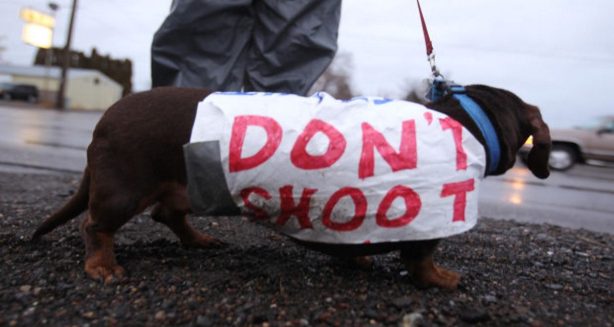
Consider that if you kill a police dog, you could face a longer prison sentence than if you’d murdered someone or abused a child.

If a cop kills your dog, however, there will be little to no consequences for that officer.

Not even a slap on the wrist.

In this, as in so many instances of official misconduct by government officials, the courts have ruled that the cops have qualified immunity, a legal doctrine that incentivizes government officials to engage in lawless behavior without fear of repercussions.

This is the heartless, heartbreaking, hypocritical injustice that passes for law and order in America today.

It is estimated that a dog is shot by a police officer “every 98 minutes.”

The Department of Justice estimates that at least 25 dogs are killed by police every day.

The Puppycide Database Project estimates the number of dogs being killed by police to be closer to 500 dogs a day (which translates to 182,000 dogs a year).

In 1 out of 5 cases involving police shooting a family pet, a child was either in the police line of fire or in the immediate area of a shooting. For instance, a 4-year-old girl was accidentally shot in the leg after a police officer opened fire on a dog running towards him, missed and hit the little girl instead.

At a time when police are increasingly inclined to shoot first and ask questions later, it doesn’t take much to provoke a cop into opening fire on an unarmed person guilty of doing nothing more than standing a certain way, or moving a certain way, or holding something—anything—that police could misinterpret to be a weapon.

All a cop has to do is cite an alleged “fear” for his safety.

According to the Sixth Circuit Court of Appeals, all it takes for dogs to pose a sufficient threat to police to justify them opening fire is for the dog to move or bark.

Even in the absence of an actual threat, the perception of a threat is enough for qualified immunity to kick in and for the cop to be let off the hook for behavior that would get the rest of us jailed for life.

As journalist Radley Balko points out, “In too much of policing today, officer safety has become the highest priority. It trumps the rights and safety of suspects. It trumps the rights and safety of bystanders. It’s so important, in fact, that an officer’s subjective fear of a minor wound from a dog bite is enough to justify using potentially lethal force.”

The epidemic of cops shooting dogs takes this shameful behavior to a whole new level, though.

It doesn’t take much for a cop to shoot a dog.

Dogs shot and killed by police have been “guilty” of nothing more menacing than wagging their tails, barking in greeting, or merely being in their own yard.

For instance, Spike, a 70-pound pit bull, was shot by NYPD police when they encountered him in the hallway of an apartment building in the Bronx. Surveillance footage shows the dog, tail wagging, right before an officer shot him in the head at pointblank range.

Arzy, a 14-month-old Newfoundland, Labrador and golden retriever mix, was shot between the eyes by a Louisiana police officer. The dog had been secured on a four-foot leash at the time he was shot. An independent witness testified that the dog never gave the officer any provocation to shoot him.

Seven, a St. Bernard, was shot repeatedly by Connecticut police in the presence of the dog’s 12-year-old owner. Police, investigating an erroneous tip, had entered the property—without a warrant—where the dog and her owner had been playing in the backyard, causing the dog to give chase.

Dutchess, a 2-year-old rescue dog, was shot three times in the head by Florida police as she ran out her front door. The officer had been approaching the house to inform the residents that their car door was open when the dog bounded out to greet him.

Yanna, a 10-year-old boxer, was shot three times by Georgia police after they mistakenly entered the wrong home and opened fire, killing the dog, shooting the homeowner in the leg and wounding an investigating officer.

Payton, a 7-year-old black Labrador retriever, and 4-year-old Chase, also a black Lab, were shot and killed after a SWAT team mistakenly raided the mayor’s home while searching for drugs. Police shot Payton four times. Chase was shot twice, once from behind as he ran away. “My government blew through my doors and killed my dogs. They thought we were drug dealers, and we were treated as such. I don’t think they really ever considered that we weren’t,” recalls Mayor Cheye Calvo, who described being handcuffed and interrogated for hours—wearing only underwear and socks—surrounded by the dogs’ carcasses and pools of the dogs’ blood.

In another instance, a Missouri SWAT team raided a family home, killing a 4-year-old pit bull Kiya. Believe it or not, this time the SWAT raid wasn’t in pursuit of drugs, mistaken or otherwise, but was intended “to check if [the] home had electricity and natural gas service.”

A dog doesn’t even have to be an aggressive breed to be shot by a cop.

Balko has documented countless “dog shootings in which a police officer said he felt ‘threatened’ and had no choice but to use lethal force, including the killing of a Dalmatian (more than once), a yellow Lab , a springer spaniel, a chocolate Lab, a boxer, an Australian cattle dog, a Wheaten terrier, an Akita… a Jack Russell terrier… a 12-pound miniature dachshund… [and] a five-pound chihuahua.”

Chihuahuas, among the smallest breed of dog (known as “purse” dogs), seem to really push cops over the edge.

In Arkansas, for example, a sheriff’s deputy shot an “aggressive” chihuahua for barking repeatedly. The dog, Reese’s, required surgery for a shattered jaw and a feeding tube to eat.

Same thing happened in Texas, except Trixie—who was on the other side of a fence from the officer—didn’t survive the shooting.

Let’s put this in perspective, shall we?

We’re being asked to believe that a police officer, fully armed, trained in combat and equipped to deal with the worst case scenario when it comes to violence, is so threatened by a yipping purse dog weighing less than 10 pounds that the only recourse is to shoot the dog?

If this is the temperament of police officers bred by the police state, we should all be worried.

Clearly, our four-legged friends are suffering at the hands of an inhumane police state in which the police have all the rights, the citizenry have very few rights, and our pets—viewed by the courts as personal property like a car or a house, but far less valuable—have no rights at all.

So what’s to be done?

Essentially, it comes down to training and accountability.

It’s the difference between police officers who rank their personal safety above everyone else’s and police officers who understand that their jobs are to serve and protect.

It’s the difference between police who are trained to shoot to kill and police trained to resolve situations peacefully.

Most of all, it’s the difference between police who believe the law is on their side and police who know that they will be held to account for their actions under the same law as everyone else.

Unfortunately, more and more police are being trained to view themselves as distinct from the citizenry, to view their authority as superior to the citizenry, and to view their lives as more precious than those of their citizen counterparts. Instead of being taught to see themselves as mediators and peacemakers whose lethal weapons are to be used as a last resort, they are being drilled into acting like gunmen with killer instincts who shoot to kill rather than merely incapacitate.

These dog killings are, as Balko recognizes, “a side effect of the new SWAT, paramilitary focus in many police departments, which has supplanted the idea of being an ‘officer of the peace.’”

Thus, whether you’re talking about police shooting dogs or citizens, the mindset is the same: a rush to violence, abuse of power, fear for officer safety, poor training in how to de-escalate a situation, and general carelessness.

It’s time to rein in this abuse of power.

A good place to start is by requiring police to undergo classes annually on how to peacefully resolve and de-escalate situations with the citizenry. While they’re at it, they should be forced to de-militarize. No one outside the battlefield—and barring a foreign invasion, the U.S. should never be considered a domestic battlefield—should be equipped with the kinds of weapons and gear being worn and used by local police forces today. If the politicians are serious about instituting far-reaching gun control measures, let them start by taking the guns and SWAT teams away from the countless civilian agencies that have nothing to do with military defense that are packing lethal heat.

Ultimately, this comes down to better—and constant—training in nonviolent tactics, serious consequences for those who engage in excessive force, and a seismic shift in how law enforcement agencies and the courts deal with those who transgress.

In terms of our four-legged friends, many states are adopting laws to make canine training mandatory for police officers. As dog behavior counselor Brian Kilcommons noted, officers’ inclination to “take command and take control” can cause them to antagonize dogs unnecessarily. Officers “need to realize they’re there to neutralize, not control… If they have enough money to militarize the police with Humvees, they have enough money to train them not to kill family members. And pets are considered family.”

After all, as the Washington Post points out, while “postal workers regularly encounter both vicious and gregarious dogs on their daily rounds… letter carriers don’t kill dogs, even though they are bitten by the thousands every year. Instead, the Postal Service offers its employees training on how to avoid bites.” Journalist Dale Chappell adds, “Using live dogs, handlers and trainers put postal workers through scenarios to teach them how to read a dog’s behavior and calm a dog, or fend it off, if necessary. Meter readers also have benefited from the same training, drastically reducing incidents of dog bites.”

The Rutherford Institute is working on a program aimed at training police to deescalate their interactions with dogs rather than resorting to lethal force, while providing pet owners with legal resources to better protect the four-legged members of their household.

Yet as I point out in my book Battlefield America: The War on the American People, there will be no end to the bloodshed—of unarmed Americans or their family pets—until police stop viewing themselves as superior to those whom they are supposed to serve and start acting like the peace officers they’re supposed to be.

WC: 1967

SOURCE: https://rutherford.org/publications_resources/john_whiteheads_commentary/dont_shoot_the_dogs_the_growing_epidemic_of_cops_shooting_family_dogs

ABOUT JOHN W. WHITEHEAD

Constitutional attorney and author John W. Whitehead is founder and president of The Rutherford Institute. His book Battlefield America: The War on the American People is available online at http://www.amazon.com. Whitehead can be contacted at johnw@rutherford.org.

Publication Guidelines / Reprint Permission

John W. Whitehead’s weekly commentaries are available for publication to newspapers and web publications at no charge. Please contact staff@rutherford.org to obtain reprint permission.
If a nation expects to be ignorant and free in a state of civilization, it expects what never was and never will be.”—Thomas Jefferson

We are approaching critical mass, the point at which all hell breaks loose.

The government is pushing us ever closer to a constitutional crisis.

What makes the outlook so much bleaker is the utter ignorance of the American people—and those who represent them—about their freedoms, history, and how the government is supposed to operate.

As Morris Berman points out in his book Dark Ages America, “70 percent of American adults cannot name their senators or congressmen; more than half don’t know the actual number of senators, and nearly a quarter cannot name a single right guaranteed by the First Amendment. Sixty-three percent cannot name the three branches of government. Other studies reveal that uninformed or undecided voters often vote for the candidate whose name and packaging (e.g., logo) are the most powerful; color is apparently a major factor in their decision.”

More than government corruption and ineptitude, police brutality, terrorism, gun violence, drugs, illegal immigration or any other so-called “danger” that threatens our nation, civic illiteracy may be what finally pushes us over the edge.

As Thomas Jefferson warned, no nation can be both ignorant and free.

Unfortunately, the American people have existed in a technology-laden, entertainment-fueled, perpetual state of cluelessness for so long that civic illiteracy has become the new normal for the citizenry.

It’s telling that Americans were more able to identify Michael Jackson as the composer of a number of songs than to know that the Bill of Rights was the first 10 amendments to the U.S. Constitution.

In fact, most immigrants who aspire to become citizens know more about national civics than native-born Americans. Surveys indicate that half of native-born Americans couldn’t correctly answer 70% of the civics questions on the U.S. Citizenship test.

Not even the government bureaucrats who are supposed to represent us know much about civics, American history and geography, or the Constitution although they take an oath to uphold, support and defend the Constitution against “enemies foreign and domestic.”

For instance, a couple attempting to get a marriage license was recently forced to prove to a government official that New Mexico is, in fact, one of the 50 states and not a foreign country.

You can’t make this stuff up.

Here’s a classic example of how surreal the landscape has become.

Just in time for Bill of Rights Day on December 15, President Trump issued a proclamation affirming the importance of the Bill of Rights in guarding against government abuses of power.

“The Founding Fathers understood the real threat government can pose to the rights of the people… That is why those first 10 Amendments to the Constitution, among others, protected the right to speak freely, the right to freely worship, the right to keep and bear arms, the right to be free from unreasonable searches and seizures, and the right to due process of law. As a part of the Constitution, the supreme law of the land, the Bill of Rights has protected our rights effectively against the abuse of government power for 227 years… Since there will always be a temptation for government to abuse its power, we reaffirm our commitment to defend the Bill of Rights and uphold the Constitution.”

Don’t believe it for a second.

The government doesn’t want its abuses checked and it certainly doesn’t want its powers restricted.

For that matter, this is not a president who holds the Constitution in high esteem.

After all, Trump routinely rails against the rights enshrined in the first ten amendments to the Constitutiondecrying the free speech rights of protesters, denouncing the media (which enjoys freedom of the press) as the enemy of the people, supporting government efforts to seize private property through asset forfeiture and eminent domain, refusing to denounce the use of internment camps to detain American citizens, sneering at due process, and encouraging police officers to use excessive force against suspects.

As law professor Garrett Epps notes:

Donald Trump ran on a platform of relentless, thoroughgoing rejection of the Constitution itself, and its underlying principle of democratic self-government and individual rights. True, he never endorsed quartering of troops in private homes in time of peace, but aside from that there is hardly a provision of the Bill of Rights or later amendments he did not explicitly promise to override, from First Amendment freedom of the press and of religion to Fourth Amendment freedom from ‘unreasonable searches and seizures’ to Sixth Amendment right to counsel to Fourteenth Amendment birthright citizenship and Equal Protection and Fifteenth Amendment voting rights.”

To be fair, it’s not all Trump’s fault.

Indeed, we wouldn’t be in this sorry state if it weren’t for Presidents Barack Obama and George W. Bush and the damage their administrations inflicted on the freedoms enshrined in the Bill of Rights, which historically served as the bulwark from government abuse.

In the so-called named of national security, since 9/11, the Constitution has been steadily chipped away at, undermined, eroded, whittled down, and generally discarded to such an extent that what we are left with is but a shadow of the robust document adopted more than two centuries ago.

The Bill of Rights—462 words that represent the most potent and powerful rights ever guaranteed to a group of people officially—became part of the U.S. Constitution on December 15, 1791, because early Americans such as James Madison and Thomas Jefferson understood the need to guard against the government’s inclination to abuse its power.

Yet the reality we must come to terms with is that in the America we live in today, the government does whatever it wants.

Make no mistake: if our individual freedoms have been restricted, it is only so that the government’s powers could be expanded at our expense.

The USA Patriot Act, passed in the wake of the 9/11 attacks, drove a stake through the heart of the Bill of Rights, violating at least six of the ten original amendments—the First, Fourth, Fifth, Sixth, Seventh and Eighth Amendments—and possibly the Thirteenth and Fourteenth Amendments, as well. The Patriot Act also redefined terrorism so broadly that many non-terrorist political activities such as protest marches, demonstrations and civil disobedience were considered potential terrorist acts, thereby rendering anyone desiring to engage in protected First Amendment expressive activities as suspects of the surveillance state.

Since 9/11, we’ve been spied on by surveillance cameras, eavesdropped on by government agents, had our belongings searched, our phones tapped, our mail opened, our email monitored, our opinions questioned, our purchases scrutinized (under the USA Patriot Act, banks are required to analyze your transactions for any patterns that raise suspicion and to see if you are connected to any objectionable people), and our activities watched.

We’ve also been subjected to invasive patdowns and whole-body scans of our persons and seizures of our electronic devices in the nation’s airports and at border crossings. We can’t even purchase certain cold medicine at the pharmacy anymore without it being reported to the government and our names being placed on a watch list.

Government surveillance, militarized police, SWAT team raids, asset forfeiture, eminent domain, overcriminalization, armed surveillance drones, whole body scanners, stop and frisk searches (all sanctioned by Congress, the White House, the courts and the like), etc.: these are merely the weapons of the police state.

The power of the police state is dependent on a populace that meekly obeys without question.

Remember: when it comes to the staggering loss of civil liberties, the Constitution hasn’t changed. Rather, it is the American people who have changed.

Those who gave us the Constitution and the Bill of Rights believed that the government exists at the behest of its citizens. The government’s purpose is to protect, defend and even enhance our freedoms, not violate them.

It was no idle happenstance that the Constitution opens with these three powerful words: “We the people.” Those who founded this country knew quite well that every citizen must remain vigilant or freedom would be lost. As Thomas Paine recognized, “It is the responsibility of the patriot to protect his country from its government.”

You have no rights unless you exercise them.

Still, you can’t exercise your rights unless you know what those rights are.

“If Americans do not understand the Constitution and the institutions and processes through which we are governed, we cannot rationally evaluate important legislation and the efforts of our elected officials, nor can we preserve the national unity necessary to meaningfully confront the multiple problems we face today,” warns the Brennan Center in its Civic Literacy Report Card. “Rather, every act of government will be measured only by its individual value or cost, without concern for its larger impact. More and more we will ‘want what we want, and [will be] convinced that the system that is stopping us is wrong, flawed, broken or outmoded.’”

Education precedes action.

As the Brennan Center concludes “America, unlike most of the world’s nations, is not a country defined by blood or belief. America is an idea, or a set of ideas, about freedom and opportunity. It is these ideas that bind us together as Americans and have kept us free, strong, and prosperous. But these ideas do not perpetuate themselves. They must be taught and learned anew with each generation.”

There is a movement underway to require that all public-school students pass the civics portion of the U.S. naturalization test100 basic facts about U.S. history and civics—before receiving their high-school diploma, and that’s a start.

Mind you, it’s only the first of many steps.

If there is to be any hope for restoring our freedoms and reclaiming our runaway government, we will have to start by breathing life into those three powerful words that set the tone for everything that follows in the Constitution: “we the people.”

People get the government they deserve.

As David Fouse writes for National Review, “A government by the people, for the people, and of the people is only as wise, as just, and as free as the people themselves.

It’s up to us.

We have the power to make and break the government.

We the American people—the citizenry—are the arbiters and ultimate guardians of America’s welfare, defense, liberty, laws and prosperity.

It’s time to stop waiting patiently for change to happen. Do more than grouse and complain.

We must act—and act responsibly.

Get outraged, get off your duff and get out of your house, get in the streets, get in people’s faces, get down to your local city council, get over to your local school board, get your thoughts down on paper, get your objections plastered on protest signs, get your neighbors, friends and family to join their voices to yours, get your representatives to pay attention to your grievances, get your kids to know their rights, get your local police to march in lockstep with the Constitution, get your media to act as watchdogs for the people and not lapdogs for the corporate state, get your act together, and get your house in order.

In other words, get moving.

A healthy, representative government is hard work. It takes a citizenry that is informed about the issues, educated about how the government operates, and willing to make the sacrifices necessary to stay involved, whether that means forgoing Monday night football in order to attend a city council meeting or risking arrest by picketing in front of a politician’s office.

Don’t wait for things to get as bad as they are in France, where civil unrest over a government  proposal to raise taxes on gas has turned into violent clashes between protesters and the police.

Whatever you do, please don’t hinge your freedoms on politics.

No election will ever truly alleviate the suffering of the American people.

No matter which party controls Congress or the White House, the government as we have come to know it—corrupt, bloated and controlled by big-money corporations, lobbyists and special interest groups—remains largely unchanged. And “we the people”—overtaxed, overpoliced, overburdened by big government, underrepresented by those who should speak for us and blissfully ignorant of the prison walls closing in on us—continue to trudge along a path of misery.

Remember what Noam Chomsky had to say about politics? “It is important to bear in mind that political campaigns are designed by the same people who sell toothpaste and cars.

In other words, as I make clear in my book Battlefield America: The War on the American People, we’re being sold a carefully crafted product by a monied elite who are masters in the art of making the public believe that they need exactly what is being sold to them, whether it’s the latest high-tech gadget, the hottest toy, or the most charismatic politician.

It’s just another Blue Pill, a manufactured reality conjured up by the matrix in order to keep the populace compliant and convinced that their vote counts and that they still have some influence over the political process.

Don’t buy any of it.

The Constitution is neutral when it comes to politics. What the Constitution is not neutral about, however, is the government’s duty to safeguard the rights of the citizenry.

“We the people” also have a duty that goes far beyond the act of voting: it’s our job to keep freedom alive using every nonviolent means available to us.

As Martin Luther King Jr. recognized in a speech delivered on December 5, 1955, just four days after Rosa Parks was arrested for refusing to relinquish her seat on a Montgomery city bus: “Democracy transformed from thin paper to thick action is the greatest form of government on earth.”

Know your rights. Exercise your rights. Defend your rights. If not, you will lose them.

WC: 2311

ABOUT JOHN W. WHITEHEAD

Constitutional attorney and author John W. Whitehead is founder and president of The Rutherford Institute. His new book Battlefield America: The War on the American People  (SelectBooks, 2015) is available online at http://www.amazon.com. Whitehead can be contacted at johnw@rutherford.org.

Publication Guidelines / Reprint Permission

John W. Whitehead’s weekly commentaries are available for publication to newspapers and web publications at no charge. Please contact staff@rutherford.org to obtain reprint permission.


“This Christmas season finds us a rather bewildered human race. We have neither peace within nor peace without. Everywhere paralyzing fears harrow people by day and haunt them by night. Our world is sick with war; everywhere we turn we see its ominous possibilities. And yet, my friends, the Christmas hope for peace and goodwill toward all men can no longer be dismissed as a kind of pious dream of some utopian. If we don’t have goodwill toward men in this world, we will destroy ourselves by the misuse of our own instruments and our own power.”— Martin Luther King, Jr., “A Christmas Sermon on Peace”

To a nation of snowflakes, Christmas has become yet another trigger word.

The latest Christmas casualties in the campaign to create one large national safe space are none other than the beloved animated classic Rudolph the Red-Nosed Reindeer (denounced for promoting bullying and homophobia) which first aired on television on December 6, 1964, and the Oscar-winning tune “Baby, It’s Cold Outside” (accused of being a date rape anthem) crooned by everyone from Dean Martin to Will Ferrell and Zooey Deschanel in the movie Elf.

Also on the endangered species Christmas list are such songs as “Deck the Halls” (it supposedly promotes “gay” apparel), “Santa Baby” (it has been denounced for “slut shaming”), and “White Christmas” (perceived as being racist).

One publishing company even re-issued their own redacted version of Clement Clarke Moore’s famous poem “Twas the night before Christmas” in order to be more health conscious: the company edited out Moore’s mention of Santa smoking a pipe (“The stump of a pipe he held tight in his teeth, / And the smoke, it encircled his head like a wreath.”)

Oh the horror.

After a year plagued with its fair share of Scrooges and Grinches and endless months of being mired in political gloom and doom, we could all use a little Christmas cheer right now.

Unfortunately, the politically charged Right and Left have been trying to score points off each other for so long, using whatever means available, that even Christmas has been weaponized.

Yet just because the War on Christmas has been adopted as a war cry by Donald Trump doesn’t mean that it’s not real.

Look around you.

When I was a child in the 1950s, the magic of Christmas was promoted in the schools. We sang Christmas carols in the classroom. There were cutouts of the Nativity scene on the bulletin board, along with the smiling, chubby face of Santa and Rudolph. We were all acutely aware that Christmas was magic.

Fast forward to the present day, and there is a phobia surrounding Christmas that has turned it into fodder for the politically correct culture wars.

Indeed, in its “Constitutional Q&A: Twelve Rules of Christmas,” The Rutherford Institute points out that some communities, government agencies and businesses have gone to great lengths to avoid causing offense over Christmas.

Examples abound.

Schools across the country now avoid anything that alludes to the true meaning of Christmas such as angels, the baby Jesus, stables and shepherds.

In many of the nation’s schools, Christmas carols, Christmas trees, wreaths and candy canes have also been banned as part of the effort to avoid any reference to Christmas, Christ or God. One school even outlawed the colors red and green, saying they were Christmas colors and, thus, illegal.

Students asked to send seasonal cards to military troops have been told to make them “holiday cards” and instructed not to use the words “Merry Christmas” on their cards.

Many schools have redubbed their Christmas concerts as “winter holiday programs” and refer to Christmas as a “winter festival.” Some schools have cancelled holiday celebrations altogether to avoid offending those who do not celebrate the various holidays.

In Minnesota, a charter school banned the display of a poster prepared to promote the school’s yearbook as a holiday gift because the poster included Jack Skellington from Tim Burton’s The Nightmare Before Christmas and other secular Christmas icons, not to mention the word “Christmas.”

In New Jersey, one school district banned traditional Christmas songs such as “Joy to the World” and “Silent Night” from its holiday concerts.  A New Jersey middle school cancelled a field trip to attend a performance of a play based on Charles Dickens’s “A Christmas Carol” because some might have found it “offensive.”

In Texas, a teacher who decorated her door with a scene from “A Charlie Brown Christmas,” including a scrawny tree and Linus, was forced to take it down lest students be offended or feel uncomfortable.

In Connecticut, teachers were instructed to change the wording of the classic poem “Twas the Night Before Christmas” to “Twas the Night Before a Holiday.”

In Virginia, a high school principal debated about whether he could mention Santa or distribute candy canes given that they were symbols of Christmas.

In Massachusetts, a fourth-grade class was asked to list 25 things that reminded them of Christmas. When one young student asked if she could include “Jesus,” her teacher replied that she could get fired if Christmas’ namesake appeared on the list.

Things are not much better outside the schools.

In one West Virginia town, although the manger scene (one of 350 light exhibits in the town’s annual Festival of Lights) included shepherds, camels and a guiding star, the main attractions—Jesus, Mary and Joseph—were nowhere to be found due to concerns about the separation of church and state.

In Chicago, organizers of a German Christkindlmarket were informed that the public Christmas festival was no place for the Christmas story. Officials were concerned that clips of the film “The Nativity Story,” which were to be played at the festival, might cause offense.

In Delaware, a Girl Scout troop was prohibited from carrying signs reading “Merry Christmas” in their town’s annual holiday parade.

While the First Amendment Establishment Clause prohibits the government from forcing religion on people or endorsing one particular religion over another, there is no legitimate legal reason why people should not be able to celebrate the season freely or wish each other a Merry Christmas or even mention the word Christmas.

The Rutherford Institute’s “Twelve Rules of Christmas” guidelines are helpful in dealing with folks who subscribe to the misguided notion that the law requires anything Christmas in nature be banned from public places.

Yet here’s the thing about this so-called War on Christmas that people don’t seem to get: while Christmas may be the “trigger” for purging Christmas from public places, government forums and speech—except when it profits Corporate America—it is part and parcel of the greater trend in recent years to whittle away at free speech and trample the First Amendment underfoot.

Claiming to promote tolerance and diversity while seeking a homogeneous mindset, many workplaces, schools and public places have become intolerant of any but the most politically correct viewpoints.

Anything that might raise the specter of controversy is avoided at all costs.

We are witnessing the emergence of an unstated yet court-sanctioned right, one that makes no appearance in the Constitution and yet seems to trump the First Amendment at every turn: the right to not be offended.

In this way, emboldened by phrases such as “hate crimes,” “bullying,” “extremism” and “microaggressions,” free speech has been confined to carefully constructed “free speech zones,” criminalized when it skates too close to challenging the status quo, shamed when it butts up against politically correct ideals, and muzzled when it appears dangerous.

This is censorship, driven by a politically correct need to pander to those who are easily offended.

Where you see this “safe space” mindset really play out is in the nation’s public schools, which continue to adopt policies—such as zero tolerance policies—that promise to steer young people clear of anything that even hints at danger, controversy or non-politically correct thinking.

Unfortunately, all too often it is common sense and individual liberty that get trampled underfoot: a student gets suspended under the school’s zero tolerance policy against drugs for chewing on a Certs breath mint; a kindergartner is suspended under the school’s zero tolerance policy against violence for playing a make-believe game of cops and robbers using his finger as a gun; and a school trip to see “A Christmas Carol” is cancelled because of the school’s zero tolerance policy against anything that is in any way offensive.

What’s worse, the motto today seems to be “When in doubt, throw it out.”

At the slightest hint of trouble, government officials (and corporations) are inclined to chuck anything that might be objectionable. So whereas Mark Twain’s classic “Huckleberry Finn” used to at least make the list of banned books every year, it now rarely even makes an appearance on school reading lists. It has been scrubbed out of existence.

See how that works?

Zero tolerance policies are ultimately about programming people into compliance with the government’s dictates.

The government doesn’t care about Christmas. It cares about control.

By government, I’m talking about the entrenched government bureaucracy that really calls the shots no matter what political party controls Congress and the White House.

Never forget, the police state wants us to be a nation of snowflakes, snitches and book burners: a legalistic, intolerant, elitist, squealing bystander nation willing to turn on each other and turn each other in for the slightest offense.

All of the petty sniping over Melania Trump’s red-themed Christmas decorations?

That plays perfectly into the Deep State’s efforts to keep the citizenry at odds with each other and incapable of presenting a united front against the threats posed by the government and its cabal of Constitution-destroying agencies and corporate partners.

You want to know why this country is in the state it’s in?

As I make clear in my book Battlefield America: The War on the American People, the answer is the same no matter what the problem might be, whether it’s the economy, government corruption, police brutality, endless wars, censorship, falling literacy rates, etc.: every one of these problems can be sourced back to the fact that “we the people” have stopped thinking for ourselves and relinquished responsibility for our lives and well-being to a government entity that sees us only as useful idiots.

The Greek philosopher Socrates believed in teaching people to think for themselves and in the free exchange of ideas. For his efforts, he was accused of corrupting the youth and was put to death. However, his legacy lived on in the Socratic method of teaching: posing questions that help young and old discover the answers by learning to think for themselves.

Now even the Socratic method is in danger of extinction.

As Rod Serling, creator of the classic sci-fi series Twilight Zone and one of the most insightful commentators on human nature, once observed, “We’re developing a new citizenry. One that will be very selective about cereals and automobiles, but won’t be able to think.”

We face an immense threat in our society from this drive to obliterate our history and traditions in order to erect a saccharine view of reality. In the process, we are creating a schizophrenic world for our children to grow up in, and it is neither healthy nor will it produce the kind of people who will be able to face the challenges of a future ruled by a totalitarian regime.

You can’t sanitize reality. You can’t scrub out of existence every unpleasant thought or idea. You can’t legislate tolerance. You can’t create enough safe spaces to avoid the ugliness that lurks in the hearts of men and women. You can’t fight ignorance with the weapons of a police state.

What you can do, however, is step up your game.

Opt for kindness over curtness, and civility over censorship. Choose peace over politics, and freedom over fascism. Find common ground with those whose politics or opinions or lifestyles may not jive with your own.

Do your part to make the world a little brighter and a little lighter, and maybe, just maybe, we’ll have a chance of digging our way out of this hole.

WC: 2014

ABOUT JOHN W. WHITEHEAD

Constitutional attorney and author John W. Whitehead is founder and president of The Rutherford Institute. His new book Battlefield America: The War on the American People  (SelectBooks, 2015) is available online at http://www.amazon.com. Whitehead can be contacted at johnw@rutherford.org.

Publication Guidelines / Reprint Permission

John W. Whitehead’s weekly commentaries are available for publication to newspapers and web publications at no charge. Please contact staff@rutherford.org to obtain reprint permission.


The freedom of individuals verbally to oppose or challenge police action without thereby risking arrest is one of the principal characteristics by which we distinguish a free nation from a police state.”— Justice William J. Brennan, City of Houston v. Hill

What the architects of the police state want are submissive, compliant, cooperative, obedient, meek citizens who don’t talk back, don’t challenge government authority, don’t speak out against government misconduct, and don’t step out of line.

What the First Amendment protects—and a healthy constitutional republic requires—are citizens who routinely exercise their right to speak truth to power.

It’s not an easy undertaking.

Weaponized by police, prosecutors, courts and legislatures, “disorderly conduct” charges have become a convenient means by which to punish those individuals who refuse to be muzzled.

Cases like these have become all too common, typical of the bipolar nature of life in the American police state today: you may have distinct, protected rights on paper, but dare to exercise those rights and you put yourself at risk for fines, arrests, injuries and even death.

This is the unfortunate price of freedom.

Yet these are not new developments.

We have been circling this particular drain hole for some time now.

Almost 50 years ago, in fact, Lewis Colten was arrested outside Lexington, Kentucky, for questioning police and offering advice to his friend during a traffic stop.

Colten was one of 20 or so college students who had driven to the Blue Grass Airport to demonstrate against then-First Lady Pat Nixon. Upon leaving the airport, police stopped one of the cars in Colten’s motorcade because it bore an expired, out-of-state license plate. Colten and the other drivers also pulled over to the side of the road.

Fearing violence on the part of the police, Colten exited his vehicle and stood nearby while police issued his friend, Mendez, a ticket and arranged to tow his car. Police repeatedly asked Colten to leave. At one point, a state trooper declared, “This is none of your affair . . . get back in your car and please move on and clear the road.”

Insisting that he wanted to make a transportation arrangement for his friend Mendez and the occupants of the Mendez car, Colten failed to move away and was arrested for violating Kentucky’s disorderly conduct statute.

Colten subsequently challenged his arrest as a violation of his First Amendment right to free speech and took the case all the way to the U.S. Supreme Court, which sided with the police.

Although the Court acknowledged that Colten was not trespassing or disobeying any traffic regulation himself, the majority affirmed that Colten “had no constitutional right to observe the issuance of a traffic ticket or to engage the issuing officer in conversation at that time.”

The Supreme Court’s bottom line: protecting police from inconvenience, annoyance or alarm is more important than protecting speech that, in the government’s estimation, has “no social value.”

While the ruling itself was unsurprising for a judiciary that tends to march in lockstep with the police, the dissent by Justice William O. Douglas is a powerful reminder that the government exists to serve the people and not the other way around.

Stressing that Colten’s speech was quiet, not boisterous, devoid of “fighting words,” and involved no overt acts, fisticuffs, or disorderly conduct in the normal meaning of the words, Douglas took issue with the idea that merely by speaking to a government representative, in this case the police—a right enshrined in the First Amendment, by the way—Colten was perceived as inconveniencing and annoying the police.

In a passionate defense of free speech, Douglas declared:

Since when have we Americans been expected to bow submissively to authority and speak with awe and reverence to those who represent us? The constitutional theory is that we the people are the sovereigns, the state and federal officials only our agents. We who have the final word can speak softly or angrily. We can seek to challenge and annoy, as we need not stay docile and quiet. The situation might have indicated that Colten’s techniques were ill-suited to the mission he was on, that diplomacy would have been more effective. But at the constitutional level speech need not be a sedative; it can be disruptive.

It’s a power-packed paragraph full of important truths that the powers-that-be would prefer we quickly forget: We the people are the sovereigns. We have the final word. We can speak softly or angrily. We can seek to challenge and annoy. We need not stay docile and quiet. Our speech can be disruptive. It can invite dispute. It can be provocative and challenging. We do not have to bow submissively to authority or speak with reverence to government officials.

Now in theory, “we the people” have a constitutional right to talk back to the government.

In fact, the U.S. Supreme Court concluded as much in City of Houston v. Hill when it struck down a city ordinance prohibiting verbal abuse of police officers as unconstitutionally overbroad and a criminalization of protected speech.

In practice, however, talking back—especially when the police are involved—can get you killed.

The danger is real.

We live in an age in which “we the people” are at the mercy of militarized, weaponized, immunized cops who have almost absolute discretion to decide who is a threat, what constitutes resistance, and how harshly they can deal with the citizens they were appointed to “serve and protect.”

While violent crime in America remains at an all-time low, the death toll as a result of police-sponsored violence continues to rise. In fact, more than 1,000 people are killed every year by police in America, more than any other country in the world.

What we are dealing with is a nationwide epidemic of court-sanctioned police violence carried out against individuals posing little or no real threat.

I’m not talking about the number of individuals—especially young people—who are being shot and killed by police for having a look-alike gun in their possession, such as a BB gun. I’m not even talking about people who have been shot for brandishing weapons at police, such as scissors.

I’m talking about the growing numbers of unarmed people are who being shot and killed for just standing a certain way, or looking a certain way, or moving a certain way, or not moving fast enough, or asking a question, or not answering a question, or holding something—anything—that police could misinterpret to be a gun, or igniting some trigger-centric fear in a police officer’s mind that has nothing to do with an actual threat to their safety.

This is not what life should be like in a so-called “free” country.

Police encounters have deteriorated so far that anything short of compliance—including behavior the police perceive as disrespectful or “insufficiently deferential to their authority,” “threatening” or resistant—could get you arrested, jailed or killed.

The problem, of course, is that compliance is rarely enough to guarantee one’s safety.

Case in point: Miami-Dade police slammed a 14-year-old boy to the ground, putting him in a chokehold and handcuffing him after he allegedly gave them “dehumanizing stares” and walked away from them, which the officers found unacceptable.

According to Miami-Dade Police Detective Alvaro Zabaleta, “His body language was that he was stiffening up and pulling away… When you have somebody resistant to them and pulling away and somebody clenching their fists and flailing their arms, that’s a threat. Of course we have to neutralize the threat.

This mindset that any challenge to police authority is a threat that needs to be “neutralized” is a dangerous one that is part of a greater nationwide trend that sets the police beyond the reach of the First and Fourth Amendments.

When police officers are allowed to operate under the assumption that their word is law and that there is no room for any form of disagreement or even question, that serves to destroy the First Amendment’s assurances of free speech, free assembly and the right to petition the government for a redress of grievances.

Then again, this is what happens when you take a police recruit, hype him (or her) up on the power of the gun in his holster and the superiority of his uniform, render him woefully ignorant of how to handle a situation without resorting to violence, drill him in military tactics but keep him in the dark about the Constitution, and never stress to him that he is to be a peacemaker and a peacekeeper, respectful of and subservient to the taxpayers, who are in fact his masters and employers.

The problem, as one reporter rightly concluded, is “not that life has gotten that much more dangerous, it’s that authorities have chosen to respond to even innocent situations as if they were in a warzone.”

What we’re dealing with today is a skewed shoot-to-kill mindset in which police, trained to view themselves as warriors or soldiers in a war, whether against drugs, or terror, or crime, must “get” the bad guys—i.e., anyone who is a potential target—before the bad guys get them.

Never mind that the fatality rate of on-duty police officers is reportedly far lower than many other professions, including construction, logging, fishing, truck driving, and even trash collection.

The result of this battlefield approach to domestic peacekeeping is a society in which police shoot first and ask questions later.

The message being drummed into our heads with every police shooting of an unarmed citizen is this: if you don’t want to get probed, poked, pinched, tasered, tackled, searched, seized, stripped, manhandled, arrested, shot, or killed, don’t say, do or even suggest anything that even hints of noncompliance.

This is the “thin blue line” over which you must not cross in interactions with police if you want to walk away with your life and freedoms intact.

If ever there were a time to scale back on the mindset adopted by cops that they are the law and should be revered, feared and obeyed, it’s now.

It doesn’t matter where you live—big city or small town—it’s the same scenario being played out over and over again in which government agents, hyped up on their own authority and the power of their uniform, ride roughshod over the rights of the citizenry.

Americans as young as 4 years old are being leg shackledhandcuffedtasered and held at gun point for not being quiet, not being orderly and just being childlike—i.e., not being compliant enough.

Americans as old as 95 are being beaten, shot and killed for questioning an order, hesitating in the face of a directive, and mistaking a policeman crashing through their door for a criminal breaking into their home—i.e., not being submissive enough.

And Americans of every age and skin color are being taught the painful lesson that the only truly compliant, submissive and obedient citizen in a police state is a dead one.

As a result, Americans are being brainwashed into believing that anyone who wears a government uniform—soldier, police officer, prison guard—must be obeyed without question.

Of course, the Constitution takes a far different position, but does anyone in the government even read, let alone abide by, the Constitution anymore?

If we just cower before government agents and meekly obey, we may find ourselves following in the footsteps of those nations that eventually fell to tyranny.

The alternative involves standing up and speaking truth to power. Jesus Christ walked that road. So did Mahatma Gandhi, Martin Luther King Jr., and countless other freedom fighters whose actions changed the course of history.

As I make clear in my book Battlefield America: The War on the American People, the American dream was built on the idea that no one is above the law, that our rights are inalienable and cannot be taken away, and that our government and its appointed agents exist to serve us.

It may be that things are too far gone to save, but still we must try.

WC: 2215

ABOUT JOHN W. WHITEHEAD

Constitutional attorney and author John W. Whitehead is founder and president of The Rutherford Institute. His book Battlefield America: The War on the American People  is available online at http://www.amazon.com. Whitehead can be contacted at johnw@rutherford.org.

Publication Guidelines / Reprint Permission

John W. Whitehead’s weekly commentaries are available for publication to newspapers and web publications at no charge. Please contact staff@rutherford.org to obtain reprint permission.


“As we express our gratitude, we must never forget that the highest appreciation is not to utter words, but to live by them.”—John F. Kennedy

Listen: I know it’s been a hard, heart-wrenching, stomach-churning kind of year.

It’s been a year of hotheads and blowhards and killing sprees and bloodshed and takedowns.

It’s been a year in which tyranny took a few more steps forward and freedom got knocked down a few more notches.

It’s been a year with an abundance of bad news and a shortage of good news.

It’s been a year of too much hate and too little kindness.

It’s been a year in which politics and profit margins took precedence over decency, compassion and human-kindness.

We’ve been operating in this soul-sucking, topsy-turvy, inside-out, upside-down state for so long that it’s hard not to be overwhelmed by all that is wrong in the world in order to reflect and give thanks for what is good.

And now we find ourselves at this present moment, more than 200 years after George Washington issued the first Thanksgiving proclamation as a time to give thanks for a government whose purpose was to ensure the safety and happiness of its people and for a Constitution designed to safeguard civil and religious liberty.

But how do you give thanks for freedoms that are constantly being eroded?

How do you express gratitude for one’s safety when the perils posed by the American police state grow more treacherous by the day?

How do you come together as a nation in thanksgiving when the powers-that-be continue to polarize and divide us into warring factions?

Washington didn’t intend Thanksgiving to be a day for offering up glib platitudes that require no thought, no effort and no sacrifice. He wanted it to be a day of contemplation, in which we frankly assessed our shortcomings, acknowledged our wrongdoings, and resolved to be a better, more peaceable nation in the year to come.

Here’s what I know: this Thanksgiving finds us saddled with a government that is a far cry from Washington’s vision of a government that is:

  • governed by wise, just and constitutional laws
  • faithfully executed and obeyed by its agents
  • assisting foreign nations with good government, peace, and concord
  • promoting true religion, virtue and science
  • and enabling temporal prosperity.

Rather, with every passing day, the U.S. government more closely resembles an evil empire, governed by laws that are rash, unjust and unconstitutional; policed by government agents who are corrupt, hypocritical and abusive; a menace to its own people; and the antithesis of everything Washington hoped the government would be—a blessing to all the people.

Here’s a prime example of how out of whack things have become: just recently, government officials in Kansas City confiscated large quantities of food being served to homeless people and soaked them in bleach, rendering them inedible.

Why would the government poison food intended for the homeless?

According to city health officials, the soup kitchen providing the free food didn’t have sufficient permits to prepare and serve food, even if that food was being handed out for free.

The government’s rationale: it’s better to allow the homeless to starve than risk them getting sick from a food-borne illness since many have no health insurance.

There are people in this country who are homeless, hungry and in need of any small act of kindness, so why is the government placing bureaucratic roadblocks in the path of those who want to help?

I’m sorry, but this isn’t just misguided government officials run amok.

This is evil disguised as bureaucracy.

This is what Hannah Arendt referred to as the banality of evil.

Evil has a broad spectrum, and poisoning food for the homeless is by no means as monstrous as killing innocent people, but still… evil is evil.

This is what happens when the government is run by bureaucrats who unquestioningly carry out orders that are immoral, inhumane and evil; obey immoral instructions unthinkingly; march in lockstep with tyrants; mindlessly perpetuate acts of terror and inhumanity; and justify it all as just “doing one’s job.”

To that list, let me add one more: a populace that remains silent in the face of wrongdoing.

This is how evil prevails: when good men and women do nothing.

By doing nothing, by remaining silent, by being bystanders to injustice, hate and wrongdoing, good people become as guilty as the perpetrator.

There’s a term for this phenomenon where people stand by, watch and do nothing—even when there is no risk to their safety—while some horrific act takes place (someone is mugged or raped or bullied or left to die): it’s called the bystander effect.

It works the same whether you’re talking about kids watching bullies torment a fellow student on a playground, bystanders watching someone dying on a sidewalk, or citizens remaining silent in the face of government atrocities.

The stories are legion.

For example, there was the 15-year-old girl who was gang raped in a schoolyard during a homecoming dance. As many as 20 people witnessed the assault over the course of two and a half hours. No one intervened to stop it.

A 28-year-old woman was stabbed, raped and murdered outside her apartment early in the morning. Thirty-eight bystanders witnessed the attack and failed to intervene. The woman died from her wounds at the locked doorway to her apartment building.

A 58-year-old man waded into chest-deep water in the San Francisco Bay in an apparent suicide attempt. For an hour, Raymond Zack stood in the shallow water while 75 onlookers watched. Police and firefighters were called in but failed to intervene, citing budget cuts, a lack of training in water rescue, fear for their safety and a lack of proper equipment. The man eventually passed out and later died of hypothermia. Eventually, an onlooker volunteered to bring the body back to the beach.

A homeless man intervened to save a woman from a knife-wielding attacker. He saved the woman but was stabbed repeatedly in the process. As The Guardian reports, “For more than an hour he lay dying in a pool of his own blood as dozens walked by. Some paused to stare, others leaned in close. One even shook his body and then left, while someone else recorded a video of the entire proceeding.”

We need to stop being silent bystanders.

So what can you do about this bystander effect?

Be a hero, suggests psychologist Philip Zimbardo.

Each of us has an inner hero we can draw upon in an emergency,” Zimbardo concluded. “If you think there is even a possibility that someone needs help, act on it. You may save a life. You are the modern version of the Good Samaritan that makes the world a better place for all of us.”

Zimbardo is the psychologist who carried out the Stanford Prison Experiment which studied the impact of perceived power and authority on middleclass students who were assigned to act as prisoners and prison guards. The experiment revealed that power does indeed corrupt (the appointed guards became increasingly abusive), and those who were relegated to being prisoners acted increasingly “submissive and depersonalized, taking the abuse and saying little in protest.”

What is the antidote to group think and the bystander effect?

Be an individual. Listen to your inner voice. Take responsibility.

“If you find yourself in an ambiguous situation, resist the urge to look to others and go with your gut instinct,” advises Melissa Burkley in Psychology Today. “If you think there is even a possibility that someone is in need, act on it. At worst, you will embarrass yourself for a few minutes, but at best, you will save a life.”

“Even if people recognize that they are witnessing a crime, they may still fail to intervene if they do not take personal responsibility for helping the victim,” writes Burkley. “The problem is that the more bystanders there are, the less responsible each individual feels.”

In other words, recognize injustice.

Don’t turn away from suffering.

Refuse to remain silent. Take a stand. Speak up. Speak out.

This is what Zimbardo refers to as “the power of one.”

All it takes is one person breaking away from the fold to change the dynamics of a situation. “Once any one helps, then in seconds others will join in because a new social norm emerges: Do Something Helpful.”

The Good Samaritans of this world don’t always get recognized, but they’re doing their part to push back against the darkness.

For instance, a few years ago in Florida, a family of six—four adults and two young boys—were swept out to sea by a powerful rip current in Panama City Beach. There was no lifeguard on duty. The police were standing by, waiting for a rescue boat. And the few people who had tried to help ended up stranded, as well.

Those on shore grouped together and formed a human chain. What started with five volunteers grew to 15, then 80 people, some of whom couldn’t swim.

One by one, they linked hands and stretched as far as their chain would go. The strongest of the volunteers swam out beyond the chain and began passing the stranded victims of the rip current down the chain.

One by one, they rescued those in trouble and pulled each other in.

There’s a moral here for what needs to happen in this country if we only can band together and prevail against the riptides that threaten to overwhelm us.

So here’s what I suggest.

Instead of just giving thanks this holiday season with words that are too soon forgotten, why not put your gratitude into action with deeds that spread a little kindness, lighten someone’s burden, and brighten some dark corner?

Pay your blessings forward in whatever way makes sense to you.

This is something that everyone can do no matter how tight our budgets or how crowded our schedules.

Engage in acts of kindness. Smile more. Fight less. Build bridges. Refuse to toxic politics define your relationships. Focus on the things that unite instead of that which divides. Be a hero, whether or not anyone ever notices.

Do your part to push back against the meanness of our culture with conscious compassion and humanity. Moods are contagious, the good and the bad. They can be passed from person to person. So can the actions associated with those moods, the good and the bad.

Even holding the door for someone or giving up your seat on a crowded train are acts of benevolence that, magnified by other such acts, can spark a movement.

Volunteer at a soup kitchen or donate to a charity that does good work. Take part in local food drives. Take a meal to a needy family. “Adopt” an elderly person at a nursing home. Support the creation of local homeless shelters in your community. Urge your churches, synagogues and mosques to act as rotating thermal shelters for the homeless during the cold winter months.

In other words, help those in need.

I know that fixing what’s wrong with this country is not going to happen overnight.

As I make clear in my book Battlefield America: The War on the American People, there may not be much we can do to avoid the dismal reality of the police state in the long term—not so long as the powers-that-be continue to call the shots and allow profit margins to take precedence over the needs of people—but in the short term, there are things we can all do right now to make this world (or at least our small corners of it) a little bit kinder, a lot less hostile and more just.

On a larger scale, we need to stop being silent bystanders to our nation’s downfall.

Historically, this bystander syndrome in which people remain silent and disengaged—mere onlookers—in the face of abject horrors and injustice has resulted in whole populations being conditioned to tolerate unspoken cruelty toward their fellow human beings: the crucifixion and slaughter of innocents by the Romans, the torture of the Inquisition, the atrocities of the Nazis, the butchery of the Fascists, the bloodshed by the Communists, and the cold-blooded war machines run by the military industrial complex.

“I swore never to be silent whenever and wherever human beings endure suffering and humiliation,” stated Holocaust Elie Wiesel in his Nobel Peace Prize acceptance speech in 1986. “We must always take sides. Neutrality helps the oppressor, never the victim. Silence encourages the tormentor, never the tormented. Sometimes we must interfere. When human lives are endangered, when human dignity is in jeopardy, national borders and sensitivities become irrelevant. Wherever men or women are persecuted because of their race, religion, or political views, that place must – at that moment – become the center of the universe.”

It’s never too late to start making things right in the world.

So this year, don’t just give thanks at Thanksgiving.

Pay your blessings forward.

WC: 2160

ABOUT JOHN W. WHITEHEAD

Constitutional attorney and author John W. Whitehead is founder and president of The Rutherford Institute. His new book Battlefield America: The War on the American People  (SelectBooks, 2015) is available online at http://www.amazon.com. Whitehead can be contacted at johnw@rutherford.org.

Publication Guidelines / Reprint Permission

John W. Whitehead’s weekly commentaries are available for publication to newspapers and web publications at no charge. Please contact staff@rutherford.org to obtain reprint permission.


“Those who cannot remember the past are condemned to repeat it.”—George Santayana

We never learn.

In the right (or wrong) hands, benevolent plans can easily be put to malevolent purposes.

Even the most well-intentioned government law or program can be—and has been—perverted, corrupted and used to advance illegitimate purposes once profit and power are added to the equation.

The war on terror, the war on drugs, the war on illegal immigration, asset forfeiture schemes, road safety schemes, school safety schemes, eminent domain: all of these programs started out as legitimate responses to pressing concerns and have since become weapons of compliance and control in the police state’s hands.

Mark my words: red flag gun laws, which allow the police to remove guns from people suspected of being threats, will only add to the government’s power.

These laws, growing in popularity as a legislative means by which to seize guns from individuals viewed as a danger to themselves or others, are yet another Trojan Horse, a stealth maneuver by the police state to gain greater power over an unsuspecting and largely gullible populace.

Thirteen states now have red flag laws on their books. That number is growing.

As The Washington Post reports, these laws “allow a family member, roommate, beau, law enforcement officer or any type of medical professional to file a petition [with a court] asking that a person’s home be temporarily cleared of firearms. It doesn’t require a mental-health diagnosis or an arrest.

In the midst of what feels like an epidemic of mass shootings, these gun confiscation laws—extreme risk protection order (ERPO) laws—may appease the fears of those who believe that fewer guns in the hands of the general populace will make our society safer.

Of course, it doesn’t always work that way.

Anything—knives, vehicles, planes, pressure cookers—can become a weapon when wielded with deadly intentions.

With these red flag gun laws, the intention is to disarm individuals who are potential threats.

We need to stop dangerous people before they act”: that’s the rationale behind the NRA’s support of these red flag laws, and at first glance, it appears to be perfectly reasonable to want to disarm individuals who are clearly suicidal and/or pose an “immediate danger” to themselves or others.

Where the problem arises, of course, is when you put the power to determine who is a potential danger in the hands of government agencies, the courts and the police.

We’ve been down this road before.

Remember, this is the same government that uses the words “anti-government,” “extremist” and “terrorist” interchangeably.

This is the same government whose agents are spinning a sticky spider-web of threat assessments, behavioral sensing warnings, flagged “words,” and “suspicious” activity reports using automated eyes and ears, social media, behavior sensing software, and citizen spies to identify potential threats.

This is the same government that keeps re-upping the National Defense Authorization Act (NDAA), which allows the military to detain American citizens with no access to friends, family or the courts if the government believes them to be a threat.

This is the same government that has a growing list—shared with fusion centers and law enforcement agencies—of ideologies, behaviors, affiliations and other characteristics that could flag someone as suspicious and result in their being labeled potential enemies of the state.

For instance, if you believe in and exercise your rights under the Constitution (namely, your right to speak freely, worship freely, associate with like-minded individuals who share your political views, criticize the government, own a weapon, demand a warrant before being questioned or searched, or any other activity viewed as potentially anti-government, racist, bigoted, anarchic or sovereign), you could be at the top of the government’s terrorism watch list.

Moreover, as a New York Times editorial warns, you may be an anti-government extremist (a.k.a. domestic terrorist) in the eyes of the police if you are afraid that the government is plotting to confiscate your firearms, if you believe the economy is about to collapse and the government will soon declare martial law, or if you display an unusual number of political and/or ideological bumper stickers on your car.

Let that sink in a moment.

Now consider what happened in Maryland after a police officer attempted to “enforce” the state’s new red flag law, which went into effect on Oct. 1.

At 5 am on a Monday, two police officers showed up at 61-year-old Gary Willis’ house to serve him with a court order requiring that he surrender his guns. Willis answered the door holding a gun.

Mind you, in some states, merely answering the door holding a gun is enough to get you killed by police who have a tendency to shoot first and ask questions later.

Willis initially set his gun aside while he spoke with the police. However, when the police attempted to serve him with the gun confiscation order, Willis reportedly became “irate” and picked up his gun again. At that point, a struggle ensued, causing the gun to go off. Although no one was harmed, one of the cops shot and killed Willis.

According to the Anne Arundel County police chief, the shooting was a sign that the red flag law is needed.

What the police can’t say with any certainty is what they prevented by shooting and killing Willis.

Therein lies the danger of these red flag laws, specifically, and pre-crime laws such as these generally.

This is the world that science fiction author Philip K. Dick envisioned for Minority Report in which the government is all-seeing, all-knowing and all-powerful, and if you dare to step out of line, dark-clad police SWAT teams will crack a few skulls to bring the populace under control.

In Dick’s dystopian police state, the police combine widespread surveillance, behavior prediction technologies, data mining and precognitive technology to capture would-be criminals before they can do any damage: precrime.

In Minority Report, directed by Steven Spielberg, the technology that John Anderton, Chief of the Department of Pre-Crime in Washington, DC, relies on for his predictive policing proves to be fallible, identifying him as the next would-be criminal and targeting him for preemptive measures. Consequently, Anderton finds himself not only attempting to prove his innocence but forced to take drastic measures in order to avoid capture in a surveillance state that uses biometric data and sophisticated computer networks to track its citizens.

With every passing day, the American police state moves that much closer to mirroring the fictional pre-crime prevention world of Minority Report.

For instance, police in major American cities have been testing a tool that allows them to identify individuals—or groups of individuals—most likely to commit a crime in a given community. Those individuals are then put on notice that their movements and activities will be closely monitored and any criminal activity (by them or their associates) will result in harsh penalties.

In other words, the burden of proof is reversed: you are guilty before you are given any chance to prove you are innocent.

Dig beneath the surface of this kind of surveillance/police state, however, and you will find that the real purpose of pre-crime is not safety but control.

Red flag gun laws merely push us that much closer towards a suspect society where everyone is potentially guilty of some crime or another and must be preemptively rendered harmless.

Where many Americans go wrong is in naively assuming that you have to be doing something illegal or harmful in order to be flagged and targeted for some form of intervention or detention.

In fact, U.S. police agencies have been working to identify and manage potential extremist “threats,” violent or otherwise, before they can become actual threats for some time now.

In much the same way that the USA Patriot Act was used as a front to advance the surveillance state, allowing the government to establish a far-reaching domestic spying program that turned every American citizen into a criminal suspect, the government’s anti-extremism program renders otherwise lawful, nonviolent activities as potentially extremist.

In fact, all you need to do these days to end up on a government watch list or be subjected to heightened scrutiny is use certain trigger words (like cloud, pork and pirates), surf the internet, communicate using a cell phone, limp or stutterdrive a car, stay at a hotel, attend a political rally, express yourself on social mediaappear mentally ill, serve in the militarydisagree with a law enforcement officialcall in sick to work, purchase materials at a hardware store, take flying or boating lessons, appear suspicious, appear confused or nervous, fidget or whistle or smell bad, be seen in public waving a toy gun or anything remotely resembling a gun (such as a water nozzle or a remote control or a walking cane), stare at a police officer, question government authority, appear to be pro-gun or pro-freedom, or generally live in the United States.

Be warned: once you get on such a government watch list—whether it’s a terrorist watch list, a mental health watch list, a dissident watch list, or a red flag gun watch list—there’s no clear-cut way to get off, whether or not you should actually be on there.

You will be tracked wherever you go.

You will be flagged as a potential threat and dealt with accordingly.

This is pre-crime on an ideological scale and it’s been a long time coming.

The government has been building its pre-crime, surveillance network in concert with fusion centers (of which there are 78 nationwide, with partners in the private sector and globally), data collection agencies, behavioral scientists, corporations, social media, and community organizers and by relying on cutting-edge technology for surveillance, facial recognition, predictive policing, biometrics, and behavioral epigenetics (in which life experiences alter one’s genetic makeup).

It’s the American police state’s take on the dystopian terrors foreshadowed by George Orwell, Aldous Huxley and Phillip K. Dick all rolled up into one oppressive pre-crime and pre-thought crime package.

If you’re not scared yet, you should be.

Connect the dots.

Start with the powers amassed by the government under the USA Patriot Act, note the government’s ever-broadening definition of what it considers to be an “extremist,” then add in the government’s detention powers under NDAA, the National Security Agency’s far-reaching surveillance networks, and fusion centers that collect and share surveillance data between local, state and federal police agencies.

To that, add tens of thousands of armed, surveillance drones that will soon blanket American skies, facial recognition technology that will identify and track you wherever you go and whatever you do. And then to complete the picture, toss in the real-time crime centers being deployed in cities across the country, which will be attempting to “predict” crimes and identify criminals before they happen based on widespread surveillance, complex mathematical algorithms and prognostication programs.

Hopefully you’re starting to understand how easy we’ve made it for the government to identify, label, target, defuse and detain anyone it views as a potential threat for a variety of reasons that run the gamut from mental illness to having a military background to challenging its authority to just being on the government’s list of persona non grata.

This brings me back to those red flag gun laws.

In the short term, these gun confiscation laws may serve to temporarily delay or discourage those wishing to inflict violence on others, but it will not resolve whatever madness or hate or instability therein that causes someone to pull a trigger or launch a bomb or unleash violence on another.

Nor will these laws save us from government-instigated and directed violence at the hands of the American police state or the blowback from the war-drenched, violence-imbued, profit-driven military industrial complex, both of which remain largely overlooked and underestimated pieces of the discussion on gun violence in America.

In the long term, all these gun confiscation laws will do is ensure that when the police state finally cracks down, “we the people” are defenseless in the face of the government’s arsenal of weapons.

After all, the most important and most consistent theme throughout the Constitution, including the Second Amendment, is the fact that it is not merely an enumeration of our rights but was intended to be a clear shackle on the government’s powers.

Supreme Court Justice William O. Douglas understood this tension well. “The Constitution is not neutral,” he remarked. “It was designed to take the government off the backs of people.”

In this way, the freedoms enshrined in the Bill of Rights in their entirety stand as a bulwark against a police state. To our detriment, these rights have been steadily weakened, eroded and undermined in recent years.

Yet without any one of them, including the Second Amendment right to own and bear arms, we are that much more vulnerable to the vagaries of out-of-control policemen, benevolent dictators, genuflecting politicians, and overly ambitious bureaucrats.

You can eliminate all of guns, but it will not necessarily eliminate violence. Those same individuals sick enough to walk into an elementary school or a movie theater and open fire using a gun can and do wreak just as much havoc with homemade bombs made out of pressure cookers and a handful of knives.

It’s also not even a question of whether Americans need weapons to defend themselves against any overt threats to their safety or well-being, although a study by a Quinnipiac University economist indicates that less restrictive concealed gun-carry laws save lives, while gun control can endanger lives. In fact, journalist Kevin Carson, writing for CounterPunch, suggests that prohibiting Americans from owning weapons would be as dangerously ineffective as Prohibition and the War on the Drugs:

[W]hat strict gun laws will do is take the level of police statism, lawlessness and general social pathology up a notch in the same way Prohibition and the Drug War have done. I’d expect a War on Guns to expand the volume of organized crime, and to empower criminal gangs fighting over control over the black market, in exactly the same way Prohibition did in the 1920s and strict drug laws have done since the 1980s. I’d expect it to lead to further erosion of Fourth Amendment protections against search and seizure, further militarization of local police via SWAT teams, and further expansion of the squalid empire of civil forfeiture, perjured jailhouse snitch testimony, entrapment, planted evidence, and plea deal blackmail.

Truly, the debate over gun ownership in America is really a debate over who gets to call the shots and control the game. In other words, it’s that same tug-of-war that keeps getting played out in every confrontation between the government and the citizenry over who gets to be the master and who is relegated to the part of the servant.

The Constitution is clear on this particular point, with its multitude of prohibitions on government overreach. As author Edmund A. Opitz observed in 1964:

No one can read our Constitution without concluding that the people who wrote it wanted their government severely limited; the words “no” and “not” employed in restraint of government power occur 24 times in the first seven articles of the Constitution and 22 more times in the Bill of Rights.

In a nutshell, then, the Second Amendment’s right to bear arms reflects not only a concern for one’s personal defense but serves as a check on the political power of the ruling authorities. It represents an implicit warning against governmental encroachments on one’s freedoms, the warning shot over the bow to discourage any unlawful violations of our persons or property. As such, it reinforces that necessary balance in the citizen-state relationship.

Certainly, dictators in past regimes have understood this principle only too well. As Adolf Hitler noted, “The most foolish mistake we could possibly make would be to allow the subject races to possess arms. History shows that all conquerors who have allowed their subject races to carry arms have prepared their own downfall by so doing.”

It should come as no surprise, then, that starting in December 1935, Jews in Germany were prevented from obtaining shooting licenses, because authorities believed that to allow them to do so would “endanger the German population.”

In late 1938, special orders were delivered barring Jews from owning firearms, with the punishment for arms possession being twenty years in a concentration camp.

The rest, as they say, is history.

Yet as I make clear in my book Battlefield America: The War on the American People, it is a history that we should be wary of repeating.

WC: 2755

ABOUT JOHN W. WHITEHEAD

Constitutional attorney and author John W. Whitehead is founder and president of The Rutherford Institute. His new book Battlefield America: The War on the American People  (SelectBooks, 2015) is available online at http://www.amazon.com. Whitehead can be contacted at johnw@rutherford.org.

Publication Guidelines / Reprint Permission

This commentary originally appeared at www.rutherford.org.

John W. Whitehead’s weekly commentaries are available for publication to newspapers and web publications at no charge. Please contact staff@rutherford.org to obtain reprint permission.

 

veteran-1807121_1280

For soldiers serving in Afghanistan and Iraq, coming home is more lethal than being in combat.” ― Brené Brown, research professor at the University of Houston

Not all heroes wear the uniform of war.

In the United States, however, we take particular pride in recognizing as heroes those who have served in the military.

Yet while we honor our veterans with holidays, parades, discounts at retail stores and restaurants, and endless political rhetoric about their sacrifice and bravery, we do a pitiful job of respecting their freedoms and caring for their needs once out of uniform.

Despite the fact that the U.S. boasts more than 20 million veterans who have served in World War II through the present day, the plight of veterans today is America’s badge of shame, with large numbers of veterans impoverished, unemployed, traumatized mentally and physically, struggling with depression, suicide, and marital stress, homeless, subjected to sub-par treatment at clinics and hospitals, and left to molder while their paperwork piles up within Veterans Administration offices.

Still, the government’s efforts to wage war on veterans, especially those who speak out against government wrongdoing, is downright appalling.

Consider: we raise our young people on a steady diet of militarism and war, sell them on the idea that defending freedom abroad by serving in the military is their patriotic duty, then when they return home, bruised and battle-scarred and committed to defending their freedoms at home, we often treat them like criminals merely for having served in the military.

The government even has a name for its war on America’s veterans: Operation Vigilant Eagle.

As first reported by the Wall Street Journal, this Department of Homeland Security (DHS) program tracks military veterans returning from Iraq and Afghanistan and characterizes them as extremists and potential domestic terrorist threats because they may be “disgruntled, disillusioned or suffering from the psychological effects of war.”

Coupled with the DHS’ dual reports on Rightwing and Leftwing “Extremism,” which broadly define extremists as individuals, military veterans and groups “that are mainly antigovernment, rejecting federal authority in favor of state or local authority, or rejecting government authority entirely,” these tactics bode ill for anyone seen as opposing the government.

Yet the government is not merely targeting individuals who are voicing their discontent so much as it is taking aim at individuals trained in military warfare.

Don’t be fooled by the fact that the DHS has gone extremely quiet about Operation Vigilant Eagle.

Where there’s smoke, there’s bound to be fire.

And the government’s efforts to target military veterans whose views may be perceived as “anti-government” make clear that something is afoot.

In recent years, military servicemen and women have found themselves increasingly targeted for surveillance, censorship, threatened with incarceration or involuntary commitment, labeled as extremists and/or mentally ill, and stripped of their Second Amendment rights.

An important point to consider, however, is that under the guise of mental health treatment and with the complicity of government psychiatrists and law enforcement officials, these veterans are increasingly being portrayed as threats to national security.

This is not the first time that psychiatry has been used to exile political prisoners.

Many times throughout history in totalitarian regimes, such governments have declared dissidents mentally ill and unfit for society as a means of rendering them disempowering them.

As Pulitzer Prize-winning author Anne Applebaum observes in Gulag: A History: “The exile of prisoners to a distant place, where they can ‘pay their debt to society,’ make themselves useful, and not contaminate others with their ideas or their criminal acts, is a practice as old as civilization itself. The rulers of ancient Rome and Greece sent their dissidents off to distant colonies. Socrates chose death over the torment of exile from Athens. The poet Ovid was exiled to a fetid port on the Black Sea.”

For example, government officials in the Cold War-era Soviet Union often used psychiatric hospitals as prisons in order to isolate political prisoners from the rest of society, discredit their ideas, and break them physically and mentally through the use of electric shocks, drugs and various medical procedures.

Insisting that “ideas about a struggle for truth and justice are formed by personalities with a paranoid structure,” the psychiatric community actually went so far as to provide the government with a diagnosis suitable for locking up such freedom-oriented activists.

In addition to declaring political dissidents mentally unsound, Russian officials also made use of an administrative process for dealing with individuals who were considered a bad influence on others or troublemakers.

Author George Kennan describes a process in which:

The obnoxious person may not be guilty of any crime . . . but if, in the opinion of the local authorities, his presence in a particular place is “prejudicial to public order” or “incompatible with public tranquility,” he may be arrested without warrant, may be held from two weeks to two years in prison, and may then be removed by force to any other place within the limits of the empire and there be put under police surveillance for a period of from one to ten years. Administrative exile–which required no trial and no sentencing procedure–was an ideal punishment not only for troublemakers as such, but also for political opponents of the regime.

Sound familiar?

This age-old practice by which despotic regimes eliminate their critics or potential adversaries by declaring them mentally ill and locking them up in psychiatric wards for extended periods of time is a common practice in present-day China.

What is particularly unnerving, however, is how this practice of eliminating or undermining potential critics, including military veterans, is happening with increasing frequency in the United States.

Remember, the National Defense Authorization Act (NDAA) opened the door for the government to detain as a threat to national security anyone viewed as a troublemaker. According to government guidelines for identifying domestic extremists—a word used interchangeably with terrorists—technically, anyone exercising their First Amendment rights in order to criticize the government qualifies.

It doesn’t take much anymore to be flagged as potentially anti-government in a government database somewhere—Main Core, for example—that identifies and tracks individuals who aren’t inclined to march in lockstep to the government’s dictates.

In fact, as the Washington Post reports, communities are being mapped and residents assigned a color-coded threat score—green, yellow or red—so police are forewarned about a person’s potential inclination to be a troublemaker depending on whether they’ve had a career in the military, posted a comment perceived as threatening on Facebook, suffer from a particular medical condition, or know someone who knows someone who might have committed a crime.

The case of Brandon Raub is a prime example of Operation Vigilant Eagle in action.

Raub, a 26-year-old decorated Marine, actually found himself interrogated by government agents about his views on government corruption, arrested with no warning, labeled mentally ill for subscribing to so-called “conspiratorial” views about the government, detained against his will in a psych ward for standing by his views, and isolated from his family, friends and attorneys.

On August 16, 2012, a swarm of local police, Secret Service and FBI agents arrived at Raub’s Virginia home, asking to speak with him about posts he had made on his Facebook page made up of song lyrics, political opinions and dialogue used in a political thriller virtual card game.

Among the posts cited as troublesome were lyrics to a song by a rap group and Raub’s views, shared increasingly by a number of Americans, that the 9/11 terrorist attacks were an inside job.

After a brief conversation and without providing any explanation, levying any charges against Raub or reading him his rights, Raub was then handcuffed and transported to police headquarters, then to a medical center, where he was held against his will due to alleged concerns that his Facebook posts were “terrorist in nature.”

Outraged onlookers filmed the arrest and posted the footage to YouTube, where it quickly went viral. Meanwhile, in a kangaroo court hearing that turned a deaf ear to Raub’s explanations about the fact that his Facebook posts were being read out of context, Raub was sentenced to up to 30 days’ further confinement in a psychiatric ward.

Thankfully, The Rutherford Institute came to Raub’s assistance, which combined with heightened media attention, brought about his release and may have helped prevent Raub from being successfully “disappeared” by the government.

Even so, within days of Raub being seized and forcibly held in a VA psych ward, news reports started surfacing of other veterans having similar experiences.

“Oppositional defiance disorder” (ODD) is another diagnosis being used against veterans who challenge the status quo. As journalist Anthony Martin explains, an ODD diagnosis

“denotes that the person exhibits ‘symptoms’ such as the questioning of authority, the refusal to follow directions, stubbornness, the unwillingness to go along with the crowd, and the practice of disobeying or ignoring orders. Persons may also receive such a label if they are considered free thinkers, nonconformists, or individuals who are suspicious of large, centralized government… At one time the accepted protocol among mental health professionals was to reserve the diagnosis of oppositional defiance disorder for children or adolescents who exhibited uncontrollable defiance toward their parents and teachers.”

Frankly, based on how well my personality and my military service in the U.S. Armed Forces fit with this description of “oppositional defiance disorder,” I’m sure there’s a file somewhere with my name on it.

That the government is using the charge of mental illness as the means by which to immobilize (and disarm) these veterans is diabolical. With one stroke of a magistrate’s pen, these veterans are being declared mentally ill, locked away against their will, and stripped of their constitutional rights.

If it were just being classified as “anti-government,” that would be one thing.

Unfortunately, anyone with a military background and training is also now being viewed as a heightened security threat by police who are trained to shoot first and ask questions later.

Feeding this perception of veterans as ticking time bombs in need of intervention, the Justice Department launched a pilot program in 2012 aimed at training SWAT teams to deal with confrontations involving highly trained and often heavily armed combat veterans.

The result?

Police encounters with military veterans often escalate very quickly into an explosive and deadly situation, especially when SWAT teams are involved.

For example, Jose Guerena, a Marine who served in two tours in Iraq, was killed after an Arizona SWAT team kicked open the door of his home during a mistaken drug raid and opened fire. Thinking his home was being invaded by criminals, Guerena told his wife and child to hide in a closet, grabbed a gun and waited in the hallway to confront the intruders. He never fired his weapon. In fact, the safety was still on his gun when he was killed. The SWAT officers, however, not as restrained, fired 70 rounds of ammunition at Guerena—23 of those bullets made contact. Apart from his military background, Guerena had had no prior criminal record, and the police found nothing illegal in his home.

John Edward Chesney, a 62-year-old Vietnam veteran, was killed by a SWAT team allegedly responding to a call that the Army veteran was standing in his San Diego apartment window waving what looked like a semi-automatic rifle. SWAT officers locked down Chesney’s street, took up positions around his home, and fired 12 rounds into Chesney’s apartment window. It turned out that the gun Chesney reportedly pointed at police from three stories up was a “realistic-looking mock assault rifle.”

Ramon Hooks’ encounter with a Houston SWAT team did not end as tragically, but it very easily could have. Hooks, a 25-year-old Iraq war veteran, was using an air rifle gun for target practice outside when a Homeland Security Agent, allegedly house shopping in the area, reported him as an active shooter. It wasn’t long before the quiet neighborhood was transformed into a war zone, with dozens of cop cars, an armored vehicle and heavily armed police. Hooks was arrested, his air rifle pellets and toy gun confiscated, and charges filed against him for “criminal mischief.”

Given the government’s increasing view of veterans as potential domestic terrorists, it makes one think twice about government programs encouraging veterans to include a veterans designation on their drivers’ licenses and ID cards.

Hailed by politicians as a way to “make it easier for military veterans to access discounts from retailers, restaurants, hotels and vendors across the state,” it will also make it that much easier for the government to identify and target veterans who dare to challenge the status quo.

Remember: no one is spared in a police state.

Eventually, as I make clear in my book Battlefield America: The War on the American People, we all suffer the same fate.

It stands to reason that if the government can’t be bothered to abide by its constitutional mandate to respect the citizenry’s rights—whether it’s the right to be free from government surveillance and censorship, the right to due process and fair hearings, the right to be free from roadside strip searches and militarized police, or the right to peacefully assemble and protest and exercise our right to free speech—then why should anyone expect the government to treat our nation’s veterans with respect and dignity?

So if you really want to do something to show your respect and appreciation for the nation’s veterans, here’s a suggestion: skip the parades and the retail sales and the flag-waving and instead go exercise your rights—the freedoms that those veterans risked their lives to protect—by pushing back against the government’s tyranny.

Freedom is not free.

It’s time the rest of the nation started to pay the price for the freedoms we too often take for granted.

WC: 2299

ABOUT JOHN W. WHITEHEAD

Constitutional attorney and author John W. Whitehead is founder and president of The Rutherford Institute. His new book Battlefield America: The War on the American People  (SelectBooks, 2015) is available online at http://www.amazon.com. Whitehead can be contacted at johnw@rutherford.org.

Publication Guidelines / Reprint Permission

John W. Whitehead’s weekly commentaries are available for publication to newspapers and web publications at no charge. Please contact staff@rutherford.org to obtain reprint permission. This article originally appeared at https://rutherford.org/publications_resources/john_whiteheads_commentary/a_badge_of_shame_the_governments_war_on_americas_military_veterans.