“But these weren’t the kind of monsters that had tentacles and rotting skin, the kind a seven-year-old might be able to wrap his mind around—they were monsters with human faces, in crisp uniforms, marching in lockstep, so banal you don’t recognize them for what they are until it’s too late.”—Ransom Riggs, Miss Peregrine’s Home for Peculiar Children

Monsters don’t always come wrapped in the trappings of horror or myth.

Most often, monsters in the real world look like ordinary people. They walk among us. They smile for the cameras. They promise protection and prosperity even as they feed on fear and obedience.

All is not as it seems.

We are living in two worlds.

There’s the world we’re shown—the bright, propaganda-driven illusion manufactured by the government and its corporate sponsors—and the world we actually inhabit, where economic inequality widens, real agendas are buried beneath layers of Orwellian doublespeak, and “freedom” is rationed out in controlled, legalistic doses by militarized police and federal agents.

We’re being fed a series of carefully contrived fictions that bear no resemblance to reality.

Tune out the distractions and diversions, and you run headlong into an unmistakable, unpalatable truth: monsters with human faces walk among us.

Many of them work for the U.S. government.

Through its power grabs, brutality, greed, corruption, and tyranny, the government has become almost indistinguishable from the evil it claims to fight—terrorism, torture, disease, drug trafficking, trafficking of persons, violence, theft, even scientific experimentations that treat humans as test subjects.

With every passing day, it becomes painfully evident that the American Police State has developed its own monstrous alter ego: the Vampire State.

Like its legendary namesake, it survives by draining the lifeblood of the nation—the sweat, money, labor, privacy, and freedoms of “We the People.”

One tax, one law, one war, one surveillance program at a time, it takes what it needs and bleeds us dry.

As in every great horror story, the most terrifying monsters are the ones that look familiar. Of all the gothic figures, Bram Stoker’s vampire—a cold, calculating predator bent on conquest—may be the closest to the waking nightmare unfolding before us.

Like its mythic counterpart, the Vampire State seduces its victims with promises of safety, comfort, and national greatness. Once trust is secured and access granted, it feeds slowly and methodically—just enough to keep the populace docile, but never enough to rouse them from their trance.

Lulled by propaganda and partisan loyalty, the people become what Rod Serling, creator of The Twilight Zone, feared most: a zombie-fied mob, mindless to the very monster that feeds on them.

Once it latches on, the Vampire State’s tyrannical hunger only grows.

The Vampire State feeds on fear. Fear is the oxygen of tyranny. Every crisis—real or manufactured—fuels the quest for more power. Serling showed how quickly panic corrodes a community in The Monsters Are Due on Maple Street, where neighbors, convinced that danger lurks next door, transform into a violent mob and turn on each other. Our headlines change—drug wars and ICE raids, “domestic extremists” and pandemics, foreign hit lists and necessary military strikes—but the script remains the same: politicians play savior, and a browbeaten populace surrenders their rights for the illusion of safety.

Fear, however, is only the beginning. Once fear takes hold, the next step is to turn people against one another. Demagogues know well how to do this.

The Vampire State feeds on division. In He’s Alive, Serling’s young fanatic learns the oldest trick in the book: “The people will follow you if you give them something to hate.” The American Police State has perfected that art—pitting citizen against immigrant, left against right, protester against police, rich against poor—because a divided nation is far easier to control.

Division, in turn, breeds submission. Once a society is at war with itself, obedience becomes the only refuge.

The Vampire State feeds on obedience. In Serling’s The Obsolete Man, a religious librarian in an atheist society where books are destroyed is condemned to death for obsolescence. The real crime was individuality. Today, bureaucracies demand the same submission—teachers disciplined for dissent, journalists axed for challenging the prevailing order, citizens detained under executive orders for speech deemed “dangerous.” Resistance is drained until only compliance remains.

Obedience, however, is never enough. Tyranny requires endless sustenance—material, financial, and human.

The Vampire State feeds on wealth. No predator survives without a steady source of sustenance, and the state’s preferred meal is the taxpayer. Endless wars, bloated budgets, emergency powers and corporate concessions keep the machine humming. As in Judgment Night and The Purple Testament, the war engine consumes bodies and earnings while sanctioning the cost as “patriotism.” Trillions get funneled to defense contractors and prison profiteers even as the public is told is “no money” for justice, infrastructure, welfare, or the basic maintenance of a free society.

Yet even that cannot satisfy a regime that wants total control. To control completely, it must know everything about those in its power.

The Vampire State feeds on privacy. A true predator must know its prey. The predatory state now drinks deeply from the digital lifeblood of the nation—every call logged, every movement tracked, every purchase recorded. Palantir-powered surveillance, biometric checkpoints, facial recognition databases: this is Serling’s cautionary universe updated for the algorithmic age.

And when fear, division, obedience, wealth, and privacy have been mined to exhaustion, the Vampire State turns to its most precious prey—the human spirit.

The Vampire State feeds on hope. The final hunger is spiritual. It drains its victims of hope until despair is all that’s left. A hopeless populace is a controlled one. Serling warned repeatedly that when people lose their moral bearings, they risk becoming the very monsters they fear.

Every horror story reaches a moment when the victims realize what they’re up against. Ours has come. The question is how to break the spell.

While Rod Serling warned of what would happen if fear and conformity became our national creed, filmmaker John Carpenter showed what it looks like when that warning is ignored.

Best known for Halloween, Carpenter’s body of work is infused with a strong anti-authoritarian, anti-establishment concern.

Again and again, he portrays governments at war with their own citizens, technology turned against the public, and a populace too anesthetized to resist tyranny.

In Escape from New York, fascism is America’s future. In The Thing, humanity dissolves into paranoia. In Christine, technology turns murderous. In In the Mouth of Madness, evil triumphs when people lose “the ability to know the difference between reality and fantasy.”

And in They Live, Carpenter rips off the mask completely.

Two migrant workers discover that society is controlled by parasitic aliens working in partnership with an oligarchic elite. The people—lulled by comfort, trained by propaganda, hypnotized by screens—serve as hosts for their oppressors.

It is only when homeless drifter John Nada discovers a pair of doctored sunglasses—Hoffman lenses—that Nada sees what lies beneath the elite’s fabricated reality: control and bondage.

When viewed through the lens of truth, the elite, who appear human until stripped of their disguises, are shown to be monsters who have enslaved the citizenry in order to prey on them.

It was fiction—but barely.

The monsters Carpenter envisioned were symbolic; ours wear suits and wave flags.

Americans no longer need special Hoffman lenses to see who is draining us. They’re not aliens disguised by human masks; our overlords sit in high offices, issue executive orders, and promise to “save” us while feeding on our fears, labor, and freedoms.

Unless we awaken soon, the Vampire State will finish what both Serling and Carpenter tried to warn us about.

The time for allegory is over; the warning has become the world we live in.

The Vampire State’s power depends on darkness—on secrecy, silence, and the willing ignorance of those it drains.

The remedy is not another political savior or bureaucratic fix. It begins where Serling’s and Carpenter’s parables always began—with the awakening of individual conscience, and the courage to name the real monsters in our midst.

Just as sunlight destroys a vampire, a populace that thinks, questions, and refuses unlawful commands is the surest defense against tyranny.

We cannot fight monsters by becoming them. We cannot defeat evil by imitating its methods.

If the Vampire State thrives on fear, feeds on hate, is empowered by violence, and demands obedience, then our weapon must be courage, our antidote love, our defense nonviolence, and our answer disciplined, creative civil disobedience.

Every generation must relearn these truths.

Almost 250 years after America’s founders pledged their lives, fortunes, and sacred honor to unseat a tyrant, we find ourselves under the tyrant’s thumb again, saddled with a government that feeds on the fears of the public to expand its power; a bureaucracy that grows fat on the labor of the governed; a surveillance apparatus that gorges on data, privacy, and dissent; and a war machine that sustains itself on endless conflict.

These are the symptoms of a nation that has forgotten its own cure.

The Declaration of Independence, the Constitution and the Bill of Rights were meant to serve as stakes through the heart of authoritarian power, but they are not magic incantations.

With every act of blind obedience, every surrendered liberty, every law that elevates the government over the citizenry, our protections diminish.

When that happens, the story turns full circle: fiction becomes prophecy.

In Serling’s universe, there was always a narrator to warn us. In Carpenter’s, the heroes had to liberate themselves from the monsters’ trap.

Our task is both: to see the truth, and to act on it.

As we make clear in Battlefield America: The War on the American People and its fictional counterpart The Erik Blair Diaries, monsters walk among us—because we have failed to see them for what they truly are.

The Vampire State is real. But so is the power of the human spirit to resist it.

Source: https://tinyurl.com/ed4um22m

ABOUT JOHN W. WHITEHEAD

Constitutional attorney and author John W. Whitehead is founder and president of The Rutherford Institute. His most recent books are the best-selling Battlefield America: The War on the American People, the award-winning A Government of Wolves: The Emerging American Police State, and a debut dystopian fiction novel, The Erik Blair Diaries. Whitehead can be contacted at staff@rutherford.org. Nisha Whitehead is the Executive Director of The Rutherford Institute. Information about The Rutherford Institute is available at www.rutherford.org.

Publication Guidelines / Reprint Permission

John W. Whitehead’s weekly commentaries are available for publication to newspapers and web publications at no charge.
Rebellion to tyrants is obedience to God.”—Thomas Jefferson

For a man supposedly intent on winning a Nobel Peace Prize, Donald Trump spends an extraordinary amount of time waging war, threatening to wage war, and fantasizing about waging war.

Notwithstanding his dubious claims about having ended “seven un-endable wars,” Trump has continued to squander the American people’s resources and moral standing by feeding the military-industrial complex’s insatiable appetite for war—preemptively bombing nuclear facilities in Iran, blowing up fishing boats in the Caribbean, and flexing military muscle at every opportunity.

Even the Trump administration’s version of “peace through strength” is filtered through a prism of violence, intimidation and strongman tactics.

It is the gospel of power, not peace—a perversion of both Jesus’ Sermon on the Mount and the U.S. Constitution.

Thus we find ourselves at this peculiar crossroads: a president hailed by his followers as an “imperfect vessel” chosen by God to save the church and restore Christianity—while they turn a blind eye to his record of adultery, deceit, greed, cruelty, and an almost religious devotion to vengeance and violence.

If anything captures Trump’s worldview, it is the AI-generated video he shared on social media: a grotesque fantasy of himself wearing a golden crown, flying a military fighter jet, and bombing a crowd of protesters with brown liquid feces.

This is the man who claims to be “saving God”?

Dismissed by his devoted base as harmless humor—a cheeky response to the millions nationwide who took part in the “No Kings” protests on Oct. 18—Trump’s crude fantasy of assaulting critics with fecal bombs nevertheless begs the question: Who would Jesus bomb?

That question, of course, is meant less literally than morally.

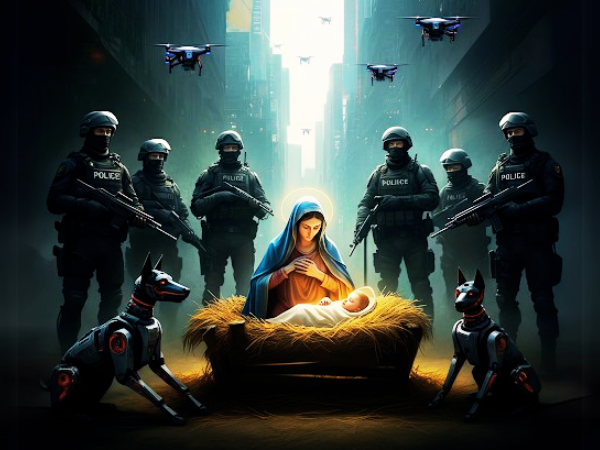
To answer it, we must first understand who Jesus Christ was—the revered preacher, teacher, radical, prophet and son of God—born into a police state not unlike the growing menace of America’s own police state.

When he came of age, Jesus had powerful, profound things to say, about justice, power and how we are to relate to one another. Blessed are the merciful,” “Blessed are the peacemakers,” “Love your enemies.

A revolutionary in both spirit and action, Jesus not only died challenging the police state of his day—the Roman Empire—but left behind a blueprint for resisting tyranny that has guided countless reformers and freedom fighters ever since.

Far from the sanitized, domesticated figure presented in modern churches, Jesus was a radical nonconformist who challenged authority at every turn. He spoke truth to power, defied political and religious hierarchies, and exposed the hypocrisy of empire.

Jesus rejected politics as a means to salvation. For Him, faith was not about seizing power but serving others—helping the poor, showing mercy even to enemies, and embodying peace, not war. He did not seek political favor or influence; He actively undermined it.

That is not to say He was passive. Jesus knew righteous anger. He turned over the tables of the money changers in the Temple because they had turned faith into profit and worship into spectacle.

Yet even in anger, He refused to wield violence as a tool of redemption. When His own arrest approached, He rebuked His followers: Put your sword in its place, for all who take the sword will perish by the sword.

The Beatitudes summarize His message: “Blessed are the peacemakers, for they shall be called the children of God.” And when asked to name the greatest commandment, He answered simply: to love God with all one’s being and to love one’s neighbor as oneself.

In other words, we love God by loving our fellow human beings.

Jesus—the “Prince of Peace”—came not to destroy life but to restore it.

Which brings us to Donald Trump, the latest political “savior” anointed by Christian nationalists for whom the pursuit of a Christian theocracy now appears to outweigh allegiance to our constitutional democracy.

Seduced by political power to such an extent that the true message of Jesus has been taken hostage by partisan agendas, much of today’s evangelical movement has become indistinguishable from right-wing politics—defined by anti-immigrant and anti-homosexual rhetoric, material excess, sprawling megachurches, and a spirit of judgment rather than mercy.

Meanwhile, the wall of separation—between church and state, between moral authority and political coercion—is being torn down from both sides.

The result is a marriage of convenience that corrupts them both.

This is what happens when you wrap your faith in the national flag.

What is worse—far worse—than the Christian right selling its spiritual birthright for a political seat at Trump’s table is the blasphemy that has followed: the Gospel of Jesus replaced by the Gospel of the Military-Industrial Complex.

Within the White House, faith leaders gather to lay hands on Trump as he sits at the Resolute Desk, praising him for defending “religious freedom” for Christians—seemingly unconcerned that from that same desk he has signed death warrants for nearly every other freedom.

In the Pentagon, Trump’s Defense Secretary, Pete Hegseth, presides over prayer services where the name of Christ is invoked almost in the same breath as he boasts of preemptive strikesrighteous killings, and “peace through strength.”

Kristi Noem, the head of the Department of Homeland Security, prays in front of the cameras all the while boosting spending on military weapons for ICE by 700%, with significant purchases of chemical weapons and “guided missile warheads and explosive components.”

This is not Jesus’ Christianity—it is Christian nationalism: Christianity draped in the flag and wielding the weapons of war.

When leaders presume to act in God’s name, every drone strike becomes a crusade, every critic a heretic, every raid a holy war.

This is how war becomes a form of worship in the American empire.

What was once the Gospel of Peace has been replaced by a national creed that equates killing with courage, dominance with divine favor, and obedience with faith.

It is a blasphemous marriage of church and state—one that desecrates both Christ’s command to love one’s enemies and the Constitution’s mandate to keep religion free from the corruption of power.

Under Trump’s rule, this weaponized faith has found expression not only in rhetoric but in action.

It is there in the bombing of Venezuelan fishing boats—no declaration of war, no congressional authorization, no due process—men in small vessels labeled “enemy combatants” by fiat. It is there in the militarized ICE raids that tear families apart under cover of darkness. It is there in the persecution of journalists and dissidents accused of being anti-American. It is there in every detail of how, as one state senator warned, “the President is building an army to attack his own country.

Each act is justified as righteous violence, sanctioned by a president who sees himself as both protector of the faithful and punisher of the wicked.

Yet beneath the veneer of divine mission lies the same old tyranny the Framers warned against: a ruler who mistakes executive power for divine right and turns the machinery of government into an instrument of holy war.

Both Jesus and the framers of the Constitution understood the same truth: faith and freedom cannot be imposed by force.

That is why the First Amendment forbids the government from establishing religion. The moment religion aligns itself with political power, it ceases to be faith and becomes ideology. The moment a president claims divine sanction for war, the republic ceases to be a democracy and becomes a theocracy of fear.

Driven by those concerns, the framers built a system designed to restrain ambition, limit vengeance, and guard against tyranny.

That constitutional system is being bulldozed before our eyes—just as surely as Trump is bulldozing his way through the White House, leaving wreckage in his wake.

And so we return to the question that started it all: Who would Jesus bomb?

The answer, of course, is no one.

Jesus would not rain destruction from the skies or bless the machinery of death. He would not mistake vengeance for virtue or domination for deliverance.

Jesus would heal the sick, welcome the stranger, and lift up the poor. He would drive the money changers from the temple, not sanctify the merchants of war.

Yet here we are.

Under Trump’s broadened definitions of “rebellion” and “domestic terrorism,” Jesus would be labeled a subversive, his name placed on a watchlist, his followers rounded up for “reeducation.” He preached compassion for enemies, defied authority, and stirred the crowds without a permit.

Were Jesus——a Palestinian refugee, a radical, and a revolutionary—to show his face in Trump’s American police state, he would fare no better than any of the undocumented immigrants being snatched up in the dead of night, stripped of any real due process, made to disappear into inhumane detention centers, and left to be tortured or die.

This is what happens when nations lose their moral compass: due process becomes a slogan, justice a privilege, and compassion a crime.

When even mercy is outlawed and truth branded subversion, the darkness is no longer metaphorical—it is moral.

It is midnight in America, a phrase evocative of Martin Luther King Jr.’s warning of a “midnight in the moral order.”

This is the time, King cautioned, when absolute standards pass away, replaced by a “dangerous ethical relativism.” Morality becomes a mere “Gallup poll of the majority opinion.” Right and wrong are reduced to the philosophy of “getting by,” and the highest law becomes the “eleventh commandment: thou shall not get caught.”

In this deep darkness, King said, there is a “knock of the world on the door of the church.”

That knock is a reminder, he warned, that the church “is not the master or the servant of the state, but rather the conscience of the state. It must be the guide and the critic of the state, and never its tool. If the church does not recapture its prophetic zeal, it will become an irrelevant social club without moral or spiritual authority.”

That knock still sounds today—steady, insistent, and largely unanswered.

It reverberates through religious institutions that mistake nationalism for faith and pulpits that confuse politics with piety. It calls us to rediscover the moral courage that resists tyranny rather than blesses it—to be, once more, the conscience of the state before the darkness becomes complete.

Whether we heed that call will determine what kind of nation we remain.

The time for silence has passed; the hour demands conscience.

As I make clear in my book Battlefield America: The War on the American People and in its fictional counterpart The Erik Blair Diaries, “we the people” must step up, speak up and speak out.

The tragedy of our age is not merely that presidents claim godlike power or that the citizenry themselves go along with it—it is that people of faith who should know better consent to it.

When Christians cheer the strongman who wraps himself in Scripture while shredding the Constitution—when they bow to the idol of safety, mistaking fear for faith—and when religious institutions fail to speak truth to power—we lose more than our freedoms.

We lose our moral and spiritual birthright.

Source: https://tinyurl.com/mvdcpht2

ABOUT JOHN W. WHITEHEAD

Constitutional attorney and author John W. Whitehead is founder and president of The Rutherford Institute. His most recent books are the best-selling Battlefield America: The War on the American People, the award-winning A Government of Wolves: The Emerging American Police State, and a debut dystopian fiction novel, The Erik Blair Diaries. Whitehead can be contacted at staff@rutherford.org. Nisha Whitehead is the Executive Director of The Rutherford Institute. Information about The Rutherford Institute is available at www.rutherford.org.

Publication Guidelines / Reprint Permission

John W. Whitehead’s weekly commentaries are available for publication to newspapers and web publications at no charge. 

Brother, I am American. You are twisting my arm.”— Man shouts “I am American” while ICE agents detain him

Masked gunmen. Tasers. Tear gas. Pepper spray. Unmarked vehicles. Intimidation tactics. Brutality. Racial profiling. Children traumatized. Families terrorized. Journalists targeted. Citizens detained. Disabled individuals, minors, the elderly, pregnant women, military veterans—snatched off the streets. Private property destroyed.

This is not a war zone. This is America.

This is what now passes for law-and-order policing by ICE agents in Trump’s America—and it is not making America safer or greater.

What began as an agency tasked with enforcing immigration law has metastasized into a domestic terror force.

From coast to coast, ICE goon squads—incognito, thuggish, fueled by profit-driven incentives and outlandish quotas, and empowered by the Trump administration to act as if they are untouchable—are prowling neighborhoods, churches, courthouses, hospitals, bus stops, and worksites, anywhere “suspected” migrants might be present, snatching people first and asking questions later.

Sometimes “later” comes hours, days or even weeks afterwards.

No one is off limits—not even American citizens.

Make no mistake: this is not how a constitutional republic operates. It is how a dictatorship behaves when it decides the rule of law—in this case, the Bill of Rights—is optional.

Journalists are being shoved to the pavement, forced into chokeholds, teargassed, and brutalized—in violation of the First Amendment. U.S. citizens, including toddlers, are being snatched up and carted off—in violation of the Fourth Amendment. People with no criminal records who have lived, worked and paid taxes in this country for decades are being made to disappear—in violation of habeas corpus.

This is not public safety. It is domestic terrorism, carried out by masked, militarized, lawless bounty hunters.

In California, ICE agents stopped a U.S. citizen and military veteran on his way to work. According to George Retes, agents fired tear gas, broke his car window, and applied physical force, including kneeling on him. Retes spent three days in federal custody with no charges, no call to his family, no access to a judge or an attorney, no shower, and no explanation for ICE’s actions before being released.

In Portland, a U.S. citizen outside his workplace was detained by masked, plainclothes agents who refused to identify themselves, threatened him with a dog, handcuffed him, hauled away in an unmarked vehicle, and held for hours without justification.

In Chicago, a local TV journalist was violently knocked to the ground by masked agents, handcuffed, arrested, and hauled to a detention center—then released without charges.

In Los Angeles, ICE agents handcuffed and detained a 23-year-old, heavily pregnant woman for over eight hours with a chain around her belly, accusing the native-born American of being from Mexico. Bruised and in labor, she went straight to the hospital upon release.

Two sisters were stopped outside a school, surrounded by at least ten ICE agents, who broke into their locked vehicle, dragged them out, and pinned them to the ground. Both women were later released without explanation.

Each of these incidents is presented as routine immigration enforcement. Yet collectively they reveal a government agency that has abandoned the principles of restraint, accountability, and due process in favor of brute force.

Justifying extreme measures—martial law, mass surveillance, suspension of constitutional safeguards— as necessary for “national security” has always been the refuge of tyrants, and this American police state is no different.

Under Trump, however, things are so much worse.

The rationalizations have become bolder, the violence more normalized, and the lies more transparent.

The biggest lie of all is the Department of Homeland Security’s claim that its costly, ego-driven, and unnecessary military invasion of Chicago—Operation Midway Blitz—rounded up “the worst of the worst pedophiles, child abusers, kidnappers, gang members, and armed robbers.” In fact, DHS’ own data shows that out of more than 1,000 people rounded up, only 10 had criminal records.

As one Chicago resident remarked, “When Donald Trump campaigned, he said he was going after criminals, rapists and drug dealers. Now, they’re assaulting women, deporting children, mothers and fathers—not criminals. And if they’re criminals, he needs to prove it. We haven’t seen that evidence yet.”

Indeed, even the courts are finding the Trump administration’s so-called “evidence” of crime to be scant and/or unreliable.

Nationally, more than 70% of individuals rounded up by ICE nationally have no criminal convictions. Many have lived in the U.S. for decades, raised families, paid taxes, contributed to the economy, and worked the jobs most Americans refuse to do.

The blatantly false claim that immigrants are inherently violent criminals has also been repeatedly refuted by studies showing that immigrants—including undocumented ones—are less likely to commit crimes than Americans born in the U.S.

Even Trump’s insistence that certain states or cities are overrun with crime, thus necessitating his military invasions, collapses under scrutiny: crime remains at record lows nationwide.

The data simply does not support the rhetoric.

Violence rises and falls with social conditions, not partisan control. Yet, conveniently, only those states that have challenged the Trump administration’s abuses have been singled out for invasion by ICE and the National Guard.

Clearly, this is not about crime, safety, or jobs.

So what is really driving this campaign of terror?

What we are witnessing is the weaponization of fear.

A government that profits from panic and rewards blind obedience has turned immigration enforcement into a spectacle of domination—part deterrent, part distraction, and all political theater.

The timing is no coincidence.

The Trump administration has just announced its fifth military strike on a Venezuelan vessel it claims—without evidence—was engaged in illegal activity. The propaganda might scream about “foreign threats,” but these spectacles serve a different purpose: to divert public outrage away from falling poll numbers, a faltering economy, and growing unrest over the regime’s corruption and incompetence.

At home, ICE raids perform the same function as those boat strikes abroad—they keep the public frightened and the cameras fixed on the wrong enemy. Meanwhile, the scandals that should command national attention—the Epstein files implicating powerful allies, the graft, the insider enrichment—sink beneath the noise.

Each new show of force, each televised arrest or explosion, is meant to remind the populace who holds the power and how easily it can be turned inward.

This is not about border control or law enforcement. It is about control, period.

When a political regime begins to equate its own survival with the nation’s survival, every citizen becomes a potential suspect and every act of dissent a potential crime.

Against such a backdrop, ICE’s strategy is predatory and deliberate.

Lower court rulings have affirmed that ICE, DHS and the Trump Administration are willfully trampling the First, Fourth and Fifth Amendments.

When ICE agents hunt people the way one might hunt animals in the wild, they cease to be officers of the law and become roving packs of lawless predators.

Lawless, paid predators, that is.

Thanks to the vast sums of taxpayer money funneled into ICE under Trump’s “One Big Beautiful Bill,” financial incentives are turning ICE agents into bounty hunters.

In addition to recruiting ICE agents with $50,000 signing bonuses and $60,000 in student loan forgiveness, DHS is also promising to lavishly reward police agencies that allow their officers to operate as extensions of ICE with salary reimbursements, overtime pay and monthly bonuses.

Then there is the Trump administration’s directive to ICE to carry out a minimum of 3,000 arrests a day.  

No wonder citizens, lawful residents and immigrants with no criminal history are getting swept up. There simply aren’t enough violent criminals to fill these quotas.

While some lower courts have attempted to rein in ICE’s abuses, the U.S. Supreme Court has largely empowered them.

In Noem v. Vasquez Perdomo, a 6–3 Supreme Court order paused a district court injunction that would have barred ICE from stopping people based on perceived race, accent, or workplace location—in effect greenlighting racial profiling and roving patrols.

The court ruled that ICE’s criteria for targeting individuals—judging people by race, language, or job—does not rise to the constitutional level of reasonable suspicion.

But for an administration that mistakes might for right, the law is whatever justifies the hunt. “Everything we’re doing is very lawful,” Trump declared. “What they’re doing is not lawful.”

Martin Luther King Jr. offered the clearest rebuttal to that logic more than sixty years ago.

In his “Letter from a Birmingham Jail,” written while jailed for participating in nonviolent demonstrations against segregation, King reminded the world “that everything Adolf Hitler did in Germany was ‘legal’ and everything the Hungarian freedom fighters did in Hungary was ‘illegal.’”

King then went on to explain how to distinguish between just and unjust laws:

“I would be the first to advocate obeying just laws. One has not only a legal but a moral responsibility to obey just laws. Conversely, one has a moral responsibility to disobey unjust laws. I would agree with St. Augustine that ‘an unjust law is no law at all.’ Now, what is the difference between the two? How does one determine whether a law is just or unjust? A just law is a man made code that squares with the moral law or the law of God. An unjust law is a code that is out of harmony with the moral law. To put it in the terms of St. Thomas Aquinas: An unjust law is a human law that is not rooted in eternal law and natural law. Any law that uplifts human personality is just. Any law that degrades human personality is unjust.”

King’s message was not about politics but about principle. His words remind us that legality and morality are not always the same — and that a nation that abandons moral law will soon find itself without any law at all.

A government that chains pregnant women, assaults journalists, and detains citizens without cause has lost its moral authority to govern.

King warned that the gravest threat to justice is not the clamor of bad people but the appalling silence of good ones. The same holds true today: silence in the face of government brutality is itself a form of consent.

Even in the face of the Trump administration’s heavy-handed repression, citizens have stepped up to meet military intimidation with moral conscience.

In Portland and other cities, protesters have embraced creative, nonviolent acts of symbolic resistance—appearing unclothed to expose the government’s hypocrisy, donning costumes to mock its fear, and standing silently before armed agents as living reminders of what it means to resist tyranny without becoming it.

These creative gestures recall the kind of moral witness King described: the courage to confront injustice with peace and strip it of its disguise.

The bottom line, as always, rests with “we the people.”

ICE does not protect America—it terrorizes America. And until it is reined in, dismantled, or reformed to operate wholly within constitutional boundaries, it will remain a standing army on domestic soil: unaccountable, unconstitutional, and un-American.

Tyranny always cloaks itself in the language of welfare and safety. And constitutional abuse transcends party lines.

Every regime that seeks to entrench its power begins by promising to protect the people from chaos, crime, or foreign enemies—then proceeds to manufacture both.

The raids, the strikes, the distractions are all part of the same design: to condition obedience, erase accountability, and cement totalitarian rule under the pretense of “law and order.”

As I make clear in my book Battlefield America: The War on the American People and in its fictional counterpart The Erik Blair Diaries, the Constitution is not a suggestion; it is the rule of law.

The Constitution is not a suggestion; it is the rule of law.

If ICE—and by extension, the DHS and the entire Trump regime—cannot operate within those limits, if it must hide behind masks and military might to exercise its power, then it has ceased to be lawful.

It has become exactly what the Framers of the Constitution feared: a government that wages war on its own people.

Source: https://tinyurl.com/65fmpevj

ABOUT JOHN W. WHITEHEAD

Constitutional attorney and author John W. Whitehead is founder and president of The Rutherford Institute. His most recent books are the best-selling Battlefield America: The War on the American People, the award-winning A Government of Wolves: The Emerging American Police State, and a debut dystopian fiction novel, The Erik Blair Diaries. Whitehead can be contacted at staff@rutherford.org. Nisha Whitehead is the Executive Director of The Rutherford Institute. Information about The Rutherford Institute is available at www.rutherford.org.

Publication Guidelines / Reprint Permission

John W. Whitehead’s weekly commentaries are available for publication to newspapers and web publications at no charge. 

“When they came in the middle of the night, they terrorized the families that were living there. There were children who were without clothing, they were zip tied, taken outside at 3 o’clock in the morning. A senior resident, an American citizen with no warrants, was taken outside and handcuffed for three hours. Doors were blown off their hinges, walls were broken through, immigration agents coming from Black Hawk helicopters … This is America.”—Chicago Mayor Brandon Johnson

When the government can label anyone or anything an enemy in order to wage war, we are all in danger.

That danger is no longer theoretical.

In the same breath that the administration touts lethal military strikes against Venezuelan boats in Caribbean waters, federal agents are conducting coordinated militarized raids on homes in Chicago, rappelling down on apartment buildings from Black Hawk helicopters, dragging families out of their homes, separating children from their parents, and using zip ties to immobilize them—even citizens.

The message—spoken and unspoken—is that the government is on a war footing everywhere: abroad, at sea, and now at our front doors.

This “everywhere war” depends on a simple redefinition: call it a war, and the target becomes a combatant. Call the city a battlespace, and its residents become suspects.

What the White House is doing overseas to vessels it deems part of a terrorist network (without any credible proof or due process), it is now mimicking at home with door-kicking raids, mass surveillance, and ideological watchlists.

With the stroke of a pen, President Trump continues to set aside the constitutional safeguards meant to restrain exactly this kind of mission creep, handing himself and his agencies sweeping authority to disregard the very principles on which this nation was founded—principles intended to serve as constitutional safeguards against tyranny, corruption, abuse and overreach put in place by America’s founding fathers.

Take National Security Presidential Memorandum 7 (NSPM-7), for example.

NSPM-7 directs a government-wide campaign to “investigate,” “disrupt,” and “dismantle” so-called domestic threats, ordering agencies to pool their data, resources, and operations in service of this agenda.

What makes NSPM-7 so dangerous is not only its declared purpose but its breadth and secrecy. There are no clearly defined standards, no meaningful transparency, and no external oversight. The public is told only that the government will protect them—by watching them.

Yet the danger is not only in what the government hides, but in what it chooses to see.

Even more troubling is the way “threats” are defined.

What is being sold as a campaign to disrupt left-wing conspiracies has expanded to include ideology, rhetoric, and belief.

Clearly, this is not just another surveillance program.

NSPM-7 is a framework for rebranding dissent as a danger to be quashed.

The government has a long history of using vague definitions of “extremism” to justify ever-expanding control. Once dissent is rebranded as danger, every act of resistance can be swept into the government’s dragnet.

Whether through counterinsurgency tactics abroad or domestic militarization at home, the pattern is the same: dissent is rebranded as danger, and those who resist government narratives become subjects of investigation.

NSPM-7 merely formalizes this cycle of suspicion.

It also resurrects an old playbook with new machinery—COINTELPRO, digitized and centralized. The tools may be different, but the logic—neutralize dissent—is the same, now scaled up with modern surveillance and stitched together under executive direction. From there, the apparatus needs only a pretext—a checklist of behaviors, viewpoints, associations and beliefs—to justify recasting citizens as suspects.

For years now, the government has flagged certain viewpoints and phrases as potential markers of extremism.

To that list, you can now add “anti-Christian,” “anti-capitalist,” and “anti-American,” among others.

What this means, in practice, is that sermons, protests, blog posts, or donor lists could all be flagged as precursors to terrorism.

Under this policy, America’s founders would be terrorists. Jesus himself would be blacklisted as “anti-Christian” and “anti-capitalist.”

Anything can be declared a war, and anyone can be redefined as an enemy combatant.

The definition shifts with political convenience, but the result is always the same: unchecked executive power.

The president has already labeled drug cartels “unlawful combatants” and insists the United States is in a “non-international armed conflict.”

The raids in Chicago and the White House’s evolving attitude towards surveillance confirm what follows from that logic: this war footing is not confined to foreign shores. It is being turned inward—toward journalists, political opponents, and ordinary citizens whose beliefs or associations are deemed “anti-American.”

By anti-American, this administration really means anti-government, especially when Trump is calling the shots.

According to local news reports, agents arrived in Black Hawk helicopters, trucks and military-style vans, using power tools to breach perimeter fencing, destroying property to gain entry, and zip-tying family members—including children—as they were separated and escorted from the building.

The imagery is unmistakably martial: a domestic operation staged and executed with battlefield methods.

This “everywhere war” lands on a country already saturated with domestic watchlists and dragnet filters.

Federal agencies have leaned on banks and data brokers to run broad, warrantless screens of ordinary Americans’ purchases and movements for so-called “extremism” indicators—everything from buying religious materials to shopping at outdoor stores or booking travel—none of which are crimes.

The point isn’t probable cause; it’s preemptive suspicion.

At the same time, geofence warrants and other bulk location grabs have exposed who went where and with whom—scooping up churchgoers, hotel guests, and passersby across entire city blocks—while a sprawling web of fusion and “real-time crime” centers ingests camera feeds, social posts, license-plate scans, facial recognition, and predictive-policing scores to flag “persons of interest” who have done nothing wrong.

This is how dissent gets relabeled as danger: by surrounding every American with the presumption of guilt first, and constitutional safeguards—if any—much later.

When merely looking a certain way or talking a certain way or voting a certain way is enough to get you singled out and subjected to dehumanizing, cruel treatment by government agents, we are all in danger.

When the president of the United States and his agents threaten to “intimidate, demoralize, hunt and kill the enemies of our country”—i.e., those who don’t comply with the government’s demands, we are all in danger.

When the police state has a growing list of innocuous terms and behaviors that are suspicious enough to classify someone a terrorist, we are all in danger.

Today it is drug cartels. Yesterday it was immigrants. Tomorrow it could be journalists, political opponents, or ordinary citizens who express views deemed “anti-American.”

With NSPM-7, the Trump White House is not merely amplifying surveillance power—it is institutionalizing a regime in which thought, dissent, and ideological posture become the raw material for domestic investigations and suppression.

Make no mistake: this is an unprecedented escalation in the government’s war on privacy, dissent, and constitutional limits.

Consider the secret phone-records dragnet operated for more than a decade across multiple administrations—formerly “Hemisphere,” now “Data Analytical Services.”

By paying AT&T and exploiting privacy loopholes, the government has gained warrantless access to more than a trillion domestic call records a year, sweeping in not only suspects but their spouses, parents, children, friends—anyone they might have called. Training on the program has reportedly reached beyond drug agents to postal inspectors, prison officials, highway patrol, border units, and even the National Guard.

This is how a surveillance apparatus becomes a governing philosophy.

A presidency armed with NSPM-7 can fuse that kind of dragnet data with interagency “threat” frameworks and ideological watchlists, collapsing the wall between intelligence gathering and political control.

This is how tyrants justify tyranny in order to stay in power.

This is McCarthyism in a digital uniform.

Joseph McCarthy branded critics as Communist infiltrators. Donald Trump brands enemies as “combatants.”

The mechanism is the same: redefine dissent as treachery, then prosecute it under extraordinary powers.

For those old enough to have lived through the McCarthy era, there is a whiff of something in the air that reeks of the heightened paranoia, finger-pointing, fear-mongering, totalitarian tactics that were hallmarks of the 1950s.

Back then, it was the government—spearheaded by Senator McCarthy and the House Un-American Activities Committee—working in tandem with private corporations and individuals to blacklist Americans suspected of being communist sympathizers.

By the time the witch hunts drew to a close, thousands of individuals (the vast majority innocent of any crime) had been accused of communist ties, investigated, subpoenaed, and blacklisted. Careers were ruined, suicides followed, immigration tightened, and free expression chilled.

Seventy-five years later, the same vitriol, fear-mongering, and knee-jerk intolerance are once again being deployed against anyone who dares to think for themselves.

All the while, the American police state continues to march inexorably forward.

This is how fascism, which silences all dissenting views, prevails.

The silence is becoming deafening.

What is unfolding is the logical culmination of years of bipartisan betrayals of the Bill of Rights, from the Cold War to the digital panopticon

What once operated in the shadows of intelligence agencies is now openly coordinated from the Oval Office.

For decades, presidents of both parties have waged a steady assault on the Constitution. Each crisis—Cold War, 9/11, pandemic—became an excuse to concentrate more power in the executive branch.

The Patriot Act normalized warrantless surveillance. The FISA courts gave secret cover for dragnet spying. The NSA’s metadata sweeps exposed millions of Americans’ phone records. Predictive policing and geofencing warrants turned smartphones into government informants.

Each measure, we were told, was temporary, limited, and necessary. None were rolled back. Each became the foundation for the next expansion.

Against this backdrop, NSPM-7 emerges as the next, more dangerous iteration.

What distinguishes it is not merely scale but centralization: the government has moved from piecemeal encroachments to a bold, centralized framework in which the White House claims the prerogative to oversee surveillance across agencies with virtually no external checks.

Oversight by Congress and the courts is reduced to a fig leaf.

This is how liberties die: not with a sudden coup, but with the gradual normalization of extraordinary powers until they are no longer extraordinary at all.

It is the embodiment of James Madison’s nightmare: the accumulation of all powers, legislative, executive, and judicial, in the same hands.

From red-flag seizures and “disinformation” hunts to mail imaging, biometric databases, license-plate grids, and a border-zone where two-thirds of Americans now live under looser search rules, the default has flipped: everyone is collectible, everyone is rankable, and everyone is interruptible.

That is how a free people become reduced to databits first and citizens as an afterthought.

The constitutional stakes couldn’t be higher.

The Fourth Amendment promises that people shall be secure against unreasonable searches and seizures. That promise is empty if the President can authorize the government to sweep up data, monitor communications, and track movements without individualized warrants or probable cause.

The First Amendment protects freedom of speech, association, and press. Those protections mean little if journalists fear their calls are tapped, if activists believe their networks are infiltrated, or if citizens censor themselves out of fear.

Separation of powers itself is on the line. By directing surveillance policy across government without legislative debate or judicial review, the White House is usurping authority never meant to rest in a single set of hands.

The risks are not hypothetical.

COINTELPRO targeted civil rights leaders and dissidents. The NSA’s bulk collection swept up millions of innocents. Fusion centers today track and analyze daily life.

What was once shocking—the idea that the government might listen in on every phone call or sift through every email—is now treated as the price of living in modern America.

If those older, less centralized programs were abused, why would NSPM-7—with broader reach and weaker oversight—be any different?

This is not speculation. We have seen this progression before.

In 2009, the Department of Homeland Security issued reports on so-called “rightwing extremism” that swept broadly across the ideological spectrum. Economic anxiety, anti-immigration views, gun rights advocacy, even the military service of returning veterans were flagged as potential red flags for extremism.

The backlash was immediate, and DHS was forced to walk back the report, but the damage was done: dissenting views had been equated with dangerous plots.

That same playbook now risks becoming institutionalized under NSPM-7, which consolidates ideological profiling into a White House-directed mandate.

Imagine a journalist investigating corruption within the administration. Under NSPM-7, their sources and communications could be quietly monitored.

Imagine a nonprofit advocating for immigration reform. Its donors and staff could be swept into a database of “domestic threats.”

Imagine an attorney representing a controversial client. Even attorney-client privilege, once considered sacrosanct, could be eroded under a regime that treats dissent as subversion.

These scenarios are not alarmist—they are logical extensions of a system that places no real limits on executive discretion.

With NSPM-7, the line between foreign and domestic surveillance blurs entirely, and every citizen becomes a potential target of investigation.

Unless “we the people” demand accountability, NSPM-7 will become the new normal, entrenched in the machinery of government long after this administration has passed.

We must insist that surveillance be subject to the same constitutional limits that govern every other exercise of state power. We must demand transparency. We must pressure Congress to reclaim its role and courts to enforce constitutional duty. Most of all, we must cultivate a culture of resistance.

The Bill of Rights is not self-executing; it depends on the vigilance of the citizenry.

Civil liberties groups have already sounded the alarm, warning that NSPM-7 authorizes government-wide investigations into nonprofits, activists, and donors. Law scholars call it a dangerous overreach, a program as vague as it is menacing. Even law firms, normally cautious about critiquing executive power, are voicing concern about the risks it poses to attorney-client privilege.

When so many diverse voices converge in warning, we should pay attention.

And yet warnings alone will not stop this juggernaut, because NSPM-7 is not simply about technology or data collection. It is about power—and how fear is weaponized to consolidate that power.

If we are silent now, if we allow NSPM-7 to pass unchallenged, we will have no excuse when the surveillance state tightens its grip further.

When ideas themselves become a trigger for surveillance, the First Amendment loses.

America has entered dangerous territory.

A government that answers only to itself is not a constitutional republic—it is a rogue state. And NSPM-7, far from securing our freedoms, threatens to extinguish them.

Unchecked power is unconstitutional power.

As U.S. District Judge Sparkle L. Sooknanan cautioned in a recent ruling: “The government’s arguments paint with a broad brush and threaten to upend fundamental protections in our Constitution. But ours is not an autocracy; it is a system of checks and balances.”

Those checks only function if we insist on them.

With congressional Republicans having traded their constitutional autonomy for a place in Trump’s authoritarian regime, the courts—and the power of the people themselves—remain the last hope for reining in this runaway police state.

Cognizant that a unified populace poses the greatest threat to its power grabs, the Deep State—having co-opted Trump and the MAGA movement—is doing everything it can to keep the public polarized and fearful.

This has been a long game.

The contagion of fear that McCarthy once spread with the help of government agencies, corporations, and the power elite never truly died; it merely evolved.

NSPM-7 is its modern form, and Trump a modern-day McCarthy.

That anyone would support a politician whose every move has become antithetical to freedom is mind-boggling, but that is the power of politics as a drug for the masses.

That anyone who claims to want to “Make America Great Again” would sell out the country—and the Constitution—to do so says a lot.

That judges, journalists and activists are being threatened for daring to hold the line against the government’s overreaches and abuses speaks volumes.

One of Trump’s supporters sent an anonymous postcard to Judge William G. Young, a Reagan appointee assigned to a case challenging the Trump administration’s effort to deny full First Amendment protection to non-citizens lawfully present in the United States. The postcard taunted: “Trump has pardons and tanks… What do you have?

Judge Young opened his opinion with a direct reply: “Dear Mr. or Ms. Anonymous, Alone, I have nothing but my sense of duty. Together, We the People—you and me—have our magnificent Constitution. Here’s how that works in a specific case.”

The judge then proceeded to issue a blistering 161-page opinion that hinges on the language of the First Amendment: “Congress shall make no law respecting an establishment of religion, or prohibiting the free exercise thereof; or abridging the freedom of speech, or of the press; or the right of the people peaceably to assemble, and to petition the Government for a redress of grievances.”

“No law” means “no law,” concluded Judge Young,

In other words, the First Amendment is not negotiable.

Non-citizens lawfully present in the United States “have the same free speech rights as the rest of us.”

This is the constitutional answer to NSPM-7’s everywhere-war logic.

When a president declares anything a battlefield and anyone a combatant, the First Amendment answers back: No law means no law.

It is not a permission slip the government can offer only to favored citizens or compliant viewpoints. It is a boundary the government may not cross.

So the question returns to us, the ones Judge Young addressed: “What do we have, and will we keep it?”

We have a constitutional republic, and we keep it by holding fast to the Constitution.

We keep it by refusing the normalization of the Executive Branch’s extraordinary overreaches and power grabs.

We keep it by insisting that dissent is not danger, speech is not suspicion, and watchlists are not warrants.

We keep it by demanding congressional oversight with teeth, courts that enforce first principles, and communities that resist fear when fear is used to rule.

In closing, Judge Young quoted Ronald Reagan’s warning, issued in 1967: “Freedom is a fragile thing and it’s never more than one generation  away from extinction. It is not ours by way of inheritance; it must be fought for and defended constantly by each generation, for it comes only once to a people.”

Reagan’s words would be flagged under NSPM-7, but it doesn’t change the challenge.

As I make clear in my book Battlefield America: The War on the American People and in its fictional counterpart The Erik Blair Diaries, the hard work of defending freedom rests as always with “we the people.”

Let’s get to it.

Source: https://tinyurl.com/yc6c7af3

ABOUT JOHN W. WHITEHEAD

Constitutional attorney and author John W. Whitehead is founder and president of The Rutherford Institute. His most recent books are the best-selling Battlefield America: The War on the American People, the award-winning A Government of Wolves: The Emerging American Police State, and a debut dystopian fiction novel, The Erik Blair Diaries. Whitehead can be contacted at staff@rutherford.org. Nisha Whitehead is the Executive Director of The Rutherford Institute. Information about The Rutherford Institute is available at www.rutherford.org.

Publication Guidelines / Reprint Permission

John W. Whitehead’s weekly commentaries are available for publication to newspapers and web publications at no charge.

“The era of the Department of Defense is over… From this moment forward, the only mission of the newly restored Department of War is this: warfighting… We untie the hands of our warfighters to intimidate, demoralize, hunt and kill the enemies of our country… You kill people and break things for a living.” — Pete Hegseth

“America is under invasion from within… That’s a war, too. It’s a war from within… We should use some of these dangerous cities as training grounds for our military… it’s the enemy from within, and we have to handle it before it gets out of control.”—President Donald Trump in remarks to more than 800 of the country’s top military leaders

Distractions abound. Don’t be distracted.

The American police state under Donald Trump has mastered the art of delivering endless diversions, constant uproar, and wall-to-wall chaos designed to prevent us from focusing on any single issue for long.

This is how psyops work: keep the populace reactive, confused, fearful and pliant while power consolidates.

According to the Trump administration, “we the people” are now the enemy from within.

Over the course of just one week, we’ve been bombarded with headlines about government shutdowns, a presidential directive aimed at blacklisting dissent, threats by Trump to deploy the National Guard into states he considers political opponents, the politicization of the military, tariffs that inflict economic pain on American consumers, and the administration’s unabashed embrace of graft and grift.

In the midst of it all, Pete Hegseth, the newly styled Secretary of War, compelled a sudden gathering of the top military brass for a costly $6 million exercise that amounted to little more than chest-thumping, propaganda and grandstanding.

With Hegseth at the helm of the renamed Department of War, calling for a new “warrior ethos,” the Trump administration is celebrating aggression and blind obedience over peacekeeping, honor and constitutional duty.

Both the rebranding of the War Department and the warrior-ethos pep rally signaled a profound shift in how the Deep State—which has consolidated its powers under Trump—views the role of the military, our constitutional government, and the American people.

It is a shift we cannot afford to ignore.

The name change alone is significant.

After World War II, “War” was deliberately retired from the department’s name to emphasize restraint in the wake of global conflicts that cost humanity dearly in terms of lives, fortunes and peace. That nominal bulwark has now been discarded. And with it, the very idea that America’s military exists for defense rather than conquest.

Reviving the Department of War signals to the bureaucracy, the brass, and the public that aggression—not defense—is the organizing principle.

The Pentagon has been rechristened not as a fortress against foreign threats but as a machine for waging endless war here at home: Democratic cities will become military staging grounds; rules of engagement will be loosened to maximize “lethality”; and militarized police will be given a license to kill their fellow Americans.

This is not the language of defense. It is the language of aggression and occupation.

A standing army on domestic soil was precisely what the Founders feared. They lived under troops quartered in their towns. They knew what happens when government treats its own citizens as a hostile force.

Two centuries later, their fear has become our reality.

For years, federal and state agencies have blurred the line between soldiers and police. Armored vehicles on neighborhood streets. Combat training in American towns. Laws allowing indefinite detention of citizens without trial.

Methodically, a war culture has been transplanted from the battlefield abroad to the homeland.

With armored tanks on our streets, SWAT raids treated as routine, and citizens viewed as combatants rather than neighbors with rights, the results are predictable: abuse, eroded liberties, and the slow death of a constitutional republic.

This is the future we warned was coming: every city a potential conflict zone, every protest a pretext for deployment, every citizen a suspect.

Trump’s reckless call to use “dangerous cities” as military training grounds doesn’t just echo this dystopia—it completes the circle.

Under the banner of “war,” the government is giving itself license to treat the American people as the enemy.

And Trump, buoyed by the power of the presidency and his ability to use taxpayer dollars for his own grandiose plans—building ballrooms, hiring thugs with extravagant bonuses for arrests and roundups, erecting detention centers—is now attempting to bribe the military with over $1 trillion in spending in 2026 if only they will march to a dictator’s drum.

But this is precisely the scenario the Founders sought to guard against. They understood that “the means of defense against foreign danger have been always the instruments of tyranny at home.”

Their warning is clear to everyone but the die-hard devotees of the American police state: a standing army puts the American people squarely in the crosshairs of a tyrannous regime.

A standing army—something that propelled the early colonists into revolution—strips the American people of any vestige of freedom. How can there be liberty when there are tanks in the streets, military encampments in cities, Blackhawk helicopters and armed drones overhead?

It was for this reason the Founders vested control of the military in a civilian government, with a civilian commander-in-chief. They did not want a military regime ruled by force.

They opted for a republic bound by the rule of law: the U.S. Constitution.

That basic civics lesson hasn’t sunk in with Trump, who seems to relish ruling with brute force and using the military to kill with impunity.

Just listen to him brag about bombing Venezuelan fishing boats and killing the occupants without any attempt at due process: he sounds like every power-hungry madman who aspires to become a dictator.

And then there’s Hegseth, who—despite professing devotion to Jesus, the prince of peace—has dismissed pacifism as “naive and dangerous,” insisting: “From this moment forward, the only mission… is warfighting, preparing for war and preparing to win.”

But in declaring war as the mission, Hegseth and Trump reveal exactly how far they have strayed from the Constitution.

They are a lesson in how power corrupts, and absolute power corrupts absolutely—exactly the danger that President Dwight D. Eisenhower, a former general in World War II, warned against:

“In the councils of government, we must guard against the acquisition of unwarranted influence, whether sought or unsought, by the military industrial complex. The potential for the disastrous rise of misplaced power exists and will persist. We must never let the weight of this combination endanger our liberties or democratic processes. We should take nothing for granted. Only an alert and knowledgeable citizenry can compel the proper meshing of the huge industrial and military machinery of defense with our peaceful methods and goals, so that security and liberty may prosper together.”

Eisenhower’s words were prophetic, because the rise of misplaced power did not begin with Trump. Trump and his administration didn’t create this quagmire from nothing—the present police state and its tools of terror have been in the works for a long time.

Back in 2008, the U.S. Army War College issued a report urging the military to be prepared to put down civil unrest within the country.

Summarizing the report, journalist Chris Hedges wrote, “The military must be prepared, the document warned, for a ‘violent, strategic dislocation inside the United States,’ which could be provoked by ‘unforeseen economic collapse,’ ‘purposeful domestic resistance,’ ‘pervasive public health emergencies’ or ‘loss of functioning political and legal order.’ The ‘widespread civil violence,’ the document said, ‘would force the defense establishment to reorient priorities in extremis to defend basic domestic order and human security.’”

In 2009, DHS reports labelled right-wing and left-wing activists and military veterans as extremists, calling on the government to subject such targeted individuals to full-fledged pre-crime surveillance. 

Fast forward to the present day, and you have NSPM-7, Trump’s new national security directive, which equates anyone with “anti-Christian” or “anti-capitalism” or “anti-American” views as domestic terrorists.

Add to this: “Megacities: Urban Future, the Emerging Complexity,” a Pentagon training video created by the Army for U.S. Special Operations Command, which envisions using armed forces to solve future domestic political and social problems.

What they’re really talking about is martial law, packaged as concern for the national security.

The chilling five-minute training video paints an ominous picture of the future bedeviled by “criminal networks,” “substandard infrastructure,” “religious and ethnic tensions,” “impoverishment, slums,” “open landfills, over-burdened sewers,” a “growing mass of unemployed,” and an urban landscape in which the prosperous economic elite must be protected from the impoverishment of the have nots.

At three-and-a-half minutes in, the narrator speaks of a need to “drain the swamps.”

That phrase should sound chillingly familiar.

Trump’s supporters know it as a rallying cry against corruption in Washington. But in the Pentagon’s scenario, “drain the swamps” means clearing urban centers of “noncombatants” and engaging adversaries in high-intensity conflict.

But here’s the catch: in the Pentagon’s lexicon, those “noncombatants” are not foreign armies at all. Who are they?

They are, according to the Pentagon, “adversaries.” They are “threats.” They are the “enemy.”

They are civilians. Protesters. The unemployed. The poor. Dissidents. In short: us.

Welcome to Battlefield America.

In the future imagined by the Pentagon, any walls and prisons that are built will be used to protect the societal elite—the haves—from the have-nots.

We are the have-nots. And once you see that division clearly, the rest falls into place.

Suddenly it all begins to make sense: the surveillance systems, the civil unrest drills, fusion centers, the databases of dissidents. The extremism reports, the military exercises and active shooter drills, the color-coded alerts and threat assessments, the transformation of local police into extensions of the military.

Meanwhile, the government has been amassing an arsenal of military weapons across government agencies—and equipping them for war against their own citizens. In fact, there are now at least 120,000 armed federal agents carrying such weapons who possess the power to arrest.

Rounding out this profit-driven campaign to turn American citizens into enemy combatants (and America into a battlefield) is a technology sector that has been colluding with the government to build Big Brother into every device we own. Cars, phones, smart homes, loyalty cards, streaming services—they all track us.

All of this has taken place in broad daylight, funded with our dollars.

It’s astounding how convenient we’ve made it for the government to lock down the nation.

So, what exactly is the government preparing for?

By “government,” I don’t mean the two-party bureaucracy of Republicans and Democrats. I mean Government with a capital “G”: the entrenched Deep State that is unaffected by elections, unaltered by populist movements, and has set itself beyond the reach of the law.

This is the hidden face of power: corporatized, militarized, and contemptuous of freedom. And it is not waiting for some distant tomorrow.

The future is here.

By waging endless wars abroad, bringing the instruments of war home, turning police into soldiers, criminalizing dissent, and making peaceful revolution nearly impossible, the government has engineered an environment where domestic violence becomes inevitable.

Be warned: in the future envisioned by the military, we will not be viewed as Republicans or Democrats. Rather, “we the people” will be enemies of the state.

As I make clear in my book Battlefield America: The War on the American People and in its fictional counterpart The Erik Blair Diaries, we’re already enemies of the state.

For years, the government has warned of domestic terrorism, erected surveillance, and trained law enforcement to equate anti-government views (that is, exercising your constitutional rights) with extremism. Now that groundwork has paid off.

What the government failed to explain—until Trump—was that the domestic terrorists would be of the government’s own choosing.

“We the people” have become enemy #1.

Source: https://tinyurl.com/msaunc87

ABOUT JOHN W. WHITEHEAD

Constitutional attorney and author John W. Whitehead is founder and president of The Rutherford Institute. His most recent books are the best-selling Battlefield America: The War on the American People, the award-winning A Government of Wolves: The Emerging American Police State, and a debut dystopian fiction novel, The Erik Blair Diaries. Whitehead can be contacted at staff@rutherford.org. Nisha Whitehead is the Executive Director of The Rutherford Institute. Information about The Rutherford Institute is available at www.rutherford.org.

Publication Guidelines / Reprint Permission

John W. Whitehead’s weekly commentaries are available for publication to newspapers and web publications at no charge. 

“Those who created this country chose freedom. With all of its dangers. And do you know the riskiest part of that choice they made? They actually believed that we could be trusted to make up our own minds in the whirl of differing ideas. That we could be trusted to remain free, even when there were very, very seductive voices—taking advantage of our freedom of speech—who were trying to turn this country into the kind of place where the government could tell you what you can and cannot do.”—Nat Hentoff

The Trump administration is taking its war on free speech into the realm of thought crimes.

This is more than politics.

In declaring “Antifa”—a loose ideology based on opposition to fascism—as a domestic terrorist organization, the government has given itself a green light to treat speech, belief, and association as criminal acts. With this one executive order, political dissent has been rebranded as terrorism and free thought recast as a crime.

Critics will argue that “Antifa” means rioting and property destruction. But violent acts are already crimes, handled under ordinary law.

What’s new—and dangerous—is punishing people not for violence, but for what they believe, say, or with whom they associate. Peaceful protest, political speech, and nonviolent dissent are now being lumped together with terrorism.

Violence should be prosecuted. But when peaceful protest and dissent are treated as terrorism, the line between crime and thought crime disappears.

When the government polices political belief, we’re no longer talking about crime—we’re talking about thought control.

This opens the door to guilt by association, thought crimes, and McCarthy-style blacklists, making it possible for the government to treat peaceful protesters, critics, or even casual sympathizers as terrorists.  

Protesters who identify with anti-fascist beliefs—or who, under this administration, simply challenge its power grabs and overreaches—can now be surveilled, prosecuted, and silenced, not for acts of violence but for what they think, say, or believe.

Under this executive order, George Orwell—the antifascist author of 1984would become an enemy of the state.

This is how dissent becomes labeled as “terrorism” in a police state: by targeting political thought instead of criminal conduct.

Once you can be investigated and punished for your associations or sympathies, the First Amendment is reduced to empty words on paper.

Nor is this an isolated development. It is part of a larger pattern in which the right to think and speak freely without government interference or fear of retribution—long the bedrock of American liberty—is treated as a conditional privilege rather than an inalienable right, granted only to those who toe the official line and revoked from those who dare dissent.

The warning signs are everywhere.

The Pentagon now requires reporters to pledge not to publish “unauthorized” information. Broadcasters silence comedians after political outrage. Social media platforms delete or deplatform disfavored viewpoints.

The common thread running through these incidents is not their subject matter but their method.

Government officials don’t need to pass laws criminalizing dissent when they can simply ensure that dissent is punished and compliance rewarded.

The result is a culture of self-censorship.

The First Amendment was written precisely to prevent this kind of chilling effect.

The U.S. Supreme Court has long recognized that speech does not lose protection simply because it is offensive, controversial, or even hateful.

Yet today, by redefining unpopular expression as “dangerous” or “unauthorized,” government officials have come up with a far more insidious way of silencing their critics.

In fact, the Court has held that it is “a bedrock principle underlying the First Amendment…that the government may not prohibit the expression of an idea simply because society finds the idea offensive or disagreeable.” It is not, for example, a question of whether the Confederate flag represents racism but whether banning it leads to even greater problems—namely, the loss of freedom in general.

Along with the constitutional right to peacefully (and that means non-violently) assemble, the right to free speech allows us to challenge the government through protests and demonstrations and to attempt to change the world around us—for the better or the worse—through protests and counterprotests.

If citizens cannot stand out in the open and voice their disapproval of their government, its representatives, and its policies without fearing prosecution, then the First Amendment—with all its robust protections for speech, assembly, and petition—is little more than window dressing: pretty to look at, but serving little real purpose.

Living in a representative republic means that each person has the right to take a stand for what they think is right—whether that means marching outside the halls of government, wearing clothing with provocative statements, or simply holding up a sign.

That is what the First Amendment is supposed to be about: assuring the citizenry of the right to express their concerns about their government, in the time, place, and manner best suited to ensuring those concerns are heard.

Unfortunately, through a series of carefully crafted legislative steps and politically expedient court rulings, government officials have managed to disembowel this fundamental freedom, rendering it little more than the right to file a lawsuit against those in power.

In more and more cases, the government is declaring war on what should be protected political speech whenever it challenges authority, exposes corruption, or encourages the citizenry to push back against injustice.

The machinery of censorship is more entrenched than ever.

With growing monopolies of the media, a handful of corporate gatekeepers dominate the digital public square. Government regulators hold powerful levers—licenses, contracts, antitrust threats—that can be used to manipulate content so that only what is approved is publicized. And a public increasingly conditioned to equate harm with offense becomes an unwitting accomplice to suppression, cheering the silencing of adversaries without realizing that the same tools will be used against them tomorrow.

This crackdown on expression is not limited to government action.

Corporate America has now taken the lead in policing speech online, with social media giants such as Facebook, Twitter, and YouTube using their dominance to censor, penalize, and regulate what users can say. Under the banner of “community standards” against obscenity, violence, hate speech, or intolerance, they suspend or ban users whose content strays from approved orthodoxy.

Make no mistake: this is fascism, American-style.

As presidential advisor Bertram Gross warned in Friendly Fascism: The New Face of Power in America, “Anyone looking for black shirts, mass parties, or men on horseback will miss the telltale clues of creeping fascism. . . . In America, it would be super modern and multi-ethnic—as American as Madison Avenue, executive luncheons, credit cards, and apple pie. It would be fascism with a smile. As a warning against its cosmetic façade, subtle manipulation, and velvet gloves, I call it friendly fascism. What scares me most is its subtle appeal.”

The appeal here is the self-righteous claim to be fighting evils—hatred, violence, intolerance—using the weapons of Corporate America. But those weapons are easily redirected. Today they are aimed at “hate.” Tomorrow they will be aimed at dissent.

The effect is the same: the range of permissible ideas shrinks until only government-approved truths remain.

Combine this with Trump’s Antifa executive order, and the danger becomes unmistakable.

By labeling a loose ideology as terrorism, the government opens the door to treat political opposition as criminal conspiracy. Combine that with corporate censorship, and the result is chilling.

Together, they create a chokehold on dissent.

The Constitution’s promise of free speech becomes little more than words on paper if every outlet for expression—public or private—is policed, monitored, or denied.

Free speech for me but not for thee” is how my good friend and free speech purist Nat Hentoff used to sum up this double standard.

We have entered an era in which free speech has become regulated speech: celebrated when it reflects the values of the majority, tolerated when it doesn’t, and branded “dangerous” when it dares to challenge political, religious, or cultural comfort zones.

President Trump, who regularly mocks critics while trying to muzzle those who speak out against him, may be the perfect poster child for this age of intoleranceProtest laws, free speech zones, bubble zones, anti-bullying policies, hate-crime statutes, zero-tolerance rules—these legalistic tools, championed by politicians and prosecutors across the political spectrum, have steadily corroded the core freedom to speak one’s mind.

The U.S. government has become particularly intolerant of speech that challenges its power, reveals its corruption, exposes its lies, and encourages the citizenry to push back against its many injustices.

Indeed, there is a long and growing list of the kinds of speech that is being flagged, censored, surveilled, or investigated by the government: “hate speech,” “intolerant speech,” “conspiratorial speech,” “treasonous speech,” “incendiary speech,” “anti-government speech,” “extremist speech,” and more.

By rebranding dissent as dangerous speech, government officials have given themselves the power to police expression without judicial oversight.

This is not a partisan issue.

Under one administration, speech may be stifled in the name of fighting “misinformation.” Under another, it may be curbed in the name of rooting out “dangerous” or “hateful” speech.

The justifications change with the politics of the moment, but the outcome is the same: less speech, narrower debate, and more fear.

The stakes could not be higher.

If we no longer have the right to tell an ICE agent to get off our property, to tell a police officer to get a search warrant before entering our home, to stand outside the Supreme Court with a protest sign, to approach an elected representative to share our views, or  if we no longer have the right to voice our opinions in public—no matter how offensive, intolerant, or politically incorrect—then we do not have free speech.

Just as surveillance stifles dissent, government censorship gives rise to self-censorship, breeds compliance, smothers independent thought, and fuels the kind of frustration that can erupt in violence.

The First Amendment is meant to be a steam valve: allowing people to speak their minds, air grievances, and contribute to a dialogue that hopefully results in a more just world. When that valve is shut—when there is no one to hear what people have to say— frustration builds, anger grows, and society becomes more volatile.

Silencing unpopular viewpoints with which the majority might disagree—whether by shouting them down, censoring them, or criminalizing them—only empowers the Deep State. The motives—discouraging racism, condemning violence, promoting civility—may sound well-intentioned, but the result is always the same: intolerance, indoctrination, and infantilism.

The police state could not ask for better citizens than those who do its censoring for it.

This is how a nation of free people becomes an extension of the surveillance state, turning citizens against each other while the government grows stronger.

The path forward is clear.

As Justice William O. Douglas wrote in his dissent in Colten v. Kentucky, “we need not stay docile and quiet” in the face of authority.

The Constitution does not require Americans to be servile or even civil to government officials.

What is required is more speech not less—even when it offends.

As I make clear in my book Battlefield America: The War on the American People and in its fictional counterpart The Erik Blair Diaries, it’s time to make the government hear us—see us—and heed us.

This is the ultimate power of free speech.

Source: https://tinyurl.com/2s49rpmp

ABOUT JOHN W. WHITEHEAD

Constitutional attorney and author John W. Whitehead is founder and president of The Rutherford Institute. His most recent books are the best-selling Battlefield America: The War on the American People, the award-winning A Government of Wolves: The Emerging American Police State, and a debut dystopian fiction novel, The Erik Blair Diaries. Whitehead can be contacted at staff@rutherford.org. Nisha Whitehead is the Executive Director of The Rutherford Institute. Information about The Rutherford Institute is available at www.rutherford.org.

Publication Guidelines / Reprint Permission

John W. Whitehead’s weekly commentaries are available for publication to newspapers and web publications at no charge. 
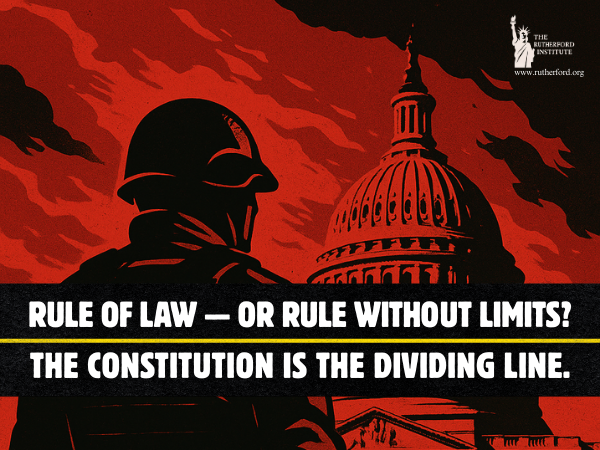
SAN FRANCISCO, Calif. — A coalition of free speech organizations is asking the federal courts to rein in President Trump’s unprecedented use of the military against civilians, especially as a means of silencing and punishing disfavored speech, warning that such actions echo the very abuses the nation’s Founders sought to prevent. The filing comes amid Trump’s ongoing threats to deploy troops to Memphis, Baltimore, San Francisco, Chicago, and New York City, often over the objections of state governors.

In an amicus brief before the Ninth Circuit Court of Appeals in Newsom v. Trump, The Rutherford Institute joined the ACLU, its state affiliates, and the Knight First Amendment Institute at Columbia University to challenge Trump’s June 2025 order federalizing the California National Guard and deploying active-duty Marines in Los Angeles to quell protests against his immigration raids. The coalition’s brief argues that the President’s claim of unilateral, unreviewable authority to deploy troops on American streets is “extreme, unprecedented, and incompatible with the history, traditions, and laws of the United States.”

“The Founders warned against standing armies on American soil, fearing that the military might be used not to defend the people, but to control them,” said constitutional attorney John W. Whitehead, president of The Rutherford Institute and author of Battlefield America: The War on the American People. “Deploying the military to deal with domestic matters that can—and should—be handled by local police violates the Posse Comitatus Act and crosses the line into authoritarianism.”

On June 7, 2025, President Trump invoked a rarely used statute, 10 U.S.C. § 12406, to forcibly federalize the California National Guard and deploy thousands of troops against largely peaceful protesters in Los Angeles. The protests erupted after armed federal agents carried out aggressive immigration raids, sparking public outrage. The federal government escalated the situation by unleashing military troops armed with tear gas, pepper balls, and flash-bang grenades on demonstrators that included journalists, legal observers, clergy, children, and elected officials. Trump claimed that the protests “constitute a form of rebellion against the authority of the Government.”

Five days later, the federal district court found that “[Trump’s] actions were illegal—both exceeding the scope of his statutory authority and violating the Tenth Amendment,” and thus issued a temporary restraining order to return control of the National Guard to the Governor. But a panel of the Ninth Circuit then stayed that initial restraining order pending appeal, giving high deference to the President’s authority. While this appeal has been pending, the district court ruled on Sept. 2, 2025, that the federal government also violated the Posse Comitatus Act, which forbids the use of the military for domestic policing absent express constitutional or statutory authorization.

The coalition’s brief before the Ninth Circuit stresses that: 1) History and tradition strictly limit military deployments against civilians; 2) Military policing threatens the First Amendment by suppressing lawful protests, political dissent, and association; and 3) Unchecked troop deployments risk authoritarian abuse, because the President cannot label ordinary political opposition as “rebellion” to justify military force. With 300 National Guard troops to remain deployed in Los Angeles through Election Day, the dangers of Trump’s military deployments are not theoretical: internal assessments reveal that troops’ presence in Washington, D.C. has been perceived by the public as “leveraging fear.”  

Hina Shamsi, Charlie Hogle, Sean M. Lau, and other ACLU attorneys advanced the arguments in the amicus brief.

The Rutherford Institute is a nonprofit civil liberties organization dedicated to making the government play by the rules of the Constitution. To this end, the Institute defends individuals whose constitutional rights have been threatened or violated and educates the public on a broad range of issues affecting their freedoms.  

Source: tinyurl.com/2bmsy45p

“That was when they suspended the Constitution… There wasn’t even an enemy you could put your finger on.”—Margaret Atwood, The Handmaid’s Tale

What we are witnessing is not a government of the people, by the people, and for the people; it is a government over the people.

Call it what it is: political gaslighting—the regime says one thing while doing the opposite, and insists on the citizenry’s trust while dismantling the very checks and balances that make trust possible.

So when the powers-that-be claim to be protecting the Constitution, they’re dismantling it at every turn. In this way, the mechanisms of constitutional government—separation of powers, federalism, due process, and the Bill of Rights—are being hollowed out in plain sight.

Although this dismantling did not start with President Trump, it has accelerated beyond imagining.

What was once a slow bleed is now a hemorrhage—and it is not random. The damage is unfolding on two parallel tracks: a steady, methodical, bureaucratic erosion (rule changes, executive orders, new databases) paired with shock-and-awe surges (National Guard deployments, mass round-ups, headline-grabbing prosecutions).

The words may say “freedom” and “order,” but the deeds smack of tyranny.

Attorney General Pam Bondi vows to punish “hateful” speech even as the administration normalizes hateful rhetoric and violent imagery. Vice President JD Vance promises to “go after” those with a “leftist” ideology while preaching free-speech absolutism for allies.

The Trump administration denounces “hate speech” even as it excuses and downplays the Jan. 6 riots; pledges fiscal restraint while shoveling billions into surveillance, prisons, and domestic deployments; wraps itself in law-and-order while tolerating lawlessness by cronies; sermonizes about faith and morality while normalizing cruelty as governance; and peddles outrage over waste while spending lavishly on the trappings of office.

Rights are framed as absolute for friends and privileges for critics. That is the opposite of constitutional government, which holds everyone—especially those in power—to the same rule of law, applied evenly.

If the government can police ideas, deploy troops at home, run dragnets by algorithm, disappear people into distant prisons, build spectacle cages, and amass power in one office, then no American is safe—including those who cheer these efforts today.

If you believe in limited government, equal justice, and due process—whatever your party—these double standards should alarm you most, because the precedents being cheered today will be wielded against you tomorrow.

What follows is a running ledger of the gaslighting playbook and its constitutional costs.

The Gaslight: “We’re Restoring the Constitution.”
Reality: The “temporary” powers created after 9/11 have hardened into a permanent police-state architecture—Patriot Act surveillance, secret FISA processes and National Security Letters, DHS fusion centers, a diluted Fourth Amendment “border zone,” civil-asset forfeiture, Pentagon 1033 militarization, Real ID, facial-recognition and geofence warrants—now run at full throttle across administrations.
The Cost: A police state.

The Gaslight: “We Value Law and Order.”
Reality: The administration deployed Marines and the National Guard into American streets to police protests protected by the First Amendment. On September 2, 2025, a federal judge ruled that the administration’s deployment of thousands of Guard troops and U.S. Marines to Los Angeles—ostensibly for immigration protests—violated the Posse Comitatus Act, describing a “top-down, systemic effort” to militarize civil law enforcement. The Constitution’s framers feared standing armies and military occupations of American communities.
The Cost: The death of Posse Comitatus.

The Gaslight: “We Defend Free Speech.”
Reality: Dissent is criminalized, expressive conduct is relitigated, and disfavored groups face terror labels and IRS pressure. Protest is a right, not a privilege, yet the government increasingly recasts organized dissent as conspiracy. After the Charlie Kirk shooting, the White House floated designating “antifa” and other liberal groups as domestic terrorists, bringing racketeering cases against funders, and targeting nonprofits critical of the administration—all while downplaying right-wing violence. Fold in Bondi’s vow to target “hateful” speech and Vance’s pledge to eradicate “leftist ideology,” and power slides from punishing unlawful acts to policing ideas.
The Cost: A weaponized First Amendment.

The Gaslight: “We’re Protecting You from Extremists.”  
Reality: Watchlists without due process, elastic “material support” theories, politicized “extremism” labels, and donor targeting that treat journalists, whistleblowers, activists—even parents at school boards—as suspects first and citizens second. Speaking truth to power is reframed as a security risk. In free societies, the state fears the citizen; in unfree ones, the citizen fears the state.
The Cost: Dissent rebranded as extremism.

The Gaslight: “We’re Ending Federal Censorship.”
Reality: On Day One, the President signed an order to “end federal censorship.” Read closely, it asserts sweeping control over how agencies interact with media platforms and broadcasters, rebranding ordinary outreach and fact-checking as First Amendment violations, while positioning the Executive as referee of the private square. By centralizing power over the flow of information in the Executive Branch, it threatens the independence of the very private forums where Americans speak. The test of free speech is whether the government stays out of the marketplace of ideas—not whether it curates it to the President’s liking.
The Cost: The state as speech referee.

The Gaslight: “We Use Smart Tech, Not Dragnet Surveillance.”
Reality: The administration is fusing government databases and outsourcing “intelligence” to private vendors in such a way that data becomes the warrant. ICE’s new $30 million deal with Palantir to build “ImmigrationOS” promises to identify, track, and deport people using AI-driven analytics and cross-agency data sharing. Add in geofence warrants, face-scan dragnets, and fusion-center “suspicious activity” pipelines, and you get a domestic intelligence system that presumes guilt by data trail.
The Cost: Probable cause replaced by algorithms.

The Gaslight: “We’re Tough on Crime.”
Reality: This year, U.S. agencies financed the transfer of migrants to El Salvador’s mega-prison (CECOT), where families and lawyers lost contact with detainees for months. Florida’s “Alligator Alcatraz” detention site whetted the government’s appetite for scaled-up incarceration, converting state prisons into immigration jails nationwide. These attempts by the Trump administration constitute an end run around longstanding constitutional protections for anyone accused of a crime. The common denominator is spectacle over justice, expansion over restraint.  
The Cost: The death of due process.

The Gaslight: “We’re Compassionate, Not Cruel.”  
Reality: The push to clear homeless encampments combines criminalization with expanded involuntary commitments. A July 24, 2025 executive order encourages states to funnel people into institutions and mental-health courts, tying funding to “maximum” use of commitments—an end-run around the presumption of liberty that undergirds due process.
The Cost: Bureaucratic coercion over compassion.

The Gaslight: “We’re Streamlining Government.”
Reality: The separation of powers was intended to serve as a check against any one government agency becoming too powerful. Yet the administration has pressed an aggressive unitary-executive theory to encroach on independent agencies, such as the Federal Reserve. Scholars warn this could erase the independence of agencies designed to check the White House.
The Cost: Checks and balances gutted.

The Gaslight: “We’re Keeping America Safe Overseas.”
Reality: Killing by assassination, not authorization. Twice in recent months, U.S. forces have launched unannounced attacks on Venezuelan boats, killing crews without warning or due process, on the mere assertion that they were drug traffickers.
The Cost: War powers and judicial oversight bypassed.

The Gaslight: “We’re Fixing Wasteful Spending.”
Reality: Having poured billions into surveillance, prisons, and domestic deployments, the “police-state budget” unravels the economy while eroding liberty.
The Cost: A debt-funded police state.

Many who cherish ordered liberty, limited government, fiscal restraint, and constitutional morality would normally recoil at these tactics under any other administration, so why not now?

Principles should not change because the party in power has changed, and yet that’s exactly what continues to drive the double standard.

If there’s a constitutional scorecard, “we the people” are on the losing team right now.

The First Amendment is buckling as protest is chilled, expressive conduct is targeted, opponents are threatened with terror labels, and the Executive Branch expands control over the speech ecosystem.

The Fourth and Fifth Amendments have been weakened by AI surveillance and cross-agency fusion that normalize suspicionless tracking, while offshore detention and coerced commitments compromise due process.

The Eighth Amendment is mocked by harsh, theatrical detention regimes.

Federalism and the Tenth Amendment give way when federal troops step into local policing.

Separation of powers erodes as an inflated unitary-executive theory encroaches on independent agencies.

War powers are skirted by extrajudicial killings abroad. And fiscal responsibility is inverted as surveillance and prison appropriations swell while liberty contracts.

What must happen now?

Congress must codify guardrails against domestic military use—tighten Posse Comitatus, narrow Insurrection Act exceptions, and mandate transparency for any domestic mission. Courts and prosecutors should reaffirm expressive rights, rejecting end-runs around Texas v. Johnson and refusing cases that criminalize symbolism.

Lawmakers must impose bright-line limits on data fusion, bar cross-agency pooling for generalized surveillance, and require algorithmic transparency and adversarial testing before any tool touches liberty. The U.S. must prohibit outsourcing detention to abusive regimes, close loopholes, and apply human-rights scrutiny to every foreign arrangement.

The independence of watchdogs and the Fed needs protection through clear “for cause” standards. States and cities should decriminalize homelessness and fund housing-first approaches instead of coercive commitments.

Congress must reassert war powers, requiring explicit authorization before any attack abroad. And fiscal sanity must be restored: sunset emergency outlays for surveillance and prison build-outs, mandate GAO audits of domestic deployments and fusion contracts, and attach civil-liberties impact statements to major security spending.

Our job as citizens is not to trust the government but to bind it down with the Constitution. “In questions of power,” Thomas Jefferson warned, we must “bind [government] down from mischief by the chains of the Constitution.”

Whatever you do, don’t trust the government with your privacy. Don’t trust it with your property: no-knock raids and forfeiture turn “private” property into whatever authorities permit you to keep.

Don’t trust it with your finances: Washington spends money it doesn’t have on programs it can’t afford. Don’t trust it with your life: force without accountability is not protection.

Above all, don’t trust it with your freedoms: on paper, rights endure; in practice, they are rationed by policy memos, watchlists, and shifting lines in the sand.

This should never be a right-vs-left debate; it’s the State vs. your liberty.

If you wouldn’t trust your worst political enemy with these weaponized tools, you shouldn’t trust your favorite politician with them either.

So think nationally, act locally.

Rebuild the habits of self-government where you live: know your neighbors and officials; know your rights and your city charter; ask who runs the jail and demand transparency; vet the people you entrust with power; and hold officials to account—show up, file requests, appeal, document, organize.

This is the work in front of us—not knee-jerk outrage, but persistent, consistent work to fortify the “chains of the Constitution.”

As I make clear in my book Battlefield America: The War on the American People and in its fictional counterpart The Erik Blair Diaries, if we let emergency rule become ordinary rule—military troops as beat cops, protest as crime, data as warrant, assassination as policy, money as politics—there won’t be a Constitution left to defend.

Source: https://tinyurl.com/ydxdjx5b

ABOUT JOHN W. WHITEHEAD

Constitutional attorney and author John W. Whitehead is founder and president of The Rutherford Institute. His most recent books are the best-selling Battlefield America: The War on the American People, the award-winning A Government of Wolves: The Emerging American Police State, and a debut dystopian fiction novel, The Erik Blair Diaries. Whitehead can be contacted at staff@rutherford.org. Nisha Whitehead is the Executive Director of The Rutherford Institute. Information about The Rutherford Institute is available at www.rutherford.org.

Publication Guidelines / Reprint Permission

John W. Whitehead’s weekly commentaries are available for publication to newspapers and web publications at no charge. 

“The greatest tyrannies are always perpetuated in the name of the noblest causes.”—Thomas Paine

They said it was for safety.
They said it was for order.
They said it was for the good of the nation.

They always say it’s for something good… until it isn’t.

Nearly a quarter-century after 9/11, we are still living with the consequences of fear-driven government power grabs. What began as “temporary” measures for our security have hardened into a permanent architecture of control.

The bipartisan police-state architecture that began with 9/11 has been passed from president to president and party to party, each recycling the same justifications—safety, security, patriotism—to expand its powers at the expense of the citizenry.

So they locked down the country “for our safety.”
They expanded surveillance “for our security.”
They rounded up anyone who challenged the narrative “for the common good.”
They erased names, ideas, and histories “to prevent offense.”
They forced schools to teach only what was politically correct “for the children.”
They censored speech “for our protection.”
They targeted dissenters “to preserve peace.”
They militarized the streets and called it “law and order.”

These very abuses—once denounced when carried out by the Left—are now cheered, defended, and excused when carried out by the Right.

People who once spoke passionately about truth, freedom, and faith have now fallen silent in the face of injustice, or worse, convinced themselves that nothing is wrong. The very voices that should be warning against tyranny are instead excusing it or looking away.

This is the danger of double standards in politics: every tyranny is rationalized in the moment by its chorus of defenders.

But history teaches that what goes around comes around. If you justify it now, you’ll have no defense when the tables turn.

And yet, time and again, the lies we tell ourselves make it possible. The cult of personality. The blind loyalty to party. The belief that “our side” can’t be the villain.

It never ceases to amaze how far people will go to excuse the actions of their favorite tyrant, even when those actions are the very things they once swore to oppose.

The pattern of justifying tyranny is as old as power itself. Every abuse comes wrapped in the same excuse: we had to do it.

After 9/11, Americans were told the Patriot Act and mass surveillance were “necessary to prevent terrorism.” The result was a sprawling security state that tracks every phone call, every online search, every purchase. The justification was security. The cost was freedom.

Under Obama, drone warfare and the prosecution of whistleblowers were defended as “keeping America safe.” The president even claimed the power to assassinate U.S. citizens abroad without trial. The result was an unaccountable government acting as judge, jury and executioner. The justification was safety. The cost was due process.

During the COVID-19 pandemic, lockdowns and mandates were imposed in the name of “public health,” laying the groundwork for a Nanny State empowered to micromanage every aspect of our lives—where we go, what we buy, who we see. The result was government claiming control over every aspect of daily life. The justification was saving lives. The cost was the right to govern our bodies.

Under Trump, the script is familiar.

National Guard deployments in American cities are justified as “restoring order.” Sweeping surveillance is framed as “protecting communities.” Crackdowns on dissent are defended as “stopping criminals.” Mental health round-ups of the homeless are justified as “helping the vulnerable.” Militarized patrols on city streets are justified as “cleaning up the streets.” Turning ICE into a roving army of lawless thugs is justified as “protecting citizenship.” Censorship and efforts to sanitize American history are now being lauded by the same voices that railed against “cancel culture.”

That same logic has taken a deadly turn abroad. At Trump’s direction, the U.S. carried out a series of preemptive military strikes this year—against Iran’s nuclear sites, against the Houthis in Yemen, and most recently against what the administration claimed was a drug-trafficking boat off the coast of Venezuela. The White House has justified these deadly attacks—carried out without congressional approval or constitutional authorization—as part of the president’s unilateral war-making authority.

This, too, is part of the bipartisan police-state architecture built after 9/11, when presidents claimed open-ended authority to wage preemptive war without meaningful congressional oversight.

What began with Afghanistan and Iraq has metastasized into a global battlefield where any president can launch attacks—on Iran, on Yemen, on Venezuela—without accountability.

As always, the justification is order, safety, and patriotism. The cost is truth, justice and freedom.

Every time Trump expands his powers, the chorus is the same: It wouldn’t be necessary if Democrats had done their job. If you don’t break the law, you have nothing to fear. If you’re not doing anything wrong, why worry?

These are the oldest excuses for tyranny—and they never change. Only the partisanship does.

What makes Trump and those who came before him especially dangerous is not merely their willingness to wield power but the eagerness of their enablers to excuse and defend it at every turn.

History shows that bullies and strongmen can only rise when mobs rally to their side. A tyrant’s greatest weapon is not his fist, but the crowd that cheers him on, intimidates his critics, and convinces itself that might makes right.

The machinery of authoritarianism always needs a chorus of defenders, and today that chorus is louder, more organized, and more dismissive of constitutional limits than ever before.

We have been building to this moment for a long time. Even so, why do people accept tyranny so easily?

First, the cult of personality. When people invest blind faith in a leader, they will excuse anything he does. If he says surveillance is necessary, they believe it. If he says dissenters are enemies, they cheer their punishment. It is the psychology of the mob, cloaked in the loyalty of the true believer.

Second, fear as a political weapon. Every despot knows that frightened people will tolerate almost anything. Fear of terrorism. Fear of crime. Fear of disease. Fear of immigrants. Fear of collapse. Fear makes people beg for the chains that bind them.

Third, the “our side” fallacy. People imagine tyranny is only tyranny when the other side does it. When their side does it, they call it leadership. They call it patriotism. They call it protection. But the abuse doesn’t change when the party label does. Wrong is wrong.

Every new regime that seizes power promises it will use extraordinary authority only for good. And every regime—without exception—uses it to entrench itself at the expense of liberty.

Every generation tells itself the same lies to excuse the same abuses.

Consider the whiplash of partisan double standards:

  • Conservatives who blasted the Obama administration for NSA spying now cheer Trump’s Palantir partnership and AI-driven surveillance that tracks Americans’ digital footprints.
  • Democrats who embraced Biden’s use of emergency orders to advance their agenda have been quick to denounce Trump for ruling by executive order.
  • Those who bristled at COVID mandates under Democrats now applaud Trump’s use of government force to impose his own version of “public safety.”
  • Both sides flip-flop on free speech. Conservatives denounced censorship on college campuses but defend banning “dangerous” books and surveilling dissidents, while liberals oppose Trump’s attempt to whitewash history yet defend platforms censoring speech they deem “harmful” or “hateful.”

The double standard is breathtaking.

Tyranny doesn’t change depending on who carries it out. Yet partisans convince themselves it does. They say: It’s different this time. It’s necessary. It’s for us.

In truth, the only difference is who holds the whip.

The Constitution was designed to restrain exactly this impulse. It does not say: “These rights apply only when the other party is in power.” It does not say: “The executive may rule by decree if he is popular.”

James Madison warned that “if men were angels, no government would be necessary.” But men are not angels. That is why the Constitution separates powers, guarantees due process, and protects speech and assembly—especially in times of crisis.

Every time one party tramples these limits, the other eventually inherits those same powers and uses them in turn. The Patriot Act, passed under Bush, was wielded aggressively under Obama, Trump, and Biden. The executive orders one president signs become the precedents for the next.

“What you excuse today,” history warns us, “will be used against you tomorrow.”

The descent into tyranny always begins with justifications.

The Roman Republic collapsed into empire because senators claimed Caesar needed extraordinary powers to restore order. The republic never recovered.

In 1930s Germany, emergency decrees were defended as temporary measures to stabilize society. They became the permanent architecture of dictatorship.

In post-9/11 America, warrantless surveillance and secret courts were sold as temporary protections. Nearly a quarter-century later, they remain fixtures of government power.

Tyranny is never announced as tyranny. It is always justified as safety, morality, and order. It is always explained away as temporary. And it is always defended by people who believe they are on the winning side.

And so here we are.

A president issues executive orders that erode the Bill of Rights. His supporters applaud. Another president expands surveillance or censorship. His supporters applaud.

Both sides denounce the abuses of their opponents yet sanction the same abuses when carried out by their own.

This is how liberty dies—not with a sudden coup, but with partisan politics valued more than principled freedom.

The police state thrives on this selective outrage. It does not matter which party is in power. The machinery of control grows. The Constitution withers. And the people are left squabbling over whose tyrant is better.

There is only one antidote: principle.

You cannot defend freedom by defending tyranny when your side is in power. You cannot preserve liberty by cheering for its destruction. You cannot expect constitutional limits to shield you tomorrow if you discard them today.

The warnings span centuries. The Founders foresaw the danger: James Madison cautioned against the “gradual and silent encroachments” of government. Thomas Jefferson warned that the natural tendency of power is to grow.

Justice Louis Brandeis later confirmed it from the vantage point of the modern state: “the greatest dangers to liberty lurk in insidious encroachments by men of zeal, well-meaning but without understanding.”

Those warnings went unheeded after 9/11, and we have been paying the price ever since. The bipartisan police-state architecture built in those years has only grown stronger, repurposed by each new administration.

Unless we find the courage to dismantle it, today’s justifications will become tomorrow’s permanent chains.

The lesson is clear: if you want liberty, you must defend it consistently—even when it restrains your own party, your own leader, your own side. Especially then.

What you excuse today will be used against you tomorrow.

As I make clear in my book Battlefield America: The War on the American People and in its fictional counterpart The Erik Blair Diaries, it does not matter whether the abuse comes draped in red or blue. It does not matter whether it is cheered by the Right or justified by the Left.

Tyranny, once excused, becomes entrenched.

Source: https://tinyurl.com/3htehha7

ABOUT JOHN W. WHITEHEAD

Constitutional attorney and author John W. Whitehead is founder and president of The Rutherford Institute. His most recent books are the best-selling Battlefield America: The War on the American People, the award-winning A Government of Wolves: The Emerging American Police State, and a debut dystopian fiction novel, The Erik Blair Diaries. Whitehead can be contacted at staff@rutherford.org. Nisha Whitehead is the Executive Director of The Rutherford Institute. Information about The Rutherford Institute is available at www.rutherford.org.

Publication Guidelines / Reprint Permission

John W. Whitehead’s weekly commentaries are available for publication to newspapers and web publications at no charge.

BOSTON, Mass. — In a major victory for the First Amendment and academic freedom, a federal court has ruled that the Trump administration’s blatant attempt to force Harvard University to conform to the government’s ideological viewpoint is unconstitutional.

The ruling by Judge Allison D. Burroughs of the U.S. District Court in Boston found that the Trump administration violated the First Amendment when it froze $2.2 billion dollars in research funding in an effort “to require Harvard to overhaul its governance, hiring, and academic programs to comport with the government’s ideology and prescribed viewpoint.” The Rutherford Institute joined a broad coalition of civil liberties organizations—including the ACLU, ACLU of Massachusetts, Cato Institute, Electronic Frontier Foundation, Knight First Amendment Institute, National Coalition Against Censorship, and the Reporters Committee for the Freedom of the Press—in opposing the Trump administration’s attempts to wage a political war on academic freedom and ideological independence.

“This ruling is a powerful rebuke of the government’s attempt to police thought and punish dissent,” said constitutional attorney John W. Whitehead, president of The Rutherford Institute and author of Battlefield America: The War on the American People. “By weaponizing federal funding to force ideological conformity, the Trump administration wasn’t just targeting Harvard—it was launching a war on the First Amendment itself. If the government can dictate what is taught in a university classroom, it won’t stop there—it will try to dictate what is preached in the pulpit, printed in the press, and spoken in the streets. This kind of ideological tyranny is the very danger the First Amendment was written to prevent.”

The district court’s ruling comes in response to an April 2025 move by the Trump administration to cancel billions in research funding and blacklist Harvard from future grants unless the university agreed to: vet students, faculty, and departments for “viewpoint diversity”; alter its hiring, admissions, and curriculum choices to conform to the government’s ideological preferences; submit to a third-party audit of programs that “reflect ideological capture”; and install new leadership committed to enforcing the government’s demands. Refusing to “surrender its independence or relinquish its constitutional rights” and “be taken over by the federal government,” Harvard then filed a lawsuit challenging the government’s actions.

In coming to Harvard’s defense, the coalition’s amicus brief argued that the government cannot use its financial power to force any private institution—liberal or conservative—to adopt state-sanctioned views. The First Amendment, the brief emphasizes, guarantees that private universities retain autonomy over what to teach, how to teach, who will teach, and whom to admit—free from government control or interference. The federal court agreed, ordering the restoration of all previously withdrawn grants and prohibiting the federal government from denying future research funding to Harvard in retaliation for the exercise of its First Amendment rights.

Cecillia D. Wang, Ben Wizner, Vera Eidelman, Brian Hauss, Jessie J. Rossman, and Rachel E. Davidson at ACLU advanced the arguments in the amicus brief in President and Fellows of Harvard College v. U.S. Department of Health and Human Services.

The Rutherford Institute is a nonprofit civil liberties organization dedicated to making the government play by the rules of the Constitution. To this end, the Institute defends individuals whose constitutional rights have been threatened or violated and educates the public on a broad range of issues affecting their freedoms.

Source: tinyurl.com/ycx9acu7