


“When did pedophilia become a partisan issue? The American people deserve to know the whole truth about Jeffrey Epstein and every single powerful person who enabled him. Every name, every flight log, every cover up, all of it … If there’s one thing we should all be able to agree on Democrats and Republicans, conservatives and progressives—it’s that no one, including the President of the United States, should be able to cover up crimes against children.”—James Talarico (Texas politician, Presbyterian seminarian, and former public school teacher)
Nearly 30 years after the first complaints were filed, the Epstein files remain a masterclass in how the ruling class shields its own.
This is no longer just about one man’s crimes—it is about the machinery of silence that keeps the global elite untouchable.
We are long past the point for partisan excuses and institutional gaslighting.
The question is no longer whether Jeffrey Epstein—the hedge fund billionaire/convicted serial pedophile and sex trafficker—committed monstrous crimes against young girls, many of them children.
We know he did.
What remains unresolved is something far more troubling.
We know that Epstein did not act alone.
A decision by the Second Circuit Court of Appeals allowing thousands of pages of Epstein-related documents to be unsealed referenced allegations involving “numerous prominent American politicians, powerful business executives, foreign presidents, a well-known Prime Minister, and other world leaders.”
That alone should have been enough to trigger full transparency.
Instead, nearly 30 years after the first complaints against Epstein were filed, the full truth remains obscured.
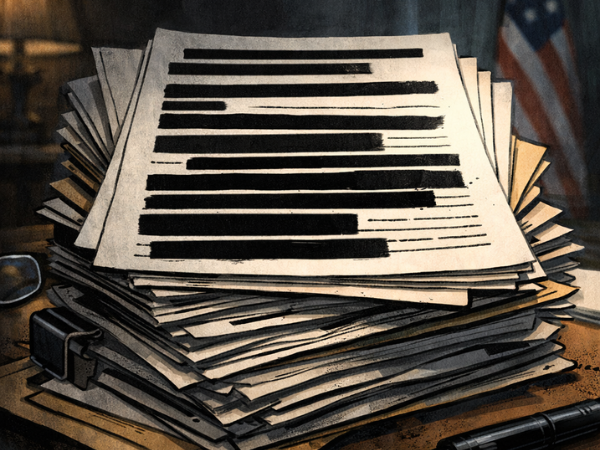
Why are documents still partially sealed? Why do redactions remain? Why are investigations declared “closed” while unanswered questions linger?
Epstein may have conveniently died in a jail cell six weeks after his arrest on federal sex trafficking charges, but the machinery that empowered and protected him is still very much intact and it continues to work overtime to shield the global power elite, silence victims, and erase accountability.
And that is the real scandal.
Because this was never simply about Epstein. It was about the system that made Epstein possible.
The Epstein files should have been a moral bright line—an issue so morally reprehensible and widely condemned as to cut through partisan politics.
Instead, it has become part of the three-ring circus that is governance in America today.
The political noise. The wag-the-dog distractions. The slow-walking of the files’ release. The what-aboutisms.
This was never about one president.
It was never about one political party.
And yet, at this present moment, it is one president and one party that appear to be resisting full transparency.
Donald Trump was at one time socially connected to Epstein. Bill Clinton was, too. Both men were shielded, in different ways and at different times, by a partisan system willing to look the other way when politically convenient.
The same voices who denounced Clinton for sexual impropriety often fell silent in the face of Trump’s own history. Likewise, some who defended Clinton had no hesitation in condemning Trump.
The principle was never the point. Power was.
And that is why this cannot be dismissed as partisan score-settling.
This is not a minor incident involving minor players, nor can it be confined to one political party or one political era.
This is about the darkness at the heart of the American police state: a system built to shield the powerful from justice.
Epstein did not sidestep accountability because he was clever. He sidestepped accountability because he was protected.
Power protects power.
Epstein was aided, abetted and protected by a cross-section of political, corporate and societal classes here in the United States and abroad. He cultivated relationships across politics, finance, academia, entertainment, and global power circles. His social network spanned parties, ideologies, and continents.
Trump’s name alone reportedly appears more than 38,000 times. Numerous top officials connected to the Trump administration have also appeared in the Epstein files, including Elon Musk, Steve Bannon, and Commerce Secretary Howard Lutnick.
While mere association is not tantamount to guilt, these associations speak volumes about how power operates according to its own rules.
As Rep. Thomas Massie warned Attorney General Pam Bondi, who has been at the forefront of the Trump administration’s effort to slow-walk the release of the Epstein files: “This is bigger than Watergate. This goes over four administrations. You don’t have to go back to Biden. Let’s go back to Obama. Let’s go back to George Bush. This cover-up spans decades, and you are responsible for this portion of it.”
If it looks like a cover-up, smells like a cover-up, and appears to benefit the same entrenched interests, we have every right—indeed, a civic and moral duty—to demand greater transparency.
Nothing illustrates how the power elite protects its own more clearly than Epstein’s 2008 plea agreement.
Almost two decades ago, when Epstein was first charged with molesting, raping and trafficking underage girls, he was gifted a secret plea deal.
According to the Palm Beach Post, that sweetheart deal, arranged by then-U.S. Attorney Alexander Acosta, led to 15 more years of abuse by Epstein.
The Justice Department estimates that Epstein victimized at least 1,000 women and children. Over 100 survivors of Epstein’s sexual abuse have come forward so far.
Yet the plea deal allowed Epstein to evade federal charges and serve what amounted to a privileged sentence. For the first 13 months, he was allowed to “work” at home six days a week before returning to a private wing of the Palm Beach County jail to sleep. Later, under house arrest, he was allowed to travel extensively, including to his private island.
Acosta, the U.S. attorney who enabled that arrangement—which, in turn, shielded Epstein’s associates from federal exposure—was later nominated by Trump and served as his Labor Secretary.
This is how corruption by the power elite flourishes: not through secrecy alone but through get-out-of-jail cards that tacitly sanction immoral, illegal and corrupt bad behavior by the ruling classes.
As the Associated Press pointed out, “The arrest of the billionaire financier on child sex trafficking charges is raising questions about how much his high-powered associates knew about the hedge fund manager’s interactions with underage girls, and whether they turned a blind eye to potentially illegal conduct.”
The rot goes deep, and the Epstein case is only the most visible symptom of a much larger disease.
For years, the Epstein case has stood as a grotesque emblem of the depravity within the global power elite: a sex trafficking ring operated not only for Epstein’s personal pleasure but also for that of his friends and business associates—billionaires, politicians, and celebrities.
According to The Washington Post, “several of the young women…say they were offered to the rich and famous as sex partners at Epstein’s parties.”
Once again, fact and fiction mirror each other.
Popular culture has long hinted at what polite society refuses to confront.
Almost 30 years ago—three years after the first complaint against Epstein was filed—Stanley Kubrick’s final film Eyes Wide Shut provided viewing audiences with a sordid glimpse of an elite sexual underworld insulated from consequence: a secret sex society that indulged the basest urges of its affluent members while preying on vulnerable young women.
Kubrick suggested these secret societies flourish because the public chooses not to see what’s right in front of them, content to navigate life in denial about the ugly, obvious truths in our midst.
The Epstein case suggests he was not wrong.
Sex slaves. Sex trafficking. Secret societies. Powerful elites. Government corruption. Judicial cover-ups.
It is not so different from the real world, where powerful men, insulated from accountability, indulge their base urges.
As The Guardian reports, “By the mid-2000s, Jeffrey Epstein’s sexual abuse of teen girls was routine. From 2002 to 2005 alone, the late financier victimized ‘dozens’ of underage teens by luring them into sex acts for payment under the auspices of massage work, some as young as 14.”
If Epstein exposed the rot at the top, the broader landscape of child sex trafficking reveals how deep and systemic that rot truly runs.
The numbers alone are staggering.
Child sex trafficking—the buying and selling of women, young girls and boys for sex, some as young as 9 years old—has become big business in America. It is one of the fastest growing criminal operations and the second most-lucrative commodity traded illegally after drugs and guns.
Adults purchase children for sex at least 2.5 million times a year in the United States.
It’s not just young girls who are vulnerable to these predators, either. Boys account for over a third of victims in the U.S. sex industry.
Who buys a child for sex?
Otherwise ordinary men from all walks of life. “They could be your co-worker, doctor, pastor or spouse,” writes journalist Tim Swarens, who spent more than a year investigating the sex trade in America.
Ordinary men, yes. But then there are the so-called extraordinary men—like Epstein and his associates—with wealth, connections, and protection who are allowed to operate according to their own rules.
Power does not create perversion, but it does insulate the powerful.
These men skate free of accountability because the criminal justice system panders to the powerful, the wealthy and the elite.
For years, investigative journalists and survivors have documented how blackmail, intelligence agency ties, and financial leverage helped shield elite sexual predators—not just from prosecution, but from public scrutiny.
For every Epstein who is—finally—called to account for his illegal sexual exploits after years of being given a free pass by those in power, there are hundreds (perhaps thousands) more in the halls of power and wealth whose predation continues unabated.
While Epstein’s alleged crimes are heinous enough on their own, he is part of a larger narrative of how a culture of entitlement becomes a cesspool and a breeding ground for despots and predators.
Nor is this culture of impunity confined to billionaires and political elites.
Across the country, law enforcement officers have been caught running sex trafficking rings, abusing women and girls in their custody, or exploiting their badge to coerce sex.
From Louisiana to Ohio to New York, officers have been arrested for trafficking underage girls, assaulting vulnerable women, and raping detainees—often shielded by unions, prosecutors, or a blue wall of silence.
This isn’t a few bad apples. It is a culture of impunity baked into the system.
This is how the system works, protecting the untouchables—not because they’re innocent, but because the system has made them immune.
And this is why this case was never just about one man.
As Piotr Smolar writes for Le Monde, “Epstein was the most striking face of a two-tier system of justice, one that provided a privileged path for the powerful.”
We see this pattern everywhere.
A cop shoots an unarmed citizen and walks free. A president sidesteps constitutional limits. An agency spies on its citizens. A financier negotiates immunity.
Abuse of power—and the ambition-fueled hypocrisy and deliberate disregard for misconduct that make those abuses possible—works the same whether you’re talking about sex crimes, government corruption, or the rule of law.
Sexual predators aren’t the only threat.
For every prominent name who eventually gets called out for his sexual misbehavior, there are hundreds—thousands—of others in the American police state who are getting away with murder—in many cases, literally—simply because they can.
And as history repeatedly demonstrates, power corrupts.
Worse, as 19th-century historian Lord Acton concluded, absolute power corrupts absolutely.
Give any one person—or government agency—too much power and allow them to believe that they are entitled, untouchable and will not be held accountable for their actions, and those powers will be abused.
History proves it. The present moment confirms it.
We can agree to disagree about many things, but the sex trafficking and abuse of children is one issue where there should be absolutely no dissembling, no wiggle room, and no immunity.
America should have zero tolerance for child sex trafficking.
So when President Trump insists that there’s nothing more to discuss or investigate so we should just move on, our collective, unequivocal answer should be an absolute refusal to move on, be distracted or engage in what-aboutisms.
At some point, moral outrage must give way to moral clarity.
The Trump administration’s cover-up is unacceptable. The selective redactions of non-victims’ names and faces are unacceptable. The removal of files by biased administration operatives is unacceptable.
As I make clear in my book Battlefield America: The War on the American People and in its fictional counterpart The Erik Blair Diaries, a constitutional republic cannot survive a protected class.
If the Epstein files force us to think and act differently about anything, let it be this: the rule of law cannot be a one-sided weapon used against the powerless. It must require that the powerful be held just as accountable for their abuses as anyone else.
Source: https://tinyurl.com/3cec2zrj
ABOUT JOHN W. WHITEHEAD
Constitutional attorney and author John W. Whitehead is founder and president of The Rutherford Institute. His most recent books are the best-selling Battlefield America: The War on the American People, the award-winning A Government of Wolves: The Emerging American Police State, and a debut dystopian fiction novel, The Erik Blair Diaries. Whitehead can be contacted at staff@rutherford.org. Nisha Whitehead is the Executive Director of The Rutherford Institute. Information about The Rutherford Institute is available at www.rutherford.org.
Publication Guidelines / Reprint Permission
John W. Whitehead’s weekly commentaries are available for publication to newspapers and web publications at no charge.
 John W. Whitehead, Constitutional Attorney