


“The people have the power… We are the government.”—John Lennon
We are living through a period of open lawlessness at the highest levels of government.
Executive orders are issued to sidestep Congress. Federal law enforcement is deployed as a tool of retaliation. Protest is criminalized. Surveillance expands. Due process becomes optional. Courts are packed, ignored, or bypassed. Entire communities are terrorized under the guise of “law and order.”
None of this is accidental. And none of it is temporary.
At a time when executive orders are used to punish dissent, federal agencies are weaponized against political opponents, protesters are met with militarized force, immigration enforcement is used as terror theater, and constitutional limits are treated as inconveniences rather than restraints, one fact has become impossible to ignore: politics won’t fix a system that is broken beyond repair.
Elections have failed to check the police state.
Courts increasingly defer to it.
And a year into Trump’s second term, what began as campaign rhetoric has hardened into administrative policy; what was once framed as a national emergency has become routine authoritarianism.
Executive power has expanded, accountability has contracted, and constitutional limits have been tested—and ignored—by the Trump administration with increasing confidence.
This is no longer a warning about what might happen. It is a record of what has already occurred.
This same authoritarian mindset has not remained confined to domestic policy. It has predictably expanded outward, revealing itself just as clearly in foreign affairs.
Trump’s renewed saber-rattling over Greenland—treating another nation’s territory as if it were a corporate asset to be acquired or controlled—reveals how deeply this distortion of power has taken hold.
It is the language of ownership, not governance; of command, not consent.
A president is not a monarch, a CEO, or a landlord over the republic. He is an employee—hired by “we the people,” bound by a written contract called the Constitution, and subject to limits he did not write and cannot rewrite.
When that employee ignores his limits, only one check remains: the people themselves.
John Lennon’s reminder that “the people have the power” has never been more relevant—or more dangerous to those in power.
That power has a name: nullification.
It is the authority of ordinary citizens and local communities to refuse cooperation with unjust laws, illegitimate prosecutions, and unconstitutional government action.
In an era of open executive defiance and punitive governance, nullification is no longer optional—it is a civic necessity.
How else do you balance the scales of justice at a time when Americans are being tasered, tear-gassed, pepper-sprayed, hit with batons, shot with rubber bullets and real bullets, blasted with sound cannons, detained in cages and kennels, and arrested and jailed for challenging the government’s excesses, abuses and power-grabs?
No matter who sits in the White House, a shadow government continues to call the shots behind the scenes.
Relying on the courts to restore justice has exposed a growing fracture within the judiciary itself.
On one side are lower courts, which have often served as a first line of defense against the Trump administration’s constitutional overreaches and abuses of power. On the other is the U.S. Supreme Court, which appears increasingly preoccupied with preserving order and insulating government agents from accountability rather than upholding the rights enshrined in the Constitution.
With each ruling handed down by the Supreme Court, it becomes harder to deny that we are living in an age of hollow justice—one in which the government is routinely granted a free pass to sidestep the rule of law, shielding the powerful from accountability rather than restraining them.
Even so, justice matters.
It matters whether you’re a rancher protesting a federal land grab by the Bureau of Land Management, a Native American defending sacred land and water from oil pipelines, a college student demonstrating against U.S. complicity in foreign wars, a trucker protesting government mandates, a Black American marching against the routine killing of unarmed citizens by police, or a protester standing witness in the face of ICE raids that terrorize communities.
They may be different causes, but it’s the same police state response over and over again: militarized force, mass arrests, surveillance, and prosecution.
Unfortunately, protests and populist movements haven’t done much to push back against an authoritarian regime that is deaf to our cries, dumb to our troubles, blind to our needs, and accountable to no one.
Regardless of ideology or grievance, the government’s modus operandi remains the same: shut down protests using all means available, prosecute First Amendment activities to the fullest extent of the law, criminalize dissent, label dissidents as extremists or terrorists, and surveil the population in order to crush resistance before it can take root.
If protests are met with force, elections are rendered performative, courts defer to power, and legislatures refuse to act, then any remaining means of thwarting the government’s relentless march toward outright dictatorship cannot lie within the system itself.
It must lie with the people—specifically, with the power of juries and local communities to refuse cooperation with illegitimate laws, abusive prosecutions, and unconstitutional government actions.
Nullification works.
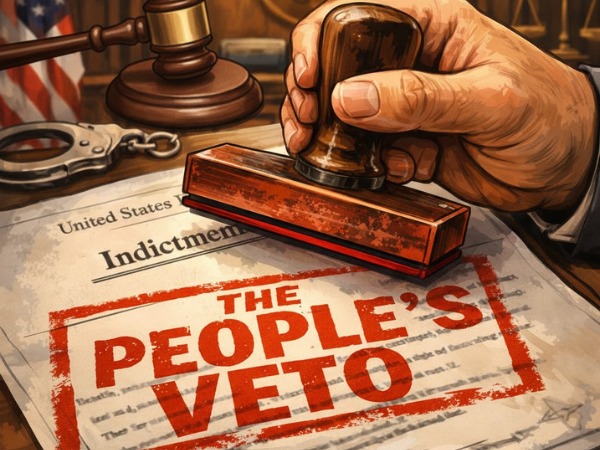
Just as a President may veto an act of Congress, the American juror possesses the “People’s Veto”—the power to refuse enforcement of a law or prosecution that offends the conscience of the Constitution.
When a former Department of Justice employee threw a sandwich at an ICE agent, the Trump administration sent 20 officers in riot gear to his home to arrest him, then attempted to have a grand jury send him to jail for eight years on charges of a felony assault on a federal agent. The grand jury refused.
That refusal was not lawlessness. It was conscience.
As law professor Ilya Somin explains, jury nullification is the practice by which a jury refuses to convict someone accused of a crime if they believe the “law in question is unjust or the punishment is excessive.” According to former federal prosecutor Paul Butler, the doctrine of jury nullification is “premised on the idea that ordinary citizens, not government officials, should have the final say as to whether a person should be punished.”
In a world of “rampant overcriminalization,” where the average American unknowingly breaks multiple laws every day, jury nullification serves as “a check on runaway authoritarian criminalization and the increasing network of confusing laws that are passed with neither the approval nor oftentimes even the knowledge of the citizenry.”
Indeed, Butler believes so strongly in the power of nullification to balance the scales between the power of the prosecutor and the power of the people that he advises: “If you are ever on a jury in a marijuana case, I recommend that you vote ‘not guilty’—even if you think the defendant actually smoked pot, or sold it to another consenting adult. As a juror, you have this power under the Bill of Rights; if you exercise it, you become part of a proud tradition of American jurors who helped make our laws fairer.”
In other words, it is “we the people”—not politicians, not prosecutors, not judges, not corporate interests—who can and should be determining what laws are just, what activities are criminal and who can be jailed for what crimes.
This is why nullification matters now more than ever—not just because injustice is being imposed from below, but because accountability is being erased from above.
Trump’s willingness to use the presidential pardon power not as a safeguard against injustice but as a tool to erase it reveals a dangerous inversion of constitutional authority.
Pardons issued to political allies and ideological foot soldiers function as a form of nullification from above—executive erasure of legal consequence.
Jury nullification, by contrast, operates from below, as the people’s last remaining check on government abuse.
Writing for New York magazine, Elie Honig, a former federal and state prosecutor, rightly points out:
“Trump presently faces little meaningful opposition to his agenda, and to his excesses. The Executive Branch has largely been purged of objectors (or even some who faithfully do their jobs). The Republican-controlled House and Senate provide no friction, while Democrats flail helplessly. And the Supreme Court generally (though not always) has gone Trump’s way on executive power. One of the few remaining checks comes from the most humble of sources – the everyday civilians who get that dreaded notice in the mail and wind up serving on grand juries and trial juries. Other than voting, it’s the most basic, populist exercise of American democracy.”
The punishment should fit the crime, but the law itself should also reflect the will and conscience of the people—not the profit-driven priorities of a corporate-government elite that sees nothing wrong with locking someone away for life over a nonviolent offense.
Unsurprisingly, the powers-that-be do not want the public to know it has this power.
The government prefers a citizenry ignorant of its rights.
Indeed, the Supreme Court ruled as far back as 1895 that jurors need not be informed of their right to nullify—a telling admission of how threatening this power truly is.
Those who attempt to educate jurors about nullification have faced intimidation’ and prosecution. Yet courts have also recognized that discussing jury nullification in the abstract is protected speech under the First Amendment, reinforcing the idea that public debate about the justice system is not only lawful, but essential.
Jury nullification has deep roots in American history. It was championed by figures such as John Adams and John Hancock and used repeatedly to resist laws that were unjust, immoral, or out of step with fundamental liberties—from colonial resistance to British rule to modern opposition to draconian drug laws.
At a time when government officials accused of wrongdoing are routinely granted leniency, while ordinary citizens are prosecuted to the fullest extent of the law, jury nullification stands as a powerful reminder that “we the people” are the government.
For too long, we have allowed our so-called representatives to call the shots. It is time to restore the citizenry to its rightful place in the republic.
To reclaim our power, we must change the rules and restore “we the people” as the masters, not the servants, in the power dynamic.
The government has perfected a divide-and-conquer strategy that exploits political, racial, economic, and cultural divisions. Surveillance, extremism reports, militarized policing, fusion centers, domestic intelligence databases, and the transformation of local police into extensions of the military have created an atmosphere of fear, suspicion, and distrust.
What too many Americans fail to realize is that, in the eyes of an unaccountable state, distinctions between left and right, protester and bystander, loyalist and dissenter eventually collapse.
When the crackdown comes—and it is coming—it will not matter who you voted for, which protest you supported, or whether you spoke out or stayed silent. When the machinery of repression turns inward, everyone becomes a potential target.
The government is not afraid of civil unrest. It anticipates it. It prepares for it.
The protests in Ferguson, Baltimore, Baton Rouge, and Standing Rock—where militarized police turned American towns into war zones and caged demonstrators like animals—were dress rehearsals.
They were training exercises for a future in which widespread dissent is met with overwhelming force.
Case in point: what’s unfolding in Minneapolis right now—a pattern that has repeated itself across the country whenever dissent threatens power.
The objective is compliance. The strategy is destabilization followed by control.
Knowing this, the question is no longer whether the police state can be reasoned with, voted out, or restrained from within.
The question is how ordinary people reclaim power in a system designed to deny it.
You change the rules.
You engage in disciplined, nonviolent resistance that disrupts unjust systems without surrendering moral authority. You practice civil disobedience and militant nonviolence, as Martin Luther King Jr. did through sit-ins, boycotts, and mass protest. You build grassroots power locally—thinking nationally, but acting locally.
And above all, you refuse to comply with laws, prosecutions, and policies that are illegitimate, egregious, or unconstitutional.
Nullify injustice.
Nullify unjust court cases. Nullify unjust laws. Nullify executive overreach.
Justice in America is too often reserved for those who can afford to buy it. For everyone else, the system is riddled with failures: police misconduct, prosecutorial abuse, judicial bias, inadequate defense, and a legal code so vast and convoluted that innocence becomes almost irrelevant.
In a courtroom, the conscience of a jury manifesting as nullification may be the one advantage left to us in the face of government corruption.
Nullification is not lawlessness. It is lawful resistance and it may be our last remaining safeguard against tyranny.
It is ordinary people refusing to rubber-stamp injustice. It is the citizenry exercising the authority the Constitution entrusts to them when every other safeguard has failed.
What nullification represents is the power of the people to reject potentates and tyrants.
It is a reminder that no president owns this country—just as no president gets to purchase, annex, or command the world as if it were his personal domain.
For too long, we have been conditioned to believe that power flows downward—from politicians, courts, and enforcers to the people. The truth is the opposite. Power flows upward, but only when citizens are willing to claim it.
As I make clear in Battlefield America: The War on the American People and in its fictional counterpart The Erik Blair Diaries, “We the people” are the government.
And if those in power don’t like being reminded of that fact, they’re free to get another job.
Source: https://tinyurl.com/5bms434y
ABOUT JOHN W. WHITEHEAD
Constitutional attorney and author John W. Whitehead is founder and president of The Rutherford Institute. His most recent books are the best-selling Battlefield America: The War on the American People, the award-winning A Government of Wolves: The Emerging American Police State, and a debut dystopian fiction novel, The Erik Blair Diaries. Whitehead can be contacted at staff@rutherford.org. Nisha Whitehead is the Executive Director of The Rutherford Institute. Information about The Rutherford Institute is available at www.rutherford.org.
Publication Guidelines / Reprint Permission
John W. Whitehead’s weekly commentaries are available for publication to newspapers and web publications at no charge.
 John W. Whitehead, Constitutional Attorney